Browse Tag

Food - Page 8

Places to go If You Are Looking for Indigenous Food In Kuching

In case you are in the mood for something other than kolo mee and laksa….

Until 10 years ago, there were not a lot of places to go if you were looking for indigenous food in Kuching.

Fortunately, local food eateries have been sprouting like mushrooms.

For the love of food, KajoMag prepared a list of places for foodies to go if you are in the mood for indigenous food in Kuching.

  1. Lepau Restaurant at Persiaran Ban Hock

Places to go If You Are Looking for Indigenous Food In Kuching
Lepau restaurant is located at Jalan Ban Hock – Picture source: Lepau restaurant

The word ‘lepau’ means ‘home’ or ‘house’ in the Kayan language.

Located in the heart of Kuching city, it is one of the most popular places to go if you are craving for indigenous dishes.

Places to go If You Are Looking for Indigenous Food In Kuching
Picture source: Lepau Restaurant

With a wide range of Orang Ulu and Dayak dishes, Lepau often host small gatherings and parties.


  1. The Dyak at Panovel Commercial Complex, Jalan Simpang Tiga

Places to go If You Are Looking for Indigenous Food In Kuching
The Dayk is located at Panovel Commercial Complex, Jalan Simpang Tiga (Picture source: the Dyak)

Tastefully decorated with Dayak motifs, The Dyak is the place to go if you are looking for fine dining.

Arguably one of the first few Dayak cuisine establishments in Kuching, The Dyak has a range of interesting Dayak dishes for you to sample.


  1. Mummy Patz at Rumah Asap Tabuan Dayak

Places to go If You Are Looking for Indigenous Food In Kuching
Mummy Patz in located at Rumah Asap Tabuan Jaya – Picture source: Mummy Patz

Previously known as Patz Dayak Home Cook Special, this spot has been known to have delicious Dayak dishes among Kuchingnites for years.

Places to go If You Are Looking for Indigenous Food In Kuching
Picture source: Mummy Patz

Previously located at Tabuan Laru, the stall was always swamped with customers for lunch.

Recently, Mummy Patz relocated to Rumah Asap at Tabuan Dayak.


  1. Rumah Asap at Tabuan Dayak, Batu Kawah, Kota Samarahan

Mummy Patz is not the only spot for traditional food in Kuching.

Recently, Rumah Asap is one of the most popular choice of places to go for traditional food in Kuching.

It is also definitely the place to go if you have a bunch of non-Sarawakian friends coming over to Kuching for the first time.

Unlike restaurants, Rumah Asap has a mash of various stalls selling traditional dishes where you and your friends can choose and share together.

  1. AwahCafe at Dayak Bidayuh National Association (DBNA) building

If you are looking for Bidayuh food, you might want to head on to AwahCafe.

You might notice that the menu is written in Bidayuh language with English translation.

  1. Tribal Stove at Jalan Borneo

Places to go If You Are Looking for Indigenous Food In Kuching
Tribal Stove is located at Jalan Borneo – Picture source: Tribal Stove

Another place to hit if you are looking for traditional food in Kuching is the Tribal Stove.

Located at Jalan Borneo, Tribal Stove serves Kelabit dishes such as nubaq layaq (mashed red rice wrapped in Isip leaves), lamud busaq keluduh (ginger flower salad) and labo senutuq (shredded beef).

Kajo Places in Kuching to go to for that ABC Craving

Kajo Places in Kuching to go to for that ABC Craving
Go big or go home with this XXL white lady ABC

Keeping hydrated in hot weather just doesn’t seem enough sometimes, so why not go and have an ABC to cool yourself down?

ABC or ‘Ais Batu Campur’ is a typical ice dessert we all crave for especially during the dry season (although Kuchingites still love their ABC during the monsoon too).

It is basically an old school dessert made out of shaved ice mixed with cordial syrup, grass jelly, condensed milk and mixed fruit jelly.

Some non-locals may have mixed feelings about this unicorn-rainbow-dessert but local Kuchingites are absolutely obsessed with it.

Here are the top choices of places to go in Kuching when you have the cravings for ABC (especially when you are just so sick of the hot weather).

  1. Summer House at the Sarawak Museum Gardens, Jalan Reservoir

Arguably the most popular spot to get ABC, the Summer House is filled with nostalgic memories.

When thinking of going for ABC here, the image of shave iced drizzled with red cordial syrup and thick condensed milk served in a small red bowl immediately pops to mind.

Besides ABC, the Summer House also serves one of the best belacan beehoon and laksa in town.

  1. Old Rex Cucur Udang Café, Rubber Road

As the name suggests, you can also order a plate full of cucur udang or prawn fritters as well as assorted lok-lok at Old Rex apart from ABC.

In addition, Old Rex also has stalls for beehoon belacan and chicken rice. So, lunch and perhaps dessert afterwards?

  1. Swee Kang Ais Kacang, Jalan Haji Taha

Another popular and nostalgic spot for ABC is Swee Kang Ais Kacang. And if you are a local Kuchingite, you will know that Swee Kang is typically flooded with customers around 4 to 5 pm for tea break.

At Swee Kang, customers have the luxury to choose from a variety of ABC. Along with that, they would also order other dishes such as cucur udang and rojak sotong kangkong.

Apart from Jalan Haji Taha, it is also worth mentioning that there is a Chang Swee Kang place at Satok.

So, if you find the one at Jalan Haji Taha full, you might want to head on to the one at Satok.

Check out their Facebook page here.

  1. Fu Yu Café, Satok

Here, you have the choice to have either have your ABC drizzled with ‘gula apong’ or condensed milk.  And like most ABC places, Fu Yu Café also serves cucur udang, the perfect complement for your ABC.

  1. Rainforest Garden Café, Kuching

This place is the go-to spot if you are looking for an XXL ABC to share with people.

The Rainforest Garden Café has a giant White Lady (a drink made of evaporated milk, grenadine and/or mango syrup, shaved ice, fresh fruit and longan… not a gigantic caucasian woman) that you can easily share with four to five friends.

And while you are here, you can do some shopping for plants and gardening tools.

Check out their Facebook page here.

  1. Open Air Market, Jalan Power

The open-air market is strategically located in the centre of town thus making it one of the easy go-to spots for food.

Apart from your usual kolo mee, chicken rice and char siew pau, the open-air market is a popular spot in Kuching for ABC.
What you need to know about Sarawakians favourite vegetable, midin

If the Malaysian state of Sarawak had to pick a national vegetable, that veg would definitely be midin. Although cassava leaves give a tight competition, this wild fern certainly takes the title.

In Sarawak, midin (Stenochlaena palustris) is that one vegetable you can find at a five-star hotel, a seafood restaurant in Kuching or a Kayan longhouse in rural Belaga.

As much as Sarawakians love to eat midin, we have not named any place after the fern.

However in the Philippines, there is a district called Diliman which is the Tagalog word for Stenochlaena palustris. It is located at the center of southern Quezon city.

In 2018, a wild rumour spread that Sarawak had one of the highest rates of stomach cancer due to eating midin or paku-pakis.

Thankfully, experts have debunked the rumour so Sarawakians can continue to enjoy this vegetable dish.

Here are 10 things you need to know about this wild vegetable, midin:

What you need to know about Sarawakians favourite vegetable, midin

1. You can find midin outside of Sarawak too!

While midin or lemidin grows wildly in Sarawak, it is also distributed naturally in South India through Southeast Asia up to Northern Australia and Polynesia.

In Sarawak, it grows in lowland areas at about 1,000m above sea level.

2. It is usually picked from the wild, not grown

You can find it thriving in forest, rubber estates, oil palm plantations and river banks.

Although it spreads across the ground, you can also find this fern up in the trees.

So far, there are no reports of cultivating the vegetable yet.


3. Shrimp paste and midin are a match made in heaven

Sarawakians’ favourite way to cook it is with belacan or shrimp paste. In India and Indonesia, the locals enjoy it with garlic.

One odd ingredient that goes well with this vegetable is a can of sardines in tomato sauce.

4. The nutritional value of lemidin

This fibrous vegetable is rich in antioxidants. It also contains potassium, phosphorus, iron as well as calcium, manganese, copper and zinc.

5. It is the original organic vegetable

Forget all the expensive ‘organic vegetables’ you find in one of those fancy supermarkets. Midin is the MVP of organic vegetables.

This is because this wild fern appears to be resistant to pests and disease. That is why you can see it grow with wild abandon even at the roadside without any proper care.

5 facts you need to know about red wine mee sua

Mee sua (also spelled misua, mee suah or miswa) is a type of noodle made from wheat flour. Originally from Fujian, China, this noodle is can now be found in Taiwan, Indonesia, Singapore, Vietnam and Thailand.

There are several ways to cook mee sua; you can fry it or cook it with sesame oil.

In the Malaysian state of Sarawak, the most popular (and iconic way) to cook it is with red wine.

Here are 5 interesting facts about red wine mee sua:

5 facts you need to know about red wine mee sua
A bowl of red wine mee sua.
1.Mee sua has long been associated with longevity in Chinese culture.

Regardless of how it is cooked, the noodle itself signifies long life in Chinese culture. It is usually served on birthday, a baby’s full moon celebration, wedding or Chinese New Year.

There are mothers who take it during their confinement period as well.

Nowadays, you can find this traditional dish at some local coffeeshops or food courts though we do not guarantee it will be as tasty as the home-cooked version.

2.The Fuzhou (Foochow) people who came up with red wine mee sua

The Fuzhou (more commonly spelled as Foochow here) in Malaysia are mainly found in Sarawak central region such as Sibu, Bintulu and Sarikei as well as Sitiawan, Perak.

These are the places you can surely find red wine mee sua being sold in common eateries.

However, the West Malaysian version of red wine mee sua is more reddish in colour with a thicker broth compared to the Sarawakian version.

Apart from kampua, kompia, and dian bian hu, red wine mee sua is one of the must-try if you are in Sibu.

3.Mee sua usually contains alkaline soda which prevent the noodles from breaking

To make your own hand-rolled mee sua, first of all is to mix wheat flour, rock salt and alkaline soda.

Later when you pull and roll the noodle, the alkaline soda will prevent the mee sua from breaking.

Then, cooking oil and sago flour are added into the mixture. Make the mixture into a dough before flattened and thinly cutting it into noodles. Lastly, dry the noodles under the hot sun before making a red wine mee sua.

4.Another key ingredient of this dish is the red wine itself

Although Chinese red wine is easily available at supermarkets or grocery shops, you can also make your own red wine at home.

Of course, it is more time-consuming (the fermentation takes about a month).

The main ingredients to make Chinese red wine are glutinous rice, water, red rice bran and yeast.

Your red wine mee sua will certainly taste better with good quality Chinese red wine.

5.A bowl of red wine mee sua is incomplete without egg and chicken

Even if you are cooking one whole chicken for your red wine mee sua, your dish for longevity is still incomplete without hard boiled eggs for each person feasting on your mee sua.

While the other ingredients for your mee sua are pretty basic such as sesame oil, ginger, mushroom, garlic, water and more Chinese red wine, the key to make the taste stronger is to let the dish sit for few minutes before serving.

How about trying these few recipes here, here, here and let us know how it goes?

5 things I learned through my gastronomic experience at Kapuas Hulu

As a Kayan from the Malaysian state of Sarawak, Kapuas Hulu is a place that feels familiar and foreign at the same time.

First of all, the Kapuas Hulu region in West Kalimantan is home to a wide diversity of indigenous communities such as the Iban, Silat, Sejiram, Seberaung and Kayan.

Hence, some of the dialects, architecture and of course, food are so familiar making a Sarawakian like me almost forget  that I was in another country.

It seems only natural since the north of Kapuas Hulu borders Sarawak. The differences in Malay dialect and vocabulary as well as infrastructure, however, did remind me that I was no longer in Malaysia.

Thanks to World Wide Fund for Nature (WWF) Indonesia, I got to visit several districts (kecamatan) under Kapuas Hulu  such as Putussibau, Semitau, Suhaid, Badau and Batang Lupar from Sept 25 till 28, giving me the opportunity to explore what made us similar yet different.

5 things I learned through my gastronomic experience at Kapuas Hulu
Indonesian nasi goreng.

Here are five things I learned from a Sarawakian perspective through my culinary experience at Kapuas Hulu, Indonesia:

1. You can take the girl out of the village, but you sure can’t take the village out of the girl
5 things I learned through my gastronomic experience at Kapuas Hulu
You can pick which side dish to go with your rice. 

Terserah kedayakanmu, asyik-asyik makan daun ubi, (You are obviously a Dayak since you keep on eating cassava leaves).”

This was what one of my travelling companions, a local reporter from Pontianak said to me.

Malaysian-style ‘nasi campur’ is also common in neighbouring Indonesia. It is our local buffet style where you pick two or three mains – vegetable or protein – to go with your white rice. The price of your meal will be based on your dish types and portions.

While other types of vegetables such as long beans, bean sprout, cabbage and cangkuk manis (Sauropus androgynus) are available, I guess the Kayan blood flowing through my veins led me to pick out the cassava leaves over the rest.

Locally known as daun ubi or sometimes daun bandung in Sambas regency, the leaves are pounded and stir-fried to perfection, just how Sarawakians would enjoy it.

5 things I learned through my gastronomic experience at Kapuas Hulu
Instead of the stainless steel canteen style setup we have in Malaysia, the nasi campur stalls across the border lay out their food in this attractive and ingenious way.
2. Chicken rice is called ‘ayam goreng’, not nasi ayam.
5 things I learned through my gastronomic experience at Kapuas Hulu
How an ‘ayam goreng’ would look like in Indonesia.

Ayam goreng means fried chicken in Malay. To order ayam goreng in Malaysia will bring you a piece of fried chicken. Meanwhile in Indonesia, ayam goreng comes with a bowl of rice and other side vegetables.

3. Tea is life, not coffee
5 things I learned through my gastronomic experience at Kapuas Hulu
Try es jeruk tambah susu which is lime juice with condensed milk.

Most of us in Malaysia love Indonesia’s famous and iconic beverage Teh Botol. Unsurprisingly, tea is a more preferred beverage in the country, compared to coffee.

Indonesia is just like Malaysia where ordering drinks can be tricky and different depending on which state you are in.

But here are key points to remember; it is called ‘es’ not ‘ais’ if you want to order an iced drink. Jeruk in Malaysia means pickled while in Indonesia, you can order ‘air jeruk’ which basically is a lime drink.

Interestingly, you can also order a cup of cappuccino in any common eatery. However do not expect it to come as a double espresso with steamed milk foam. It is equivalent to premixed Malaysian white coffee.

4. The fish is delicious in Kapuas Hulu!
5 things I learned through my gastronomic experience at Kapuas Hulu
Fish cooked with asam pedas (spicy tamarind).
5 things I learned through my gastronomic experience at Kapuas Hulu
Salted fish roe.

My visit to Kapuas Hulu revolved around Danau Sentarum. It is a magnificent-looking floodplain with plenty of  biodiversity treasures and resources especially fish. Hence, the star of my gastronomic experience is none other than the fish. At one point, it was hard to keep up with the types of fish I tried or which is which but I remember I have tried toman and biawan.

The only type of fish I tasted before during my trip was baung fish. It is a type of catfish which can also be found in Sarawak such as in Bakun or Belaga. In Kapuas Hulu, it is more common to cook these kinds of fish with asam pedas (spicy tamarind).

Fish may not be everybody’s favourite kind of protein, but in Kapuas Hulu,  you might find yourself enjoying it as the freshness adds to its tastiness.

5. Kerupuk basah is a must-try snack
5 things I learned through my gastronomic experience at Kapuas Hulu
You must dip the kerupuk basah in the accompanying peanut sauce to enjoy it completely.

Kapuas Hulu’s kerupuk basah is reportedly Indonesian President Jokowi’s favourite food in West Kalimantan and I have to agree with the president because it was delicious. To this day I regret not buying some to bring home.

What might come to mind when you see kerupuk basah is how much it looks like the Malaysian keropok lekor, a traditional fish snack originally from Malaysian state of Terengganu.

The main similarity between kerupuk basah and keropok lekor is that both of them are made of fish but that’s where it ends.

5 things I learned through my gastronomic experience at Kapuas Hulu
Freshly cooked kerupuk basah in a steamer.

Kerupuk basah has a spongy and smooth texture, almost like a crossover of textures between siu mai and fish cake.

Apparently the most delicious type of kerupuk basah is made from belidak fish. The one I tried was made from toman fish, but it is still tasty.

Most of the time, the kerupuk is served straight from a steamer, although some people prefer it fried.

What makes kerupuk basah extra tasty though, is the peanut sauce that comes with it. Made from fried peanuts, salt, chilli and sugar, the peanut sauce that goes with kerupuk basah is sweeter than our typical peanut sauce here in Malaysia.

So if you ever make your way to Kapuas Hulu, especially its administrative centre Putussibau, do not leave the regency without trying this iconic snack.

5 things I learned through my gastronomic experience at Kapuas Hulu
Kerupuk basah.
5 things I learned through my gastronomic experience at Kapuas Hulu
A view of Kapuas river from Semitau.
5 things I learned through my gastronomic experience at Kapuas Hulu
A view of Kapuas river from Suhaid.
5 things I learned through my gastronomic experience at Kapuas Hulu
Danau Sentarum of Kapuas Hulu.

5 things to do at Danau Sentarum Festival in West Kalimantan this October

Danau Sentarum Festival is an annual event organised in Kapuas Hulu District which was started in 2012.

The festival is aimed to promoted the rich culture of people in Kapuas Hulu, West Kalimantan particularly around Danau Sentarum.

This year, Danau Sentarum Festival will be held on Oct 25 to 28 at three different locations including Lanjak, Batang Lupar and Putussibau.

With the theme “Stimulate Cross-Border Ecotourism in the Heart of Borneo”, the festival was launched as part of 100 Wonderful Events Indonesia by Ministry of Tourism of the Republic of Indonesia.

5 things to do at Danau Sentarum Festival in West Kalimantan this October
The Danau Sentarum Festival will spread out in different locations including Putussibau.

If you are heading to Danau Sentarum Festival this year, here are five things to expect during the event:

1. Join in the Danau Sentarum Cruise

During the festival, visitors are more than welcomed to join the Danau Sentarum Cruise which they will be taken on board Bandong boats to explore the lake.

It is a unique boat with the bottom designed by the Malays and the top designed by the Dayaks. The boat is used as both transportation and accommodation.

There will be two trips daily; one in the morning and another in the afternoon. Visitors should take this opportunity to observe the daily activities of people living in Danau Sentarum.

Plus, do not forget to bring your binocular just in case you can spot any birds along the way.

2. Watch traditional boat parade

Boats are important assets for the local communities of Danau Sentarum. Each tribes living in their area has its own unique traditional boats.

This year, the Dayak Tamambaloh tribe’s Parau Tambe boat by will lead the Traditional Boat Parade. The event will start from Lanjak town to Kedungkang, Melayu Island and Sepandan island, all around Danau Sentarum. 

It is definitely a sight to see with each boat will feature its own traditional music and dances. This activity will be held on Oct 27.

5 things to do at Danau Sentarum Festival in West Kalimantan this October
An example of a Malay village at Danau Sentarum.
3. Enjoy the music of Sentarum Ethnic Music Festival
5 things to do at Danau Sentarum Festival in West Kalimantan this October
Dusun Kedungkang, an Iban longhouse of Batang Lupar district, West Kalimantan.

What do Kalimantan and its Malaysian neighbour, Sarawak have in common when it comes to music? The sape.

This Dayak traditional lute will be featured together with rebana, sitar, gambus with other musical instrument at the Sentarum Ethnic Music Festival (Lanjak, Oct 26).

This is a golden opportunity to hear and compare the different sounds of various tribes in Kapuas Hulu regency, West Kalimantan.

4. Watch the one-of-a-kind Arwana Super Red Contest

Heading over to Putussibau, the contest to be held over the course of the festival aims to promote the conservation of the ‘dragon fish’, the Arwana Super Red (Scleropages formosus). Also called Ikan Siluk Merah in Indonesia, this fish in its vibrant colours ranging from red to chili ted is endemic to Danau Sentarum and has a reputation as one of the most expensive fishes in the world.

5. Have some honey at Culture and Honey Festival
5 things to do at Danau Sentarum Festival in West Kalimantan this October
An example of traditional tattoo of a Kayan Mendalam woman.

Beside arwana fish, another special commodity from Danau Sentarum is its honey. The honey is traditionally farmed and harvested by the Malay communities of Danau Sentarum.

The event will see a parade of 2,000 people drinking honey from bamboo cups.

And the best part is the local people will be donning their traditional attires during this festival. The Culture and Honey Festival will be held at Lanjak on Oct 25.

5 things to do at Danau Sentarum Festival in West Kalimantan this October
Are you up for a blowpipe challenge this coming Danau Sentarum Festival?

Other activities include a blowpipe competition, carving contest, traditional tattoo demonstration, dragon boat and bidar boat races and many more.

For more information on Danau Sentarum Festival, contact the organiser here or here or download the booklet here.

5 easy recipes from Happy Together’s Late Night Cafeteria you should try

If you are one of the those people who gets hungry and starts to scavenge through your fridge in the middle of the night, this is for you.

Happy Together is a South Korean talk show which has been running since 2001. It used to have this regular segment called Late Night Cafeteria. Occasionally, the show brings back this famous segment.

The Late Night Cafeteria allows celebrities to share their easy, affordable meals that they make themselves at home.

Here are five easy Happy Together’s Late Night Cafeteria you should try:

1. Kwantos

5 easy recipes from Happy Together’s Late Night Cafeteria you should try

The life of a K-pop idol trainee is infamously known to be harsh. Some of the idol trainees even do not have enough to eat or be put on a diet at a young age.

K-pop star Kwanghee of ZE:A shared that once he accidentally left a bag of Cheetos open and the chips got soggy. But he refused to throw the chips away and developed a recipe out of the soggy snack.

The host of Late Night Cafeteria, Yoo Jaesuk initially had doubts about the recipe. However once he tasted it, he suggested the dish might goes well with beer.

So, how to make Kwanghee’s Kwangtos? Leave your Cheetos bag open for a day.Then top it with cheese and hot sauce before putting it in microwave.

This recipe is good if you do not want to let your Cheetos go to waste.

Watch how to make it here:

2.Mushroom toast

5 easy recipes from Happy Together’s Late Night Cafeteria you should try

South Korean singer Byul is famously known as Running Man HaHa’s wife. Together, the couple runs a BBQ restaurant in Seoul on top of their entertainment careers.

During this year’s segment of Late Night Cafeteria, the mother of two shared a toast recipe she usually make for her son.

It is a sandwich made from mushroom patty with two slices of toast. She made a patty out out enoki mushroom, crabs stick, sweet corn and an egg. After that, pan-fry the batter to make square-shaped fritters.

As for the sauce, just mix tomato ketchup and mayonnaise. You can add on your own chilli if you prefer it to be a little bit more spicy.

This is how Byul makes it.

3.Egg toast and Shaved Ice

5 easy recipes from Happy Together’s Late Night Cafeteria you should try

How about snacking like an Olympic gold medalist? Lee Sanghwa, a two-time Olympic champion shared her late night snack recipes which consist of egg toast and shaved ice.

The egg toast is made with bread dipped in beaten egg with a little bit of diced chili.

Sanghwa then completes her snack with dessert of homemade shaved ice. The cold dish comprises only three ingredients; frozen milk, vanilla ice-cream and chocolate cookies.

Watch how to make it here

4.Dumpling Spaghetti

5 easy recipes from Happy Together’s Late Night Cafeteria you should try

Nowadays, instant food even dumplings are easily available at the supermarket. Actor Seo Hajoon accidentally discovered this recipe when he trying to cook instant dumplings but failed.

In attempt to rescue the dumplings, he mashed up the dumplings in a bowl. He added ketchup and mozzarella cheese on top of it before making it in the oven.

Hajoon called it Dumpling Spaghetti because the dumpling wrappers taste like noodles.

Watch how to make the dumpling spaghetti here. 

5.Pad Thai Ramyeon

5 easy recipes from Happy Together’s Late Night Cafeteria you should try

Although South Korean celebrity chef Baek Jongwon is the culinary expert, he entrusts his wife to cooking spaghetti or noodle-related dishes at home.

His wife, Korean actress So Yujin shared an easy to make homemade pad thai ramyeon.

Basically, it is similar to Malaysian Maggi Goreng. Using the noodle from ramyeon packet, Yujin stir-fries the noodle with garlic, chili, pickled radish. As for the seasoning, she combines chili powder, fish sauce, soy sauce, vinegar and sugar. There you have it, a taste of Thailand in the middle of the night.

Watch it here.

5 ingredients that go well with Sarawakian pounded cassava leaves

5 ingredients that go well with Sarawakian pounded cassava leaves
A local favourite, the cassava leaf or ‘daun ubi’.

Sarawakians love our pounded cassava leaves. Only, we don’t call them “cassava leaves”. We call this bitter, fibrous plant by different names including daun ubi tumbuk, daun bandung tumbuk, uvek kele (in Kayan) and many more.

There is no better way to prepare cassava leaves than to pound them. Traditionally, Sarawakians used a long wooden pestle and mortar to pound the leaves till they got nicely crushed – not too pulpy – and slightly moist.

The cooking method for pounded cassava leaves is generally the same as stir-frying any Asian vegetable except it takes more time to cook.

For a really simple stir-fry, just heat up some oil in a wok, throw in some garlic and red onions until aromatic and then throw in your pounded cassava leaves. You know they’re done once the light green uncooked pounded cassava leaves change to a darker shade of green.

With cassava leaves, every part of its preparation from stem to pot is important. This is because poorly processed cassava plants can trigger the production of cyanide. So while you cannot eat raw cassava leaves, traditional techniques like pounding and mashing cassava leaves before cooking it can help to neutralise the cyanide-inducing cyanogens. While you are stir-frying your cassava leaves, never ever cover your wok as this is believed to trap the cyanogens as it cooks.

Here in Sarawak we have mastered the art of preparing these cassava leaves, and it is very much an essential part of local Sarawak cuisine. Here are a variety of ingredients to mix with this dish.

5 ingredients that go well with Sarawakian pounded cassava leaves
There are plenty ingredients which go well this pounded cassava leaves dish.

Here are how five common ingredients Sarawakians love to cook their pounded cassava leaves with.

1. Three layer pork meat

Three layer pork or pork belly is the boneless cut of fatty meat from the belly of a pig, and as such it has a rich, oily flavour that pork-lovers crave.

One commonly known tip to make pounded cassava leaves tastier and more delicious is to cook it with a lot of oil. However, some people would stir-fry the pork belly long enough to allow the oil from the meat to flavour the cassava. leaves.

2. Tepus

Tepus is a type of wild ginger found in Sarawak. While some people enjoy tepus and chicken cooked in a bamboo, it also goes well with pounded cassava leaves.

3. Terung pipit

Here is another local vegetable= commonly found in Sarawak which goes well with pounded cassava leaves. In the state, the vegetable is known as terung pipit but it has fancier names such as turkey berry, shoo-shoo bush and prickly nightshade.

Also known with its scientific name Solanum torvum, the vegetable is usually stir-fried with belacan (shrimp paste).
To pair up terung pipit and cassava leaves is easy; it’s either you cook them together or you can also pound the leaves and egg plant together.

3. Gulong Sliced Stewed Pork

We bet when China brand Gulong came up with this product, they didn’t imagine that hundreds of miles away in Sarawak that people would use it with pounded cassava leaves.

Put the pork slices in once the cassava leaves are cooked. The oiliness and saltiness of the processed food somehow makes the whole dish more flavourful.

4. Luncheon meat

Luncheon meat is another source of protein which goes well with pounded cassava leaves. Just like Gulong Stewed Pork Sliced, luncheon meat is put in once the leaves are cooked.

5. Pork crackling

If we were to name a list delicious yet unhealthy snacks, pork crackling definitely takes the crown.
This snack which made of fried pork rind is crunchy and salty. Once you cook it together with pounded cassava leaves, the crackling would turn soft giving another extra texture to the whole dish.

So Sarawakians, let us know in the comment box which ingredient is your favourite!

5 Taiwanese foods featured on Running Man

Since 2010, Korean variety show Running Man has been running all over the world visiting various different countries such as Vietnam, Indonesia and England.

Over the course of their visits outside of South Korea, they have never failed to promote other countries’ specialties and culture.

This includes when they visited Taiwan in episode 347. The members HaHa, Yang Se-chan and Song Ji-Hyo needed to try the countries’ food specialties as part of their mission.

Here are the Taiwanese foods featured in that Running Man episode and why they are so special:

1.Taiwanese Beef Noodle

5 Taiwanese foods featured on Running Man

There are plenty of variations when comes to beef noodles around Asia. However, the Taiwanese version of this dish is like kolo mee for Sarawak. It is listed as one of the must-try foods when visiting the country.

Generally, beef noodles are either cooked in a clear broth or with braised meat. The Taiwanese version is the latter. In Taiwan, people prefer the tomato variation of the braised beef noodles. It is red in colour, cooked with chunks of tomatoes, sometimes even without soy sauce.

2. Danzai Noodle

5 Taiwanese foods featured on Running Man

Also known as Ta-a or danzi noodles, this dish has history that can be traced back 130 years.

Legend has it that a fisherman named Hong Yutou began selling this noodle to earn money during off-season when typhoons were frequent. Usually served in small size, this dish is more like a snack rather than the main course.
On top of the noodles, it is made with bean sprouts, cilantro, shrimp and minced pork.

3. Stinky Tofu

This Taiwanese food requires first timers to gather their guts to try. Traditionally a Chinese snack, it is also found in mainland China and Hong Kong.

In Taiwan, however, the tofu is usually served deep-fried with sour pickled vegetables. Visitors can find the deep-fried stinky tofu in Taiwanese night markets. Other ways to cook it in Taiwan are with spicy hot soup and barbecued over charcoal.

4. Mango Shaved Ice

A post shared by Meetfresh (@meetfreshusa) on

Mango shaved Ice is a quintessential Taiwanese dessert. Now you can find Taiwanese dessert chains popping up around the world serving mango shaved ice as their star menu item. It is basically made from freshly cut mango, mango ice cream and sweet mango sauce.

5. Pineapple Cake

Here is one of those Taiwanese foods you can bring home as a gift. It is a sweet traditional pastry made with butter, flour, egg, sugar and pineapple jam in between.

Pineapple played an important economical role in the country’s history which started when it was under Japanese rule (1895-1945).

During this period, Japanese brought in pineapple cultivators and set up processing plants. By the late 1930s, the country was the third largest pineapple exporter in the world.

In 2015, CNN readers voted Taiwan as the number one food destinations in the world. If you are planning a visit to the country, you can start with your must-try Taiwanese foods with this list.

10 types of Korean kimchi you can make from your Malaysian kitchen

Although kimchi is quintessentially a part of Korean cuisine, we can still make and enjoy it here in Malaysia.

Kimchi is basiclly fermented vegetables, much like preserved tuhau for the Sabahans. Just like tuhau, Korean kimchi makes a great quick meal if you are in a rush. Just cook some rice, take out those preserved vegetables, fry an egg and voila you have a complete meal.

Most kimchi is made with the basic seasoning of gochujang (Korean chilli paste), Korean chilli powder, garlic, ginger and jeotgal (salted shrimp).

If you do not have Korean chilli powder, you can replace it with Malaysian serbuk cili. (It is also more economical.)

As for jeotgal, some replace it with fish sauce while some Malaysians may use cencaluk as a substitute.

So what are you waiting for, here are ten types of Korean kimchi you can make from your Malaysian kitchen:

1. Napa kimchi

10 types of Korean kimchi you can make from your Malaysian kitchen
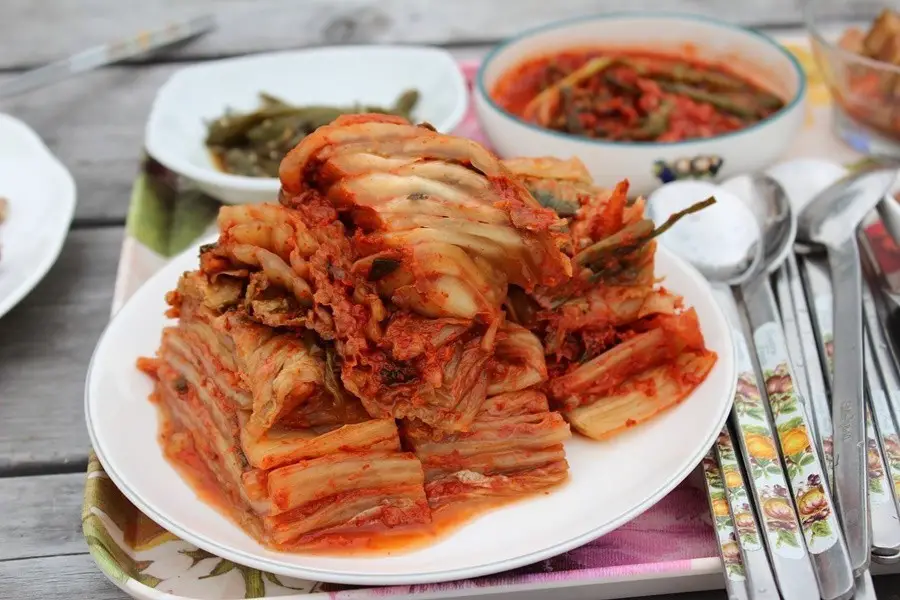
Napa kimchi, the most regular type of Korean kimchi. Credits: Pixabay.

The most common type of Korean kimchi is napa kimchi. It is made from napa cabbage which is widely known as Chinese cabbage in Malaysia. The secret to make your napa kimchi a little bit sweet is to put in some shredded pear.

2. Buchu kimchi

Buchu is an onion species known for many names including garlic chives, Chinese leek, oriental garlic, Asian chives. Here in Malaysia, we simply know it as daun kucai. While we enjoy stir-fried daun kucai with garlic, you can also make a type of Korean kimchi out of it.

Watch how to make it here.

3.Oisabagi

Oisabagi is basically spicy stuffed cucumber kimchi made with garlic chive, carrot and seasoning. The best part about this type of Korean kimchi is, you can eat it right away without waiting for it to be fermented.

Watch how to make it here. 

4. Baek kimchi

Here comes a Korean kimchi without the chilli powder, aptly named baek kimchi or white kimchi. If you find regular kimchi is too spicy for you, opt for baek kimchi. It is mainly made with salted napa cabbage, radish, spring onions, salt, garlic, and sugar.

Watch how to make it here. 

5. Gat kimchi

Even in Malaysia, not everyone enjoys gat which is sawi pahit in Malay or mustard leaves in English. The bitter taste lingers even after you finish your meal. However, you might enjoy it after turning the vegetable into kimchi.

Watch how to make it here.

6. Kakdugi

10 types of Korean kimchi you can make from your Malaysian kitchen
Kakdugi. Credits: Pixabay.

The star ingredient for kakdugi is white radish or else is called mu in Korean or daikon in Japanese. Unlike other Korean kimchi, kakdugi is crunchier thanks to the radish texture. Making kakdugi is another way to eat radish instead of our usual Malaysian radish cake.

7. Dongchimi

Traditionally, the Koreans enjoy dongchimi during winter season. Though it is all-year summer season in Malaysia, make your own dongchimi out of radish, cabbage, pickled green chilli, pear, and water. It takes usually two or three days to mature.

Watch how to make it here.

8.Nabak kimchi

Similar to dongchimi, nabak kimchi is a watery kimchi except it is added with chilli pepper powder. Thus, the colour is redder than dongchimi.

Watch how to make it here.

9. Gaji kimchi

Gaji means eggplant in English or terung in Malay. Here in Malaysia, one of the favourite ways to cook it is with sambal (Malay hot paste). Gaji kimchi takes about half an hour to make and one day to mature before you can enjoy it.

Watch how to make it here.

10. Gochu Sobagi

Most Malaysians can handle spiciness pretty well which is why Korean cuisine is well received here. Gochu sobagi or spicy stuffed green chilli is another way to satisfy your craving for spiciness. It is made by stuffing kimchi seasoning into green chilli.

Watch how to make it here. 

1 6 7 8 9 10 12