Browse Category

Lifestyle - Page 11

Where to buy your beading supplies in Kuching?

Searching for beading supplies in Kuching can be a headache especially when you do not know where to start.

When it comes to beading, there are so many things that crafters need and it is not just beads alone.

Even for its stringing, beaders need to decide to use beading thread, wire, leather or elastic cords.

Plus, there are other supplies such as headpins, split rings, clasps, earring findings and many more.

Fret not because here at KajoMag we narrowed it down for you where to stock up your beading supplies in Kuching, Sarawak.

1.Beads Story By Xing Ya Enterprise

This is the Mecca for all the beading supplies in Kuching. Located at Kota Sentosa, it is the best place in town to buy Toho and Miyuki beads. Both brands are high quality Japan-made glass seed beads.

There are other types of bead being sold there too including tube, acrylic, wooden, faux pearls and many more.
Even for other supplies such as stringing materials, pliers, beading boards and even accessories displays are readily available.

Where to buy your beading supplies in Kuching?
Beads Story by Xing Ya also offers semi-precious beads such as amethyst, quartz and agate.
Where to buy your beading supplies in Kuching?
This store is the best place all the beading supplies one go in Kuching.
2. F.A.H

Fabric Accessories House or commonly known as FAH is the place to be to buy fabric in Kuching.
However, the store also has a good selection of beads for sell.

On top of the beads and fabric, the choices of ribbons, laces and rhinestones would give any crafters a glimpse of heaven. It is the best place for crafters to get buy their fabric and beading supplies in one place.

The store has few outlets all over the city but perhaps the most-visited one is at Gambier Street.

Where to buy your beading supplies in Kuching?
The FAH branch located at Gambier Street has two floors; the ground floor is dedicated to all the fabric while the first floor is all about beading and sewing supplies.
Where to buy your beading supplies in Kuching?
The variety of laces and ribbons at FAH.
3. Jing Lee Travel Souvenier Wholesale

Located at Ewe Hai Street, it is also selling souvenirs to tourists apart from beading supplies. The best part of this store, sometimes you can find old Orang Ulu beads in its collection. You might be feeling the pinch but it is definitely worth it.

4. Satex at Kuching Sentral

Similar to F.A.H., Satex at Kuching Sentral is also selling beading supplies on top of its fabrics. But, their beading collection is limited to seed beads only.

Where to buy your beading supplies in Kuching?
If you are running out seed beads, Satex is another option for you to restock your supply.
5. SL FLowers and Handicraft Shop
Where to buy your beading supplies in Kuching?
Fancy anything from SL FLowers and Handicraft Shop?

Every year during Chinese New Year, Kenyalang Park Commercial Centre would come alive with people busy looking for house decoration.

The whole commercial area is known for affordable food and beauty supplies. But at SL FLowers and Handicraft Shop, crafters can also stock up their beading as well as embroidery and crochet supplies.


5 easy recipes from Happy Together’s Late Night Cafeteria you should try

If you are one of the those people who gets hungry and starts to scavenge through your fridge in the middle of the night, this is for you.

Happy Together is a South Korean talk show which has been running since 2001. It used to have this regular segment called Late Night Cafeteria. Occasionally, the show brings back this famous segment.

The Late Night Cafeteria allows celebrities to share their easy, affordable meals that they make themselves at home.

Here are five easy Happy Together’s Late Night Cafeteria you should try:

1. Kwantos

5 easy recipes from Happy Together’s Late Night Cafeteria you should try

The life of a K-pop idol trainee is infamously known to be harsh. Some of the idol trainees even do not have enough to eat or be put on a diet at a young age.

K-pop star Kwanghee of ZE:A shared that once he accidentally left a bag of Cheetos open and the chips got soggy. But he refused to throw the chips away and developed a recipe out of the soggy snack.

The host of Late Night Cafeteria, Yoo Jaesuk initially had doubts about the recipe. However once he tasted it, he suggested the dish might goes well with beer.

So, how to make Kwanghee’s Kwangtos? Leave your Cheetos bag open for a day.Then top it with cheese and hot sauce before putting it in microwave.

This recipe is good if you do not want to let your Cheetos go to waste.

Watch how to make it here:

2.Mushroom toast

5 easy recipes from Happy Together’s Late Night Cafeteria you should try

South Korean singer Byul is famously known as Running Man HaHa’s wife. Together, the couple runs a BBQ restaurant in Seoul on top of their entertainment careers.

During this year’s segment of Late Night Cafeteria, the mother of two shared a toast recipe she usually make for her son.

It is a sandwich made from mushroom patty with two slices of toast. She made a patty out out enoki mushroom, crabs stick, sweet corn and an egg. After that, pan-fry the batter to make square-shaped fritters.

As for the sauce, just mix tomato ketchup and mayonnaise. You can add on your own chilli if you prefer it to be a little bit more spicy.

This is how Byul makes it.

3.Egg toast and Shaved Ice

5 easy recipes from Happy Together’s Late Night Cafeteria you should try

How about snacking like an Olympic gold medalist? Lee Sanghwa, a two-time Olympic champion shared her late night snack recipes which consist of egg toast and shaved ice.

The egg toast is made with bread dipped in beaten egg with a little bit of diced chili.
Sanghwa then completes her snack with dessert of homemade shaved ice. The cold dish comprises only three ingredients; frozen milk, vanilla ice-cream and chocolate cookies.

Watch how to make it here

4.Dumpling Spaghetti

5 easy recipes from Happy Together’s Late Night Cafeteria you should try

Nowadays, instant food even dumplings are easily available at the supermarket. Actor Seo Hajoon accidentally discovered this recipe when he trying to cook instant dumplings but failed.

In attempt to rescue the dumplings, he mashed up the dumplings in a bowl. He added ketchup and mozzarella cheese on top of it before making it in the oven.

Hajoon called it Dumpling Spaghetti because the dumpling wrappers taste like noodles.

Watch how to make the dumpling spaghetti here. 

5.Pad Thai Ramyeon

5 easy recipes from Happy Together’s Late Night Cafeteria you should try

Although South Korean celebrity chef Baek Jongwon is the culinary expert, he entrusts his wife to cooking spaghetti or noodle-related dishes at home.

His wife, Korean actress So Yujin shared an easy to make homemade pad thai ramyeon.

Basically, it is similar to Malaysian Maggi Goreng. Using the noodle from ramyeon packet, Yujin stir-fries the noodle with garlic, chili, pickled radish. As for the seasoning, she combines chili powder, fish sauce, soy sauce, vinegar and sugar. There you have it, a taste of Thailand in the middle of the night.

Watch it here.

How to be beautiful from the inside like Im Soohyang

South Korean actress Im Soohyang is currently wrapping up her latest drama My ID is Gangnam Beauty.

In the drama, the 28-year-old actress is playing a college student who did plastic surgery to become prettier.

Off camera, Soohyang believes taking care of your beauty also means nurturing your body from within.

During an episode of KBS Beauty Bible, Im Soohyang shares the four things she uses to be beautiful from the inside:

How to be beautiful from the inside like Im Soohyang
Soohyang mixing her detox drink to start her day as an actress.

1. Detox drink

The actress said her skin condition fluctuates depending on what she eats. Thus, she takes detoxifying beverages to get rid of excess toxins in the body. The key is to choose a cleansing drink that allows you to take food like usual, not the ones that require you to fast.

She said, “Detox drinks help me to reduce the toxins in my body and it is also a great for constipation. I usually get skin problems whenever I am constipated.”

2. Vitamin D Jelly Supplement

Do you know that vitamin D has antioxidant properties which can prevent skin damage and premature aging even when taken via supplements?

Speaking of supplements, Soohyang takes her extra dose of vitamin E – not in pill or liquid form – but in jelly form instead.
There is this product in South Korea called VAP Sunbeam Vitamin D Jelly which basically supplement made in jelly. According to the Korean actress, the best part of this supplement is that you can take it like a snack.

3.Skin collagen jelly

Besides Vitamin D jelly, Soohyang is also taking skin collagen jelly as a snack.
Collagen helps to promote skin elasticity, reverse skin aging and reduce cellulite.

4.LED Mask

How to be beautiful from the inside like Im Soohyang
LED Mask helps to rejuvenate your skin at the end of the day.

Soohyang ends her day by wearing LED Mask. This revolutionary facial mask uses colour light therapy in specific wavelengths to increase facial blood circulation and promote collagen production.

There are plenty of good reviews of wearing LED Mask out there. Some of the changes are smoother skin, reduced crow’s feet, forehead wrinkles and reduced pigmentation.

Watch the full segment of Soohyang’s Beauty 24 on Beauty Bible here:

5 ingredients that go well with Sarawakian pounded cassava leaves

5 ingredients that go well with Sarawakian pounded cassava leaves
A local favourite, the cassava leaf or ‘daun ubi’.

Sarawakians love our pounded cassava leaves. Only, we don’t call them “cassava leaves”. We call this bitter, fibrous plant by different names including daun ubi tumbuk, daun bandung tumbuk, uvek kele (in Kayan) and many more.

There is no better way to prepare cassava leaves than to pound them. Traditionally, Sarawakians used a long wooden pestle and mortar to pound the leaves till they got nicely crushed – not too pulpy – and slightly moist.

The cooking method for pounded cassava leaves is generally the same as stir-frying any Asian vegetable except it takes more time to cook.

For a really simple stir-fry, just heat up some oil in a wok, throw in some garlic and red onions until aromatic and then throw in your pounded cassava leaves. You know they’re done once the light green uncooked pounded cassava leaves change to a darker shade of green.

With cassava leaves, every part of its preparation from stem to pot is important. This is because poorly processed cassava plants can trigger the production of cyanide. So while you cannot eat raw cassava leaves, traditional techniques like pounding and mashing cassava leaves before cooking it can help to neutralise the cyanide-inducing cyanogens. While you are stir-frying your cassava leaves, never ever cover your wok as this is believed to trap the cyanogens as it cooks.

Here in Sarawak we have mastered the art of preparing these cassava leaves, and it is very much an essential part of local Sarawak cuisine. Here are a variety of ingredients to mix with this dish.

5 ingredients that go well with Sarawakian pounded cassava leaves
There are plenty ingredients which go well this pounded cassava leaves dish.

Here are how five common ingredients Sarawakians love to cook their pounded cassava leaves with.

1. Three layer pork meat

Three layer pork or pork belly is the boneless cut of fatty meat from the belly of a pig, and as such it has a rich, oily flavour that pork-lovers crave.

One commonly known tip to make pounded cassava leaves tastier and more delicious is to cook it with a lot of oil. However, some people would stir-fry the pork belly long enough to allow the oil from the meat to flavour the cassava. leaves.

2. Tepus

Tepus is a type of wild ginger found in Sarawak. While some people enjoy tepus and chicken cooked in a bamboo, it also goes well with pounded cassava leaves.

3. Terung pipit

Here is another local vegetable= commonly found in Sarawak which goes well with pounded cassava leaves. In the state, the vegetable is known as terung pipit but it has fancier names such as turkey berry, shoo-shoo bush and prickly nightshade.

Also known with its scientific name Solanum torvum, the vegetable is usually stir-fried with belacan (shrimp paste).
To pair up terung pipit and cassava leaves is easy; it’s either you cook them together or you can also pound the leaves and egg plant together.

3. Gulong Sliced Stewed Pork

We bet when China brand Gulong came up with this product, they didn’t imagine that hundreds of miles away in Sarawak that people would use it with pounded cassava leaves.

Put the pork slices in once the cassava leaves are cooked. The oiliness and saltiness of the processed food somehow makes the whole dish more flavourful.

4. Luncheon meat

Luncheon meat is another source of protein which goes well with pounded cassava leaves. Just like Gulong Stewed Pork Sliced, luncheon meat is put in once the leaves are cooked.

5. Pork crackling

If we were to name a list delicious yet unhealthy snacks, pork crackling definitely takes the crown.
This snack which made of fried pork rind is crunchy and salty. Once you cook it together with pounded cassava leaves, the crackling would turn soft giving another extra texture to the whole dish.

So Sarawakians, let us know in the comment box which ingredient is your favourite!

5 Taiwanese foods featured on Running Man

Since 2010, Korean variety show Running Man has been running all over the world visiting various different countries such as Vietnam, Indonesia and England.

Over the course of their visits outside of South Korea, they have never failed to promote other countries’ specialties and culture.

This includes when they visited Taiwan in episode 347. The members HaHa, Yang Se-chan and Song Ji-Hyo needed to try the countries’ food specialties as part of their mission.

Here are the Taiwanese foods featured in that Running Man episode and why they are so special:

1.Taiwanese Beef Noodle

5 Taiwanese foods featured on Running Man

There are plenty of variations when comes to beef noodles around Asia. However, the Taiwanese version of this dish is like kolo mee for Sarawak. It is listed as one of the must-try foods when visiting the country.

Generally, beef noodles are either cooked in a clear broth or with braised meat. The Taiwanese version is the latter. In Taiwan, people prefer the tomato variation of the braised beef noodles. It is red in colour, cooked with chunks of tomatoes, sometimes even without soy sauce.

2. Danzai Noodle

5 Taiwanese foods featured on Running Man

Also known as Ta-a or danzi noodles, this dish has history that can be traced back 130 years.

Legend has it that a fisherman named Hong Yutou began selling this noodle to earn money during off-season when typhoons were frequent. Usually served in small size, this dish is more like a snack rather than the main course.
On top of the noodles, it is made with bean sprouts, cilantro, shrimp and minced pork.

3. Stinky Tofu

This Taiwanese food requires first timers to gather their guts to try. Traditionally a Chinese snack, it is also found in mainland China and Hong Kong.

In Taiwan, however, the tofu is usually served deep-fried with sour pickled vegetables. Visitors can find the deep-fried stinky tofu in Taiwanese night markets. Other ways to cook it in Taiwan are with spicy hot soup and barbecued over charcoal.

4. Mango Shaved Ice

A post shared by Meetfresh (@meetfreshusa) on

Mango shaved Ice is a quintessential Taiwanese dessert. Now you can find Taiwanese dessert chains popping up around the world serving mango shaved ice as their star menu item. It is basically made from freshly cut mango, mango ice cream and sweet mango sauce.

5. Pineapple Cake

Here is one of those Taiwanese foods you can bring home as a gift. It is a sweet traditional pastry made with butter, flour, egg, sugar and pineapple jam in between.

Pineapple played an important economical role in the country’s history which started when it was under Japanese rule (1895-1945).

During this period, Japanese brought in pineapple cultivators and set up processing plants. By the late 1930s, the country was the third largest pineapple exporter in the world.

In 2015, CNN readers voted Taiwan as the number one food destinations in the world. If you are planning a visit to the country, you can start with your must-try Taiwanese foods with this list.

10 types of Korean kimchi you can make from your Malaysian kitchen

Although kimchi is quintessentially a part of Korean cuisine, we can still make and enjoy it here in Malaysia.

Kimchi is basiclly fermented vegetables, much like preserved tuhau for the Sabahans. Just like tuhau, Korean kimchi makes a great quick meal if you are in a rush. Just cook some rice, take out those preserved vegetables, fry an egg and voila you have a complete meal.

Most kimchi is made with the basic seasoning of gochujang (Korean chilli paste), Korean chilli powder, garlic, ginger and jeotgal (salted shrimp).

If you do not have Korean chilli powder, you can replace it with Malaysian serbuk cili. (It is also more economical.)

As for jeotgal, some replace it with fish sauce while some Malaysians may use cencaluk as a substitute.

So what are you waiting for, here are ten types of Korean kimchi you can make from your Malaysian kitchen:

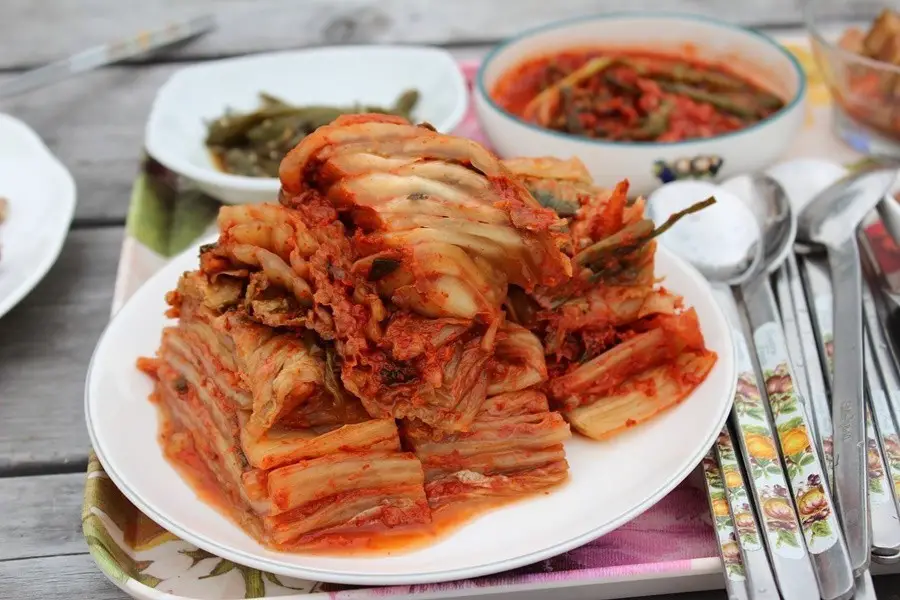
1. Napa kimchi

10 types of Korean kimchi you can make from your Malaysian kitchen
Napa kimchi, the most regular type of Korean kimchi. Credits: Pixabay.

The most common type of Korean kimchi is napa kimchi. It is made from napa cabbage which is widely known as Chinese cabbage in Malaysia. The secret to make your napa kimchi a little bit sweet is to put in some shredded pear.

2. Buchu kimchi

Buchu is an onion species known for many names including garlic chives, Chinese leek, oriental garlic, Asian chives. Here in Malaysia, we simply know it as daun kucai. While we enjoy stir-fried daun kucai with garlic, you can also make a type of Korean kimchi out of it.

Watch how to make it here.

3.Oisabagi

Oisabagi is basically spicy stuffed cucumber kimchi made with garlic chive, carrot and seasoning. The best part about this type of Korean kimchi is, you can eat it right away without waiting for it to be fermented.

Watch how to make it here. 

4. Baek kimchi

Here comes a Korean kimchi without the chilli powder, aptly named baek kimchi or white kimchi. If you find regular kimchi is too spicy for you, opt for baek kimchi. It is mainly made with salted napa cabbage, radish, spring onions, salt, garlic, and sugar.

Watch how to make it here. 

5. Gat kimchi

Even in Malaysia, not everyone enjoys gat which is sawi pahit in Malay or mustard leaves in English. The bitter taste lingers even after you finish your meal. However, you might enjoy it after turning the vegetable into kimchi.

Watch how to make it here.

6. Kakdugi

10 types of Korean kimchi you can make from your Malaysian kitchen
Kakdugi. Credits: Pixabay.

The star ingredient for kakdugi is white radish or else is called mu in Korean or daikon in Japanese. Unlike other Korean kimchi, kakdugi is crunchier thanks to the radish texture. Making kakdugi is another way to eat radish instead of our usual Malaysian radish cake.

7. Dongchimi

Traditionally, the Koreans enjoy dongchimi during winter season. Though it is all-year summer season in Malaysia, make your own dongchimi out of radish, cabbage, pickled green chilli, pear, and water. It takes usually two or three days to mature.

Watch how to make it here.

8.Nabak kimchi

Similar to dongchimi, nabak kimchi is a watery kimchi except it is added with chilli pepper powder. Thus, the colour is redder than dongchimi.

Watch how to make it here.

9. Gaji kimchi

Gaji means eggplant in English or terung in Malay. Here in Malaysia, one of the favourite ways to cook it is with sambal (Malay hot paste). Gaji kimchi takes about half an hour to make and one day to mature before you can enjoy it.

Watch how to make it here.

10. Gochu Sobagi

Most Malaysians can handle spiciness pretty well which is why Korean cuisine is well received here. Gochu sobagi or spicy stuffed green chilli is another way to satisfy your craving for spiciness. It is made by stuffing kimchi seasoning into green chilli.

Watch how to make it here. 

8 Malaysian recipes with pineapple

While the Italians do not like pineapples on their pizzas, people in Malaysia have plenty of ways to cook it.

For those who are in love with this tropical fruit, here are eight Malaysian recipes with pineapple:

1.Sweet and sour fish
8 Malaysian recipes with pineapple
Sweet and sour pork. Credits: Pixabay.

This dish is originally a Chinese recipe made of fried white fish covered in a sauce made from ketchup, diced pineapples and cucumbers.

The sauce offers a nice blend of sweetness and sourness all thanks to the ketchup, canned pineapple juice and vinegar.

If you are not a big fan of fish, you can replace it with fried chicken meat or pork.

2. Pig intestines cooked with pineapple

Speaking of pork, pig intestines might not be everyone’s cup of tea but in Sarawak it is famously cooked with this tropical fruit.

During Gawai or the harvest festival, pork is the white meat of choice. Usually, each and every part of the pig is not wasted and cooked including its intestines. Pineapple makes the perfect pairing, as its sweetness balances out this organ’s strong taste.

3. Pajeri nanas

From Sarawak, we now head to Peninsular Malaysia. “Pajeri nanas” or pineapple curry is a Malay traditional dish whereby each West Malaysian state has its own recipe.

Watch how to make it here.

4. Sambal nanas

Here is another Malay recipe; sambal is a sauce or paste made mainly from chili peppers with other secondary ingredients such as shrimp paste (sambal belacan) or petai (sambal petai).

Hence, sambal nanas is a rough paste made from pineapple.

5. Nanas Tumis Air

“Nanas tumis air” is a stir fried dish suitable for vegetarians. It is cooked with shallots, garlic, turmeric powder and spices like clove, star anise and cardamom.

6. Pineapple fried rice

Inspired by Thai fried rice, it is commonly seasoned with turmeric powder giving the dish its slightly yellow colour. What makes this dish so good, is the sweetness of the pineapple which gives this Asian staple the tropical fusion it needs.

7. Fruit rojak

Also known as Malaysian fruit salad, a rojak is a famous dish taken during tea-time. It consists of cucumber, jicama, deep-fried tofu and of course pineapple.

8. Pineapple tart

If you are not a big fan of this fruit as a savoury dish, here is the recipe that will suit all taste buds. These tarts are bite-sized baked goods topped or filled with pineapple jam. It is one of the famous festive cookies because it is usually served during Hari Raya, Chinese New Year and Gawai.
However, you can still find them in local bakeries all year round.

Watch how to make it here.

How to master secondhand shopping for your wardrobe

Secondhand shopping is a skill that needs to be learned. It requires practice and perseverance so that you won’t leave a thrift or vintage store with regrets.

Furthermore, mastering secondhand shopping also allows you to grab that one perfect piece of clothing before everybody else.

Here are Kajo-tested and approved techniques on how to master secondhand shopping for your wardrobe:

How to master secondhand shopping for your wardrobe
Never miss a rack when secondhand shopping.
  1. Don’t miss a rack

There are plenty to see when you go for secondhand shopping but no matter what happens, never lose your focus.
Go through every rack and check every hanger because you never know what you’ll find.
Also, wear something comfortable and be patient when you go out shopping.

2. Never buy anything with a stain on it.

It doesn’t matter how good it looks or how well it fits you, do not buy anything with a stain on it. No matter how big or small the stain is, it is better to play safe and don’t purchase a stained piece of secondhand clothing.

Never assume you can get rid of the stain later.

3. Check every zip and button

How to master secondhand shopping for your wardrobe
If the clothes need major repairs, skip them.

Secondhand shopping is like working on quality control section of a factory: You have to check every part of the clothes especially the buttons, seams and zips.

If it only needs minor repair such as sewing in a missing button, then it is worth to buy.

If the clothes need major repairs like a broken zip, however, it is better to drop it.

4. Black is always the safest colour

How to master secondhand shopping for your wardrobe
Black clothes are always a good idea.

When secondhand shopping for your wardrobe, it is best to pick fashion neutrals. These are colours that go with anything.

Basic neutral colours are black, gray, navy, brown, khaki and white. The best out of these fashion neutrals is of course black, while the riskiest choice is white.

Try to avoid printed fabrics unless they look timeless. Most prints come and go so you can easily which era some specific prints come from.

5.Go for the classic, timeless style

Channel your inner Audrey Hepburn when secondhand shopping for clothes. Aim for classic and timeless designs which will make you effortlessly chic.

Say no to big puffy sleeves that definitely scream 80s fashion unless you are shopping for a Halloween costume.
Hepburn was known for her form-fitting long sleeve shirt, striped shirt, smart black trousers, button up shirt and A-line skirt or dress.

When in doubt, go for Hepburn-inspired little black dress from Breakfast at Tiffany’s. You can never ever go wrong with an LBD.

Style guide for women: 5 easy tips on how to dress better instantly

We’ve heard the phrases “dress for success” or “dress for the job that you want, not the job you have.”

Dressing up will boost your self-confidence, promote self-respect and give a good impression.

As Coco Chanel’s famous quote goes, “Dress shabbily and they remember the dress. Dress impeccably and they remember the woman.”

Now comes the question on how to be effortlessly more stylish with little effort.

Here are KajoMag’s five easy tips on how to dress better instantly without changing your whole wardrobe:

1. Don’t know what to wear? Pick a one-piece outfit.

Style guide for women: 5 easy tips on how to dress better instantly
Pick a dress or a jumpsuit if you are too lazy to mix and match your outfit. Credits: Pexels.

Ever have one of those days when you just don’t know what to wear? Most professionals advise that we should plan our outfits the night before so that you don’t have to make that decision in the morning. But if you are really stuck and tired of playing the mix and match game, pick a one-piece like a dress or a jumpsuit.

2. Highlight one feature on your face

Style guide for women: 5 easy tips on how to dress better instantly
Rock a red lipstick and you definitely look effortlessly stylish. Credits: Pexels.

You don’t need to have professional skills or a suitcase of cosmetics to know how to apply makeup.

First of all you need to pick your favourite facial feature, then start to work some magic on your face.

Put on a bold red lipstick with super light eye makeup or wear a pair of fake lashes while rocking nude lips. Either way, highlight only one feature on your face so that way you won’t spend tonnes of time on makeup and still look polished.

3. Fix your hair

Style guide for women: 5 easy tips on how to dress better instantly
Give your a quick blow dry before going out from the house. Credits: Pexels.

For women, our hair is the crown that we never take off. So no matter how lazy you are in the morning, the least you can do is to simply comb your hair.

There is no need to go full blown salon style on your hair. As long as you tame that frizzy mane, you are good to go.

4. Choose one statement accessory

Style guide for women: 5 easy tips on how to dress better instantly
Pick only one statement accessories and your outfits would immediately looked more stylish. Credits: Pexels.

Even if you outfit is plain and uninteresting, dress better instantly by pairing it with a statement accessory.
Choose a pair of statement earrings or necklace depending on your outfit. Accessories do make you look like you dressed to impress.

5. Wear a pair of covered shoes

Style guide for women: 5 easy tips on how to dress better instantly
A pair of close-toed shoes is always a good choice. Credits: Pexels.

Have you heard the saying, “I make shoe contact before eye contact?” Your shoes can be the first thing people notice when they see you.

However, if it is hard to make a choice of which pair of footwear to go with, go for covered shoes. Covered heels will always make you look more professional than a pair of open toed shoes. A pair of white sneakers, for example, definitely looks better with your jeans than flip-flops.

If you don’t believe a pair of shoes can make a difference, just remember Cinderella.

10 types of beauty masks you never thought you needed

At the mention of beauty masks, one immediately thinks of the facial mask.

Not surprisingly though, the beauty industry has come up with so many innovations within this decade that you can find a mask for every inch of your body!

Well… Not exactly every inch of your body, but gone are the days when beauty masks are only meant for your face.

10 types of beauty masks you never thought you needed
The beauty industry has come with so many innovations over the last decade. Credit: Unsplash.

Here are 10 types of beauty masks you never thought you needed:

1. Foot mask

While most people are busy taking care of their faces and hair, some of us often neglect our feet. (Raise your foot if you wished your feet were smooth and soft before adulthood made them dry and cracked.)

The hottest thing in the beauty industry now is the foot peeling mask, which has becomean effective way to get rid of the dead skin on your feet. Be warned, the mask actually helps your feet peel like insects going through the molting process.

Place these masks like a sock on your freshly-cleansed feet and let the chemical do its magic. You will only see the results five to seven days after applying these masks when all the dead skin starts to peel off.

Some widely reviewed foot masks online are TONYMOLY Shiny Foot Super Peeling Liquid and Baby Foot Lavender.

2. Chin mask

This is reportedly a surgical-free way of lifting your jawline. V-mask, face lift mask, chin up mask are basically masks designed to reduce the appearance of your double chin. You can also use this to say goodbye to turkey neck.

Most of these masks for your chin claimed to to work to redefine your jawline after one 30-minute treatment.

3.Under-eye mask

https://www.youtube.com/watch?v=UrARKnACoN8

Puffiness, fine lines and dark circles… these are some of the problems we have under our eyes.

Nowadays, you can easily find comma-shaped masks at Malaysian drug stores work to reduce these problems. They are known to be a quick fix to brighten your eyes while giving a cooling effects on your skin.

4. Lip mask

https://www.youtube.com/watch?v=SOVE9QR78tM

Forget about lip balms, we are taking our lip care to another level with lip masks.
Famous beauty brands such as Laneige, TONYMOLY and Sephora have all come out with their own lip masks which work to soothe, replenish, moisturise and nourish your dry and cracked pout.

But if you are not willing to spend that kind of money, slathering your lips with butter and leaving it on overnight works too.

5. Elbow mask

South Korea will always a solution for every problem you have on your body no matter how small.

A couple years back, Etude House from South Korea came up with masks to moisturise and brighten your dry and rough elbows.

Well, that is definitely something we need just in case anybody noticed we have rough elbows in the first place.

6. Hand mask

This is another beauty inspiration which comes from South Korea.

Hand masks are meant to nourish your rough hands and brittle fingernails. L’Occitane has a product to gently slough off the dead skin on your hands. Lush also offers a hand mask that works like a specialised bath for your hands.

Gone are the days that you apply only lotion on your hands.

7. Body mask

Now what about the rest of our bodies? No worries, the 21st century beauty industry has you covered in that area too.

Body mask products are aimed to give users that spa-like experience at home, leaving your body smooth and refreshing.

8.Boob mask

The public won’t be able to see your breasts from top to bottom, but it doesn’t meant that you should neglect them.

Boob sheet masks are apparently a thing, and were created to hydrate the chest areas. They also have anti-aging and skin-brightening properties, ensuring your chest will look great in those décolleté tops and dresses.

9.Belly mask

Show some love to your belly! Pregnant mamas now can lighten the appearance of stretch marks while carrying their babies with beauty masks designed for their pregnant bellies.

They are also meant to soften scars after Caesarean section.

10. Butt mask

Finally, we are now talking about the tush! If you think your buttocks lack suppleness, firmness and bounciness, fret not! There are masks designed to restore those qualities to your butt.

Canada-based beauty brand Nannete de Gaspé is one of the leading players in the industry when it comes to beauty masks.

They introduced to the world the concept of dry masks in 2016. So it is no surprise, this brand offers masks for different parts for the body and that includes the bust and butt.

1 9 10 11 12 13 15