Browse Tag

Food - Page 3

An exclusive guide to start your very own home cafe

During this time of the Covid-19 pandemic, it is safer to stay at home at all cost, especially when you are able to.

But what happens when you have a strong craving for a specialised coffee?

We are not talking about instant coffee powder or 3-in-1 coffee, we are referring to the aromatic taste of americano, the creamy taste of cafe latte or the foamy texture of cappuccino.

Nowadays, it is possible to have a cafe-like experience even at home.

Using the right equipment and ingredients, you can have that glass of iced cafe latte at the comfort of your home.

Your home cafe starts with a shot of espresso.

If you have the money to buy a coffee machine, go ahead.

However if you don’t, there are other more affordable replacements.

How do you start your home cafe without a coffee machine?

An exclusive guide to start your very own home cafe
Moka Pot

Kicking off the list is a Moka pot. It is a stove top or electric coffee maker that brews coffee by passing boiling water pressurised by steam through ground coffee.

Invented by Italian engineer Alfonso Bialetti in 1933, it is named after the Yemeni city of Mocha.

There are plenty of tutorials available on Youtube on how to use a Moka pot.

The basic ratio for coffee to water is 1:2.

Since the pressure of a Moka pot is five to 10 times less than that of an espresso machine, the coffee brewed using the pot is not exactly an espresso by definition.

However as far as taste goes, it is as strong as close to you can get to espresso without buying a fancy machine.

Another affordable replacement for an espresso machine is the French press.

An exclusive guide to start your very own home cafe
French press

Similar to a Moka pot, a French press does not produce as much pressure as an espresso machine.

Nevertheless, it is still good enough to make an espresso-like coffee.

While you need to boil the Moka pot to let the steam brew the coffee, you only need boiling water with a French press.

The idea of a French press is to slowly press the plunger down with even pressure after allowing your coffee to steep.

The perfect time to brew a French press is about three to four minutes. If it exceeds this time, you may find yourself with a bitter over-extracted coffee.

Lastly, if you can get a hand of a ‘Kompresso’ or a portable espresso maker then that is the easiest way to make an espresso.

Starbucks Korea for instance offers a limited edition Picnic Series which include a Picnic Kompresso.

Along with one of these replacements, it is a good to have a liquid thermometer, a small electric whisk and a kitchen timer to help you to brew the perfect shot of espresso.

Arabica, Robusta or Liberica

To make that shot of espresso, of course you need ground coffee.

If you are a coffee enthusiast, then you probably already have your personal preferences of java beans.

When you search ‘ground coffee’ on online shopping platform such as Shopee, you are dumped with different kinds of choices.

So how to choose?

The most common type of ground coffee that are easily available is arabica coffee, also known as Arabian coffee.

The label on the packaging usually states ‘100% Arabica’ which means the coffee ground is made only using arabica beans.

This species of coffee tree Coffee arabica is believed to be the first species of coffee to be cultivated and made up about 60 per cent of global production.

Meanwhile, the second most cultivated types of coffee is robusta coffee.

Widely known as Coffee robusta, the plant is scientifically as Coffea canephora.

The third choice is Liberian coffee or Coffea liberica.

It is more common species in the Philippines, Indonesia as well as in Malaysia. Here in Sarawak, we have our very own Sarawak Liberica.

So how do you choose your java beans?

Firstly, let us talk about the most important factor which is the caffeine concentration because a decaf coffee is just a sacrilege.

The caffeine concentration of Liberica beans is the lowest of the three with 1.23g/100g.

Arabica has 1.61g/100g and Robusta has 2.26/100g. Hence, choose one that suits your caffeine expectations.

As for the taste, every blend has a specific sensation on its own.

Overall, arabica is known for its smoother taste often with hints of fruits or sourish aftertaste.

If Robusta is an occupation, then it would be a strong, six-packed construction worker. It has harsher, stronger and bitter taste compared to Arabica.

Last but not least is the Liberica beans. The feedback for this bean is varies. Some said it is the most aromatic beans compared to Arabica and Robusta beans.

It is also known for its woody and smokey taste.

When choosing your coffee grounds, you can also choose mixed blends between different kinds of coffee beans. The most common blend is a combination of Arabica and Robusta beans.

Now that you have chosen your beans, next is to choose the type of grind.

There are ‘extra course’, ‘course’, ‘medium’, ‘fine’ and ‘extra fine’.

If you are using French press, choose ‘extra course’ or ‘course’ or ‘medium’. For a Moka pot, opt for ‘fine’ grind.

Other ingredients for your home cafe

Besides coffee beans, you must have milk in your home cafe. It is recommended to use skim milk for frothing since it is the lightest.

You can use whole milk but the froth will be creamier in taste.

Speaking of frothed milk, you can make one without a machine.

The steps include heating the milk and using a hand mixer to whisk the milk until it reaches the desired frothiness.

Don’t have any hand mixer or a whisk? Make full use of your biceps and triceps by shaking a jar filled with warmed milk.

To make more home cafe recipes, get ready other ingredients such as whipping cream, flavoured syrup such as vanilla and hazelnut as well as cocoa powder.

Your home cafe recipes

Once you have that particular shot of espresso perfects to your taste, you are ready to have your own home cafe.

The easiest thing to make is americano. Take your shot of espresso and add into 100-150ml of hot water.

Do not go the other way round because the water being flowed through the coffee can lead it to be over extracted.

For a cup of cafe latte, have an espresso with 150-300ml steamed milk poured over it. Feel free to add your own flavour with vanilla or hazelnut syrup.

An exclusive guide to start your very own home cafe
Iced latte

You can make own cappuccino by adding 160-240ml milk foam into your espresso.

A flat white is made with a double espresso and about 150-240ml light frothy milk.

Not feeling like too much dairy? Make yourself an espresso macchiato with as shot of espresso and about 50ml of milk froth.

An espresso macchiato is a single shot of espresso with a dollop of milk froth on top.

Another way to make full use of frothed milk is by making latte macchiato.

Unlike a cafe latte whereby the milk is poured into the espresso, a latte macchiato is made by adding a single shot of espresso slowly onto a big glass of steamed and frothed milk.

If you have whipped cream laying around the kitchen, top your espresso with it to make espresso con panna.

Finally for a dessert at your very own home cafe, pour a shot of espresso over a scoop of vanilla ice-cream to make an affogato.

An exclusive guide to start your very own home cafe
Make your very own affogato.

Setting the ambience for your home cafe

An exclusive guide to start your very own home cafe

Clear the clutter and sit on the most comfy couch in your living room. Light a scented candle if you have one, have a book ready at your side and put up some music.

There is a wide range of playlist of ‘coffee shop music’ to choose from especially on Youtube.

From ‘Korean coffee shop playlist’ to ‘Starbucks-inspired playlist’, pick your choice.

With the perfect cup of java poured into your favourite cup, you are now ready to have a cafe experience at home.

All images are stocks photos from Unsplash.com and Pexels.com

Know the legends behind these 5 famous Chinese desserts

Behind every traditional food, there is always a story. It should not be surprising that traditional Chinese food such as mantou, Dragon’s beard candy, Wife Cake, doufufa and even guilinggao will have it’s own lore and background story.

Here are the legends behind these five famous Chinese desserts:

1.Guilinggao

You have seen this jelly-like Chinese dessert being sold at the supermarket.

Did you know that it is traditionally made from ‘gao’ or a paste of the under shell of the turtle such as the Chinese three-striped box turtle (Cuora trifasciata)?

It is traditionally prepared by boiling turtle shells for hours before adding in a variety of herbs.

After the water is thickened to form a jelly-like residue, rice flour and corn starch are added to make guilinggao.

There are guillinggao brands which use commercially farmed three-lined box turtles. As such, the traditional guilinggao is quite expensive. For those that use turtle shell in their ingredients, typically other species of turtles such as soft-shelled turtle are used.

However to make guilinggao at home, there is no need for you to catch a turtle, take off the shell and boil it.

Most commercially available guilinggao products today do not contain turtle shell powder.

Today, guilinggao powder is easily available in stores and supermarkets. Follow the instructions and add in as much sugar as your heart desires.

While it has never been proven, like many traditional Chinese desserts, gulinggao is believed to be medicinal to improve circulation, healthier complexion and good for the kidney.

Legend has it that the Tongzhi Emperor who reigned from 1861 to 1875 nearly cured his smallpox by taking guilinggao.

His mother, the Empress Dowager Cixi, on the other hand believed that his smallpox could be cured by worshipping a smallpox god.

After convincing the emperor not to take guilinggao anymore, the Tongzhi Emperor passed away soon after.

Was it because he stopped taking guilinggao or is there another reason for his death? We might never know.

2.Doufufa

The origins of doufufa can be traced back to as early as the Han Dynasty (202BC-220AD).

According to legend, Emperor Gaozu of Han who reigned from 202-195AD had a grandson named Liu An.

He wanted to create something that would help him achieve immortality and Liu An thought the answer could be found in soybean.

After few attempts, he managed to create soft tofu. People of the Han Dynasty started to call it tofu brains because of its softness.

While Liu An did not get to live forever, his recipe has survived to this day.

Today, there are so many version of doufufa. Some have it with something sweet like sweet ginger soup while others tend to make it savoury by adding in soy sauce.

Meanwhile, Sarawakians love to have it with gula apong (palm sugar).

3.Dragon’s Beard Candy

Here is another Chinese dessert that originated during the Han Dynasty.

With no internet or TV, the Emperor found himself being entertained by an imperial court chef who performed complicated steps to make a new confection.

After stretching the dough into small, thin strands, a new recipe was created in front of the Emperor.

These strands reminded the Emperor of a dragon’s beard hence the name that we all know now.

Fast forward to the Chinese Cultural Revolution from 1966 to 1976, the Communist Party of China banned any activities connected to the Han Dynasty – including Dragon’s Beard Candy.

People in China actually stopped making it for some time until recently with the new generation picking up the craft to make this traditional sweet again.

4.Wife Cake

Sometimes you can roughly guess there must be a legend behind some Chinese desserts according to their names.

Lo Po Beng – or its English translation Wife Cake – is actually a Chinese pastry made with winter melon, almond paste and sesame.

Long time ago, there was a poor couple who loved each other dearly. One day, the husband’s father fell sick.

The couple spent all their money to cure the poor old man but he was still not cured.

Without her husband’s knowledge, the wife sold herself as a slave for money to buy medicine for her father in-law.

Once the husband found out what his wife did, he created this pastry filled with winter melon and almond.

The husband sold the pastry which he dedicated to his wife. Thankfully, the cake was a hit and the poor man managed to buy back his wife using the money that he earned.

5.Mantou

Know the legends behind these 5 famous Chinese desserts
Some Chinese desserts like this mantou can be served as part of main course. Credit: Pixabay.

The Chinese mantou is a soft, white steamed bun. It is a popular side that can even be found in the frozen section at the supermarket.

The most famous legend behind mantou is related to human sacrifice.

During the Three Kingdoms period of ancient China (220-280AD), the Chancellor of Shu Han state Zhuge Liang led the Shu army on a campaign against Nanman forces or the Southern Barbarians.

After capturing the Nanman king Meng Hua, Zhuge Liang brought his army back to Shu Han.

The troops suddenly came across a very fast flowing river that could not be crossed.

One of the barbarian lords told Zhuge Liang that in the olden days the barbarians would sacrifice 50 men and throw their heads into the river to appease the river deity and allow them to cross.

Zhuge Liang did not want any of his men to lose their heads. Instead, he ordered them to slaughter the livestock and fill their meat into buns shaped roughly like human heads.

The men then threw these buns into the river.

Somehow, Zhuge Liang and his men managed to cross the river and he named the bun ‘mantou’ or barbarian’s head.

5 Italian deep-fried pastries you should try to make at home

Just because international travelling is impossible right now, you can always have a taste of another country through food.

How about ‘travel’ to Italy and try their deep-fried pastries by making them yourself?

Unlike French pastries which require a lot of time and work, Italian deep-fried pastries are comparatively easy to make.

Here are five Italian deep-fried pastries you should try to make at home:

1.Bombolone
5 Italian deep-fried pastries you should try to make at home

Many refer bombolone as the Italian version of the doughnut but it is also similar to German berliner pfannkuchen.

It is basically round fried dough, either empty or filled with creme patissiere, chocolate, Nutella or jam and topped with icing sugar.

The basic ingredients are flour, yeast, salt, sugar, egg, water and butter as well as oil for frying. Some variation of bombolone does not include eggs.

Plus, the original version of bombolone actually uses lard for both the dough (instead of butter) and for frying the pastry.

To add an extra kick in flavour, the modern version of the recipe even uses a bit vanilla and rum in the dough.

Give these recipes a try here, here and here.

2.Zeppole

Zeppole is another Italian deep-fried pastry topped with powdered sugar.

Traditionally, it is eaten to celebrate Saint Joseph’s Day on Mar 19 every year.

As for the filling, the common ingredients are custard, jelly, cannoli-style pastry cream or butter and honey mixture.

To make the dough, you need flour, eggs, salt, sugar, butter, water and milk.

So what are the differences between zeppole and bombolone?

Unlike bombolone which is rolled into shape from a dough, zeppole is almost a batter. To fry zeppole, you need to spoon them into the oil.

Zeppole is practically more like a fritter, hence it is less chewy than bombolone.

While bombolone is filled with flavoured ingredients such as cream and chocolate, zeppoli has its added flavour on top of the pastry.

Here are some of the recipes for zeppole; here, here, here.

3.Frittelle

Known as Venetian doughnuts, this Italian deep-fried pastry is commonly served during carnivals.

It is more similar to bombolone compared to zeppole as they are yeast-risen fried pastries.

There are many variations of frittelle, both filled and unfilled version.

The unfilled version have raisins mixed into the dough while the filled version has fillings such as pastry cream.

If you like your deep-fried pastry without extra calories of fillings, you can definitely give frittelle a try.

Here are the recipes; here, here, here.

4.Castagnole

Speaking of Italian deep-fried pastry without any filling, here is an easy pastry to make at home.

Castagnole are soft on the inside and crunchy on the outside that are best eaten while they are still warm.

The common ingredients are flour, baking powder, salt, sugar, eggs and butter.

The key to make the perfect castagnole is to fry them at the right temperature.

Cook them in a too high temperature then the pastry is cook on the outside but not on the inside.

However, fry them in a too low temperature the pastry would become soggy.

The perfect temperature is between 170-175 degree Celsius.

Here are the recipes; here, here, here.

5.Crostoli/Sfrappe/Chiacchiere

This Italian deep-fried pastry is known by many names according to the different regions in Italy but they all refer to the same sweet dough which has been rolled out, cut-up and then fried.

They all made from flour, sugar, baking powder, eggs, oil, liquor or wine, citrus zest and icing sugar.

Unlike other pastries on this list, chiacchiere is more on the crunchy side.

For Malaysians, imagine kuih lidah buaya or kuih tiram.

Traditionally, they are eaten in the period before Lent season according to Christian calendar.

Here are the recipes: this, this and this.

Nuns or concubines: Who invented Italian pastry, cannoli?

Cannoli is an Italian pastry which has recently made its way to Malaysia. It is a tube-shaped shell made of fried pastry dough, filled with a sweet, creamy filling. Yum.

In Italian, cannoli is plural and its corresponding singular is cannolo. However in English, cannoli is usually used as a singular.

The shells are made basically from flour, sugar, butter, egg and oil. Meanwhile, the ingredients for the fillings are ricotta, powdered sugar, ground cinnamon and chocolate chips.

What makes this pastry more interesting besides its crispy shell and creamy filling is the legend behind its origin.

Nuns or concubines: Who invented Italian pastry, cannoli?

From a harem to a convent, here are some theories behind who invented the cannoli:

1.Concubines made cannoli in order to capture the prince’s attention

Between 827 and 1091 AD, the city of Caltanissetta in Sicily was under Arab domination.

During the time, the city was known for its large number of harems. Even its name back then was ‘Kalt El Nissa’ which meant ‘women’s castle’.

With so many harems, then there must be many concubines. Usually, these concubines served only one prince.

The women of Caltanisseta reportedly were inspired by their prince’s ‘body part’ that they created a pastry shaped like it with a creamy filling in the middle. Ahem. Nudge nudge wink wink.

If it is true that the concubines in Caltanissetta created the cannoli just to impress their prince, the effort is nothing compared to the concubines in the Turkish drama The Magnificent Century, who resorted to poisoning and framing each other just to be the Sultan’s favourite.

Based on the life of Ottoman Sultan Suleyman the Magnificent and his wife Hurrem Sultan, a slave girl who (of course) rises through the ranks of the harem’s hierarchy to become Sultana, the drama can be a guilty pleasure as you watch the concubines pulling all kinds of moves just to gain the Sultan’s attention.

Nuns or concubines: Who invented Italian pastry, cannoli?
Credit to Pixabay.com.

2. The Christian nuns were trying to have fun

The Carnevale season, a celebration which started during the Middle Ages and is still being celebrated today in some part of the world, usually takes place before the liturgical season of Lent. It was celebration involved a lot of food, alcohol and meat before the abstinence of them during Lent.

Some historians believed that the nuns of Caltanissetta were being playful and wanted to join the festivities of Carnavale.

They came up with this brilliant idea of making a fountain with edible faucets where ricotta cream came out instead of water. Patrons would then fill the cannoli shell with cream.

The dessert was a hit and eventually became a year-round staple pastry in Sicily.

3.Former concubines who later became nuns were responsible for passing down the recipe

By 1086, when Arab rule in Sicily came to an end, the harems also started to disappear.

Some of the concubines decided to remain in Sicily and convert to Christianity.

A number of them is believed to have become nuns and resided in the monasteries.

They brought along with them food they cooked as concubines, including the cannoli.

Some historians believed that it was possible that the nuns who brought cannoli to the Carnevale were former concubines themselves or learned the recipes from their sisters who used to live in the harem.

While you might not look at cannoli the same way after knowing the ‘inspiration’ behind it, still we all need to thank these women. If it weren’t for them, we might never indulge in this crispy, sweet, creamy pastry.

Click here, here and here for the recipe.

#KajoTries ordering Nyems Sekal Cafeteria with Foodpanda

Are you scrolling through Foodpanda and undecided about what you want to eat? If you feel like local cuisine for lunch or dinner, you could try Nyems Sekal Cafeteria.

Their menu selection on Foodpanda offers diverse types of dishes served with your choice of Nasi Kukus, Nasi Putih, Mee/Kuey Teow or Nasi Goreng, and even Western, making Nyems Sekal a perfect choice if you can’t decide what you want to eat or are ordering in for yourself and family or colleagues.

On top of that, each category of dishes has interesting variations. If you pick Nasi Putih as your carb of choice, you will have so many styles and combos to choose, whether you feel like something simple like Nasi Putih Black Pepper or unusual like Nasi Putih Paprik Seafood.

The Nasi Kukus Ayam Berempah (RM13.70) and Nasi Kukus Ikan Bawal Goreng (RM18.00) are among Nyems Sekal’s popular orders.

Nyems Sekal Cafeteria Foodpanda Nasi Kukus Ayam Berempah
Nasi Kukus Ayam Berempah

Bundled up oldschool style in paper wrapping, the dishes delivered by Foodpanda came accompanied with a really tasty Indian-style curry and a side of their house blend sambal with slices of cucumber and pineapple. The sambal has the great combination of spice from the chilli and saltiness from the belacan, you’ll want to have even more sliced cucumbers or whatever you usually want on the side to finish it off.

The Ayam Berempah was cooked just right. Many ayam penyet-style dishes run the risk of cooking their chicken too dry but Nyems Sekal’s ayam berempah was moist and flavourful all the way down to the bone. Dip it into the accompanying curry or belacan and you’ll wish you ordered another one.

Nyems Sekal Cafeteria Foodpanda Nasi Kukus Ikan Bawal Goreng
Nasi Kukus Ikan Bawal Goreng

Meanwhile, the Ikan Bawal was soft, moist, and tasty from head to tail. Roughly the size of one’s hand, the fish is just between crispy and pan-fried, you’ll want to take it apart and eat it with your fingers.

For those who like their curries, Nyems Sekal offered a generous serving of curry in their delivery.

If you want to give your dish some extra oomph, you can add the telur dadar (omelette) and telur mata (fried egg sunny-side-up).

There is a huge range of hot and cold drinks available, whether you like local style cold drinks like Asam Boi or Jagung Susu, or coffee and tea drinks like Kopi Cincau and Teh Tarik Dangdut.

Prices (not including drinks) on their Foodpanda menu range from RM9.00 to RM18.90, making Nyems Sekal an affordable choice, especially for those working from home.

Customers can enjoy an automatic 30% discount menu wide across 13,600 restaurants from now until March 29 when you order RM20 and above from Foodpanda within the specific locations.

Nyems Sekal Cafeteria Foodpanda
Time to eat!

10 YouTube channels if you love Korean street food

Along with K-pop and K-dramas, South Korean food has garnered a huge following over the years.

While it has become a matter of course today to find South Korean food outside of South Korea, in its country of origin, you typically find street food at bunsikjap (snack bars), pojangmacha (street stalls) and traditional markets.

10 YouTube channels if you love Korean street food
Photo by Pixabay

If you are looking for gastronomic adventure for your eyes only, here are 10 channels focusing on Korean street food to subscribe to on YouTube:

1.ETTV

Almost all the Korean street food YouTube channels are just videos of food vendors preparing ingredients and cooking.

There are usually no captions or explanations of what is going on or notes on their recipes as they focus more on the ASMR (autonomous sensory meridian response – it’s a thing) of the whole process.

In a world of information overload though, ASMR videos of Korean street food being prepared have garnered millions of views.

ETTV for instance, has at least 1.33 million subscribers.

Meanwhile, the channel’s most popular video has 28 million views.

The 4-minute and 33-second long video shows how a street vendor makes cheese egg bread.

It is a popular Korean street food gyeran bbang but with cheese on top.

ETTV also features other street foods such as Indian, Taiwanese and Thailand.

Watch the channel here.

2.MUKKEBI Street Food

It has been awhile since MUKKEBI Street Food last updated its channel but its ‘old’ content is still worth-watching.

With 286,000 subscribers, the channel features Korean street food such as sundae.

Sundae is a popular street food in both North and South Korea. For those who don’t know, sundae is actually blood sausage.

It is generally made of a mixture of meat, dangmyeon (glass noodles) and vegetables stuffed into steamed cow or pig’s intestines.

On top of that, MUKKEBI Street Food has a playlist featuring Malaysian food.

Here you can find Malaysian street food such as roti John, fried oyster omelette and good old Ramly burger.

Watch the channel here.

3.Yummyboy

Yummyboy joined YouTube on Dec 8, 2018 and now has collected 3.21 millions subscribers.

It’s most popular video, however, is a video of a Thai street vendor in Chiang Mai expertly stripping a coconut with a machete and opening it. So far that video has garnered 57 million views.

Meanwhile, the Korean street food videos are divided into different playlist according to their respective locations.

Altogether, there are at least 751 videos focusing on Korean street food alone.

Watch the channel here.

4.Soon Films

Claiming to be a food channel that introduces delicious street food, Soon Films now has 651,000 subscribers.

Apart from South Korea, Soon Films feature street food from Vietnam, Thailand, Japan, Malaysia and Taiwan.

For strawberry lovers, the channel has a whole playlist dedicated to street food made of strawberries.

Its most popular video shows how a chocolatier skillfully makes and packs chocolates in Bucheon, South Korea.

This video alone has 28 million viewers watching it.

Watch the channel here.

5.FoodieLand

This YouTube channel has food making videos from the streets of Jeolla, Busan, Daejoon, Gangwon, Gyeonggi and Incheon.

Besides, FoodieLand has the affinity to feature cheap street food and old lady vendors on its channel.

While the channel has just started making videos in 2020, the content looks promising.

Overall, it already gathered 153 million views.

Watch the channel here.

6.YumYum

Tteokbokki is a popular Korean street food made from rice cakes cooked with fish cakes, scallions and boiled eggs.

The most common seasoning is with spicy gochujang.

On the channel YumYum, there are plenty of videos featuring vendors cooking tteokbokki.

It even shows viewers the best teteokbokki shops in Seoul, Busan and Daegu cities to visit.

Apart from tteokbokki, YumYum’s other playlist of videos making toast, sundae, seafood and dessert.

Watch the channel here.

7.YummyYammy

With 471,000 subscribers, this Korean street food channel has already 141 million views since its inception in November, 2019.

It offers various types of ‘How do they make it’ videos, from trendy food like souffle pancake to the classic kimbap.

Similar to other YouTubers on this list, YummyYammy divides its videos according to location.

Hence, making it easy for viewers who are looking for what to eat in a particular city or province in South Korea.

Watch the channel here.

8.Food Kingdom

Besides showcasing how Korean street food is made, the Food Kingdom channel offers its 1.06 million subscribers what goes on behind the scenes in food factories.

How about a glimpse of the world’s largest handmade candy factory in Jeju island?

Or a Korean confectionery that mass produces desserts such as cream cakes, Swiss rolls and macaroons?

If you are fascinated with how food is made, this is definitely a channel for you.

Watch the channel here.

9.FoodStory

It is all about size and quantity for this Korean street food channel; the more the better.

FoodStory offers video content of people making food in huge quantities or larger than life utensils.

Have you seen a griddle the size of a pool table? Or 1000kg of strawberries made into cakes?

You can watch these videos on FoodStory.

Watch the channel here.

10.Healing Boy

Here is another Korean YouTuber who is rather new but has already gathered 4.2 million views in total.

His most viewed video already hitting 700,000 views and it features another famous Korean street food.

The video shows how pig feet are made and cooked before they reach its customers.

Watch the channel here.

The origin stories behind 8 yōshoku dishes you might want to know

Nothing sums up ‘fusion food’ better than yōshoku.

Yōshoku is a Western-influenced cooking style of Japanese food. Most of these dishes originated during the Meiji Restoration era (1868 to 1912) when the Meiji Emperor opened its border to foreign ideas and trading.

During that time, the Emperor lifted the ban on red meat and promoted Western cuisine. The Japanese believed that Western food was the cause of the Westerners’ larger physique.

The first recorded of the term yōshoku can be traced back to 1872. The name of these dishes are mostly inspired by its original Western version.

So here are interesting origin stories behind eight yōshoku dishes you should know about:

1.Japanese curry rice

The origin stories behind 8 yōshoku dishes you might want to know

How curry powder was introduced to Japan all the way from India, is all thanks to the British.

During the Meiji era, the Indian subcontinent was under British colonial rule.

Legend has it that in the late 1800s, a shipwrecked British sailor was picked up by a fishing boat.

The lone sailor was carrying curry and introduced it to the Japanese after being rescued.

While the story of the lone sailor is most probably a myth, it is indeed true that the British navy brought curry powder over to Japan from India.

Japanese restaurants then started to serve curry as early as 1877. It was not until the Japanese started to feed their army and navy with it in the early 20th century that the dish gained its popularity.

Apart from the curry sauce, other ingredients include onions, carrots, potatoes, and a choice of meat such as beef, pork and chicken.

2.Nikujaga

Here is another yōshoku dish with a military origin story.

Togo Heihachiro was one of the Japan’s greatest naval heroes. When he studied in Portsmouth, England from 1870 to 1878, he really loved the beef stew there.

After he returned to Japan, he allegedly instructed the chefs of the Imperial Japanese Navy to recreate the dish and Nikujaga was born.

The dish is made from meat (beef in western Japan and pork in eastern Japan), potatoes, onion stewed in sweetened soy sauce and mirin.

It is often served with a bowl of white rice and miso soup.

Watch how to make it here.

3.Omurice

The origin stories behind 8 yōshoku dishes you might want to know

Just like many yōshoku dishes, there is no exact origin story behind omurice.

The dish allegedly came around in 1900 at a famous Western-style restaurant in Ginza, Tokyo, called Renga-tei.

The idea behind it was to create a dish that could be easily eaten with one hand while working in a busy kitchen.

Omurice is considered a Western dish because of the omelette.

The dish typically consists of fried rice wrapped in a thin omelette. For Malaysians, it is basically another version of Nasi Goreng Pattaya.

4.Hambagu

Also known as hamburg, this yōshoku is made from ground meat with finely chopped onion, egg and breadcrumbs flavoured with various spices.

It is believed the dish was first served in Yokohama, which was one of the first ports opened to foreigners during Meiji era.

Then during the 1960s, the dish became popular when magazines regularly printed the recipe.

Not to be confused with American hamburger, hambagu is basically a hamburg steak which was made popular by migrating Germans. The dish gained its popularity at the beginning of the 19th century.

Watch how to make it here.

5.Napolitan

If you want to have pasta but you don’t have any pasta sauce, try to make pasta sauce instead.

This yōshoku is typically made of spaghetti, tomato ketchup, onion, button mushrooms, green peppers, sausage and bacon.

Legend has it that the general chef of the New Grand Hotel (Hotel New Grand) in Yokohama was inspired by one of the military rations of the American forces during World War II.

At that time, tomato paste was rare so he used ketchup as a substitute.

He named it Napolitan or Naporitan after Naples, Italy.

Watch how to make it here. 

6.Doria

If you are not familiar with gratin, it is a culinary technique where the main ingredient is topped with a browned crust, often with breadcrumbs, grated cheese, egg or butter.

It has a golden crust on top after being baked or cooked under an overhead grill or broiler.

The most common example of this style of cooking is potatoes au gratin, funeral potatoes or potato bakes.

Instead of the potato, the Japanese used their local staple –  rice – as a base, creating a casserole dish called doria.

It is believed that a Swiss chef at New Grand Hotel in Yokohama named Saly Weil developed the dish in the 1930s.

He was inspired by the classic French gratins as well as baked Italian casseroles.

While Western gratins often used beef or ham, doria’s common ingredient is seafood.

To make doria, the rice must be cooked and buttered. Then add in other ingredients such as seafood, chicken and vegetables.

Fold in a classic French bechamel sauce which is made of butter, flour and milk.

Pour the mixture into a baking dish and topped with cheese such as Parmesan. Finally, bake it until the cheese is nice and golden in colour.

Watch how to make it here.

7.Korokke

Here is another yōshoku which inspired by French cuisine. Korokke is basically the Japanese version of French croquette.

It is made by mixing cooked chopped meat, seafood, vegetables with mashed potato or white sauce.

Shape the mixture into a flat patty, then roll it in flour, eggs and breadcrumbs. Lastly, fry it until brown on the outside.

The French reportedly introduced croquette to Japan some time in 1887. The earliest mentions of the dish is something called a ‘kuroketto’ which appear in recipe books from the Meiji era.

When korokke was first introduced to Japan, it was considered an expensive dish which only available at high-end restaurant.

Then came in a chef-turned-butcher named Seiroku Abe in the aftermath of the Great Kanto Earthquake of 1923.

According to Japan Times, Abe came up with the idea of using leftover meat scraps by grinding them and mixing the meat with potato. He also used lard (which was cheaper) back then to fry it. Since then, korokke became a common dish at Japanese butcher shops.

Today, the dish is a common dish that can be found in supermarket and convenience store.

Watch how to make it here.

8.Hayashi rice

The history of this yōshoku can be traced back to the 19th century Ikuno, a former mining town in Hyogo Prefecture.

Legend has it that a French engineer who worked for the mine back in 1868 improved the dish.

Hayashi rice mainly contains beef, onions and button mushrooms.

The western influence of this dish is the use of red wine and tomato sauce in its demi-glace sauce.

This sauce is served atop or alongside steamed rice.

There are several theories on how the name ‘Hayashi’ came about. Some believed that it was named after Yuteki Hayashi, the first president of published company Maruzen. Other believed that it was named after a cook named Hayashi who often served this dish for staff meals.

However, the most common understanding is that it derived from the phrase ‘hashed beef’.

The best thing thing about this dish is that you can keep your hayashi stew in the fridge for a few days. Or else try using it for other meals such as Omurice.

Watch how to make it here.

8 French pastries to make at home during this pandemic

Staying at home during this pandemic has become the perfect chance to hone your baking skills. If you have run out of ideas on what to make, how about a real challenge like some French pastries?

Here are 8 French pastries you can try to make at home:

1.Croissant

8 French pastries to make at home during this pandemic

Kicking off this French pastries list is none other than the good old croissant. While the croissant is widely known as part of the French pastries family, the ‘ancestor’ of the croissant actually has Austrian origins.

Legend has it that the croissant is an adaptation of the kipfel or kifli which originated from Austria-Hungary. An Austrian artillery officer named August Zang founded a bakery in Paris some time in 1839 which served Viennese specialties such as kipfel and the Vienna loaf.

Soon enough, these pastries caught the attention of French bakers who proceeded to make their own versions, including the croissant.

Like any other French pastries, the croissant is a labour of love which requires a lot of patience and practice.

Chef Dominique Ansel shared seven tips for making the perfect croissant, including how to practice your rolling pin technique and to keep a close eye on the dough temperature.

For beginners, it is advised to choose a cold day with a room temperature below 20oC for your first attempt. This way you will have more time for the whole process and less chance of butter being absorbed by the dough.

Keeping the butter solid between the layers of dough is what gives the croissant its flakiness.

If you live in a tropical country like Malaysia, there are a few tips on making the perfect croissant. Cool the ingredients as well as the utensils in the fridge before use. Additionally, cool your dough for longer if you need to.

While croissants are amazing on their own, you can always turn them into a sweet dessert or a savoury meal.

Have it with jam or butter for your afternoon tea or enjoy it as a light lunch by eating it with hams, cheese and lettuce in between.

Check out the recipe here, here and here.

2.Brioche

8 French pastries to make at home during this pandemic

In a 1611 dictionary, a brioche was described as “a rowle, or bunne, or spiced bread”.

It is basically a French bread with rich and tender crumb thanks to its high egg and butter content. You can cook it with fruit or chocolate chips and serve it on its own.

Similar to other French pastries, it can be served as a basis of a dessert with various kinds of fillings or toppings.

When it comes to the do’s and don’ts there are plenty to follow if you want to bake the perfect brioche.

Adding in the butter for instance, must be done slowly and with great patience. Food website Delish.com shares the butter addition process should take no less than 10 minutes.

It stated, “If you add the butter in too fast, it will not ‘emulsify’ into the dough and result in an oily, broken dough. It’ll still bake off well enough, but do it right and your dough will satisfyingly smooth, glossy and plump.”

To make the dough, it is important to let it rise to double its size at room temperature and then punch it down again.

After that, let the dough rise again in the refrigerator for varying periods.

The dough can be stored in the fridge for up to 24 hours (some even put it in for 48 to develop a stronger flavour).

Once the dough is nice and cold, you can divide it and shape. You can bake them in loaf pan, cake pan or a baking tray.

If you do not have the patience to wait until the next day, you can bake it on the same day, provided that you let the dough to rise double in size.

Check out the recipe here, here and here.

3.Beignet

8 French pastries to make at home during this pandemic

While the origin of the beignet can be traced back to Ancient Rome, the term ‘beignet’ comes from the French word for ‘bump’.

In the 17th century, French settlers brought beignets with them as they migrated to the eastern coast of Canada in a region called Acadia. From there, they were known as the Acadians.

A hundred years later, the British took control of the region causing thousands of Acadians to move elsewhere.

Many of them settled in Louisiana bringing along their language and food including beignets.

Fast forward to 1986, beignets became the Louisiana State Doughnut.

If you are into French pastries but you don’t have an oven at home, you can try to make a beignet instead because it only requires frying.

The basic ingredients are butter, all-purpose flour, water, salt, eggs and oil for deep frying as well as powdered sugar to dust over the top of your beignet.

Those who have tried beignet might compare it to a doughnut. Some even called it the square, hole-less doughnut.

However, there are some differences between the beignet and the good-old doughnut.

Since it is made with more yeast and fewer eggs, the beignet tends to be more airy or puffy than the doughnut.

As for cooking tips, one of them is to make sure the dough is refrigerated for at least two hours before frying.

Check out the recipe here, here and here.

4.Canelé

8 French pastries to make at home during this pandemic

Sometimes, it is not just the recipes that make great French pastries but it is the meticulous process behind them.

You can have the exact recipe from a world-class baker but it won’t work if you cannot understand and master the skill behind the process.

The same thought goes to the canelé, a small French pastry flavoured with rum and vanilla.

This pastry has a soft and tender custard center and a dark, thick caramelised crust.

There are different versions of how the canelé came about. The history can be traced back between 15th and 18th centuries. It is understood that the pastry came from a convent in the regions of Bordeaux in Southern France.

These regions were famous for their wine. Hence, winemakers used to clarify wine using egg whites and would give the leftover egg yolks to the nuns. Combining it with other ingredients such as milk, flour, butter and sugar, the nuns created the canelé.

One of the tips to prepare the batter is by placing sugar, flour, egg yolk and salt in a blender. Then, blend the ingredients on the slowest speed and slowly put in warm milk and butter.

By blending the ingredients for about one minute, you should have a very thin batter.

Canelé has its own mold. Do not worry if you cannot find canelé mold in your local baking supply stores. These days, almost everything can be bought online. You can even find them on shopping apps such as Shopee.

Check out the recipe here, here and here.

5.Cream Puff

8 French pastries to make at home during this pandemic

A cream puff or profiterole is a French choux pastry ball filled with whipped cream or custard.

A choux pastry is a type of delicate pastry dough which contains only butter, water, flour and eggs. While other pastries essentially need a raising agent to rise, choux pastry uses high moisture content to create steam to puff up the pastry.

A perfect choux pastry has a light and crisp outer shell with soft, creamy filling. The pastry has to be air with large air pockets inside as well.

There are two simple rules for choux pastry. Firstly, stick to the ingredients and measurements which means there is no room for improvisation.

Secondly, do not open the oven while it bakes.

Unlike other doughs, you need to boil the liquid ingredients with butter first before mixing in in the flour. Once this doughy paste is ready, let it cool down before beating the eggs in.

To make a profiterole, you need to pipe the choux pastry dough through a pastry bag into small balls.

After baking it, these little balls will form largely hollow puffs. You can then inject the cream puffs with fillings of your liking using a pastry bag.

It is believed that a chef by the name Panterelli or Pantanelli or Popelini invented the dough in 1540. This was seven years after he left Florence with Catherine de’ Medici as part of her court when she married Henry II of France.

Soon enough, the pastry became famous among the French.

Check out the recipe here, here and here.

6.Pain Au Chocolat

8 French pastries to make at home during this pandemic

If you love chocolate, this is the pastry for you. Pain au chocolat literally means chocolate bread. It is also known as chocolatine in the southwest part of France and in Quebec.

Legend has it that Marie-Antoinette introduced this pastry to France but it is actually considered a modern invention.

Once you have mastered the skill of making your own croissant, pain au chocolat should not be a problem for you.

It is made of the same layered dough as croissant except that you put one or two pieces of dark chocolate in the centre.

Like many of the French pastries on this list, pain au chocolat requires lots of resting and less time on your counter.

You can leave your covered dough to rest in the fridge for four hours and up to 24 hours.

Another tip is while rolling make sure the dough stays cold. If it is too warm especially after a few rolling, cover it and refrigerate for 30 minutes before rolling it again.

Remember that every time you work on the dough, only lightly flour the work surface, the dough and your rolling pin. Do not pour too much flour.

Lastly, if you find any air bubbles in your dough, just pop them with your finger then light flour the area where you popped the air bubble.

Check out the recipe here, here and here.

7.Pain aux raisins

8 French pastries to make at home during this pandemic

If you have mastered the skill of making croissant or pain au chocolat, then making pain aux raisins should not be a problem for you. This pastry is practically another variant of the croissant or pain au chocolat.

Also known as escargot, this is a spiral-looking pastry often eaten for breakfast in France.

It is made with a leavened butter pastry with raisins added and shaped in spiral with custard filling.

Speaking of custard filling, you can make it the night before and refrigerate it.

Another tip is to use a floss to slice the rolls instead of knife. By doing so, you can prevent the roll from unrolling while you slice the dough.

Once cooled, you can brush apricot jam to give a great glaze and extra sweetness to pains aux raisins.

Check out the recipe here, here and here.

8.Palmier

8 French pastries to make at home during this pandemic

All these pastries seem so hard to make, there must be an easy one to try, you may be thinking.

Let me introduce you to the palmier, also known as pig’s ear, palm heart or elephant ear. It is a French pastry which is curled, very much like an ear. (Although, the more poetic one of us may describe it as a butterfly shape.)

Here is the thing; you can actually make palmier by using three ingredients. As long as you have frozen puff pastry, butter and sugar, then you are good to go.

It is made by alternating layers of puff pastries and butter, rolled and folded over to create (possibly) hundreds of flaky layers.

Once the puff pastry is rolled out, coat it with sugar, and then the two sides are rolled up together so that they meet in the middle, making a roll.

Then, the roll is cut into slices and baked.

While the origin of palmier could be traced back to the beginning of the 19th century, the history of puff pastry started way earlier.

Traditionally, it is believed that French painter and cook Claude Lorrain invented the puff pastry in 1645.

He wanted to make a loaf of bread for his sick father who was prescribed a diet of water, flour and butter.

Lorrain then prepared a dough, kneading the dough over and over, folding it again, and repeating the procedure ten times, unknowingly created the first puff pastry.

Check out the recipe here, here and here.

All photos are from pixabay.com

5 favourite ways Malaysians eat their cornflakes

Malaysians love cornflakes. However, the weird thing is that we do not necessarily enjoy them as breakfast cereal with milk poured on top, but have (improved?) upon this Western breakfast staple with local stylings.

5 favourite ways Malaysians eat their cornflakes

Here are five favourite ways Malaysians eat their cornflakes:

1.Cookies

Even if Malaysian households do not buy cornflakes on a daily basis, they most probably buy it during the festive season.

Malaysians love to make cookies out of cornflakes. The most common one is Honey Cornflakes.

The recipe is quite easy; melt some butter with honey (some even add sugar), once the mixture is melted, mix in the cornflakes. Then, divide the cornflakes into small paper cups. Bake it until it is golden brown.

Other cookies recipe include cornflake cookies, milky cornflake cookies and nestum cornflake cookies.

The easiest way to make a cookie out of cornflakes? You only need cooking chocolate. Melt the chocolate in a double boiler, pour in the cornflakes and mix it until the cereal is well coated. After that, divide the chocolate into small paper cups. Finally, let the cookies set inside the fridge. Easy right?

Watch how to make chocolate cornflake here.

2.As a snack with fried peanuts and anchovies

Who doesn’t love to munch on snacks? Another favourite Malaysian spin is Spicy Cornflakes with fried peanut and ikan bilis (small anchovies).

The key ingredient of this snack is sambal.

Fry the sambal with oil first before putting other ingredients such as fried peanuts, fried anchovies and of course corn flakes. Make sure every ingredient is well-covered in sambal and crispy before you turn off the stove.

3.Salted egg cornflakes

Salted egg flavouring truly reigned supreme in 2019-2020 and cornflakes were no exception. Malaysians love to flavour this corn cereal and the latest trend was with salted egg powder.

The basic ingredients are 150gm butter, 500gm corn flakes and 100gm salted egg powder. For a little bit of spiciness and flavour, add in dried chilies and curry leaves.

Firstly, melt the butter and pour in the chilies and curry leaves. Then, add in the salted egg powder. Once the mixture is well-mixed, pour in the cereal.

The final step is optional which is to bake the cornflakes at 160 degrees for eight minutes.

Trust us, this snack is so addictive that it is hard for you to stop once you start munching.

Watch how to make it here.

4.Ice-cream toppings

Forget colourful sprinkles or crushed nuts, cornflakes are the perfect way to top your ice-cream.

Its bland taste and crunchy texture is the much needed oomph for your cold dessert.

5.Add some crispiness to your breaded meat dishes instead

Again, forget about panko or breadcrumbs, coat your meat dishes with blended corn flakes the next time you fry your protein.

One of our favourite Malaysian dishes is crispy butter prawn. We love it so much that we have different variations of it. From butter chicken/pork to butter nestum prawn/chicken/pork and of course we have the cereal version using corn flakes instead.

Regardless of the version of this dish, each of them would not be complete without- drum roll please – curry leaves. Don’t you agree?

What is your favourite variation of this famous breakfast cereal?

The significance of serving a whole fish for Chinese New Year dinner

There are many symbolic dishes to be eaten during the Chinese New Year season. However, it is more significant to have them for dinner on the eve of the Lunar New year.

One of those dishes is one whole fish. Did you know that it is considered a must-have and lucky food to have on Chinese New Year Eve?

The significance of a whole fish during Chinese New Year

There is a Chinese idiom, “年年有余 (nian nian you yu)”, meaning ‘to have abundance every year’.

The word ‘abundance’ in Mandarin has the same pronunciation as the word ‘fish’.

To have a whole fish served during Chinese New Year dinner symbolises the abundance you hope for the brand new year.

Why is it important to have the fish served as a whole? Can’t it just be served as fish fillet or half of a fish? Having a whole fish symbolises a good beginning and ending for the months to come. Another meaning is to serve as a reminder; to finish what you started.

Chinese Malaysians mostly follow the Southern Chinese tradition, which is to eat only the body, leaving the head and tail behind. This is to express the hope that the new year will start and finish with surplus.

Again, when eating the fish, do not turn the fish over. It is as if a boat is being overturned and your blessing will be overturned too,

How should it be cooked?

The significance of serving a whole fish for Chinese New Year dinner
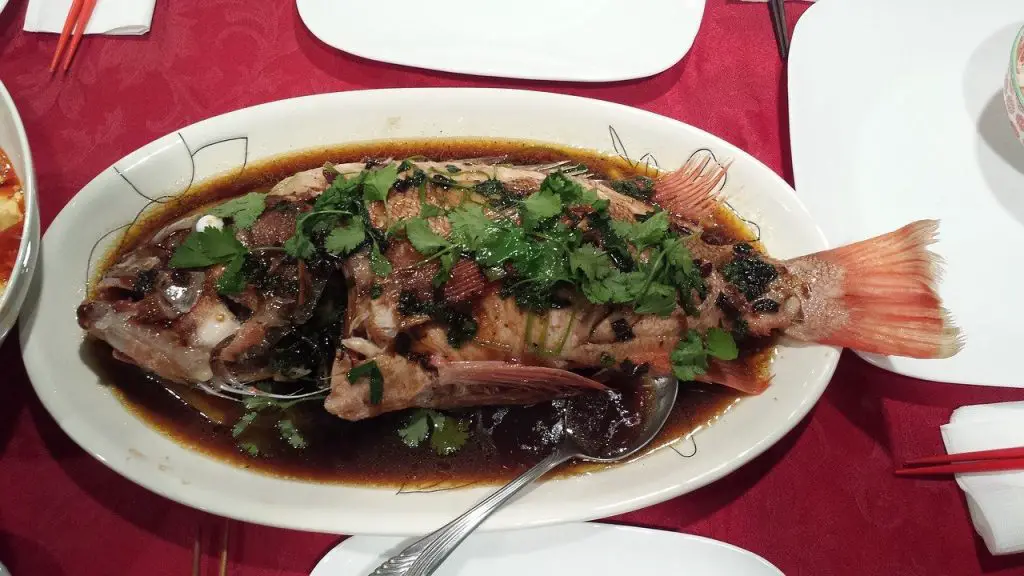
Steamed fish with soy sauce. Credit: Pixabay

The most common way to prepare your fish is to steam it. The important thing to remember, however, if you want tender fish meat is not to over-steam it.

Usually, it takes eight minutes for a smaller fish or 12 minutes for a bigger fish. According to Chef Leung Fai Hung, a fish weighing 1 catty (0.6kg) takes six minutes to steam, while a fish twice the size will take double the time.

Moreover, only place your fish in the steamer after the water has come to a boil.

When it comes to picking recipes, Teochew-style steamed fish is known for its sourness because of the use of pickled plums or pickled vegetables.

Meanwhile, the typical Cantonese-style typically uses light soy sauce, Shaoxing wine and sesame oil as flavouring.

Another common recipe for steamed is using fermented black bean.

Of course, the less healthy way to cook your fish is to fry it. After frying it, you can top it with any sauce you want, for example sweet and sour sauce or soy sauce.

With the Covid-19 pandemic still raging and homes experiencing flooding as the Year of the Metal Rat moves into the Year of the Metal Ox, why not try to cook a fish on your own while staying at home this Chinese New Year?

The significance of serving a whole fish for Chinese New Year dinner
Steamed fish with black bean sauce. Credit: Pixabay.
1 2 3 4 5 12