Browse Category

Culture - Page 13

MV Krait, the Japanese fishing ship that was used against the Japanese

If you want to raid the enemy’s harbour and blow up their ships without getting caught, what better way to do it than using one of the enemy’s own vessels?

MV Krait is a wooden-hulled vessel that was used in a raid against Japanese ships anchored in Singapore Harbour during the Second World War (WWII).

Codenamed Operation Jaywick, the mission was carried out by a special task forced called Z Special Unit.

They are mainly made of British and Australian soldiers who had escaped Singapore before its surrender.

The history of MV Krait

After the Fall of Singapore in 1942, civilians made their escape from the island on all kinds of boats and ships.

In the middle of the chaotic scene, an Australian master mariner named Bill Reynolds managed to salvage a little Japanese fishing boat.

The ship’s name was Kofuku Maru. Reynolds used her to rescue civilians fleeing the island and at one point evacuating over 1,100 people from ships sunk along the east coast of Sumatra.

Kofuku Maru eventually reached Australia and was handed over to the Australian military. The Allied forces then renamed her Krait after the small but deadly snake.

MV Krait and Operation Jaywick

Major Ivan Lyon, whom Reynolds came across with during his rescue work, became very interested in the Japanese vessel.

He conceived the idea of raiding Singapore Harbour using Kofuku Maru. Both Lyon and Reynolds realised that if the vessel could get out of Singapore unnoticed then she could get in unnoticed as well.

On Sept 2, 1943, eleven Australian and four British army and navy personnel as part of the Z Special Force went on board MV Krait left Exmouth Gulf, Western Australia heading to Singapore.

Today, blackface is considered rude and offensive since it was used to mock enslaved Africans. However, these operatives dyed not only their hair black but their skins as well for their disguise. The skin dye later caused many skin problems for them causing irritation and reactions to sunlight.

The crew even flew a Japanese flag and wore sarongs to look like the local fishermen.

MV Krait finally arrived off Singapore on Sept 24. There, six of them left the boat to paddle 50km to a small island near the harbour.

Then on the night of Sept 26, the men used folboats to paddle into the harbour and placed limpet mines on several Japanese ships.

The mission was successful, sinking six of the Japanese ships. The raiders waited until the commotion to die down before returning to Krait on Oct 2.

In the meantime, MV Krait spent two weeks circling in the South China Sea to avoid suspicion and waiting to return for the pre-arranged pickup.

On their way back to Australia, MV Krait was almost approached by a Japanese auxiliary minesweeper who was on patrol. Lucky for them, nothing happened and the Japanese did not suspect a thing. On Oct 19, the Krait arrived safely back at Exmouth Gulf.

MV Krait, the Japanese fishing ship that was used against the Japanese
Crew of the MV Krait during Operation Jaywick, 1943. Credit: Public Domain

The price of Operation Jaywick

The raid had caught the Japanese with their pants down. They never thought the Allied forces would attack Singapore.

Hence, their suspicion laid on the locals. The price for the successful Operation Jaywick was unfortunately paid by the blood of civilians and civilian internees who were captured and tortured by Kenpeitai (Japanese military police).

It went down in history as the Double Tenth Incident or Double Tenth Massacre since it occurred on Oct 10, 1943.

The Kenpeitai arrested altogether 57 civilians and civilians internees suspecting them to be involved in a raid on Singapore Harbour.

However, none of them had participated in the raid or even had any knowledge of it. In the end, 15 of them died in Singapore’s Changi Prison.

MV Krait after Operation Jaywick

After the success of Operation Jaywick, MV Krait was used continuously by the Australian military throughout WWII.

When the Japanese official surrendered on Ambon, Indonesia in September 1945, she was there to witness the historical event.

After her service, she was sold to the British Borneo Company at Labuan and operated off Borneo for few years.

In 1964, MV Krait was purchased as an Australian Royal Volunteer Coastal Patrol vessel. In the same year, she was dedicated as a war memorial.

Since 1988, she has been displayed to the public at the Australian National Maritime Museum, Sydney.

Since the success of MV Krait on Operation Jaywick, the Australian Commando Unit traditionally used the names of venomous snakes for their vessels.

5 strange epidemics you probably never heard of

An epidemic happens when there is a rapid spread of disease to a large of number of people under a short period of time.

When the disease is spread to other countries or continents and affects a large number of people, then it is called a pandemic, just like what the world is going through in 2020.

However, these epidemics are restricted to influenza. There are many strange and unheard of epidemics that baffle scientists to this day.

Here are five strange epidemics you probably never heard of:

1.The Dancing Epidemics of 1518

5 strange epidemics you probably never heard of
Engraving of Hendrik Hondius portrays three women affected by the plague. Work based on original drawing by Pieter Brueghel, who supposedly witnessed a subsequent outbreak in 1564 in Flanders. Credit: Public Domain.

Also known as the dancing plague , this epidemic took place in Strasbourg, Alsace (present-day France) in July 1518.

The account vary but reportedly between 50 and 400 people danced for days.

The outbreak started when a woman referred to as Frau Troffea started to dance with no signs of stopping in a street in Strasbourg.

By end of the week, 34 others joined her. Then within a month, the dancing crowd grew to 400.

Looking back at official records such as cathedral sermons, local and regional chronicles, city council reports as well as physician notes, mass dancing was clearly mentioned. However, there were no reasons given.

While some sources reported that the unique plague cost the lives of up to 15 people a day, there were no official records stating the number of fatalities.

Death is, nonetheless, possible. Imagine dancing for days without stopping, one could easily collapse due to dehydration and exhaustion. Moreover, there is no evidence that the dancers got jiggy with it out of their own free will. In fact, they reportedly looked afraid and desperate.

But what could lead these people to groove it unwillingly till they kicked the bucket?

Like many unexplained things in the world (such as the King Tut Curse), blame it on mold.

Some experts believed that ergot, a mold that grows on the stalks of damp rye could be the culprit. But there is one problem. When consumed, the mold (which can be found in bread), will cause violent convulsion and delusion, not dancing that lasts for days.

Meanwhile, another theory suggested it was due to stress-induced psychosis. It happened when people were starving and suffering from disease. The psychosis might have created a chorea, causing the body to move in random and intricate movements that looked like dancing.

The dancing plague is one of the strange epidemics ever occurred.

2.Tanganyika Laughter Epidemic

While it is called a laughter epidemic, this disease is no laughing matter.

It started on Jan 30, 1962 at a mission-run boarding girl school in Kashasha, Tanganyika (now Tanzania after being united with Zanzibar).

Three girls started to laugh and eventually the laughter spread throughout the school.

Eventually, the uncontrollable laughter affected roughly 1000 people lasting several months, causing the temporary closure of schools.

The laughing fits could last from a few hours up to 16 days.

Those affected also showed other symptoms such as crying, fainting, problem with breathing, and in some cases, rashes.

According to researcher Christian Hempelmann, the laughter epidemic could be described as a case of mass psychogenic illness (MPI).

It happens when there is a variety of high-stress settings. Hempelmann wrote, “The local situation in the school setting can also increase as it is a point of friction and transition where the students from the traditional tribal society are confronted with Western methods of instruction, educational expectations, and religious-moral values. In addition, the transition of students through adolescence takes place while they are separated from their families.”

Basically, the laughing fits were symptoms to anxiety and stress. Just like you would feel dizziness and headaches due to stress, these young girls were laughing instead.

Furthermore, Hempelmann pointed out that MPI a last a resort for people of a low status. For them, it is an easy way for them to express that something is wrong.

3.Kalachi Sleep Hollow

Sleep hollow is considered a possible medical disease causing patients to sleep for days or weeks at a time.

So far, this disease has only been reported in a remote village of Kalachi in Kazakhstan.

It was first reported in March 2013 and it has affected at least 152 people.

Villagers would fall asleep suddenly even while walking. They then woke up with memory loss, grogginess, weakness and headaches. Some of them even slept for up to six days at a time.

The sickness would affect both the young and the old. In some cases, the patients suffered from hallucinations.

At first, experts diagnosed the epidemic as “encephalopathy of unknown origin” or a generic term for brain illnesses.

They also suspected the nearby uranium mines that were closed after the fall of the Soviet Union as the root cause of the strange epidemic.

However, authorities did not detect significant amount of radiation or heavy metals to cause the phenomenon.

Eventually in 2015, the government announced they finally solved the mystery behind the strange epidemic.

The uranium mines were indeed the cause but not the way the experts imagined at first.

After the mines were closed, there was a high concentration of carbon monoxide in the area. This caused the oxygen in the air to be reduced accordingly, causing people to fall asleep.

A sleepy hollow, one of the strange epidemics that took place recently.

4.The meowing nuns epidemic hysteria

This event which took place in the early 14th century in northern France, is considered a mass hysteria or epidemic hysteria.

A nun at a secluded Catholic convent began meowing like a cat. Within one week, all the nuns at the convent started to meow and purr.

The bizarre meowing session even lasted for hours. Since the Catholic Church at the time considered cats to be the devil’s animals, the soldiers were employed to whip the nuns and the meowing ceased.

This was not the only bizarre mass hysteria that took place among nuns during the Middle Ages.

In the 1400s, a nun in a German convent began to bite her fellow nuns. This strange behaviour soon spread through other convents in Germany, Holland and Italy.

They eventually stoped biting when they were exhausted.

One theory is that many of these nuns were forced into convents by their parents. They were forced to a lifestyle of celibacy, poverty and manual labour. Plus, combined with the fact it was during the Middle Ages when people believed in supernatural things, these might be the cause of nuns meowing and biting.

5 strange epidemics you probably never heard of
Can you imagine a group of nuns meowing non-stop? It is definitely one of the stranger epidemics to have ever happened. Credits: Pixabay.

5.West Bank Fainting Epidemic

Occurring in late March and early April 1983, the 1983 West Bank fainting epidemic affected large numbers of Palestinians, resulting in 943 people being hospitalised.

The symptoms were headaches, dizziness, blurred vision, abdominal pain, weakness and fainting.

About 70% of them were teenage schoolgirls.

At first, authorities suspected mass chemical poisoning. However, there was no solid proof to this claim.

After schools were closed in the area, there were no additional illnesses reported. The most possible reason is psychological factors that the students were suffering from stress and anxiety.

Due to the conflict at West Bank between the Israelis and Palestinians, many of the reports surrounding the fainting epidemic were biased and some were even exaggerated.

A curious case of sleep hollow in Bintangor in 1937

The Sarawak Gazette has published many eyebrow-raising stories since its first publication in 1870.

Most of these incidents took place in Sarawak while others happened in other countries.

One of the strange incidents that was reported in the gazette took place in May 1937.

The headline of the report was “Asleep for a Week”. Is it possible for a person to sleep for one whole week?

Under certain circumstances, it is possible. The medical term for it is sleep hollow, not Sleepy Hollow (Tim Burton’s gothic supernatural horror).

The only known case of sleep hollow was reported in the remote village of Kalachi in Kazakhstan. The first case was reported in March 2013, after which the disease disappeared for some time before re-emerging in mid-2015.

Kazakh officials later discovered the disease was caused by carbon monoxide, along with other hydrocarbons as a result of flooding of an abandoned Soviet-era uranium mine nearby. These gases spread into the village air, causing sleep hollow among the villagers.

Kazakhstan may not have been the only place where sleep hollow has occurred.

Here is the report about a possible case of sleep hollow published in the Sarawak Gazette in July, 1937:

On May 1st, it was reported in Binatang (today Bintangor) that Sa’at bin Taha, master of the sailing vessel Mas Melayu, had mysteriously disappeared and his ship left Binatang for the coast without him.

An intensive search was made but no trace of him could be found, and it was generally agreed that he had tired of a seafaring life and had decided to retire into solitude on shore.

Great was the astonishment of the people of Binatang, therefore, when on May 7, Sa’at was found asleep in a sago godown.

After some minutes of strenuous effort the manager of the sago factory succeeded in awaking him. When he had been revived by copious draught of milk and broth, he immediately demonstrated a creditable sense of duty by enquiring where his ship was.

He was told that it had sailed a week ago, but he patiently explained to his dull-witted audience that this was impossible, as he had disembarked and visited the bazaar with one of the sailors on the previous evening.

It is firmly believed in Binatang, that Sa’at bin Taha had been asleep for a week.

A curious case of sleep hollow in Bintangor in 1937

Can Sa’at be considered suffering from sleep hollow? Is it possible that the sailor accidentally inhaled some carbon monoxide? We might never know.

Rowan Waddy and his experience as a Semut Operative in Sarawak

Operation Semut was a series of reconnaissance operations that took place in Sarawak.

It was carried out by Australia’s Z Special Unit in 1945 during the final days of World War II (WWII).

Altogether, there were four operations were undertaken under Operation Semut.

Their main objectives? To gather intelligence and to train the indigenous people in launching guerrilla warfare against the Japanese.

Commando! The M/Z Unit’s Secret War Against Japan (1996) is a book compiled and edited by A.B. Feuer.

The book is a compilation of stories from Australian commandos who fought against the Japanese in Borneo during WW2.

In it, readers can find an interesting story of Australian Lieutenant Rowan Waddy and his experience in Sarawak. He was a part of Operation Semut IVB.

From Aug 13 to 23, 1945, Semut IVB sailed out of Labuan via HMAS Tigersnake and moored at Mukah. Together with Lieutenant Ron Hoey, Waddy paddled Hoehn folboats (collapsible canoes) journeyed along the Mukah river to engage any remaining hostile Japanese groups.

They continued to work in Sarawak until October 1945 to secure the surrender of remaining Japanese troops.

Rowan Waddy and his experience as a Semut Operative in Sarawak
HMAS Tiger Snake. Public Domain.

Rowan Waddy on working with local guerrillas

Here, Waddy had the opportunity to work with the locals, especially the Ibans.

Commenting about them, Waddy stated, “The Ibans are a paradox. Despite their warrior reputation, they are a happy, fun-loving people- highly superstitious and tattooed – with long black hair and cut-extended earlobes. The Ibans are also loyal, brave and love to fight. Their weapon is the blowpipe (sumpit) using poisoned darts. The dart is about 20cm long and perforated near the point. After the dart enters the skin, the shaft easily breaks off, leaving the poisoned tip embedded in the flesh. It can take from 20 minutes to 24 hours of agonizing suffering to kill a person. There is no doubt that the Japanese feared the Ibans more than they did the Australians.”

Waddy also commented on how the Ibans were always in the lead while on patrol, always moving without caution and always looking for action. Waddy often was forced to hold them back.

Additionally, the Ibans had great eyesight, even working in the dark jungle. In one of the nights which Waddy described as ‘so dark that it was impossible to see one’s own foot’, an Iban man who carried spare magazines for his gun stayed closed by.

Waddy shared, “He constantly made slight physical contact, which was indeed reassuring. If the Iban wanted me to stop, he would give a gentle tug on my sleeve, slide his arm over my shoulder, and point in the direction he wanted to look, but I could not see or hear anything unusual.”

The importance of local cooperation

It was crucial for these soldiers to work closely with the locals. According to Waddy, agents inserted into enemy-occupied Europe did not have the problems of colour or stature.

There, they blended in with the local population but not in Borneo or throughout the Southwest Pacific.

“White Europeans, with large builds, attracted a lot of unwelcome attention. Therefore, to ensure success, it was essential that the local population was friendly and cooperative,” Waddy noted.

Thankfully for Waddy and most Semut operatives, the locals were being cooperative to them.

Although the Ibans in particular never heard of Australia before, and thought the Semut operatives were British.

Rowan Waddy and his Japanese head

During one of the combats under the Semut Operation, Waddy successfully killed a Japanese soldier.

He described what happened after the battle when he returned to his boat, “The Ibans followed after burying the body. I had no sooner taken my seat in the perahu than a thin, torn burlap bag was dropped at my feet. To my horror it contained the bloody head of the soldier I had killed.”

The Iban guerillas had cut off the soldier’s head, extracted the brain and brought it back with them.

From there, Waddy managed to witness Iban traditions no longer practiced to this day.

According to Iban tradition, the head officially belonged to Waddy. For the next couple of weeks, the head was always hung where he slept.

Describing the smoking process, Waddy wrote, “The head was positioned above a slow fire that was covered with thatching, allowing the smoke to continuously encircle the head. The heat caused the fat, especially from around the cheeks, to slowly drip and sizzle in the fire – not unlike sausage a barbecue grill. At all times there were Ibans squatting and gazing longingly, with admiring smiles, at the head and the sizzling.”

Waddy goes on to describe the rest of the effects of the smoking process, and how the smoking drew the skin taut across the face, and the skin split down one side, revealing the teeth, and “leaving the head with a permanent grin.”

Celebrating the head and its owner, Rowan Waddy

After the skin on the head was dried, it was now the time for the Feast and Dance of the Enemy Head.

According to Waddy, it was an amazing experience.

The event lasted two days and nights which began outside the longhouse before moving inside the long communal room in from of the fifteen doors.

As the “owner” of the head, Waddy was one of very few white men who had ever witnessed and participated in the head dance.

There were dancing and chanting as well as beating of the gongs and drums. While Waddy described the atmosphere and excitement as electric, he said that the ceremonies were sparse compared to what they normally would have been.

This was due to the food shortages forced upon the locals by the Japanese.

Rowan Waddy on the tension between the Chinese and the Iban

Speaking about the locals, Waddy could not help but notice the tension between the Iban and the Chinese during the war.

He noted, “There is no love lost between the Chinese and the Ibans. The Chinese are traders, and comparatively wealthy. On the other hand, the Ibans are simple, communal jungle people who love to hunt heads including Chinese collaborators. The Ibans look down upon the Chinese – the Chinese fear the Ibans.”

Waddy related a story on how he received an unconfirmed report that a small party of Japanese were hiding out in a nearby village when he was in Bintulu.

Since he was busy at the time, his fellow companion Penghulu Blaja from Kanowit volunteered himself to go have a look.

He agreed but he instructed them not to attack or kill any Japanese soldiers, only to observe.

The next day, a group of Chinese showed up wanting to see the Military Governor.

Apparently, there was a loud argument between the Chinese and Iban the previous night and several Chinese were killed.

Waddy immediately sent for Blaja. As it turned out, the penghulu was behind the attack.

After sending the Chinese with Malay police escort, Waddy asked the penghulu why he disobeyed his order.

To that Blaja insisted that he had not disobeyed Waddy’s order as the order was not to kill any Japanese. Blaja argued however that Waddy never told him not to kill Chinese, especially those who had collaborated with the enemy.

Waddy eventually was forced to admit that Blaja had a point.

Rowan Waddy and his experience as a Semut Operative in Sarawak
Lieutenant Rowan Waddy and Penghulu Blaja in an undated photo. Credit: Australian War Memorial

Rowan Waddy’s final goodbye to Sarawak

Not long after that, the operatives received orders that all special operations in Sarawak were to cease and members of Z unit were to be out of the field by Oct 15, 1945.

On Oct 11, Waddy handed over command of his district to Major Futter of the British Borneo Civil Affairs Unit (BBCAU).

Waddy wrote, “The night before we left Bintulu, Les Royle, Max Newton and I were treated to a memorable farewell party – an unforgettable feast with ample supplies of rice wine. We played many games with Penghulu Blaja and the happy Ibans. The festivities went on until the early hours of the morning.”

The Australian commandos reportedly taught the Ibans how to play musical chairs and how to dance the Hokey Pokey.

On his final thoughts about leaving Sarawak, Waddy stated, “I had mixed feelings when our Catalina took off later in the day. I had left many friends behind. But, for the first time, I realised that the war was finally over, and I had survived. Still feeling the effects of our emotional farewell, I did not remember much at all about that flight.”

A Bidayuh legend of seven blind brothers and the origin story of Gawai Timpijog

Here at KajoMag, we love folklore and legends that people hardly ever heard of. Here is one about the story from the Bidayuh community about seven blind brothers:

Once upon a time there were seven brothers named Patu, Laja, Rangan, Tungulino, Bunga Nuing, Buku Tabu, and Mamang, the eldest.

They were all born blind, and to poor parents who found it a problem to provide for them.

Much of the time, they had nothing to eat. However, despite these hardships, they grew up fit and strong.

When the brothers felt able to start working, they each made a string, then joined the pieces together, coming up with a string that stretched up to more than 1 km. This they used as a guide-line to help them find their way back after going out into old jungle.

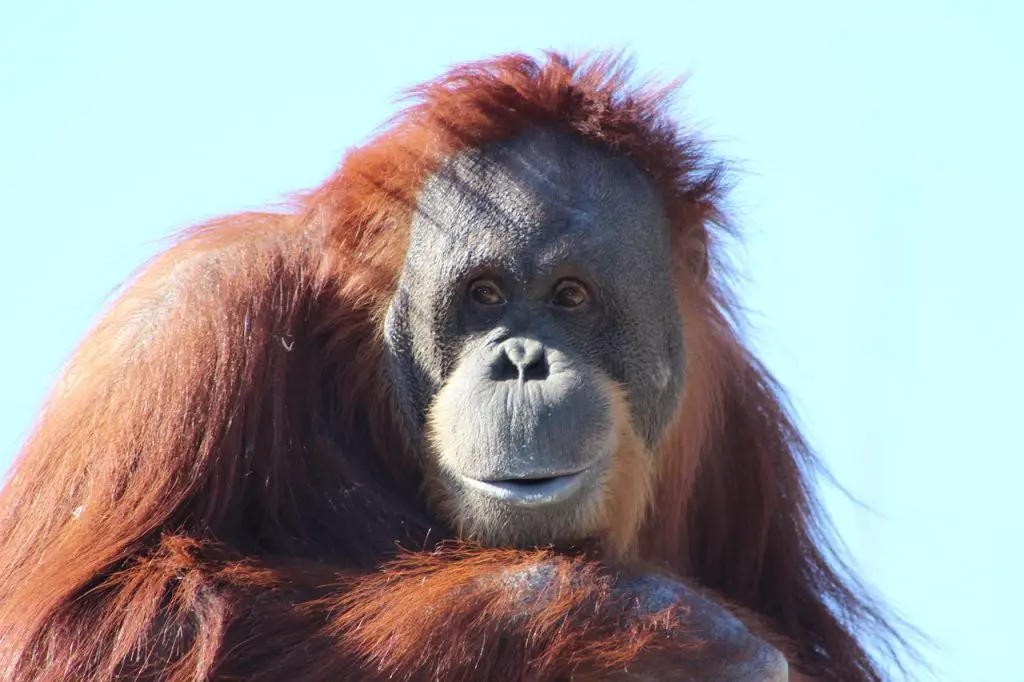
The seven blind brothers and an orangutan

A Bidayuh legend of seven blind brothers and the origin story of Gawai Timpijog
Orangutan. Credit: Pixabay

One day, they decided to go on a ‘tuba’ fishing expedition (tuba the plant with poisonous roots, not the brass instrument).

They tied the end of the string to their house and set off with their tuba roots, reeling out the string as they went. Upon reaching a stream, they threw in the roots, waited for the fish to die, and later gathered and cooked their catch.

Unbeknownst to them, an orangutan joined in their feast, eating the fish as it was served. The brothers, being unable to see, blamed each other for stealing the fish but could not decide who was the culprit.

Eventually one brother grabbed the orangutan’s hands.

Figuring out what had actually happened, with the help of his other brothers the orangutan was squeezed to death.

The brothers then prepped the orangutan for cooking and it was thoroughly enjoyed by them all.

The blind brothers gain their eyesight

At the end of the meal, one brother accidentally swallowed a bone which stuck in his throat. He gave a hard gulp, and to his surprise, his eyes opened and he could see. He told his brothers to swallow the bones too; to their delight they also were able to see.

The brothers decided to go on a wild boar hunt now that their sight was restored. They went into old jungle and killed many boars, which they smoked over a fire. Some of the meat was preserved.

Each day one brother in charge of the cooking would stay by the camp, but was frightened by daily visits from a huge wild man.

The brother would run into the jungle as soon as the visitor appeared, abandoning the smoked and preserved boar to the wild man.

The other brothers got very angry on returning to the camp and finding their meat already eaten.

Each declared he would fight and kill the wild man if he appeared again. So they took turns at guarding the camp. But all felt afraid at the visitor’s approach and ran away.

Mamang and the wildman

Then it came to Mamang’s turn to be on guard. He collected plenty of rattan vines and began to plait them in preparation for making a trap.

When the wild man appeared, he asked for some smoked pig but was diverted by the sight of Mamang plaiting his rattan. He sat close to Mamang and asked what he was doing.

Mamang replied he was tired from boar hunting and hoped the plaited rattan tied around his knees and elbows would cure him. (It was common in those days for aching knees and elbows, even wounds, to be covered with plaited rattan.)

He explained he had often used this treatment and found it most effective.

The wild man said he too was tired and asked to be treated. Mamang replied that such treatment deserved a good reward or the cure would not be a complete success.

Hence, the wild man offered the choice of one of his granddaughters in marriage.

Not wanting to be cheated, Mamang wisely said he must see the girls first before treatment started, so they together went to the wild man’s house.

Mamang’s choice for marriage was the youngest girl, whom he marked and covered in soot and charcoal.

The ‘treatment’ on the wild man

Back at the camp, treatment commenced with plaited rattans being fixed around the wild man’s knees and elbows. Mamang then put pieces of wood across the knots, and when the wild man complained of being hurt, he said this was part of the treatment.

The patient was eventually tied so thoroughly that he lay immobile on his back. Mamang then searched for a wooden club and used this to beat the man.

After a short struggle, the wild man lay dead. With the corpse pulled behind the camp, Mamang went to rest.

Later that evening the brothers returned with two pigs. They saw Mamang fast asleep, but as the smoked boar was safe, they could not accuse him of lazing around.

The pigs were cleaned and some were smoked over a large wood fire. When the fire burned low, Mamang told his brothers to fetch more logs from behind the camp. They were horrified to find the wild man’s corpse there, and ran back to ask him how it had been done.

Meanwhile, Mamang did not bother to tell them of the killing. Instead, he told them about the granddaughters they had been promised as wives.

He said they were all beautiful, except the youngest whom he described as filthy and ugly.

The last one to claim his bride would end up with this girl, he warned.

Seven brothers taking new wives

Next morning they set off to the wild man’s house, Mamang at first taking the lead but later falling back.

The brothers rushed into the house to take their choice. Mamang, being last, found only the blackened one left for him.

Before long they all had a wash, and then it was revealed that Mamang’s girl was the most beautiful after the charcoal was washed off.

Her name was Dayang Nion. The two were married and lived in the wild man’s house, while the rest of the couples made their homes nearby. Later the parents and then the whole village moved to the new site, and found life very pleasant there.

Patu lusting over his brother’s wife

Several months passed before Patu, who dearly loved Mamang’s wife, Dayang Nion, said he wished to make an exchange. She did not agree with this so Patu decided to kill Mamang.

Patu told the people he was sick and asked Mamang to go out and get certain pig and fish delicacies for him to be found only in very dangerous country.

Thankfully, Mamang survived the dangers. But when the cooked foods were offered, Patu said he had no appetite.

Next Patu asked his brother to trap pheasant, again in dangerous jungle, and once more refused to eat the birds when they were served. Finally he asked Mamang to collect mushrooms from a certain tree which he pointed to.

Dayang Nion knew of Patu’s evil intentions and warned her husband that the tree was old and unsafe.

However, he went ahead; the tree gave away under the man’s weight and Mamang soon lay dead on the ground. The body was buried and Dayang Nion mourned her husband for the customary five days.

Dayang Nion searching for her husband Mamang in the afterlife

When the five-day no-work taboo and grieving period was over, the widow set out from her home through old jungle determined to follow Mamang into Sibayan, the underworld, despite her mother in-law’s advice to the contrary.

She walked for several days and nights, and met eight kinds of freshwater fish. There were ikan bantah, ikat pait, ikan dungan, ikan puteh mpahat, ikan siluang, ikan buhing, ikan toman and ikan limpasih.

From these fish, Dayang Nion asked news of Mamang. Each said they had seen him pass, the ikan limpasih saying he had just gone by.

Dayang Nion quickened her pace and suddenly came upon Mamang watching a cockfight with people of the underworld.

Dayang Nion brings her husband back

Wanting to get her husband back from the underworld, she asked Tayung Kamayuh’s advice. She was an old woman who always helped those in need.

Unfortunately, Tayung Kamayuh said nothing could be done.

Dayang Nion went back to the place where she had last seen Mamang and called for him to return with her to the real world. He replied that he did not wish to return; people living on earth were bad, and anyway he was enjoying himself.

Tayung Kamayuh took pity on Dayang Nion in her sorrow and suggested she make several kinds of cake from rice flour. These were to be put on the roof of the old women’s outer verandah and would look like starlight. She said Mamang usually came to rest on the outer verandah, and if he saw the cakes, he would stop to count them.

Dayang Nion was told to seize Mamang while he counted and not be frightened if he transformed into a snake, centipede, dragon or other animal. Only if he changed into an egg was she to show fear.

Dayang Nion tried to remember the instructions most carefully as she was anxious to rescue her husband.

Next evening, Mamang came as expected to shelter on Tayung Kamayuh’s outer veranda, being tired after cockfighting.

He saw the cakes shining on the roof and began counting them, unaware of Dayang Nion until she seized him.

Mamang changed in turn into various animals as the old woman had warned, but Dayang Nion held tight. Only when Mamang finally turned into an egg did she show fear. She took the egg to Tayung Kamayuh.

Mamang coming back from the dead

On the following day, the old woman asked Dayang Nion to kill a young chicken and together they held a small ‘makan selamat’ (thanksgiving) dinner.

Dayang Nion’s next instruction were to fall six times on her way home, taking care not to break the egg as it now held her husband.

On the seventh fall, she was to put her full weight on the egg and Mamang would appear, although he would be unconscious. She was to bless him with a live chicken, at the same time saying this prayer:

Indi, duwuh, taruh, mpat, rimuh, inum, ijuh, tampa sua, tampa basa. Aku itih masi ihang Mamang massu tanah samar tanah dakus, tanah Sibayan mada nuh maring asla maring indih, mada nun marui missia lagi.

This means:

One, two, three, four, five, six, seven,

Oh! God Almighty, God of the religious,

I here bless Mamang’s soul,

Let it return to the beginning from the wasted and dirty places,

From the spirits of the underworld,

And become man again.

These instructions were to be remembered carefully. Dayang Nion then set off homeward with the egg and did exactly as she had been told.

After the seventh fall and recital of the prayer, Mamang did indeed come to life. Dayang Nion told him their adventures, for he thought he had been merely deeply asleep.

Mamang returns from the dead

They continued homeward together to be met at the village by overjoyed parents. A special feast was celebrated for Mamang’s return from the underworld, called the Gawai Timpijog.

Everyone in the longhouse had a good time dancing, singing and eating. Patu persuaded Mamang to dance with him but Mamang had planned revenge. While dancing, he pierced his brother’s throat with a bamboo tuak wine container and Patu fell down dead.

Nonetheless, this incident did not deter the party as they continued to enjoy themselves. The Gawai Timpijog lasted for three days.

When it was over, Patu was buried with respect. People suggested his wife should try to regain her husband from the underworld, as Dayang Nion had. However, she declined saying he had been killed with good reason.

Thus was the Gawai Timpijog inaugurated and it is to celebrate the passing of a person’s spirit to the underworld.

This legend was recorded by R. Naen and R. Nyandoh and was published in the Sarawak Gazette on Jan 31, 1965.

The locust plague that hit North Borneo in 1919

Do you know a plague of locusts once hit North Borneo about a century ago in 1919?

The Sarawak Gazette on Dec 16, 1919 reported that until that year North Borneo had never suffered from a locust plague on a big scale.

The locust plague that hit North Borneo in 1919

“As far as is known the only occasion on which they have appeared previously was about fifteen years ago in the Tenom district, when they died out spontaneously without increasing to large proportions.”

The 1919 locust plague started in Tempasuk (Kota Belud) at the end of December 1918.

“The insects rapidly increased in number- their multiplication being doubtless assisted by favourable weather conditions and by June of this year they head spread to Kudat and Mempakad on the north, Membakut and Kuala Penyu on the south and Parenchangan in the Interior residency on the east,” the report stated.

By June, the locust plague hit the river Bengkoka in the Marudu district, the Sipitang district and the river Lingkabao in the Sandakan residency.

Fighting against locust plague

Since the locals and administrators of North Borneo were not familiar with locust plagues, they initially did not know how to fight it.

Eventually, they came up with a very labour-intensive solving method.

The report stated, “The first method of destruction used was to drive the hoppers into traps composed of sheets by a strip of smooth oilcloth sewn near the top. A pit was dug at the apex of the trip and filled with water with a little crude oil on the surface; on falling into this the locusts were immediately killed.

Another method to kill them, especially when labour was scarce is to poison them. The vegetation on which they were feeding was sprayed with sodium arsenite ‘with molasses being added to make the poisoned substances attractive’.

These methods were successful in killing the locusts, save for small swarms that escaped their fates.

By the end of 1919, North Borneo was almost free of locust plague. However, patrols were still being maintained to guard against the possibility of scattered individuals multiplying into swarms.

3 theories on Kayan migration to Borneo island

3 theories on Kayan migration to Borneo island
When the Kayans are naming a child, or engaged in any special ceremony, such as going on the war-path, matches may not be used and fire must be made by drawing rattan backwards and forwards on a piece of soft, dry wood. Credit: Public Domain.

When speaking about Kayan migration, many would immediately think about the Kayan who migrated from Apo Kayan in North Kalimantan, Indonesia to Sarawak specifically to Baram and Upper Rajang rivers.

According to legend, the Kayan people are the forefathers of all smaller sub-ethnic Dayak people found along the Kayan River in Kalimantan.

3 theories on Kayan migration to Borneo island
Kayan river in North Kalimantan.

Many historians and ethnologists, however, have their own theories on Kayan migration before arriving in Borneo.

So where did the Kayan people come from in the first place before they found themselves on the island of Borneo?

Here at KajoMag, we look through the various notes and theories of Kayan migration:

1.Harrison W. Smith in Sarawak: The Land of the White Rajahs (1919)

About 100 years ago, a National Geographic writer and photographer visited Sarawak. The result of that visit is an article entitled, “Sarawak: The Land of the White Rajahs”.

This is what Smith wrote about Kayan migration, pointing out that they might have entered through southeastern Asia.

Perhaps the most interesting tribe in Sarawak and one of those least affected by contact with foreigners is the Kayan, which occupies the head-waters of the Baram and Rejang rivers, in the northerly part of Sarawak, extending also into Dutch Borneo.

These people for unknown generations have lived almost entirely isolated in the interior of the island. There are many reasons for believing they are of Caucasic origin, having entered Borneo from southeastern Asia, where they received infusion of Mongol blood and separated from the people of their their own race, who were the progenitors of the present Karen tribes of Lower Burma.

It appears that the Kayan came to Borneo by the way of Tenasserim, the Malay Peninsula, and Sumatra, later penetrating up the rivers of Borneo.

One notices the features of some Kayans that very strongly suggest Caucasic origin, this being particularly true of the upper or ruling classes, who would be most likely to preserve their racial stock uncontaminated by mixture with conquered tribes.

Many Kayans have very light skin, particularly those of the interior and those who have been little exposed to the sun. The tribe believes in a large number of deities, with one supreme being at the head, thus resembling the Greek mythology.

Many of the details of the methods of taking omens among the Kayans by the flight of birds and the examination of the entrails of animals present extraordinary points of similarity with the Roman methods of taking the auspices.

2.Charles Hose’s theory on three phases of migrations into Borneo

British colonial administrator, zoologist and ethnologist Charles Hose also had his own speculation on the origin of not only Kayan people but the Borneo peoples in general.

Writing for the preface of Hose’s Natural Man, Professor Elliot Smith suggested that the possibility of the transmission to Borneo of certain customs known among the ancient Egyptians, Romans, Babylonians, Estruscans and Persians.

Meanwhile, Hose proposed that there were three migrations into Borneo.

The first group is the ancestors of the Kayan people of central Borneo whom he suggested had migrated from the Irrawaddy Basin in Burma via Sumatra.

The Muruts had then followed from the Philippines or Annam. Lastly, the most recent arrival, which Hose supposed took place in the seventh century, were the ancestors of the Ibans.

Hose believed that they were brought from Sumatra as ‘pagan fighting men’ by Malay nobleman.

Additionally, Hose theorised that groups such as the Punans, Kenyahs and other smaller groups were then assumed to have been the original populations of the island ‘going back possibly to the time when Borneo was still continental’.

Other than the supposed racial and cultural differences within Borneo and the assumed similarities with populations outside Borneo, Hose had no firm evidence for his migration theory.

3.Ida Laura Pfeiffer’s comparison of the Dayak of Borneo and Seram Island

Ida Pfeiffer went down in history as one of the first female travelers of the world.

This Austrian explorer had journeyed an estimated 32,000 km by land and 240,000 km by sea through Southeast Asia, the Americas, Middle East and Africa including two trips around the world from 1846 to 1855.

In her travel book A Lady’s Second Voyage (1856), she commented on the similarity between the Dayaks of Central Borneo and the mountain Alforas of Seram island in current-day Maluku province of Indonesia.

She stated of the latter that their customs “agreed so much with what I had observed among the Dyaks that I feel convinced that the Alforas may be classed as their descendants of collateral relatives.”

While some writers believed the Borneo people came out of the west, writers such as Pfeiffer suggested that they came from the east.

This is due to their resemblance of their way of living to the tribes of Celebes and the more eastern islands such as New Guinea.

Regardless, all of these theories on Kayan migration to Borneo all have one thing in common that they are all just theories without any physical evidence.

They are all just based on the cultural similarities between Kayan people and the tribes at the other part of the world.

Do you know any Kayan migration theories we should know about? Let us know in the comment box.

5 stories about the Sihan people you should know about

5 stories about the Sihan people you should know about

With less than 300 Sihan people in Sarawak (as of 2012), any stories about their legends, customs and histories are very precious and important.

As recorded by Benedict Sandin in “Notes on the Sian (Sihan) of Belaga” for the Sarawak Museum journal, the Sihan speak the same language with Punan Bushang and Punan Aput, and not with other Punans.

In ‘Language Vitality of the Sihan Community in Sarawak, Malaysia’ by Noriah Mohamed and Nor Hashimah Hashim, the Sihan people, who identify themselves as Punan, migrated to Belaga from Namang River, after moving from their original settlement in Mujong near the Baleh River.So here are 5 stories about the Sihan people you should know about:

1.The ancestors of the Sihan people

A Sihan man named Jingom Juroh once told a story to Sarawak Museum about the ancestors of the Sihan people.

“I know that a spirit begot our first ancestor called Kato’o. He was born overseas. Kato’o was a brave hero who fought and won many wars against other people. Upon seeing his bravery his children began to become afraid of his actions. Knowing that his children worried about him, he ordered them to use only bamboo spears, and not with other kinds of weapons so that they could not harm him.

However, they killed him with the bamboo spears. After his death the bamboo spears which pierced him grew to become a high mountain. We do not know where this hill is, but according to our history it is somewhere overseas.

Kato’o sons immigrated from overseas. Their names were Belawan Jeray and Belawan Tiau. The two brothers lived in the Mujong. From Mujong Belawan Tiau led his followers to migrate eastward to Kapuas. Therefore in the Kapuas quite a number of Sian (Sihan) lived.

Belawan Jeray died in the Mujong. After his death his son named Maggay migrated to the Pilla and died there. After his death his son Gawit moved to Seggam and died there.”

Mujong is a tributory of Baleh river and Pilla is a tributory of the Rajang river.

2.Life of the Sihan people before they settled in the longhouse.

Unlike most indigenous groups in Sarawak, the Sihan people originally lived in huts like the Penan people.

They did not live in longhouses.

Jingom was 56 years old when he shared this to the Sarawak Museum in 1961: “We Sihan have never joined other races to live in longhouses. I remember that we start to farm when I had already grown up to about the age of thirteen years. We started to live in longhouses from the time we were taught to farm by the Kejaman chief Akek Laing alias Matu.”

He added, “During our nomadic days we have no other tool to use other than the axes. We got iron by bartering with the Kejaman our jungle produce such as rattan baskets and mats. Till this day though our people still can make baskets and mats, but we do not keep them because we sell them to the Kayan and others.”

The Sihan people also did not make blow pipes. Only after they traded blowpipes from the Penan did they hunt for birds and animals. Before that, they relied on fish as their source of protein.

Additionally, the Sihan people did not rear domestic pigs but chickens. With regards to fruits, they collected wild fruits when they were nomadic. They started to plant fruit trees after they settled in longhouses.

3.The legend of Batu Balitang

When the Sihan people were still living at Mujong, there was a man who went out shooting animals with his blowpipe.

As he roamed the forests, he did not find anything.

When he was on his way home, he saw a huge shining animal standing on the bough of a tree. It looked like a rainbow.

The man shot at it several times with his poisonous darts, but could not kill it.

The hunter returned to his hut to bring his friends for help.

While explaining to his friends what happened, they heard a very loud sound as if something falling from the sky.

Everyone, men and women alike, ran toward the source of the noise and found an animal lying on the ground.

Rejoicing over the fresh meat, they cut the animal up and cooked it. Everyone in the village ate the meat, except a pair of brother and sister.

Unbeknownst to the villagers, the animal they feasted on was a demon. That night when they slept, the demon’s wife came.

As she came, she danced from one home to another, looking for the people who ate her husband.

She found that all except two, had eaten her husband. Hence, she ordered the brother and sister to escape instantly and never look back.

The demon’s wife ordered them to go to a certain stream not far away on the left of the Mujong above their village. In order that they may know this place, on her way to the village the demon’s wife had cut a certain small tree as a sign.

The two siblings fled as directed. After they had gone, a great wind blew and a heavy rain began to fall. During the storm, the houses gradually became stone, becoming what has become recognised today as Batu Balitang.

After all the villagers became stones and boulders, the siblings got married and became the ancestors of Sihan people.

4.The truth about headhunting among the Sihan people

While most indigenous peoples in Borneo have a long history of headhunting, the Sihan people tried their best to avoid them.

However, they did fight against Iban and Bukitan headhunters about a century ago.

Many people were killed on both sides of the war.

The Sihan people reportedly did not value the heads of the enemies as trophies, even throwing them away.

5.The burial customs of the Sihan people

Immediately after a Sihan person dies, their bodies are cleaned with water. After that, the deceased is dressed in clothes made of tree bark.

All of their possessions like axes and baskets must be buried with them.

Unlike the Kayan who used to erect Salong, or burial poles, to bury their dead, the Sihan people will cut a tree for the coffin.

When it is complete, the coffin is placed inside for burial. The burial usually takes place on the second day after death.

Then two nights after the burial, a fire will be lit outside the house. The Sihan people believed that in the nights after the burial, the soul of the deceased will wander about intending to return to the house. As for offerings, they place sago by the fire.

The Sihan traditional belief is that when one passes away, thunder is usually sounded. With the sound of this thunder, it is believed that the soul of the deceased is carried away to heaven above.

First shots of the Pacific War were fired at Kota Bharu, not Pearl Harbour

When it comes to the Pacific War, most people believe that the first shots that began it all was Pearl Harbour.

Little do most people know that the first attack actually took place in Kota Bharu, the capital of Malaysian state of Kelantan, as part of the Japanese invasion of Malaya.

The Japanese landed at Kota Bahru at 12.25 am on Monday, Dec 8, 1941 and first attacked Pearl Harbour at 8am on Dec 7, 1941 (local times).

Are you sure Kota Bahru was the first to be attacked? You ask, as you read the dates.

Due to Malaya and Hawaii being on the opposite sides of the International Date Line, the Japanese actually launched its assault on Kota Bharu about 1 hour and 35 minutes before the attack on Pearl Harbour.

The Japanese attack on Kota Bharu and the whole of Malaya

Now the next question is why Malaya?

According to Australian War Memorial, Malaya was a key British colony prior to Second World War (WWII).

It was the source of large quantities of natural resources, particularly tin and rubber. Furthermore, it strategically provided a large defensive barrier to any landward advance on Singapore and its naval base.

The island was the cornerstone of British power in the Asia-Pacific Region.

Knowing the importance of Malaya, the Japanese began planning for an invasion as early as October 1940.

One local survivor told the Japan Times in 2009 that he remembered one particular high-ranking officer widely known as Kawasaki.

Before the war, the locals used to see him riding a bicycle around the villagers selling shrimp rice crackers and speaking fluent Malay. As it turned out, ‘Kawasaki’ was a high-ranking officer who was in-charge of the troops in Kota Bahru.

The first troop against the Japanese was the British Indian Army

When the Imperial Japanese Army first landed at Padang Pak Amat beach, they were ‘greeted’ by the British Indian Army.

Local survivors heard the Indian soldiers were singing Hindi film songs on the beachfront when they saw Japanese landing craft approaching.

Before the Japanese landing, the British had fortified the narrow beaches and islands with land mines, barbed wire and pillboxes.

Colonel Masanobu Tsuji in his book wrote, “The enemy pillboxes, which were well prepared, reacted violently with such heavy force that our men lying on the beach, half in and half out of the water could not raise their heads.”

True enough, the defence was working well, at least in the beginning. The Japanese casualties in the first and second waves were heavy.

While there were some progress, the British forces were not able to completely wipe out the landings on the beach.

Air attacks

First shots of the Pacific War were fired at Kota Bharu, not Pearl Harbour
Camouflaged A6M (Zero) fighter aircraft of 22 Air Flotilla, Japanese Navy, on airstrip at Kota Bharu. This unit flew into Kota Bharu from South Vietnam and operated along the East Coast of Malaya including flying “top cover” for the successful Japanese air attack on the British war ships HMS Repulse and HMS Prince of Wales. Credit: Public Domain.

The moment it was confirmed that the Japanese had attacked, the British air force at Kota Bharu received permission to launch an attack.

The first wave of seven aircraft made the initial attack at 2.10am. These aircraft continued to drop bombs on the Japanese until 5am.

All the Japanese transports were repeatedly hit at this time. Colonel Tsuji wrote, “Before long enemy planes in formations of two and three began to attack our transports, which soon became enveloped in flame and smoke.”

Despite the strong defense, the Japanese had three full battalions ashore at Kota Bharu by 10.30 that morning.

The British forces who were forced to retreat, fled the Kota Bharu airfield without destroying anything. This action left the Japanese invaders a fully working airfield along with fuel and ammunition.

At the same time, the Japanese troops also landed at Patani and Singora on the south-eastern coast of Thailand.

With this, the landings at Kota Bharu allowed the troops to proceed to the eastern side of the Malay peninsula. Meanwhile, the troops in Thailand advanced down the western side.

First shots of the Pacific War were fired at Kota Bharu, not Pearl Harbour
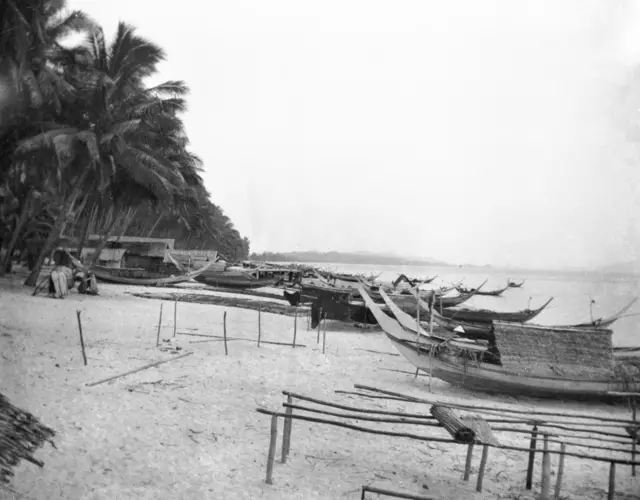
Bachok Beach, Kota Bharu, Malaya. 1941-07. Local fishing boats (perahu) pulled up on the beach, possibly at one of the points where the Japanese invasion troops landed on 1941-12. (Donor E. Cooke-Russell). Copyright expired.

The local villagers’ experience

A group of 30 local villagers came across the Japanese forces during the invasion.

They tried to escape but the Japanese ordered them to dig trenches and stay inside to avoid getting shot in the gunfire exchange.

The locals had to dig the holes in the sand with their hands. Overwhelmed with fear, they stayed in the trench for three days.

When they finally came out from it, they found about 380 dead Japanese soldiers.

The Japanese then cremated their dead comrades.

They stayed in the areas for about two weeks before moving to other locations. The Japanese reportedly did not cause any problems for the locals taking away their livestock.

Only three villagers reportedly died during the attack at Kota Bharu.

The aftermath

As for the British and Japanese troops, there is no official death toll. For the Japanese, they suffered an estimated 300 deaths and 500 wounded. The British casualties and losses were estimated at 68 fatalities, 360 wounded and 37 missing.

Regardless, the attacks on Kota Bharu were one of the most violent battles of the whole Malayan Campaign.

The Brunei Civil War and how it led to Sulu’s claim over Sabah

The Brunei Civil War took place centuries years ago from 1660 to 1673. However, the consequences from this particular warfare seems to have an effect even to this day.

Adding on to the element of disbelief of this piece of history, the Brunei Civil War had, in fact, started from a cockfight.

The Brunei Civil War, a warfare which started from a cockfight

Pengiran Muda Bongsu, the son of Brunei’s 12th sultan, Sultan Muhammad Ali, had been indulging in a round of cockfighting with Pengiran Muda Alam, the son of the chief minister (only second to the sultan), Bendahara Abdul Hakkul Mubin.

The innocent cockfight turned bloody when Pengiran Muda Bongsu was defeated by Pengiran Muda Alam.

Pengiran Muda Bongsu, either being a super sore loser or entitled as the sultan’s son (perhaps both?) was so enraged by the loss that he stabbed Pengiran Muda Alam in the chest with his keris, ultimately killing him.

The Brunei Civil War and how it led to Sulu’s claim over Sabah
When a cockfight turns bloody. Credit: Pixabay.

The wrath of a father

The bendahara was furious upon learning the death of his beloved son, marching his men to the palace to confront the sultan.

‘A tooth for a tooth’, Abdul Hakkul Mubin told the sultan, wanting to avenge his son’s death.

To this demand, various sources cite the sultan’s responses differently.

One source stated that Abdul Hakkul Mubin was denied the right to search the palace for Pengiran Muda Bongsu, while another source stated that the sultan had allowed him to do so.

Either way, the prince had made his escape and the bendahara could not find Pengiran Muda Bongsu.

Furious, Abdul Hakkul Mubin went amok, going into a killing spree which took the lives of everyone in the palace, including the royal family.

With the help of his men, Abdul Hakkul Mubin killed the sultan by garroting him to death.

The place where the sultan was slain is now known as ‘Marhum Tumbang Dirumput’, as his body was left lying on the grass.

Meanwhile, the bendahara took the throne, becoming sultan as he crowned himself the 13th Sultan of Brunei.

Sultan Abdul Hakkul Mubin’s reign

Naturally, the people were not happy that their new sultan had killed his way to the throne. In order to gain their trust, Sultan Abdul Hakkul Mubin installed the late sultan’s grandson – Pengiran Muhyiddin – as the new Bendahara.

It was not enough. The loyal followers of the late Sultan Muhammad Ali were not happy, imploring the now Bendahara Muhyiddin to fight against Sultan Abdul Hakkul Mubin.

A rebellion started by ‘mengarok’

Muhyiddin and his followers planned to create a disturbance at the palace and the houses in the area.

They started to ‘mengarok’, poking spears through the floors of the palace and houses.

When Sultan Abdul Hakkul Mubin turned to Muhyiddin for advice on what to do, he advised him to move his palace to Pulau Chermin.

The moment the Sultan moved out from the mainland to Pulau Chermin, Muhyiddin declared himself the 14th Sultan of Brunei.

No country can be ruled by two kings. Therefore, the battle between the two sultans began.

The war begins

After repelling several attacks from Muhyiddin, Abdul Hakkul Mubin eventually retreated to Kinarut, Sabah.

With help of local Bajaus and Dusuns, he managed to defend himself from Muhyiddin.

Abdul Hakkul Mubin reportedly lived in Kinarut for 10 years to defend his title.

In the final attack at Kinarut, however, Muhyiddin still failed to defeat Abdul Hakkul Mubin.

Then, Abdul Hakkul Mubin decided to return to Pulau Chermin.

It turned out to be a great strategic move for Abdul Hakkul Mubin. From there, he was able to control the food supply going into the mainland as the island is located near the mouth of Brunei river.

In the meantime, the people of Brunei were suffering as they could not go out to fish during the civil war.

Worried that the war would drag on, Muhyiddin decided to seek the Sultan of Sulu for help.

In return, Muhyiddin promised to hand over the eastern part of north Borneo as a reward.

Finally, Muhyiddin’s men successfully attacked Pulau Chermin, launching the final assault on Abdul Hakkul Mubin and his men.

Knowing that he would be defeated, Abdul Hakkul Mubin threw himself into the sea along with his crown.

The Brunei Civil War and how it led to Sulu’s claim over Sabah
Territory in the 1878 agreement from the Pandassan River on the north west coast to the Sibuco River in the south. Copyright: Public Domain

The Sulu Sultanate and their claim over eastern Borneo (current-day Sabah)

Meanwhile, the Sulu Sultanate was like that classmate everyone used to have who did not contribute to the group assignment but still had his share of the mark.

They reportedly did not help much in the final battle except by showing up at the last minute.

Regardless, the Sultan of Sulu still claimed his reward of eastern Sabah.

Meanwhile, Brunei, on their side, never recognised the claim and never released any official document to legitimise Sulu’s sovereignty of the area.

Fast forward to December 1877, Baron Gustav von Overbeck managed to convince the Sultan of Brunei to concede some territories to him to form the British North Borneo Company.

From there, he found out about the Sulu’s claim to the eastern territory of the area. Hence, he proceeded to obtain that part of territories from Sultan of Sulu.

Some historians believed that was when the real trouble of the North Borneo dispute began. Many believed that the eastern part of Borneo was never officially ruled by Sulu sultanate in the first place.

Overbeck reportedly wanted to ‘avoid’ future problems with Sulu Sultanate. Therefore, he had the Sultanate of Sulu to sign an agreement on January 22, 1878.

The problematic agreement which, depending on the translation, stipulated that North Borneo was either ceded or leased to the British company.

Today, the Philippines, presenting itself as the successor state of the Sulu Sultanate, retains a dormant claim on Eastern Sabah on the basis that the territory was only ‘leased’ to the British North Borneo Company in 1878.

Can you imagine how these international claims today, had originated from a cockfight?

1 11 12 13 14 15 40