Browse Category

Culture - Page 12

The Limbang Rebellion from a local point of view

On Dec 8, 1962, Limbang witnessed bloodshed when Sheikh Azahari Sheikh Mahmud (famously known as A.M. Azahari) ordered an attack on the town in what became known as the Limbang Rebellion.

A.M. Azahari was the leader of the Brunei People’s Party and North Kalimantan National Army (TNKU).

After attacking the police station, they captured several rifles and machine guns.

They then held the British resident and his wife hostage along with 12 others.

On the morning of Dec 12, the British Royal Marine commandos were tasked to rescue the hostages.

The attack, which later became known as the Limbang Rebellion, without a doubt gained the support local people, especially among the Kedayans.

A Kedayan who worked in Miri District Office back in the 1960s offered his theories.

In a letter published in The Sarawak Gazette on Nov 30, 1965, Said Mohidin explained what he believed the reasons behind the Limbang Rebellion.

The Limbang Rebellion from a local point of view
Photo from the Memorial service and the unveiling of plague at Limbang on Aug 3, 1963 to honour those who died during the Limbang rebellion. All photos are under © Commando Veterans Archive 2006 – 2016 licensed under CC BY-NC-ND 4.0. Photo courtesy of Estelle Hart who adds ” Unveiling performed by His Excellency, the Governer of Sarawak, Sir Alexander Waddell KCMG, DSC. Wreaths also laid by General W.C. Walker CBE, DSO, Director of Operations, Brigadier F.C. Barton, OBE, Commander 3rd Commando Brigade, RM”

1.Economic Depression

Said wrote, “Limbang, out of her population of about 15,000 comprises almost 4,000 Kedayans. Most of them, with the exception of a few villages, live in the interior. Being not the only one race in Sarawak who was then, and is still now, economically handicapped or depends merely on rubber as a source of income, they experienced greatly on the effect of the fluctuation of rubber prices in about 1950s; or at least offers every evidence to justify their being out of job in this competitive world.”

Most of them then moved to Seria and Kuala Belait in Brunei in seeking for job opportunities.

2.Seria oil boom

Speaking of job opportunities, the Seria oil boom was like a heaven-sent opportunity for many Kedayans.

They poured in there in the hundreds in the early 1950s.

It was when they were working there that they heard about A.M Azahari. They believed in A.M. Azahari’s causes and joined his Brunei People’s Party.

The party sought to democratise the government by shifting the national leadership from the palace to the people.

Those who had returned to Limbang tried to form the Limbang branch of Brunei People’s Party. Meanwhile, the locals as well as the then British colonial government were quick to wipe out their influence they even started.

Things started to change in the late 1950s when the Brunei Shell Company no longer needed manual labourers from Sarawak. Many were sent home to Limbang. Obviously, they were not happy to lose their source of income.

Said stated, “They argued that they should not be deprived of their rights to stay in Brunei. Besides, they simply thought that this was the work of the British.”

With that, their opposition against the British and their yearning to stay in Brunei grew.

3.Political set-up in Limbang

According to Said, the native leaders and members had two very great things in commons political-wise. The first one was to return Limbang to Brunei and to oppose the creation of Malaysia.

With the said reasons, they could not care less which party they were in.

Said wrote, “I often times heard them say, in an answer to my questions, that ‘if Limbang were under Brunei government we would enjoy the same privileges that our brothers and sisters do there’.”

To voice out their opposition, the Kedayan leaders tried every means to get Limbang out before Sarawak join Malaysia.

Said wrote, “They demonstrated jointly against the imposition of house assessment; they submitted their petition to the Cobbold Commission pledging that Limbang should be returned to Brunei; they submitted a mandate to the British Queen and to the Governor of Sarawak of same. All failed.”

“They were very desperate, but many accepted failures democratically and were later seemed to fade away from view. However, a few extremists together with many interior Kedayans were still very determined to return Limbang to Brunei. With this objective coupled with their intention to get seedy independence outside Malaysia, they performed secret indoctrination meetings and have their secret oath taken.”

From there, we know what happened to those who participated in the raid on Limbang.

Of 150 rebels, 12 were killed and 15 were captured.

Read about how the government rehabilitated the rebels after the Limbang Rebellion.

What we can learn about Iban customs from Rev Edwin H. Gomes

Reverend Edwin Herbert Gomes was an Anglican missionary in Sarawak at the beginning of the twentieth century.

During his 17 years of working here, he wrote several books about Sarawak including Seventeen Years Among the Sea Dyaks of Borneo (1911).

He received permission from ethnologist Dr Charles Hose to use his photographs for the book.

Through the book, readers can not only read a missionary’s experience in Sarawak but images to give the rough ideas of what it was like in those days.  

Rev Gomes recorded mostly about the customs of the Ibans with whom he worked closely.

From naming the children to burial rites, Gomes’ writing is based on what he had observed and what the Ibans in the early 19th century told him.

Perhaps because of the nature of his job as a pastor, the tone of his writing is not condescending but respectful.  

What we can learn about Iban customs from Rev Edwin H. Gomes
The figures in this picture were posed to give some idea of Dayak warfare. In the foreground was a ‘dead’ man. The Dayak over him was grasping his hair about to ‘cut off’ his head. Meanwhile, the two figures on the left and the man behind were waiting with their spears to attack the man who had taken refuge in the hole in the stump of a tree. Credit: Creative Commons. Copyright Expired.

So here are some of the things we learned about Iban customs as observed by Reverend Edwin Herbert Gomes:

What we can learn about Iban customs from Rev Edwin H. Gomes
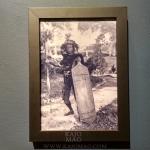
A Sea Dayak with Shield
The man is dressed in the usual waist-cloth the Dayak wear. On his head is a headkerchief decorated with a fringe. He wears a necklace of large silver buttons. On his arms are sea-shell bracelets, and on his calves a large number of palm fibre rings. His right hand is holding the handle of his sword, the sheath of which is fastened to his belt, and his left hand is on his shield. The shield is made out of one piece of wood and coloured with a fanciful design. It is decorated with human hair from the head of dead enemies.
Credit: Creative Commons. Copyright Expired.

1. Iban customs on adultery

First of all, Gomes described Iban customs on adultery as “peculiar and worthy of notice.”

 “If a woman commit adultery with a married man, his wife may make a complaint to the headman of the house, and receive a fine from the guilty woman; or, if she prefer it, she may waylay the guilty woman and thrash her; but if she do so, she must forgo one-half of the fine otherwise due to her.

In the eyes of the Dyak the woman is alone to blame in a case like this. “She knew,” they say, “the man has a wife of his own; she had no business to entice him away from her.” If a married man commits adultery with an unmarried woman the procedure is similar. The wife of the man may punish the girl, but no one punishes the man. The whole blame, according to Dyak ideas, falls on the woman for tempting the man.

If a married man commits adultery with a married woman, the husband of the woman is allowed to strike him with a club or otherwise maltreat him, while the wife of the adulterer has the right to treat the adulteress in the same way.

The innocent husband supposes the one most to be blamed is not his wife, but her tempter, and vice versâ. This striking must not, however, take place in a house; it must be done in the open. The club used must not be of hard wood.

Very often this striking is merely a means of publishing the fact that adultery has been committed, and no one is much hurt, but I have known cases where the man has been very badly wounded.

No striking can take place after the matter has been talked about or confessed, and if one knew for certain of a case of adultery, one could easily stop this maltreatment of each other by talking about it publicly.

The case is then settled by fining the guilty parties. Where both parties are married, and no divorce follows, the fining is no punishment, because each party pays to the other.”

2. Who owns a tree according to Iban customs?

What we can learn about Iban customs from Rev Edwin H. Gomes
Iban longhouse. Credit: Creative Commons. Copyright Expired.

Gomes also recorded the Iban customs regarding the ownership of a tree and the answer might surprise you.

“Fruit-trees are owned by the people who plant them. The different families in a Dyak house plant fruit-trees near their part of the house. When they leave the spot and build a new habitation elsewhere, they each still claim ownership of the trees they planted.

The rule with regard to fruit-trees is that anyone may take the ripe fruit that has fallen, but only the owner or someone deputed by him may climb the tree.

Banting Hill, where I lived for some years, was covered with fruit-trees (durian), and at night during the fruit season crowds of men and boys would watch for the falling of the ripe fruit. They would each have a torch made of the bark of some tree, and they would sit and wait with the torch smouldering by their side.

As soon as a ripe durian fruit was heard to fall, they would wave their torches in the air to make them flare up into a flame, and they would rush to the spot, and the person who found the fruit would take possession of it.”

3.Iban customs when mourning

Every culture has its own custom especially when mourning for someone’s death including the Iban.

When anyone dies, the ulit, or mourning, has to be observed by the immediate relatives of the deceased, and continues until the feast in honour of the dead (Gawai Antu) is held. All the finery and bright articles of apparel belonging to the relatives are tied up in a bundle and put away. At the Gawai Antu the string which binds this bundle together is cut by the headman of the house, and they may use their bright garments again. The mourning (ulit) includes many other restrictions beside the prohibition of ornaments and bright-coloured clothing. There must be no striking of gongs or drums or dancing or merrymaking in the house. In the old days the mourning could not end until one of the relatives managed to secure a human head.

On the third day an observance called Pana is made. A plate containing rice and other eatables, as well as a Dyak chopper, an axe, and a cup, are taken by several of the neighbours to the room of the dead person. They go to tell the mourners to weep no more, and to give the dead man food. They enter the room, and one of them—generally[140] an old man of some standing—pushes open the window with the chopper, and the offering of food is thrown out for the benefit of the dead man and his spirit companions. Up to this time the near relatives of the dead man live in strict seclusion in their room, but after it they may come out to the public part of the house and return to their usual occupations. But the ulit, or mourning, is still observed, and does not come to an end till the feast in honour of the dead (Gawai Antu) is held.

4.The power of the tuai rumah

According to Iban customs, the tuai rumah or head of the longhouse also played the role of judge when there is a conflict. The reverend had the opportunity to witness trials during his missionary work in Sarawak.

“Whenever I have been present, the fine was cheerfully paid. The punishment, in fact, was very slight. Though the Government recognize this method of settling disputes among themselves, still, if Dyaks are discontented with the decision of their headmen, they can always bring their case for trial before the Government officer of the district. But this is seldom done. The fine imposed by the headman is so small compared to that which would have to be paid if the case were tried elsewhere that the guilty party generally prefers to pay it cheerfully rather than appeal to the Government.

If the dispute be between the inmates of one house and those of another, then the headmen of both houses have to be present at the trial. When matters are at all complicated, headmen from other houses are also asked to be present and help in the administration of justice.

I learn from conversations with the older Dyaks that in bygone days the power of the headman was much greater than it is now. Then he used to impose much heavier fines and take part of them himself for his trouble, and no Dyak dared to murmur against the decision of his Chief. In those days there was no court of appeal. The only means of protesting was to leave the house and build on to another, and in the old days such a thing was not so easily done as at present. The Dyak houses were much longer and built much farther apart, and to join another house meant moving to a district very far away and cutting off all connection with relatives and friends.

5. Iban custom of settling disputes by diving

Of all the Iban customs which recorded by Gomes, the one that no longer practiced is the diving ordeal since sometimes it resulted in death.

Here is Gomes’ record on it:

The practice of referring disputed questions to supernatural decision is not unknown to the Dyaks. They have the trial by ordeal, and believe that the gods are sure to help the innocent and punish the guilty. I have heard of several different methods, which are seldom resorted to nowadays. The only ordeal that I have frequently seen among the Dyaks is the Ordeal by Diving. When there is a dispute between two parties in which it is impossible to get any reliable evidence, or where one of the parties is not satisfied with the decision of the headman of the Dyak house, the Diving Ordeal is often resorted to.

Several preliminary meetings are held by the representatives of both parties to determine the time and place of the match. It is also decided what property each party should stake. This has to be paid by the loser to the victor. The various articles staked are brought out of the room, and placed in the public hall of the house in which each litigant lives, and there they are covered up and secured.

The Dyaks look upon a Diving Ordeal as a sacred rite, and for several days and nights before the contest they gather their friends together, and make offerings and sing incantations to the spirits, and beg of them to vindicate the just and cause their representative to win. Each party chooses a champion. There are many professional divers who for a trifling sum are willing to undergo the painful contest.

On the evening of the day previous to that on which the diving match is to take place each champion is fed with seven compressed balls of cooked rice. Then each is made to lie down on a fine mat, and is covered with the best Dyak woven sheet they have; an incantation is made over him, and the spirit inhabitants of the waters are invoked to come to the aid of the man whose cause is just.

Early the next morning the champions are roused from their sleep, and dressed each in a fine new waist-cloth. The articles staked are brought down from the houses and placed upon the bank. A large crowd of men, women, and children join the procession of the two champions and their friends and supporters to the scene of the contest at the riverside. As soon as the place is reached, fires are lit and mats are spread for the divers to sit on and warm themselves. While they sit by their respective fires, the necessary arrangements are made.

Each party provides a roughly-constructed wooden grating to be placed in the bed of the river for his champion to stand on in the water. These are placed within a few yards of each other, where the water is deep enough to reach the waist, and near each a pole is thrust firmly in the mud for the man to hold on to when he is diving.

The two men are led out into the river, and each stands on his own grating grasping his pole. At a given signal they plunge their heads simultaneously into the water. Immediately the spectators shout aloud at the top of their voices, over and over again, “Lobon—lobon,” and continue doing so during the whole contest. What these mysterious words mean, I have never been able to discover. When at length one of the champions shows signs of yielding, by his movements in the water and the shaking of the pole he is holding to, the excitement becomes very great. “Lobon—lobon,” is shouted louder and more rapidly than before. The shouts become deafening. The struggles of the poor victim who is fast becoming asphyxiated are painful to witness. The champions are generally plucky, and seldom come out of the water of their own will. They stay under water until the loser drops senseless, and is dragged ashore apparently lifeless by his companions. The friends of his opponent, raising a loud shout of triumph, hurry to the bank, and seize and carry off the stakes. The vanquished one, quite unconscious, is carried by his friends to the fire. In a few minutes he recovers, opens his eyes and gazes wildly around, and in a short time is able to walk slowly home. Next day he is probably in high fever from the effects of his dive. When both champions succumb at the same time, the one who first regains his senses is held to be the winner.

I have timed several diving contests, and where the divers are good they keep under water between three and four minutes.

Among some tribes of Dyaks, the champion is paid his fee whether he wins or loses. They say it is not the fault of the diver, but because his side is in the wrong, that he is beaten. Among other tribes, however, no fee is given to the losing champion, so he comes off very poorly indeed.

There are certain cases where diving seems to be the only means of a satisfactory decision. Take the case of the ownership of a durian tree. The tree probably does not bear fruit till fifteen years after it has been planted. Up to that time no one pays any attention to it. When the tree begins to bear fruit two or three lay claim to it. The man who originally planted it is probably dead, and no one knows for certain whom the tree belongs to. In a case like this, no amount of discussion can lead to a satisfactory decision, whereas a diving contest settles the matter to the satisfaction of all parties.

The Dyaks have great faith in the Diving Ordeal, and believe that the gods will always maintain right by making the man who is in the wrong be the loser. In fact, if a Dyak refuses the challenge of a Diving Ordeal, it is equivalent to his admitting that he is in the wrong.

Read Seventeen Years Among the Sea Dyaks of Borneo (1911) here.

The Raven (1935), the film that was banned in Miri back in 1937

A film, called The Raven, was banned in Miri, as being “purely morbid and gruesome.”

That was the the description that was published in The Sarawak Gazette on July 1, 1937.

So what was so morbid and gruesome about the movie that it was banned? Plus, where did Mirians watch movies back in the 1930s?

The Raven (1935), the film that was banned in Miri back in 1937

About The Raven (1935)

The Raven (1935), the film that was banned in Miri back in 1937

The Raven was the last film in the 1930s Universal Pictures Edgar Allan Poe trilogy, after the previous adaptations of Murders in the Rue Morgue and The Black Cat.

It is based on Poe’s 1845 poem The Raven.

The story follows Dr Richard Vollin (portrayed by Bela Lugosi, who played the first Count Dracula on film) who is obsessed with all things related to Poe. If only he was obsessed with normal merchandise such as T-shirts, mugs or socks, but nope…Dr Vollin was passionate in making torture devices inspired by Poe’s works.

When Jean Thatcher (Irene Ware) is injured in a car accident, her father Judge Thatcher (Samual S. Hinds) and boyfriend Jerry (Lester Matthews) ask Dr Vollin for help.

Vollin agrees and the operation is a success. Somewhere between the operation table to a recovered Jean, Vollin falls in love with the girl.

After finding out Vollin’s feelings, her father disapproves of his pursuit of Jean.

Unfortunately, the doctor does not handle rejection well so he plots revenge against the Thatchers, making full use of his Poe-inspired torture devices.

On Aug 4, 1935, The London Times wrote this in its review of this film:

“Every picture should have a purpose, preferably a high one. Any concentration upon Murder as Murder can only kill the films themselves. But it is difficult to speculate as to what intention, other than the stimulation of a low morbid interest, can be behind such a production as The Raven’….Here is a film of “horror” for “horror’s” sake…. It devises shelter under the statement that it has been inspired by the genius of Edgar Allan Poe. Non-sense. Neither story nor treatment give indication of any imaginative control.”

The earliest cinema in Miri

Now, comes the question of where did Mirians watch The Raven before it was banned?

They most probably watched it in an open air cinema on the field of Gymkhana Club which back then doubled as a baseball field.

Gymkhana Club Miri (GMC) was founded sometimes in 1913 and the club built the first swimming pool in Miri in 1926.

This open air cinema was reportedly started since the 1920s by Sarawak Oilfields Ltd.

The company was a subsidiary of the Shell/Royal Dutch Group which was established to run the oil industry in Miri.

The patrons of this open air cinema was most probably the employees and families of Sarawak Oilfields Ltd.

Have you heard of Sarawak national war song ‘Rix Rax’?

‘Rix Rax’ was originally written as a Sarawak war song, but it eventually became a closing hymn for a party.

The discussion on ‘Rix Rax’ in the Sarawak Gazette

In a letter published to the Sarawak Gazette on Feb 29, 1956, N.S Haile inquired about what he called the ‘Sarawak National Anthem’.

Haile wrote, “I wonder whether any of your readers can assist me in tracing the Sarawak National Anthem? Ever since I read about the existence of one, in John Macgregor’s Through the Buffer State, I have been hoping in vain to hear it played on Radio Sarawak, or by the Police Band in the Museum Gardens. Macgregor, who visited Kuching in the 1890s, makes the following reference to the anthem:

‘The country is kept in order by a small police force, mostly of Indian Sikhs… And there are also four companies of native Dyak troops, known as the Sarawak Rangers, commanded by Major D, a retired British officer, who takes the greatest interest in his lively little levy. This little corps has everything complete, from the commanding officer down to the drummer boy, and even a national anthem that goes under very melodious and patriotic name of ‘Rix Rax!’ whatever that may mean.’

Tracing the copy of ‘Rix Rax’

In response to Haile’s letter, N. Heyward wrote a letter to the gazette which was published a month later on Mar 31, 1956.

According to Heyward, his information on ‘Rix Rax’ was provided by the then Anglican Bishop of Borneo Reverend Nigel Edmund Cornwall.

In 1953 when the Bishop was on leave, he lunched with a retired schoolmaster named G. C. Turner. Turner was the grandson of Francis McDougall who was the first Bishop of Labuan and Sarawak (1855-1868).

Turner reportedly gave Bishop Cornwall a copy of the “Sarawak National War Song” which has the handwriting of Bishop McDougall’s wife Harriette.

According Heyward, Cornwall then handed a copy of the manuscript to Radio Sarawak in 1953.

Accompanying his letter to the gazette was the manuscript of ‘Rix Rax’ which was in Cornwall’s possession.

The Sarawak Gazette pointed out that the ink of the old manuscript was somewhat faded and it was ‘found impossible to get a clear and legible reproduction’.

However, the gazette did published the original words of the ‘Rix Rax’ song.

It goes:

Rix rax filly bon bon bon,
Filly bon bon bon,
Filly bon.

Rix rax filly bon bon bon,
Filly bon bon bon,
Filly bon.

Kayoh kayoh balah moussu
Kayoh kayoh balah moussu Sarawak
Sarawak menang
Sarawak Sarawak Sarawak menang.

‘Rix Rax’, the closing song of 19th century Sarawakian parties

If you need to get a bunch of Sarawakians to hype up during a party, just play the Iban song ‘Berkikis Bulu Betis’ by Andrewson Ngalai.

This song will surely get the crowd sing ‘La La La La La La La’.

Just like ‘Berkikis bulu betis’, the ‘Rix Rax’ song is a must-played song in Sarawak, not to pump up the crowd but to close a party.

We know this from Harriette McDougall, the wife of Bishop Francis McDougall.

She wrote in her book, “It is an established rule now that we go to the Rajah’s on Tuesday evening, and he comes to us on Thursday, and we are to dine together once a month… You have no idea how merry we are, but there is no resisting the fun of this patchwork society. Last Tuesday, Mr. H, a tall and immensely stout man, would persist in dancing a Minuet de la Cour with a little midshipman.

“He mounted a Dayak cap and feathers and made us laugh till we cried. I danced a quadrille with the Rajah, who dances beautifully and is as merry as a child. A charade was acted, which, with the dancing, infinitely amused the natives of whom I should think 150 were present. The evening closed with singing ‘Rix Rax’, the national anthem of Sarawak, the Europeans clapping their hands and the natives yelling a war yell for the chorus.”

Who wrote the ‘Rix Rax’?

According to author Nigel Barley in his book White Rajah: A Biography of Sir James Brooke, Harriette and Brooke Brooke had written ‘Rix Rax’. They based it on an old German nonsense song ‘catch’.

However, Barley stated the lyrics that he came across actually went like this,

‘Rix Rax, filly bow bow bow bow, filly bow bow bow,
Rix Rax Sarawak, Sarawak, Sarawak shall win,
I see from far the Dayak fleet of war. How fast!
And meet Saribas pirate fleet! And Sarawak and Sarawak and Sarawak shall win.’

Barley was correct in one thing that the song was based on an old German tune.

However, it was reportedly the first Rajah himself, James Brooke, who wrote the song, not as an anthem but as a Sarawak National War Song in 1848.

Regardless of how the lyrics originally went, wouldn’t be interesting fun to be able to hear this war song again, especially during a party?

KajoReaders, let us know what you think in the comment box.

The significance of lucky bamboo during Chinese New Year

First of all, the lucky bamboo is not a bamboo. Despite its name and appearance, this plant that you see being sold during Chinese New Year actually belongs to the Asparagaceae family, the same family as the asparagus.

Its scientific name Dracaena sanderiana is named after the German-English gardener Henry Frederick Conrad Sander (1847-1920).

Scientifically, this plant is more closely related to African lilies than the actual bamboo.

It is also known by its other names such as ribbon plant, Chinese water bamboo and Belgian evergreen.

The symbol of bamboo in Chinese culture

The significance of lucky bamboo during Chinese New Year

Even though lucky bamboo is not exactly a real bamboo, let us look at the meaning of the bamboo itself in Chinese culture.

You might notice bamboo is a common theme to see in Chinese painting and calligraphy.

This is because it is a symbol of Oriental beauty. It represents the character of resistance, moral integrity as well as modesty and loyalty.

A famous Tang Dynasty poet Bai Juyi (772-846) once summarised what the bamboo represented, according to its plant characteristics.

While its deep root represents resoluteness, a straight stem denotes honourability, while its hollow interior signifies modesty and clean exterior exemplifies chastity.

Overall, the bamboo is a positive symbol to encourage people to persevere and hang in there especially throughout a difficult situation.

The significance and symbolism of lucky bamboo during Chinese New Year

Coming back to the lucky bamboo, there are five elements surrounding the plant which makes it auspicious especially during Chinese New Year.

Before that, the plant must be decorated. First of all, there must be stones or pebbles surrounding it.

It is best to put it in a metal pot or hang some decorative coins on it. Then, tie a red ribbon around the plant or pot.

By doing so, you will have all the five elements to make your lucky bamboo plant to be auspicious.

The stones or pebbles represent the earth element while the metal pot or coin is the metal element.

While the fire element is represented by the red ribbon, the water element is the water used to nourish the plant and the wood element is the bamboo itself.

Moreover, the significance of the lucky bamboo depends on the number of stalks you put together.

Two stalks represent love and three stalks for wealth, happiness and longevity.

If you are doing business, put together five stalks because it represents wealth for businessmen.

Six stalks are for prosperity and seven stalks are supposed to bring you good health.

Let say you are looking for luck and motivation this year, put together eight stalks of lucky bamboo.

Nine stalks is for good fortune, ten for perfection and finally 21 stalks for abundance and blessings.

Even if you don’t believe in the symbol of the lucky bamboo and its significance, this indoor plant is actually beautiful and easy to care for, hence, making it a perfect decorative plant to brighten your home.

5 interesting Sarawak stories as recorded by H. Wilfrid Walker

During the 19th and early 20th century, many European explorers made their way to what they deemed as the “exotic” island of Borneo.

Some were looking for wealth while others were seeking knowledge, to be the first one to discover something new.

British novelist William Somerset Maugham for instance came to Sarawak in 1921 to explore and get inspiration for his writing.

Meanwhile, Scottish Robert Burns was considered the first European man who visited the Kayans in Borneo. His explorations were ended after he was caught by Iranun pirates during a trip to Marudu Bay in northern Borneo.

Another European who had an untimely death while exploring Borneo was Frank Hatton. He accidentally shot himself when his rifle got twisted in some jungle creepers.

Most of these explorers have one thing in common; they put their experience into writing, giving us a glimpse of what was it like in Borneo more than a century ago.

One of the lesser known writings about Borneo is written by H. Wilfrid Walker, entitled Wanderings Among South Sea Savages and in Borneo and the Philippines (1909).

Little is known about this British author except that he is a fellow of the Royal Geographical Society.

The book is actually a compilation of letters Walker wrote back home during his journey to Fiji, Papua, North Borneo and the Philippines.

He was visiting these places to collect birds and butterflies.

Walker explained that Wanderings Among South Sea Savages by no means is a scientific book and was not for naturalists and ethnologists.

Regardless, his experience – especially in Borneo – is still worth an interesting read.

After spending seven months in British North Borneo (present day Sabah), Walker made his way to Kuching.

He arrived as a guest of the Borneo Company and stayed at what he described as “the rather dilapidated government rest house.”

5 interesting Sarawak stories as recorded by H. Wilfrid Walker
View of Kuching from the Rajah’s Garden. (Copyright expired -Public Domain).

During his visit to Bau, Walker came across the Land Dayaks. How he described the Bidayuhs in his writing is an indicator of the racism endemic in the science of the times as he wrote that they were “not to be compared to the Sea Dayaks, who are born fighters, and whose predatory head-hunting instincts give a great deal of trouble to the government.”

Besides coming to collect birds and butterflies, the purpose of his visit to Sarawak was to see the Sea Dayaks or the Iban. And he definitely reached his goal when he visited a longhouse called Menus somewhere at upper Rajang river.

5 interesting Sarawak stories as recorded by H. Wilfrid Walker
Walker (left) with L. Dyke-Acland, and C. A. W. Monckton (Copyright expired -Public Domain).

After reading Wanderings Among South Sea Savages and in Borneo and the Philippines (1909) by H. Wilfrid Walker, here are five interesting stories which took place in Sarawak we think you should know about:

1.The first time Walker saw an Iban man

Walker was really excited to see the Ibans. Together with his two servants, a Chinese cook whom he called ‘Cookie’ and a ‘civilised Dayak named Dubi’, they made their way to Sibu onboard a steamer.

In Sibu, he stayed with the Resident/famed naturalist Charles Hose.

It was in Sibu that Walker finally met his first Iban and this was how he described his first impressions.

“My first real acquaintance with the Sea Dayak was in the long bazaar at Sibu, and I was by no means disappointed in my first impressions, as I found him a most picturesque and interesting individual. The men usually have long black hair hanging down their backs, often with a long fringe on their foreheads.

Their skin is brown, they have snub noses but resolute eyes, and they are of fine proportions, though they rarely exceed five feet five inches in height. Beyond the “jawat,” a long piece of cloth which hangs down between their legs, they wear nothing, except their many and varied ornaments. They wear a great variety of earrings.

These are often composed of heavy bits of brass, which draw the lobes of the ears down below the shoulder. When they go on the war-path they generally wear war-coats made from the skins of various wild animals, and these are often padded as a protection against the small poisonous darts of the “sumpitan” or blow-pipe which, together with the “parang” (a kind of sword) and long spears with broad steel points constitute their chief weapons. They also have large shields of light wood; often fantastically painted in curious patterns, or ornamented with human hair.”
5 interesting Sarawak stories as recorded by H. Wilfrid Walker
Dayak in War-Coat. Photo by H. Wilfrid Walker (Copyright expired – Public Domain)
5 interesting Sarawak stories as recorded by H. Wilfrid Walker
Dayaks and Canoes. Photo by H, Wilfrid Walker (Copyright expired -Public Domain)

2.The first time he sees heads fresh from the headhunters

After spending three or four days in Sibu, Hose received news that the Ibans from Ulu Ai had killed a group of Punans for their heads.

Hose immediately set out to go to Kapit to punish the headhunters and he allowed Walker to go with him.

After they had arrived at Kapit, Hose invited Walker to inspect the heads. Naturally as an explorer, Walker did not want to miss the opportunity.

This was how he described it,

“They were a sickening sight, and all the horrors of head-hunting were brought before me with vivid and startling reality far more than could have been done by any writer.

Only seven of the heads had been brought in, and two of them were heads of women, and although they had been smoked, I could easily see that one of them was that of a quite young, good-looking girl, with masses of long, dark hair.

She had evidently been killed by a blow from a “parang,” as the flesh on the head had been separated by a large cut which had split the skull open. In one of the men’s heads there were two small pieces of wood inserted in the nose. They were all ghastly sights to look at, and smelt a bit, and I was not sorry to be able to turn my back on them.”

5 interesting Sarawak stories as recorded by H. Wilfrid Walker
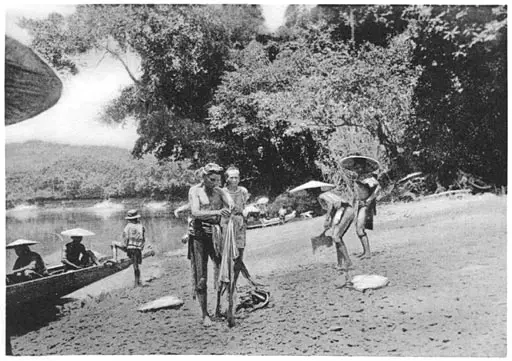
Dayaks Catching Fish Photo by H, Wilfrid Walker (Copyright expired -Public Domain)


3.When a girl doubted a Christian Dayak’s manhood

Walker relates a story which was told to him, of how a girl had turned down a converted Christian man for not carrying on the practice of head-hunting.

In a certain district where some missionaries were doing good work among the Dayaks, a Dayak young man named Hathnaveng had been persuaded by the missionaries to give up the barbaric custom of headhunting.

One day, however, he fell in love with a Dayak maiden. The girl, although returning his passion, disdained his offer of marriage, because he no longer indulged in the ancient practice of cutting off and bringing home the heads of the enemies of the tribe.

Hathnaveng, goaded by the taunts of the girl, who told him to dress in women’s clothes in the future, as he no longer had the courage of a man, left the village and remained away for some time.

When he returned, he entered his sweetheart’s hut, carrying a sack on his shoulders. He opened it, and four human heads rolled upon the bamboo floor. At the sight of the trophies, the girl at once took him back into her favour, and flinging her arms round his neck, embraced him passionately.

“You wanted heads,” declared her lover. “I have brought them. Do you not recognize them?”

Then to her horror she saw they were the heads of her father, her mother, her brother and of a young man who was Hathnaveng’s rival for her affections. Hathnaveng was immediately seized by some of the tribesmen, and by way of punishment was placed in a small bamboo structure such as is commonly used by the Dayaks for pigs, and allowed to starve to death.

5 interesting Sarawak stories as recorded by H. Wilfrid Walker
A Dayak Woman with Mourning Ornaments round waist. Photo by H. Wilfrid Walker (Copyright expired – Public Domain)


4.When some of Brooke’s soldiers mistakenly buried a prisoner alive

During his time in Sibu, Walker spent a great time with two of Hose’s officers named Johnson and Bolt, who then related this story to him:

A Chinese prisoner at Sibu had died, at least Johnson and Bolt both thought so, and they sent some of the Malay soldiers to bury the body on the other side of the river.

A few days later one of them casually remarked to Johnson that they had often heard it said that the spirit of a man sometimes returned to his body again for a short time after death (a Malay belief), but he (this Malay) had not believed it before, but he now knew that it was true. Johnson, much amused, asked him how that was.

“Oh,” said the Malay, “when the Tuan (Johnson) sent us across the river to bury the dead man the other day, his spirit came back to him and his body sat up and talked, and we were much afraid, and seized hold of the body; which gave us much trouble to put it into the hole we had digged, and when we had quickly filled in the hole so that the body could not come out again, we fled away quickly, so now we know that the saying is true.” It thus transpired that they had buried a live Chinaman without being aware of the fact.


5.This European who wanted to see the Dayaks, ended up becoming an exhibit himself

5 interesting Sarawak stories as recorded by H. Wilfrid Walker
Dayak Women and Children on the Platform outside a longhouse. Photo by H. Wilfrid Walker (Copyright expired – Public Domain)


During his first night at an Iban longhouse, the natives who had never seen a white man before was curious to see Walker’s skin.

About midnight I began to feel a bit sleepy, but the admiring multitude did not seem inclined to move, so I told Dubi to tell them that I wanted to change my clothes and go to sleep. No one moved. “Tell the ladies to go, Dubi,” I said, but on his translating my message a woman in the background called out something that met with loud cries of approval.

“What does she say, Dubi?” I asked.“She says, Tuan,” replied Dubi, “they like see your skin, if white the same all over.”
This was rather embarrassing, and I told Dubi to insist upon their going; but Dubi, whose advice I generally took, replied, “I think, Tuan (master), more better you show to them your skin.”

I therefore submitted with as good a grace as possible, and took my shirt off, while some of them, especially the women, pinched and patted the skin on my back amid cries of approval and delight.

The next two or three nights the crowd that waited to see me change into my pyjamas was, if anything, still larger, a good many Dayaks from neighbouring villages coming over to see the sight.

But gradually the novelty wore off, to my great joy, as I was getting a bit tired of the whole performance. I had come here to see the Dayaks, but it appeared that they were even more anxious to see me.

You can read the rest of Walker’s book here.

What you should know about the Battle of Beaufort

The Borneo campaign of 1945 was the last major Allied campaign in the South West Pacific Area during World War II (WWII) to liberate Japanese-held Borneo.

One of the combats that took place during the campaign was Battle of Beaufort in 1945.  

Located about 90 kilometers south of Kota Kinabalu, the town of Beaufort was initially developed to help the economic activity of interior of Sabah.

The town was named after former British governor Leicester Paul Beaufort.

The prelude before the Battle of Beaufort

The operation to secure North Borneo was separated into phases; preparatory bombardment, forced landing and an advance.

They wanted to turn Brunei Bay into a naval base for the British Pacific Fleet. To do that, the Allied forces need to secure Labuan to control the entrance to Brunei Bay. At the same time, Labuan would be developed as an airbase.

After several weeks of air attacks as well as a short naval bombardment, soldiers of the Australian 24th Brigade landed on Labuan on June 10.

The Japanese garrison was outnumbered and the Australians quickly captured the island’s harbour and main airfield.

The fight in Labuan continued until June 21. In the end, a total of 389 Japanese personnel were killed on Labuan and 11 were captured. Meanwhile, Australian casualties numbered 34.

After capturing Labuan, the Australian solders successfully captured the town of Weston against light opposition from the Japanese.

Since there was no road from Weston to Beaufort, the battalion advanced along the single track railway toward Beaufort.

In the meantime, another Australian battalion landed around Mempakul from Labuan also without any resistance from the Japanese.

They managed to secure the Klias Peninsula before moving along the Klias River heading to Beaufort.

Later, the two Australian battalions reunited at Kandu and made their journey towards Beaufort together.

Once the Australians captured Beaufort, they would be able to control the railway that ran toward Jesselton (now Kota Kinabalu).

The Battle of Beaufort

What you should know about the Battle of Beaufort
A 2/43rd Battalion mortar crew firing on Japanese positions near Beaufort on 28 June 1945 (Copyright expired – Public Domain).

On June 26, the two Australian battalions started to approach the town. At that time, there were about 800 to 1000 Japanese soldiers at Beaufort.

The Australian soldiers coordinately captured the town and ambushed the route where the Japanese were expected to withdraw along.

At the same time, the Japanese resistance lacked coordination as they tried to launch six counterattacks against the Australians.

During the battle, some fights even went down to hand-to-hand combat.

The six counterattacks by the Japanese all resulted in failure. By June 29, Australian soldiers had captured the town.  

With that, the Australians were able to open the Weston-Beaufort railway line to bring in the supplies.

The Allied forces then continued to secure Papar on July 6.

In the end, The Battle of Beaufort took the lives of seven Australians and 93 Japanese, leaving 40 people (including 2 Japanese) wounded.

The story of Tom Starcevich’s gallantry

What you should know about the Battle of Beaufort
A patrol from the 2/43rd Battalion in the Beaufort area during August 1945 (Copyright expired- Public Domain).

On June 28, Tom Starcevich’s company encountered two Japanese machine-gun positions in the middle of a jungle track.

The Japanese opened fire first and the Australians suffered some casualties. Starcevich moved forward and assaulted both Japanese positions using his Bren gun.

He killed five Japanese soldiers and causing the rest to retreat. Later on the same day, the company again came across another two machine gun positions. Again, Starcevich single-handedly attacked both and killing another seven Japanese soldiers.

For his bravery, Starcevich was awarded the Victoria Cross after the war. It is the highest decoration for gallantry in the face of the enemy that can be awarded to members of Commonwealth armed forces.

The track where Starcevich’s gallant move took place was later renamed Victoria Cross Road.

Additionally, there is a monument in Beaufort named The Starcevich Monument or Beaufort Australian Monument dedicated to Starcevich.

The aftermath of Battle of Beaufort and the discovery of comfort women

With their six counterattacks, the resistance in Beaufort was the only time that the Japanese had actually made an effort to fight against Allied forces in North Borneo.

Although there were minor combats in the following months, the Battle of Beaufort was considered the last significant action fought in North Borneo during WW2.

In August 1945, a member of the Australian Ninth Regiment was in Borneo as part of the British-Borneo Civil Affairs Unit.

He reportedly found some Javanese women who had been transported to Borneo by the Japanese as comfort women. These women were forced into sexual slavery during the war.

The Javanese women were living in the ruins of the Japanese comfort station somewhere in Beaufort.

According to the book Legacies of the Comfort Women of World War II, the Australian forces took them to a small island off in the Borneo coast for medical treatment and rehabilitation.

While the Australians wanted to send them back to Indonesia, the women were afraid of going home because of the shame associated with their experience, so much so that one of them committed suicide. However, it is not certain if the rest of the women managed to return home.

After the war ended, Beaufort was the place where the Japanese were told to gather before they were transported back to Japan.

Unfortunately for them, many of the Japanese were killed by the Muruts on their way to Beaufort.

Out of thousands of Japanese troops who marched to Beaufort after surrendering their firearms, only a few hundred ever reached Beaufort.

The significance of serving a whole fish for Chinese New Year dinner

There are many symbolic dishes to be eaten during the Chinese New Year season. However, it is more significant to have them for dinner on the eve of the Lunar New year.

One of those dishes is one whole fish. Did you know that it is considered a must-have and lucky food to have on Chinese New Year Eve?

The significance of a whole fish during Chinese New Year

There is a Chinese idiom, “年年有余 (nian nian you yu)”, meaning ‘to have abundance every year’.

The word ‘abundance’ in Mandarin has the same pronunciation as the word ‘fish’.

To have a whole fish served during Chinese New Year dinner symbolises the abundance you hope for the brand new year.

Why is it important to have the fish served as a whole? Can’t it just be served as fish fillet or half of a fish? Having a whole fish symbolises a good beginning and ending for the months to come. Another meaning is to serve as a reminder; to finish what you started.

Chinese Malaysians mostly follow the Southern Chinese tradition, which is to eat only the body, leaving the head and tail behind. This is to express the hope that the new year will start and finish with surplus.

Again, when eating the fish, do not turn the fish over. It is as if a boat is being overturned and your blessing will be overturned too,

How should it be cooked?

The significance of serving a whole fish for Chinese New Year dinner
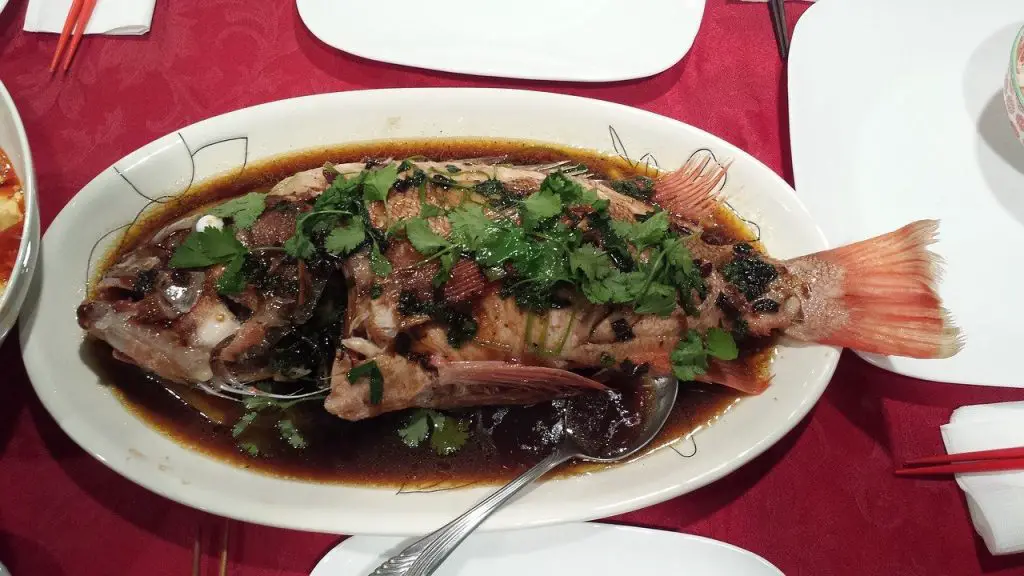
Steamed fish with soy sauce. Credit: Pixabay

The most common way to prepare your fish is to steam it. The important thing to remember, however, if you want tender fish meat is not to over-steam it.

Usually, it takes eight minutes for a smaller fish or 12 minutes for a bigger fish. According to Chef Leung Fai Hung, a fish weighing 1 catty (0.6kg) takes six minutes to steam, while a fish twice the size will take double the time.

Moreover, only place your fish in the steamer after the water has come to a boil.

When it comes to picking recipes, Teochew-style steamed fish is known for its sourness because of the use of pickled plums or pickled vegetables.

Meanwhile, the typical Cantonese-style typically uses light soy sauce, Shaoxing wine and sesame oil as flavouring.

Another common recipe for steamed is using fermented black bean.

Of course, the less healthy way to cook your fish is to fry it. After frying it, you can top it with any sauce you want, for example sweet and sour sauce or soy sauce.

With the Covid-19 pandemic still raging and homes experiencing flooding as the Year of the Metal Rat moves into the Year of the Metal Ox, why not try to cook a fish on your own while staying at home this Chinese New Year?

The significance of serving a whole fish for Chinese New Year dinner
Steamed fish with black bean sauce. Credit: Pixabay.

5 things you need to know about Operation Opossum during WWII

In 1945, the Australian Z Special Unit organised a dangerous mission to rescue the Sultan of Ternate, Muhammad Jabir Syah right under the Japanese nose. They called the mission Operation Opossum.

Also known as the Kingdom of Gapi, the Sultanate of Ternate is one of the oldest Muslim kingdoms in Indonesia.

It was established in 1257 by Momole Cico who was the first leader of Ternate.

The kingdom’s Golden Age took place in 1570-1583 during the reign of Sultan Baabullah. During this time, the sultanate encompassed most of the eastern part of Indonesia and a part of southern Philippines.

Fast forward to 1942 during World War II (WWII), the capital of the sultanate Ternate city was occupied by the Japanese.

The sultan and his family were held hostage in his own palace. While imprisoned, the Sultan sent several of his men to Australian Army headquarters on Morotai island asking to be rescued.

General Douglas MacArthur heard the Sultan’s plea and sent a team from the Z Special Unit to rescue him in a raid called Operation Opossum.

So here are five things you need to know about Operation Opossum:

1.The initial plan for Operation Opossum was not to rescue the Sultan

According to Australian War Memorial, the original plan for the Operation Opossum was to attack Ternate Island in order to extract an Australian airman.

However, the Netherlands Indies Civil Administration later informed that the man was later removed.

Since most of the intelligence on which Operation Opossum based came from the Sultan, the plan then changed to extract him as a preliminary move to recover the missing airman.

2.How Operation Opossum went down

The team consisted of eight Australians from Z Special Unit along with three Dutch officers and a Timorese corporal.

After roughly two months of planning, the mission left Morotai on Apr 8, 1945 and landed on Hiri Island, two kilometers north Ternate.

From Hiri, the message that Z Force had arrived was sent up the volcano where the royal family was hiding.

The family then safely descended to the coastal village of Kulaba after a six-hour trek. From there, two perahu took the Sultan along with his two wives, eight children and other relatives to Hiri.

3.The mission almost failed because the locals were too happy to see the Sultan.

When the royal family arrived at the village, the villagers were too happy to see their sultan and greeted him in their traditional way. They squatted down with one raised knee, with hands pressed against their faces in an attitude of prayer and remained so until dismissed by a nod from the Sultan.

Some of the village elders even lined up to kiss his feet.

The sultan was not happy with the greetings from his people. He kept telling them to be careful in case the Japanese would see them.

True enough, word got out that Sultan was escaping. Several boats carrying Japanese soldiers were sent to Hiri to stop the mission at dawn the very next day.

5 things you need to know about Operation Opossum during WWII
TERNATE ISLAND, HALMAHERA ISLANDS. 1945-11-09. ATTENDED BY AUSTRALIAN FORCES THE SULTAN OF ISKANDAR MUHAMMAD DJABIR, SYAH OF TERNATE MAKES A SPEECH AFTER HIS INAUGURATION. (NAVAL HISTORICAL COLLECTION).

4.The heroic death of Lieutenant George Bosworth

When the Japanese soldiers made contact with the Z Forces, they exchanged fire.

The current Sultan of Ternate, Sultan Mudaffah described what happened during the attack to The Sydney Morning Herald in an interview back in 2010. He was 10 when his family was rescued by the Z Forces.

Lieutenant George Bosworth, who was guarding Sultan Jabir, rushed about 500 meters to the landing site.

Speaking of Bosworth, Sultan Mudaffah said, “This man was too brave. According to my father, he was just standing there, shooting. My father said ‘you can’t just stand there’.”

Three of the Japanese soldiers fell on the beach. As Lieutenant Bosworth approached one of them, it turned out the Japanese soldier was still alive as he picked up his rifle and shot Bosworth in the head.

The fight continued between Z Force and the Japanese, forcing the remnants of Japanese tried to swim back to Ternate.

However, the Japanese were all killed by the locals before they reached shore.

From Hiri, the sultan and his family were taken to Moratai. There, Sultan Jabir debriefed General MacArthur on Japanese positions and tactics in the area.

They were then sent to settle in the Queensland town of Wacol until the end of the war.

MacArthur learned from the sultan that the Australian airman had been removed. Therefore the plan for his extraction was not carried out.

5.Operation Opossum loosely inspired a movie which starred Mel Gibson before his Hollywood fame.

Attack Force Z (alternative title The Z Men) is a 1982 Australian-Taiwanese film. Operation Opossum reportedly inspired the film, although the plot was very different from what had actually happened.

The plot circles around Captain P.G. Kelly (Mel Gibson) who leads a team of the Z Special Unit against Japanese during the WW2.

The movie was screened at the Cannes Film Festival on May 18, 1981. Years later, Gibson called the film “pretty woeful… it’s so bad, it’s funny.”

What to know about Asian fox spirits; huli jing, kumiho and kitsune

What to know about Asian fox spirits; huli jing, kumiho and kitsune
Asian fox spirit is often depicted as having nine tails. Credits: Pixabay

Different cultures have their own versions of almost the same mythical creature, which is almost always inspired by the same animal. Take the fox, for example. Although there are some variations in their depictions, the fox often appears in the folklore of many cultures.

Typically, they are known as symbols of cunning and trickery, especially in Western and Persian folklore. Perhaps this reputation derived from fox’s ability to evade hunters.

Similarly in Asian folklore, they appear as fox spirits with the ability to disguise themselves as beautiful women. The widely known Asian fox spirits are huli jing, kumiho and kitsune which comes from Chinese, Korean and Japanese cultures respectively.

Here are some interesting facts and stories about these three Asian fox spirits:

1. Chinese fox spirit, Huli jing

Overall in Chinese mythology, all things are capable of acquiring human forms, magical powers and immortality.

The ideas of species being able to transform, especially from non-human to human, started during the Han Dynasty.

Since then, the idea of the fox being able to form itself into human started to take shape.

The Huli jing walks on its four legs but has nine tails, which is why it is also known as the nine-tailed fox. As for how they are able to transform into a human? A fox needs to find a skull that fits on its head to be able to transform into a human being.

Chinese fox spirits often appear as young, beautiful but dangerous women.

There are several early accounts depicting the physical appearance and capability of huli jing.

Chinese historian Guo Pu wrote in Records from Within the Recondite, “When a fox is fifty years old, it can transform itself into a woman. When it is one hundred, it becomes a beautiful woman or a shaman; some become men and have sex with women. They can know events from more than a thousand li (miles) away and good at witchcraft, beguiling people and making them lose their senses. When they are a thousand years old, they can commune with the heavens and become heavenly foxes.”

Apparently, it is not pleasant to bump into one of these huli jing especially if you are a woman.

Qian Xiyan in the book The Garden of Cleverness (1613) said: “Foxes hide all day and run around all night. Foxes love women’s chambers, and when women in the capital have their period, they throw their dirty rags in the gutter, and the foxes come and lick up all the menstrual blood. No one sees them. This is probably the reasons they turn into monsters.”

2.Korean fox spirit, Kumiho

As all nine-tailed foxes come from China, the Korean counterpart of huli jing is a kumiho. If you are a huge Korean drama fan, you might be familiar with this fox spirit.

In 2010 My Girlfriend is a Gumiho, Shin Min-ah plays the role of a kumiho. In that version of kumiho, she has superhuman strength, is exceptionally fast and can identify people and objects from far.

On the downside, she has a fear of water. This is due to her fox bead, which stores her life energy, and is made from goblin fire.

Meanwhile in Tale of the Nine-Tailed (2020), Lee Dong-wook is a kumiho named Lee Yeon who abdicated his position as the mountain spirit of Baekdudaegan to search the reincarnation of his mortal love. He follows her soul into the afterlife to give her the fox bead as her mark when she is reborn again.

Unlike other Asian fox spirits, kumiho is known to have a fox bead or yeowoo guseul.

According to Korean mythology, the fox bead provides power and intelligence to kumiho as well as absorb a human’s energy with it.

Furthermore, kumiho is often depicted as evil entities, compared to other fox spirits who have at least some moral compass and can therfore be either good or bad.

Just like the kumiho in Tale of the Nine Tailed, they are known for their capability to change their appearances. In most tales, they change into a beautiful woman who aims to seduce men in order to eat their livers or hearts.

In other versions of the folklore, if a kumiho abstains from killing and eating humans for a thousand days, it can be a true human and lose its evil character.

3.Japanese fox spirit, Kitsune

Just like kumiho, Japanese fox legends had their origins in Chinese huli jing. Similar to other fox spirits, kitsune is known to have shape-shifting ability.

However, they have to live a life of a normal fox for a hundred years before it can transform into a human. They can be male or female at any age but like other Asian fox spirits, kitsune’s preference is to be a young beautiful woman.

It was believed that any woman encountered alone, at dusk or night, could be kitsune. Kitsune’s other powers include fire breathing, being able to create lightning like Thor and enter people’s dreams as they please.

As for kitsune’s tails, it can have from one to nine of them. The only way to kill a kitsune is to cut off all of its tails. While only one of the tails is believed to be the source of its power, it is better to cut them all since you might not which tail is the main one.

Kitsune can be good or bad. The zenko kitsune is a follower of Inari, the Shinto deity of agriculture, harvest and fertility. Meeting a zenko kitsune is definitely a good sign.

On the contrary, the yako kitsune is not only mischievous but evil too.

According to Japanese mythology, a fox can possess a human and the victim is always a young woman.

The method of possession? The fox may enter beneath her fingernails or through her breasts. In order to get rid the fox spirit, an exorcism should be performed on that person, preferably at an Inari shrine.

Once the victim is freed from possession, he or she would never be able to eat food favoured by kitsune such as tofu or adzuki beans.

Special mentions: Ho Tinh

The least famous among these Asian fox spirits is the Vietnamese ho tinh.

Legend has it that ho tinh is a huge nine-tailed fox that inhabited a deep cave in Long Bien.

In a typical Asian fox spirits’ move, ho tinh would disguise itself as a beautiful woman. Then she would trick its victims into following it back to the mountains.

Somewhere in the mountains is ho tinh’s cave where it would trap and feed on them.

1 10 11 12 13 14 40