Browse Category

Culture - Page 11

Beriberi, the deadly disease among Allied POWs during WWII

Do you know that a severe chronic form of thiamine (vitamin B1) is known as beriberi?

The term ‘beriberi’ is believed to come from a Sinhalese phrase for ‘weak, weak’ or ‘I cannot, I cannot’.

There are two main types in adults; wet beriberi and dry beriberi. Wet beriberi affects the cardiovascular system while the dry beriberi affects the nervous system.

During World War II, beriberi was widespread among Allied prisoners of war (POWs) captured by the Japanese.

This is due to they were fed only with a diet of rice which did not contain adequate quantities of most vitamins.

Beriberi, the deadly disease among Allied POWs during WWII
Four prisoners of war (POWs) with beriberi at Burma-Thai Railway. Copyright expired – public domain

Beriberi’s symptoms among POWs

When suffering from dry beriberi, the victims would experience tingling in their hands and feet, loss of muscle function, vomiting and mental confusion.

Meanwhile, suffering from wet beriberi commonly can cause oedema or severe swelling. Another Australian POW Stan Arneil recalled what was it like to suffer from oedema due to beriberi.

“The symptoms were swollen feet and legs as the moisture contained in the body flowed down towards the feet. Ankles disappeared altogether and left two large feet almost like loaves of bread from which sprouted legs like small tree trunks, in bad cases the neck swelled also so that the head seemed to be part of the shoulders.”

Despite this, the Japanese continued to force the POWs to work through their sickness as no medical care was given.

During the Sandakan Death Marches for instance, POWs were forced to march from Sandakan to Ranau, of a distance of approximately 260km long through thick tropical jungle.

Those who too weak to walk due to exhaustion or sickness, were shot by Japanese guard.

“Death had slippers” when it came to beriberi

Speaking of Sandakan Death Marches, an Australian POW who had a very narrow escape from the deadly march witnessed first hand how a victim of beriberi perished.

Billy Young was among the soldiers who was imprisoned at Sandakan POW Camp.

After a failed escape from the camp, he was sent to Outram Road Jail in Singapore. This turned out to be a blessing in disguise for Young as those who stayed at Sandakan camp all died during the war (except for six Australians who managed to escape).

Still, Young went through hell on earth where he spent six months in solitary confinement and was forced to sit cross legged for hours at a time.

Since food rations were scarce, everyone including Young became skeletal. One time, one of Young’s inmates, a Dutch, died in his arms due to beriberi.

“I put his head on my lap. I chatted to him and I pushed his chest and felt it. And you could feel it going up and down as he was panting for breath. But death must have had slippers because he died and I didn’t know so I waited.

“I put him down and I didn’t tell the guard, and I waited till his box of rice came and I put Peter’s bowl by him. And I got mine, I ate mine, and then I ate Peter’s. And that’s the only banquet we ever had between us you know.”

Similarly, many of the surviving POWs described the deaths of the fellow comrades due to beriberi as ‘wasting away’.

Beriberi, a ‘norm’ for Prisoners of War

Ian Duncan was one of thousands Australian POWs who were send to work at Burma-Thai Railway.

He once shared this to journalist Tim Bowden during an interview, “At the end of the war, I interviewed every Australian and English soldier in my camp. I was the only medical officer in the camp. And I though it was duty to record their disabilities. And you’d say to them, what diseases did you have as a prisoner of war? Nothing much, Doc, nothing much at all. Did you have malaria? Oh yes, I had malaria. Did you have dysentery? Oh yes, I had dysentery. Did you have beriberi? Yes, I had beriberi. Did you have pellagra? Yes, I had pellagra but nothing very much. These are lethal diseases. But that was the norm, you see, everyone had them. Therefore they accepted them as normal.”

Burma-Thai POW camp was not the only one which was suffering from this disease. Another infamous Japanese internment camp is Batu Lintang Camp in Kuching which had similar conditions.

After the camp was liberated on Aug 30, 1945, a female civilian internee who was also a nurse named Hilda Bates went to visit the sick POWs.

She recounted, “I was horrified to see the condition of some of the men. I was pretty well hardened to sickness, dirt and disease, but never had I seen anything like this in all my years of nursing. Pictures of hospital during the Crimean War showed terrible conditions, but even those could not compare with the dreadful sights I met on this visit. Shells of men lay on the floor sunken-eyed and helpless; some were swollen with hunger, oedema and beriberi, others in the last stages of dysentery, lay unconscious and dying.”

Meanwhile in Indonesia, it was reported the disease affected nearly one hundred percent of Bataan POWs. It was considered as the most ubiquitous disease among the POWs.

Experiments on POWs to cure beriberi

A Japanese doctor army named Masao Mizuno described experiments he conducted in a report he submitted in October 1943.

He wrote in the report, “In South Sea operations, such conditions as the lack of materials, the difficulty in sending war materials, the heat and moisture, increase the occurrence of beriberi patients. For this reasons, attention must be given to the use of local products. Favourable results in the prevention of beriberi have been noticed by the usage of coconut milk, coconut meat and the yeast from corn.”

Mizuno continued to describe an experimental treatment he did on 16 POWs who were suffering from beriberi in an unknown location.

He gave them hypodermic injections of 30ml of sterilized coconut milk. (Yes, you read that right – sterilized coconut milk.)

According to Mizuno, most patients felt a slight prickling pressure pain at the site of the first injection and one felt a slight headache.

Later, the condition of most patients improved with the second, third and fourth injections. They showed ‘satisfactory pulse, refreshing sensation and increased appetite.’

However, it is not known whether these experiments were continued or if the procedure was ever used as a treatment.

The death tolls caused by beriberi among Allied POWs remain unknown

Through survivors’ testimonies, we might know which perished Allied POWs had the disease but we will never if the disease was the leading cause of death.

Just like Dr Duncan had testified, these poor men had other diseases such as pellagra, malaria, dysentery on top of beriberi.

For the fortunate POWs who were freed after the war had ended, sickness including beriberi followed them into their liberation.

It was reported that some deaths due to wet beriberi did occur soon after their release but the number was small and did not continue.

One unusual case, however, did happened on a British POW who died of cardiac failure 31 years after his release.

As a POW, he suffered very severe beriberi. After autopsy, it was found that he had extensive myocardial fibrosis considered due to the effects of severe wet beriberi.

Unfortunately until today, it is difficult to know how many Allied POWs suffered or died due to beriberi during and after the war.

Ellena, the forgotten American colony in Sabah

Did you know that there was an American colony in Sabah? And at one point in time, James Brooke and successors were not the only white ‘Rajahs’ on Borneo island.

The establishment of Consulate in Brunei

In 1850, the United States signed a bilateral treaty of Peace, Friendship, Commerce, and Navigation with the Sultanate of Brunei. This treaty was enforced on July 11, 1853 and is still in effect to this day.

Then in 1865, the US sent its first consul in Brunei, Charles Lee Moses.

Moses later on played an important role in the establishment of Ellena.

In August 1865, Moses concluded a 10-year lease with Brunei’s Sultan Abdul Momin.

The Sultan then guaranteed land rights in various areas in the north of Borneo.

Later, Moses went on to sell these rights to an American merchant Joseph William Torrey in return for a third of any profits made.

In October 1865, Torrey along with another American, Thomas Bradley Harris decided to build a colony in the area of today’s Kimanis, about 45km from Kota Kinabalu.

The new venture was pursued under The American Trading Company of Borneo. It was a chartered company formed by Torrey, Harris and several Chinese investors.

Torrey even made a trip to Sultan of Brunei to draw up a new concession letter on Nov 24, 1865.

In the letter, the Sultan even gave Torrey the title of ‘Rajah of Ambong and Marudu’.

The beginning of Ellena colony

Finally in December 1865, Torrey with 12 Americans and around 60 Chinese founded a colony in Kimanis called ‘Ellena’.

After raising a flag of his own designed, Torrey appointed himself as the governor and Harris as his vice-governor.

The news of this colony even made it to Hong Kong China Mail. The news reported, “The progress of the enterprise will be watched with much interest, as being the first attempt of Americans to colonise away from their own continent.”

Ellena, the forgotten American colony in Sabah
Thomas Bradley Harris (standing) and Joseph William Torrey, founders of the US colony “Ellena” on the Island of Borneo

The downfall of Ellena

According to Frank Tatu in his paper ‘The United States Consul, the Yankee Raja, Ellena and the Constitution’, the British government was concerned with American intentions.

They asked their Minister in Washington to enquire about the issue.

In response, the British was informed that the US had not authorised any attempts to form any settlements in Borneo.

As for Moses, he simply acted on his own.

Maybe because the colony was not approved by their own government, Ellena went down as fast as it came into being.

Ellena became a target for pirates from Hong Kong and Macau.

In the same time, the colony did not have any financial backup and their workers were going hungry.

Rumours had it that it was Moses who recruited the pirates in an effort to collect the money from the company.

While Torrey was trying to find investors in Hong Kong for Ellena, Harris died of Malaria on May 22, 1866.

By the end of 1866, Ellena was abandoned.

The remaining Ellena colonists found work at nearby British-operated coal fields while others went back to Hong Kong.

As for Torrey, he buried his friend Harris on the top of a nearby hill in Ellena.

He still used his title as the ‘Rajah’ and conducted commerce in the region for several years.

Finally in 1881, Torrey sold his rights in Kimanis to Austrian Baron von Overbeck and partner Alfred Dent for $25,000.

This paved way for what we know now as the British North Borneo Company (BNBC).

What happened to Moses?

The fall of Ellena affected the life Moses who became poor after the collapse of the colony.

Tatu stated, “He frequently wrote the US State Department complaining that no consular fees were to be had, and imploring that he be accorded a salary. Receiving no favourable response, Moses was driven to desperation.

“Moses allegedly armed attacks on the burning of his consulate on Mar 25, 1867 by ‘Malay people’.
By way of demanding reparations, Moses threatened the Sultan with retaliation by American naval units ‘to fire and burn the city.’”

However, the Sultan strongly believed that Moses burned the consulate himself. He was reportedly seen removing valuables from the consulate for days before the fire.

In the meantime, Moses moved to Labuan to wait for any news especially from the US.

There, tragedy struck him again when one of his children died. He had no choice but to send his wife and surviving child back to the US.

In September 1867, Moses received the news that he had been suspended from his duties by the president.

Then in May 1868, he boarded the Barque Swallow and later reported to be lost at sea.

The rediscovery of Ellena and he rediscover the grave of Thomas Bradley Harris

Ernest Alfred Pavitt, a land surveyor for the British North Borneo Company (BNBC) was the one who found Harris’ grave in 1909.

In a note published in British North Borneo Herald, Pavitt wrote, “A good many years ago, having to go from the West Coast to the Interior of British North Borneo, accompanied by Mr. P.F. Wise, the District Officer of North Keppel, we made our starting point from Kimanis and from the principal native kampung on the river. Mr Wise pointed on a hill on which he had told me an American gentleman had, some years previously, been buried.

”This was again brought forcibly to my collection some days ago as in my examination of land at this particular place I sent a gang of coolies to clear the top of a small and prominent hill of jungle to enable me to have a look at the surrounding country.

“On my going up a few days later I found this was the resting place of evidently an old pioneer, as there still exist in a very fair state of preservation both the head and foot stone marking this interesting spot.”

A year later, while BNBC was opening the Kimanis Rubber Estate, they found that some of the hill sides had been carefully terraced.

The company believed that these terraces were probably the remains of the company’s experimental planting.

What happened to Torrey after Ellena collapsed?

A year after the collapse of Ellena, Torrey had a daughter born in 1867. He named her Elena Charlotte, most probably after his colony.

Torrey later bought his own ship which he christened as ‘Ellen’.

From 1877 to 1880, Torrey was a vice-consul at the US Consulate in Thailand.

By 1883, he returned to America. In 1885, he received the news that he had been appointed as the King of Thailand’s chief adviser.

While he was contemplating whether he should accept the post, Torrey died suddenly on June 22, 1885.

After his death, Torrey was known as the ‘Yankee Rajah’ and ‘the only American Rajah’ despite the fact his beloved colony did not even last a year.

Elizabeth Mershon’s patronising descriptions of ‘Wild Men of Borneo’

It is the 1920s. Imagine you are a pastor’s wife, and have sailed thousands of miles from your home to live in a very foreign country.

You don’t speak the local languages so there is no way you can understand their cultures or customs.

Your husband is always away from home preaching to people you refer to as the ‘wild men’ with hope the news of the Gospel will ‘civilise’ them.

And you stay at home with your servant girl who often clashes with you because she is not running the chores according to your American way.

The only way you could learn about this foreign place you are living in is through your husband and other Westerners around you.

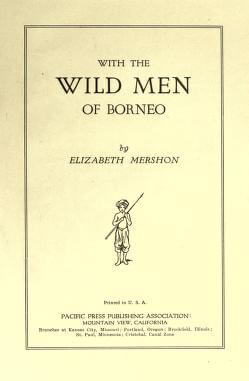
By the time you return to your home country, you write a book and publish it under the title ‘With the Wild Men of Borneo’ (1922), which is what Elizabeth Mershon did.

Elizabeth and her husband Leroy Mershon were stationed in Sandakan in the 1920s as part of the Seventh-day Adventist North Borneo Mission.

Her book ‘With the Wild Men of Borneo’, obviously was by no means an anthropology book but was based on her experience here in Borneo.

For the most part, it offers a glimpse of life in Borneo before World War 2, and also the Western perspective of the ‘civilising mission’ which can be seen in Mershon’s descriptions of Borneans as part of an introduction in the third chapter of her book.

These descriptions are based on her personal opinions which Mershon seemed to have gathered from hearsay around her.

Elizabeth Mershon’s patronising descriptions of ‘Wild Men of Borneo’

So here are some of Elizabeth Mershon’s eyebrow-raising descriptions about the so-called ‘Wild Men of Borneo’:

1.There are ‘two classes’ of Dayaks and one of them is ‘more truthful than the other’

“There are two classes of Dyaks. Those living inland are called Land Dyaks; those living on the coast are called Sea Dyaks.”

“The Sea Dyak, unlike the Land Dyak, is truthful and fairly honest.”

2.The Ibans are descended from the Bugis?

“The Sea Dyaks are not as pure a race as the Land Dyaks, having intermarried with the Bugis from Makassar, in the Celebes.”

3.The description about Bajau people

“On the east coast of British North Borneo are found the Bajaus, or Sea Gypsies. They are a lazy, irresponsible race, building their houses over water, but living almost entirely in their boats. They are of Malay origin, although much darker and larger than the Malays. Taking each day as it comes, and never troubling about what is going to happen tomorrow, they pick up a scanty living along the seashore, catching fish, and finding turtles’ eggs, clams and sea slugs. They lead a wild roving life in the open air, plundering and robbing at every opportunity.”

4.The Bajau are not the only ‘lazy people’ in Borneo according to Mershon

“The Sulus are very lazy, independent and troublesome. Yet they are very brave, and make the best sailors and traders among the islands.”

5.Perhaps ‘the laziest people’ in Borneo according to Mershon are the Muruts

“A very low race called the Muruts live in the interior, on a mountain range near the west coast. These people simply will not work. They eat food they can put their hands on. No matter how dirty an article of food may be, and no matter how long an animal may be dead, it is all the same to the Muruts; they eat it and seem to enjoy it.”

6.The Bruneians don’t seem to be hardworking either

“The natives living in Brunei are called after the name of their country. They too are very lazy; but when they have a mind to work, they make good fishermen.”

7.Finally, the last group of ‘lazy people’ of British North Borneo

“There are also a few Malays and Javanese in British North Borneo. The former are naturally lazy and do not care to work. The Javanese make fairly good gardeners for the Europeans.”

As patronising as Mershon might sound, she did grow fond of Borneo.

In the very first paragraph of her book, “From my childhood days until I arrived in Borneo, all I knew about the country was that it was where the wild men lived, and I always imagined that they spent most of their time running around the island cutting off people’s heads… Before you finish what I am going to tell you about distant Borneo and its people, I hope you will have learned that the ‘wild man from Borneo’ is not such a bad fellow after all.”

Remembering the tragic Hillsborough disaster of 1989

By Geryl Ogilvy

Ninety-six football fans lost their lives in the Hillsborough disaster on April 15, 1989, an event that shook the modern footballing world.

It should come as no surprise that the tragedy remains fresh in the minds of the people, in particular the British public and Liverpool Football Club fans alike, 32 years on.

The victims – men, women and children, the youngest being 14 – had come to support their team in a semi-final FA Cup tie between Liverpool and Nottingham Forest at Sheffield Wednesday’s Hillsborough stadium.

The match was televised live globally. To the horror of the spectators and those watching on the telly, overcrowding in the standing-only section behind the goal post of the Liverpool supporters led to the people being crushed against the fan barriers.

The crush was so great that the fencing collapsed, injuring 766 people.

Ninety-four died on the day itself. One person died at the hospital a few days later and the last victim, who was in a vegetative state following the crush, never regained consciousness, eventually dying in 1993.

It was the highest death toll in British sporting history.

The Hillsborough stadium disaster led to the Taylor Report, which recommended that all major stadiums be converted to an all-seated model, where all ticketed spectators should have seats to prevent overcrowding.

The football league in England and Scotland introduced regulations that required clubs in their top two divisions to comply with these recommendations by August 1994.

While the report stated that standing accommodations were not intrinsically unsafe, the government decided that no standing accommodation (standing terraces) would be allowed. Also gone were the fences surrounding the pitch as a number of safety improvements were made in football grounds across Great Britain.

Events that led to the Hillsborough disaster

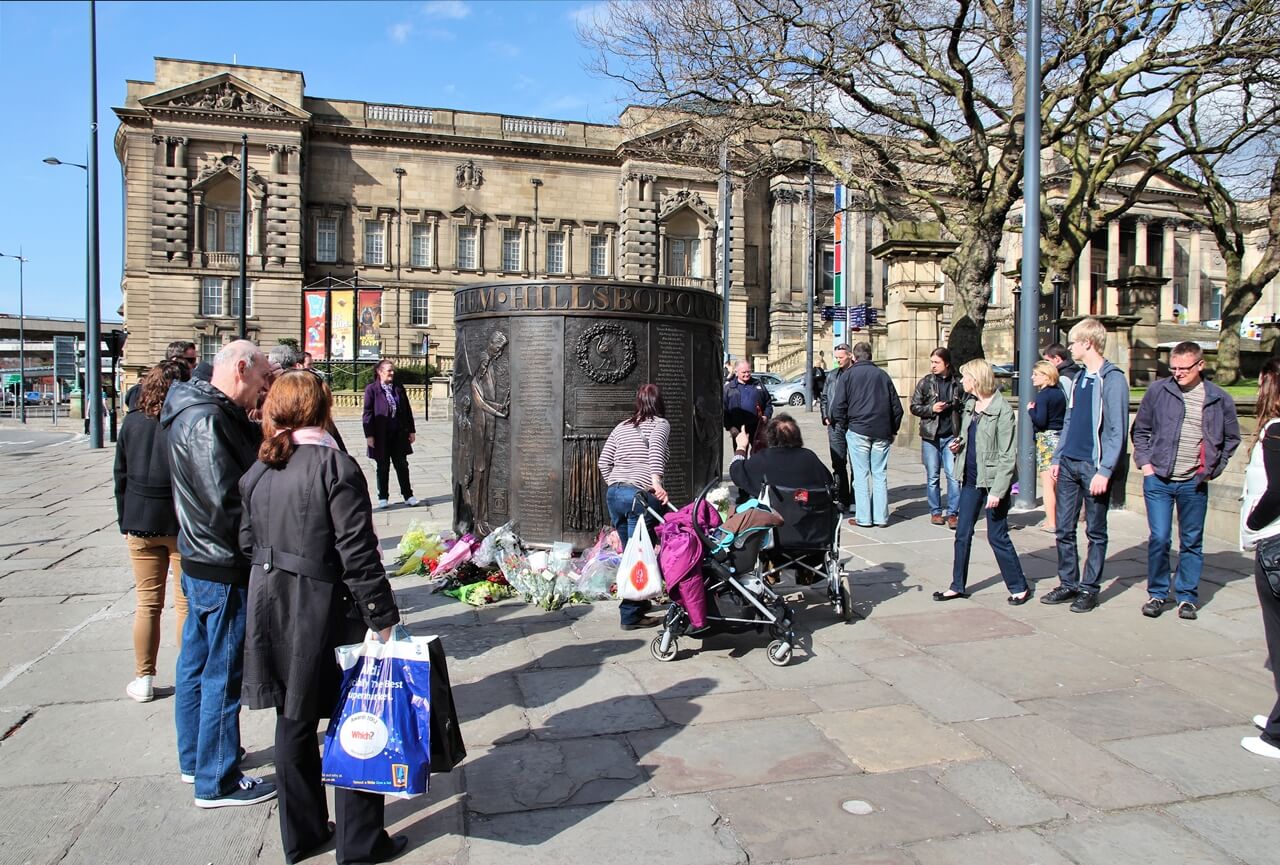
Hillsborough disaster memorial
People visit Hillsborough disaster memorial on April 20, 2013 in Liverpool, UK. Hillsborough disaster was a stadium crush on April 15, 1989 which resulted in 96 deaths.

The semi-final clash between Liverpool and Nottingham Forest took place on a Saturday, April 15, 1989. Tickets to the 53,000 capacity stadium were already sold out, with fans from both sides heading to Hillsborough stadium for the 3pm kick-off.

With hooliganism in English football at its height in the 80s, segregation of the fans needed to be enforced strictly.

As such, Liverpool supporters were allocated the smaller end of the stadium, Leppings Lane, so that their route would not come in contact with Forest supporters coming from the south.

The North and West ends (Leppings Lane), held 24,256 fans, reached by 23 turnstiles from a narrow concourse.

Meanwhile, Nottingham Forest supporters were allocated the South Stand and Spion Kop on the East Stand, with a combined capacity of 29,800 reached by 60 turnstiles spaced along the two sides of the ground.

Fans began to arrive at Leppings Lane stand around noon. Only seven turnstiles at the west entrance were allocated for the 10,100 ticketed Liverpool supporters for the two standing-only terraces.

At the time, it was common practice in football grounds that terraces be divided into “pens” by high fences to separate fans into blocks, as well as from the pitch.

According to the second coroner’s inquests held between April 1 and 26, 2016, the jury was told that entrance tunnel led supporters directly into the two pens, marked pens 3 and 4, situated behind the goal, while access to other pens (1 and 2) was poorly marked.

There was no proper system on the day to ensure fans were evenly distributed across the pens. The lack of personnel to monitor entries made counting the crowd in each pen difficult. The police had expected supporters to find their own sections and to spread across the pens in search for space. However, movement between the pens was difficult due to narrow gates of the entrance tunnels.

By 2.15pm, a large crowd had built outside Leppings Lane turnstiles as progress at the turnstiles was slow. Inquests heard that half an hour before kick-off, only 4,383 people had entered, meaning some 5,700 fans with tickets were still outside the ground.

By 2.45pm, CCTV footage showed thousands of people pressing into the turnstiles alongside a large exit gate, marked Gate C. The inquests were told that the funnel-shaped nature of the area meant that congestion was hard to escape for those at the front. The limited turnstiles became hard to operate and people were getting crushed at the entrance.

Meanwhile, the police officer in charge of the section had told the inquests that he thought people might get killed unless the exit gates were opened to alleviate the pressure at the turnstiles. Several requests were made before recently appointed match commander, South Yorkshire Police Chief Supt David Duckenfield gave the order to open the gates.

About 2,000 fans made their way into the ground, mostly entering through Gate C, which headed straight for the tunnel leading to the already overcrowded central pens 3 and 4.

This led to an influx of supporters and severe crushing occurring in the pens. The official combined capacity of pens 3 and 4 was 2,200. It was later discovered that the safety certificates to the pens had not been updated since 1979, despite several modifications made to the ground over the past decade.

Witnesses said some of the people had begun to climb over the side fences into the less packed adjoining pens to escape. By 2.59pm, right before kick-off, fans in the two central pens were seen pressed up against the fences and being crushed against the barriers.

Hundreds of people were pressed against each other and the fencing, with the weight of the incoming crowd worsening the situation as those entering were unaware of the problems going on at the fence.

When the match began as scheduled at 3pm, the crowd was still streaming into pens 3 and 4. Meanwhile, the problems at the front of the section went largely unnoticed by the authorities.

It is understood that Liverpool’s goalkeeper Bruce Grobbelaar had reported that fans behind him were pleading with him to seek help as the situation worsened. At approximately 3.04pm, a shot from Liverpool’s Peter Beardsley hit the bar.

Possibly connected to the excitement, a surge in pen 3 caused one of the metal crush barriers to give way, causing the people to fall on top of each other. There were accounts among survivors of people losing consciousness before their eyes.

At 3.06pm, Supt Roger Greenwood ran to the pitch and told the referee to stop the game.

Fans started to climb the fence in an effort to escape the crush, going onto the track. Fans had also forced open several parts of the collapsed fencing in a desperate attempt to escape. Other fans were pulled to safety by those in the West Stand above (upper tier) the Leppings Lane terrace.

The crowd from the terrace overspilled onto the pitch with many traumatised.  Many were still trapped in the pens  and it is understood that many victims died of compressive asphyxia.

Disastrous emergency response

In the chaotic aftermath, supporters tore up advertising billboards to use as makeshift stretchers as they tried to administer first aid to the injured. The authorities’ response to the disaster was deemed by many as slow and poorly coordinated.

Police delayed declaring a major incident and staff from the South Yorkshire Metropolitan Ambulance Service at the ground also failed to recognise and call a major incident.

Firefighters with cutting gear had difficulty getting into the grounds. Although dozens of ambulances were dispatched, access to the pitch was delayed because the police were reporting “crowd trouble”. Two ambulances eventually reached the Leppings Lane end of the pitch and of the 96 people who died, only 14 were ever admitted to hospital.

Confusion arose among first responders, as the agreed protocol was for the ambulances to queue at the entrance of the gymnasium, termed casualty reception point, or CRP. Any individuals in need of medical attention were to be delivered expeditiously by police and paramedics to the CRP.

The system of ferrying the injured victims from any location within the stadium to the CRP required a formal declaration by the person in charge for it to take effect. As the declaration was not immediately performed, confusion reigned over those administering aid on the pitch. Some ambulance crews were also hesitant to leave their vehicle, unsure whether patients were coming to them or vice versa.

Meanwhile, players from both teams were rushed to the dressing room and told there was a 30-minute delay. (The match would be abandoned and the fixture replayed at Old Trafford, Manchester, on May 7, 1989 with Liverpool winning and going on to win the FA Cup.)

As for the jury of the inquests, police errors in planning, defects at the stadium and delays in the emergency response contributed to the disaster. In an age where football hooliganism had reached its heights in English football, the behaviour of the fans was not to blame.

The jury found that Duckenfield had breached a duty of care to fans in the stadium that day, which amounted to gross negligence and that the 96 victims were unlawfully killed.

Unfortunately, Duckenfield was new to his post and had limited experience in policing football matches. Even though Duckenfield had discussed delaying the kick-off with his deputy Supt Bernard Murray to allow fans to enter, he had decided against it on that day.

Justice for the 96

Bereaved families and survivors had fought a tireless campaign seeking justice after the first coroner’s inquests into the Hillsborough disaster, completed in 1991, ruled all the deaths as accidental.

Families of the victims rejected the findings and fought to have the case reopened. In 1997, Lord Justice Stuart-Smith concluded that there was no justification for a new inquiry. Even private prosecution brought by the Hillsborough Families Support Group against Duckenfield and Murray failed in 2000.

By 2012, new inquests were quashed as the court proceeding had gone on to become the longest running in British legal history.

However, on April 16, 2016, the jury of the second inquests returned verdicts of unlawful killing in relation to each Hillsborough victim, vindicating all those who fought tirelessly for the truth for so long.

The jury concluded that police errors had caused a dangerous situation at the turnstiles and failures by commanding officers had also caused a crush on the terraces. There were also mistakes in the police control box over the order to open Leppings Lane end exit gates.

It also concluded that defects at the stadium contributed to the disaster and that there was an error in the safety certification of the Hillsborough Stadium.

Police also delayed declaring a major incident, leading to the emergency response including ambulance service also being delayed.

The condition of Hillsborough stadium prior to the disaster

Constructed in 1899 to house Sheffield Wednesday, HIllsborough stadium had been selected as a neutral venue to host the FA Cup semi-final rounds on five occasions in the 1980s.

Sheffield Wednesday was criticised for neglecting safety at the stadium following the tragedy, as this wasn’t the first time that fans had been crushed during a game.

An incident in the semi-final of the 1981 FA Cup between Tottenham Hotspur and Wolverhampton Wanderers at Hillsborough stadium saw 38 fans being crushed and injured after hundreds more spectators were permitted to enter the terrace.

Serious overcrowding was also observed at the 1987 quarter-final between Sheffield Wednesday and Coventry City and again between Coventry City and Leeds United.

Liverpool and Nottingham Forest even met in the semi-final at Hillsborough a year earlier in 1988, and fans reported of crushing at Leppings Lane. Liverpool had lodged a complaint before the match in 1989.

Although the 1981 incident prompted Sheffield Wednesday to alter the layout at the Leppings Lane to restrict sideways movement, several changes to the ground later on invalidated the stadium’s safety certificate.

The Leppings Lane did not hold a valid safety certificate at the time of the disaster.

The Taylor Report

The Hillsborough disaster inquiry overseen by Lord Justice Taylor between May 15 and June 29, 1989, published two reports – an interim report (Aug 1), which laid out the events of the day and immediate conclusions, and the final report on Jan 19, 1990, which outlined the general recommendations on football ground safety.

The Taylor Report had a deep impact on safety standards for stadiums in Great Britain. Perimeter and lateral fencing was removed and many top stadiums converted into an all-seated format. Purpose-built stadiums for the football league teams since the report require that they are all-seated.

The Football Spectators Act does not cover Scotland but the Scottish Premier League chose to make all-seater stadiums a requirement of league membership.

In England and Wales, all-seating is a requirement of the Premier League and the Football League for clubs who have been present in the Championship for more than three seasons. However, the government announced a relaxation of the regulation for the lower two English leagues (now known as League One and League Two).

Of late, several campaigns have attempted to get the government to relax the regulation and allow standing areas to return to the Premiership and Championship grounds.

Lest we forget

Remembering the tragic Hillsborough disaster of 1989
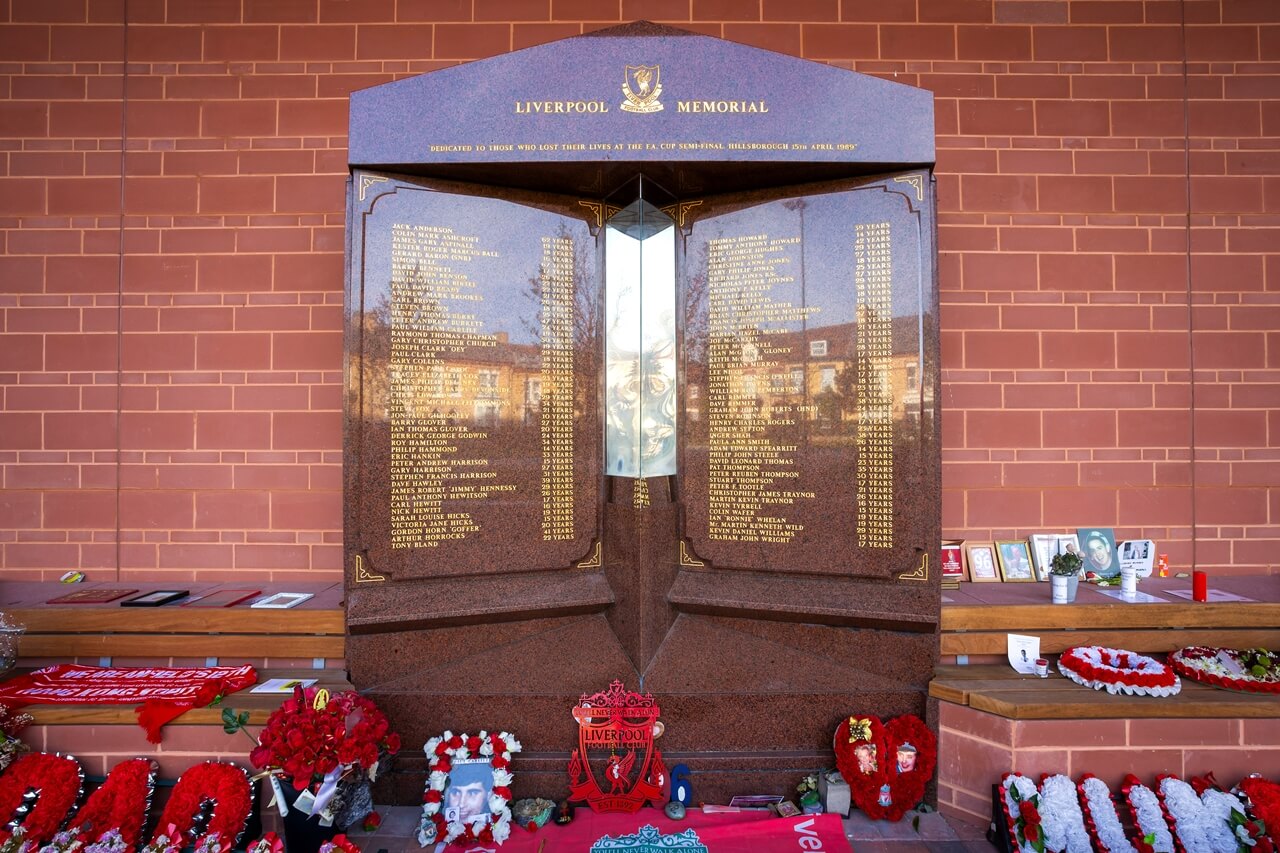
Liverpool, UK – May 17 2018: Hillsborough memorial for the 96 victims in Hillsborough disaster constructed 2015 situated in a specially-designed garden in front of the Anfield stadium Main Stand.

Several memorials have been erected in memory of the victims of the Hillsborough disaster, most notably at Anfield, featuring the names of the 96 who lost their lives.

There is also a memorial garden in Hillsborough Park with a “You’ll never walk alone” gateway.

Flames were added either side of the Liverpool FC crest in memory the victims.

In 2014, the English FA decided all FA Cup, Premier League, Football League and Football Conference matches played between April 11 and 14 would kick-off seven minutes later than originally scheduled with a six-minute delay and a one-minute silence tribute.

How people travelled from Tubau to Belaga 70 years ago

Today, it only takes two to two-and-a-half hours to drive from Tubau to Belaga.

It depends on the weather, road conditions and how many timber-laden lorries you come across along the way.

However, did you know that to travel from Tubau to Belaga 70 years ago would have taken roughly two and a half days depending on the river water levels?

In March 1949, when the Geological Survey Department of British Territories in Borneo was established, their job was to do a geographical survey in Sarawak and North Borneo (Sabah).

At the same time, they interviewed the locals on their mode of transportation in order to understand the geographical features of the area.

Some of their reports were published in the Sarawak Gazette.

During one of the surveys, the director F.W Roe interviewed an Iban longhouse chief near Sungai Takis named Nawi anak Ngelai.

How people travelled from Tubau to Belaga 70 years ago
Geological Survey, British Territories In Borneo. R.A.F. Food Supply Drop to Geological Party, Upper Rajang River, Eastern Sarawak. Photo by G. Whittle.

Nawi gave Roe a rough description on how to travel from Tubau to Belaga because he himself had already made a few trips.

First, Nawi explained how to travel from Bintulu to Tubau: “From Bintulu to Tubau up the Kemena river a launch can be used. At three places rocks occur in the river bed, but these do not normally break the surface of the water; the first two rocks are not far apart and are about three miles upstream from Labang, the first locality is near the mouth of the tributary Telavei, about two miles before Tubau. These rocks do not show at the surface, and are neither marked on the maps, nor by a notice on the river bank; it is wise to take a local waterman knowing their location, although if the water is calm the locality is indicated by a slight surface ripples.”

Then, the Iban chief described to the geologist the journey from Tubau to Belaga.

So here is Roe’s note on how to travel from Tubau to Belaga based on Nawi’s description written in 1953:

1.From Tubau to the confluence of the Tubau and Pesu rivers is about half an hour’s travel in a long boat using an outboard engine.

2.Beyond the mouth of the Pesu, the journey up the Tubau river to the Langunan takes about one day. The first section to Rumah Maring Batok, the last house, takes about three hours using an outboard engine; from here to the Langunan the longboat usually has to be paddled, and the journey takes about seven hours. If the water is high and an outboard can be taken and the distance would then be covered in almost three hours.

3.From the Langunan river to Rumah Tamang Ubong on the Belaga river is said to take about four hours. Boats have to be left near the mouth of the Langunan (the locality is referred to locally as Pangkalan) and one travels on foot up the valley. At the source of the river there is said to be a low col leading over the watershed, and after crossing this the route is downhill following the valley of the Paku. Near the confluence of this tributary with the Belaga river there is the Kenyah longhouse, Rumah Tamang Ubong.

4.Rumah Tamang Ubong to Belaga Kubu (fort) is said to be one day’s journey. After two hours paddling down the Belaga river the section is reached where the river loops, around Bukit Jayang, and there are numerous falls. A jungle route follows the mountain side past these falls and takes about 10 hours to cross. Once the falls are passed, Belaga Kubu is about 15 minutes down river.

Take note that the Nawi’s description might not be 100 per cent accurate since the interview was done under the influence of alcohol.

In addition, the longhouses that Nawi mentioned might have already moved to other locations today.

Nonetheless, it is still interesting to know the route taken to travel from Tubau to Belaga 70 years ago.

Prince Philip’s full address in Sarawak’s Council Negri on Feb 27, 1959

Prince Philip, Queen Elizabeth II’s husband, has died Friday (April 9, 2021) at age 99, Buckingham Palace announced.

The death of the Duke of Edinburgh is a profound loss for the 94-year-old monarch, who once described him as her “strength and stay all these years”.

In a statement, the palace said: “His Royal Highness passed away peacefully this morning at Windsor Castle.”

Prince Philip’s visit to Sarawak

Did you know that in 1959 the duke actually had a short tour in Sarawak?

Prince Philip made a 41-hour visit to Sarawak when it was still part of the British colony. He arrived in Kuching on Feb 26, then visited Sibu and Miri before making his way to Brunei.

During his visit, he attended a private dinner at the Astana, tasted our Iban tuak and watched the multi-cultural performances by Sarawakians.

Prince Philip’s full address in Sarawak's Council Negri on Feb 27, 1959
Prince Philip alights under a yellow umbrella, a sign of royalty. The arch was erected by the Malay community. Screengrab from The Sarawak Gazette
Prince Philip also attended a Council Negri meeting on Feb 27, 1959. Here is his full address to the council members back then:

“Mr President, Honourable Members:

I have always enjoyed travelling especially when it brings me to such a charming and friendly place as Sarawak. I have often heard of your hospitality but even so I was not prepared for the kind and generous welcome I have received from so many people.

It was particularly thoughtful of you to invite me to attend this meeting of the Council Negri to present these four Addresses of Welcome. As you have kindly provided me with translation of what has been said in Malay, Iban and Mandarin I can truthfully say that I greatly appreciate your expressions of loyalty and affection to the Queen. I will see to it that she receives a copy of what has been said I know it will give her very great pleasure.

The Queen takes a close and personal interest in the well being pf all the people of the Commonwealth and Empire but I know that she has a special place in her heart for all those who suffered loss and damage during the last war. We have been following the progress of your reconstruction with admiration and sympathy.

I hope and believe that this progress will be maintained in peace and growing prosperity but it would be idle to suppose that there are no problems. The four Addresses heard this morning illustrate the problems of a multi-racial society, the difficulties arising every day when people of different race and customs live side by side. Only common sense in deciding what is in the best practical interests of the State and tolerance of the cultural traditions of all will produce a happy and progressive community.

Take the Commonwealth for example, British Administration from the earliest times has fostered and encouraged local language and culture, but for practical purposes of administration, law, commerce, engineering and science and education is in English. The practical result is that the leaders in every sphere of human activity can understand each other. This ability to exchange ideas in a common tongue is both link binding the countries together as well as a very practical advantage in trade, commerce and science.

There is another characteristic of the Commonwealth which I would like to mention. There is an automatic sympathy and interest in the progress and problems of other Commonwealth countries. On the national level there is the Colombo plan and other similar cooperative schemes but this also applies to individuals. All the Universities of the Commonwealth are willing and anxious to be of service and I am delighted to hear that so many men and women from this country are taking advantage of this.

I am also interested to hear that there are several boys from British schools performing useful service here in the Government’s Community Development projects.

The Commonwealth exists to make this sort of exchange possible and I hope that they will be continued and expanded to the benefit of the countries concerned as well as an example to all the world that the Commonwealth is a brotherhood of nations and a brotherhood of people.

The Queen, as Head of the Commonwealth, sends you and all the people of Sarawak her best wishes for a happy and successful future.

Queen Elizabeth II also visited Sarawak, together with Prince Philip and their only daughter Princess Anne in 1972. Since then, Princess Anne made another visit to the Land of the Hornbills in 2016.

Sarawak traditional handicrafts in danger of being lost

In a paper published in the Sarawak Museum Journal in August 1983, former Sarawak Museum director Lucas Chin came up with a list.

The list is made of Sarawak traditional handicrafts he had observed would become extinct.

It has been almost 40 years since Chin listed down these items. Going through the list, however, we could not agree more that these Sarawak traditional handicrafts are in danger of being lost or have already vanished.

So here are the endangered Sarawak traditional handicrafts in need of revival according to Chin in 1983:

Wood carvings:

  • Kenyah carved wooden utensils: dishes, bowls and spoons which are elaborately carved and decorated should be revitalised and promoted.
  • Kenyah traditional ceremonial wooden masks. He recommended that smaller but genuine versions be produced for the market.
  • Sape musical instrument – smaller versions should be produced and sold together with the cassette music tape.
  • Parang Ilang- Chin noted that those produced in the Baram and Belaga were very coarse and simplified. Traditionally, the parang ilang blade is proportionately cut and decorated and the sheath decorated with tufts of hair or fibre and carved bone.
  • Blowpipes which are only produced by the Penan should be further promoted.
  • Traditional walking sticks which are more elaborately carved than those simplified ones available in the market today, should be encouraged to be produced and promoted.
  • Traditional ceremonial Iban hornbill carving, a stylised interpretation of a striking bird, which holds and honoured place in the Iban folklore – smaller genuine versions are recommended to be produced and promoted.
  • Iban carved trap charms (tuntun peti) – these small carvings in the form of squatting human figure with the elbows resting on the knee, etc., were traditionally made and used by the Iban to attract and lure game, especially wild pigs. The Iban no longer produce these as most of them own shotguns.
  • The series of sickness images made by the Melanau in connection with their healing ceremonies, should be encouraged to be produced and promoted. Traditionally, these images were quickly carved from sago pith. It is recommended that carvers should produced these images from more lasting soft wood (for instance jelutong) but not hard wood as it is difficult to carve the intricate designs onto hard wood.
  • The series of fishing fetishes elaborately carved from the antlers by the Melanau as fishing charms, should be encouraged to be produced and promoted. Antlers are difficult to get nowadays, but it is recommended that other bones, like those of buffalo, should be used by the craftsmen for carving these items.
  • The series of bamboo items such as ceremonial shields, walking sticks, tobacco pipes, pencil holders, etc., which are still being popularly produced by the Bidayuh of Kampung Pichin, need further improvement as their workmanship and standard somewhat deteriorated.

Textiles Weaving

  1. The Sarawak famous Kain Songket, Kain Berturus and other garments produced by the Malay, should be revitalised and promoted. Apparently only one elderly lady living along Datu’s Road (sincd renamed Jalan Datuk Ajibah Abol after Sarawak’s first female minister) could produce this craft.
  • Iban textiles like blankets, skirts, jackets and other smaller garments traditionally woven on simple loom, should also need to be looked into as the technique is gradually being modified. Weavers nowadays no longer take the trouble to collect, prepare and process the raw materials for weaving. Instead, more and more weavers prefer to use commercial coloured threads, dyes, etc.,
  • Kenyah/Lun Bawang/Kelabit bark cloth – it is recommended that simple sleeveless jackets made of bark and decorated with traditional designs should be revitalised and promoted, not so much for wearing, but for decorative purposes.

Basket, Mats and Hats

  • Smaller versions of the tikar lampit produced by the Kayan, Kenyah and Kelabit and should be encouraged to be produced. Nowadays, it is difficult to see any good tikar lampit on sale. It is suspected that the saga rattan is getting difficult to obtain in the jungle nowadays;
  • The Kayan/Kenyah sun hats (saong in Kenyah/hong in Kayan) traditionally produced by the Kayan and Kenyah should be encouraged to be produced and promoted as these items are popular among tourists.
Sarawak traditional handicrafts in danger of being lost
A Kayan woman weaving a traditional mat.

Hopes for Sarawak traditional handicrafts

Some of these handicrafts that Chin predicted as ‘in danger of being lost’ have become extinct 40 years later due to a number of factors like change in lifestyle and depletion of natural resources.

There is no way we could revive Iban hornbill carving, for example, as the bird is an endangered species. Even so, we still can find other alternatives to revive this art form without harming the environment.

Overall, other Sarawak traditional handicrafts on Chin’s list have potential to be revitalised. For example, promoting the Kayan and Kenyah sun hats just as vigorously as Vietnam promotes their leaf hats. You can find them in almost every handicraft store in that country.

Thankfully, Sarawak traditional handicrafts such as sape and Iban textiles are still being promoted and produced today, even taking on the world stage in contemporary art and music.

Other items like the Iban tuntun peti, fishing fetishes carved from antlers and Melanau sago carving, however, are almost never heard of nowadays.

What Chin wrote in 1983 still rings true today:“A country without heritage can be likened to a person without a passport or identity. Although the Government is making gradual efforts to preserve and protect our heritage, I believe that the people themselves should also play a major part in preserving their heritage.”

What was it like living in Sarawak in 1912?

Have you every wondered what life was like in Sarawak over a hundred years ago?

Thanks to a contributing writer of The Sarawak Gazette in 1948 who wrote under the initials ‘O.F’, we had a glimpse of old Sarawak through his writing.

So here is the author’s account of what it was like living in Sarawak in 1912:

“Sarawak in 1912 was enjoying the end of its heydays. The last great war had been the affair in South Africa, and bar a Melanau policeman we all called Lord Kitchener on account of his moustache, and a gentleman who after a gin or two loved telling us about the joys of the Base at Cape Town, that campaign had left no visible mark on the country.

Cadets came out on a hundred dollars a month and the five years furlough was a thing recent memory. One of my first outstation acquaintances was just about to go home after a full ten years service. He looked extremely healthy and I am certain that he did not have an electrolux either.

The whole European Civil Service numbered less than fifty, of which about twenty one were in outstations, the same number in Kuching and the rest or knocking about somewhere. Except for the staff of the two Government collieries there were no Departmental officers outside Kuching.

There was no wireless, no electric light (except, I think, in Bau) but one motorcar, no buses, no cocktail parties and no slap-and-tickle dancing.

Those ladies who wore European dress would not have been seen dead in the street without a monster hat or topi; those who wore Malay dress covered their shy heads with gay sarongs and veils; only the older Chinese women were ever seen in public.

Lofty masted schooners lay in the creek off Sibu Maleng. The Second Division was served by sailing bandongs, propelled up the rivers by the crew sweating at the sweeps; steam vessels and launches laboriously pounded along with sparks sometimes flying from the funnel from the wood fuel.

In Kuching Lee Wai Heng made us good white suits for three dollars sixty and a khaki one was four dollars and a half. Hap Shin would make white canvas shoes for a dollar twenty. Syn Hin Leong, Chong Kim Eng and Ban Jui Long had good whisky at under a dollar a bottle for the same sum you could get nearly three tins of cigarettes. If you went the right way about it it was possible to charter a smart rickshaw to take you to and from the office every day, and a few odd extra trips thrown in, for fifteen dollars a month you could send all the washing you liked to a dhobie for a monthly payment of four dollars.

Sebah, known to everyone, brought round real kain tenun for a couple of dollars a piece, and she was a pleasant company too. Good gold, as pure as one could wish for, could be bought over the counter from Kong Chan for a bit over four and a half dollars an amas, real gold sovereigns about nine dollars, half a quid for four fifty and a real whopper of an American gold piece for about seventeen dollars. Belts made of silver dollars cost their face value plus an equal amount for labour. Every year the pawn farmers used to melt down the unredeemed gold, and I have handled lumps of the stuff.

In Singapore the police arrested Sarawak Dayaks for walking around Raffles Place in a chawat, cables were received from England and Singapore via Labuan, the festival of chap goh meh was the only time one saw Chinese girls, and the idea of ‘Women’s Day’ or processions of gaily clad members of Kaum Ibu was a thing which no man, brown, yellow or white, could dream of.

Once a year, hordes of little Malay boys went over to the Astana to eat the Rajah’s curry, and on New Year’s Day there was a monster regatta. Tuba fishing were always great occasions. In outstations everyone nearby took a holiday. Government servants included, and even if the catches were hot often great the fun was. Most of the tuba was secreted for private fishing up small streams the next day.

In Limbang they raced buffaloes, and in Sibu we spent half the landas roaming about in small boats. When the officers in Mukah and Oya got bored they went pukat fishing with the police and prisoners. In Bintulu they went to Kedurong (Kidurong) to catch rock cod and cast a jala.

Sarawak Rangers paraded with snider rifles and sword bayonets; at headquarters they still exercised in ‘form hollow square to receive cavalry!’ The Rajah’s yacht ‘Zalora’ lay off Kuching with a three-pounder hotchkiss mounted on the forecastle.

Up in the outstations administrators and people lived a feudal but by no means an uncolourful life. Now and again a headhunting foray lived up things, occasionally Chinese gang robbers threw pepper in travelers’ eyes and got away with the spoils. A sporting District Officer, out after snipe, was gored by an angry buffalo. In Limbang an unhappy Chinese tried to commit hara kiri and was saved and lived happily ever after by the efforts of the Resident and his assistant who pushed in his entrails, sewed him up and then gave him a good shaking to get them into place.

One or two small motor boats were introduced at this time and the Malays, ever quick to catch on to a good nickname, called them by a most expressive word. Rajah Brooke drove around Kuching in a wagonette, or sometimes a governess cart; the manager of the Borneo Company had a dashing dog cart. Silk-hatted gentlemen went to Church on Sunday evenings and bottle-green tails appeared at Astana functions.

No one seemed to have much money; in any cases few of the merchants seemed to use it. For raw sago the Kuching towkays sent up cargoes of tobacco, cloth, pots and pans, hurricane lamps, braces and sock suspenders and Dr Williams Pink Pills.

The State was not run on orthodox lines, and I suppose that some modern thinkers would say that it was sheer autocracy, oligarchy and despotic benevolence, and of course so it was. It was run very well. But it could not have gone on much longer. The first world war shook it a bit but left the foundations cracked but standing. The second world war finished it off.”

Curiosity for Sarawak in 1912

What was it like living in Sarawak in 1912?
This is not Sarawak in 1912 but in 1919. In the back of the photo is the jewellery store Kong Chan mentioned by O.F in his writing. Credit: The National geographic magazine (Public Domain)

Obviously, there are huge changes between Sarawak in 1912 and the present.

Even though we still see ladies wearing ‘European dress’ today, they no longer pair their outfits with a ‘monster hat’.

Speaking of clothing, you will never find ‘good white suits for three dollars sixty and a khaki one for four dollars’ anywhere in this world, let alone in Kuching.

While we still have cobblers to repair our footwear, nobody would make white canvas shoes today.

Furthermore, it would be nice to have a bottle of whisky under a dollar right now.

Thanks to O.F, we now know the modus operandi of 1912 Sarawak robbers. Who knew Sarawak pepper had its criminal usage?

Plus, who knew Residents back then had the surgical skill to rescue someone who committed harakiri? Can you imagine the effort they took in 1912 to push someone’s entrails back into their abdomen and stitch them back together again?

For those who are curious, the medicine stated in the article is Dr Williams’ Pink Pills for Pale People.

It contained ferrous sulfate and magnesium sulfate and it was claimed to cure chorea.You will never find it today because it was withdrawn from the market in the 1970s.

What was it like living in Sarawak in 1912?
Dr Williams’ ‘Pink Pills’, London, England, 1850-1920 Credit: Science Museum, London. Wellcome Images (Creative Commons)

Finally, it would be interesting to know if the descendants of those O.F. mentioned in his article are still alive today

5 interesting Sarawak stories as recorded by Harrison W. Smith

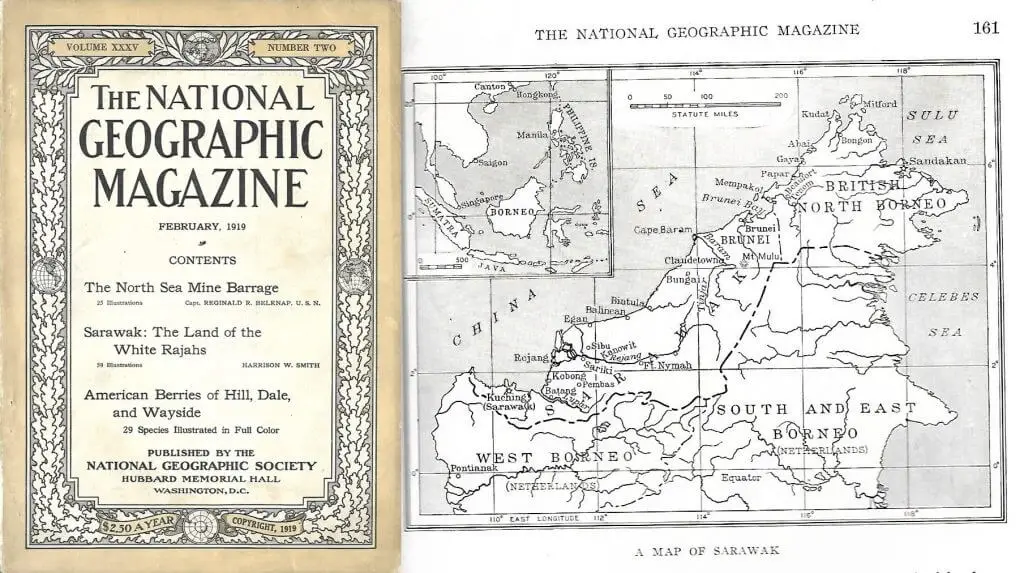
About 100 years ago, an article was published in The National Geographic Magazine about Sarawak.

The article ‘Sarawak: Land of the White Rajahs’ was written by Harrison W. Smith and published in February 1919.

Smith basically described his experience in Sarawak mingling with the Iban, Bidayuh and Kayan peoples in the 58-page long article featuring a whopping 59 photographs taken by Smith himself.

It was written in a non-condescending and enlightening tone to introduce Sarawak to National Geographic readers.

The Sarawak Gazette even published a note on July 16, 1919 to comment about the article and the only problem they had about it was the use of an outdated map.

It stated, “The article gives an interesting account of Professor Smith’s experience in this country and is illustrated, as might be expected, by photographs, excellent in themselves and in their variety.

“The map for which Professor Smith denies all responsibility is another matter; in any paper it would be a matter for regret, but in a magazine whose professed object is ‘the increase and diffusion of geographic knowledge’ it calls for both criticism and correction. This map, taken apparently from a thirty year old school atlas, shows near the whole of Borneo, about which the Sarawak boundary wanders in pleasing uncertainty. The whole of state of Brunei is included therein and Labuan disappears entirely.”

Nonetheless, here are five interesting Sarawak stories that Smith experienced when he was in Sarawak:

5 interesting Sarawak stories as recorded by Harrison W. Smith

1.A phonograph in Sarawak

“A phonograph that I carried for the purpose of recording native songs was a source of great amusement. Many natives who had traveled to the government stations had heard the ordinary records, but none had ever heard their own language.

It was at times difficult to persuade any one to sing into the rather formidable looking trumpet, but when a song had been reproduced from a record made at another village there was usually no further difficulty in bringing forward of the artists of the house.

When they finally they heard their own voices issuing from the little box, their wonder and amusement knew no bounds. It is a pity no photograph could have been obtained of the bank of faces surrounding our little party, with the phonograph in the center, when they first realised that a box was talking their own language in the voice of one of their own number.”

2.Counting using fingers and toes

One of Smith’s companions was an Iban man named Changkok. On one occasion, Smith had to ask Changkok about a longhouse they about to visit.

“Having occasion to ask Changkok the size of a particular house that I planned to visit, he began counting on the fingers of his right hand, calling off the name of the head of each family. He continued counting on the fingers of his left hand, then on the toes of his right foot, then, beginning on the big toe of his left foot, he paused in thought, holding the second toe.

But the effort had been too much; he lost hold of the toe and had to count all over again.

Probably if the problem had required a computation above 20 Changkok, like many other natives, would have had to call in another man with more fingers and toes to count on.”

3.Sarawakians have heard about the Titanic a hundred years ago

Smith spent a great deal of time at Mulu area. One time, he was spending a night at the house of a Malay trader near Melinau river.

“The trader had fastened some logs together and moored them to the shore, forming a small landing stage with a little shed, where one could bathe without danger from crocodiles.

As the launch swung in toward the landing, the current caught the bow, and for a moment it seemed that we should strike the log with considerable force; whereupon a Malay on the landing cried out, ‘Don’t run into the iceberg.’ Thus the story of the Titanic, incredible to the tropical people, spread far into Borneo.”

Titanic sank in the North Atlantic Ocean on Apr 15, 1912.

4.The female Kayan leader of Long Palei

While female presidents fascinate people nowadays because they are rare, female Kayan chieftains were not something unusual even back in Smith’s day.

Even back then, a Kayan woman could rule a longhouse as long as she came from an aristocratic family (maren).

Smith had the opportunity to meet a woman Kayan chief named Ulau when he was visiting Long Palei (Long Palai), Baram.

“The dignified presence and stateliness of the old lady gave me one of the greatest surprises I ever experienced. She maintains rigid discipline, which is characteristic of the Kayan household, from the chief of the house to the head of the family, and the fruits of discipline are apparent in the good manners and recognition of authority that, more than anything else, astonish the visitor, who is not prepared to find such culture among Bornean ‘savages’”.

5.Trying to teach geography to a Kayan

Ulau had a stepson named Kebing who later became one of Smith’s companions during his journey.

While learning about the local culture, Smith in return taught the natives some knowledge of geography and a taste of astronomy and the sun’s orbit.

“In an effort to give Kebing some idea of geography, I told him it was possible to go to America by travelling either in the direction in which the sun rises or the direction in which it sets, and to explain this incredible statement I scratched a map on the surface of a green orange, telling him that the sun stands still and the earth turns around.

‘Once every day?’ he asked.

‘Yes,’ I replied.

‘Well, why does it turn?’ A rather difficult question.”

The legends behind four ancient beauties of China

How beautiful can a woman be that her name and beauty inspires idioms and legends?

While no one in the current generation can claim to be that beautiful, these four ancient beauties of China definitely know how that feels.

The beauties of Xi Shi, Wang Zhaojun, Diaochan and Yang Guifei are reportedly so out of this world that kings were swayed by them and even Mother Nature couldn’t compete.

There might be some exaggeration going on here but here are some of the legends behind the four ancient beauties of China:

The legends behind four ancient beauties of China
Xi Shi as depicted in the album Gathering Gems of Beauty created during Qing Dynasty. Credit: Public Domain.

1.Xi Shi

The first of the four ancient beauties of China is Xi Shi who lived during 7th to 6th century BC.

She was said to be so beautiful that while leaning over a balcony to look at the fish in the pond, the fish would be so dazzled that they forgot to swim and sank below the surface.

The fish were literally killed by Xi Shi’s beauty.

Due to her beauty, she became a political tool between the Wu and Yue Kingdoms of ancient China.

King Goujian of Yue and his military advisor Fan Li were both hostages of King Fuchai from Wu Kingdom, turning Yue into a tributary state to Wu.

In order to strike back against Wu, Goujian decided to send trained beautiful women to Fuchai. One of the women was Yi Shi.

Despite being in love with Fan Li, Yi Shi went to Wu as a tribute.

The move was definitely a smart one because Fuchai had a weakness for beautiful women.

He was so bewitched by Yi Shi that he forgot all about his state affairs and killed his best advisor along the way.

As the strength of Wu dwindled, Goujian attacked his enemy and completely overpowered Wu’s army.

After the fall of his kingdom, Fuchai committed suicide.

There are different legends of what happened to Xi Shi after the fall of Wu.

One version is that Goujian killed her by drowning because he was afraid that he would be mesmerised by her beauty the way Fuchai was. (Oh yes, blame it on the women for your own weakness.)

Another version of the legend thankfully has a happy ending. Xi Shi reunites with Fan Li and they live together on a fishing boat, roaming like fairies in the misty wilderness of Taihu Lake.

2.Wang Zhaojun

The legends behind four ancient beauties of China

Just like Yi Shi, Wang Zhaojun was sent by Emperor Yuan to marry Chanyu Huhanye of the Xiongnu Empire to establish friendly relations with the Han Dynasty through marriage.

She first entered the harem of Emperor Yuan of Han in 36 BC.

According to the custom in the palace, the Emperor was first presented with portraits of all the candidates in the harem to choose as his wife.

Most women resorted to ancient way of catfishing; they bribed the artist Mao Yanshou to paint them to be more beautiful than they really were.

Since Wang Zhaojun refused to bribe him, Mao Yanshou painted an ugly portrait of her.

As a result, Emperor Yuan never visited her and she remained as a palace lady-in-waiting.

Then in 33BC, Huhanye of the Xiongnu Empire visited Han kingdom. He took the opportunity to request to become a son-in-law of Emperor Yuan.

Normally, the emperor would honour the request by offering the daughter of one of his concubines.

However, Yuan refused to give Huhanye a real princess for marriage so he ordered the plainest girl in the harem to be selected.

The matron of the harem gave the emperor the ugly portrait of Wang Zhaojun and he immediately agreed.

Only when she was presented to Huhanye did Emperor Yuan find out the beauty of Wang Zhaojun.

It was too late for Emperor Yuan to retract his decision and Huhanye was beyond happy to receive Wang Zhaojun as his bride.

The good news was that relations between two empires improved after the marriage. Unfortunately for the artist Mao Yanshou, he was executed for deceiving the Emperor.

The beauty of Wang Zhaojun

So how beautiful was Wang Zhaojun according to ancient texts? Legend has it that Wang Zhaojun left her hometown on horseback to join Emperor Yuan’s harem.

She was sad leaving her hometown that Wang Zhaojun began to play sorrowful melodies on a pipa.

A flock of geese flying over saw the beautiful Wang Zhaojun and immediately forgot to flap their wings and fell to the ground.

3.Diaochan

The legends behind four ancient beauties of China
Qing dynasty Romance of the Three Kingdoms illustration of Diaochan. Credit: Public Domain.

This ancient beauty of China is mostly a fictional character, famous for her role in the 14th century historical novel Romance of the Three Kingdoms.

In the story, warrior Lu Bu fell in love with Diaochan up to the point that he betrayed and kill his own foster father.

It is not that sad and tragic story because the foster father is a tyrannical warlord named Dong Zhuo.

Diaochan was Dong Zhuo’s concubine. In order to kill the warlord, she made full use of her beauty to turn Lu Bu against Dong Zhuo. The plan seemed to be straight forward and simple; seduce both father and son while encouraging the son to kill the father.

Diaochan was highly praised in writings because thanks to her beauty, Dong Zhuo’s evil regime was put to an end.

She was said to be so beautiful with a face so luminous that the moon itself would shy away in embarrassment when compared to her face.

There are various accounts telling the fate of Diaochan. One account stated that Dong Zhuo’s followers killed her out of revenge, other said she ended up with Lu Bu and eventually was executed along with him when he lost in a battle.

4.Yang Guifei

The legends behind four ancient beauties of China
Painting of Hosoda Eishi titled “The Chinese beauty Yang Guifei”. Edo period, about AD 1800-20. Credit: Public Domain.

While Diaochan’s beauty made the moon shy away, Yang Guifei (whose real name was Yang Yuhuan) was so beautiful that the flowers were put to shame.

In 733, 14-year-old Yang Guifei married Li Mao, the Prince of Shou and the son of Emperor Xuanzong and Consort Wu.

Here comes the icky part; after Consort Wu died, Emperor Xuanzong became attracted to his daughter-in-law Yang Guifei.

Since it is scandalous to take your own daughter-in-law as your concubine even during ancient China, Emperor Xuanzhong sent Yang Guifei to be a Taoist nun.

Yang Guifei stayed as a nun for a brief moment before the emperor took her in again and made her an imperial consort.

In the meantime, Xuanzong bestowed a new wife on his son Li Mao.

Yang Guifei soon became Xuanzong’s favourite concubine. He loved her so much that the emperor had Yang Guifei’s favourite fruit lychee to be delivered to the capital for her.

The Grab riders of Ancient China would take night and day shifts from southern China, where the fruit grew, to the palace.

During the An Lushan Rebellion, the imperial court blamed Yang and the rest of her family for the rebellion.

This was because the conflict between Yang Guozhang (Yang Guifei’s second cousin) and An Lushan, a favourite official of Emperor Xuanzhong that drove An into rebellion.

In order to put an end to the rebellion, Emperor Xuanzhong reluctantly ordered his man to strangle Yang Guifei to death.

1 9 10 11 12 13 40