Patricia Hului

Patricia Hului is a Kayan who wants to live in a world where you can eat whatever you want and not gain weight.

She grew up in Bintulu, Sarawak and graduated from the University Malaysia Sabah with a degree in Marine Science.

She is currently obsessed with silent vlogs during this Covid-19 pandemic.

Due to her obsession, she started her Youtube channel of slient vlogs.

Follow her on Instagram at @patriciahului, Facebook at Patricia Hului at Kajomag.com or Twitter at @patriciahului.

8 French pastries to make at home during this pandemic

Staying at home during this pandemic has become the perfect chance to hone your baking skills. If you have run out of ideas on what to make, how about a real challenge like some French pastries?

Here are 8 French pastries you can try to make at home:

1.Croissant

8 French pastries to make at home during this pandemic

Kicking off this French pastries list is none other than the good old croissant. While the croissant is widely known as part of the French pastries family, the ‘ancestor’ of the croissant actually has Austrian origins.

Legend has it that the croissant is an adaptation of the kipfel or kifli which originated from Austria-Hungary. An Austrian artillery officer named August Zang founded a bakery in Paris some time in 1839 which served Viennese specialties such as kipfel and the Vienna loaf.

Soon enough, these pastries caught the attention of French bakers who proceeded to make their own versions, including the croissant.

Like any other French pastries, the croissant is a labour of love which requires a lot of patience and practice.

Chef Dominique Ansel shared seven tips for making the perfect croissant, including how to practice your rolling pin technique and to keep a close eye on the dough temperature.

For beginners, it is advised to choose a cold day with a room temperature below 20oC for your first attempt. This way you will have more time for the whole process and less chance of butter being absorbed by the dough.

Keeping the butter solid between the layers of dough is what gives the croissant its flakiness.

If you live in a tropical country like Malaysia, there are a few tips on making the perfect croissant. Cool the ingredients as well as the utensils in the fridge before use. Additionally, cool your dough for longer if you need to.

While croissants are amazing on their own, you can always turn them into a sweet dessert or a savoury meal.

Have it with jam or butter for your afternoon tea or enjoy it as a light lunch by eating it with hams, cheese and lettuce in between.

Check out the recipe here, here and here.

2.Brioche

8 French pastries to make at home during this pandemic

In a 1611 dictionary, a brioche was described as “a rowle, or bunne, or spiced bread”.

It is basically a French bread with rich and tender crumb thanks to its high egg and butter content. You can cook it with fruit or chocolate chips and serve it on its own.

Similar to other French pastries, it can be served as a basis of a dessert with various kinds of fillings or toppings.

When it comes to the do’s and don’ts there are plenty to follow if you want to bake the perfect brioche.

Adding in the butter for instance, must be done slowly and with great patience. Food website Delish.com shares the butter addition process should take no less than 10 minutes.

It stated, “If you add the butter in too fast, it will not ‘emulsify’ into the dough and result in an oily, broken dough. It’ll still bake off well enough, but do it right and your dough will satisfyingly smooth, glossy and plump.”

To make the dough, it is important to let it rise to double its size at room temperature and then punch it down again.

After that, let the dough rise again in the refrigerator for varying periods.

The dough can be stored in the fridge for up to 24 hours (some even put it in for 48 to develop a stronger flavour).

Once the dough is nice and cold, you can divide it and shape. You can bake them in loaf pan, cake pan or a baking tray.

If you do not have the patience to wait until the next day, you can bake it on the same day, provided that you let the dough to rise double in size.

Check out the recipe here, here and here.

3.Beignet

8 French pastries to make at home during this pandemic

While the origin of the beignet can be traced back to Ancient Rome, the term ‘beignet’ comes from the French word for ‘bump’.

In the 17th century, French settlers brought beignets with them as they migrated to the eastern coast of Canada in a region called Acadia. From there, they were known as the Acadians.

A hundred years later, the British took control of the region causing thousands of Acadians to move elsewhere.

Many of them settled in Louisiana bringing along their language and food including beignets.

Fast forward to 1986, beignets became the Louisiana State Doughnut.

If you are into French pastries but you don’t have an oven at home, you can try to make a beignet instead because it only requires frying.

The basic ingredients are butter, all-purpose flour, water, salt, eggs and oil for deep frying as well as powdered sugar to dust over the top of your beignet.

Those who have tried beignet might compare it to a doughnut. Some even called it the square, hole-less doughnut.

However, there are some differences between the beignet and the good-old doughnut.

Since it is made with more yeast and fewer eggs, the beignet tends to be more airy or puffy than the doughnut.

As for cooking tips, one of them is to make sure the dough is refrigerated for at least two hours before frying.

Check out the recipe here, here and here.

4.Canelé

8 French pastries to make at home during this pandemic

Sometimes, it is not just the recipes that make great French pastries but it is the meticulous process behind them.

You can have the exact recipe from a world-class baker but it won’t work if you cannot understand and master the skill behind the process.

The same thought goes to the canelé, a small French pastry flavoured with rum and vanilla.

This pastry has a soft and tender custard center and a dark, thick caramelised crust.

There are different versions of how the canelé came about. The history can be traced back between 15th and 18th centuries. It is understood that the pastry came from a convent in the regions of Bordeaux in Southern France.

These regions were famous for their wine. Hence, winemakers used to clarify wine using egg whites and would give the leftover egg yolks to the nuns. Combining it with other ingredients such as milk, flour, butter and sugar, the nuns created the canelé.

One of the tips to prepare the batter is by placing sugar, flour, egg yolk and salt in a blender. Then, blend the ingredients on the slowest speed and slowly put in warm milk and butter.

By blending the ingredients for about one minute, you should have a very thin batter.

Canelé has its own mold. Do not worry if you cannot find canelé mold in your local baking supply stores. These days, almost everything can be bought online. You can even find them on shopping apps such as Shopee.

Check out the recipe here, here and here.

5.Cream Puff

8 French pastries to make at home during this pandemic

A cream puff or profiterole is a French choux pastry ball filled with whipped cream or custard.

A choux pastry is a type of delicate pastry dough which contains only butter, water, flour and eggs. While other pastries essentially need a raising agent to rise, choux pastry uses high moisture content to create steam to puff up the pastry.

A perfect choux pastry has a light and crisp outer shell with soft, creamy filling. The pastry has to be air with large air pockets inside as well.

There are two simple rules for choux pastry. Firstly, stick to the ingredients and measurements which means there is no room for improvisation.

Secondly, do not open the oven while it bakes.

Unlike other doughs, you need to boil the liquid ingredients with butter first before mixing in in the flour. Once this doughy paste is ready, let it cool down before beating the eggs in.

To make a profiterole, you need to pipe the choux pastry dough through a pastry bag into small balls.

After baking it, these little balls will form largely hollow puffs. You can then inject the cream puffs with fillings of your liking using a pastry bag.

It is believed that a chef by the name Panterelli or Pantanelli or Popelini invented the dough in 1540. This was seven years after he left Florence with Catherine de’ Medici as part of her court when she married Henry II of France.

Soon enough, the pastry became famous among the French.

Check out the recipe here, here and here.

6.Pain Au Chocolat

8 French pastries to make at home during this pandemic

If you love chocolate, this is the pastry for you. Pain au chocolat literally means chocolate bread. It is also known as chocolatine in the southwest part of France and in Quebec.

Legend has it that Marie-Antoinette introduced this pastry to France but it is actually considered a modern invention.

Once you have mastered the skill of making your own croissant, pain au chocolat should not be a problem for you.

It is made of the same layered dough as croissant except that you put one or two pieces of dark chocolate in the centre.

Like many of the French pastries on this list, pain au chocolat requires lots of resting and less time on your counter.

You can leave your covered dough to rest in the fridge for four hours and up to 24 hours.

Another tip is while rolling make sure the dough stays cold. If it is too warm especially after a few rolling, cover it and refrigerate for 30 minutes before rolling it again.

Remember that every time you work on the dough, only lightly flour the work surface, the dough and your rolling pin. Do not pour too much flour.

Lastly, if you find any air bubbles in your dough, just pop them with your finger then light flour the area where you popped the air bubble.

Check out the recipe here, here and here.

7.Pain aux raisins

8 French pastries to make at home during this pandemic

If you have mastered the skill of making croissant or pain au chocolat, then making pain aux raisins should not be a problem for you. This pastry is practically another variant of the croissant or pain au chocolat.

Also known as escargot, this is a spiral-looking pastry often eaten for breakfast in France.

It is made with a leavened butter pastry with raisins added and shaped in spiral with custard filling.

Speaking of custard filling, you can make it the night before and refrigerate it.

Another tip is to use a floss to slice the rolls instead of knife. By doing so, you can prevent the roll from unrolling while you slice the dough.

Once cooled, you can brush apricot jam to give a great glaze and extra sweetness to pains aux raisins.

Check out the recipe here, here and here.

8.Palmier

8 French pastries to make at home during this pandemic

All these pastries seem so hard to make, there must be an easy one to try, you may be thinking.

Let me introduce you to the palmier, also known as pig’s ear, palm heart or elephant ear. It is a French pastry which is curled, very much like an ear. (Although, the more poetic one of us may describe it as a butterfly shape.)

Here is the thing; you can actually make palmier by using three ingredients. As long as you have frozen puff pastry, butter and sugar, then you are good to go.

It is made by alternating layers of puff pastries and butter, rolled and folded over to create (possibly) hundreds of flaky layers.

Once the puff pastry is rolled out, coat it with sugar, and then the two sides are rolled up together so that they meet in the middle, making a roll.

Then, the roll is cut into slices and baked.

While the origin of palmier could be traced back to the beginning of the 19th century, the history of puff pastry started way earlier.

Traditionally, it is believed that French painter and cook Claude Lorrain invented the puff pastry in 1645.

He wanted to make a loaf of bread for his sick father who was prescribed a diet of water, flour and butter.

Lorrain then prepared a dough, kneading the dough over and over, folding it again, and repeating the procedure ten times, unknowingly created the first puff pastry.

Check out the recipe here, here and here.

All photos are from pixabay.com

5 interesting Sarawak stories as recorded by H. Wilfrid Walker

During the 19th and early 20th century, many European explorers made their way to what they deemed as the “exotic” island of Borneo.

Some were looking for wealth while others were seeking knowledge, to be the first one to discover something new.

British novelist William Somerset Maugham for instance came to Sarawak in 1921 to explore and get inspiration for his writing.

Meanwhile, Scottish Robert Burns was considered the first European man who visited the Kayans in Borneo. His explorations were ended after he was caught by Iranun pirates during a trip to Marudu Bay in northern Borneo.

Another European who had an untimely death while exploring Borneo was Frank Hatton. He accidentally shot himself when his rifle got twisted in some jungle creepers.

Most of these explorers have one thing in common; they put their experience into writing, giving us a glimpse of what was it like in Borneo more than a century ago.

One of the lesser known writings about Borneo is written by H. Wilfrid Walker, entitled Wanderings Among South Sea Savages and in Borneo and the Philippines (1909).

Little is known about this British author except that he is a fellow of the Royal Geographical Society.

The book is actually a compilation of letters Walker wrote back home during his journey to Fiji, Papua, North Borneo and the Philippines.

He was visiting these places to collect birds and butterflies.

Walker explained that Wanderings Among South Sea Savages by no means is a scientific book and was not for naturalists and ethnologists.

Regardless, his experience – especially in Borneo – is still worth an interesting read.

After spending seven months in British North Borneo (present day Sabah), Walker made his way to Kuching.

He arrived as a guest of the Borneo Company and stayed at what he described as “the rather dilapidated government rest house.”

5 interesting Sarawak stories as recorded by H. Wilfrid Walker
View of Kuching from the Rajah’s Garden. (Copyright expired -Public Domain).

During his visit to Bau, Walker came across the Land Dayaks. How he described the Bidayuhs in his writing is an indicator of the racism endemic in the science of the times as he wrote that they were “not to be compared to the Sea Dayaks, who are born fighters, and whose predatory head-hunting instincts give a great deal of trouble to the government.”

Besides coming to collect birds and butterflies, the purpose of his visit to Sarawak was to see the Sea Dayaks or the Iban. And he definitely reached his goal when he visited a longhouse called Menus somewhere at upper Rajang river.

5 interesting Sarawak stories as recorded by H. Wilfrid Walker
Walker (left) with L. Dyke-Acland, and C. A. W. Monckton (Copyright expired -Public Domain).

After reading Wanderings Among South Sea Savages and in Borneo and the Philippines (1909) by H. Wilfrid Walker, here are five interesting stories which took place in Sarawak we think you should know about:

1.The first time Walker saw an Iban man

Walker was really excited to see the Ibans. Together with his two servants, a Chinese cook whom he called ‘Cookie’ and a ‘civilised Dayak named Dubi’, they made their way to Sibu onboard a steamer.

In Sibu, he stayed with the Resident/famed naturalist Charles Hose.

It was in Sibu that Walker finally met his first Iban and this was how he described his first impressions.

“My first real acquaintance with the Sea Dayak was in the long bazaar at Sibu, and I was by no means disappointed in my first impressions, as I found him a most picturesque and interesting individual. The men usually have long black hair hanging down their backs, often with a long fringe on their foreheads.

Their skin is brown, they have snub noses but resolute eyes, and they are of fine proportions, though they rarely exceed five feet five inches in height. Beyond the “jawat,” a long piece of cloth which hangs down between their legs, they wear nothing, except their many and varied ornaments. They wear a great variety of earrings.

These are often composed of heavy bits of brass, which draw the lobes of the ears down below the shoulder. When they go on the war-path they generally wear war-coats made from the skins of various wild animals, and these are often padded as a protection against the small poisonous darts of the “sumpitan” or blow-pipe which, together with the “parang” (a kind of sword) and long spears with broad steel points constitute their chief weapons. They also have large shields of light wood; often fantastically painted in curious patterns, or ornamented with human hair.”

5 interesting Sarawak stories as recorded by H. Wilfrid Walker
Dayak in War-Coat. Photo by H. Wilfrid Walker (Copyright expired – Public Domain)
5 interesting Sarawak stories as recorded by H. Wilfrid Walker
Dayaks and Canoes. Photo by H, Wilfrid Walker (Copyright expired -Public Domain)

2.The first time he sees heads fresh from the headhunters

After spending three or four days in Sibu, Hose received news that the Ibans from Ulu Ai had killed a group of Punans for their heads.

Hose immediately set out to go to Kapit to punish the headhunters and he allowed Walker to go with him.

After they had arrived at Kapit, Hose invited Walker to inspect the heads. Naturally as an explorer, Walker did not want to miss the opportunity.

This was how he described it,

“They were a sickening sight, and all the horrors of head-hunting were brought before me with vivid and startling reality far more than could have been done by any writer.

Only seven of the heads had been brought in, and two of them were heads of women, and although they had been smoked, I could easily see that one of them was that of a quite young, good-looking girl, with masses of long, dark hair.

She had evidently been killed by a blow from a “parang,” as the flesh on the head had been separated by a large cut which had split the skull open. In one of the men’s heads there were two small pieces of wood inserted in the nose. They were all ghastly sights to look at, and smelt a bit, and I was not sorry to be able to turn my back on them.”

5 interesting Sarawak stories as recorded by H. Wilfrid Walker
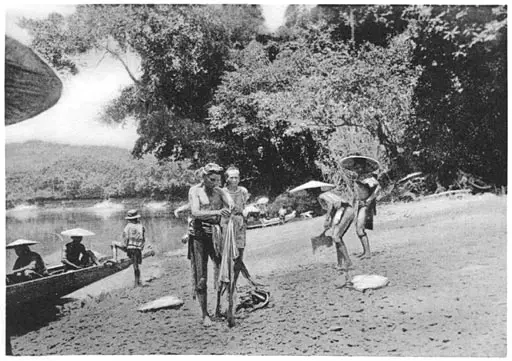
Dayaks Catching Fish Photo by H, Wilfrid Walker (Copyright expired -Public Domain)


3.When a girl doubted a Christian Dayak’s manhood

Walker relates a story which was told to him, of how a girl had turned down a converted Christian man for not carrying on the practice of head-hunting.

In a certain district where some missionaries were doing good work among the Dayaks, a Dayak young man named Hathnaveng had been persuaded by the missionaries to give up the barbaric custom of headhunting.

One day, however, he fell in love with a Dayak maiden. The girl, although returning his passion, disdained his offer of marriage, because he no longer indulged in the ancient practice of cutting off and bringing home the heads of the enemies of the tribe.

Hathnaveng, goaded by the taunts of the girl, who told him to dress in women’s clothes in the future, as he no longer had the courage of a man, left the village and remained away for some time.

When he returned, he entered his sweetheart’s hut, carrying a sack on his shoulders. He opened it, and four human heads rolled upon the bamboo floor. At the sight of the trophies, the girl at once took him back into her favour, and flinging her arms round his neck, embraced him passionately.

“You wanted heads,” declared her lover. “I have brought them. Do you not recognize them?”

Then to her horror she saw they were the heads of her father, her mother, her brother and of a young man who was Hathnaveng’s rival for her affections. Hathnaveng was immediately seized by some of the tribesmen, and by way of punishment was placed in a small bamboo structure such as is commonly used by the Dayaks for pigs, and allowed to starve to death.

5 interesting Sarawak stories as recorded by H. Wilfrid Walker
A Dayak Woman with Mourning Ornaments round waist. Photo by H. Wilfrid Walker (Copyright expired – Public Domain)


4.When some of Brooke’s soldiers mistakenly buried a prisoner alive

During his time in Sibu, Walker spent a great time with two of Hose’s officers named Johnson and Bolt, who then related this story to him:

A Chinese prisoner at Sibu had died, at least Johnson and Bolt both thought so, and they sent some of the Malay soldiers to bury the body on the other side of the river.

A few days later one of them casually remarked to Johnson that they had often heard it said that the spirit of a man sometimes returned to his body again for a short time after death (a Malay belief), but he (this Malay) had not believed it before, but he now knew that it was true. Johnson, much amused, asked him how that was.

“Oh,” said the Malay, “when the Tuan (Johnson) sent us across the river to bury the dead man the other day, his spirit came back to him and his body sat up and talked, and we were much afraid, and seized hold of the body; which gave us much trouble to put it into the hole we had digged, and when we had quickly filled in the hole so that the body could not come out again, we fled away quickly, so now we know that the saying is true.” It thus transpired that they had buried a live Chinaman without being aware of the fact.


5.This European who wanted to see the Dayaks, ended up becoming an exhibit himself

5 interesting Sarawak stories as recorded by H. Wilfrid Walker
Dayak Women and Children on the Platform outside a longhouse. Photo by H. Wilfrid Walker (Copyright expired – Public Domain)


During his first night at an Iban longhouse, the natives who had never seen a white man before was curious to see Walker’s skin.

About midnight I began to feel a bit sleepy, but the admiring multitude did not seem inclined to move, so I told Dubi to tell them that I wanted to change my clothes and go to sleep. No one moved. “Tell the ladies to go, Dubi,” I said, but on his translating my message a woman in the background called out something that met with loud cries of approval.

“What does she say, Dubi?” I asked.“She says, Tuan,” replied Dubi, “they like see your skin, if white the same all over.”
This was rather embarrassing, and I told Dubi to insist upon their going; but Dubi, whose advice I generally took, replied, “I think, Tuan (master), more better you show to them your skin.”

I therefore submitted with as good a grace as possible, and took my shirt off, while some of them, especially the women, pinched and patted the skin on my back amid cries of approval and delight.

The next two or three nights the crowd that waited to see me change into my pyjamas was, if anything, still larger, a good many Dayaks from neighbouring villages coming over to see the sight.

But gradually the novelty wore off, to my great joy, as I was getting a bit tired of the whole performance. I had come here to see the Dayaks, but it appeared that they were even more anxious to see me.

You can read the rest of Walker’s book here.

What you should know about the Battle of Beaufort

The Borneo campaign of 1945 was the last major Allied campaign in the South West Pacific Area during World War II (WWII) to liberate Japanese-held Borneo.

One of the combats that took place during the campaign was Battle of Beaufort in 1945.  

Located about 90 kilometers south of Kota Kinabalu, the town of Beaufort was initially developed to help the economic activity of interior of Sabah.

The town was named after former British governor Leicester Paul Beaufort.

The prelude before the Battle of Beaufort

The operation to secure North Borneo was separated into phases; preparatory bombardment, forced landing and an advance.

They wanted to turn Brunei Bay into a naval base for the British Pacific Fleet. To do that, the Allied forces need to secure Labuan to control the entrance to Brunei Bay. At the same time, Labuan would be developed as an airbase.

After several weeks of air attacks as well as a short naval bombardment, soldiers of the Australian 24th Brigade landed on Labuan on June 10.

The Japanese garrison was outnumbered and the Australians quickly captured the island’s harbour and main airfield.

The fight in Labuan continued until June 21. In the end, a total of 389 Japanese personnel were killed on Labuan and 11 were captured. Meanwhile, Australian casualties numbered 34.

After capturing Labuan, the Australian solders successfully captured the town of Weston against light opposition from the Japanese.

Since there was no road from Weston to Beaufort, the battalion advanced along the single track railway toward Beaufort.

In the meantime, another Australian battalion landed around Mempakul from Labuan also without any resistance from the Japanese.

They managed to secure the Klias Peninsula before moving along the Klias River heading to Beaufort.

Later, the two Australian battalions reunited at Kandu and made their journey towards Beaufort together.

Once the Australians captured Beaufort, they would be able to control the railway that ran toward Jesselton (now Kota Kinabalu).

The Battle of Beaufort

What you should know about the Battle of Beaufort
A 2/43rd Battalion mortar crew firing on Japanese positions near Beaufort on 28 June 1945 (Copyright expired – Public Domain).

On June 26, the two Australian battalions started to approach the town. At that time, there were about 800 to 1000 Japanese soldiers at Beaufort.

The Australian soldiers coordinately captured the town and ambushed the route where the Japanese were expected to withdraw along.

At the same time, the Japanese resistance lacked coordination as they tried to launch six counterattacks against the Australians.

During the battle, some fights even went down to hand-to-hand combat.

The six counterattacks by the Japanese all resulted in failure. By June 29, Australian soldiers had captured the town.  

With that, the Australians were able to open the Weston-Beaufort railway line to bring in the supplies.

The Allied forces then continued to secure Papar on July 6.

In the end, The Battle of Beaufort took the lives of seven Australians and 93 Japanese, leaving 40 people (including 2 Japanese) wounded.

The story of Tom Starcevich’s gallantry

What you should know about the Battle of Beaufort
A patrol from the 2/43rd Battalion in the Beaufort area during August 1945 (Copyright expired- Public Domain).

On June 28, Tom Starcevich’s company encountered two Japanese machine-gun positions in the middle of a jungle track.

The Japanese opened fire first and the Australians suffered some casualties. Starcevich moved forward and assaulted both Japanese positions using his Bren gun.

He killed five Japanese soldiers and causing the rest to retreat. Later on the same day, the company again came across another two machine gun positions. Again, Starcevich single-handedly attacked both and killing another seven Japanese soldiers.

For his bravery, Starcevich was awarded the Victoria Cross after the war. It is the highest decoration for gallantry in the face of the enemy that can be awarded to members of Commonwealth armed forces.

The track where Starcevich’s gallant move took place was later renamed Victoria Cross Road.

Additionally, there is a monument in Beaufort named The Starcevich Monument or Beaufort Australian Monument dedicated to Starcevich.

The aftermath of Battle of Beaufort and the discovery of comfort women

With their six counterattacks, the resistance in Beaufort was the only time that the Japanese had actually made an effort to fight against Allied forces in North Borneo.

Although there were minor combats in the following months, the Battle of Beaufort was considered the last significant action fought in North Borneo during WW2.

In August 1945, a member of the Australian Ninth Regiment was in Borneo as part of the British-Borneo Civil Affairs Unit.

He reportedly found some Javanese women who had been transported to Borneo by the Japanese as comfort women. These women were forced into sexual slavery during the war.

The Javanese women were living in the ruins of the Japanese comfort station somewhere in Beaufort.

According to the book Legacies of the Comfort Women of World War II, the Australian forces took them to a small island off in the Borneo coast for medical treatment and rehabilitation.

While the Australians wanted to send them back to Indonesia, the women were afraid of going home because of the shame associated with their experience, so much so that one of them committed suicide. However, it is not certain if the rest of the women managed to return home.

After the war ended, Beaufort was the place where the Japanese were told to gather before they were transported back to Japan.

Unfortunately for them, many of the Japanese were killed by the Muruts on their way to Beaufort.

Out of thousands of Japanese troops who marched to Beaufort after surrendering their firearms, only a few hundred ever reached Beaufort.

5 favourite ways Malaysians eat their cornflakes

Malaysians love cornflakes. However, the weird thing is that we do not necessarily enjoy them as breakfast cereal with milk poured on top, but have (improved?) upon this Western breakfast staple with local stylings.

5 favourite ways Malaysians eat their cornflakes

Here are five favourite ways Malaysians eat their cornflakes:

1.Cookies

Even if Malaysian households do not buy cornflakes on a daily basis, they most probably buy it during the festive season.

Malaysians love to make cookies out of cornflakes. The most common one is Honey Cornflakes.

The recipe is quite easy; melt some butter with honey (some even add sugar), once the mixture is melted, mix in the cornflakes. Then, divide the cornflakes into small paper cups. Bake it until it is golden brown.

Other cookies recipe include cornflake cookies, milky cornflake cookies and nestum cornflake cookies.

The easiest way to make a cookie out of cornflakes? You only need cooking chocolate. Melt the chocolate in a double boiler, pour in the cornflakes and mix it until the cereal is well coated. After that, divide the chocolate into small paper cups. Finally, let the cookies set inside the fridge. Easy right?

Watch how to make chocolate cornflake here.

2.As a snack with fried peanuts and anchovies

Who doesn’t love to munch on snacks? Another favourite Malaysian spin is Spicy Cornflakes with fried peanut and ikan bilis (small anchovies).

The key ingredient of this snack is sambal.

Fry the sambal with oil first before putting other ingredients such as fried peanuts, fried anchovies and of course corn flakes. Make sure every ingredient is well-covered in sambal and crispy before you turn off the stove.

3.Salted egg cornflakes

Salted egg flavouring truly reigned supreme in 2019-2020 and cornflakes were no exception. Malaysians love to flavour this corn cereal and the latest trend was with salted egg powder.

The basic ingredients are 150gm butter, 500gm corn flakes and 100gm salted egg powder. For a little bit of spiciness and flavour, add in dried chilies and curry leaves.

Firstly, melt the butter and pour in the chilies and curry leaves. Then, add in the salted egg powder. Once the mixture is well-mixed, pour in the cereal.

The final step is optional which is to bake the cornflakes at 160 degrees for eight minutes.

Trust us, this snack is so addictive that it is hard for you to stop once you start munching.

Watch how to make it here.

4.Ice-cream toppings

Forget colourful sprinkles or crushed nuts, cornflakes are the perfect way to top your ice-cream.

Its bland taste and crunchy texture is the much needed oomph for your cold dessert.

5.Add some crispiness to your breaded meat dishes instead

Again, forget about panko or breadcrumbs, coat your meat dishes with blended corn flakes the next time you fry your protein.

One of our favourite Malaysian dishes is crispy butter prawn. We love it so much that we have different variations of it. From butter chicken/pork to butter nestum prawn/chicken/pork and of course we have the cereal version using corn flakes instead.

Regardless of the version of this dish, each of them would not be complete without- drum roll please – curry leaves. Don’t you agree?

What is your favourite variation of this famous breakfast cereal?

#KajoPicks: 10 South Korean legal dramas you must watch

#KajoPicks: 10 South Korean legal dramas you must watch

If you enjoy a few doses of courtroom dramas, here are 10 Korean legal series for you to check out:

1.While You Were Sleeping (2017)

This South Korean legal drama has a dose of fantasy in it.

Hong-joo (Bae Suzy) lives with her single mother and helps her run a pork restaurant.

She looks like any other woman of her age working as a reporter, but Hong-Joo is haunted by seeing the future deaths of others in her dreams.

However, she does not know when the deaths will happen. She tries to stop her dreams from becoming reality.

Things took a different turn when Hong-joo dreams about the death of her own mother. Can she prevent it from happening?

Meanwhile, Jae-chan (Lee Jong-suk) is a rookie prosecutor. Jae-chan and his younger brother move to new house and they become neighbours with Hong-joo.

One thing leads to another, Jae-chan and police officer Han Woo-tak (Jung Hae-in) together with Hong-joo all have the ability to see the future through their dreams.

Putting aside the trio fantasy adventure, the drama also highlights the corruption and office politics which goes behind a prosecution office.

Watch the trailer here.

2.I Can Hear Your Voice (2013)

When Jang Hye-sung (Lee Bo-young) was in high school, she testified as a witness and her statement caused the murderer of Park Soo-ha’s father to be convicted and imprisoned.

Ten years later, she becomes an apathetic public defender who does her job only for the salary.

In the meantime, Soo-ha (Lee Jong-suk) gains the supernatural ability to read people’s minds by looking at their eyes after witnessing the murder of his father.

After meeting Hye-sung during the trial of his father’s murder, he develops a crush on her.

However, when he meets her again after ten years, Soo-ha finds her completely different from what he has expected.

Things turn deadly when the murderer is released from jail and now is holding grudges on both Hye-sung and Soo-ha for getting him convicted of murder.

In a previous article, we picked this drama one of our favourite ‘noona’ romance. The chemistry between Lee Jong-suk and Park Bo-young in this drama is undeniably compatible.

Originally set for 16 episodes, due to its successful ratings, the series was extended by two more episodes.

3.The Good Wife (2016)

By the title, you can tell that this is a Korean legal drama based on the famous American series The Good Wife starring Julianna Margulies.

The Korean remake of the drama has only 16 episodes and stars Jeon Do-yeon. The drama marked Do-yeon’s first comeback to the small screen after 11 years.

Her last role on television was in the famous 2005 Lovers In Prague.

Do-yeon’s return as it turned out worth the buzz as her performance as Kim Hye-kyung was impressive.

She plays the role of a housewife who is forced to return to her job as a lawyer after her husband is put behind bars.

There are differences between The Good Wife and its original plot in the American series. For example, the sex scandal scene has been shortened to accommodate the storyline into 16 episodes.

While the American series, Margulies’s character Alicia Florrick, works with her tech-savvy son to discover the truth together, the Korean version, Hye-kyung does not involve her children in the criminal cases.

If you enjoy the drama and scandal in the American The Good Wife, this Korean legal drama is definitely worth watching.

4.Suits (2018)

Here is another Korean legal drama based on an American television series.

It follows the story of a distinguished lawyer Choi Kang-seok who recruits a young man Go Yeon-woo. Yeon-woo has a retentive memory but not a law degree.

Kang-seok (Jang Dong-gun) is the equivalent of Harvey Spector in the American version while Yeon-woo (Park Hyung-sik) is the equivalent of Michael Ross.

The Korean equivalent of Jessica Pearson is Kang Ha-yeon (Jin Hee-kyung). Before Megan Markle became the Duchess of Sussex, she was known for her character Rachel Zone in Suits.

Her equivalent character is Kim Ji-na (Ko Sung-hee), a paralegal who is perfect in what she does.

Watch the trailer here.

5.Lawless Lawyer (2018)

Who doesn’t love a bad boy lawyer?

Lawless Lawyer (2018) is set in the fictional city of Kisung which is known to be lawless and corrupt.

The plot follows Bong Sang-pil, a former gangster who has a career change to become a lawyer. On top of using his skill and knowledge as a lawyer, he uses his fists and old gang connection to win a case.

Meanwhile, Ha Hae-yi is an idealist lawyer full of integrity but ends up being temporarily disbarred after after attacking a corrupt judge.

The villain of this story is Cha Moon-sook. She appears to be a caring, noble judge but it is all just a facade. Little the public knows, she orders murder to be carried out, conducts rigged trials and run a corrupt charity.

While fighting against Moon-sook, Sang-pil and Hae-yi falls in love with each other.

The drama is a commercial hit and became one of the most highly rated Korean dramas in cable television history.

It stars Lee Joon-gi, Seo Yea-ji, Lee Hye-young and Choi Min-soo.

Watch the trailer here.

6.Innocent Defendant (2017)

You are the top prosecutor at your office, then one day you wake up and find yourself on death row. What would you do?

Park Jung-woo (Ji Sung) is a prosecutor of the violent crimes investigative division who never loses a case. One day, he finds himself in a prison without any memory of what happen.

His hope lies in Seo Eun-hye (Kwon Yu-ri), a public defender who always lose her court case every single time.

Uhm Ki-joon plays the antagonist, a psychotic killer who kills his own twin brother.

The drama was a hit, all thanks to its plot and impressive performance by Ji Sung.

Watch the trailer here.

7.Ms Hammurabi (2018)

How about a Korean legal drama that was written by a real-life judge?

Ms Hammurabi is written by Moon Yoo-seok, the chief judge of Seoul Eastern District Court who also wrote the book version of this story.

It stars Go Ara, Kim Myung- soo and Sung Dong-il.

The drama circles around the life of judges and the various disputes that they have to settle.

While Moon is known for his novels, Ms. Hammurabi is his first script writing work.

Due to its new perspective on the role of a judge and its real-life depiction of people daily struggles, the series was well-received by Korean viewers.

Watch the trailer here.

8.Witch At Court (2017)

Ma Yi-deum (Jung Ryeo-won) is the ace prosecutor who walks a fine line between legal and illegal investigation.

Using personal attacks, evidence fabrication and inciting perjury, she goes all the way to win her case.

In the same time, she is hot-tempered. One day, she is assigned to the special task force for child sex crimes against women and children.

Joining her on the team is Yeo Jin-wook (Yoon Hyun-min), he is a newbie prosecutor who graduated from law school at the top of his class.

He does not like how Yi-deum carries her job. However after he learns about her painful past, Jin-wook comes forward to protect her.

Thanks to the chemistry of the two main leads, Ryeo-won and Hyun-min won the Best Couple Award in the 31st KBS Drama Awards.

Watch the trailer here.

9.Suspicious Partner (2017)

The Korean drama industry has a gift of throwing in an almost random serial killer in the middle of a seemingly normal storyline.

Suspicious Partner (2017) follows the story of prosecutor Noh Ji-wook (Ji Chang-wook) and prosecutor trainee Eun Bong-hee (Nam Ji-hyun).

Like most main characters in a K-drama world, Ji-wook has a tragic past in which his parents died in a fire.

Then the tragic past somehow get entangles with his present when he finds out. After love starts to blossom between Ji-wook and Bong-hee, Ji-wook learns that it was Bong-hee’s father who set the fire causing his parents’ death.

When the drama was aired, it was famous among the 20-49 demographic. So if you fall into this age group, you might enjoy this drama.

10.Diary of a Prosecutor (2019)

While Ms Hammurabi is written by a real judge, Diary of Prosecutor is based on the essay written by a real-life prosecutor Kim Woong.

Set in the fictional city of Jinyoung, it explores the competitiveness and over-working lives of prosecutors.

Lee Sung-jae plays the role of Jo Min-ho, the Chief of Jinyoung District Prosecutor’s Office Criminal Unit 2.

Unhappy that his team always comes in second when comes to work performance, he brings in a prosecutor from the city, Seoul with hope that it will raise his team’s results.

The prosecutor from Seoul is Cha Myung-joo (Jung Ryeo-won). Her working style is straight forward without spending any extra time on cases, hence her colleagues think she is to careless in her work.

However, the person that Myung-joo unhappy the most in the group is Lee Sun-kyun (Lee Sun-woong).

He was Myung-joo’s senior back in university but entered the prosecution one year later than her. The duo often fight in disagreement when comes to work.

The actual filming scene of the drama took place in a small city of Tongyeong with a population of 139, 869.

There, more than 150 members of the cast and crew actually stay during the five months of filming.

Watch the trailer for this Korean legal drama here.

The significance of serving a whole fish for Chinese New Year dinner

There are many symbolic dishes to be eaten during the Chinese New Year season. However, it is more significant to have them for dinner on the eve of the Lunar New year.

One of those dishes is one whole fish. Did you know that it is considered a must-have and lucky food to have on Chinese New Year Eve?

The significance of a whole fish during Chinese New Year

There is a Chinese idiom, “年年有余 (nian nian you yu)”, meaning ‘to have abundance every year’.

The word ‘abundance’ in Mandarin has the same pronunciation as the word ‘fish’.

To have a whole fish served during Chinese New Year dinner symbolises the abundance you hope for the brand new year.

Why is it important to have the fish served as a whole? Can’t it just be served as fish fillet or half of a fish? Having a whole fish symbolises a good beginning and ending for the months to come. Another meaning is to serve as a reminder; to finish what you started.

Chinese Malaysians mostly follow the Southern Chinese tradition, which is to eat only the body, leaving the head and tail behind. This is to express the hope that the new year will start and finish with surplus.

Again, when eating the fish, do not turn the fish over. It is as if a boat is being overturned and your blessing will be overturned too,

How should it be cooked?

The significance of serving a whole fish for Chinese New Year dinner
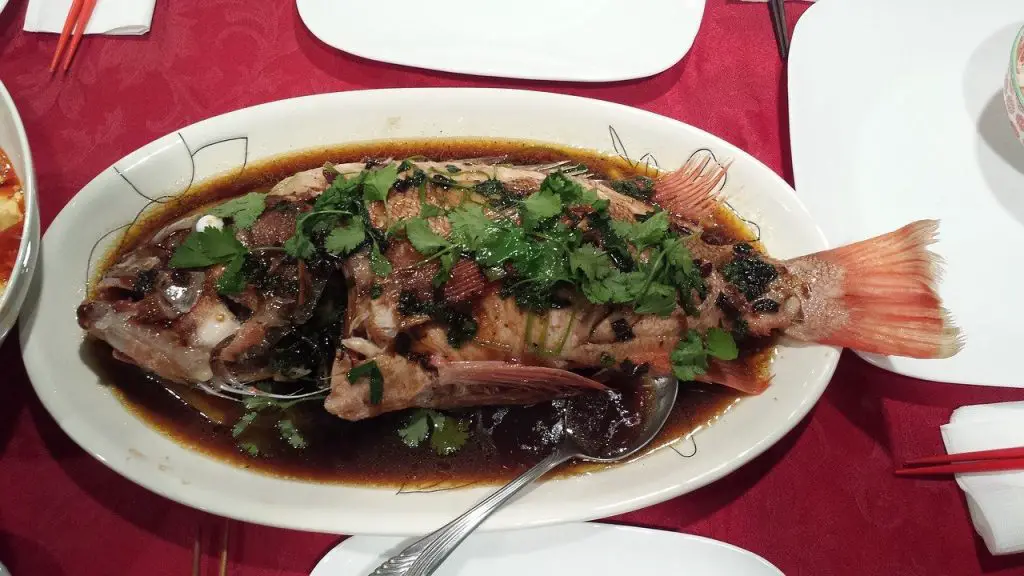
Steamed fish with soy sauce. Credit: Pixabay

The most common way to prepare your fish is to steam it. The important thing to remember, however, if you want tender fish meat is not to over-steam it.

Usually, it takes eight minutes for a smaller fish or 12 minutes for a bigger fish. According to Chef Leung Fai Hung, a fish weighing 1 catty (0.6kg) takes six minutes to steam, while a fish twice the size will take double the time.

Moreover, only place your fish in the steamer after the water has come to a boil.

When it comes to picking recipes, Teochew-style steamed fish is known for its sourness because of the use of pickled plums or pickled vegetables.

Meanwhile, the typical Cantonese-style typically uses light soy sauce, Shaoxing wine and sesame oil as flavouring.

Another common recipe for steamed is using fermented black bean.

Of course, the less healthy way to cook your fish is to fry it. After frying it, you can top it with any sauce you want, for example sweet and sour sauce or soy sauce.

With the Covid-19 pandemic still raging and homes experiencing flooding as the Year of the Metal Rat moves into the Year of the Metal Ox, why not try to cook a fish on your own while staying at home this Chinese New Year?

The significance of serving a whole fish for Chinese New Year dinner
Steamed fish with black bean sauce. Credit: Pixabay.

10 random historical facts about Malaysian islands you might know

Malaysia has a lot of islands. In fact, there are 878 that belong to the country.

Taking the prize for having the largest number of islands is the state of Sabah, with 394 within its waters.

Each of these islands has its own charm. Some Malaysian islands are uninhabited, while others are a place the locals call home. The ones which offer accommodation, white sandy beaches and activities such as snorkeling and scuba diving were always swarmed by tourists during pre-Covid days.

Nonetheless, the historical attractions of these Malaysian islands are often overlooked. 10 random historical facts about Malaysian Islands you might not know:

1.One of Malaysia’s islands is shared with North Kalimantan.

10 random historical facts about Malaysian islands you might know
Pulau Sebatik. Credit: Creative Commons.

The biggest island in Malaysian territory – Borneo – is shared with Brunei and Indonesia. But do you know that there is a Malaysian island which has a border cutting straight through it with the northern half belonging to Sabah on one side and the southern part to North Kalimantan, Indonesia?

Located on the eastern coast of Borneo, between Tawau Bay to the north and Sibuku Bay to the south, the island is officially listed as one of the 92 outlying islands of Indonesia.

The border was carved out by the British and the Dutch under the Anglo-Dutch treaty when they colonised British North Borneo and Indonesia respectively, in the 19th century.

It is not immediately obvious that the island belongs to two different countries when you arrive there. There are no border guards, no immigration office, no customs department and no barbed wire fence or any kind of fencing.

2. The Suluk male population of this island was executed by Japanese forces during World War II.

During World War II (WWII), the locals formed the Kinabalu guerrillas to rebel against the Japanese forces in North Borneo.

With about 300 guerrilla fighters, the revolt was aided by the Bajau-Suluk leaders such as Panglima Ali (Sulug island), Jemalul (Mantanani islands), Arshad (Udar island) and Saruddin (Dinawan island) attacking from the sea.

They won, successfully reclaiming Jesselton, Tuaran and Kota Belud with 50 to 90 Japanese casualties.

Meanwhile, the Japanese retaliated and they retaliated hard. They launched a series of bombings from Kota Belud to Membakut, burning down villages along the way.

In Dinawan island in particular, nearly every Suluk male was executed while their women and children were moved elsewhere.

According to official reports, 66 were killed out of a population of 120 in Dinawan island.

3.On another island, the Japanese massacred the women and children who were left behind.

Today, the Mantanani islands provide a popular diving site, boasting rich marine life and blue waters. But in World War 2, the islands became a site of bloodshed.

The Japanese was gathering all the Kinabalu Guerrillas when they heard a rumour that some of them were hiding on the island of Mantanani.

Edward Frederick Langley Russell in the book The Knights of Bushido wrote, “When the Japanese force commander on Mantanani was unable to find the Chinese guerrillas for whom he was searching. During the next few weeks, each one of these men died of torture or starvation at the Kempei Tai headquarters or in Jesselton Prison. Not a soul survived.”

Two days after the Japanese force had left Mantanani with the arrested Suluks, it returned.

First, they machine-gunned the Suluk men and women, subsequently killing all the wounded.

After that, the Japanese killed 25 women and four children.

4.One of the battle of the Napoleonic Wars took place near the vicinity of this island

While the Napoleonic Wars had nothing to do with Malaysia, interestingly enough, one of its tiny battles took place near our coast.

The Napoleonic Wars (1803-1815) were a series of major conflicts between the French Empire and other European powers.

On Valentine’s day in 1804, a large convoy of East Indiaman (a type of sailing ship) consisting of well-armed merchant ships chased away a powerful French naval squadron. The naval engagement took place in the vicinity of Aur island, Johor.

The french convoy was led by Contre-Admiral Charles-Alexandre Durand Linois. Meanwhile, Commodore Nathaniel Dance was the commander of the British convoy.

Although the French force was much stronger than the British convoy (they were just merchant chips by the way), Dance’s aggressive approach against the French led Linois to retire after only a brief exchange of shot.

After chasing the French away, Dance resumed his passage toward British India.

Perhaps out of embarrassment, Linois later exaggeratedly claimed that the British convoy was defended by eight ships of the line. This claim, of course was later disputed by many historians.

Whatever makes you happy, Linois.

10 random historical facts about Malaysian islands you might know
The retreat of Rear Admiral Linois’s Squadron consisting of the ‘Marengo’ of 84 guns, the ‘Belle Poule’ and ‘Semillante’ of 44 guns each, a corvette of 28 guns and a Batavian brig of 18 guns from a fleet of 16 of the East India Company ships after the action off Pulo Aor in the China Seas on the 15th. February 1804. Credit: Public Domain.

5.Another island which witnessed a battle during World War I.

10 random historical facts about Malaysian islands you might know
Route taken by Emden during her commerce raiding operations. Credit: Public Domain.

During World War I (WWI), Penang island was a part of the Straits Settlements, a British Crown Colony.

Right after the outbreak of WWI, the German East Asia Squadron left its base in China. All but one ship headed east for Germany. In the meantime, the lone ranger which was the SMS Emden under Lieutenant Commander Karl von Muller was sent on a solitary raiding mission.

Then on the early morning of Oct 28, 1914, SMS Emden appeared off Penang island to attack any harbour defenses or any vessels she could find.

As a disguise, von Muller made her vessel to look like the British cruiser HMS Yarmouth (1911).

Once Emden entered the harbour, she came across the Imperial German navy. von Muller then proceeded to launch a torpedo at the Imperial Russian protected cruiser Zhemchug.

In retaliation, French cruiser D’lberville and French destroyer Fronde by now opened fire on the Emden. However, the French was just shooting wildly and Emden just left the harbour unharmed.

You might wonder why Zhemchug did not return fire. Well, her captain Baron I. A. Cherkassov went ashore that night to visit his wife (in some reports, they state it was his mistress).

After spending what we like to assume was a good night with his woman, Cherkassov watched helplessly from the Eastern & Oriental Hotel as his ship sank.

88 of his men died and 121 were wounded because of the attack.

6.The former name of this island is Peria (bittergourd in Malay).

Pulau Duyong is a river island located in the mouth of Terengganu river.

The island was a famous residence for Tok Syeikh Duyong (1802-1889). Originally, the island was known as Pulau Peria or Bittergourd Island alluding the shape of the island.

However, the villagers of the island allegedly saw two mermaids landing on its shore.

Hence, the name Duyong or Mermaid.

Honestly, Mermaid Island does sound cooler than Bittergourd Island.

10 random historical facts about Malaysian islands you might know
A mermaid sighting has led the residents of Pulau Peria to change its name to Pulau Duyong. Credit: Pixabay.

7.One of the Malaysian islands is a former leper colony and camp for Prisoners of War (POWs).

Located in Sandakan Bay, Malaysian state of Sabah, the Berhala island is about 5 hectares in size.

Before World War II (WWII), the island was used as a layover station for labourers coming from China and the Philippines. There was also a leper colony on the island.

Then during WWII, the Japanese used the quarantine station as a makeshift internment camp for both prisoners-of-war (POWs) and civilian internees.

The POWs and civilian internees were stationed on Berhala Island before they were sent Sandakan POW Camp or Batu Lintang Camp respectively.

Some of the notable internees who were held here were author Agnes Newton Keith and her husband, Harry Keith as well as North Borneo district officer Keith Wookey.

In June 1943, eight POWs made a daring escape from the island. They managed to escape to Tawi-tawi in the Philippines before they were transferred to Sandakan POW Camp.

The eight-member group was later known as the Berhala Eight.

8.The 18th descendant of Prophet Mohammad was buried on one of Malaysian islands.

Pulau Besar or Big Island is an island in Malacca. On the island, there is a tomb which belongs to Sultan Al Ariffin Syeikh Ismail.

He was the 18th descendant of the Prophet Mohammad. He received his calling to spread Islam to Java after a visit to the Prophet’s tomb in Medina.

Syeikh Ismail reached Pulau Besar in 1495 and from there start to preach the Islamic teaching throughout the Malay Archipelago.

He passed away at the age of 58 and was buried on the island.

His tomb along other ancient graves and mausoleums are now part of tourist attraction of the island.

9.A Malaysian island was a refugee camp for up to 40,000 Vietnamese refugees.

10 random historical facts about Malaysian islands you might know
Bidong island in undated photo. Credit: Creative Commons.

The Vietnam War ended on Apr 30, 1975 with the evacuation of the American Embassy and the fall of Saigon to the North Vietnamese Army.

Soon after that, millions of people tried to flee the new communist rule in Vietnamese.

By May 1975, the first boat with 47 Vietnamese refugees arrived on Malaysian shore. On Aug 8, 1975, Bidong island off Terengganu officially opened on Aug 8, 1978. At one point, the small island was cramped with up to 40,000 refugees.

From then, about 250,000 Vietnamese had passed through or resided on Bidong island until it was closed as a refugee camp on October 30, 1991.

Most of them resettled in countries such as the United States, Canada, Australia and France. The remaining ones were repatriated to Vietnam against their will. The last refugees left on Aug 18, 2005 for Vietnam.

Today, a marine research station was established by Universiti Malaysia Terengganu on the island.

10.The natives of this island attacked shipwreck survivors, cutting off the legs of one of them.

The year was 1805. A 75-tonne schooner named Betsey departed Macau heading for Sydney. Her crew comprised of two officers, Captain William Brooks and chief mate Edward Luttrell, and 10 seamen, including four from China, three from the Philippines and three from Portugal.

On Nov 21, 1805, the vessel struck a reef. The crew struggled to refloat their vessel for three days before deciding to abandon her.

Brooks, Luttrell and three Portuguese crew climbed into the jollyboat while the rest abandoned the Betsey on a raft. The initial plan was to travel together, but a strong wind parted them.

Unfortunately, the raft and the crew on it were never seen again.

On Dec 2, the jollyboat arrived on the Balambangan Island off the North Coast of Borneo. There, 11 natives attacked them. Brookes died after they cut off both his legs.

The survivors, Lutterall and two Portuguese crew managed to escape and head back to the sea.

Two weeks later on Dec 15, the three men arrived at another island to find food but were attacked by a group of local Malays.

After killing one of the Portuguese, the Malay kept Lutterall and the surviving Portuguese crew as slaves. A year later, the captors finally released them.

Remember these interesting historical events when you have the opportunity to visit any of these Malaysian islands some day.

10 things you might not know about Memories of the Alhambra (2018)

One of the highest rated Korean series in cable television history, Memories of the Alhambra (2018) is also Korea’s first augmented reality-gaming drama.

Set in Spain and South Korea, the story follows a CEO and a hostel owner who get entangled in a series of mysterious incidents surrounding an augmented reality (AR) game.

The CEO, Yoo Jin-woo (Hyun Bin) travels to Granada, Spain to meet the creator of a groundbreaking AR game about medieval battles, Jung Se-joo (Park Chan-yeol).

However, he discovered Se-joo is missing and meets his sister Jung Hee-joo (Park Shin-hye), owner of an almost run down Hostel Bonita instead.

Things get complicated around Jin-woo as he finds the border between the game and his reality starts to blur.

In the meantime, romance begins to blossom between Jin-woo and Hee-joo.

With its unique storyline, impressive computer graphics and beautiful cinematography, it is no surprise how Memories of the Alhambra can keep the audience captivated up to its last episode.

Here are at least 10 things you might not know about South Korean drama Memories of the Alhambra (2018):

1.Memories of the Alhambra was inspired by Pokemon Go

In an interview, the writer Song Jae-jung revealed the story started about a man from the future, Yoo Jin-woo. She was playing with the idea of Yoo Jin-woo staying in a hotel room and opening the door to a stranger who would shoot him with a gun.

However, there was one problem. The idea was not motivated enough for her to carry on with the idea.

When she was searching for ideas to write about, Pokemon Go was the in thing at that time.

Song stated in the 2019 interview, “I didn’t think of doing a video game theme because it didn’t seem possible to create a virtual reality like the movie Avatar. But if it were to involve augmented reality with items on the screen like Pokemon Go, it seemed doable. That was when I dropped the time travel idea and decided to only keep the character Yoo Jin-woo.”

In another interview with The Korea Times, Song revealed that she was really impressed by Korean digital special effects technicians’ skills.

She further stated, “I was afraid of taking on the challenge of AR gaming genre. Since there was no prior drama to take reference, people I’ve talked with painted different pictures in their heads. But when I first saw the first episode, it was really beyond my expectations how realistically those technicians embodied the AR world in the drama. Memories of the Alhambra introduced the AR genre to viewers, applying only basic gaming concepts like doing missions, level-ups and alliances. I think maybe I can tell another gaming story in my next project applying more advanced gaming rules.”

2.Another source of inspiration is Elon Musk

In the same interview, Song revealed that the male lead Yoo Jin-woo is inspired by CEO of SpaceX Elon Musk.

She admitted that she seldom read books like novels, preferring books and magazines focused on the humanities.

When Song was reading Musk’s autobiography, she was inspired to write a character similar to him.

3.Hyun Bin’s character is also inspired by Odysseus from Greek Mythology

As you watch Memories of the Alhambra, you cannot help but notice the episodes of hardship after hardship that Jin-woo experiences throughout the drama.

This is because Song drew a similarity between Jin-woo and Odysseus from Greek mythology.

“Although Odysseus was a great king, he suffered serious repercussions from war and also experienced inexplicable situations. Jin-woo also faces troubles and strange incidents. What mattered to me was how Jin-woo becomes a hero in the end, after bearing all the consequences of his previous decisions.”

4.The relationship initially draws inspiration from Mathilda and Leon

What makes Jin-woo different from typical Korean drama male leads is that he has gone through not one but two divorces.

At first, Song imagined a Mathilda and Leon in Leon: The Professional (1994) kind of relationship. It is one that stands somewhere between love and friendship with the woman being the saviour of Jin-woo.

The 1994 film is an English-language French action-thriller film that follows a professional hitman named Leon. He reluctantly takes in 12-year-old Mathilda (Natalie Portman’s first film) after her family is brutally murdered.

After the cast was finally decided, Song decided that the relationship would be on the romantic side.

10 things you might not know about Memories of the Alhambra (2018)

5.The scriptwriter is known for her fantasy dramas circling about different dimensions and time travels.

The reason why the initial idea behind Memories of the Alhambra was a time-travel story is because Song is known for this kind of story line.

Her drama Nine: 9 Times Time Travel (2013) is about an anchorman who obtains nine incense items which allow him to travel 20 years back in time.

Another drama Queen In-Hyun (2012) by Song is about a noble man from the Joseon Dynasty who winds up in present-day Seoul.

Memories of the Alhambra is not Song’s first drama in which she plays around with the idea of a different dimension.

W: Two Worlds Apart (2016) is about the romance between a webtoon character and a real-life surgeon.

6.Some of the scenes were actually not shot in Granada, Spain

While the drama supposedly set in both Spain and South Korea, there are plenty of scenes which were not shot in either of these two countries.

When Hee-jo and Jin-woo meet up in a restaurant to discuss Jin-woo buying the hostel, the eatery is actually a steak restaurant located in Ljubljana, Slovenia.

And when Jin-woo accidentally ends up in a small town train station which is supposed to be in Spain? The rustic train station is actually Kisterenye Railway Station in Hungary that dates back at least to the 1870s.

Again, the Granada train station in the drama is not even in Spain but in Hungary. Opened in 1858. the Mezotur Railway Station is about 2.5 hours away from Budapest by car.

7.The story behind Recuerdos de la Alhambra

The title of the drama actually alludes to Spanish guitarist Francisco Tarrega’s classical guitar piece Recuerdos de la Alhambra.

The piece also serve as the drama’s original soundtrack.

Tarrega wrote and dedicated it to his patron Concepcion Gomez de Jacoby, commemorating their visit to the Alhambra palace.

The melody supposedly represents the water of the fountains inside of the Alhambra.

8.Park Shin-hye learns how to speak Spanish for her role in the Memories of the Alhambra

If you have been following the works of Korean actress Park Shin-hye, she is known to take up the role of a poor girl who cries a lot.

In this drama she still plays a poor girl who cries a lot but knows how to speak Spanish and play the classical guitar.

She reportedly took up Spanish and classical guitar lessons for her role in the drama.

When filming in Spain, Shin-hye put some effort to create an authentic pronunciation by learning from the native speakers there.

9.And yes, Alhambra is a real palace and fortress

Alhambra was originally constructed as a small fortress in 889 on the remains of Roman fortifications.

Then, the fortress was neglected until the mid-13th century by the Arab Nasrid emir Mohammed ben Al-Ahmar of the Emirate of Granada.

The name Alhambra has its origin in an Arabic word meaning ‘red castle’. This is perhaps due to the colour of the towers and walls.

Today, Alhambra is known to be the only surviving palatine city (a royal territorial center) of the Islamic Golden age.

Additionally, the palace became a remnant of the Nasrid dynasty, the last Islamic kingdom in Western Europe.

10.Will there be a second season of Memories of the Alhambra?

While the fans are rooting for the second season of this Korean series, there is no confirmation yet.

Watch the trailer here.

5 things you need to know about Operation Opossum during WWII

In 1945, the Australian Z Special Unit organised a dangerous mission to rescue the Sultan of Ternate, Muhammad Jabir Syah right under the Japanese nose. They called the mission Operation Opossum.

Also known as the Kingdom of Gapi, the Sultanate of Ternate is one of the oldest Muslim kingdoms in Indonesia.

It was established in 1257 by Momole Cico who was the first leader of Ternate.

The kingdom’s Golden Age took place in 1570-1583 during the reign of Sultan Baabullah. During this time, the sultanate encompassed most of the eastern part of Indonesia and a part of southern Philippines.

Fast forward to 1942 during World War II (WWII), the capital of the sultanate Ternate city was occupied by the Japanese.

The sultan and his family were held hostage in his own palace. While imprisoned, the Sultan sent several of his men to Australian Army headquarters on Morotai island asking to be rescued.

General Douglas MacArthur heard the Sultan’s plea and sent a team from the Z Special Unit to rescue him in a raid called Operation Opossum.

So here are five things you need to know about Operation Opossum:

1.The initial plan for Operation Opossum was not to rescue the Sultan

According to Australian War Memorial, the original plan for the Operation Opossum was to attack Ternate Island in order to extract an Australian airman.

However, the Netherlands Indies Civil Administration later informed that the man was later removed.

Since most of the intelligence on which Operation Opossum based came from the Sultan, the plan then changed to extract him as a preliminary move to recover the missing airman.

2.How Operation Opossum went down

The team consisted of eight Australians from Z Special Unit along with three Dutch officers and a Timorese corporal.

After roughly two months of planning, the mission left Morotai on Apr 8, 1945 and landed on Hiri Island, two kilometers north Ternate.

From Hiri, the message that Z Force had arrived was sent up the volcano where the royal family was hiding.

The family then safely descended to the coastal village of Kulaba after a six-hour trek. From there, two perahu took the Sultan along with his two wives, eight children and other relatives to Hiri.

3.The mission almost failed because the locals were too happy to see the Sultan.

When the royal family arrived at the village, the villagers were too happy to see their sultan and greeted him in their traditional way. They squatted down with one raised knee, with hands pressed against their faces in an attitude of prayer and remained so until dismissed by a nod from the Sultan.

Some of the village elders even lined up to kiss his feet.

The sultan was not happy with the greetings from his people. He kept telling them to be careful in case the Japanese would see them.

True enough, word got out that Sultan was escaping. Several boats carrying Japanese soldiers were sent to Hiri to stop the mission at dawn the very next day.

5 things you need to know about Operation Opossum during WWII
TERNATE ISLAND, HALMAHERA ISLANDS. 1945-11-09. ATTENDED BY AUSTRALIAN FORCES THE SULTAN OF ISKANDAR MUHAMMAD DJABIR, SYAH OF TERNATE MAKES A SPEECH AFTER HIS INAUGURATION. (NAVAL HISTORICAL COLLECTION).

4.The heroic death of Lieutenant George Bosworth

When the Japanese soldiers made contact with the Z Forces, they exchanged fire.

The current Sultan of Ternate, Sultan Mudaffah described what happened during the attack to The Sydney Morning Herald in an interview back in 2010. He was 10 when his family was rescued by the Z Forces.

Lieutenant George Bosworth, who was guarding Sultan Jabir, rushed about 500 meters to the landing site.

Speaking of Bosworth, Sultan Mudaffah said, “This man was too brave. According to my father, he was just standing there, shooting. My father said ‘you can’t just stand there’.”

Three of the Japanese soldiers fell on the beach. As Lieutenant Bosworth approached one of them, it turned out the Japanese soldier was still alive as he picked up his rifle and shot Bosworth in the head.

The fight continued between Z Force and the Japanese, forcing the remnants of Japanese tried to swim back to Ternate.

However, the Japanese were all killed by the locals before they reached shore.

From Hiri, the sultan and his family were taken to Moratai. There, Sultan Jabir debriefed General MacArthur on Japanese positions and tactics in the area.

They were then sent to settle in the Queensland town of Wacol until the end of the war.

MacArthur learned from the sultan that the Australian airman had been removed. Therefore the plan for his extraction was not carried out.

5.Operation Opossum loosely inspired a movie which starred Mel Gibson before his Hollywood fame.

Attack Force Z (alternative title The Z Men) is a 1982 Australian-Taiwanese film. Operation Opossum reportedly inspired the film, although the plot was very different from what had actually happened.

The plot circles around Captain P.G. Kelly (Mel Gibson) who leads a team of the Z Special Unit against Japanese during the WW2.

The movie was screened at the Cannes Film Festival on May 18, 1981. Years later, Gibson called the film “pretty woeful… it’s so bad, it’s funny.”

How does watching ‘gongbang’ or people studying online help you?

How does watching ‘gongbang’ or people studying online help you?

Are you having a hard time studying at home during this Covid-19 pandemic? Have you tried everything that you could to concentrate and be productive that even listening to music doesn’t help anymore?

There are many ways to stay concentrated and motivated while studying alone. One of the least heard of ways is by putting a ‘gongbang’ video on play when you study.

What is ‘gongbang’?

Originating from South Korea, ‘gongbang’ literally translates to ‘study broadcast’.

It sees students filming themselves studying and livestreaming it. Some ‘gongbang’ are prerecorded with soothing music inserted in the background.

It is not sure when or who started the trend. ‘Gongbang’ started to make headlines sometime in 2018 with more and more people livestreaming videos of themselves studying on YouTube.

Those who filmed these videos claimed that it helps them to stay concentrated because the camera is rolling and there are people watching them.

Imagine having your teacher or parents watching over you to make sure you study… now replace those eyes with unknown strangers online.

How does watching gongbang videos or people study on YouTube help you in your own studies?

A Korean silent vlogger Suzlnne who is known for her gongbang revealed in a video how to use her ‘study-with-me’ clips.

First of all, you need to choose a video length depending on how long you are planning to study.

How does watching ‘gongbang’ or people studying online help you?

So let’s say that you are planning to study for half an hour, then pick a video with about the same length.

The first rule is that you have to concentrate the whole length of the video. Another rule is no phones allowed (unless you are watching the video using your phone, put it aside).

There are different kinds of ‘gongbang’ to choose from on YouTube.

Do you want one with background music or without one? How about the sound of a pen or pencil scribbling? Or one with the sounds of rain in the background.

If you are watching the live stream version of ‘gongbang’, then you and the broadcasters are studying at the same time even though you might be thousand of miles apart. Those who have competitive streak in them might feel challenged watching somebody else studying hard somewhere else in the world.

Consider these ‘gongbang’ vloggers as your study buddy who do not know of your existence. Stay focused in your studies while they concentrate in theirs.

Who are the trendy broadcasters these days?

Speaking of Suzlnne, her YouTube channel has around 497,000 subscribers.

Most of her videos are silent vlogs of her life as a college student in South Korea. As for her ‘gongbang’ videos, she has categorised them into different playlists such as with music, at the library (which has the background sound of a library), at a cafe (which has the background sound of a cafe) and the sound of her pencil writing notes.

Another YouTube channel with the username Hyobee live-streamed her studying up to six hours at a time. Her broadcast hour usually takes place between 9pm to 2am. Honestly, she really needs all that studying because she is actually a medical student.

https://www.youtube.com/watch?v=Sczn2JF10-A

Nowadays, the trend ‘Gongbang’ is also being caught up by non-Koreans. Instead of ‘gongbang’, they call it Study with Me videos.

A law student from University of Cordoba, Spain started her YouTube channel Estudiar Derecho last Apr 29, 2020.

Since then, she has already gathered 60,000 subscribers. All her videos are just views of her desk while she studies without showing her face.

Don’t find watching ‘gongbang’ motivating enough? How about filming yourself studying instead? Who knows, you might earn thousands of subscribers on YouTube just by studying.

1 19 20 21 22 23 75