Browse Tag

Culture - Page 5

Brothels and sex workers in Sarawak under Brooke rule

Did you know that when Sarawak was under the reign of the Brooke family (1841-1946), there were regulations to keep the local sex industry in check?

Here are 10 things you need to know about prostitution in Sarawak during Brooke time.
1.The back alleys of Kuching’s Carpenter Street was known for its brothels.

Besides brothels, the street was once known for opium dens and gambling houses.

There are no other records found of possible brothels in Kuching or other parts of Sarawak.

2.There is no proper record on the number of brothels or of prostitutes in the country.

Actually, there is no proper record found on prostitution in Sarawak back then.

According to archivist Loh Chee Yin in The Sarawak Gazette on May 31, 1965, the revenue and expenditure reports over the period concerned do not indicate under which headings the licence fees from brothel keepers and prostitutes are classed.

He further stated, “The annual reports of the Medical Department of the same period do not even mention the number of prostitutes examined over the year, though they give detailed reports on lunatics and lepers.”

3.The first order referring to prostitution was issued on Sept 30, 1867.

If there was no record of legal prostitution, how do we know such activities exist in the first place?

When the first White Rajah had already left Sarawak and his nephew Charles was acting Rajah, there was a royal order referring to prostitution issued in 1867.

With the heading of ‘Contagious Diseases’, the order however was not directed towards the prostitutes but the Dayak fortmen instead.

It read, “Should any Dyak fortment wish to return to their homes on leave of absence, or on discharge, if suspected of having venereal disease they must be taken to the Medical Officer for examination, and should it be the case that any such disease has been contracted they are to be detained until cured.

“Strict attention is to be paid to this order; the necessary information as to the health of the men can be obtained from non-commissioned officers.”

4.In April 1886, more regulations were implemented to control the spread of venereal diseases.

Here are the summary of the regulations:

A)Any woman suffering from a venereal disease would not be permitted to practice as a prostitute and any man having the same disease would be forbidden to have connection with any woman.
B)A prostitute found at the usual fortnightly examination to be suffering from a venereal disease would be placed under treatment until cured. She had to pay the following fees – $1 for first consultation; 50 cent for every subsequent consultation plus charges for medicines.

5.Six years later in 1892, the fortnightly compulsory medical examination for prostitutes became voluntary.

Nonetheless, the Brooke government imposed heavier penalties ($50 fine or six months imprisonment) on brothel keepers and prostitutes for spreading sexual transmitted disease.

Furthermore, prostitutes from abroad had to undergo medical examination before the government allowed them entry permits.

6.Who were the migrant prostitutes back then?

Since there was no record, it is impossible to know who they were and where they came from.

However, there were records of Japanese immigrants coming in since 1915. Reportedly, some Japanese women were working in the red-light district of Kuching. The red-light districts could be referring to the back alley of Carpenter street.

7.In 1898, the Contagious Diseases Order was further amended.

These are the amendment made on the order:

A)Dayak fortmen on transfer to outstations were to be medically examined before leaving.
B)Medical examination of prostitutes was again compulsory. Additionally, it was to be done once a week instead of fortnightly.
C)Prostitutes found to have venereal diseases were to be detained until cured.
D)All brothels were to be registered at the police station and duly licensed.
E)Every brothel keeper had to supply to the police a list of the names and nationalities of the women in his brothel.
F)The inspector of police had right of entry to any brothel for purpose of checking.

8.Charles Brooke was scared that the Dayak girls in Kuching mission schools would turn to prostitution upon graduation.

He once wrote in a letter, “I ask, what is it to be their future when they are grown-up? One thing very certain is they will never be able to live in their own country again or marry their own race nor be able to farm or do the work of Dyak women in their own land – separated from their own people -they will become waifs – to be prostitutes.

I should be sorry to think that this is what our Dyak girls will come to but it is in my opinion almost a certainty if they are educated in Kuching away from they own people to country.”

Charles then cited examples from the mission schools of Singapore and Penang where school girls were the occupants of the brothels or who ever were enticed there at night time.

Consequently, the second White Rajah ordered that the handful of Dayak girls in the Anglican and Roman Catholic schools in Kuching be sent home.

9.In 1927, the Women and Girls’ Protection Order was enacted.

The order was to make provision for the protection of women and girls. Plus, it made provision for the suppression of abuse in connection with prostitutes.

In addition to that, the government issued protection tickets to the prostitutes. On this ticket stated, “Whenever a prostitute has any grievance, she may come to the Protectorate, District Office, or Police Office, and complain. Anyone daring to prevent her will be arrested and punished. These tickets are to be always kept by you on the person.”

Who would have thought prostitutes during Brooke reign had their rights protected more than a lot of people these days?

Brothels and sex workers in Sarawak under Brooke rule
Do you think brothels in the olden days had a sign similar to this? Credits: Pixabay.
10.There were notices posted in brothels informing prostitutes of their rights back then.

“Women and girls! If any of you have been kidnapped, purchased, seduced, deceived, or pledged for money; or have been forced to swear before entering the brothel that you will act as prostitutes for a certain term of year- understand clearly that anyone who has committed any of these offences against you, and is detaining you in a brothel against your wishes, is acting in contravention of the Orders of the State will, if detected, be punished.

If therefore you have any grievance, do not be afraid to tell the Protector on his visit of inspection or come in person to this office or go to the police station and report the matter at any time you please. If you want to leave the brothel the government will certainly let you do what you like and will not allow you to be detained against your will. All persons residing in the State of Sarawak are free agents and cannot be kept under the restraint of others. Be all of you then watchful! Be not deceived by anyone! Observe this notice!

Office of Protector.”

Do you anymore information about prostitution in Sarawak during Brooke time? Share with us in the comment box.

An old Bidayuh punishment for murder before the death penalty

If you are found guilty of murder today, the punishment is usually a life sentence in prison or the death penalty.

But how did Sarawakians in the olden days punish criminals who committed murder?

An old Bidayuh punishment for murder before the death penalty
What was the olden day Bidayuh punishment for committing a crime of murder?
Here is an example of Bidayuh punishment recounted by R. Nyandoh in The Sarawak Gazette on Sept 30, 1964:

Sharing the background of the murder case, Nyandoh wrote, “Mungang from Kampung Mayang in the Serian district married a woman from Kampung Engkaroh and they went to live at Mawang Mungang on the Krang river.”

After some time, the couple moved to Simpoh Rawih on the Jimun river. Mungang was a skilled craftsman, known for his talents for carving, boat-building and painting.

Additionally, he could make all kinds of knives and parangs. Even in the olden days haters were gonna hate, and Mungang was disliked by many of his relatives out of jealousy for his skills.

One day, two of his wife’s relatives, Bulo and his grandmother, came all the way from Kampung Engkaroh to visit the couple.

They asked Mungang to sharpen all their old knives, which he kindly did.

Before Bulo headed home, Mungang asked him to tell his two brother-in-laws not to visit him till the new paddy harvest. Due to the poor crop during the previous year, Mungang had no food to offer them if they came to visit.

Misinformation which led to a murder

However when Bulo returned to Kampung Engkaroh, he did not tell his brother-in-laws, Dibong and Bungan, the correct information.

In fact, he told the brothers that Mungang was getting his knives ready to fight them. Enraged, the brothers set to work to get their own weapons ready to defend themselves.

Several months later, Dibong and Bungan changed their plan. Instead of being on the defensive, they went on the offensive and decided to kill Mungang.

They went to their sister’s house, fixed on their intent to kill Mungang. When they arrived there, Dibong and Bungan found Mungang asleep in the bedroom.

Pushing past their own sister, the brothers stabbed Mungang to death.

The old Bidayuh punishment for murder

Mungang’s wife went back to her own village to report the crime to the headman of Kampung Engkaroh.

The headman then announced that the brothers Dibong and Bungan had to give her a list of items.

In the olden days, the headman of a village also served as a judge to settle any disputes among the villagers.

The fees and punishments for committing crimes might differ as they were according to the headman’s discretion.

As for the murder of Mungang, the headman of Kampung Engkaroh decided that these were the items needed to pay his wife as a punishment:

1.One large brass vessel to replace the head of her husband
2.One string of 30 small bells to replace his eyes
3.Four ounces of gold pieces for the teeth
4.Seven coils of different coloured silk thread to replace his hair
5.Two large silver plates for the ears
6.One large brass tray to replace the hat that belonged to her mother-in-law
7.One whole string of Bidayuh beads to replace her mother-in-law’s beads
8.Two large gongs to replace her husbands’ breasts
9.Two large cannons to replace his legs
10.One Iban loin cloth to replace the mother in-law’s nursing clothes
11.One large jar (Payan Rangkang) to replace his stomach
12.One large jar (Payan Eron) to replace the basket in which her husband had kept his soul

One top of these items, the two brothers also had to pay the woman two large round gongs called katawak and two small gongs called chanang.

They needed to pay her five kinds of jars namely payan botuh, payan lajur, payan jering, payan mandoh and tandok.

The woman, reportedly after receiving all these items from her brothers, left Kampung Engkaroh for good.

She went to live with her relatives in Kampung Ramun which now lies in Kalimantan, never to be heard from again.

“Tuan’s Lament”, a war song written by Semut operatives during WWII

A war song is any musical composition that relates to war or a society’s attitudes towards war.

Sometimes a war song can be pro-war or antiwar while some are just description of lives during war time.

Do you know when Operation Semut took place in 1945 during War World II (WWII), the operatives composed a song about their lives in Sarawak?

The operation was a series of reconnaissance operations carried out by Australia’s Z Special Unit.

About Operation Semut

Launched in mid-1945 by the Australian Services Reconnaissance Department (SRD), the operation had two main missions.

First was to gather intelligence and to train the indigenous people in launching guerrilla warfare against the Japanese.

Overall, the operation was considered a remarkable success. It was estimated there were about 1,500 Japanese casualties with 240 captured under Operation Semut. These were inflicted by a force of around 82 Allied soldies and 200 local guerrillas.

While there were no casualties amongst the Z Special Unit members, about 30 local heroes were killed during combat.

"Tuan’s Lament", a war song written by Semut operatives during WWII
Photograph of Major G. S. Carter (centre) with Semut 2 operatives. Credits: From Australian War Memorial website, Public Domain.
About “Tuan’s Lament”

“Tuan’s Lament” written during Operation Semut is sung in the tune of “The Mountains of Morne” by Irish musician Percy French.

The lyrics were published in The Sarawak Gazette on Jan 31, 1965 under the article “From an old War Chest”.

Going through the lyrics now, readers could at least catch a glimpse what the operatives went through 75 years ago.

“Tuan’s Lament” chorus mentions ‘Charlie the Raj’ which most probably refers to Charles Vyner Brooke, the third White Rajah of Sarawak.

See the war in the eyes of Semut operatives through the lyrics of “Tuan’s Lament”:

Verse 1
Away in the east far out o’er the sea
There’s a place named Sarawak, a great mystery
They said you will go and fight the foe there
We answered ‘For Charlie we’d fight anywhere’.

Chorus
Charlie the Raj
Charlie the Raj
Its all in the service of Charlie the Raj

Verse 2
Our ideals were high and our hearts very large
We left home and comforts to fight for the Raj
To relieve the oppressed was our guiding aim
But we found ourselves players in a far different game

Verse 3
We arrived in Sarawak so strange and so dark
Where collecting of skulls is the lads favourite lark
Each house has its quota, smoked to a turn
At the first glimpse of this for the homeland you yearn

Verse 4
The first thing they told us was ‘here you must stay’
And work for dear Charlie on a dollar a day
The rate they arrived at was decided by Fish*
They dare not pay less ‘cos the coolies get this.

Verse 5
We chased round the country- the Japs on the run
The natives decided to join in the fun
With sumpits and parangs they did rather well
The ‘heathen’ decided Sarawak was hell.

Verse 6
The Japs soon discovered that no man can spare
Lebeh satu kapala and a handful of hair
To join honoured ancestors Jap not lose face
If stop in this country just not in the race

Verse 7
The ‘heathen’ surrendered and now he has gone
But for Charlie the Rajah we still carry on
But now we are tired we don’t want to roam
So Charlie, dear Charlie, oh please send us home.

*Fish here may be a nickname for J.C.B. Fisher

How a Chinese magician brought crocodiles to Sarawak and other tales

When it comes to legends related to crocodiles in Sarawak, most people will remember the story of Bujang Senang.

It was a 20-foot long saltwater crocodile that once roamed the river of Batang Lupar in Sri Aman.

How a Chinese magician brought crocodiles to Sarawak and other tales
The narrower part of Batang Lupar river near Engkilili town.

Bujang Senang was believed to have swum in that river as early as 1942. (Saltwater crocodiles can have long lifespans, averaging 70 years and even up to 100.)

There is no exact number of how many had fallen into its prey, but after killing a woman in Sungai Pelaban, a tributary of Batang Lupar on May 20, 1992, it was shot to death after two more deaths later.

Some legends have it that Bujang Senang was an incarnation of an Iban warrior named Simalungun who was killed and cursed to turn into a crocodile. Seeking vengeance, he vowed to kill the descendants of those responsible for his death.

The legend of how crocodiles came to be in Sarawak

Among his accounts of how to go crocodile fishing or hunting them by torch light, J.Leong Ipoi, a Kenyah from Baram, relates a legend in the Sarawak Gazette on Aug 31, 1965 of how crocodiles first came to Sarawak.

Apparently, many years ago, there were no crocodiles found in this country.

Then came a Chinese magician named Sam Pa Kong, who brought one crocodile with him “because he did not find any fierce and wild animals here.”

He had packed the animal inside a mosquito net, which made it furious as it could not see anything.

“On arrival Sam Pa Kong set free the animal. That is why until the present time, people dare not wash their mosquito nets in the river. If they do, a crocodile will attack them,” Leong wrote.

He continued, “During many years, the Chinese said crocodiles in the Baram never attacked the Chinese because the Chinese had set the animal free.”

How a Chinese magician brought crocodiles to Sarawak and other tales
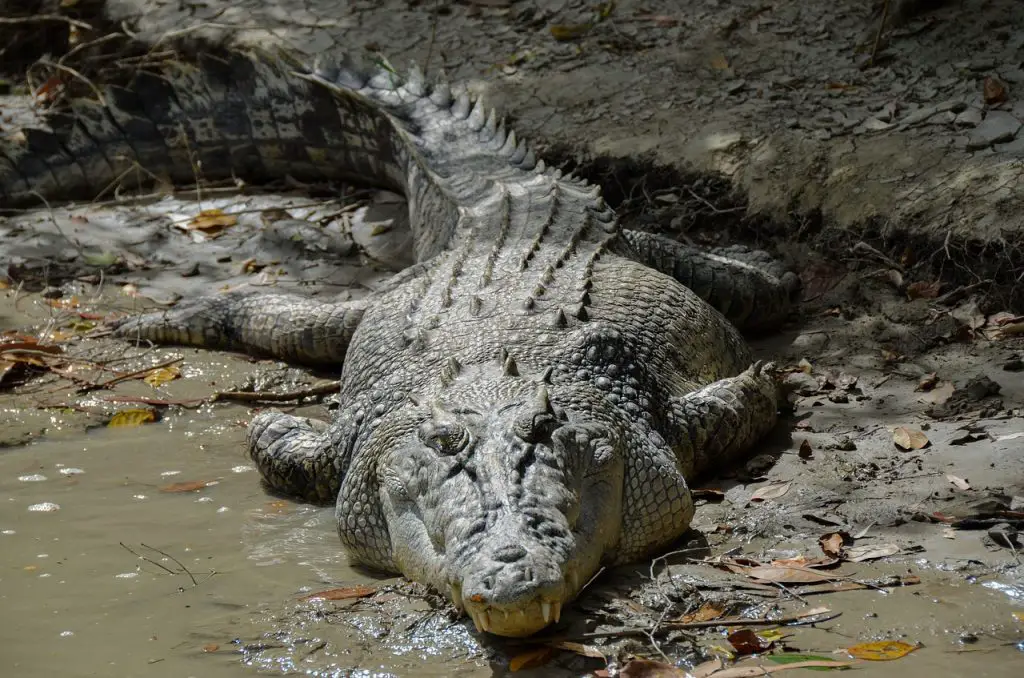
The saltwater crocodile is one of the crocodile species found in Sarawak.
Before there were crocodiles, there were water ghosts

Leong also shared a story of how water ghosts and other wild animals existed before there were crocodiles in Sarawak waters.

These water ghosts were more dangerous than crocodiles.

He wrote, “They used to take children or adults into the water while they were swimming. They did not take people for food. Instead, they only wanted to kill, most of the dead bodies recovered were still in proper condition.”

Then came a man who gave the villagers an idea of how to get rid of these dangerous ghosts.

He asked the villagers to plant chillies, ginger, tuba and other plants which could sting and give off a biting heat.

After harvesting these plants, he told them to pound them together.

How a Chinese magician brought crocodiles to Sarawak and other tales
Signage to warn visitor about crocodiles at Engkilili.

Under the man’s instruction, the villagers loaded the pounded vegetables onto the boats. At the right place, everyone capsized the boats, dumping their loads.

“This caused the fish to come out of the water including the water ghosts because their eyes could not stand it. Many of the ghosts escaped to the river bank. Some of them looked like human beings, with long finger nails, some had animal bodies but human heads; others with long hair around their bodies and also long teeth,” Leong stated.

Here comes the gruesome part of this legend; the villagers started to run after them, chopping off their heads.

Since then, only a few water ghosts are said to have survived the skirmish, but are no longer a danger to human beings.

How a Chinese magician brought crocodiles to Sarawak and other tales
Saltwater crocodile. Credits: Pixabay

How Dayak climbers helped in foreign expeditions

We have often heard of Sherpas and Nepalese mountain climbers, but did you know that Dayak climbers from Borneo were often recruited by westerners during scientific expeditions?

These adventures took these Dayak climbers out of Borneo way back in the early part of the 20th century.

Hendrikus Albertus Lorents and his Dayak climbers/porters

Hendrikus Albertus Lorentz (1871-1944) was the first recorded explorer to hire Dayak climbers to accompany him in his expedition.

The Dutch explorer participated in three expeditions to New Guinea; the first was the North New Guinea Expedition in 1903, led by Arthur Wichmann. Lorentz himself led expeditions in 1907 and 1909-1910.

According to Tom Harrisson in an article “Kenyah above the Snow Line” published on The Sarawak Gazette (April 30, 1965), Lorentz recruited Dayak climbers to climb Puncak Jaya in 1909.

Known as Carstensz Peak back then, it is the highest mountain in Indonesia standing tall at 4,884 metres.

“The 1909 expedition was a Dutch race against a British group, sponsored by the British Ornithologists Union. Dutch leader Lorentz recruited 61 Dutch-Indonesian troops and 82 Bornean Dayaks, who were allowed to bring blowpipes and poison darts but not beheading swords,” Harrisson wrote.

More than a month after leaving their base, Lorentz and his party reached the snowfield of Puncak Jaya at 14,786 feet on Nov 8, 1909.

The first Kayan and Kenyah climbers to reach a snow capped mountain

Most records stated that Kenyah porters from Apo Kayan who helped Lorentz in his conquests.

According to Tom Harrisson, the six Dayak porters were actually Kenyahs and Kayans from the Batang Kayan and Mahakam, Indonesia.

Lorentz once wrote, “It is still incredible, as it was then, to think of us and our five Dayaks standing on that high white island.”

Though it is impossible to find out their identities today, it is right to say they might be the first Kayan and Kenyah climbers to reach a snow peaked mountain.

There is a photo of them on top of the mountain. It was published in “New Guinea: The Last Unknown” by Gavin Souter with one of the Dayak climbers covering his face with snow.

On the way down, Lorentz fell and got himself seriously injured. Thankfully, his Dayak climbers saved the day by bringing him down safely.

How Dayak climbers helped in other expeditions

Meanwhile, the British expedition got into serious difficulties and failed to reach to the top. Their expedition had 96 servants from Maluku, Indonesia and ten Gurkhas.

In 1912, the British Ornithologists Union tried again. Learning from the Dutch, the British also hired Dayak climbers to aid in their expedition.

Along with 74 Iban climbers partly from Sarawak, they reached the then record height of 14,866 feet of Puncak Jaya.

Later in 1938, American zoologist Richard Archbold dispatched two exploration teams into the Baliem Valley of New Guinea. Each team consisted of Dutch soldiers, convicts and Dayak porters from Kalimantan.

According to Harrisson, a large number of them were Kenyahs and Kayans from Apo Kayan “who among other things planted garden of beans and lettuce above 10,000 feet” during the expedition.

With their jungle survival skills and high-enduring stamina, it is understandable why foreign adventurers recruited Dayak climbers during such expeditions.

How Dayak climbers helped in foreign expeditions
Dayak warriors. Credit: Creative commons

How did rubber plantations become part of rural Sarawak?

In Malaysian history class, we learned that rubber plantations in the country was promoted by an Englishman named Henry Nicholas Ridley (1855-1956).

He was a botanist, naturalist, and geologist who spent most of his time in Singapore.

His career on this side of the globe started in 1888. He applied and was selected the first director of Gardens and Forests in the Straits Settlements.

Before he made his way here, he was to meet Italian botanist Odoardo Beccari to prepare for his new job.

After reaching Singapore, Ridley was in charge of introducing new plants of economical value to the region. Against popular belief, he was not the first person to introduce rubber to this part of the world as it was already introduced 10 years earlier by Sir Hugh Low.

However, he did establish the taping method for harvesting latex. He was also the one who heavily promoted rubber plantations in Malaya.

He was so passionate in promoting rubber planting that he was always stuffing rubber seeds into the pockets of everyone he met, with hopes that they would plant the seeds. That was how he earned the nickname “Mad Ridley”.

The first rubber tree planted in Sarawak was in the Anglican bishop’s garden in Kuching
How did rubber plantations become part of rural Sarawak?
Rubber trees are tapped for their resins. Credits: Pixabay

While we learned a lot of Malaysian history in school, we only know a little about Sarawak’s own history with the rubber tree.

Ridley might not have been the one who promoted rubber in Sarawak as vigorously as he did in Malaya, but he did provide a written account of rubber planting in the state.

In September 1905, Ridley wrote an article which was published in the Agricultural Bulletin of the Straits Settlements.

He stated, “It would now be interesting to hear from the present Custodians of the gardens mentioned if the trees are still in existence, and to what girth they have attained at the sere and yellow age of 39 years.”

According to Ridley’s account, the first rubber trees planted in Sarawak were from seeds imported from the Botanic Gardens, Singapore. Reverend Bishop George Frederick Hose brought them in 1881. Bishop Hose was the uncle of Marudi resident, ethnologist and botanist Charles Hose.

He further stated, “One of these trees is still standing in the Bishop’s garden at Kuching and two more in the garden of the Resident. The former measures 6 feet 4 inches in girth at three feet from the ground and the others are nearly as large. The remainder of the trees have disappeared.”

The first rubber plantation in Sarawak

Ridley actually visited Sarawak four times, in 1903, 1904, 1914 and 1915. During his visits, Mad Ridley could not help but go out and see the rubber plantations.

The first rubber plantation he visited was the Coffee Estate on the slopes of Mount Matang. There, they planted the rubber trees together with coffee, tea and Mauritius hemp.

However according to Ridley, the rubber trees were in bad condition. Although the trees were five years old, they looked like the size of two-year-old trees.

“Many of the trees had fallen, others remained as dead stumps, or if alive bore only a few struggling leafy branches. Round Kuching, in the cemetery and along the roads, a good many para rubber trees have been planted lately, and seem to be doing fairly well, though it is too soon yet to form an opinion of them.”

Based on Ridley’s observation of rubber planting in Sarawak, the soils were too sandy.

“The greater part of the hills of Sarawak, at least that portion which I have seen, are sandstone or limestone, and a great area of the diluvium of the lower country is therefore very sandy. But the Lundu hills which I visited are granite, compose of a fine-grained granite. The soil here is less sandy and more argillacuous, with sandy mounds or small hills scattered about it. This seemed to be the most suitable ground for para rubber I saw in Sarawak. Another likely spot is long the Kucing river near Santubong, I had not time to visit this, but head that somewhere here Chinese were planting para rubber.

The first rubber export in Sarawak and the Rubber Boom
How did rubber plantations become part of rural Sarawak?
Natural rubber sheets in drying priocess. Credits: Pixabay.

Based on a report from 1962, the first rubber was exported from Sarawak in 1910.

When the world price of rubber hit historic highs during that decade (the first time in 1905-1906, followed by another boom in 1909-1910), Sarawak got hit by rubber fever.

Then Simanggang Resident AB Ward observed in his memoirs that 1911-1912 were the Planting Eras, as “Natives caught the rubber infection badly. Malays planted all the land they could. Dyaks followed suit, and rubber banished all thoughts of tribal warfare and headhunting.”

Professor Rob Cramb in Land and longhouse: Agrarian Transformation in the Uplands of Sarawak describes how the Saribas Iban took advantage of the money-making opportunity in rubber.

“Initially it was the wealthier Iban communities with a large land base and an accumulated surplus from the gutta and coffee booms which embarked on rubber planting.”

He also cites examples of early enterprising farmers like Tuai Rumah Budin in Stambak, who planted over 4,000 seedlings his son Lumpoh brought back from Singapore, and Penghulu Saang who planted his rubber in Pelandok in the Paku branch of the Saribas in 1912.

Although the price of rubber fell sharply after 1910, it nonetheless became the main agricultural export of the country until the late 1960s.

Unlike Malaya and other rubber producing countries, the kingdom was relatively late in establishing rubber plantations, as the Brookes favoured smallholders and were reluctant to give indigenous farmland to European companies.

During Charles Brooke’s reign, only five large rubber estates were established.

By 1941 before the World War II, there were 236,557 acres of rubber plantations in Sarawak.

Tengkawang Oil, the Butter from Nature

During a traditional food festival in Lanjak in West Kalimantan, Indonesia, no preservative or artificial flavouring such as MSG was used in any of the dishes. This also includes the oil they used for cooking which was substituted with tengkawang oil.

  • The traditional food festival was held at Lanjak, West Kalimantan from September 14-15 and was organised by Indonesian community-based natural resource management (CBNRM) NGO, Riak Bumi
  • The traditional food festival was held at Lanjak, West Kalimantan from September 14-15 and was organised by Indonesian Indonesian community-based natural resource management (CBNRM) NGO, Riak Bumi
  • The traditional food festival was held at Lanjak, West Kalimantan from September 14-15 and was organised by Indonesian community-based natural resource management (CBNRM) NGO, Riak Bumi
  • The traditional food festival was held at Lanjak, West Kalimantan from September 14-15 and was organised by Indonesian Indonesian community-based natural resource management (CBNRM) NGO, Riak Bumi

Known to many as the butter from nature or green butter, tengkawang oil is extracted from the fruit of tengkawang trees.

Tengkawang fruit or the Borneo shallow nut is a native fruit species that can be found in the jungles of Borneo.

However, West Kalimantan, Indonesia is particularly known for its tengkawang oil as it is still widely used by the locals.

Tengkawang Oil, the Butter from Nature
Tengkawang oil, also known as green butter, is made from the fruit of the tengkawang tree which can be commonly found in the tropical jungles of Borneo.

In both Sarawak and Kalimantan, tengkawang fruits are collected by the locals where it will then be processed into oil.

While tengkawang can be found in the jungle, there are some people who actually grow the trees at their farm.

Tengkawang is known as “engkabang” among the Iban people, and “kakawang” among the Embaloh people.

The tree will usually bear fruit once every five years, although there are places in Kalimantan that bear fruits once a year.

In Lanjak, the locals will usually collect tengkawang fruit sometime around February.

According to the locals, the trees will usually bear fruits at the beginning of the year during the rainy season. The trees are typically found near water sources such as the river.  

Usually locals will collect and process it for their own household consumption, although now most have began to commercialize the oil.

However, when picking these fruits, those that have fallen off the tree and started sprouting should not be used.

This is because when processed, they will taste differently. Apart from that, the oil will also be green instead of the usual bright yellow hue.

To process the fruits into oil, the fruits are first separated from the shell and dried under the sun.

Tengkawang Oil, the Butter from Nature
The dried tengkawang fruits before being ground into powder

This process might take up to a few days to a week before they are ground into powder.

  • Dried tengkawang fruit being ground into powder.
  • The ground tengkawang fruit.

After that, the powder is then placed in a steamer filled with water for about an hour.

However, the time may vary, depending on the amount of tengkawang powder being steamed at a time.

The lesser the amount of tengkawang powder being steamed at a time, the less time is spent steaming it.

Tengkawang Oil, the Butter from Nature
The tengkawang powder is placed in a steamer for about an hour

Then, after some time, the steamed powder is taken out to be pressed by a manual oil press machine expeller to produce a glossy, pale yellow liquid.

  • The oil is extracted from the powder by hand through an oil press machine expeller.
  • What comes out from the extractor is a glossy, pale yellow fluid.

Before the machine, the locals would extract the oil using a wooden device called an “apit”.

The dregs or the remains of the tengkawang powder is not discarded but used as fodder and fertilizer.

Tengkawang Oil, the Butter from Nature
The remains can be used as fodder or fertilizer

At room temperature, it will take about three days for the tengkawang oil to solidify, although it will be much quicker using a refrigerator.

Once solidified, tengkawang oil can be stored in containers and be kept for up to more than a year.

However, according to locals, the oil can also be stored in bamboo to ensure a longer storage period.

Tengkawang Oil, the Butter from Nature
Tengkawang oil is usually stored in bamboo to ensure longer storage period

Local people will usually use tengkawang oil for cooking and baking.  

So instead of the usual cooking vegetable or palm oil that we use for cooking, you might consider substituting it with tengkawang oil. You can even substitute butter with tengkawang oil when baking.

Tengkawang Oil, the Butter from Nature
Tengkawang oil used for cooking

On warm rice, the locals will usually press tengkawang to give the rice an aromatic nutty flavour and scent.

It is said that tengkawang oil is preferred over liquid oil when cooking in the jungle as it is more convenient.

Unlike typical oil, tengkawang oil is easier to carry and you would not have to worry about it spilling.

Tengkawang Oil, the Butter from Nature
Example of commercial products using tengkawang oil

Apart from that, tengkawang oil has also been used in cosmetic products such as lipstick and make up foundation due to it moisturising properties. It has also been used to make chocolate, bar soap, medicine, cream, lotion, hair conditioner, sunscreen and as a margarine substitute.

The Mandor Affair, the massacres in West Kalimantan during WWII

On June 28, 1944, a horrendous war crime was committed in a quiet village called Mandor in West Kalimantan, Indonesia during World War II (WWII).

While some historians believed the number of victims were 21,037, other records stated about 1,000 people died during the massacre.

Although the official death toll is still in dispute, nobody can deny that hundreds were killed by Japanese officials on that day.

The Background of The Mandor Affair

The Mandor Affair is in fact part of two massacres called The Pontianak Incidents which took place in West Kalimantan during the Japanese Occupation of the Dutch East Indies.

The whole incident happened in 1943-1944 when the Japanese decided to arrest the Malay elites, Arabs, Javanese, Dayaks, Bugis, Bataks, Menadonese, Dutch, Chinese, Indians and Eurasians in Kalimantan.

Despite the racial differences, those who were arrested had a few things in common. They were mostly community leaders, intellectual and educated people, lawyers, doctors, journalists, politicians, religious leaders and royal members of various Sultanates in Kalimantan.

According to the book Chinese Indonesians: Remembering, Distorting, Forgetting by Tim Lindsey and Helen Pausacker, from January until June in 1944, trucks picked up people by night, either from their homes or from the prisons. They were all taken secretly to Mandor, a quiet village located 95 kilometers northeast of Pontianak.

Many did not know what were the fates of these people until early July 1944. The then local Japanese official newspaper, Borneo Shimbun (Pontianak edition) reported that those who were arrested, were tried and executed on June 28, 1944 in Mandor for plotting to overthrow Japanese rule.

The Japanese reportedly beheaded them one by one before burying them in ten mass graves in the forest near the village.

Meanwhile, other accounts reported they were all buried alive in several large holes. Most were probably weak due to illnesses and diseases after a period of internment and were too weak to fight their way out from being buried alive.

The victims of The Mandor Affair

The question now is how did the number 21,037 come about?

Lindsey and Pausacker wrote that the number 21, 037 was allegedly recorded in war documents kept in the libraries of Japanese universities after WWII.

It is believed that the number was in connection with the kidnapping, torture and massacre by the Japanese troops all over Pontianak, not just in Mandor.

Whatever the real death toll was, what was certain was that the Mandor Affair took the life of up to 25 aristocrats of Pontianak sultanate including its 74-year-old sultan, Sharif Mohamed Alkadri.

The Japanese named him as the one of the ringleaders in the alleged planned rebellion.

They also killed the heir to the Sultan, 31-year-old Pangeran Adipati.

Besides the Sultan of Pontianak, the Japanese also executed the Sultans of Sambas, Ketapang, Soekadana, Simbang, Koeboe, Sanggau, Sekadau, Tajan, Singtan, and Mempawa.

Unfortunately, the timeline of their deaths is still unclear.

Who was responsible for the Mandor Affair?

Indonesian writers Syafaruddin Usman and Isnawita Din wrote in their book Peristiwa Mandor Berdarah claimed Syuutizitiyo Minseibu was responsible for the Mandor Affair.

But there were no records after WWII if he was ever held responsible for the massacre.

Someone, however, did actually pay the price for the Pontianak Incidents.

The Mandor Affair, the massacres in West Kalimantan during WWII
Marquis Tadashige Daigo

After the end of WW2, vice admiral Marquis Tadashige Daigo in the Imperial Japanese Navy was extradited to Batavia in the Dutch East Indies and was found guilty in a closed military tribunal for crimes that occurred during the Pontianak Incidents.

He was executed with a rifle shot to the stomach on Dec 6, 1947.

As the commander of submarine forces, he was based at Balikpapan since late 1943. Hence, whether he was fully aware of the doings of his junior staff thousands of kilometers away in Pontianak, remained unclear due to the secrecy of his trial.

In 2007, the local Indonesian government had declared June 28 as an official mourning day for West Kalimantan Province (Hari Berkabung Daerah Provinsi Kalimantan Barat) to remember those who died in Mandor.

A memorial was elected at the massacre site and it is now known named as Juang Mandor Graves.

The Mandor Affair, the massacres in West Kalimantan during WWII
Makam Juang Mandor or Juang Mandor graves. Credits: Indonesian Tourism Board.

The legend of how salt springs were discovered in Krayan Highlands

The legend of how salt springs were discovered in the Krayan Highlands according to the locals

Long time ago, the whole area of Krayan Highlands was a thick forest. Then came a man who saw that there were many pigeons (burung punai) in the area.

So the man took out his blowpipe and shot one of the birds. He quickly dressed the bird, plucking out its feathers. As he was looking for a water source to clean the bird, the man saw there was a spring nearby.

After washing the bird, he returned home, where he quickly roasted it.

Once the man tasted the bird, he was overwhelmed by its taste. He wondered what could have made the bird tast so delicious.

So the man returned to where he caught the bird, retracing his steps until he figured out that it must have been the water which made the bird tasty.

He dipped his finger into the spring and discovered that the water was actually salty. The man then told his fellow villagers about his find, and they started to cook their dishes using the saltwater from the spring.

At first, they just poured the saltwater into their dishes when they cooked.

Eventually, the villagers figured out how to process the saltwater into brine, and it has been practiced by the residents of Krayan Highlands for generations.

The legend of how salt springs were discovered in Krayan Highlands
A salt spring in Long Midang, Kalimantan.
The current salt springs of Krayan Highlands

Located in North Kalimantan, Indonesia, the Krayan Highlands at the Heart of Borneo have 33 known salt springs.

However, not all are fully operational these days. But how can these salt springs be found in the highlands of an altitude between 760 and 1,200 meters?

It is believed that the salt springs were formed by high salinity water flowing from deep in the soil strata where it was trapped million of years ago when the area was covered by seawater.

The local Lundayeh people call the mountain salt tucu’ and have traded it throughout the interior of Borneo.

Apart from salt springs, mineral licks or salts licks can also be found in the highlands. The locals them rupan where animals can go to lick essential mineral nutrients from it.

The legend of how salt springs were discovered in Krayan Highlands
Saltwater is boiled to turn into brine.

Read about how mountain salt is processed at Long Midang, Kalimantan here.

Hatim Tai, the anonymous writer who wrote ‘The Ballad of Kuching’

In 1965, the Sarawak Gazette received an anonymous package. Inside, it contained a ‘beautifully bound autograph book with a cover in Chinese silk’.

It was properly addressed to The Sarawak Gazette editor. The book contained 52 pages, one for every week of the year.

The verses were typed, preventing one from identifying the writer by the handwriting.

According to the gazette, they normally did not publish unidentified anonymous material. But they found one poem ‘though topical in impeccable good taste’.

So they published the poem in The Sarawak Gazette on Aug 31, 1965.

“We feel this is a remarkable effort in its kind and publish it for that reason. A good deal of the ‘spirit of Sarawak’ is embalmed in the somewhat subtle ‘infrastructure’ of these verses,” the gazette reported.

The poem was called “The Ballad of Kuching” and was dedicated to Tun Jugah Barieng (1903-1981), a notable politician of Iban descent and recognised as one of the founding fathers of the Federation of Malaysia.

He played an important role in bringing Sarawak into the formation of the federation on Sept 16, 1963.

While the gazette credited the poem to ‘Hatim Tai’, it is not sure whether the penname was given by the publication or if that was what the writer called him- (or her-) self.

Hatim Tai, the anonymous writer who wrote ‘The Ballad of Kuching’
What we know about The Ballad of Kuching by Hatim Tai dedicated to Tun Jugah Barieng

Altogether, there are 52 stanzas in “The Ballad of Kuching”. The poem, as Sarawak Gazette described, truly did convey the spirit of Sarawak in its lines, describing the different races in Sarawak, such as the Malay, Chinese and the Dayaks as well as their celebrations.

“Orang Melayu, courteous, proud and gay,
The sly mouse-deer whose deeds of yesterday.
Cicadas sing, renounces kris for pen
And writes his fate upon the future’s clay.

The Orang China kicks against the womb
And scattering riches makes my house his home;
The lotus-blossom blooms in every street
Whose very stones applaud the honeycomb.

The longhouse-dweller by his jungle stream
Sends me his sons who of diplomas dream
The world moves on; some savant’s staff- who knows?-
May one day strike upon the longhouse beam.”

When did Hatim Tai write the “Ballad of Kuching”?

From the poem, we know Hatim Tai wrote it in 1965 (the year of the publication).

“This Chinese New Year celebrates the Snake
And in the streets the dragons dance and shake;
The candles burn for luck, the din of gongs
Six confined generations might awake!”

In one of the stanzas, Hatim wrote:

And in 1965, the Chinese calender celebrated the year of the snake.

Furthermore at this time, Sarawak was going through the Indonesia-Malaysia confrontation as a result of Indonesia’s opposition to the creation of Malaysia.

Hatim Tai also referred to the confrontation in stanza 19.

“Now Mao Tse-Tung is getting to his feet,
And Bung Soekorno in his winding-sheet
On Confrontation feeds- to arms! before
The bland horizons of forebears meet.”

This was also the time when Sarawak saw transitions of power and service from the British colonial officers, all of whom eventually left service here in Sarawak after it became part of the Malaysian federation.

Hatim Tai seemed unhappy with those eager to see these officers leave and yet still wanted the Commonwealth forces to stay and protect them during the confrontation.

He wrote,

“’Depart, Expatriate’, the foolish say,
‘And office leave to those who hold the sway,’
Yet dare to utter in the self-same breath,
‘Soldier, remain- the tiger stalks his prey!’”

Who could Hatim Tai have been?

A number of times in the poem, Hatim Tai referred to himself as “Kuching”, especially in the second and third stanzas.

The second stanza goes,

“Now fades the golden sunset, swift to bring
The paramour of night upon its wing;
The molten silver of the crescent moon
Exhorts my song, I am the Cat – Kuching!”

Meanwhile the third stanza goes,

“I am Kuching- the-Cat this is my town,
My city, palace, capital and crown,
And thus I reign and watch my people go,
And take no thought if they white or brown.”

A king?

However in Stanza 50 instead of referring himself as “Kuching”, Hatim Tai calls himself a king.

“Yet am I King. A king without a throne?
Yet do I have a throne; the seed I’ve sown.
Tun Abang in his palace eats my salt,
And in my shade the people’s will is known.”

Tun Abang here most probably referred to Tun Abang Haji Openg, the first Yang Di-Pertua Negeri (Governor) of Sarawak who took office from Sept 16, 1963 to Mar 28, 1969.

The official residence of the Yang di-Pertua Negeri Sarawak is the Astana. The name ‘Astana’ is a variation of ‘istana’ which means palace.

Built in 1870 by the second white Rajah, Charles Brooke, it was the Brooke family’s main residence in Sarawak.

Going back to him dedicating the poem to Jugah, the late minister was a candidate for the first Sarawak governor.

The idea, however was rejected by Malaysia’s first prime minister Tunku Abdul Rahman. His reason was that the posts of the Sarawak chief minister (which was held by Tan Sir Datuk Amar Stephen Kalong Ningkan) and the Sarawak governor could not both be held by Ibans at the same time.

Subsequently, the post which could have gone to Jugah went to Abang Haji Openg.

More questions about Hatim Tai and “The Ballad of Kuching”

Even after more than half a century later since “The Ballad of Kuching” was published (and now forgotten), there is no answer for the question, ‘Who was Hatim Tai?’

Yet, there were more questions to ask about this anonymous writer.

For instances, why did he want to conceal his identity? Is it possible that the writer was a ‘she’? Was he a close friend of Jugah?

To write a 52-long page of book and meticulously type it out must have taken a great effort on the author’s part.

Was he a Sarawak British colonial officer who had a great passion for Sarawak? Or even maybe a local who served in Sarawak service with other expatriates?

Another curious question, where is the book now? Most importantly, what were the contents of the rest of the 51 pages?

We might not be able to answer these questions anytime soon. But, Hatim Tai’s message in his final stanza in “The Ballad of Kuching” still resonates with today’s Sarawak.

“Divided we must perish- doubt not that,
We shall not fail the insignia of the Cat
If for each race the writ of freedom runs:
“Our strength lies in our unity.”

You can read the poem here. If you have any thoughts or information about the mysterious author, leave it in our comment box.

1 3 4 5 6 7 14