Patricia Hului

Patricia Hului is a Kayan who wants to live in a world where you can eat whatever you want and not gain weight.

She grew up in Bintulu, Sarawak and graduated from the University Malaysia Sabah with a degree in Marine Science.

She is currently obsessed with silent vlogs during this Covid-19 pandemic.

Due to her obsession, she started her Youtube channel of slient vlogs.

Follow her on Instagram at @patriciahului, Facebook at Patricia Hului at Kajomag.com or Twitter at @patriciahului.

The 1880 advertisement inviting Chinese settlers to Sibu

Advertising has been around since people created the written word. In this 21st century, we are constantly bombarded with advertisements, whether it’s in newspapers, websites, social media, billboards or signage.

Today’s advertisements usually sell different types of products and services.

But we at KajoMag bet that you have never seen an advertisement by a government inviting immigrants to settle in their respective regions in exchange for land and rice.

Building a kingdom

During the reign of second White Rajah, Charles Brooke, the Kingdom of Sarawak was slowly becoming politically stable.

Hence, the government started to draft development plans. One of the plans was to cultivate the land along the lower Rajang river.

In order to do so, the government needed a workforce. They had this action plan to invite Chinese immigrants to settle in the area and start cultivating.

At that time, there were already Chinese settlers in the area, but they were mainly traders and merchants.

The 1880 advertisement inviting Chinese settlers to Sibu
(Left) Sibu_Bazaar_(1900-1930) Credits: The National Archives UK headquartered in Kew, Richmond, Greater London. [Public domain].
(Right) Arrival of Chinese immigrants in 1900 at Sibu. Credits: http://www.intimes.com.my/write-html/06bau12.htm [Public domain]
So Charles put out an advertisement in the Sarawak Gazette which was printed on Nov 29, 1880:

I, Charles Brooke, Rajah make known the following terms which the Government of Sarawak hereby agrees to fulfill with any Company of Chinese who will engage to bring the Rajang River Chinese Settlers with wives and families numbering not less than three hundred souls, who will employ themselves in gardening and farming paddy or in other cultivation;-

1st – The Government will provide land sufficient for their requirements free of charge.

2nd – The Government on first starting will build them temporary houses, and make a good path to their landing place.

3rd – The Government will give them one Pasu (14.4 kg) of rice per man or woman a month and little salt and half the amount to every child for the first 12 months.

4th- The Government engage to keep upstream communication with Kuching and carry any necessaries for these settlers on the most reasonable terms.

5th – The Government will build a Police Stations near them to protect them and assist in making themselves understood in the native language and generally look after them.

6th – In carrying out the above engagements the Government expect the said will permanently settle in the territory of Sarawak.

Kuching, 11 November, 1880

Thanks to this advertisement, there were about 500 Chinese who came over to cultivate the land along the Lower Rajang area.

Later on, according to local historian Chang Pat Foh, many of them moved to Sibu area. Nonetheless, the large scale Chinese immigration did not happen until the early 20th century.

This was when the government directly sponsored the entry of three different Chinese groups: Foochows (1900), Cantonese (1901) and Henghuas (1911).

The 1859 murder of Fox and Steele in Kanowit

Murders call up the same amount of emotions – horror, fear, rage, even intrigue – whether they happened in 1859 or 2019.

One could argue that for 19th century Sarawak where headhunting was still in practice, a double homicide might not be that all interesting…unless the murder victims were two European officers.

Who were Fox and Steele?

Charles James Fox and Henry Steele were two Brooke officers stationed in a fort in Kanowit.

The 1859 murder of Fox and Steele in Kanowit
Kanowit Bazaar

Although Fox was appointed as the Resident of Rejang and Steele as the commander of the fort, the second white Rajah of Sarawak, Charles Brooke was not entirely convinced of the two’s capabilities in carrying out their jobs.

According to Cassandra Pybus in White Rajah: A Dynastic Intrigue, Fox was “an unsteady and inconsistent fellow, had come to Sarawak as a missionary and had been deflected from his calling by his desire for a dyak mistress” while Steele was “an imaginative bully who treated the dyaks with arrogant disregard”.

Meanwhile, Robert Payne in The White Rajahs of Sarawak described Fox as “brusque, efficient, easily excited”. As for Steele, he was a “former apprentice on a merchant ship, was more knowledgeable about the native ways, but hard on the Dyaks who worked under him.”

Whatever the reason, Fox and Steele were murdered on June 25, 1859.

Payne wrote that on the morning of the murder, Fox was calmly digging a trench in the garden attached to the fort.

He had been unarmed when a local, whom Payne described as ‘a Kanowit’ came out from the forest and speared him in the back. He then pitched forward into the trench that he himself dug.

At the same time, another local attacked Steele. He was about to get the upper hand in that struggle when another local came up behind him with a sword and split his head.

Fox and Steele’s heads were cut off and the murderers fled.

The alleged killers of Fox and Steele

As the Tuan Muda, Charles was furious over the deaths of his two officers. He reportedly said he had “an intense thirst and concentrated desire to seek out and bathe hands in the blood of those who had murdered our much lamented friends.”

One theory had it that Syarif Masahor, a Malay leader from Sarikei was behind the murders as he was famous then among the locals for his rebellion against the Brooke administration.

Charles – who was still the Tuan Muda at this time – also believed that Masahor was behind it, but nobody had any proof.

Nonetheless, the Brooke government managed to name two suspects; Sawing and Sekalai (Pybus added a third suspect named Talip).

In some records, it was stated that these suspects fled to their Kayan relatives at upper Rajang river. Meanwhile, local historian Jayl Langub stated that they actually took refuge at the Kejaman Longhouse. This was located at Tuju Matahap just above the confluence of Belaga and Balui rivers (tributaries of Rajang river).

The 1859 murder of Fox and Steele in Kanowit
Belaga bazaar.
Over a hundred native lives paid for the deaths of Fox and Steele

What followed after the double homicide was something that left a dark past along the Rajang river: The Great Kayan Expedition 1863.

It is uncertain that the murders of Fox and Steele were the sole reason for the punitive expedition mainly against the Kayan people.

However, Charles did send an expedition of 1,000 Dayak people to punish the murderers as well as those who harboured them.

For the Brooke administration, the first expedition was a failure although they were well-armed. The second one led by Charles himself was successful.

According to Payne, it was Charles’ first major engagement. So, you can imagine how excited he was.

“He felt he was completely fearless, showing himself in the open. Whenever he found one of his Dyaks wounded, he would rush up to him, pour some brandy between his lips and make him get up and walk. Apparently brandy and walking were a sufficient antidote against poisoned arrows,” he wrote.

There was no exact number of casualties but it was believed over hundreds lives were lost, including women and children.

But Charles did ‘bathe his hand in the blood of the murderers’; They were sentenced to death by having their throats cut.

As for his ‘much lamented friends’, Payne stated “No one had anything good to say about Fox or Steele, and it is possible that they deserved to die.”

The early days of Engkilili town, Sarawak

Located about 156km from Sarawak’s capital Kuching, Engkilili is a humble town in the district of Lubok Antu, Sri Aman.

According to Chang Pat Foh in Legends and History of Sarawak, the bazaar was first established in 1888.

By 1920, there were 12 attap shop-houses in the bazaar.

The name of the bazaar was likely derived from a local fruit which was found in abundance in the olden days.

The Engkilili tree (Lepisanthes alata) is also commonly known as pokok ceri Terengganu or Malay cherry.

The tree can grow up to 15m high with flowers that come in purple to reddish brown.

Besides Borneo, the Engkilili tree can also be found in Sumatra, Java and Peninsular Malaysia.

Early Chinese Settlements in Engkilli
The early days of Engkilili town, Sarawak
The bazaar was first established in 1888.

In 1854, a group of Chinese Hakka came to Engkilili from Pontianak and Sambas in Kalimantan, Indonesia.

Led by Bong Chie, the group came through Tebedu, passing through Tebekang and from there to Engkilili.

According to Alex Ling in Golden Dreams of Borneo, the move was inspired by a medium, who told them in a trance that it would be safer for them to move to Engkilili in the future.

True enough, the Dutch administration was reportedly harassing this community, forcing them to make the move faster than expected.

Originally, this group of mainly Hakka migrated all the way from four districts (Tapu, Chia Ying, Huilai and Kityang) in Kwantung Province of China before they arrived in Borneo.

By September 1870, according to Sarawak Gazette there were 450 Chinese settled down mainly at Marup, Engkilili.

During that time, the gold mining industry was booming in Marup. The gold miners formed the Fifteen Kongsi at Marup to run their daily administration.

Then in 1917, another wave of Chinese immigrants came to Engkilili. Unlike the Hakkas, the Teochews worked mainly as traders at the bazaar.

The early days of Engkilili town, Sarawak
A unique sign selling waffles at one of the shops in Engkilili.
A visit by Italian botanist Odoardo Beccari

The Fifteen Kongsi had a house which also functioned as the administration office, gathering space, as well as guesthouse.

In fact, one of the earliest records of Marup from the 19th century was written by Italian botanist Odoardo Beccari.

He spent three years in Borneo from 1865 to 1868. Most of his experiences were recorded in his book Wanderings in the great forests of Borneo, travels and researches of a naturalist in Sarawak (1904).

Of Marup, Beccari wrote, “Marop is a Chinese village, placed in a small valley surrounded by low hills. The stream from which it takes its name runs through it, supplying an abundance of cool limpid water, and giving off a minor torrent which dashes merrily amidst the houses. The village was very clean; most of the houses were made with mats or palm leaves, but the big house, or residence of the Kunsi, the headman of the Chinese, in which I took up my quarters, was almost entirely built by wood.”

More importantly, he recorded some of the species found in Engkilili in those days. These included the hyacinth orchid (Dipodium sp.), monkey (Semnopithecus rubicundus), orangutan and Rajah Brooke’s birdwing.

Beccari also noted that Marop was an excellent station for a zoologist but a poor one for a botanist. This was because the forest in the area had been mostly cleared for paddy planting.

The early days of Engkilili town, Sarawak
Welcome to Engkilili!
The rise and fall of Fort Leonora

Like most settlements built during the reign of the White Rajahs of Sarawak, Engkilili has its own fort.

However unlike most Brooke’s forts which were built for defence purposes, the one in Engkilili was designed as an administration office.

Built in 1924, the fort was named Fort Leonora after Vyner’s eldest daughter, Dayang Leonara Margaret.

Since it was built, the fort served different purposes over the years. When the Japanese took over Sarawak during World War II, the fort was used as the kempeitai’s office.

Then during the colonial period, the British colonial officers used it as their office. Later during Indonesia-Malaysia Confrontation, Fort Leonora was turned into an army base for the Commonwealth forces.

Despite its rich history, the original building was torn down and was rebuilt. Today it is the Engkilili Sub-District Office.

The only known photo of Fort Leonora belonged to Brian Houldershaw which was taken in 1965.

Get to know the symbols of towns in Sarawak

Most towns in this world have at least one thing that they are known for, be it an agricultural product or a wildlife species that also calls their respective regions home.

This symbol usually can be found as a landmark or statue in the centre of the town. The same thing happens here in the Land of Hornbills.

If you get the chance to travel to each and every town of Sarawak, pay extra attention to the roundabout or the main entry road leading into the town. These are the common sites to find the town’s symbol.

Here at KajoMag, we want you to get to know all the symbols of the towns in Sarawak:
Kuching

There are plenty of stories about how Kuching got its name. The most popular one is that it came from the word ‘Kucing’ or ‘cat’ in Malay.

However, this theory is usually rejected as ‘cat’ in Sarawak Malay dialect is ‘pusak’ not ‘kucing’.

Nonetheless, this animal has become the symbol of Sarawak’s capital city. You can find plenty of cat statues around the city. There is even a museum dedicated to felines.

Get to know the symbols of towns in Sarawak
Some cat plates that could have been from Harry Potter’s Professor Umbridge private collection at the Kuching Cat Museum.
Lundu

Situated in the western part of Sarawak, Lundu serves as the gateway to Gunung Gading National Park and Tanjung Datu National Park.

There are two symbols of this town; Normah orchid and Rafflesia flower.

Normah orchid (Phalaenopsis belina) is Sarawak’s very own state flower while Rafflesia tuan-mudae is endemic to Gunung Gading, Lundu.

Bau

The town of Bau was historically known for its gold mining industry. Hence, it was only natural that the symbol of the town would be its miners.

There is a landmark in Bau depicting three miners with sculptures of Normah orchid and pitcher plants on top.

Serian

Serian town is home to – allegedly – the most delicious and best quality of durian in Sarawak.

There is a giant monument of king of fruits in the middle of Serian market place.

Sarikei

This town is known as the food basket of Sarawak. However, the symbol of this town is not a food basket but a pineapple.

At the Sarikei waterfront, visitors can find a 3.6 high pineapple statue.

The history of pineapple planting in Sarikei goes back to the 1970s. At that time, the locals started to plant pineapples n the Sungai Sawang, Parit Tengah, Parit Bugis, Sungai Salah, Sungai Sageng and Bukit Kinyau areas.

Sri Aman

Although the town is now called Sri Aman, the older generations in Sarawak still call this town Simanggang to this day.

Get to know the symbols of towns in Sarawak

After it was renamed as Sri Aman or town of peace in 1973, the symbol has been a pair of doves.

Betong

The symbol of this town is the rubber tree. This is because Saribas district was one of the first districts in Sarawak to plant rubber tree back in the early 20th century.

Get to know the symbols of towns in Sarawak
The landmark of Betong, a rubber tree statue.
Sibu

Do you know that Sibu is also nicknamed the ‘Swan City’ of Sarawak?

Legend has it there was a famine in Sibu, which ended when a flock of swans flew through the skies of the town.

Bintulu

Bintulu is the energy town of Sarawak. While most visitors might expect the symbol of this town to be a liquefied natural gas plant, the symbol of this town is actually an egret.

There used to be a landmark of several egret statues in downtown Bintulu which, unfortunately, no longer exists.

Miri

Miri Municipal Council picked the seahorse as the town’s official symbol after it was proposed by then Sarawak chief minister Tun Abdul Taib Mahmud.

It was introduced as part of the “I love Miri Campaign” in 1994.

The seahorse is chosen reportedly because of its beautiful and distinctive figure with gentle and graceful motion just like the multiple ethnic and cultural identities of Miri which live in peace and harmony with good values of life.

Limbang

In the rural parts of Limbang, buffalo are not just used for sources of meat but also in paddy farming, exchanged as dowries and in their famous buffalo races.

Get to know the symbols of towns in Sarawak
The symbol of Limbang town.

With plenty of buffaloes around, it is no surprise Limbang picked it as its town symbol.

Lawas

According to Chang Pat Foh in Legends and History of Sarawak, the famous landmarks of Lawas are the sweet corn and apple.

Sweet corn is the most popular crop planted in Lawas while the apples planted in Ba’ Kelalan in the 80s was a success and has become famous since then.

How Sarawak, the Land of Hornbills, got its name

Located in the northwest Borneo island, the Malaysian state of Sarawak is the largest state in the country.

It is nicknamed ‘Bumi Kenyalang’ or ‘Land of the Hornbills’ as these birds are culturally significant for the native people of Sarawak.

Looking back at its history, Sarawak was first established as an independent kingdom from a series of land concessions acquired by a British former soldier and adventurer, James Brooke, from the Sultanate of Brunei since 1841.

Known as The Kingdom of Sarawak, it received recognition as an independent state from the United States in 1850 and from the United Kingdom in 1864.

But how does this former kingdom and today, a state that comprises part of the Federation of Malaysia, get its name?

Here are few versions of the origin of the name ‘Sarawak’:
1.The name of a mineral

First of all, there is no consensus on how the state got its name. However, the common understanding it was named after the Sarawak river.

But then what is the origin of the name of the river?

It is believed that the river was named after a type of mineral named ‘serawak’ or ‘serewa’, which was found in the area.

According to Chang Pat Foh in Legends and History of Sarawak, ‘serawak’ means antimony in old Sarawak Malay.

In 1823, there was a discovery of antimony in Siniawan area of Bau.

Chang stated, “Since Sarawak river flows through Siniawan, it is likely that people in the olden days referred the river which flows through antimony areas as ‘Serawak’ river. Even when Sir James Brooke wrote home while contemplating his navigational plans in 1839, he was aware of the antimony ore in Sarawak. He wrote, ‘My intention is first to visit Sarawak- a river whence they get antimony ore..'”

How Sarawak, the Land of Hornbills, got its name
Sarawak may have been named after this river.
2.It is the name of a pineapple

Additionally, Chang shared another version stating it was the name of a pineapple.

Back in those days, the pineapple planted along the river was extraordinarily sweet, hence the name of the river.

3.‘Serah kepada awak’

There is this legend that the name is derived from ‘Serah kepada awak’ or ‘Give it to you’.

In the 15th century when the Brunei sultanate took over the area, the locals reportedly welcomed the move.

They told the Bruneians, “Serah kepada awak”.

Another theory was when Brooke helped Pangiran Muda Hashim in pacifying the Brunei-led rebellion, he handed the area to Brooke saying “Serah kepada awak”.

However, this legend is definitely incorrect. This was because the river was named Sarawak before Brooke arrived in this territory.

Plus, the word ‘awak’ is not part of Sarawak Malay vocabulary.

Do you know any theory or legend on how the state got its name? Let us know in the comment box.

Getting close to endangered animals at Matang Wildlife Centre

If you want to take a closer look at some of the endangered wildlife in Sarawak, make a pit stop at Matang Wildlife Centre.

Getting close to endangered animals at Matang Wildlife Centre
Welcome to Matang Wildlife Centre!

Located about 40 minutes’ drive from Kuching, the centre houses threatened wildlife in large enclosed areas of rainforest or spacious cages.

Here you can see crocodiles, sun bears, bearcats (binturong), gibbons, porcupines, civets, tortoises and orangutan.

There are several kinds of birds as well such as oriental-pied hornbill, black hornbill, imperial pigeon, hill myna, wrinkled hornbill, bushy crested hornbill and Buffy fish owl.

Getting close to endangered animals at Matang Wildlife Centre
Take your time and enjoy your 40-minute walk through the Animal Enclosure Trail
Matang Wildlife Centre is not a zoo

The Animal Enclosure Trail is where it takes visitors past the animals enclosures for an opportunity to see the resident animals there.

The trail takes about 40 minutes to finish but visitors can always take their time to observe the behaviour of each species.

Getting close to endangered animals at Matang Wildlife Centre
The enclosure for crocodile and gharial.

Although the centre is not a zoo but rather, a dedicated centre where endangered species are rehabilitated, one cannot help but feel sad to see the animals out of their natural habitats.

Most of the animals have been confiscated from members of the public who kept them illegally as pets. At Matang Wildlife Centre, they must be rehabilitated and trained on how to fend for themselves before being released into the wild.

Getting close to endangered animals at Matang Wildlife Centre
Can you spot some of the animals in the photo?

How long do these animals need to be rehabilitated? The length of time can vary depending on the species.

Visitors can see that some of the different animal enclosures have been designed to closely resemble their natural habitats in the wild.

The enclosure for sun bears, for example, has a lot of trees. Plus, their food is placed high up in those trees to encourage the bears to use their climbing skills.

Some of the animals such as binturong and porcupine are nocturnal, so visitors might not be able to see them during the day.

Getting close to endangered animals at Matang Wildlife Centre
Somewhere in one of these burrows, there is a porcupine sleeping.

It was good to see some of the local visitors bringing along their young children to visit Matang Wildlife Centre.

Hopefully the future generations of Sarawakians will be more proactive in protecting the state’s endangered animals.

Getting close to endangered animals at Matang Wildlife Centre
The animal enclosure trail is perfect for family to bring their young children to learn more about the wildlife.

Part of Kubah National Park, you can also do a jungle trek at Matang Wildlife Centre. There is the Pitcher Trail (about two hours), Sungai Trail (about three to four hours), Sungai Senduk trail (about one hour) and Sungai Buluh trail (about two hours).

Unfortunately, all the the trails were closed temporarily during KajoMag’s visit.

Getting close to endangered animals at Matang Wildlife Centre
Sambar deers in enclosures.
Getting close to endangered animals at Matang Wildlife Centre
Oriental-pied hornbill.
Getting close to endangered animals at Matang Wildlife Centre
A gibbon sucking its thumb.
Read more about other national parks here:

Five things you can enjoy at Similajau National Park

Five reasons to visit Danau Sentarum National Park, Indonesia

What to do in Gunung Gading National Park, Lundu?

3 easy trails in Bako National Park you must visit

Six nature attractions near Kuching City, Sarawak

Silat, pantun and many more at Kuching Heritage Race 2019

There were a lot of things going on other than racing at the fourth edition of Kuching Heritage Race (KHR).

Themed ‘Darul Hana Revisited’, the one-of-a-kind race kicked off at Chung Hua Middle School No 4 last Saturday on Feb 16.

About Kuching Heritage Race 2019

Almost like a small-scale Amazing Race, the race had a treasure hunt and maps were provided for participants to find stations or control points.

Every team made up of two to five people was given a ‘passport’ with clues for the location of each station. (About 60 teams took part, making this treasure hunt really competitive 😄)

At each station or checkpoint, the participants had to complete missions related to local culture and heritage.

Some of these tasks included performing the Malay martial art of silat, playing the kompang, making roti canai, completing a pantun and making air mawar.

Additionally, there were ‘brainy quizzes’ on the history and heritage of Kuching at some stations. Teams with the correct answers had a few minutes taken off their running time.

For the first time, this year’s Kuching Heritage Race took the participants through residential areas such as Kampung Muda Hashim, Kampung Dagok Timur, Kampung No. 4 and others.

With that, the race was able to introduce participants, both local and non-local, to Kuching’s heritage sites.

The team that was able locate all the stations and complete all the tasks in the shortest time was the winner.

Last year’s champion, the Sarawak Convention Bureau, was able to hold on to their title and become the overall winner once again.

Kuching Heritage Run is also aimed to raise money for deserving underfunded projects.

Proceeds from this year’s race were channeled to several organisations including Single Mothers Association, Kuching Parkinson Society, Sarawak Society for The Prevention of Cruelty to Animals (SSPCA).

Kuching Heritage Race was listed on Sarawak Tourism Board (STB)’s calendar of events.

Also present during the event were permanent secretary to Kuching North City Hall (DBKU) Mayor Datuk Abang Abdul Wahab Abang Julai, Ministry of Tourism, Arts, Culture, Youth and Sports permanent secretary Hii Chang Kee and Brooke Trust director Jason Brooke.

Want to pick up a new skill? Women can go for these free classes at WWTC, Kuching

Calling out all women living in Kuching area! Did you know that you can take culinary, spa and beauty classes for free at Wisma Wanita Training Centre (WWTC)?

WWTC was officially launched by Datuk Amar Jamilah Anu on Oct 9, 2014.

It was established as a platform for women to pick up a new skill. At the same time, the training centre aimed to train women on how to earn extra income with the new skills they learned.

The classes are open to all women regardless of marital status, age or race.

All the participants need to do is find their way to the centre. However, spaces are limited, so remember to register early.

These two-day classes are mostly organised during weekdays but they do have some classes happening over the weekend.

Here are the classes available at Wisma Wanita Training Centre (WWTC) in 2019:
Free culinary classes at WWTC
Want to pick up a new skill? Women can go for these free classes at WWTC, Kuching
It is not too late to know how to use all of these ingridients. Credits: Pexels.

It doesn’t matter if you prefer cooking or baking, you can learn both at WWTC. From traditional Malaysian desserts such as onde-onde and seri muka to western cakes like butter cheesecake and Swiss rolls.

Additionally, interested participants can pick up how to whip up a dish or two to spice up your dinner table or start a food stall. There are classes to teach how to cook Nasi Kerabu, Ayam Goreng Berempah, Nasi Lemak Pandan, Shepard Pie, Nasi Tomato, Kimchi, Korean Hot Spicy Chicken and many more!

Free spa and massage classes at WWTC
Want to pick up a new skill? Women can go for these free classes at WWTC, Kuching
You can also learn how to do manicure and pedicure at WWTC. Credits: Pexels

Cooking or baking might not be everyone’s cup of tea, but no worries, there are free classes for those who are interested in beauty and spa.

The spa and massage classes at WWTC are organised weekly mostly on Thursdays and Fridays. Who knew there were so many different kinds of massage available out there?

Here, interested students can try to master the art of Thai, Japanese, Balinese massage or even Malaysian massage.

These days, there is a rising number of new mothers looking for postnatal care experts to make home visits. So, there are classes offer to teach postnatal care and massage.

Other classes include sauna and body scrub, foot spa, reflexology, stress reliever massage and more.

Free beauty classes at WWTC
Want to pick up a new skill? Women can go for these free classes at WWTC, Kuching
Learn how to do your own makeup for free at WWTC. Credits: Pexels

A makeup class can cost you at least RM200 these days depending on what kind of makeup and the popularity of your makeup gurus.

But at WWTC, you can learn how to touch up your face from day to night for free.

If you are looking to earn extra income as home-based makeup artist, this is a good place to hone your skill. Furthermore, there are different kinds of bridal makeup to choose from. Pick up a few hair-styling classes and lots of practices, you are ready to beautify a bride!

Take note that WWTC has the rights to change their schedule without prior notice. For more information on schedule and contact persons, check out their Facebook page here.

There will be certificates for those who complete these classes. Remember to dress up decently and appropriately for the class!

KajoTries: The crunchy deep-fried kuih cap or kuih goyang

KajoMag traded our pens and laptops for a whisk and a wok to make our own traditional Malaysian cake – kuih cap.

Even if you have never heard of ‘kuih cap’, you have most probably heard the name of this cake under other names. In Sarawak, it is widely known as kuih cap (sometimes kuih sap). This snack is also called kuih goyang, kuih loyang, kuih ros, kuih bunga durian, beehive cookie and honeycomb cookie.

The basic ingredients to make kuih cap are rice flour, eggs, sugar and coconut milk.

Although this traditional snack does not share a common name, it uses the same brass mold to make it. In Malaysia, you can find the mold at major supermarkets, grocery shops or kitchenware stores.

The original kuih cap is golden brown in colour but it can come in other colours as well, especially in pink.

Similarity with snacks from other countries

While there is no proven fact on where kuih cap comes from, the common understanding is that it is inspired by southern Indian’s rose cookies.

Even in India, it is known by different names; Gulabi Puvvulu in Telugu, Acchu Murukku in Tamil and Achapam in Malayalam. Made from flour, sugar, eggs and coconut milk, this rose cookie is a favourite among Indian Christians during the Christmas season.

In Indonesia, this snack is called Kembang Goyang. It shares the same ingredients with kuih cap of rice flour, eggs, sugar, salt and coconut milk.

KajoTries: The crunchy deep-fried kuih cap or kuih goyang
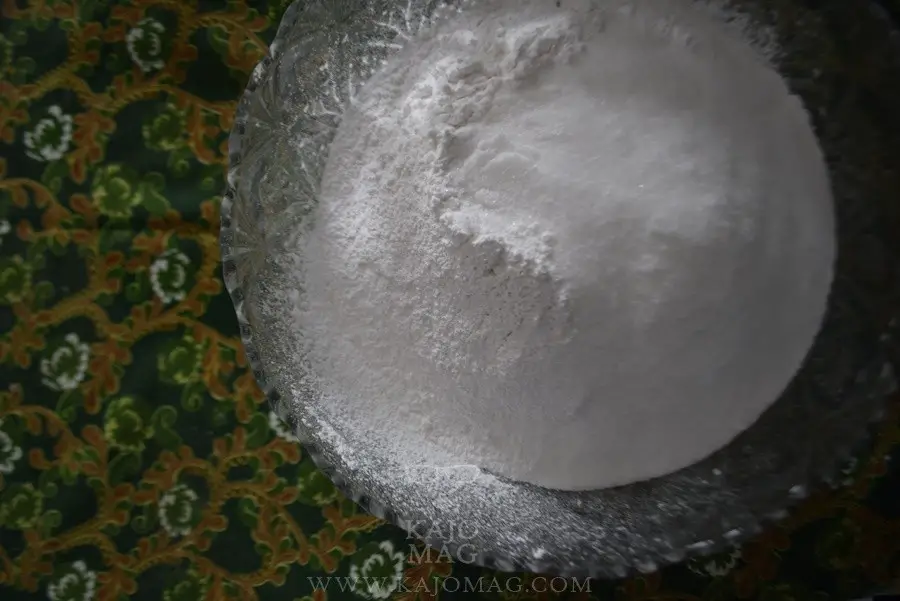
The dry ingridients of Kuih Cap.

Meanwhile in Thailand, a snack which is similar to kuih cap is Lotus Blossom Cookie or Kanom Dok Bua.

The pattern of the Lotus Blossom Cookie mold looks more like a lotus flower and more elaborate from kuih cap’s mold.

Unlike kuih cap, Thai’s Lotus Blossom Cookie is not flat and really does look like a flower. To shape the flower, place a small bowl upside down on a plate. When the cookie is fresh out of the fryer and still soft, place the cookie on top of the bowl to make it curve like a blossoming flower. Allow to cool.

Beside rice flour, some Lotus Blossom Cookie recipes also put in all-purpose flour and cassava flour as their ingredients.

This Lotus Blossom Cookie reportedly can also be found in Hong Kong and Taiwan.

The variations of Malaysian kuih cap recipes

In Malaysia, there are plenty of variations in portions when it comes to kuih cap recipes. However, the main ingredients are rice flour, sugar, eggs, coconut milk, salt, water and oil for frying.

Some put in drops of colouring to make it more colourful. Another ingredient, which is optional for kuih cap, is sesame seeds.

After mixing all the ingredients into a batter, heat the oil together with the brass mold. After the oil and mold are hot enough, dip the mold lightly into the batter and then put it back into the hot oil long enough to cook the batter. Then shake it over a plate until the snack comes off the mold.

KajoTries: The crunchy deep-fried kuih cap or kuih goyang
Dip the heated mold into the batter.
KajoTries to make our own kuih cap

Here at KajoMag, we traded our pens and laptops for a whisk and a wok to make our own kuih cap.

To make the batter, we used 500g of rice flour, one cup of castor sugar, 2 eggs, 250ml of coconut milk, one teaspoon of salt and 400ml of water.

The recipe also stated that we supposed to put a little bit of air kapur (limewater). But we couldn’t find any so we scratched that of the ingredient list. (Do let us know in the comment box why we should put in limewater in our kuih cap).

KajoTries: The crunchy deep-fried kuih cap or kuih goyang
NOT SO EASY!: This is what happened when we left the mold in the oil for too hot.

While the rest of the ingredients were easily available and affordable, the hard part was deep-frying it.

Some people suggested keeping the fire low to prevent it from burning. (But it does take a toll on our patience.)

Sometimes, the mold was too hot that the batter just fell off the mold even before we transferred it from batter to oil to fry it.

Additionally, we realised that therewas an art to shaking the mold while dipping the batter in the frying oil that most online recipes failed to mention. We were supposed to shake the mold up and down – not side to side as we were doing! – in order for the snack to stay in shape.

The end product
KajoTries: The crunchy deep-fried kuih cap or kuih goyang
Obviously, we still have lots to improve on.

After getting the hang of the mold and the frying, we were happy to announce that 60% of our kuih cap were nicely shaped and crispy, while the rest were burnt or deformed beyond recognition.

KajoTries: The crunchy deep-fried kuih cap or kuih goyang
Some of our ‘failed’ kuih cap.

KajoMag readers, feel free to share your ultimate recipe of this traditional snack and tricks to make the perfect piece of Kuih Cap in the comment box.

Do you have any traditional recipes that you want us to try to make next? Let us know!

Alta Moda Sarawak could be a successful yearly event for Sarawak: Abdul Karim

While Sarawak has firmly established itself as THE place to go for world music, and as a Culture, Adventure and Nature destination (did you know Gunung Mulu National Park was a UNESCO World Heritage site?), it aims to be the leading fashion hub in this region with the upcoming lifestyle and fashion event ALTA MODA SARAWAK.

Sarawak Tourism, Arts, Culture, Youth and Sports Minister Datuk Abdul Karim Rahman Hamzah said he was confident that ALTA MODA SARAWAK would become a successful yearly event to promote the state as a leading fashion hub in Asean and beyond.

“The fashion industry is a multi-billion dollar industry worldwide. This is because it involves a big group of people coming from all work and backgrounds, including those from production to design and marketing.

“There are also those who are making a good living out of writing, analyzing, shooting, commenting and blogging about fashion,” he said during a recent press conference at Restaurant Budaya Sarawak.

He added that the event could attract potential tourism and merchandise buyers domestically and internationally in support of Sarawakian designers and artists.

“It is therefore good for ALTA MODA SARAWAK to have the objective of promoting Sarawak as a state of diversity with different ethnic groups and cultures.”

Additionally, Abdul Karim believed that the event could be one of the catalysts and key players in helping to boost tourist traffic to Sarawak under the state’s tourism initiatives, which is why the Ministry suggested moving it from October last year to March 2019.

“This is to give more time for the organisers to make it a grand affair in conjunction with our ‘Visit Sarawak Campaign’ objectives.”

He also noted that ALTA MODA SARAWAK might be one of the last few events to be held at the old State Legislative Assembly (DUN) Building before it will be closed for renovations to transform it into a performing arts centre.

Alta Moda Sarawak could be a successful yearly event for Sarawak: Abdul Karim
Abdul Karim (center) speaking to the press at Restaurant Budaya Sarawak on Feb 2.
ALTA MODA SARAWAK as a brand platform for Sarawak’s designers

The Sarawak fashion industry has seen a gradual boom over recent years.

Abdul Karim said, “We too have our very own designers whose meteoric rise is something to be proud of. These include names like Paul Carling, Anna Sue, Ben Nazry, Melinda Omar, Sereni & Shentel, Latip’s Collection and more. With ALTA MODA SARAWAK, I hope that their star continues to rise.”

The organisers of ALTA MODA SARAWAK are confident that the designers taking part will be able to establish themselves as the fashion and lifestyle brands to be reckoned with and help propel the growth of Sarawak’s fashion industry.

“This development will, in return, be able to attract more tourist traffic into Sarawak and create demand for a growing domestic industry among the talented artisans and skillful beads craftsmen,” he said.

Meanwhile, ALTA MODA SARAWAK organising chairperson Datin Esther Mujan Balan said the organising team was excited to be holding the event in conjunction with Visit Sarawak Campaign, with the support and partnership from the Ministry of Tourism Sarawak and Sarawak Tourism Board.

“We are determined and focused for ALTA MODA SARAWAK to be a successful yearly event to promote Sarawak as a leading fashion hub in Southeast Asia and attract potential tourism and merchandise buyers domestically and internationally for our Sarawakian designers and artists.”

She stated, “Another objective of the event is to provide up and rising Sarawakian designers the opportunity to make their mark in their own country rather than having to go abroad to make a name for themselves. It also aims to give local fashion followers the chance to have ‘high fashion at their doorstep.’”

Besides Abdul Karim, the three-day event is expected to be attended by the Chief Minister of Sarawak Datuk Patinggi Abang Johari Tun Openg and wife of the Governor of Sarawak Toh Puan Ragad Waleed Alkurdi.

The press conference also saw a short runway show featuring 11 out of the 24 designers that will be participating during ALTA MODA SARAWAK.

MARK YOU CALENDARS: The inaugural ALTA MODA SARAWAK will be held at the old State Legislative Assembly Building, Kuching on Mar 7 to 9.

1 55 56 57 58 59 75