Patricia Hului

Patricia Hului is a Kayan who wants to live in a world where you can eat whatever you want and not gain weight.

She grew up in Bintulu, Sarawak and graduated from the University Malaysia Sabah with a degree in Marine Science.

She is currently obsessed with silent vlogs during this Covid-19 pandemic.

Due to her obsession, she started her Youtube channel of slient vlogs.

Follow her on Instagram at @patriciahului, Facebook at Patricia Hului at Kajomag.com or Twitter at @patriciahului.

KajoPicks: 5 K-dramas set in Korea under Japanese rule to watch

In 1910, the Japanese empire formally annexed the Korean peninsula through the Japan-Korea Treaty of 1910.

Until the end of World War II in 1945, Korea was under Japanese rule which was administered by the Governor-General of Korea based in Keijo (now Seoul).

While Korea saw a growth in industrialisation and an improvement in infrastructure during this time, the country also suffered from exploitation of its people and marginalisation of Korean history and culture.

This part of history also inspired many films and dramas with their storyline set in Korea under Japanese rule:

If you are looking to watch a bit of history and plenty of entertainment, here are five K-dramas set in Korea under Japanese rule to watch:

1.Bridal Mask (2012)

During the Japanese occupation of Korea, local Koreans who worked for the Japanese were deemed as traitors by their fellow countrymen.

This drama shows how much these traitors were hated.

Set in the 1930s, Lee Kang-to (Joo Won) is a Korean who works with the Japanese police to capture Gaksital (Bridal Mask).

Gaksital is a masked vigilante who fights for Korea’s independence using his skills in traditional martial arts, taekkyeon.

What Kang-to does not know at first is that his estranged brother Lee Kang-san (Shin Hyun-joon) is the man behind Gaksital.

After Kang-to accidentally kills Kang-san, Kang-to decides to succeed his brother as Gaksital.

The drama is based on a popular Korean manhwa by Huh Young-man.

2.Inspiring Generation (2014)

Here is another drama set in Korea during Japanese rule which is based on a manhwa.

The manhwa Age of Feeling by Bang Hak-gi was published by Sports Seoul from June 1985 to June 1988.

Shin Jung -tae (Kim Hyun-joong)’s father died when a Japanese soldier shot him during the Japanese occupation of Shanghai.

Since then, he worked hard to become a street fighter in the back alleys of Shanghai.

Jung-tae later comes across a group of Korean freedom fighters who gather in Shanghai to fight for independence in their home country.

But why Shanghai? The Korean Provisional Government (KPG) or formally known as the Provisional Government of the Republic of Korea was a partially recognised Korean government in-exile based in Shanghai, China.

Inspiring Generation was one of the more expensive series produced that year with the budget USD14 million.

It was filmed in a studio which was purposely-built to look like 1930s Shanghai.

3.Different Dreams (2019)

On Mar 1, 1919, over 1,000 demonstrations were held across different cities in Korea.

Attended by thousands of civilians and students, the event marks one of the first public displays of Korean resistance during the Japanese occupation of Korea.

Unfortunately, the event had a bloody ending with about 7,500 people killed, 16,000 others wounded and up to 46,000 arrested.

The drama Different Dreams (2019) was aired to celebrate the 100th anniversary of the March 1st Movement.

It follows the story of a group of freedom fighters with different ideologies but coming together with the same goal – to achieve independence for Korea.

One of the main characters Kim Won-bong (Yoo Ji-tae) is based on the real-life Korean anarchist and independence activist.

The director of Different Dreams, Yoon Sang-ho told The Korea Times that he wanted the second Eyes of Dawn, a classic hit drama which was aired between October 1991 and February 1992.

He stated, “That drama was a masterpiece that depicted the pains of Korea’s modern history. When I was young, the heart-touching drama captivated me so much that I thought I would like to do a project set in that period too.”

4.Mr Sunshine (2018)

If you are writing a fictional story based on a real-life past event, you have to be careful to avoid historical inaccuracies.

Take it from scriptwriter Kim Eun-sook, whose work Mr Sunshine (2018) received criticism for inaccurate portrayals of historical facts and being ‘pro-Japanese’.

Unlike other dramas which set in Korea under Japanese rule, this series depicts events that took place right before the annexation in the late 1800s to early 1900s.

It focuses on the work of the Righteous Army, who are real-life informal civilian militias that have appeared several times across Korean history, especially when the national armies were in need of assistance.

Moreover, the series features historical figures such as the last king of Joseon Emperor Gojong, Japanese politician Ito Hirobumi, Japanese diplomat Hayashi Gonsuke, American ambassador Horace Newton Allen and more.

To date, Mr Sunshine is the sixth highest ratings for cable television series and was the Drama of the Year at the 6th Apan Star Awards in 2018.

Watch the trailer here.

5.The Hymn of Death (2018)

KajoPicks: 5 K-dramas set in Korea under Japanese rule to watch

Another Korean period drama based on true events, this one circles around a group of Korean students who furthered their studies in Japan.

Yun Sim-deok was the first Korean to study at the Tokyo Music School who later known as Korean first professional soprano singer.

While in Japan, she fell in love a fellow Korean student Kim U-jin who was studying English literature.

They both started a love affair as U-jin had a wife back in Korea.

The series follows the tragic romance between Sim-deok and U-jin.

It stars Lee Jong-suk and Shin Hye-sun who previously worked together in School 2013 (2013).

Watch the trailer here.

From Sandakan POW Camp to Singapore Outram Prison

Outram Prison was one of the earliest prisons in Singapore.

Originally, it was known as Pearl’s Hill Prison before being called Outram Prison or Outram Road Prison.

Completed in 1882, the jail complex had five blocks for male criminals; four for natives and one for European.

Other buildings housed the female prisons, hospitals, employees’ quarters, execution room and morgue.

By January 1937, the long-term prisoners were transferred to the-then new Changi prison while leaving the short sentenced prisoners in Outram Prison.

During World War Two (WWII), Singapore was occupied by the Japanese Imperial Army. Immediately, the infamous Japanese military police known as Kempeitai took over Outram Prison.

They used the gaol to punish all those who broke their laws; prisoners of war (POWs), civilian internee and local people alike.

From Sandakan POW Camp to Singapore Outram Prison

The inmates jailed at Outram Prison were coming in from not only in Singapore but surrounding areas such as Malaya and Borneo.

They were transported by sea using Japanese hell ships. As if their journey to receive their sentences were not hellish enough, another form of hell welcomed them at Outram Prison.

These men and were punished for many reasons, from espionage to rebellion.

For a group of POWs from Sandakan POW camp in former British North Borneo, their crime against the Japanese circled around a radio.

From Singapore to Sandakan POW Camp

The Battle of Singapore or Fall of Singapore is till known today as the largest British surrender in history.

The intense fight took place lasted from Feb 8 to 15, 1942 which resulted in the Japanese capture of Singapore.

After the battle ended, about 80,000 British, Indian and Australian troops in Singapore became POWs along with 50,000 men who were taken by the Japanese during the earlier Malayan Campaign.

As for the Japanese, they were not entirely ready with this large influx of POWs.

One of the POWs who arrived in Sandakan POW camp to work on the airfield in July 1942 was Lionel Colin Matthews.

While many were taken prisoner in Changi Prison, thousands were transported to be used for forced labour on constructions like the Burma-Siam Railway and Sandakan airfield in North Borneo.

There, Matthews founded an intelligence network among the POWs. They collected information, weapons, medical supplies and radio.

The secret group even made contact with the local police as well as Filipino guerrillas.

Unfortunately in July 1943, four local Chinese members of Matthews’ underground group were betrayed to the Japanese.

After being tortured by the kempetai, they confessed to providing radio parts to Matthews and his team.

Matthews and his second in-command, Lieutenant Rod Wells as well as the members of the underground group were captured, beaten, tortured and starved during their interrogation.

After that, the group was sent to Kuching, Sarawak to stand for trial.

In Kuching, Matthews was sentenced to death along with two members of the British North Borneo Constabulary and six other local Sabahans.

Meanwhile, Wells and 18 others were sentenced to Outram Prison.

Rod Wells’ account on his experience at Outram Prison

Wells, who received 12 years of solitary confinement, said goodbye to Matthews with a handshake and a few personal message from Matthews to his wife.

Two days after departing Kuching, Wells arrived in Singapore where he had been captured two years before.

In Singapore, he was imprisoned at Outram Prison and here is his account as recorded by Christoper Somerville’s Our War: Real Stories of Commonwealth soldiers during World War II.

“On entering Outram Road Jail I found the most terrible sights of dejected people with absolutely no will to live, just slowly walking around. From the back you could see their reproductive organs hanging down between their legs – there was no flesh on them. It made sitting very hard. The hip bone would be pressing into bare skin. But you just had to sit and put up with the pain.

“Everything was done to order. No talking was allowed. When no order was given, you were silent and just stayed in the same position you were in when the last order was given. At nine o’clock at night you were sent back to your cell. There was a light on all night inside the cell, so that there was not a second of the twenty-four hours you were in darkness. And this went on, for me, for twenty-three months, including my period in Kuching. Twenty-three months in solitary.

“We worked at picking strands of hemp out of old ropes, to make a new ones. The strands were too tough to break with your hands; you had to follow them to find out where they started. If you left any of those knots untouched you got a belt across the back with a sword in its scabbard. And as an added incentive, if you didn’t do a hundred of these lengths of rope in day by picking out about 200 lengths of hemp from each – you got no rice that day.

“Meals were roughly five ounces of cooked rice and a bit of stewy water with a bit of weed in it, green grassy stuff. Tea – that was like a hundred to one whiskey and water, pale discoloured stuff that was always cold when you got to it.

“The little pair of shorts you had on had your number on it. 641, that was me. You had to learn that number in Japanese pretty quick, because that was your name and address and everything else. I lost all identity. I was no longer a POW – I was a criminal; just a number. That was the worst thing of the lot. Just a number.”

Bill Young’s account on his experience at Outram Prison and ‘The Postman’

Not all POWs who were sent from Sandakan POW Camp to Outram Prison belonged to Matthews’ group.

William Young or better known as Bill Young, was captured and trialed in Kuching for escaping Sandakan POW Camp.

They were captured by the Formosan guards an hour after their escape and then Young and his friend M.P Brown were severely beaten.

The duo both ended up with broken arms, a leg and an ankle.

In Kuching, Brown was sentenced to eight years of hard labour in Outram Prison while Young was sentenced to four years because of his age. Young was around 16 years old, making him one of the youngest Australian POWs during WWII.

One of the many things Young remembered about Outram Prison was a guard which the prisoners nicknamed ‘The Postman’.

“And there was one guard in particular we used to call ‘The Postman’, he was very, very particular about it. He’d open the door and come and bash you if you weren’t sitting properly. Some of the guards you knew were lazy or indifferent and you could get away with standing up, resting your legs out, reading the graffiti. Morse code. And there’s some guards you would never send a message or anything like that, you’d never read graffiti and you’d never not sit cross-legged, and the worst one was the bloke we called ‘The Postman’.

And sometimes, I know on one particular time, probably one of the first times I was caught by him. I didn’t realise he was on duty. I’m sitting back, with my back on the wall with my legs stretched and I’m shaking them and one thing and another, relaxing, and I heard the knock and that was the signal, only one knock, bang!, just one knock like that. There was about two or three minutes, which seemed to be hours in time, and you knew he was outside, you knew.

“Now after that you’d hear the key’d go in the lock, now it wouldn’t turn, you’d hear the key go in the lock, and then for another two or three minutes there’d be silence, but you’d know he was outside there, and then he’d turn the lock and you’d hear it turned and there’d be nothing else. Two, couple of minutes.

“And then all of a sudden, bang! The door’d be slammed back. Frightened the life out of you. And there would be The Postman. And they all had swords. But it was an old-fashioned jail and the locks were old-fashioned and the keys were great old-fashioned things. And he’d come in and you’d be looking up and you’d be at attention, as if you were like that all the time, you’re willing your hair to grow bit thicker because you know what’s coming.

And he’d stand just a little bit behind you on the side. Not much room between you but he’d get there, wasn’t a very big bloke actually, and then he’d be giving you a lecture or something like that and all of a sudden, while he’s doing this, he’s raising this flaming great big key and then bang! down it comes. And oh God, flaming lump or a cut, sometimes blood come down, and you couldn’t do anything and you’re sitting there and the tears come into your eyes because when you have lost all your weight, your food, your muscles go down, it’s not mentally, everything goes down too. Your resistance to pain, your resistance to everything.”

Surviving Sandakan POW Camp and Outram Prison

From Sandakan POW Camp to Singapore Outram Prison
The ruins of huts in the prisoner of war camp, Sandakan, North Borneo, October 1945. Those who were too ill for the march were eventually murdered here. Courtesy Australian War Memorial: 120457

After the war ended, Young returned to Sydney, Australia. He revealed to ABC news in 2016 at that time he couldn’t wait to reunite with his old mates from Sandakan.

But Young couldn’t find any of his friends. He told ABC, “I waited and waited and waited. It took me ages to find out.”

The sad truth was there were only six survivors from Sandakan POW camp and they had survived because they escaped.

After the war ended, 1,787 Australians died in Sandakan with many of them perishing during the 250km-long Death Marches from Sandakan to Ranau.

Those who were sent out from Sandakan to Outram Prison for their punishment had a narrow escape from death. If they were to stay in Sandakan, chances were high that they did not survive just like their friends.

Still, all of them did not escape from suffering caused by the Japanese at Outram Prison.

According to Australian War Memorial website, the prison was a place of starvation, torture and terror, a place of madness and for many, death.

Since these prisoners were sentenced to prison and not death, the Japanese couldn’t legally execute them.

Instead, the Japanese purposely trying to starve the prisoners to death by providing little food for them.

It is estimated about 1400 prisoners died at Outram Road Prison during Japanese occupation in Singapore.

Know the legends behind these 5 famous Chinese desserts

Behind every traditional food, there is always a story. It should not be surprising that traditional Chinese food such as mantou, Dragon’s beard candy, Wife Cake, doufufa and even guilinggao will have it’s own lore and background story.

Here are the legends behind these five famous Chinese desserts:

1.Guilinggao

You have seen this jelly-like Chinese dessert being sold at the supermarket.

Did you know that it is traditionally made from ‘gao’ or a paste of the under shell of the turtle such as the Chinese three-striped box turtle (Cuora trifasciata)?

It is traditionally prepared by boiling turtle shells for hours before adding in a variety of herbs.

After the water is thickened to form a jelly-like residue, rice flour and corn starch are added to make guilinggao.

There are guillinggao brands which use commercially farmed three-lined box turtles. As such, the traditional guilinggao is quite expensive. For those that use turtle shell in their ingredients, typically other species of turtles such as soft-shelled turtle are used.

However to make guilinggao at home, there is no need for you to catch a turtle, take off the shell and boil it.

Most commercially available guilinggao products today do not contain turtle shell powder.

Today, guilinggao powder is easily available in stores and supermarkets. Follow the instructions and add in as much sugar as your heart desires.

While it has never been proven, like many traditional Chinese desserts, gulinggao is believed to be medicinal to improve circulation, healthier complexion and good for the kidney.

Legend has it that the Tongzhi Emperor who reigned from 1861 to 1875 nearly cured his smallpox by taking guilinggao.

His mother, the Empress Dowager Cixi, on the other hand believed that his smallpox could be cured by worshipping a smallpox god.

After convincing the emperor not to take guilinggao anymore, the Tongzhi Emperor passed away soon after.

Was it because he stopped taking guilinggao or is there another reason for his death? We might never know.

2.Doufufa

The origins of doufufa can be traced back to as early as the Han Dynasty (202BC-220AD).

According to legend, Emperor Gaozu of Han who reigned from 202-195AD had a grandson named Liu An.

He wanted to create something that would help him achieve immortality and Liu An thought the answer could be found in soybean.

After few attempts, he managed to create soft tofu. People of the Han Dynasty started to call it tofu brains because of its softness.

While Liu An did not get to live forever, his recipe has survived to this day.

Today, there are so many version of doufufa. Some have it with something sweet like sweet ginger soup while others tend to make it savoury by adding in soy sauce.

Meanwhile, Sarawakians love to have it with gula apong (palm sugar).

3.Dragon’s Beard Candy

Here is another Chinese dessert that originated during the Han Dynasty.

With no internet or TV, the Emperor found himself being entertained by an imperial court chef who performed complicated steps to make a new confection.

After stretching the dough into small, thin strands, a new recipe was created in front of the Emperor.

These strands reminded the Emperor of a dragon’s beard hence the name that we all know now.

Fast forward to the Chinese Cultural Revolution from 1966 to 1976, the Communist Party of China banned any activities connected to the Han Dynasty – including Dragon’s Beard Candy.

People in China actually stopped making it for some time until recently with the new generation picking up the craft to make this traditional sweet again.

4.Wife Cake

Sometimes you can roughly guess there must be a legend behind some Chinese desserts according to their names.

Lo Po Beng – or its English translation Wife Cake – is actually a Chinese pastry made with winter melon, almond paste and sesame.

Long time ago, there was a poor couple who loved each other dearly. One day, the husband’s father fell sick.

The couple spent all their money to cure the poor old man but he was still not cured.

Without her husband’s knowledge, the wife sold herself as a slave for money to buy medicine for her father in-law.

Once the husband found out what his wife did, he created this pastry filled with winter melon and almond.

The husband sold the pastry which he dedicated to his wife. Thankfully, the cake was a hit and the poor man managed to buy back his wife using the money that he earned.

5.Mantou

Know the legends behind these 5 famous Chinese desserts
Some Chinese desserts like this mantou can be served as part of main course. Credit: Pixabay.

The Chinese mantou is a soft, white steamed bun. It is a popular side that can even be found in the frozen section at the supermarket.

The most famous legend behind mantou is related to human sacrifice.

During the Three Kingdoms period of ancient China (220-280AD), the Chancellor of Shu Han state Zhuge Liang led the Shu army on a campaign against Nanman forces or the Southern Barbarians.

After capturing the Nanman king Meng Hua, Zhuge Liang brought his army back to Shu Han.

The troops suddenly came across a very fast flowing river that could not be crossed.

One of the barbarian lords told Zhuge Liang that in the olden days the barbarians would sacrifice 50 men and throw their heads into the river to appease the river deity and allow them to cross.

Zhuge Liang did not want any of his men to lose their heads. Instead, he ordered them to slaughter the livestock and fill their meat into buns shaped roughly like human heads.

The men then threw these buns into the river.

Somehow, Zhuge Liang and his men managed to cross the river and he named the bun ‘mantou’ or barbarian’s head.

5 Italian deep-fried pastries you should try to make at home

Just because international travelling is impossible right now, you can always have a taste of another country through food.

How about ‘travel’ to Italy and try their deep-fried pastries by making them yourself?

Unlike French pastries which require a lot of time and work, Italian deep-fried pastries are comparatively easy to make.

Here are five Italian deep-fried pastries you should try to make at home:

1.Bombolone
5 Italian deep-fried pastries you should try to make at home

Many refer bombolone as the Italian version of the doughnut but it is also similar to German berliner pfannkuchen.

It is basically round fried dough, either empty or filled with creme patissiere, chocolate, Nutella or jam and topped with icing sugar.

The basic ingredients are flour, yeast, salt, sugar, egg, water and butter as well as oil for frying. Some variation of bombolone does not include eggs.

Plus, the original version of bombolone actually uses lard for both the dough (instead of butter) and for frying the pastry.

To add an extra kick in flavour, the modern version of the recipe even uses a bit vanilla and rum in the dough.

Give these recipes a try here, here and here.

2.Zeppole

Zeppole is another Italian deep-fried pastry topped with powdered sugar.

Traditionally, it is eaten to celebrate Saint Joseph’s Day on Mar 19 every year.

As for the filling, the common ingredients are custard, jelly, cannoli-style pastry cream or butter and honey mixture.

To make the dough, you need flour, eggs, salt, sugar, butter, water and milk.

So what are the differences between zeppole and bombolone?

Unlike bombolone which is rolled into shape from a dough, zeppole is almost a batter. To fry zeppole, you need to spoon them into the oil.

Zeppole is practically more like a fritter, hence it is less chewy than bombolone.

While bombolone is filled with flavoured ingredients such as cream and chocolate, zeppoli has its added flavour on top of the pastry.

Here are some of the recipes for zeppole; here, here, here.

3.Frittelle

Known as Venetian doughnuts, this Italian deep-fried pastry is commonly served during carnivals.

It is more similar to bombolone compared to zeppole as they are yeast-risen fried pastries.

There are many variations of frittelle, both filled and unfilled version.

The unfilled version have raisins mixed into the dough while the filled version has fillings such as pastry cream.

If you like your deep-fried pastry without extra calories of fillings, you can definitely give frittelle a try.

Here are the recipes; here, here, here.

4.Castagnole

Speaking of Italian deep-fried pastry without any filling, here is an easy pastry to make at home.

Castagnole are soft on the inside and crunchy on the outside that are best eaten while they are still warm.

The common ingredients are flour, baking powder, salt, sugar, eggs and butter.

The key to make the perfect castagnole is to fry them at the right temperature.

Cook them in a too high temperature then the pastry is cook on the outside but not on the inside.

However, fry them in a too low temperature the pastry would become soggy.

The perfect temperature is between 170-175 degree Celsius.

Here are the recipes; here, here, here.

5.Crostoli/Sfrappe/Chiacchiere

This Italian deep-fried pastry is known by many names according to the different regions in Italy but they all refer to the same sweet dough which has been rolled out, cut-up and then fried.

They all made from flour, sugar, baking powder, eggs, oil, liquor or wine, citrus zest and icing sugar.

Unlike other pastries on this list, chiacchiere is more on the crunchy side.

For Malaysians, imagine kuih lidah buaya or kuih tiram.

Traditionally, they are eaten in the period before Lent season according to Christian calendar.

Here are the recipes: this, this and this.

5 Korean dramas that were criticised for their product placements (PPL)

When it is done right, product placements or PPL in South Korean dramas don’t hurt the storyline.

However when it is not, PPLs can annoy and make viewers lose interest in the drama.

This type of marketing move is like salt in a dish for any Korean drama. If you put too much salt in your cooking, you will find it salty. At the same time, you shouldn’t completely get rid of the salt because you need that flavour and sodium for your health.

The same thing goes for Korean dramas; a production company cannot produce a television series without the money coming in from product placements.

All the same, they cannot feature too many products in a drama that it feels like a 16-episode long advertisement.

With the rise in global popularity of Korean dramas, many companies are riding on the wave to promote their brands.

We are seeing more and more product placements from Subway sandwiches to Dyson vacuum in K-dramas nowadays compared to days of Winter Sonata.

And not all Korean drama fans are happy with this change.

So here are at least 5 Korean dramas that were criticised for its product placements (PPL):

1.Guardian: The Lonely and Great God (2016)

Widely known as Goblin among K-drama fans, this series follows Kim Shin (Gong Yoo) who is cursed to stay immortal forever.

Some of the products placed in the drama include Toreta Hydration Drink, Samsung Galaxy S7s, Baskin-Robbins, Kanu Coffee, Subway, Pure Love White Musk Perfume, Dal.Komm Coffee and Haru Yache Organic Daily Vegetables Yogurt.

The main reason the drama was slammed for its PPL is because it is just excessive.

The characters mainly drink only one beverage throughout the drama namely Toreta Hydration Drink.

When they go out to eat, they only go to Dal.Komm Coffee, Subway, Baskin-Robbins and BBQ Olive Chicken.

While the PPL scene in Goblin is deemed awkward and excessive, one cannot deny the power of advertising of the romantic fantasy drama.

It is that the estimated revenue for this drama is about 2 to 4 billion won (USD1.8 mil to USD3.6mil).

With increase in visitors at the various filming sites especially at Jumunjin Beach Breakwater, Gangneung city, Goblin is credited for boosting the local economy.

It also helped promote Korean author Kim In-yook whose poetry book The Physics of Love gained renewed attention after one of its verses was featured in the drama.

2.The King: Eternal Monarch (2020)

5 Korean dramas that were criticised for their product placements (PPL)

Written by the same scriptwriter as Goblin, Kim Eun-sook seemed to not know how to smoothly place PPL in her dramas especially The King: Eternal Monarch (2020).

It is understandable since it is a sci-fi drama which requires a lot of CGI, the series is backed up with estimated budget of 30 billion won (USD25.4 million).

To compensate that along with star-studded cast including Lee Min-ho and Kim Go-eun, The King: Eternal Monarch was heavily filled with advertisements.

Some of the products include food delivery app Yogiyo, bakery chain Paris Baguette, Georgia Coffee, BBQ Olive Chicken, Aston Martin, The Alley, jewellery line J.estina, Cheong Kwan Jang Red Ginseng Extract, Jongga Stir-fry Kimchi, Kahi Skincare, Cellreturn LED Mask, DParks Handphone Case and other sponsored items such as sunglasses and furniture.

It is not just the excessive product placements which stirred up the audience but also the cringey, unnecessary comments to promote these products in the middle on the storyline.

While the fans were unhappy, the companies behind these product placements were laughing their way to the bank.

BBQ Chicken for instance, reported the sale of 550,000 sets of its fried chicken in a month after its appearance on the series.

3.Memories of the Alhambra (2018)

A typical advertisement for beauty products is a scene of a woman getting ready for her work or a date.

Imagine this familiar scene but place it in a Korean drama then you have the reason why Memories of the Alhambra being critised.

After the main characters Yoo Jin-woo (Hyun Bin) and Jung Hee-joo (Park Shin-hye) confirmed their feelings for each other, they both go out for a date.

Then, a series of product placements take place in the drama.

When getting ready for a date, Hee-joo start to use various items such as shampoo, hair essence, lipstick and earrings, which are all paid advertising items.

The scene in which Hee-joo putting on the hair essence is practically a hair tutorial of how to use RYO Hair Loss Care Essence.

Nonetheless, other product placements in the drama can be considered smoothly incorporated into the plot.

Since the series is about augmented reality game, some of the advertised products appeared as game items in the story.

For instance, players need to purchase a Subway sandwich to boost their characters’ ‘health’ in the game.

4.True Beauty (2020)

“Is this a Chinese drama?” This was some of the criticism over the product placement in the drama True Beauty (2020) after its seventh episode was aired.

In that particular episode, the main character Lim Joo-kyung (Moon Ga-young) enjoys an instant hot pot from Zihaiguo, a Chinese brand.

The scene was heavily criticised because it was a blatant product placement without making any sense to the plot.

A high school student buys a Chinese product from a convenience store but the brand is not even available in any convenience stores in South Korea.

With other Chinese brands popping up on billboards every now and then throughout the drama, many Korean viewers were not happy with the heavy promotions on foreign companies.

5.Vincenzo (2021)

5 Korean dramas that were criticised for their product placements (PPL)

Here is another Korean drama that came under fire for its product placements of Chinese products.

Just like the drama True Beauty, Vincenzo (2021) was under heat for featuring the brand Zhihaoguo but instead of instant hotpot, this time it was instant bibimbap.

Moreover, bibimbap is a Korean dish not a Chinese food.

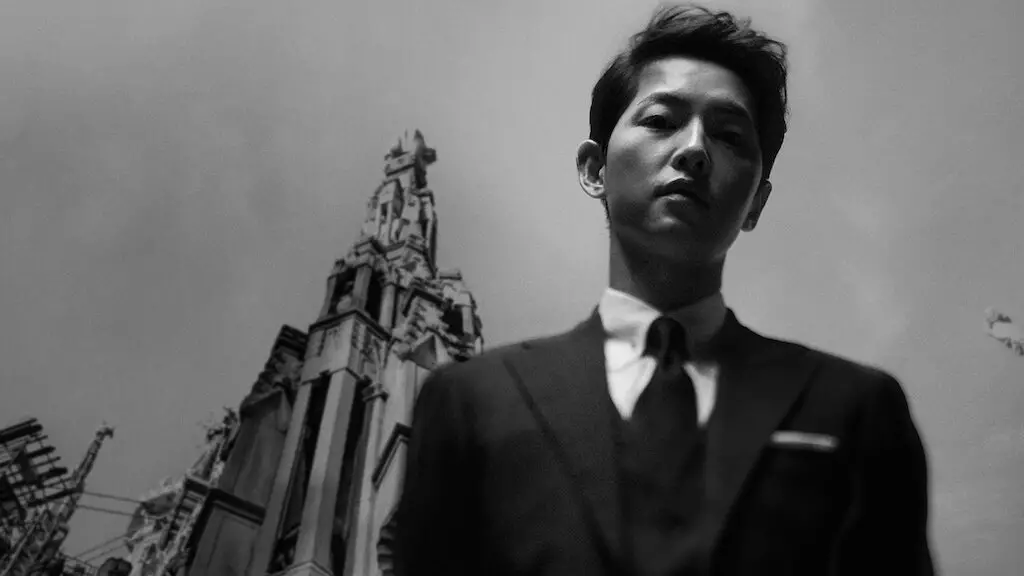
The controversy even drew out Vincenzo’s lead actor Song Joong-ki to apologise for the scene.

On the other hand, Indonesian viewers were happy to see their home brand Kopiko seen in the drama.

It is estimated that it cost around 200 million won (RM740,000) to have your product being placed in A-list drama like Vincenzo.

5 things you should know about sumpit or blowpipe of Borneo

‘Sumpit’ or ‘sumpitan’ are what we call the blowpipe or blowgun in Borneo. Some communities in the Philippines and Sulawesi also refer to the blowpipe as ‘sumpit’.

In fact, the first written description of sumpit can be found in the works of Italian scholar and explorer Antonio Pigafetta in 1521 who visited the Palawan people.

He wrote, “”Those people of Polaoan (Palawan) go naked as do the others: almost all of them cultivate their fields. They have blowpipes with thick wooden arrows more than one palmo long, with harpoon points, and other tipped with fishbones, and poisoned with an herb; while others are tipped with points of bamboo like harpoon and are poisoned. At the end of the arrow they attach a little piece of softwood, instead of feathers. At the end of their blowpipes they fasten a bit of iron like a spearhead; and when they have shot all their arrows they fight with that.”

Just like the Palawan’s sumpit, the blowpipe in Borneo commonly has a spearhead attached to the end.

5 things you should know about sumpit or blowpipe of Borneo
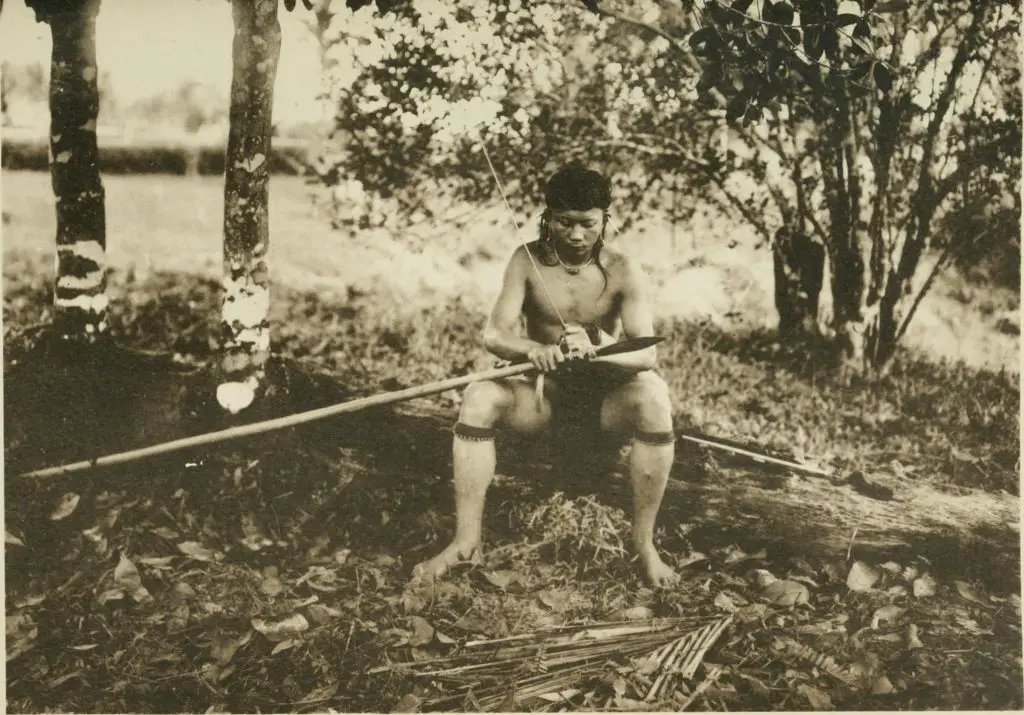
A traditional blowpipe which also works as a spear.

Traditionally, the sumpit is used for hunting and in fights against the enemy. Today, they have become souvenirs or treasured family heirlooms.

Here are five things you should know about sumpit or blowpipe of Borneo:

5 things you should know about sumpit or blowpipe of Borneo
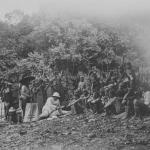
Kenyah man lashing spear-blade to a blowpipe. Circa 1912. Credit: Copyright expired.

1.The reason why people of Borneo use sumpit

Have you ever wondered why the Borneo natives chose the blowpipe over the bow when it came to hunting?

According to author Peter Metcalf, in the nineteenth century, ethnologists were curious why people who advanced using iron tools did not adopt or come up with the bow.

The reason lay on topography and landscape. Metcalf wrote “For hunting, they (bows) are ineffective because the dense vegetation seldom allows a clear shot.”

“For pigs or deer, a combination of dogs and spears brings the best results. In regard to small game in the lower branches of trees, such as birds and monkeys, they are easily shot with darts.”

Furthermore, the bow is difficult to shoot at such steep angles. And once you lose your arrows, it is impossible to recover them in the thick Bornean thick jungle.

2.The materials of the blowpipe

Generally, blowpipes are made from bamboo. However, there are some made from wood.

A blowpipe can be made from one to three pieces joined together.

The length of this weapon usually depends on the user. The typical length is about 1.2 to 1.6m and 2 to 3cm in diameter.

5 things you should know about sumpit or blowpipe of Borneo

3.How to make blowpipe darts

Thick wooden or palm leaf-rib darts are generally used in war.

Also known as damak, the dart is basically a single pointed sharp needle.

The needle is plugged into a cork-lie cushion with bird feathers to allow the blowgun to float constantly toward the target.

Then the tip of the damak is dipped in poison.

4.How to make blowpipe dart poison

According to Herwig Zahorka in his paper “Blowpipe dart poison in Borneo and the secret of its production”, the poison is generally produced from the latex of the Antiaris toxicaria tree which belongs to Moraceae (fig family).

He started, “This latex contains a variety of toxic chemical compounds. The principal toxic agent is a steroid glycoside known as beta-antiarin. A lethal dose is only about 0.1mg per kg weight of a warm-blooded animal.”

On how to make them, Zahorka explained, “To dehydrate the milky latex into a paste, a long, carefully implemented procedure is essential because the steroid glycoside compound is extremely heat-sensitive.

“Therefore, hunters perform the dehydration of the latex by using a young leaf from the small Licuala spinosa palm. The leaf is folded into a boat-shaped container to hold the latex at a carefully determined distance over a small flame for one week. This is possible because the young Licuala leaf is astonishingly fireproof and durable. If the latex were heated at too high a temperature, the glycoside compound would crack and its toxicity would be lost.”

5.How long does it take to kill using the blowpipe

Andrew Horsburgh who was in Sarawak from 1852 to 1856 as a missionary published a book called Sketches in Borneo (1858).

Regarding our local sumpit, he wrote, “The arrows are dipped again into the poison immediately before using and are used in hunting as well as in war, and kill not only birds and squirrels, but also large animals such as orangutans. To animals the poison proves fatal, because they cannot pull the arrow out of the wound; but men suffer little inconvenience from it, as their comrades can always extract the missile before the poison has been absorbed by the system. Squirrels and small animals drop a few minutes after they have been struck, but orangutans frequently clamber about among the trees for a whole day before the poison takes effect upon them as to bring them down.”

5 devastating stories about animals during World War II

When humans decide to start a war, there is always a price to pay. Other than innocent lives, the environment and the animals are the casualties of war which are often overlooked.

Looking back in history, here are five sad stories on what happened to some animals during World War II (WWII):

1.The British pet massacre

The year was 1939, the United Kingdom knew WWII was coming so they needed to prepare for the worst such as food shortage.

The British government then formed the National Air Raid Precautions Animals Committee (NARPAC) to decide what happened to pets before the war.

The committee’s solution? They distributed pamphlets titled “Advice to Animal Owners” advising pet owners to move their pets from the big cities into the countryside.

However, the pamphlets concluded with the statement, “If you cannot place them in the care of neighbours, it really is kindest to have them destroyed.”

It is estimated that over 750,000 pets were killed, especially during the beginning of the war.

Eventually, many pet owners blamed the government for starting the hysteria.

2.No thanks to air raids, a giraffe was frightened to death

During the second World War, the Whipsnade Zoo in England served as a refuge center for animals evacuated from the Regents Park London Zoo.

In 1940, altogether there were 41 bombs fell on Whipsnade Zoo during three different raids.

According to the zoo’s official website, there were only two casualties.

The first victim was a goose which was one of oldest inhabitants of the zoo.

Meanwhile the second casualty was a 3-year-old giraffe named Boxer, which had been born in captivity.

The poor giraffe was so frightened by the bombing sounds that she ran herself to exhaustion and died.

3.The animals were electrocuted because they couldn’t be poisoned

The Kamoike Zoo in Kagoshima city was built by a railway company on a former hunting grounds in 1916.

In those days, it was normal for railway companies to build zoos or amusement parks as attractions for new railroads.

According to official records, the Kamoike City Zoo killed two lions, seven bears, four alligators and two pythons from Oct 6 to 31, 1943.

However, it was not mentioned how they were executed.

Later, the zoo officials revealed in 1986 interviews that all fifteen animals were electrocuted.

M.Itoh in the book Japanese Wartime Zoo Policy: The Silent Victims of World War II stated,
“The zoo staff initially tried to poison them with strychnine nitrate. However, the animals sensed something unusual and refused to eat the poisoned food. Then the zoo staff connected high-voltage electricity from the nearby streetcar station early in the morning before the trains began to run and electrocuted the animals.”

4.The death of Ellie the Elephant

After the war broke out, basically all the zoos in Japan empire received order to kill their most ferocious animals.

Kumamoto City Zoo for instance, executed three tigers, two lions, two Japanese black bears, an Exo brown bear, a brown bear, a Malayan sun bear, a black leopard, a leopard and three wolves in 1944.

Other animals such as the python, hippopotamus and a ten-year-old elephant named Ellie were saved by the staff as they strongly argued that they were not “ferocious animals”.

Unfortunately, despite the effort, things did not end well for these animals during World War II.

In 1945, the Imperial Japanese Army (IJA) decided to kill Ellie in order to feed the servicemen instead.

At first, they tried to force Ellie go into a pool to which high-voltage electricity was connected.

Ellie’s instinct, however, kicked in sensing there was something unusual so she refused to enter the pool.

The army then made Ellie’s keeper in-charge Kanazawa Taro do something against his will.

They forced Kanazawa to feed Ellie using a stick with a potato.

Since the stick came from the human she trusted, Ellie accepted the potato using her mouth.

The stick actually was connected to an electric wire and Ellie was electrocuted to death.

Kanazawa who had been taking care of Ellie since she was three, reportedly stopped talking about the poor elephant since her death.

5.The Massacre of Ueno Zoo, Japan

5 devastating stories about animals during World War II
Animals during World War II are the silent victims of human war.
Lions are shot at Higashiyama Zoo in 1944. Photo credit: Copyright Expired.

In Japan, one of the horrific animal massacres took place in the oldest zoo in the country.

Opened on Mar 20, 1882, Ueno Zoo in Tokyo was started as a menagerie under the National Museum of Natural History.

During WWII, the animals in Ueno Zoo were killed systematically.

Most of them were executed using poison and strangulation.

Sadly, some had to go through slow and painful death by starvation.

Kyoko was a female hippopotamus who gave birth to a male offspring at Ueno Zoo in 1937.

While many of the animals in the zoo were killed in 1944, Kyoko and her son survived.

However, Allied air raids on Tokyo changed their fate. On the night of Mar 9-10, 1945, a series of bombing took place in Japan’s capital city.

The zookeeper then decided on Mar 19 to stop feeding Kyoko and her son due to lack of food.

Unfortunately, the son died first on Apr 1 and Kyoko only on Apr 24 after about a month long of starvation.

Apart from Kyoko and her son, three elephants and one polar bear were also put through the most cruel of execution method as they were purposefully starved to death by the zookeepers.

KajoPicks: 15 South Korean romance-fantasy dramas you must watch

One of the many reasons why South Korean drama series do well not just domestically but internationally is because they know what they are good at and they stick to it.

You don’t see Korean dramas doing a superhero storyline or comedy drama in front of a live audience.

The first Korean drama genre that broke through to international audiences was romance which is why we have plenty of romantic Korean series going around.

Today, we have so many types of Korean romance dramas out there. From romance between an older woman with a younger man to love stories set in an office or campus, Korean series have them all.

On top of that, Korean dramas take romance to another level of unreal-ism by giving viewers love stories between mortal and supernatural beings.

These Korean romance-fantasy dramas show how true love prevails even when you are not of the same entity or universe.

So here are KajoMag’s pick for 15 Korean romance-fantasy dramas you need to watch:

1.Secret Garden (2010)

Kicking off the list is Secret Garden (2010), a classic Cinderella story. A poor stunt woman with no family falls in love with a good-looking but arrogant CEO.

The fantasy part of the story is the two swap bodies after drinking a mysterious drink in a secret garden.

Gil Ra-im (Ha Ji-won) works as a stunt woman who lost her father when she was in high school.

Meanwhile, Kim Joo-won (Hyun Bin) is a strict and rational CEO of a high-end departmental story who is secretly suffering from claustrophobia.

After a series of misunderstandings, Ra-im constantly bumps into Joo-won.

Despite their differences, Joo-won finds himself constantly thinking about Ra-im.

He then decides to pursue Ra-im, all of this happening while they are swapping bodies, literally walking in each other shoes.

Even to this day, the drama remains one of the highest rated Korean series.

2.Guardian: The Lonely and Great God (2017)

At first glance, the love story in this popular drama by Kim Eun-sook is bottom line disturbing.

The age difference between a thousand year-old deity and high school kid is huge.

But then again, even if the deity fell for a 100 year-old grandma, the age difference would still be huge.

Anyway, the story follows Kim Shin (Gong Yoo), a military general who is cursed to be an immortal goblin.

The only way to put an end to his immortality is the Goblin’s bride as she is the only who can see and pull out the sword and kill him.

His destined wife is Ji Eun-tak (Kim Go-eun), a plucky orphan and struggling high school student.

One day, Kim Shin’s nephew Yoo Deok-hwa (Yook Sung-jae) rents out his house without his knowledge to Grim Reaper (Lee Dong-wook).

Due to this, the Goblin and the Grim Reaper reluctantly become housemates.

Later, Eun-tak becomes homeless and join in the Goblin’s household.

At the same time, Eun-tak starts to work part time job at a chicken story run by Sunny (Yoo In-na).

As they spend more time together, Kim Shin, Grim Reaper, Eun-tak and Sunny never knew how deep the connection between them and how fate brought them together in the first place.

This Korean romance-fantasy series is currently the fifth highest rated drama in Korean cable television history.

Watch the trailer here.

3.Black Knight: The Man Who Guards Me (2017)

This drama follows the story of Moon Soo-ho (Kim Rae-won), a successful CEO who is still holding on to his first love.

His first love is Jung Hae-ra (Shin Se-kyung), a hardworking employee who works for a travel agency.

Both of them share two past stories together; one takes place in a current time and another happens two hundred years ago.

In the present time, Soo-ho is brought into Hae-ra’s home after the death of his parents.

They grow up like siblings but Soo-ho begins to have feelings for Hae-ra. They separate when Soo-ho goes oversea to study but he returns to Hae-ra as a successful CEO.

What both of them do not know is that they are the reincarnations of Lee Myung-so and his lover Boon-yi who died in the hands of Myung-so’s wife Choi Seo-rin (Seo Ji-hye).

Apart from that, the couple do not know that Seo-rin is cursed with immortality and still obsessed over her husband or now, the reincarnation of him.

Watch the trailer here.

4.My Girlfriend is Gumiho (2010)

This Korean romance-fantasy drama is old but gold. It follows the story of Cha Dae-woong (Lee Seung-gi), a college student who wants to be an action star.

He accidentally releases a gumiho (Shin Min-ah), a Korean mythological fox who was sealed in a painting.

Legend has it that gumiho takes men’s livers for food, causing Dae-woong to be afraid of the creature.

What he does not know is that the gumiho that he released has been wanting to turn into human for along time.

Gumiho takes advantage of Dae-woong’s fear to stay by his side.

As they spend more time with each other, love blossoms between the mortal man and gumiho.

5.The Bride of the Habaek (2017)

Based on the Korean manhwa Bride of the Water God by Yoon Mi-kyung, the series stars Shin Se-kyung, Nam Joo-hyuk, Lim Ju-hwan, Krystal Jung and Gong Myung.

The God of Water, Ha-baek (Nam Joo-hyuk) needs to come down to earth to retrieve the sacred stones in order for him to claim the throne of the Divine Realm.

To do so, he needs the help of So-ah (Shin Se-kyung), the descendant from a family fated to serve the gods for generations.

However, when Ha-baek arrives on earth, he loses his power and unable to convince So-ah that he is in fact a god.

So-ah, on her part treats him like a patient who is suffering from a mental illness.

While the storyline can be messy and confusing, the acting and performances by the cast is what makes this Korean romance-fantasy drama worth watching.

KajoPicks: 15 South Korean romance-fantasy dramas you must watch

Watch the trailer for this Korean romance-fantasy drama here.

6.About Time (2018)

What if one day you wake up and can see the life spans of other people ticking? Will you save them from their deaths or walk away ignoring them.

For aspiring musical actress Choi Michaela (Lee Sung-kyung), this gift has been a curse rather than a blessing.

The worst part is the fact she can see her own life span.

Everything changes for Michaela when she comes across Lee Do-ha (Lee Sang-yoon), a chaebol son and CEO.

Michaela realises her life clock whenever she is with Do-ha.

Obsessed with living longer on earth, Michaela does everything in order to stay by Do-ha that she even becomes his personal driver.

Soon enough, Michaela and Do-ha’s relationship turns in to a problem especially to Do-ha with his business and family.

Watch the trailer here.

7.Extraordinary You (2019)

KajoPicks: 15 South Korean romance-fantasy dramas you must watch
Watch the trailer here.

Imagine, one day you discover that the world you have been living is not real and actually a fantasy world of a comic.

To make matters worse, you find out that your character will be killed off in the end of the comic.

Eun Dan-oh (Kim Hye-yoon) is a high school girl born into a wealthy family, but with a heart disease.

At first, she believes that everything in her life is perfect despite her illness. Then, her world collapses when she finds out that everyone in her life is just characters in a teen comic book entitled Secret.

Moreover, Dan-oh is just a supporting character in the comic and the author is planning to kill her character off in the end of the story.

Dan-oh is not the only who has such ‘awareness’ as a small group of people around her start to become ‘aware’ of their identities.

One of them is Number 13 (Rowoon), an extra character in the comic who does not even have a name.

After spending time together, Dan-ah names him Ha-ru.

Overall, this Korean romance-fantasy drama is light and entertaining with a good dose of suspense thrown into it.

8.My Love from the Star (2013)

How about a love story between an alien and a human being?

Do Min-joon (Kim Soo-hyun) is an alien who landed on Earth in 1609.

After saving a girl named Seo Yi-hwa from falling off a cliff, he misses his return journey to his home planet.

For the next four centuries, Min-joon roams around the Earth changing his identity every ten years as he never ages.

Meanwhile, Cheon Song-yi (Jun Ji-hyun) is a famous actress who happens to be Min-joon’s neighbour.

Later, Min-joon finds out that Song-yi at her young age resembles Yi-hwa, the girl he rescued 400 years ago.

The duo starts to spend time together after a series of incidents and mishaps. Song-yi eventually finds out Min-joon’s identity and he using his enhanced abilities of his vision, hearing and speed to help Song-yi in her troubles.

The drama marks Jun’s first comeback to the small screen after 14 years. It was definitely a notable comeback for her because she won the Grand Prize in Television at the 50th Baeksang Arts Awards for her role in the drama.

9.Legend of the Blue Sea (2016)

Written by the My Love from the Star’s screenwriter Park Ji-eun, this drama tells the story of a conman and a mermaid.

Perhaps because the drama stars two of the biggest Korean stars Jun Ji-hyun and Lee Min-ho, the series was one of the most popular ones in 2016.

It centers around Shim Cheong (Jun Ji-hyun), a mermaid who falls in love with a con artist named Heo Joon-jae (Lee Min-ho).

Their love story, however, starts from the Josean era but when they died almost Romeo and Juliet style, they are reincarnated in the 21st century.

Many of the key elements such as parallel time between the past and present as well as the romance between a human and a non-human are basically a recycled version of Park Ji-eun’s previous work My Love from the Star.

Even the same female lead actress Jun Ji-hyun switches her role from a human to a mermaid in this drama.

So if you love Jun’s performance and Park’s script writing style, this drama is definitely worth watching.

Watch the trailer here.

10.The King: Eternal Monarch (2020)

As if long distance relationship is not enough, imagine dating someone who is from another universe.

The series follows Emperor Lee Gon of Kingdom of Corea who accidentally comes across to another parallel universe where current South Korea exist.

In South Korea, the emperor who is without any identity comes across detective Jung Tae-eul (Kim Go-eun).

He recognises her from an identity card he obtained during his childhood when his father was assassinated.

The culprit is Lee Gon’s half-uncle, Lee Lim (Lee Jung-jin) who also finds his way to cross between the two universe.

Overall, the drama is an entertaining story of combining myth and science with amazing performance of a stellar cast.

Unfortunately, it was dampened by controversies over excessive use of product placement and historical inaccuracies.

KajoPicks: 15 South Korean romance-fantasy dramas you must watch

Watch the trailer here.

11.W (2016)

Speaking of alternate universe, W centers on the clash between the real world and another that takes place inside a webtoon.

It follows the story of Kang Chul (Lee Jong-suk), the lead character of the popular webtoon W.

After being stabbed by a mysterious assailant, Kang Chul is rescued by Oh Yeon-joo (Han Hyo-joo).

What he doesn’t know is that Oh Yeon Joo comes from the real world and the daughter of the webtoon artist who created W.

The drama is directed by Jung Dae-yoon, who directed She was Pretty and writer Song Jae-jung who wrote Nine: Nine Time Travels and Queen In-hyun’s Man.

Watch the trailer here.

12.Queen In Hyun’s Man (2012)

Also securing a spot on this list is Queen In-hyun’s Man or Queen and I starring Ji Hyun-woo and Yoo In-na.

It follows the story of actress Choi Hee-jin (Yoo In-na) who falls in love with Kim Bung-do (Ji Hyun-woo).

Bung-do is a noble-born scholar from the year 1684 who finds himself time travels to 2012.

When the still-cut of the drama was released showing the two lead characters in front of Gwanghamun, the main gate of Gyeongbokgung Palace, it popularised the ‘Gwanghwamun Kiss’ trend.

The spot has become a famous backdrop for tourists to take photos.

13.Strong Girl Do Bong Soon (2017)

If you are looking for something cute and funny but creepy and thrilling in the same time, this is the Korean romance-fantasy drama for you.

Do Bong-soon (Park Bo-young) was born with superhuman strength, a trait inherited only by the women in her family.

Thanks to her strength, she gets a job as bodyguard to CEO of a gaming company Ahn Min-hyuk (Park Hyung-sik).

In the same time, a series of kidnapping cases targeting women happen in Bong-soon’s neighbourhood.

Bong-soon is determined to catch the culprit who targeted her best friend but managed to escape.

With help and training from Min-hyuk, Bong-soon slowly knows how to use and embrace her superhuman strength.

After it aired, the series became one of the highest rated Korean drama in cable television history.

Watch the trailer here.

14.Tomorrow, With You (2017)

This Korean romance-fantasy drama circles around Yoo So-joon (Lee Je-hoon), a successful CEO of a real estate company.

He has the ability to time travel whenever he takes the subway.

After going back and forth in time, he sees his future self living a sad and tormented life.

In order to change his future, he decides to marry Song Ma-rin (Shin Min-ah) thinking that it will bring him happiness.

There is one problem though, So-joon is not in love with Ma-rin. So how can a loveless marriage brings him happiness?

Watch the trailer here.

15.Tale of Nine-tailed (2020)

KajoPicks: 15 South Korean romance-fantasy dramas you must watch

Imagine being so in love with someone that you are willing to live for a thousand years just to wait for your old flame to be reincarnated.

Is it love or obsession? In the K-drama world, it is nothing but true love.

Lee Yeon (Lee Dong-wook) is a gumiho (nine-tailed fox) and former mountain spirit of Baekdudaegan.

After the death of his lover Ah-eum in the hands of Imoogi, a lesser dragon in human form, Lee Yeon works for the Afterlife Immigration Office to eradicate supernatural beings that threaten the mortal world.

He is searching for the reincarnation of Ah-eum.

Finally after almost a thousand years of searching, Ah-eum is reincarnated as Nam Ji-ah, a 30-year-old TV producer.

Many of the characters in the drama are based on Korean mythological figures so those who love legends and myth should watch this Korean romance-fantasy drama.

Watch the trailer here.

Sumatra Railway, the death railway you probably never heard of

Junyo Maru was one of the many Japanese hell ships during World War II. It was used to transport Prisoners of War (POWs) with bamboo cages built in to imprison them.

When it was attacked and sunk on Sept 18, 1944 by British submarine HMS Tradewind, it became the world’s greatest sea disaster at the time.

During her last voyage, she was packed with 1377 Dutch, 64 British and Australian and eight US POWs along with 4,200 Javanese romusha.

After the sinking, only 680 survived with 5,620 dead.

But the horrific fates of these 680 survivors did not end with the sinking of Junyo Maru as hell awaited them at the Sumatra Railway.

Sumatra Railway

The survivors were sent to work on the 220km Muora-Pekanbaru railway, which also became later known as the Sumatra railway.

The Japanese wanted to use it to transport coal and troop between Muora and Pekanbaru.

Along with the Junyo Maru survivors, there were over 120,000 romusha together with 6,500 Dutch POWs, 1000 POWs and the rest 300 POWs from the US, Australia and New Zealand.

The first group of labourers to work on the railway were the romushas who started in April 1943.

However, the Japanese became anxious and wanted to speed up the construction.

They then brought in the first group of POWs on May 19, 1944.

All of them were housed in 18 camps located along the railway.

Sumatra Railway in comparison to Burma-Siam Death Railway

When you hear mention of a ‘death railway’ during WWII, one immediately thinks of the Burma-Siam Death Railway.

Similar to the Sumatra Railway, the Burma-Siam Railway was built by the Empire of Japan from 1940-1944 to supply troops and weapons in the Burma campaign.

Overall, 60,000 Allied POWs and 180,000-250,000 romusha were forced to work on the railway.

In the end, about 90,000 labourers died along with more than 12,000 POWs.

Lizzie Oliver in her book Prisoners of the Sumatra Railway wrote, “Although the Sumatra Railway was half the length of the Burma-Siam Railway (220 kilometers vs 414 kilometers), it took almost the same number of months for POWs to complete (15 vs 16).

“Progress was approximately sixteen kilometers per month slower on Sumatra than in Burma and Siam. This slow progress each month indicates specific difficulties for those on Sumatra, two of which dominate the narratives of former POWs.

“First, the terrain on Sumatra was foreboding. The railway construction had to navigate through a ‘chain of mountains’, the rolling hills of volcanic and sedimentary rocks and the swampy and jungle-covered lowlands characterised by long rivers, sandbanks and mudflats. Second, having already been incarcerated, malnourished and forced into hard labour for over two years beforehand, the initial general condition of the Sumatra Railway workforce was poorer that that on Burma-Siam (the building of which began relatively early in captivity).”

Life on the Sumatra Railway

All the same, working on Sumatra and Burma-Siam railways were equally deadly.

One of the survivors of Sumatra railway, George Duffy once wrote, “Indeed death was no stranger there. We were overworked, underfed, provided with little medicine, and subjected to constant physical and mental abuse by our Japanese overseers.

“A hospital for malaria, dysentery, pellagra and beriberi patients existed in name only. It was simply a dilapidated bamboo-framed, thatched roof barracks where the sick were placed to await their eventual death.”

One of the few doctors treating the POWs was military surgeon W.J. van Ramshorst from The Hague.

The good doctor was brave enough to confront the Japanese army about the death rates of the prisoners.

He told them, “Camp 2 has about eight hundred patients. Around one hundred men die each month. If things continue as they are, all patients will be dead in eight months time.”

To this, the Japanese replied, “Your calculations are correct. That is exactly our goal.”

Liberation comes to Sumatra Railway

August 15 will always be remembered as V-J Day or Victory over Japan Day. It is a day the Imperial Japan surrendered in World War II, in effect bringing the war to an end.

It was also the day that Sumatra Railway officially completed. There was even a completion ceremony organised by the Japanese army.

Henk Hovinga in his book The Sumatra Railroad: Final Destination Pakan Baroe described how the prisoners welcomed the news of their freedom.

“For all prisoners, liberation after three and a half years of captivity was a moment they would never forget. Yet each man experienced that day in his own individual way. Some cried, other laughed, prayed or cursed.

“They had suffered too much to be only thankful that it had finally ended. Many were deadly ill or dying and could no longer grasp the magnitude of the news of their liberation.

“Others were too apathetic or too bitter to respond spontaneously. In every camp along the railway the moment of liberation was a different experience. And even prisoners living together in the same camp cherished different memories of the moment when the Japanese surrender was announced.”

Dr van Ramshorst for instance, remembered the day liberation as just another ordinary day.

“We all received as double ration of rice. After a couple of days, we were allowed to leave the camp, but still had to return. I walked leisurely to Pakan Baroe (Pekanbaru), visited the post office and asked the crazy question if I could send a telegram to my wife on Java. And strangely enough that was possible. I paid ten cents per word. In the meantime, the Japs had become friendly, but fearfully nervous. After they had burned all camp documents, some of them asked me if they should commit suicide. And I answered them: ‘Yes, if it is your custom to commit harakiri, then that is the best thing to do…”

What happened to the Japanese after the war?

It is not sure how many, if any, Japanese who actually took Dr van Ramshorst’s advice.

However, it is certain many Japanese army along with their Korean guards were prosecuted for war crimes they committed during the construction of Sumatra Railway.

Captain Ryohei Miyazaki who was responsible for the 18 camps along the railway was sentenced to death on May 30, 1948.

The man who was responsible for food and provisions General Yamamoto was sentenced to death on Dec 30, 1948.

Meanwhile, the chief medical officer Colonel Fukaya was executed on Dec 30, 1948.

Many of the guards received prison sentences ranging from 5 to 20 years of imprisonment.

What happened to Sumatra Railway after the war?

Sumatra Railway, the death railway you probably never heard of
Liberated prisoners distributing rice rations to campmates. Pakanbaroe, Sumatra, 1945. AWM 019382. Courtesy of Australian War Memorial.

After all the blood, sweat and tears put into the railway, in the end it was never fully utilised.

For a railway built for war purposes, the first train ride on the Sumatra Railway was used to transport former Dutch POWs from Muoro to Pekanbaru driven by a Japanese corporal.

The train derailed from its track but the passengers helped to get it back on line.

Then in early 1946, the last group of the Japanese railway engineers in Sumatra boarded the train from Muoro to Pekanbaru.

Since then, the railway between Muoro and Pekanbaru was never used again.

Many parts of the railway have been claimed back by nature as the areas are now overgrown by jungle.

It is even hard to see the remnants of the railway, as many of the parts have been removed for scrap.

In the end, the railway took the lives over 100,000 labourer including about 703 POWs.

Many of them died due to accident, sickness and abuse as well as execution by the Japanese.

Why were Dayak volunteers sent to Malaya in 1948?

We have heard of stories of how Sarawak Rangers assisted in the Malayan Emergency (1948-1960) when Sarawak was a British Crown Colony.

And we have read stories of how Dayak climbers assisted in scientific expeditions all the way to New Guinea.

But did you know why did Dayak volunteers were sent to Federation of Malaya in 1948?

If you are familiar with Ghostbusters’ theme song, part of the lyrics goes

“If there’s something strange,
In your neighborhood
Who you gonna call?
Ghostbusters!
If there’s something weird,
And it don’t look good
Who you gonna call?
Ghostbusters!”

As for the Malayans 80 years ago, they called the Dayak people from Sarawak to help when something happened in their neighbourhoods.

Dayak volunteers to the rescue

Why were Dayak volunteers sent to Malaya in 1948?

In 1948, the federation of Malaya requested Sarawak to send a ‘limited number of Dayak Volunteers to assist in operations against bandits.’

According to the Sarawak Gazette, these volunteers reportedly arrived in Malaya in two groups.

However, it was not reported where or how these Sarawakians completed their missions.

The report in the gazette also pointed out, “This is not the first time that Dayak volunteers have served in Malaya.”

In 1936, a ferocious ape terrorised the Weld Hill district (now Bukit Nanas) near Kuala Lumpur.

The animal ‘made a nuisance of itself by attacking and biting children and adults and all attempts to destroy the animal failed’.

Then two Dayak men from Sarawak arrived to the rescue and captured the ape.

The ape’s stuffed remains were reportedly exhibited in the Kuala Lumpur Museum back in 1948.

The Dayak people were known for their skills living in the jungle and tough terrains. Their knowledge of plants and animals was wide and their hunting skills were commendable.

Combining these traits, the Dayak people in those days made good trackers be it, tracking animals or humans.

Thus, it is no surprise why when Malaya had problem with thieves and a raging ape, the first people they turned to for help were the Dayak people.

1 13 14 15 16 17 75