Browse Category

Travel - Page 9

Tebedu’s KLB Garden makes the perfect visit for families and couples alike

If you are running out of ideas on where to spend quality time with your families and partners, here is a KajoMag-approved suggestion: KLB Garden.

Located about one hour and thirty minutes from Kuching city in the sleepy town of Tebedu, the garden provides a variety of activities for you to spend with your loved ones.

This border town of Sarawak and Kalimantan is also a trading hub for both Malaysians and Indonesians.

Tebedu's KLB Garden makes the perfect visit for families and couples alike
Beginning to look alot like Christmas in KLB Garden.

A huge garden for families with small children to explore

Tebedu's KLB Garden makes the perfect visit for families and couples alike
Zodiac Kids Playground for children.
Tebedu's KLB Garden makes the perfect visit for families and couples alike
A kiddy pool for the children to play in.

Overall, the garden prides itself on being able to house more than 100 different species of birds, fishes and animals such as deer, cows and goats.

They also have other animals such as peacocks, porcupines and rare fowls too.

Visitors can also see more than 20 different kinds of tropical fruits like rambutan, jackfruit, and dragon fruits.

Unfortunately, there were no signs to mark these trees. Thus, it was not entirely educational for those who were unfamiliar with these tropical species.

However, KLB Garden’s patrons can always keep a watchful eye on their surroundings. When you sit in one of its swings, for example, just look up and you will find a bunch of jackfruit hanging right above you.

Tebedu's KLB Garden makes the perfect visit for families and couples alike
Swing underneath this jackfruit tree.

The wide variety of flora and fauna makes it an ideal place for young children to learn and explore their natural environment.

Plus, visitors are allowed to feed the cows, goats and rabbits. This gives young children first-hand experience with animals.

For those who are not thrilled with the idea of ‘caged animals’ or a zoo, KLB Garden might not be the place to visit.

Nonetheless, the animals all looked well taken care of and the cages were clean. Rest assured, all plants and animals were allowed in with permits from the Forest Department.

KLB Garden – a perfect place to go on a date

Additionally, the garden made a perfect date idea for couples looking for other options besides the usual movie and dinner dates.

There are 2-seater bicycles provided for rent, conveniently romantic for couples in love.

Take your sweet time to explore the area on your bicycle while enjoying your surroundings.

And if your partner is the Insta-boyfriend kind, there are a wide range of Insta-worthy spots inside the garden itself.

Social media enthusiasts can away pose to their hearts’ content on a covered walkaway with arches of greenery.

Then, there are two old buses refurbished into cute dining halls with colorful interiors.

If you have a keen eye, then you might notice the small details put into the garden.

For instance, there was a wishing well with statues of Snow White and Seven Dwarfs.

Disney fans would definitely be reminded of Snow White’s song ‘I’m Wishing’; the part when she is pulling a bucket of water out of the well and The Prince makes his sudden appearance.

Speaking of details, rubbish and recycle bins as well as washrooms were located almost at every corner. Hence, making it convenient for all visitors.

Tebedu's KLB Garden makes the perfect visit for families and couples alike
Sing ‘I’m Wishing’ with Snow White at KLB Garden’s wishing well.

Giving visitors a reason to visit Tebedu

KLB Garden was named after Kueh Lau Boo, a prominent Tebedu businessman. During the war against the communists, Kueh’s family was one of the four selected businessmen allowed to continue to do business in the town.

The 13-acre garden is expected to be a main tourism attraction for Tebedu. For local Kuchingites, the garden makes another perfect excuse to escape the city.

Read about other day trips you can make while in Kuching:

What to do in Gunung Gading National Park, Lundu?

What to at Santubong, Sarawak?

Kuching-Serian Itinerary: What can you do in one day?

Ranchan Recreational Park, Serian’s Famous Picnic Spot

Soak your body in Panchor Hot Spring

3 Easy Trails in Bako National Park you must visit

How to avoid lightning strikes when you travel

Did you know that Malaysia has the third highest lightning activity in the world?

According to US National Lightning Safety Institute records, Malaysia recorded an average of 180 to 260 thunderstorm days a year, after Indonesia (322) and Columbia (275 to 320).

If you are living or travelling to these countries (or anywhere else), here are ways to avoid getting hit by lightning:

When you are indoors(!)
How to avoid lightning strikes when you travel
You still need to take precautions when you stay indoors when lightning strikes.


When a thunderstorm hits, get yourself under some shelter. Once inside, avoid using corded phones or electrical appliances.

Plus, the US National Weather Service urges the public to avoid showering during a lightning storm because a bolt might strike the water pipes and electrify your bathroom.

Even MythBusters, an Australian-American science television programme, proved that showering during a thunderstorm might not be a good idea.

So it doesn’t matter how filthy or stinky you are, do not wash your hands or take a shower.

The rainy weather might look beautiful for some but it is advisable to stay away from the windows.

When you are outdoors
How to avoid lightning strikes when you travel
Avoid the beach during thunderstorm. Credits: Pexels

Lightning can strike even when you think you are some distance away from the thunderstorm, so as soon as you hear a distant rumble, that’s when you should scramble for safety.

Even if there aren’t any in sight, never use a cliff or rocks for shelter. The same goes for trees.

What if you get caught in a thunderstorm while surrounded by trees? The best thing you can do is to get far from any trunks and avoid low-hanging branches.

Additionally, get as far as you can from street lamps, wire fences or power lines. These tall, metal objects attract lightnings like flies attracted to lights. You do not want to go near them.

When you are in open spaces
How to avoid lightning strikes when you travel
Check out the weather forecast before you go out. Credits: Pexels

In March 2018, it was reported that a lightning strike on a Penang beach instantly killed a man while injuring another. This is not an isolated case. There have been many reports of lightning strikes in open spaces like the beach all around the world.

Safety experts advise the public to stay away from water including ocean, lakes and rivers because water is a conductor of electricity.

If you’re in a group of people in an open space stuck in a thunderstorm during a futsal match for example, spread out so that everyone is at least three meters away from each other. This is to avoid any live currents travelling between you.

Three people were struck by lightning during in a futsal match in Kuala Lumpur earlier this month. Unfortunately one of the three died in the hospital a week after the incident.

For safety precaution, crouch down in a ball – low to the ground – but make sure to make as little contact with the ground as possible. (Which means no lying flat on the ground during a thunderstorm.)

When you are planning your travel itinerary

As much as you want to make full use of your time during travelling, always remember that safety comes first.

Check the weather forecast before making any plans. If a thunderstorm is on its way, ditch the park, beach, river, trekking trail, golf course and any sports in open fields.

Just relax and stay indoor with a good book, a cup of cocoa… or maybe a glass of wine.

Top five shopping spots in Sydney this holiday season

Sydney is known for its food and coffee culture, but it is also a top shopping destination brimming with luxury international brands, local artisan finds, and standout Aussie fashion.

If you are heading out early on Christmas shopping, here are top five shopping spots in Sydney, Australia:

1. Birkenhead Point
Top five shopping spots in Sydney this holiday season
Levels of discounted shopping at Birkenhead Point Outlet Centre, Drummoyne.Credits: Destination NSW

This is Sydney’s answer to Los Angeles premium shopping outlets. Birkenhead Point has a classic, shopping mall feel with loads of top brands under one roof.

To top it all, it offers a free nanny service, Visitor Passport, bus tour drop offs and a direct ferry service.

The Shopper Hopper ferry is a great way to see the harbor and get to Birkenhead. Just jump on board for the 20-minute ride to Sydney’s largest outlet centre for $13 one-way or $22 return.

Once inside, both domestic or international travellers can present their IDs to the customer service desk to receive a complimentary Visitor Passport with over 35 discount offers.

There are plenty of to shop from luxury goods, fitness gear, shoes and children’s clothing.

End your shopping trip by enjoying crispy squid with soft polenta, tomato and herbs with a glass of bubbles at Café Birkenhead.

2.Mosman
Top five shopping spots in Sydney this holiday season
Boutique and designer brands lining Military Road, Mosman in Sydney’s lower north shore. Credits: Destination NSW

Located on Sydney’s north shore, Mosman had a bustling village feel with many sophisticated multi-concept retailers.

Walk its pretty streets where you can find cafes, florists and beautiful boutiques. Then, make a stop to fuel up at The Mews, tucked into a laneway in Mosman Square. There you can give the Poke Bowl and a Green Peace Smoothie with kale and coconut water.

At the newly opened Moya, visitors can find a carefully curated collection of Equipment shirts, AG Jeans and Max Mara.

Or you can to Fox and Dove where you can pick a stylish sunglasses, a Zulu and Zephyr swimwear and an Oganised Life Zodiac notebooks.

3. Pyrmont
Top five shopping spots in Sydney this holiday season
Women enjoying a day of shopping for Australian designs at Urban Oasis, Pyrmont. Credits: Destination NSW

With luxury shopping at The Star Casino and unique retailers popping up a round Union Street, innercity village Pyrmont is having something of a shopping renaissance.

The luxe arcade in The Star has high-end brands Bottega Veneta, Chanel, Gucci, Moda Emporio along with G-Star Raw and IM Lingerie.

For unique finds, Urban Oasis has cute gifts such as S ’Well water bottles and quirky stationery.

Meanwhile, go to St Frock as it is popular for its Aussie-designed, floral-print midi dresses.

For lunch, just head to The Star’s top eateries—sample Asian street food at Fat Noodle, a burger at Fuel or coffee from Antidote.

Then, what better way to end your shopping trip than perusing the bookshelves and sipping a martini at Edition BookBar.

4.The Intersection, Paddington
Top five shopping spots in Sydney this holiday season
The Intersection shopping precinct, Paddington. Credits: Destination NSW

The Intersection is the tree-lined point where Glenmore Road meets Oxford Street,Paddington.

The Chic enclave is the home of high-end Australian designer boutiques; niche art galleries and hole-in-the-wall cafes.

Start at Jackie’s Café with a lazy sunlit brunch in their leafy courtyard. After that, head to Lee Mathews for sophisticated blouses, skirts and dress.

There are plenty to shop at this part of Syndey, from a cashmere-blend shawl from Jac+Jack or a standout accessory from Sass and Bide.

Then, enjoy a vegan coffee with almond milk at Orchard street or a crisp rosé at historic Village Inn.

5.Surry Hills
Top five shopping spots in Sydney this holiday season
French antiques, accessories and furniture on sale at ici et la in Surry Hills. Credits: James Horan, Destination NSW.

If vintage is your style, this is the shopping spot for you in Sydney. In this vibrant inner-city suburb of working-class origins, you will find one-off vintage finds and seriously cool collectibles.

Start with a taste of Surry Hills at Kawa Café with a Chai Latte and Generous ‘Best Breakfast’.

From here, you can find some of the best vintage clothing in Sydney. Zoo Emporium is a treasure trove of vintage dresses and accessories.

It offers treasures throughout the eras, from 1920s art deco sequined numbers to faux-furc apes, 1940s suits and delicate jewellery.

Or go to Cream on Crown which is a busy secondhand den overflowing with seventies shirts, vintage denim and coats.

Across the road is Oscar and Friends Booksellers, with an interesting collection of non-fiction novels, teen tales and sweet giftcards.

For lunch, have a healthy buffet at About Life or settle into The Winery for their signature ‘Picnic’, $45pp and a glass of Bilpinapple cider.

This article is based on the press release provided by Destination New South Wales, the official tourism board for the state of Australia. 

Learn more about felines at Kuching Cat Museum

If quirky is your taste and the cat is your animal spirit, then you must visit Kuching Cat Museum. If there was a group of cat lovers out there combining together their cats memorabilia of cats, the place would look exactly like this museum.

Founded in 1993, Kuching Cat Museum run by Kuching North City Hall (DBKU) was an idea mooted by current Sarawak governor Abdul Taib Mahmud and his late wife Laila Taib who thought of having a museum dedicated to nothing but cats.

The museum is located in Petra Jaya on the bottom floor of the DBKU building which is about 20 minutes from Kuching city. Standing tall at 60 meters above sea level, the building also offers great view of Petra Jaya and Kuching city.

The Kuching Cat Museum is divided into four galleries; Gallery A, B, C, and D.

Learn more about felines at Kuching Cat Museum
There are many things to see and read at Kuching Cat Museum.
Gallery A of Kuching Cat Museum

Cats play significant role in many communities around the world including the Malay, Chinese as well as the Iban in Sarawak.

In the olden days, some Malays believed that one of the most effective way to call for rain was to soak a cat in a pan of water… It is certainly not something we would encourage people to do nowadays, but this is one of the many cat-related superstitions one can learn at Kuching Cat Museum.

Here at Gallery A of the museum, visitors can also learn about the famous Japanese lucky cat, maneki-neko.

It is a common figurine depicting a calico Japanese bobtail which is often believed to bring good luck to the owner.

Learn more about felines at Kuching Cat Museum
Some cat plates that could have been from Harry Potter’s Professor Umbridge private collection.
Gallery B of Kuching Cat Museum
Learn more about felines at Kuching Cat Museum
Cats in contemporary arts.

In this part of the museum, visitors can know about interesting cat facts in oriental arts, medieval age and ancient Egypt.

Do you know that in China, cats are usually portrayed as a child’s gentle playmate? Meanwhile, the Japanese prefer to associate cats with women.

Additionally, this museum is one of the few places in the world which featured the works of Malaysian artist Jane Yap Jian Yi.

Graduated with a Bachelor Degree in Japanese Painting from Takasaki Art Center College, cats have been the only subject that she has featured in her work since 2000.

Apart from Kuching Cat Museum, her works are also displayed in Club Med Kabira, Japan and many private collections in China, Malaysia, Tahiti and the US.

Learn more about felines at Kuching Cat Museum
Some of the paintings by Jane Yap.
Gallery C of Kuching Cat Museum
Learn more about felines at Kuching Cat Museum
Cats in posters.

We cannot talk about cats without mentioning them in popular culture. Felines have inspired humankind in many artistic ways from poems to songs, and even Broadway musicals.

Visitors can find the poem “Lost Words to a Dumb Friend” by Thomas Hardy at this museum.

Large portions of the artifacts displayed at the museum were donated by cat lovers from around the world. One of them is Dr Betty Jamie Chung from Hong Kong.

She visited Kuching Cat Museum in the 90s and was left impressed by the collection. Later after her death in October 2013, Dr Chung donated 539 cat artifacts to the museum.

Learn more about felines at Kuching Cat Museum
The late Dr Betty Jamie Chung’s private cat merchandise collection.
Gallery D of Kuching Cat Museum
Learn more about felines at Kuching Cat Museum
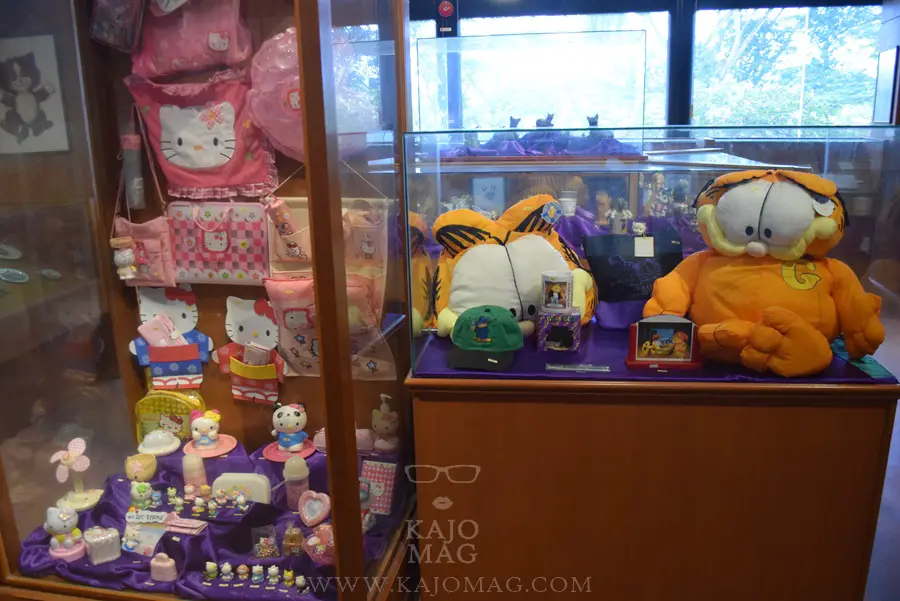
The museum also features some celebrity cats.

Speaking of popular culture, Gallery D of the museum featured more famous felines around the world such as Garfield and Hello Kitty.

Visitors can also browse through comic strips featuring cats for their own amusement at this part of the museum.

There is also an exhibition of local and wild cats of Borneo if you want to learn more about these animals.

For example, some of the interesting observations of Sarawak cats are that 15% of them have short tail, 50% kinked tail, 25% bobbed tail while 10% or less have long tails.

Another fun fact about this museum is that it houses the only complete Bay Cat (Pardofelis badia) skeleton in the world.

Learn more about felines at Kuching Cat Museum
The only complete Bay Cat (Pardofelis badia) skeleton in the world.

Found in Borneo, it is one of the rarest cat species in the world.

On top of wide collection of cats artifacts, Kuching Cat Museum also paid tribute to famous cat lovers around the world including French poet Charles Pierre Baudelaire, Sir Isaac Newton and Anne Frank.

For cat lovers with great appreciation for arts and patience for reading fun facts and cat-related general knowledge, Kuching Cat Museum is definitely worth the trip.


10 things you should know about the spectacular Hong Kong-Zhuhai-Macao Bridge

10 things you should know about the spectacular Hong Kong-Zhuhai-Macao Bridge
The sunset view of Hong Kong-Zhuhai-Macao Bridge.

On Oct 24, the world’s longest bridge and tunnel sea crossing was opened to the public.

With hope to provide a major boost to regional tourism, the Hong Kong-Zhuhai-Macao Bridge connects Hong Kong to cities throughout the Greater Bay Area of southern China.

This is also to bring the attractions of Macao and Guangdong within easy reach and to make Hong Kong a hub for visitors from around the world.

Here are the 10 things you should know about the magnificent Hong Kong-Zhuhai-Macao Bridge:

1.Undoubtedly a record-breaking architectural icon, the bridge is the first of its kind to combine road and tunnel sea-crossing in the Greater Bay Area of China.

2. It connects an artificial island near Hong Kong International Airport to Macao and the mainland Chinese city of Zhuhai. Plus, it shortens the journey from the airport to Zhuhai from four hours to just 45 minutes.

3.With the length of 55km spanning over the sea, it is 20 times longer than San Francisco’s Golden Gate Bridge. The bridge comprises of 12km Hong Kong Link Road, 29.6km Main Bridge and another 13.4km Zhuhai Link Road.

4. Do you know that the Hong Kong-Zhuhai-Macao Bridge contains enough steel to build 60 Eiffel Towers? The Guardian even has named it as one of the architectural Seven Wonders of the Modern World.

5. Amazingly, they designed it to last the next 120 years. That is two decades longer than the lifespan of most major cross-sea bridges in the world!

6.The Hong Kong-Zhuhai-Macao Bridge will consolidate Hong Kong’s position as a hub for multi-destination travel within the Greater Bay Area. This area includes nine cities in China’s Guandong Province and two Special Administrative Regions.

10 things you should know about the spectacular Hong Kong-Zhuhai-Macao Bridge
The Hong Kong-Zhuhai-Macao bridge connects Hong Kong to nine cities in Guangdong Province, China.

7.There are many attractions near and around the Hong Kong-Zhuhai-Macao Bridge.
For example the Hong Kong’s Lantau island is home to the city’s international airport and Disneyland.
Furthermore, visitors can ride the famous Ngong Ping 360 cable car to the Big Buddha statue and Po Lin Monastery.

8.If you ride a boat from Tung Chung to Tai O Fishing Village, you can clearly enjoy the view of the Hong Kong-Zhuhai-Macao Bridge. Or you can see it during on the cable car ride.

9. On top of that, the Hong Kong-Zhuhai-Macao Bridge allows those who are in Hong Kong to conveniently visit Macao and Guandong’s tourists attraction spots.

These include the stunning ruins of St. Paul’s in Macao, the Statue of Fisher Girl in Zhuhai, the Kaiping Diaolou, the Seven Star Crags in Zhaoqing and many more. This means you can combine your Hong Kong and Greater Bay Area in one single itinerary!

10 things you should know about the spectacular Hong Kong-Zhuhai-Macao Bridge
You can take in the view of the bridge from a boat ride from Tung Chung to Tai O Fishing Village.

10.There is a fast and convenient cross-border bus service is available to take travellers over the iconic new bride between Hong Kong, Macao and Zhuhai. Additionally, it operates 24 hours a day! What are you waiting for? Time to plan that trip!

This article is based on the press release provided by Hong Kong Tourism Board. For more information, please visit http://www.hzmb.hk/eng/index.html

10 things you should know about the spectacular Hong Kong-Zhuhai-Macao Bridge
The world’s longest bridge and tunnel sea crossing was opened to the public last Oct 24.

An encounter with a fellow Kayan at Putussibau, Indonesia

An encounter with a fellow Kayan at Putussibau, Indonesia
A view of Putussibau from the plane.

Putussibau, the capital of the Indonesian regency Kapuas Hulu, is the last market town on the Kapuas river.

Located in the northeastern part of West Kalimantan, it is close to the Indonesia-Malaysian Sarawak border. It is the tourists’ gateway to Danau Sentarum and Betung Kerihun national parks.

From the perspective of a Malaysian Kayan, Putussibau is the gateway to Mendalam, Mahakam and other rivers where the Indonesian Kayan people mostly reside.

After I posted a photo of Putussibau Pangsuma Airport on Instagram (as most Gen Y and millennials do) during my short pit stop at Putussibau, I was bombarded with comments and personal messages from my relatives.

Beside asking me to look for Kayan inu (beads) as souvenirs, my relatives also urged me to meet and talk to as many Kayans as I could.

And I did! I had a brief meeting with Fransiska Mening, a Kayan from Mendalam who owned a handicraft shop at Putussibau called Kerawing Gallery and Art.

An encounter with a fellow Kayan at Putussibau, Indonesia
One of the streets in Putussibau.

From one Kayan to another

An encounter with a fellow Kayan at Putussibau, Indonesia
Some of the beaded handicrafts in Fransiska’s shop.

According to Fransiska, the Kayan of Kalimantan still hold tight to their customs and cultural practices to this day.

She herself was proud of the hand-tapped tattoos on her forearms. Fransiska shared, “There is an ongoing effort by the government to record the different kind of tattoo patterns among the Kayan women here. We are still working on it.”

Fransiska’s tattoo patterns are like nothing I have seen before on any Kayan woman in Sarawak. While most tattoo patterns fully cover their forearms, Fransiska’s tattoos were in spiral patterns like ferns.

In Sarawak, it is a pattern more often found in wood carvings and traditional dress but not as a tattoo.

An encounter with a fellow Kayan at Putussibau, Indonesia
The tattoos on Fransiska’s forearm.

Kayan and blowpipe shooting

An encounter with a fellow Kayan at Putussibau, Indonesia
Fransiska inherited these old beads from her late grandmother.

The Kayan, like most tribes on the island of Borneo, chose the blowpipe as their preferred weapon when it came to hunting or wartime.

According to author Peter Metcalf, 19th century ethnologists were curious as to why the Bornean people (who advanced to using iron tools) did not develop the bow and arrow like most other cultures around the world.

The reason lies in Borneo’s topography and landscape. Metcalf wrote “For hunting, they (bows) are ineffective because the dense vegetation seldom allows a clear shot.”

“For pigs or deer, a combination of dogs and spears brings the best results. In regard to small game in the lower branches of trees, such as birds and monkeys, they are easily shot with darts.”

Furthermore, he argued that it was difficult to shoot an arrow at such steep angles, and once you lose your arrows, it was impossible to recover them in the thick Bornean jungle.

An encounter with a fellow Kayan at Putussibau, Indonesia
It takes strong forearms and a steady base to shoot the blowpipe with accuracy.

Blowpipe shooting as a hobby

An encounter with a fellow Kayan at Putussibau, Indonesia
A traditional blowpipe like this can also work as a spear.

While the blowpipe is no longer used to hunt or shoot one’s enemies, Fransiska and her family picked It up as a hobby.

“Everyone in my family has his or her own blowpipe. It is more hygienic that way,” she said. And they take their blowpipe shooting seriously, participating in local competitions including the annual Danau Sentarum Festival.

Fransiska was quick to show some of the blowpipes in her shop as well as those from her personal collection.

There were made of different types of wood with intricate carvings. The one made from belian wood was heavier and of course, more expensive.

She also owned a more traditional blowpipe which comes with a spearhead at the end, doing double duty as a spear and a blowpipe.

It’s similar to what my family have at home. Unlike Fransiska, however, our blowpipe once used by our ancestors to hunt is now displayed as a decorative item in the living room. (Perhaps now is the right time to dust the blowpipe and shoot some darts.)

An encounter with a fellow Kayan at Putussibau, Indonesia
An example of non-poisonous darts. These types of darts used to be soaked with poison for hunting in the olden days.

The differences in Kayan dialects

After coming back from Putussibau, my family bombarded us with many questions. One question that stood out was, “Do the Kayan speak closer to Belaga accent or Baram accent?”

In Sarawak, the Kayan language can be primarily divided into three dialects of these three rivers where they mostly settled; Tubau, Belaga and Baram.

From there, the dialects can be vastly different from each other, even though they’re from the same area, depending on which longhouses they are from.

The differences are in the accents, tones and certain words,  much as you would imagine English being spoken in a Scottish, Irish and British accent. Most of the time, however, all Kayans can understand each other.

So when it came to the Indonesian Kayan dialect, I found that they had accent on their own; not as fast-spoken as the Tubau accent and not as melodic as the Baram accent.

Apart from the accents, I also noticed some of their vocabulary were distinctively their own, different from any Sarawakian Kayan dialects.

An encounter with a fellow Kayan at Putussibau, Indonesia
A decoration with Kayan motif and Catholic influence.

Sharing the same roots from Apo Kayan

An encounter with a fellow Kayan at Putussibau, Indonesia
It is hard to choose from all these different variety of woven bracelets.

Whether you are a Kayan from West Kalimantan or Sarawak, we all have the same understanding that our ancestors come from Apo Kayan.

It is located at the Kayan river, Bulungan Regency at East Kalimantan. Their migration from the ancestral land in Apo Kayan began in the 18th and 19th centuries.

From there, they settled in Sarawak of Baram and Rajang rivers as well as upper Kapuas and Mahakam rivers.

Even though the Kayans now have been divided by political boundaries of Malaysia-Indonesia, it does not stop them from visiting each other.

Many trips have been organised by different Kayan longhouses communities, mostly from Sarawak to Kalimantan.

According to Fransiska, the Kayan from Kalimantan are planning to return the favour next year.

“There will be a group from Putussibau driving through the Badau-Lubok Antu border maybe sometime in April and May next year. We are planning to visit Belaga and see how is it like there.”

An encounter with a fellow Kayan at Putussibau, Indonesia
Fransiska Mening.

Saying goodbye to Putussibau

The Kayan people, particularly the women, have a unique way of air-kissing each other when they greet or say goodbye.

They touch each other cheek-to-cheek twice but instead of being accompanied by the ‘mwah’ sound with their lips, they give a small sniff.

It is commonly practiced among family members and usually those whom you are affectionate with.

Growing up, I distinctly remember hearing those sniffing sounds every time I kissed my grandparents goodbye. To this day, it is still the way my family shows their affection.

When I bid my farewells to Fransiska, the soft sniffing sound from her air-kiss reminds me it is undeniable that the Kayans still share the same strong roots despite our differences in nationality.

10 interesting facts about Indonesia’s Kapuas River

Borneo has often been referred to as the Amazon of Asia thanks to its high density biodiversity. So if Borneo is the Asian Amazon, the ‘Amazon river’ of this island is none other than the Kapuas river.

Here are 10 interesting facts you need to know about Kapuas River, Indonesia

1.It is the longest river in Indonesia

At 1,143 kilometers in length, it is the longest river of Indonesia and the island of Borneo.

It is also the world’s longest river. The delta of Kapuas river is at Pontianak, the capital of West Kalimantan Province.

10 interesting facts about Indonesia's Kapuas River
An early morning view of Kapuas river from Semitau.

2.Wait, there are two Kapuas riverS?

There are actually two Kapuas rivers flowing from the same mountain range. One Kapuas river flows west into the South China Sea. Meanwhile, the other Kapuas river flows to the south, merging with the Barito Sea and ends at Java Sea.

3. Kapuas river originates from the Muller mountain range

Both Kapuas rivers originate from the Muller Mountain Range, located south of the Indonesian-Malaysian border.

The mountain range was named after Major Georg Muller. He was a soldier and even fought for Napolean Bonaparte when France attacked Russia.

So how did a European army end up in the middle of Borneo in the 19th century?

Born in Mainz, Germany in 1790, Muller joined the Royal Netherlands East Indies Army in 1817.

He took part in the Dutch attack against the Sambas kingdom in 1818.

In 1825, he led an expedition to cross Borneo inland via Mahakam and Kapuas rivers. However, the expedition ended in tragedy when he and his party were killed by the local Dayak tribe.

4.There are two national parks on its river banks

Betung Kerihun and Danau Sentarum are the two national parks located at Kapuas river banks.

Together with Lanjak Entimau Wildlife Sanctuary in Malaysia, Betung Kerihun has been proposed as a World Heritage site.

Meanwhile, Danau Sentarum National Park lies in the upper Kapuas river tectonic basin some 700 kilometers from its delta.

5. It is an important source of water and mode of transport

If you spend an early morning in any town located next to the river, you can catch some of the local people doing their daily chores.

You can see young children in large groups before going to school while the women do their washing on the wooden jetties.

Although roads are available to connect most parts of West Kalimantan, the Kapuas river is still the major waterway connecting the centre of Borneo with its western coast.

6.The Kapuas river and its flora and fauna are any researchers’ dream subject

Many researchers believe there are still many new species to discover in Borneo, especially small creatures

The most recent fascinating species found in the river is the Kapuas mud snake back in 2005. German and American researchers discovered it accidentally when it was put in a dark bucket and changed colour 20 minutes later.

The snake has chameleon-like behaviour which allows it to change its epidermal colour spontaneously.

In addition to that, tropical rivers are unlike rivers in temperate zones. To this day, researchers are still gathering more information on hydrology and geomorphology of tropical river system.

7. It has a high density of fish species

There are about 300 fish species recorded in the river basin. The most iconic one is none other the super red arowana fish. It is only found in Kapuas river and is a famous species in the aquarium trade.

Sadly, the species is continuously decreasing because of wild poachers and low productive rates.

8. There are other remarkable species too

Apart from the super red arowana fish, there is one striking fish species found in Kapuas river.

Only officially described in 2008, the eight-banded barb (Eirmotus insignis) is a small zebra-striped fish which measures about 3.6cm in length.

It was found between the towns of Sanggau and Putussibau, among overhanging tree roots and aquatic vegetation.

Where can you find the world’s first lungless frog? In Kapuas river, of course! The Bornean flat-headed frog breathes entirely through its skin.

Scientists first discovered the frog in the middle of Kapuas river basin back in 1978.

9.The longest bridge in Borneo crosses this river

The Tayan Bridge is the longest bridge in Borneo spreading over 1,975 meters. It crosses the Kapuas River in Sanggau, West Kalimantan to connect West Borneo with Central Borneo in Indonesia.

10.You can take a tour upriver from Pontianak

It takes up to two days on the deck to travel up Kapuas river from Pontianak depending on your mode of transportation. In Pontianak, there are travel agencies which can help you to plan a trip upriver if you are feeling adventurous. Plus, there are plenty to see along the river from local villages with different architecture to wildlife that might pass your way.

Go to the furthest upstream and you would find yourself in Tanjung Lokang. Located about 13 hours from Putussibau town by speedboat through Kapuas river, the village belongs to the Dayak Punan.

It is the last village in the Borneo jungle when you are heading east across the island.

5 things to do at Buntal Esplanade, Kuching

Located about 30km from Kuching city, Buntal Esplanade is a hidden gem waiting to be explored more by the locals and tourists alike.

5 things to do at Buntal Esplanade, Kuching
The road into Kampung Buntal, a local fishing village located between Kuching city and Santubong.

The esplanade is inside Kampung Buntal, a traditional Malay fishing village situated at the mouth of Sarawak river leading to South China Sea.

The village is named after ikan buntal or the puffer fish which commonly found near the area.

If you are looking for fresh air on a Saturday afternoon, here are five things to do at Buntal Esplanade:

5 things to do at Buntal Esplanade, Kuching
Welcome to Buntal Esplanade!
1.Enjoy the beach view

First of all, just enjoy the view of South China Sea at Buntal Esplanade. Do you know that Buntal beach offers a mesmerising scenic view of the sunrise? (Just make sure you’re there before 6 am).

Plus, the best part is that the walkway of Buntal Esplanade is wheelchair-friendly.

5 things to do at Buntal Esplanade, Kuching
The esplanade was designed to be wheelchair-friendly.
2.Buy some seafood

Being a fishing village right next to the ocean, it is no surprise that Buntal provides a variety of fresh marine resources at its market.

Some of their seafood on offer are seasonal catch, so you only get to buy them during certain periods of the year.

These include jelly fish (March-April), swimmer crab (July-August), eng-ngoyang (October-February), sea anemone (December-January) and ambal (December-January).

Additionally, the non-seasonal catches are hard clams, mangrove clams, cockles, mud crabs and obtuse horn shell.

5 things to do at Buntal Esplanade, Kuching
Support the local communities by buying their products.
3. Do some bird-watching activities
5 things to do at Buntal Esplanade, Kuching
The observation point of Buntal Esplanade.

Did you know that Bako Buntal Bay is the wandering site for 27 migratory bird species in their annual migration between Southeast Asia and Australasia?

Completed on March 2015, Buntal Esplanade was designed as a walkaway with an observation point for bird-watching activities.

According to the East Asian-Australasian Flyway Partnership, the Bako Buntal Bay area welcomes more 25,000 migratory birds between October and April every year.

Most of them are threatened species such as Nordmann’s Greenshank, Asian Dowitcher and Far Eastern Curlew.

Meanwhile in 2009, two rare birds – the Pied Avocet and Eurasian Oystercatcher were caught  on sight near the bay.

The habitat in the coastal area is mud and mangrove forest, making it attractive for migratory birds in search of food.

If you notice unique wooden structure near the beach while bird-watching, it could be an engian. It is a traditional trapping method used by the local fishermen to catch anchovies and small shrimps.

5 things to do at Buntal Esplanade, Kuching
Take an evening walk at the esplanade to escape the hustle and bustle of Kuching city.
4.Taste the local food
5 things to do at Buntal Esplanade, Kuching
Try some of these local delicacies such as pais.

Visitors should not miss the chance to buy local delicacies. These include kuih keria (fried dough similar to doughnuts but covered in palm sugar or gula apong), pais ikan (grilled smashed fish) and bahulu.

Other local favourite are belacan (shrimp paste), madu kelulut (stingless bee honey), jeruk buah (pickled fruits) and cencaluk (preserved shrimp).

5 things to do at Buntal Esplanade, Kuching
Kuih Keria.
5.Eat some seafood

Kampung Buntal is one of the favourite local places for Kuchingites to go to enjoy some seafood.

While visiting Buntal Esplanade, why not drop by one of the seafood restaurants like Teo Seafood?

Besides Kampung Buntal, other famous local seafood cuisine spots are at Telaga Air and Muara Tebas.

5 things to do at Buntal Esplanade, Kuching
Kampung Buntal is one of the popular places for local people to enjoy seafood cuisine.
5 things to do at Buntal Esplanade, Kuching
The view of Mount Santubong from Kampung Buntal.

5 things I learned through my gastronomic experience at Kapuas Hulu

As a Kayan from the Malaysian state of Sarawak, Kapuas Hulu is a place that feels familiar and foreign at the same time.

First of all, the Kapuas Hulu region in West Kalimantan is home to a wide diversity of indigenous communities such as the Iban, Silat, Sejiram, Seberaung and Kayan.

Hence, some of the dialects, architecture and of course, food are so familiar making a Sarawakian like me almost forget  that I was in another country.

It seems only natural since the north of Kapuas Hulu borders Sarawak. The differences in Malay dialect and vocabulary as well as infrastructure, however, did remind me that I was no longer in Malaysia.

Thanks to World Wide Fund for Nature (WWF) Indonesia, I got to visit several districts (kecamatan) under Kapuas Hulu  such as Putussibau, Semitau, Suhaid, Badau and Batang Lupar from Sept 25 till 28, giving me the opportunity to explore what made us similar yet different.

5 things I learned through my gastronomic experience at Kapuas Hulu
Indonesian nasi goreng.

Here are five things I learned from a Sarawakian perspective through my culinary experience at Kapuas Hulu, Indonesia:

1. You can take the girl out of the village, but you sure can’t take the village out of the girl
5 things I learned through my gastronomic experience at Kapuas Hulu
You can pick which side dish to go with your rice. 

Terserah kedayakanmu, asyik-asyik makan daun ubi, (You are obviously a Dayak since you keep on eating cassava leaves).”

This was what one of my travelling companions, a local reporter from Pontianak said to me.

Malaysian-style ‘nasi campur’ is also common in neighbouring Indonesia. It is our local buffet style where you pick two or three mains – vegetable or protein – to go with your white rice. The price of your meal will be based on your dish types and portions.

While other types of vegetables such as long beans, bean sprout, cabbage and cangkuk manis (Sauropus androgynus) are available, I guess the Kayan blood flowing through my veins led me to pick out the cassava leaves over the rest.

Locally known as daun ubi or sometimes daun bandung in Sambas regency, the leaves are pounded and stir-fried to perfection, just how Sarawakians would enjoy it.

5 things I learned through my gastronomic experience at Kapuas Hulu
Instead of the stainless steel canteen style setup we have in Malaysia, the nasi campur stalls across the border lay out their food in this attractive and ingenious way.
2. Chicken rice is called ‘ayam goreng’, not nasi ayam.
5 things I learned through my gastronomic experience at Kapuas Hulu
How an ‘ayam goreng’ would look like in Indonesia.

Ayam goreng means fried chicken in Malay. To order ayam goreng in Malaysia will bring you a piece of fried chicken. Meanwhile in Indonesia, ayam goreng comes with a bowl of rice and other side vegetables.

3. Tea is life, not coffee
5 things I learned through my gastronomic experience at Kapuas Hulu
Try es jeruk tambah susu which is lime juice with condensed milk.

Most of us in Malaysia love Indonesia’s famous and iconic beverage Teh Botol. Unsurprisingly, tea is a more preferred beverage in the country, compared to coffee.

Indonesia is just like Malaysia where ordering drinks can be tricky and different depending on which state you are in.

But here are key points to remember; it is called ‘es’ not ‘ais’ if you want to order an iced drink. Jeruk in Malaysia means pickled while in Indonesia, you can order ‘air jeruk’ which basically is a lime drink.

Interestingly, you can also order a cup of cappuccino in any common eatery. However do not expect it to come as a double espresso with steamed milk foam. It is equivalent to premixed Malaysian white coffee.

4. The fish is delicious in Kapuas Hulu!
5 things I learned through my gastronomic experience at Kapuas Hulu
Fish cooked with asam pedas (spicy tamarind).
5 things I learned through my gastronomic experience at Kapuas Hulu
Salted fish roe.

My visit to Kapuas Hulu revolved around Danau Sentarum. It is a magnificent-looking floodplain with plenty of  biodiversity treasures and resources especially fish. Hence, the star of my gastronomic experience is none other than the fish. At one point, it was hard to keep up with the types of fish I tried or which is which but I remember I have tried toman and biawan.

The only type of fish I tasted before during my trip was baung fish. It is a type of catfish which can also be found in Sarawak such as in Bakun or Belaga. In Kapuas Hulu, it is more common to cook these kinds of fish with asam pedas (spicy tamarind).

Fish may not be everybody’s favourite kind of protein, but in Kapuas Hulu,  you might find yourself enjoying it as the freshness adds to its tastiness.

5. Kerupuk basah is a must-try snack
5 things I learned through my gastronomic experience at Kapuas Hulu
You must dip the kerupuk basah in the accompanying peanut sauce to enjoy it completely.

Kapuas Hulu’s kerupuk basah is reportedly Indonesian President Jokowi’s favourite food in West Kalimantan and I have to agree with the president because it was delicious. To this day I regret not buying some to bring home.

What might come to mind when you see kerupuk basah is how much it looks like the Malaysian keropok lekor, a traditional fish snack originally from Malaysian state of Terengganu.

The main similarity between kerupuk basah and keropok lekor is that both of them are made of fish but that’s where it ends.

5 things I learned through my gastronomic experience at Kapuas Hulu
Freshly cooked kerupuk basah in a steamer.

Kerupuk basah has a spongy and smooth texture, almost like a crossover of textures between siu mai and fish cake.

Apparently the most delicious type of kerupuk basah is made from belidak fish. The one I tried was made from toman fish, but it is still tasty.

Most of the time, the kerupuk is served straight from a steamer, although some people prefer it fried.

What makes kerupuk basah extra tasty though, is the peanut sauce that comes with it. Made from fried peanuts, salt, chilli and sugar, the peanut sauce that goes with kerupuk basah is sweeter than our typical peanut sauce here in Malaysia.

So if you ever make your way to Kapuas Hulu, especially its administrative centre Putussibau, do not leave the regency without trying this iconic snack.

5 things I learned through my gastronomic experience at Kapuas Hulu
Kerupuk basah.
5 things I learned through my gastronomic experience at Kapuas Hulu
A view of Kapuas river from Semitau.
5 things I learned through my gastronomic experience at Kapuas Hulu
A view of Kapuas river from Suhaid.
5 things I learned through my gastronomic experience at Kapuas Hulu
Danau Sentarum of Kapuas Hulu.

5 things to do at Danau Sentarum Festival in West Kalimantan this October

Danau Sentarum Festival is an annual event organised in Kapuas Hulu District which was started in 2012.

The festival is aimed to promoted the rich culture of people in Kapuas Hulu, West Kalimantan particularly around Danau Sentarum.

This year, Danau Sentarum Festival will be held on Oct 25 to 28 at three different locations including Lanjak, Batang Lupar and Putussibau.

With the theme “Stimulate Cross-Border Ecotourism in the Heart of Borneo”, the festival was launched as part of 100 Wonderful Events Indonesia by Ministry of Tourism of the Republic of Indonesia.

5 things to do at Danau Sentarum Festival in West Kalimantan this October
The Danau Sentarum Festival will spread out in different locations including Putussibau.

If you are heading to Danau Sentarum Festival this year, here are five things to expect during the event:

1. Join in the Danau Sentarum Cruise

During the festival, visitors are more than welcomed to join the Danau Sentarum Cruise which they will be taken on board Bandong boats to explore the lake.

It is a unique boat with the bottom designed by the Malays and the top designed by the Dayaks. The boat is used as both transportation and accommodation.

There will be two trips daily; one in the morning and another in the afternoon. Visitors should take this opportunity to observe the daily activities of people living in Danau Sentarum.

Plus, do not forget to bring your binocular just in case you can spot any birds along the way.

2. Watch traditional boat parade

Boats are important assets for the local communities of Danau Sentarum. Each tribes living in their area has its own unique traditional boats.

This year, the Dayak Tamambaloh tribe’s Parau Tambe boat by will lead the Traditional Boat Parade. The event will start from Lanjak town to Kedungkang, Melayu Island and Sepandan island, all around Danau Sentarum. 

It is definitely a sight to see with each boat will feature its own traditional music and dances. This activity will be held on Oct 27.

5 things to do at Danau Sentarum Festival in West Kalimantan this October
An example of a Malay village at Danau Sentarum.
3. Enjoy the music of Sentarum Ethnic Music Festival
5 things to do at Danau Sentarum Festival in West Kalimantan this October
Dusun Kedungkang, an Iban longhouse of Batang Lupar district, West Kalimantan.

What do Kalimantan and its Malaysian neighbour, Sarawak have in common when it comes to music? The sape.

This Dayak traditional lute will be featured together with rebana, sitar, gambus with other musical instrument at the Sentarum Ethnic Music Festival (Lanjak, Oct 26).

This is a golden opportunity to hear and compare the different sounds of various tribes in Kapuas Hulu regency, West Kalimantan.

4. Watch the one-of-a-kind Arwana Super Red Contest

Heading over to Putussibau, the contest to be held over the course of the festival aims to promote the conservation of the ‘dragon fish’, the Arwana Super Red (Scleropages formosus). Also called Ikan Siluk Merah in Indonesia, this fish in its vibrant colours ranging from red to chili ted is endemic to Danau Sentarum and has a reputation as one of the most expensive fishes in the world.

5. Have some honey at Culture and Honey Festival
5 things to do at Danau Sentarum Festival in West Kalimantan this October
An example of traditional tattoo of a Kayan Mendalam woman.

Beside arwana fish, another special commodity from Danau Sentarum is its honey. The honey is traditionally farmed and harvested by the Malay communities of Danau Sentarum.

The event will see a parade of 2,000 people drinking honey from bamboo cups.

And the best part is the local people will be donning their traditional attires during this festival. The Culture and Honey Festival will be held at Lanjak on Oct 25.

5 things to do at Danau Sentarum Festival in West Kalimantan this October
Are you up for a blowpipe challenge this coming Danau Sentarum Festival?

Other activities include a blowpipe competition, carving contest, traditional tattoo demonstration, dragon boat and bidar boat races and many more.

For more information on Danau Sentarum Festival, contact the organiser here or here or download the booklet here.

1 7 8 9 10 11 15