Patricia Hului

Patricia Hului is a Kayan who wants to live in a world where you can eat whatever you want and not gain weight.

She grew up in Bintulu, Sarawak and graduated from the University Malaysia Sabah with a degree in Marine Science.

She is currently obsessed with silent vlogs during this Covid-19 pandemic.

Due to her obsession, she started her Youtube channel of slient vlogs.

Follow her on Instagram at @patriciahului, Facebook at Patricia Hului at Kajomag.com or Twitter at @patriciahului.

Remembering an old Iban ceremony called ‘Gawai padi datai’

The Iban community is known for having different kinds of gawai celebrations.

Even though we associate the word ‘gawai’ with partying today, the feasting and festivities are actually secondary to the main event of the gawai celebration which is the religious ritual.

Some of the examples of gawai rituals include Gawai Antu (rituals to invite dead souls to their final separation from the living), Gawai Ngar (to celebrate patrons of weaving) and Gawai Melah Pinang (for the deity of creation).

One of the rare gawai rituals that are perhaps no longer celebrated is Gawai Padi Datai.

Betong’s then acting district officer A.M. Phillips witnessed the ritual, writing about it in The Sarawak Gazette on Sept 30, 1955.

According to Phillips, Gawai Padi Datai is held when the harvest is low, and is a celebration for paddy which they believed fell from the sky.

He stated that most longhouses in the Layar, Padeh, Spak, Rimbas and Paku areas had either performed the Gawai Padi Datai themselves or had at least attended one or two of the ritual.

Remembering an old Iban ceremony called 'Gawai padi datai'
Gawai Padi Datai is celebrated when the harvest is low.

Here is Phillips’ account of Gawai Padi Datai:

A feature of this gawai is that paddy which alleged to have fallen from the sky is brought from other houses to the house which is about to celebrate.

On arrival at the foot of the ladder a babi bland and manok labang (white pig and spotted white chicken) are killed and an offering made at the bottom of the ladder.

From the landing stage (pendai) to the foot of the ladder, thence up the ladder on to the ruai, and from the tanju to the bilik and into a tajau lama run strings, either of decorated rattan or of red cotton threaded with hundreds of puffed rice grains (letup).

The whole house is spread out with mats covering all the ruai and the whole of the bilik.

The visitors with the padi datai sit on the ruai together with 11 or possibly 13 women dressed in white, as men, with feathered hats and parangs, who make the offerings etc.

What happened after the offerings?

After this, during the night, grains of paddy are found from time to time either on the mats or on the ground outside the house.

Stones and animals’ teeth are also found, sometimes on the mats, sometimes in the offerings, sometimes falling from the roof.

All these grains of paddy and pebbles are supposed to bring good luck.

Most of the paddy probably falls out of the paddy bins in the roof whence it is disturbed by the usual rats, cats, or shaking of the house caused by the crowd of visitors.

The stones and animals teeth could also be placed in situ by subterfuge. If it is a hoax it is a big one and is yet undiscovered by the locals. The house carrying out this gawai and who place not a little faith in its efficacy include houses with many Christians. This phenomenon impresses or seems to impress, much more quickly and effectively than such mundane benefits as local authorities, or indeed V.H.F. telephones.

So what do you think? How did the paddy grains, stones and animals’ teeth are found after the Gawai Padi Datai? Let us know what you think in the comment box.

5 things you should know about the old customs of Iban divorce

Many of Sarawakians’ old customs are no longer practiced mainly because they have been replaced with a more uniform judiciary laws.

Some proceedings in the olden days did not rely on justice or what is best for all parties. Sometimes, the old generations relied on omens and dreams to decide including divorce.

Here are 5 things you should know about the old customs of Iban divorce as recorded by Reverend William Howell in The Sarawak Gazette on Mar 16, 1909:

1.There were two kinds of Iban divorce.

In those days, there were two types of Iban divorce. According to Howell, a temporary divorce was effected through an ill omen or a bad dream. Meanwhile, a permanent divorce was brought about by incompatibility of temper, inhospitableness, ill-temper and adultery.

The Ibans called temporary divorce “belega'” or “beluit”. The marriage could be renewed again after a short interval.

As for a permanent divorce, it could be effected before it was brought in front of the chiefs and elders.

Howell stated, “The guilty part is amerced. The innocent party takes the fine and divides it with the chiefs or elders and friends who witness the settlement of the case.

If the husband is the guilty party he pays a fine not only to the woman but towards the upkeep of the children also if he has any. The woman’s fine is called “pekain” and the upkeep of the children is called “pelanja”. The man’s fine is called “pesirat”.

2.How the fine is imposed

The fine was imposed according to the offence. If both parties would not agreed to the settlements of the chiefs or elders or even if one of them disagreed, the case would be settled by a diving contest.

By doing so, not only the fine is settle but also the bet on who would win the contest.

In this case, the losing party would have to meet not only the loss by the shame also.

“A ring or a bracelet given by the party that brings about the divorce, if it is received by the other party, is an ample sign of divorce. Before a person can consider himself properly divorced according to the Dayak point of view such person takes away all his or her belongings from the room where they lived together,” Howell stated.

3.A temporary divorce could be brought to a permanent one.

If the temporary divorce was brought to a permanent divorce, there would be no fine.

Interestingly, the news or occurrence of death in the area of the newly married couple may result in a permanent or temporary divorce.

For an unknown reason, it was generally more taboo if a death occurred upriver.

4.Superstitions which lead to divorce.

Howell pointed out that the Iban superstition seemed to be an advantage to them in creating a plea or to exculpate them from punishment.

“If a man says he has had a very bad dream or an ill omen, with that plea he is justified putting away his wife. In view of such religion or superstition or a great many of them have simply invented a story and have had a divorces with impunity. The same thing has been also practiced by women,” he stated.

5.The children matters in an Iban’s divorce.

The binding nature of an Iban marriage seems to depend on the children. Howell gave an example of how the children influence their parents’ divorce proceeding:

The wife of a certain man had already misconducted herself three times but her husband forgave her. The fourth time she did so with a relation and her husband swore by the gods of his ancestors that he would put her away. The case was brought before the court of justice, the man divorced his wife and the wife was fined but the children all agreed and said to their father that unless he lived again with their mother they would have nothing to do with him. The father gave in and took his wife back and paid her fine for her.

5 things you should know about the old customs of Iban divorce

Early records of inoculation and smallpox vaccination in Sarawak

If you are not familiar with inoculation or variolation (deliberately introducing the pathogen into an uninfected person), it is the method first used to immunize an individual against smallpox with material taken from a patient or a recently variolated individual, in the hopes that a mild, but protective infection would result.

The procedure was most commonly carried out by rubbing powdered smallpox scabs of fluid pustules (an inflamed blister containing pus) into superficial scratches made on the skin.

Then the patient would develop pustules identical to those caused by naturally occurring smallpox. This would lead them to develop a less severe disease than naturally acquired smallpox.

Slowly after two to four weeks, these symptoms would slow down indicating successful recovery and immunity.

According to historian Loh Chee Yin, vaccination against smallpox was introduced into Sarawak in the 1960s. However, inoculation was already practiced in the 1850s.

Early records of inoculation and smallpox vaccination in Sarawak
Drawing accompanying text in Book XII of the 16th-century Florentine Codex (compiled 1555–1576), showing Nahuas of conquest-era central Mexico with smallpox. Credit: Creative Common

Early records of smallpox inoculation in Sarawak

One of the early records of inoculation in Sarawak was recorded by Brooke Hugh Low in 1876. At that time, he was holding the post of Assistant Resident of Sibu. When he was travelling up the Baram river which was still under Brunei territory (Baram was ceded to Sarawak in June 1882).

He recorded about a smallpox epidemic which decimated the Kayan population in the area.

“I next proceeded up the Baram as far as Long Lusan, where Oyong Ngau now lives. He abandoned Batu Gadin on account of the smallpox which carried of 200 persons in his own house; 1,333 Kayans are estimated to have fallen victims to this epidemic, and 3000 Kenyahs. Although I did not ascend the river above this point I met several of the upriver chiefs, both Kayans and Kenyahs, and among the latter, Paran Libut’s brother, Tama Peng Wang, who assured me that his tribe had been decimated and that the Upper Baram, which before was populous, is now a mere waste. Houses which a year ago could boast of 100 fighting men can now scarcely muster 10. Fortunately for the Kayans there was a Selimbu Malay, one Haji Unus, at Batu Gadin who understood inoculation and inoculated some 3,600 persons of both sexes, and though many died, many also were saved.”

A record of Ibans practicing inoculation

Bishop Walter Chambers once wrote in 1857 about how inoculation saved a community of Ibans in Lingga.

“The smallpox attacked six months ago (1856) the people up the main river, the Batang Lupar. In some of the Dyak houses it made frightful ravages, chiefly through the panic fear into which it threw the occupants, who in some cases, fled into the jungles, abandoning their sick friends and carrying the infection in their own bodies. It is said there are longhouses, whose occupants having thus rushed away, not one of them has since made his appearance.

The Dyaks regard the smallpox as an evil spirit, with the notion which induced our English peasantry to use the same caution to fairies- they never venture to name the smallpox, but designate it politely by the titles Rajah and Buah-kagu. I heard an old woman yesterday, telling how that, during the time she was nursing her grandson, she was continually begging, ‘Rajah have compassion on him, and on me, and spare his life- my only child.’

In the neighbourhood of Sakarran, the Malays inoculated with success both their own people and the Dyaks. By inoculation the disease was gradually drawing near to Lingga.

I wished the Dyaks not to inoculate until the appearance of the disease in the country, but they had an idea that the ‘Rajah’ was more mild to those who thus made submission to him. Out of hundreds who have been inoculated, only three have died under the operations.”

The Kayans’ knowledge of smallpox

Loh believed that the Kayans in those days were aware of the infectious nature of smallpox long before the introduction of inoculation and vaccination. They knew that immunity could be secured by complete isolation from affected villages.

He cited an example from Charles Hose’s The Pagan Tribes of Borneo (1912). This is what Hose wrote:

“With this object the people of tributary stream will fell trees across its mouth or lower reaches so as to block it completely to the passage of boats, or a less drastic measure, will stretch a rope of rattan from a bank as a sign that no one may enter. Such a sign is generally respected by the inhabitants of other parts of the river basin. They are aware also of the risk of infection that attends the handling of a corpse of one who has died of epidemic disease, and they attempt to minimise it by throwing a rope aorund it and dragging it to the graveyard, and there burying it in a shallow grave in the earth, without touching it with the hands.”

As for the Ibans, it was a normal practice for the unaffected members of a longhouse to run away into the jungle to avoid smallpox infection.

Here is an example of how the Ibans who refused to be inoculated reacted to the epidemic according to Spenser St. John:

“When the smallpox was committing sad havoc among those Sea Dyak villagers who would not allow themselves to be inoculated, they ran into the jungle in every direction, caring for no one but themselves, leaving the house empty, and dwelling far away in the most silent spots, in parties of two and three, and sheltered only by a few leaves. When these calamities come upon them, they utterly lose all command over themselves, and become as almost timid children. Those seized with the complaint are abandoned; all they do is to take care that a bundle of firewood, a cooking pot, and some rice, are placed within their reach. On account of this practice, few recover, as in the delirium they roll on the ground and die.

When the fugitives become short of provisions, a few of the old men who have already had the complaint creep back to the houses at night and take a supply of rice. In the daytime, they do not dare to stir or to speak above a whisper for fear the spirits should see or hear them. They do not call the smallpox by its name, but are in the habit of saying, “Has he yet left you? At other times, they call it jungle leaves or fruits; and at other places the datu or the chief. Those tribes who inoculate suffer very little.”

Other records of inoculations and vaccination in Sarawak

In those days when a smallpox epidemic attacked Sarawak, the news was usually reported in the Sarawak Gazette.

In 1868 for example, Sibu had a mild attack of smallpox. The gazette reported as the people failed to receive vaccine from Kuching, they were inoculating themselves.

On Apr 29, 1874, the gazette reported a smallpox epidemic was raging along the Batang Lupar and Rajang rivers.

The then principal medical officer-in-charge Dr. E. P. Houghton investigated the epidemic in person and found the disease to be measles and chickenpox.

Dr Houghton wrote in his report, “I vaccinated some children at Simanggang, which was successful and left a public vaccinator there to carry on the vaccination. I also started vaccination at Sibu in Rajang which was successful, and left two public vaccinators to vaccinate the people.”

Two years later in June 1876, Dr Houghton wrote this in the Sarawak Gazette; “Smallpox occasionally visits us but only in a sporadic form, and since vaccination has been so successfully carried on, there is every reason to hope this scourge will eventually be stamped out.”

Looking back at Sarawak history, smallpox epidemica appeared periodically affecting selected communities in the state.

These epidemics not only affected the Sarawak populations back in those days, it also caused the early migration of Sarawakians leading them to move from one place to another to flee from the disease.

If you’re freaking out about smallpox on top of your fears of the Covid-19 outbreak, don’t worry; smallpox was eradicated globally in 1980.

Cultural similarities between Naga people of India and Myanmar regions, and the people of Borneo

The Naga people are tribes who live in northeastern India and northwestern Myanmar. They make the majority of the population in the Indian state of Nagaland and Naga Self-Administered zone of Myanmar.

The Naga people are known for their strong warrior tradition. In the olden days, the Naga people practiced headhunting, as they took the heads of their enemies in the belief that they would also take their power.

Meanwhile, thousands of miles from India and Myanmar, the indigenous people of Borneo also had a culture of headhunting. But what do these two indigenous groups share besides cutting off the heads of their enemies?

Former Sarawak Museum curator Edward Banks explored this question in a paper published in The Sarawak Museum Journal in August 1983.

According to Banks, there were many other things the Naga and Borneo peoples did the same way because they lived under the same conditions, not because they are related.

Cultural similarities between Naga people of India and Myanmar regions, and the people of Borneo
The Naga people made an appearance during Rainforest World Music Festival in 2019 at Sarawak Cultural Village.

Here are some of the comparisons between the Naga people and the ethnic groups in Borneo according to Banks:

1.Clothing

The Naga people, like the tribes in Borneo, wore loin cloth in the olden days. In Assam, they called it lengta.

Cultural similarities between Naga people of India and Myanmar regions, and the people of Borneo

2.Slash and burn method of farming

“Both sides plant rice by first cutting down the jungle, burning it off and then planting hill rice in the clearings,” Banks wrote.

To celebrate bountiful harvest, both cultures also have festivals at the end of harvest season.

3.Rice Wine

Most societies that rely on rice as a staple food tend to use its surplus to brew rice wine.

Here in Sarawak, we are known for our tuak and burak. The Naga people also have their own version of rice wine.

Banks stated, “The brews seem to be very much the same, boiled rice fermented with the dust from the winnowing of the husked rice. The taste seems to be much the same and so does the result, not very intoxicating at the time you merely feel rather ill the next day.”

4. Knife and sword

Naga knives, known as “dao”, were made so that the hilt angled upwards from the blade to prevent the back of the hand being skinned against the tree trunk or log which was being cut.

The “dao” mostly resembles the Bidayuh people’s war sword called pandat as well as the parang latok or latok from Kalimantan.

5. How a woman was buried

Banks in his paper pointed out, “One of the oddest things common to Kayans and to Nagas was the hanging up of the departed lady’s sun hat beneath her tomb. I do not know anyone else does this and it is an extraordinary custom to crop up thousands of miles apart.”

6.Bachelor’s house or head house

A baruk (also known as pangah/baluh/balu/pangarah) is an important architectural feature in a traditional Bidayuh village.

It works as a meeting hall, shelter and where they used to keep the heads of their enemies.

Similarly, the Naga people have a bachelor’s house where they had meeting, welcomed strangers and kept the heads.

In the olden days, women were not allowed to enter this house.

7.Jar burials

Jar burials were common in many cultures throughout Southeast Asia. However, the manner of how a jar burial was conducted might differ.

According to Banks, the Kelabits used to cut a ridge in the jungle, dig a trench, put in the jar containing the bones of the deceased and erect an upright stone pillar with a large flat stone at its base.

“These menhirs are just the same as those used by some of the Nagas, the likeness is astonishing,” he stated.

8.The naming of a son

Banks also claimed there was a similarity in the ceremony for naming a son between the Naga people and the Kayans.

He stated, “A 100 foot jointed bamboo pole was placed in the ground and supported by a forked stick about one third of the way up so that the rest of the pole bent over in a graceful arc with the tip almost touching the ground. The pole was covered with bamboo leaves, gourds and flat pieces of bamboo were tied on near the tip and the whole thing clapped away merrily when the wind blew. You can see a picture of one in Hose’s book. In pre-war days, there were lots of these lovely things up and down the banks of the Baram river.”

Cultural similarities between Naga people of India and Myanmar regions, and the people of Borneo
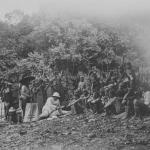
Black and white photographs taken by R.G. Woodthorpe, c.1873-1875 Tangkhul Nagas photographs Tangkhul Woodthorpe/ R.G.(1873-1875). Pitt Rivers Museum Archive, Oxford AL.62.1.4 Credit: Public Domain.

Mandi Rumah, an old Iban housewarming ceremony

Mandi Rumah, an old Iban housewarming ceremony
An example of an Iban Longhouse. Dusun Kedungkang, an Iban longhouse located near Danau Sentarum, West Kalimantan.

Different cultures have different housewarming traditions as people embark on the next step of their lives, which is settling into their new homes.

While housewarming rituals can encompass religious blessings, other cultural traditions may include symbolic gestures like lighting a candle on the first night, or painting the front porch roof blue or ringing a bell around the house to create positive spaces.

For the Iban people of Sarawak in the olden days, their specific ceremony when they started to move into a new home was called mandi rumah.

One of the few testimonies of mandi rumah from back then was written by Reverend William Howell, who submitted an essay about the ceremony to Sarawak Gazette which was published on March 1, 1909.

Here is what Reverend Howell wrote about the Iban ceremony, mandi rumah:

When a new house has been taken possession of by its future occupants, there are few ceremonies that must be gone through in order to make it habitable, such as the rite of making it lawful for the house to receive food for its inhabitants.

But the rite of mandi rumah (house washing) may be deferred although the house must be under certain restrictions until it has been performed.

Mandi rumah literally translated is “to bathe the house”. Yet the term is more common than the more exact phrase masu rumah ‘to wash the house’.

Muai rumah (to abolish the house) is also used as the name of this feast, having reference to the abolishing of restrictions by its observance.

It is hard to say what was the original significance of this observance, for nothing but the name implies anything about washing, the ceremony as now performed having nothing to suggest it. Perhaps, however, there is a hint of the original idea remaining in the restriction that prevents anyone polluting the water of the bathing and watering place, by fishing with the aid of tuba (poisonous root) which is thrown into the water to stupefy the fish or kill them, before the masu rumah.

Again, if, as the name implies, a cleansing of the house is meant it is difficult to divine its purpose. The washing of an old house might signify the purging of some stain of guilt attaching to it or its inmates, but in the case of a new house it seems to imply a sort of consecration to good purposes, and the formal renunciation of all that is accounted by Dayak custom immoral.

The restrictions before mandi rumah

Iban ceremonies typically have a period of “fasting” before the actual event, where certain daily activities which could affect the outcome of said ceremony will be put on hold.

In the case of mandi rumah, that means that alot of the activities typically held in the longhouse veranda are prohibited. These include settlements of disputes; fines, if imposed may not be paid; wearing and the making of blankets from bark (tekalong) are also prohibited until the housewarming ceremony is held.

Anybody caught breaking these rules will have to pay a fine, which usually takes the form of sacrifice. It is believed that paying this penalty will prevent any misfortune from falling upon the residents of the longhouse as a result of their misstep.

Preparing for mandi rumah

The mandi rumah feast itself is generally held after a good harvest. According to Howell, preparation for the feast typically takes two to three months.

When the event, or “promise of three days” nears, invitations are sent out, and fighting cocks are prepared for the festivities.

Much like Gawai Dayak today, mandi rumah also takes place over the course of three days. Unlike Gawai Dayak, however, the main event – which is the feasting – is on the third day.

The first day is devoted to making the ladder for the house which will be used in a ritual called beban tangga. The second day to preparing cooking of piring i.e. offerings that are to be made to the gods at the feast.

Three rites properly belong to the feast; namely beban tangga, mangkong tiang (striking the post) and ngiga igi engkuni (seeking the seed of the engkuni tree) which is used as a charm.

The feast of mandi rumah

When all the guests, who include all the men of importance arrive, they are received with great ceremony and a pig is sacrificed for them, or a libation made of their tuak, or homemade drink.

This is by way of an offering to their patron saints or gods.

The opening ceremony is miring ka tangga (the offering of the ladder). As soon as the new ladder is placed in position, Pulang Gana and other gods are honoured with an offering, which is hung underneath the ladder, and the sacrifice of a pig.

Howell says a chanter (typically an old man) then recites as follows:

“But thou art the heart of iron wood,
Come up, and bring with them brassware,
As gongs, tetawak and bebendai,
Let their merchandise be cheap, etc.”

Mangkong tiang

The second ceremony is mangkong tiang. The same chanter enters the room of the tuai rumah, or head of the longhouse first, to perform this rite.

Another offering is prepared in the room, and is placed on the shelf of the kitchen for Pulang Gana, the god of the earth.

The old chanter then strikes a post of the house with a bamboo containing pulut while reciting this incantation:

“Thou art not a common bamboo,
Thou at the heart of iron wood,
Be thou a supporter to fill the paddy bin,
And cause the Malays, the Chinese, the Europeans,
To come and buy paddy, and help us, O Pulang Gana.”

The chanter must repeat the ceremony in every room. According to Howell, it can take a better part of the day, and the old man might feel very drowsy or fatigued by the whole thing.

Ngiga igi engkuni

Mandi Rumah, an old Iban housewarming ceremony
The ruai of Dusun Kedungkang, an Iban longhouse of Batang Lupar district, West Kalimantan.

In the ruai or reception room of the house, the professional reciters are deeply engaged with their incantation called “pengap” to look for igi engkuni.

It is a long recitation and it is done at the top of their voices to implore the father of Nendak to descend from above and give them the igi engkuni.

Apai or the father of Nendak, is believed to come down and put the igi engkuni in the engkuni post from where the longhouse people will pick it up.

The incantation begins in the afternoon and will continue until daylight the next day.

The feast itself lasts a day and a night and the house or village is generally quite full.

At the approach of daylight, the longhouse is a hive of activity again as Apai Nendak, Pulang Gana and the rest of the gods are believed to have arrived at the feast.

Offerings are made to them and musical instruments are struck louder and with more liveliness and energy.

“Shouting and laughter, the crowing of cocks and dogs fighting all about the place are enough to drive anyone mad. Such is this religious feast of the Dayaks.”

Have you witnessed this ceremony of mandi rumah in your own longhouse? Let us know in the comment box.

20 craft business ideas for creative entrepreneurs

A craft business is perhaps one of the longest forms of trade. Craftsmen have been making things with their hands and selling their small-scale products before factories and machines came along and mass-produced almost everything.

Nowadays, these craftsmen often identify themselves as artisans. Since many of these craft-making skills are slowly disappearing, there is a new wave of appreciations for those who can make things by hand.

If crafting is your hobby, a craft business makes an excellent startup idea.

According to a study published in 2019, the worldwide market for Arts and Crafts is a expected to grow at a CAGR (Compound Annual Growth Rate) of roughly over the next five years. The number is expected to reach USD53100 mill in 2024 from USD38400 in 2019.

Recognising the skills of displaced artisans, United Nations High Commissioner for Refugees (UNHCR) started a new initiative called MADE51 a couple years ago.

MADE51 work closely with social enterprises to support refugee artisans in producing craft products.

A craft business is not just about profit-making. For many social enterprises, a craft business is part of empowering and providing solution for the community.

Check out these 20 craft business ideas if you are looking into creative entrepreneurship:

1.Glassblowing

20 craft business ideas for creative entrepreneurs
Glassblowing is a craft of inflating molten glass into bubble with the aid of a blowpipe. Credit: Pexels.

Glassblowing is a technique that involves inflating molten glass into bubble with the aid of a blowpipe.

The most common objects made from glassblowing are table-glass, chandelier piece, paper weight and art sculpture.

When comes to a craft business, sometimes it is not necessary to have the skill yourself. You can seek local glassblowers and buy from them.

When Glassbaby, a multi-million glassblowing company was first started, they did not make their own product. Their glasses were made from glassblowers around Seattle city. From there, they then slowly opened up their own glassblowing studios and stores.

Now, they have more than 80 glassblowers crafting each an every product. The company even had Amazon founder Jeff Bezos on board as investors.

2.Woodworking

20 craft business ideas for creative entrepreneurs
The craft of carpentry still has its own niche market. Credit: Pixabay

This craft business involves making any kinds of items from wood from furniture making, wood carving to carpentry.

Some people prefer uniqueness and individuality even when comes to their spaces. For them, there is no room for mass-produced furniture at their homes or offices. This is when a woodworking business comes in to cater this kind of need in the market.

Bintulu-based company Matahari Furnishings is an example of making business out of woodworking skill.

The company handcrafted all kinds of furniture such as baby cot, cabinet, bed, table and chair.

Another example of woodworking is woodturning. It is a craft using the wood lathe with hand-held tools to cut a shape that is symmetrical around the axis of rotation.

An artisan can use woodturning to make tool handles, candlesticks, egg cups, Christmas ornaments and hollow forms items such as bowls and plates.

3.Candle making

20 craft business ideas for creative entrepreneurs
There is a new craze for hand-poured candles. Credit: Pexels.

Did you know that the Romans started to make candles since 500BC? Since then, the art of candle making have been developed independently across the world. The Chinese made their candles from whale fat during the Qin Dynasty (221-206 BC).

We might not rely on candles like we used to because we now have electricity and light bulbs but it does not mean there is no market for it.

Author Peter Drucker once said, “Innovation is the specific instruments of entrepreneurship. The act that endows resources with a new capacity to create wealth.”

CandleLab+Co is a perfect example of candle making innovation. Using 100 per cent natural soy wax, the company makes creative designs of candles cater to different kinds of festivals in Malaysia. During Chinese New Year for instance, it offers scented candles in the shape of lokam.

4.Sewing

20 craft business ideas for creative entrepreneurs
A sewing skill is always comes in handy daily lives.

Sewing is perhaps one of the most useful craft skill that everybody needs. It does not matter if you are not planning to open up a craft business, this skill still comes in handy when you need to sew a button.

Since it is a common skill, create something niche and different if you want to stand out as a business.

Erpha Ahdayani Othman used her sewing skills to create gowns for Silkstone Barbie dolls.

These are collectable items with collectors around the world are willing to money for their costumes.

5.Crocheting

20 craft business ideas for creative entrepreneurs
Always take your skill into another level if you want to start a craft business.

If you want to turn crocheting into a craft business, you must first think of uncommon types of crochet products.

Instead of the usual blankets, hats or bags, how about giving amigurumi a try?

Amigurumi is a Japanese art of knitting or crocheting small, stuffed yarn creatures.

In 2006, amigurumi was one of the most popular items on Etsy, an online craft marketplace.

This Japanese craft is slowly gathering fans outside of Japan now. Tiny Rabbit Hole from Singapore made adorable stuffed animals using the art of amigurumi. Each product they handmade looked like an art piece on their own.

6.Soap making

20 craft business ideas for creative entrepreneurs
Who does not love to use good old soap bar?

While humans have been using soap bars for cleaning for ages, they slowly became unpopular when shower gels came around.

Now, the craft of soap making is back again as people are slowly getting rid use of single-use plastic products such as shower gel bottles.

Most of these crafters even took soap to another level by making them in unique shapes and sizes.

Kuching-based social enterprise Crafter’s Studio for instance specialised in making soap bars looking like Malaysian desserts.

What made this business more interesting is that they work with drug rehab patients and local communities to improve their livelihood through soap making.

7.Knitting

20 craft business ideas for creative entrepreneurs
If knitting is your hobby, why not turn it into a business?

Here is an example of a successful craft business which was started with a knitting blog.

From 2008 to 2014, Christina Fagan-Pardy was knitting through her college days.

In the meantime, she started a knitting blog called shitthatiknit.com

In 2015, she quit her job to knit full-time. By 2016, her company production was outsourced to a team of women in Lima, Peru.

Now, her blog Sh*t That I Knit is a full-blown website selling knitting products such as wraps, earrings and beanies.

8.Hand Embroidering

20 craft business ideas for creative entrepreneurs
Embroidery artists often share their work on social media network. It is also a great way to promote their products.

In the last couple of years, we started to see the resurgence of hand embroidery through social medias. Now we have embroidery artists sharing their crafts through social networking sites such as Instagram.

An example of an embroidery artist who took the craft to the next level is Sheena Liam. Some might remember her as the winner of the second season of Asia’s Next Top Model.

Liam let the threads fall freely from her hoop, turning them into locks of flowing hair. This gave an almost two-dimension effects to her embroidery.

Her innovative way of hand embroidering was like breath of fresh air to the art. Innovation is always the key to a successful craft business.

If you choose hand embroidering to start a craft business, be innovative like Liam. Create something new or reinvent something old in a new way.

9.Decoupage

If you cutting and pasting is your thing, then you might want to try decoupage. It is an art of decorating an object by gluing coloured paper cutouts onto it in combination with other decorative elements such as gold leaf.

Crafters can create 3D decoupage by cutting out elements of varying sizes from a series of identical images and layering them on top of each other.

Another style of this form of craft is pyramid decoupage. In pyramid decoupage, a series of identical images are cut into progressively smaller. Then the images are layered and fixed with adhesive foam spaces to create a pyramid effect.
Browsing through Etsy you can find thousands of decoupage items selling online.

Chopping board, tray, candle, box, card, bowl are just the few materials used for decoupage craft.

10.Scrapbooking

20 craft business ideas for creative entrepreneurs
You can start to offer a service helping people to keep their memories in a scrapbook.

Speaking of cutting and gluing, here is another form of craft that could be turned into a business.

Did you know that there are people out there offering professional scrapbooking service?

You can hire them to create a scrapbook for you based on the photos and information you provide.

Charges vary depending on the time, size of the project and the cost of supplies.

If you already have fun keeping your own memories through scrapbooking, why not try to make money out of it?

11.Leather craftwork

20 craft business ideas for creative entrepreneurs
Book binding is one of the many ways to work with leather.

The beauty of leather crafting is that there are so many things you can do. You can dye, paint, carve, stamp, mold, laser cut, perforate or used it for pyrography.

When it comes to handmade leather products, there are so many possibilities. From the common items such as bags, jewelry, watch straps to unconventional (but most profitable) ones like BDSM gear.

12.Macrame

In the 1970s, macrame was so popular as wall hangings decorative and plant hangers.

By the early 1980s, it slowly fell out of fashion but recently, this craft began to gain its followers again.

There are many things to make with macrame like hammocks, bags, table cloths and jewelry.

Additionally, using macrame as a craft business has its own selling point. You can use only biodegradable cotton cord and you can already build your brand around this environmentally-friendly product.

In the United Kingdom, the flower and indoor plant market is worth £2.2billion and 36 per cent of adults there prefer gardening as one of their favourite pastimes.

Furthermore, hanging houseplants has becoming the latest trend since it does not take so much space.

Making plant hangers using macrame is definitely a business venture that should be considered.

13.Quilting

According to the Fall Fashion 2020 runways, the world of fashion is still obsessed with quilting.

From padded jackets to bags, fashion designers still pay homage to this classic craft.

There are so many types of quilting that one can tap into from hand quilting to machine quilting.

By sewing two or more layers of fabric together, quilting is used to make blanket, bed coverings and other variety of textile products.

14.Pottery

20 craft business ideas for creative entrepreneurs

Pottery is considered one of the oldest human inventions that originated before the Neolithic period.

It is a process of creating something using clay and other ceramic materials which are fired at high temperature.

There are three main types of pottery; earthenware, stoneware and porcelain.

Like any types of business, it is important to diversify your products and services.

If you are looking to tap into this craft business, do not just sell your product but offers pottery classes too.

You might also want to spice up your class by giving your students a chance to recreate the famous pottery wheel scene from Ghost (1990).

15.Paper filigree

Do you know that during the Renaissance, French and Italian nuns and monks used paper filigree to decorate religious book covers?

Today, you do need to be a religious person to make paper filigree. This form of craft is made from using strips of paper that are rolled, shaped and glued together to create decorative designs.

It is commonly used to decorate greeting cards but paper filigree is also used to design abstract arts, pictures and miniatures.

16.Jewelry making

20 craft business ideas for creative entrepreneurs
Metalsmithing is one of the many ways to make a jewelry.

The craft of making jewelry out of metal combined with precious stones has been around for many centuries.

While there are countless jewelry stores out there, there are always demands for hand-crafted, custom-made jewelry.

Left&Right, Aini Ali Designs, Sue Ling Jewelry are just among the few artisans who painstakingly craft their own pieces.

Then we have artisans who take the uncommon path of jewelry-making.

Beejooz for instance handcrafts every piece of jewelry using real flowers. As for Malaysian based Woodie Pie, they utilise breast milk to make their jewelry. Unconventional right?

Speaking of unconventional, Kelly Lee made her jewelry using polymer clay looking like Malaysian foods. Who doesn’t want a pair soy sauce bottles or nasi lemak hanging from their ears, right?

17.Beading

When it comes to jewelry, beading has become increasingly popular. However, beading is not limited to one string bead after another to make necklace.

Artisans have been using beads to create handbags, coasters, hats, outfits and even painting for ages now.

There are plenty of beading techniques to master if you are looking to turn it into a craft business.

Besides stringing, one can use it in loom weaving, bead embroidery, bead crochet and bead knitting techniques.

For example, Ran & Nong Creations’s 3D beaded statement necklaces are the perfect illustration of intricate beadwork.

18.Weaving

20 craft business ideas for creative entrepreneurs
Make your own fabric through weaving.

Although we have machines to make our textiles nowadays, fabric or cloth made through weaving is still very much in demand.

There is still a great appreciation for skillful artisans out there who take on or carry on this rare skill.

Across the world, there are many types of traditional weavings found in different culture.

The Iban people in Sarawak are known for their pua kumbu, the Malay people are known for their songket and the indigenous people of the Amazon basin weave their product using palm-bast.

As long as the quality is there, woven products such as scarf, rug and clothing will never go out of style.

Additionally, weaving is not limited to textiles. Some artisans turn to basket weaving to make a business out of this craft while others use it to help those who are in need.

For example, Penan Women Project focuses on helping the Penan women of Sarawak to earn regular incomes from crafting handmade bags using their traditional basket weaving technique.

19.Floral arrangement

The floral industry is growing all thanks to the ever-growing interest in flowers. It grows so much so that there are official training provided in floral design worldwide.

Furthermore, people are getting more creatives than they used too. We now even have money, beer, chocolate incorporated into flower bouquets.

No matter where you are in this world, we can find flowers for almost every important occasion throughout your life. People need flowers for their weddings, as gifts and also for funeral.

Speaking of gifts, Gem&Feather is an example of artisans who preserved real flowers that can last for years. It is perfect gift for those who do not want their flowers to wither.

20.Resin casting

By using a one to one ratio of epoxy resin and polyamine hardener, a crafter can make all kinds of wonders with resin casting.

But before that, make sure work in a well-ventilated area and always wear eye and hand protection.

Resin casting is primarily used for industrial prototypes and dentistry. However, there is a new wave of hobbyist trend where you’ll see people crafting resin into collectible toys, figurines, miniatures and even jewelry.

KajoPicks: 10 Korean office romance dramas you need to watch

While an office romance can lead to a lifetime commitment, some cases can result in uncomfortable situations for themselves as well as their coworkers.

In the fantasy world of Korean dramas, an office romance is a recurring theme for the main fictional couple. Additionally, the romance usually occurs between a male boss and his employee.

Here are 10 Korean office romance dramas you need to watch:

1.Strong Woman Bong Soon (2017)

Do Bong-soon (Park Bo-young) was born with superhuman strength which was hereditary and passed along only to the women in her family.

Her dream is to create a video game with herself as the main character.

Thanks to her strength, she lands a job as a bodyguard to Ahn Min-hyuk (Park Hyung-sik), the CEO of a gaming company.

As Bong Soon protects her boss from anonymous threats and stalking, they slowly develop romantic relationship between them.

Overall, Strong Woman Bong Soon is entertaining to watch. It has nice balance of romance, thriller scenes and a handful of comedic reliefs in between.

Watch the trailer here.

2.What’s Wrong With Secretary Kim? (2018)

KajoPicks: 10 Korean office romance dramas you need to watch

When a highly skilled secretary quits her job after almost 10 years, what would the boss think?

Lee Young-joon (Park Seo-jun)’s first assumption is that his secretary Kim Mi-so (Park Min-young) was in love with him.

However, reality is that Young-joon’s narcissism made life difficult around him, especially his secretary.

While waiting for her resignation notice to end, will Mi-so change her decision and decide to stay with Young-joon as they slowly fall in love with each other?

Due to Seo-joon being in this drama, he was dubbed the master of romantic comedy by the Korean press.

Watch the trailer here.

3.Jugglers (2014)

Here is another office romance drama between a secretary and her boss.

It circles around Jwa Yoon-yi (Baek Jin-hee), a skilled secretary who is adaptable and knows how to get by in any situation.

As every secretary in a Korean drama needs cold-hearted boss, Choi Daniel plays Nam Chi-won who is the director of a media company.

While the storyline might be cliched, it is still interesting to watch Jin-hee works in comedic series. Her character in this drama is a far departure from her villainous role in period drama Empress Ki.

Watch the trailer here.

4.She Was Pretty (2015)

If you are interested in what goes behind a magazine company, this Korean drama is the one to watch.

Park Seo-joon plays Ji Sung-joon, Korea’s youngest deputy chief editor. He falls in love with Kim Hye-jin (Hwang Jung-eum) who works as the junior editor in the company.

As it turns out, Hye-jin is Sung-joon’s childhood best friend.

The office romance turns out to be a love triangle when Kim Shin-hyuk (Choi Si-won) who works as the senior office romance also falls for Hye-jin.

We warn you; She Was Pretty suffers from Second Lead Syndrome. Korean drama enthusiasts coined the phrase ‘Second Lead Syndrome’ for dramas in which the second lead character is way better than the main male lead.

Watch the trailer here.

5.Gogh, The Starry Night (2016)

Her hot -tempered boss is tough on her but he is actually secretly in love with her.

This Korean office romance drama surrounds Kwon Yuri (Go Ho) who works in an advertising company. Her boss Kang Tae-ho (Kim Young-kwang) hardly praise Go Ho for her hard works.

Things start to change when her ex-boyfriend Hwang Ji-hoon (Lee Ji-hoon) joins in the company and Go Ho is placed under him.

The story goes on with these two men trying to win Go Ho’s heart.

Watch the trailer here.

6.Introverted Boss (2017)

Despite his introverted character, Eun Hwan-ki (Yeon Woo-jin) is the CEO of a public relations company. He hides behind his image of a cold and prickly boss.

Little that his employees know is that Hwan-ki is extremely shy and very sensitive.

Meanwhile, Chae Ro-woon (Park Hye-soo) looks extroverted and has excellent communication skills at work. At home, she is very quiet and introverted.

Like many storyline in any Korean dramas, both lead characters usually have secrets which connect them in the past.

Watch the trailer here.

7.Cunning Single Lady (2014)

Would you hire your ex-wife as an intern in your company? After being the sole-breadwinner in the family while her husband struggles to start a business, Na Ae-ra (Lee Min-jung) had enough.

She hits rock bottom when she secretly suffers from a miscarriage. Ae-ra then divorces Cha Jung-woo (Joo Sang-wook) after four years of marriage.

Three years pass, Jung-woo becomes a wealthy successful businessman. Meanwhile, Ae-ra is still paying debts that she collected during their marriage.

Upono learning that her ex-husband as become a success, Ae-ra becomes an intern at his company to win him back. Jung-woo believes his ex-wife only wanted his money, but Ae-ra only wants an apology from Jung-woo.

There is a lot of emotions going through this drama and life could have been easier in a K-drama if people just talk about their feelings.

Watch the trailer here.

8.Touch Your Heart (2019)

Looking at the chemistry between Yoo In-na and Lee Dong-wook in the drama Goblin, viewers must be dying to watch them acting together.

Touch Your Heart (2019) manages to bring out their on-screen chemistry again, this time both as the main leads.

In-na plays Oh Jin-shim, a top actress who has a scandal that damages her career leaving her jobless for two years.

In order to get a role in an upcoming movie, she agrees to work as a secretary to a lawyer named Kwon Jung-rok (Lee Dong-wook).

Jung-rok’s uptight character and Jin-shim’s carefree attribute makes the office romance between them entertaining to watch.

Watch the trailer here.

9.My Secret Romance (2017)

What if your new boss turns out to be the man you had a one night stand with? Can you imagine how awkward could it be?

Lee Yoo-mi (Song Ji-eun) is a nutritionist who works at the company cafeteria where Cha Jin-wook (Sung Hoon) is the director.

Three years prior, they met in a resort where they unexpectedly spent the night together. However, Yoo-mi disappeared in the morning, leaving Jin-wook perplexed and disappointed.

The drama between them unfold as Jin-wook thought Yoo-mi’s younger brother was a result of their one night stand.

My Secret Romance (2017) is interesting to watch since it features some uncommon themes such as the stigma surrounds one night stands and the career of nutritionists.

Watch the trailer here.

10.Encounter (2018)

If you are tired of office romance Korean dramas where the male lead is the boss falling in love with his female employee, this is the series for you.

Cha Soo-Hyun (Song Hye-Kyo) is the daughter of a politician and the CEO of a hotel. After she graduates from college, she marries the son from a family who runs a large company.

Her marriage is a marriage of convenience for her ambitious politician father. Her husband though had an affair, after which they divorced.

Meanwhile, Kim Jin-Hyeok (Park Bo-Gum) is an ordinary young man who tries to find a regular job. Jin-Hyeok decides to take a trip to Cuba where he meets Cha Soo-Hyun by accident.

When he goes back to Korea, he receives a phone call from a hotel. Prior to leaving for Cuba, he had an interview at the hotel for a job.

He learns that he is now hired and his vacation romance is the CEO.

Whilst it is okay for a male boss to have a relationship with his younger female employee, this drama shows how society reacts when a female boss dates a younger male staff.

Watch the trailer here.

The story of Apai Saloi being a glutton over smoked deer meat

Here is an Iban legend of comedic hero Apai Saloi being a glutton over smoked deer meat:

The story of Apai Saloi being a glutton over smoked deer meat

One day, Apai Saloi took his wife and children to stay at their farm hut.

There, he went to the edge of his paddy field to catch a deer for its meat. After they caught the deer, they cut up its meat.

He then salted and smoked most of the meat while giving the rest to his wife to cook for dinner.

The salted and smoked deer meat were then preserved in dried telak or bamboos.

Later that night, Apai Saloi took the meat in which he already stored in the bamboo into his mosquito net.

He did this so that the rats would not eat it. Apai Saloi also used the bamboo as his pillow.

The next morning, Indai Saloi asked Apai Saloi to send some of the smoked deer meat to her parents.

Before he went out, Indai Saloi told Apai Saloi what to say if her mother asked where he got the deer meat from.

This was what he was supposed to answer,

“The meat of a deer,
Killed by Apai Saloi,
Because it had eaten the tapioca leaves,
In his paddy field.”

After receiving the instruction from his wife, Apai Saloi went to his in-law’s house. As he handed the deer meat to his mother in-law, he told her as his wife instructed.

Apai Saloi and his midnight snack

He then returned home to his family. During the following night, Apai Saloi went early to bed.

Before he slept, he secretly took the bamboo which contained the deer meat.

Apai Saloi munched on the meat in between his sleep throughout the night. Immediately after midnight, Apai Saloi woke up and began to eat the meat again.

This time, the meat inside the bamboo was almost finished. Determined to have some more, Apai Saloi slipped his hand into the bamboo to take the meat.

Because he had to reach farther in to take the meat, his hand got stuck. Despite all his efforts, he could not free himself of the bamboo.

He had to wake his wife up to help him. Indai Saloi was nothing but furious and scolded Apai Saloi for being greedy.

While scolding her husband, Indai Saloi broke the bamboo into halves releasing Apai Saloi from his agony.

4 Family Friendly Activities to Enjoy in Western Australia

The upcoming week-long school holidays in March holds to arrange a fun-filled family friendly activities with their kids.

With an abundance of crisp and fresh air, alongside the opportunity to get close to mother nature, Western Australia is a must-visit destination for the enjoyment of both parents and kids.

Easily accessible via a 5.5-hour flight from Kuala Lumpur, a trip to Western Australia with the family would not be complete without bringing the kids along to experience these family friendly activities:

1.Visit Australia’s cutest inhabitants at Caversham Wildlife Park

4 Family Friendly Activities to Enjoy in Western Australia
Caversham Wildlife Park, Swan Valley.

Situated in the heart of Whiteman Park in the Swan Valley, Caversham Wildlife Park is a 30-minute drive north east of Perth and is bound to be a hit with the kids!

Being home to one of the largest collections of native fauna in Western Australia, Caversham Wildlife Park invites visitors to experience magical encounters with many uniquely Australian animals.

Kids of all ages will be thrilled with the chance to hand-feed the kangaroos and have their photo taken with cuddly koalas and wombats.

Visitors can also peek into the interactive zone to witness a variety of farmyard activities, including sheep shearing, sheepdog and droving demonstrations, and try their hand at milking cows and bottle-feeding lambs.

Once the kids have had their fill of mingling with wildlife, visitors can head into the surrounding Whiteman Park which acts as a picnic spot, or head to the on-site restaurant located just a 4-minute walk away.

2.Spend a day at Rottnest Island

4 Family Friendly Activities to Enjoy in Western Australia
Couple taking selfie with Quokka (Setonix brachyurus) on Rottnest Island.

Perth’s idyllic island playground, Rottnest is just a short 25-minute ferry ride from Fremantle and a world away from city life.

For such a tiny island, visitors are in for a treat with the amount of activities families can enjoy at this carefree island in a day.

Being a car-free island, cycling is the best way to get around. With rental bicycles available at the ferry terminals and on the island, kids (and parents) can set off on a journey to explore the island.

Alternatively, the Bayseeker Bus regularly runs around the island, dropping visitors off at some of the more secluded beaches.

More family fun can be enjoyed in the form of golf, tennis, shopping and guided tours that can be found in Thomson Bay.

Don’t miss the chance to take a selfie with the world’s cutest and friendliest marsupial – the quokka. Found only in Western Australia, getting a #QuokkaSelfie with the world-famous quokka is a must-do for visitors headed to Rottnest Island and is sure to be a treat for the kids.

3.Go on a walk at Kings Park Botanic Garden

4 Family Friendly Activities to Enjoy in Western Australia
DNA Tower, Kings Park and Botanic Garden.

Kids who love to explore are bound to enjoy the 17-hectare Kings Park Botanic Garden.

Located just 1.5km from the Perth central business district and overlooking the Swan River and the iconic Perth skyline, the park is home to over 3,000 flowering plant species.

Before setting of on an adventure, be sure to make a stop at the Visitor Information Centre to pick up a park map before discovering the amazing attractions of the park. Don’t miss going on a walk via the 40-minute Lotterywest Federation Walkway which takes visitors up into the treetops to enjoy one of the best panoramic views of the river and city.

For families with more time to explore, follow the Lotterywest Federation Walkway to the tranquil Water Garden and Pioneer Women’s Memorial Fountain and don’t forget to take plenty of pictures along the way.

4.Visit the dolphins of Monkey Mia

4 Family Friendly Activities to Enjoy in Western Australia
Children feeding dolphins at Monkey Mia.

For families looking to take a road trip up north to the Coral Coast, The Dolphins of Monkey Mia in the Shark Bay World Heritage area will be a worthy addition to a trip with the kids.

Famous for their almost daily ritual of swimming to shore, as many as five wild Bottlenose dolphins will visit the beach, making this spot a popular dolphin-watching destination for families.

For an extra kick of adrenaline, specially-trained rangers who are on hand to control the interaction sessions will even choose a few lucky onlookers to hand feed the dolphins.

Of course, parents are always reminded to keep their kids safe from approaching the dolphins too closely and are refrained from touching the dolphins without the supervision of the specially-trained rangers.

With this list, parents and kids alike are sure to enjoy a stress-free school holiday by enjoying the best family-friendly activities that Western Australia has to offer.

For more details and destination inspirations, head over to Tourism Western Australia’s website at https://www.westernaustralia.com.

How were executions carried out during Brooke’s time in Sarawak?

Execution of criminals has been used by almost all societies in the world.

If you’ve watched Braveheart you’ll know that there were many painful and cruel methods of carrying out an execution throughout history. One example is keel hauling. This form of execution was carried out on sailors at sea and was usually a torture technique used by pirates as early as 700BC.

They would tie the condemned to a rope line looped beneath the vessel, thrown overboard on one side of the ship. Then they would dragged the poor man under the ship’s keel, either from one side of the ship to the other or the length of the ship from bow to stern.

The persecuted man would die either from drowning or head trauma from colliding against the ship, especially if the vessel was moving.

Death by Malay dagger, the keris

When Sarawak came under the first Rajah, James Brooke in 1841, executions were carried out using a Malay dagger called keris. He also elected a man named Subu as the Public Executioner.

The first Ranee of Sarawak, Margaret Brooke described how executions were first carried out in her book My Life in Sarawak.

“A kris is a curious-looking dagger, straight and flat, the blade double-edged, eighteen inches long, with a sharp point. It is inserted in the cavity of the condemned man’s right shoulder, and thrust diagonally across the body through the heart, causing instantaneous death. “Do they never tremble?” I would ask Subu. “No,” he said, “they do not tremble. They smoke cigarettes while their grave is being dug, and sometimes they eat betel nut and sirih. Then, when I tell them, they sit on the brink of their grave as though they were sitting on the edge of their bed, prepared to take their afternoon sleep. We always parted good friends,” said Subu, “and very often we talked all the way to the place of execution.”

The condemned men never quite knew when their last moment had come, for they sat placidly smoking until Subu approached from behind them, and with one blow of the kris sent them into eternity. “You white people fret too much about trifles, and that makes you frightened of death,” Subu would say. “We take it just as it comes, and consider that Allah has chosen the best moment to end our lives. Many such murderers have I sent to their peace,” he often said to me.

W.J. Chater wrote in the Sarawak Gazette on May 31, 1964 that executions by Subu used to be carried out near the Batu Kinyang rock at the second mile of Rock Road, Kuching.

At that time, the area was still considered to be deep in the jungle.

Execution by shooting

Subu held the post as Sarawak Public Executioner from 1841 until his death in 1873. Then his son Tomah took over the post until 1889. This was the year execution by shooting was first introduced.

Charles Brooke, the second Rajah wrote a letter on Aug 12 that year to Major Irvin Day, the Commandant of Sarawak Rangers, ordering an execution of six prisoners.

Here is the content of the letter:

“I hereby direct that you will take command of a guard of twenty Rangers and proceed at half past six o’clock tomorrow morning to receive at the prison entrance the six prisoners to be shot. Then take them on board the “Young Harry” and proceed to the execution ground, accompanied by Dr Rolph and a guide which Mr Daubeny can furnish.

You will then have these six men shot as mercifully as lays in your power and buried on the spot, and return.”

These six men became the first prisoners to be executed by shooting in Sarawak.

According to Chater, the prison referred in Charles’ letter was at the Pangkalan Batu Police Post.

It was built as a prison in 1879, the same year as Fort Margherita and contained the prisoners’ cells on the ground flood and the Police Officer’s quarters above. Back then, C. W. Daubeny held the post of Inspector of Police and Prison. As for the execution ground, it was located on the riverside somewhere near Santubong.

“Young Harry” was a vessel named after Charles’ youngest son, Harry Keppel Brooke. He was born in 1879 and given the title of Tuan Bunsu or the Youngest Lord.

The Rajahs’ perceptions on death penalty

Chater reported, “The second and third Rajahs held an intense dislike for executions. The third Rajah in particular was definitely against capital punishments; and whenever there was a death penalty to be signed he would usually be conveniently away in an outstation and the senior government officer in Kuching would have to do the signing.”

For this reason, the third Rajah Vyner Brooke was reportedly extremely merciful about the way executions were carried out.

The condemned was always given an injection. In the days when executions were carried out downriver, there was always a bottle of brandy in the boat for the prisoner.

“I have heard it said that sometimes by the time the party reached the execution ground the condemned man was feeling fine and would help to beach the boat before standing up to be shot,” Chater wrote.

Execution by hanging

When Sarawak became a British colony, hanging was introduced for the first time in Sarawak.

As for the keris that was once used by Subu, it had been handed to the Sarawak Museum by Bertram Brooke (Vyner’s brother) in the 1960s with the tip broken. The second White Rajah broke the tip off to prevent it being used again.

How were executions carried out during Brooke's time in Sarawak?
Execution by hanging was only introduced when Sarawak became part of British colony.
1 33 34 35 36 37 75