Patricia Hului

Patricia Hului is a Kayan who wants to live in a world where you can eat whatever you want and not gain weight.

She grew up in Bintulu, Sarawak and graduated from the University Malaysia Sabah with a degree in Marine Science.

She is currently obsessed with silent vlogs during this Covid-19 pandemic.

Due to her obsession, she started her Youtube channel of slient vlogs.

Follow her on Instagram at @patriciahului, Facebook at Patricia Hului at Kajomag.com or Twitter at @patriciahului.

What is an Imoogi, the villain in K-drama Tale of Nine Tailed (2020)?

Are you watching Tale of the Nine Tailed (2020) right now?

What is an Imoogi, the villain in K-drama Tale of Nine Tailed (2020)?
Tale of the Nine Tailed (2020)

The drama focuses on 100-year-old gumiho (nine-tailed fox) named Lee Yeon (Lee Dong-wook) who abdicated his position as the mountain spirit of Baekdudaegan for the reincarnation of his first love Ah-eum (Jo Bo-ah).

She was killed by Imoogi, a serpent beast in human form and Lee Yeon’s arch-nemesis.

This romance fantasy series is interesting to watch, especially if you love folklore and urban legends. It stars Lee Dong-wook, Jo Bo-ah and Kim Bum.

But first, what is an Imoogi? Is it as evil as it is depicted in Tale of Nine Tailed?

Imoogi, a Korean lesser dragon

According to Korean folk mythology, most dragons were originally imoogi or lesser dragons.

While other dragons are related to fire and destruction, the Korean dragon is associated with water and agriculture and can bring on rain and clouds.

It is said that imoogis resemble gigantic serpents. In some depictions, imoogi is depicted carrying a yeouijui in one of its claws.

Remember the Philosopher’s Stone in the Harry Potter series? A yeouiju is sort of like that.

Essentially, Korean mythology describes these imoogis as dragons in training. It will take them over a thousand years to become a true dragon. If (or when) they do catch a yeouijui falling from the sky, then they will become a full-fledged dragon.

Some legends say that the Korean Sun Goddess created imoogi from human girls. When they are born, the girl is marked on her shoulder with a dragon symbol. When the girl turns 17, she turns into an imoogi.

Legend of Kim Si-min and imoogi

While the battle is between a nine-tailed fox and imoogi in the drama, the fight is in fact between a soldier and the creature according to legend.

Kim Si-min was a soldier who fought during Imjin War or the Japanese Invasions of Korea (1592-1598).

When he was nine, his village was terrorised by a large imoogi that lived in a nearby cave. It often came out to frighten people and harm their livestock.

One day, Si-min decided to kill the imoogi. After reading a book about how a snake was caught using a mulberry bow and a sprouting arrow, Si-min had an idea.

At once, he gathered the local children and ran to the stream near the cave where the imoogi hid. They also placed a large stone to cover the entrance to the village.

Then, one of the children climbed a tree right next to the stream and the shadow of the child was reflected in the stream.

When the imoogi saw the reflection of the child in the stream, it came out from the cave. The moment its head popped out, Si-min shot it using the mulberry bow and a sprouting arrow that he brought.

The imoogi was killed and its blood turned the colour of the stream to red for days.

Imoogi’s power

It was believed that if a lake, pond or river had more than 2,500 fish, an imoogi would appear to become the king of all living creatures in that fresh water.

While a dragon was believed to have power to bring rain, typhoon and thunders, an imoogi, being the lesser dragon, could only bring clouds.

The good thing is that the spring water would not dry out if there was an imoogi living nearby.

Additionally, this mythical creature tended to be territorial. There were many cases of imoogis fighting each other over the rights of a lake.

Naturally, the stronger imoogis dominated the larger lakes with more fish while the weaker imoogis had to live in small ponds and rivers.

According to Lisa Graves in her book Mythical Beasts and Beings, there are theories that the imoogi could have actually been a titanoboa, a giant and thankfully, extinct snake that lived 58 million years ago.

Titanoboa was the longest and heaviest snake to ever exist.

However, the titanoboa was native to areas around South America and not Korea.

The locust plague that hit North Borneo in 1919

Do you know a plague of locusts once hit North Borneo about a century ago in 1919?

The Sarawak Gazette on Dec 16, 1919 reported that until that year North Borneo had never suffered from a locust plague on a big scale.

The locust plague that hit North Borneo in 1919

“As far as is known the only occasion on which they have appeared previously was about fifteen years ago in the Tenom district, when they died out spontaneously without increasing to large proportions.”

The 1919 locust plague started in Tempasuk (Kota Belud) at the end of December 1918.

“The insects rapidly increased in number- their multiplication being doubtless assisted by favourable weather conditions and by June of this year they head spread to Kudat and Mempakad on the north, Membakut and Kuala Penyu on the south and Parenchangan in the Interior residency on the east,” the report stated.

By June, the locust plague hit the river Bengkoka in the Marudu district, the Sipitang district and the river Lingkabao in the Sandakan residency.

Fighting against locust plague

Since the locals and administrators of North Borneo were not familiar with locust plagues, they initially did not know how to fight it.

Eventually, they came up with a very labour-intensive solving method.

The report stated, “The first method of destruction used was to drive the hoppers into traps composed of sheets by a strip of smooth oilcloth sewn near the top. A pit was dug at the apex of the trip and filled with water with a little crude oil on the surface; on falling into this the locusts were immediately killed.

Another method to kill them, especially when labour was scarce is to poison them. The vegetation on which they were feeding was sprayed with sodium arsenite ‘with molasses being added to make the poisoned substances attractive’.

These methods were successful in killing the locusts, save for small swarms that escaped their fates.

By the end of 1919, North Borneo was almost free of locust plague. However, patrols were still being maintained to guard against the possibility of scattered individuals multiplying into swarms.

KajoPicks: 10 classic Korean dramas you should watch

If you are new to Korean dramas and you have no idea which drama to start with, we highly suggest watching the classics.

The obsession for Korean dramas would not be here today, if it were not for these series which introduce K-dramas to audience outside of South Korea.

You can say, these classic Korean dramas are responsible for the start of Korean wave which is the increase in global popularity of South Korean culture.

Here are 10 classic Korean dramas that somehow never gets old:

1.Full House (2004)

This classic Korean series is considered the romantic comedy genre in Korean drama.

Ji-eun, an aspiring scriptwriter, lives in a house called “Full House” built by her late father.

One day, her two best friends trick her into believing that she has won a free vacation.

While she is away, they sell her house. On the plane, she meets a famous actor named Young-jae.

They get acquainted during her vacation and when she returns, she discovers that her house has been sold to him.

Although they do not get along with each other due to their contrasting habits, they agree to live with each other.

At first, Ji-eun works as his maid in order to buy her house back.

However, they enter into a contract marriage as Young-jae wanted to make his crush, Kang Hye-won, jealous.

Rain, who plays the role of Young-jae, won the Best Actor Award at the KBS Drama Awards for this drama.

The main filming site of this drama, the Full House, was especially built for the series.

It cost approximately USD1 million to build. The house was a tourist attraction until it was torn down in April 2013 due to irreparable damage from a typhoon.

2.Coffee Prince (2007)

Who knew Gong Yoo in his pre-Goblin days? The current generation was introduced to Gong Yoo through Goblin or Guardian: The Lonely and Great God (2016) or Train to Busan (2016).

The older Korean drama fans still remember him and his 2000s hairstyle from Coffee Prince (2007).

He plays the role of Choi Han-kyul, who is the grandson of chairwoman Bang (Kim Young-ok) of Dong-in Foods. It is a company that has a thriving coffee business.

Acting like a stuck-up chaebol, he has never had a job and does not care for responsibility.

In the meantime, Go Eun-chan (Yoon Eun-hye) is a 24-year-old tomboy who is often mistaken for a guy.

Her father died when she was 16 years old and since then she has taken over as the breadwinner in her family.

When Han-kyul and Eun-chan meet, he, not knowing that she is a girl, decides to hire her to pretend to be his gay lover so that he can escape the blind dates arranged by his grandmother.

Wanting to prove himself, Han-kyul takes over a rundown old coffee shop, later renamed “Coffee Prince”.

To attract more female customers, he only hires good-looking male employees.

Eun-chan, desperate for money, continues to hide her gender to get a job at Coffee Prince.

Soon, Han-kyul starts to develop feelings for Eun-chan. Believing that Eun-chan is a man, Han-kyul starts to question his sexuality.

This series was remade in different countries including Thailand, Philippines and Malaysia.

In 2020, the cast of Coffee Prince returns to the cafe of their drama for a documentary called “My Dear Youth – Coffee Prince”.

3.Secret Garden (2010)

Taking a typical Cinderella story to a different twist, Secret Garden (2010) follows the love story between stuntwoman Gil Ra-im and CEO Kim Joo-won.

The pair are from two different worlds. One is a poor orphan and the other is a rich man with a secret phobia. As their worlds collide, Ra-im and Joo-won begin to understand each other’s lives.

And what better way to do that other than magically swapping with each other’s bodies?

The drama was purchased by numerous countries after its release including Peru and United States, Japan, Taiwan, Hong Kong, Indonesia, Malaysia and Thailand.

4.Autumn in My Heart (2000)

If Full House is the pioneer of romantic comedy in Korean dramas, Autumn in My Heart is the pioneer of Korean melodramatic series.

It follows the story of two girls who share the same birthday, are raised in the same village and going to the same class.

One leads a happy life with loving parents and a brother. Her name is Eun-suh (Song Hye-Kyo).

Meanwhile, the other girl named Shin-ae (Han Chae-young) is raised by a single parent and is living in poverty.

One day, Eun-suh has a car accident and a blood test finds hat Eun-suh and Shin-ae were swapped at birth.

The girls are then returned to their biological families. Eun-suh’s brother Jun-suh (Song Seung-Heon) is especially saddened by this.

The two girls meet years later by twist of fate. What happens when Jun-suh sees his long lost ‘sister’ again?

The series has been broadcast in Singapore, Indonesia, Philippines, Sri Lanka and many more.

5.Winter Sonata (2002)

We cannot talk about classic Korean drama without mentioning Winter Sonata (2002).

The story begins with Joon-sang (Bae Yong-joon), who moves to a small town. There, he meets Yoo-Jin (Choi Ji-woo) in the local high school.

They fall in love, but Jun-Sang gets killed in a car accident.

Ten years later, Yoo-Jin meets a guy who looks just like her Jun-Sang.

Yoo-Jin has to choose between her current boyfriend and a person who reminds her of her dead sweetheart.

Winter Sonata is credited for improving the image of South Korea among the Japanese. It also sets fashion trends throughout East Asia.

6.Princess Hours (2006)

This classic Korean drama is also known for contributing to the Korean Wave.

In an alternate reality of 21st century South Korea, the country is ruled by a monarchy.

The crown prince, Lee Shin (Ju Ji-hoon) is a smug and insensitive high school kid.

After getting rejected by his girlfriend Min Hyo-rin (Song Ji-hyo), he decides to proceed with his arranged marriage to Shin Chae-kyeong (Yoon Eun-hye).

Though he was initially annoyed by her naivete and enthusiasm, he gradually begins to open his heart to her.

First of all, can you believe how young Running Man’s Song Ji-hyo in this drama? And Ju Ji-hoon’s acting definitely improves since this drama. His later performances in Along With the God series and Kingdom are just amazing.

7.Temptation of Wife (2008)

In this revenge drama, Jang Seo-hee plays Ku Eun-jae, a lady that was nearly killed by her husband Jung Kyo-bin (Byeon Woo-min).

Kyo-bin believes that Goo Eun-Jae did indeed die. However, he is astonished to meet this woman who looks identical to his former wife but with a completely different personality.

Despite the many controversies concerning the questionable plot, the series is one of the most viewed dramas to date.

The series eventually had two remakes by China and Philippines.

8.Stairway to Heaven (2003)

Han Jung-suh (Choi Ji-woo) and Cha Song-joo (Kwon Sang-woo) grew up together. They were always there for each other.

One day, Jung-suh’s father (Ha Jae-young) marries an actress named Tae Mi-ra (Lee Hui-hyang).

Mi-ra takes in her two children from a previous marriage, Tae-hwa (Lee Wan) and Yoo-ri (Kim Tae-hee).

Yoo-ri is envious of the life that Jung-suh leads and is determined to take everything away from her, including Song-joo.

Meanwhile, Tae-hwa (disturbingly) begins to develop feelings for his stepsister.

Five years later, Jung-suh gets into a car accident causing her to lose her memory. Song-joo is led to believe that she is dead.

Stairway to Heaven was so famous that some of its filming sites are now tourist attractions. This include the carousel where Song-joo and Jung-suh rode as children at Lotte World.

Like many of the classic Korean dramas on this list, Stairway to Heaven was remake in Philippine, Indonesia, Cambodia and Russia.

9.Lovers in Paris (2004)

Today, South Korean screenwriter Kim Eun-sook is known to be her works such as Descendants of the Sun (2016), Guardian: The Lonely and Great God (2017) and The King: Eternal Monarch (2020).

Her work which catapulted her into a household name is actually Lovers in Paris (2004).

It follows the story of the chairman of GD Motors, Han Gi-ju (Park Shin-yang) who is a divorced man working in Paris.

He has a housekeeper named Kang Tae-young (Kim Jung-eun), who is a poor international student.

In the meantime, Han Gi-ju’s nephew, Yu Soo-hyeok (Lee Dong-geon) meets Tae-young by chance, and falls for her.

Tae-young ends up returning to Seoul, soon after, Gi-ju and Soo-hyeok also return to Seoul separately.

When they return, Tae-young asks Gi-ju for a job and in time, the two fall in love.

As the family secret involving Gi-ju and Soo-hyeok is disclosed, the relationship between Tae-young and Gi-ju is in crisis.

To this day, Lovers in Paris is one of the most highly rated Korean dramas of all time.

10.Dae Jang Geum (2003)

This is the only historical drama on this list and its based on a true story of Jang-geum.

She is the first female royal physician of the Josean Dynasty.

Despite her poor background in the male-dominated society, Jang-geum overcomes social and gender discrimination and becomes a royal cook.
From there, she works her way to become the physician in charge of the king.

Thanks to this drama, the Korean public renewed their interest in traditional Korean culture especially royal court cuisine and traditional medicine.

The lovers’ suicides which inspired the K-drama Hymn of Death (2018)

The lovers’ suicides which inspired the K-drama Hymn of Death (2018)

Think there’s no real-life Romeo and Juliet? Then you’ve never heard of the Korean drama Hymn of Death (2018).

It depicts the tragic romance between Korea’s first soprano Yun Sim-deok and legendary playwright Kim Woo-jin.

Starring Lee Jong-suk as Kim and Shin Hye-sun as Yun, the drama is directed by Park Soo-jin.

The background story behind Hymn of Death

Yun was born in Pyongyang (now the capital city of North Korea) in 1897. She was the second of four siblings.

Meanwhile, Kim was the son of a big landowner in Jeolla Province (now in South Korea). He was in an arranged marriage set by his father.

Since they lived so far apart from each other, how did these two meet and fall in love?

At that time, the Korean peninsular was under Japanese colonial rule.

After graduatIng from Gyeongseong Girls’ High School and working for a teacher for a year, Yun arrived in Japan as the first Korean student who earned a scholarship of the Japanese government general.

There, she studied in Aoyama Gakuin before entering Tokyo Music School to study vocal music. Yun was also the first Korean who attended the school.

Some reports stated Yun and Kim met while participating in a student drama association in Japan. Kim was at Waseda University to study English literature at that time.

Other reports stated that Yun was on a two-month road tour in Korea in 1921 when she met Kim.

Either way, the two fell in love and became inseparable.

The ups and downs of Yun and Kim’s affair

Yun established herself as a singer in Japan before returning to Korea.

Once back in her home country, she made her debut as the nation’s first soprano singer at the Central Youth Center in Jongro, Seoul.

Despite having a number of performances, Yun was still struggling as a singer. Like those who went abroad to study under a scholarship, Yun was supposed to work as a teacher.

Unfortunately, her teaching job never arrived. Furthermore, the country was still unfamiliar with Western classical music.

Due to financial difficulties, Yun became a pop singer and actress.

With the rise of her fame, many began to show interest in her including the media and interested pursuers.

One of them was a millionaire named Lee Yong-mun. The media began to report about Yun and Lee’s alleged relationship.

In the meantime, Kim had returned to Korea trying to pursue his career as a poet and playwright.

However, his family was against his career choice. Hence, he left Korea and went to Japan in 1926.

Despite being physically apart for some time, the couple maintained their affair. When the media began to speculate about Yun and Lee’s relationship, the news arrived to Kim who was in Japan.

Refusing to take Yun’s phone calls, Kim determined to end his affair by sending her a goodbye letter.

The recording of the ‘Hymn of Death’

What Yun did after receiving Kim’s breakup letter was what any rational woman would do while suffering from a heartbreak – she went travelling.

She spent several months in Manchuria before deciding to return to her lover’s side.

Around the same time, Japanese recording company Nitto in Osaka wanted to record her songs in July 1926.

When she was in Japan, Yun sent a telegram to Kim while she was in Tokyo to meet her in Osaka. She threatened to kill herself if Kim did not show up.

Her recording with the Japanese company was completed on Aug 1.

However, Yun requested to record one more song.

Written based on the western classic and a Romanian tune ‘The Waves of the Danube’, Yun wrote the lyrics to the song herself.

She called the song ‘In Praise of Death’ (in some translations it is ‘Eulogy of Death’).

The lovers’ suicides

At that time, nobody knew that Yun wrote the song as if it was her final words.

On the night of Aug 4, 1926, Yun and Kim jumped into the sea while boarding a passenger ship en route from Simonoseki to Busan, Korea.

The lovers were both just 29 years old.

After their suicides, rumours had it that the couple was in Italy starting a new life together and running a music store.

Yun and Kim both had dreams about going to Europe to study. Reportedly, Kim used to tell his lover, “I’ll go to Germany to study drama and Sim-deok, you’ll be in Italy to pursue music.”

He even suggested, “Let’s get together once a month somewhere in between like Switzerland, to talk about each other study and travel around the continent.”

To that, Yun only answered, “I think that is going to be only a dream.”

Unfortunately for the couple, Yun was right.

Their tragic love story fueled the sale of Yun’s final album. Upon its release, the album was selling 100,000 copies which was an unprecedented number at that time.

Today, her gramophone record is being sold for the highest price among any Korean musicians. As of 2016, only four copies of The Praise of Death were found in South Korea.

The lovers’ suicides which inspired the K-drama Hymn of Death (2018)
The official poster by Netflix for Hymn of Death (2018)

Watch the trailer here.

3 theories on Kayan migration to Borneo island

3 theories on Kayan migration to Borneo island
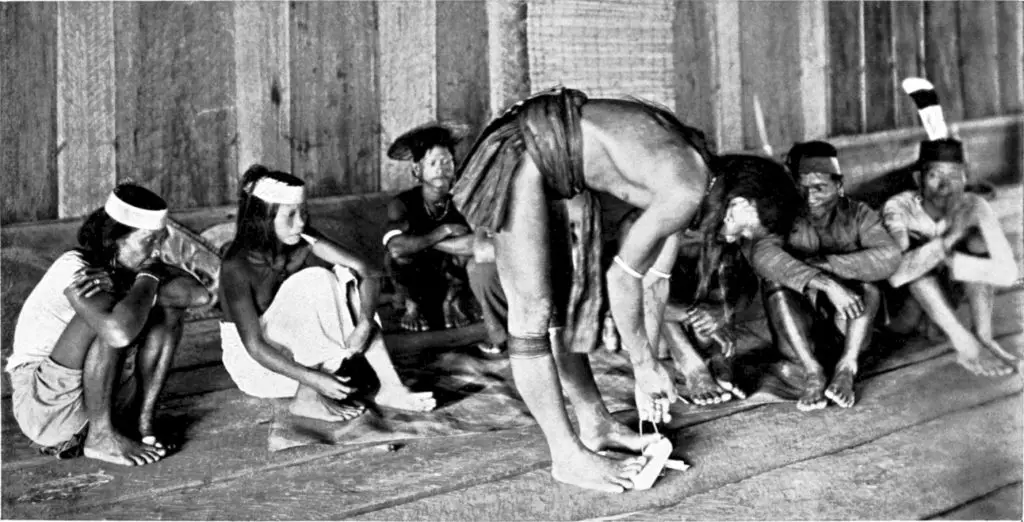
When the Kayans are naming a child, or engaged in any special ceremony, such as going on the war-path, matches may not be used and fire must be made by drawing rattan backwards and forwards on a piece of soft, dry wood. Credit: Public Domain.

When speaking about Kayan migration, many would immediately think about the Kayan who migrated from Apo Kayan in North Kalimantan, Indonesia to Sarawak specifically to Baram and Upper Rajang rivers.

According to legend, the Kayan people are the forefathers of all smaller sub-ethnic Dayak people found along the Kayan River in Kalimantan.

3 theories on Kayan migration to Borneo island
Kayan river in North Kalimantan.

Many historians and ethnologists, however, have their own theories on Kayan migration before arriving in Borneo.

So where did the Kayan people come from in the first place before they found themselves on the island of Borneo?

Here at KajoMag, we look through the various notes and theories of Kayan migration:

1.Harrison W. Smith in Sarawak: The Land of the White Rajahs (1919)

About 100 years ago, a National Geographic writer and photographer visited Sarawak. The result of that visit is an article entitled, “Sarawak: The Land of the White Rajahs”.

This is what Smith wrote about Kayan migration, pointing out that they might have entered through southeastern Asia.

Perhaps the most interesting tribe in Sarawak and one of those least affected by contact with foreigners is the Kayan, which occupies the head-waters of the Baram and Rejang rivers, in the northerly part of Sarawak, extending also into Dutch Borneo.

These people for unknown generations have lived almost entirely isolated in the interior of the island. There are many reasons for believing they are of Caucasic origin, having entered Borneo from southeastern Asia, where they received infusion of Mongol blood and separated from the people of their their own race, who were the progenitors of the present Karen tribes of Lower Burma.

It appears that the Kayan came to Borneo by the way of Tenasserim, the Malay Peninsula, and Sumatra, later penetrating up the rivers of Borneo.

One notices the features of some Kayans that very strongly suggest Caucasic origin, this being particularly true of the upper or ruling classes, who would be most likely to preserve their racial stock uncontaminated by mixture with conquered tribes.

Many Kayans have very light skin, particularly those of the interior and those who have been little exposed to the sun. The tribe believes in a large number of deities, with one supreme being at the head, thus resembling the Greek mythology.

Many of the details of the methods of taking omens among the Kayans by the flight of birds and the examination of the entrails of animals present extraordinary points of similarity with the Roman methods of taking the auspices.

2.Charles Hose’s theory on three phases of migrations into Borneo

British colonial administrator, zoologist and ethnologist Charles Hose also had his own speculation on the origin of not only Kayan people but the Borneo peoples in general.

Writing for the preface of Hose’s Natural Man, Professor Elliot Smith suggested that the possibility of the transmission to Borneo of certain customs known among the ancient Egyptians, Romans, Babylonians, Estruscans and Persians.

Meanwhile, Hose proposed that there were three migrations into Borneo.

The first group is the ancestors of the Kayan people of central Borneo whom he suggested had migrated from the Irrawaddy Basin in Burma via Sumatra.

The Muruts had then followed from the Philippines or Annam. Lastly, the most recent arrival, which Hose supposed took place in the seventh century, were the ancestors of the Ibans.

Hose believed that they were brought from Sumatra as ‘pagan fighting men’ by Malay nobleman.

Additionally, Hose theorised that groups such as the Punans, Kenyahs and other smaller groups were then assumed to have been the original populations of the island ‘going back possibly to the time when Borneo was still continental’.

Other than the supposed racial and cultural differences within Borneo and the assumed similarities with populations outside Borneo, Hose had no firm evidence for his migration theory.

3.Ida Laura Pfeiffer’s comparison of the Dayak of Borneo and Seram Island

Ida Pfeiffer went down in history as one of the first female travelers of the world.

This Austrian explorer had journeyed an estimated 32,000 km by land and 240,000 km by sea through Southeast Asia, the Americas, Middle East and Africa including two trips around the world from 1846 to 1855.

In her travel book A Lady’s Second Voyage (1856), she commented on the similarity between the Dayaks of Central Borneo and the mountain Alforas of Seram island in current-day Maluku province of Indonesia.

She stated of the latter that their customs “agreed so much with what I had observed among the Dyaks that I feel convinced that the Alforas may be classed as their descendants of collateral relatives.”

While some writers believed the Borneo people came out of the west, writers such as Pfeiffer suggested that they came from the east.

This is due to their resemblance of their way of living to the tribes of Celebes and the more eastern islands such as New Guinea.

Regardless, all of these theories on Kayan migration to Borneo all have one thing in common that they are all just theories without any physical evidence.

They are all just based on the cultural similarities between Kayan people and the tribes at the other part of the world.

Do you know any Kayan migration theories we should know about? Let us know in the comment box.

KajoPicks: 8 Chinese coming-of-age dramas you need to watch

A coming-of-age story is a genre of film and literature which focuses on the growth of a protagonist from youth to adulthood.

In Chinese dramas, a typical coming-of-age story starts when the characters are in their secondary school, then during university, and ends when they become working adults.

While in real-life it is rare to have the same body size from your teenage years into adulthood, some of these Chinese drama characters even have the same hairstyles throughout the years.

Nonetheless, most Chinese coming-of-age dramas manage to capture the real essence of growing up from their teenage years to adulthood in an Asian country.

Although these dramas are set in China, some of the conflicts and inner struggles that these characters experience are relatable, especially if you are from a typical conservative Asian household.

One example is how some of the characters are advised to get “real jobs” like becoming a doctor or lawyer.

While the main storyline is typically about the love story between two main characters, these Chinese coming-of-age dramas also showcase how good friendships can grow over the years.

In real life, some of us still do keep in touch with our high school friends.

If you are looking for heartwarming Chinese coming-of-age dramas, here are eight of them that made it to our list:

1.A Love So Beautiful (2017)

Based on the novel To Our Pure Little Beauty by Zhao Qianqian, this Chinese coming-of-age drama stars Hu Yitian and Shen Yue.

It circles around Chen Xiaoxi and Jiang Chen who are classmates in high school and neighbours since they were in kindergarten.

Their characters are polar opposites. Chen Xiaoxi has a cheerful personality but does not study much, while Jiang Chen is the popular kid known for his good looks and high grades.

After losing his father at an early age, Jiang Chen becomes very distant towards people.

Despite this, Xiaoxi still expresses her crush towards Jiang Chen.

The story also follows their friends, a swimmer Wu Bosong, a tomboy Lin Jingxiao and Lu Yang, who has heart disease.

Even until when they are in university, Xiaoxi still crushes on Jiang Chen. Will Jiang Chen’s heart finally soften?

What happen to them when they finally made it into adulthood?

Like many other coming-of-age, A Love is So Beautiful focuses about these characters discovering themselves and their places in the world.

2.Rush to The Dead Summer (2017)

Starring Chen Xuedong, Zheng Shuang and Bai Jingting, the drama is based on Guo Jingming’s novel of the same name.

After winning a scholarship, Li Xia earns her place at Qian Chuan secondary school. There, she meets the two popular boys Fu Xiaosi and Lu Zhiang.

She also befriends a boyish girl named Yu Jian and the rich girl in school, Cheng Qiqi.

After they graduate, things seem to go fine, at least for some of them. Li Xia starts to date Xiaosi who is now a famous artist. Meanwhile, Qiqi becomes a celebrity after winning a singing competition.

Then, comes death, and betrayal after betrayal. Can their friendships survive all these hardships?

This Chinese coming-of-age drama was praised for its realistic life of youth and on campus as well as beautiful cinematography. Hence, it is definitely worth watching.

Watch the trailer here.

You can watch this drama on Youtube here.

3.With You (2016)

Speaking of realistic portrayal of youth, here is another Chinese coming-of-age drama that received high reviews.

Hailed as ‘best youth drama’ by critics in recent years, the drama tackles issues relatable to viewers such as family problems, school struggles as well as the ups and downs of friendships.

One of the most realistic scenes in the drama is when the students draw lots to answer objective questions during the exam. (Raise your hand if you did that in your high school years.)

It follows the story of Geng Geng (Seven Tan) who just move into Zhen Hua High School and is seated next to top student Yu Huai (Liu Haoran).

Unlike her who struggles in her studies, Yu Huai is the smart kid in class.

At first, the duo fights a lot but soon become friends. They also become close friends with the rest of their classmates, each of whom has their own interesting background stories.

However, things start to change after graduation when Yu Huai ghosts everyone in the group.

This drama gives a great reminder that even though high school memories might be sweet to look back on but there is not much to it other than memories. Sometimes, you just need to let go of your past in order to enjoy the present.

With You (2016) is based on the novel The Best of Us by Ba Yue Chang An.

Watch the trailer here. https://www.youtube.com/watch?v=sQTThM21J4Y

4.My Huckleberry Friends (2017)

Here is another Chinese coming-of-age drama based on a novel by Ba Yue Chang An entitled Hello, Old Times.

The story starts when Yu Zhou Zhou starts her first day of primary school and becomes friend with a boy named Lin Yang.

Something happens and the two start to drift apart.

They meet up again during high school. At first there is an obvious awkwardness between them but soon they begin to reconcile.

It starts Li Landi and Zhang Xincheng as Zhou Zhou and Lin Yang respectively.

Watch the trailer here.

5.When We Were Young (2018)

If you spent your high school days in the 90s, you might enjoy this drama.

It is a story that revolves around high school students in the year 1996.

While chasing down a bike thief during the summer break, Yang Xi gets injured after a nearby lab explosion. This caused her unable to compete in a long-distance run.

When her school opens, she finds out that the culprit behind the lab explosion has transferred to her class. His name is Hua Biao and he even takes Yang Xi’s position as the class president.

Hua Biao is also known to be a hot-blooded genius.

Since the drama is set in the 90s, expect a lot of retro vibes in it from the hairstyle to 90s furniture and appliances.

Watch the trailer here.

6.Just An Encore (2019)

Yan Ze and Xi Ye are two best friends. Yan Ze does not see herself as beautiful and her grades are just okay. Meanwhile, Xi Ye is known in school for her beauty and grades.

Yan Ze has a secret crush on Ji Xiao who is the top student in school and unfairly handsome too.

She grows jealous of Xi Ye when she discovers that Ji Xiao might like Xi Ye. Then, another person comes into the love triangle, He Xin Liang.

He is the transfer student who always appears by Yan Ze’s side whenever she needs help.

Xi Ye, however, has a crush on Xin Liang.

Little that Yan Ze knows that her best friend Xi Ye is secretly jealous of her for her friendliness and how easy she gets along with everyone.

Remember those days when you do not have to worry about work or bill but only crushes and fights with your best friend?

Watch the trailer here.

7.All I want For Love is You (2019)

Gu Xiao Man is nothing like your average high school girl. She is a sanda (Chinese kickboxing) fighter. While she excels in sports, Xiao Man struggles with her grades.

Lucky for her, her crush, who also happens to be the school’s top student Zuo An (Liu Yu Han), is willing to tutor her.

To impress her crush (and improve her grades), Xiao Man is willing to study hard.

Thanks to Zuo An’s help, Xiao Man not only manage to graduate but she gets into the same university as Zuo An.

Their story continues in university as the duo adjusts to campus life together.

Watch the trailer here.

8.Le Coup De Foudre (2019)

This Chinese coming-of-age drama is based on the novel I Don’t Like This World, I Only Like You by Qiao Yi.

It has uplifting life lessons and a heartwarming storyline. In 35 episodes, it manages to cover various themes such as the impact of divorce on the children, the preference for sons in China, domestic violence, and the real struggles of startups.

Do not expect perfect main characters who could never go wrong in this drama as they rise and fall throughout this story.

It follows the story of Zhao Qiaoyi, a kind-hearted but timid girl and Yan Mo, a quiet and extremely disciplined boy who excels in his studies.

Qiaoyi has a twin brother, Zhao Guanchao who is an easygoing person but hides a secret pain from his past. Their circle of friends is joined by Hao Wuyi, a tomboyish girl who loves to write and Fei Dachuan, a tough-looking but kind guy.

There are plenty of realistic and relatable moments in the drama. Wuyi, for instance, is told off by her class teacher, Teacher Gao to let go of writing and focus to find ‘a real job that actually pays the bills’. As it turns out, Teacher Gao himself let go of his dream to become a musician and chose to become a teacher instead.

If we were to pick our must-watch drama from this list, it has to be Le Coup de Foudre (2019).

Watch the trailer here.

KajoPicks: 8 Chinese coming-of-age dramas you need to watch

KajoPicks: 12 Korean silent vloggers you should subscribe to on YouTube

Raise your hand if you love watching vlogs but cannot stand loud vloggers.

As much as it is interesting to watch strangers living their normal lives, some vloggers out there really go all out with the TMI (Too Much Information).

Besides showing their daily activities, they talk about their ex-boyfriends, sex lives and family issues. For some, it may be cathartic or even therapeutic to hear that other people are having the same, or even more, problems than you.

Then we have the silent vloggers. Unlike other vloggers who unload their lives in front of the camera, these vloggers remain silent.

They do not talk to the camera but communicate with their audience through subtitles.

The country which offers so many silent vloggers on YouTube is none other than South Korea.

Most of these Korean silent vloggers are freelancers, stay-at-home mums and college students.

They document their lives doing normal activities such as grocery shopping, cooking and going to class.

At the same time, they promote slow living and minimalist lifestyle.

KajoPicks: 12 Korean silent vloggers you should subscribe to on YouTube
Most of these Korean silent vloggers have similar concept of living in a minimalist home.

If you are looking into a change of scenery on your YouTube channel subscription, here are 12 South Korean silent vloggers you should watch:

1.Sueddu

Sueddu is a freelance videographer and writer. Expect nothing but aesthetic vlogs from her.

The cinematography and colour tone that she uses are a whole other level from most vlogs.

Living alone with her pet dog Bebe, she enjoys cooking and painting.

With 772,000 subscribers, Sueddu is one of the most followed Korean silent vloggers on YouTube.

2.Hamimommy

This YouTuber is one of many Korean silent vloggers who proves that being a stay-at-home mom doesn’t have to be boring.

She spends her time doing the usual household chores like any other stay-at-home mom, except she does it in front a camera.

This housewife, who is in her 30s, is taking leave of absence from work to take care of her 4-year-old son.

Besides showing her 378,000 subscribers how she cleans, gardens and organises, Hamimommy also share useful tips on living a zero waste life.

3.Heejo

Before her career as a vlogger, this fashion design graduate worked as a designer.

Now, she juggles between running a bedding brand, producing videos and writing.

Her videos are mainly about her daily activity, minimalist lifestyle and recipes.

4.Jihyunkkung

We bet that when you were a campus student, the last thing you would thought is to have 1 million people watching you living your normal life.

Most of her videos are of her preparing meal in between her classes.

This business administration student started her Youtube channel with cafe vlogs when she was working as a part-timer.

Now, her channel has grown to have 1.18 million subscribers.

Jihyunkkung is signed under CJ&EM DIA TV, a company in-charge online content creators.

5.Suzlnne

Here is another Korean vlogger who is a college student. With 480,000 subscribers, Suzlnne started her channel with Gongbang. It is where people broadcast themselves studying in almost total silence.

During this Covid-19 pandemic, she shows how she goes through her daily life as a university student.

Her days mostly circle around cooking, eating, doing assignments and attending online lectures during the South Korea lockdown.

6.Haegreendal

The most popular video of this Korean silent vlogger has 7.7 million views. Interestingly, it is a video about her trying 11 different egg dishes she has tried for the first time.

The second most viewed video is a video entitled “Vlog that makes you want to clean” and it has 4.5 million views.

She spices up her life as a stay-at-home mum by filming aesthetic videos of her cooking and doing chores.

7.Eyol

Eyol proves that one can be funny even without uttering a single word as she is cute and hilarious in her subtitles.

Like many South Korean silent vloggers, her vlogs are ‘food diary’ entries, what she eats in a day.

Her most popular video is of her going to a BTS concert with 2.9 million views. That particular video really attracts other BTS’ fans out there.

Other than that, her 265,000 subscribers just enjoy her daily vlogs as a university student.

8.Nebom

Most of these Korean silent vloggers rely on their foreign subscribers to help in the translation of their subtitles.

While it is a good thing since it is a free service, but an error in translation can go very wrong.In one of Nebom’s video which supposed to be about ‘Delicious food with boyfriend’ was translated as ‘delicious boyfriend’.

Anyway, who are we to say if her boyfriend is delicious or not. Nonetheless, the wrong translation on the video’s title turned out to be a good thing for her as it gathered 1.4 million views.

Her daily vlogs circle around her cooking at delicious-looking food at home and enjoying them at the end of her videos.

By doing that alone, she has gathered 221,000 subscribers with a total of 11,947,287 views since May 3, 2018.

9.Hyonyeo

Are you curious about the life of a cafe owner when she is not in her cafe? Hyonyeo give her 157,000 subscribers a glimpse of her daily life working in cafe and her off days through her Youtube channel.

From learning how to play the piano to a play session with her cat, Hyonyeo seems to live a fairy tale life.

Plus, her apron collection which is part of her working attire is just too adorable.

10.Cardsu

Here is another aesthetic silent vlog channel with soothing background music for you to subscribe.

Cardsu lives with her husband and two sons (one of them is away for college). The former interior designer promotes minimalist lifestyle through her vlogs.

She also shares recipes, interior designing tips and her life with minimal waste as possible.

11.Seungahne

With only 28 videos, Seungahne has already gathered 269,000 subscribers.

Similar to other Korean silent vloggers, she focuses on home-cooking videos and decorating her room.

Her most popular video is about her making over her home for winter with 1.7 million views.

12.With Anna

This YouTube is perhaps the most popular figure on this list. She is not exactly a South Korean but of Swiss nationality. Her children Na-eun, Gun-hoo and Jin-woo are perhaps among the most famous toddlers in South Korea.

Anna is the wife of professional footballer Park Joo-hoo. Joo-hoo and his children are the cast of The Return of Superman, a variety show about celebrity fathers spending times with their children.

She just started her YouTube channel last Sept 19, 2020 but her content already looks promising.

Anyway, do not forget to subscribe To KajoMag’s YouTube channel for our silent vlogs.

5 stories about the Sihan people you should know about

5 stories about the Sihan people you should know about

With less than 300 Sihan people in Sarawak (as of 2012), any stories about their legends, customs and histories are very precious and important.

As recorded by Benedict Sandin in “Notes on the Sian (Sihan) of Belaga” for the Sarawak Museum journal, the Sihan speak the same language with Punan Bushang and Punan Aput, and not with other Punans.

In ‘Language Vitality of the Sihan Community in Sarawak, Malaysia’ by Noriah Mohamed and Nor Hashimah Hashim, the Sihan people, who identify themselves as Punan, migrated to Belaga from Namang River, after moving from their original settlement in Mujong near the Baleh River.So here are 5 stories about the Sihan people you should know about:

1.The ancestors of the Sihan people

A Sihan man named Jingom Juroh once told a story to Sarawak Museum about the ancestors of the Sihan people.

“I know that a spirit begot our first ancestor called Kato’o. He was born overseas. Kato’o was a brave hero who fought and won many wars against other people. Upon seeing his bravery his children began to become afraid of his actions. Knowing that his children worried about him, he ordered them to use only bamboo spears, and not with other kinds of weapons so that they could not harm him.

However, they killed him with the bamboo spears. After his death the bamboo spears which pierced him grew to become a high mountain. We do not know where this hill is, but according to our history it is somewhere overseas.

Kato’o sons immigrated from overseas. Their names were Belawan Jeray and Belawan Tiau. The two brothers lived in the Mujong. From Mujong Belawan Tiau led his followers to migrate eastward to Kapuas. Therefore in the Kapuas quite a number of Sian (Sihan) lived.

Belawan Jeray died in the Mujong. After his death his son named Maggay migrated to the Pilla and died there. After his death his son Gawit moved to Seggam and died there.”

Mujong is a tributory of Baleh river and Pilla is a tributory of the Rajang river.

2.Life of the Sihan people before they settled in the longhouse.

Unlike most indigenous groups in Sarawak, the Sihan people originally lived in huts like the Penan people.

They did not live in longhouses.

Jingom was 56 years old when he shared this to the Sarawak Museum in 1961: “We Sihan have never joined other races to live in longhouses. I remember that we start to farm when I had already grown up to about the age of thirteen years. We started to live in longhouses from the time we were taught to farm by the Kejaman chief Akek Laing alias Matu.”

He added, “During our nomadic days we have no other tool to use other than the axes. We got iron by bartering with the Kejaman our jungle produce such as rattan baskets and mats. Till this day though our people still can make baskets and mats, but we do not keep them because we sell them to the Kayan and others.”

The Sihan people also did not make blow pipes. Only after they traded blowpipes from the Penan did they hunt for birds and animals. Before that, they relied on fish as their source of protein.

Additionally, the Sihan people did not rear domestic pigs but chickens. With regards to fruits, they collected wild fruits when they were nomadic. They started to plant fruit trees after they settled in longhouses.

3.The legend of Batu Balitang

When the Sihan people were still living at Mujong, there was a man who went out shooting animals with his blowpipe.

As he roamed the forests, he did not find anything.

When he was on his way home, he saw a huge shining animal standing on the bough of a tree. It looked like a rainbow.

The man shot at it several times with his poisonous darts, but could not kill it.

The hunter returned to his hut to bring his friends for help.

While explaining to his friends what happened, they heard a very loud sound as if something falling from the sky.

Everyone, men and women alike, ran toward the source of the noise and found an animal lying on the ground.

Rejoicing over the fresh meat, they cut the animal up and cooked it. Everyone in the village ate the meat, except a pair of brother and sister.

Unbeknownst to the villagers, the animal they feasted on was a demon. That night when they slept, the demon’s wife came.

As she came, she danced from one home to another, looking for the people who ate her husband.

She found that all except two, had eaten her husband. Hence, she ordered the brother and sister to escape instantly and never look back.

The demon’s wife ordered them to go to a certain stream not far away on the left of the Mujong above their village. In order that they may know this place, on her way to the village the demon’s wife had cut a certain small tree as a sign.

The two siblings fled as directed. After they had gone, a great wind blew and a heavy rain began to fall. During the storm, the houses gradually became stone, becoming what has become recognised today as Batu Balitang.

After all the villagers became stones and boulders, the siblings got married and became the ancestors of Sihan people.

4.The truth about headhunting among the Sihan people

While most indigenous peoples in Borneo have a long history of headhunting, the Sihan people tried their best to avoid them.

However, they did fight against Iban and Bukitan headhunters about a century ago.

Many people were killed on both sides of the war.

The Sihan people reportedly did not value the heads of the enemies as trophies, even throwing them away.

5.The burial customs of the Sihan people

Immediately after a Sihan person dies, their bodies are cleaned with water. After that, the deceased is dressed in clothes made of tree bark.

All of their possessions like axes and baskets must be buried with them.

Unlike the Kayan who used to erect Salong, or burial poles, to bury their dead, the Sihan people will cut a tree for the coffin.

When it is complete, the coffin is placed inside for burial. The burial usually takes place on the second day after death.

Then two nights after the burial, a fire will be lit outside the house. The Sihan people believed that in the nights after the burial, the soul of the deceased will wander about intending to return to the house. As for offerings, they place sago by the fire.

The Sihan traditional belief is that when one passes away, thunder is usually sounded. With the sound of this thunder, it is believed that the soul of the deceased is carried away to heaven above.

First shots of the Pacific War were fired at Kota Bharu, not Pearl Harbour

When it comes to the Pacific War, most people believe that the first shots that began it all was Pearl Harbour.

Little do most people know that the first attack actually took place in Kota Bharu, the capital of Malaysian state of Kelantan, as part of the Japanese invasion of Malaya.

The Japanese landed at Kota Bahru at 12.25 am on Monday, Dec 8, 1941 and first attacked Pearl Harbour at 8am on Dec 7, 1941 (local times).

Are you sure Kota Bahru was the first to be attacked? You ask, as you read the dates.

Due to Malaya and Hawaii being on the opposite sides of the International Date Line, the Japanese actually launched its assault on Kota Bharu about 1 hour and 35 minutes before the attack on Pearl Harbour.

The Japanese attack on Kota Bharu and the whole of Malaya

Now the next question is why Malaya?

According to Australian War Memorial, Malaya was a key British colony prior to Second World War (WWII).

It was the source of large quantities of natural resources, particularly tin and rubber. Furthermore, it strategically provided a large defensive barrier to any landward advance on Singapore and its naval base.

The island was the cornerstone of British power in the Asia-Pacific Region.

Knowing the importance of Malaya, the Japanese began planning for an invasion as early as October 1940.

One local survivor told the Japan Times in 2009 that he remembered one particular high-ranking officer widely known as Kawasaki.

Before the war, the locals used to see him riding a bicycle around the villagers selling shrimp rice crackers and speaking fluent Malay. As it turned out, ‘Kawasaki’ was a high-ranking officer who was in-charge of the troops in Kota Bahru.

The first troop against the Japanese was the British Indian Army

When the Imperial Japanese Army first landed at Padang Pak Amat beach, they were ‘greeted’ by the British Indian Army.

Local survivors heard the Indian soldiers were singing Hindi film songs on the beachfront when they saw Japanese landing craft approaching.

Before the Japanese landing, the British had fortified the narrow beaches and islands with land mines, barbed wire and pillboxes.

Colonel Masanobu Tsuji in his book wrote, “The enemy pillboxes, which were well prepared, reacted violently with such heavy force that our men lying on the beach, half in and half out of the water could not raise their heads.”

True enough, the defence was working well, at least in the beginning. The Japanese casualties in the first and second waves were heavy.

While there were some progress, the British forces were not able to completely wipe out the landings on the beach.

Air attacks

First shots of the Pacific War were fired at Kota Bharu, not Pearl Harbour
Camouflaged A6M (Zero) fighter aircraft of 22 Air Flotilla, Japanese Navy, on airstrip at Kota Bharu. This unit flew into Kota Bharu from South Vietnam and operated along the East Coast of Malaya including flying “top cover” for the successful Japanese air attack on the British war ships HMS Repulse and HMS Prince of Wales. Credit: Public Domain.

The moment it was confirmed that the Japanese had attacked, the British air force at Kota Bharu received permission to launch an attack.

The first wave of seven aircraft made the initial attack at 2.10am. These aircraft continued to drop bombs on the Japanese until 5am.

All the Japanese transports were repeatedly hit at this time. Colonel Tsuji wrote, “Before long enemy planes in formations of two and three began to attack our transports, which soon became enveloped in flame and smoke.”

Despite the strong defense, the Japanese had three full battalions ashore at Kota Bharu by 10.30 that morning.

The British forces who were forced to retreat, fled the Kota Bharu airfield without destroying anything. This action left the Japanese invaders a fully working airfield along with fuel and ammunition.

At the same time, the Japanese troops also landed at Patani and Singora on the south-eastern coast of Thailand.

With this, the landings at Kota Bharu allowed the troops to proceed to the eastern side of the Malay peninsula. Meanwhile, the troops in Thailand advanced down the western side.

First shots of the Pacific War were fired at Kota Bharu, not Pearl Harbour
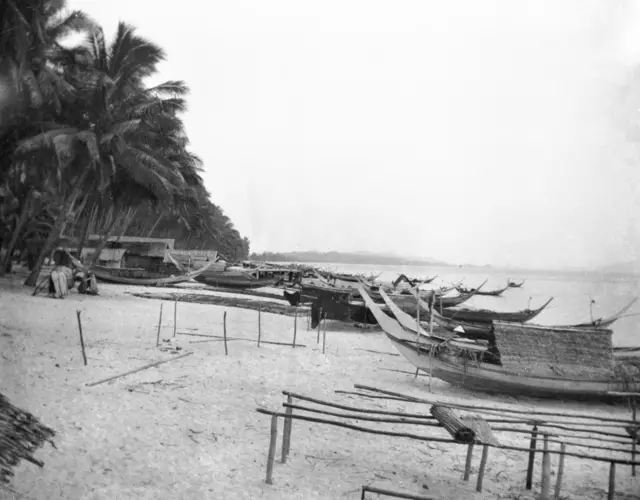
Bachok Beach, Kota Bharu, Malaya. 1941-07. Local fishing boats (perahu) pulled up on the beach, possibly at one of the points where the Japanese invasion troops landed on 1941-12. (Donor E. Cooke-Russell). Copyright expired.

The local villagers’ experience

A group of 30 local villagers came across the Japanese forces during the invasion.

They tried to escape but the Japanese ordered them to dig trenches and stay inside to avoid getting shot in the gunfire exchange.

The locals had to dig the holes in the sand with their hands. Overwhelmed with fear, they stayed in the trench for three days.

When they finally came out from it, they found about 380 dead Japanese soldiers.

The Japanese then cremated their dead comrades.

They stayed in the areas for about two weeks before moving to other locations. The Japanese reportedly did not cause any problems for the locals taking away their livestock.

Only three villagers reportedly died during the attack at Kota Bharu.

The aftermath

As for the British and Japanese troops, there is no official death toll. For the Japanese, they suffered an estimated 300 deaths and 500 wounded. The British casualties and losses were estimated at 68 fatalities, 360 wounded and 37 missing.

Regardless, the attacks on Kota Bharu were one of the most violent battles of the whole Malayan Campaign.

The Brunei Civil War and how it led to Sulu’s claim over Sabah

The Brunei Civil War took place centuries years ago from 1660 to 1673. However, the consequences from this particular warfare seems to have an effect even to this day.

Adding on to the element of disbelief of this piece of history, the Brunei Civil War had, in fact, started from a cockfight.

The Brunei Civil War, a warfare which started from a cockfight

Pengiran Muda Bongsu, the son of Brunei’s 12th sultan, Sultan Muhammad Ali, had been indulging in a round of cockfighting with Pengiran Muda Alam, the son of the chief minister (only second to the sultan), Bendahara Abdul Hakkul Mubin.

The innocent cockfight turned bloody when Pengiran Muda Bongsu was defeated by Pengiran Muda Alam.

Pengiran Muda Bongsu, either being a super sore loser or entitled as the sultan’s son (perhaps both?) was so enraged by the loss that he stabbed Pengiran Muda Alam in the chest with his keris, ultimately killing him.

The Brunei Civil War and how it led to Sulu’s claim over Sabah
When a cockfight turns bloody. Credit: Pixabay.

The wrath of a father

The bendahara was furious upon learning the death of his beloved son, marching his men to the palace to confront the sultan.

‘A tooth for a tooth’, Abdul Hakkul Mubin told the sultan, wanting to avenge his son’s death.

To this demand, various sources cite the sultan’s responses differently.

One source stated that Abdul Hakkul Mubin was denied the right to search the palace for Pengiran Muda Bongsu, while another source stated that the sultan had allowed him to do so.

Either way, the prince had made his escape and the bendahara could not find Pengiran Muda Bongsu.

Furious, Abdul Hakkul Mubin went amok, going into a killing spree which took the lives of everyone in the palace, including the royal family.

With the help of his men, Abdul Hakkul Mubin killed the sultan by garroting him to death.

The place where the sultan was slain is now known as ‘Marhum Tumbang Dirumput’, as his body was left lying on the grass.

Meanwhile, the bendahara took the throne, becoming sultan as he crowned himself the 13th Sultan of Brunei.

Sultan Abdul Hakkul Mubin’s reign

Naturally, the people were not happy that their new sultan had killed his way to the throne. In order to gain their trust, Sultan Abdul Hakkul Mubin installed the late sultan’s grandson – Pengiran Muhyiddin – as the new Bendahara.

It was not enough. The loyal followers of the late Sultan Muhammad Ali were not happy, imploring the now Bendahara Muhyiddin to fight against Sultan Abdul Hakkul Mubin.

A rebellion started by ‘mengarok’

Muhyiddin and his followers planned to create a disturbance at the palace and the houses in the area.

They started to ‘mengarok’, poking spears through the floors of the palace and houses.

When Sultan Abdul Hakkul Mubin turned to Muhyiddin for advice on what to do, he advised him to move his palace to Pulau Chermin.

The moment the Sultan moved out from the mainland to Pulau Chermin, Muhyiddin declared himself the 14th Sultan of Brunei.

No country can be ruled by two kings. Therefore, the battle between the two sultans began.

The war begins

After repelling several attacks from Muhyiddin, Abdul Hakkul Mubin eventually retreated to Kinarut, Sabah.

With help of local Bajaus and Dusuns, he managed to defend himself from Muhyiddin.

Abdul Hakkul Mubin reportedly lived in Kinarut for 10 years to defend his title.

In the final attack at Kinarut, however, Muhyiddin still failed to defeat Abdul Hakkul Mubin.

Then, Abdul Hakkul Mubin decided to return to Pulau Chermin.

It turned out to be a great strategic move for Abdul Hakkul Mubin. From there, he was able to control the food supply going into the mainland as the island is located near the mouth of Brunei river.

In the meantime, the people of Brunei were suffering as they could not go out to fish during the civil war.

Worried that the war would drag on, Muhyiddin decided to seek the Sultan of Sulu for help.

In return, Muhyiddin promised to hand over the eastern part of north Borneo as a reward.

Finally, Muhyiddin’s men successfully attacked Pulau Chermin, launching the final assault on Abdul Hakkul Mubin and his men.

Knowing that he would be defeated, Abdul Hakkul Mubin threw himself into the sea along with his crown.

The Brunei Civil War and how it led to Sulu’s claim over Sabah
Territory in the 1878 agreement from the Pandassan River on the north west coast to the Sibuco River in the south. Copyright: Public Domain

The Sulu Sultanate and their claim over eastern Borneo (current-day Sabah)

Meanwhile, the Sulu Sultanate was like that classmate everyone used to have who did not contribute to the group assignment but still had his share of the mark.

They reportedly did not help much in the final battle except by showing up at the last minute.

Regardless, the Sultan of Sulu still claimed his reward of eastern Sabah.

Meanwhile, Brunei, on their side, never recognised the claim and never released any official document to legitimise Sulu’s sovereignty of the area.

Fast forward to December 1877, Baron Gustav von Overbeck managed to convince the Sultan of Brunei to concede some territories to him to form the British North Borneo Company.

From there, he found out about the Sulu’s claim to the eastern territory of the area. Hence, he proceeded to obtain that part of territories from Sultan of Sulu.

Some historians believed that was when the real trouble of the North Borneo dispute began. Many believed that the eastern part of Borneo was never officially ruled by Sulu sultanate in the first place.

Overbeck reportedly wanted to ‘avoid’ future problems with Sulu Sultanate. Therefore, he had the Sultanate of Sulu to sign an agreement on January 22, 1878.

The problematic agreement which, depending on the translation, stipulated that North Borneo was either ceded or leased to the British company.

Today, the Philippines, presenting itself as the successor state of the Sulu Sultanate, retains a dormant claim on Eastern Sabah on the basis that the territory was only ‘leased’ to the British North Borneo Company in 1878.

Can you imagine how these international claims today, had originated from a cockfight?

1 21 22 23 24 25 75