Browse Tag

History - Page 3

Lubok Antu and the mystery behind its name

Lubok Antu and the mystery behind its name
A small whirlpool or lubok was reported to be located at Batang Ai river.

Lubok Antu is a small district located in Sri Aman division of Sarawak.

The history of its bazaar dates back to 1872. Back then the bazaar was made of double-storey wooden shophouses, a market and a Chinese temple.

The name of this small town is interesting to the locals as the words lubok means ‘whirlpool’ and antu means ‘ghost’ in Iban language.

Lubok Antu and the mystery behind its name
A row of handicraft stalls found in Lubok Antu town.

Locals and historians have different accounts on how Lubok Antu got its name. So let us take a look of the various versions:

1. A fight between two brothers

The name Lubok Antu is believed to come from a local folklore based on two brothers named Chiri and Jampi.

One day, the two brothers went off to sharpen their parangs (machetes).

Upon their return, they came across Bunga Nuing (a mystical figure) who then challenged them both to a duel on the sharpness of their parangs.

It was during that duel when Bunga Nuing slashed a rock along a riverbank next to a lubok (whirlpool).

Ever since then, the locals believed the area was cursed and called it Lubok Antu.

2. The Cholera Expedition

Lubok Antu and the mystery behind its name
Thousand of dead bodies were reported floating around this area during the administration of Charles Brooke.

In June 1902, the-then Rajah Muda Vyner Brooke led an expedition to attack the Dayaks upriver at Batang Ai.

These Dayaks allegedly had been terrorising the neighbouring tribes.

By the time the troop had assembled in Simanggang (Sri Aman), two of their men suddenly dropped dead.

Vyner reportedly informed his father Charles that the two men might have died due to cholera.

To which the second White Rajah said, “Nonsense, the expedition must go on.”

They continued their journey upriver and eventually 2,000 men died of cholera out of the 10,000 strong force.

Their bodies were thrown into the river,  eventually floating downstream.

Because of the lubok (whirlpool), the bodies continued to circle the area.

The locals saw all the dead bodies at the lubok and called it Lubok Antu.

3. Same dead bodies but different COD (Cause of death)

Another version of the story behind the floating dead bodies is that they did not die due to cholera.

Instead, they were the casualties of the uprising against the Brooke government by the Iban of upriver Batang Ai.

In another account, the bodies were the casualties of the tribal wars which happened back then among the different tribes living upstream.

4. A haunted pool?

In the book Legends and History of Sarawak by Chang Pat Foh, the name ‘Lubok Antu’ comes from a pool located outside of Fort Arundell.

Back in the olden days, people bathing or swimming in the pool had a feeling that someone at the bottom of the pool was trying to pull them down into its depths.

Then people started to call it a ghostly pool or what the locals called ‘Lubok Antu’ to this day.

5. A Demon’s Pool

According to the book River of the White Lily by Peter Goullart, Lubok Antu was known as a demon’s pool.

An old and monstrously large crocodile apparently lurked at the bottom of the river, only surfacing to attack animals which came for a drink or any man unfortunate enough to have his boat overturn in the area.

The locals believed the crocodile was an evil spirit which made the place come to be called Lubok Antu.

6. The simplest version

The last version of the story is quite simple yet amusing.

There was a guy named Antu who loved to fish at a particular lubok or whirlpool at Batang Ai.

Sooner or later, people started to call it Lubok Antu, which means a whirlpool belonging to Antu.

Lubok Antu and the mystery behind its name
The town Lubok Antu was founded in the late 19th century.

Marianne North and her fascinating journey as botanical artist in Sarawak

While North America had the Klondike Gold Rush in the late 1800s, other people in the Victorian era were rushing to satisfy a scientific obsession – collecting natural specimens.

This obsession for new discoveries and adventure brought many collectors and explorers to Borneo’s door, including notable botanical artist Marianne North.

A life of travel

North was born in Hastings, England on Oct 24, 1830. Her father Frederick North was a member of parliament for Hastings and a deputy lieutenant as well as a Justice of the Peace.

After her mother Janet died in 1855, North travelled frequently with her father and sister. They visited Switzerland, Austria, Spain, Italy, Greece and the Bosporus in Turkey.

She received her first lessons in oil painting from renowned Australian colonial artist Robert Hawker Dowling in 1867.

She had been painting throughout her life, starting with flower painting to cope with the grief after her mother’s death and again after her father’s death in 1869.

With a large inheritance North received, she started to travel from 1871 to 1885. She visited 17 countries, painting 800 illustrations of their native plants and flowers.

And she did all of this while travelling alone, reportedly in Victorian dress.

Thanks to her influential family, North was able to visit countries all over the world and was welcomed by their respective ambassadors, ministers and governors.

One of those government administrators who hosted her was Sarawak’s second White Rajah, Charles Brooke.

Marianne North’s visit to Sarawak

Margherita
A visitor looking at a portrait of Ranee Margaret on display at The Brooke Gallery at Fort Margherita.

When she arrived in Sarawak in 1876, Charles was not in town to welcome her visit.  His wife, Ranee Margaret stepped in to host this Victorian painter instead.

The Ranee wrote about her guest in “My Life in Sarawak”.

“One morning, as I was watching the arrival of the mail-steamer from my verandah at Kuching, I noticed the figure of a tall European lady standing on deck.

“A few moments after, a messenger brought me a letter from Singapore from the Governor’s wife, Lady Jervois, introducing a traveller to Sarawak, whose name was Marianne North.”

“The first evening of her stay in Kuching we went for a row on the river, and the sunset behind Matang was, as she said, a revelation. That land of forests, mountains, and water, the wonderful effects of sunshine and cloud, the sudden storms, the soft mists at evening, the perfumed air brought through miles and miles of frost by the night breezes, were an endless source of delight to her.”

Her views on the Dayaks

Despite being extensively travelled, North had a strong opinion of the Dayaks who were still practicing head-hunting at the time.

Margaret wrote:

“(Marianne North) could not bear the thought of either Dyaks or Kayans. I could never eradicate from her mind the idea that they were savages. I used to try and interest her in these people, for I longed that she should accompany us in our journeys into the interior, but this she would never do.
“’Don’t talk to me of savages,’she would say; ‘I hate them.’ ‘But they are not savages,’ I would reply, ‘They are just like we are, only circumstances have made them different.’
‘They take heads; that is enough for me’, she would add severely.”

How Marianne North influenced the Ranee

North stayed with the Brookes for about six weeks.

During her short stay with the Ranee, North managed to open her eyes more to the beauty of Sarawak’s biodiversity.

Margaret stated, “… I felt that something new and delightful had come into my life, for she had not only introduced me to pitcher-plants, but to orchids, palms, ferns, and many other things of whose existence I had never dreamed. Miss North was the one person who made me realise the beauties of the world. She was noble, intelligent, and kind, and her friendship and the time we spent, together are amongst my happiest memories.”

The story of Nepenthes northiana

Marianne North
A copy of Marianne North’s Nepenthes northiana displayed at the Brooke Gallery at Fort Margherita.

Nepenthes northiana is an endemic pitcher plant found in Borneo. The species was named after North who was the first one to illustrate the species.

During her stay, North made friends with Herbert Everett who was working for the Borneo Company then.

Everett went up to the mountainous area in Bau to get her this plant.

North wrote about the discovery for The Gardeners’ Chronicle:

“The specimens grew on the branches of a tree about 1000 feet above the sea on the limestone mountains of Sarawak. When I received them I tied them in festoons all around the verandah, and grumbled at having only one small half-sheet of paper left to paint them on.”

Regardless of the size of the painting, thanks to North’s illustration, Sarawak became known as a land of exotic plants in the late 19th century.

The painting of Nepenthes northiana is now on display at the Marianne North Gallery at the Royal Botanic Gardens, Kew.

Read more:

Charles Hose and his love affair with Sarawak

The Eastern Seas, the book which inspired James Brooke to explore

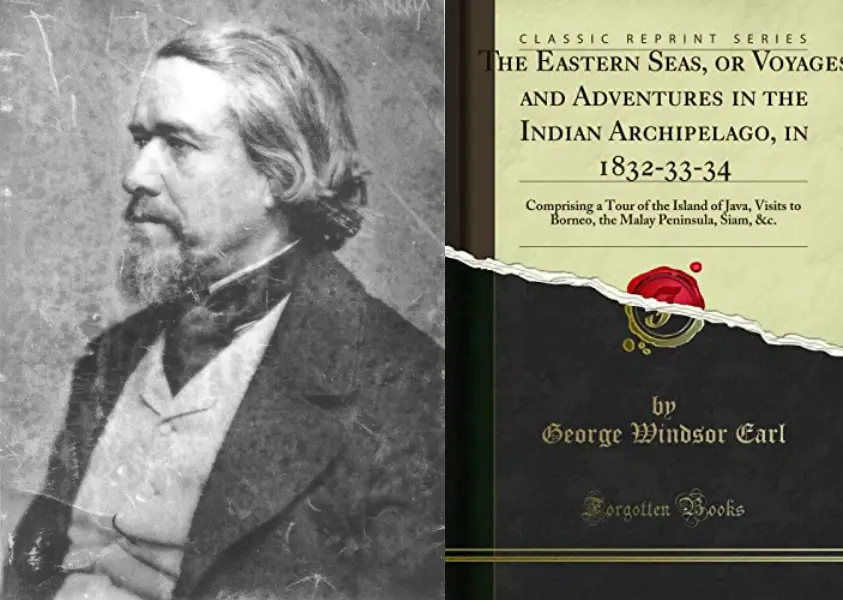
For an idea of how Borneo looked like before the Brookes, have a read of The Eastern Seas written by George Windsor Earl.

An English navigator, Earl was the first one to provide a European account of north-west Borneo’s Chinese gold miners and the incredible wealth of Borneo which included gold, diamonds and other native resources like camphor and ebony.

His voyages took him around the world including India, Southeast Asia, Papua New Guinea and Australia.

Many were inspired by his expedition and followed suit including James Brooke himself, who eventually founded the Kingdom of Sarawak and ruled the country from 1841 until his death in 1868.


The Eastern Seas
The book, The Eastern Seas and a miniature of The Royalist on display at The Brooke Gallery at The Fort Margherita.

Getting to know the author of The Eastern Seas

Born on Feb 10, 1813 in Hampstead, London, Earl was very much influenced by the world of navigation from early on. His father, Percy was a sea captain working for the East India Company. He started his nautical career by travelling to India after becoming a midshipman at age 14.

Earl was already on his journey from Western Australia bound for Java by the year 1832. Over the next two years, until about Nov 1834, he journeyed through the area he knew as “the Eastern Seas.”

Subsequently in 1835, Earl returned to London to publish his account in a book he later named The Eastern Seas or Voyages and Adventures in the Indian Archipelago in 1832-1834.

It comprised a tour of Java, Borneo, Malay Peninsular, Thailand and Singapore and observations on the commercial resources of the archipelago.

The Eastern Seas is culturally important. Interested readers can read it online through various archives.

The Eastern Seas (2)
The Eastern Seas or Voyages and Adventures in the Indian Archipelago 1832-33-34

George Windsor Earl’s work inspired many

Apart from Brooke, Earl also inspired other established naturalists and explorers.

In 1845, Earl published a pamphlet On the Physical Geography of South-Eastern Asia and Australia.

He described how shallow seas connected islands on the west for example Sumatra and Java with the Asian continent.

Furthermore, Earl found the islands on the east such as New Guinea were related to the Australian continent and reportedly had the same type of marsupials.

British naturalist Alfred Russel Wallace used Earl’s deductions to propose the faunal boundary line now known as the Wallace Line.

Charles Darwin also reportedly used Earl’s observation on deep sea channels to study the bio-geographic distribution of the region.

Another of Earl’s works ‘The Native Races of the Indian Archipelago: Papuans’, was an important work of early New Guinea anthropology.

However, he did not actually visit the island or maybe he never officially recorded his visit.

He compiled the first hand accounts of other visitors for his works on the Papuan people.

In 1850, Earl proposed the term Indunesians or Malayunesians for the people living in the Indian Archipelago or Malayan Archipelago.

Earl’s student, James Richardson Logan later popularised the name Indonesia as synonym for Indian Archipelago.

But it was only after 1900 that the term Indonesia became more commonly used.

George Windsor Earl’s death

The Eastern Seas
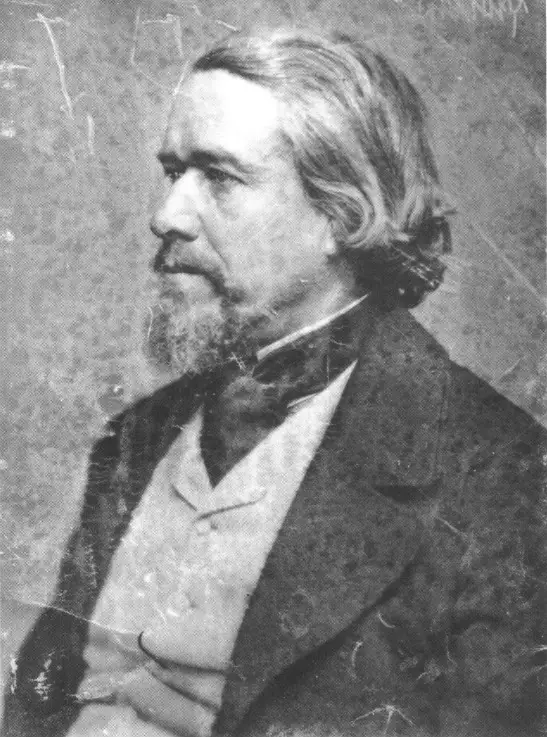
Portrait photo of George Samuel Windsor Earl (February 10, 1813 – August 9, 1865), colonial administrator, who coined the term “Indonesia”.

From 1855, he held various official administrative posts, his last one being Penang.

Earl died on his journey back to England in 1865. He was buried at the Old Protestant Cemetery, George Town in Penang.

Read more:

Toshinari Maeda, The Japanese Nobleman Who Died off the Coast of Bintulu During WWII

Charles Hose and His Love Affair With Sarawak

Datu Patinggi Abdul Gapor: 5 interesting things to know about this historical figure

If you paid attention to your history lessons in school, you might remember who Datu Patinggi Abdul Gapor is… but if you’re like the rest of us, you might only recognise his name on a school in Kuching.

As there is only a bit info on him in our history books, KajoMag decided to dig up more about this historical figure.

1. Who is Datu Patinggi Abdul Gapor?

Before James Brooke came to Sarawak, Datu Patinggi Abdul Gapor was a powerful and influential man.

He was once appointed as the Governor of Sarawak. He was also the first imam of the Masjid Besar (the State Mosque) in Kuching from 1851 to 1854.

Abdul Gapor was married to Dayang Inda. She was the daughter of Datu Patinggi Abang Ali, who fought for the independence of Sarawak from Brunei.

It was said that Abang Ali’s family was responsible for building the state mosque. The construction took place from 1848 to 1852.

2. Datu Patinggi Abdul Gapor had his title stripped by James Brooke

Abdul Gapor was awarded the title ‘Datu Patinggi’  after his father-in-law (Abang Ali) was murdered alongside George Stewart (a European officer) in 1844 when fighting a rebellion in Skrang.

In 1854, however, Abdul Gapor’s title was stripped by James Brooke because it was said that he imposed a very high tax upon the people under him.

Angered by this, he no longer had the privilege he used to before and demanded compensation.

3. He planned a revolt with another Sarawakian historical figure

Datu Patinggi Abdul Gapor: 5 interesting things to know about this historical figure
Datu Patinggi Abdul Gapor planned a revolt with Sharif Masahor (picture) against the British (Image source Sejarah Melayu Sarawak)

In 1860, Abdul Gapor planned a revolt with Sharif Masahor, a leader from Sarikei, against James Brooke.

This happened when Brooke took control over the Rajang River in 1857 and stripped Sharif Masahor and several powerful men of their titles.

This resulted in them losing power to collect tax and influence the locals.

The revolt that took place in Kuching, however, failed.

Sharif Masahor managed to escape to Mukah but was handed over to the British by the Sultan of Brunei in 1861. He was later banished to Singapore.

Abdul Gapor escaped to Betawi, Jawa in 1860 but was captured by the Dutch and handed over to James Brooke.

He was later imprisoned in Betawi until he passed away after a few years.

4. Guess who his descendants are

Did you know that Abdul Gapor is Sarawak Premier Datuk Patinggi Abang Johari Tun Openg’s direct ancestor?

Datu Patinggi Abdul Gapor: 5 interesting things to know about this historical figure
Tun Haji Openg bin Abang Sapi’ee (left) and Datuk Amar Abang Abdul Rahman Zohari Abang Openg  (Image source: Wikipedia)

According to a book compiled by Ho Ah Chon on his father Tun Haji Openg bin Abang Sapi’ee,  Abdul Gapor turns out to be his great-great-grandfather.

The brief genealogy reads like a who’s who of Sarawak Malay history, which also outlines how through Abdul Gapor, Abang Johari can also trace his ancestry back to Menteri Hussin, the grandson of Raja Minangkabau, who was also an ancestor of Their  Highnesses the Sultans Mohammad Tajuddin, Hashim, Mohamad Jumalul Alam and Omar Ali Saifuddin III of Brunei.

Interestingly, Openg was also Sarawak’s first governor upon the independence of Sarawak from Great Britain and the formation of Malaysia until his death on March 28, 1969 at the age of 63.

Meanwhile, Abang Johari became Sarawak’s sixth Sarawak premier in 2017 following the death of Pehin Sri Adenan Satem.

5. A school was named after Datu Patinggi Abdul Gapor

Datu Patinggi Abdul Gapor: 5 interesting things to know about this historical figure
SMK Datuk Patinggi Haji Abdul Gapor (DPHAG), Stampin (Image source: Alumni SMK DPHA Gapor Website)

A public secondary school, SMK Datuk Patinggi Haji Abdul Gapor (DPHAG), Stampin in Kuching was named after him.

SMK Datuk DPHAG was established in 1974 by the Sarawak State Education Department.

At that time, there were only 182 students and four teachers teaching in the school.

It was the first school in Sarawak to use Malay as the primary language for communication. These days however, students and teachers use Malay, English and Chinese for communication purposes.

The dark forgotten history of the Cholera Expedition down the Batang Lupar in 1902

Famous today for the Pesta Benak, or Tidal Bore Festival, the Batang Lupar river was the site of a devastating cholera epidemic in the 1900s.

Modern-day Sarawakians might not have heard of the ‘Cholera Expedition’ that happened during the reign of the Brooke family.

But back in 1902, what was originally a military expedition against Iban rebels down the Batang Lupar river became a disaster, so much so it made headlines across the globe.

Historians and news reports back then called it the “cholera expedition” because one fifth of the 10,000 men recruited to fight against Iban rebels died of the disease.

A river runs through it

Batang Lupar flows for 275 kilometers from the Klinkang Range to the South China Sea. It has a large rivermouth and  becomes shallow upstream.

The river runs through a number of towns including Lingga, Sri Aman and Engkilili. The Batang Lupar river is the only river in Malaysia which experiences the tidal bore phenomenon. Even though it happens everyday, it becomes more spectacular at king tide during dry season.

Cholera expedition
The narrower part of Batang Lupar river near Engkilili town.

What actually happened?

Vyner Brooke, the eldest son of Charles Brooke, the second rajah of Sarawak, started his career in the then-kingdom as a cadet government officer in 1897.

He first served in Simanggang (now known as Sri Aman), then at Mukah and Oya.

In May 1900, he participated in a punitive expedition against the Muruts in Trusan. Then in June 1902, he took part in another expedition against the Ibans in upper Batang Lupar.

It was an expedition Vyner would never forget.

The expedition was to pacify Iban factions who had started a few raids against their traditional enemies – and Brooke allies – the Ibans from the lower Batang Lupar.

Branded rebels under the Brooke regime, they also refused to pay taxes or follow directives by the Brooke government to move their longhouses to the riverbank.

Charles and Vyner arrived at the fort in Lingga on June 8 where they found more than 10,000 of their Iban and Malay allies in about 800 longboats ready to fight for them.

The next morning, Vyner reported to his father that two men had died outside his bungalow.

Charles refused to listen, assuming his son was trying to escape his duty.

Then on June 9, the Rajah made his way back to Kuching leaving Vyner to carry on the expedition with two English officers, Demetrius Bailey and Harry Deshon.

The dark forgotten history of the Cholera Expedition down the Batang Lupar in 1902
A wooden bridge across Batang Lupar at Engkilili town.

Margaret Brooke’s account on the Cholera Expedition

Vyner’s mother, Margaret wrote briefly about the expedition in her book My Life in Sarawak.

“For some unexplained reason, cholera broke out amongst the force just before it had reached the enemy’s country,” she stated.

When they arrived near the rebels’ area, the force was separated into two groups. One group led by the Malay chiefs set out on foot to attack the rebels while the rest including Vyner and his two English officers were left behind.

The remaining force set up camp by the river. By this time, many had suffered from cholera.

“As the days wore on, the air was filled with the screams and groans of the stricken and dying.”

According to Margaret, it was impossible to turn back despite the fact that men were dropping dead everyday because of the “bad impression such a course would have made on the enemy.”

In the end about 2,000 men died of the disease.

She was told by the two British officers that Vyner’s presence helped to keep discipline and hope among the force.

Margaret wrote, “He was always cheerful, they said. It appears that Vyner and his two friends used to sit on the gravel bed and with a grim humour point out to one another where they would like to be buried.”

The floating bodies from the Cholera Expedition

However, the truth is some who died of cholera were not properly buried.

Although Brooke’s forces had returned successfully from battle against the rebels, they found many dead bodies and dying comrades at the camp.

Some were buried in shallow graves at the campsite while some were flung from the boats during their return journey to Simanggang.

The bodies that were brought to Simanggang were stacked into pyres and burnt.

The disease spread even more when – after hearing of the dead bodies – the upper Batang Lupar Ibans came to the campsites to cut off the heads and bring them home.

This caused more people at the upper river to get infected, with some dying from cholera.

The dark forgotten history of the Cholera Expedition down the Batang Lupar in 1902
Sculptures of doves at the roundabout in modern-day Sri Aman are reminders of the MoU signed on 20 October 1973 between the Sarawak government and the communist organisation, PARAKU. The original name of the town, Simanggang, was also changed to Sri Aman (as “aman” means “peace” in Malay) to recognise the peace declaration.

The Cholera Expedition which made world headlines

When the Ranee first read the news about the expedition, she was in Italy.

The Italian paper had mistakenly reported that the Rajah’s son died of cholera in Sarawak, as he was leading an expedition into the interior.

“I hurried to England with my younger son, Harry, who was staying with me at the time, and when we arrived at Dover, placards at the station confirmed the report. Telegrams, however, soon put out of suspense, but I had spent a terrible day.”

Not all of the reports about the Cholera Expedition were inaccurate.

There was one which made it to the pages of The San Francisco Call on July 9, 1902 with the headline “Punitive Expedition is Attacked by Cholera”.

It stated, “While Harry de Windt has been undergoing tragic experiences in Siberia, his nephew Charles Vyner Brooke, son of Rajah Brooke of Sarawak, who married De Windt’s sister, has been having terrible time in the northern part of Sarawak.”

The news reported that more than 1,000 deaths occurred among the 10,000 members of expedition within 10 days due to cholera.

It pointed out that the intensely hot weather favoured the rapid progress of the disease.

The Singapore Free Press was more straightforward in its report on the expedition: They put the blame on the second rajah’s “arrogant stupidity” for insisting to carry on the expedition despite signs of cholera outbreak.

Plus, the paper observed that with more than 10,000 people travelling along a shallow river which they also used as drinking water, with even just one case of  cholera, the rapid spread of the disease was inevitable.

The aftermath of the Cholera Expedition

According to Cassandra Pybus in White Rajah: A Dynastic Intrigue, Vyner was determined to turn his people back from the expedition.

But Bailey’s fear of the Rajah was greater than his fear of cholera so he insisted the attack must proceed.

As for Vyner, he reportedly never forgave his father for not heeding his warning.

Perhaps he was right: if only Charles had listened to his son’s plea, more than 2,000 people would have not been infected by the disease.

Margaret, however, was not that critical of his husband’s decision.

According to Margaret, the spread of this waterborne disease in the whole Simanggang area was almost fateful.

In her final note on the event, she wrote “Nothing apparently could be done to stop the disease, which disappeared as suddenly as it had come, but this calamitous epidemic destroyed nearly one-quarter of the population.”

10 non-spicy Korean dishes you should try before you die

Non-spicy Korean dishes do exists, despite the fact that they are known for its spiciness.

The best part is that they are equally delicious.

If you feel like eating Korean cuisine but could not handle the heat, try these non-spicy Korean dishes dishes instead.

1. Jajangmyeon

If you are a fan of K-dramas or Korean variety shows, you must be familiar with this food.

The main component of this Korean noodle dish is its sauce, made of chunjang or black bean sauce, ground pork and vegetables.

The sauce is thick and served hot over thick noodles made from white wheat flour.

For those who prefer rice instead of noodles, the rice variation of this dish is jajangbap made with the same sauce but served with rice.

Imagine a heavier taste of soy sauce with a thicker texture – that is what jajang sauce tastes like.

If you are not a fan of soy sauce however, you might not like jajangmyeon either.

non-spicy Korean dishes
Jajang Rice, one of many non-spicy Korean dishes that you must try. 

2. Sujebi

Sujebi or hand-pulled dough soup is one of my personal favourite non-spicy Korean dishes.

It has a refreshing broth with noodles roughly torn by hand served with vegetables.

Malaysians can compare sujebi to local pan mian with kelp instead of mani chai.

Once you’ve tried it, you might start craving for sujebi especially during the rainy season.

sujebi-726026_1280
One of the non-spicy food to try, Sujebi! Photo credits: Pixabay.

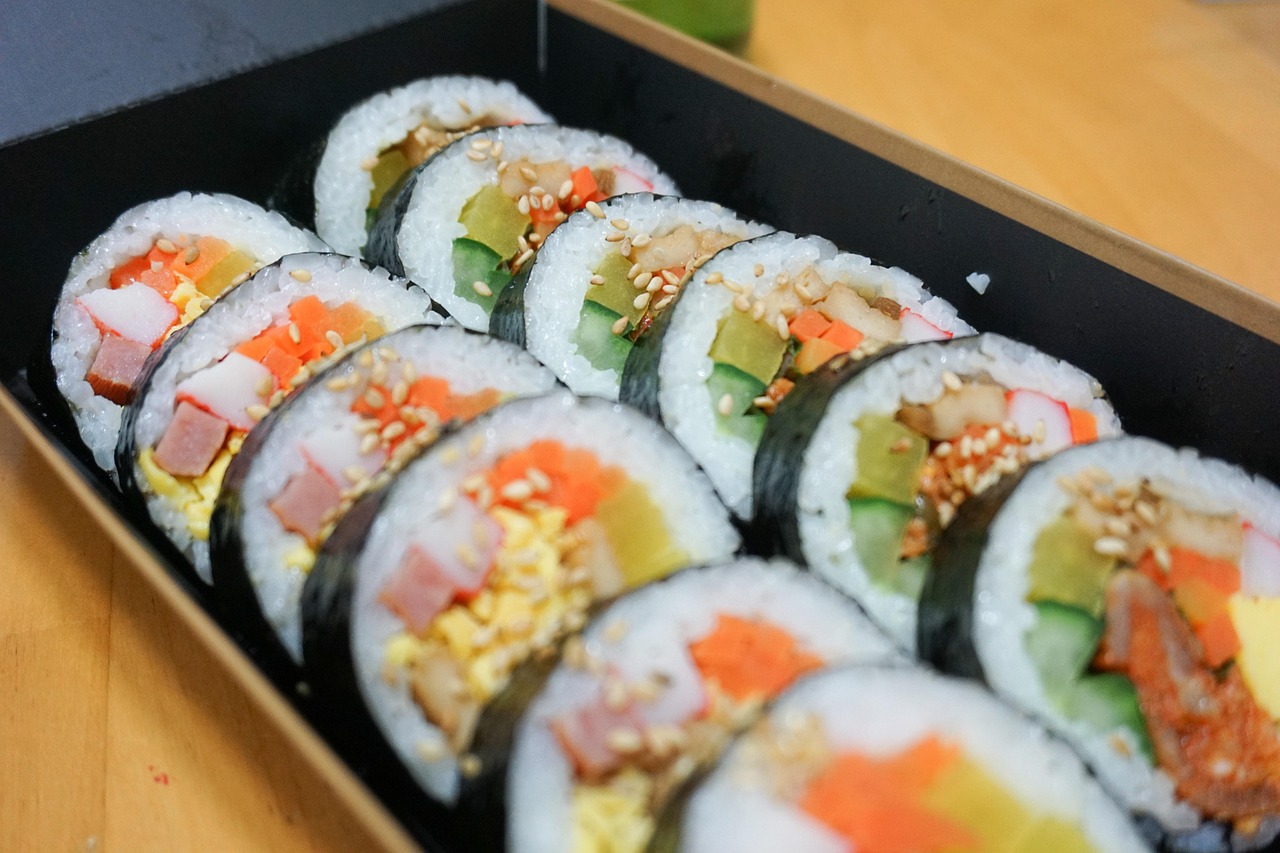
3. Kimbap

10 non-spicy Korean dishes you should try before you die
Image by jinsoo jang from Pixabay

This rice-roll wrapped in seaweed is so irresistible and perfect for light lunches.

There are varieties of fillings of kimbap including cheese, egg strips, carrot, cucumber, kimchi, ham, tuna, stir-fried beef and spicy cooked squid.

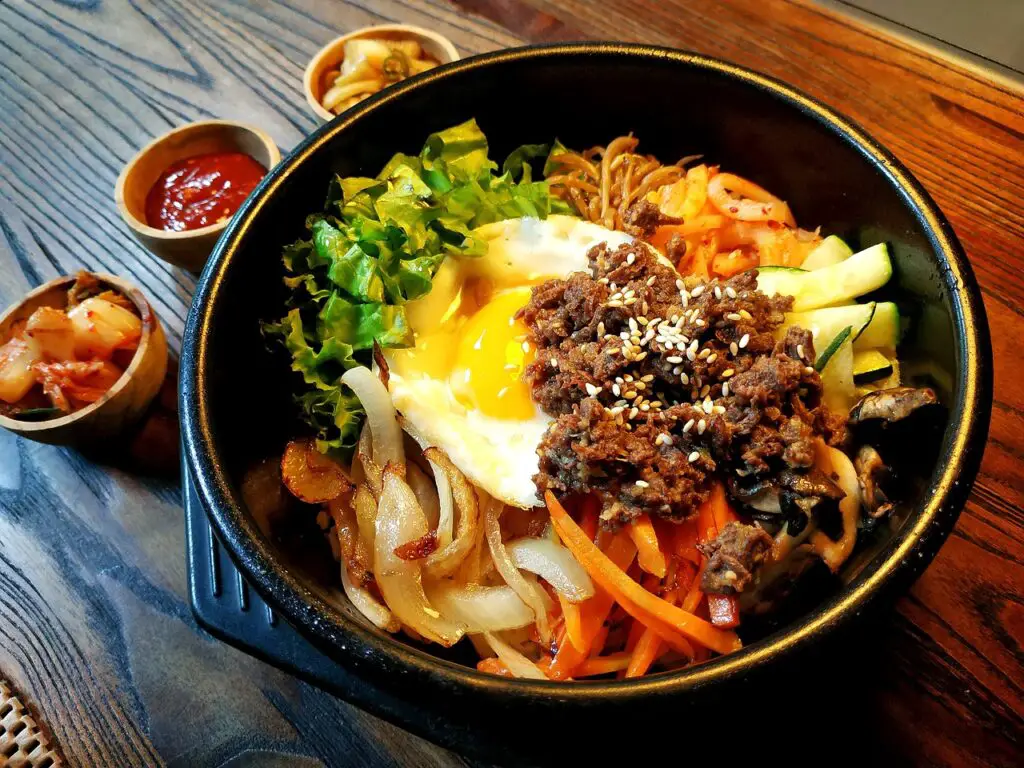
4. Bibimbap

This dish was listed at number 40 on the World’s 50 most delicious foods reads’ poll compiled by CNN Travel.

Bibimbap literally translates to “mixed rice”. It is usually a bowl of rice topped with sauteed and seasoned vegetables and gochujang (chilli pepper paste).

To make the non-spicy version of this dish – just replace gochujang with doenjang (soybean paste).

Vegetables commonly used are cucumber, radish, mushroom, soybean sprouts and seaweed.

Historically, bibimbap was served to the king for lunch or a between-meals snack. However, nowadays it is a perfect dish for any time of the day.

10 non-spicy Korean dishes you should try before you die
Image by Nikki from Pixabay

5.Doenjang jjigae or doenjang guk

Doenjang or soybean paste is used by Koreans as a seasoning or as a dipping condiment.

This paste can be used to make doenjang jjigae (soybean stew) and doenjang guk (soybean soup).

Other ingredients usually added to both these dishes are mushrooms, tofu, potatoes, radishes, seafood and meat.

The difference is that doenjang jjigae is heartier, thicker compared to doenjang guk.

6.Bulgogi

If you love meat, this is the dish for you.

To make bulgogi, one can either grill thinly cut slices of meat (pork or beef) or stir-fry them.

What makes the meat flavourful is all thanks to its seasoning which is a mixture of soy sauce, sugar, garlic, sesame oil, black pepper, onions and interestingly enough, pureed pears.

Bulgogi rice

7. Japchae

If the Thais have their pad thai, the Koreans have their japchae to brag about.

The star of this dish is dangmyeon, a type of cellophane noodle made from sweet potato starch.

It is cooked with various ingredients such as carrots, spinach, and onions.

Every ingredient is stir fried separately before being mixed together and season with soy sauce and sesame oil.

8.Galbitang

This non-spicy dish is usually served at wedding receptions.

Galbitang literally means “short ribs soup”. It is a clear dish made by slowly simmering galbi for hours.

It is fits for the royals as there were records of galbitang to be served in Korean royal banquets in the 1890s.

9. Kalguksu

Similar to sujebe, this dish is made of handmade, knife-cut wheat flour noodles served in a hearty broth.

The broth is commonly made with dried anchovies and kelp or chicken.

There are various types of kalguksu including snail kalguksu, perilla seed kalguksu and millet kalguksu.

noodles-709609_1280
A bowl of hearty kalguksu. Photo credits: Pixabay.

10. Naengmyeon

10 non-spicy Korean dishes you should try before you die
Image by manseok Kim from Pixabay

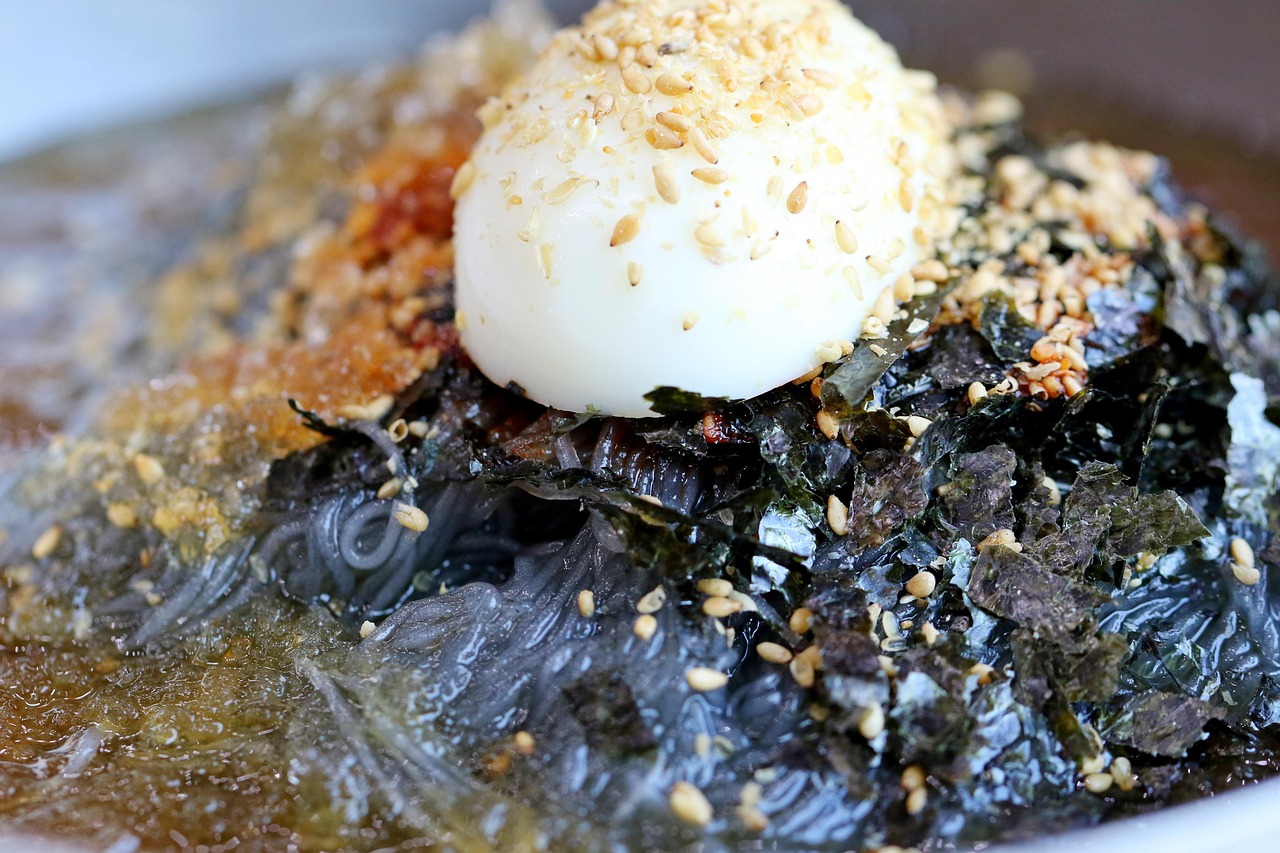
The Japanese are not the only who are known for its cold noodle.

In South Korea, naengmyeon is long, thin noodle served with iced broth, cucumbers, pears and radish.

Because its served cold, the dish is a famous dish during the summer season.

Sometimes the dish is served with gochujang but the non-spicy version of this is made with beef and radish broth.

10 cherished Malaysian childhood snacks we grew up with in the ’90s

Malaysian childhood snacks play important parts in our core memories, do you agree?

Even though we could only watch two TV channels on RTM before TV3 and NTV7 came along, growing up in Malaysia in the ’90s was not that bad.

We could only watch cartoons at 5 pm on weekdays, which gave us more reason to play outside.

And our local kuih only cost 10 to 20 sen per piece back then.

Apart from that, our memories growing up in the ’90s wouldn’t be complete without a look back at our favourite Malaysian childhood snacks.

Let us walk you down memory lane of 10 Malaysian childhood snacks we grew up with:

1. Colourful Lollies

Drink it or freeze it first, either way you cannot get enough of these.
Drink it straightaway or put it in the freezer first; either way you can’t get enough of these.

Some people like to twist the top off with their teeth and drink it first while most of us love to freeze it before enjoying it.

Raise your hand if you were one of those people who twisted these frozen lollies apart and shared it with your friend.

2. Nano Nano Candy

“Nano, nano, nano, nano…”

Who can forget this addictive jingle from Nano Nano candy’s advertisement?

Originally from Indonesia, this candy has a distinctive taste of sweet, sour and salty combined, just like the song says.

3. Polo mints

Polo candy.
The unmistakable mint with the hole in the middle.

This is perhaps the most popular breath mint in the world. It has a distinguishing feature that everybody recognises even without the packaging – the hole in the middle.

Originating from the United Kingdom, these mints were developed by Rowntree’s (which also developed Kit Kat) in 1939 but it was only introduced to the market in 1947.

Now you can find Polo mints almost everywhere in the world including Malaysia.

4. Tora and Ding Dang

Were you a Tora fan or a Ding Dang fan?
Were you a Tora or a Ding Dang fan?

Malaysian Childhood Snacks (5)

No one bought Tora and Ding Dang for the snacks. Everybody bought it for the toy inside.
And usually the toy wouldn’t last a day until it broke.

5. Ligo Raisins

Sweet old Ligo raisins.

There was this rumour circulating around in the ’90s that raisins could help boost your memory.

Soon enough, people started munching on packs of Ligo Raisins during their lunch break.

Whether they really helped to improve the memories of ’90s kids, who cares? These were, and still are, tasty and addictive snacks.

6. Haw flakes

Have some haw flakes.
The tiny yet addictive Haw Flakes.

Haw Flakes are probably one of the most iconic Malaysian childhood snacks that goes as far back as the ’70s .

Do you know it is actually made from the fruit of the Chinese hawthorn tree?

Besides Haw Flakes, this fruit is widely used as candied fruit slices and jam.

7.Apollo Layer Cake

They started with vanilla and chocolate layered cake.

Now they offer various flavours including pandan, cocoa, strawberry, red cherry, blueberry, kaya, coffee and even banana.

8.White Rabbit candy

Who can forget the thin layer sheet wrapped around this candy that melt in your mouth?

Most of us would lick the sheet first before popping the whole thing into our mouths!

9. Mamee Monster

According to Mamee Monster’s official website, it was introduced to the market in 1972.

Now it is one of the most popular snacks in Malaysia.

Apart from Mamee Monster, the same company also produces other household names for snacks such as Mister Potato, Corntoz and Double Decker.

10. Ice Gem Biscuits

Do not underestimate this particular snack, these Iced Gem Biscuits have a history that dates all the way back to the 1850s.

Thomas Huntley started to sell these mini biscuits in Reading, Britain.

Sixty years later in 1910, they added the crunchy icing, which is how the Iced Gem Biscuit was born.

Are your favourite Malaysian childhood snacks not in the list? Let us know in the comment box.

Toshinari Maeda and his ‘mysterious’ death in 1942 Bintulu

Bintulu, once a sleepy fishing village on the island of Borneo is largely known today for its booming oil and gas industry.

What lies deep down in the seabed off its coast is not just large reserves of natural gas, however, but a silent witness to one of the most mysterious air crashes during World War II.

A tragedy, mostly forgotten by many.

Toshinari Maeda and his 'mysterious' death in 1942 Bintulu
A photo of Toshinari Maeda By Kamakura Museum of Literature, Public Domain

Toshinari Maeda – a samurai lord in Borneo

Toshinari Maeda was a Japanese marquis and a military general. Born to the former daimyo of Nanokaichi Domain* in Kozuke province (modern Tomioka city) in 1885, he was later adopted as the heir to the main branch of the Maeda clan in 1900.

The Maeda clan ruled the Kaga Domain from 1583 until 1868 and was one of the most powerful samurai families in Japan. The clan became daimyo (feudal lords)  during the Edo period.

He became the 16th head of the Maeda clan on June 13, 1900.

*Domain or han is the Japanese historical term for the estate of a warrior after the 12th century of a daimyo in the Edo period (1603-1868) and early Meiji period (1868-1912).

Toshinari Maeda’s military career and death

Maeda had served as a battalion commander in the 4th Regiment of the Imperial Guard of Japan. He had also served as military attache to Great Britain from 1927 till 1930 and had actually retired from active military duty in 1939.

He was later called out of retirement to command operations in Borneo on April 1942 after the Pacific War broke out. By then, Sarawak had already been under Japanese occupation since Christmas Eve of 1941.

During World War II, the lieutenant-general became the first commander of the Borneo Defence Army which encompassed Japanese forces in northern Borneo (Sarawak, Brunei, Labuan and North Borneo).

His office of the Borneo Head of Military Defence Army,  at first headquartered in Miri, was then moved to Kuching according to his orders.

On Sept 5, 1942, after witnessing the execution of five men at Padungan, Kuching for allegedly stealing petrol,  he boarded a plane with two other officers to Labuan to officiate an airport named after him.

They never arrived.

A month later, the plane he was on was found to have crashed off the coast of Tanjung Batu in Bintulu.

Maeda was 57 years old.

The island of Labuan itself had been renamed Maeda Island or Pulau Maeda during the Japanese occupation in remembrance of the marquis. Maeda had also been promoted to ‘General’ posthumously.

A sunset view of Tanjung Batu where Toshinari Maeda was believed to have crashed.

Was it a curse that killed Toshinari Maeda?

The Japanese suspected the cause of the crash to be sabotage or suicide; but the Sarawak people attributed it to a curse brought on by Maeda himself.

In his post as commander of the Borneo Defence Force (which later became the 37th army), Maeda took up residence at the Astana.

John Beville Archer, a Batu Lintang camp internee and the last chief secretary to Rajah Vyner Brooke, in a June 1, 1948 issue of the Sarawak Gazette details how Maeda may have brought this curse down upon himself:

The main entrance of the Astana is the imposing and rather ancient tower overlooking the chief door to the palace.

Now there is a Brooke tradition that the exterior of this tower must not be whitewashed or renovated.

If this should occur, so runs the legend, some disaster will take place.

The tower had therefore became covered by an ivy-like creeper, and parts of the original building were crumbling in venerable decay.

The Japanese, vainglorious and victorious, saw fit to put this ruin into apple-pie order.

The creeper was torn down, masons, plasterers and white washers got busy.

Shortly afterwards Field Marshal Prince Maeda, cousin of the Emperor Sun god and Generalissimo, fell miserably to earth in a crashed plane somewhere round about Miri.

To this day, no one knows the cause of the crash and Maeda’s body was never found.

Toshinari Maeda’s legacy

After Borneo was liberated from Japanese occupation, Labuan assumed its former name. It became part of the North Borneo Crown Colony on 15 July 1946.

The Japanese had set up a Belian post at the beach of Tanjung Batu not far from the crash site in honor of Maeda, which was later taken back to Japan by the Maeda family after the Japanese occupation ended.

So now, there is no trace or anything in Sarawak to remember that the air crash ever happened.

But back in Japan, his former home built in Meguro, Tokyo in 1929 still survives to this day and part of the estate is now host to the Japan Museum on Modern Literature.

His former summer home in Kamakura is now used as the Kamakura Museum of Literature.

Photo courtesy of AJ Creations Photography.

Gerard MacBryan, the most eccentric Sarawak officer exposed

Gerard MacBryan
Gerard MacBryan after his pilgrimage to Mecca.

“There came out to Sarawak at about this time a young man who was destined to play a sinister part in the history of the Sarawak Raj.”

This is how Sylvia Brett, the last Ranee of Sarawak introduces Gerald MacBryan in her book Queen of the Headhunters.

The Brooke family governed Sarawak between 1841 and 1946. James Brooke ruled the area until his death in 1868. He was succeeded by his nephew Charles who in turn was succeeded by his son Vyner.

During the Brooke family’s reign, many British citizens were employed into Sarawak service.

One of them being Gerard MacBryan or his full name was Truman Magill MacBryan, whom some historians believed was Sarawak’s equivalent to Rasputin.

The story of Gerard MacBryan

Gerard MacBryan was the son of a doctor who owned a mental hospital near Bath, England. He was described as tall, graceful with bright eyes and ivory-white skin.

MacBryan was only 18 when he entered the Sarawak government service in 1920. Soon after MacBryan arrived in Sarawak for duty, however, rumours already began spreading about him.

According to Sylvia, “MacBryan, it was said, suffered from hallucinations that his bungalow was being attacked, and would start shooting wildly into the darkness.”

Sylvia was not the only one who recorded MacBryan’s lunacy.

Robert Payne in The White Rajahs of Sarawak stated that most of the white Sarawak officers during the Brooke reign were too busy to indulge in complicated pleasures.

“With Malays, Dyaks, Chinese, and Indians, all around them, and with a growing country to serve, they were kept occupied. Only one went mad, but he had a streak of madness in him long before he came to Sarawak.”

And of course the madman Payne referred to in his book was none other than MacBryan himself who was reported to have had a series of manic episodes.

Once in South Africa, he appeared naked at a party, and afterwards explained that he thought he was invisible. Sometimes he thought he was a dog, and would walk on all fours, barking at the top of his voice.

MacBryan also allegedly stole from shops and alms-boxes.

Gerard MacBryan and Vyner Brooke

Even so, with all the manic incidents, how MacBryan would continue to stay and serve in Sarawak was due to his relationship with the third white rajah, Vyner Brooke.

Of his first impression, Vyner told his wife, Sylvia that he thought MacBryan was “wonderful, but nuts”.

Putting aside the nuisance he presented to some of his fellow white officers, the Malay and Dayak people reportedly loved him.

MacBryan spoke fluent Malay and had even delivered a speech in Kenyah.

He also proved himself helpful by negotiating the peace-making ceremony between the Ibans and Kayans in Kapit in 1924.

Vyner nicknamed MacBryan the “Baron”, after Baron von Munchausen, the German cavalry officer who had been renowned for his fantastic and irresponsible antics.

According to historian Dr Bob Reece in The Name of Brooke, MacBryan was a man of considerable talent with an intelligence superior to that of most officers.

Reece wrote,

“More importantly, he was a skillful politician and a shrewd judge of character. He seems to have had the knack of knowing how the Rajah’s mind worked and of suggesting courses of action which would fulfil his wishes. In other words, MacBryan was capable of doing the Rajah’s thinking and decision making for him, something Vyner Brooke found very useful sometimes.”

Gerard MacBryan interfering with the succession to the throne

Vyner and Sylvia had no sons, so MacBryan began courting their young daughters. He even openly talked about becoming the next Rajah.

At one point Vyner had enough of the ‘Baron’ and fired him. MacBryan was subsequently banished from Sarawak for about four years.

During this time, he married a Malay lady, announced his conversion to Islam and even made a pilgrimage to Mecca. He had planned to make himself the Muslim ruler of the east.

MacBryan did not manage to do that but he did successfully make a return to Sarawak. By 1927, he was put in charge of Sarawak Gazette and eventually became Vyner’s secretary again.

Despite his best efforts, however, MacBryan was unable to seduce his way to the White Rajah’s throne.

But some reports claimed that he made sure the next heir apparent, Vyner’s nephew Anthony, would not make it to the throne either.

Another popular opinion was that the last Ranee was trying to push her eldest daughter, Leonora or her grandson Simon MacKay, to succeed the throne.

At the time, it was believed that Sylvia was plotting with MacBryan.

But on July 8, 1940, Sylvia wrote a letter to her brother in-law Captain Bertram Willes Dayrell Brooke (Anthony’s father) claiming her innocence.

“I happen to know more about the MacBryan plot than anyone. It began with MacBryan making violent love to Didi (Elizabeth, Vyner’s second daughter). I don’t think that Didi was more than fourteen at the time. But as you know MacBryan was determined to get into the family somehow. The whole thing has really grown from the evil seeds in MacBryan’s brain.”

Gerard MacBryan’s role in Sarawak’s cession to the British

But MacBryan’s biggest role yet in influencing Sarawak’s history was when Vyner appointed him to negotiate the terms of cession between Sarawak and the British government.

Local historian Ho Ah Chon stated in Sarawak Historical Events 1941-1945 that:

“After the war, Vyner sent out his private secretary to induce the leading Kuching Datus to sign letters in which they agreed to support any moves Vyner might think fit to make ‘in the interest of Sarawak’.”

According to reports, the letter never mentioned cession .

The community leaders signed the letters, not knowing the truth till few days later.

“One of the Datus, Datu Patinggi Abdillah, was furious when he discovered that they had been tricked, and he returned the $12,000 (all those who signed were given a large sum)- saying it was a bribe.”

And that private secretary was MacBryan.

Sylvia also wrote,“I think it can safely be said that if there had been no Gerard MacBryan there would have been no cession of Sarawak at that time — July 1946.”

When Vyner and Sylvia returned to Sarawak in 1946 to say their final farewell, the Baron was not there with them.
Sylvia stated,

“He had sworn he would see Vyner through the difficult period of Cession. After all, it was he who set the machinery in motion; who had coerced and corrupted the Malay Datus into signing papers they did not understand. And then he had simply vanished, leaving Vyner to face the music alone, to withstand the disapproval of his brother, and the shocked fury of his nephew.”

However according to Reece, this claim might not be true.

Reece stated,

“There is no way of verifying later accusations that MacBryan used trickery and even force to obtain the necessary signatures. But it is clear that he deliberately misrepresented Bertram and Anthony as having agreed to the cession.”

Nonetheless, the information retained and reproduced in a Malaysian secondary school History textbook for Form 3 was that of Gerard T. MacBryan using trickery to gain signatures from Council Negri members.

The Brooke family ceded Sarawak to the British government as a crown colony on July, 1 1946.

Life after Sarawak for Gerard MacBryan

By late 1949, there were reports of him losing his sanity. He was arrested for stealing peaches from a fruit barrow in London eventhough he had more than £40 in his pocket.

At one point, he also carried with him everywhere a mysterious black box which he said could blow up the world.

He occasionally checked himself into a mental institution in London.

Towards the end of his life, he was living in a cheap hotel in Hong Kong until he died in 1953.

Vyner believed MacBryan hanged himself although Sylvia believed MacBryan starved himself to death.

In her final mention of Gerard MacBryan in her book, the former Ranee stated, “…although he had thousands of dollars in the bank, the ‘Baron’, with his charmed and twisted dreams of powers, looked down-and-out, filthy and in rags. I never dared ask Vyner what he thought about the downfall of his friend.”

Claudetown: This historically rich town is now known as what?

Marudi is a quiet town in Sarawak famous for its kueytiaw noodles.

But did you know this town was once called Claudetown (sometimes spelled as Claude Town) not Marudi?

It was named Claudetown after Claude Champion de Crespigny who was the Resident of Baram district.

Claudetown
Marudi is also famous for its Baram regatta.

Who was Claude Champion de Crespigny?

An initial Google search of Claude Champion de Crespigny will lead you to Wikipedia page describing a British soldier and polo player. (This de Crespigny, however, committed suicide in 1910 at the age of 37.)

Marudi’s de Crespigny was born in 1829 to Reverend Heaton Champion de Crespigny and his wife Caroline.

He joined the Royal Navy in 1844 and became a fellow of the Royal Geographical Society of Great Britain.

de Crespigny was part of the French nobility during the tumultuous period of the French Revolution, which forced many aristocrats to flee France due to the political unrest.

Like many French émigrés who fled revolutionary France, he eventually made his way to Southeast Asia.  On how did this Frenchman found his way to Sarawak, that remains unclear.

Regardless, the second White Rajah Charles Brooke appointed him as the Resident of the Fourth Division (Baram and Trusan) in 1883.

Before that, he was the Resident of the Third Division (Rejang, Oya, Mukah, Matu and Bintulu).

His administration was made up of two junior officers, 30 rangers and a few native police officers.

In 1882, de Crespigny recorded in his diary that there were 18 hand-dug oil wells at the mouth of Miri river.

He found out about this when he noticed that the locals mixed the oil with resin to caulk their boats.

Unfortunately, the Brooke government didn’t put more thought to this observation until de Crespigny’s successor Charles Hose came along.

Due to this, Hose is more widely known as the important figure in discovery of oil in Sarawak.

de Crespigny died on Dec 28, 1884.

Claudetown: This historically rich town is now known as what?
The town is also home to the famous kueytiaw Marudi.

Claudetown in the 1880s

Looking back into the town history, the first foundation of Claudetown was laid on July 19, 1882.

In 1885, Charles Brooke visited Claudetown and it already had 45 attap shophouses.

The population throughout the whole of Baram area back then was mainly made up of the Kayan, Kenyah, Kelabit, Penan, Berawan, Kiput, Sebop, and Seping.

The first group of Chinese immigrants who arrived in town were the Hokkien.

They came down from Kuching in 1882 to trade.

By 1888, there were 300 Hokkiens and Teochews living in Claudetown.

Then in 1905, a Malay named Dato Sharif Hamid from Simanggang (known today as Sri Aman) introduced rubber planting in the area. Now, there is a primary school SK Dato Sharif Hamid named after him.

From Claudetown to Marudi

So why did Claudetown change its name to Marudi?

According to Miri’s official government website, it was later renamed to Marudi after a small river flowing through the town.

But local historian Chang Pat Foh had a more amusing story behind the name Marudi.

After the discovery of oil in Miri, the administrative centre of the Fourth Division was relocated from Claudetown to Miri.

Miri people back then used to tease those from Claudetown in the Iban language, “Malu dek, Kubu Claudetown udah pindah ngagai Miri.” (How embarassing for you, your fort has been moved to Miri).

Then, slowly people started to call the town “Malu dek” which eventually became Marudi.

Whether is there any truth in this playful story, that will remain a mystery for all of us.

1 2 3 4 5 32