Browse Tag

Culture

Limbang and the little-known history of this town of buffaloes

Limbang in the Malaysian state of Sarawak is a unique town. It cuts its neigbouring country into half, leaving itself sandwiched between two parts of Brunei Darussalam.

The town is home to mainly Malay, Kedayan, Lun Bawang, Bisaya and Chinese communities.

Some interesting historical events

It is one of those towns which holds many historical facts unknown to many.

For example, Pengiran Indera Mahkota was historically painted as the villain in Sarawak who governed in the 1830s.

The reign of Indera Mahkota on behalf of Brunei Sultanate caused unrest among Sarawakians especially due to high tax and piracy problems.

Eventually, he was chased out by Pengiran Muda Hashim who promised James Brooke a territory after Brooke suppressed the rebellions.

After his defeat, Indera Mahkota travelled along the coast of Sarawak from Batang Lupar down to Mukah.

Then in 1858, the prince was believed to have died somewhere along the coast of Limbang while en route back to Brunei.

One theory has that his boat was attacked and he was killed by the local Bisayas for kidnapping the local women and making them his concubines.

Another theory is that his boat simply capsized and that he could not swim to safety.

About 30 years later, the town saw two other Bruneian officials die in the same area, although the causes were not so mysterious.

In 1884, Pengiran Temenggong Hashim of Brunei sent his representatives to Limbang to collect taxes.

The residents put up a resistance, refusing to pay, killing the representatives instead.

Retribution was swift – Sultan Abdul Mumin ordered an attack to punish the rebels.

The Limbang Rebellion

Fast forward to Dec 8, 1962, the town witnessed more bloodshed when Sheikh Azahari Sheikh Mahmud (famously known as A.M. Azahari) ordered an attack on the town.

He was the leader of the Brunei People’s Party and North Kalimantan National Army (TNKU).

Completely against the formation of Malaysia, TNKU militants took over the town by attacking the police station as well as hold hostages.

Thankfully, four days later the British Royal Marines came and freed Limbang from the rebels.

The freedom came with a price; four members of Sarawak Constabulary and five members of the Royal Marines died during the attack.

The origin of the name

Long before it was ever called Limbang, the first settlement in the area was called Pangkalan Tarap (or Tarap Wharf in English)

Tarap (Arctocarpus odoratissimus) is a type of fruit native to Borneo, Palawan and Mindanao island.

How did Pangkalan Tarap change its name? Nobody precisely knows from when or why. However, there are two theories of how Limbang got its name.

1.From the word ‘melimbang’

Bukit Mas in Limbang was believed to have gold deposits. That was why the hill is called Bukit Mas as in emas or gold in Malay.

In the book Legend and History of Sarawak, author Chang Pat Foh wrote that people in those days panned for metal ores which were supposed to be the gold ores.

The act of panning ores in Malay is called ‘melimbang’. Hence, it was believed that people slowly started to called the place from the word ‘melimbang’.

However, Chang also rebuked this theory. He cited a report from Geological Surveys Sarawak that there were no traces of gold in Bukit Mas.

Nonetheless, geologists did find yellow-looking ores called pyrites, more commonly known as Fool’s Gold.

2.Another meaning of melimbang
Limbang and the little-known history of this town of buffaloes
The local residents used to melimbang or wash rice at this river.

The word melimbang in Malay also means washing rice. The residents in the olden days used to wash their rice in the river which is now called Sungai Limbang. Many historians believe the town was named after the river, not the other way around.

This theory could possibly true because Limbang was the ‘rice bowl’ of Brunei, supplying rice to the country.

Paddy farming in the area could be traced back during the reign of Sultan Abdul Mumin of Brunei (1852-1885) where Bruneians migrated in the area to farm paddy.

Buffaloes are commonly used in paddy farming. Now it has become the symbol of Limbang town.

Limbang and the little-known history of this town of buffaloes
Buffalo, the official symbol of the town.

Robert Burns, the first European man who wrote about the Kayans back in 1849

Scotland’s national poet Robert Burns (1759-1796) may be the last person anybody would have thought had any links to Sarawak. He was considered the pioneer of Romanticism, an artistic movement which emphasises on emotion and individualism.

Burns’ connection to Sarawak comes through his alleged grandson – also named Robert Burns – who became the first European man who visited the Kayans in Borneo.

The journey of Robert Burns in Borneo

Burns left Glasgow for Singapore some time in 1846. There he worked with a Scots-owned trading company, Hamilton Gray.

One of the firm partners George Nicol sent him to Borneo in search of more business prospects.

He first set foot in Labuan where he sought his passage to Bintulu.

Accompanied by one European companion, Burns arrived in what the westerners called ‘Kayan country’ in Borneo. It is the vast area where Rajang and Baram rivers are located.

This was around 1847 when this area was still under the Brunei Sultanate. Burns spent several months among the Kayans, learning their customs and writing down their vocabulary.

He returned the second time in Bintulu about a year later. During this time, the first White Rajah of Sarawak James Brooke was holding the post as the first governor of Labuan.

Robert Burns burning a scandalous trail through Borneo

Not long after his stay in Borneo, Brooke received a letter from the Kayan chiefs in Baram that Burns was causing some problems. Burns had reportedly even posed as Brooke’s son to gain approval from the local chiefs.

The letter stated,

“Mr. Burns does very treacherously, he wishes to take persons’ wives whether they like it or not, he takes people’s wives. And also Mr. Burns ordered us to kill people who enter the River Baram, of whatever description or race they be; whoever enters it is good to kill them.”

Brooke replied letter telling the chiefs, “can act justly and rightly in support of their authority, and for the protection of their people.”

The letter arrived in Bintulu via the East India Company’s steamer and returned to Singapore with Burns in it.

After his return to Singapore, Burns wrote a paper about the Kayan which was then published in the Journal of the Indian Archipelago and Eastern Asia in February, 1849.

The editorial note stated, “We have great pleasure in presenting to our readers the first authoritative account that has been given of the greatest aboriginal people of Borneo Proper- the Kayans. Mr. Burns is the first European who has ventured to explore the interior Borneo Proper.”

Robert Burns
A European man having a discussion with the leaders of the Kayan people in Sarawak, circa 1900 to 1940. Credit: Creative Commons.

Robert Burns and his death

At the age of 29, Burns was clearly not done yet with his thrilling adventures. In 1851, Burns made his way again to Borneo, determined to explore its north-eastern coast.

He set sail in a schooner named Dolphin, commanded by Captain Robertson and a Portuguese cook, a 13-member crew as well as the captain’s love interest, a native woman.

The adventurer was looking for bird’s nests in Kinabatangan area which was sought after by the Chinese back then.

Before they departed Labuan, many warned him of the danger of Illanun piracy in that part of Borneo.

Owen Rutter wrote in The Pirate Wind that, “His experiences among the wild Kayans had perhaps made him over-confident of his ability to handle natives in all emergencies.”

Somewhere in Maladu Bay, a group of Illanun pirates led by Memadam sailed alongside the schooner.

On Sept 10, they boarded the schooner saying they had some tortoiseshell, camphor and pearls they wished to trade.

Appearing to be harmless and without weapons, the pirates were even given rice and fish.

The following morning, the pirates boarded the schooner again and this time the pirates did not take any rice and fish but some heads instead.

Rutter detailed the incident in his book stating,

“Mr. Burns was bargaining with Memadam over the pearls when the Malay who had remained with the boats handed up some rolled mats. One of Memadam’s companions, Ibrahim, a Sulu, stepped to the side to take one of the mats and presented it to Mr. Burns, who put out his hands to receive it. At that instant Ibrahim snatched a naked sword which had been concealed in the mat, and with one blow severed Mr Burns’ head from his shoulder.”

His death was reported In December 1851 by the Singapore Straits Times.

Robert Burns and possible descendants in Borneo

In the book On the Trail Burns by John Cairney, the writer wrote about the how Burns’ descendants were found at this part of the world.

“Jenny’s Robert Burns the Second did well, no matter, and prospered as a merchant in London. His son, also called Robert, went to the East Indies and became a highly successful trader. Unfortunately, in 1851, his schooner, the Dolphin was captured by pirates off the coast of Borneo and he was murdered with all his crew. His descendants are to be found in the Far East to this day- a long way from that attic room in chilly Edinburgh’s St James’ Square.”

Another author and biochemist Alistair Renwick who wrote the book, The Burns Boys (2003) also agreed that there is a possibility of Burns’ surviving descendants in Borneo.

In his interview to the The Scotsman in 2004, Renwick said “This seems to be fairly reliable although there is no proof other than a statement in a letter from Nicol.”

Nicol, the firm partner from Hamilton Gray, wrote to Burns that he was surprised to hear the news: “I thought it was a joke, but on sending for a Malay from Bintulu who came over on the Amelia he told me it was true that you had been married to the daughter of Akumlassa, the Kayan chief.”

Robert Burns, the first European man who wrote about the Kayans back in 1849
The Tattooing of a Married Kayan Woman,” (c. 1896-98), photograph by William Henry Furness III. Credits: Creative Commons License.

Robert Burns and his legacy

Putting aside his questionable antics, Burns was still acknowledged for his work. Scottish diplomat and author John Crawfurd (1783-1868) believed Burns had written by far the best and most authentic account of Borneo that had ever been given to the public at that time.

Like Burns, Crawfurd also argued that the Kayans were actually the dominant tribe in Borneo. During that time, Brooke and his allies had the British public focusing on the savageness of Ibans from Saribas and Skrang.

Both Burns and Crawfurd believed that the Kayans were more superior because they mastered iron smithing while the Ibans had not done so.

Additionally, former Sarawak Museum Curator Tom Harrisson regarded Robert Burns as the ‘first ethnologist and explorer of interior Sarawak’.

How New Year’s Day was celebrated in 1875 Sarawak

In many countries, New Year’s Day celebrations usually start the night before with food and drinks and, of course, a fireworks display.

Then the first day of the year proceeds with all kinds of activities; from going to picnics with families and friends, to last-minute shopping for school supplies. New Year’s Day is always a busy day.

Did you know that Sarawakians have been celebrating New Year’s Day since more than 145 years ago?

Let us look back at how 1875 Sarawak celebrated the brand new year.

The year 1875 was welcomed with the booming of a gun from the fort at the stroke of midnight.

Then the song ‘Auld Lang Syne’ was sung to celebrate the brand new year.

While the band paraded into Kuching town, all the European officers came out of their respective houses to wish each other ‘Happy New Year’.

The celebration didn’t just circle around the expatriates.

At the mosque, the Muslims welcomed the year 1875 according to their faith.

The minute the clock struck twelve, they started to berzikir till nearly daylight.

On New Year’s morning, about 60 people sat down for breakfast at The Rajah’s Arms Hotel.

Owned by Low Kheng Whatt in partnership with a European named Montgomery, the hotel was first opened on 1 December 1872.

However, it went into liquidation in 1875. It was then taken over by the second White Rajah, Charles Brooke, and reopened on 1 January 1876 as the Sarawak Club.

The breakfast was attended mainly by Sarawak government officers as well as Borneo Company staff and Chinese businessmen. Out of these 60 plus people, only two were women.

How New Year’s Day was celebrated in 1875 Sarawak
A lot has changed on how we celebrate New Year’s Day.

New Year’s Day Boat Race

At noon, hundreds of people started to gather along the Sarawak riverbank to witness a boat race.

Overall, there were seven boats who entered the race on New Year’s Day and they had pretty interesting names.

They were Api Naraka (owned by Mr W.M. Crocker), Ayer Penawar (Mr E.J. Smith), Bujang Kilat (Mr J. Hardie), Bujang Pukat (Mr J.M Lewis), Bujang Tudong (Mr Kassim), Sakalip Mata (Confederates) and Ular Sawa (Mr Kongkong).

New Year’s Day in 1875 Sarawak ended with a dinner at the hotel which was attended mostly by Sarawak government officers.

Clearly, there were many differences in celebrating the brand new year compared to now; we no longer have gunshots from the fort nor a band marching through Kuching town after midnight.

Nonetheless, it would be fun to revive the boat race at Sarawak river to celebrate the new year. It would be an activity that brings everyone together.

Discover SKULLPANDA CAGE-UNCAGE Singapore at the National Museum of Singapore

By Ng Ai Fern

Find your “key” in life at the international debut of SKULLPANDA CAGE-UNCAGE Singapore at the National Museum of Singapore.

Running from 12 December 2025 to 22 February 2026, the exhibition invites visitors on a journey of self discovery through the deeper narrative behind the popular SKULLPANDA character. 

SKULLPANDA, one of POP MART’s successful collectible characters, is created by Chinese artist Xiong Miao. Unlike the playful, mischievous Labubu, SKULLPANDA is dreamy and introspective – a character with a skull-like face wearing an astronaut-style helmet that reflects its inner world.

A quest for the “key”

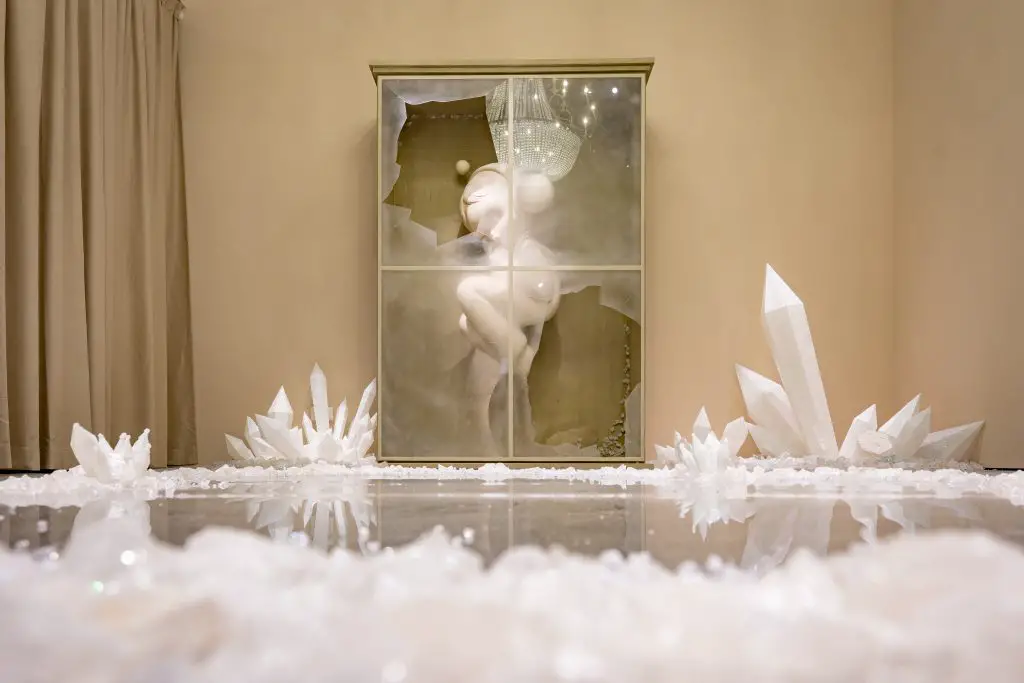
Fortune zone with mirrored surfaces and a central Skullpanda sculpture inside the Cage-Uncage Singapore showcase.

This immersive and thought-exploring showcase is built around a search for the “key,” connecting the dual states of “caged” and “uncaged” that define SKULLPANDA’s conflicting thoughts.

Visitors begin with The Key, where fragmented mirrors and scattered keys invite reflection on the boundaries between reality and endless possibilities. The journey continues through six themed zones – Emotion, Fortune, Rules, Exploration, Life and Direction – each offering a glimpse into SKULLPANDA’s inner landscape.

Visitors  can also become active participants by rotating a large cuboid. As the patterns break apart and reassemble. This simple motion mirrors exploration itself: shift your perspective, and the story changes; rearrange the pieces, and a new meaning appears.

The Room: the heart of the showcase

This central installation, known as The Room, uses reflection and repetition to evoke the inner conflicts at the core of SKULLPANDA’s narrative.
SKULLPANDA’s central installation, known as The Room.

At the centre of the exhibition sits The Room, a mirrored chamber linking all six zones. Two SKULLPANDA sculptures sit back-to-back, each holding a key.

The scene symbolises a familiar tension – the weight of being held back and the hope of breaking free. The mirrors create an abstract cityscape that blurs inside and outside, confinement and possibility, the finite and the infinite. Somewhere within these reflections lies the “answer” – the key held by the sculpture, and metaphorically, by the viewer.

And yes, just like SKULLPANDA, visitors eventually discover their own “key.”

A Singapore-exclusive installation

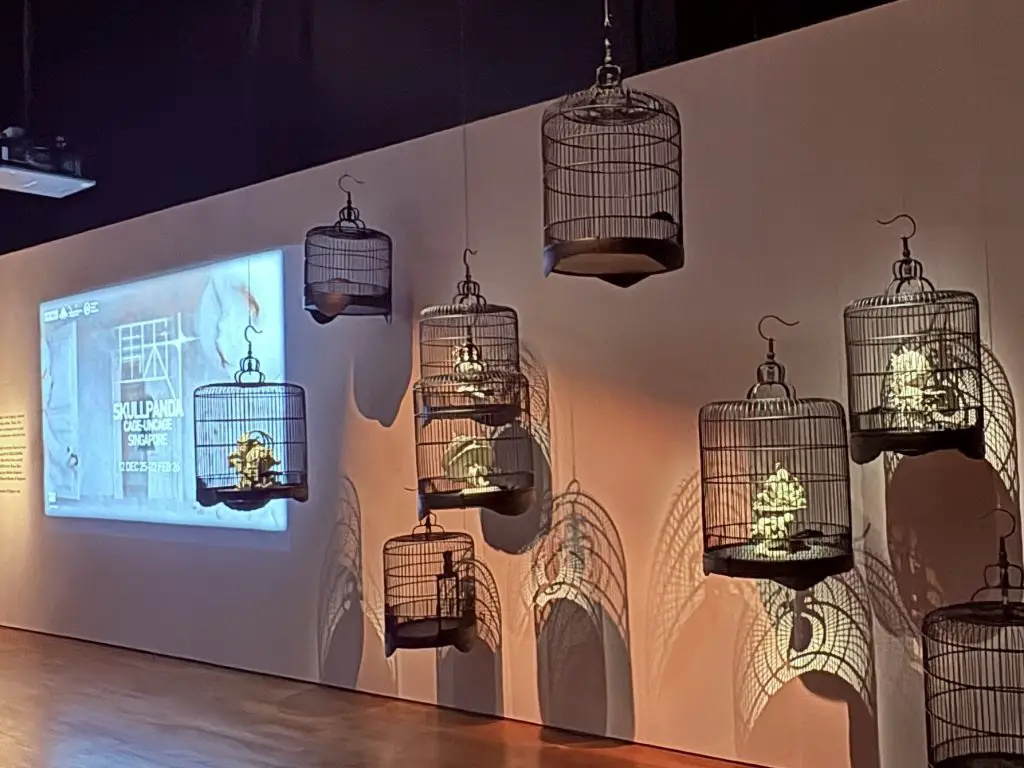
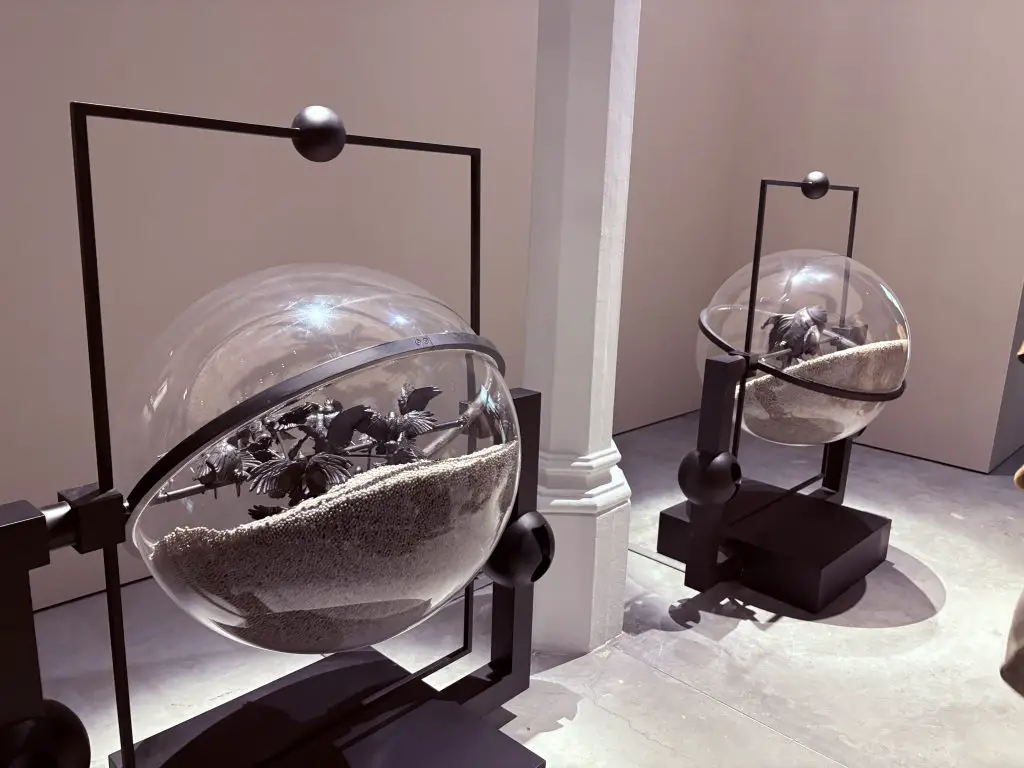
A Singapore-exclusive installation inspired by the city’s bird-singing tradition, featuring prototype Skullpanda figures from The Paradox Series and video art created specially for the CAGE-UNCAGE showcase by Xiong Miao. The exhibit was jointly created by POP Mart, The National Museum of Singapore and The Singapore Tourism Board.
A Singapore-exclusive installation jointly created by POP MART, The National Museum of Singapore and The Singapore Tourism Board.

Exclusive to the Singapore edition of the showcase is an installation that pays homage to bird singing, a beloved pastime enjoyed in Singapore’s housing estates among enthusiasts. Suspended bird cages present the original prototype figurines from the SKULLPANDA TheParadox Series, 

Presented by POP MART in collaboration with the character’s creator, Chinese artist Xiong Miao, and in partnership with the National Museum of Singapore and the Singapore Tourism Board, SKULLPANDA CAGE-UNCAGE Singapore presents a visual journey that delves into the tensions between containment and release that exist within our decisions. 

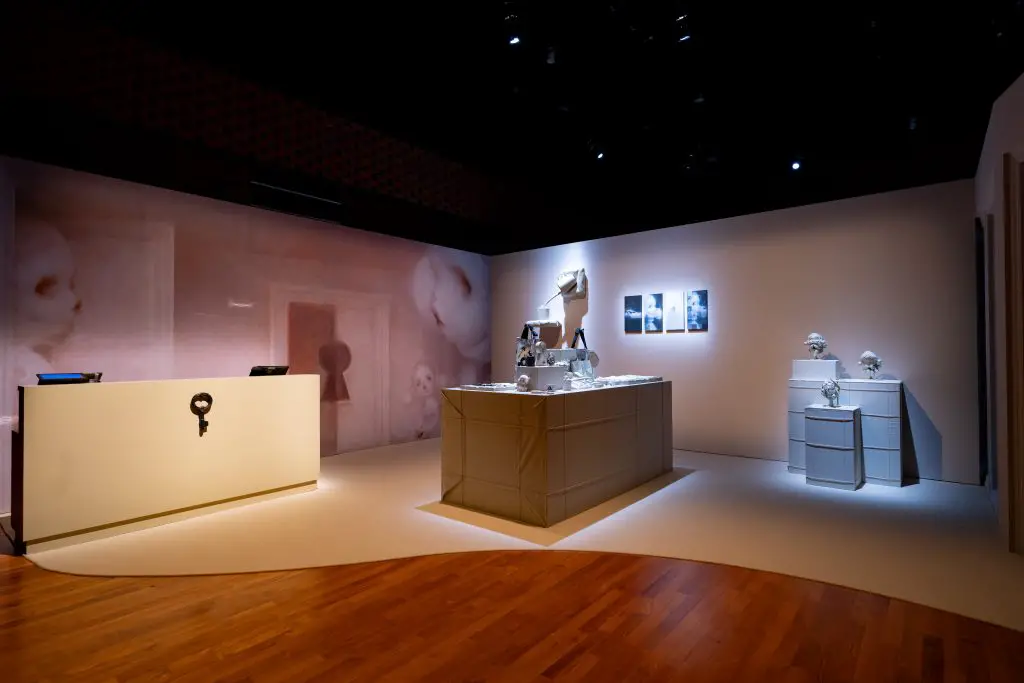
Showcase-exclusive merchandise is available at the Gallery Theatre retail zone for ticket holders, subject to eligibility and purchase limits. Additional POP MART items can be found at the POP-UP store in the museum’s Longer Concourse.

Inside the Gallery Theatre retail zone, visitors can browse exclusive CAGE-UNCAGE merchandise, available only at the Singapore exhibition.
Showcase-exclusive merchandise will be available for purchase at the Gallery Theatre retail zone.

Tickets are available at NMS at their official website or through the showcase’s ticketing partner Trip.com, priced from $36 (RM115) for Malaysian tourists. 

The National Museum of Singapore – the country’s oldest museum – is located at 93 Stamford Road, Singapore 178897.

Travel Note

Direct flights from Kuching, Sibu and Miri to Singapore are available via AirAsia and Scoot. AirBorneo will begin connecting to Singapore next year.

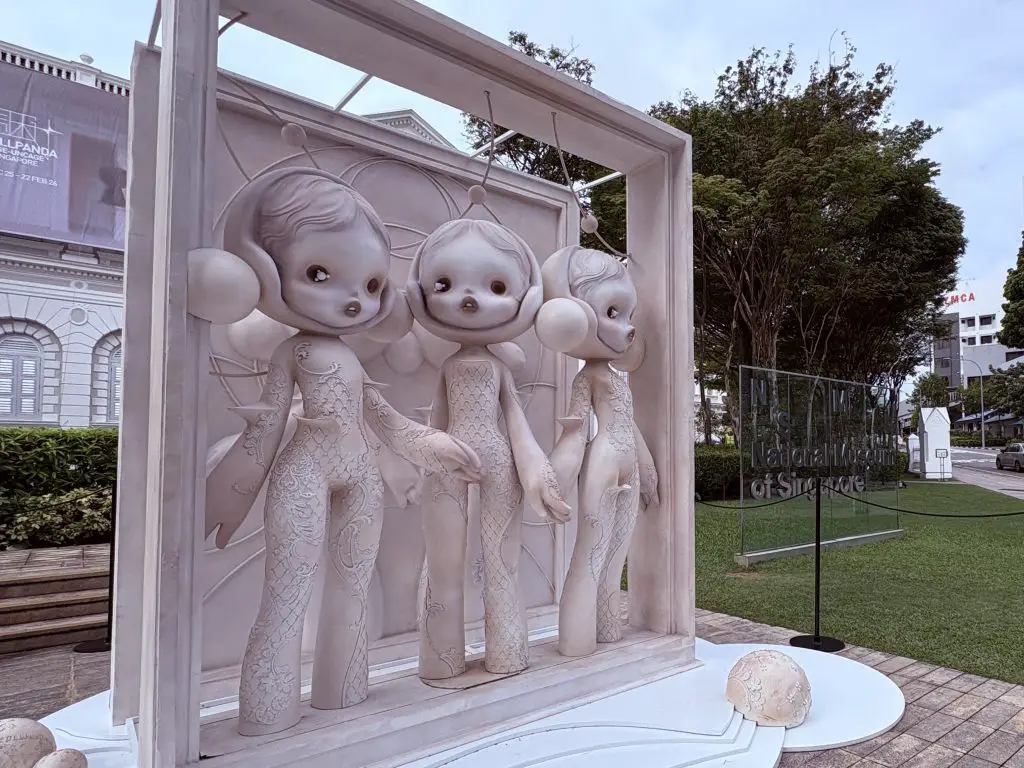
Large Skullpanda sculpture displayed on the front lawn of the National Museum of Singapore during the Cage-Uncage exhibition.
This outdoor SKULLPANDA installation marks the entrance to the CAGE-UNCAGE Singapore exhibition, extending the showcase beyond the gallery walls.
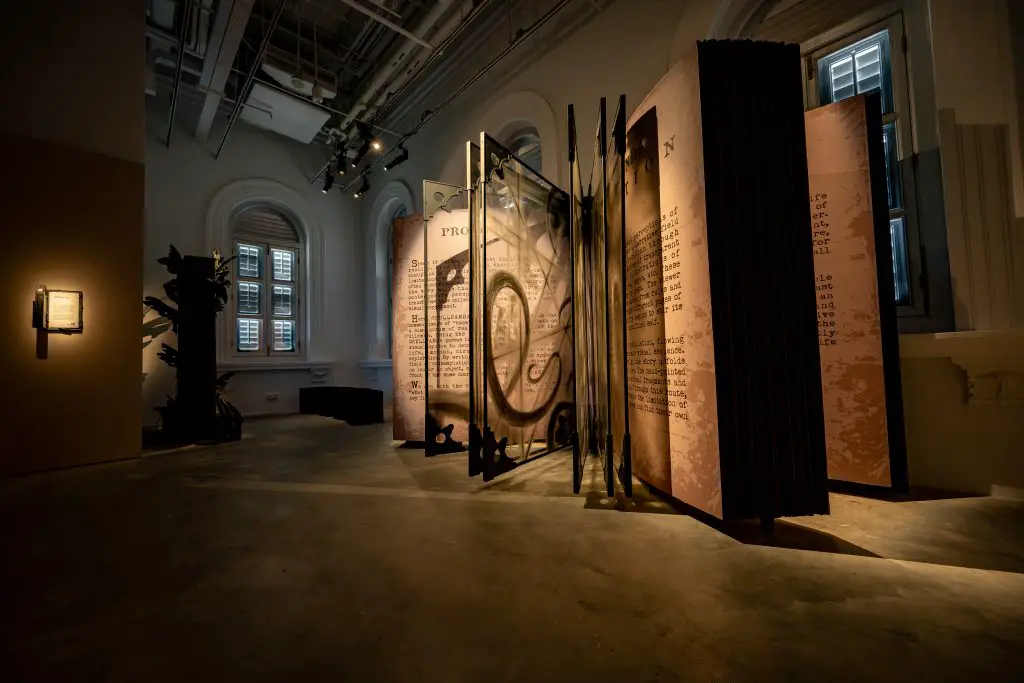
Transparent book pages installation in the Direction zone at Skullpanda Cage-Uncage Singapore.
In the Direction zone, transparent pages marked with thorns, shackles, and webs unfold like shifting paths toward freedom. Each turn reveals a new way to navigate obstacles or find sanctuary within constraints, while a giant picture frame of hand-drawn illustrations and moving light ties the narrative together with Xiong Miao’s signature butterfly motif.
Through motion and balance, the Rules zone reflects the invisible structures that shape how we move through life.

Melanau tall house: 3 things you need to know about this important architectural history

Unlike other traditional houses in Sarawak, the Melanau tall house was built distinctively higher.

However similar to longhouses of other ethnic groups such as Iban and Kayan, this Melanau traditional house can accommodate up to 50 families.

The Melanau tall house at Sarawak Cultural Village is one of the few traditional houses left as the rest have been abandoned or demolished.

Besides the one in Sarawak Cultural Village, it is difficult to find a traditional Melanau tall house in the state. Most of the houses in Melanau villages now are built individually on stilts, and the designs are believed to be inspired by houses in the Malay community.

Here are 3 things to know about the architectural heritage of a Melanau tall house:

1.They are built very tall for a lot of reasons.

Traditionally, a Melanau tall house is built about 10 to 40 feet above the ground. For this, the Melanau have to thank the Filipinos for inspiring the need for this design.

As the Melanau people lived mostly along the coastal region, particularly near the mouth of the Rajang river, they were often attacked by pirates from the Southern Philippines in the olden days. To protect themselves, the Melanau built tall houses and even fortified them with cannons.

Besides the pirates, the tall houses also protect the Melanau people during tribal wars against the Ibans.
The Brooke authority also had some scuffles with the Melanau on one point when the former accused the latter for harbouring pirates.

Furthermore according to author Peter Metcalf in The Life of the Longhouse: An Archaeology of Ethnicity, a house raised on stilts serves many advantages.

“It escapes the mud below; it allows disposal of kitchen waste, soon cleaned up by free-roaming chickens and pigs; and it greatly improves ventilation.”

Particularly in Borneo, an elevated building like a Melanau tall house and a Bidayuh baruk would reduce the number of insects in your home.

2. The floor of a Melanau tall house was designed for defensive and offensive purposes.

Besides the height advantage, the floor of a Melanau tall house also serves to defend the community.
The flooring of the main level of the tall house are arranged in a crisscross pattern with small gaps in between.

When there was an attack, the flooring made it hard for the enemies to pierce their sharp weapons through the floor. As for the Melanau, they would pour hot, boiling water on their enemies.

The columns, which are the main structure of the building, are typically made from belian while the wall and flooring structures are made from nibong.

Meanwhile for the roof, they used sago leaves, which also happen to be the main economical source for the Melanau people.

The rungs on every staircase in a Melanau tall house were built in odd numbers. This is because they believed that by doing so it could bring wealth and good health to the household members.

Melanau tall house: 3 things you need to know about this important architectural history
The rung of a ladder in a Melanau tall house has odd numbers because they believed it would bring them luck.

3.The living arrangement in a Melanau tall house.

Melanau tall house: 3 things you need to know about this important architectural history
A traditional Melanau house comprises of few levels.

According to research done by Universiti Sains Malaysia, gender and marital status affected the organisation of the space in a Melanau tall house.

Every tall house was built with a few levels and each level had multiple bedrooms.

Only unmarried men occupied bedrooms located aon the first floor while married couples and unmarried women had their bedrooms on the upper level.

The upper level also houses the family’s ceremonial items and assets.

Curious visitors still can see some of Melanau artifacts at Sarawak Cultural Village’s tall house.

Melanau tall house: 3 things you need to know about this important architectural history
Some of the ceremonial items displayed at Sarawak Cultural Village’s tall house.

Japanese Surrender 1945 and the contents of leaflet announcing it

After the Japanese surrender in August 1945, Royal Australian Air Force planes dropped leaflets all over Sarawak’s First Division.

According to The Sarawak Gazette, the leaflet was foolscap size (a bit longer than A4) with a broad orange border and it was only available in English.

The content of the leaflet was about what to expect or do when the Japanese surrendered their power after the end of the war.

These leaflets were dropped all over Kuching, Batu Kawah, Bau, Lundu, Serian and Simunjan.

Japanese Surrender 1945 and the contents of leaflet announcing it
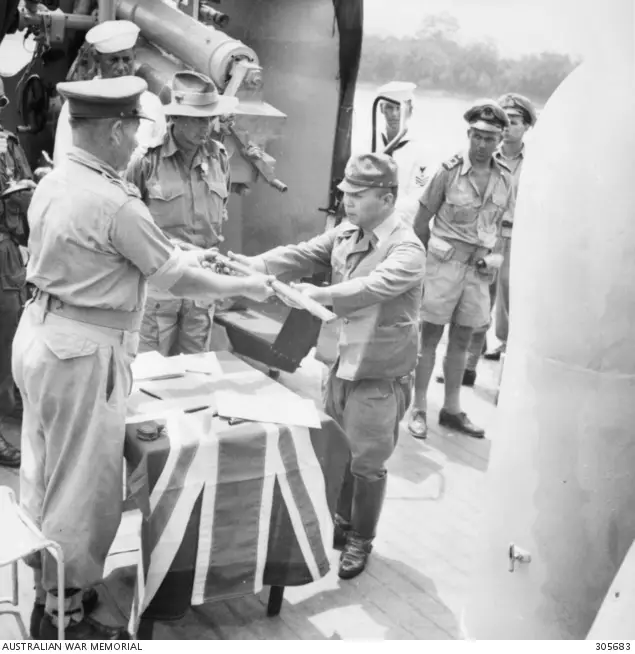
The day when the Japanese Surrender. Aboard HMAS Kapunda as the Japanese envoy’s interpreter reads the surrender terms to Major-General Yamamura, the Kuching Garrison Commander (right). Copyright expired-public domain.

Here is the text of of the leaflet announcing that the Japanese surrender:

To the people of the First and Second Division of Sarawak.

1.News of the Japanese surrender will already have reached you. In addition to the Australian troops who will be coming to remove the Japanese, three officers of the Sarawak government are coming to help you, they are Lieutenant Colonel W.P.N.L Ditmas, Lieutennat Colonel C.E. Gascoigne and Major G.T Myles. They belong to a military unit known as the British Borneo Civil Affairs Unit (BBCAU).

2.The following general instructions are issued for your help and guidance:

A)You are asked to conserve your stocks of food as carefully as possible and to continue planting food stuffs to your utmost ability, as shortage of shipping and food makes the supply problem difficult.


B)Persons living outside the Kuching Municipal Area are asked to stay where they are until called, this applies particularly to the Bau and Serian districts.


C)Looting or stealing of any property whatsoever is a very serious offence and is liable to severe punishment. This includes all Japanese owned property, also property taken from others by the Japanese but in the case of the latter, after investigation and in due course this property will be returned to the rightful owners.


D)In the event of the Japanese authorities relinquishing administrative control before the arrival of the Allied troops and until further orders are received from BBCAU, Native officers and other government servants at present in office should administer the areas under their control in accordance with the laws of Sarawak and of conditions existing in Sarawak immediately prior to the Japanese occupation in 1941. Their main duty is to ensure the protection of life and property. Ketua-ketua kampung and Kapitan-kapitan Cina and other chiefs will continue to exercise the powers they held prior to the Japanese occupation. Improper behavior during the period of enemy occupation will be investigated.

E)The native officer in-charge of Kuching district and the senior inspector in charge of Police in Kuching will report to BBCAU immediately on its arrival at Pending or Kuching.


F)It is possible that some stocks of food still exist in the First and Second divisions. All of these must be safeguarded and police guards put over the places in which they are stored. In cases of genuine need, issues of food may be made from any of such stores, but full details of total stocks, amounts of issues with names and dates must be recorded.


G)All government office buildings, including the Museum, the Power Station, Churches, the Mosque and Cinemas, and all stores of valuable commodities must be placed under Police guard to ensure their safety.


H)It should be be the immediate responsibility of all Native Officers assisted by their staffs to make reports on the availability of all food supplies and the location and quantity of all food in stores, and the condition and location of any former Government or Japanese vegetables gardens or rice plantations. These reports for the whole of the First and Second Divisions are to be handed to or sent to BBCAU as soon as possible after their arrival in Kuching. The Kuching Chinese Chamber of Commerce is requested to assist with this work.

Japanese surrender
Aboard the corvette HMAS Kapunda, General Yamamura, commanding officer of Japanese forces in the Kuching area, hands his sword to Eastick, commanding officer of Kuching Force. This marks the Japanese surrender in Sarawak.

In the right background is Lieutenant A. J, Ford Ranr, commanding officer of the Kapunda. Copyrighted expired-public domain.

In the end, the surrender document was received by Australian Brigadier General Sir Thomas Eastick in the afternoon of September 11, 1945. 

Today, one can only imagine how Sarawakians felt when reading the leaflet, especially those who lived in fear during the Japanese occupation.

The Eastern Seas, the book which inspired James Brooke to explore

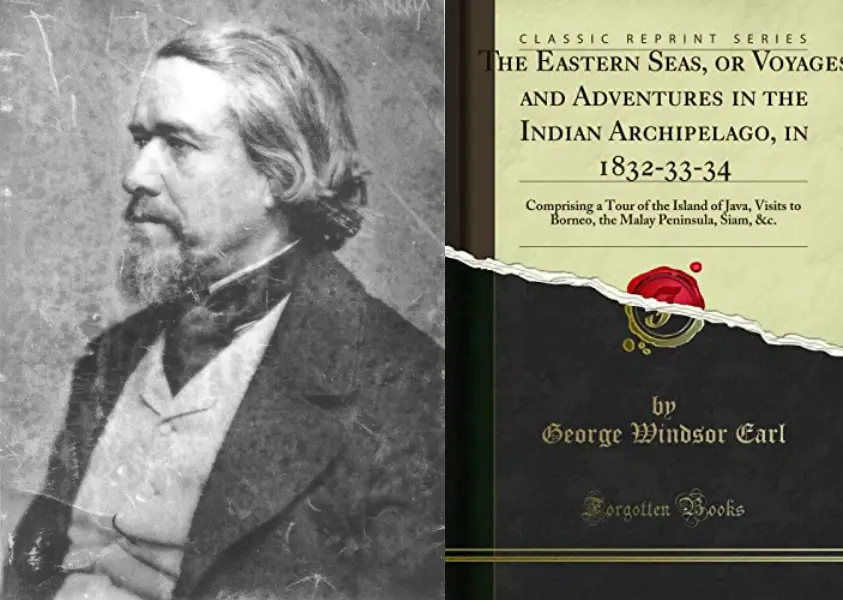
For an idea of how Borneo looked like before the Brookes, have a read of The Eastern Seas written by George Windsor Earl.

An English navigator, Earl was the first one to provide a European account of north-west Borneo’s Chinese gold miners and the incredible wealth of Borneo which included gold, diamonds and other native resources like camphor and ebony.

His voyages took him around the world including India, Southeast Asia, Papua New Guinea and Australia.

Many were inspired by his expedition and followed suit including James Brooke himself, who eventually founded the Kingdom of Sarawak and ruled the country from 1841 until his death in 1868.


The Eastern Seas
The book, The Eastern Seas and a miniature of The Royalist on display at The Brooke Gallery at The Fort Margherita.

Getting to know the author of The Eastern Seas

Born on Feb 10, 1813 in Hampstead, London, Earl was very much influenced by the world of navigation from early on. His father, Percy was a sea captain working for the East India Company. He started his nautical career by travelling to India after becoming a midshipman at age 14.

Earl was already on his journey from Western Australia bound for Java by the year 1832. Over the next two years, until about Nov 1834, he journeyed through the area he knew as “the Eastern Seas.”

Subsequently in 1835, Earl returned to London to publish his account in a book he later named The Eastern Seas or Voyages and Adventures in the Indian Archipelago in 1832-1834.

It comprised a tour of Java, Borneo, Malay Peninsular, Thailand and Singapore and observations on the commercial resources of the archipelago.

The Eastern Seas is culturally important. Interested readers can read it online through various archives.

The Eastern Seas (2)
The Eastern Seas or Voyages and Adventures in the Indian Archipelago 1832-33-34

George Windsor Earl’s work inspired many

Apart from Brooke, Earl also inspired other established naturalists and explorers.

In 1845, Earl published a pamphlet On the Physical Geography of South-Eastern Asia and Australia.

He described how shallow seas connected islands on the west for example Sumatra and Java with the Asian continent.

Furthermore, Earl found the islands on the east such as New Guinea were related to the Australian continent and reportedly had the same type of marsupials.

British naturalist Alfred Russel Wallace used Earl’s deductions to propose the faunal boundary line now known as the Wallace Line.

Charles Darwin also reportedly used Earl’s observation on deep sea channels to study the bio-geographic distribution of the region.

Another of Earl’s works ‘The Native Races of the Indian Archipelago: Papuans’, was an important work of early New Guinea anthropology.

However, he did not actually visit the island or maybe he never officially recorded his visit.

He compiled the first hand accounts of other visitors for his works on the Papuan people.

In 1850, Earl proposed the term Indunesians or Malayunesians for the people living in the Indian Archipelago or Malayan Archipelago.

Earl’s student, James Richardson Logan later popularised the name Indonesia as synonym for Indian Archipelago.

But it was only after 1900 that the term Indonesia became more commonly used.

George Windsor Earl’s death

The Eastern Seas
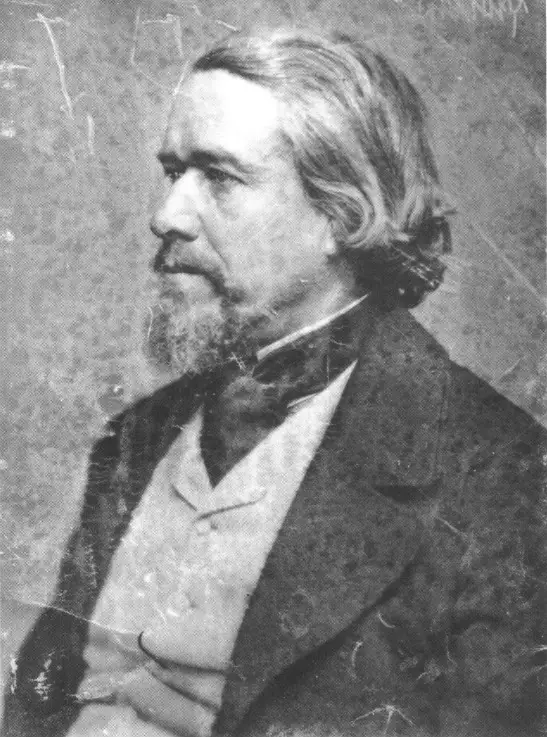
Portrait photo of George Samuel Windsor Earl (February 10, 1813 – August 9, 1865), colonial administrator, who coined the term “Indonesia”.

From 1855, he held various official administrative posts, his last one being Penang.

Earl died on his journey back to England in 1865. He was buried at the Old Protestant Cemetery, George Town in Penang.

Read more:

Toshinari Maeda, The Japanese Nobleman Who Died off the Coast of Bintulu During WWII

Charles Hose and His Love Affair With Sarawak

The dark forgotten history of the Cholera Expedition down the Batang Lupar in 1902

Famous today for the Pesta Benak, or Tidal Bore Festival, the Batang Lupar river was the site of a devastating cholera epidemic in the 1900s.

Modern-day Sarawakians might not have heard of the ‘Cholera Expedition’ that happened during the reign of the Brooke family.

But back in 1902, what was originally a military expedition against Iban rebels down the Batang Lupar river became a disaster, so much so it made headlines across the globe.

Historians and news reports back then called it the “cholera expedition” because one fifth of the 10,000 men recruited to fight against Iban rebels died of the disease.

A river runs through it

Batang Lupar flows for 275 kilometers from the Klinkang Range to the South China Sea. It has a large rivermouth and  becomes shallow upstream.

The river runs through a number of towns including Lingga, Sri Aman and Engkilili. The Batang Lupar river is the only river in Malaysia which experiences the tidal bore phenomenon. Even though it happens everyday, it becomes more spectacular at king tide during dry season.

Cholera expedition
The narrower part of Batang Lupar river near Engkilili town.

What actually happened?

Vyner Brooke, the eldest son of Charles Brooke, the second rajah of Sarawak, started his career in the then-kingdom as a cadet government officer in 1897.

He first served in Simanggang (now known as Sri Aman), then at Mukah and Oya.

In May 1900, he participated in a punitive expedition against the Muruts in Trusan. Then in June 1902, he took part in another expedition against the Ibans in upper Batang Lupar.

It was an expedition Vyner would never forget.

The expedition was to pacify Iban factions who had started a few raids against their traditional enemies – and Brooke allies – the Ibans from the lower Batang Lupar.

Branded rebels under the Brooke regime, they also refused to pay taxes or follow directives by the Brooke government to move their longhouses to the riverbank.

Charles and Vyner arrived at the fort in Lingga on June 8 where they found more than 10,000 of their Iban and Malay allies in about 800 longboats ready to fight for them.

The next morning, Vyner reported to his father that two men had died outside his bungalow.

Charles refused to listen, assuming his son was trying to escape his duty.

Then on June 9, the Rajah made his way back to Kuching leaving Vyner to carry on the expedition with two English officers, Demetrius Bailey and Harry Deshon.

The dark forgotten history of the Cholera Expedition down the Batang Lupar in 1902
A wooden bridge across Batang Lupar at Engkilili town.

Margaret Brooke’s account on the Cholera Expedition

Vyner’s mother, Margaret wrote briefly about the expedition in her book My Life in Sarawak.

“For some unexplained reason, cholera broke out amongst the force just before it had reached the enemy’s country,” she stated.

When they arrived near the rebels’ area, the force was separated into two groups. One group led by the Malay chiefs set out on foot to attack the rebels while the rest including Vyner and his two English officers were left behind.

The remaining force set up camp by the river. By this time, many had suffered from cholera.

“As the days wore on, the air was filled with the screams and groans of the stricken and dying.”

According to Margaret, it was impossible to turn back despite the fact that men were dropping dead everyday because of the “bad impression such a course would have made on the enemy.”

In the end about 2,000 men died of the disease.

She was told by the two British officers that Vyner’s presence helped to keep discipline and hope among the force.

Margaret wrote, “He was always cheerful, they said. It appears that Vyner and his two friends used to sit on the gravel bed and with a grim humour point out to one another where they would like to be buried.”

The floating bodies from the Cholera Expedition

However, the truth is some who died of cholera were not properly buried.

Although Brooke’s forces had returned successfully from battle against the rebels, they found many dead bodies and dying comrades at the camp.

Some were buried in shallow graves at the campsite while some were flung from the boats during their return journey to Simanggang.

The bodies that were brought to Simanggang were stacked into pyres and burnt.

The disease spread even more when – after hearing of the dead bodies – the upper Batang Lupar Ibans came to the campsites to cut off the heads and bring them home.

This caused more people at the upper river to get infected, with some dying from cholera.

The dark forgotten history of the Cholera Expedition down the Batang Lupar in 1902
Sculptures of doves at the roundabout in modern-day Sri Aman are reminders of the MoU signed on 20 October 1973 between the Sarawak government and the communist organisation, PARAKU. The original name of the town, Simanggang, was also changed to Sri Aman (as “aman” means “peace” in Malay) to recognise the peace declaration.

The Cholera Expedition which made world headlines

When the Ranee first read the news about the expedition, she was in Italy.

The Italian paper had mistakenly reported that the Rajah’s son died of cholera in Sarawak, as he was leading an expedition into the interior.

“I hurried to England with my younger son, Harry, who was staying with me at the time, and when we arrived at Dover, placards at the station confirmed the report. Telegrams, however, soon put out of suspense, but I had spent a terrible day.”

Not all of the reports about the Cholera Expedition were inaccurate.

There was one which made it to the pages of The San Francisco Call on July 9, 1902 with the headline “Punitive Expedition is Attacked by Cholera”.

It stated, “While Harry de Windt has been undergoing tragic experiences in Siberia, his nephew Charles Vyner Brooke, son of Rajah Brooke of Sarawak, who married De Windt’s sister, has been having terrible time in the northern part of Sarawak.”

The news reported that more than 1,000 deaths occurred among the 10,000 members of expedition within 10 days due to cholera.

It pointed out that the intensely hot weather favoured the rapid progress of the disease.

The Singapore Free Press was more straightforward in its report on the expedition: They put the blame on the second rajah’s “arrogant stupidity” for insisting to carry on the expedition despite signs of cholera outbreak.

Plus, the paper observed that with more than 10,000 people travelling along a shallow river which they also used as drinking water, with even just one case of  cholera, the rapid spread of the disease was inevitable.

The aftermath of the Cholera Expedition

According to Cassandra Pybus in White Rajah: A Dynastic Intrigue, Vyner was determined to turn his people back from the expedition.

But Bailey’s fear of the Rajah was greater than his fear of cholera so he insisted the attack must proceed.

As for Vyner, he reportedly never forgave his father for not heeding his warning.

Perhaps he was right: if only Charles had listened to his son’s plea, more than 2,000 people would have not been infected by the disease.

Margaret, however, was not that critical of his husband’s decision.

According to Margaret, the spread of this waterborne disease in the whole Simanggang area was almost fateful.

In her final note on the event, she wrote “Nothing apparently could be done to stop the disease, which disappeared as suddenly as it had come, but this calamitous epidemic destroyed nearly one-quarter of the population.”

Gerard MacBryan, the most eccentric Sarawak officer exposed

Gerard MacBryan
Gerard MacBryan after his pilgrimage to Mecca.

“There came out to Sarawak at about this time a young man who was destined to play a sinister part in the history of the Sarawak Raj.”

This is how Sylvia Brett, the last Ranee of Sarawak introduces Gerald MacBryan in her book Queen of the Headhunters.

The Brooke family governed Sarawak between 1841 and 1946. James Brooke ruled the area until his death in 1868. He was succeeded by his nephew Charles who in turn was succeeded by his son Vyner.

During the Brooke family’s reign, many British citizens were employed into Sarawak service.

One of them being Gerard MacBryan or his full name was Truman Magill MacBryan, whom some historians believed was Sarawak’s equivalent to Rasputin.

The story of Gerard MacBryan

Gerard MacBryan was the son of a doctor who owned a mental hospital near Bath, England. He was described as tall, graceful with bright eyes and ivory-white skin.

MacBryan was only 18 when he entered the Sarawak government service in 1920. Soon after MacBryan arrived in Sarawak for duty, however, rumours already began spreading about him.

According to Sylvia, “MacBryan, it was said, suffered from hallucinations that his bungalow was being attacked, and would start shooting wildly into the darkness.”

Sylvia was not the only one who recorded MacBryan’s lunacy.

Robert Payne in The White Rajahs of Sarawak stated that most of the white Sarawak officers during the Brooke reign were too busy to indulge in complicated pleasures.

“With Malays, Dyaks, Chinese, and Indians, all around them, and with a growing country to serve, they were kept occupied. Only one went mad, but he had a streak of madness in him long before he came to Sarawak.”

And of course the madman Payne referred to in his book was none other than MacBryan himself who was reported to have had a series of manic episodes.

Once in South Africa, he appeared naked at a party, and afterwards explained that he thought he was invisible. Sometimes he thought he was a dog, and would walk on all fours, barking at the top of his voice.

MacBryan also allegedly stole from shops and alms-boxes.

Gerard MacBryan and Vyner Brooke

Even so, with all the manic incidents, how MacBryan would continue to stay and serve in Sarawak was due to his relationship with the third white rajah, Vyner Brooke.

Of his first impression, Vyner told his wife, Sylvia that he thought MacBryan was “wonderful, but nuts”.

Putting aside the nuisance he presented to some of his fellow white officers, the Malay and Dayak people reportedly loved him.

MacBryan spoke fluent Malay and had even delivered a speech in Kenyah.

He also proved himself helpful by negotiating the peace-making ceremony between the Ibans and Kayans in Kapit in 1924.

Vyner nicknamed MacBryan the “Baron”, after Baron von Munchausen, the German cavalry officer who had been renowned for his fantastic and irresponsible antics.

According to historian Dr Bob Reece in The Name of Brooke, MacBryan was a man of considerable talent with an intelligence superior to that of most officers.

Reece wrote,

“More importantly, he was a skillful politician and a shrewd judge of character. He seems to have had the knack of knowing how the Rajah’s mind worked and of suggesting courses of action which would fulfil his wishes. In other words, MacBryan was capable of doing the Rajah’s thinking and decision making for him, something Vyner Brooke found very useful sometimes.”

Gerard MacBryan interfering with the succession to the throne

Vyner and Sylvia had no sons, so MacBryan began courting their young daughters. He even openly talked about becoming the next Rajah.

At one point Vyner had enough of the ‘Baron’ and fired him. MacBryan was subsequently banished from Sarawak for about four years.

During this time, he married a Malay lady, announced his conversion to Islam and even made a pilgrimage to Mecca. He had planned to make himself the Muslim ruler of the east.

MacBryan did not manage to do that but he did successfully make a return to Sarawak. By 1927, he was put in charge of Sarawak Gazette and eventually became Vyner’s secretary again.

Despite his best efforts, however, MacBryan was unable to seduce his way to the White Rajah’s throne.

But some reports claimed that he made sure the next heir apparent, Vyner’s nephew Anthony, would not make it to the throne either.

Another popular opinion was that the last Ranee was trying to push her eldest daughter, Leonora or her grandson Simon MacKay, to succeed the throne.

At the time, it was believed that Sylvia was plotting with MacBryan.

But on July 8, 1940, Sylvia wrote a letter to her brother in-law Captain Bertram Willes Dayrell Brooke (Anthony’s father) claiming her innocence.

“I happen to know more about the MacBryan plot than anyone. It began with MacBryan making violent love to Didi (Elizabeth, Vyner’s second daughter). I don’t think that Didi was more than fourteen at the time. But as you know MacBryan was determined to get into the family somehow. The whole thing has really grown from the evil seeds in MacBryan’s brain.”

Gerard MacBryan’s role in Sarawak’s cession to the British

But MacBryan’s biggest role yet in influencing Sarawak’s history was when Vyner appointed him to negotiate the terms of cession between Sarawak and the British government.

Local historian Ho Ah Chon stated in Sarawak Historical Events 1941-1945 that:

“After the war, Vyner sent out his private secretary to induce the leading Kuching Datus to sign letters in which they agreed to support any moves Vyner might think fit to make ‘in the interest of Sarawak’.”

According to reports, the letter never mentioned cession .

The community leaders signed the letters, not knowing the truth till few days later.

“One of the Datus, Datu Patinggi Abdillah, was furious when he discovered that they had been tricked, and he returned the $12,000 (all those who signed were given a large sum)- saying it was a bribe.”

And that private secretary was MacBryan.

Sylvia also wrote,“I think it can safely be said that if there had been no Gerard MacBryan there would have been no cession of Sarawak at that time — July 1946.”

When Vyner and Sylvia returned to Sarawak in 1946 to say their final farewell, the Baron was not there with them.
Sylvia stated,

“He had sworn he would see Vyner through the difficult period of Cession. After all, it was he who set the machinery in motion; who had coerced and corrupted the Malay Datus into signing papers they did not understand. And then he had simply vanished, leaving Vyner to face the music alone, to withstand the disapproval of his brother, and the shocked fury of his nephew.”

However according to Reece, this claim might not be true.

Reece stated,

“There is no way of verifying later accusations that MacBryan used trickery and even force to obtain the necessary signatures. But it is clear that he deliberately misrepresented Bertram and Anthony as having agreed to the cession.”

Nonetheless, the information retained and reproduced in a Malaysian secondary school History textbook for Form 3 was that of Gerard T. MacBryan using trickery to gain signatures from Council Negri members.

The Brooke family ceded Sarawak to the British government as a crown colony on July, 1 1946.

Life after Sarawak for Gerard MacBryan

By late 1949, there were reports of him losing his sanity. He was arrested for stealing peaches from a fruit barrow in London eventhough he had more than £40 in his pocket.

At one point, he also carried with him everywhere a mysterious black box which he said could blow up the world.

He occasionally checked himself into a mental institution in London.

Towards the end of his life, he was living in a cheap hotel in Hong Kong until he died in 1953.

Vyner believed MacBryan hanged himself although Sylvia believed MacBryan starved himself to death.

In her final mention of Gerard MacBryan in her book, the former Ranee stated, “…although he had thousands of dollars in the bank, the ‘Baron’, with his charmed and twisted dreams of powers, looked down-and-out, filthy and in rags. I never dared ask Vyner what he thought about the downfall of his friend.”

Claudetown: This historically rich town is now known as what?

Marudi is a quiet town in Sarawak famous for its kueytiaw noodles.

But did you know this town was once called Claudetown (sometimes spelled as Claude Town) not Marudi?

It was named Claudetown after Claude Champion de Crespigny who was the Resident of Baram district.

Claudetown
Marudi is also famous for its Baram regatta.

Who was Claude Champion de Crespigny?

An initial Google search of Claude Champion de Crespigny will lead you to Wikipedia page describing a British soldier and polo player. (This de Crespigny, however, committed suicide in 1910 at the age of 37.)

Marudi’s de Crespigny was born in 1829 to Reverend Heaton Champion de Crespigny and his wife Caroline.

He joined the Royal Navy in 1844 and became a fellow of the Royal Geographical Society of Great Britain.

de Crespigny was part of the French nobility during the tumultuous period of the French Revolution, which forced many aristocrats to flee France due to the political unrest.

Like many French émigrés who fled revolutionary France, he eventually made his way to Southeast Asia.  On how did this Frenchman found his way to Sarawak, that remains unclear.

Regardless, the second White Rajah Charles Brooke appointed him as the Resident of the Fourth Division (Baram and Trusan) in 1883.

Before that, he was the Resident of the Third Division (Rejang, Oya, Mukah, Matu and Bintulu).

His administration was made up of two junior officers, 30 rangers and a few native police officers.

In 1882, de Crespigny recorded in his diary that there were 18 hand-dug oil wells at the mouth of Miri river.

He found out about this when he noticed that the locals mixed the oil with resin to caulk their boats.

Unfortunately, the Brooke government didn’t put more thought to this observation until de Crespigny’s successor Charles Hose came along.

Due to this, Hose is more widely known as the important figure in discovery of oil in Sarawak.

de Crespigny died on Dec 28, 1884.

Claudetown: This historically rich town is now known as what?
The town is also home to the famous kueytiaw Marudi.

Claudetown in the 1880s

Looking back into the town history, the first foundation of Claudetown was laid on July 19, 1882.

In 1885, Charles Brooke visited Claudetown and it already had 45 attap shophouses.

The population throughout the whole of Baram area back then was mainly made up of the Kayan, Kenyah, Kelabit, Penan, Berawan, Kiput, Sebop, and Seping.

The first group of Chinese immigrants who arrived in town were the Hokkien.

They came down from Kuching in 1882 to trade.

By 1888, there were 300 Hokkiens and Teochews living in Claudetown.

Then in 1905, a Malay named Dato Sharif Hamid from Simanggang (known today as Sri Aman) introduced rubber planting in the area. Now, there is a primary school SK Dato Sharif Hamid named after him.

From Claudetown to Marudi

So why did Claudetown change its name to Marudi?

According to Miri’s official government website, it was later renamed to Marudi after a small river flowing through the town.

But local historian Chang Pat Foh had a more amusing story behind the name Marudi.

After the discovery of oil in Miri, the administrative centre of the Fourth Division was relocated from Claudetown to Miri.

Miri people back then used to tease those from Claudetown in the Iban language, “Malu dek, Kubu Claudetown udah pindah ngagai Miri.” (How embarassing for you, your fort has been moved to Miri).

Then, slowly people started to call the town “Malu dek” which eventually became Marudi.

Whether is there any truth in this playful story, that will remain a mystery for all of us.

1 2 3 14