Browse Category

Culture - Page 34

How Sarawak, the Land of Hornbills, got its name

Located in the northwest Borneo island, the Malaysian state of Sarawak is the largest state in the country.

It is nicknamed ‘Bumi Kenyalang’ or ‘Land of the Hornbills’ as these birds are culturally significant for the native people of Sarawak.

Looking back at its history, Sarawak was first established as an independent kingdom from a series of land concessions acquired by a British former soldier and adventurer, James Brooke, from the Sultanate of Brunei since 1841.

Known as The Kingdom of Sarawak, it received recognition as an independent state from the United States in 1850 and from the United Kingdom in 1864.

But how does this former kingdom and today, a state that comprises part of the Federation of Malaysia, get its name?

Here are few versions of the origin of the name ‘Sarawak’:
1.The name of a mineral

First of all, there is no consensus on how the state got its name. However, the common understanding it was named after the Sarawak river.

But then what is the origin of the name of the river?

It is believed that the river was named after a type of mineral named ‘serawak’ or ‘serewa’, which was found in the area.

According to Chang Pat Foh in Legends and History of Sarawak, ‘serawak’ means antimony in old Sarawak Malay.

In 1823, there was a discovery of antimony in Siniawan area of Bau.

Chang stated, “Since Sarawak river flows through Siniawan, it is likely that people in the olden days referred the river which flows through antimony areas as ‘Serawak’ river. Even when Sir James Brooke wrote home while contemplating his navigational plans in 1839, he was aware of the antimony ore in Sarawak. He wrote, ‘My intention is first to visit Sarawak- a river whence they get antimony ore..'”

How Sarawak, the Land of Hornbills, got its name
Sarawak may have been named after this river.
2.It is the name of a pineapple

Additionally, Chang shared another version stating it was the name of a pineapple.

Back in those days, the pineapple planted along the river was extraordinarily sweet, hence the name of the river.

3.‘Serah kepada awak’

There is this legend that the name is derived from ‘Serah kepada awak’ or ‘Give it to you’.

In the 15th century when the Brunei sultanate took over the area, the locals reportedly welcomed the move.

They told the Bruneians, “Serah kepada awak”.

Another theory was when Brooke helped Pangiran Muda Hashim in pacifying the Brunei-led rebellion, he handed the area to Brooke saying “Serah kepada awak”.

However, this legend is definitely incorrect. This was because the river was named Sarawak before Brooke arrived in this territory.

Plus, the word ‘awak’ is not part of Sarawak Malay vocabulary.

Do you know any theory or legend on how the state got its name? Let us know in the comment box.

Sarawak War Memorials in Kuching You Should Know

Sarawak had just approved a new constitution in September 1941 – a constitution that would see an end to Brooke autocratic rule and see itself transitioning to self-governance – when the Japanese invaded in December that year.

Japanese forces attacked and occupied Miri on December 16, and then Kuching on Christmas Eve, and would not surrender until 1945.

Throughout this brief occupation period, Sarawak was very much affected, and as a result, war and hero memorials were erected to honour those who sacrificed their lives for freedom.

Here are five war and hero memorials in Kuching honouring those who lost their lives during WWII that you should definitely know about.

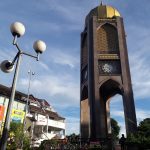
1. The Clock Tower at Jalan Padungan

Sarawak War Memorials in Kuching You Should Know
One of the earliest war and hero memorial in Kuching

If you pass by the roundabout at Jalan Padungan, you will see a clock tower just behind the White Cat Statue.

Many might not know this, but it was actually Sarawak’s first war memorial.

It was declared open in November 1952 to commemorate all Sarawak residents who lost their lives during World War II.

The idea of building a war memorial came from former Chief Secretary of Sarawak, J.B. Archer who spent years as a civil internee at the Batu Lintang Camp.

The clock tower remained as a war memorial until 1961 when a new war memorial was built at the Central Padang.

This was because the authorities thought that the space at Jalan Padungan was too cramped for big parades.

2. Sarawak Volunteer Mechanics and Drivers at Tabuan Laru

Sarawak War Memorials in Kuching You Should Know
Located at Tabuan Laru, this is one of the war and memorials in Kuching built to remember those involved in War World II

The monument was erected for Sarawak volunteer mechanics and drivers who had served in World War II.

The word ‘Nanyang’ means Southern Ocean, which refers to Southeast Asia. The Nanyang Volunteer Drivers and Mechanics was an important group that offered support to China during the war.

Sarawak War Memorials in Kuching You Should Know
Names of the mechanic volunteers

From February to September 1939, about 4,000 young men from Southeast Asia, or ‘Nanyang’ left their families and homes voluntarily to travel to China to work as mechanics and drivers during the Second Sino-Japanese War (1937-1945).

About 100 volunteers came from Sarawak, who registered through the recruitment committee of the China Relief Committee in Kuching.

Sarawak War Memorials in Kuching You Should Know

Known as “’Nanyang Huaqiao Jigong’, the volunteers also came from other parts of Malaysia, Singapore, Thailand, Burma, Vietnam, the Philippines and Indonesia.

Out of the 4000 volunteers, about 1,144 survived and 20 returned to Sarawak.

Sarawak is one of the locations in Malaysia where a monument was erected for Nanyang volunteers. Others include Kuala Lumpur, Johor Bahru and Penang.

3. Heroes Monument at Sarawak Museum ground

Sarawak War Memorials in Kuching You Should Know
The Hero Monument at the Sarawak Museum ground

The museum ground has one of the most well known war and hero memorials in Kuching.

The monument was laid by Malaysia’s first prime minister, Tunku Abdul Rahman.

Sarawak War Memorials in Kuching You Should Know
One of the war and hero memorials in Kuching that was erected to commemorate fallen heroes of Sarawak

While it may not be exclusively erected to honour those during WWII, the monument was erected to commemorate fallen heroes from past wars in Sarawak.

The museum ground is said to an old burial ground of the Chinese community in Kuching.

Sarawak War Memorials in Kuching You Should Know
Spears and shield features on the monument

Its most distinguished feature are the plaques of Sarawak’s fallen heroes who fought in different military battles.

Sarawak War Memorials in Kuching You Should Know
Plaque of Datuk Patinggi Ali on the hero monument

However, over the years the monument has lost many of its plaques. Out of nine plaques, the only remaining one is of Datuk Patinggi Ali.

4. World War II Heroes Grave at Jalan Taman Budaya

Sarawak War Memorials in Kuching You Should Know

The War World II Heroes is probably one of the most well known war and hero memorials in Kuching.

Sarawak War Memorials in Kuching You Should Know
Names of the 13 men who lost their lives to help PoW of Allied Forces in Batu Lintang and Sandakan

It was built to honour 13 men who sacrificde their lives to help the prisoners of war (POW) of Allied Forces held in Batu Lintang and Sandakan POW camps during WWII.

Eight were executed at Stapok Road in March 2nd in 1944 by the Japanese for assisting the Allied POW at Sandakan POW Camp.

The other five were arrested and imprisoned by Japanese ‘Kempetai’ until their deaths at Jawa Road Prison in Kuching.

Sarawak War Memorials in Kuching You Should Know
Gravestone of Datuk Temenggong Kanang Langkau, an Iban soldier during the Communist Insurgency in Malaysia, who passed away in 2013
Sarawak War Memorials in Kuching You Should Know
Gravestone of police officer Michael Anak Padel who was killed in Semporna by Sulu gunmen in 2013. He was the first policeman to be buried at the Heroes Cemetery.

The hero memorial also honoured 21 Iban trackers and Sarawak Rangers who fought in battlefields during the Malayan Emergency.

5. Batu Lintang PoW Campsite Memorial at the Batu Lintang Teacher’s Education Institute

The Batu Lintang Teacher’s Education Institution was once a PoW Campsite during the World War II.

A memorial plaque was made to commemorate those who did not survive during imprisonment.

One of the detainees in the Batu Lintang PoW Campsite was Bishop Peter H.H Howes.

His experiences is documented in books ‘The Lintang Camp’ and ‘In a Fair Ground’.

The Iban woman who does Malay keringkam embroidery

Keringkam embroidery is a significant artistic heritage for the Sarawak Malay community.

The word ‘keringkam’ comes from the gold or silver thread called clinquant thread used to embroider motifs on shawls and headscarves.

With traditional Sarawak Malay attire, there are two types of scarves; the shorter ones called selayah and the longer types called selendang.

In the olden days, the women would wear these keringkam embroidered scarves for special occasions such as weddings.

Charles Brooke’s wife, Margaret, was known to have loved these fine traditional embroidery, as she had several in her keeping and had also taken portraits of herself wearing the selayah keringkam.

Depending on the size of the fabric and the detail of the motifs, a piece can take up to three months to complete.

The Iban woman who does Malay keringkam embroidery
There are several types of flower motifs in traditional keringkam embroidery. The one pictured above is the ‘motif rose mekar’, or ‘blooming rose motif’.

Nowadays, only a handful of artisans know how to do keringkam embroidery. One of them is a 41-year-old Iban lady, Doris Hilda Reji, who fell in love with this Malay traditional craft.

She also happens to be the only non-Malay keringkam embroiderer in Sarawak.

Hailing from Lundu, she currently lives in Kampung Siol Kandis, and first began keringkam embroidery in 2003.

She was part of Skim Inkubator Kraf, an incubator scheme to start handicraft businesses under Malaysian Handicraft Development Corporation. She still does custom orders today.

When KajoMag met her, she was working from home embroidering keringkam as per customers’ orders.

The Iban woman who does Malay keringkam embroidery
Doris showing her first keringkam embroidering work.
KajoMag: How did you first learn how to embroider keringkam?

Doris: I was a single mother trying to learn extra skills to make a living. Back then, I took some courses at Sarawak’s Women and Family Department (JWKS) and they started to offer a keringkam embroidery class.

I was among the youngest in the group so some of the officers suggested that I sign up for it. They said since I was still in my 20s, my eyesight was still good; perfect to do intricate work of keringkam embroidery. Before taking the class, I had never heard of keringkam before.

When I first saw a selendang with keringkam embroidery, I told myself I had to learn and finish one myself. It took me about three months and I still have my first ever keringkam embroidering work.

Since I started, I did keringkam embroidery on not just scarves but clothes and decorations to put in a frame.

There were some people looking for unique souvenirs, so I turned keringkam embroidery into small bookmarks to cater for their requests.

KajoMag: How does it feel being the only non-Malay in this artistry?

Doris: I have always liked anything that is handmade so I was not choosy on what to do; as long as the finished product is something made by hand. Since there was an opportunity for me to learn, I took it without thinking about it.

KajoMag: Do you have any plans on teaching your children how to embroider keringkam?

Doris: I taught my daughter how to embroider over the three months as we waited for her SPM results. She did that before she went off to further her studies. Even now, she occasionally sits next to me and helps embroider with me.

I don’t think she would take it seriously as a career, but at least she has some basic skills on how to do it. I always welcome those who are willing to learn from me at an affordable fee.

KajoMag: What is your hope for the future of keringkam embroidery in Sarawak?

Doris: As far as I’m concerned, pua kumbu is still widely known among the Iban community because we still use it to this day, so the younger generation knows about pua kumbu.

For keringkam, however, perhaps there are not many who are familiar with this art.

There is always room to promote more about keringkam among the younger generation. If they do not learn about it, then they would have no interest in wearing anything with keringkam embroidery on it.

The Iban woman who does Malay keringkam embroidery
A closer look at Doris’ keringkam embroidery work.

How a father’s rage led to the origin of oil in Miri

British Charles Hose was the one responsible for the discovery of oil in Miri, Sarawak.

After his appointment as the Resident of Baram in 1890, Hose started mapping oil seeps in and around Miri.

He reportedly gave his findings to the Sarawak government but an oil exploration was an impossible mission back then due to its poor logistic conditions.

No one pursued the idea again until Hose retired and returned to England. There, he showed his map of oil seeps to Charles Brooke, the second White Rajah of Sarawak.

After a series of meetings, Sarawak signed the first Sarawak Oil Mining Lease in 1909, allowing the oil in Miri to be exploited.

However, according to legend there was another man who not only discovered oil, but was responsible for the origin of oil in this northern city of Sarawak.

How does the legend of the origin of oil in Miri go?
How a father’s rage led to the origin of oil in Miri

History writer Lee Fook Onn wrote in Miri Legends and Historical Stories about a family that lived in the middle course of Baram river many years ago. They came down to live there from Usun Apau highlands.

The family consisted of Balai and his wife, their son and their two daughters, Miri and Seria.

They were a happy family, with Usung famous for his hunting skills as well as Miri and Seria for their beauty.

The family owned a mortar from which black-coloured fluid would continuously flow but would never overflow.

Balai and his family would dip a piece of wood or leaf into the fluid to light a fire. This made their life easy and convenient as they saved a lot on firewood.

Time passed and the two daughters married, going off to live with their own families. Their only son Usung had died a while ago in a hunting mishap, and so Balai and his wife began to feel lonely in their own home.

The good thing was that Miri and Seria both lived nearby, so they often came back to visit their parents.

Every time they returned to their own homes, however, they brought the black fluid back with them.

Balai was not happy with that. However, their mother was more than willing to give and even used bamboo pipes to store the black fluid for her daughters.

One day, Balai caught his wife pouring the black fluid into the pipes. This time, he was so furious that he took a knife to cut the pipes. In his rage, he broke the mortar as well.

In the midst of his temper tantrum, Balai lost his balance and fell. As he struggled to get up, according to legend, he stamped the ground so hard that a heap of soil was formed. The black fluid then seeped through the ground and flowed into the sea.

This heap of soil is what Sarawakians recognise as Canada Hill today. Baram river, Sungai Melayu and several other rivers separating Miri and Seria towns (named after Balai’s daughters) are the ‘cuts’ made by Balai.

And the black fluid is the oil which now can be found in Miri and Seria.

Since Balai’s tantrum, oil has not been found in the middle course of Baram river to this day.

How Betong town in Sarawak got its name

If you look up ‘Betong’ on Google, more often than not you will probably end up with Betong, Thailand.

The Thai town of Betong is located in southern Thailand, near the Malaysian border. It is the capital of Betong District, the southernmost district of Yala province.

Meanwhile, there is another town named Betong in Sarawak, Malaysia which falls under the Betong Division.

Both these two Betong towns not only share the same names but the origins of its name…and it all comes from a plant.

How Betong town in Sarawak got its name
One of the monuments in Sarawak’s Betong town.
The origins of the name of Betong

Just like the town in Thailand, Betong derives its name from a type of bamboo called ‘buluh Betong’ in Malay.

It is also known as giant bamboo and it is a type of species native to Southeast Asia.

According to Legends and History of Sarawak by Chang Pat Foh, the scientific name of the bamboo is Dendrocalamus asper. He wrote, “In the olden days, there were plenty of buluh Betong widely grown in the vicinity of Betong area.”

In those days the area was mostly known as Saribas after the river that flows through the area.

There was no mention of ‘Betong’ in some of the books written about Brooke’s administration in Sarawak such as The White Rajahs of Sarawak by Robert Payne, Twenty Years in Sarawak by Max Saint and My Life in Sarawak by Margaret Brooke.

Due to its colourful history of anti-Brooke movement in the 19th century, there are plenty of references to Saribas.

According to Betong District Council’s website, the name ‘Betong’ was chosen collectively by both the Iban and Malay communities in the area after the abundance of bamboos there.

How Betong town in Sarawak got its name
St. Augustine Church, Betong.

The history of the bazaar can be traced back to the 1890s. Back then there were only 16 attap shophouses.

A huge fire broke out in 1915, razing the bazaar to the ground. Then, the town was rebuilt but was destroyed another fire in 1925.

Betong town and anti-Brooke movement

In 1855, a fort was built by the Brooke government in Betong. It was named Fort Lily, after Charles Brooke’s wife – Margaret Alice Lili de Windt.

The purpose of the fort was to keep the alleged Iban rebels in check.

At that time, there was an Iban leader from Padeh river called Aji. Son to Orang Kaya Pemanca Dana Bayang who led the Saribas Ibans, Aji and his followers challenged Brooke’s authority in the area, refusing to have a foreign power ruling over the Ibans.

The Brookes sent out an expedition in April 1858 to pacify the rebellion.

Fortunately, Aji survived the attack. Unwilling to give up, the Brookes ordered another attack against Aji. This time they were successful, and he was killed near Kuala Langit by Brooke’s forces.

Later, Fort Lily became the fortress from which they defended themselves against another famous Iban warrior named Rentap.

How Betong town in Sarawak got its name
The locked gate to Fort Lily.
Betong town and its agricultural history

Although the town was named after a bamboo, the symbol of Betong is a rubber tree. This is because the area was among the first in Sarawak to plant the lucrative rubber trees in the early 20th century.

As such, a monument of a rubber tree was built in 1996 and is located right in the middle of Betong town.

Besides rubber, other major crops planted here in Betong division are pepper, paddy, coconuts and oil palm.

While bamboo is not widely grown as it used to be, the agriculture industry still remains a significant economic sector for Betong to this day. Together with Sarikei, Betong division aims to be Sarawak’s food basket by 2030.

How Betong town in Sarawak got its name
The monument of a rubber tree in the town square.

Read about how other towns in Sarawak got their names:

Marudi, when it was called Claudetown

How Lubok Antu got its name

How Limbang, Sarawak town of buffaloes got its name

How the world began according to Tuaran Dusun legend

Most cultures in the world have their own unique creation myths. It is a symbolic narrative of how the world began and how people first came to live in it.

In Malaysian Borneo state of Sabah, the Tuaran Dusun people have a unique legend on how the world began.

Ivar Evans recorded in his 1922 book Among Primitive Peoples in Borneo this creation myth after an interview with the headman of Timpalang, a Dusun from Tuaran, located along the west coast of Sabah.

Interestingly, the myth supports the long debated theory that life began at sea.

Kedharingan, Munsumundok and the spirit of smallpox

“At first there was a great stone in the middle of the sea. At that time there was no earth, only water. The rock was large and it opened its mouth, and out of it came a man and a woman.

“Then, they both looked around them but they could only see water. So the woman asked the man, ‘How can we walk for there is no land?'”

They came down from the rock and tried to walk on water. To their surprise, they could! But they returned to the rock and sat down to think.

Then, they decided to walk again. After walking on water for some time, they arrived at the house of Bisagit (the spirit of smallpox). They found out that Bisagit had made land but it was very far away.

According to Tuaran Dusun legend, the man and his wife were the chief gods named Kenharingan and Munsumondok. They asked for earth from Bisagit and he agreed.

The duo returned to their rock. There they pounded the rock together with the earth Bisagit gave them. From the mixture, it became land.

Then Kenharingan made the Dusun people while Munsumondok made the sky. As it was not good for men to walk in darkness, they both created the sun.

Munsumundok then said, “There is no light at night, let us make the moon.” Hence, they created not only the moons but also the seven stars (Pleiades) as well as the kukurian (constellations).

Here comes the unexpected twist of this Tuaran Dusun legend

The couple had a son and a daughter. Now Kenharingan’s people cried because there was no food.

“So Kenharingan and Munsumundok killed their girl child and cut it up, and from the different portions of its body grew all things good to eat: its head gave rise to the coconut, and you can see the marks of its eyes and mouth on the coconut till this day; from its arm bones arose sugarcane; its fingers bananas and its blood rise.”

All the animals also arose from pieces of the child.

After Kenharingan had made everything, he said: “Who is able to cast off his skin? If anyone can do so, he shall not die.”

The snake then said, “I can.” According to the legend, this is why the snake will not die unless killed by man.

Then Kenharingan placed the Dusuns in a basket to wash them in the river. However, one of the men fell out of the basket and drifted away by the river ended up at the sea. This man, according to legend, gave rise to the Bajaus. That is why the Bajau people live by the sea and are skillful with boats.

After Kenharingan had washed the Dusuns in the river, he performed a religious ceremony over them in his house.

But one of them left the house to the jungle before Kenharingan managed to do the ceremony. When he came back, he could not enter the house because he become a monkey. So the legend has it that this man was the father of the monkeys.

Understanding the creation myth of Tuaran Dusun

Mythologists have tried to categorise the different kinds of creation myths around the world.

Romanian historian Mircea Eliade came up with the most common classifications, namely ex nihilo, creation from chaos, world parent, earth-diver and emergence.

In this creation myth from the Tuaran Dusun people, it is a mixture of earth-diver and world parent.

Both Kenharingan and Munsumundok are the earth-divers in this myth where they are sent into the primal waters to find bits of sand or mud with which to build habitable land.

Earth-divers myths are also common in Native American folklore.

Meanwhile in world parent myth, creation itself comes out from dismembered parts of the body of the primeval being.

Most of these stories have the limbs, hair, blood, bones or organs of the primeval being are somehow cut to transform into sky, earth, animal or plant.

In this case is Kenharingan and Munsumundok’s daughter in which she gives her body to create other plants.

Rajah Vyner Brooke’s message to Sarawak on Cession Day

After the end of World War II, Sarawak was briefly administered by the British Military Administration.

On July 1, 1946, the third White Rajah Vyner Brooke ceded the kingdom to the British Government.

So Sarawak became a British Crown Colony with Sir Charles Arden Clarke becoming the first British Crown Colonial Governor.

Sarawakians were conflicted and largely divided over the cession. Some felt betrayed because Sarawakians were promised self-rule according to the Nine Cardinal Principles of the rule of the English Rajah.

Rajah Vyner Brooke’s message to Sarawak on Cession Day
Sarawak anti-cession demonstration. Borneo Asian Reports [Public domain], via Wikimedia Commons

Meanwhile, the last Ranee of Sarawak, Sylvia blamed Brooke’s officer over the cession in her book stating “I think it can safely be said if there had been no Gerard MacBryan there would have been no cession of Sarawak at that time – July 1946.”

Nonetheless, Sarawak was a British Crown Colony from 1946 to 1963.

On the first anniversary of Sarawak’s Cession Day, the last Brooke ruler sent his message to the people of Sarawak in four languages; English, Malay, Iban and Chinese.
Here is the transcript of his message in English:

“On this day July 1st, I send warm greetings to all my friends in Sarawak. A year has passed since Sarawak was ceded to His Majesty the King.

I have deep thought to his proposal for cession before making it to the British Government and placing it before the Councils in Kuching. I knew that it meant the end of Brooke rule, an event which, I was proud to realise, would be matter of sorrow to very many of you. Nevertheless I took the decision because I knew that it was the best interests of the people of Sarawak and that in the turmoil of the modern world they would benefit greatly from the experience, strength and wisdom of British rule.

I have followed very closely the events of the last year and I am more than ever convinced that the decision taken was the right one. The assurances given at the time of cession that there would be no interference with your ancient customs are being scrupulously observed. At the same time large schemes for the welfare and betterment of the people have been worked out and will be put into force with the aid of funds provided by the King’s Government in Britain. I am glad that all these plans adhere to the main principles of the policy of the three Rajahs in the past, that the interests of the local population shall be paramount and that the development shall be undertaken by the people by the people and for the benefit of the people of Sarawak.

I know that there are still some in Sarawak, encouraged by persons living outside the country, who maintain their opposition to what has been done. Their cry is that they have lost their “independence” and wish to recover it. What in fact is the position? You have transferred your loyalty from the Rajah who was like your father to a greater father, the King, who has for so long been our Protector. Your feet are firmly set on the road which lead to true independence. Your local institutions are being developed, your power to express your views on laws and forms of Government is being increased, and your will gradually approach that goal, already reached by so many peoples who have had the privilege of Britain’s guidance, where you will be completely self-governing.

The length of time which must elapse before your arrive at that goal will depend largely on the willingness with which your grasp the hand of friendship and support held out to you by His Majesty’s Government. This is the greatest opportunity for progress that Sarawak has ever had. With unaltered devotion for your interests and well-being I say, “Long Live the people of Sarawak. Long Live the King.”


C. V. Brooke

One badass Sarawak legend about a coconut, dragons and the middle of the world

There was a Malay woman who gave the first Ranee of Sarawak Margaret Brooke a coconut as a parting gift before she left for England.

The woman told the Ranee that the coconut would bring her good luck.

At the same time, the woman told Margaret that the fruit came from fairyland.

Not one to pass up a good story, Margaret asked the woman to tell her the legend of the coconut and why she said it was from fairyland.

One badass Sarawak legend about a coconut, dragons and the middle of the world
A legend of coconuts and dragons

According to the woman, in the middle of the world was a place called “The Navel of the Sea.”

In this spot, two dragons guarded a tree on which these large coconuts grew, known as Pau Jinggeh.

Margaret said in her book My Life in Sarawak that “The dragons feed on the fruit, and when they have partaken too freely of it, have fits of indigestion, causing them to be seasick. Thus the fruit finds its way into the ocean, and is borne by the current into all parts of the world.

“These enormous nuts are occasionally met with by passing vessels, and it this manner some are brought to the different settlements in the Malayan Archipelago.”

The coconut that the woman brought was given by the captain of a Malay schooner. He found it bobbing up and down in the water under the keel of his boat.

What did Ranee Margaret think about local legends and superstitions?

Whether she believed that the coconut would bring her good luck, we will never know. But she did put the coconut on display in her drawing room at the Astana and according to her was “a source of great interest to the natives.”

Additionally, she wrote:

“With our ideas of European wisdom, we may be inclined to smile superciliously at these beliefs, but we should not forget that a great many of us do not like seeing one magpie, we avoid dining thirteen at table, we hate to see the new moon through glass, we never walk under a ladder, or sit in a room where three candles are burning; and how about people one meets who assure us they have heard the scream of a banshee, foretelling the death of some human being? Putting all these things together, I do not think either Malays or Dyaks show much more superstition than we Europeans do. After all, we are not so very superior to primitive races, although we imagine that on account of our superior culture we are fit to govern the world.”

Margaret Brooke, My Life in Sarawak (1913)
One badass Sarawak legend about a coconut, dragons and the middle of the world

Read about other legends on KajoMag:

A Sarawakian love story of a pirate and a slave

The legends of Pelagus Rapids, Kapit

5 interesting legends from Central Borneo recorded by Carl Sofus Lumholtz

Five Sarawak legends about people turning into stones

The legends of how paddy came to Sarawak

The legend of Mount Santubong that you never heard of

Legend of coconut and dragons of Sarawak

10 powerful quotes about native land rights from Bruno Manser’s Voices from The Rainforest

“Everyone of us has an inner voice. If you are a girl, you have the picture of a princess inside of you. If you are boy, you have the picture of a prince inside of you. May this book encourage you to follow your inner voice against all obstacles from the outside.”

Bruno Manser, Voices from The Rainforest (1992)

Bruno Manser wrote this in his book Voices from The Rainforest (1992) to introduce western readers to the life of a Penan in Sarawak. It was the only book he ever published before his mysterious disappearance in 2000.

Manser was a Swiss environmental activist, known for staying with the Penan in Sarawak. He lived with them from 1984 to 1990, learning their culture and language .

After he came out from the jungle in 1990, Manser actively voiced out against illegal logging and fighting for the rights of the Penan people.

He also founded an NGO called Bruno Manser Fonds in 1991.

Throughout his stay with the Penans, Manser kept diaries which also contained his drawings and descriptions of plants and animals.

Part of these illustrations were published in Voices from The Rainforest. In his books, he also collected testimonies from the Penans on their journey to defend their lands.

Here are ten powerful quotes by the Penan people about their native land from Manser’s Voices from The Rainforest:
1.Along Sega, from Ulu Limbang.

“Think about the trees. They did not create themselves, they don’t know how to talk. God (Balei Ngebutun, the creative spirit) created them. The earth, too, is created by God and doesn’t know how to communicate with humans. The animals are like that, too; they can talk to each other, but we don’t understand their speech. When a tree falls or is torn down by a bulldozer, its outflowing resin is its blood.

“The earth is like our mother, our father. If you from the government gives orders to the companies to invade our land, you might as well cut off our heads and our parents’ heads too. When the bulldozers tear open the earth, you can see her blood and her bones even though she can’t speak. Some company employees have fractured skulls and broken bones. Don’t you understand? It is the earth crying: ‘I don’t want to be killed.”

2.When asked why they refused to change their nomadic lifestyle, this was what Jugah Lesu from Long Ballau. According to Manser, Jugah was one of a handful Penan who spoke English fluently back then.

“Can you throw an ocean fish into a mountain river or a fish from the Ulu into the sea? They will surely die. Even though they are both fish, they have different lifestyles. We humans on earth are the same.”

He also added,

“We don’t know that (our land is government property). This land is our land, because we live on it. We roam through the forest for weeks on end without ever meeting the government. The further the company penetrates our land the emptier our bellies become. It is our bellies that make us stand up and say no to the timber companies’ destructive acts with one voice.”

3.Aiong Pada from Long Ballau

“My father is in the forest and so am I. No, building a house isn’t a project I want. The project I love is called sago palm, rattan, deer. My heart is happy in the ulu. There, I want to hear the voice of the argus pheasant, the deer and the hornbill.”

4.Berehem from Patik

“You in the town live off business, you are towkay or coolie. That’s why you ask others to work or work for others. But we are free people and live off our land. Our forest gives us life. If it gets destroyed, our customs die with it. As reward for suffering, God gives us paradise. First suffering, then reward. He doesn’t give it to idlers and lazybones.”

5.Pellutan from Ba Pulau

“In the old days, a shirt costs 50 cents. Today, it costs RM30. But our land provides us with food for free, and so, without a cent in our pocket, we have enough. Nobody tells us to sign anything or ask for the number on our identity card. What is it about the people in the town in their stores? Why do they have to install fans and air-conditioners in their apartments? They live in the heat because they have destroyed their forest. Here, under the big trees, is cool shadow. We don’t want to change places with them.”

6.Aji from Long Sembayang, Ulu Limbang

“Without our forest, we are like animals without bones, like a baby monkey fallen from its mother. Without our forest, we become orphans, and those who kill it and take away from us are like wicked step-parents to us.”

6.Uan Limun from Long Ballau

“What we need on our land are the sago palms and the rattans to weave our our mats, bags and carrying baskets, wood for blowpipes and tajem (dart poison), laue and daun (the leaves of the two dwarf palms) for our roof, pellaio (resins), ketipai, gerigit, jakan (wild species of rubber), bear and leopard… In the forest, we don’t need tinned sardine because we know how to find fish ourselves. But now, the fish in the river have disappeared, the deer have fled and rattan has become expensive.”

7.Ayat Lirong from Long Kevok

“In former times, one could hear the sound of the hornbills’ wings. Nowadays, you might as will forget about catching prey with the blowpipe or hearing your dogs rouse a deer or enjoying yourself in the clear of the river. Do we even have to tell you this? Can’t you see it yourself from the airplane? In the old days, the mountains were green, not red like now.

“ We trust and hope in God, that give us somebody who is like our father. If you wait too long, it will be too late for the lives of our crying children and wives!”

8.Saya Megut from Magoh

“We are tired of hearing bulldozers which are penetrating our land. Our land is no larger than the black edge of a finger nail. We have no other land. Come quickly! Come and see for yourselves. Be of strong heart. Success means preserving part of a primeval forest.”

9.Djauau Lat

“Our land means life. The forest gives us food and everything we need for our life.”

10.Lakei Petujek from Long Napir

“The jungle is our home and our house where all of us can find food. We need even the little trees- they are our arms and legs. When we hear the droning of a bulldozer, how can we help but be sad?”

How the story of SS Vyner Brooke will break your heart

SS Vyner Brooke started her service as the royal yacht of Sarawak. The Scottish-built steamship also worked as a merchant ship used between Singapore and Kuching.

However at the beginning of World War II, this ship owned by Sarawak Steamship Co Ltd, had a tragic ending.

Here are 5 things to know about SS Vyner Brooke:

1.She was named after the third White Rajah of Sarawak

The ship was named after Vyner Brooke. His wife Ranee Sylvia launched it on Nov 10, 1927 at Leith, north of the city of Edinburgh, Scotland.

Then the ship sailed from Leith for Singapore on Apr 17, 1928.

2.The interior of SS Vyner Brooke was clearly described in an issue of The Sarawak Gazette
How the story of SS Vyner Brooke will break your heart
A screenshot of The Sarawak Gazette published on Nov 1, 1927.

On Nov 1, 1927, The Sarawak Gazette published an article on the launching of SS Vyner Brooke.

It described the specifications and interiors of the royal yacht.

The main deck had accommodation for crews as well as a cold store room designed for temperature -2 degree Celsius.

Meanwhile, the upper deck cabin could accommodate 44 first class passengers and a large saloon for dining. The saloon was ‘panelled to the full height with polished mahogany and is provided with twenty large windows of Laycock type’.

In fact, all furniture is of mahogany and the chairs came with leather seats.

For passengers who were looking for entertainment and exercise, there was a room for deck quoits and deck tennis.

As for safety, she was equipped with lifeboats, rafts and lifebelts enough for six hundred and fifty people.

3.She was requisitioned by the Britain’s Royal Navy as an armed trader

Before the war, she sailed the waters between Singapore and Kuching under the flag of the Sarawak Steamship Company. She usually carried about 12 passengers in addition to her 47 crew.

When the war broke out, SS Vyner Brooke was considered a militarily-useful vessel. So the British Royal Navy requisitioned it as an armed trader.

Now known as HMS Vyner Brooke, the ship was painted gray and armed with guns. The crew was made of members of Malay Royal Navy Reserve as well as survivors of HMS Prince of Wales and HMS Repulse.

Both HMS Prince of Wales and HMS Repulse were sunk by Japanese aircraft on Dec 10, 1941. The wrecks now rest near Kuantan, Pahang in the South China Sea.

4.SS Vyner Brooke was bombed by Japanese aircraft and sunk

Unfortunately, the former crew of HMS Prince of Wales and HMS Repulse could not survived a Japanese attack for the second time.

On the evening of Feb 12, 1942, HMS Vyner Brooke was one of the last ships carrying evacuees leaving Singapore.

This was right before Singapore fell into Japanese hands on Feb 15, 1942.

On top of her 47 crew, there were 181 passengers, including the last 65 nurses of the Australian Army Nursing Service in Singapore, wounded servicemen as well as civilian men, women and children.

In the late afternoon on Feb 13, she was attacked by a Japanese aircraft. Fortunately, there were no casualties. By sunset, she set her sail for Palembang passing through Bangka Straits.

The next day on Valentine’s day at about 2pm, HMS Vyner Brooke was attacked by several Japanese aircraft. This time she did not survive. Within 30 minutes, she rolled over and sunk bow first.

Altogether, it is believed that 44 ships were carrying evacuees from Singapore between Feb 12 to 14. All but four were bombed and sunk as they sailed through the Bangka Straits.

Thousands of people died before any of them could reach land.

5.Some of the survivors died during the Bangka Island Massacre

According to records, there were approximately 150 survivors washed up ashore at different parts of Bangka island, east of Sumatra.

Unfortunately, Japanese troops had already occupied the then Dutch East Indies island. On Radji beach of Bangka island, a group of survivors from HMS Vyner Brooke gathered together with survivors from other vessels bombings.

What happened to them after the sinking is now known as the Bangka Island Massacre.

At first, they tried to ask for help and food from the locals but were denied due to the locals’ fear of the Japanese.

One unnamed officer from HMS Vyner Brooke had an idea. Since they had no food, no help for the injured and no chance of rescue, they considered giving themselves up as prisoners of war (POWs).

The group agreed and the officer walked to Muntok to inform the Japanese that they surrendered.

While he was away, one of the nurses – Matron Irene Drummond – instructed a group of civilian women and children to walk toward Muntok.

Those who remained on Radji beach were 22 Australian nurses from HMS Vyner Brooke and the injured.

The Massacre and aftermath

Several hours later, the officer returned with about 20 Japanese soldiers (some records stated 15).

The nurses were confident that the Japanese would not hurt them as they wore their Red Cross armbands. By right, they were Non-combatants and therefore protected under the international treaties of the Geneva Convention.

However, the Japanese started to divide the survivors into three groups. The first two groups were the male survivors who were capable of walking.

The Japanese soldiers escorted the groups down to Radji Beach and around a headland, out of the nurses’ sight.

When they heard gunshots from a distance, the survivors knew that the Japanese were not accepting their surrender.

All 22 Australian nurses and one civilian woman were in the third group. They were instructed to walk into the sea until they were waist deep.

Knowing what would happen to them, Drummond reportedly called out, “Chin up girls. I’m proud of you and I love you all.” Then, the Japanese began to shoot them down.

A nurse, Vivian Bullwinkel was the only one who survived the shooting.

Of the 65 Australian nurses on board the HMS Vyner Brooke, 12 were killed during the air attack, 21 were shot dead at Radji Beach, and 32 became POWs. Eight of the nurses did not survive the internment.

Two of its crew were taken as POWs. Some of the non-European crew members who died on board of HMS Vyner Brooke were Ahmad Rashid, Awang Adam Awang Nong, Li Wong Chuan and Phiaw Chew Teck.

1 32 33 34 35 36 38