Browse Category

Culture - Page 33

Revisiting Malaysia Solidarity Consultative Committee’s December 1961 communique

The Malaysian Solidarity Consultative Committee was an organisation formed by political leaders from the Federation of Malaya, Singapore, Sarawak and North Borneo (now Sabah).

The committee held its first meeting on Aug 25, 1961 in Jesselton (now Kota Kinabalu), Sabah.

Then on Dec 18 till 20, 1961, the committee met up again in Kuching.

Aimed to discuss the formation of the Federation of Malaysia, the meeting was chaired by Sabah’s political leader Donald Stephens.

During the meeting, the Federation of Malaya was represented by seven people headed by Muhamad Khir Johari.

Singapore had four representatives with Prime Minister Lee Kuan Yew as the head while Sarawak had eight with Datu Mustapha Datu Harun as the leader.

After the meeting, the committee released a final communique.

Revisiting Malaysia Solidarity Consultative Committee's December 1961 communique
The Malaysian Solidarity Consultative Committee held its second meeting in Kuching on December 1961. Credit: Pixabay.
The communique wrapped up on several issues raised during the meeting including:
1.Religious freedom

A number of Borneo delegates asked whether the acceptance of Islam as the official religion of the Federation of Malaya would affect the religious freedom of other communities in Malaysia.

It was explained to them that although Islam was the religion of the Federation, every person and all communities had the right to profess and practice any religion under the Federation of Malaya constitution.

The communique stated that this right would be enshrined in the constitution of the Federation of Malaysia. The North Borneo and Sarawak delegates expressed satisfaction at the clarification that all the religious orders and religious freedom would remain as at present.

2.Representation in the Federal Parliament

Some of the Borneo delegates expressed anxiety that there might not be adequate representation for them in the central legislature, because of their sparse population.

According to the communique, they were assured by the Federation delegation that the universal practice in all democratic countries was to give weightage of representation to less densely populated areas. This principle would apply to the Borneo territories, which were all rural.

3.Migration

The communique stated that the delegates from North Borneo and Sarawak expressed their fear of their people being overwhelmed by unimpeded migration from other states of Malaysia.

The Federation of Malaya delegation pointed out that the Prime Minister, Tunku Abdul Rahman, had already expressed his understanding and sympathy of the natural desire of the people of the Borneo territories not to have their territories, which are sparsely populated, flooded with migrants from the other State of Malaysia.

The Federation delegation also stated that the constitutional provisions whereby such control could be affected by the State Governments of each of the Borneo Territories could be devised by constitutional experts.

4.Civil Service

It was agreed that all state civil service appointments would be under the control of the state governments.

According to the communique, the meeting endorsed that the progressive Borneanisation of the public services would occur and that in all Federal service appointments made to the Borneo territories, the people of Borneo territories would be given priority.

The delegates also stressed that all present serving officers would continue until there were suitable local officers to fill their posts.

Importance was also given to the training of indigenous people to equip them to hold professional and executive posts in administration and commerce.

Attention was drawn to the special provision in the Federation of Malaya constitution relating to Malays. There should be similar provisions to cover the indigenous peoples of the Borneo territories.

These provisions related to matters such as scholarships, training and civil service posts. At the same time, all present legitimate interests of the other communities would also be safeguarded.

5.National Language

All nations have a national language. Whether a component state has its own indigenous or other language media of education is a matter which can be resolved by the State and Central Government.

What you need to know about Operation Claret 1964-1966

Most Malaysians are aware about the Indonesian-Malaysian Confrontation, a conflict which happened in the years 1963-1966 as a result of Indonesia’s opposition to the creation of Malaysia.

However, most may not have heard about Operation Claret, which was a long running series of secretive cross-border raids by conducted by British Commonwealth forces in Borneo.

The operation was conducted during the confrontation across the border in Indonesian Kalimantan.

Here what you need to know about Operation Claret 1964-1966:

1.What was the mission of Operation Claret?

Claret was the code name given to highly classified and never publicised operations conducted from July 1964 until July 1966 in East Malaysia (Sabah and Sarawak) across the border in Indonesian Kalimantan.

It was part of a new strategy planned to stop Indonesian incursions by forcing them onto the defensive mode.

With the agreement of the British and Malaysian government, the operation was instigated by the Director of Borneo Operations (DOBOPS) Major General Walter Walker.

During the earlier part of the confrontation, both British Commonwealth and Malaysian troops were only patrolling the border and protecting the local communities in Malaysian Borneo.

Then, the operation slowly increased their penetration into Indonesian territory from 3,000 yards, to 6,000 yards and finally 10,000 yards in April 1965.

Since these operations were about penetrating the Indonesian border and it was a matter of violation of state sovereignty, Operation Claret was highly classified. All those involved were sworn to secrecy.

What you need to know about Operation Claret 1964-1966

British Royal Marines Commando unit armed with machine gun and Sten gun patrolling using a boat in the river on Serudong, Sabah between 1963 until 1966. Credit: Malaysian Archive [Public domain]
2.Who were involved in Operation Claret?

Most Claret operatives were from the British infantry units. As for special forces operations, they were undertaken by the British Special Air Service, Special Boat Sections, Guards Independent Parachute Company, Gurkha Independent Parachute Company, patrol companies of the Parachute Regiment (C Company 2nd and D Company 3rd Battalions), the Australian Special Air Service Regiment and the 1 Ranger Squadron, New Zealand Special Air Service.

But the reconnaissance and intelligence gathering activities of the Border Scouts, mostly trained by 22 SAS, are unclear (apart from their accompanying many infantry patrols). Plus, how involved the Malaysian Army units who undertook Claret operations is also unclear.

3.What were the ‘Golden Rules’ of Operation Claret?

In order to ensure the secrecy of Operation, all operatives needed to abide what they known as the ‘Golden Rules’.

These were the rules:
Every operation will be authorized by DOBOPS
Only trained and tested troops will be used.
Depth of penetration must be limited and the attacks must only be made to thwart offensive action by the enemy.
No air support will be given to any operation across the border, except in the most extreme of emergencies.
Every operation must be planned with the aid of a sand table and thoroughly rehearsed for at least two weeks.
Each operation will be planned and executed with maximum security. Every man taking part must be sworn to secrecy, full cover plans must be made and the operations to be given code-names and never discussed in detail on telephone or radio. Identity discs must be left behind before departure and no traces – such as cartridge cases, paper, ration packs, etc.- must be left in Kalimantan.
On no account must any soldier taking part be captured by the enemy- alive or dead.

Since no soldiers, alive or dead, were to be left behind, bodies and those who were wounded had to be carried back to the Malaysian side of the border no matter what.

Thankfully for the Commonwealth forces, there were only few such cases. Officially, there was only one helicopter ‘casevac’ (casualty evacuation) from Kalimantan recorded.

There are at least two cases of soldiers being lost across the border but there are no records of Indonesians found the bodies.

4.How secretive was Operation Claret?

Then Indonesian president Sukarno, who had been vocal about his opposition on the formation of Malaysia, possibly did not even know about Operation Claret.

According to Raffi Gregorian in “Claret Operations and Confrontation, 1964-1966”, Sukarno possibly never knew about British activities in Kalimantan or that by August 1965 his soldiers were no longer operating in East Malaysia.

For any casualties during Operation Claret, the deaths were publicly reported to have happened in East Malaysia, not in Kalimantan.

Furthermore, Britain only publicly disclosed Operation Claret in 1974 while the Australia only officially admitted its involvement in 1996.

To this day, the exact number of Claret operations and their objectives are unclear.

Operational reports are available in UK National Archives but they do not identify any actions specifically to Claret. As for any incidents of ‘contacts with Indonesian forces’, the reports implied that the action took place in East Malaysia.

Although the operations were done in complete secrecy, the operatives could not hide from the local people. For instance in the Krayan Highlands near the Indonesia-Malaysia border, some of the elders have pointed out some mountain ranges where they said the British soldiers hid during ‘konfrontasi’.

This was because throughout the second half of 1965 and into January 1966, the battalion continued to prevail over the Indonesian in the valley between Long Bawan and Long Midang. During this period, every man in Company ‘C’ had spent at least half of his time actually living in Kalimantan.

What you need to know about Operation Claret 1964-1966
Local guide Alex Ballang from Krayan Highlands pointing out where British soldiers were hiding during the confrontation.
5.How did Operation Claret help to end the Indonesian-Malaysian Confrontation?

Operation Claret in a way helped to avoid any unnecessary escalation during the confrontation. By keeping Operation Claret a secret and reporting any deaths happened on Malaysian side of the border, Britain, Malaysia and Australia were able to tell the world that Indonesia was the aggressor during the confrontation.

According to Gregorian, the operation may have increased the division between Sukarno and the army officers who played an important key role in his overthrow later.

The army would not have been telling Sukarno about his military failings on his side of the border. Meanwhile, Sukarno continued to believe that the war was fought on the Malaysian side of the border.

When the Battle of Plaman Mapu in Sarawak happened on Apr 27, 1965, it became the peak battle of Operation Claret and the turning point for the confrontation.

The battle was the last attempt by Indonesian forces to launch a major raid into Malaysian territory after being defeated a number of times, especially by Claret operatives.

Indonesia lost the battle with at least 30 casualties, while two were killed and eight wounded on the British side.

Due to this, tensions continued to rise between the army and the Communist Party of Indonesia (PKI) who backed up Sukarno.

Eventually, the communists were thrown out of power and left Sukarno alone with his Confrontation.

Since, the concept of ‘Konfrontasi’ was introduced to Sukarno by PKI. Without the support of the Communists, the Confrontation quickly became unpopular in Indonesia and eventually came to an end before it escalated into a full-fledged war.

Perupun, the mysterious Lundayeh ancient burial tombs of Krayan Highlands

Long time ago, the Egyptian pyramids were built as tombs for the country’s Pharaohs and their consorts.

Here in the central region of Borneo in the Krayan Highlands, the ancient Lundayeh community built perupun to bury their dead.

Both ancient burial tombs have one thing in common, nobody really knows how exactly they were built.

Perupun, the mysterious Lundayeh ancient burial tombs of Krayan Highlands
The journey to the ancient Lundayeh tomb in Pa Rupai requires a little bit of hiking.
Perupun in Pa Rupai village
Perupun, the mysterious Lundayeh ancient burial tombs of Krayan Highlands
The hole left by tomb raiders.

According to an elder from Pa Rupai village near Long Midang Murad Baru, 73, perupun means ‘batu yang dikumpul’ or piled up stones.

It takes about 20 minutes’ hike from the main road to reach the only perupun in his village.

Nobody knows whom the tomb belongs to, but as Murad said, “This man must be a man of wealth and most probably some sort of a leader or a nobleman.”

He further explained, “Since he was without an heir, nobody was allowed to take his wealth, and he was buried together with all his belongings.

“In order to protect his wealth from tomb raiders, or his enemies from taking his head off his body, they piled up all of these stones on top of his grave.”

Perupun, the mysterious Lundayeh ancient burial tombs of Krayan Highlands
Murad standing on top of the remnants of an ancient tomb.

Murad said his grandparents used to tell him that many noblemen back then did not have any heirs. It was believed they were cursed to die without children to carry on their line by others jealous of their courage and wealth.

Over the years, the stone mound at Pa Rupai has been heavily damaged by thieves. Today, there is still evidence of a gaping hole where thieves tried to dig up the tomb.

Accroding to Murad, the perupun was damaged even before his time but he believed that whoever the thieves might be, they must be living a cursed life.

“Anybody who tries to steal from the perupun will experience misfortune until his death. Back then when I was a child, it was even forbidden for us to visit this tomb. But we became lenient over the years, and now everybody can visit these ancient tombs.”

Perupun, the mysterious Lundayeh ancient burial tombs of Krayan Highlands
Tomb raiders left a big hole in this ancient tomb at Pa Rupai.
Building a perupun
Perupun, the mysterious Lundayeh ancient burial tombs of Krayan Highlands
One of the stone mounds in Terang Baru was located right next to paddy fields.

“Can you imagine how people in the olden days managed to collect all these more than 100 big stones to build this stone mound?” Murad asked.

They most probably carried these stones from the river about 10 meters away to build the tomb.

Judging by the hole left by the thieves, the perupun could be two meters deep and the stones piled up two meters up from the ground.

“Most probably they took up to two weeks to build it. According to my grandparents, the olden community would come together at this site, cooking here, eating here, while building it.”

Since nobody could inherit the nobleman’s wealth – including his livestock – the villagers would have slaughtered all his livestock and eaten them while building his tomb.

Perupun, the mysterious Lundayeh ancient burial tombs of Krayan Highlands
Ellias Yesaya
The perupun in Terang Baru village
Perupun, the mysterious Lundayeh ancient burial tombs of Krayan Highlands
What’s left of this ancient burial tomb are scattered rocks.

In Terang Baru village, there are two perupun. Just like the perupun in Pa Rupai, nobody knows whom these tombs belong to. All they know is that they belonged to noble people because perupun are not built for commoners.

It helps that they found beads in one of the two perupun. According to Krayan native Ellias Yesaya, this particular perupun most probably belonged to a noblewoman.

Unfortunately, time and the natural elements have left both perupun in bad condition. The stones have either rolled away or collapsed and are covered in weeds.

Perupun, the mysterious Lundayeh ancient burial tombs of Krayan Highlands
The locals found beads buried in this ancient tomb.

A fence surrounds one of the perupun to prevent wandering buffalo from damaging it any further while the other perupun (the one believed to belong to a noblewoman) is located on private property.

Besides Pa Rupai and Terang Baru, perupun can also be found in Long Umung, Pa Raye, Long Layu, Long Api and Pa Kebuan. There are also jar burial sites in the Krayan Highlands which most likely belong to the commoners.

Ellias had two theories on how people in the olden days managed to build these ancient tombs.

“I think our ancestors were way taller and stronger than us. I remember in the 60s when I was still in school, they found bones in old burial grounds. Their bones were very long,” Ellias said.

Another way was that they used their strength in numbers and simply did ‘gotong-royong’ (communal work).

“The community could have come together and built this perupun,” he added.

Perupun, the mysterious Lundayeh ancient burial tombs of Krayan Highlands
Nobody knows how the olden Lundayeh people managed to carry this stone.

Crocodile mounds, where the headhunting after-party took place in Krayan Highlands

The Lundayeh people of Indonesia had the same reasons to build crocodile mounds or effigies like the Lun Bawang people in Sarawak; to celebrate successful headhunting trips.

Crocodile mounds, where the headhunting after-party took place in Krayan Highlands
Melud leading the way to one of the two sites of crocodile mounds in his village of Pa Rupai.

In the olden days, it was considered a great achievement for a man to take an enemy’s head.

Upon returning home, they would raise a pole (called ulung) on an earthen mound shaped like a crocodile.

In Krayan Highlands of North Kalimantan province today, these crocodile mounds can be found in places like Long Midang, Tang Payeh, Trang Baru and Long Layu.

Each mound is maintained by the communities who live near the area. However over the years, the shape of the crocodile on these mounds are difficult to distinguish. This is due to several factors such as soil erosion as well as trampling by animals such as buffalo.

Crocodile mounds, where the headhunting after-party took place in Krayan Highlands
Melud standing on top of a crocodile mound.
Crocodile mounds as a symbol of bravery

According to Melud Baru, 73, from Pa Rupai village of Long Midang, the Lundayeh tribe picked the crocodile as a symbol of bravery.

“According to our ancestors long time ago when we still had lamin panjang (longhouse), they made this as a symbol of bravery. They picked a crocodile because it thrives both on land and in the river,” he said.

“My grandfather told us the crocodile was an unbeatable animal. Its scales are impenetrable, it has strong jaws and teeth to bite its opponent, its tail can be used to strike its enemies.”

No other animal could ever beat the crocodile before so their ancestors picked the crocodile as their symbol of bravery.

They are specific ways to build these crocodile mounds. Most of their heads face the river,to protect the community who built them from enemies coming for them from the river.

Crocodile mounds, where the headhunting after-party took place in Krayan Highlands
Melud showing where the head of the crocodle used to be.

A headhunting after-party on the crocodile mounds

Crocodile mounds, where the headhunting after-party took place in Krayan Highlands
This what was supposed to be the head of the crocodile.

The crocodile mounds were where the celebrations took place after the headhunters came back from a successful headhunting trip.

Melud said, “Back then during our ancestors time, if there was a conflict among them, they wouldn’t talk it out like they do nowadays. The young people just gathered and went headhunting to ‘solve’ the conflicts – less talk that way.

“For headhunters who just came back from the trip, they would ‘slash’ the body of the crocodile mound using their parang just to say, ‘We are home!’ Then, they would drink and celebrate.”

The celebrations at these mounds lasted for weeks, sometimes even months.

Crocodile mounds, where the headhunting after-party took place in Krayan Highlands
Due to soil erosion, the shape of the crocodile is no longer can be distinguished.

On top of these mounds, they would erect the ulung for them to hang the heads that they claimed from their enemies.

Before the celebration, they would prepare jars of rice wine or burak. The amount of jars prepared ranged from 10 and above depending on the amount of heads they achieved. Thus, the more heads, the more rice wine they prepared.

“The weird thing is that there are no crocodiles here in Krayan, so our ancestors may have never even seen a crocodile. But they managed to build a crocodile mound. Maybe some of them had travelled far enough to have seen a crocodile,” Melud said.

Crocodile mounds, where the headhunting after-party took place in Krayan Highlands
Melud standing on top of a crocodile mound.

10 quotes by Tunku Abdul Rahman about raising living standards in Sabah and Sarawak through Malaysia in 1962

Before the federation of Malaysia was formed on Sept 16, 1963, there were meetings over meetings held attended by different delegates from Malaya, Singapore, Sarawak and North Borneo.

One of those meetings was held on Jan 6, 1962 in which the representatives met up in Kuala Lumpur. They touched upon different subjects including citizenship, transfer sovereignty, economy and special position of the indigenous peoples.

The meeting lasted for three days till Monday, Jan 8. During the closing session, Sabah’s Donald Stephens said that the pieces of Malaysia’s jigsaw puzzle had fallen into place and the picture it produced was that of a “new, vigorous and young nation in the making.”

Meanwhile, Sarawak delegation leader Yeo Cheng Hoe thanked the prime minister of Malayan federation Tunku Abdul Rahman for his desire to help Sarawak.

Singapore then president Lee Kuan Yew stated that with Malaysia there were no reasons why the standard of living of the people of the five territories should not reach that of more developed countries as we lack neither human or natural resources.

As for Tunku Abdul Rahman, he mainly talked about how Malaysia would raise the living standards of Borneo.

Here are 10 takeaway points from Tunku Abdul Rahman’s address during that meeting convincing Sabah and Sarawak to form the Federation of Malaysia:

1.“I am confident that the rate of development in the Borneo territories would be considerably increased after the merger, sufficient not only to offset or compensate for their loss of the Commonwealth Development and Welfare Funds, but to increase the tempo of their economic activities.”

2.“(About the plan to form a Federation of Borneo States) I reasoned to myself that if the people of Borneo themselves could wish to come together for their own good and well-being of their country in the form of a Federation, why then should we not join together?”

3.“The only difference would be that whereas in a Federation of Borneo States, as among themselves, the Borneo territories would continue for a long time to be colonies of Britain, in the Federation, with us they would lose the subject status immediately and would gain in stature, and which become independent territories enjoying equal rights and dignity with all other eleven states which now comprise the Federation of Malaya.”

4.“Please do not think that by embracing the territories of Borneo, Malaya is looking for territorial aggrandizement. We are linked by a common cultural heritage and historical background and financial and economic interests.”

10 quotes by Tunku Abdul Rahman about raising living standards in Sabah and Sarawak through Malaysia in 1962
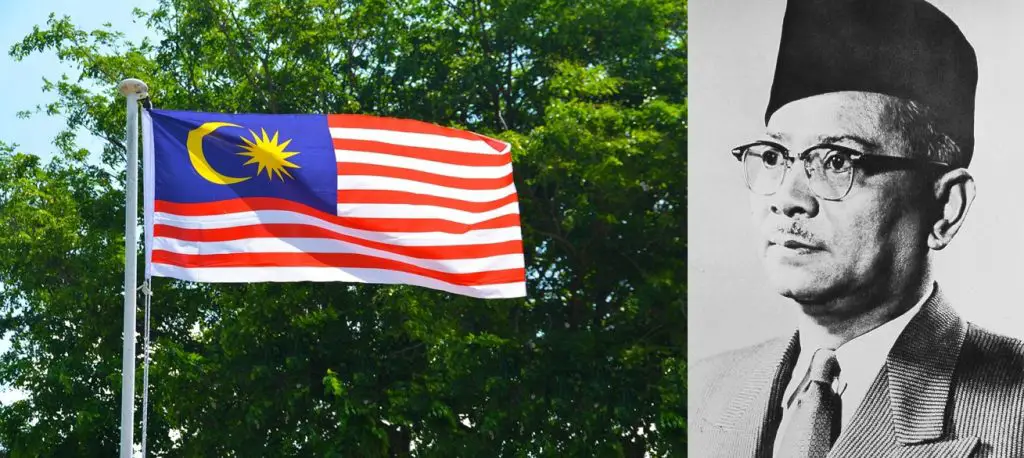
(Left) A photo of Malaysian flag and (right) Tunku Abdul Rahman.

5.“You might say that the British have promised you independence. The question is when will that come about? Should your independence depend on normal development, I do not think you will achieve it in the near future. And when your independence finally arrives, you will be exposed to a precarious existence as tiny and powerless preys to the hungry and rapacious powers of the world.”

6.“As for the poor people of the rural areas who had been neglected before (in Malaya), they are getting a better life and a better deal than they had ever had before. The same cannot be said for the people of Borneo.”

7.“There is no single railway track in the whole of mainland of Sarawak, not one road connecting one territory with another. So very little has been done to improve the lot of people living in Borneo today.”

8.“To suggest that by joining us in Malaysia the Borneo territories would not be our equals, and to suggest that by joining us they would lose their right to practice their own religion and culture to pursue their own customs and the right to study the languages of their forefathers is not true, and is a falsehood which had intentionally been spread by forces which hope to take control of these territories for themselves.”

9.“The Borneo territories too have their won aborigines who live in the most primitive way in the very deepest part of the country. But even the Ibans, Kayan, Kadazans and Melanaus – to mention a few of your indigenous peoples-suffer today such neglect as we Malays used to suffer. It sadden my heart every time I think of the fact and welfare of the sons of the soil of Sarawak and Sabah.”

10.“Therefore, it is only logical that if the Borneo territories want to secure strength through unity, they should unite with the (Malaya) Federation and Singapore which alone can give us all strength viability and unity.”

Why is there a badger on the old Sarawak coat of arms?

If you have never seen the old Sarawak coat of arms, you can spot it on the pediment above the pillars of the Kuching General Post Office on Jalan Tun Haji Openg.

There you will see the shape of an animal on top of a shield and the words “Dum Spiro Spero”.

Now comes the question what is that animal? It is actually a European badger, an animal that cannot be found in Sarawak.

If you are not familiar with a badger, remember Trufflehunter from The Chronicles of Narnia, one of Aslan’s followers?

Why is there a European badger on the old Sarawak coat of arms?

The White Rajahs were a dynastic monarchy of the British Brooke family. With the first ruler James, they founded and ruled the Kingdom of Sarawak from 1841 to 1946.

The heraldic arms of the Brooke dynasty were based on the emblem used by James. It consisted of a red and black cross on a yellow shield, crested by a badger.

This animal, in Middle English, was known as a “brock” and was also a nickname for people named “Brook” or “Brooke”. Hence the animal refers to the dynastic surname.

There are different kinds of badgers out there such as honey badger, American badger, European badger, Asian badger and Japanese badger.

The closest thing we have to the European badger (Meles meles) on the coat of arms is the Bornean ferret-badger (Melogale everetti). Although its only known certainty of location is on Mount Kinabalu and nearby regions in Sabah, it is suspected it can be found in Kalimantan and Sarawak too.

Why is there a badger on the old Sarawak coat of arms?
Sarawak’s old coat of arms (left) beside the one used today.
The current Sarawak coat of arms

Instead of a badger, we have our own Rhinoceros hornbill befitting the state’s nickname ‘Land of Hornbills’. The bird itself wears a shield on our current coat of arms. This design was established in 1988. The hornbill’s wings have 13 feathers representing all the Malaysian states.

It also features Malaysia’s national flower, the hibiscus.

Right below the hornbill is a banner bearing Sarawak’s motto “Bersatu, Berusaha, Berbakti” which means ‘Unity, Effort, Service’.

This motto was to replace Kingdom of Sarawak’s Dum Spiro Spero.

Animals that have gone extinct from Niah Cave, Miri

While 40,000-year-old human remains and rock art might be the highlights of Niah’s archaeological site, many tend to overlook the cave’s prehistoric fauna.

When archaeologists dug up the site, they found more than just pottery. They also found bones attributed to remains of food as well as charcoal from the fires they used to prepare the food.

Based on findings by Tom Harrisson, Dirk Albert Hooijer, Lord Medway (now the 5th Earl of Cranbrook) and Gustav Heinrich Ralph von Koeningswald, they found bones of animals that no longer exist.

Here the animals that have gone extinct from Niah Cave:
1.Tapir (Tapirus indicus)

The tapir has not only gone extinct in Niah Cave but from the whole of Borneo island.

A compilation of specimens from cave excavations in both Sabah and Sarawak reported that Malay tapirs once occurred in northern Borneo. They were roaming around this part of the island from the late Upper Pleistocene, ca. 45,000 years ago through Holocene to near recent dates.

The reasons that they are no longer found here are due to climate change during the post-Pleistocene era, together with restoration of the humid tropical rainforest environment which would have reduced the extent of available habitat favourable to the species.

According to research, it is possible that the final disappearance of the tapir from the island was a recent phenomenon, perhaps occurring over the last 500 years.

Now, they are found mostly throughout the tropical lowland rainforest of Southeast Asia, including Peninsular Malaysia, Indonesia, Laos, Cambodia and Myanmar.

Animals that have gone extinct from Niah Cave, Miri
2. Asian giant pangolin (Manis paleojavanica)

Recently, pangolins have made headlines for being the most trafficked mammal. Sadly, their ancestor species were most probably extinct due to humans too. The giant pangolin was 2.5 times the size of the Sunda pangolin.

Lord Medway excavated bones of the Asian giant pangolin at the Niah Cave and then Hooijer identified it in 1960.

They found that it was similar to the extinct giant pangolin in Java island.

Furthermore, carbon dating suggests that the Niah bones are about 42,000 -47,000 years old. This coincides with the presence of humans in Borneo.

Researchers believed this was the first Borneo mammal to become extinct after the arrival of humans.

Species that are extinct from Niah Cave, but not from Borneo

Apart from these, archaeologists have also found bones of other animals which no longer can be found in Niah Cave. But they can still be found in other parts of Borneo.

These include the bearded pig (Sus sp.), orangutan (Pongo pygmaeus), banteng (Bos Javanicus) and clouded leopard (Felis nebulosa).

The oldest orangutan teeth found in Niah Cave are larger than those of the biggest animals living today. These animals were possibly larger…but it is possible that maybe it was only their teeth that were larger.

Animals that have gone extinct from Niah Cave, Miri
Seduku the Orangutan enjoying her banana while hanging from a tree at Semenggoh Nature Reserve.

Meanwhile, it is undetermined if the bearded pig we have today is the same species as its ancestors.

Just like the orangutan, the bones and teeth of the prehistoric pig are very much larger than the present-day Borneo bearded pigs.

In National Parks of Sarawak, Hans P. Hazebroek and Abang Kashim Abang Morshidi suggested the smaller body size of the animals is a trend during the latest stage of evolution of the Bornean fauna.

“This trend is possibly related to changes in the environment, from the more seasonal forests of the Pleistocene to today’s rainforests.”

However looking at the extinction of the tapir in Borneo and its presence in other regions, as well as the complete extinction of Asian giant pangolin, there might be unknown factors also influencing this stage of evolution.

Tom Harrisson on the discovery of “Ships of the dead” at Niah Cave

Major Tom Harrisson was many things. He was an explorer, soldier, ethnologist, guerrilla, museum curator, writer and archaeologist.

One of his biggest contributions to Sarawak was the archaeological exploration at Niah National Park in Miri.

In October 1954, Harrisson with his two friends, Michael Tweedie and Hugh Gibb spent two weeks examining that site. After they found evidence of human occupation, they decided to come back again. This time in 1957, the Sarawak Museum organised a larger expedition with the help of transport and equipment from Brunei Shell Petroleum and Sarawak Oilfields Ltd (Shell).

Together with his wife Barbara, the expedition team discovered Deep Skull. Estimated to be 37,000 years old, Deep Skull is the oldest known modern human skeleton. Iron-age rock paintings were also found at the Painted Cave in 1958.

The rock arts were believed to be similar to those of the living culture of the Ngadju in southeast Kalimantan, Indonesian Borneo.

Here Harrisson in his own words, vividly described the discovery of what mostly now known as “Ships of the dead” and ancient wooden coffins.
Tom Harrisson on the discovery of “Ships of the dead” at Niah Cave
Tom Harrisson. Credits: BBC.

“My wife was the first person to enter this part of the labyrinth. She was so moved that she came back to the camp and burst into tears. Here, is one of the strangest, loveliest and quietest death scenes an archaeologist can wish to see. High above the valley floor, in a cave mouth beautifully coloured with green, purple, orange lichens and mosses, there is a perfectly dry, dusty floor. Upon this floor there was, until we came, no trace or sign of man’s footsteps. The cave is not, indeed, of interest to the local people. For it is one of many where there are no edible birds’ nests to attract the nest collectors; and no bats to attract the guano collectors. Only the footprints of a family of Leopard Cats patterned the floor in many directions.

In a scattered line along this floor lay a number of what at first glance appeared to be ordinary river boats. They lay ‘beached’ pointing inwards, on the dry dust. Coming closer, one saw at once that they were shallower and shorter than boats and were really coffins, each made in two parts, both boatshaped, but slotted to fit together. With each, the lower “boat” had a queer bowsprit, carved in the face of sabre-toothed dragon or tooth-bared crocodile. These boats had originally been placed on posts, one at each end. But over the centuries, all except one had fallen over. Littered on the ground around where human bones of all sorts, and a conspicuous number of shells, mostly sea-shells bored with holes. All over the ground lay pieces of earthenware and stoneware pottery.

About 15m beyond the strange, cool, incaverned beach of boats, the ceiling of the cave arches deeply down to meet the floor. Between 5 to 9m along the wall runs a sloping, and in one place a flat, ledge for about 46m. Where the ceiling runs up again above this shelf or ledge, there suddenly became apparent lines and groups of patterns, in red. It took a little while for the eye to assimilate these, to adjust to the peculiar lighting conditions. It was then easy to realise that at long last we had found actual cave drawings in Borneo. None had previously been known; and very few indeed from anywhere in this part of the world. These drawings (of which we have so far identified rather more than a hundred) range in size from a few centimetres to 120cm. All are executed in what is almost certainly red haematite, perhaps applied with frayed bamboo or with reeds tied together, is the work of people all in the same mood, and of the same culture. They have painted crouched or squatting along the shelf or under the ceiling, quite uncomfortably. The reasons for choosing this particular place are (apart from the presence of the boat-beach immediately below?) that here the cave-ceiling is unusually clean, white, free of animal or plant materials; and that though difficult it is for once practicable to work on the ceiling from below.”

The Ships of the dead now

The boat-coffins have since been transferred to the Sarawak Museum, but the paintings of these ‘Ships of the dead’ can still be viewed on the wall behind the fence at the national park.

Just like Harrisson stated, these ‘Ships of the dead’ can be difficult to see unless you allow your eyes to become accustomed to the light.

They portray ‘dancing’ human figures, often on top of the boats with arms outspread. It is believed these ‘Ships of the Dead’ are longboats carrying the souls of the deceased on the dangerous journey to the land of the dead.

Novelist Joseph Conrad and how his book “Lord Jim” was inspired by Sarawak

While W. Somerset Maugham drew inspirations from Sri Aman’s famous tidal bore, there was another British novelist whose works were inspired by Sarawak.

Joseph Conrad (1857-1924) was a Polish-British writer whose hero – Lord Jim (1900) – was famously based on the first White Rajah, James Brooke.

Besides Lord Jim, his other notable works are The Nigger of the Narcissus (1897), Heart of Darkness (1899), Typhoon (1902) and The Secret Agent (1907).

Novelist Joseph Conrad and how his book "Lord Jim" was inspired by Sarawak

Conrad in 1904 by George Charles Beresford. Credits: Public Domain.
Joseph Conrad’s Lord Jim and S.S Jeddah

Lord Jim is a novel by Conrad originally published as a serial in Blackwood’s Magazine from October 1899 to November 1900.

Jim is a first mate on an old steamer Patna carrying Muslim pilgrims to Jeddah. When the ship hits something and begins taking on water, Jim and the captain together with two other crewmen jump into a lifeboat to save themselves, leaving the passengers behind.

A few days later, they are rescued by an outbound steamer. When they reach the port, they find out Patna and its passengers are safe. The captain is then put on trial for abandoning his ship and the passengers.

The circumstances in the opening of the book are inspired by an actual event which happened to the crew and passengers of S.S.Jeddah in 1880.

On July 17 of that year, S.S. Jeddah was sailing from Singapore bound for Penang and subsequently Jeddah. When it appeared to sink during a hurricane, the captain and some of the crew abandoned ship, leaving its more than 700 passengers behind. Although, the ship did not sink in the end, a court of inquiry was held for the captain.

In the first part of the book, the circumstances and actions of Jim’s character was inspired by the scandalous Augustine Podmore Williams. He was the chief mate of S.S. Jeddah who abandoned the vessel together with its captain and other officers leaving more than 700 passengers behind.

Joseph Conrad’s Lord Jim and James Brooke

Meanwhile, the second part of the book was inspired by James Brooke’s real life exploits in Borneo. Brooke, who managed to set up an independent state of Sarawak, was fascinating for many people during those times.

In the book, Jim was a trade representative in Patusan, a fictional country on a remote island.

Novelist Joseph Conrad and how his book "Lord Jim" was inspired by Sarawak

Who grew up reading these Classics Illustrated Comics? Here’s a page from a comic adaptation ofLord Jim by George Evans in the 1950s. (https://cafart.r.worldssl.net/images/Category_3563/subcat_44275/LordJim.jpg#.XKRBOLbJSsw.link)

Away from European civilisation, the place is exactly what Jim needs because he is unable to forgive himself for what happened on the Patna.

On Patusan, Jim earns his respect from the locals by defeating Sherif Ali, a local bandit who extorts fees and steals crops from the locals.

He also protects the people of Patusan from the corrupt local Malay chief, Rajah Tunku Allang. Jim then leads the people of Patusan and they call him “Tuan Jim” or “Lord Jim”.

Sound familiar? In Sarawak, Brooke had assisted Pangeran Muda Hashim in defeating the rebels led by Datu Patinggi Ali. At that time, Sarawak was administered by Pengiran Indera Mahkota who was not a crowd favorite, just like the Conrad’s Rajah Tunku Allang.

Besides Brooke, Conrad also wrote many of his characters based on real people at that time. Stein in Lord Jim, for example, might have been inspired by Alfred Russel Wallace who wrote his hugely influential Sarawak Law paper.

In Lord Jim, Stein learned botany, occasionally sending specimens to his contact in Europe.

Moreover, Wallace’s book The Malay Archipelago (1869) was Conrad’s favorite bedside companion and used it for information in his book Lord Jim.

Was Joseph Conrad’s Patusan set at Batang Lupar?
Novelist Joseph Conrad and how his book "Lord Jim" was inspired by Sarawak

A map of the forts and villages of Patusan which appears in Henry Keppel‘s account of The Expedition to Borneo of HMS. Dido for the Suppression of Piracy (1846). Credits: Public Domain.

Conrad described Patusan as a remote backwater in the South Seas, forgotten by the rest of the world. Before Jim arrived to the country, it is ruled by various factions of native Malay people.

The famous theory of what inspired this fictional Patusan is that it might be the actual Patusan. It is a historical Sarawakian fort on the Batang Lupar river where the HMS Dido led by Captain Henry Keppel fought on behalf of Brooke in 1844.

The map of the forts and villages of Patusan was actually featured in Keppel’s account of The Expedition to Borneo of HMS Dido for the Suppression of Piracy (1846).

However, one theory pointed out that Patusan might actually by Berau which is located in East Kalimantan province in Indonesian Borneo.

This was because Conrad actually visited Berau four times during his career as a merchant marine officer.

Other than Borneo, another hypothesis theorised Patusan might be in the island of Sumatra, based on the passage route written in Lord Jim.

Nonetheless, Patrick Tourchon in a study “Joseph Conrad & Sarawak: How if Patusan were in Patusan?” strongly believed that Sarawak alone was on Conrad’s mind when he wrote Lord Jim.

Many disagreed with this theory because first of all, Conrad never actually visited Sarawak.

Tourchon argued, “But this only proves that Conrad’s knowledge about Sarawak came exclusively from books: a point nobody dreams of challenging, and which would rather confirm that Conrad left Patusan where he found it so as not to take any risk.”

Joseph Conrad and his letter to The Ranee

Scholars could continue to argue if Patusan was really located in Sarawak, but as what Tourchon wrote, they could not argue how the first White Rajah was partly the inspiration behind Lord Jim.

Conrad even gushed about Brooke in a letter to Ranee Margaret on July 15, 1920.

He wrote, “The first Rajah Brooke has been one of my boyish admirations, a feeling I have kept to this day strengthened by the better understanding of the greatness of his character and the unstained rectitude of his purpose. The book which has found of the first Rajah’s enterprise and even by the lecture of his journals as partly reproduced by Captain Mundy and others.”

Conrad also expressed his admiration on the Ranee’s autobiography. He continued, “It was never my good fortune to see Kuching; and indeed my time in the Archipelago was short, though it left most vivid impressions and some highly valued memories.”

“It was a very great pleasure to read “My Life in Sarawak”, recalling so many things (which, I, myself, have only half seen) with so much charm and freshness and a loving understanding of the land and the people. I have looked into that book many times since.”

He even admitted to Margaret that he wrote The Rescue, A Romance of the Shallows (1920) partly inspired by the Ranee’s book.

After all, drawing from inspiration and working on their own experiences is how many writers become great. For Conrad, who never visited Sarawak, he drew his inspiration from his reading experience.

What went down during 1862 Battle off Mukah

Here is a piece of Sarawak history that could inspire the next movie installment of Pirates of the Caribbean.

It is called The Battle off Mukah, a naval engagement fought in 1862 between the Sarawak navy and the notorious Illanun pirates.

Sarawakian citizens along the coast of Mukah were kidnapped by the pirates, most probably to be sold as slaves. In response, the then heir apparent of the first White Rajah, the Rajah Muda Captain John Brooke led his force in two small warships to defeat these pirates.

The preparation for the Battle off Mukah

Harriette McDougall, the wife of the first Bishop of Labuan and Sarawak Francis Thomas McDougall, recorded the Battle off Mukah in her 1882 book called the Sketches of Our Life at Sarawak.

Though she herself was not there during the battle, her husband was one of the eight Europeans on board. There were two warships; one 80-foot steamer named Rainbow and a gunboat called Jolly Bachelor.

To prepare the vessels, planks were hung over the railing to raise the rear part of the ships where there were no bulwarks.

Then, they laid mattresses inside part of the ships to receive the shots and spears from the enemy.

Together with a few dozen soldiers and sailors, the two vessels began their journey from Kuching.

The Battle off Mukah

When they were somewhere off Mukah, they came across three of the Illanun perahus.

The water along this coastline was shallow and the Rainbow had the Jolly Bachelor in tow. Brooke’s battle plan was to release the smaller ship as soon as they were in a good firing position.

After confirming with his Sarawakian Malay chief that the vessels were pirates, both Rainbow and Jolly Bachelor went after them.

Brooke described the battle in a letter to James Brooke, his uncle and the first White Rajah “The first boat, a very large and fast one, took the lead and it soon became evident that she would cross our course and get ashore before we could be up to her.”

Then, the offence against the pirates began. The first pirate perahu got away. Brooke led the steamer to sink the second one. The Rainbow was about to chase the third pirate boat when it was ran aground.

But the guns onboard were still working so they pointed them to the third boat. This forced the pirates to abandon the ship without fighting.

Brooke ordered his men to rescue the survivors hanging on to the wreckage. Some of the Illanun pirates were so relentless; continuing to fight and attack the captives with weapons even in water.

During this time, one of the rescued pirates told them that there were another three boats on the way.

True enough after an hour or so, three enemy boats approached Brooke and his ships. The two parties exchanged fire.

In the end, two of the vessels were split in two as the Rainbow ran them over. Meanwhile, the final vessel was destroyed by gunfire and sank with a valuable cargo of gold and jewels.

The rescue of the captives

After the pirate boats were destroyed, they finally could focus on the rescue.

Brooke wrote, “In a moment, the steamer was surrounded by the unhappy captives floating on pillows built of planks and every thing that came to hand. Those that were Chinese holding up their tails to show their nationality, women with children clinging to them.”

According to Brooke, it was not difficult to distinguish the captives from the pirates as the captives had ropes around their necks.

Meanwhile, the bishop who busy treating the wounded captives said they were almost living skeletons.

When the Bishop asked them if their wounds hurt, the captives answered, “Nothing hurts so much as the saltwater the Illanuns gave us to drink. We never had fresh water; they mixed three parts of fresh with four of saltwater; and all we had to eat was a handful of rice or raw sago twice a day.”

And the wounds that these captives received were even more horrifying.

Harriette wrote, “One man came on board with the top of his skull as cleanly lifted up by a Sooloo (Sulu) knife, as if a surgeon had desired to take a peep at the brain inside! It took considerable force to close it in the right place. This man had also two cuts in his back, yet the next morning he was discovered eating a large plate of rice, and he ultimately recovered. Another poor fellow could not be got up the ladder because he had a long-handled three-barbed spear sticking in his back.”

The horror in Illanun’s captivity

The survivors also shared their horrific experiences on how they were attacked and taken captive by the pirates.

The Illanun pirates usually attacked those with valuable cargo. If the ships offered resistance, they killed everybody on board and burnt the vessels.

If the pirates spared their lives, they beat them with a piece of flat bamboo over the elbows and knees, and the muscles of arms and legs. The beating continued until the captives were unable to move.

When the pirates deemed the captives sufficiently meek and obedient, they were made to row.

They put one of their own fellow captives to keep them in check. But if he did not do his job properly, they would knife him and thrown him overboard.

If the captives tried to escape and jump into the sea, the pirates speared them in the water. The poor captives rowed day and night in relays.

To keep them awake, the pirates would rub cayenne peppers into their eyes and wounds.

The Aftermath of Battle off Mukah

Overall, there were about 165 people rescued from the pirates, including two British subjects. Among them were nine women and six children, most of them from Mukah or Oya. In every pirate boat, there were 40 to 50 pirates with 60 to 70 captives.

Sadly, many of them were killed by the pirates when they realised they were about to be defeated. The captives were taken from various locations; some were on their way to Terengganu from Singapore and some at the mouth of Pontianak river.

The Illanun pirates who survived the battle and washed ashore were reportedly killed by the Melanaus along Mukah and Bintulu shorelines. Meanwhile, the Brooke government ordered the locals to give help to the captives who survived.

Of the Illanuns, 32 were taken alive with 10 of them were boys. Brooke gave the boys away to people to bring up with hopes they might be reformed. For the adults, some died because of their wounds while some were taken to Kuching to be tried and then executed.

What went down during 1862 Battle off Mukah
Piraguas piratas de los Joloanos c.1850 A depiction of garay warships used by Sulu pirates. Credit: Public Domain.
1 31 32 33 34 35 40