Browse Category

Culture - Page 17

The Japanese empire once wanted to buy North Borneo as a colony

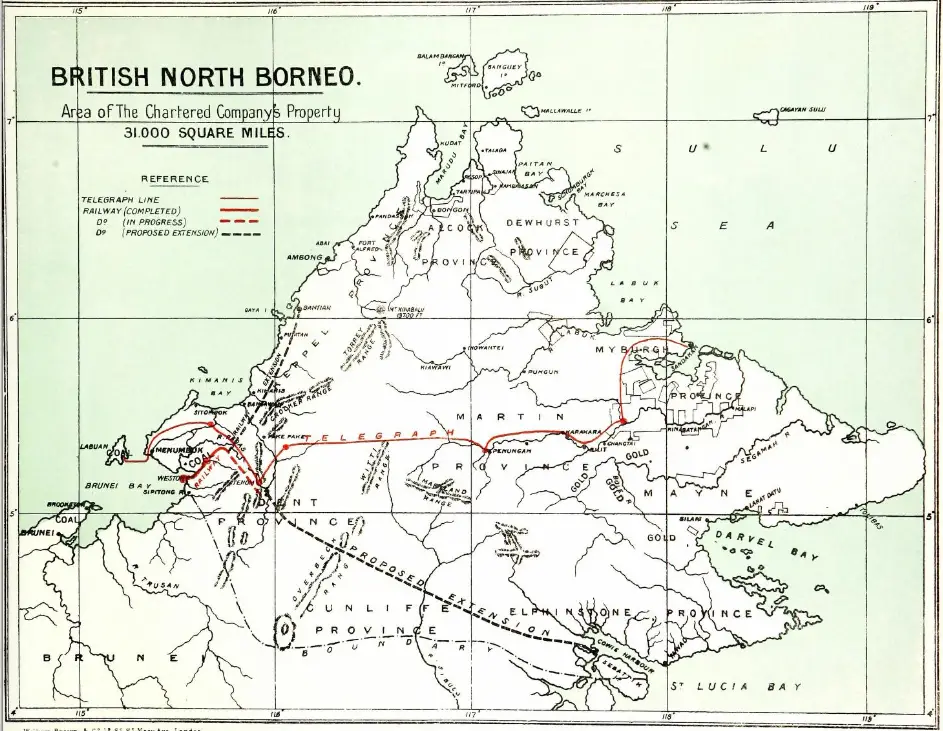
On Nov 1, 1881, the British North Borneo Chartered Company (BNBCC) was formed to administer and exploit the resources of North Borneo (present-day Sabah).

The territory then became a protectorate of the British Empire in 1888.

At that time, BNBCC was lack of funds to develop the territory.

Hence, the company started to offer territorial concessions to outside parties including the second White Rajah of Sarawak, Charles Brooke and the Japanese empire.

Apart from offering North Borneo for concessions, the company also sought outside resources for manpower to develop the territory.

After failing to secure Indian and Javanese labour, the second governor of BNBCC Charles Vandeleur Creagh wrote to Japan inquiring for labours.

Sabihah Osman in his paper Japanese Economic Activities in Sabah from the 1890s until 1941 stated the Japanese Foreign Ministry responded to the request by introducing “emigration agencies” for this purpose.

He pointed out, “The Japanese government thus encouraged emigration to the less populous and undeveloped countries. For this purpose, it amended its emigration law in 1894 in order to increase protection for Japanese immigrants, a move that led a large number of Japanese to go overseas. Besides migration Sabah, Japan sent migrants to Micronesia, the Caribbean, and North and South America.”

For the Japanese government, sending its citizens to foreign countries was a way to solve overpopulation and unemployment. Or was there another purpose?

So why was the Japanese empire willing to send their citizens to labour in North Borneo?

According to Hara Fujio in his paper Japanese Activities in North Borneo Before World War II: Focus on Labour Immigrants, sending a labourer to a new territory was the first step to colonisation.

“The theory that in order to establish a Japanese colony, agricultural emigrants should firstly be sent, followed by commodities and merchants was shared by the Shokumin Kyokai (Colonisation Association),” Haru wrote.

Organised by Japanese former Foreign Minister Enomoto Takeaki, the CA was led by an executive council consisting of influential politicians, bureaucrats, aristocrats, nationalists and expansionists.

The Japanese Consul to the United Kingdom in 1891 wrote in a report to the Japanese government that, “If several hundred to several thousand Japanese emigrated to North Borneo for agricultural purposes, Japanese villages will surely be formed there. Once villages are established, merchants would follow one after another to form Japanese towns.”

From there, the Japanese started to send citizens to North Borneo since the 1890s. Some were peasants who did not own any land in Japan.

By 1941, the Japanese community in North Borneo numbered 1,737 with 84% of them living in Tawau working various jobs such as labourers, hairdresser, barbers, physicians and dentists.

The price of North Borneo
The Japanese empire once wanted to buy North Borneo as a colony
Dr. Johnstone; A.J. West (Officers of the Company) – British North Borneo Chartered Company: Views of British North Borneo, Printed by W. Brown & co., limited, London, 1899. Credits: Public Domain.

In the same time, the Japanese also showed some interest in buying North Borneo as a colony.

Shuzo Aoki from the Envoy Extraordinary and Minister of Plenipotentiary in Berlin sent a cable on Nov 7, 1893 to the Minister of Foreign Affairs, Munenori Mutsu.

The cable stated, “Are Imperial Government inclined to buy the Territory of the North Borneo Company for value within 500,000 pounds in order to make Japanese Colony thereof? If so, I will negotiate with British Government regarding cession of its sovereign right. Area thereof is about 1/3 of Japan. An early decision required.”

Meanwhile, Shuzo himself thought that Japan should buy the territory. He envisioned that North Borneo would be a colony to absorb the problem of overpopulation in Japan and its geographical position might contribute significantly to future Japanese commercial and military purposes and interests in the area.

In the meantime, the Japanese Consul in Shanghai, General Oogashi carried out his own feasibility study about the purchase of North Borneo.

He claimed that the BNBCC would sell North Borneo on the condition that the Japanese empire agreed to guarantee a 5% dividend per annum to the company’s shareholder or pay a lump sum of £500,000.

Despite the interest of both Shuzo Aoki and General Oogoshi, the Japanese empire declined to purchase North Borneo simply because they could not afford to.

£500,000 in the year 1893 is worth around £64,672,918.22 in 2020. That is close to 65 million pounds!

Due to financial difficulties, the deal never came through and North Borneo remained under the company until 1946 when it became a British crown colony.

As for the Japanese migrants who came to North Borneo to work, all of them were repatriated to Japan after World War II.

How paddy came from a girl’s body according to a Dayak Taman legend

The Dayak Taman people is a small indigenous group found in West Kalimantan, Indonesia.

There are roughly 30,000 people in this ethnic group. Apart from the Embaloh language, the Taman language is not close to other languages in Borneo.

However, like any other Dayak groups in Borneo, the Taman people have many legends and folklore of their own.

Here is how the Taman people discovered paddy:

According to researcher Victor T. King in his paper “Main Outlines of Taman Oral Tradition”, before the discovery of paddy, the Taman people were nomadic like the Bukat and Bukitan. These two are also Dayak groups found in Borneo.

They had no knowledge of rice cultivation and lived simply off sago, jungle fruits, vegetables and fish.

So how did they discover paddy?

King, who went to a field trip to West Kalimantan from July 1972 to September 1973, interviewed a Taman elder named Bau.

Bau revealed to King a common legend known by most people of his tribe of how their people started rice cultivation.

Once there was a young girl who was an only child. One night her father dreamed that a spirit came to him and told him that his daughter must die.

It was to be the father’s job to kill her.

The spirit said that when her body disintegrated, it would became paddy and that if the father planted the paddy, it would grow and he would always have a plenty of food.

Just as in the Old Testament where Abraham was asked to sacrifice his son Isaac, the man’s decision echoed Abraham’s own.

The next day, the father called the girl to have a morning breakfast. He asked her, in a sad voice, to wear her best clothes, and after she finished her food, he asked her to lay down on a rattan mat with her eyes closed.

Killing the daughter

How paddy came from a girl’s body according to a Dayak Taman legend
Paddy. Credits: Pixabay.

The girl did not share the same fate as Isaac in the Bible.

The father then proceeded to cut his own daughter in half using a parang.

Her body started to decay and transform into paddy grains, which he then planted it in his field. However as time passed, nothing happened.

Then one day, he caught sight of an old, white-haired woman carrying a basket full of rice over her shoulder.

The old woman told him that the rice would not grow by itself.

Since it derived from a human being who has a spirit, the paddy too had its own spirit that must be pleased.

One had to perform various rituals to ‘feed’ and coax the rice.

The old woman, whose name was Piang Ambong, then taught the man different kinds of paddy ceremonies.

Since then, the Taman people have always offered gifts and prayers to paddy spirits so that they will be blessed with plenty of rice.

Read more:

Legends of how paddy came to Sarawak

That time when the Daughter of the Sea Dragon King caused a flood

In January 1963, the people of Bau, Siniawan and Batu Kawa experienced a flood like they never seen before.

Apparently, the locals believed that it was caused by the capture of the Daughter of the Sea Dragon King.

Who was the Daughter of the Sea Dragon King and how did she cause the major flooding in these areas? Here is an account of what happened written by Ong Kwan Hin to the Sarawak Gazette on Mar 31, 1963:

Readers of the Sarawak Gazette would have come across a vivid account, and have seen the pictures of the flood at Bau, Siniawan and Batu Kawa by Messrs S Cottrell and Des Carbury in the February issue.

This flood at its peak period in late January, 1963 was the worst ever experienced before in living memory. Various parts of the first division of Sarawak were affected, and in other parts of the country flooding also took place. It was a generally agreed that never before in the known history of Sarawak had there been such calamity.

The Chinese devotees of the various temples offered prayers and supplications all over the country for a heavenly release from the afflictions of the prevailing rain and stormy seas.

Signs were sought for, and horoscopes were cast, and consulted as to what the bad weather and the trouble in Northern Sarawak and beyond augured for the people.

Worshipers and devotees of the various guardian deities who manifested themselves through mediums in trances flocked to supplicate for relief and assurances.

The assurances obtained were disquieting – more affliction in the form of floods or an epidemic of sickness, seemed to be what the gods could presage of the future.

The capture of Daughter of the Sea Dragon King

On the fifteenth day of the second moon (Mar 10), the Lim Hua San Temple situated at Tabuan Road was visited by devotees, who went there to pray with incense sticks and burn joss papers and send up supplications for good weather.

In the midst of the worship one of the worshipers, who was an old woman, went into a trance. While in her trance, in which one of the several deities venerated in the temple manifested itself, the deity proclaimed that yet more terrible flood and form of mad sickness would take its toll.

For months in the Museum at Kuching (so proclaimed the deity) one of the tortoises brought from Muara Tebas had been held captive and she was a daughter of the Sea Dragon King.

The flood waters would one day rise as high as the Museum Building to release this daughter and Princess from the wooden tub in which she was exhibited.

On being asked by the devotees present as to what must be done to alleviate the prevalent bad weather resulting from the wrath of the Sea Dragon King – a deity in his own right – and to forestall such a calamity in store, the deity stated that the Princess must be released.

Pleading for the freedom of the Daughter of the Sea Dragon King

According to the deity, an appeal must be made direct to the Curator of the Museum, and the appeal must be through the writer’s eldest song, Ong Kee Hui, in his capacity as Mayor of Kuching.

On doubts being expressed by the devotees that Mr Tom Harrisson would willingly free the captured tortoise Princess, the deity stated that no matter how difficult the Curator would be, his heart could be made to relent.

If and when Ong Kee Hui had released the Princess the Ong family (according to the deity) would be honoured and visited with blessings for this generation and succeeding generations.

The Sarawak Tribune in its issue dated 14th March on the trance stated that it was medium at the Muara Tebas temple. This is not correct.

From my knowledge of both temples I know, and this can be confirmed, both do not have mediums.

I went to see the senior monk living at the Lim Hua San Temple to get a first hand account a few days before sitting down to record the above facts.

He could not tell me which deity, of which there were several in the temple, had manifested itself through the old woman worshiper.

It was generally believed to be one of the Buddhas. The identity of the old woman was not discovered as this might lead to understanding, and personal embarrassment in such a case for her and her family.

A deputation of three ladies- one the wife of a proprietor of a well-known firm in Kuching, another whose husband works with a prominent textile firm, and one of the wife of a physician -called on Mrs Ong Kee Hui on the 12th March.

Mrs Ong was told the facts and as Kee Hui was not in, she promised to take up the matter to him.

Meeting up with the Sarawak Museum

I was consulted, and on the morning Mar 12, 1963, Kee Hui made a request to Tom Harrisson, the Curator of the Sarawak Museum for the release of the tortoise to the Muara Tebas temple as it belonged to that area.

Harrisson agreed to hand it back through me as one of the trustees of the temple.

On the afternoon of the 13th March at 2.30pm, I went down to the museum accompanied by my wife, Kee Hui and his wife, and my ninth son Ong Kee Pheng to effect the release of the Princess. The Information Office which acted as ‘go-between’ was there to photograph and record the occasion. Mr Lo Chi Yin (Museum Archivist) was there to meet us.

In recognition and appreciation of Mr Harrisson’s courtesy in freeing the Princess, the Hokkien Association which looks after the Muara Tebas Temple, and of which Ong Kee Hui is the Chairman, presented the Sarawak Museum with three Jade Buddha statues.

The ‘go-between’ -the Information Office was promised the gift parchment scroll, to be suitably inscribed with an invocation to the Three Kong Deity asking for countless blessings to be bestowed on its work in the future. The Princess was left in the Museum for that night.

A search for a launch was without result, but the Heng Hua fishing folk offered us the use of a Kotak.

These people had been following the fate of the Princess with deep interest. They had even thought and talked of liberating her by kidnapping, and then be the hostages to be put in jail for this unlawful act.

As their livelihood is in the sea, they are as a people extremely careful to keep on the right side of the Sea Dragon King.

Thus they would have preferred to face an irate mortal Curator than the wrath of a deity.

Releasing the Daughter of the Sea Dragon King

Eventually my son Henry Ong succeeded in renting a speedboat from the Kuching Boat Club for $35. This plus fuel and driver charges amounted to $54 for the whole trip the cost of which were subscribed to by some devotees and members of my family.

On the morning of the 19th day of the 2nd moon (Thursday 14th March, 1963) we called at the museum for the Princess at 8.30am.

We then drove up to Pending and embarked on board the speedboat. This day was the Birthday of Kuan Im – the Goddess of Mercy, a very auspicious one for liberating the Sea Dragon Princess.

The party consisted of my wife, my fifth son Henry, Mrs Ong Kee Hui, three of the women devotees (including the two who came originally to see Mrs Ong Kee Hui) and on old monk from the Lim Hua San Temple, who chanted prayers and invocation all the way.

We were met at Pending by the Tua Kampong Dawi Aron of Kampong Semilang, Muara Tebas, who told us that he had heard the story about the Princess over the radio the previous night. He expressed regret that his capture of Her Highness had caused so much trouble.

He had found the Princess in the trap he set for catching prawns.

When we later arrived back in the afternoon we found him still waiting at Pending to find if the Princess had been safely released.

Prayers at Muara Tebas Temple

That time when the Daughter of the Sea Dragon King caused a flood
Muara Tebas Temple

On arrival at Muara Tebas at 9.30am we brought the Princess up to the Temple.

The chief nun who greeted us found that Her Highness was the same tortoise which had previously been brought by her from a Malay fisherman and liberated in the sea.

There was a small hole punched in the shell where she had put stick of incense when after chanting prayers, she had released her.

We offered incense sticks, joss papers and our prayers to the deities at the Temple. I suggested that after having been reared in fresh water, the Princess should be released on dry land.

But the deity Kuan Im indicted by signs that she must be given back to the sea.

That afternoon, on our way home, we took the speedboat right out to the middle of the exactly facing the temple.

There, while the old monk recited prayers and invocations, Her Royal Highness, daughter of the dreaded and mighty Sea Dragon King deity was released.

As she went back to her own element she went into and out over the water three times, each time stretching out her royal neck to look hard and long at us.

Then she sank away from sight and while we all repeated the “Lam Boo Oh Mee Toh Hood”, she disappeared to join the denizens of the deep.

The Consort of the released Sea Dragon King’s daughter

About one week after the Princess of Sea Dragon King was released at Muara Tebas, another tortoise was found at Matang.

This time the temple devotees claimed that it was the Consort of the Released Princess.

It was reported the tortoise was sold to a bus driver who then handed it over to the Hun Nam Siang Tng Temple of Sekama Road.

After consulting the deity, the devotees released it on the birthday of the deity at the Guan Thian Siang Tee Temple in Carpenter Street which fell on the third day of the third moon.

That year, the date fell on March 27, 1963.

This was not the first time a mystical creature was held responsible for a flood in Sarawak. In 1942 for example, a dragon was believed to be the cause of a major flood in Belaga.

The Iban legend of Batu Indai Binjut you might never have heard of

Legend has it that in Paku river at Nanga Anyut, there is a stone of three petrified women called Batu Indai Binjut.

In ancient times before the Paku region was populated by the Ibans the area sparsely inhabited by an ancient tribe of people called the Baketan.

The last of their group who left Paku took place in the days of Iban chiefs Kaya and Bayans eight generations ago.

Long before Tindin the first Iban migrant arrived in the Paku from Skrang, one sunny morning three Baketen women went out to fish (mansai) at the mouth of the Ayut stream.

As they fished an empelasi fish jumped out of the water and touched one of the girl’s breasts.

On seeing this, the girl sigh and said, “Eh! If it were only a young man, even an empelasi fish been attracted by the beauty of my breasts”.

On hearing her words her companions started to laugh and joke with one another and said that, “Even a tiny fish had wanted to covet them, so what more if a young man should see her breasts”.

They continued joking and laughing.

Invoking the wrath of gods

The Iban legend of Batu Indai Binjut you might never have heard of
The sky turns dark and the women slowly turned into stone.

As they laughed the sunshine suddenly disappeared and the sky started to become overcast, the wind blew strongly and was followed by torrential rain. Due to the heavy storm the three poor women could not find where to go.

They stood where they were and they gradually turned into stone.

It was said that up to seven days after their petrification, their heads were still able to speak and ask food from those who happened to come to that place. No one dared to give them anything, and they died due to petrification as well as due to starvation.

Even now this stone can still be seen in the shape of human beings, lying at the left bank of the Paku river below the mouth of the Anyut stream.

The mention of Batu Indai Binjut in an Iban folk song

According to Benedict Sandin, a former Sarawak Museum curator who recorded this legend, there is a mention of Batu Indai Binjut in the Iban Pengan song.

The song is about when either Simpulang Gana and Sengalang Burong became puzzled on hearing the sound of wind which came to invite him to attend the feast of men.

Here is the lyric of the song goes:

“Who amongst us angers the land and the world?
Well try and burn the remains of our derris,
And crop the hair which falls over our foreheads!
But still the wind would not stop blowing,
And the hurricane blew continually!”
“Oh! Maybe the children have collected the red ants!,
In baskets with holes
Or maybe someone has dipped a frog into a wooden trough?”
The children would reply:
The stone of Indai Binjut
At the mouth of river Anyut,
Has long been known to us, Serit Mamut,
As caused by a disaster during fishing”.

The similarity between the legend of Batu Indai Binjut and the legend of Ikan Pasit

If you feel the legend of Batu Indai Binjut sounds familiar, it is because it is almost familiar with Ikan Pasit.

The first Ranee of Sarawak, Margaret Brooke recorded this legend in her book My Life in Sarawak.

According to the legend, there was a village called Marup.

One day there was a girl who went fishing and caught what the locals called ‘ikan pasit’.

As she was preparing the fish, one of them jumped up and touched her breast.

“What are you doing? Do you imagine that you are my husband?” she said, laughing at her own joke.

The people who were there also laughed and those who heard the commotion came over and also laughed.

Suddenly, the sky turned grey and a mighty wind blew accompanied by flashes of lightning.

Then a hail-storm began. Hail stones fell down non-stop and hitting everybody even their houses, turning them into stone.

Meanwhile, the girl who made fun of the ikan pasit was only partly petrified. Just like the three Baketan ladies, the girl’s her head and neck were unchanged while the remaining part of her body was turned into stone.

Together with the rest of her village, the whole longhouse and its residents fell into the river.

Living as part human, part stone

While the Baketan women died due to the petrification and starvation, sadly for the girl, she lived many years with a living head and stone as her body.

Many tried to end her misery by striking her with a blade but nothing worked. Until one day, a man who heard her cries came.

Like many who came before him, he tried to strike her head with an axe and a sword but neither worked.

Eventually he struck her with a spindle and her cries finally stopped while her head and neck slowly turned into stone.

It is believed, the group of rocks believed to be Marup village were not far from Lubok Antu.

Efforts to rehabilitate TNKU rebels after the Limbang rebellion 1962

On Dec 9, 1962, as the Brunei Revolt took place, the North Kalimantan National Army (Tentera Nasional Kalimantan Utara, TNKU) seized the town of Limbang.

After attacking the police station, they captured several rifles and machine guns.

They even held the British resident and his wife as hostage along with 12 others.

On the morning of Dec 12, the British Royal Marine commandos were tasked to rescue the hostages.

In the end, five marines were killed and many more rebels were captured.

So what happened to the TNKU rebels after they were caught? These rebels were local Sarawakians who then believed they were fighting for a good cause.

They wanted to fight for the North Borneo Federation also known as North Kalimantan or Negara Kesatuan Kalimantan Utara (Unitary State of North Kalimantan). The proposed entity would have comprised the then British Colonies of Sarawak, British North Borneo and Brunei.

Life in detention

According to Liang Kim Bang, the Limbang district officer at that time there were 204 convictions following the rebellion.

The TNKU rebels were charged under section 6 of the Preservation of Public Security Ordinance, 1962.

Liang stated, “Most of the TNKU prisoners were sentenced to periods ranging from one to five years but one lone man, a staunch rebel leader, Salleh Sambas, after much chase and hide-and-seek was sentenced to fifteen years imprisonment.”

Some of the prisoners had been taken to prisons in Kuching, Miri or Sibu while the remainders at Limbang Prison and Detention Camp had all been released on parole.

At that time, the rest of Sarawak believed Limbang was a bloody place where rebels and criminals roamed far and wide.

However, Liang clarified, “This is not at all the picture. Just sink into the oblivion of the December Rebellion. Limbang is as peaceful and sober as any district in the country. Most of the rebels are Kedayans but not all Kedayans are rebels.”

Making room for the TNKU rebels

Due to the high number of prisoners, the Limbang prison had to make some arrangement.

The district officer explained in his report, “The prison proper which has accommodation for only sixteen prisoners managed to accommodate more than 100 detainees and prisoners. This has been made feasible by converting two paddy godown into a detention camp where all the detainees and some of the prisoners were kept.”

Nonetheless, the paddy godowns were not as ‘uninhabitable as might have thought at first though by no means a healthy place to stay in for too long’.

As for the prison staff, there were 19 wardens with only three working as permanent staff and the rest paid daily.

Commenting on the prison staff, Liang pointed out, “The relationship between warders and prisoners/ detainees is good and it was with pleasure to report that no prisoner escaped or attempted to escape during the year. Medical facilities were readily available to them in the nearby hospital, the divisional medical officer or his representative and the Board of Visitors visited the prison regularly.”

Overall, the prisoners reportedly looked healthy.

Rehabilitating the former TNKU rebels

Liang also reported on the rehabilitation of the rebels which was geared to assist the rebel families and dependents since the men had either been taken in or killed during the rebellion.

“A substantial amount of work involved in rehabilitation is undertaken by prisoners who were transported daily to work in the various paddy schemes along 4 1/2th, 7th, 8th, and 9th mile Pandaruan Road which roughly coincides with the stronghold of the rebellion.

“Monthly ration is issued and from May, 1963 to the end of the year Government has spent $27,334.56 on them. Besides providing the rebel dependents with rations, 47 of their houses and 24 durong (paddy stores) were repaired with attap. This was made possible with $500 cash contribution from the Prisoner’s Aid Society and assistance from the District Office.”

Moreover, the children whose fathers were either imprisoned or killed during the rebellion, were exempted from paying their school fees for the first half of 1963.

Helping the wives of the TNKU rebels

Meanwhile, the government also provided classes four times weekly for some 30 wives or daughters of the TNKU rebels. They learned some of the life skills including cooking, needlework, gardening and child welfare.

Liang added in his report, “Besides the assistance so far outlined which is mainly of an educational, social or relief nature, concrete assistance in the form of paddy schemes. Labour for these paddy schemes is provided by the prisoners released on parole, planting know-how and supervision was given by the Department of Agriculture and the administration in general was left to the district office. Under these schemes sixty acres of paddy were planted and these were allocated to 102 rebel families.”

According to Liang, rehabilitation of these rebel dependants was a sensitive and many-sided task that had to be handled with the greatest care and prudence to prevent from being misunderstood, misjudged or misconstrued as something else.

The Limbang Rebellion left many families without their breadwinners.

Some of the women reportedly ‘either spent their time picking pebbles at the 4th mile Pandaruan Road to sell to the local constructor or the Public Works Department for constructional works, or coming to the District Office for more rations or the more loving spent a considerable part of their time visiting their husbands in prison or detention camp.’

The rebellion was also a proof that not all marriages survived for better and for worse, as some of the wives of the TNKU rebels divorced their husbands on the ground of mental cruelty through long absence.

The plea of the Kedayans

Why did the Kedayan join the TNKU rebels? The former Sarawak Museum Curator Tom Harrisson had his explanation for this.

Other than Limbang, the Kedayans in Niah and Bekenu also supported the Brunei Revolt which opposing the inclusion of Brunei in the Malaysian federation.

Harrisson explained that the Kedayans got completely confused and misled.

 “The Kedayans have played a major role in this. There are only about less than 10,000 of them in Sarawak but they have not been taken into account. There are practically no responsible Kedayans in any positions.

They are not represented adequately in government and this applies equally to many other group in the north.”

He then gave an example of how large groups of Sarawak back then were given attention not only in administration but over the radio where only they had programmes in their language.

“They (The Kedayans) are guilty all the same, no one is denying that, but there is a lesson that the same sort of thing can happen widely and I do not think the argument is sufficient that this group is small one, therefore we can ignore it.”

If some of the minority races in Sarawak are continuously being ignored, is there possible that there will be another rebellion in the future? We might never know.

Photos from the Memorial service and the unveiling of plague at Limbang on Aug 3, 1963 to honour those who died during the Limbang rebellion. All photos are under © Commando Veterans Archive 2006 – 2016 licensed under CC BY-NC-ND 4.0.

Efforts to rehabilitate TNKU rebels after the Limbang rebellion 1962
Photo courtesy of Estelle Hart who adds ” Unveiling performed by His Excellency, the Governer of Sarawak, Sir Alexander Waddell KCMG, DSC, who laid a wreath.
Efforts to rehabilitate TNKU rebels after the Limbang rebellion 1962
The Guard of Honour provided by ‘L’ Company 42 Commando under Lt. P.S. Waters R.M.(soapy) who was wounded in the Assault on Limbang. Photo courtesy of Estelle Hart, sister of Marine Gerald ‘Scouse’ Kierans, killed in action at Limbang
Efforts to rehabilitate TNKU rebels after the Limbang rebellion 1962
Photo courtesy of Estelle Hart who adds ” Unveiling performed by His Excellency, the Governer of Sarawak, Sir Alexander Waddell KCMG, DSC. Wreaths also laid by General W.C. Walker CBE, DSO, Director of Operations, Brigadier F.C. Barton, OBE, Commander 3rd Commando Brigade, RM”

Atrocities aboard Japanese destroyer Akikaze during WWII

Adults executed, babies thrown overboard from Japanese destroyer Akikaze during WWII

If you’re a history buff, you might have heard of all kind of atrocities that took place during World War II (WWII).

However, have you heard about how adults were executed and children thrown overboard while still alive?

About Japanese destroyer Akikaze

Akikaze was a Minekaze-class destroyer that was built for the Imperial Japanese Navy immediately following the end of World War I.

In those days, the Minekaze class was considered advanced for their time. They served as first-line destroyers in the 1930s.

Akikaze was laid down on June 7, 1920 and launched on Dec 14, 1920. It was completed on Apr 1, 1921, Akikaze was commissioned on Sept 16, 1921.

During her career, she served under Torpedo Squadron 1. In 1938-1939, her division was assigned to patrols of the central China coastline in support of Japanese combat operations in the Second Sino-Japanese War.

During War World II, Akikaze was on patrol and convoy escort duties. From January to the end of April 1942, she was based at Davao (Philippines).

By May 1942, Akikaze Was based out of Rabaul, escorting transports throughout the Pacific.

Atrocities aboard Japanese destroyer Akikaze during WWII
Imperial Japanese Navy destroyer Akikaze departing Yokosuka. Credits: Public Domain.

The Prisoners-of-War (POWs) aboard Akikaze

After departing Rabaul, Akikaze moved to Wewak (Papua New Guinea) from Mar 8, 1943 to deliver medicine and supplies then to nearby Kairuru Island.

On Mar 15, the Akikaze loaded Catholic Divine Word missionaries (mostly German citizens) including Bishop Joseph Loerks, six priests, 14 friars, 18 nuns and another Chinese woman with her two children.

Two days later, 20 more civilians were brought aboard from Manus. They were German missionaries, one Hungarian missionary and Chinese civilians including six women. The second batch of missionaries were reported from the Liebenzell Evangelical Mission.

Other reports stated that the Chinese infants were the children of Wewak storekeeper Ning Hee. Additionally, the POWs who boarded from Manus were reportedly consisted of an European infant, a plantation owner named Carl Muster and plantation overseer Peter Mathies, two Chinese and four Malays. There were reports stated there were at least two Americans among the missionaries.

However, it is difficult to determine the identities of the POWs as most records were destroyed after the end of WWII.

Altogether, there was a total of sixty POWs aboard the ship including three children.

Life on board the Akikaze

At first, the POWs on board were treated with dignities. They were well fed and taken care off.

The commander even removed some of his crew from their quarters so the missionaries and children could be sheltered from Allied bombs should his ship have encountered enemy forces.

Furthermore, the ship’s surgeon was ordered to attend to the sick POWs.

Suddenly, things changed dramatically over one order.

Many historians have described the events leading to the massacre.

Bruce Gamble in his book Target: Rabaul: The Allied Siege of Japan’s Most Infamous Stronghold stated, “Akikaze’s captain, Lieutenant Commander Tsurukichi Sabe, evidently presumed he would deliver the civilians to New Britain.

Several hundred missionaries and associates were already interned at Vunapope, the largest Catholic mission in the territory.

But the message delivered at Kavieng rattled him. With a pale, somber expression Sabe gathered his officers and informed them that 8th Fleet Headquarters had issued orders “to dispose of all neutral civilians on board.””

The Akikaze crew’s testimony

Perhaps, the one would give the best account of what happened during the is one of the crew of Akikaze.

In his interrogation in December 1945, the crew member described the slaughtering (which he said took 2 hours 50 minutes) as follows:

Each internee passed beneath the forward bridge on the starboard side and came upon two waiting escorts. Here they were blindfolded with a white cloth and supported by each arm.

By this time the interrogation of the second person was begun. Meanwhile, beneath the bridge of the quarter-deck on the starboard side, both wrists of the first person were firmly tied and he was again escorted to the execution platform. On the execution platform, they were faced toward the bow, suspended by their hands by means of a hook attached to a pulley, and at the order of the commander, executed by machine gun and rifle fire.

After the completion of the execution the suspension rope was slackened and it had been so planned that when the rope binding the hands was cut, the body would fall backwards off the stern due to the speed of the ship. Moreover, boards were laid and straw mats spread to keep the ship from becoming stained.

Thus, in this way, first the men and and the women executed. The child going on toward five years old was thrown into the ocean.

The testimony of Akikaze crew can be found in the paper The Australian War Crimes Trials and Investigations (1942-51) by D.C.S. Sissons.

Appeasing the dead

Meanwhile in Slaughter at Sea: The Story of Japan’s Naval War Crimes, Mark Felton described how the executions took place.

“At a given signal the destroyer would suddenly increase speed, the noise of the engines used by the Japanese to disguise the shots coming from behind the curtain. A four-man firing squad then took aim and dispatched the victims with a single, along with a burst from Lieutenant Takeo’s machine gun. Afterwards, the body was dropped to the deck, untied and pitched over the stern of the ship as she continued on her way. Whether international or not, the nature of the prisoners’ deaths, suspended as if crucified, was the final indignity to their beliefs.”

After all the internees were killed, the captain held a short religious service in honour of the recently deceased.

The motives behind the killing

The big question is why killed them? What did they do to deserve to be executed?

Felton theorised that the Japanese suspected there was a spy among the civilians.

He wrote, “The missionaries were suspected by the Japanese authorities of using concealed radio transmitter to report the movements of Imperial Navy ships to the Americans.

The spying story was most probably concocted by the Tokei Tai naval police as an excuse to dispose of the Germans, giving them a reason to kill them within Japanese military law.”

But why kill the Germans, who were the Japanese allies? Germany and Japan were both belonged to the Axis power.

Most of the times during WWII, the Japanese helped to protect the civilians of their fellow Axis forces.

Gamble explained that the Japanese forces in New Guinea did not regard German missionaries as allies, even though Nazi Germany and Japan shared a military allegiance.

“Instead, missionaries came under the jurisdiction of the minsei-bu as neutral civilians,” he stated.

The investigation

After the war ended, many war crimes came to light including the Akikaze massacre.

According to Yuki Tanaka in his book Hidden Horrors, the staff members of the Australian War Crimes Section who investigated the massacre on the Akikaze tried to discover who issued the order for the executions.

The executions were clearly against the Geneva Convention.

Meanwhile, the Australian War Crimes Section realised that this order could not have been issued by a single and relatively low-ranking staff officer. They believed that the source was several senior staff of 8th Fleet Headquarters.

The Australians interrogated Rear Admiral Onishi Shinzo. He was at that time the chief of staff at 8th Fleet Headquarters. They also interrogated vice admiral Mikawa Gunichi, who was the commander in chief.

Onishi at first tried to avoid responsibility. He claimed that the Akikaze did not belong to the 8th Fleet but rather to the 11th Fleet.

Of course, Onishi could not lie his way out of this because the vessel clearly belonged to the 8th Fleet.

Meanwhile, Mikawa claimed that he did not issue the order to move the civilians in the first place let alone execute them.

It was possible that Onishi and Mikawa both collaborated and blamed their subordinates in order to avoid prosecution.

Moreover, the Akikaze’s captain, Lieutenant Commander Sabe and his second-in-charge both died in action during the war.

As dead men could not talk, the living could spin stories as they want.

Why did Australia refused to proceed with the charges?

In the end, the Australian War Crimes Section did not continue with the prosecution.

The official reason is that they were no Australians among the victims.

A ‘victim of war crimes’ is defined in the Australian War Crimes Act 1945 as “the provisions of this Act shall apply in relation to war crimes committed, in any place whatsoever, whoever within or beyond Australia, against British subjects or citizens of any Power allied or associated with His Majesty in any war, in like manner as they apply in relation to war crimes committed against persons who were at any time resident in Australia.”

Even though the victims had been living in an Australian territory, they were not Australian citizens.

On July 18, 1947 the Australians handed the matter over to the American authorities. The Americans in turn never took further action on the case.

What happen to Akikaze?

On May 1, 1944, Akikaze was reassigned to Destroyer 30 of the Central Pacific Fleet. Together with Yukuzi (flagship) and Uzuki (destroyer), Akikaze departed Mako Guard District heading toward Brunei.

Mako was the major navy base for the Japanese in Taiwan before and during WWII. It is located at present-day Makung, Pescadores Islands.

The ships were escorting carrier Junyo and cruiser Kiso. Two days into the journey, a US Navy submarine fired a spread of torpedoes at Junyo.

In order to save the carrier, Akikaze intercepted them sacrificing herself.

Akikaze sank with all hands at about 257 km west of Cape Bolinao, Philippines.

In the meantime, it is unsure what happened to Onishi after the war. As for Mikawa, he lived a quiet, peaceful life in Japan, dying in 1981 at the age of 92.

It has been more than 75 years passed since the Akikaze massacre, one question remains; who gave the order to kill the sixty civilians including three children?

10 things you might not know about Japanese hell ships during WWII

When we look at how Prisoners-of-War (POWs) suffered in internment camps or death marches during World War II (WWII), little do most people know about the atrocities onboard Japanese hell ships.

‘Hell ship’ describes a ship with extremely inhumane living conditions or with reputation for cruelty among the crew.

The term was coined during the American Revolution when the British were shipping American prisoners of war. While the term was also used for German POWs transports, ‘hell ship’ now generally refers to the ships used by the Imperial Japanese Navy and Imperial Japanese Army to transport Allied POWs and romushas during WWII.

Romusha is a Japanese word for labourer. During WWII, it is a term to refer Asian (mainly Indonesians) forced slave labourers.

The Japanese began transferring POWs by sea in May 1942. On board these ships, there was no escape for these prisoners.

10 things you might not know about Japanese hell ships during WWII
Plaque dedicated to the survivors of the P.O.W. Hell Ship Shinyo Maru, sunk by USS Paddle (SS-263) on 7 September 1944. Credit: Public Domain.

Here are ten things you should know about about Japanese hell ships during WWII:

1.Some survivors said Japanese hell ships were worse than the death marches

In 2012, American film producer Jan Thompson created a film documentary on the Japanese hell ships and POWs camps titled ‘Never the Same’.

She was inspired by her own father, who was one of the war veterans who survived the hell ships.

Thompson told Chicago Tribune in 2013, “Men who were on the Bataan Death March said the hell ships were worse and it’s a story that nobody knows.”

The Bataan Death March saw the transfer of 60,000-80,000 American and Filipino POWs from Bataan to Capas in the Philippines. The estimated casualties during the march range from 5,650 to 18,000 of POW deaths.

Thompson estimated 14,000 Allied POWs died on the Japanese hell ships. They either froze or starved to death. There was so little food that Thompson’s father resorted to eating undigested oats in horse manure in the ship’s hold.

Others suffocated when they were crammed in spaces that reached 120 degrees.

2.Not all Japanese hell ships were hellish

Not all POW-carrying Japanese ships were left under these cruel conditions. They may not have been five-star cruise ships either but they were somehow bearable.

One of them was Nagara Maru. On Aug 11, 1942, 179 American POWs departed Manila heading for Formosa (Taiwan).

The short voyage to Taiwan aboard Nagara Maru could not be strictly termed a hell ship voyage.

It was reported that the POWs were well-treated, well-fed and did not live in over-crowded conditions. Aboard the ship, there were two generals. They were given the same food as the Japanese officers. They slept on comfortable mats, had access to a clean bathroom and were allowed on deck at anytime.

The colonels and other POWs, however, found their stay aboard less satisfactory. There were 14 men forced to sleep toe-to-toe in each of the 13 foot deep berths.

Their meals consisted of rice with small pieces of fish, picked vegetables or fruits and seaweed.

Water and hot tea were provided. As for sanitation, there was a tub provided as well as access to deck and toilets.

Pacific Maru was another ‘bearable’ Japanese hell ship. On Dec 28, 1942, about 72 (perhaps 85) POWs were taken to Tanjung Priok, Java to Singapore.

According to witnesses aboard the ship, the journey was probably one of more bearable hell ship voyages, partly because there was a small number of POWs aboard and the short duration of three day journey.

3.Why many Japanese hell ships were sunk and bombed by Allied forces

Overall, more than 20,000 Allied POWs are estimated to have died at sea when the transport ships carrying them were attacked by Allied submarines and aircraft.

The Japanese could have identified the merchant vessels they used for prisoner transport by painting or putting a white cross on the ship, but they refused — violating the terms protecting POWs under the Geneva Convention.

They reportedly used transports bearing these Red Cross markings for their weapons while the ships carrying POWS were unmarked.

Due to this, the Japanese transports were often targeted by American carriers and submarines.

Nonetheless, it was believed that the Allied forces knew that some of these ships were carrying POWs after cracking shipping codes relayed among the Japanese.

So why did they bomb POW ships?

According to Greg Michno in Death on the Hellships, they opted to attack POW transport because to leave them untouched while sinking other Japanese shipping would have indicated to the Japanese that their codes had been compromised.

4.Even if POWs survived the sinking, many were not rescued

Many have said that the true character of a person is revealed in the time of crisis. What is the bigger crisis other than a sinking ship?

There were different accounts from survivors of how these POWs dealt with the situation when they were drifted in the ocean waiting for rescue.

In the case of Tamahoko Maru, the sinking showed the best of humankind.

The survivors’ report stated, “Finding themselves in the water, most prisoners managed to gain these rafts or other wreckage and settled down with the Japanese survivors to wait for dawn, all nationalities helping each other.”

However, this beautiful moment did not last long as Japanese vessels returned only to pick up the Japanese, leaving the prisoners on the wreckage.

5.Some were rescued by the same vessels which sunk them

SS Rakuyo Maru was transporting 1,317 Australian and British POWs from Singapore to Formosa in Sept 1944. Another ship in the convoy was SS Kachidoki Maru with another 950 on board.

On Sept 12, the convoy was attacked in the Luzon Strait by three US submarines.

Both Japanese vessels were torpedoed and sunk, killing around 1,159 POWs. As some of the POW survivors tried to row their way towards land in lifeboats the next day, they were bombarded by a Japanese navy vessel.

On Sept 15, the three US submarines returned and rescued 149 surviving POWs who were on rafts. Four more died before they could make it on land.

One of SS Rakuyo Maru’s survivors Roydon Charles Cornford wrote his account of survival in 1982.

The survivors saw a lot of dead POWs floating around. They took life jackets off the dead Japanese and busted them open to use the kapok to wipe the oil out of their eyes and off their faces.

At one point, it started to rain with all of the prisoners looking up to the sky with open mouths to catch any water they could.

While drifting in the sea not knowing what happened to him, Cornford shared, “We never once talked about not surviving.”

When he was rescued, Cornford pleaded his rescuers not to grab his arms because they were just blisters and sores.

6.There were mixed reactions on board on these bombings.

So how did the POWs felt seeing their own countrymen bombing their ships?

Kelly E. Crager in Hell under the Rising Sun recorded the reactions of POWs aboard Dai Moji Maru when their ship was torpedoed by the US.

“The bombing raid was quite literally a near-death experience for the POWs, and they responded in different ways. Some expressed elation that the Americans were disrupting Japanese shipping at this stage of the war and in this part of the world.

“They reasoned that if the Americans were capable of this kind of action, the war would soon be over. Houston sailor Seldon Reese cheered the American bombers, shouting from the hold: ‘Hit the son-of-bitch! Sink the bastard! Others received a morale boost from the American bombing, although they admitted that they hoped their ship would emerge unscathed.

Lester Rasbury had mixed emotions about the bombing: ‘I was kind of hoping to take up for myself, if I could. But we were glad to see it, and we weren’t, either. We at least knew (the US Army Air Forces) were still doing something.’

Kelly Bob Bramlett described his reaction: ‘Well, you hate to get it from your own people, but you’re glad to see them out, too, you know’.

To Johnny Buck, the reaction was simple: ‘I guess I was partial toward the Americans, but I wasn’t caring about them hitting us’.

Wade Webb spoke for many others: ‘I guess I had to pull for the Japs, because I wanted to stay afloat. You know you can’t straddle the fence, so I had to go with the Japs on this one.’”

10 things you might not know about Japanese hell ships during WWII
Oryoku burning after attack on 15 December 1944 about 11 AM. Photo by a Hellcat from USS Hornet shows POWs swimming in the water. Public Domaim

7.One Japanese hell ship executed all of its POWs (including throwing babies overboard alive)

While these POWs were alive to tell their tales, not all were lucky enough like them. One of the most gruesome scenes of WWII took places in one of these Japanese hell ships.

Akikaze was a Japanese destroyer and performed patrol as well as convoy escort duties during WWII.

After departing Rabaul, the Akikaze moved to Wewak from Mar 8, 1943 to deliver medicine and supplies, then to nearby Kairuru Island.

On Mar 15, 1943, Catholic missionaries including Bishop Joseph Loerks, six priests, 14 brothers, 18 nuns and one Chinese woman with her two infants were loaded onto Akikaze.

At first, the passengers were treated with dignity, even given a rear cabin and tea, water and bread. Their sea sickness were even treated by the ship’s doctor.

The destroyer proceeded northward and anchored off Lorengau on Manus Island overnight.

Then on Mar 17, 1943 twenty more civilians were brought aboard from Manus. The POWs included German missionaries, one Hungarian missionary and Chinese civilians including six woman. Now there were a total of sixty prisoners aboard the ship.

The apparent intention was to carry them to internment in Rabaul.

However, it was reported, “between Manus and Rabaul each of the adults was strung up by the hands on a gallows in the stern of the vessel, shot dead by rifle or machine-gun fire, and thrown overboard. The two Chinese infants and the European baby were thrown over alive.”

8.Journeying on these ships weaken the POWs

Even if these POWs were safely arrived at their destinations, their hellish experiences did not end on hell ships.

Suffering from diseases and malnutrition, these POWs continued to suffer even when they arrived at the POWs camps.

On Nov 6, 1943, 1230 Dutch POWs departed Singapore for Japan aboard Hawaii Maru.

They were provided with little amount of food consisted of a rice porridge and vegetable of food.

On Nov 27, their convoy was attacked near northern Taiwan. Another large transport (Hakone Maru) was sinking and an escort vessel (Tomodzuru) had been damaged.

The Hawaii Maru stopped up to rescue about 900 survivors, cramping the already crowded ship.

According to reports, Hawaii Maru arrived Moji, Japan on Dec 3, 1943. The prisoners were then moved to camps in Fukuoka, Kokura, Moji and Miyata. Some were sent to Shimonoski and Osaka.

At first, all POWs appeared to survive the journey to Japan. However, six died in the first two weeks after their arrival due to the deprivations of the journey.

Death records of camps in Fukuoka and Osaka showed there were slower effects of these voyages. The victims of hell ships that arrived in Japan typically died within 1 to 2 months due to diarrhea and malnutrition. At least another 70 passengers of Hawaii Maru died of pneumonia in the following months.

While it is impossible to tell if these deaths were caused by their journey, the high death rates among the passengers suggest that the month-long journey aboard Hawaii Maru left many men so weak that they were easily infected by diseases.

9.Those who were found guilty of war crimes because of what happened on board Japanese hell ships

Not all who were responsible of the deaths of POWS on board of these hell ships were convicted of war crimes after the war ended.

Well, it was hard to convict them as some of these Japanese armies gone down together with the sunken ships.

However, justice was served in some cases. The Tofuku Maru was transporting 1200 POWs and 600 Japanese Army troops between Singapore and Moji, Japan.

The voyage took place between Oct 27 and Nov 27, 1942. Altogether 27 POWs died during the journey, another 130 were carried off the ship on stretchers. As many as 100 died later.

Ship’s Master Shiro Otsu and Sergeant Major Eiji Yoshinari were tried for war crimes that led to deaths of the prisoners on the voyage during a Singapore War Crimes trial.

It was found that the POWs, who was a mix of American, Dutch, British and Australian were crammed into two holding areas with an average of 5 men per 6 square foot.

To make matter worse, there not enough toiletry facilities and foods for the prisoners.

On June 11, 1947, Otsu was found guilty while Yoshinari was acquitted.

10.Should these Japanese hell ships be raised from their seabed graves?

The Japanese hell ships that were sunk are still lying in the ocean bed. Now, some people opined that they should be raised.

One of them is Chinese fimmaker, Fang Li who wanted to raise Lisbon Maru that was sunk in 1942.

On her final voyage, she was transporting 1816 POWs between Hong Kong and Japan when torpedoed on Oct 1, 1942.

When the ship started to sink, the POWs tried to save their own lives.

Survivors reported that the Japanese guards first fired on the POWs who reached the deck and that other Japanese ships used machine guns to fire POWs who were in the water.

Some of the victims’ families agreed with the idea. However, one of the survivors of Lisbon Maru disagreed.

Dennis Morley, who thought to be the last survivor alive in Britain told BBC in 2018, “Oh God, how many hundred went under? Could be 1,000 odd. I don’t know. It’s no good getting them out. They’re all dead. They are probably bleached bones now. It’s wartime and a lot of horrible things happened during the war. They’re in peace. Leave them in peace. It is a war grave and should be left as a war grave.”

As for Fang Li, he had his own argument for wanting to raise Lisbon Maru as he considered it to be a jail.

He argued, “All those boys were detained there against their will, that’s why I feel so sad today- they are still detained on the sea floor. In my personal opinion they are on the Chinese sea floor in a Japanese jail. Shouldn’t we free them and send them home?”

The Melanau Oya legend of Bunga Lawan and the wicked antu sababu

Here is the Melanau version of a changeling; the legend of Bunga Lawan and the wicked antu sababu.

The Melanau Oya legend of Bunga Lawan and the wicked antu sababu
Long time ago, there was a nobleman who lived happily with his wife.

Once upon a time, there lived in Oya a Melanau nobleman with his lovely wife and his sister. This man was Bunga Lawan, the “Flower of Strength of Melanau Warriors”.

His wife was Dayang Tri-Ikat-ku Bunga and his sister was Dayang Salalan.

When Dayang Tri came with child, she told her husband that she would like to eat buah pangai, a fruit that tastes sour when it is eaten unripe but is still a favourite among Melanau women.

The tree that bore buah pangai fruit was on the opposite bank of the river, so Bunga Lawan asked his wife to accompany him. Dayang Tri also asked her sister-in-law to join them and together they set off in a boat, bringing some food with them.

On reaching their destination they were surprised to find the fruit tree was not there. Dayang Tri persuaded her husband to look for another tree, and so Bunga Lawan went deeper into the forest with his sister, leaving Dayang Tri alone in the boat. In those days, it was a Melanau taboo for women who were with child not to go into the forest.

Dayang Tri and antu sababu

While Bunga Lawan and his sister were off looking for the fruit, Dayang Tri sat alone in the boat trying to amuse herself by putting her hands into the water.

Suddenly she saw a woman coming towards her from the river bank.

It turns out that this woman was the wicked fairy, the antu sababu, who was out to do her harm.

Dayang Tri did not realise this, inviting the woman to sit down in the boat with her. No sooner had the fairy entered the boat than she knocked Dayang Tri unconscious and threw her into the river.

Then the cunning antu sababu changed herself into Dayang Tri.

Antu Sababu living as Dayang Tri

When Bunga Lawan and his sister returned, the wicked fairy tried to greet them as Dayang Tri had always done, but she was unsuccessful because she was an antu.

It is said that wicked antu shout at people rather than talk to them, and so try as she might, she could not keep her voice down.

Believing that it was Dayang Tri, and not a wicked antu, Bunga Lawan thought that the atmosphere of the forest had affected his wife’s disposition and he hurriedly rowed homeward.

In time the antu sababu’s behaviour became worse, so much so that Bunga Lawan left her alone as often as he could. Soon she gave birth to a son who was just as ugly and wicked as his mother.

As the boy grew his wickedness became more pronounced; he would bully and beat up all his friends. Bunga Lawan was so angry that he ordered his men to kill his wife but spare the boy as he believed he was of his line.

Bunga Lawan also swore he would never marry again.

Ugul and Mainang

Near where Bunga Lawan had gone to look for buah pangai there lived an old couple who had no children. The couple were named Ugul and Mainang.

Ugul was a farmer and a fisherman. One morning, Mainang told her husband that she had had a dream the night before. She dreamt that the moon had fallen to earth and that she had picked it up.

To the Melanaus such a dream was portentous of good fortune.

Ugul teased his wife about it, making her angry. She turned away and told her husband not to follow her no matter where she went that day.

Mainang went to the river and looked into the trap that Ugul had set the previous night. To her surprise, she did not find fish, but a beautiful woman! She shouted for her husband to come and they strained as they pulled it up – for they were very old – at last successfully dragging the trap onto the bank.

They opened it and took the woman out. They rubbed her with a reviving potion and at long last she opened her eyes, and said, “Where am I?”

“You are with us, child,” said Mainang. They then brought her to their home and the aged couple treated her as their own.

Dayang Tri living with Ugul and Mainang

The woman was, of course, the lovely Dayang Tri whose place the antu sababu had usurped.

In time Dayang Tri gave birth to a fine boy who looked very much like his mother.

At the sight of the boy, Dayang Tri would often weep as she remembered husband Bunga Lawan.

Her son was called Berdak Mas. When Berdak Mas was 3-years-old, he found his mother weeping one day.

Little as he was, he wanted to know why.

Dayang Tri revealed to him who she was and who his father was.

On hearing this, the boy went away resolving that he would go to look for his father one day.

However, whenever he told his mother about this, Dayang Tri said he was far too young to think about it.

Berdak Mas and his dream

One night, Berdak Mas was asleep when he saw an old man coming to him.

The old man told him that his father, Bunga Lawan was very sick. “You are the only person, my child, who could cure your father’s illness. But before you go to him, you must be made strong so that no harm will come to you,” said the old man.

The next morning, Berdak Mas told his mother what had happened and sought permission to leave her.

His mother reluctantly agreed, even packing some food for his journey.

He bid farewell to her and travelled day and night.

Berdak Mas goes against Antu Sababu’s son

At last Berdak Mas came to a place where he saw a group of boys playing marbles.

He asked about Bunga Lawan and one of the boys who was very ugly said to him, “He is my father. Come and play with me. If you beat me in the game I shall lead you to him, but if you lose I shall beat you up.”

Berdak Mas agreed. No sooner had the ugly boy’s marble come into contact with his than it broke into hundreds of fragments. The ugly boy became very angry, dragging Berdak Mas to his father who lay in bed.

The happily ever after

As soon as Bunga Lawan saw him he bid him come near and asked, “Who are you, child?”

The little boy then told his father the story that his mother had told him. On hearing this, Bunga Lawan was so delighted that he got well again and followed his son back to his mother.

Dayang Tri was waiting for them both at the door and great was their reunion.

The ugly boy, son of the antu sababu, became their servant while Ugul and Mainang were taken to live with them in Bunga Lawan’s home. They all lived happily ever after.

This legend was recorded by Gertrude Wong and published in The Sarawak Gazette on Nov 30, 1953.

Susumi Hoshijima, the Beast of Belsen of Sandakan POW Camp

Susumi Hoshijima, the Beast of Belsen of Sandakan POW Camp
Captain Susumi Hoshijima (center)

Susumi Hoshijima, the Beast of Belsen of Sandakan POW Camp

One of the infamous commandants of concentration camps during World War II (WWII) was none other than Josef Kramer.

He was the Commandant of Auschwitz-Birkenau (from May 8, 1944 to Nov 25, 1944) and of the Bergen-Belsen concentration camp (From Dec 1944 to its liberation on Apr 15, 1945).

The camp inmates called Kramer, the Beast of Belsen.

An apt label for someone who was directly responsible for the deaths of thousands of people.

After the war, he was captured by the British Army and convicted of war crimes.

Kramer was sentenced to death on Nov 17, 1945 and hanged on Dec 13, 1945.

Thousand of miles away from Poland and Germany’s Auschwitz-Birkenau and Bergen-Belsen concentration camps, there was another camp in Borneo where hundreds of Prisoners of War (POWs) died under severe conditions and under cruel treatment.

In the Sandakan POW camp, more than a thousand people died and another thousand died marching from Sandakan to Ranau.

And the one who was directly responsible for their deaths was the commander of Sandakan camp, Captain Susumi Hoshijima.

Captain Athol Moffitt, the prosecutor of the war crime trials for the brutality at the camp and Sandakan Death Marches, compared Hoshijima to the Beast of Belsen.

Susumi Hoshijima and Sandakan POW Camp

During WWII, the Sandakan camp POWs were forced to build a military airstrip. As Hoshijima was the military engineer, he was tasked to lead the construction.

A graduate of Osaka University, he started his military career managing the Sandakan camp as a lieutenant. By the end of the war, he was promoted to captain.

Towering at 1.8m, Hoshijima was described to have an athletic body.

In the beginning, life at the Sandakan POW camp was reported to be in good condition.

The POWs were actually paid for their work on the airstrip. The money they earned allowed them to buy extra food from the locals.

There was even a canteen for the POWs to buy extra food, medicine and cigarettes.

In terms of law and order, the discipline was considered light.

Things reportedly started to change when the Japanese moved the British and Australian officers from the Sandakan camp to Batu Lintang in Kuching.

These officers were the ones who provided some sort of protection from the Japanese. They formally complained to the Japanese and organised the soldiers to support each other.

Once they were removed, the conditions started to deteriorate in the camp.

On top of that, Formosan (Taiwanese) guards started to arrive in 1943. These guards were reportedly more vicious and cruel than the Japanese.

Since they themselves were colonial subjects, they were also suffering from their Japanese superiors, creating an injurious chain reaction.

As Japanese military officers beat and punished Formosan guards, so those same guards carried the pain forward by torturing POWs.

Susumi Hoshijima and his firing squad

Another theory is that the conditions at Sandakan camp had reportedly started to deteriorate in August 1942.

So what happened? It started when two POWs tried to escape but were caught in the jungle outside the camp.

As a warning, Hoshijima drew up a contract that specified execution by firing squad as the punishment for escape.

The POWs’ leader, Colonel A. W. Walsh at first refused to sign the contract. He stated that under Australian army regulations, it was a prisoner’s duty to take any ‘reasonable opportunity’ to escape.

Bound and held at gunpoint in front of his men, however, Walsh was left with no choice but to agree to Hoshijima’s terms.

Hoshijima’s new terms came into effect in May 1943. More than 20 men were rounded for possessing radio components.

After enduring three months of torture, one of them admitted to having the radio parts. The group was tried and found guilty. They received punishments ranging from six months in jail to execution by firing squad.

From there on, the conditions became worse and eventually ended with the infamous death marches of 1945.

Susumi Hoshijima’s cage punishment

According to Paul Taucher in his paper Command Responsibility at the Sandakan-Ranau War Crimes Trials, Hoshijima had authorised the use of the cage as punishment.

He also permitted the confinement of prisoners under inhumane conditions, and had authorised his subordinates to beat them.

“Three bamboo cages had been built in early 1943, to be used in the punishment of both POWs and IJA (Imperial Japanese Army) soldiers who broke camp regulations. The cages were designed so that a person inside could not lie down or properly stand up. These cages were not unique to Sandakan; records show they were relatively widespread in POW camps across Asia and the Pacific,” Taucher wrote.

While in the cage, these prisoners had no protection against the elements or mosquitoes.

In Sandakan, one POW died in the cage and several others died after being released from the cage.

Medical conditions in the Sandakan POW Camp

Apart from suffering from torture and brutality, the POWs were also suffering from lack of medical attention.

According to Japanese regulations, each POW camp was required to have at least one doctor on site.

However, the Sandakan POW Camp was established as a branch of the larger Batu Lintang (Kuching) camp.

Due to this, the camp doctor was permanently located there.

Records stated that two doctors visited Sandakan sometime in 1944.

Unfortunately, they did not bring any medical supplies with them. They did not even bother to treat any of the sick prisoners.

They just came, inspected the camp then went back.

The last consignment of medical supplies was sent to Sandakan from Kuching in July 1944.

By October 1944, the shipping route between Sandakan and Kuching was closed because of Allied forces continual bombing and attacks.

It was reported that the last doctor to visit Sandakan camp was Dr Yamamota. When he visited the camp in October 1944 and February 1945, he brought large amounts of quinine and atabrine (antimalarial drug).

However, it is not sure if the drugs were given to the POWs.

Susuimi Hoshijima reduces the food supply in Sandakan POW Camp

To make things worse, Hoshijima reportedly ordered the reduction of food supplies to Sandakan POW Camp.

Mark Felton in Never Surrender: Dramatic Escapes from Japanese Prison Camps wrote, “In accordance with the sudden reduction in work as the Allied air campaign closed the airstrip, in December 1944 the Japanese camp commandant, Captain Susumi Hoshijima, reduced the prisoner’s already meagre rations to only 140-200 grams of food per man per day.

“The POW death rate, which was already fairly high from tropical diseases and physical abuse, began to climb rapidly as the men, wracked by malaria, dysentery and beriberi, now became seriously malnourished and started to die of starvation and disease in large numbers. To make matters even worse Hoshijima ordered his men to cease feeding the prisoners altogether from January 1945.”

A shocking find inside the home of Susumi Hoshijima

While the POWs of Sandakan Camp slowly died due to hunger and sickness, Yuki Tanaka in Hidden Horrors: Japanese War Crimes in World War II revealed a shocking truth.

He stated, “By March 1945 the Japanese had stockpiled huge quantities of food and medical supplies in preparation for the expected Allied invasion. Presumably these stockpiles were intended only for Japanese personnel. The storage room beneath Commandant Hoshijima’s house contained more than 90 metric tonnes of rice and 160,000 quinine tablets. After the war, Allied forces found other stockpiles in the Sandakan area containing more than 786,000 quinine tablets, 19,600 Vitamin A and D tablets, large numbers of Vitamin B and C tablets, and a great deal of medical and surgical equipment. Nothing from these stockpiles was supplied to POWs, nor would the camp command have been permitted to do this even had they wished to.”

Tanaka added that the responsibility for the many POWs deaths from malnutrition and illness must lie in large part with the higher command of the Borneo Garrison and Lieutenant General Yamawaki Masataka and Major General Manaki Takanobu in particular, who seemed to have made the decisions deliberately to weaken POWs to death or close to it.

Susumi Hoshijima’s trial

It doesn’t matter whether the order to reduce the food supply came from Hoshijima or his superiors, the fact did not change that Hoshijima was directly responsible for the deaths and brutality against POWs in Sandakan camp.

After the war, Hoshijima was charged with ‘authorising and permitting POWs in his charge to be closely confined under in human conditions and beaten’, ‘authorising and permitting POWs in his charge to be tortured and beaten by soldiers under his command’, ‘failing to provide adequate and proper medical care and food for the POWs under his charge’ and ‘authorising and permitting underfed and ill POWs in his charge to be used for heavy manual labour and other labour’.

His trial took place between Jan 8 and 20, 1946 at Labuan.

Rather than focusing on the Sandakan Death Marches, his charges focused on the conditions at Sandakan Camp.

Under his command of the camp, more than 1100 POWs died from sickness, torture and starvation.

In the end, Hoshijima was found guilty on all four charges. He was sentenced to death and executed by hanging on Feb 27, 1946.

Moffitt, who had compared Hoshijima to Beast of Belsen, wanted the worst punishment for him. In fact, he even stated, “Death by the ignominy of hanging is too good for this barbarian, ironically self-termed ‘cultured’”.

Iban, Malay or Chinese? Looking at the origin of the name ‘Santubong’

The name Santubong is widely known among Sarawakians as the name of a mountain located in Sarawak.

The common myth is that the mountain takes its name after a celestial princess. But what other origin stories are there behind the name Santubong?

The legend of Princess Santubong

The common understanding of the legend behind Puteri Santubong is that she and her sister Puteri Sejinjang had an epic fight. As it usually is when it comes to fairy tales and legends, the two were fighting about which one of them was the more beautiful.

Sejinjang hit Santubong’s head, causing Santubong to fall to the earth. Managing to get the last ‘word’ in, Santubong threw the beam of her weaving loom at Sejinjang right before she fell and became a mountain.

The impact of her weaving loom broke Sejinjang’s body, and the pieces of her scattered into the ocean, forming nearby islands Pulau Satang, Pulau Talang-Talang and so on.

The discussion on the name Santubong in Sarawak Gazette correspondence

Iban, Malay or Chinese? Looking at the origin of the name 'Santubong'
The view that greets you from the top of Mount Santubong.

In the Sarawak Gazette which was published on Aug 31, 1953, there is a glossary of terms “with distinctly Chinese flavour which may be interest to readers.”

One of the words is Santubong. It stated that the word ‘Santubong’ was suggestive of Sanchubong (Kheh) ‘King of Wild Boars’ or Santoobong ‘Lord of the Jungle’.

In those days, readers were welcomed to write in and state their opinions on the subjects that have published in the gazette.

One reader, named I. A. N. Urquhart responded to the subject of the name Santubong, writing in to the gazette in September that year.

He stated, “I offer, without comment, a further fact, namely that ‘Santubong’ is the Iban word for ‘coffin’.”

C.N. Chong then responded to Urquhart in the November publication of the gazette. He agreed with Urquhart stating, “Coffin is also known in Iban as lungun. It appears, therefore, that ‘santubong’s an original Iban word as the Malays don’t use that word.”

However, Chong also pointed out that it would be interesting if anyone could explain whether the Iban meaning of ‘santubong’ has anything to do with the locality at all.

Santubong, Kheh (Hakka) or Cantonese origin

Iban, Malay or Chinese? Looking at the origin of the name 'Santubong'
Take a relaxing dip at one of the waterfalls at Mount Santubong.

Responding to all these correspondence, P. Aichner elaborated more about the name Santubong in his letter dated on Jan 27, 1954.

“The common opinion would be against it; it would rather deter people from going to Santubong, if they connect Santubong with the meaning of coffin. It is very likely that Santubong is Chinese (Kheh or Cantonese).

The explanation in August issue is certainly a good one, (Lord of the Jungle), if it can be proved that there was a Chinese temple in the locality in ancient times, because the Chinese would have gone there to worship the Tu Vong, the King of the earth.

However, Lim Swee Kee, Kapitan China of Dalat offers a more plausible explanation. The word Santubong is definitely Chinese (Kheh and Cantonese dialect) San-to-mong, i.e. the mountain much to gaze (the mountain with a good view), or it may also mean: the mountain much to hope for.

Nobody can deny the first meaning, that there is a good view from that mountain, and for many years it has been a holiday resort.

The second meaning, the mountain much to hope for, would also be justified. Imagine the Chinese coming with their junks from China, having been tossed about the waves, sighted the mountain and cried out full of joy San-to-mong, the mountain much to hope for. The perilous journey came to an end, and the sight of the mountain gave them fresh hopes for what lay ahead.

That San-to-mong became Santubong can easily be explained by the fact that people did not speak Chinese would have tried to imitate the pronunciation, sounded the m a little too hard, and it became Santubong.”

A Sarawakian mountain

Iban, Malay or Chinese? Looking at the origin of the name 'Santubong'

Meanwhile, Lee Kok Yin agreed that the name Santubong indeed came from the Hakka language.

He wrote in the Sarawak Gazette on Aug 31, 1957 , “In Chinese Hakka dialect, San means mountains; tu means in; bong means King. Santubong means ‘King of the Mountains’.”

Lee related it to a legend about how a Ming Dynasty fleet came to Sarawak. The leader of the fleet, Sam Pau Tai Chian gave honour to the local chief who helped them to fight piracy as San Tsung Wang (King of Mountain).

As time passed, the mountain which the chief lived on became ‘San Tsung Wang’ and eventually Santubong.

Overall, there are different kinds of accounts and legends explaining the meaning of Santubong, from a Malay celestial princess to a Iban and Chinese words.

Regardless, this symbolic mountain of Sarawak is truly Sarawakian with various races have their own stories and legends behind it.

Do you have stories on what is the meaning of Santubong? Let us know in the comment box.

1 15 16 17 18 19 40