Patricia Hului

Patricia Hului is a Kayan who wants to live in a world where you can eat whatever you want and not gain weight.

She grew up in Bintulu, Sarawak and graduated from the University Malaysia Sabah with a degree in Marine Science.

She is currently obsessed with silent vlogs during this Covid-19 pandemic.

Due to her obsession, she started her Youtube channel of slient vlogs.

Follow her on Instagram at @patriciahului, Facebook at Patricia Hului at Kajomag.com or Twitter at @patriciahului.

Top five shopping spots in Sydney this holiday season

Sydney is known for its food and coffee culture, but it is also a top shopping destination brimming with luxury international brands, local artisan finds, and standout Aussie fashion.

If you are heading out early on Christmas shopping, here are top five shopping spots in Sydney, Australia:

1. Birkenhead Point
Top five shopping spots in Sydney this holiday season
Levels of discounted shopping at Birkenhead Point Outlet Centre, Drummoyne.Credits: Destination NSW

This is Sydney’s answer to Los Angeles premium shopping outlets. Birkenhead Point has a classic, shopping mall feel with loads of top brands under one roof.

To top it all, it offers a free nanny service, Visitor Passport, bus tour drop offs and a direct ferry service.

The Shopper Hopper ferry is a great way to see the harbor and get to Birkenhead. Just jump on board for the 20-minute ride to Sydney’s largest outlet centre for $13 one-way or $22 return.

Once inside, both domestic or international travellers can present their IDs to the customer service desk to receive a complimentary Visitor Passport with over 35 discount offers.

There are plenty of to shop from luxury goods, fitness gear, shoes and children’s clothing.

End your shopping trip by enjoying crispy squid with soft polenta, tomato and herbs with a glass of bubbles at Café Birkenhead.

2.Mosman
Top five shopping spots in Sydney this holiday season
Boutique and designer brands lining Military Road, Mosman in Sydney’s lower north shore. Credits: Destination NSW

Located on Sydney’s north shore, Mosman had a bustling village feel with many sophisticated multi-concept retailers.

Walk its pretty streets where you can find cafes, florists and beautiful boutiques. Then, make a stop to fuel up at The Mews, tucked into a laneway in Mosman Square. There you can give the Poke Bowl and a Green Peace Smoothie with kale and coconut water.

At the newly opened Moya, visitors can find a carefully curated collection of Equipment shirts, AG Jeans and Max Mara.

Or you can to Fox and Dove where you can pick a stylish sunglasses, a Zulu and Zephyr swimwear and an Oganised Life Zodiac notebooks.

3. Pyrmont
Top five shopping spots in Sydney this holiday season
Women enjoying a day of shopping for Australian designs at Urban Oasis, Pyrmont. Credits: Destination NSW

With luxury shopping at The Star Casino and unique retailers popping up a round Union Street, innercity village Pyrmont is having something of a shopping renaissance.

The luxe arcade in The Star has high-end brands Bottega Veneta, Chanel, Gucci, Moda Emporio along with G-Star Raw and IM Lingerie.

For unique finds, Urban Oasis has cute gifts such as S ’Well water bottles and quirky stationery.

Meanwhile, go to St Frock as it is popular for its Aussie-designed, floral-print midi dresses.

For lunch, just head to The Star’s top eateries—sample Asian street food at Fat Noodle, a burger at Fuel or coffee from Antidote.

Then, what better way to end your shopping trip than perusing the bookshelves and sipping a martini at Edition BookBar.

4.The Intersection, Paddington
Top five shopping spots in Sydney this holiday season
The Intersection shopping precinct, Paddington. Credits: Destination NSW

The Intersection is the tree-lined point where Glenmore Road meets Oxford Street,Paddington.

The Chic enclave is the home of high-end Australian designer boutiques; niche art galleries and hole-in-the-wall cafes.

Start at Jackie’s Café with a lazy sunlit brunch in their leafy courtyard. After that, head to Lee Mathews for sophisticated blouses, skirts and dress.

There are plenty to shop at this part of Syndey, from a cashmere-blend shawl from Jac+Jack or a standout accessory from Sass and Bide.

Then, enjoy a vegan coffee with almond milk at Orchard street or a crisp rosé at historic Village Inn.

5.Surry Hills
Top five shopping spots in Sydney this holiday season
French antiques, accessories and furniture on sale at ici et la in Surry Hills. Credits: James Horan, Destination NSW.

If vintage is your style, this is the shopping spot for you in Sydney. In this vibrant inner-city suburb of working-class origins, you will find one-off vintage finds and seriously cool collectibles.

Start with a taste of Surry Hills at Kawa Café with a Chai Latte and Generous ‘Best Breakfast’.

From here, you can find some of the best vintage clothing in Sydney. Zoo Emporium is a treasure trove of vintage dresses and accessories.

It offers treasures throughout the eras, from 1920s art deco sequined numbers to faux-furc apes, 1940s suits and delicate jewellery.

Or go to Cream on Crown which is a busy secondhand den overflowing with seventies shirts, vintage denim and coats.

Across the road is Oscar and Friends Booksellers, with an interesting collection of non-fiction novels, teen tales and sweet giftcards.

For lunch, have a healthy buffet at About Life or settle into The Winery for their signature ‘Picnic’, $45pp and a glass of Bilpinapple cider.

This article is based on the press release provided by Destination New South Wales, the official tourism board for the state of Australia. 

8 scientific reasons why nature is good for your health

You’ve heard or read it on the Internet before; nature is one of the best medicines out there. So much so that doctors in Scotland have been authorised to prescribe nature to their patients.

Here at KajoMag, we searched high and low for the scientific proof of why nature is good for you:

8 scientific reasons why nature is good for your health
If you are picking a vacation spot, why not pick somewhere near the nature instead of a metropolitan city? Credits: Pexels.
1.An experience with nature helps to reduce depression

According to a study published by Proceedings of the National Academy of Sciences of the United States of America (PNAS) in 2015, nature experiences reduces rumination.

So what is rumination? It is a repetitive thought which focuses on negative aspects of the self, a known risk factor for mental illness.

This research showed that participants who went for a 90-min walk in nature reportedly had lower levels of rumination compared with those who walked through an urban environment.

In other words, being outdoor does helps you to lower your chances of getting depressed and the risk of having mental illness.

8 scientific reasons why nature is good for your health
It has been scientifically proven that being in the outdoors helps to reduce depression risks. Credits: Pexels.

2. Living in an urban area with more green space is also beneficial

Even if nature is not that accessible to you, living in an urban area with more green space is also beneficial.

A study has shown that individuals have lower mental distress when living in places with more greenery.

Although the effects are relatively small, it does have cumulative benefits when you have some trees or plants outside your doorstep.

8 scientific reasons why nature is good for your health
It is better to live in a residential area with more green space. Credits: Pexels.

3. Spending time in the forest has proven to lower heart rate and blood pressure

Forest bathing has been a part of the Japanese national public health program since 1982. It is basically the practice of being in the presence of trees.

In a study conducted by Japan’s Chiba University, the researchers measured the physiological effects of 280 subjects. These parameters included salivary cortisol (which increases with stress), blood pressure, pulse rate and heart rate.

They compared these results from subjects who spent a day in the city and of those who spent 30 minutes in the forest.

Surprisingly, the study concluded that the forests did actually have a visible effect as subjects in lower concentration of cortisol, pulse rate and blood pressure.

4.A day trip to the forest can also improve immunity

If you haven’t hear of NK cells, they are natural killer cells that are important to the innate immune system.

Renowned for their healthy lifestyles and longevity, the Japanese have also proven that simply making a day trip to a forest park can increase human NK cells activity. They also found that making that just one day visit to a forest park can increase the number of NK cells in your body.

Apart from that, the group of researchers from Nippon Medical School, Tokyo found that such a trip can increase levels of intracellular anti-cancer proteins and all of these effects can last for at least 7 days after the trip.

8 scientific reasons why nature is good for your health
Practice forest bathing just by spending a day in the forest. Credits: Pexels.
5.Children who spend more time in green and blue (beach) spaces have lower ADHD symptoms

In 2012, a group of researchers in Barcelona, Spain was investigating the impact of contact with green spaces and blue spaces (beaches) on children’s mental health.

Then the result came back that there beneficial impacts of spending longer time in green spaces and beaches as well as living in residential area surrounding greenness on children.

Evidently, these factors reduce symptoms of attention deficit/hyperactivity disorder (ADHD) in schoolchildren.

6. The sounds and sights of nature help to reduce pain during flexible bronschoscopy

Flexible bronschoscopy is a procedure which allows a clinician to examine the breathing passages of the lungs. The clinician will insert a thin tube called a bronchoscope is placed in the nose or mouth.

There has been a study in Chest Journal that showed that distracting patients with the sounds and sights of nature can reduce their pain during this intrusive procedure.

Perhaps next time you are going through any painful medical procedure, try playing some sounds of nature.

8 scientific reasons why nature is good for your health
Try to play the sounds of nature such as the sounds of waterfall to soothe yourself next time. Credits: Pexels.
7.The closer you are to nature, you have higher tendency to exercise

Danish researchers were trying to study the relationship between distance to green space and the level of physical activity among the population of Denmark.

Later they found that those who are living more than 1km from green space had lower odds to exercise and keep shape compared with people living closer than 300m to green space.

Additionally, the scientists found that people who are living more than 1km from green space had higher chance of being obese.

With more and more news on the effects of climate change, it may be time to move closer to nature rather than the gym, don’t you think?

8 scientific reasons why nature is good for your health
Instead of spending your time in the shopping mall, how about spending a day in a nature reserve with your friends and family. Credits: Pexels.
8. Lastly, nature lower risk of you dying

Forget about the Fountain of Youth, nature is the real deal to prolong your life.

A study proved that middle-aged men living in high amounts of green space have 16 per cent lower risk of dying compared with similar group living with less greenery.

Another research showcased that older people are more likely to live longer if they live near walkable greenery filled public areas.

Overall, people are just healthier, happier and have better well-being when they spend more time or live closer to nature.

Learn more about felines at Kuching Cat Museum

If quirky is your taste and the cat is your animal spirit, then you must visit Kuching Cat Museum. If there was a group of cat lovers out there combining together their cats memorabilia of cats, the place would look exactly like this museum.

Founded in 1993, Kuching Cat Museum run by Kuching North City Hall (DBKU) was an idea mooted by current Sarawak governor Abdul Taib Mahmud and his late wife Laila Taib who thought of having a museum dedicated to nothing but cats.

The museum is located in Petra Jaya on the bottom floor of the DBKU building which is about 20 minutes from Kuching city. Standing tall at 60 meters above sea level, the building also offers great view of Petra Jaya and Kuching city.
The Kuching Cat Museum is divided into four galleries; Gallery A, B, C, and D.

Learn more about felines at Kuching Cat Museum
There are many things to see and read at Kuching Cat Museum.
Gallery A of Kuching Cat Museum

Cats play significant role in many communities around the world including the Malay, Chinese as well as the Iban in Sarawak.

In the olden days, some Malays believed that one of the most effective way to call for rain was to soak a cat in a pan of water… It is certainly not something we would encourage people to do nowadays, but this is one of the many cat-related superstitions one can learn at Kuching Cat Museum.

Here at Gallery A of the museum, visitors can also learn about the famous Japanese lucky cat, maneki-neko.

It is a common figurine depicting a calico Japanese bobtail which is often believed to bring good luck to the owner.

Learn more about felines at Kuching Cat Museum
Some cat plates that could have been from Harry Potter’s Professor Umbridge private collection.
Gallery B of Kuching Cat Museum
Learn more about felines at Kuching Cat Museum
Cats in contemporary arts.

In this part of the museum, visitors can know about interesting cat facts in oriental arts, medieval age and ancient Egypt.

Do you know that in China, cats are usually portrayed as a child’s gentle playmate? Meanwhile, the Japanese prefer to associate cats with women.

Additionally, this museum is one of the few places in the world which featured the works of Malaysian artist Jane Yap Jian Yi.

Graduated with a Bachelor Degree in Japanese Painting from Takasaki Art Center College, cats have been the only subject that she has featured in her work since 2000.

Apart from Kuching Cat Museum, her works are also displayed in Club Med Kabira, Japan and many private collections in China, Malaysia, Tahiti and the US.

Learn more about felines at Kuching Cat Museum
Some of the paintings by Jane Yap.
Gallery C of Kuching Cat Museum
Learn more about felines at Kuching Cat Museum
Cats in posters.

We cannot talk about cats without mentioning them in popular culture. Felines have inspired humankind in many artistic ways from poems to songs, and even Broadway musicals.

Visitors can find the poem “Lost Words to a Dumb Friend” by Thomas Hardy at this museum.

Large portions of the artifacts displayed at the museum were donated by cat lovers from around the world. One of them is Dr Betty Jamie Chung from Hong Kong.

She visited Kuching Cat Museum in the 90s and was left impressed by the collection. Later after her death in October 2013, Dr Chung donated 539 cat artifacts to the museum.

Learn more about felines at Kuching Cat Museum
The late Dr Betty Jamie Chung’s private cat merchandise collection.
Gallery D of Kuching Cat Museum
Learn more about felines at Kuching Cat Museum
The museum also features some celebrity cats.

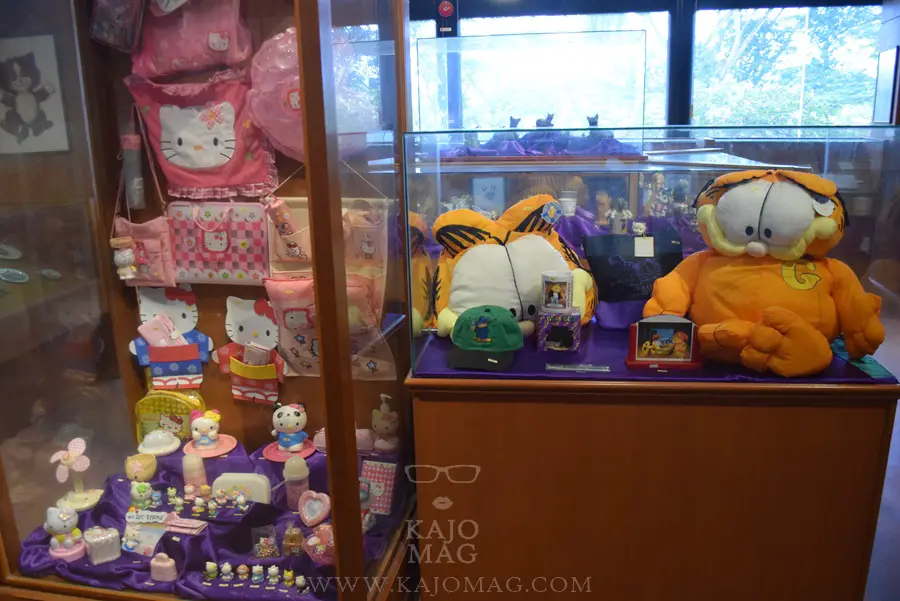
Speaking of popular culture, Gallery D of the museum featured more famous felines around the world such as Garfield and Hello Kitty.

Visitors can also browse through comic strips featuring cats for their own amusement at this part of the museum.

There is also an exhibition of local and wild cats of Borneo if you want to learn more about these animals.

For example, some of the interesting observations of Sarawak cats are that 15% of them have short tail, 50% kinked tail, 25% bobbed tail while 10% or less have long tails.

Another fun fact about this museum is that it houses the only complete Bay Cat (Pardofelis badia) skeleton in the world.

Learn more about felines at Kuching Cat Museum
The only complete Bay Cat (Pardofelis badia) skeleton in the world.

Found in Borneo, it is one of the rarest cat species in the world.

On top of wide collection of cats artifacts, Kuching Cat Museum also paid tribute to famous cat lovers around the world including French poet Charles Pierre Baudelaire, Sir Isaac Newton and Anne Frank.

For cat lovers with great appreciation for arts and patience for reading fun facts and cat-related general knowledge, Kuching Cat Museum is definitely worth the trip.


How Catholicism influenced the Kayan in Tubau to honour their dead

Under a temporary hut made of wooden sticks and canvas, some 80 people gathered together at Sungai Pesu cemetery, near Tubau to attend All Souls’ Day mass.

Celebrated annually on Nov 2, it is a day to commemorate the souls of all Christians who have died.

The small congregation came not only from the nearby longhouses but also all around Sarawak who came home purposely to observe All Souls’ Day at the cemetery.

Preceding the mass on muddy ground without any chairs, the priest Rev Fr John Chia reminded the congregation that it was their duty to pray for the dead.

He also pointed out the Catholic Church teaches that the purification of the souls in Purgatory can be hastened by the prayers of the faithful on earth.

After the mass ended, the congregation spread out to their respective loved one’s tombs to pray and clean the grave sites.

How Catholicism influenced the Kayan in Tubau to honour their dead
Some 80 Catholic faithfuls attended the All Souls’ Day mass in Sungai Pesu, Tubau.

Kayan’s burial ground of different faiths

How Catholicism influenced the Kayan in Tubau to honour their dead
The faithfuls coming together to pray under the temporary shelter.

Located about an hour and half from Bintulu, the Sungai (river) Pesu cemetery was one of the earliest final resting places for the Kayan settlers near Tubau river who migrated from Balui river.

They were believed to have moved to Tubau basin at the beginning of the 19th century in search of better farmland.

Reportedly, the first two longhouses who buried their loved ones at Sungai Pesu cemetery were from Uma Pako and Uma Awai.

After more than 150 years since the Kayan settled in Tubau, the cemetery now laid rest those who were practicing Adat Bungan (old Kayan religion), Borneo Evangelical Mission and Catholicism.

However, it was hard to know whose tomb was the oldest there because there was no such things tombstones back then.

The earliest Christian graves there date back to the 1970s while most are marked by old rotting crosses.

How Catholicism influenced the Kayan in Tubau to honour their dead
Some of the old ‘salong’.

Before Catholicism came

How Catholicism influenced the Kayan in Tubau to honour their dead
Hawing Igang

Before the Kayan communities embraced Christianity, the practice of honouring the dead was almost unheard of.

This was why most old burial grounds were not maintained or taken care of. They were not allowed to cut any trees or clear the grave site.

Even at Sungai Pesu cemetery, some old salong (burial hut) were in various states of dilapidation.

According to one of the nearby residents Hawing Igang, there were so many dos and the don’ts back in those days.

“If somebody died, they were not allowed to carry the body across the longhouse passing other amin (family’s home) as it was considered bringing bad luck to other residents.

“Back then, they purposely designed the longhouse to have loose flooring. So that if someone died, the family would open up the floor and carefully pass the body to people below to carry to the cemetery.”

During the recent All Souls’ day, a group of children were seen playing while their parents and grandparents reciting the Rosary prayers.

This scene was never seen before as children back in the days were to hide away in a room both during the wake and funeral.

Sungai Pesu cemetery back then was only accessible by the river. In the olden days whenever they passed by any cemetery, the parents would cover their children faces, forbidding them to look at the burial grounds.

All of these were done believing it would protect the children from any harm or misfortune.

How Catholicism influenced the Kayan in Tubau to honour their dead
All Souls’ Day allows the communities to honour their dead loved ones.

After Catholicism came

When the Kayan in Tubau started to embrace Catholicism in the 1960s, it brought many changes to local customs, particularly when it came to funeral rites or honouring the dead.

The dead were given Catholic burials and every year on All Souls’ Day, the communities gather together at cemeteries to pray for them.

Despite this, some of the elders still believe some of the old customs. Some of them were quick to scold if they saw the younger ones straying away to the old graves buried in Adat Bungan.

According to Hawing, it is hard to locate any of these old graves anyway. Most of them are covered in bushes and even secondary forests.

The practice of remembering the dead brought by Catholicism allow the communities to clean and maintain their ancestral burial grounds.

Some of them even replaced the old wooden crosses with proper tombstones in honour of their loved ones.

If it were not for Catholicism, most of the old burial grounds such as the one in Sungai Pesu could easily be forgotten, overgrown by bush and forest.

How Catholicism influenced the Kayan in Tubau to honour their dead
Most of the old burial grounds such as the one in Sungai Pesu could easily be forgotten, overgrown by bush and forest if it were not for Catholicism.

5 facts you need to know about red wine mee sua

Mee sua (also spelled misua, mee suah or miswa) is a type of noodle made from wheat flour. Originally from Fujian, China, this noodle is can now be found in Taiwan, Indonesia, Singapore, Vietnam and Thailand.

There are several ways to cook mee sua; you can fry it or cook it with sesame oil.

In the Malaysian state of Sarawak, the most popular (and iconic way) to cook it is with red wine.

Here are 5 interesting facts about red wine mee sua:

5 facts you need to know about red wine mee sua
A bowl of red wine mee sua.
1.Mee sua has long been associated with longevity in Chinese culture.

Regardless of how it is cooked, the noodle itself signifies long life in Chinese culture. It is usually served on birthday, a baby’s full moon celebration, wedding or Chinese New Year.

There are mothers who take it during their confinement period as well.

Nowadays, you can find this traditional dish at some local coffeeshops or food courts though we do not guarantee it will be as tasty as the home-cooked version.

2.The Fuzhou (Foochow) people who came up with red wine mee sua

The Fuzhou (more commonly spelled as Foochow here) in Malaysia are mainly found in Sarawak central region such as Sibu, Bintulu and Sarikei as well as Sitiawan, Perak.

These are the places you can surely find red wine mee sua being sold in common eateries.

However, the West Malaysian version of red wine mee sua is more reddish in colour with a thicker broth compared to the Sarawakian version.

Apart from kampua, kompia, and dian bian hu, red wine mee sua is one of the must-try if you are in Sibu.

3.Mee sua usually contains alkaline soda which prevent the noodles from breaking

To make your own hand-rolled mee sua, first of all is to mix wheat flour, rock salt and alkaline soda.

Later when you pull and roll the noodle, the alkaline soda will prevent the mee sua from breaking.

Then, cooking oil and sago flour are added into the mixture. Make the mixture into a dough before flattened and thinly cutting it into noodles. Lastly, dry the noodles under the hot sun before making a red wine mee sua.

4.Another key ingredient of this dish is the red wine itself

Although Chinese red wine is easily available at supermarkets or grocery shops, you can also make your own red wine at home.

Of course, it is more time-consuming (the fermentation takes about a month).

The main ingredients to make Chinese red wine are glutinous rice, water, red rice bran and yeast.

Your red wine mee sua will certainly taste better with good quality Chinese red wine.

5.A bowl of red wine mee sua is incomplete without egg and chicken

Even if you are cooking one whole chicken for your red wine mee sua, your dish for longevity is still incomplete without hard boiled eggs for each person feasting on your mee sua.

While the other ingredients for your mee sua are pretty basic such as sesame oil, ginger, mushroom, garlic, water and more Chinese red wine, the key to make the taste stronger is to let the dish sit for few minutes before serving.

How about trying these few recipes here, here, here and let us know how it goes?

10 things you should know about the spectacular Hong Kong-Zhuhai-Macao Bridge

10 things you should know about the spectacular Hong Kong-Zhuhai-Macao Bridge
The sunset view of Hong Kong-Zhuhai-Macao Bridge.

On Oct 24, the world’s longest bridge and tunnel sea crossing was opened to the public.

With hope to provide a major boost to regional tourism, the Hong Kong-Zhuhai-Macao Bridge connects Hong Kong to cities throughout the Greater Bay Area of southern China.

This is also to bring the attractions of Macao and Guangdong within easy reach and to make Hong Kong a hub for visitors from around the world.

Here are the 10 things you should know about the magnificent Hong Kong-Zhuhai-Macao Bridge:

1.Undoubtedly a record-breaking architectural icon, the bridge is the first of its kind to combine road and tunnel sea-crossing in the Greater Bay Area of China.

2. It connects an artificial island near Hong Kong International Airport to Macao and the mainland Chinese city of Zhuhai. Plus, it shortens the journey from the airport to Zhuhai from four hours to just 45 minutes.

3.With the length of 55km spanning over the sea, it is 20 times longer than San Francisco’s Golden Gate Bridge. The bridge comprises of 12km Hong Kong Link Road, 29.6km Main Bridge and another 13.4km Zhuhai Link Road.

4. Do you know that the Hong Kong-Zhuhai-Macao Bridge contains enough steel to build 60 Eiffel Towers? The Guardian even has named it as one of the architectural Seven Wonders of the Modern World.

5. Amazingly, they designed it to last the next 120 years. That is two decades longer than the lifespan of most major cross-sea bridges in the world!

6.The Hong Kong-Zhuhai-Macao Bridge will consolidate Hong Kong’s position as a hub for multi-destination travel within the Greater Bay Area. This area includes nine cities in China’s Guandong Province and two Special Administrative Regions.

10 things you should know about the spectacular Hong Kong-Zhuhai-Macao Bridge
The Hong Kong-Zhuhai-Macao bridge connects Hong Kong to nine cities in Guangdong Province, China.

7.There are many attractions near and around the Hong Kong-Zhuhai-Macao Bridge.
For example the Hong Kong’s Lantau island is home to the city’s international airport and Disneyland.
Furthermore, visitors can ride the famous Ngong Ping 360 cable car to the Big Buddha statue and Po Lin Monastery.

8.If you ride a boat from Tung Chung to Tai O Fishing Village, you can clearly enjoy the view of the Hong Kong-Zhuhai-Macao Bridge. Or you can see it during on the cable car ride.

9. On top of that, the Hong Kong-Zhuhai-Macao Bridge allows those who are in Hong Kong to conveniently visit Macao and Guandong’s tourists attraction spots.

These include the stunning ruins of St. Paul’s in Macao, the Statue of Fisher Girl in Zhuhai, the Kaiping Diaolou, the Seven Star Crags in Zhaoqing and many more. This means you can combine your Hong Kong and Greater Bay Area in one single itinerary!

10 things you should know about the spectacular Hong Kong-Zhuhai-Macao Bridge
You can take in the view of the bridge from a boat ride from Tung Chung to Tai O Fishing Village.

10.There is a fast and convenient cross-border bus service is available to take travellers over the iconic new bride between Hong Kong, Macao and Zhuhai. Additionally, it operates 24 hours a day! What are you waiting for? Time to plan that trip!

This article is based on the press release provided by Hong Kong Tourism Board. For more information, please visit http://www.hzmb.hk/eng/index.html

10 things you should know about the spectacular Hong Kong-Zhuhai-Macao Bridge
The world’s longest bridge and tunnel sea crossing was opened to the public last Oct 24.

The legends of how paddy came to Sarawak

As rice is a staple food in Sarawak like any another Asian culture, paddy planting plays an important economical role in the local communities.

Though most people nowadays stock up their rice from supermarkets, there are people who still cultivate rice for self-consumption.

However, have you ever wondered how paddy came to Sarawak?

Here we take a look on the different legends of how paddy came to this Malaysian state of Borneo:

1. Singalang Burong taught the Ibans how to plant paddy
The legends of how paddy came to Sarawak
According to an Iban legend, the God of war taught the Iban how to plant the paddy. Credits: Pixabay.

Singalang Burong is the God of War and one of the deities in Iban mythology. According to legend, he had a daughter named Endu Dara Tincin Temaga (or Endu Sudan Galigan Tincin Mas).

One day, Menggin (or Siu) who was a human found a feathered robe belonging to Tincin Temaga during a hunt.

He took the robe into his possession and Tincin Temaga made Menggin promise that he would never touch another bird.

To make a long story short, Menggin married Tincin Temaga and they had a son named Seragunting.

After the birth of their son, Menggin accidentally broke his promise to his wife.

Upset, Tincin Temaga left her husband, returning to her father’s realm. Together, Menggin and Seragunting went out to look for her. They followed Tincin Temaga’s instructions on the routes and ways to avoid the traps to Singalang Burong’s home in the celestial realm.

Eventually, they arrived at Singalang Burong’s house and remaining there for one whole year.

During this period, Seragunting learned how to read omen, catch fish, dear, and wild pig as well as how to plant paddy.

Singalang also gave Menggin and Seragunting some paddy to bring home to the mortal world.

There are many written accounts of this legend available out there. But one of the most detailed stories was written by Edwin H. Gomes.

Gomes was an English missionary who wrote the book Seventeen Years among the Sea Dyaks of Borneo: a record of intimate association with the natives of the Bornean jungles (1911).

Gome wrote Singalang Burong said this when he handed them the paddy.

“You have learned here how to plant paddy. I will give you some paddy to take away with you, and when you get back to your own country, you can teach men how to cultivate it. You will find rice a much more strengthening article of food than the yams and potatoes you used to live upon, and you will become a strong and hardy race.”

2. The plant of Pleiades or Seven Sisters
The legends of how paddy came to Sarawak
In another legend said the paddy plant must be cultivated first under the seven stars. Credits: Pixabay.

This legend of how paddy was first brought to Borneo was recorded by the first Ranee of Sarawak, Margaret Brooke in her book My Life in Sarawak (1913). A fortman’s wife in Simanggang (Sri Aman) told the Ranee this version of the legend.

Long time ago, there was a man who lived alone in a small hut by the river. After a series of heavy downpours and thunderstorms, the man watched the driftwood and debris floating down from the upper river past his house.

Then, a huge tree with its roots still intact floated down the river. The tree got caught on a sandbank with its roots emerging above the water.

The man noticed there was a strange-looking plant entangled in its roots. So the man took his sampan and went out into the river to collect it.

But after that he thought the plant had no use so he threw it at the corner for his hut. That night, the man had a dream.

A spirit told him that “the plant was necessary to the human race, but that it must be watched and cherished, and planted when seven stars were shining together in the sky just before dawn.”

After he woke up, then man went to his neighbour and told him about the dream. His neighbour said that the Petara (deity) himself who appeared in that dream and the man should listen to him.

Later that night, the man waited for another dream to tell when he was to look for the seven stars.

The Ranee wrote:

“In due time, under Patara’s guidance, the man noticed the ‘necklace of Pleiades’ appearing in the sky. The little plant was then put in the ground, where it grew and multiplied. The people in neighbouring villages also procured roots to plant in their farms, so that the paddy now flourishes all over the country and the people of Sarawak have always enough to eat.”

3. The Chinese legend of paddy
The legends of how paddy came to Sarawak
It has been scientifically proven that all Asian rice come from China. Credits: Pixabay.

There are plenty of Chinese legends on how paddy came to Earth. In one legend, a Chinese deity named Shennong was the one who introduced paddy planting to human race.

Shennong was credited for teaching the ancient Chinese how to use the plow and medicinal plants. From China, rice cultivation was spread to India, Southeast Asia, Korea and Japan.

Putting aside these folk stories and myths, it had been scientifically proven that all forms of Asian rice come from a single domestication that happened between 8,200 and 12,000 years ago in China.

Researchers from Proceedings of the National Academy of Sciences in the United States did the research using a map of rice genome variations and published their work in Nature journal back in 2012.

The research also indicated the domestication of rice occurred in the Pearl River Valley regions of China.

Even so there are no written records or proven research of how paddy planting introduced to Sarawak, only mythical legends to tell the next generations.

Do you have know any legends of how paddy came to Sarawak in your culture? Share with us in the comment box.

An encounter with a fellow Kayan at Putussibau, Indonesia

An encounter with a fellow Kayan at Putussibau, Indonesia
A view of Putussibau from the plane.

Putussibau, the capital of the Indonesian regency Kapuas Hulu, is the last market town on the Kapuas river.

Located in the northeastern part of West Kalimantan, it is close to the Indonesia-Malaysian Sarawak border. It is the tourists’ gateway to Danau Sentarum and Betung Kerihun national parks.

From the perspective of a Malaysian Kayan, Putussibau is the gateway to Mendalam, Mahakam and other rivers where the Indonesian Kayan people mostly reside.

After I posted a photo of Putussibau Pangsuma Airport on Instagram (as most Gen Y and millennials do) during my short pit stop at Putussibau, I was bombarded with comments and personal messages from my relatives.

Beside asking me to look for Kayan inu (beads) as souvenirs, my relatives also urged me to meet and talk to as many Kayans as I could.

And I did! I had a brief meeting with Fransiska Mening, a Kayan from Mendalam who owned a handicraft shop at Putussibau called Kerawing Gallery and Art.

An encounter with a fellow Kayan at Putussibau, Indonesia
One of the streets in Putussibau.

From one Kayan to another

An encounter with a fellow Kayan at Putussibau, Indonesia
Some of the beaded handicrafts in Fransiska’s shop.

According to Fransiska, the Kayan of Kalimantan still hold tight to their customs and cultural practices to this day.

She herself was proud of the hand-tapped tattoos on her forearms. Fransiska shared, “There is an ongoing effort by the government to record the different kind of tattoo patterns among the Kayan women here. We are still working on it.”

Fransiska’s tattoo patterns are like nothing I have seen before on any Kayan woman in Sarawak. While most tattoo patterns fully cover their forearms, Fransiska’s tattoos were in spiral patterns like ferns.

In Sarawak, it is a pattern more often found in wood carvings and traditional dress but not as a tattoo.

An encounter with a fellow Kayan at Putussibau, Indonesia
The tattoos on Fransiska’s forearm.

Kayan and blowpipe shooting

An encounter with a fellow Kayan at Putussibau, Indonesia
Fransiska inherited these old beads from her late grandmother.

The Kayan, like most tribes on the island of Borneo, chose the blowpipe as their preferred weapon when it came to hunting or wartime.

According to author Peter Metcalf, 19th century ethnologists were curious as to why the Bornean people (who advanced to using iron tools) did not develop the bow and arrow like most other cultures around the world.

The reason lies in Borneo’s topography and landscape. Metcalf wrote “For hunting, they (bows) are ineffective because the dense vegetation seldom allows a clear shot.”

“For pigs or deer, a combination of dogs and spears brings the best results. In regard to small game in the lower branches of trees, such as birds and monkeys, they are easily shot with darts.”

Furthermore, he argued that it was difficult to shoot an arrow at such steep angles, and once you lose your arrows, it was impossible to recover them in the thick Bornean jungle.

An encounter with a fellow Kayan at Putussibau, Indonesia
It takes strong forearms and a steady base to shoot the blowpipe with accuracy.

Blowpipe shooting as a hobby

An encounter with a fellow Kayan at Putussibau, Indonesia
A traditional blowpipe like this can also work as a spear.

While the blowpipe is no longer used to hunt or shoot one’s enemies, Fransiska and her family picked It up as a hobby.

“Everyone in my family has his or her own blowpipe. It is more hygienic that way,” she said. And they take their blowpipe shooting seriously, participating in local competitions including the annual Danau Sentarum Festival.

Fransiska was quick to show some of the blowpipes in her shop as well as those from her personal collection.

There were made of different types of wood with intricate carvings. The one made from belian wood was heavier and of course, more expensive.

She also owned a more traditional blowpipe which comes with a spearhead at the end, doing double duty as a spear and a blowpipe.

It’s similar to what my family have at home. Unlike Fransiska, however, our blowpipe once used by our ancestors to hunt is now displayed as a decorative item in the living room. (Perhaps now is the right time to dust the blowpipe and shoot some darts.)

An encounter with a fellow Kayan at Putussibau, Indonesia
An example of non-poisonous darts. These types of darts used to be soaked with poison for hunting in the olden days.

The differences in Kayan dialects

After coming back from Putussibau, my family bombarded us with many questions. One question that stood out was, “Do the Kayan speak closer to Belaga accent or Baram accent?”

In Sarawak, the Kayan language can be primarily divided into three dialects of these three rivers where they mostly settled; Tubau, Belaga and Baram.

From there, the dialects can be vastly different from each other, even though they’re from the same area, depending on which longhouses they are from.

The differences are in the accents, tones and certain words,  much as you would imagine English being spoken in a Scottish, Irish and British accent. Most of the time, however, all Kayans can understand each other.

So when it came to the Indonesian Kayan dialect, I found that they had accent on their own; not as fast-spoken as the Tubau accent and not as melodic as the Baram accent.

Apart from the accents, I also noticed some of their vocabulary were distinctively their own, different from any Sarawakian Kayan dialects.

An encounter with a fellow Kayan at Putussibau, Indonesia
A decoration with Kayan motif and Catholic influence.

Sharing the same roots from Apo Kayan

An encounter with a fellow Kayan at Putussibau, Indonesia
It is hard to choose from all these different variety of woven bracelets.

Whether you are a Kayan from West Kalimantan or Sarawak, we all have the same understanding that our ancestors come from Apo Kayan.

It is located at the Kayan river, Bulungan Regency at East Kalimantan. Their migration from the ancestral land in Apo Kayan began in the 18th and 19th centuries.

From there, they settled in Sarawak of Baram and Rajang rivers as well as upper Kapuas and Mahakam rivers.

Even though the Kayans now have been divided by political boundaries of Malaysia-Indonesia, it does not stop them from visiting each other.

Many trips have been organised by different Kayan longhouses communities, mostly from Sarawak to Kalimantan.

According to Fransiska, the Kayan from Kalimantan are planning to return the favour next year.

“There will be a group from Putussibau driving through the Badau-Lubok Antu border maybe sometime in April and May next year. We are planning to visit Belaga and see how is it like there.”

An encounter with a fellow Kayan at Putussibau, Indonesia
Fransiska Mening.

Saying goodbye to Putussibau

The Kayan people, particularly the women, have a unique way of air-kissing each other when they greet or say goodbye.

They touch each other cheek-to-cheek twice but instead of being accompanied by the ‘mwah’ sound with their lips, they give a small sniff.

It is commonly practiced among family members and usually those whom you are affectionate with.

Growing up, I distinctly remember hearing those sniffing sounds every time I kissed my grandparents goodbye. To this day, it is still the way my family shows their affection.

When I bid my farewells to Fransiska, the soft sniffing sound from her air-kiss reminds me it is undeniable that the Kayans still share the same strong roots despite our differences in nationality.

The legend of Mount Santubong that you never heard of

Sarawakians for the most part have heard of how the legend of Mount Santubong is one of jealousy and rage between two celestial princesses Puteri Santubong and her sister Puteri Sejinjang.

However, there is another legend that circles around Mount Santubong in which many may have never heard of. The best part is, this legend is a love story.

A Haji and his moonshine

The first Ranee of Sarawak, Ranee Margaret published her bibliography entitled “My Life in Sarawak” in 1913.

In the book, she gave glimpses of her life as the consort to the second White Rajah of Sarawak, Charles Brooke.

The Ranee also shared stories and daily conversations she had with her local friends.

The Brookes had a bungalow at the foot of Mount Santubong to stay when they needed a change of air.

During one of her stays at Santubong, a Malay friend told the Ranee a love story of a Haji and the spirit of Santubong which she penned down in her book.

Legend has it there was a man named Hassan who lived in a house at the foot of Mount Santubong.

He was a religious man; he read the Quran daily, never missed his prayers and had done his pilgrimage to Mecca.

Occasionally, Hassan visited his siblings who were living in Kuching. Little that he knew, the Spirit of Santubong and also the daughter of the moon was watching him with admiration the whole time.

One day, the spirit flew down to Hassan’s house and they became friends. They eventually fell in love and married.

The spirit brought her husband to live with her in the other realm. They were living the happy-ending fairy tale life until the husband started to miss his family in Kuching.

This was what the man said to his wife in the Ranee’s account, “Delight of my life and light of my eyes, forgive me for what I am about to say. I want to go to Kuching to see my brothers and sisters, and to stay with them for a while.”

Reluctantly, the wife agreed. She sent her servants to send Hassan to Kuching but asking him to return in a month’s time.

The legend of Mount Santubong that you never heard of
Mount Santubong jungle.

The husband that had too much fun

When her husband was away, the spirit of Santubong sat on top of the mountain missing her husband.

Meanwhile, the Haji was happy reuniting with his family in Kuching. They had a feast for him and he was enjoying himself.

He was enjoying it too much that he forgot his wife for months (an action that would grant him a divorce in this modern day).

One morning after he was taking his bath at the riverbank, Hassan saw a great black cloud forming over the peak of the mountain.

He rushed to call his servant and made his way back home, only to find it empty and desolate.

Crushed and devastated, Hassan went back to Kuching longing for his wife. One evening, a man on a sampan passed Hassan while he was sitting by the river.

The man told him that his wife was seen on the top of Mount Sipang. Hassan then quickly climbed to the mountain peak only to find she was not there.

After that, he heard another rumour that his wife was seen on Mount Serapi, the highest peak of Matang range.

Again, the Spirit of Santubong was not there.

From there, Hassan sought his wife all over Borneo but he never saw her again. He returned to Kuching and died of a broken heart.

The legend of Mount Santubong that you never heard of
The view that greets you from the top of Mount Santubong.

The secrets of the Earth

The Ranee’s friend (whose name was not recorded) also said this to her, “If you like to go out by yourself, Rajah Ranee, and stand under those trees at midnight, you will hear voices of unknown people telling you the secrets of the earth.”

Margaret of course did not go out to do that but she did regret it. She wrote,

“I wish now I had gone out and listened, for I am foolish enough to believe the secrets told by those musical branches might have been worth listening to, but afraid of the night, of the solitude, and above all, of the criticisms of my European friends, I refrained. I have since come to the conclusion that I have lost a wonderful and beautiful experience which may never occur again.”

Perhaps it was the voices of unknown people who told the Ranee’s friend the story of Hassan and his wife-spirit.

Get to know the hopping ghosts of Asia, pocong and jiangshi

There are two varieties of ghosts in Southeast Asia renowned for hopping their way around, one is the pocong and the other is jiangshi.

They have different reasons for only being able to hop around: Pocong hops because its whole body is bound while jiangshi’s limbs are stiff from rigor mortis so it hops around with its arms outstretched.

Here we take a closer look of pocong and jiangshi, the hopping ghosts of Asia:

Pocong

On top of nasi goreng and rendang, Malaysia and Indonesia share many other non-edible similarities and one of them is pocong. It is believed to be the soul of a dead person trapped in its shroud or kain kafan in Malay.

In Muslim burials, the corpse is wrapped in a simple and modest manner which is why white cotton cloth is used. After being enshrouded, the body is tied in three areas; around the head, neck and feet.

According to traditional beliefs, the soul will stay on earth for 40 days after death. In order for the soul to pass on, these ties should be released 40 days after the burial. If they aren’t, the corpse will appear as pocong, hopping around hoping to be free from its ties.

Pocong pranks

With white fabric and some strings, dressing up as a pocong seems to be the easiest Halloween costume.

With fear of pocong still very real, it is also the easiest way to prank people. Earlier this year in Malaysian state of Kedah, a group of youths decided to dress one of their friends as a pocong to scare young children.

Unfortunately for this pocong and his friends, they bumped into a policeman barely 15 minutes after they set out on their mission.

The policeman told them off and the prank ended just like that.

Moving over to Indonesian city of Depok, two teenagers pulled the same prank. But they did not meet with the same ending with their fellow pranksters in Malaysia.

The villagers who caught the pranksters punished them by forcing them to sleep in a graveyard. They ended up calling their parents because the two ‘pocongs’ started crying as they lay in the open graves,

Thankfully in both cases, there were no police reports filed against the pranksters.

So if you think you saw what appeared to be a pocong, look closer. It might be just some kids pulling some tricks.

Or maybe a real pocong waiting to be untied.

Get to know the hopping ghosts of Asia, pocong and jiangshi
Before you scream when you see a pocong, make sure it is not some prank done by teenagers.
Jiangshi

Unlike pocong which is dressed in white cloth, jiangshi have better OOTD. They are usually dressed in official garments from the Qing dynasty with a coat-like robe and tall rimmed hat.

Jiangshi is separated into two categories; a person who died recently but came back to life and a corpse that does not decompose after being buried for a long time.

There are plenty of supernatural reasons why these dead bodies make their comebacks as jiangshi. Somebody may have used supernatural skills (maybe something similar to Harry Potter’s Resurrection Stone) to resurrect a body, or another spirit has taken possession of the dead body.

Other causes are when a dead person is not buried and was struck by  lightning, bringing it back as jiangshi or when the soul simply refuses to leave the body.

Either ways, there are methods to put jiangshis back where ever they should be. According to traditional folklore, these include a mirror (they are scared of their own reflections), items made from peach tree wood, a rooster’s call as well as jujube seeds.

The origin story of jiangshi

But what do pocong and jiangshi have in common besides hopping around to get to places?

Just like pocong whose soul wants to be released from this Earth, jiangshi is a soul who wants to go to its final resting place.

The origin story of jiangshi came from the ancient practice of transporting a corpse called xiangxi ganshi. Xianxi is a prefecture in China located in western Hunan province. In the olden days, many people left their homes to work elsewhere.

After they died, their bodies were transported back to their hometown. These were the days when there was no such thing as a hearse. So the body wasput in an upright position with bamboo rods tied to its sides. Two men would carry the rods on their shoulders to transport the corpse.

When the bamboo rods flexed up and down, the body would move up and down too. This is perhaps how the legend of jiangshi originated since the corpse looks like it hops up and down.

The two famous hopping ghosts have Asian origin proving again that Asia have more varieties not only with is rich culture and biodiversity but also its supernatural world.

1 61 62 63 64 65 75