Patricia Hului

Patricia Hului is a Kayan who wants to live in a world where you can eat whatever you want and not gain weight.

She grew up in Bintulu, Sarawak and graduated from the University Malaysia Sabah with a degree in Marine Science.

She is currently obsessed with silent vlogs during this Covid-19 pandemic.

Due to her obsession, she started her Youtube channel of slient vlogs.

Follow her on Instagram at @patriciahului, Facebook at Patricia Hului at Kajomag.com or Twitter at @patriciahului.

8 things the Timugon Murut believe about Nabalu, or the afterlife

8 things the Timugon Murut believe about Nabalu, or the afterlife

Different beliefs offer different views of the afterlife. In some views, the afterlife takes place in a spiritual realm. Another popular view is reincarnation. It is where the individual may be reborn into this world with no memory of his past life.

Meanwhile in Sabah, the Timugon Murut people have their own perception of the afterlife.

According to Kielo A. Brewis in his paper The Death of a Timugon Murut (1987), nabalu is what the Timugon Murut people believe to be their afterworld.

So here are what you should know about the traditional belief of the Timugon Murut when comes to nabalu:

1.After a person dies, their soul is said to leave the body and continue to float around the house until a chicken is sacrificed on the morning of the burial day. That is when the soul goes to nabalu.
At that time, the soul is believed to not take any special form, but is merely invisible.

2.Souls of good people can straightaway go to Nabalu. Although there is no mention of an escort like the grim reaper, some said that the souls flew to Nabalu while others said angels (masundu) came to get them.

3.If there is a rainbow during the wake or on the day of the burial, it means the dead person is present to take part in the sorrow of the villagers. Beside that, it means that the soul will get to Nabalu very quickly.

4.Souls that are barred or delayed from entering Nabalu will turn into a ghost (timbunus). It is a Timugon Murut version of vampire with a particular preference for pregnant women. It likes to lurk around at the time of childbirth on lonely stretches of road causing accidents so that they can suck the blood of the victims.

5.If the deceased had cursed or poisoned someone, they may turn into a snake or a black cat at death. The soul will probably never reach Nabalu, and is destined to roam and haunt people.

6.Speaking of haunting people, the same fate goes to the soul of a person who died a violent death. His soul will not go to Nabalu immediately but will have to stay around for some time to frighten people.

7.Meanwhile, a soul who has gone to Nabalu can occasionally come down and visit people. He flies down in the form of a bird and watches the people on earth.

8.As for the location of Nabalu, those who believe in it said that it is “up there”, on top of a great mountain facing the sunrise. Brewis opined that the mountain his informants referred to could not be Mount Kinabalu since the mountain could not be seen from Tenom valley where the Timugon Murut lived. One thing for sure is that Nabalu is a good place where there is no sickness and people probably are of the age they were when they died.

How a liar caused the war between Luju, a Kayan warrior, and the Taman

Here is a story of how a war in ancient Kalimantan broke out due to mistaken identity:

How a liar caused the war between Luju, a Kayan warrior, and the Taman
Kapuas river.

There was a Palin man named Baring Ma’ Bojang. He married an Embaloh woman and moved to the village of Belimbis in the upper Embaloh river of Kapuas Hulu.

Both Palin and Embaloh are Dayak groups in Indonesian Kalimantan.

Baring was the brother of Rombonang, a Palin raja or leader.

One day, Baring decided to go on a journey to the Mahakam river in East Kalimantan in search of valuable beads.

He went with a large number of followers and he set up good connection with Luju, a member of the Kayan royalty and a warrior in the Mahakam.

There in the Mahakam, he stayed for a long time with Luju, eventually managing to obtain the valuable ‘lawang lukut’ beads.

Baring also asked Luju for seven of his Kayan villagers to show him the way back to the Kapuas from the Mahakam.

In return, Baring promised that he would send these men back with some valuables such as jars and lamps.

Luju agreed and Baring made his trip back with Luju’s seven men.

Luju and Baring’s broken promise

Throughout Baring’s stay in the Mahakam, Luju was under the impression that Baring was a Dayak Taman not a Dayak Palin.

Meanwhile, Baring was a renowned liar, and could not be bothered to correct Luju.

Baring also never had the intention to give Luju what he had promised.

On their way to Embaloh, Baring declared that the seven Kayan men were now his slaves.

Although they were enraged, the Kayan men could not do anything as they were outnumbered by Baring’s men.

To make things worse for the Kayan men, Baring planned to sacrifice the men along their route from Mahakam to Embaloh to ensure a safe journey.

By the time they had reach Embaloh, there were no Kayan men left among his party.

Luju declared war on the wrong people

Eventually, the news of Baring’s treachery had reached Luju at Mahakam. Furious, Luju spent the next three years recruiting men from the Mahakam, Tabang and Oga’ rivers .

Together with the Kayan of Mendalam river near Putussibau, Luju and his warriors attacked the Dayak Taman longhouses at night.

They sacked their homes and burned them to the ground.

As Luju attacked all the Taman longhouses, he never got as far as Embaloh where Baring was hiding.

The Kayans, satisfied with their attack and felt that the Dayak Taman had punished enough.

The Dayak Taman take revenge

The following year, Luju’s brother Kule returned to the Kapuas river with a peacemaking force.

He explained that Luju was tired of war and wished to restore peace between Taman and Kayan.

After Luju had returned to Mahakam, the Taman people had sent some raiding parties to attack the Kayans, but they were not as strong as the Kayans.

The Taman made peace with the Kayan but were still determined that they would avenge themselves against Baring who was the cause of this problem.

Baring, who seemed unaware of the vendetta against him, had ventured into the Taman area, and was subsequently ambushed by the Taman warriors who then took his head.

This caused a war between the Taman and Embaloh as Baring’s son, Bojang sought revenge.

The tribal war between the Taman and Embaloh reportedly continued until the Dutch came into the area.

This story is recorded by Victor T. King in his paper Main Outlines of Taman Oral Traditions.

KajoPicks: 10 South Korean dramas about reincarnation to watch

Korean dramas love playing with the ideas ‘I will love you even in my next life’. With Buddhists accounting for 46 per cent of the South Korean population, the idea of reincarnation is not a foreign concept for the viewers there.

The idea of reincarnation in a Korean drama usually offers one common question, who was the character in their past life?

Here are 10 South Korean dramas about reincarnation you should watch:

1.Goblin (2016)

Kicking off the list is Goblin, a high-rated Korean drama written by Kim Eun-sook.

Kim Shin (Gong Yoo), is a decorated military general from the Goryeo Dynasty.

After all he has done for the country, he is framed as a traitor and killed by the young king.

Years after his death, he is cursed to be the immortal goblin as punishment for the kills he committed in the wars to protect his country.

The only way to put an end to his immortality is the Goblin’s bride. She is the only one who can see the sword in his body and pull it out to end his painful immortality.

In the meantime, Ji Eun-tak (Kim Go-eun) is a bubbly high school student who summons the goblin by chance.

Their story starts to unfold after the Goblin’s nephew Yoo Deok-hwa (Yook Sung-jae) leaves the Goblin’s house to a Grim Reaper (Lee Dong-wook) and the two end up living under the same roof.

Meanwhile, Eun-tak works as a part-timer for Sunny (Yoo In-na) who runs a chicken shop.

What are the connections among the four of them and how do their fates overlap?

The drama is entertaining to watch for those who want to escape from a reality for awhile.

2.Chicago Typewriter (2017)

Han Se-joo (Yoo Ah-in) is a famous writer who is in a slump struggling with writer’s block.

As he continues to struggle, he comes across a fan of his work, Jeon Seol (Im Soo-jung) and Yoo Jin-oh (Go Kyung-pyo), a mysterious ghost writer.

What the trio do not know is that they all have connections which date backs during the 1930s Japanese occupation of Korea.

Are there any reasons why they meet up again in this present life?

Watch the trailer here.

3.Black Knight: The Man Who Guards Me (2017)

If a love story transcends 200 years in a Korean drama, there must be reincarnations in it. How about an obsession that lasts for two centuries? Must it take 200 years to accept the fact that your love is not accepted?

Jung Hae-ra (Shin Se-kyung) works for a travel agency but never travelled abroad herself. Her life was turned upside down, after the death of her parents and her family went bankrupt.

After reaching a breaking point of her life, she tries to kill herself. Then she remembers she ordered a wine-coloured coat she had ordered at Sharon’s Boutique as a child.

Due to her family’s sudden bankrupt, she never had the chance to pick the coat.

After picking up the coat from the mysterious owner, good things start to happen to her. Why?

Besides the love and immortality themes, the story touches on gentrification happening in Seoul.

Like any other big cities in the world, Seoul is struggling on embracing the new development and keeping the old in the same time.

Black Knight manages to highlight some of the problems and ways to work around gentrification.

Watch the trailer here.

4.Legend of the Blue Sea (2016)

This Korean drama about reincarnation is inspired by Korean folklore written by Joseon scholar Yu Mong-in. It tells the story about country magistrate Kim Dam-ryung who released mermaids into the ocean after they were caught by the fishermen.

The drama first sets sometime at 1598. A newly appointed governor Dam-ryung (Lee Min-ho) stays for a night at an inn run by Yang (Sung Dong-il).

That evening, Yang shows Dam-ryung a captured mermaid named Se-hwa (Gianna Jun). The mermaid is actually his childhood friend who saved him from drowning when he was a child.

Later that night, Dam-ryung releases her into the ocean.

In the same time, Dam-ryung has premonition that in the far future dangers will afflict on himself and Se-hwa.

Thus, he commissions a time capsule containing a portrait of himself with a message to his future reincarnation.

Fast forward in the present day, Joon-jae (also played by Lee Min-ho) is a smooth talking conman who swindles money from rich women.

Using the money from his scams, he escapes to Spain for a vacation. There, he meets a mysterious woman.

However, when he returns to Seoul, Joon-jae realises there are gaps in his memories.

What happen to him and who is the mysterious woman? Plus, will Dam-ryung get the message across to his future self?

5.Abyss (2019)

If you are reincarnated into someone else’s body immediately after being murdered, it is natural to find the murderer of your past body.

Go Se-yeon is a beautiful prosecutor and his friend Cha Min is an unattractive but a rich heir.

After their deaths in separate incidents, they are both revived into different bodies by an unknown being using an ‘Abyss’.

While Se-yeon takes on a plainer look than before, Cha Min is reincarnated into a very attractive looking person.

Together, they work to find out why did they reincarnated and the nature of their deaths.

Watch the trailer here.

6.49 Days (2011)

The concept behind this drama is inspired by Korean shamanism ‘bardo’ in which a soul usually wanders the earth for 49 days before moving on to the next life.

The drama focuses on Ji-hyun (Nam Gyu-ri), a pampered yet kind bride-to-be. She seems to have everything in life, parents who adore her, friends who admire her and fiance who loves her.

One day, she is caught in an accident. When she wakes up, she sees her own body being carted into an ambulance and nobody notices her existence except for a man on a bike.

He is the Scheduler (Jung Il-woo), a death reaper of sorts who takes souls to their final destinations.

The Scheduler tells Ji-hyun that if there are three people (besides her own family) who genuinely shed tears over her comatose condition, she can wake up from her coma.

She is so confident, thinking that her two best friends and fiance would definitely cry for her.

Little does she know that not everything seems like she thought it would be.

7.My Love from the Star (2014)

This is a love story between an alien and a celebrity. When an alien arrives in Korea during the Josean period, he falls for a young girl named Yi-hwa.

She dies while saving him, and the alien Do Min-joon (Kim Soo-hyun) waits for his time to return to his home planet.

During his 400 years of a lonely and isolated life, he meets a celebrity named Cheon Song-yi who looks exactly like Yi-hwa when she was younger.

Soon, Do Min-joon’s quiet, private world is shaken by Song-yi’s chaotic celebrity life as they slowly fall for each other.

Overall, the series turned out to be one of the most famous and influential Korean dramas of all time.

All of clothes, accessories and make-up products worn by Jun Ji-hyun were a craze among fashionista.

As Kim So-hyun’s character keeps on quoting from The Miraculous Journey of Edward Tulane by Kate DiCamillo, the book became top of the bestseller lists in Korean bookstores that year.

8.Mystic Pop Up Bar (2020)

Based on popular webtoon Twin Tops Bar by Bae Hye-soo, the drama stars Hwang Jung-eum, Yook Sung-jae and Choi Won-young.

It tells the story of Weol-ju who is the hot-tempered owner of Mystic Pop-up Bar. Her customers do not know that she is in fact of 500 years-old, cursed to settle the grudges of 100,000 souls in atonement for her sins.

One day, she meets Han Kang-bae who has the ability to make people confess the truth by making physical contact with them.

In order to get rid of this unique ability, he is willing to work for Weol-ju.

Who is Kang-bae in his past life and why his fate with Weol-ju is intertwined again in this present day?

Watch the trailer here.

9.Hotel Del Luna (2019)

KajoPicks: 10 South Korean dramas about reincarnation to watch

Speaking of an ill-tempered immortal woman in K-drama-land, one cannot not mention Jang Man-wol in Hotel Del Luna (2019).

Starring Lee Ji-eun and Yeo Jin-goo as the owner and manager of a hotel respectively, the drama is one of the highest rated Korean drama in cable television history.

It follows the story of a supernatural hotel which caters only to ghosts who have unfinished business in their past lives.

Moreover, the hotel serves as a stopover before they move on to the afterlife and get ready for reincarnation.

The owner, Jang Man-wol has been stuck to serve the hotel for the past 1000 years due to her past sins.

Hence, what happen when she comes across with the reincarnations of people she knew centuries ago?

10.Born Again (2020)

By the title of this drama, you already have a clue that it is a drama about reincarnation.

Honestly, the reincarnation method and concept in this drama is ridiculous. There is no head or tail on how it happened and why. Lovers are simply reincarnated and remember their past lives.

Putting these aside, the drama is entertaining to watch as it is full of suspense and thriller.

It is the 1980s and Detective Cha Hyung-bin (Lee Soo-hyuk) is in love with Ha-eun (Jin Se-yun), a bookshop owner suffering from heart disease.

At the same time, serial killer Gong Ji-chul (Jang Ki-yong) has also fallen in love with her.

One thing after another, their paths collide and three of them die. In the present time, the three of them are reincarnated.

And the murders commited in the 80s are happening all over again. Is it because Gong Ji-chul is reincarnated or was he not the real killer in the first place?

Watch the trailer here.

How did the Ibans near Kalimantan border cope with Konfrontasi

People have been living along the border of Sabah and Sarawak, Malaysia with Kalimantan, Indonesia for centuries.

When there was a conflict such as the Indonesia-Malaysia Confrontation which broke out between the two countries, it was unfortunate that they found themselves caught in between.

So how did the Sarawakians near Kalimantan border cope with Indonesia-Malaysia Confrontation or Konfrontasi?

On Sarawak’s side of the border, Commonwealth forces were flown in to help protect the border.

Besides this, they employed Iban and other border-dwelling Dayaks as scouts. They were a local auxiliary force, widely known as ‘Border Scouts’.

On the other side of the border, Indonesian army also employed Kalimantan Iban scouts to aid in patrolling their side of border.

Before the confrontation, the Iban communities from both side of the border had been living peacefully with each other.

Most of them had relatives across the border as intermarriages were common between different Iban longhouses, regardless of nationalities.

After they were employed by their respective countries, how did they do their work while still keeping their own relatives safe?

First of all, not all of the Ibans became scouts willingly.

According to Michael Eilenberg in the book At the Edges of States, most Kalimantan Iban had no particular interest in Indonesia-Malaysia confrontation.

However, a group of Iban from the Lanjak area were recruited by force as scouts.

These unwilling scouts did their uttermost to prevent clashes between the different border patrols Indonesian and Malaysian.

Eilenberg wrote, “Former Iban scouts in Lanjak recount how they purposely led the Indonesian military patrols in circles around the Malaysian patrols in order to prevent clashes. In doing so, they avoided being forced to fight Iban kin employed as scouts by the ‘enemy’.

One very common strategy employed by Iban trackers was to use different kinds of signals to warn the oncoming Iban trackers employed by the enemy.

For example, they imitated animal cries or simply wore their caps backward as a signal that regular soldiers were following close behind.

Life at Kalimantan border while coping with Indonesia-Malaysia Confrontation

Those who lived near the Kalimantan border during the confrontation remembered it as a period of restriction.

With military forces guarding both sides of the border, contact with relatives over the border was made difficult.

Even though the border was officially closed, some of the locals had reportedly continued their cross-border interaction such as trading and visiting relatives.

But of course, these were done at considerable risk of being caught in the line of fire.

Furthermore, several Kalimantan Iban families took more drastic moves.

They permanently immigrated to Sarawak to live with their Sarawakian families.

In the paper Straddling the Border: A Marginal History of Guerrilla Warfare and Counter Insurgency in the Indonesian Borderlands, 1960s-1970s which was also written by Eilenberg, the researcher came across many Kalimantan Ibans who had immigrated to Sarawak either during the Confrontation or during the later communist insurgency.

He wrote, “A senior Iban, originally from the Lanjak area but now a Malaysian citizen, conveyed during a visit to Kalimantan how, after immigrating to Sarawak, he was employed by British soldiers to fight the Indonesian army and later awarded an honorary military insignia by the Malaysian state for his courage in the fighting. Ironically before immigrating, the same person had been employed as a scout by the Indonesian forces.”

How did the Ibans near Kalimantan border cope with Konfrontasi
Some 1,500 men from the indigenous tribes of Sabah and Sarawak were recruited by the Malaysian government as Border Scouts under the command of Richard Noone and other officers from the Senoi Praaq to counter the Indonesian infiltrations. Credit: Public Domain in Malaysia and US.

Getting close with the Sarawakians near Kalimantan border as a military strategy

Speaking of the British soldiers, blending in with the locals is part of the Commonwealth forces’ military strategy.

The Director of Operations in Borneo during the confrontation was General Sir Walter Walker.

General Walker once stated, “We set out to speak their language and respect their customs and religion. We sent small highly work among them, to protect them and share their danger, to get to know them and gain their confidence. These troops were as friendly, understanding and patient to the villagers as they were tough and ruthless in the jungle. We sought to give the villagers a feeling of security by day and night, through the presence of phantom patrols and through constant visits by the civil administration, the police and the army. We helped their agriculture, improved their communications and trading facilities, improved their water supply, provided medical clinics and a flying doctor service, established schools, provided transistor wireless sets and attractive programmes, and so on.”

Additionally, Walker saw winning popular support as ‘absolutely vital to the success of operations because by winning over the people to your side, you can succeed in isolating your enemy from supplies, shelter and intelligence.’

In the meantime, Captain David L. Watkins wrote in his paper Confrontation: the Struggle of Northern Borneo that unless villages along the border could be secure day and night from Indonesian intruders, they could be intimidated into providing the enemy aid.

“Although an armed patrol could not be posted in every village, frequent visits could be made, not only by soldiers, but by police and civil administrators as well. These visits had several purposes, two of which were to ‘encourage the loyal to give information and to discourage the few disloyal from doing anything that would disturb the uneasy peace’.”

The safety of the locals came first

At the same time, Walker emphasised that the security and safety of the local Sarawakians would always come first.

He once wrote his command, “went to any length to keep our hands clean. One civilian killed by us would do more harm than ten killed by the enemy.”

He added, “If the price a village had to pay for its liberation from the enemy was to be its own destruction, then the campaign for hearts and minds would never have been won.”

As much as the Commonwealth forces as well as the government wanted to protect its people, deaths are inevitable during war (although this war was never officially declared).

In the end of the Indonesia-Malaysia Confrontation, the total number of civilian casualties are 36 killed and 53 wounded.

Why did Indonesia give guerrilla training to Sarawak Chinese youths during Konfrontasi?

During Konfrontasi or the Indonesia-Malaysia Confrontation, Indonesia lent their support to Sarawak Chinese.

But why?

When the formation of Malaysia was proposed, President Sukarno-led Indonesia was not the only who opposed the idea.

The Sarawak Communist movement was also against the idea of Malaysia.

Instead, the Sarawak Communists supported the idea of unification of all Borneo territories to form an independent leftist North Kalimantan state.

They gained support from Sukarno who let the Sarawak Communist Organisation use Indonesian Kalimantan as a base to build up a guerrilla force.

Why did Sarawak Chinese youths turn to communism at that time?

The then Sarawak Deputy Chief Minister, James Wong might have the right explanation on why communism seemed to be attractive to Sarawak Chinese youths.

As what was reported by Sabah Times on Dec 28, 1963, Wong stated,

“As we all know some of the younger generation of Chinese in Sarawak have been much affected by the teachings of Communism. There are all sorts of reason for this.

Many young Chinese are proud of the achievements of Communist China and feel that what is good in China should be copied here. Others have had their sense of idealism twisted and misused by the Communist leaders in the country who teach that Communism is the only road to justice in this world.

Others are discontented because they cannot get good jobs or feel they are not making enough money or that they do not own enough land and that Communism will provide the answer to all their problems.

The older people do not subscribe to these ideas, but many of the older Chinese in Sarawak are people who, in China, never received a proper education.

They are overawed by the fact that so many of their children can claim to possess an education and they defer to the views of their youngsters. They are unable or unwilling to exercise the restraints and disciplines which parents should be able to exercise.”

The testimony of a young Sarawak Chinese

According to a Sarawak Tribune report which was published on Dec 8, 1965, a young Sarawak Chinese revealed his experience being recruited into CCO.

“About April or May 1962, subject to the propaganda and influence of a cadre of the clandestine communist organisation, I joined the Farmer’s Association under the Sarawak clandestine communist organisation. In August of the same year I was again recommended by my leader to join the Sarawak Advanced Youths Association, a secret communist organisation.
Later in November, I was sent by my leader to do racial work in Tebedu. Meanwhile a racial work cell for Tebedu area was formed with me as one of the cell members.

Our method of work was to make use of the SUPP (Sarawak United People’s Party) by asking the masses to join the party openly and then to absorb the better elements amongst the SUPP members into the Farmer’s Association.

In April 1963, our leader informed us that the organisation was prepared for armed struggle and wanted to send persons to receive military training in Indonesia. The Organisation wanted us to make a road from 23rd mile to Kampong Sidek in Indonesia via Tebedu.

The route was divided into four sections, and in May that year this new jungle track was completed secretly. On June 1st, the first batch of Sarawak youths of both sexes, about 40 in number, escaped to Indonesia by this jungle track.”

It was reported that harsh and contemptuous treatment by the Indonesians, as well as deprivations of jungle life had caused some of these Chinese to lose their ardour.

By the end of 1963, some of these Sarawak Chinese youths began to ‘trickle back into Sarawak’.

Those Communist exiles in Indonesia who have stayed behind, eventually would form the core of the North Kalimantan Communist Party’s two guerrilla formations.

The first one would be Sarawak People’s Guerrilla Force (SPGF) or Pasukan Gerilya Rakyat Sarawak (PGRS). Meanwhile, the second one was North Kalimantan People’s Army (Paraku).

With the assistance of the Indonesian Ministry of Foreign Affairs, PGRS was formed Mar 30, 1964 at Mount Asuansang in West Kalimantan.

How many of the Sarawak Chinese youths were in Kalimantan?

According to Justus M. Van Der Kroef in The Sarawak-Indonesian Border insurgency, “Already by mid-1964 more than one thousand Sarawak Chinese, mostly youths had crossed into Indonesia to receive guerrilla training, subsequently returning with Indonesian terrorist units, while others affiliated with the TNKU (Tentera Nasional Kalimantan Utara).”

It is believed that Sarawak Chinese youths were still slipping over the border into Indonesia to train for guerrilla war against their home state as late as March 1966.

As for the sympathisers, Herald-Journal’s report on Sept 2, 1971 might had some explanation on why some Sarawakians were not totally against communism.

First of all, the communists actually helped the people in the fields and give them medical care.

Additionally, the report stated, “Some farmers and villagers almost never see a government official; often the Communists win simply by default. In rural areas, Chinese shopkeepers have found it safer to keep quiet and roll with the punches. They don’t resist if a guerrilla demands bicycles so the frames can be made into shotguns.”

There were other impacts of communists insurgency in Sarawak mainly due to the curfew implemented in the state.

Herald-Journal reported, “Babies died of malnutrition and of diseases that could be cured because their families couldn’t go out after help. Government teams offered some relief but not all people could be reached by the limited staff.”

In the meantime, the British Intelligence estimated that there might be some 24,000 Chinese Communist sympathisers at a point in Sarawak.

The end of communist insurgency in Sarawak

While the confrontation officially ended on Aug 11, 1966, the communist insurgency in Sarawak continued until 1990.

The number of communist operatives distinctly decreased in the 1973-1974 when Sarawak then Chief Minister Abdul Rahman Ya’kub managed to convince several of the insurgents to lay down their arms.

One of their leaders Bong Kee Chok surrendered along with 481 of his supporters.

The final peace agreement communist insurgency was ratified in Kuching on Oct 17, 1990.

That was when the last of the communist operatives officially surrendered, marking the end of communist insurgency in Sarawak.

Why did Indonesia give guerrilla training to Sarawak Chinese youths during Konfrontasi?
Members of the Sarawak People’s Guerilla Force (SPGF), North Kalimantan National Army (NKNA) and Indonesian National Armed Forces (TNI) taking photograph together marking the close relations between them during Indonesia under the rule of Sukarno. Credit: Copyright Expired.

A legend of how the Timugon Murut people came into existence

The Timugon Murut is one of the 29 ethnic groups of Murut people.

Overall, the Murut people can be found mainly in Sabah and Sarawak in Malaysia as well as in Brunei and Kalimantan, Indonesia.

As for Timugon Murut, they mainly live in Sabah. Each of the ethnic group of Murut people including Timugon Murut has its own distinct language, custom and even folklore.

Here is a tale on how the Timugon people was created as recorded by researcher Kielo A. Brewis in the paper The Death of a Timugon Murut (1987):

There was a great flood which saw everyone drown, except one young man, who climbed up a very tall coconut tree.

After the waters began to recede, he went down to look for survivors.

An angel from heaven (masundu) came to tell him that there were no other survivors and gave him a proposal instead – that they should marry.

The angel wasn’t anything like the shiny Western concept of an angel, but came in the form of a woman who was afflicted with a skin condition, similar to that of ringworm.

Even though he was the only person left on the planet, the young man did not want to marry her.

Instead he went off to find prettier girls, holding on to the hope that there were survivors besides himself.

In the meantime, the angel did not handle the rejection well.

In his absence, the angel made a clay figure that looked much like herself, except the figure did not have the markings of ringworm.

Then she made the figure into a living being by spitting red betel nut juice from her mouth onto it.

When the young man returned empty-handed and saw the beautiful girl who had been made from clay, he wanted to marry her.

Their descendant became the ancestors of the Timugon Murut.

A legend of how the Timugon Murut people came into existence
The man marries the woman who was made from clay. Credit: Pixabay.

KajoPicks: 10 South Korean revenge dramas you need to watch

On KajoMag.com, we have covered Korean revenge movies so here are our favourite Korean revenge dramas you need to watch:

1.Doctor Prisoner (2019)

KajoPicks: 10 South Korean revenge dramas you need to watch

What would you do if you were fired unfairly from your job? Normal people would file a complaint with the labour department, but in this Korean revenge drama, the main character goes as far as applying for a job at the prison.

Doctor Prisoner (2019) centers around an ace doctor named Na Yi-je (Min Nam-gung) who works at a university hospital’s emergency care center.

However, his medical license gets suspended as a result of a medical malpractice incident which he did not cause.

He then gets his certificate as a medical internist and applies to work at a prison.

His plot is to cozy up to all the big-shots in the prison such as business tycoons, celebrities, sports stars to win allies.

Using his connections, he is planning to get revenge against the hospital that ousted him.

2.The Innocent Man (2012)

Song Joong-ki as Kang Ma-ru, is a smart but poor medical student who has to singlehandedly look after his little sister.

He was in love with Jae-hee (Park Si-yeon) who left him for a rich CEO, as she always dreamt of being rich. (Cuz, who doesn’t?)

Six years after Jae-hee leaves, he becomes an arrogant playboy who works as a bartender. Now, he is no longer the ‘innocent man’.

He then meets Seo Eun-gi (Moon Chae-won) as part of his revenge plan against Jae-hee.

Slowly, Ma-ru starts to care for her and eventually falls in love with her. In the end, can he really see through with his revenge onJae-hee?

3.Secret Love (2013)

How much do you love someone? Are you willing to sacrifice your future by going to prison for your boyfriend?

When Do-hoon (Bae Soo-bin) kills a woman in a hit-and-run accident, he asks his girlfriend Kang Yoo-jung (Hwang Jung-eum) to admit she was the one who drove.

Yoo-jung agrees and ends up in prison. Then Do-hoon dumps her when she is in prison.

In the meantime, Jo Min-hyuk (Ji Sung) is burning with revenge after the death of his girlfriend who was killed in the hit-and-run accident.

After realising the truth that Yoo-jung was not the one behind the wheel, Min-hyuk begins to help her making a fresh start in life.

4.Monster (2016)

When you lose all your family wealth, causing you to fall from being a rich, spoilt heir to blind beggar, it is natural for you to seek for revenge.

Born Lee Guk-cheol (Kang Ji-hwan), he was the heir to Sudo Hospital, until the deaths of his parents and aunt.

While he survived several murder attempts against him, he lost everything and became a beggar.

Blinded by the car accident that killed his parents, Guk-cheol’s sense of hearing is heightened to superhuman level, an ability he would continue to possess as an adult.

Years later, he undergoes surgery to cure his blindness and change his appearance.

He obtains a new identity – Kang Ki-tan, using it to take revenge on those responsible for his misfortune.

5.I Hear You Voice (2013)

KajoMag picked this drama as one of our favourite ‘noona’ drama since the main characters are in love with each other and six years apart.

Revenge-wise, it offers viewers a slice of thriller and suspense with a murderer running around trying to kill the main characters.

Lawyer Jang Hye-sung (Lee Bo-young) is a public defender who doesn’t care about her clients and only does her job for the salary.

When she was a teenager, she testified on the witness stand causing the murderer of Park Soo-ha’s father to be convicted and imprisoned.

Meanwhile, Soo-ha has the supernatural ability to read people’s minds by looking into their eyes. He gains it after witnessing his father killed.

Ten years later, the murderer has been released from prison. Now, he is getting revenge on Hye-sung and Soo-ha as well as their loved ones.

6.City Hunter (2011)

Dive South Korean officials plan a covert operation, codenamed “Operation Cleansweep”, to enter North Korea and kill several top members of the North’s high command.

Lee Jin-pyo (Kim Sang-joong) and Park Moo-yeol (Park Sang-min), two Presidential Security Service bodyguards and best friends organised a 21-man team for the mission.

The operation is successful, but as the troops swim out to return, the Navy submarine assigned for their extraction, snipers aboard the submarine open fire on them.

An already injured Moo-yeol sacrifices his life to save Jin-pyo. Jin-pyo then swims back to shore and returns to South Korea.

There he finds out that the assault team’s service and personal records have been erased.

Promising to avenge his fallen comrades, Jin-pyo kidnaps Mu-yeol’s infant son, and names him Lee Yoon-sung (Lee Min-ho).

He flees to the Golden Triangle to raise the child as his own and trains the boy intensively in combat.

Yoon-sung returns to South Korea to avenge his father’s killers.

7.Iris (2009)

Two elite National Security System (NSS) agents and best friends, Hyeong-jun (Lee Byung-hun) and Sa-woo (Jeong Jun-ho) both are in love with fellow agent Seung-hee (Kim Tae-hee).

However for the sake of his friend, Sa-Woo suppresses his feelings for Seung-Hee.

Hyeon-Jun is then sent off on a solo mission to Hungary.

In Hungary, Hyeon-jun accomplishes his mission but wounded while making his escape.

Shortly after that, he finds out that he was betrayed by his friend Sa-woo.

At that time, Seung-hee steps in to help Hyeon-jun escape, but a car explosion separates the two and both are misled to believe that the other person are dead.

Hyeon-jun is then saved by an unknown organisation and learns of the secret society “IRIS”.

One year later, Hyeon-jun returns to Korea to seek revenge. During this time, the two Koreas are set to reunify, while the group “IRIS” are intent on stopping the reunification.

Full of action and suspense, Iris (2009) is one of the most expensive Korean series ever make.

8.Golden Cross (2014)

Speaking of secret societies here is a drama about a secret society known as ‘Golden Cross’.

It secretly controls the Korean economy and marketplace using its deep connections and financial power.

In the midst of it, prosecutor Kang Do-yoon (Kim Kang-woo) gets entangled in the society when his sister is murdered and his father gets framed for it.

Due to this, Do-yoon is set to get his revenge against the powerful man behind the organisation, Seo Dong-ha (Jeong Bo-seok).

Things gets complicated when Seo happens to be the father of the woman he loves. So do you seek vengeance on your potential father in-law?

Watch the trailer here.

9.Defendant (2017)

How do you prove your innocence when you have amnesia? Park Jung-woo (Ji Sung) is a renowned prosecutor at the Seoul Central Prosecution Office.

One day, he wakes up in a prison cell and is told that he has killed his wife and that his daughter is currently missing.

To make things worse, he suffers from temporary amnesia not remembering what happened.

Can Jung-woo proves his innocence as well as find the real culprit behind it?

The drama also stars Um Ki-joon, Kwon Yu-ri, Oh Chang-seok and Uhm Hyun-kyung.

Watch the trailer here.

10.Pinocchio (2014)

This Korean revenge drama showcases how irresponsible media organisations could ruin families and affect public perception.

It also shows how the rich and powerful could control the media by deverting the public’s attention to juicy, but ultimately unimportant news.

After a misleading news report destroys his family, Ha-myung (Lee Jong-suk) begins to live a new life as Dal-po.

He hides his intelligence and past memories behind a facade.

After years of being a taxi driver, he decides to become a reporter to prove his family’s innocence.

However, not everybody is like him who takes the high ground in taking revenge. Some people who just take the violent and bloody way to seek vengeance.

How thousands of Dayak Taman people died due to a poisonous tree

Researcher Victor King recorded in his paper Main Outlines of Taman Oral Tradition (1975) that the Dayak Taman people once suffered a great setback in their population.

And it was all thanks to a tree.

So what was the poisonous tree and how did it kill thousands Dayak Taman people?

There was a man named Bai Upa who was so angry with life. If he lived in the 21st century, you might find him ranting on social media. But instead, he decided to fetch a special poison from the headwaters of the Kapuas river.

This poison was watery in appearance and only can be found in remote places.

Additionally, the poison oozed from the ground and in the center of the ooze stood a tree.

The poison was believed to be almost impossible to obtain. Any attempts in the past usually caused the death of the seekers.

Bai Upa was a wise man. Knowing the danger of fetching of this poison, he sent eight of his slaves instead.

It was said that nothing could live around the tree for a distance of 200 paces.

There were no grass, trees or flowers. Instead, they were bones of humans and animals scattered.

The locals believed that even its scent could kill.

Bai Upa’s slaves took turns to get the poison.

The first slave only got a few paces into the poison zone when he fell dead.

Meanwhile, the second got a little further and so on. Finally, the last slave managed to hold his breath and bit one of the lower branches of the tree.

Actually, biting the tree acted as an antidote for the poison. The slave managed to collect a small amount of the poison in a container with a tight cover.

After the slave got back to Bai Upa, he used the poison to kill his enemies.

When the corpses were thrown into the river, fishes ate the flesh.

When the Dayak Taman people downstream ate these fish, they died. According to King’s informant, that was how thousands of Dayak Taman died with many of their villages abandoned.

What is the poisonous tree?

How thousands of Dayak Taman people died due to a poisonous tree
Antiaris toxicaria is a type of fig tree. Credit: Pixabay

Although King did not identify the poisonous tree, another researcher Richard B. Primack in his paper Moraceae Trees in the Religious Life of Borneo People wrote that the tree is ‘clearly about the Upas tree, Antiaris toxicaria.

Primack explained that only the latex of an Upas tree can be so poisonous.

He wrote, “There are certain inaccuracies in the exaggerated description, which was probably embellished to make the story more interesting. The poison does not ooze from the ground and does not fill the air. The vegetation under these trees is perfectly normal. People and animals can approach the tree without injury. The poison must enter the blood, generally by a poison dart, in order to be effective. Consequently, people downriver eating poisoned fish would not become poisoned. Also, biting the lower branches of the tree is not an antidote.”

It is fortunate that the poisonous tree in King’s story is not as powerful as it was said to be. Or else someone might turn it into a bio-weapon. And thankfully the antidote is not by biting the lower branches. People surrounding a tree and biting its lower branches would definitely be an interesting sight to see.

Was the first contact between James Brooke and the Kanowits a peaceful one?

The name of Kanowit town comes from the earliest ethnic group who settled in the area, the Kanowits. Today, they are often referred to as Melanau Kanowit.

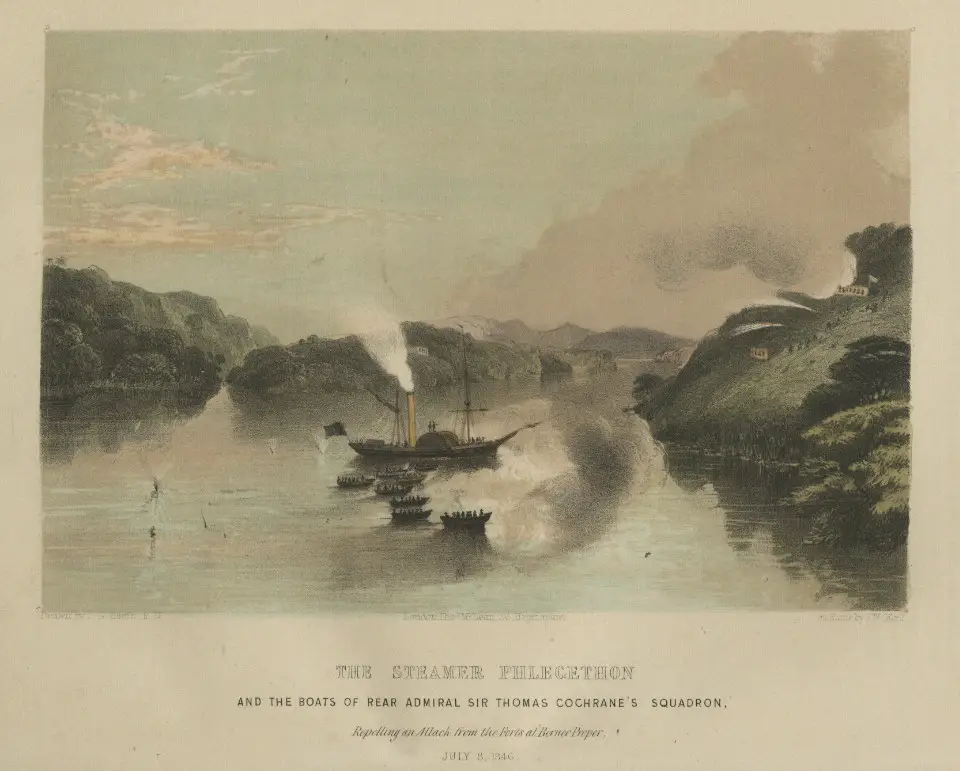
Their first contact with the British took place in 1846 when the steamer, the Phlegethon, commanded by James Brooke and Captain Rodney Mundy sailed up the Rajang River.

Brooke would have been 43 years of age at the time, and would have been Rajah of Sarawak for four years since the Sultan of Brunei had granted him the title.

Was the first contact between James Brooke and the Kanowits a peaceful one?
James Brooke

On June 29, they arrived in the area that we know now as Kanowit town.

Imagine the Kanowits’ reaction watching an unfamiliar vessel came to shore with people of different skin, eye and hair colour on board… it would have been bound to create some havoc at that time.

So did their first meeting turn out a peaceful one or was there some blowpipe action going on?

Was the first contact between James Brooke and the Kanowits a peaceful one?
The Steamer Phlegethon and the Boats of Rear Admiral Sir Thomas Cochrane’s Squadron, Repelling an Attack from the Forts at Borneo Proper, By Captain Thomas Cochrane (1789–1873), Phlegethon, 8 July 1846. Credit: Creative Commons

The answer lies in Mundy’s journal as he describes their first encounter with the Kanowits as follows:

Shortly after noon our pilots pointed out the neck of land round which, in a small bay, was situated the village of Kanowit, and above the trees we caught sight of numerous flags, and the matted roofs of houses.

The admiral (Rajah James Brooke) now ordered the steamer to be kept as close as possible to the over-hanging palms; and with our paddle-box just grazing their feathery branches, we shot rapidly round the point, and the surprise was complete; so complete, indeed, that groups of matrons and maidens who, surrounded by numerous children, were disporting their sable forms in the silvery stream, and enjoying, under the shade of the lofty palms, its refreshing waters, had scarcely time to screen themselves from the gaze of the bold intruders on their sylvan retreat.

It would be difficult to describe the horror and consternation of these wild Dayak ladies as the anchor of the Phlegethon dropped from her bows into the centre of the little bay selected for their bathing ground.

The first impression seemed to have stupified both old and young, as they remained motionless with terror and astonishment. When conscious, however, of the terrible apparition before them, they set up a loud and simultaneous shriek, and fleeing rapidly from the water, dragged children of all ages and sizes after them, and rushed up their lofty ladders for refuge; then we heard the tom-tom beat to arms, and in every direction the warriors were observed putting on their wooden and woollen armour, and seeking their spears and sumpitans.

In ten minute all seemed ready for the fight, though evidently more anxious to find the extraordinary stranger inclined for peace. Meanwhile, the steamer swinging gradually to the young flood, and so drawing her stern within a few yards of the landing-place, brought into view the whole of the under part of the floor of this immense building erected at the very brink of the stream; for the piles on which it was supported were forty feet in height, and although at this short distance, had these savages chosen to attack us, a few of the spears and poisoned arrows might have reached our decks, it was evident that their own nest thus raised in the air, though containing 300 desperate men, was entirely at our mercy.

The chief, who was a very old man, with about thirty followers, then came on board. He was profusely tattooed all over the body, and like the rest of his savage crew, was a hideous object. The lobes of his ears hung nearly to his shoulders, and in them immense rings were fixed. Round his waist he wore a girdle of rough bark which fell below his knees, and on his ankles large rings of various metals. With the exception of the waistcloth, he was perfectly naked. We knew that this old rascal and the whole tribe were pirates downright and hereditary.

Having dismissed our visitors, we all landed and some of us mounting ladders of these extraordinary houses, presented ourselves as objects of curiosity to the women and children. I could stand upright in the room, and looking down at the scene below, might have fancied myself seated on the top-mast cross-trees. Having traversed every part of the long gallery thus level with the summits of the trees, and distributed the few gifts we had to bestow on the women and children, we turned our backs on the pendant human skulls, and retracing our steps to terra firma, immediately proceeded to the Phlegethon.

Unfortunately, the forty foot high longhouse which Brooke and Mundy visited is long gone. Additionally, we can hardly see a Kanowit man with full-bodied tattoos and long ear lobes these days.

Was the first contact between James Brooke and the Kanowits a peaceful one?
Sir Rodney Mundy by Grillet Jr, albumen carte-de-visite, 1860s. Credits: Creative Commons

If only the Kanowits knew how Mundy thought and described of them then, would their first encounter have been a peaceful one?

The Lun Bawang legend of a giant man named Temueng

Long time ago, there was a giant man named Temueng and his friend named Pengiran who first lived at Kemaloh in Kalimantan, Indonesia.

The Lun Bawang legend of a giant man named Temueng

According to legends, these people were believed to be the ancestors of Lun Bawang people.

Benedict Sandin in his paper The Bisayah and Indigenous Peoples of Limbang, Sandin recorded the life journey of this Lun Bawang legendary hero.

“Temueng and Pengiran were much ashamed that they could not defeat in battle chief enemy named Yada. Therefore Temueng moved from Kemaloh to Punang Trusan, and Pengiran also moved and settled at Illot, now in Indonesian Borneo,” Sandin wrote.

The life of Temueng

Legend has it that owing to the extraordinary size of the body, Temueng could easily eat one whole pig per meal. He was also rumoured to be a very strong man.

Meanwhile, Abdul Karim Abdul Rahman in his paper History of the founding of Brunei Kingdom Based on Oral Tradition (2016) pointed out that Temueng was Upai Semaring’s son.

He is another giant who is a Lundayeh legend from the Krayan Highlands, Kalimantan.

The Lun Bawang legend of a giant man named Temueng
Upai Semaring hill, where he allegedly lived in Krayan Highlands.

When he lived in the Ulu Trusan, he carved a number of rocks and the posts of his house were all made of rocks which are still intact at that location to this day.

According to Sandin, while at Punang Trusan, Temueng lived at the present day Semado Nesab village.

His house there was surrounded by wide and deep drains for protection against invasion by his enemies.

While Temueng was living at Long Lopeng, hundreds of Kayan came to attack him. Also known as Luping, Long Lopeng is a settlement in the Lawas division.

When the enemy came, he was reportedly at ease smoking his pipe.

But when they came, he knocked each one of them on the head with his pipe and killed them all.

A giant bigger than Temueng?

Another story circles around Temueng; one day Temueng went out hunting animals in the forest.

He found a huge coil of rattan which could be used in a fish trap.

Thinking that the coiled rattan cane was a leg ornament, he put his leg into it.

But the coil was bigger than Temueng’s leg, and this frightened him. Temueng immediately thought there was a giant bigger than him living in the area.

While Temueng was not afraid of those who were smaller than him, he was afraid of people bigger than him.

Terrified, he fled from Long Lopeng and down the Trusan river to live at the foot of a mountain near Long Merarap. It is believed that is where he stayed until he died.

The Lun Bawang people after the death of Temueng

It is unsure how Temueng died but the Lun Bawang people still remember him even many years on after his death.

In memory of his settlements on the upper Trusan river, the Lun Bawang people from Kemaloh moved to the lands between the headwaters of Trusan and Limbang rivers.

They moved there in small groups, each group gradually followed by others.

Expanding their territory, they moved down the Trusan till they were attacked by the Kayans.

According to Sandin, the Lun Bawang successfully repulsed the Kayans, driving them away.

To this day, the Lun Bawang still settle in various areas of Lawas and Limbang regions.

1 23 24 25 26 27 75