Browse Tag

Sabah - Page 6

Four covert operations by Z Special Unit in Borneo during WWII

For those who survived, they kept their silence for 30 years. Nobody knew what they did during World War II (WWII).

For those who died during their missions, nobody, not even their families knew about their sacrifices or the nature of their deaths for those 30 years.

They were part of Z Special Unit, a joint Allied Special forces unit formed to operate behind Japanese lines in Southeast Asia.

The operatives were mostly from Australia while others were British, Dutch, New Zealand, Timorese and Indonesian.

After the war ended, the special military unit operatives were sworn to secrecy and not allowed to tell anyone of their experiences until 1980.

While their best known missions were Operation Jaywick and Operation Rimau (both of which involved raids on Japanese shipping in Singapore Harbour), these operatives also carried out covert operations in Borneo.

Here are at least four covert operations run by Z Special united in Borneo during WWII:
Four covert operations by Z Special Unit in Borneo during WWII
Members of Z Special Unit at their base at East Arm, near Darwin. Credits: Australian War Memorial.
1.Operation Python

As all Z Special Unit’s operations were covert and secretive, not much has been revealed to the public even almost 80 years since the war has ended.

This included Operation Python which took place from 1943 to 1944. The mission’s objective was to set up a wireless station near Labian Point in Sabah and undertake covert operations reporting on the Imperial Japanese Navy in the Sibutu Passage and the Balabac Strait of the Sulu Sea.

The overall operation was divided into Python I and Python II. During Operation Python I, the Z Special Unit operatives landed along Labian Point in early October 1943. Besides setting up a wireless station there, they also supported and provided equipment for Filipino guerrillas.

In January 1944, Operation Python II took place with the objective of organising the native population for guerrilla warfare.

Unfortunately, these early operations did not yield significant results.

2.Operation Agas

A total of 44 Z Special Unit operatives took part in Operation Agas in carrying out guerrilla warfare against Japanese in North Borneo (present day Sabah) with the support of locals.

Operation Agas was split into five operations, starting in March 1945, continuing up to September and October 1945.

While the operations were able to supply reliable information to Australian forces, they did little rescue mission-wise.

For example, Agas 1 operatives provided information about the Sandakan Death March but there were no rescue missions for the prisoners of war (POWs). The death march subsequently resulted in the deaths of 2,434 POWs.

Nonetheless, the intelligence gathered during Operation Agas helped the Allied forces during the Battle of North Borneo which was fought between June 10 to Aug 15, 1945.

3.Operation Semut

While Operation Agas was executed in North Borneo, a similar covert mission was undertaken in Sarawak called Operation Semut.

There was four operations undertaken under Operation Semut. Overall, the operation reportedly caused the deaths of 1,500 to 1,700 Japanese from March to October 1945.

Under this operation, the Z Special Unit members trained and supplied the locals with weapons to help conduct surveillance and sabotage behind enemy lines.

Unlike Operation Agas, the intelligence gathered during Operation Semut was not entirely helpful as the locals could not differentiate between facts and rumours.

4.Operation Platypus

Just like any other operations undertaken by Z Special Unit, Operation Platypus aimed to gather intelligence and train local peoples as resistance fighters against the Japanese.

The operatives were inserted in small groups into the Balikpapan area of Dutch Borneo (present day Kalimantan).

There were 11 operations altogether in Operations Platypus with the first part of the operations carried out on Mar 20, 1945.

The last operation took place on July 22, 1945 where the operatives used folboats to reconnoitre and pinpoint prospective target areas.

The legend of seven brothers and the Kinabatangan cave

Today, Kinabatangan is the capital of Kinabatangan district in Sabah’s Sandakan Division.

But many generations ago, there was a cave in this area that mythical princesses called home.

British explorer Frank Hatton recorded many legends and stories when he came to North Borneo (Sabah) working as a geologist.

These legends included the story of a cave where seven sons of a nobleman took shelter long time ago.

Hatton did not mention the exact name of the place except that it was a cave in Kinabatangan.

The legend of seven brothers and the Kinabatangan cave
The legend of the Kinabatangan cave. Credit: Pixabay.
Here is how the legend of seven brothers and the Kinabatangan cave goes:

There was once a powerful Pangeran (nobleman) in Kinabatangan who had seven sons.

This chief was famous for his power and bravery, so much so that he wanted his sons to follow in his footsteps.

So he told his eldest son to conquer some islands near the Sulu Sea.

Obediently, the eldest took his brothers along with seven large perahus (long boats) on an expedition.

Their battles for conquest were hard and severe, but they completed their quest successfully. Upon their return home, they found themselves pulling up against strong currents.

As night fell, they realised they were opposite a cave embedded in a limestone cliff on a riverbank.

“Let us sleep in that cave,” said the eldest brother. “It will be easier and we shall enjoy more comfort than in the perahu.”

The youngest brother, however had bad feelings about the cave. He told him, “I fear some harm will come to us if we go there.”

Refusing to listen to the youngest brother, they all went ahead to stay in the cave.

It’s a TRAP! The Kinabatangan cave closes its mouth

The youngest brother was still restless, so he woke up with a sudden jolt in the middle of the night.

To his horror, he saw the entrance of the cave getting smaller. He tried to wake his brothers but none of them wanted to listen to him.

As he watched the cave entrance shrink, in his anguish the youngest brother did the unimaginable. He dove out of the cave just in time to make his escape.

In that split second, he managed to turn to look at his brothers.

That was when he saw each of his brothers in the arms of fairy-like damsels who led them further into the cave.

The entrance of the cave then shut, sealing the six brothers inside forever.

Hatton, who wrote this tale in the 1880s, said that ladders were kept hanging outside the cave, and rice thrown in by passing travellers to feed these long-lost warriors.

12 Indonesia-Malaysia combats during Konfrontasi you should know

Also known as Konfrontasi, the Indonesia-Malaysia Confrontation was an undeclared war with most of the battles happening between Kalimantan (Indonesia) and East Malaysia.

The confrontation was a result from Indonesia’s opposition to the creation of Malaysia.

Initially, Indonesian attacks on East Malaysia comprised of local volunteers trained by the Indonesian Army.

Over a period of time, the intrusions became more organised with involvement of Indonesian forces.

On the Malaysian side, the British provided help to Malaysian forces with periodic contributions from Australian and New Zealand forces.

The intensity of the Indonesia-Malaysia confrontation eventually subsided after the 30 September Movement when six Indonesian Army generals were assassinated.

Indonesia formally recognised Malaysia when a final peace agreement was signed on Aug 11, 1966.

Still, many lives were lost on both sides with combats happening in small-sized operations.

Here are at least 12 Indonesia-Malaysia Confrontation combats you should know about:
12 Indonesia-Malaysia combats during Konfrontasi you should know
While operating in Borneo during the Indonesian Confrontation, a soldier is winched up to a Westland Wessex HAS3 of 845 Naval Air Squadron, during operations in the jungle. Another soldier is kneeling on the edge of the extraction zone. Credit: Public Domain.
1.Attack on Tebedu police station

The first infiltration and attack as part of Indonesia-Malaysia Confrontation was recorded in April 1963.

On Apr 12, 1963, an Indonesian force attacked and seized Tebedu police station. Although Malaysia was not formed yet, the Malaysian government considered this as the first military attack on the-then future East Malaysia.

The raid, which happened on Good Friday that year, caused the death of a corporal and two wounded soldiers.

12 Indonesia-Malaysia combats during Konfrontasi you should know
Tebedu
2.Battle of Long Jawai

On Sept 28, 1963, a large number of Indonesian troops crossed the Sarawak-Kalimantan border and attacked the outpost at Long Jawai.

After exchanging fires for several hours, one Gurkha was killed and ten Malaysian border scouts were captured and later executed.

3.The Kalabakan Incident

The locals of Kalabakan, Tawau unfortunately witnessed one attack by the Indonesian forces on Dec 29, 1963.

Nonetheless, the attack successfully brought different groups of Malaysians to fight together for one sole cause.

A battalion from the 3rd Royal Malay Regiment (RMR) from Peninsular Malaysia, the Police Field Force, Sabah Home Guard and even Kalabakan villagers united to fight off the Indonesian forces.

The Kalabakan Incident resulted in the deaths of eight men from RMR and 18 others injured.

4.Landing at Pontian

On Aug 17, 1964, Indonesian troops made an amphibious landing at the Pontian district of Johor.

The troops landed in three different locations along Pontian coast according to plan. However, Malaysians security forces were quick to respond with half of the raiders captured immediately upon landing.

5.Landing at Kesang river

Located on the border between the Malaysian states of Malacca and Johor, Kesang river witnessed an amphibious raid conducted by a small force of Indonesian volunteers on Oct 29, 1964.

52 of these volunteers sailed across the Straits of Malacca in fishing vessels on each side of the mouth of the Kesang river.

Their action plan was to blend in with the locals and to launch guerrilla raids against Malaysian infrastructure.

However, Malaysian fishermen spotted the raiders and quickly informed the authorities.

The British troops, assisted by the Australians immediately arrived to the scene where they killed and captured all but two of the invaders.

6.Landing at Labis

About a month later after the landing at Kesang river, the Indonesians made another landing on Sept 2, 1964 near Labis, Johor and this time via air.

Three Indonesian Air Force aircraft set off from Jakarta but only two landed as the third aircraft crashed into the Straits of Malacca.

Under the command of 4th Malaysian Infantry Brigade, the operation took about a month to round up all the 98 paratroopers.

32 of the intruders were killed while the rest were captured.

7.Action of Dec 13, 1964

The Action of Dec 13, 1964 was a naval action between the Australian minesweeper HMAS Teal and two Indonesian vessels.

It took place in the Singapore Strait where HMAS Teal was conduction patrols at night. The two Indonesian vessels fired automatic weapons upon HMAS Teal. The Australian ship killed three and captured four other during the combat.

8.Battle of Plaman Mapu

The Battle of Plaman Mapu was one of the largest battles of the Indonesia-Malaysia Confrontation.

In the early hours of Apr 27, 1965, a battalion of Indonesian soldiers launched a surprise attack on B Company, 2nd Battalion of the Parachute Regiment in their base at Plaman Mapu.

The British was outnumbered by at least five to one but they still managed to cause significant damage on the Indonesians.

In the end, the battle took the lives of 30 Indonesians and two British troops.

9.Battle of Sungei Koemba

The Battle of Sungei Koemba was part of the wider Operation Claret that took place along the Sungai Koemba in Kalimantan.

The battle consisted of two ambushes conducted by two platoons from the Australian forces.

B Company ambushed Indonesian troops on May 27, 1965 resulting in significant Indonesian casualties and no loss for the Australians.

Meanwhile, the second ambush happened a little further downstream from the last one by a platoon from C Company. Occurred on June 12, 1965, the second ambush again resulted in heavy Indonesian casualties for no loss to the Australians.

12 Indonesia-Malaysia combats during Konfrontasi you should know
British Royal Marines Commando unit armed with machine gun and Sten gun patrolling using a boat in the river on Serudong, Sabah between 1963 until 1966. Credit: Malaysian Archive [Public domain]
10.Battle of Kindau

Three days after the last ambush at Sungei Koemba, a platoon from A Company successfully ambushed another large Indonesian force at Kindau, Kalimantan.

The ambush resulted in about 25 to 50 Indonesian casualties and two Australians wounded.

Unlike other engagements under Operation Claret which remained under wraps, Battle of Kindau was caught by the media after a journalist interviewed one of the wounded Australians.

However, the news was reported under the pretence the battle took place within Malaysian authority.

11.Battle of Babang

This was the last in a series of successful ambushes conducted between May and July 1965 by Australian troops from 3rd Battalion, Royal Australian Regiment (3RAR).

The battle took place on July 12, 1965 at Babang, Kalimantan as part of the wider British-Commonwealth Operation Claret.

On that day, 7 Platoon C was in an ambush position along a track near the Indonesian base at Babang. Around noon time, a force of about 30 Indonesians approached along the track. The Australians ambushed the Indonesian troops subsequently killing at least 13 of them and wounded five.

The cross-border attack was to provide warning to the Indonesian troops not to incur into Sarawak territory.

12.Battle of Bau or Battle of Gunung Tepoi

On Nov 21, 1965, 16 members of the British Army Gurkhas launched an attack on about 100 Indonesian troops.

The Gurkhas were then supported by the 104 men resulting the Indonesians to withdraw.

After the battle, the Indonesians reported at least 24 men killed in action and the British lost three men.

7 types of mental illness according to Murut traditional beliefs

In January 1968, the Psychiatric Specialist-in-Charge of Sarawak Mental Hospital K.E. Schmidt published a paper called ‘Some Murut Concepts of Mental Illness’ in the International Journal of Social Psychiatry.

The Murut people are an indigenous ethnic group found in the southwest interior of Sabah, northern part of Sarawak, Brunei and North Kalimantan in Indonesia.

They are known to be the last of Sabah’s ethnic groups to renounce headhunting.

The paper explored the traditional understanding behind mental health and how native healers played important roles in the successful treatment of mental illness.

It also described the different concepts of mental illness according to the traditional knowledge of Murut people.

So here are seven types of mental illness according to Murut traditional beliefs:
7 types of mental illness according to Murut traditional beliefs
What is going on with someone’s mental health according to Murut traditional knowledge? Credits: Pixabay.
1.Ruden repan (rupan means ‘well’)

According to Murut beliefs,this illness is due to a haunted well. All Murut interviewed by Schmidt agreed that this was the number one cause of mental illness.

He stated, “If a person passes within two feet of a well or more important, if he comes into the contact with the water, he will have visual and auditory hallucinations of crowds of people who want to catch him. He therefore runs away. The urge to escape ‘them’ may be strong that he might even run into fire in order or escape. He will call out the names of those who he believes want to kill him, usually names of people unknown in the community.”

Sufferers will often die from exhaustion especially since they may refuse food and water. They might jump into the river in an attempt to drown themselves or attempt to hang themselves to be free from the terror of their ‘tormentors’. When they do not see their hallucinations, they will sit quietly and be withdrawn. Such a phase may last from one to several weeks, and spontaneous remissions are known to occur.

According to Murut beliefs, these wells are set up by the spirits under the big trees where they live. They are always at the foot of a hill and are known by the community to be haunted. Thus when a man sets out on a hunt, offerings are made to the spirits of these wells.

If there is no sacrifice, the spirit of the well may disturb the hunter.

So how to heal a person with ruden repan?

The traditional healer or ngurur will make images of animals and send them to the well. Along with these images, there are eggs, rice and household articles piled up on an altar where he will chant incantations.

Then, the ngurur will appeal to the spirits not to disturb the person anymore. If the ngurur is not properly rewarded (which is usually in the form of a buffalo or jars), relapse may occur on the patient.

2.Ruden Talai (talai means a kind of tree)

Ruden talai happens when coming into contact with the fallen leaves or touching a type of tree locally known as pelai or pulai.

The Murut people believe if the trees are disturbed and cut or the under bush is cleared, mental illnesses will occur to whoever that cause them.

Schmidt pointed out, “The illness begins with tiredness and pain in the limbs and trunk. The patient cannot sleep at night, has headache and as in ruden rupan has visual hallucinations of people who want to kill him. A person affected by this kind of mental illness will be aggressive and attack people i.e. running amok.”

3.Ruden meruai

In this condition, the patient will sometimes fall into the fire. They fall as if they were fascinated and attracted by it and have in some instances died from the burns.

The Murut believe that the spirit of the fire takes possession of the patient. Similarly, the spirit of the water will be at work if a person has a fit while taking a bath, and those of the earth of the fit occurs on land.

One of the cures prescribed by the ngurur is fasting. According to Schmidt, there exists some similarity here with dehydration achieved by the diuretic Diamox in the treatment of epilepsy in Western medicine.

4.Ruden mebuyai (mebuyai means stupid)

This condition occurs among young people who for unknown reasons change or become demented. They give indirect answers, are indecisive, aimless and drive-less.

Some people even attribute this condition to ‘sumpah’ or a curse.

5.Ruden sinoso (sinoso means poisoned)

Schmidt pointed out, “This is another allegedly induced psychosis, caused in this case by mixing into the food or drink something which has been obtained from certain trees. This may also kill. The person, after an interval of a day or so will begin to feel cold and wish to sit by the fire. Later, he may feel hot and wish to cool himself. He will often sit motionless for long periods and will neither eat nor drink. In no more than a month, he will die.”

Just like ruden mebuyai, the Murut believe it is another cause of mental illness which is the work of a paid charmer.

Additionally, they believe that a spell of this kind can be imposed for a limited period.

7 types of mental illness according to Murut traditional beliefs
A mental illness according to Murut belief can be caused by a paid charmer.
6.Ruden pa’lamai

Here is another mental condition caused by a paid charmer. The charmer will uses a kind of grass or a concoction from it and then plant it as a love charm into the seams of a persons’ garment.

When planting it, a charm is spoken: “Each time you wear this garment you will think of him who pays me. You will die if you do not return his love. If you do not die, you will become insane, but you will get well if you marry him.”

What a way to drag someone to marry you! But no worries, there is a cure to break this love spell.

Just throw the urine of several people into the face of the affected person.

7.Mururu teruaien

“Mururu” means “lose” while “teruaien” is “thinking”. It is a condition of dementia without violence but possibly with elements similar to autism which occurs in young people.

Overall, Schmidt deduced that the Murut concepts of mental illness are the various forms of schizophrenia that have been ‘fairly clearly differentiated’.

“Ruden rupan could correspond to acute hebephrenia, ruden talau does appear to have most of the features of paranoid schizophrenia, ruden sinoso sounds like catatonic schizophrenia and ruden pa’lamai may be looked upon as coming nearest to simple schizophrenia,” he stated.

Meanwhile, ruden mebuyai might be simple schizophrenia or post-encephalitic state and ruden meruai covers epilepsy including its symptomatic forms.

Read the rest of Schmidt’s paper here.

The migration of Indonesian romusha to Malaysian Borneo during WWII

‘Romusha’ is actually a Japanese word for labourer. However during World War II (WWII), it specifically referred to forced labourers during the Japanese occupation of Indonesia.

According to the US Library of Congress, it was estimated in Java between 4 to 10 million romusha were forced to work by the Japanese military.

Indonesia during Japanese occupation

The experience in Indonesia during World War II varied depending on where one lived and one’s social status.

Those who lived in areas considered important to the war effort such as Balikpapan or Tarakan (for their oilfields) experienced torture, sex slavery, execution and war crimes.

The migration of Indonesian romusha to Malaysian Borneo during WWII
Pantai Amal, where the Japanese landed at Tarakan in North Kalimantan.

The romusha’s services were supposed to be voluntary but in reality many were recruited against their will.

Some were taken from their homes while others were even seized in the middle of a movie in theaters.

Most of them were put to work through threats and violence.

If they were lucky, they were put to work on Java island itself. The unfortunate ones were those who werw sent to work outside Java.

These locations included New Guinea, Malaya, Singapore, Thailand, Burma, British Borneo (current day Sabah and Sarawak), Indochina and Hong Kong.

Regardless of the locations, these romusha were forced to work under harsh conditions with insufficient food, shelter or medical care.

They were often treated worse than Prisoners of War (POWs) from Allied countries.

The migration of Indonesian romusha to Malaysian Borneo during WWII
Japanese invastion of Java. Credits: Creative commons.
Romusha in British Borneo

There is no exact number on how many romusha were sent to Borneo island during WWII. It is understood that they came here to work on oilfields and build facilities such as airstrips.

Richard Wallace Braithwaite in his book Fighting Monsters: An Intimate History of the Sandakan Tragedy gave one rough number.

“One estimate is that 31,700 Javanese were sent to North Borneo and another 48,700 to South Borneo. This occurred mainly in 1944. They constructed airfields in British Borneo, worked in the oilfields at Miri, and were used elsewhere in Borneo hacking tunnels and storage facilities out of rock.”

It was also reported there were about 3,000 Javanese romusha working in Sandakan airstrip alone during WWII.

Braithwaite further noted,

“Many romusha died in the transport ships before they reached their destination. While the Japanese kept good records, most records were destroyed after capitulation. The mortality rate for those who were sent outside was 74.3 per cent. However, only 5,000 survived of those who went to British Borneo, a much higher mortality rate of 85 per cent.”

Shigeru Sato in War, Nationalism and Peasants: Java Under the Japanese Occupation, 1942-1945 gave a different estimate number for North Borneo.

He wrote,

“Sending of Javanese labourers overseas was done mostly within the 1944 fiscal year. Like other commodities, the supply of labourers from Java fell below the levels set in the initial plan due to shipping difficulties. In the case of North Borneo, for which 17,000 men were approved for the year 1944, the total number of romusha who arrived from Java during the entire occupation period was 9,000 according to one estimate between 12,000 and 13,000 according to another.”

So did the romusha in Borneo return to Java after WWII?

After the end of WWII in September 1945, the Dutch Indies government established the Nederlandsh Bureau voor Documentatie en Repatrieering van Indonesiers (Netherlands Bureau for Documentation and Repatriation of Indonesians, or NEBUDORI).

This was to register, care for, and repatriate displaced Indonesians, most of whom were Javanese romusha.

The Japanese on the other hand did not make much effort to repatriate Indonesian romusha.

According to Shigeru, the repatriation of romusha by the Dutch began in May 1946, and by April 1947, a total of 52,117 Javanese romusha had been repatriated from Singapore, Malaya, Thailand, Indochina, Borneo, Celebes, New Guinea, the Moluccas and the Lesser Sunda Islands.

However, the repatriation of Indonesian romusha was not an easy job.

According to Braithwaite, when it came to repatriation back to Java, the romusha were the lowest priorities of the Allies.

“Some refused to go on Dutch ships as the Indonesian revolution was well underway and they did not trust the Dutch. Some presumably thought that going into a revolutionary zone in Java was likely to be worse than their situation in Borneo. In the end, only about a thousand returned from British Borneo. It was 1947 before authorities made ships available to them. By then, most had found employment and many were married to local women and had children.”

A thousand reportedly only managed to return home to Java out of the estimated number of 5,000 to 13,000 that were sent here.

This meant many had either decided to call Sabah and Sarawak home after the war or died working as romushas.

Nobody knows the fate of every romusha

There is no way to confirm these. The Japanese did not keep proper records of the romusha system and those who died were often buried in unmarked graves.

Historians believed the brutality of the romusha is one of the main reasons for the mass death rates among Indonesians under the Japanese occupation.

With no proper records documenting their arrivals or departures and no tombstones to mark their graves, the lives and sufferings of romusha outside of Indonesia, particularly in Malaysian Borneo, can be easily lost amongst the current and future generations.

How the Bajau came to live in Tempasuk, otherwise known as Kota Belud today

Before it was named Kota Belud, this district was widely known as Tempasuk.

It is located at the midpoint of the highway connecting Sabah’s state capital Kota Kinabalu with Kudat town near the northern tip of Sabah.

Many regard the town of Kota Belud as the unofficial capital and gateway to the heartland of the West Coast Bajau people.

Besides the West Coast Bajau, the town is also home to the Dusun, Illanun and Chinese peoples.

The West Coast Bajau are often referred to as Bajau-Sama, Sama Kota Belud or sometimes Bajau Kota Belud.

This is to distinguish them from the East Coast Bajau or Sama Dilaut or Sama Laut who settled in the eastern coast of Sabah.

How did the Bajau-Sama people first come to Tempasuk in the olden days?

British anthropologist Ivor H.N. Evans in his book Among Primitive peoples in Borneo might have the answer where he collected a range of local stories told in the oral tradition.

How the Bajau came to live in Tempasuk, otherwise known as Kota Belud today
West Coast Bajau horsemen in their hometown of Kota Belud, with Mount Kinabalu behind them. Credits: Creative Commons
Tempasuk and the kendilong tree

There is a tree which the locals call kendilong. Although it had sap that was clear as water, it was also very irritating to the skin. The tree also proved to be a great home for bees.

A long time ago, there was a poor Dusun man who dreamed that if he could find a kendilong tree he would become rich.

So the man set out to look for one. He discovered one just as night was about to fall. Since it was late, he decided to spend the night.

The next morning, the man left and later returned with two companions.

After collecting the sap, the man noticed there was a bee’s nest on top of the tree. They collected the nest, although they did not know what to do with it.

On their way back, they came across a Bajau man who had come up the river in a boat.

At the time, Bajaus did not live in Tempasuk yet. The Bajau man offered to help the Dusun man sell his bee’s nest, and share the profit between them.

Being practical, he also asked the Dusun man to collect more nests, in case they really were profitable.

So the two men swore an oath of brotherhood, sacrificing a hen to mark the occasion.

While the Bajau sailed away, the Dusun man searched hard for bee’s nests.

Three months later, the Bajau man returned to Tempasuk, his tongkang filled with goods from the sale of the bees nest to share with him just as he promised.

Imagine how happy he was to see that the Dusun man’s house was full of bee’s nests.

Seeing the start of a mutually beneficial friendship, that was how the alliance formed between the Dusun and the Bajau. Eventually, the Bajau resettled in Tempasuk while the Dusun learned the use of beeswax.

The strange death of British explorer Frank Hatton in North Borneo

Nineteenth century Borneo was as exotic as one could imagine. For the outside world, especially Westerners, hardly anything was known about the island except maybe that it was home for headhunters.

It’s no surprise then that many adventurous and curious explorers found their ways to the island in order to be the first among themselves to discover something new, be it a new plant, new animal or a new source of valuable mineral.

One of those who arrived upon the shores of Borneo back then was Frank Hatton, an English geologist and explorer.

Born in 1861, Frank was the son of journalist Joseph Hatton (1839-1907) and a graduate of the Royal School of Mines in London.

Being the son of a journalist gave Frank an advantage as his father’s connections made it easier for him to publish his writings.

The strange death of British explorer Frank Hatton in North Borneo
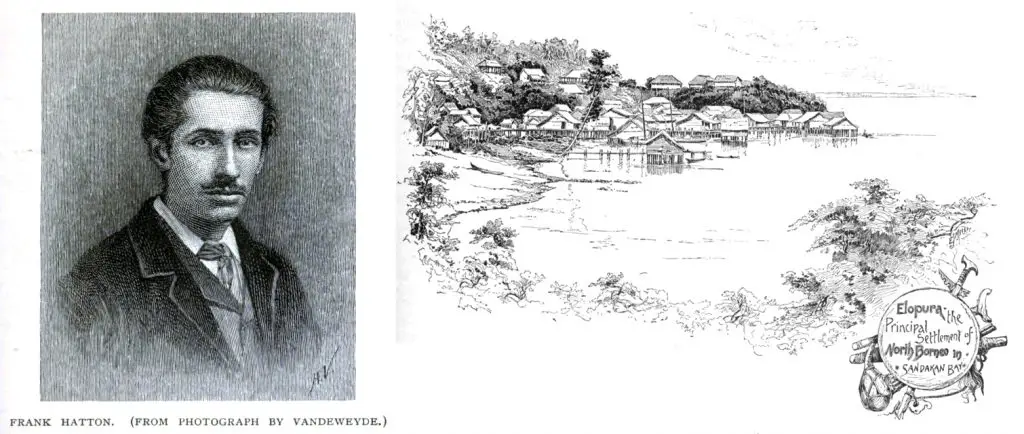
Frank Hatton, engraving based on a photo by Vandeweyde (1885) . Credit: Public Domain.
Frank Hatton’s career in British North Borneo Company

Driven and motivated, Frank joined the British North Borneo Company as a mineral explorer, leaving London in August 1881.

According to W.H Treacher, the British Governor of Labuan at the time, “Frank Hatton joined the Company’s service with the object of investigating the mineral resources of the country and in the course of his work travelled over a great portion of the Territory, prosecuting his journeys from both the West and East coasts, and undergoing the hardship incidental to travel in a roadless, tropical country with such ability, pluck and success as surprised me in one so young and slight and previously untrained and inexperienced in rough pioneering work.”

Treacher added, “He more than once found himself in critical positions with inland tribes, who had never seen or heard of a white man, but his calmness and intrepidity carried him safely through such difficulties, and with several chiefs he became sworn brother, going through the peculiar ceremonies customary on such occasions.”

For Frank, however, Borneo was far from what he had originally hoped for. In his diary, Frank vented out a few of his irritations about life in Borneo.

He grew sick of eating Dusun food. He was tired of being stared at by the natives who had never seen a Caucasian man before.

Additionally, Frank thought the local methods of headhunting was cowardly, calling it “head-stealing” not “headhunting” as he said the natives would wait in the bushes before making an attack during headhunting.

Frank Hatton and his sudden death in North Borneo

In 1883, Frank went up to the Kinabatangan river from Elopura (now known as Sandakan) to verify a local report of gold in the area.

There he was killed during an elephant-shooting expedition when his gun reportedly got tangled in the vegetation and went off, shooting him in the lungs.

According to Anne Tagge in Hatton’s Folly: Assaulting “This Eden of the Eastern Wave”, Frank had been persuaded to give up his hunt.

“On the way back to the boat, his Winchester rifle twisted in jungle creepers, a twig pulling the trigger. His followers reported that Hatton’s last words were in his recently required Malay ‘Odeen, Odeen mati saya’ (Odeen, Odeen, I am dead) to his servant while resting his head on Odeen’s shoulder.”
Frank’s only non-native companion during the expedition was an Australian gold miner named Andrew Beveridge.

Somehow knowing that Frank had always been careful with weapons, Beveridge first shouted “Who has done this?” to Frank’s party.

But after looking at how distraught his native servants were as they were exclaiming “Better we had died!”, Beveridge believed the incident was an accident caused by Frank himself.

Beveridge and the rest then went on a 60-mile journey down the river to Elopura, carrying Frank’s decaying body.

After arriving in Elopura, an inquest was held on the day of Frank’s burial on Mar 4, 1883.

The strange death of British explorer Frank Hatton in North Borneo
Elopura where Frank Hatton’s body was brought . This illustration was first published in  “Frank Hatton in North Borneo. Notes on his life and death, by his father“. Century Illustrated Magazine. Credit: Public Domain
Did the natives kill Frank and make it look like an accident?

Before Frank’s death, one of his colleagues in the British North Borneo Company named Franz Witti had been killed by headhunters.

Frank had written to his parents, reassuring them that he could take care of himself and that they shouldn’t be worried about Witti’s murder.

Tagge pointed out, “The company always ascribed such deaths (Witti’s) to accident or uncontrolled tribes or to tribes across the border in Dutch-ruled Borneo.”

As for Frank’s shooting, there was no proof that it was premeditated. The then resident at Elopura, W.B Pryer wrote to Treacher that there was no evidence that the gun was cocked.

The muzzle of the gun would have had to slip from Frank’s shoulder as he held the stock and moved a jungle creeper with his hand holding the stock.

Furthermore during the inquest, Beveridge revealed that he didn’t notice whether any of the guns carried by the natives had been discharged.

He stated that Frank fell in a very open place with a little undergrowth; the nearest vine was four feet from where Frank lay. When Beveridge arrived at the scene, running in four or five minutes from the boat, the gun had already been moved, and Frank was no longer able to speak.

Was there any tension between Frank Hatton and his servants?

According to Beveridge who had questioned Frank’s servants, he found that the natives would have defended Frank from an elephant even if it meant their own deaths.

However, there was still no definite proof that the bullet which killed Frank came from his own gun. Even if it had, how did it happen?

Before the incident, Frank had sighted an elephant on Feb 17, 1883.

He was reportedly extremely anxious to shoot one before leaving Borneo and this was his last inland trip. (Obviously, the trend of Western tourists desecrating or ravaging local spots goes back centuries…)

In his diary, Frank recorded that his group had been struggling through the swamp through this trip. One of his servants, Durahim, had also capsized a boat, costing them some of their food and valuable supplies.

He had even listed down all his losses in the diary and his willingness to cut his servants’ wages if he found out that it was their fault that the perahu (boat) had been overturned.

While they were pursuing the elephant, the day was getting darker and his servants were restless to return.

But Frank was believed to be obsessed with shooting the elephant. If he had managed to kill an elephant and acquired its tusks, he might have been the first white hunter to do so in North Borneo back then.

The inquest’s result

Maybe it was Frank’s obsession over elephants tusks that brought him to his death.

Nonetheless, the British North Borneo company interpreted Frank’s ambiguous death as an unfortunate accident and he was buried at Sandakan cemetery.

“The company seems to be anxious not only to exonerate but to praise the natives who were with Hatton. A young man dies because he is determined in the last weeks of his contract to find minerals, preferably gold, in Borneo, also to bring home the triumph of having killed an elephant. His family is determined to interpret him as a hero fallen in the cause of British scientific and geographical supremacy,” Tagge wrote.

The Hatton family also accepted the verdict of the inquiry. An article in the North Borneo Herald of 1 Sept, 1883 noted Hatton’s death and comments on contributions to the Company, including a Dusun vocabulary and mineral samples ‘which will in time doubtless be developed in the interests of the Company’s Government’.

The same issue contained a letter to the editor from Joseph Hatton in which he thanked the Company for their tributes to and care for Frank’s grave.

He also sent a floral wreath for the grave – from London to Borneo – as well as knives to be given as gifts to Frank’s servants.

After his son’s death, Joseph co-wrote and published Frank’s writing in a posthumous work entitled North Borneo, Explorations and Adventures on the Equator (1886).

Frank Hatton was 22 when he died.

Hunting for barbecued lokan and coconut in Tuaran, Sabah

If you are visiting Kota Kinabalu, make your way to its neighbouring small town of Tuaran.

Located just 35 kilometers from Sabah state capital, the small town is home to many good food including the famous Tuaran mee.

The Hakka Chinese community of Tuaran created the noodle from egg yolk and flour. It is then fried with vegetables and garnished with Chinese roasted pork.

However do not limit your gastronomic journey with this noodle, there are plenty other foods to try in Tuaran.

At Sulaman Road right near heavy traffic along Kota Kinabalu-Tuaran highway, the must-try foods there are barbecued lokan, grilled coconut and coconut pudding.

To get there, you can go by taxi or Grab car. If you are driving on your own, search for ‘lokan bakar Jalan Sulaman’ on your Google Maps or Waze.

Hunting for barbecued lokan and coconut in Tuaran, Sabah
The stalls along Sulaman Road.
Hunting for barbecued lokan
Hunting for barbecued lokan and coconut in Tuaran, Sabah
Lokan bakar

Lokan, or the scientific name Polymesoda expansa, is a type of marsh clam usually found near the tropical coastline and riverbank.

More than five years ago, there are perhaps only few stalls selling barbecued lokan along Sulaman Road.

Now, there are more than 20 wooden stalls lining up both sides of the road. Since almost every stall is selling the same barbecued lokan at about the same price, there are only two things that might set some stalls apart from each other; cleanliness and the sambal.

Choose a stall that practices better hygiene and with no flies flying around.

Plus, you can always ask the stall owners what kind of sambal they serve. Some stalls offer up to six different kinds of sambal.

In the end, the best kind of condiment which goes perfectly with barbecued lokan is the simple sauce made from chilli and lime.

The sour and slight spiciness of this kind of sauce could cleanse that seafood after-taste on your palate.

Hunting for barbecued lokan and coconut in Tuaran, Sabah
The lokan are usually marinated with ginger and a bit of turmeric powder.
The wondrous coconut
Hunting for barbecued lokan and coconut in Tuaran, Sabah
Kelapa bakar or barbecued coconut

A visit to any of these stalls at Sulaman Road is incomplete without having a coconut.

If you are a traditionalist, order the good old young coconut to quench your thirst. Or you can always give kelapa bakar or barbecued coconut a try.

The taste might be a shocker for those who are not familiar with it. It taste as if kerisik (grated and toasted coconut flesh) was turned into juice.

To end your gastronomic adventure at Sulaman Road, Tuaran, have some coconut pudding for dessert.

Although this dessert can be found in most restaurants in Kota Kinabalu, somehow the clear, sweet taste of the pudding goes well with the barbecued lokan.

Hunting for barbecued lokan and coconut in Tuaran, Sabah
Coconut pudding.

5 things about tarap fruit of Borneo you wouldn’t learn in the classroom

Tarap is always on the list when comes to types of fruits you should try in Borneo.

Sometimes known as the cempedak of Borneo, this fruit usually shares the same fate with durian. It is commonly being banned from entering most hotels for its strong smell.

If you are not familiar with this fruit, here are five things you should know about tarap:
5 things about tarap fruit of Borneo you wouldn't learn in the classroom
It is also known as marang in the Philippines.
1.It is also known by many names.

Does the tarap fruit seem familiar but you’re not sure if you’ve tried it before? You may have heard it called by any of these other names: terap, marang, johey oak, green pedalai, madang or timadang.

The scientific name of tarap is Actocarpus odoratissimus, and it is actually a tree in the mulberry and fig family Moraceae.

2.It is found in Borneo, Palawan and Mindanao islands.

While it is famously found on the island of Borneo, this fruit is also native to the Palawan and Mindanao islands.

In the Philippines, the locals call it marang.

3.There are two other species of fruit similar to tarap.

The first fruit species that is similar to Actocarpus odoratissimus is Artocarpus sericarpus. It is also known as pedalai, gumihan or terap bulu.

Terap bulu does not have strong odour like tarap. As for its outer appearance, terap bulu is hairy and looks like a giant rambutan.

The second one is Artocarpus sarawakensis (pingan or mountain tarap). It is the same shape as the Artocarpus odoratissimus but it is orange in colour and has smaller kernel sections.

4.Once you open it, you need to eat the fruit really fast

Unlike durian, it does not fall to the ground when it is overripe. So farmers can harvest tarap when they are deemed a mature size and leave it to ripen.

The flesh is sweet and has a creamy texture.

Once opened, you need to eat the fruit immediately because it oxidizes fast and loses its flavour quickly.

This is also the reason why the commercialisation of this tropical fruit is limited. It has a very low shelf life.

5.The many uses of tarap fruit.

If you have the chance to visit Tarakan in North Kalimantan, Indonesia, give the city’s signature tarap juice and tarap layered cake a try.

The tarap layered cake is one of the city’s own original products. As for tarap juice, it is one of the must-try drinks in Tarakan.

You can actually make it at home using tarap, sugar, ice, water and condensed milk.

Besides the fruit, the peels were reported to be useful material for the removal of colouring agents.

Even the seeds are edible; just like jackfruit seeds they can be boiled or roasted and then eaten as snacks. Just like Actocarpus odoratissimus, terap bulu’s seeds are edible after boiling or roasting.

How salt was obtained in the olden days of Borneo

Salt plays an important role in not just Sarawakian cuisine, but in Borneo overall.

Besides seasoning, every community, whether they were Iban, Bidayuh or Kadazandusun, used salt as a means to preserve their food.

How salt was obtained in the olden days of Borneo
Here are just five ways how salt was obtained in Borneo back when there were no supermarkets:

Salt is such an available commodity for us today; we can simply buy it from any grocery store or supermarket. Have you ever wondered how the olden communities of Borneo used to get it back in those days?

1.Nipah palm

Nipah salt or garam attap is salt processed from the mature leaves of the nipah palm, Nypa fruticans.

Here in Borneo, nipah palm grows wild and abundantly along coastal areas, especially in Borneo.

The palms are constantly washed by saltwater daily and this salt can be processed from the leaves.

Unlike conventional salt, it has a smoky flavour as well as the aroma of dried nipah leaves.  

Here is how Reverend Andrew Horsburgh in Sketches in Borneo described nipah salt processing:

”The chief condiment of the Dyaks is salt, which they procure from the nipah palm, and which they much prefer to that obtained by evaporation from seawater. The boughs of the nipa are cut, dried, and burnt, and their ashes washed in water, so as to dissolve the salt contained in them. This water being then allowed to run off clear is evaporated in pans, the salt remaining at the bottom of the vessel. It is a dirty grey and often black-looking substance, processing a slightly bitter taste, which is grateful to the palate of the Dyaks; and it is generally produced in a masses of considerable size and as hard as a stone, it has much the appearance of a mineral that has been dug out of the earth.”

2.Seaweed

According to Captain Thomas Forrest in A Voyage to New Guinea and the Moluccas from Balambangan (1780), the Bajau would gather seaweed, burn them, make a lye of the ashes, filter it and finally form a bitter kind of salt.

How salt was obtained in the olden days of Borneo
Salted fish, a common delicacy found in Sabah and Sarawak.
3.Mangrove roots and nipah palm

Meanwhile, Spenser St John recorded how salt was processed at the foot of Mount Kinabalu.

“They burnt the roots of the mangrove with those of the nipah palms as well as wood collected on the sea-beach and therefore impregnated with salt.

In one place, I noticed a heal, perhaps fifteen feet in height, sheltered by a rough covering of palm leaves, and several men were about checking all attempts of the flames to burst though by throwing saltwater over the pile. This doubtless, renders the process much more productive. In one very large shed, they had a kind of rough furnace, where they burnt the wood; and suspended around were many baskets in which the rough remains of the fire are placed, and the whole then soaked in water and stirred about till the salt is supposed to have been extracted from the charcoal and ashes. The liquid is the boiled, in large iron pans purchased from the Chinese.”

4.Seawater and ashes of driftwood

In The Gardens of the Sun, British explorer and tropical plant collector Frederick William Burbidge detailed how the Kedayans used a combination of seawater and ash to obtain their salts.

“The ashes of driftwood are placed in a tub and seawater poured over them. To evaporate the water, receptacles are neatly made from the sheaths of the Nibong palm, fastened into shape by slender wooden skewers. Two logs are then laid parallel to each other, and a foot or fifteen inches apart, and over these the pans are placed close together, so as to form a rude kind of flue, in the which a fire of light brushwood is lighted, and very soon afterwards the salt maybe observed falling to the bottom of the evaporators.”

5.Salt springs
How salt was obtained in the olden days of Borneo
Salt spring in the Krayan Highlands.

Even to this day, the people of Bario and Ba Kelalan Highlands (Malaysia) as well as Krayan Highlands in (Indonesia) still use salt springs to make salt.

The water from these natural springs is boiled and evaporated for an extended period of time before it is dried to form salt.

How salt was obtained in the olden days of Borneo
An example of how saltwater is processed traditionally these days.

Read how salt springs are processed in Long Midang, Krayan in Kalimantan, Indonesia.

1 4 5 6 7 8 9