The Kuching Intercultural Mooncake Festival returned for its 17th installment this year to Carpenter Street, one of the oldest streets in the city.
The event started from Sept 17 and will be ending on September 24 and runs from 6pm to 11pm.
With the slogan “Sight, Sound and Taste”, the nightly event showcases the different food, music and cultures of various ethnicities in Sarawak.
Organised by The Federation of Kuching Division Community Association with Kuching Old Market Community Association, the festival promises eight days of fun-packed activities for all ages.
The different sights, sounds and tastes at Kuching Intercultural Mooncake Festival
As celebration in Sarawak is nothing without food, there are so many cuisines to choose from at the Kuching Intercultural Mooncake Festival.
From traditional Chinese food to Dayak barbecued goodies, visitors will be spoilt for choice.
Patrons can quench their thirst with a variety of drinks such as Thai milk tea, Vietnamese coffee and assorted bubble teas.
For those who are health-conscious, Kuching Chinese Traditional and Holistic Natural Medicine Association is there to provide free medical checkup.
Apart from that every night from 8am to 9pm, there will be Street Magic Show happening along Carpenter Street.
Making its return this year is 2017’s RM2 Charity Haircut where hairdressers from Maison Monica Hair & Beauty Academy are offering haircut services. The proceeds will be donated to Sarawak Society for the Prevention of Cruelty to Animals (SSPCA).
Other activities are children’s colouring competition, lantern fabrication competition, snow skin mooncake making contest and photography competition.
Local patrons who are diving are advised to park their vehicles at Plaza Merdeka, St. Thomas Cathedral or the Kuching Waterfront.
About Mooncake Festival
The mooncake festival or mid-autumn festival is a harvest festival celebrated on the 15th day of the 8th month of the lunar calendar.
This year, the festival falls on Sept 24. On this day, the traditional delicacy called mooncake is enjoyed and shared among family and friends.
The eight-day Kuching Intercultural Mooncake Festival promises fun activities for all ages.
There will be a live Chinese orchestra performance at one end of Carpenter Street.
A glass of Vietnamese coffee to quench your thirst.There will be performances by different ethnic groups every night and visitors are more than welcome to join in the fun.Have some mooncakes which are inspired by Sarawak kek lapis.Oyster pancakes fresh off the stove.
Different kinds of sausage, anyone?Visitors can also enjoy freshly fried dumplings at the Kuching Intercultural Mooncake Festival.
The friendly ice-cream goyang vendor will let customer to shake the traditional Popsicle making machine.To carry brightly-lit lantern like this is part of celebrating the mooncake festival.Trader selling lanterns at the Kuching Multicultural Mooncake Festival.A dragon dance performance happening at The Hong San Si Temple.A taste of Thailand at The Kuching Intercultural Mooncake Festival.There are various street performances happening at almost every corner of Carpenter Street.Patrons enjoying their foods as well as the performances.
Malaysian history textbooks gave credits to Sir Hugh Low as the first successful British administrator in Malayan states during the late 19th century.
He was the fourth Resident of Perak in 1877. It was reported that he left Perak with a credit balance of 1.5 million Straits Dollars by the end of his retirement in 1889.
Low’s most acknowledged contribution to Malaysia was for introducing rubber plantations to the country.
He first planted the seeds in Kuala Kangsar in 1877 and subsequently created a model for rubber plantations in Malaya.
Before Low even arrived in Malaya, however, he first travelled Sarawak before making his way up to Sabah.
Hugh Low, a British Naturalist and Administrator. Credits: Public Domain.
Hugh Low and his accounts of Sarawak
Born in 1824 to a horticulturist father, Low started to show interest in botany at an early age while working at his family’s nursery.
At the young age 20, his father sent him to Southeast Asia to collect plants. Low was based in Singapore first before he made friends with Sarawak’s first White Rajah, James Brooke.
Brooke invited Low to Sarawak and together they travelled to the interior.
He spent about 30 months in Sarawak, long enough for him to pick up a little bit of conversational Malay.
The book not only provided the general survey of the kingdom, but also its natural resources and the indigenous peoples.
He described the customs and traditions of Sarawak tribes he encountered during his stay. This included the Malays which he became acquainted with, Sea Dayaks, Land Dayaks, Melanau and Kayans.
Being a botanist, Low also detailed the significance of plants he collected during his adventure in his book.
Low’s book was considered one of the first detailed accounts on Sarawak.
After writing his book about Sarawak in England, Low made his return to the island of Borneo.
Again thanks to his friendship with the Rajah, he became Brooke’s colonial secretary in Labuan.
This was when Brooke was appointed as the first governor of newly established British Colony, Labuan.
During his stay in Labuan, Low explored part of North Borneo. His notable exploration in the area is when he ascended to Mount Kinabalu, the highest peak in Southeast Asia.
Low made the first documented ascent of the mountain in March 1851. Then in 1858, he made another two ascents that year in April and July.
Although now the highest peak Low’s Peak is named after him, the truth is he never reached the highest point of the mountain. He described the peak as “inaccessible to any but winged animals.”
Nonetheless, a non-winged English explorer did actually reached the highest peak of the mountain. John Whitehead, a naturalist and zoologist made it to the top in 1888.
Hugh Low and a gully
Besides the highest peak of the mountain, the lowest point of the mountain was also named after the British administrator.
Low was recorded as the first person who looked down into it in 1851. Low’s Gully is a 1,800m deep gorge on the north side of Mount Kinabalu.
To this day, the gully is dubbed one of the least explored places on Earth.
More than 100 years after Low looked down into the ravine, Low’s Gully made headlines across the world.
In March 1994, a British Army expedition of seven British and three inexperienced Hong Kong soldiers made a disastrous descent in to the gully.
Half of the party (two British and three Hong Kong soldiers) were trapped for 16 days before being rescued.
Years later in 1998, a joint expedition by Malaysian and British team made the first successful complete descent of Low’s Gully.
The highest and lowest points of this mountain was named after Hugh Low. Credits: Pixabay.
Hugh Low’s Legacy
Besides Low’s Peak and Gully, there were numerous species named after him thanks to his contribution.
He discovered Nepenthes lowii, a tropical pitcher plant endemic to Borneo during his ascent to Mount Kinabalu.
There are also five species of orchids, a treeshrew, a squirrel, a beetle and two butterflies named after him.
Low made home in this part of the globe and even raised a family in Labuan. After his wife Catherine Napier died of fever in 1851, he buried her at the Government House which was locally known as Bumbung 12.
Low designed Bumbung 12 (twelve roofs in Malay) with a long and low structure and planting trees around it.
Unfortunately the house was completely destroyed during World War II and the only thing left was its water storage tank.
Today the site is one of the island’s main attractions called the Labuan Botanical Garden.
Located behind Labuan’s old airport, some of the oldest trees in the garden are believed to be planted by Low.
All of the graves in the area were relocated to different parts of Labuan except for one, a grave which belonged to a foxhound named Jim.
Although the grave of Low’s wife was already relocated, urban legend has it her ghost was still roaming around in the area.
A local favourite, the cassava leaf or ‘daun ubi’.
Sarawakians love our pounded cassava leaves. Only, we don’t call them “cassava leaves”. We call this bitter, fibrous plant by different names including daun ubi tumbuk, daun bandung tumbuk, uvek kele (in Kayan) and many more.
There is no better way to prepare cassava leaves than to pound them. Traditionally, Sarawakians used a long wooden pestle and mortar to pound the leaves till they got nicely crushed – not too pulpy – and slightly moist.
The cooking method for pounded cassava leaves is generally the same as stir-frying any Asian vegetable except it takes more time to cook.
For a really simple stir-fry, just heat up some oil in a wok, throw in some garlic and red onions until aromatic and then throw in your pounded cassava leaves. You know they’re done once the light green uncooked pounded cassava leaves change to a darker shade of green.
With cassava leaves, every part of its preparation from stem to pot is important. This is because poorly processed cassava plants can trigger the production of cyanide. So while you cannot eat raw cassava leaves, traditional techniques like pounding and mashing cassava leaves before cooking it can help to neutralise the cyanide-inducing cyanogens. While you are stir-frying your cassava leaves, never ever cover your wok as this is believed to trap the cyanogens as it cooks.
Here in Sarawak we have mastered the art of preparing these cassava leaves, and it is very much an essential part of local Sarawak cuisine. Here are a variety of ingredients to mix with this dish.
There are plenty ingredients which go well this pounded cassava leaves dish.
Here are how five common ingredients Sarawakians love to cook their pounded cassava leaves with.
1. Three layer pork meat
Three layer pork or pork belly is the boneless cut of fatty meat from the belly of a pig, and as such it has a rich, oily flavour that pork-lovers crave.
One commonly known tip to make pounded cassava leaves tastier and more delicious is to cook it with a lot of oil. However, some people would stir-fry the pork belly long enough to allow the oil from the meat to flavour the cassava. leaves.
2. Tepus
Tepus is a type of wild ginger found in Sarawak. While some people enjoy tepus and chicken cooked in a bamboo, it also goes well with pounded cassava leaves.
3. Terung pipit
Here is another local vegetable= commonly found in Sarawak which goes well with pounded cassava leaves. In the state, the vegetable is known as terung pipit but it has fancier names such as turkey berry, shoo-shoo bush and prickly nightshade.
Also known with its scientific name Solanum torvum, the vegetable is usually stir-fried with belacan (shrimp paste).
To pair up terung pipit and cassava leaves is easy; it’s either you cook them together or you can also pound the leaves and egg plant together.
3. Gulong Sliced Stewed Pork
We bet when China brand Gulong came up with this product, they didn’t imagine that hundreds of miles away in Sarawak that people would use it with pounded cassava leaves.
Put the pork slices in once the cassava leaves are cooked. The oiliness and saltiness of the processed food somehow makes the whole dish more flavourful.
4. Luncheon meat
Luncheon meat is another source of protein which goes well with pounded cassava leaves. Just like Gulong Stewed Pork Sliced, luncheon meat is put in once the leaves are cooked.
5. Pork crackling
If we were to name a list delicious yet unhealthy snacks, pork crackling definitely takes the crown.
This snack which made of fried pork rind is crunchy and salty. Once you cook it together with pounded cassava leaves, the crackling would turn soft giving another extra texture to the whole dish.
So Sarawakians, let us know in the comment box which ingredient is your favourite!
Although kimchi is quintessentially a part of Korean cuisine, we can still make and enjoy it here in Malaysia.
Kimchi is basiclly fermented vegetables, much like preserved tuhau for the Sabahans. Just like tuhau, Korean kimchi makes a great quick meal if you are in a rush. Just cook some rice, take out those preserved vegetables, fry an egg and voila you have a complete meal.
Most kimchi is made with the basic seasoning of gochujang (Korean chilli paste), Korean chilli powder, garlic, ginger and jeotgal (salted shrimp).
If you do not have Korean chilli powder, you can replace it with Malaysian serbuk cili. (It is also more economical.)
As for jeotgal, some replace it with fish sauce while some Malaysians may use cencaluk as a substitute.
So what are you waiting for, here are ten types of Korean kimchi you can make from your Malaysian kitchen:
1. Napa kimchi
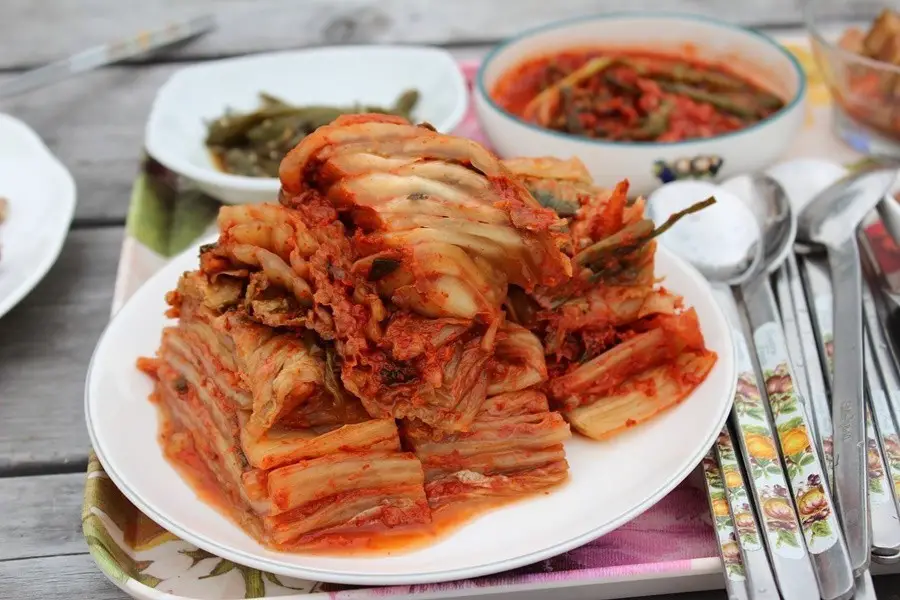
Napa kimchi, the most regular type of Korean kimchi. Credits: Pixabay.
The most common type of Korean kimchi is napa kimchi. It is made from napa cabbage which is widely known as Chinese cabbage in Malaysia. The secret to make your napa kimchi a little bit sweet is to put in some shredded pear.
2. Buchu kimchi
Buchu is an onion species known for many names including garlic chives, Chinese leek, oriental garlic, Asian chives. Here in Malaysia, we simply know it as daun kucai. While we enjoy stir-fried daun kucai with garlic, you can also make a type of Korean kimchi out of it.
Oisabagi is basically spicy stuffed cucumber kimchi made with garlic chive, carrot and seasoning. The best part about this type of Korean kimchi is, you can eat it right away without waiting for it to be fermented.
Here comes a Korean kimchi without the chilli powder, aptly named baek kimchi or white kimchi. If you find regular kimchi is too spicy for you, opt for baek kimchi. It is mainly made with salted napa cabbage, radish, spring onions, salt, garlic, and sugar.
Even in Malaysia, not everyone enjoys gat which is sawi pahit in Malay or mustard leaves in English. The bitter taste lingers even after you finish your meal. However, you might enjoy it after turning the vegetable into kimchi.
The star ingredient for kakdugi is white radish or else is called mu in Korean or daikon in Japanese. Unlike other Korean kimchi, kakdugi is crunchier thanks to the radish texture. Making kakdugi is another way to eat radish instead of our usual Malaysian radish cake.
7. Dongchimi
Traditionally, the Koreans enjoy dongchimi during winter season. Though it is all-year summer season in Malaysia, make your own dongchimi out of radish, cabbage, pickled green chilli, pear, and water. It takes usually two or three days to mature.
Gaji means eggplant in English or terung in Malay. Here in Malaysia, one of the favourite ways to cook it is with sambal (Malay hot paste). Gaji kimchi takes about half an hour to make and one day to mature before you can enjoy it.
Most Malaysians can handle spiciness pretty well which is why Korean cuisine is well received here. Gochu sobagi or spicy stuffed green chilli is another way to satisfy your craving for spiciness. It is made by stuffing kimchi seasoning into green chilli.
What About Kuching (WAK) is back! From Sept 29 till Oct 28, Kuching will be lit up with tonnes of activities all over the city.
This month-long festival is a local community effort aiming to celebrate the arts, culture and lifestyle that Kuching has to offer.
Mark your calendar and decide what to do during this year’s What About Kuching:
1.Watch local artists in action at Bishopsgate and The Clock Tower
What About Kuching Music Portail provides platform for local artists to showcase their talents. Watch out for these dates Oct 5, 6, 12, 13, 19 and 20 when the fun is happening at Bishopsgate Street Stage. Then on Oct 26 and 27, the party is moving to Clock Tower@The Old Courthouse.
There will be performances from Zee Avi, Tuku Kame, At Adau, Meruked and many more.
At Adau’s Ezra Tekola on the sape’. Catch At Adau on Oct 12 at Bishopsgate Street Stage.
2.Visit the World Press Photo Exhibition
The iconic Padang Merdeka will come alive during the whole duration of What About Kuching. There, the World Press Photo Exhibition will make its Kucing debut showcasing a series of award-winning photos.
3.Follow a food trail along Padungan Street
What Kuching without its food? Follow the trail of Food Safari, collect stamps along the way and redeem a What About Kuching Merchandise.
4.Enjoy the music by Sarawak river at Waterfront Night Live
Do you know that there is a free weekly entertainment programme at GoDown Amphitheatre@Kuching Waterfront? The entertainment continues throughout What About Kuching month every Friday and Saturday.
5.Support young entrepreneurs at Junior Art Market
Lend your support to young entrepreneurs at Junior Art Market.
This art market is unlike others as it is exclusively dedicated to young entrepreneurs. However, there are art workshops, food and performances for all ages.
6. Observe the beauty of body art of Sarawak
What does the late Anthony Bourdain and Crazy Rich Asian’s Henry Golding have in common? Both of them have tribal Iban tattoos on their bodies.
From Sept 29 till Oct 9 there will be a tattoo exhibition happening at The Old Courthouse.
7. Learn more about Sarawak tattoos
Speaking of tattoos, know more about this artistry on Sept 30. There will be a presentation about tattoo artifacts. While on Oct 7, there will be a panel discussion on Sarawak tattoo industry.
8. Take part in a photojournalism workshop
Calling out all professional and amateur photographers! There will be a free a workshop conducted by photojournalists from the World Press. Sign up quickly because seats are limited.
9.Meet a fine artist
Ramsay Ong is a household name when comes the local fine art scene. Meet him daily from 10am to 2pm from Mondays to Fridays at the Pullman Hotel.
10.Take pleasure in listening to monologues
Listen to local talents reciting their monologues on Oct 5. There will guests performers flying in from Singapore and West Malaysia.
11.Enroll your kids in a Latin dance workshop
Enroll your kids in a Latin dance workshop.
Start ‘em young! Sign your kids up for Latin Dance Workshop and they might have a knack for it!
12. Watch a yoga performance
Observe professional yogis in action at Sarawak famous Darul Hana Bridge Oct 6. On Oct 18, the yoga performance is happening at the Old Courthouse. After both of the performances, the public will have the chance to try some yoga moves. Do not miss out on this!
13. Gain an understanding on how to be a published writer
Do you have a manuscript tucked away somewhere in the corner of your room? Or have you always wanted to be a published writer? For two hours on Oct 7, bestseller Gina Yap will share about her journey.
14.Take in the knowledge of a poet
Marc Nair, a poet from Singapore will gives listeners a peak into his world of publishing poetry, taking photographs and more on Oct 7.
15. Familiarise yourself with Borneo beads
The beads of Sarawak can be considered as one of the state’s most precious heirlooms. Know more about beads of Sarawak by Heidi Munan on Oct 9.
16.Admire the beauty of Sarawak craft
From Oct 8 till 28, explore the beauty of Sarawak arts and Crafts at Pullman Hotel.
17. Grasp more about mental health problems in Kuching
Honestly here in Sarawak we do not talk enough about mental health. Join in the movement of raising awareness in conjunction of World Mental Health Day from Oct 10 till 14. There will be exhibitions, screening and forums.
18.Ignite your passion in Latin dance
Dance to Latin music with Sarawak sunset glowing on you on Oct 12 and 19 at Kuching Waterfront. Only for two days, there will be a showcase and free dance lesson from Baile Latino Kuching from 6.30pm to 7.30pm.
19.Spend an evening of music, art and coffee
Shades of Art is back in town on Oct 13! The 13th edition of this evening of music and arts is dedicated to the Ranee of Sarawak.
20. Watch local short independent films
For one night only on Oct 13 at The Garden@The Old Courthouse, there will be film screenings and sharing session.
21. Play some ping pong games
Sweat it out for some ping pong games at Plaza Merdeka on Oct 14-27.
22.Show your support to the artists from the Kuching Autistic Association
Give your support to the artists from the Kuching Autistic Association during this What About Kuching.
Walk through forty pieces of artworks from the talents of Kuching Autistic Association. The exhibition is happening on Oct 19 to 21 at Hilton Hotel.
23.Explore a cardboard city
Here is another activity to bring your kids! Explore the Cardboard city made from recycled cardboard on Oct 20 till 21.
24.Jam with the youths
Feel the young vibes of local youths at Kuching Youth Jam. This monthly gathering features exhibition and workshop for hip hop enthusiasts.
25.Party with the local hip hop scene
Another What About Kuching event for hip hop enthusiasts, Tha (this is not a spelling error) Block Party organised by Tha Project will highlight hip hop talents, break dancing and more.
26.Take a pint (or more) during an Oktoberfest
Forget about celebrating Oktoberfest in Germany and head down tHe Spring shopping mall. Enjoy your drinks and the live music for ten nights from Sept 29 till Oct 7.
27.Channel your inner Tony Hawk
What About Kuching is all out giving platforms to different kinds of communities in the city. One of these community is the skaters of Kuching. There will be workshops, competitions and booths during Skate About Kuching on Oct 21.
28.Celebrate Deepavali for three days
Although Deepavali is not a public holiday in Sarawak, it should not stop all Sarawakians to celebrate. Come together on Oct 26-28 at CityOne Megamall to celebrate with arts, fashion shows, Bollywood competition as well as cooking classes and contests.
29.Visit a flea market
Show your support to local artisans and entrepreneurs while watching live music at Green Heights Mall Halloween Flea.
30.Find a treasure at a trunk sale
The biggest pre-loved market in Kuching is back on Oct 27 till 28. Give new life to old items at Kuching Trunk Sale (Oct 27-28) at Emart Batu Kawa.
This dish is originally a Chinese recipe made of fried white fish covered in a sauce made from ketchup, diced pineapples and cucumbers.
The sauce offers a nice blend of sweetness and sourness all thanks to the ketchup, canned pineapple juice and vinegar.
If you are not a big fan of fish, you can replace it with fried chicken meat or pork.
2. Pig intestines cooked with pineapple
Speaking of pork, pig intestines might not be everyone’s cup of tea but in Sarawak it is famously cooked with this tropical fruit.
During Gawai or the harvest festival, pork is the white meat of choice. Usually, each and every part of the pig is not wasted and cooked including its intestines. Pineapple makes the perfect pairing, as its sweetness balances out this organ’s strong taste.
3. Pajeri nanas
From Sarawak, we now head to Peninsular Malaysia. “Pajeri nanas” or pineapple curry is a Malay traditional dish whereby each West Malaysian state has its own recipe.
Here is another Malay recipe; sambal is a sauce or paste made mainly from chili peppers with other secondary ingredients such as shrimp paste (sambal belacan) or petai (sambal petai).
Hence, sambal nanas is a rough paste made from pineapple.
5. Nanas Tumis Air
“Nanas tumis air” is a stir fried dish suitable for vegetarians. It is cooked with shallots, garlic, turmeric powder and spices like clove, star anise and cardamom.
6. Pineapple fried rice
Inspired by Thai fried rice, it is commonly seasoned with turmeric powder giving the dish its slightly yellow colour. What makes this dish so good, is the sweetness of the pineapple which gives this Asian staple the tropical fusion it needs.
7. Fruit rojak
Also known as Malaysian fruit salad, a rojak is a famous dish taken during tea-time. It consists of cucumber, jicama, deep-fried tofu and of course pineapple.
8. Pineapple tart
If you are not a big fan of this fruit as a savoury dish, here is the recipe that will suit all taste buds. These tarts are bite-sized baked goods topped or filled with pineapple jam. It is one of the famous festive cookies because it is usually served during Hari Raya, Chinese New Year and Gawai.
However, you can still find them in local bakeries all year round.
Even if you are visiting Sabah for the first time, driving from its capital Kota Kinabalu to Kundasang is possible to make on your own.
By making the journey yourself without hiring a cab or paying for a tour package, you can save more money and enjoy the trip at your own pace.
Sunflowers growing at Kundasang.
Kundasang is the highest settlement in Malaysia, standing at an elevation of 1,900m.
It is the closest town to Mount Kinabalu, the highest peak in the country.
The average temperature at Kundasang is about 20oC so you might want to pack a jumper or sweatshirt.
Here are 10 things to know before starting your engine from Kota Kinabalu to Kundasang:
1. Take an early flight in
Try to arrive in Kota Kinabalu early in the morning. You can either rent a car at the airport or you can arrange your rental service to send the car there.
2. Have breakfast in Kota Kinabalu
Fill yourself up before starting your journey. Kota Kinabalu has plenty to offer when it comes to food, from Sang Nyuk Mee (pork noodle), Tuaran Mee(wok-fried handmade noodles) to Ngiu Chap (beef broth served with noodles).
This is another choice for breakfast in Kota Kinabalu, Fook Yuen cafe is famous for its fresh baked breads.
3. Fill up your gas tank in Kota Kinabalu
After filling your belly, it’s time to fill the fuel up before your ride. It takes about two hours to drive from Kota Kinabalu to Kundasang.
What’s so fun about it, you ask? As the saying goes, “It’s not about the destination but about the journey itself.” So grab some snacks and plain water, and let the journey begin!
About 45 minutes into your journey depending on the traffic, make the first stop at Chanteek Borneo Indigenous Museum.
Located at Telibong-Tamparuli road, the museum is Sabah’s first miniature doll gallery. Truly one-of-a-kind, the museum aims to replicate all the traditional costumes from 300 ethnicities and and sub-ethnicities in Borneo into a miniature size.
You can also show your support to the local community by shopping at its souvenir shop where 70% of the products are made by women of Borneo.
5. Have fun at rumah Terbalik and the 3D Wonders Museum
After learning more about indigenous cultures, now it’s time for a quirky and fun experience.
Rumah Terbalik (‘upside-down house’ in Malay) and 3D Museum offers visitors an experience to visit a house where everything is flipped upside down. From its furniture and cars, visitors can now know how it feels to walk on the ceiling.
There is a 3D Wonders Museum on the same compound where visitors can learn about biodiversity and the ecosystem.
6.Take a photo at Tamparuli bridge
Before going straight to Kundasang, make a short detour into Tamparuli town to visit its famous suspension bridge.
It is so famous that there is even a song about it.
7.Have a taste of Sinalau Bakas
During your journey from Kota Kinabalu to Kundasang, you will see signs selling ‘sinalau bakas’. The highway stretch from Tamparuli to Kundasang is reportedly most famous for this unique Kadazandusun dish.
Make a pit stop at any of these stalls and give sinalau bakas a try. It is basically smoked wild boar.
8.Shop at Nabalu for souvenir
After driving for about 40km from Tamparuli, make another pit stop at Nabalu town.
Apart from taking a toilet break, here you can take a view of the majestic Mount Kinabalu. You can also contribute to the local economy by purchasing some souvenirs and snacks at the local market.
9.Buy some Sabahan preserved food
If you are feeling a little gastronomically adventurous while at Nabalu, buy some of their preserved foods.
From Nabalu, there are 20km left till you arrive Kundasang. There are so many things to do here even if you are not intending on climbing to the top of Mount Kinabalu.
Pay your respects to British and Australian soldiers who died in the Sandakan Prisoners of War camp at Kundasang War Memorial.
Hike or soak in at Poring Hot Spring or shop for snacks, fresh flowers, fruits and vegetables at Kundasang market. We suggest trying their keropok bayam (spinach crackers).
Experiencea little bit of New Zealand by visiting the Desa Dairy Farm where the cows flourish and fresh milk as well as gelato are aplenty.
As for accommodations, there are plenty to choose from depending on your budget. However, the best is to pick a room with a window overlooking the peak of Mount Kinabalu. Waking up to the view of this mountain early in the morning is something one must experience at least once in their lifetime.
If you are visiting Kuching for the first time and are a big fan of ice cream, there are two iconic desserts you have to try.
Both ice creams have distinct tastes from each other and have maintained their legendary status in the Kuching dessert scene despite having no air-conditioners, let alone Instagram-worthy settings.
But locals have been flocking to these ice-cream places for years now and by the looks of it, they will continue to do so in coming years.
So no matter how packed your itinerary is, do not leave Cat City of Sarawak without trying these two ice creams.
1.Sunny Hill Ice Cream
A cup of sundae with sweetened, crushed peanuts.
If ice-creams in Kuching had a king, Sunny Hill ice cream would definitely be sitting on that throne.
This ice-cream maker has been operating since the ’60s, maintaining its canteen-style design over the years.
Located at Jalan Bukit Cahaya, Sunny Hill offers affordable soft ice creams.
Besides their basic ice cream cones, they also offer ice cream sandwiches, banana splits and ice cream floats.
You can also choose to have toppings of syrup and/or crushed peanuts.
Unlike other ice-cream parlours that have an ever-ready selection of flavours, Sunny Hill serves its selection of flavours on a rotational basis.
While vanilla is served everyday, their other flavours are served as follows: strawberry (Monday and Tuesday), pandan and corn (Wednesday to Friday) and chocolate (Saturday and Sunday).
On top of their mouth-watering ice-creams, Sunny Hills also sell baked goods such as cookies, breads and egg tarts.
2. R.G. Ais Krim Bergula Apong
Ice cream gula apong (palm sugar) has been in trend for the past few years. But the first one to come up with the idea is a humble stall located at Kuching Open Air Market.
A pandan-flavoured ice cream with a drizzle of palm sugar and cornflakes topping.
Reportedly, Richard Tan the owner of R.G. Gula Apong Ais Krim started the ice-cream plus palm sugar craze 20 years ago.
They only have one flavour a day but in three sizes – small, medium and large.
You can choose your own topping – peanut, cornflakes, Oreo or Nestum – for free.
The texture of this ice cream is closer to a shaved ice unlike most of the ice creams with palm sugar out there which usually has soft serve ice creams.
Some people may find R.G. Ais Krim Bergula Apong too sweet for their taste, but if you need an instant dose of sugar, why not give this ice cream a try.
R.G. Ais Krim Bergula Apong is believed the one who started to serve ice creams with palm sugar.
Nasi goreng, which literally translates to “fried rice” in Malay, has ignited a few cross-country fights over the past few years.
The most famous incident was when former England footballer Rio Ferdinand twitted “Nasi goreng lunch… Keeping it local in Singapore.”
Indonesians were quick to correct Ferdinand saying nasi goreng is not from Singapore, but Indonesia.
Meanwhile, some Malaysians jumped into the squabble, slamming Indonesians for wanting to claim every dish in the region including rendang.
However, do you know that chao fan or fried rice in Mandarin has been served in China since 4,000 BC?
Perhaps now China can stop claiming the South China Sea and stake their claim on nasi goreng instead?
Regardless of who owns nasi goreng, a visit to any Southeast Asian country especially Indonesia, Malaysia and Singapore would not be complete without tasting this dish.
In Malaysia, there are plenty of nasi goreng variations served in different parts of the country.
Some of these variations cannot be found in its neighbouring countries.
So here is your complete guide to Malaysian nasi goreng:
1.Nasi Goreng Ayam/Udang/Kambing/Daging
If you see this on the menu, you just need to choose your type of protein.
This fried rice is cooked with chicken (ayam), udang (prawn), kambing (mutton) and daging (beef).
2.Nasi Goreng Special
Nasi goreng special is usually an in-house specialty. However, most often they just add a sunny side up egg with a piece of fried chicken on top of your nasi goreng.
3.Nasi Goreng Tom Yam
This Malaysian nasi goreng has a Thai inspiration.
It is cooked with tom yam paste, lime, sometimes with a bit of lemongrass and fish sauce.
This Malaysian nasi goreng might sound like it comes from Thailand but it is believed to originate from Malaysia.
It is made by wrapping chicken fried rice in a thin fried omelette, almost similar to Japanese omurice. Nasi goreng Pattaya is often served with chili sauce, tomato ketchup and slices of cucumber.
Hailam refers to a Chinese cooking style which usually uses watery soy sauce.
Hence if it is Nasi Goreng Hailam, it is fried rice served in vegetables, chicken or prawn cooked in Hailam-style.
6.Nasi Goreng Kerabu
Nasi Goreng Kerabu is a fried rice dish serve with ginger flower (bunga kantan), curry leaves and fried anchovies.
It is inspired by Kelantanese famous dish nasi kerabu, a blue-coloured rice served with dried fish or fried chicken, pickles and keropok.
The irony of nasi goreng cina (Chinese) in Malaysia it is usually can be found in Malay restaurants instead of Chinese restaurants.
There are plenty of nasi goreng cina variations out there but they all have one thing in common, sesame oil.
If you love fried anchovies and kangkung (water spinach) then you will love this dish.
A nasi goreng kampung is not nasi goreng kampung without fried anchovies and kangkung.
This dish can be found mainly in Chinese restaurants.
It is fried rice cooked with char siu pork or lap cheong (Chinese sausage), scallion and vegetables such as long beans, carrots and green peas.
10.Nasi Goreng Belacan
Nasi goreng belacan is rice fried with shrimp paste (belacan), fish or chicken and long beans.
If you are into salty food then this is the Malaysian nasi goreng for you.
It is fried rice cooked with salted fish.
12.Nasi Goreng Mamak
Nasi goreng mamak is cooked in Indian-Muslim style. Nasi goreng mamak tends to be oilier than most Malaysian nasi goreng. Besides chilli paste, other main ingredients of this dish are dried tofu, fish cakes and curry powder Maggi’s instant noodle
13.Nasi Goreng Dabai
This is a Sarawak specialty of fried rice. It is rice fried with a seasonal native fruit called buah dabai (Canarium odontophylum).
14.Nasi Goreng USA
Again no, this Malaysian nasi goreng does not get any inspiration from the United States of America.
In fact, the acronym USA means udang (prawn), sotong (squid) and ayam (chicken).
Thus, this fried rice is served with prawn, squid and chicken.
15.Nasi Goreng Paprik
The key ingredient in nasi goreng paprik is the sauteed chili paste. With a bit tom-yum paste, this fried rice is a little bit on the spicy side.
This is another Malaysian nasi goreng inspired by its neighbour Thailand. The word paprik refers to Thai phrase pad prik where pad is stir-fry and prik means chilli.