Browse Tag

Kuching - Page 6

How did the name of Sarawak’s capital get changed to Kuching?

In the olden days, Sarawak’s capital was also known as ‘Sarawak’.

How did the name of Sarawak's capital get changed to Kuching?
Kuching view. Credits: Pixabay.
Why did the second White Rajah, Charles Brooke decide to change Sarawak’s capital name to Kuching on Aug 12, 1872?

Abang Othman Datu Haji Moasili wrote in The Sarawak Gazette on Aug 31, 1964 that explained the reason behind it.

“The story, according to the old Malays and as related to me by my father, the late Datu Hakim, goes that the second Rajah who spent most of his time as Tuan Muda and later as Rajah Muda and Rajah among the Sea Dayaks in the Second Division used continually to be asked, as is the Iban custom not what town he came from but which river he came from?” he wrote.

Abang Othman described a small rivulet called the Sungei Sarawak located about 16 miles above Kuching from which the capital originally derived its name.

He continued, “But much closer to his residence, the Astana and only a short distance down the river, near the present Chinese General Chamber of Commerce, there used to be another rivulet, the Sungei Kuching, until it was filled in, in 1928.”

This rivulet was the river nearest to the Astana. Plus, it was well known to the Ibans, as they used to put up there for shelter during the night on their visits to the capital.

How did the name of Sarawak's capital get changed to Kuching?
The Chinese General Chamber of Commerce is now the Chinese History Museum.

Kuching river

Hence, when people used to ask the Rajah where he came from he would say “Kuching river”.

Over time, the word ‘river’ was dropped and he was known among the Dayaks as “coming from Kuching”.

As the territory of Sarawak expanded, it caused some confusion to call the country and the capital by the same name. This led to the necessity for a distinction to be made between them.

Abang Othman stated, “At first, the difficulty was overcome by calling the capital ‘Sarawak Proper’. But as it had now become known to the Sea Dayaks, who formed the largest number of the population as Kuching, the Rajah decided officially to change the name from Sarawak to Kuching.”

Read more:

How Sarawak, Land of Hornbills, got its name?

The legend of Iban warrior Unggang and goddesses of Mount Santubong

The legend of Iban warrior Unggang and goddesses of Mount Santubong

If it weren’t for Benedict Sandin (1918-1982), many Iban legends and folktales would have been forgotten by now. Originally from Paku, Benedict was an ethnologist, historian and Sarawak Museum curator (December 1966- March 1974).

The legend of Iban warrior Unggang and goddesses of Mount Santubong
Mount Santubong

Here is one of his stories that was published on the Sarawak Gazette. This time he told the story of Iban warrior Unggang.

Long time ago at a small stream called Entanak, lived a very powerful Iban war leader named Unggang “Lebor Menoa”.

During his time, there was no chief in the Saribas river area more well known than him.

When he was still a young warrior, Unggang dreamt that he was travelling in a boat from the mouth of the Saribas river to Mount Santubong.

He then attempted to climb to the top of that mountain. Halfway up, he met two beautiful maidens who just finished bathing.

They said that they did not have much time to talk, and one of them handed him a stone that she had used to scrub her skin. The stone was called Batu Perunsut.

She told him that the stone was a charm that he could use whenever he led his people to war.

The woman also told Unggang that none of the people who lived in the countries between Santubong and the mouth of Saribas river could possibly beat him in war.

Luckily for him, she warned him if he led his war parties southeast beyond Santubong, the stone would have no effect.

Later, the women revealed to him that they were Kumang and Lulong, the goddesses who lived on the summit of Santubong.

Unggang’s path to becoming a great warrior

Shortly after he had the dream, Unggang built a large war boat with which he used to lead his warriors to guard the mouth of the Saribas river from being penetrated by enemies. At the time they were the Bajau and Illanun pirates.

They also killed strangers that came into the river from the South China Sea.

Besides guarding his territory, Unggang sailed farther along the coast of Sarawak to look for trading ships.

During one of his sails, he came across with a band of Chinese traders who negotiated with him.

The Chinese traders sought his permission to trade in the Saribas country.

Unggang agreed with condition that these Chinese traders agreed to fly white flags on their vessels.

Due to this agreement, many Chinese traders came to Saribas to trade their cooking pots, brassware, earthen bows, pants and cloths. In return, the Chinese brought back shell armlets, beads, cowry shells and so on.

Meanwhile, Unggang and his men killed anybody who entered the Saribas river without flying a white flag on their boats.

Although Unggang seemed to be a ferocious warrior, he was also a savvy tactician, and allied himself with the Malays who lived in the coastal areas. Hence, he never attacked his Malay neighbours.

Unggang’s son Luta

The legend of Iban warrior Unggang and goddesses of Mount Santubong
Illustration of Dayak men.

After Unggang died, his son Luta succeeded him as the chief. During Luta’s reign as chief, a fight started between the Dayaks of Saribas and Skrang against their neighbours of the lower Batang Lupar (the Dayaks from Undop, Balau and Sibuyau).

During one of these tribal wars, Luta’s youngest brother Ngadan was killed by Temenggong Juti and his men from Sebuyau.

Also killed during the war in Undop was Angkum, one of the brothers to Orang Kaya Pemancha Dana Bayang, a leader from Padeh who led the Saribas Iban.

Due to these incidents, Luta took his revenge by invading Sebuyau and killed many of them there.

Meanwhile, Dana Bayang avenged his brother’s death by invading Undop with the largest force from the Saribas and Skrang.

After invading Sebuyau, Luta took his brothers Mulok and Ketit to sail to the Belitung island near Sumatra.

He wanted to go there because he heard a rumour that someone in Belitung was selling a tuchong (shell armlet) which could be fitted over one’s head. Apparently, Luta was anxious to buy this for his inheritance.

However, the three brothers never returned to the Saribas. The rumour back then they were shipwrecked. A piece of their broken boat found at the beach near Sungai Ubah not far from Tanjung Datu.

The location of Luta’s alleged shipwreck was located beyond Santubong mountain from Saribas. Perhaps the charm that worked to protect Unggang before did not work to protect his sons once they went beyond southeastward of Santubong.

After the brothers’ untimely death, none of their descendants were able to lead their warriors to fight.

Hence, the leadership in the Saribas area fell onto the shoulders of Orang Kaya Pemancha Dana Bayang. He later became one of the most of famous Iban warriors and leaders.

5 things you should know about Sarawak’s flags throughout the years

Did you know that the current Sarawak flag was inspired by the state’s old flag when it was under the reign of the White Rajahs?

Over the years, there have been several changes to the Sarawak flag with the current design becoming official in 1988.

And who could forget the Trisakti that was designed and first hoisted by the then Chief Minister of Sarawak Abdul Rahman Ya’kub in 1973?

5 things you should know about Sarawak's flags throughout the years
The Trisakti flag: The blue was supposed to symbolise Sarawakians being unified in pursuit of national aspirations; the red to symbolise their perseverance and determination; and the white to reflect honesty and purity.

The current design retains the same colour scheme as the flag of the former kingdom, except with two significant changes. The cross was replaced with two diagonal bars while the crown was substituted with a nine-pointed star.

Here are 5 things you should know about the history of previous Sarawak flags before all these changes:
1.Before there was an official flag, there was the flag of St George.
5 things you should know about Sarawak's flags throughout the years
Brooke’s personal standard was the flag of St George’s Cross. Photo credit: The Sarawak Gazette.

When the first White Rajah James Brooke came into power, he originally used St. George’s Cross as the state’s flag.

It was a red cross on a white background in the form of swallow-tailed pennant. James flew this flag over his first fort at Berlidah, not far from Siniawan.

2.The first official Sarawak flag was designed by James Brooke.

Finally in 1845, James decided to give Sarawak a flag of its own. However, he only hoisted it three years later on Sept 21, 1848.

The flag was made up of a half blue and half red cross of his Armorial Bearings on a yellow background.

So what did the first White Rajah do after there was an official Sarawak flag? In 1845, he applied to the British Ministries for Foreign and Colonial Affairs in order for them to recognise Sarawak by allowing a Protectorate flag to be displayed.

However, it took the British government 15 years (January, 1864) to recognise Sarawak as an independent state and another 35 years (June, 1888) before Britain expressed its protection.

James was reported to have regretted that the flag did not contain a quartered Union Jack (like you see in today’s New Zealand and Australian flags).

3.Was it blue or purple?
5 things you should know about Sarawak's flags throughout the years
The first official Sarawak flag caused some debate over whether it was a blue and red cross or a purple and red cross. Photo credit: The Sarawak Gazette.

The only recorded account of the first hoisting of the Sarawak flag can be found in “Letters from Sarawak” in 1851 by Harriette McDougall, the wife of Bishop McDougall.

She wrote a letter to her son Charley who was at school in England, which was later published to help raise missionary funds in Sarawak.

Unfortunately, Charley passed away a year after this letter was written due to a blow from a cricket ball.

Going back to the Sarawak flag, this was what Harriette wrote to her son:

“The Sarawak flag is a purple and red cross, out of Sir James Brooke’s armorial shield, on a yellow background, yellow being the royal colour of Borneo. It was given by the Rajah to his people on his return from England in 1848 and I remember well what a grand occasion it was. HMS Meander was at Sarawak (the old name for Kuching) at the time, and their band played ‘God save the Queen’, as the flag was the first time hoisted on the flag-staff before the Rajah’s house.

All the English (probably only men) were assembled there, and a great crowd of natives, Malays and Dayaks, whom the Rajah addressed in the Malay language telling them the flag which he had that day given them would he hoped, be their glory and protection, as the flag of England had been hers. The Malays listened with love and reverence to his words and from house across the river, I could hear their acclamation.”

Although Mrs McDougall here pointed out that the flag was a purple and red cross, the second White Rajah Charles had clarified in a letter that the cross was in fact blue and red.

But that did not stop many of the early writers from the late 19th century stating that the colours were purple and red.

4.The first recorded official notification regarding the Sarawak flag was issued on May 7, 1870.

According to archivist W.J Chater, the first official notification regarding the Sarawak flag was concerning the dimensions of the flag.

It also stated, “Black bunting to be used in place of blue” denoting the change from the cross’ blue colour to black and quash the rumours that it was purple instead of blue.

5.The three bodies that first used Sarawak flags officially

While it is common to see the Sarawak flag hoisted up in front of government buildings these days, back in the olden days the Rajah first gave the Sarawak flags to three bodies, namely the Society for the Propagation of the Gospel (S.P.G) in 1871, the Borneo Company in 1874 and the Roman Catholic Mission in 1906.

The Roman Catholic Mission hoisted the Sarawak flag for the first time on Vyner Brooke’s birthday (Sept 26, 1906).

Meanwhile, the Kuching branch of the Borneo Company Limited hoisted the flag only for a short time. Then they refused to do so reportedly because they found ‘it was too ugly’ and the blue border being a Chinese sign of mourning might have been considered unlucky for business.

Book your home away from home at the Riverside Majestic Astana Wing

What type of traveler are you? Are you the type to hit the ground running, or the kind that just wants to relax, kick off your shoes and absorb your surroundings first? At Riverside Majestic’s Astana Wing, you can have it both ways (or more).  

Situated in the middle of Kuching City’s golden triangle made up of a unique balance between the city’s architectural and cultural heritage sites, and its business district; you can explore, enjoy the local cuisine as well as its nightlife, all on foot from the ease of your hotel.
  • Book your home away from home at the Riverside Majestic Astana Wing
  • Book your home away from home at the Riverside Majestic Astana Wing
  • Book your home away from home at the Riverside Majestic Astana Wing
  • Book your home away from home at the Riverside Majestic Astana Wing

Riverside Majestic Astana Wing itself provides a luxurious hotel stay for casual travellers, while also providing fully-equipped facilities for digital nomads. It’s perfect for local event planners as well as incoming business travellers looking for an event venue and hotel stay with a killer view, and that is of one of Kuching’s most iconic heritage locations, the Kuching Waterfront.

No matter what floor you are on, the Kuching Waterfront remains the mainstage of your view. Thanks to constant upgrading and recent additions to the waterfront like the Darul Hana Bridge and most notably the Darul Hana Musical Fountain, you can never take a bad photo of the waterfront, morning, noon or night. 

Book your home away from home at the Riverside Majestic Astana Wing
The view of Kuching’s historical waterfront from the Riverside Majestic’s events and meetings floor which features the spacious Alamanda Room, Orchid Room and Rafflesia Room.

For digital nomads and business travellers

Riverside Majestic Astana Wing enables digital nomads to plug and play here. Besides free wifi throughout the hotel, facilities such as the Surf & Chat business centre at the Mezzanine allows you to work while on holiday. 

It’s neatly placed just above the buzz of families and fellow travellers checking in at the reception counter, and private enough for business professionals to work or hold discussions and meetups with clients and partners. Their choice of punchy colours and comfortable sofa arrangements definitely provide inspiring backdrops for serious business discussions.

Book your home away from home at the Riverside Majestic Astana Wing
Besides their business facilities, you can also enjoy a coffee or a meal as you take in the view.

Meanwhile, the Sape Restaurant provides a diverse and comprehensive breakfast buffet spread offering Western and Asian breakfast favorites. 

The Deli Cafe below the Surf & Chat is perfect for a quick munch or a sugar hit with your coffee or tea. 

  • Book your home away from home at the Riverside Majestic Astana Wing
  • Book your home away from home at the Riverside Majestic Astana Wing
  • Book your home away from home at the Riverside Majestic Astana Wing
  • Book your home away from home at the Riverside Majestic Astana Wing
  • Book your home away from home at the Riverside Majestic Astana Wing
  • Book your home away from home at the Riverside Majestic Astana Wing
  • Book your home away from home at the Riverside Majestic Astana Wing

For a fine dining experience at the top where you can enjoy the skyline over the Kuching Waterfront, you can spend the evening with a business partner or a loved one at Suasana on 18 Fine Dining.

Meanwhile, for those who don’t want to skip leg day or want to take advantage of the sun, the gym and swimming pool facilities are in the main Riverside Majestic Puteri Wing, and navigable through a scenic corridor connecting the two buildings.

A look at the Insiders Club

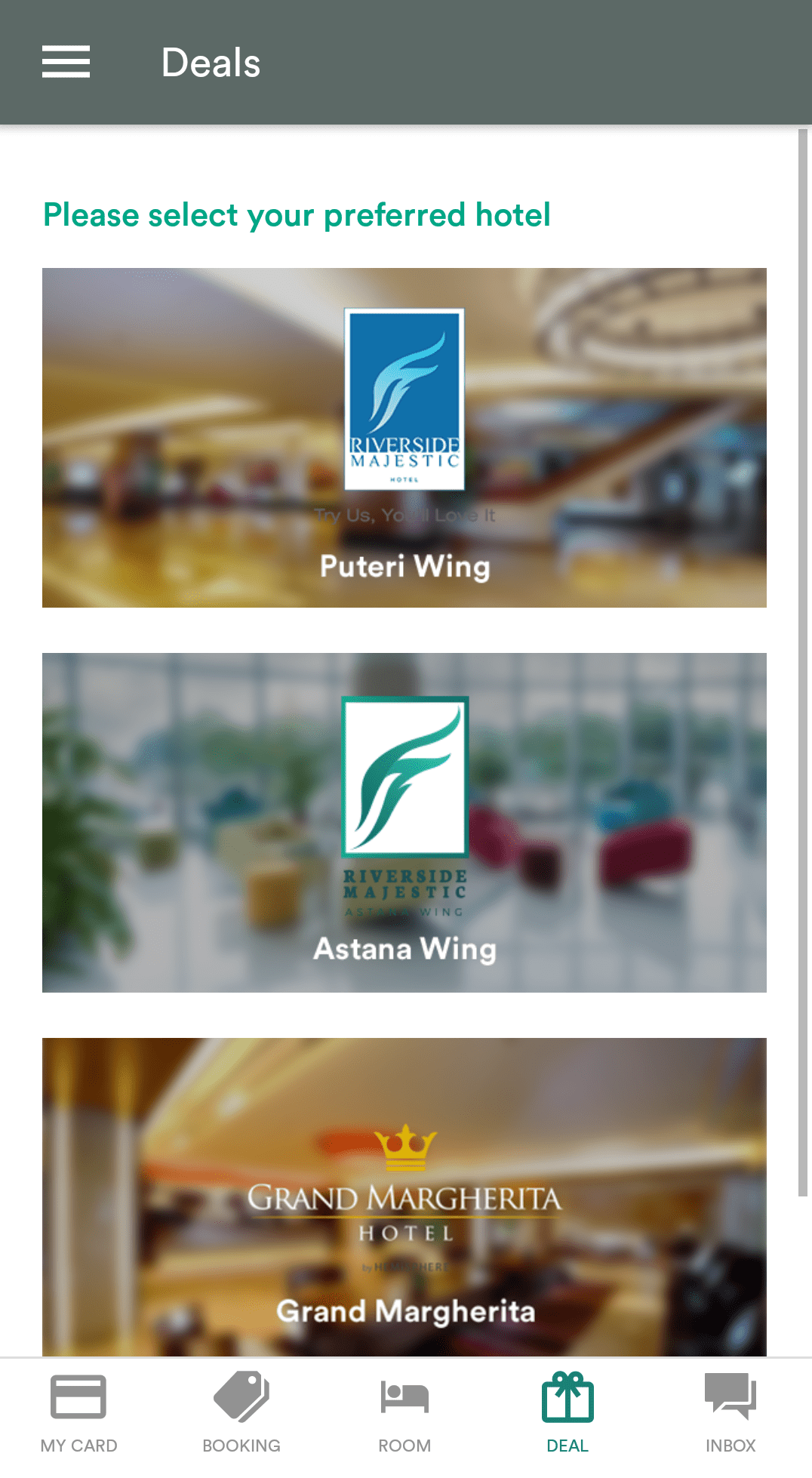
This is the handy app you didn’t know you needed. Free to download, membership is also free. Once you’ve logged in, you are automatically an Insiders Club member and can enjoy great deals and prices on their rooms and restaurants. 

For frequent travelers to Kuching’s Cat City who enjoy the luxury, convenience and reliability of this hotel chain made up of Riverside Majestic Astana Wing, Puteri Wing and Grand Margherita Hotel, you can keep updated with their deals, book your rooms under member prices or collect and redeem Insiders Club points.

You can even book Room Promo Packages which will include sightseeing packages along with your hotel stay, making this app a perfect tool for business travellers and families looking for a fuss-free, memorable holiday.

Kuching may not be the biggest tourist draw when it comes up against tour destinations like the Maldives or Phuket, but Sarawak’s capital city has a lot of heart made up of its living and historic heritage, all of which can be experienced from the comfort of Riverside Majestic Astana Wing.

How did rubber plantations become part of rural Sarawak?

In Malaysian history class, we learned that rubber plantations in the country was promoted by an Englishman named Henry Nicholas Ridley (1855-1956).

He was a botanist, naturalist, and geologist who spent most of his time in Singapore.

His career on this side of the globe started in 1888. He applied and was selected the first director of Gardens and Forests in the Straits Settlements.

Before he made his way here, he was to meet Italian botanist Odoardo Beccari to prepare for his new job.

After reaching Singapore, Ridley was in charge of introducing new plants of economical value to the region. Against popular belief, he was not the first person to introduce rubber to this part of the world as it was already introduced 10 years earlier by Sir Hugh Low.

However, he did establish the taping method for harvesting latex. He was also the one who heavily promoted rubber plantations in Malaya.

He was so passionate in promoting rubber planting that he was always stuffing rubber seeds into the pockets of everyone he met, with hopes that they would plant the seeds. That was how he earned the nickname “Mad Ridley”.

The first rubber tree planted in Sarawak was in the Anglican bishop’s garden in Kuching
How did rubber plantations become part of rural Sarawak?
Rubber trees are tapped for their resins. Credits: Pixabay

While we learned a lot of Malaysian history in school, we only know a little about Sarawak’s own history with the rubber tree.

Ridley might not have been the one who promoted rubber in Sarawak as vigorously as he did in Malaya, but he did provide a written account of rubber planting in the state.

In September 1905, Ridley wrote an article which was published in the Agricultural Bulletin of the Straits Settlements.

He stated, “It would now be interesting to hear from the present Custodians of the gardens mentioned if the trees are still in existence, and to what girth they have attained at the sere and yellow age of 39 years.”

According to Ridley’s account, the first rubber trees planted in Sarawak were from seeds imported from the Botanic Gardens, Singapore. Reverend Bishop George Frederick Hose brought them in 1881. Bishop Hose was the uncle of Marudi resident, ethnologist and botanist Charles Hose.

He further stated, “One of these trees is still standing in the Bishop’s garden at Kuching and two more in the garden of the Resident. The former measures 6 feet 4 inches in girth at three feet from the ground and the others are nearly as large. The remainder of the trees have disappeared.”

The first rubber plantation in Sarawak

Ridley actually visited Sarawak four times, in 1903, 1904, 1914 and 1915. During his visits, Mad Ridley could not help but go out and see the rubber plantations.

The first rubber plantation he visited was the Coffee Estate on the slopes of Mount Matang. There, they planted the rubber trees together with coffee, tea and Mauritius hemp.

However according to Ridley, the rubber trees were in bad condition. Although the trees were five years old, they looked like the size of two-year-old trees.

“Many of the trees had fallen, others remained as dead stumps, or if alive bore only a few struggling leafy branches. Round Kuching, in the cemetery and along the roads, a good many para rubber trees have been planted lately, and seem to be doing fairly well, though it is too soon yet to form an opinion of them.”

Based on Ridley’s observation of rubber planting in Sarawak, the soils were too sandy.

“The greater part of the hills of Sarawak, at least that portion which I have seen, are sandstone or limestone, and a great area of the diluvium of the lower country is therefore very sandy. But the Lundu hills which I visited are granite, compose of a fine-grained granite. The soil here is less sandy and more argillacuous, with sandy mounds or small hills scattered about it. This seemed to be the most suitable ground for para rubber I saw in Sarawak. Another likely spot is long the Kucing river near Santubong, I had not time to visit this, but head that somewhere here Chinese were planting para rubber.

The first rubber export in Sarawak and the Rubber Boom
How did rubber plantations become part of rural Sarawak?
Natural rubber sheets in drying priocess. Credits: Pixabay.

Based on a report from 1962, the first rubber was exported from Sarawak in 1910.

When the world price of rubber hit historic highs during that decade (the first time in 1905-1906, followed by another boom in 1909-1910), Sarawak got hit by rubber fever.

Then Simanggang Resident AB Ward observed in his memoirs that 1911-1912 were the Planting Eras, as “Natives caught the rubber infection badly. Malays planted all the land they could. Dyaks followed suit, and rubber banished all thoughts of tribal warfare and headhunting.”

Professor Rob Cramb in Land and longhouse: Agrarian Transformation in the Uplands of Sarawak describes how the Saribas Iban took advantage of the money-making opportunity in rubber.

“Initially it was the wealthier Iban communities with a large land base and an accumulated surplus from the gutta and coffee booms which embarked on rubber planting.”

He also cites examples of early enterprising farmers like Tuai Rumah Budin in Stambak, who planted over 4,000 seedlings his son Lumpoh brought back from Singapore, and Penghulu Saang who planted his rubber in Pelandok in the Paku branch of the Saribas in 1912.

Although the price of rubber fell sharply after 1910, it nonetheless became the main agricultural export of the country until the late 1960s.

Unlike Malaya and other rubber producing countries, the kingdom was relatively late in establishing rubber plantations, as the Brookes favoured smallholders and were reluctant to give indigenous farmland to European companies.

During Charles Brooke’s reign, only five large rubber estates were established.

By 1941 before the World War II, there were 236,557 acres of rubber plantations in Sarawak.

Check out these six exhibitions during WAK 2019

What About Kuching (WAK 2019) is back for its third and the biggest edition yet.

Featuring a total of 56 collaborations and 99 events, WAK 2019 will turn Kuching city into a hub of colourful activities between Sept 28 to Oct 27.

Since its inception in 2017, WAK had been a true partnership between the public and private sectors while exemplifying its cohesiveness as Sarawakians and patriots of Sarawak.

WAK 2019 has also activated its Location X-traordinaire- the building that was once Ting & Ting Supermarket.

The month-long festival will all kinds of events such as conferences, workshops, live music, parties and sport events.

Check out these six exhibitions during WAK 2019
But if art is what you are looking far, check out these six exhibitions during WAK 2019:
1.Art Street Kuching: Ruangseni Exhibition
Date: Sept 28 – Oct 27
Time: 8am – 5pm
Location: Location X

From fine art paintings, sculptures to a film photography segment; this WAK 2019 exhibition explores an over-arching theme that offers visitors a metaphorical and literal understanding of ‘Dreams’.

The exhibition will feature the works of Benyamin Bahri, Mj Samaroon, Norma Saini, Sonia Luhong, Syed Rusydie, Billy Simon, Iona Danald, Jack Arjuna Chan, Ida Thien and Bethany Balan.

Do watch out for their workshops which span throughout WAK 2019.

2.The Art of the Tinsmith
Date: Sept 28 – Oct 27
Time: 9am – 6pm
Location: The Japanese Building at the Old Courthouse

Let this exhibition walks you through the craft of the traditional tinsmith’s workshop.

3.Driven by Inspirations – My Artistic Journey: Ramsay Ong
Date: Oct 1 – Oct 27
Time: 10am – 6pm
Location: Location X

Sarawak’s very own renowned artist Ramsay Ong will feature 12 pieces of fine arts at this exhibition.

Visitors will be able to take an insight into his transitions through various mediums and inspirational moments that has shaped him as an artist today.

4.Sarawakiana Carnival 2019: Sale, Demonstration & Exhibition of Sarawak Arts, Sculpture and Handicrafts
Date: Oct 4 – Oct 6
Time: 8.30am – 4.30pm
Location: Sarawak State Library’s lobby

An event about Kuching or Sarawak overall can never be complete without an exhibition about Sarawak craft. This exhibition will feature the art of carving and sculpture in Sarawak.

5.Discover Kuching – Photography Exhibition
Date: Oct 5 – Oct 11
Time: 10.30am – 5.30pm
Location: Ground Floor @The Hills Mall

Organised by Swinburne Photomedia and Design Club, this exhibition aims to showcase and promote local Kuching lifestyle and culture through photography.

Besides exhibition, there will be photography and editing workshops happening at the venue.

6.Symbiosis
Date: Oct 12- Oct 13
Time: 11am – 6pm
Location: Ground Floor @ Plaza Merdeka Mall

Expect to see how four fields of arts (visual art, dance, music and theater) to come together in this exhibition called Symbiosis.

Organised by Visual Art Department from Sekolah Seni Malaysia Sarawak, the exhibition promises it is a showcase to remember.

About WAK

In 2017, Donald and Marina Tan founded a festival which brings together numerous communities in Kuching city to stage their different contents under one roof called ‘What About Kuching’ or better known as WAK.

It is an ‘open access’ festival, meaning that anyone and everyone can participate and all it takes is for those interested to fill in a proposal form during the Call for Proposal period from March to May each year.

Find more about the rest of WAK 2019 events here.

KajoPicks: 5 best foods to go with your beer at Kuching Food Fest 2019

So by now, you might have seen all the reviews for Kuching Food Fest 2019. From the most popular foods, most popular ice-creams to the classic and best foods you should actually try.

But we, at KajoMag are going to share with you the type of food that actually matters to us – food that goes well with beer.

First of all, what kinds of foods are compatible with your brew? That actually depends on what kinds of beer you are having.

Generally, foods that digest well with your beer are barbecued meat (think Sabahan sinalau bakas) and fried salty foods.

According to Men’s Journal, cheese, sandwiches and pizza could go well with almost any beer. While chicken, seafood, pasta go well with light beer and fried foods should be paired with any brew which cleanse your palate like Stella Artois.

If you prefer your brew as dark as your soul like stout, be a carnivore and choose burgers, steak and roasted meats instead.

Some of the choices of beer offered at the Kuching Food Fest include Carlsberg, Asahi, Tiger, Royal Stout and various flavours of Somersby cider.

So here are our picks for five best foods to go with our Carlsberg Draught, Asahi and Somersby Blackberry Cider during Kuching Food Fest:
1.Thai Pork Barbecued at Stall No.211 (3 sticks for RM15)
KajoPicks: 5 best foods to go with your beer at Kuching Food Fest 2019
Thai BBQ Pork Meat

If you have been to any night markets in Thailand and tried their barbecued pork, this is the closest thing you can get to it here.

Although Kuching Food Fest does not offer any Thai beers like Chang, this flavourful and tender barbecued pork is a champion because it goes well with any other beer.

The stall also offers other items on the menu such as garlic and cheese sausages. But take it from us; if you are planning to drink beer, the garlic sausage can leave a funny after-taste on your palate, so this is best eaten on another day.

2.Swedish Kurobuta Meatballs at Stall No.190 (6 balls for RM10)
KajoPicks: 5 best foods to go with your beer at Kuching Food Fest 2019
Swedish meatballs.

Just by taking in the aroma, you can tell these Swedish meatballs are made from fresh ground pork because it gives off that warm smell of your mum cooking minced pork soup in the kitchen.

Surprisingly, the best pairing for Swedish Kurobuta Meatballs is Somersby Blackberry Cider.

So you might want to try other fruity ciders to go with it.

3.Sausages from Pinoy Lechon Baboy at Stall No.122 (1 stick with 3 sausages for RM10)
KajoPicks: 5 best foods to go with your beer at Kuching Food Fest 2019

While the meatballs go well with cider, the pork sausages from Pinoy Lechon Baboy are sweet and the flavours tend to get lost with the sweetness of the ciders.

These sausages go best with punchy beers or lagers like Carlsberg and Asahi.

4.Takoyaki at Stall No.10 (One box for RM12.90)
KajoPicks: 5 best foods to go with your beer at Kuching Food Fest 2019
Takoyaki

Unlike most takoyaki which are filled with minced or diced octopus, this one has its legs poking out from the batter.

Plus, the best part of this snack is that the octopus is nicely cooked and not chewy. Choose this if you are looking something light to go with your beer.

5.Stuffed Chicken with Rice at Stall No.176 (One piece for RM8.50)
KajoPicks: 5 best foods to go with your beer at Kuching Food Fest 2019
Stuffed Chicken with rice.

This food item is a random find at the festival and unexpectedly, it is compatible with beer.

It is made from chicken stuffed with rice. You can choose the original normal white rice and Malaysian favourite nasi lemak.

The marinade for the chicken is more on the sweet side and the rice is equally flavourful.

About Kuching Food Fest 2019

Kuching Food Festival or widely known as Kuching Food Fest is part of Kuching Festival, an annual event organised by Kuching South City Council (MBKS) to celebrate Kuching being elevated to city status on Aug 1, 1988.

This year the food fair happening from July 26 to Aug 16 is made up of 281 stalls selling a wide variety of food ranging from local, Japanese, Korean, Western Indian and Taiwanese cuisine.

While it might not be easy to find a seat due to the crowd, there are designated places for those having beer.

Do take note that some of the beer brands might run out sooner then you think, so you might want to go early.

Besides food, the festival also features nightly entertainment and a trade fair.

Read more about tips before going to Kuching Food Fest here.

An amusing story of papayas during WWII in Kuching

During World War II (WWII), Batu Lintang camp housed both Allied prisoners of war (POWs) and civilian internees.

The living conditions within the compounds were cramped. The occupants were separated into different compounds and groups, namely British officers and non-commissioned officers (NCOs), Australian officers and NCOs, Dutch officers and NCOs, British other ranks, British Indian Army, Indonesian soldiers, Roman Catholic priests and religious men, male civilian internees and female civilian internees.

There were altogether 110 priests and religious Catholics, including 44 Capuchin friars, five Mountfort missionaries, 22 Brothers of Huijbergen and 38 Mill Hill missionaries.

These priests and religious men who were mostly Dutch and Irish, had a large plot of land to grow vegetables and fruits in their compound.

Meanwhile, other compounds such as those that belonged to the Australian, Dutch and British officers had not enough land for cultivation.

Besides vegetables and fruits, the priests happened to be successful in growing papayas.

According to The Sarawak Gazette report (Apr 1, 1947), it was not a surprise to see a Japanese soldier came to their compound asking for papayas.

He said that his chief needed three papayas immediately and they must be large and fully ripe.

The priests then obeyed, giving the soldier the papayas that he demanded.

Lieutenant-Colonel Tatsuji Suga and ‘his papayas’
An amusing story of papayas during WWII in Kuching

Then Lieutenant-Colonel Tatsuji Suga came into the picture. He was the commander of all Prisoner-of-War (POW) and civilian internment camps in Borneo .

Suga was believed to be a Christian. There were accounts of him attending church services at the internment camps during the war.

Within an hour after the three priests reluctantly surrendered their papayas to the Japanese, a messenger arrived from the camp commandment office.

He said that the Lieutenant-Colonel would like to see the three priests, whom he learned were all over 70 years of age.

So the priests quickly wore their best robes and proceeded to the office where they met with Suga.

Suga told the priests that while he treated all his prisoners sympathetically, he was particularly considerate of the aged.

“That being so he trusts his visitors will accept as a token of his respect and appreciation, a small gift.”

And guess what? He handed to each priest, one very succulent papaya.

The betrayal of Pengiran Muda Hashim and his family

Pengiran Muda Hashim (also known as Raja Muda Hashim) has famously gone down in history as the man who sought the backing of James Brooke and his schooner, the Royalist, to fight against rebels and pirates in Sarawak.

Responding to the request, Brooke succeeded in controlling the uprising in Sarawak.

Subsequently, Brooke was appointed Governor of Sarawak and he became a close friend with the pengiran.

The friendship between James Brooke and Pengiran Muda Hashim

The close relationship between Brooke and the pengiran was in fact not favourable to his nephew Sultan Omar Ali Saifuddien II and some of the royal family members of the Brunei Sultanate.

Just like Brooke, Pengiran Muda Hashim was against piracy and the slave-selling business. However, it was believed that part of the sultan’s income derived from the profits of selling slaves. The sultan accused his uncle and his family of being pro-English.

So in 1844, the Sultan summoned Pengiran Muda Hashim and his whole family to return to Brunei.

The pengiran returned home accompanied by his friend Brooke on board HMS Samarang.

Upon arriving in Brunei, the pengiran discovered that the role of Bendahara (similar to Prime Minister) originally meant for him, had been taken by Pengiran Yusuf.

Despite this, the pengiran still decided to stay on in Brunei as it was his home.

After a while, however, tensions started to rise between Pengiran Muda Hashim and Pengiran Yusuf.

The peak of the tension

The tension between Pengiran Yusuf and Pengiran Muda Hashim reached its peak on June 3, 1845 when civil war broke out between them.

Pengiran Muda Hashim was assisted by one of his brothers Pengiran Badruddin.

The battle took place in an area called Barakas, Brunei. The brothers brought along 1,000 soldiers from the Kedayan tribe while the Bendahara had about 300 loyal followers.

By sheer numbers alone, Pengiran Yusuf was defeated in the battle and he fled to Kimanis in current-day Sabah.

After the battle, the Sultan reluctantly appointed Pengiran Muda Hashim as the Bendahara and named him as his heir to the throne.

This event caused the previous heir to the Sultan’s adopted son, Pengiran Temenggung Pengiran Anak Hashim, to feel threatened, enough to finally make a plan for the murder of the pengiran.

The murder plot against Pengiran Muda Hashim

Owen Rutter in The Pirate Wind detailed the murder plot against Pengiran Muda Hashim and his family.

According to Rutter, the man assigned to execute the coup against the newly appointed Bendahara was a commoner named Haji Saman.

Rutter wrote,“Without warning, and in the dead of night, forty or fifty armed men surrounded the house of Pengiran Muda Hashim, set fire to it in several places then began a general attack.”

At first, the pengiran managed to escape with his wife and children while some of his brothers were killed.

When Haji Saman and his followers caught him, he persuaded them to allow him to send a message to the Sultan begging for his life.

But the Sultan refused to spare his life. Together with his surviving family and followers, Pengiran Muda Hashim retreated to a vessel. An explosion happened on the vessel killing almost everyone except for the pengiran. Determined not to be taken alive by his enemies, Pengiran Muda Hashim ended his life by shooting himself in the head with a pistol.

The betrayal of Pengiran Muda Hashim and his family
Sketch of Pengiran Raja Muda Hashim who became the close friend of Brooke, c. 1846
James Brooke mourns his friend Pengiran Muda Hashim

Meanwhile, in Sarawak, Brooke was not informed about the death of his friend.

Japar, one of Pengiran Badruddin’s slave boys had survived the attack. He tried to relay his master’s last message to Brooke but was unable to escape from Brunei.

Japar eventually made his way to board a British warship HMS Hazard that took him to Sarawak to meet with Brooke.

After much difficulties, Japar reached Kuching on Mar 30, 1846. It was from Japar that the White Rajah finally found out about the bloody coup.

The betrayal of Pengiran Muda Hashim and his family
The pengiran and his friend James Brooke.
Regarding the death of Pengiran, the first White Rajah’s feelings are best described in his own words. Here is an excerpt from his journal dated Apr 1, 1846:

“It is impossible for me to describe the indignation which I feel at this almost unheard of butchery of every member of the royal family known to be well-inclined to the British policy.

This infamous act has sealed the most flagrant breach of treaty entered into with Her Majesty’s government with the blood of the Sultan’s nearest relatives, and His Highness has now openly declared that he is prepared to fire upon the British flag whenever it shall appear near the defences which he is erecting.

Had this dreadful event arisen out of any source of internal struggle for sovereignty or power, however much to be regretted, it would not have rendered me so miserable as this fearful intelligence has now done.

Sure Her Majesty’s Government will well consider the case. It is beyond a doubt that the treachery and bad faith of the Sultan has resulted entirely from the fidelity of the Pengiran Muda Hashim, and of Pengiran Badruddin, to their engagements and the treaty entered into with the British authorities in these seas.

What other object can the Sultan have in placing himself in a position of such decided hostility to the British Government than a determination to have again recourse to the former atrocious system of a piracy and murder?

No less than thirteen of the members of the royal family have been massacred; and that the vicious sovereign gave his consent, if he did not directly order these murders, is clear on the face of the evidence before me.

Had I the power I would destroy both the city and Sultan, or at least would depose him; then if possible I would rescue the son of Muda Hashim and his surviving brothers, and place them in a fresh locality, and commence de novo with a better government under my own supervision.

I can write no more, my poor, poor friends, how sad and melancholy has been your fate! Never, never can I forget it. The regret, the indignation which I feel overpowers me.”

What Sarawak nature looked like in the 19th century according to Harriette McDougall

Harriette McDougall was the wife of Francis Thomas McDougall, the first Anglican Bishop of Labuan and Sarawak from 1849 to 1868.

They first arrived in Sarawak on June 29, 1848 then subsequently established a medical mission as well as a home school here.

The couple spent the next 20 years -on and off- in the Kingdom, visiting various areas in Sarawak.

In 1888, Harriette published ‘Sketches of Our Life at Sarawak’, a book sharing her experience while staying in Borneo.

While some of her accounts were controversial, arguable and biased; she cited the deaths of the Great Kayan Expedition as “their own fault” and stated Islam as “not a faith which teaches mercy or respects life”, Harriette did give descriptions of Sarawak nature during the mid-19th century that would be important for historians or ecologists today.

They not only gave glimpses of how the state appeared back then, but how much has changed in term of biodiversity:

Here are some of the places Harriette described in her book ‘Sketches of Our Life at Sarawak’:
1.Buntal Bay
What Sarawak nature looked like in the 19th century according to Harriette McDougall
Welcome to Buntal Esplanade!

Over recent years, scientists identified Bako Buntal Bay as the wandering site for at least 27 migratory bird species in their annual migration between Southeast Asia and Australasia.

However, can you imagine that the number of bird species could be more during the mid 19th century?

According to Harriette, there was no settlement at Buntal bay when they occasionally visited the area.

Harriette wrote, “As the tide ebbed the birds arrived–tall storks, fishing eagles, gulls, curlew, plover, godwits, and many others we did not know. They flew in long lines, till they seemed to vanish and reappear, circling round and round, then swooping down upon the sand where the receding waves were leaving their supper. I never saw a prettier sight. The tall storks seemed to act like sentinels, watching while the others fed.”

She continued, “And there are many such spots in Borneo where no human foot ever trod, and where trees, flowers, and insects flourish exceedingly; where the birds sing songs of praise which are only heard by their Maker, and where the wild animals of the forest live and die unmolested. There is always something delightful to me in this idea. We are apt to think that this earth is made for man, but, after many ages, there are still some parts of his domain unconquered, some fair lands where the axe, the fire, and the plough arc still unknown.”

2.Muara Tebas
What Sarawak nature looked like in the 19th century according to Harriette McDougall
The view of Muara Tebas.

When Harriette and her companions needed to enter Sarawak, they used the Muara Tebas route.

Along this route, she took in the view of villages and environment along the river banks.

Though Harriette mistook crocodiles for alligators, she did describe how the mangrove forests came alive with glittering fireflies during the night.

During this 21st century, one can only imagine how beautiful that sight was.

“The river winds continually, and every new reach had its interest: a village of palm-leaf houses built close to the water, women and children standing on the steps with their long bamboo jars, or peeping out of the slits of windows at the schooner; boats of all sizes near the houses, fishing-nets hanging up to dry, wicked alligators lying basking on the mud; trees of many varieties–the nibong palm which furnishes the posts of the houses, the nipa which makes their mat walls, and close by the water the light and graceful mangroves, which at night arc all alive and glittering with fire-flies. On the boughs of some larger trees hanging over the stream, parties of monkeys might be seen eating the fruits, chattering, jumping, flying almost, from bough to bough.”


3.Batang Rajang

When Harriette arrived at Batang Rajang, she described it as a glorious river saying “It is not visited by a bore, and eighty miles from the sea it is half a mile broad, and deep to the banks.”

She also had high praises for the flowers in Borneo.

Harriette wrote, “They seldom grow on the ground, though you may sometimes come upon a huge bed of ground orchids, but mostly climb up the trees, and hang in festoons from the branches. One plant, the Ixora, for instance, propagating itself undisturbed, will become a garden itself, trailing its red or orange blossoms from bough to bough till the forest glows with colour.

The Rhododendron, growing in the forks of the great branches, takes possession of the tall trees, making them blush all over with delicate pinks and lilacs, or deepest rose clusters. Then the orchideous plants fix themselves in the branches, and send out long sprays of blossom of many colours and sweetest perfume.”

At the Rajang river, Harriette also paid attention to the sounds or birds.

According to her there were not many singing birds in Borneo but she did notice the curious creaking noise made by the wings of Rhinoceros hornbills as they fly past.

(We bet Sarawakians nowadays may not be aware of how hornbills’ wings sound.)

Regardless, the biggest noisemaker of the Borneon jungle was none other than the gibbons or as Harriette called them, the Wawa monkey.

Here is how she lengthily described the sounds of gibbons:

“More musical is the voice of the Wawa monkey, a bubbling like water running out of a narrow-necked bottle, always to be heard at early dawn, and the sweetest of alarums. A dead stillness reigns in the jungle by day, but at sunset every leaf almost becomes instinct with life. You might almost fancy yourself beset by Gideon’s army, when all the lamps in the pitchers rattled and broke, and every man blew his trumpet into your ear. It is an astounding noise certainly, and difficult to believe that so many pipes and rattles, whirring machines and trumpets, belong to good-sized beetles or flies, singing their evening song to the setting sun. As the light dies away all becomes still again, unless any marshy ground shelters frogs. But to hear all this you must go to the old jungle, where the tall trees stand near together and shut out the light of day, and almost the air, for there is a painful sense of suffocation in the dense wood.”

1 4 5 6 7 8 13