Browse Tag

History

Panau, the admirable Iban chief behind this rare photograph

An Iban chief is always associated with courage and bravery but what happened when a photo taken of them?

Margaret de Windt or better known as Ranee Margaret married the second Rajah of Sarawak, Charles Brooke in 1869.

At the young age of 19, she became the first Queen of the Kingdom of Sarawak back then.

During her husband’s reign, the Ranee showed many interests in her multiracial subjects’ cultures and traditions.

From Malay gold-embroidered fabrics called keringkam to painting the beautiful landscape of Sarawak, Margaret also enjoyed taking photographs.

She even published some of her photos that she took in her 1913 autobiography My Life in Sarawak.

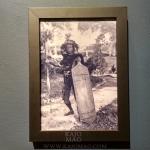
There was one photo that stood out; a photo of Sea Dayak Chief in full warrior attire.

“Let those who look upon my picture tremble with fear!” – Panau, Iban chief

Panau, an Iban chief
Are you trembling in fear yet?

Panau is the man who stood before the Ranees’ camera in this photograph. Margaret wrote that he was an Iban chief who often visited the Rajah and Ranee at their bungalow in Simanggang (now known as Sri Aman).

As a warrior, Panau and his tribe accompanied the Rajah Muda, Vyner on many expeditions up the Batang Lupar river.

The Ranee described him as humble, kind, loyal and talkative. This Iban chief was also described as a funny fellow (although Margaret admitted she didn’t get his sense of humour).

The Iban chief had showed interest in her camera, amazed by the miracle that a photo could came out of a box.

So one day, Margaret decided to take Panau’s picture. And what happened next might not what we expected from a headhunter.

While he was posing for the camera, Panau said: “Let those who look upon my picture tremble with fear!”

Panau’s reaction to his own photo

After the picture-taking session, the Ranee was kind enough to take Panau into the dark room to watch her develop the picture.

Margaret wrote, “He looked over my shoulder as I moved the acid over the plate, when he saw his likeness appear, he gave a yell, screamed out “Antu (Ghost!)” tore open the door, and rushed out, slamming the door behind him.

Mind you, this photoshoot took place around 1896 when photography was rare. Plus, when Panau was glancing over to look at the photo, his picture was still somewhat foggy.

Thankfully, the Iban chief eventually got over his fear and even accepted one of the prints.

Maybe somewhere out there, in one of the longhouses in Sri Aman, Panau’s descendants have that copy of this Iban warrior holding a shield in one hand and a spear in the other.

Besides Margaret’s My Life in Sarawak, Panau’s photo can also be found on display at ‘The Ranee: Margaret of Sarawak’ exhibition at the Old Courthouse.

Read My Life in Sarawak by Ranee Margaret Brooke here at Project Gutenberg.

Panau, the admirable Iban chief behind this rare photograph
Panau’s photo is one of the many photographs showcased at theThe Ranee: Margaret of Sarawak’ exhibition at the Old Courthouse.

Limbang and the little-known history of this town of buffaloes

Limbang in the Malaysian state of Sarawak is a unique town. It cuts its neigbouring country into half, leaving itself sandwiched between two parts of Brunei Darussalam.

The town is home to mainly Malay, Kedayan, Lun Bawang, Bisaya and Chinese communities.

Some interesting historical events

It is one of those towns which holds many historical facts unknown to many.

For example, Pengiran Indera Mahkota was historically painted as the villain in Sarawak who governed in the 1830s.

The reign of Indera Mahkota on behalf of Brunei Sultanate caused unrest among Sarawakians especially due to high tax and piracy problems.

Eventually, he was chased out by Pengiran Muda Hashim who promised James Brooke a territory after Brooke suppressed the rebellions.

After his defeat, Indera Mahkota travelled along the coast of Sarawak from Batang Lupar down to Mukah.

Then in 1858, the prince was believed to have died somewhere along the coast of Limbang while en route back to Brunei.

One theory has that his boat was attacked and he was killed by the local Bisayas for kidnapping the local women and making them his concubines.

Another theory is that his boat simply capsized and that he could not swim to safety.

About 30 years later, the town saw two other Bruneian officials die in the same area, although the causes were not so mysterious.

In 1884, Pengiran Temenggong Hashim of Brunei sent his representatives to Limbang to collect taxes.

The residents put up a resistance, refusing to pay, killing the representatives instead.

Retribution was swift – Sultan Abdul Mumin ordered an attack to punish the rebels.

The Limbang Rebellion

Fast forward to Dec 8, 1962, the town witnessed more bloodshed when Sheikh Azahari Sheikh Mahmud (famously known as A.M. Azahari) ordered an attack on the town.

He was the leader of the Brunei People’s Party and North Kalimantan National Army (TNKU).

Completely against the formation of Malaysia, TNKU militants took over the town by attacking the police station as well as hold hostages.

Thankfully, four days later the British Royal Marines came and freed Limbang from the rebels.

The freedom came with a price; four members of Sarawak Constabulary and five members of the Royal Marines died during the attack.

The origin of the name

Long before it was ever called Limbang, the first settlement in the area was called Pangkalan Tarap (or Tarap Wharf in English)

Tarap (Arctocarpus odoratissimus) is a type of fruit native to Borneo, Palawan and Mindanao island.

How did Pangkalan Tarap change its name? Nobody precisely knows from when or why. However, there are two theories of how Limbang got its name.

1.From the word ‘melimbang’

Bukit Mas in Limbang was believed to have gold deposits. That was why the hill is called Bukit Mas as in emas or gold in Malay.

In the book Legend and History of Sarawak, author Chang Pat Foh wrote that people in those days panned for metal ores which were supposed to be the gold ores.

The act of panning ores in Malay is called ‘melimbang’. Hence, it was believed that people slowly started to called the place from the word ‘melimbang’.

However, Chang also rebuked this theory. He cited a report from Geological Surveys Sarawak that there were no traces of gold in Bukit Mas.

Nonetheless, geologists did find yellow-looking ores called pyrites, more commonly known as Fool’s Gold.

2.Another meaning of melimbang
Limbang and the little-known history of this town of buffaloes
The local residents used to melimbang or wash rice at this river.

The word melimbang in Malay also means washing rice. The residents in the olden days used to wash their rice in the river which is now called Sungai Limbang. Many historians believe the town was named after the river, not the other way around.

This theory could possibly true because Limbang was the ‘rice bowl’ of Brunei, supplying rice to the country.

Paddy farming in the area could be traced back during the reign of Sultan Abdul Mumin of Brunei (1852-1885) where Bruneians migrated in the area to farm paddy.

Buffaloes are commonly used in paddy farming. Now it has become the symbol of Limbang town.

Limbang and the little-known history of this town of buffaloes
Buffalo, the official symbol of the town.

Robert Burns, the first European man who wrote about the Kayans back in 1849

Scotland’s national poet Robert Burns (1759-1796) may be the last person anybody would have thought had any links to Sarawak. He was considered the pioneer of Romanticism, an artistic movement which emphasises on emotion and individualism.

Burns’ connection to Sarawak comes through his alleged grandson – also named Robert Burns – who became the first European man who visited the Kayans in Borneo.

The journey of Robert Burns in Borneo

Burns left Glasgow for Singapore some time in 1846. There he worked with a Scots-owned trading company, Hamilton Gray.

One of the firm partners George Nicol sent him to Borneo in search of more business prospects.

He first set foot in Labuan where he sought his passage to Bintulu.

Accompanied by one European companion, Burns arrived in what the westerners called ‘Kayan country’ in Borneo. It is the vast area where Rajang and Baram rivers are located.

This was around 1847 when this area was still under the Brunei Sultanate. Burns spent several months among the Kayans, learning their customs and writing down their vocabulary.

He returned the second time in Bintulu about a year later. During this time, the first White Rajah of Sarawak James Brooke was holding the post as the first governor of Labuan.

Robert Burns burning a scandalous trail through Borneo

Not long after his stay in Borneo, Brooke received a letter from the Kayan chiefs in Baram that Burns was causing some problems. Burns had reportedly even posed as Brooke’s son to gain approval from the local chiefs.

The letter stated,

“Mr. Burns does very treacherously, he wishes to take persons’ wives whether they like it or not, he takes people’s wives. And also Mr. Burns ordered us to kill people who enter the River Baram, of whatever description or race they be; whoever enters it is good to kill them.”

Brooke replied letter telling the chiefs, “can act justly and rightly in support of their authority, and for the protection of their people.”

The letter arrived in Bintulu via the East India Company’s steamer and returned to Singapore with Burns in it.

After his return to Singapore, Burns wrote a paper about the Kayan which was then published in the Journal of the Indian Archipelago and Eastern Asia in February, 1849.

The editorial note stated, “We have great pleasure in presenting to our readers the first authoritative account that has been given of the greatest aboriginal people of Borneo Proper- the Kayans. Mr. Burns is the first European who has ventured to explore the interior Borneo Proper.”

Robert Burns
A European man having a discussion with the leaders of the Kayan people in Sarawak, circa 1900 to 1940. Credit: Creative Commons.

Robert Burns and his death

At the age of 29, Burns was clearly not done yet with his thrilling adventures. In 1851, Burns made his way again to Borneo, determined to explore its north-eastern coast.

He set sail in a schooner named Dolphin, commanded by Captain Robertson and a Portuguese cook, a 13-member crew as well as the captain’s love interest, a native woman.

The adventurer was looking for bird’s nests in Kinabatangan area which was sought after by the Chinese back then.

Before they departed Labuan, many warned him of the danger of Illanun piracy in that part of Borneo.

Owen Rutter wrote in The Pirate Wind that, “His experiences among the wild Kayans had perhaps made him over-confident of his ability to handle natives in all emergencies.”

Somewhere in Maladu Bay, a group of Illanun pirates led by Memadam sailed alongside the schooner.

On Sept 10, they boarded the schooner saying they had some tortoiseshell, camphor and pearls they wished to trade.

Appearing to be harmless and without weapons, the pirates were even given rice and fish.

The following morning, the pirates boarded the schooner again and this time the pirates did not take any rice and fish but some heads instead.

Rutter detailed the incident in his book stating,

“Mr. Burns was bargaining with Memadam over the pearls when the Malay who had remained with the boats handed up some rolled mats. One of Memadam’s companions, Ibrahim, a Sulu, stepped to the side to take one of the mats and presented it to Mr. Burns, who put out his hands to receive it. At that instant Ibrahim snatched a naked sword which had been concealed in the mat, and with one blow severed Mr Burns’ head from his shoulder.”

His death was reported In December 1851 by the Singapore Straits Times.

Robert Burns and possible descendants in Borneo

In the book On the Trail Burns by John Cairney, the writer wrote about the how Burns’ descendants were found at this part of the world.

“Jenny’s Robert Burns the Second did well, no matter, and prospered as a merchant in London. His son, also called Robert, went to the East Indies and became a highly successful trader. Unfortunately, in 1851, his schooner, the Dolphin was captured by pirates off the coast of Borneo and he was murdered with all his crew. His descendants are to be found in the Far East to this day- a long way from that attic room in chilly Edinburgh’s St James’ Square.”

Another author and biochemist Alistair Renwick who wrote the book, The Burns Boys (2003) also agreed that there is a possibility of Burns’ surviving descendants in Borneo.

In his interview to the The Scotsman in 2004, Renwick said “This seems to be fairly reliable although there is no proof other than a statement in a letter from Nicol.”

Nicol, the firm partner from Hamilton Gray, wrote to Burns that he was surprised to hear the news: “I thought it was a joke, but on sending for a Malay from Bintulu who came over on the Amelia he told me it was true that you had been married to the daughter of Akumlassa, the Kayan chief.”

Robert Burns, the first European man who wrote about the Kayans back in 1849
The Tattooing of a Married Kayan Woman,” (c. 1896-98), photograph by William Henry Furness III. Credits: Creative Commons License.

Robert Burns and his legacy

Putting aside his questionable antics, Burns was still acknowledged for his work. Scottish diplomat and author John Crawfurd (1783-1868) believed Burns had written by far the best and most authentic account of Borneo that had ever been given to the public at that time.

Like Burns, Crawfurd also argued that the Kayans were actually the dominant tribe in Borneo. During that time, Brooke and his allies had the British public focusing on the savageness of Ibans from Saribas and Skrang.

Both Burns and Crawfurd believed that the Kayans were more superior because they mastered iron smithing while the Ibans had not done so.

Additionally, former Sarawak Museum Curator Tom Harrisson regarded Robert Burns as the ‘first ethnologist and explorer of interior Sarawak’.

How New Year’s Day was celebrated in 1875 Sarawak

In many countries, New Year’s Day celebrations usually start the night before with food and drinks and, of course, a fireworks display.

Then the first day of the year proceeds with all kinds of activities; from going to picnics with families and friends, to last-minute shopping for school supplies. New Year’s Day is always a busy day.

Did you know that Sarawakians have been celebrating New Year’s Day since more than 145 years ago?

Let us look back at how 1875 Sarawak celebrated the brand new year.

The year 1875 was welcomed with the booming of a gun from the fort at the stroke of midnight.

Then the song ‘Auld Lang Syne’ was sung to celebrate the brand new year.

While the band paraded into Kuching town, all the European officers came out of their respective houses to wish each other ‘Happy New Year’.

The celebration didn’t just circle around the expatriates.

At the mosque, the Muslims welcomed the year 1875 according to their faith.

The minute the clock struck twelve, they started to berzikir till nearly daylight.

On New Year’s morning, about 60 people sat down for breakfast at The Rajah’s Arms Hotel.

Owned by Low Kheng Whatt in partnership with a European named Montgomery, the hotel was first opened on 1 December 1872.

However, it went into liquidation in 1875. It was then taken over by the second White Rajah, Charles Brooke, and reopened on 1 January 1876 as the Sarawak Club.

The breakfast was attended mainly by Sarawak government officers as well as Borneo Company staff and Chinese businessmen. Out of these 60 plus people, only two were women.

How New Year’s Day was celebrated in 1875 Sarawak
A lot has changed on how we celebrate New Year’s Day.

New Year’s Day Boat Race

At noon, hundreds of people started to gather along the Sarawak riverbank to witness a boat race.

Overall, there were seven boats who entered the race on New Year’s Day and they had pretty interesting names.

They were Api Naraka (owned by Mr W.M. Crocker), Ayer Penawar (Mr E.J. Smith), Bujang Kilat (Mr J. Hardie), Bujang Pukat (Mr J.M Lewis), Bujang Tudong (Mr Kassim), Sakalip Mata (Confederates) and Ular Sawa (Mr Kongkong).

New Year’s Day in 1875 Sarawak ended with a dinner at the hotel which was attended mostly by Sarawak government officers.

Clearly, there were many differences in celebrating the brand new year compared to now; we no longer have gunshots from the fort nor a band marching through Kuching town after midnight.

Nonetheless, it would be fun to revive the boat race at Sarawak river to celebrate the new year. It would be an activity that brings everyone together.

Odoardo Beccari, the man who discovered the corpse flower

Odoardo Beccari (1843-1920) might be an unfamiliar name among Sarawakians today but more than 100 years ago he was here in Sarawak documenting our plants.

Originally from Florence, Italy, he went to school in Pisa and Bologna.

After his graduation, Beccari spent his time at Royal Botanic Gardens, Kew.

Odoardo Beccari
Odoardo Beccari (Credits: Public Domain).

It was there he met with fellow naturalist Charles Darwin and the first white Rajah of Sarawak James Brooke.

Thanks to his friendship with Brooke, he was able to his spend 3 years in Borneo from 1865 and 1868 .

Odoardo Beccari and Kubah National Park

Odoardo Beccari, the man who discovered the corpse flower
A view of Kubah waterfall. Did Odoardo Beccari came across this waterfall? We never know.

Together with another Italian naturalist Giacomo Doria, they travelled extensively throughout Sarawak up to Brunei.

He set up a research hut at the slopes of Mount Matang. Beccari named it Vallombrosa after a Benedictine abbey near his hometown of Florence.

Beccari recorded his experience in his book Wanderings in the great forests of Borneo, travels and researches of a naturalist in Sarawak (1904).

After his stay in Sarawak, Beccari called for preservation of species and conservation of biodiversity in the region.

The Rajah then established a water catchment preserve in Mount Matang which is now part of Kubah National Park.

Apart from Mount Matang, Beccari also visited Peninjau Hill and described many of the plant species there.

Odoardo Beccari and the corpse flower

The world of environmental biologists and naturalists mostly recognised Beccari as the man who discovered the corpse flower.

He was the first one who scientifically described the plant in 1878 during his stay in Sumatra.

The corpse flower or its scientific name Amorphophallus titanium is considered the world’s largest unbranched inflorescence.

The plant is called bunga bangkai in Malay which means “corpse flower” due to its rotting smell.

A rediscovery after 150 years

In 2017, Beccari made headlines in scientific magazines after more than 100 years of his death.

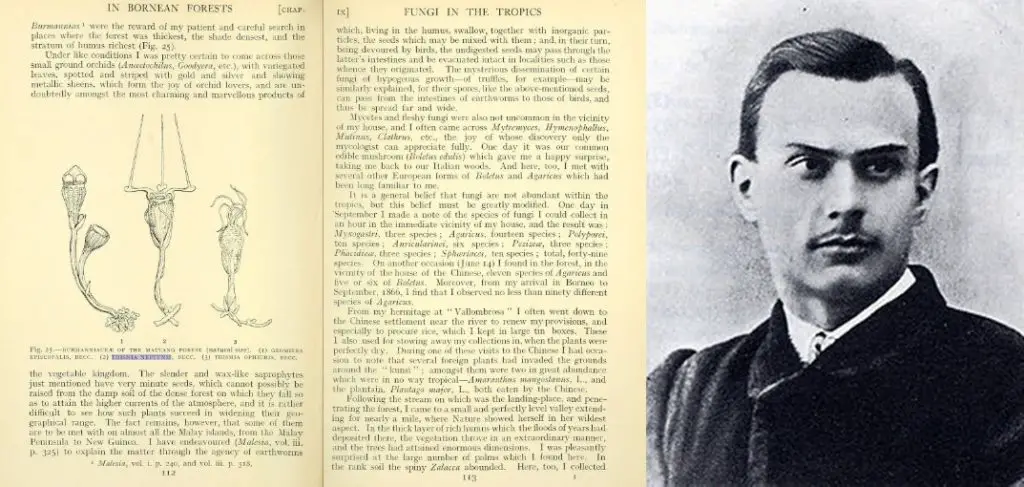
The story went that in 1866, he discovered Thismia neptunis in the mountains of Matang.

Endemic to Malaysia, the plant is a myco-heterotroph, meaning it obtains nutrients through a parasitic relationship with fungi.

Odoardo Beccari, the man who discovered the corpse flower
A screenshot of Beccari’s Wanderings in the great forests of Borneo, travels and researches of a naturalist in Sarawak (1904) describing Thismia neptunis.

Beccari then formally described the plant a few years later in 1878. Since nobody had ever seen it, it was thought that the plant had become extinct.

That was the case until January 2017, a group of researchers from the Czech Republic took a photograph of it in the same region where Beccari found it more than a century ago.

Perhaps the reason why this plant is difficult to spot is the fact that it doesn’t bloom every year.

And when it finally does, the flower appears above the soil only for a few weeks.

On top of that, Thismia neptunis actually lives underground.

In 2013, Sarawak Forestry Corporation organised a “Vallombrosa Walk” taking visitors to Beccari’s field station Vallombrosa or at least what was left of it.

The walk also took visitors to the remnants of two temples and a chapel built during Beccari’s time in the area.

Reportedly, a Dayak hunter named Abi Bengali stumbled upon the ruin of one of the temples in 1960.

For now, there were no information on how to visit Vallombrosa published or no news of any efforts to preserve the area.

Nonetheless, interested visitors can view his botanical collection at Museo di Storia Naturale di Firenze and University of Florence as well as his travel notes at Museo Galileo in Italy.

Balan-balan and 6 other similar eerie floating head ghosts throughout Asia

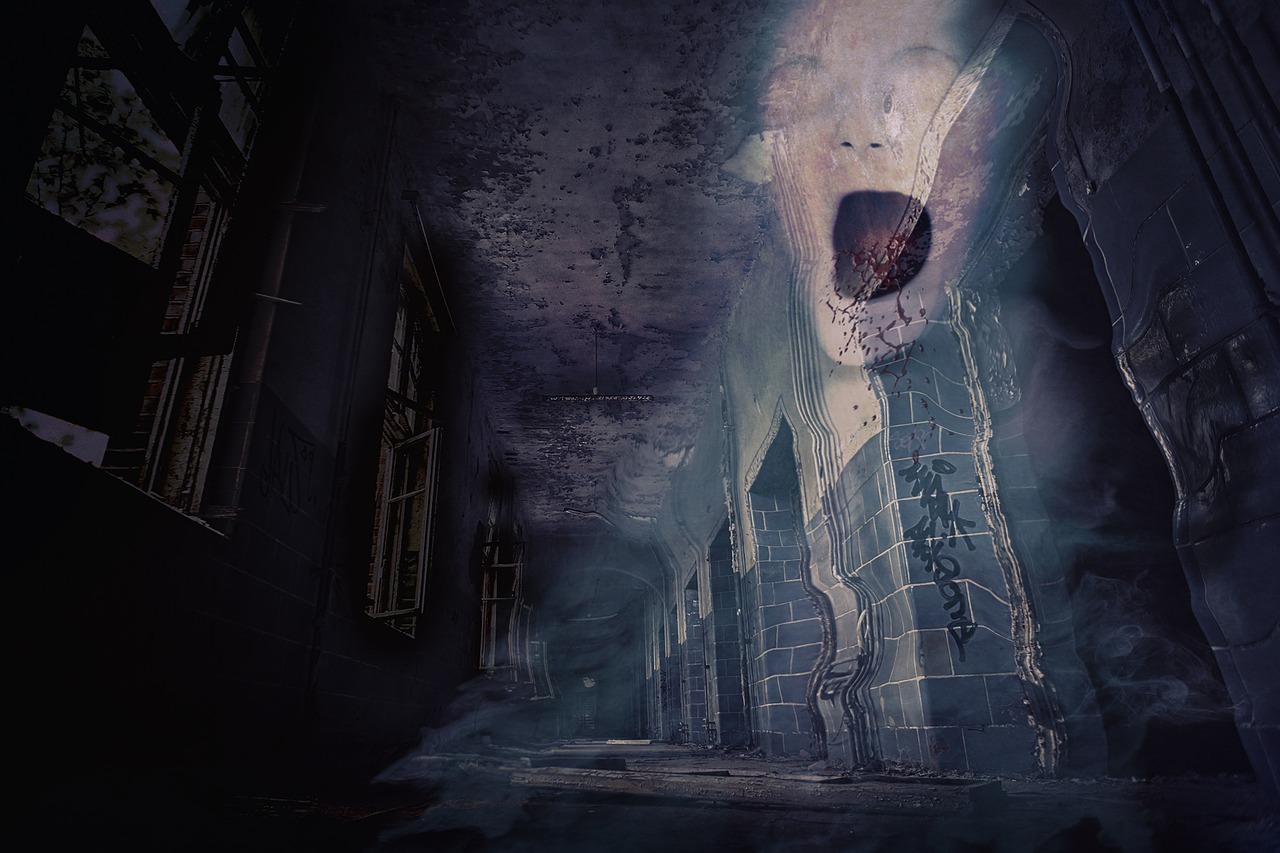
Balan-balan is a ghost of Sabahan folk mythology, also known as Penanggalan or Hantu Penanggal in West Malaysia.

Famous in Kota Belud, it is also called ‘B kuasa dua’ which means B to the power of 2, because you’re saying the b-word twice.

You’re not supposed to say its name aloud as legend says you summon it closer to you every time you say “balan-balan.”

However, some believe this entity is not a ghost, but a woman who practices black magic.

According to legend, the balan-balan is able to detach its head with lungs, stomach and intestines attached, leaving its body behind to hunt. It usually hunts at night but can leave its body any time it wants. It has a preference for the blood of pregnant women, women who recently gave birth and newborns.

A balan-balan is said to be able to pass through walls and ooze up through the cracks of the floorboards in the house.

To return it to its human form, simply soak its entrails in vinegar and—voilà!—it will reconstitute itself and become a normal person again.

One of the widely known ways in local folklore to destroy a balan-balan is to pour broken glass into its empty neck cavity – assuming you have found its headless body.

Some say that the balan-balan traits are inherited, passing down from one generation to another from mother to daughter.

There are other related myths in Asia  of supernatural entities with similar modus operandi and appearances.

Perhaps there are no immigration boundaries for those in the mystical world.

balan-balan
Balan-balan is famous in Sabah but it is similar to a ghost called Leyak among the Balinese, Kuyang by the Dayak people of Kalimantan, the Krasue in Thailand and Phi Kasu in Laos. Credit: Pixabay

1. Manananggal, the Philippines

Imagine a vampire that detaches itself from its lower body to hunt and uses huge bat-like wings to fly. Swap out the typical Hollywood fangs for a long, piercing tongue and there you have it: a manananggal.

A manananggal feeds on sleeping, pregnant women, sucking on the blood or hearts of fetuses with its tongue.

To kill it, just sprinkle some salt, crushed garlic or ash on the lower part of the body.

Then it would not be able to rejoin itself and would be killed by sunrise.

2. Kuyang in Kalimantan, Indonesia

Kuyang are believed to be women practicing black magic in search of immortality.

To increase their power, they have to feed on babies and women who just recently gave birth.

Some who claimed to have seen a Kuyang said it is just a flying head.

According to an article in Banjarmasin Post, if you are able to catch it, it will grant any wish in exchange for you to keep its secret.

Apparently the best advice is to ask for ‘Minyak Kuyang’ or kuyang oil which has the power to return objects to you even after you have given them away.

Ideally, you would be able to rub kuyang oil on your money and watch it magically return to you after making your purchase.

3. Leyak in Bali, Indonesia

Similar to Kuyang, leyak are humans practicing black magic.

Interestingly, they have a mistress or a queen, a witch named Rangda.

They say leyak haunt graveyards, feed on corpses, and have the power to change themselves into animals.

In daylight, they are like ordinary humans but at night their heads break loose from their bodies.

Unlike balan-balan which is known to be only females, it is believed that three leyak – typically composed of two females and one male – float around together terrifying people.

4. Krasue in Thailand

Krasue is believed to be an entity consisting of a floating head and a will-o’-the-wisp.

However, the origin story for Krasue is more romantic than might be expected.

According to one version of the legends, a certain Khmer princess had a forbidden love affair with a younger man of lower status.

As with all forbidden love stories, she was caught with her lover and condemned to death by burning by the Siamese aristocrats.

The princess managed to implore the help of a sorceress before her sentence, asking her body to be unharmed by the fire.

But the spell came too late and the only parts that remained untouched by the fire were her head and some of her internal organs. She was then cursed to live as a Krasue ghost.

The 2019 Thai film Inhuman Kiss is inspired by Krasue. It follows the story of a Krasue in 1940s Thailand who lives a normal life as a woman during the day but whose head detaches from her body at night to seek out fresh blood.

Watch the film trailer here.

5. Phi Kasu in Laos

A Phi Kasu is a woman who separates her head from her body, taking her inner organs and flying around to look for victims.

She uses her long tongue to suck out her victim’s organs.

Although it is possible to harm a Phi Kasu, traditional beliefs hold that she is ultimately invincible and cannot be killed.

6. Nukekubi, Japan

In the land of the rising sun, rokurokubi is a type of Japanese apparition.

There are two types of rokurokubi; one with a long, stretchable neck,  while another is like the balan-balan whose head comes off and flies around called nukekubi.

How do you kill a nukekubi? According to traditional tales, the simplest method is to move its headless body to another location. When the head returns and cannot find the body to reattach itself to, the creature is destroyed.

5 interesting facts about ‘mengayau’, the headhunting culture of Sabah

Now famous as an adventure destination, Sabah shares a history similar to Sarawak in that it once practiced mengayau or headhunting. This tradition involved not only taking the head but also preserving it as part of cultural rituals and beliefs.

Once practiced mainly by the Murut and Kadazandusun communities, the artifacts and legacy of headhunting can today be seen in the Sabah Museum.

Here are five interesting facts you need to know about mengayau or headhunting culture:

Here are five interesting facts you need to know about mengayau or headhunting culture of Sabah:

mengayau
A small gallery dedicated to the ‘mengayau’ practice in Sabah museum.

1. There were three types of mengayau or headhunting practices back then.

The ownership of the trophies brought back from their mengayau trips would depend on how the head was taken. If a mengayau was carried out by a larger group (usually the result of a tribal war between different communities) the community would keep the heads.

Meanwhile, if the mengayau happened as the result of a feud between a small group of people, the family would keep the head.

On top of that, some men were also known to go headhunting as a proof of bravery. This was in order for the man seeking to win a bride.

2. One of the tools used  in mengayau is called ilang sakuit.

5 interesting facts about 'mengayau', the headhunting culture of Sabah
An ilang sakuit.

Ilang sakuit is often used to cut off the enemy’s head as a symbol of a warrior’s bravery.

It is believed to have originated from Kalimantan and widely used by the Muruts.

Murut headhunters also wore ‘bilong’ on their mengayau journey, a wooden armlet used as an arm guard. In addition, they are know to have worn ‘papakol’, an accessory and talisman worn on the calf.

5 interesting facts about 'mengayau', the headhunting culture of Sabah
The bilong (right) was used as an arm guard while the papakol (left and centre) were worn as accessories on the calf.

3. How and where the skulls are kept were important.

Once the headhunters returned from their raids, the heads had to be kept outside the village for the meantime. The heads were hung from trees or bamboo in what the Kadazandusun from Tambunan and Tamparuli areas called ‘sogindai’. Other headhunters kept them in a temporary hut called ‘sulap’.

After a few days or even weeks, the Kadazandusun ‘bobohizan’ or traditional priest would perform an appeasement ritual before the heads could be safely allowed into the village.

5 interesting facts about 'mengayau', the headhunting culture of Sabah
A bobohizan’s traditional attire.

4. The skulls were then passed down from generation to generation.

In the past, skulls were considered as heirlooms and it was believed that the skulls kept by a family would bring protection to the household. When kept by the community, the skulls were believed to protect the village from harm and sickness.

5. The Murut were known to be the last of Sabah’s ethnic groups to renounce ‘mengayau’.

Collecting the heads of their enemies played an important role in the Murut spiritual belief system. As such, the Murut were reportedly the last of Sabah’s ethnic groups to renounce headhunting.

Apart from Sabah, the Murut communities can also be found living in Lawas and Limbang of Sarawak as well as in North Kalimantan, Indonesia.

Baroness Angela Burdett-Coutts and James Brooke: Was there something more it seems?

Baroness Angela Burdett-Coutts might be an unfamiliar name today, but about a hundred years ago she was the “richest heiress in England”.

King Edward VII even reportedly described her as “the most remarkable woman in the kingdom”, only second to his mother, Queen Victoria.

Born on April 21, 1814, Burdett-Coutts became one of the wealthiest women in England in 1837 when she inherited her grandfather’s fortune of around £1.8 million (approximately £196 mln in 2018).

Burdett-Coutts was in love with James Brooke

Burdett-Coutts (left) allegedly was in love with James Brooke (right). Credits: CCO.

Many historians believe Burdett-Coutts was in love with the first White Rajah of Sarawak.

When James Brooke first established the Kingdom of Sarawak, he needed money to develop it. He considered many options, including selling the country to Belgium.

At the same time, Brooke also wanted his kingdom to be protected. Even when he was in England, the White Rajah constantly worked on making connections with powerful people in the country.

His networking efforts landed him in a levee at the palace as a guest of Queen Victoria.

According to writer Robert Payne in The White Rajahs of Sarawak, this was when Brooke caught the attention of Burdett-Coutts. He wrote:

“Born to great wealth, she was determined to use her money as a weapon to advance her humanitarian ideas, and when the Rajah spoke to her about the Dyaks and Malays plagued by their feudal Sultans and by Ilanun pirates, still living in the Middle Ages, her heart went out to them.”

According to Payne, Brooke skipped out the fact that the Dayaks were headhunters back then.

It seemed to work. In 1859, Burdett-Coutts and Brooke exchanged many letters. These letters were later published in a book in 1935.

In Brooke’s letter to Burdett-Coutts, he asked about her health and how she took care of herself. As he knew the baroness loved riddles, he made riddles for her in his letters.

Their correspondence lasted almost nine years till Brooke died.

Burdett-Coutts and Sarawak

Thanks to Burdett-Coutts, Sarawak had money to spend. One of the kingdom’s expenditures included a ship which Brooke named ‘Rainbow’ after the baroness.

This was, according to Payne, to “honour the beauty of Miss Burdett-Coutts, the goddess of the Dayaks, and the calm following a storm”.

Brooke trusted her so much that he willed Sarawak to Burdett-Coutts at one point. He wrote in his will:

“I do hereby nominate and appoint her to be my true and lawful successor in the dignity and office of the Rajah of Sarawak now vested in me, to be held by her, the said Angela Burdett-Coutts, as a public trust for the good of the people.”

But Brooke long lived long enough to change his will.

Nevertheless, there is a fort in Mukah called Fort Burdett, which was named after her.

What happened to Burdett-Coutts and James Brooke

With all those letters and evenings spent together, why didn’t they get married?

According to British historian Owen Rutter this was because Brooke was sexually incapacitated.

British journalist Henry Nevinson pointed it out in an article published in The Spectator on April 5, 1935.

“He (Rutter) tells us that in storming Burmese stockade in 1825 James Brooke received a wound that rendered him incapable of marriage in the physical sense, and so he carefully avoided any approach to the subject.”

Of course, many claimed that this was not true.

Nonetheless she did everything she possibly could to help Brooke and his Sarawak, a country she herself never set foot on.

As Nevinson wrote:

“She forwarded all his schemes; she advanced vast loans for his people, she presented him with ships to cruise among the islands and stamp out rebellion among the Dayak headhunters and other savages.

“Whatever the mese, she did not marry till late in life, many years after her Rajah had died. She is to be regarded, I think, as a final sacrifice to the idol of Victorian prudery, and it was the Rajah who sacrificed her.”

Melanau tall house: 3 things you need to know about this important architectural history

Unlike other traditional houses in Sarawak, the Melanau tall house was built distinctively higher.

However similar to longhouses of other ethnic groups such as Iban and Kayan, this Melanau traditional house can accommodate up to 50 families.

The Melanau tall house at Sarawak Cultural Village is one of the few traditional houses left as the rest have been abandoned or demolished.

Besides the one in Sarawak Cultural Village, it is difficult to find a traditional Melanau tall house in the state. Most of the houses in Melanau villages now are built individually on stilts, and the designs are believed to be inspired by houses in the Malay community.

Here are 3 things to know about the architectural heritage of a Melanau tall house:

1.They are built very tall for a lot of reasons.

Traditionally, a Melanau tall house is built about 10 to 40 feet above the ground. For this, the Melanau have to thank the Filipinos for inspiring the need for this design.

As the Melanau people lived mostly along the coastal region, particularly near the mouth of the Rajang river, they were often attacked by pirates from the Southern Philippines in the olden days. To protect themselves, the Melanau built tall houses and even fortified them with cannons.

Besides the pirates, the tall houses also protect the Melanau people during tribal wars against the Ibans.
The Brooke authority also had some scuffles with the Melanau on one point when the former accused the latter for harbouring pirates.

Furthermore according to author Peter Metcalf in The Life of the Longhouse: An Archaeology of Ethnicity, a house raised on stilts serves many advantages.

“It escapes the mud below; it allows disposal of kitchen waste, soon cleaned up by free-roaming chickens and pigs; and it greatly improves ventilation.”

Particularly in Borneo, an elevated building like a Melanau tall house and a Bidayuh baruk would reduce the number of insects in your home.

2. The floor of a Melanau tall house was designed for defensive and offensive purposes.

Besides the height advantage, the floor of a Melanau tall house also serves to defend the community.
The flooring of the main level of the tall house are arranged in a crisscross pattern with small gaps in between.

When there was an attack, the flooring made it hard for the enemies to pierce their sharp weapons through the floor. As for the Melanau, they would pour hot, boiling water on their enemies.

The columns, which are the main structure of the building, are typically made from belian while the wall and flooring structures are made from nibong.

Meanwhile for the roof, they used sago leaves, which also happen to be the main economical source for the Melanau people.

The rungs on every staircase in a Melanau tall house were built in odd numbers. This is because they believed that by doing so it could bring wealth and good health to the household members.

Melanau tall house: 3 things you need to know about this important architectural history
The rung of a ladder in a Melanau tall house has odd numbers because they believed it would bring them luck.

3.The living arrangement in a Melanau tall house.

Melanau tall house: 3 things you need to know about this important architectural history
A traditional Melanau house comprises of few levels.

According to research done by Universiti Sains Malaysia, gender and marital status affected the organisation of the space in a Melanau tall house.

Every tall house was built with a few levels and each level had multiple bedrooms.

Only unmarried men occupied bedrooms located aon the first floor while married couples and unmarried women had their bedrooms on the upper level.

The upper level also houses the family’s ceremonial items and assets.

Curious visitors still can see some of Melanau artifacts at Sarawak Cultural Village’s tall house.

Melanau tall house: 3 things you need to know about this important architectural history
Some of the ceremonial items displayed at Sarawak Cultural Village’s tall house.

White Rajahs of Sarawak: 10 interesting books to read about them

The history of the White Rajahs of Sarawak seems like a boy’s adventure book come to life. Basically, an Englishman with his topsail schooner receives a kingdom to rule as a reward for helping the local king fight off pirates.

Of course, history is more complicated than that, but that is roughly how James Brooke and his family came to found and rule the Kingdom of Sarawak from 1841 to 1946.

He was succeeded by his nephew Charles and grandnephew Vyner before the latter ceded the throne to the United Kingdom after World War II.

Plenty of books based on the Brooke dynasty have been written over the years analysing and giving different accounts on Brooke reign.

White Rajahs

Here are 10 books to read to know more about the White Rajahs of Sarawak:

1.The White Rajahs of Sarawak by Robert Payne

Robert Payne was a well-known author for his biographies of prominent historical figures such as Hitler, Mao Zedong, Stalin and Gandhi.

For his book on the White Rajahs, he based it on Vyner’s and his father’s letters, the Ranee Margaret’s letters as well as other documents.

2.The Name of Brooke by R.H.W. Reece

Dr. Bob Reece first came to Sarawak as a correspondent for the Far Eastern Economic Review in 1969. He then wrote his doctorate on the cession of Sarawak.

His book The Name of Brooke is considered the only detailed scholarly study of the end of Brooke rule in Sarawak.

3.Power and Prowess: The Origins of Brooke Kingship in Sarawak by John Walker

This book explores Brooke’s power among the local Malay, Iban and Bidayuh as well as Sarawak’s network of power and economy.

4.The White Rajahs: A History of Sarawak from 1841 to 1946 by Steven Runciman

The Sarawak government was said to have sponsored the publication of this book. It is also worth mentioning that Runciman, an English historian best known for his A History of the Crusades was already fascinated with the Brooke family.

5.The White Rajahs of Sarawak: A Borneo Dynasty by Bob Reece

Another book by Reece, he also specialises in Australian aboriginal and colonial history and the Irish in Australia.

6.My Life in Sarawak by Margaret Brooke
White Rajahs of Sarawak: 10 interesting books to read about them
A visitors looking at Ranee Margaret’s painting at The Brooke Gallery.

The first Ranee of Sarawak, Margaret Brooke recorded her accounts on living in Sarawak in this book.

My Life in Sarawak, the Ranee tells stories about her friends in Kuching, her expeditions to different parts of Sarawak with her husband Charles and how she copeD living in the Astana.

7.Queen of the Headhunters by Sylvia Brett

Unlike Margaret’s autobiography, Sylvia Brett wrote in a more candid tone on her life as the last Ranee of Sarawak.

Brett told the stories about her considerably open marriage to Vyner and what she thought how and why the Brooke dynasty ended. She also published another book on the Brooke family entitled The Three White Rajahs.

8.Bishops and Brookes by Graham Saunders

While most books listed here are about the Brookes,  this book is mainly about the Anglican mission in Sarawak.
It explores the up and down relationship between the mission with the Brooke family from 1848-1941. Another book about the Anglican mission during the White Rajah dynasty is Twenty Years in Sarawak by Max Saint. This book is more about James’ friend and first Anglican Bishop of Labuan and Sarawak Francis McDougall.

9.White Rajah: A Dynastic Intrigue by Cassandra Pybus

Pybus, an Australian historian and writer published this book in 1996. She is the professor of history a the University of Sydney.

10.The End of the Brooke Raj in Sarawak by Colin Crisswell

Crisswell wrote about how the White Rajahs’ rule came to an end in Sarawak and the events leading up to it.

Apart from The End of the Brooke Raj in Sarawak, Crisswell also published Rajah Charles Brooke: Monarch of All He Survived.

Besides these books, other books worth mentioning are Rajahs & Rebels: The Iban of Sarawak under the Brooke Rule by Robert Pringle, Ten Years in Sarawak by Charles Brooke and The Life of Sir James Brooke by Spenser St. John.

1 2 3 32