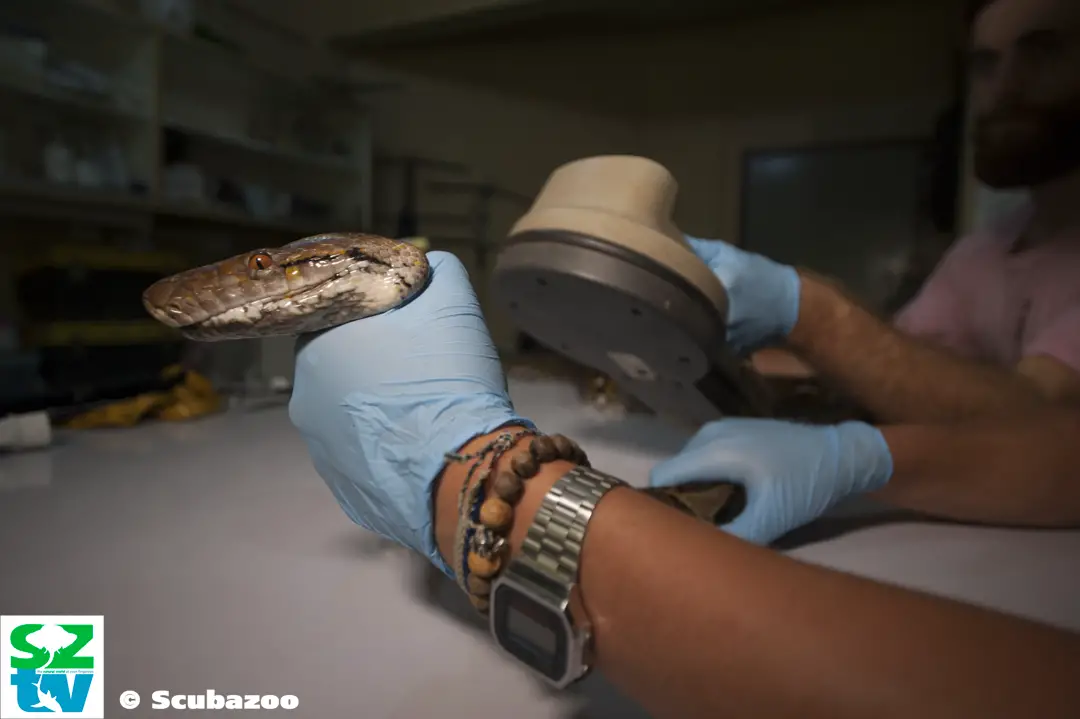
- Field surveys may not provide reliable enough population data to set sustainable commercial harvest quotas for reticulated pythons.
- Researchers carried out 527 nocturnal surveys over five years, covering 2,427km along the Kinabatangan River.
- Low detection and recapture rates made it difficult to estimate python abundance, survival and reproduction using traditional population models.
- Researchers recommend monitoring long-term trends in commercially harvested pythons as a more reliable way of assessing whether trade is sustainable.
KINABATANGAN: Traditional mathematical population modelling is incapable of determining sustainable commercial harvesting levels for reticulated pythons (Malayopython reticulatus), according to findings recently published in Scientific Reports.
Reticulated pythons have been commercially harvested in Malaysia and Indonesia for more than a century, with hundreds of thousands taken from the wild each year for domestic and international trade in meat, skins and body parts used for medicines.
Determining whether this level of harvesting is sustainable, however, has been the subject of debate. Studies of harvested pythons have used factors such as body size, sex, maturity and body condition to assess the sustainability of the trade, while field-based population estimates have also been proposed as a basis for determining sustainable harvest levels.
The comprehensive five-year study – the most intensive field research ever conducted on free-ranging reticulated pythons – concludes that the extreme camouflage, low detectability and cryptic nature of tropical reptiles render field-based Population Viability Analysis (PVA) functionally impossible.
Instead, researchers assert that international regulatory bodies and conservation policymakers, including CITES (Convention on International Trade in Endangered Species of Wild Fauna and Flora), must pivot toward monitoring data collected directly from commercial processing facilities to ensure long-term trade sustainability.
The study focused on wild python populations across eastern Sabah’s Lower Kinabatangan Wildlife Sanctuary (LKWS) and nearby oil palm agricultural landscapes, uncovering critical insights into python detectability, behaviour and population dynamics.
Researchers chose an area where the python population is not subject to commercial harvesting and should therefore theoretically be at its natural carrying capacity. The riverside habitat could also be surveyed by boat, providing conditions where the snakes were expected to be more numerous and easier to detect than across much of their range.
Conducted from April 2016 through March 2021, researchers completed 527 nocturnal riverbank boat surveys, covering a total distance of 2,427 kilometres along a 64-kilometre stretch of the Kinabatangan River.
The main finding of the study was that pythons proved remarkably elusive.
The overall mean detection probability was just 20.5%, with individuals remaining undetected 25% of the time even in habitats where their presence was definitely confirmed.
Over the study period, researchers recorded 159 total python encounters – 83 through standardised surveys and 76 opportunistic sightings.
However, only 25 unique individuals were recaptured across 40 events. This low recapture rate proved insufficient for traditional open-population mathematical modelling, such as Jolly-Seber models, to accurately estimate total abundance, survival or reproduction rates.
The findings highlight the challenges researchers face when monitoring cryptic apex reptiles in tropical riverine ecosystems.
“Even under ideal ecological conditions and with massive, sustained field effort, gathering empirical abundance and mortality data for ambush-predatory tropical snakes is functionally impossible. Expecting field surveys to establish harvest quotas is a flawed strategy,” said Dr Benoit Goossens, Director of Danau Girang Field Centre and one of the researchers for the study.
“With this study now complete, we know where best to expand precious resources for the monitoring and management of species like reticulated pythons,” said Dr Daniel Natusch, Chair of the IUCN SSC Snake Specialist Group and co-author of the study.
“Our findings directly challenge policies that demand field-based population estimates before permitting commercial trade. We emphasise that international policy decisions – such as CITES regulations or trade quotas – should not rely on unfeasible field population models,” added Natusch.
“Instead, we advocate for tracking long-term trends from specimens harvested by commercial processing facilities in active trade regions. Monitoring consistency in parameters such as body size distributions, body condition, and sex ratios over time serves as a far more reliable, realistic, and responsive benchmark for determining whether trade levels are sustainable,” concluded Goossens.