Browse Category

Travel

The 3 Famous Trees of Fort Canning Park, Singapore

By Ng Ai Fern

Most people come to Fort Canning Park, one of Singapore’s most historic green spaces, for its past. Some come for the museums. Others come for the view.

But today, many visitors arrive for something else entirely: its trees – centuries old, rare, or simply photogenic.

Here are three famous trees in Fort Canning Park, including one that technically isn’t just about the tree at all.

1. The most famous heritage tree in Fort Canning: The Majestic Rain Tree

“I flew all the way to Singapore just to see this tree.”
– a Trip.com post that has since gained significant attention online

The post even provides detailed directions to locate the Rain Tree within Fort Canning Park – no small feat in a 22-hectare green space with multiple entrances and winding paths.

Native to tropical America, the Rain Tree (Samanea saman) was introduced to Singapore in 1876. It is one of the Heritage Trees in Fort Canning Park, conserved under Singapore’s Heritage Tree Scheme for its ecological and historical value.

According to the Heritage Tree Guide, the Rain Tree gets its name from the way its leaflets close when the sky is overcast. It is also known locally as “Pukul Lima” – “five o’clock” in Malay – because its leaves fold in the evening.
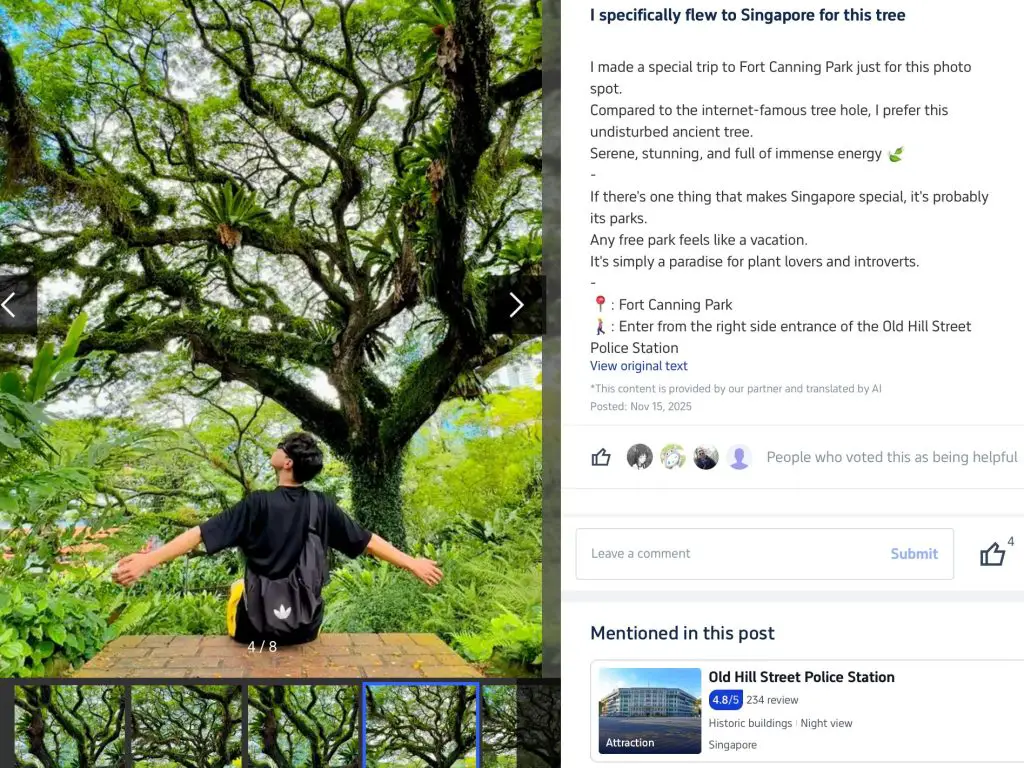
Trip.com Moments post
Post on Rain Tree in Fort Canning featured on trip.com moment

2. The most mysterious tree: The Kapok Tree that allegedly walks at night

The Kapok Tree (Ceiba pentandra) is another Heritage Tree found in Fort Canning Park and, like the Rain Tree, is native to tropical America.

Unlike its photogenic counterpart, the Kapok Tree is less famous on social media and far more renowned in folklore and ghost stories.

According to the Fort Canning tree trail guide, the Kapok is a fast-growing species that can reach heights of 50 to 70 metres, and is likely still growing today.

Its cream-coloured flowers emit a milky scent and later produce large seed pods that split open to release white, cotton-like floss. The word kapok itself means “floss” in Malay. This waterproof fibre was traditionally used to stuff pillows, mattresses, and even life buoys.

Across cultures, the Kapok Tree is steeped in mysticism.

In ancient Maya mythology, it was believed to form a sacred link between the heavens, earth, and the underworld – its roots reaching below while its branches held up the sky. Some Caribbean folklore even claims the Kapok Tree walks at night.

Closer to home, in Singapore and Malaysia, it is said that “Dear Lady P” loves to sit on its branches.

Despite its imposing presence, the Kapok Tree remains relatively overlooked online – perhaps not because of its ghostly reputation, but because its sheer height makes it difficult to frame as a dramatic photo backdrop.
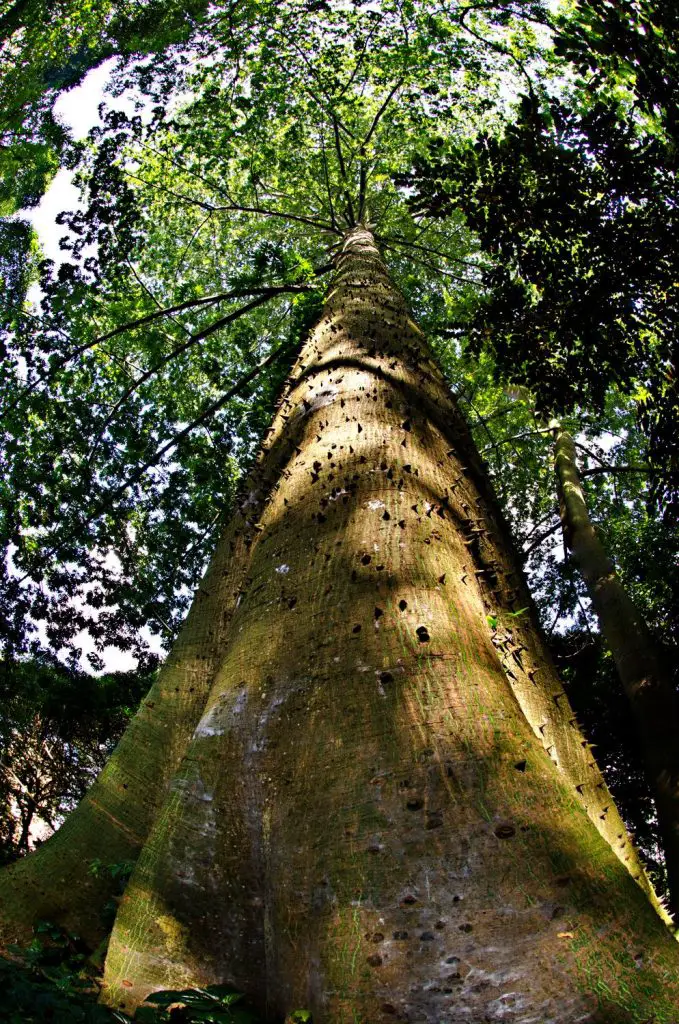
 Kapok Tree in Fort Canning, Photo from Singapore National Parks’s official Facebook page
Kapok Tree in Fort Canning, Photo from Singapore National Parks’s official Facebook page.

3. The most photographed “tree” in Fort Canning

This is the spot almost every visitor recognises, even if they don’t know its name.

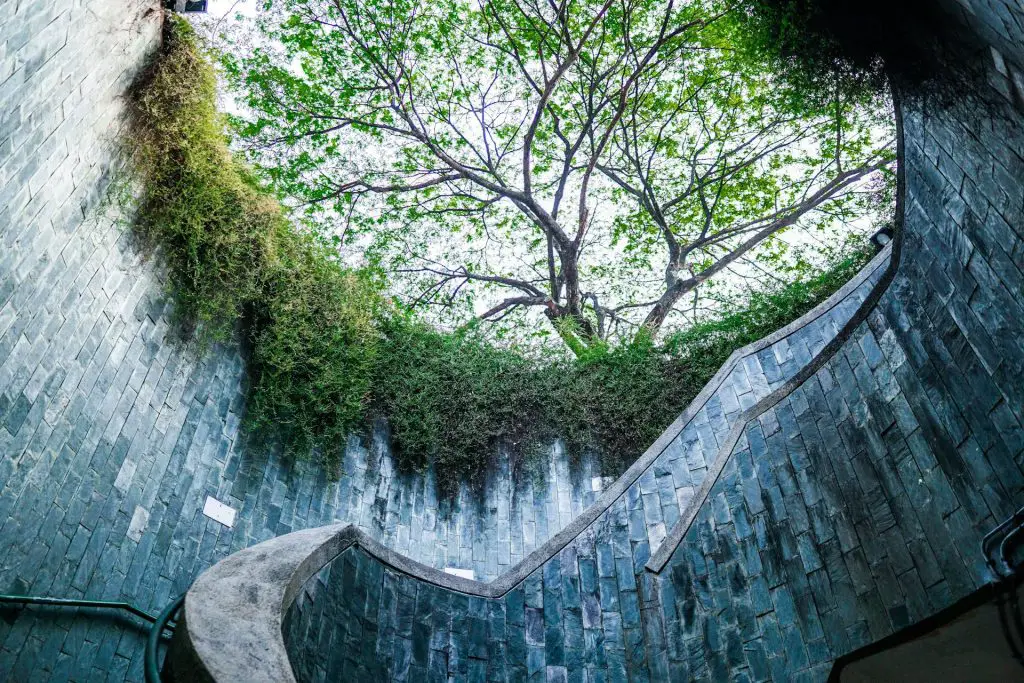
Many come specifically to take a photo here, often queuing for long stretches of time for what has become Singapore’s most viral “tree” photo.

Here’s the truth: it isn’t a tree.
It isn’t a tree hole.
And it isn’t really a tree tunnel either.

It’s a drainage tunnel.

The circular opening frames a yellow Flametree above, while most photos are taken from the spiral staircase below. Together, they create the illusion of a “tree inside a tunnel”, a visual trick that has taken Instagram and Xiaohongshu by storm.

Follow the park signage to the famous “tree tunnel.” Visit at any time, but expect a queue. There have even been reports of disputes, theft, and complaints due to overcrowding.

It might just be the most photogenic piece of tree-related travel content, not only in Singapore and Johor Bahru (as Phua Chu Kang would say), but possibly the world.
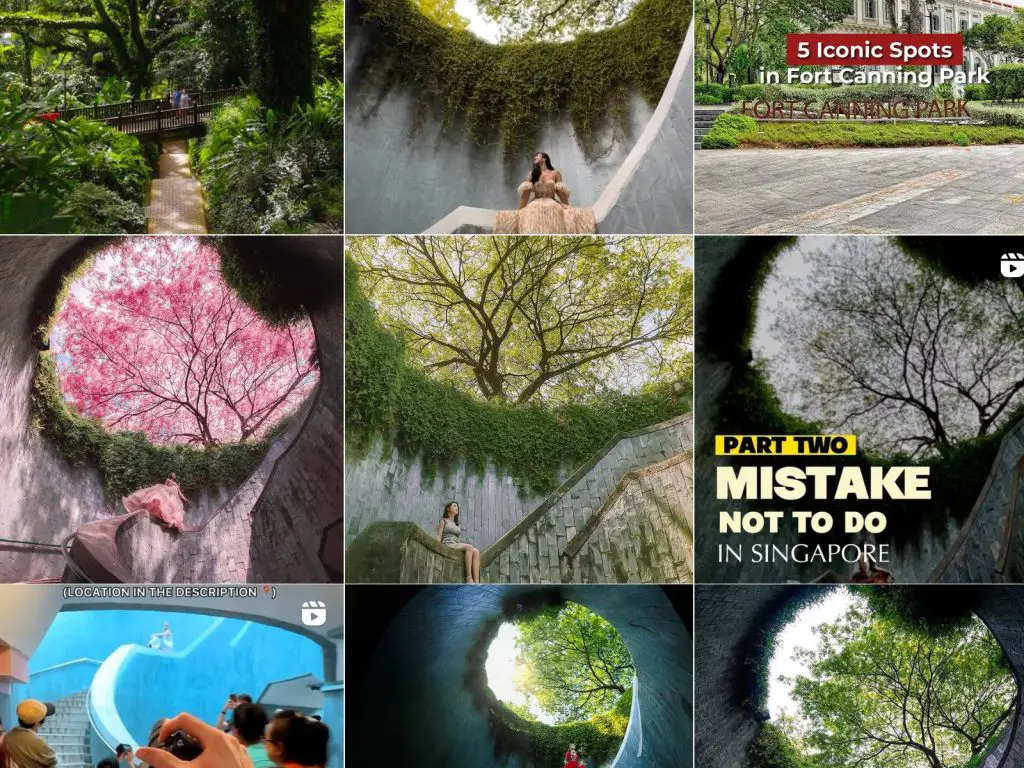
Screenshots of Instagram posts with #fortcanning
Screenshots of Instagram posts with #fortcanning.

Visiting Fort Canning Park Today

Once known as the “forbidden hill,” Fort Canning is now open for everyone to enjoy. Visitors can explore the Heritage Gallery, the Spice Gallery, and nine historical gardens, all free of charge. Guided tours and virtual tours are also available.

Do keep an eye on the tropical weather: watch for lightning or falling branches during storms, and bring plenty of patience for your photoshoot.

Back home in Sarawak, our trees may be older. But there is something uniquely striking about seeing heritage trees standing quietly just steps away from bustling Orchard Road. Best of all, Fort Canning is less than an hour’s flight away with Scoot and AirAsia and soon, AirBorneo.

Cheap in Asia, Costly Abroad: 3 ‘Old School’ Traditional Remedies Sarawakians Pack for Travel

By Ng Ai Fern

Asians have always packed their own “essentials” when studying, working, or living overseas. They aren’t modern travel essentials like gadgets or accessories, but old-school traditional remedies many instinctively bring along whenever they travel.

Even today, with globalisation and online shopping, some things are still worth bringing from home.

Not because they are unavailable, but because they cost much more, are harder to find, or simply don’t feel the same.

Here are three everyday items that are cheap at home, but cost an arm and a leg abroad.

  1. The ‘atas’ little jar with global claws: Tiger Balm
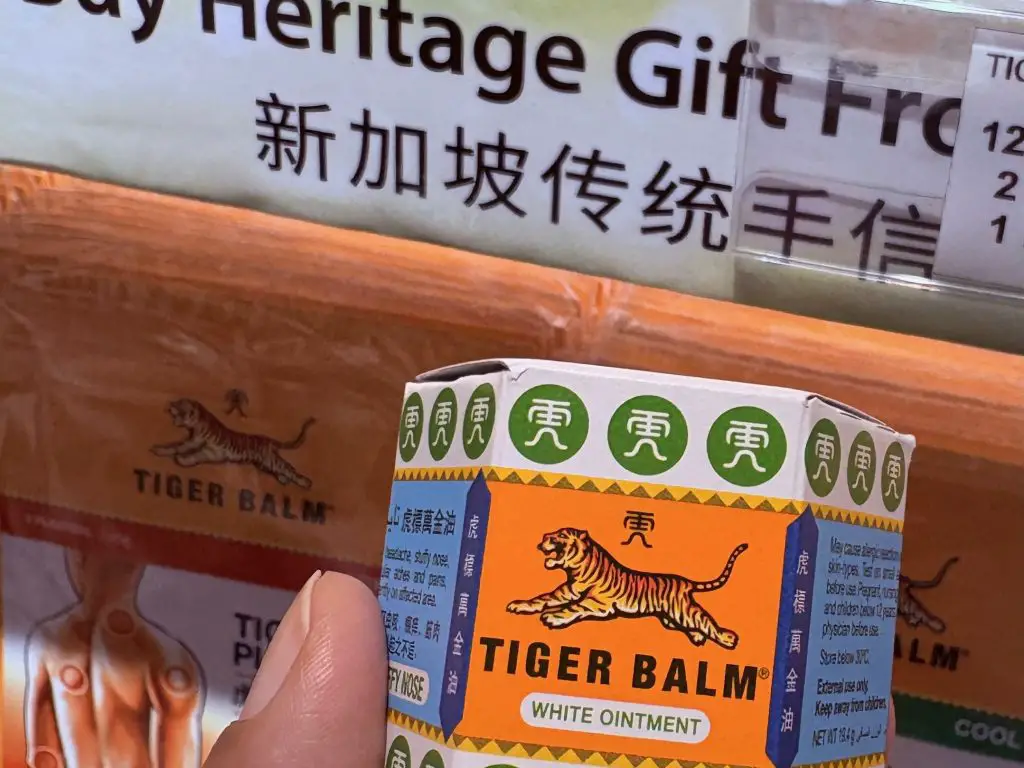
A must-buy Singapore heritage gift: Tiger Balm on display at a local tourist shop in Singapore.
Tiger Balm displayed at a Singapore tourist shop, a small, old-school traditional remedy that often feels ‘atas’ once you see overseas prices.

Tiger Balm is a brand from Singapore, one of Asia’s four “tigers”. Its roots trace back to the Qing dynasty, and over time, it became one of the world’s most recognisable pain-relief formulas, including Sarawak. From muscle aches to insect bites and even blocked noses – one jar does it all.

In Australia, Tiger Balm is sold at Chemist Warehouse, priced around AUD10–15 for small jars. In France, it is available at Decathlon and some major pharmacies, ranging from €10 for 20g to €15 for 30g.

In some countries, it is only found at Asian grocery stores or online platforms like Amazon where it is usually priced at 10–15 units in local currency.

In Singapore, Tiger Balm is like a heritage souvenir. Pharmacies and tourist shops sell it for about SGD6.50 per jar, or at cheaper rates when bought in bulk.

In Sarawak, a 20g jar costs around RM9–10.

YES – now you know why that little jar still goes into the luggage.

2. The universal “essential oil” of Asia: Axe Brand Oil

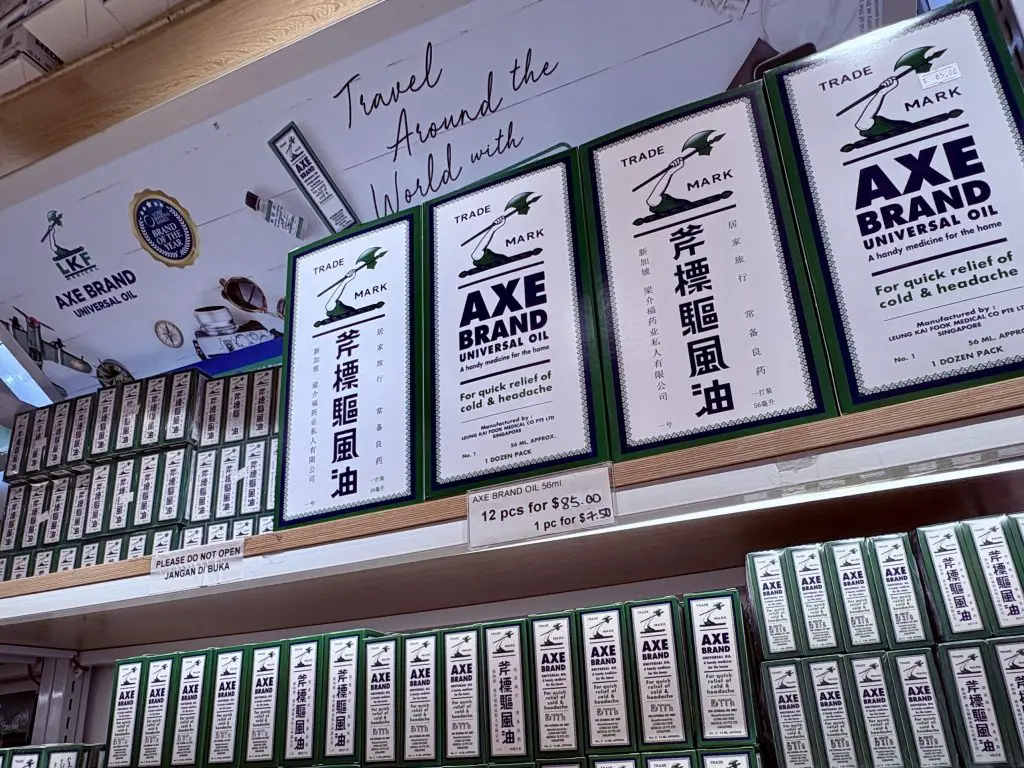
Travel around the world with Axe Brand Universal Oil.
Axe Brand Universal Oil, commonly known as minyak angin, is a familiar traditional remedy many Asians instinctively pack when travelling abroad.

Another trusted remedy from Singapore is Axe Oil, better known as Minyak Angin or Cap Kapak. For many Sarawakians, it is a must-have travel companion.

Headache. Dizziness. Nausea. Stomach discomfort. Insect bites. Some start using it the moment they board the plane to ease motion sickness, calm nerves, or simply feel at home. Whether physical or psychological, its effect feels magical. That’s why it often travels in hand luggage, like a small insurance policy. It comes in various sizes, from small 3ml bottles to 56ml bottles. Dozen-packs are available in Singapore as souvenirs.

Overseas, it is harder to find and far more expensive, if available at all. In Europe, especially France, it is almost impossible to buy. Some Asian stores sell it at premium prices, around AUD17.99 (RM49) in Australia or EUR16.90 (RM80) in France for a medium bottle.

Many similar oils exist from Thailand or Indonesia. But for Sarawakians, nothing quite replaces the familiar scent of Axe Oil.

  1. Salonpas: The pain patch that became ‘premium’ abroad
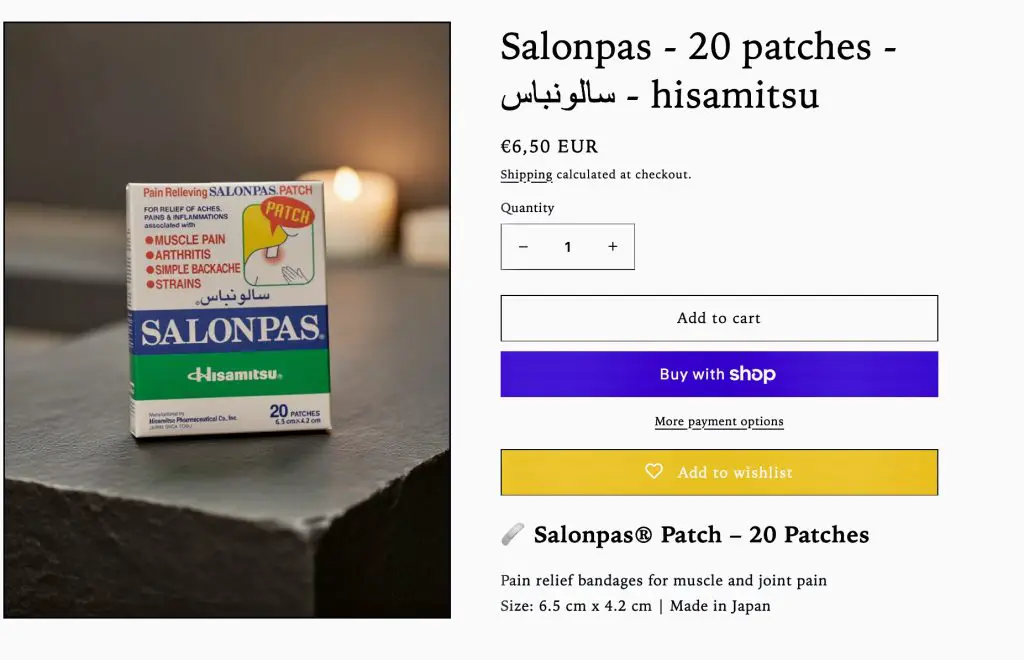
Salonpas pain relief patches listed on an overseas herbal store, where everyday traditional remedies from home are often sold at premium prices.
Salonpas pain relief patches listed on a France-based online herbal store, priced at levels typical for over-the-counter remedies in Europe.

Choosing a third item is tricky. Everyone has their own must-pack item – Po Chai Pills, Yoko Yoko, herbal tablets, Pei Pa Koa, or traditional remedies for aches and skin issues.

For something practical, lightweight and travel-friendly, Salonpas stands out.

Originally from Japan, Salonpas is a household staple across Southeast Asia, including Sarawak. It comes in handy after sleeping on unfamiliar beds, carrying heavy luggage, long shopping hours, or days of walking while travelling. Stick one on. Carry on.

It is widely available in Malaysian pharmacies and supermarkets.

In Europe and Australia, it is usually found only in Asian grocery stores or herbal online stores. Many travellers end up settling for unfamiliar alternatives available in local pharmacies that simply don’t work the same.

These old-school remedies aren’t rare, and not luxurious. But they carry familiarity, memory and comfort, and overseas, they suddenly become ‘premium’.

That’s why, even today, many Sarawakians still pack these little essentials before flying out. Cheaper at home. Harder to buy abroad. And always comforting to have in your bag.

10 island hopping essentials for your perfect vacation

Look no further as these are the island hopping essentials that you have been looking for!

Packing for your vacation can be stressful at times. Even more so if you have no idea what to expect.

On one hand, you do not want to pack too much that you look like you’re moving to another country.

On the other hand, you don’t want to end up saying, “Shoot, I forgot to bring this!”

Even after you reach your tropical destination, another dilemma which comes to mind is what to pack for a day out in the sun island-hopping.

island hopping essentials
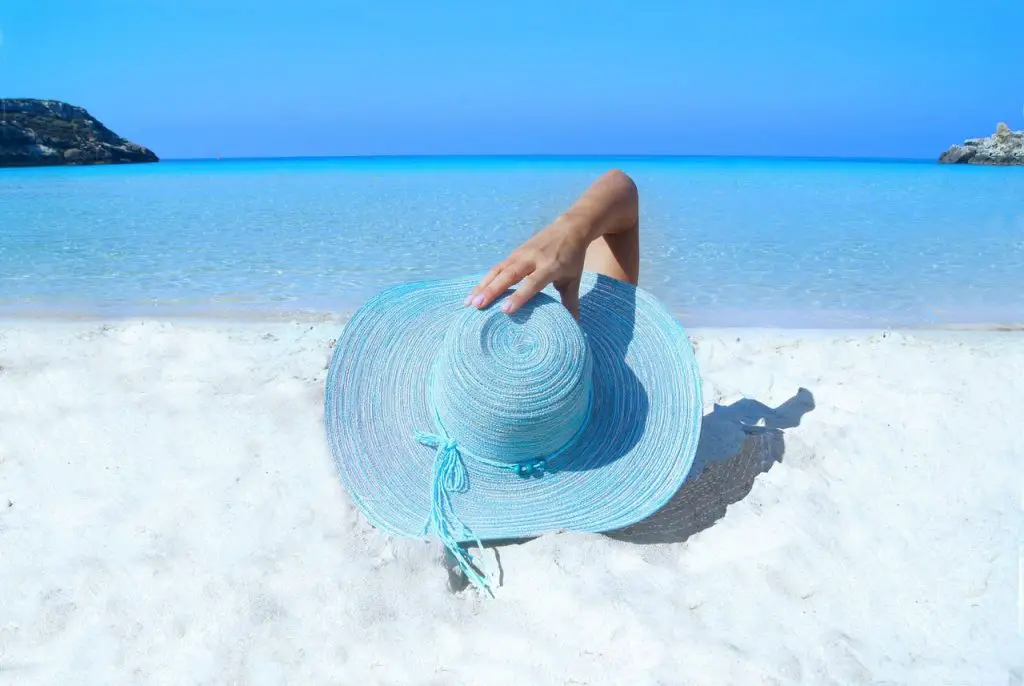
Take out your beach hat as it is one of your island hopping essentials and just relax. Credit: Pexels.

Fret not, here are your ultimate island hopping essentials for your vacation in any tropical countries:

1. Drybag

Your important stuff like your wallet and smartphone will thank you for this.

There is a wide range of sizes available. But small drybag that is large enough for your wallet and smartphone is good enough.

Fold the top closure at least three times to ensure your bag is watertight.

2. Beach hat

Besides a fashion item, a hat is essential for sun protection.

For ladies, the best one out there must be a wide brimmed beach hat.

Not only does it block out more sun, it also gives off a more elegant vibe than your usual beach hat.

3.Sunscreen

Do you know that according to American Academy of Dermatology Association, sunscreen use can help prevent skin cancer by protecting you from the sun’s harmful ultraviolet (UV) rays?

Hence, sunscreen or sunblock is definitely a must for your island hopping essentials.

It does not matter if it is a lotion, spray or gel, as long as it is able to reflects ultraviolet radiation and protect your skin from sunburn. Don’t forget to reapply every two hours.

4. Spare towel

A small spare towel comes handy when you need to quick dry your body in between island visits.

10 island hopping essentials for your perfect vacation
A pair of sunglasses is definitely a must bring for island hopping. Credit: Pexels.

5. Mat

While some of the islands you visit might offer lounging chairs for you to relax, they are always limited in numbers.

So the best is to bring your own mat and lie down on the beach while feeling the sand between your toes.

6. Water/ Snacks

10 island hopping essentials for your perfect vacation
Photo by Alexandra Tran on Unsplash

The tropical sun has no mercy when comes to dehydration. You will enjoy your island hopping trip even more if you stay hydrated.

Pack some even when you sign up for a tour package which include drinking water.

There is no such thing as too much when comes to drinking water.

Just in case you are starving after all those swimming, pack up some snacks too.

7. Insect repellent

Shoo away those nasty bloodsucking sandflies and mosquitoes with insect repellent.

The best trick is one of those waterproof insect-repelling bracelets which means you won’t have to keep reapplying repellent between your swims.

8. Shades

Apart from protecting your skin with sunscreen, don’t forget to protect your eyes too.

Do not just pick a pair of sunglasses because you like how the glasses look on you. Opt for the one comes with polarised lenses.

It can help to eliminate sun glare and subsequently reduce eye fatigue.

9. Swimming gear

If you are not keen to rent swimming gear, you can always bring your own.

Pack up a pair of swimming goggles, snorkeling mask or even a pair of swimfins.

When it comes to safety, most water transport providers or tour operators should provide you a life jacket by law.

10. Waterproof Cellphone Case

The best part of having a waterproof cellphone case is you can take photos while swimming at the beach.

There is no need for one of those expensive sports cameras, and of course, it cuts out the added worry.

No matter where you go; be it in Thailand or the Caribbean, make sure you don’t forget these island hopping essentials!

Tasik Biru: Legends and conspiracy theories behind this mesmerizing lake

Tasik Biru (which means “blue lake” in Malay because of its colour); what stories have you heard about this lake in Bau?

All over the world, lakes have been the subject of folklore and legend. There is Loch Ness in Scotland and Danau Toba in Indonesia as well as Malaysia’s very own Tasik Dayang Bunting  in Langkawi and Tasik Chini in Kuantan.

Sarawak has her own fair share of mythical lakes and one of them can be found about one hour from its capital city of Kuching.

Located in Bau, Tasik Biru (which means “blue lake” in Malay because of its colour) is not a natural lake but an open pit gold mine.

Its original name was Tai Parit or “big drain” in the Hakka dialect.

According to history, the gold mine was operated by the Borneo Company from 1898 until it was flooded in 1921.

Since it was flooded in 1921, many rumours and legends have been floating around about the lake.

Tasik Biru: Legends and conspiracy theories behind this mesmerizing lake
Tasik Biru is not a natural lake but a mining pit

The legends from underneath the lake

Chang Pat Foh wrote in The Land of Freedom Fighters that an old miner told a story about a human-shaped stone removed from the bottom of the lake.

Some believed that the stone was a deity named the King of Stone. The deity was angry that he was removed from the lake so he decided to flood the lake until it overflowed.

There were also rumours of three monsters appearing in Tasik Biru back in 1988. The large figures were reportedly about 3m long!

Tasik Biru: Legends and conspiracy theories behind this mesmerizing lake
There were also rumours of three monsters appearing in Tasik Biru.

The tragedy long forgotten

Besides myths and legends, the lake was also witness to an awful tragedy.

On June 7, 1979, a bus carrying students and teachers from SMK Lake, Bau plunged into the lake in an accident.

The tragedy took the lives of one trainee teacher and 29 students.

A monument is planned to be erected near the lake in remembrance of the 30 victims.

Tasik Biru: Legends and conspiracy theories behind this mesmerizing lake
The lake was the site of a tragedy in 1979.

Conspiracy theory about Tasik Biru

There is a signboard warning the public against swimming, fishing and bathing in Tasik Biru.

This is due to the fact that Tasik Biru has high levels of arsenic.

A local Chinese daily once reported a conspiracy theory about the arsenic warning. Apparently, there were people who believed that the lake was not actually polluted with arsenic and that the warning was made up to stop miners from excavating the large quantities of gold underneath.

Another piece of hearsay was that the state government was planning to dry up the lake to mine the gold.

Additionally, it was rumoured that people had discovered Japanese samurai swords and cannonballs from World War II, said to be thrown into the lake by the Japanese forces themselves during their occupation.

Tasik Biru: Legends and conspiracy theories behind this mesmerizing lake
Some people believed that the lake buried ammunition from World War II.

A home to Jong Regatta

Putting aside the legends and conspiracy theories surrounding the lake, one thing for sure is that visitors still make their way to Tasik Biru for the Bau Jong Regatta.

Jong is a miniature sailing boat some believe was inspired by the Royalist, a schooner owned by the first White Rajah of Sarawak, James Brooke.

The regatta, however, was first started by a colonial officer named A.J.N. Richards in the 1950s.

It was held several times over the past few decades until it was revived as an annual event in 2009.

The event is usually organised in the last quarter of the year so watch out for the this year’s date to visit this scenic (yet) arsenic lake.

Tasik Biru: Legends and conspiracy theories behind this mesmerizing lake
Head to Tasik Biru for Bau Jong Regatta.

Kuching-Serian Itinerary: What can you do in 1 spontaneous day?

Kuching-Serian: What can you do in 1 day?

Serian is a modest town located 40km outside Kuching, Sarawak’s capital. Famous for its durian and its fresh produce, it is also gateway to a number of waterfalls and natural beauties in the area.

If you are looking for things to do in a day from Kuching to Serian, here is a Kajo-tested and approved itinerary.

All you need to have for this trip are a car, Waze or Google Navigation, change of clothes, snacks, drinking water, binoculars (optional) and spirit of adventure.

Kuching-Serian Itinerary: What can you do in one day?

1.Panchor Hot Spring (9am-10am)

Kuching-Serian Itinerary: What can you do in one day?
Dip your feet at Panchor Hot Spring.

Start your day with breakfast at home or at any of these Kuching’s favourite foods in town.

Make sure to start driving from Kuching by 8am. The first place to visit in this Kuching-Serian itinerary is the Panchor Hot Spring located at Kampung Panchor Dayak.

This hot spring is famous among locals who are looking for natural healing.

If you find the temperature too hot for you to have a whole-body soak, just dip your legs into the pool.

The minerals in the water are believed to soothe joint pains and rheumatism.

Read more about Panchor Hot Spring here.

2.Ranchan Recreational Park (11am-12.30pm)

Kuching-Serian Itinerary: What can you do in 1 spontaneous day?
Explore the pools and waterfalls of Ranchan Recreational Park.

It is a natural haven celebrated for its picturesque waterfalls, clear natural pools, and unique stone riverbeds.

After experiencing the high temperatures at a hot spring, perhaps you want to cool down.

So head to Ranchan Recreational Park located right outside Serian town.

Ranchan offers visitors a chance to unwind in pools surrounded by rainforest.

Take your time to explore the park or just sit down by the waterfall and listen to the water crashing against the rocks.

Read more about Ranchan Recreational Park here.

3.Lunch at Serian and a visit to Serian Market (1pm-2.30pm)

Kuching-Serian Itinerary: What can you do in 1 spontaneous day?
How about giving a plate of fried noodle with seafood a try at Yee Siang Bak Kut Teh, Serian?

If you packed your lunch, then enjoy it at Ranchan. If not, head to Serian town to nourish your body.

One of the best places to have your lunch is at Yee Siang Bak Kut Teh.

The place is famous for its crab satay, prawn satay and tom yam coconut prawns.

Once you’ve had your meal, try to explore Serian town. The best place to start is at Serian Market.

There, visitors can find plenty of local vegetables and fruits.

Right next to Serian market is a row of local craft stores. Besides the local Bidayuh accessories and costumes, you can also find some traditional handicraft from our local ethnic communities such as the Penan woven baskets.

4.Semenggoh Nature Reserve (3pm)

Kuching-Serian Itinerary: What can you do in 1 spontaneous day?
Try to take a wefie with an orangutan at Semenggoh Nature Reserve.

To end your Kuching-Serian road trip, navigate your way to the Semenggoh Nature Reserve.

It takes about 20 to 30 minutes to reach Semenggoh from Serian.

Say hi to the orangutans there and observe their behaviour.

Their feeding time in the afternoon is at 3pm so make sure to arrive there on time.

If you are into birding and brought along your binoculasr, Sarawak Tourism Board website highlighted that there are at least 23 species you can spot at this reserve.

These species include Sunda Frogmouth, Red-crowned Barbet, Red-naped Trogan, Blue-winged Leafbird and Hooded Pita.

By 4pm or so you can end your Kuching-Serian trip by saying goodbye to the orangutans.

Read more about Semenggoh nature here.

5 beautiful churches in K-dramas you can visit

Churches in K-dramas can look like they are straight out of an expensive Hollywood set and at other times like an 18th century Gothic church in Europe.

Yet all the beautiful churches in K-dramas were shot, well in South Korea. About 30% of the South Korean population are Christian, predominantly divided into Catholic and Protestant faiths.

It is no surprise that these scenic churches served as filming locations, thanks to their fine-looking high ceilings and elaborate mural work.

Here are five beautiful churches in K-dramas you might want to pay a little visit:

one of the beatiful churches in K-dramas.
A view of Myeongdong Cathedral, one of the beatiful churches in K-dramas. Credit: Pixabay.

1. Myeongdong Cathedral

Myeongdong Cathedral or the Cathedral Church of the Virgin Mary of the Immaculate Conception is located in Seoul.

Here is where dramas such You are Beautiful (2009) and Black Knight: The Man who Guards Me (2017) were shot.

The first episode of You are Beautiful when the lead character Go Mi Nam (Park Shin Hye) is still discerning if nunnery is her calling was shot here.

Built in 1898, the cathedral is one of the famous historical sites in Seoul. It was the birthplace of Roman Catholicism in South Korea and also houses the remains of Bishop Laurent Joseph Marie Imbert (1796-1839), and priests Peter Simon (1803-1839), James (Jacques Honor Chastan, 1803-1839) and Pourthie Jean Antoine Charles (1830-1866) and four martyrs.

Myeongdong Cathedral is also strategically located near other popular tourist spots.

According to Korea Tourism Organisation, visitors can also visit Korean traditional houses of Namsangol Hanok Village, N Seoul Tower and Namdaemun Market.

2. Gongseri Catholic Church

If you are travelling to Chungcheongnam-do or South Chungcheong Province then make way to Asan city and visit Gongseri Catholic Church.

Uncontrollably Fond (2016), Cheongdam-dong Alice (2012) and Iris 2 (2012) used this 19th century church as one of its filming locations.

It was the first church built in that province back in 1894.

But back then, the congregation was using a common house to worship until a proper church building was built in 1922.

After a tour of the church, don’t forget to visit tourist sites such as Asan Spavis and Asanoncheon Hot Spring.

3. Mirinae Holy Site

Remember in Goblin (2016) when Kim Shin aka Dokkaebi (Gong Yoo) handsomely appears (as he always does) after Ji Eun Tak (Kim Go Eun) summons him in a church?

That scene was shot in Mirinae Holy Site located in Anseong city, 80 kilometres south of Seoul.

The first Korean Catholic saint, St Andrew Kim Taegon was buried here.

The church is called Mirinae (Milky Way) because when Korean Catholics took refuge at this place to avoid persecution during the late Joseon Dynasty (1392-1897), the lamplight coming from their homes in the village looked like the starlight of the Milky Way.

4. Yakhyeon Cathedral

By Liturgy - Own work, CC BY-SA 4.0, https://commons.wikimedia.org/w/index.php?curid=75200316
One of the beautiful churches in K-dramas. By Liturgy – Own work, CC BY-SA 4.0

This is the church which witnessed so many weddings in Korean dramas. Nam Da Jung (Yoona) and Kwon Yul (Lee Beom Soo) married here in the final episode of Prime Minister and I (2013).

Oh Jin Hee (Song Ji Hyo) and Oh Chang Min (Choi Jin Hyuk) married here in Emergency Couple (2014).

And in My Daughter, Geom Sa Wol (2015), Oh Hye Sang (Park Se Young) and Joo Se Hoon (Da Sang Woo) wed here too.

This parish in Seoul is named Yakhyeon which means a hill of herbs because the area has many herbs.

Just like most 19th century Catholic churches in South Korea, Yakhyeon Cathedral is the final home for 44 martyrs.

Nonetheless, this cathedral was the first western style church built in South Korea in 1892 which unlike other churches that were more Gothic-inspired.

5. Youngnak Church

Out of all the churches in K-dramas on this list, this is the only non-Catholic Church.

Seo Sang Ryun and his brother Seo Sang U founded the first Protestant Church in Korea back in 1884.

The congregation grew over the years and in due time, there was a need to build a church in Seoul.

So, a new church building called Youngnak Presbyterian Church was constructed and completed in May 1950.

Gong Yoo’s Seo Yoon Jae met Gil Da Ran (played by Lee Min Jung) for the first time in this church in Big (2012).

Top 3 exciting things to do at Gunung Gading National Park, Lundu?

Top 3 exciting things to do at Gunung Gading National Park, Lundu?
Welcome to Gunung Gading National Park!

Gunung Gading National Park is one of the most accessible places in Sarawak to view Rafflesia blooms.

Gazetted in 1983, the national park is a conservation area for this majestic plant.

The park is located about 80km from Sarawak’s state capital Kuching, near the small town of Lundu.

It is known for its stunning biodiversity and is a popular destination for nature lovers, hikers, and those interested in exploring tropical rainforests.

The park is around 4,300 hectares in size and offers a variety of ecosystems, from tropical lowland forests to montane regions.

The name Gunung Gading was believed to come from a tree called engkabang gading (Shorea hemsleyana).

However, according to the book National Parks of Sarawak by Hans Hazebroek and Abang Kashim Abang Morshidi, it’s name comes from a legend behind this mountain.

There were three celestial princesses from Gunung Roban in Java, Indonesia.

The princesses were guardians of Gunung Gading Puteri Gading, Gunung Perigi Puteri Sri Giar and Gunung Sebuluh Puteri Sri Geneng.

They loved to bathe and play in the seventh waterfall. They also planted flowers called Sri Gading on the mountain.

It is said that if you manage to find these flowers, you will be showered with good luck.

Top 3 exciting things to do at Gunung Gading National Park, Lundu?
What should you do on Gunung Gading?

Here are the three things you can do at Gunung Gading National Park (on top of looking for a good luck charm):

1.See Rafflesia

Top 3 exciting things to do at Gunung Gading National Park, Lundu?
Come and visit Rafflesia in Gunung Gading.

Regardless if you are a celestial princess or not, the only flower that matters in this national park is the Rafflesia.

Gunung Gading National Park is home to the endemic Rafflesia tuan-mudae, named after Charles Brooke, the second White Rajah of Sarawak.

This rare and huge flower is a highlight of the park. Known for its strong odor (often described as rotting flesh), it blooms for only a few days a year, making it a unique and sought-after sight. The park is one of the few places where you can find this remarkable flower.

Since the Rafflesia is a rare flower with a short flowering period, plan your visit carefully.

You can check in with the park headquarters at 082-7355714 on whether the flower is in bloom.

2.Climb to the top of Gunung Gading National Park

Top 3 exciting things to do at Gunung Gading National Park, Lundu?
The sound of a splashing waterfall can be heard along the trail to the summit.

Visitors can opt to climb to the top of Gunung Gading although there is no picturesque view awaiting you.

It has a a sign telling you something to the effect of “this is it, you’ve reached the top”.

The climb will take up to eight hours for a round trip so plan to start hiking early in the morning.

Do not forget to pack a lot of water, some food for an energy boost and a bag to carry your trash back with.

3.Visit the waterfalls

Top 3 exciting things to do at Gunung Gading National Park, Lundu?
The two-tiered Waterfall no 7 awaits you.

Follow the path of the celestial princesses and take a dip in any of the waterfalls.

The waterfall trails pass seven waterfalls but not all of the waterfalls are accessible.

The easiest trail is to Waterfall 1 while the two-tiered Waterfall 7 is the furthest to reach (about 1 hour depending on your stamina).

Every waterfall is a perfect bathing pool offered by Mother Nature for us to relax in so don’t leave any trash behind.

Last but not least, do wear long pants or leech socks as, based on my personal experience, those creepy-crawlies can pop up unexpectedly. So better be safe than sorry!

Gunung Gading National Park
Doesn’t this look so relaxing?

8 fascinating pecies of hornbills you can spot in Sabah

Sarawak might be called the “Land of the Hornbills” but plenty of these birds also call neighbouring state – Sabah – home.

Nature lovers or avid bird watchers will find this Sabah Tourism Board infographic handy as it details the types of hornbills which can be found there along with their measurements from head to tail.

hornbills

Check out how else these hornbills differ from each other:

1. Bushy-crested hornbill (Anorrhinus galeritus)

Bushy-crested hornbills prefer roaming around subtropical and tropical lowland areas.

It is a dark-coloured bird and its tail is grey-brown with a broad black tip.

Its diet include figs, fruits, cockroaches, mantis and millipedes.

2. Asian black hornbill (Anthracoceros malayanus)

We would not be able to enjoy durian if it were not for this particular hornbill.

Asian black hornbill is known to be a major durian seeds disperser.

The bird is black overall except for its broad white-banded outer tail and its pale yellow casque.

3. Oriental-pied hornbill (Anthracoceros albirostris)

The oriental-pied hornbill is a black and white bird with a white belly and thighs. The casque, however is yellowish.

The male has a larger casque with few black marks while the female has a smaller casque with more black marks.

This hornbill is considered more common among the Asian hornbill.

4. Wrinkled hornbill (Rhabdotorrhinus corrugatus)

One characteristic of the wrinkled hornbill which stands out are its blue eye rings.

Plus, the males and females of the species look like they come from different families altogether.

The male’s bill is yellow with a red base and its casque is brown on the lower mandible while the bill and casque of the females are almost completely yellow.

Males have bright yellow feathers on the neck, chest and cheeks, but they are black in the females.

5. White-crowned hornbill (Berenicornis cormatus)

With white crown feathers on its crest, this particular hornbill is like the Andy Warhol of its kind.

It can be easily distinguished by its white head, neck, breast and tail while the remaining plumage is black.

It is also known as the long-crested hornbill or white-crested hornbill.

6. Wreathed hornbill (Rhyticeros undulatus)

Also known as the bar-pouched wreathed hornbill, you can recognise it by its yellow inflatable pouch on its throat

The casque is corrugated and it has overall black plumage with short white tail.

Males and females of wreathed hornbills look similar but the females weigh averagely lighter than the males

7. Rhinoceros hornbill (Buceros rhinoceros)

Like the rhinoceros, this hornbill has a huge bill and casque which come in orange and red.

The males’ eyes are red with black rims while the females have white with red rims.

The plumage is mostly black with white legs and its white tail has a black band.

It enjoys mostly fruit but will eat insects, rodents, small reptiles too.

8. Helmeted hornbill (Rhinoplax vigil)

First of all, this hornbill has a very heavy head. Its casque accounts up to 11 per cent of its 3kg weight.

It has mostly blackish plumage, except that the belly and legs are white.

The throat is wrinkly; pale blue to greenish in colour in females and red in males.

Where to find them?

Now that you can roughly tell these hornbills apart, where can you find them in Sabah?

According to Sabah Tourism Board website, all eight species can be spotted in one place- the Kinabatangan River – the second longest river in Malaysia and renowned for its diverse ecosystem.
Besides hornbills, the river also plays home to proboscis monkeys, orangutan and Asian elephants.

Time to pack the binoculars and a field guide book and head to Kinabatangan!

6 nature attractions near Kuching city for you to discover

So you are now in Kuching city and you are looking for an accessible, green place to go to.

Fret not, here are the six nature attractions near Kuching city you visit and enjoy a day out with Mother Nature.

1. Santubong National Park

Kuching city
Mount Santubong.

Santubong National Park is about 40 minutes drive from Kuching city.

Here visitors can climb to the top of Mount Santubong, take a dip in the waterfall or simply enjoy the rainforest.

There is no accommodation at the national park but there are handful of resorts and homestays nearby.

2. Kubah National Park and Matang Wildlife Centre

Come and explore Kubah Waterfall.

Kubah National Park is situated about 22km from Kuching city.

It is rich in floras and is a scientifically important site for palm trees.

One 1992 study by Katherine Pearce found that there are 86 species of palm trees in the area, 16 of them only found in Borneo.

You can choose to climb to the top of Mount Serapi or go for trekking in search of waterfall at Kubah.

Next to Kubah is Matang Wildlife Centre where endangered species such as orang utans are rehabilitated and released into the forest.

Beside saying ‘hi’ to the orang utans, visitors can also go for jungle trekking at one of the four trails here.

3. Sama Jaya Nature Reserve

Imagine New York’s Central Park but a thousand times smaller. (Okay, it’s only approximately eight times smaller. New York’s Central Park covers 341 hectares, while Sama Jaya Nature reserve spans 38.)

Much like Central Park, however, Sama Jaya is a small patch of forest in the middle of an urban area located at Stutong.

Just a 10-minute drive from Kuching City centre, the nature reserve is famous among joggers as it offers two jogging tracks at 870 metres and 1600 metres respectively.

As the jogging tracks wind through this urban jungle, do not be surprised if you spot some local wildlife.

According to Sarawak Forestry website, here you can find squirrels, shrew, fruit bars, frogs, lizards and monkeys.

Other perks this reserve offers is the Hiroshima-Sarawak Friendship Garden, forest biology museum and an ethno-botanical garden.

4. Wind Cave and Fairy Cave Nature Reserves

A post shared by Visit Sarawak (@sarawaktravel) on


Wind Cave and Fairy Cave Nature Reserves are located at Bau bazaar, just half an hour’s drive from Kuching city.

The two caves are located 8km from each other.

There are plankwalks available for visitors to explore the caves.

Keep your eyes open to spot various species of bats, squirrels and birds at these nature reserves.

5. Semenggoh Nature Reserve

A post shared by Visit Sarawak (@sarawaktravel) on


Here is another great place to visit the orang utan. It has a wildlife centre for the rehabilitation of rescued orang utan.

Semenggoh Nature Reserve is 20km away from Kuching.

The best time to visit Semenggoh is during feeding times. It usually takes place between 9 to 10am and between 3 to 3.30pm.

6. Bako National Park

Bako
Bako National Park, one of tourists favourite spot to visit while in Kuching city.

Sarawak’s oldest national park, Bako National Park requires a boat-ride to visit but is still accessible from Kuching city.

It is a nature lovers’ paradise where visitors can opt for bird watching, beach-strolling or jungle trekking.

It takes about 45 minutes from Kuching to Bako market. From there, it takes another 20-minute boat ride to reach the park.

Here you can spot proboscis monkeys, long-tailed macaque monkeys and bearded pigs roaming around the park.

A post shared by Visit Sarawak (@sarawaktravel) on

Mount Serapi: 5 reasons why you seriously need to climb this scenic mountain

Mount Serapi located at Kubah National Park is one of the two mountains that can be easily spotted from Kuching city.

Together with Mount Selang and Mount Sendok, they make the three summits of the Matang Range.

Famous among locals and foreigners alike, Kubah National Park offers jungle trails for trekkers and waterfalls to dip in.

It offers six trails for visitors to explore including a path leading up to the summit of Mount Serapi.

If you are looking to strike “climb a mountain” off your bucket list, Mount Serapi is a good place to start.

Mount Serapi
The view as far as the eyes can see from the top of Mount Serapi.

Even if you have no interest in hiking or are ‘allergic’ to nature, here are some reasons why you should consider climbing Mount Serapi at least once in your life:

1. It is accessible from Kuching!

Mount Serapi.
You can easily spot this communication tower resting on top of Mount Serapi from Kuching.

Kubah National Park is located 20 km from Kuching city, very accessible indeed.

Thanks to its distance, it is famous among day trippers. However, the park offers lodging too if you are planning to stay overnight.

Even if it is near Kuching, plan your ascent as early as you can. Then you can avoid the afternoon heat and take your time on your climb.

2. Your shoes won’t get muddy.

Mount Serapi
A tarred road leads all the way up to the summit.

The best part about climbing to the top of Mount Serapi is *drum roll please* there is a tarred road leading all the way up to the top!

So you can ditch wearing your expensive hiking footwear and even the affordable adidas kampung and take your usual running shoes.

Even so, it is crucial to invest in a pair of good shoes that fit perfectly.

A pair of loosely fitted shoes will hurt when you are descending from the summit; your feet will be sliding forwards and your toes repeatedly hitting the inner part of your shoes. And yes, I’m speaking from personal experience.

3. It only takes less than 4 hours to reach the top

It takes about 3 to 3 1/2 hours to reach to the top.
It’s a quick trek up, but has lots of rest stops along the way.

Depending on your stamina, it takes about 3 to 3 1/2 hours to reach to the top.

Some seasonal runners and trekkers can finish the round up trip even in five hours.

There are plenty of rest stops along the way, so take your time.

4. You can listen to the sound of nature

Enjoy the sound of nature before feasting your eyes with this view.

You can always enjoy the sounds of cicadas, frogs, birds and insects along your way to the top.

Or swing by at the frog pond and listen to the world’s most beautiful sound.

In 2014, nature recordist Marc Anderson won a competition sponsored by The Sound Agency with a recording he took at Kubah National Park’s frog pond.

The recording won the Most Beautiful Sound in the World.

If you are familiar with birds’ call, Kubah is also one of the best places in Kuching where you can hear them.

Among the birds highlighted by Sarawak Tourism Board found here in Kubah are Blue-banded Pitta, Red-naped Trogan, Rufous-backed Kingfisher and many more.

For visiting birders out there, remember to bring your binoculars.

5. Do it for the view!

Last but definitely not least, climb up to the summit of Mount Serapi for the view.

There is a viewing platform for climbers to enjoy the scenic view of Kuching, Mount Santubong and the coastline of Southwest Sarawak.

If you are good at geography, perhaps you can spot which mountain peaks mark the border with Indonesia.

Mount Santubong too offers great view from on top but the climb to the top is not for all.

Mount Gading in Lundu is another option for climbers. Sadly, there is no views from the top, only a sign saying you have reached the summit.

The best option for an achievable climb and comes with a great view near Kuching, choose Mount Serapi instead.

Read more:

3 easy trails in Bako National Park you must visit

1 2 3 15