Browse Category

Culture - Page 37

5 things everybody should know about Songket Sambas

The Sambas Regency in West Kalimantan Province of Indonesia is known for its beautiful and intricate weaving of Songket Sambas.

Songket is a type of fabric that is hand woven in silk or cotton and often embroidered with intricate motifs in gold or silver thread.

A proud legacy of the Malay community in Sambas, here are 5 things to learn about Songket Sambas.

  1. Songket Sambas is believed to be over 400 years old.

5 things everybody should know about Songket Sambas
A tradition as old as time

Estimated to be over 400 years old, Songket Sambas is said to have existed before the Sambas Islamic Sultanate that was established with the birth of its first Muslim sultan Muhammad Shafi ud-din I.

Born Radin Sulaiman to Sultan Tengah (Sarawak’s first and only Sultan) from Brunei and Ratu Sepudak, a descendant of the Majapahit governors of Sambas, he ruled it for 10 years from 1675 to 1685.

  1. It was a sign of luxury

5 things everybody should know about Songket Sambas
Songket Sambas is luxury item in the old days

As a traditional luxury item, Songket Sambas was worn by ladies from the upper class in the olden days.

5 things everybody should know about Songket Sambas
Songket details on the collar

Today, it is often worn to formal and grand functions or events in Malaysia, Indonesia and Brunei.

5 things everybody should know about Songket Sambas
Songket details on a songkok (cap)

As of now, besides womenswear, the songket weaving is also used as decorative trimming on men’s clothing along the collar or on songkok (the traditional Malay cap).

  1. Gold thread is used in Songket Sambas

5 things everybody should know about Songket Sambas
Songket Sambas is a hand woven fabric with gold or silver thread

Songket Sambas is a hand-woven fabric in silk or cotton with gold or silver thread.

The incorporation of gold thread is such an important part of the textile that the locals refer to the weaving as ‘bannang ammas’ (gold thread).

This is because the threads are light, durable and the colours do not fade even after hundreds of years.

  1. It was given as a wedding gift from the groom to the bride

5 things everybody should know about Songket Sambas
It plays an integral part in the Sambas marriage custom, often given as wedding gift from the groom to the bride

Thanks to the use of the gold thread, Songket Sambas was a valuable gift and played an important part in local wedding customs.

In accordance to the Sambas Malay custom, it was often given by the bridegroom to the bride as a gift.

  1. The bamboo shoot pattern signifies modesty and humility

5 things everybody should know about Songket Sambas
The bamboo shoot (long, tapered and triangular in shaped) motif signify modesty and humility

Another unique feature of Songket Sambas is the bamboo shoot motif that can be found on the textile.

Known as ‘suji bilang’ among the locals, the bamboo shoot pattern is triangular in shape, long and tapered.

Inspired by the bamboo shoot for its ability to bend when it grows tall, it signifies modesty and humility.

The motif reminds the wearer to aspire to great heights but  not to be arrogant or proud once they’ve reached a higher level in life.


10 things you should know about Fajar Sarawak, Sarawak’s first Malay newspaper

Did you know that the first Malay-language newspaper in the state was called Fajar Sarawak?

Here are 10 things you should know about this long forgotten local publication:

1.It was founded by Muhammad Rakawi Yusuf
10 things you should know about Fajar Sarawak, Sarawak’s first Malay newspaper
Muhamad Rakawi Yusuf

Fajar Sarawak was the brainchild of Muhammad Rakawi Yusuf, a former customs officer, a silat practitioner and Sarawak’s first Malay novelist. His known works are Hikayat Sarawak and Melati Sarawak.

Using his retirement money from the civil service, he published the first newspaper in 1930. Initially, Rakawi was helped by his two friends Abdul Rahman Kassim and Johari Anang. Then Mohammad Daud Abdul Ghani and Mohammad Awi Anang also pitched in to start Syarikat Putra Sarawak, the company behind Fajar Sarawak.

Rakawi was a member of the Sarawak branch of Persaudaraan Sahabat Pena Malaya, a writers’ guild which was one of the first starters of nationalism in Malaya then.

2.It ran for only four months

The publication was written in Jawi and appeared twice a month from February to June in 1930. The printing company responsible for the publication was Diocesan Press located on Wayang Street, Kuching.

3.Fajar Sarawak was focused on news, education, general knowledge and entertainment

Sadly, Fajar Sarawak did not publish a lot of news. Partly because the company did not have enough resources to cover the whole kingdom, and another reason was there was not enough newsworthy happenings back then.

However thanks to the founders’ connections, they had their own correspondents in Tehran and Medan.

They did not carry any news from Sarawak’s neighbours such as Malaya, Singapore, Brunei and North Borneo.

4.There were also world history, poems and news reports.

Nonetheless, Fajar Sarawak did carry stories from the Middle East such as Afghanistan and Turkey.

It also published articles on world history and poems of religious nature.

5.The closest thing they came to criticise the Brooke government was regarding the Malay land policy.

Just as in today’s world, governments introduced laws and ordinances to keep the media in check.

Back then the Brookes introduced the 1927 Printing Presses Ordinance to control licensing of the media. Some speculated it was to prevent the rousing of Chinese political action through Chinese newspapers.

As for Fajar Sarawak, it started its first publication with praise for the government by publishing a photo of the third Rajah, Vyner Brooke and these words:

The Rajah loves his people
Their cause be never forsook
All generations yet to come
Shall bless the name of Brooke

Nonetheless, the founders used the newspaper to voice out their concerns over Kuching’s changing racial composition since the beginning of 20th century.

During this period, many Malays were forced to sell their lands due to financial depression.

So the newspaper called the government to grant every Malay three acres of vacant land which could not then be legally sold or mortgaged.

They even pointed out that the Kesatuan Melayu in Singapore and Penang had managed to do so from their government.

6.Fajar Sarawak was also interested in developing Malay education

Since education was one of its focuses, historian Bob Reese wrote that Fajar Sarawak might have been partly responsible for the opening of a number of new Malay schools from 1930.

Reese stated, “The Merpati Jepang School was opened in that year and 1931 saw the opening of the Enche Buyong School and the merging of two existing schools to form the government-sponsored Madrasah Melayu. This was intended to train the Malays for the Native Officer and Junior Administrative Services. The first Malay girls’ school, Sekolah Permaisuri, opened in 1930 and the government initiated a policy of sending Sarawak students to the Sultan Idris College at Tanjung Malim in Malaya to train as Malay-medium teachers. And it was significant that the leadership of this movement was provided by commoners like Rakawi.”

7.Advertisers ranged from tailors to a bicycle shop

Although the newspaper was vocal in encouraging the Malay community to patronise Malay shops to increase prosperity, Fajar Sarawak did publish advertisements from Chinese businesses.

Among them were advertisements for bicycle parts, a bookshop by H.K. Abdul Rahman Brothers and even condensed milk from Milkmaid brand priced at 7 cents(!) a can or 80 cents for a dozen cans.

8.A few factors led to its short life

Fajar Sarawak had a short yet significant life. The passion of its writing could not make up for its lack of business skills. The newspaper could not compete with imported magazines such as Singapore’s Dunia Melayu. It had few stories beyond Kuching and local advertisers only advertised once. Eventually, Rakawi ran out of money to keep the publication going.

9.There was no Malay newspaper in Sarawak until the appearance of Utusan Sarawak in 1948

After the end of Fajar Sarawak, only Chinese newspapers and the English language Sarawak Gazette were left. Then in 1948, Utusan Sarawak emerged as the new Malay newspaper.

10.Four issues of Fajar Sarawak are known to have survived

So far, there are only four issues of Fajar Sarawak left in existence. They can be found in Rhodes House Library, Oxford and the Singapore National Library (No. 1 issue of Feb 1,1930) as well as Issue no 4, 9, 10 in Sarawak Museum (Mar 1, June 1, and June 16).

Rising Sun over the Land of Hornbills: Sarawak during the Japanese Occupation

After the attack on Pearl Harbor on Dec 8, 1941, US and Britain immediately declared war on Japan.

The result? The Pacific War spread over around Southeast Asia including Sarawak.

By Dec 16 that year, the Japanese force secured Miri and by Christmas eve, they took over Kuching.

About less than a month later, the Japanese conquered the whole island of Borneo. And it was the first time in modern history that all of Borneo was under a single rule.

For the next three years and eight months, the Japanese occupation did little for Sarawak development. There was a lack of food supply and other basic necessities.

Even so, the Japanese did  – in their own way –  try to govern Sarawak.

Sarawak Constabulary under the Japanese occupation

Just like in most civil sectors, many Malay policemen kept their jobs in Sarawak Constabulary during the occupation.

Before the Japanese arrived, there were only a few Dayaks in the force. During the occupation, the Japanese intensively recruited the Dayaks as they found them to be hardworking, honest and loyal.

Besides the infamous kempeitai, the Japanese also set up a couple other law enforcement groups.

There was a vigilante system comprised of about 30 houses under a local man called jikeidan.

Apart from that, there was a militia called kyodohei consisting mainly of Ibans but with Malay senior officers.

Even with a day job, the constabulary personnel overall suffered from malnutrition due to lack of food supply.

Both jikeidan and kyodohei were not that successfully implemented due to strong resistance from the local people.

Rising Sun over the Land of Hornbills: Sarawak during the Japanese Occupation
Japanese building of Kuching.

Land policies under the Japanese occupation

According to Vernon L. Porritt in British Colonial Rule in Sarawak, the Land Department reopened its office only few weeks after the Japanese arrived.

But with reduced staff and of course a Japanese officer in charge of the department. Then in 1942, the Japanese demanded that all land titles be confirmed and ratified, charging $2 for the service.

They also imposed special tax on transfers of land valued at more than $1,000.

Generally, the local staff handled the departmental affairs according to Brooke legislation and procedures.

Women under Japanese occupation

Ooi Keat Gin wrote in Rising Sun over Borneo that there was only one single case of rape reported during the occupation. It involved a 14-year-old European girl.

Five Japanese soldiers sexually assaulted her when she and her family were arrested. After the incident, she was treated at the hospital. Apparently, one of the rapists was later imprisoned and badly beaten by the Japanese police.

While the rest of Southeast Asia as well as Taiwan and South Korea had appalling cases of women being coerced or abducted to serve as ‘comfort women’ (the numbers have been reported to be as high as 200,000 women), surprisingly there were no official reports of sexual assaults even at Batu Lintang Prisoners of War (POW) Camp.

Historians contributed it the strict discipline enforced by the camp commander Lieutenant-Colonel Tatsuji Suga.

It was believed that Suga had a ‘soft spot’ for women and children, even allowing children to ride his car within the camp compound.

Rising Sun over the Land of Hornbills: Sarawak during the Japanese Occupation
A kempeitai (Japanese police) would wear this headgear and leggings during the World War II.

Education under the Japanese occupation

Speaking of Suga and Batu Lintang Camp, the Lt Col reportedly allowed books brought into the camp for the prisoners to read.

They were even given university certificates after the prisoners mastered various languages.

Meanwhile, the rest of education system in Sarawak suffered tremendously. The Japanese closed mission schools while allowing most government Malay schools to continue to function.

Only some Chinese schools were allowed to open. Regardless of these, attendance and enrolment decreased during the Japanese occupation.

In Kuching, St Thomas’ School was turned into a labour camp while the main building of St Mary’s School was used as an army mess and brothel.

Overall, 17 schools were completely destroyed and another 35 schools damaged.

After the Japanese occupation

On Sept 11, 1945, the Allied Force under Major General Wooten arrived in Kuching to receive the formal surrender of the Japanese Army.

After that, Australian Military Administration immediately took over Sarawak administration for about seven months until Apr 4, 1946.

Read more:

What you need to know about the Japanese Building of Kuching

Toshinari Maeda, the Japanese nobleman who died off the coast of Bintuly during WWII

Alber Kwok, the Kuchinite who led the Kinabalu Guerrillas during WWII

5 things every Sarawakian should know about Circular No.9/1946

When the third White Rajah of Sarawak Charles Vyner Brooke decided to cede the kingdom to Britain as a crown colony, many Sarawakians were unhappy.

This was because he previously stated he would grant the right self-rule to Sarawak according to the Nine Cardinal Principles of the rule of the English Rajah.

Despite the heavy resistance by the local people, the British declared Sarawak a crown colony on July 1, 1946 anyway.

Many of the local associations started an anti-cession movement around the country. Then the British government realised that civil servants made up most of the members of the anti-cession movement.

So the British fought back by issuing a warning in a secretariat circular. Here are 5 things you should know about the infamous anti-cession Circular No.9/1946:

5 things every Sarawakian should know about Circular No.9/1946
The current Sarawak Textile Museum. It used to house the Education Department of Sarawak State Museum.
1.Circular No.9/1946 came about due to a huge rally in Padang Merdeka

The members of anti-cession movement organised many rallies across the country. However, the biggest rally reportedly was held in Central Padang (now Padang Merdeka) where about 15,000 people attended.

2.It was issued to curb the anti-cession activity

Embarrassed by the fact it was attended mostly by civil servants, the Chief Secretary to the Government C.W. Dawson signed Circular No.9/1946 on Dec 31, 1946.

3.This was the exact words of the circular
‘In view of the political change in the Status of Sarawak by which on 1st July, 1946, it became a Crown Colony, His Excellency the Governor has directed that this circular should be sent to all Government officers on the establishment.

(a)Government experts and requires absolute loyalty from all servants.
(b)Since there is no question of any change in the present regime or any reversion to Brooke rule, Government will not permit or tolerate any association by its servants with any activities designed to keep alive the question of cession.
(c)There will be no victimisation for any speech or act of any Government servant in the past relating to the question of cession, but each Government servant must now make his mind weather he wishes to serve the present Government loyally and faithfully or not.
(d)If you do not feel that you wish to continue in the Government service under these conditions, you should inform your Resident, District Officer, or Head of Department, as the case may be, before 31st December, 1946, and he will advise you as to the course you should pursue.
(e)Any Government servant in future who associates himself with any activity designed to keep open the question of cession or commits any act of deliberate disloyalty Government will render himself liable to instant dismissal.’

4.How the circular backfired

If the British government were looking to scare the civil servants with Circular No.9/1946, the move backfired immediately.

The circular led to a mass resignation of at least 338 teachers and government servants on Apr 2, 1947. That number made up of 13% of the civil service.

The mass resignation forced the closure of more than 22 schools in Sarawak. Additionally, 56 university students quit their studies in protest.

A book containing all the signatures of civil servants who resigned is now on display at Urang Sarawak Exhibition at Sarawak Art Museum.

5.It led to the birth of Young Malay Association

Despite the mass resignation, the British were not going down without a fight. The then government allegedly used the racial card by disrupting the relationship between the Malays and the Dayaks.

They promoted the idea that Sarawak colonisation was to bring better life only to the Malays.

The British government reportedly encouraged the formation of Young Malay Association (YMA) which would only support Sarawak colonisation. The British recruited YMA members by threatening them or extorting them: If they refused to join, their children would be unable to attend school or join the civil service.

The climax of the anti-cession movement in Sarawak was the murder of the second Sarawak governor, Duncan Stewart.

Sarawak then continued remained as a colony until July 22, 1963 when the British granted it self-governance.

Snapshots of the old Rumah Dayak in Kuching

It was said that the original Rumah Dayak was going to be rebuilt as a bigger, better commercial project in 1996. Since it was demolished the following year, however, construction has been lagging and changing developers for the better part of 20 years.

Here’s a brief snapshot of what it was like hanging out at Rumah Dayak in it’s heyday.

Snapshots of the old Rumah Dayak in Kuching
A Kumang Gawai from Gawai Dayak celebrations at Rumah Dayak in 1971. – Photo credit Penerangan.

Rumah Dayak at Jalan Satok was once a proud symbol of unity for the Dayak people. For those who have memories of the building, they would understand that it served more than just a function venue but a center of cohesiveness that brought the people together regardless of their backgrounds.

Opened by Sarawak’s second Chief Minister Dato Sri Penghulu Tawi Sli on 26 December 1969, Sarawak Dayak National Union’s Rumah Dayak was once a lively and vibrant gathering place for the Dayak communities before it was demolished in 1997.

Back then the double-storey, semi concrete wooden community centre was where people would come together for discussions and for any kind of celebration. It was also a learning center for people to learn and share traditional customs such as ngajat, bebiau and bejampi.

Rumah Dayak held such a place of prominence among the Dayak community at the time that it was also used for state level Gawai Dayak celebrations held every year on June 1-2.

Snapshots of the old Rumah Dayak in Kuching
Gawai Dayak celebrations in 1971 which the second Sarawak Chief Minister attended. – Photo credit Penerangan.

Besides an events venue, it also served as a resting and lodging house for rural Dayak people who had to travel to Kuching for official matters.

After office hours, the place was usually packed with people who stopped by to meet their friends or to play sports as it had a badminton hall as well as billiards and ping pong.

It was such a popular hangout spot that even the likes of Tan Sri Stephen Kalong Ningkan, Tun Abang Haji Openg, and former deputy chief ministers Dato Daniel Tajem and Datuk Amar Dunstan Endawie Enchana used to go there.

Snapshots of the old Rumah Dayak in Kuching
A dance performance during the 1971 Gawai Dayak celebrations at Rumah Dayak.

The current scenario for Rumah Dayak

During the 34th SDNU Triennial General Assembly at the Borneo Convention Centre Kuching (BCCK) in May 2015, Minister of Social Development Tan Sri William Mawan Ikom who also served as the president of Sarawak Dayak National Union (SDNU) announced that the SDNU Supreme Council had agreed to transform Rumah Dayak into a budget hotel.

Currently, SDNU is still waiting for the Land and Survey Department to approve the revised plans before the Kuching City North Commission can issue an occupation permit (OP) for the completed structure on Jalan Satok.

Although Rumah Dayak on Jalan Satok may remain plagued by red tape, hopefully SDNU Sibu’s plans to have its own Rumah Dayak as promised by the Deputy Chief Minister Datuk Amar Douglas Uggah Embas in May this year during the union’s Pre Gawai Dayak Dinner won’t suffer the same fate.

10 interesting facts about the 19th century Iranun pirates

Forget about Captain Jack Sparrow, the most fearsome pirates in this part of the world were the Iranun people.

Although the Iranun people are native to Mindanao island in Philippines, they also had settlements on the west coast of Malaysian Sabah as well.

During the 19th century, they were infamous for their piracy activities.

The British gave them the exonym ‘Illanun’. That is where the Malay term ‘lanun’ or pirate came about.

Here are 10 interesting facts about the 19th century Iranun pirates:

10 interesting facts about the 19th century Iranun pirates
Illustrations of Illanun or Iranun pirates circa 1800s. Credits: Public Domain.
1.The Spanish called the Iranun pirates “los Illanuns de la Laguna”

This was because their main stronghold was located on the shores of a lagoon in Mindanao island. Besides being a stronghold, it was also where their wives and children lived.

2.They also had settlements in Sabah

Apart from Mindanau island, the Iranun pirates also had settlements along the coast of Sabah including Kota Marudu, Ambong Bay and Tempasuk back then.

3.The Iranun pirates were the fiercest pirates in this region during the 19th century.

According to author Owen Rutter, the Iranuns were the fiercest and most powerful pirates of the Eastern ships.

He wrote, “They never hesitated to attack European ships, and, while they might give quarter to a native crew, to white men, they showed no mercy, owing, it is said, to the former treatment they had received at the hands of the Spaniards.”

4.Their favourite weapon was called ‘kampilan’

A kampilan is a single-edged long sword, traditionally used by various ethnic groups in the Philippines. Apart from kampilan, the Iranun pirates were also known to use spears, kris (a type of dagger) and guns.

5.The Iranun pirates marked the number of heads they took on their kampilan

Remember Killmonger from Black Panther? He scarred his body with every kill he committed. As for the Iranuns, they marked their kampilan every time they beheaded someone. According to Rutter, he had seen an Iranun kampilan with no less than 27 markings.

6.They preferred to kill in a single blow

A kampilan had a long enough handle to be wielded with two hands. Combining the weight of the kampilan and the force of two hands, a single blow was enough to cut someone’s head off their shoulders.

10 interesting facts about the 19th century Iranun pirates
Piraguas piratas de los Joloanos c.1850 A depiction of garay warships used by Sulu pirates. Credits: Public Domain.
7.They cruised not only in the Sulu Archipelago

Although their piracy and sailing skills were well-known in the Sulu Archipelago, they also roamed the Malay peninsular, throughout the Philippines, Papua New Guinea, Java, Sumatra, Bay of Bengal and all the way up to Penang.

8.An Iranun squadron was usually up to 40 big vessels

Sometimes a fleet might be numbered up to even 200 vessels of different sizes. One man would command the whole fleet while each small boat had its own captain. Each small boat was usually made of their own relatives.

9.They had two main objectives for their piracy

The Iranun pirates had two reasons to commit piracy; plunder and slaves. They stole from the ships they boarded and they took slaves from the coastal villages they attacked.

In Borneo, they were known to attack the Melanau people who settled along the coast of Sarawak.

10.The Iranun pirates usually disguised themselves as traders

Their modus operandi was to disguise themselves as traders so that they could board a ship. They were cunning thieves as well; even when they robbed a ship, they avoided taking objects that could be identified easily as stolen property.

Rutter explained that this would be so it was difficult to prove that they were anything but peaceful traders when their ships were being overhauled.

Read about how the pirates killed the first European man who wrote about the Kayan people here.

Longhouses, Sarawak cultural heritage we lost to fire in 2018

On Nov 19, a 30-door Kenyah longhouse called Uma Bakung in Sungai Asap was razed by fire at around 10.46am.

Locally famous for its pineapple production, the longhouse fire left over 400 people homeless.

Many people may not realise that a loss of a longhouse is a loss of cultural heritage.

A longhouse is more than just a home where family memories are made, it’s also where family heirlooms and traditional crafts passed down from generation to generation are stored.

Taking the recently burnt Uma Bakong for example, every ‘bilik’ had a display of ‘sa’ong’(a Kenyah sunhat) in its living room as decoration.

A sa’ong, similar to the Kayan’s ‘hong’ is made from palm leaves and usually decorated with beads and fabric.

Nowadays, it is difficult to harvest palm leaves in the jungle and even more difficult to find is the art of making sa’ong among the younger generation.

Furthermore when a longhouse is lost to fire, it takes some time to rebuild it. For safety reasons, most wooden longhouses are rebuilt in concrete, forgoing the authenticity of the traditional structure.

While the worth of burnt properties could be estimated and become a Fire and Rescue Department statistic, the value of customary items and traditional artifacts to the family and the community as a whole can never be quantified.

Longhouses, Sarawak cultural heritage we lost to fire in 2018
A photo of Uma Bakung before it was taken by fire in early October 2018.
Longhouses, Sarawak cultural heritage we lost to fire in 2018
What is left of Uma Bakung after the fire on Nov 19.

Apart from Uma Bakung, here is a list of longhouses in Sarawak we lost so far to fire in 2018:

1. Rumah Langat Anthony Collin, Tinjar (Jan 31)

When fire gutted the entire 37-door Rumah Langat Anthony Collin, one of its residents reportedly died from an apparent heart attack after the incident.

Located in Nanga Majang, it takes two hours’ journey by boat from Marudi where the nearest fire station is situated.

2. Rumah Mawang Takan, Tatau (Jan 25)

A 21-door longhouse was engulfed in flames in Tatau on a late Thursday night. However, the fire and rescue department reportedly only received a distress call the next morning due to poor phone connectivity in the area.

3. Rumah Nyipak, Sebauh (Feb 4)

A Sunday night fire engulfed more than half of the 63-door longhouse at Rumah Nyipak in February.

In this case, the firefighters were able to save 27 units of the longhouse from being razed. Still, more than 250 people lost their homes that night.

4.Rumah King Brim Kartadem, Limbang (Mar 4)

Rumah King Brim Kartadem was one of many longhouses in rural Sarawak located too far from any fire station.

It took about four hours for personnel from the Limbang fire station to reach the scene when fire razed the seven-door longhouse. In the end, 27 victims were left homeless when their entire longhouse was completely destroyed.

5.Long Peluan, Ulu Baram (Apr 5)

A midnight fire destroyed a 19-door Kelabit longhouse block reportedly in just 15 minutes. The incident left 19 families homeless with nothing but their clothes on. The second block of the longhouse with 12 families was unaffected by the fire.

6.Rumah Museh, Pantu (Aug 19)

About 40 residents lost their homes to an afternoon fire on Aug 19. The fire gutted a 20-door Rumah Museh in Sri Aman. Only the kitchen section of two units were undisturbed while the rest of the longhouse was razed to the ground.

7.Rumah Sengalang, Tatau (Aug 27)

Luckily there were no injuries when a fire razed the 12-door longhouse in Jalan Seliliut Tatau-Bintulu. According to a statement by the Fire and Rescue Department, the firemen used water from the fire engines as well as from Sungai Selitut to take out the flame. Regardless, about 65 people lost their homes in the early morning fire.

7. Rumah Augustine Sait, Sri Aman (Sept 14)

This 24-door longhouse was reduced to ashes leaving 50 residents homeless. Thankfully, there were no reports of injuries or casualties.

8. Rumah Patrick Kebing, Tubau (Sept 12)

Two families lost their homes in a fire that burnt a five-door longhouse in Tubau, about an hour from Bintulu. Fortunately, there were no casualties in the incident.

9. Rumah Dagom Sanggai, Song (Sept 25)

Located at Nanga Makut in Sungai Katibas, Rumah Dagom Sanggai was one of the longhouses which still retained its traditional structure. A fire broke out at about 8am, razing the longhouse to the ground. The incident left almost 300 residents homeless.

10.Rumah Bada, Song (Sept 29)

Less than a week after fire in Rumah Dagom Sanggai, another longhouse in Song district went up in smoke. The 16-door Rumah Bada was completely destroyed in a fire happened around 6am.

Watch the video of Uma Bakung after fire on Nov 19, 2018 at 12.30pm:


Various efforts by the Fire and Rescue Department and corporations have been carried out to prevent or minimise fire damage which include training longhouse chiefs in fire safety. But with challenges in water supply, cell phone service and logistics for many rural and remote communities is it enough?

Read about how a longhouse was rebuilt after being razed to the ground:

The soul of a community: How a young architect helped resurrect a village longhouse in Borneo

5 interesting legends from Central Borneo recorded by Carl Sofus Lumholtz

Carl Sofus Lumholtz (1851-1922) was a Norwegian explorer and ethnographer. His best known works were publications on indigenous cultures of Australia and Mexico.

In 1913, Lumholtz made his way to Dutch Borneo, which is the current day Kalimantan. He spent roughly four years exploring the jungle and mingling with the Kayans, Kenyahs, Saputans, Bukits, Punans and many other Dayak tribes.

He died in New York while seeking treatment for tuberculosis in 1922. Lumholtz’s death was untimely as he was planning to write more about Borneo.

The only published record about Lumholtz’s journey in Borneo was a book called Through Central Borneo.

In the books, he wrote about the Borneo climate and ecosystem as well his adventure passing through Banjaramasin, Kayan and Mahakam rivers.

Published originally in Dutch on the year he died, the book also featured at least 23 legends particularly of the Dayak people.

Here at KajoMag, we narrowed down it to five interesting legends from Kalimantan recorded by Lumholtz:

1.The legend of patin fish

This legend came from Katingan regency, Indonesia.

There was a Dayak who went out fishing and caught a patin fish.

He left the fish in his prahu (boat) and asked his wife to fetch it. His wife was shocked to see that the fish had turned into a baby girl.

The couple decided to raise the girl as their own. Years later, the girl grew up and married. However, she first warned her husband that as long as they were married he was never to eat patin.

One day, the husband saw another man catching patin. He had a sudden craving for the fish and the man gave him some to take home.

The husband then took the fish and cooked it. When he was about to eat it, his wife walked in on him (talk about the perfect timing).

Sadly, the wife asked “Why did you eat the patin? You must not love me.” It seems that guilt trips don’t work on the husband as he insisted on having the fish and even fed it to the children.

Then the wife dropped the bomb on the husband telling that she was, in fact, a patin fish, telling him of her real origins. Because the husband ate the patin fish, she then turned back into one and left him.

To add some swagger to her exit (or maybe it was self-preservation), she also cursed her family on her way out, telling them that they will get sick if they ever eat a patin again.

2.The legend of burung punai
5 interesting legends from Central Borneo recorded by Carl Sofus Lumholtz
A view of Kapuas river, Kalimantan in Indonesia.

If somebody tells you not to eat something, the best thing to do is to listen and take heed.

The legend of burung punai or green pigeon (Treron spp.) comes from the Kahayan tribe of Kapuas river.

Long time ago, there was a man who tried to catch a green pigeon using a stick with glue on its end.

After several miserable attempts, he finally caught one. Suddenly, the bird turned into a woman. The man took the woman home and made her his wife. She agreed to marrying him, but made him promise not to eat a green pigeon ever again.

The couple had many children together. One day, he visited his friend’s house. There, they served green pigeon meat. The husband took some but when he returned home somehow the wife found out.

Like the legend of the patin fish, the wife turned back into a bird. Since then, her descendants kept the promise and never ate the bird.


3.The Dysfunctional Ghost Couple

Here is a ghost story of the Saputan tribe. There was a woman named Inu Songbakim and her husband Monjang Dahonghavon.

One day the man went out to cut some wood but accidentally hurt himself with an axe. Sadly, the man died. His parents took his body and restored his life.

How did they do that? Apparently, the man and his parents are ghosts or Lumholtz called them “antohs”.

Monjang Dahonghavon who was just risen from the dead, blamed Inu Songbakim for his demise for some unknown reason. He took a parang and tried to kill his wife but she was strong and able to fight him off.

In the midst of the fight, her parents were killed instead. Enraged, the wife killed his parents out of vengeance.

Monjang Dahonghavon left Inu Songbakim to look for another wife. But none were as strong or as good looking as his wife.

He returned to Inu Songbakim trying to mend their marriage. The wife also wanted to work things out but she put up a condition first. Monjang Dahonghavon first must restore her dead parents to life.

He answered, “I will do that if you first restore my parents to life.” Obviously they were both “antohs”.

The dead parents rose from the dead and they all lived happily ever after.

4. The disturbing love of an orangutan
5 interesting legends from Central Borneo recorded by Carl Sofus Lumholtz
A female orangutan enjoying her banana while hanging from a tree at Semenggoh Nature Reserve.

Lumholtz recorded this particular legend when he stayed at the the upper Kahayan river at Central Kalimantan.

There was a grieving man who just lost his wife and children.

He was devastated over his family’s deaths that he went far into the forest. Feeling exhausted, he took a nap underneath a tree. A female orangutan saw him and carried him up on her nest far up on a tree.

Imagine his surprise when he woke up to find out he was high up on a tree unable to come down.

So he decided to stay on that tree. Everyday the orangutan brought fruits and occasionally rice stolen from people’s homes for him.

After a few days, the orangutan tried to make her moves on him but the man declined. The animal was angry that it bit him on his shoulder. Unwillingly, the man surrendered.

He stayed on the tree for quite some time afraid for his life. In due time, a male child was born who was a human but covered with long hair.

One day while the orangutan was away looking for food, the man saw a ship at the coast putting out a boat for hauling water from the river nearby.

The man put his clothes together into a rope and began making a descent from the tree. The rope was not long enough but he still managed to jump into the river. Then he swam his way to the boat which took him to the ship.

When the orangutan did not find the man at their nest, she was furious. She saw the ship from a distance and tried to swim toward it but failed. The orangutan returned to her nest, took their son and tore him in half.

5.The otter that demands compensation

Here is another legend from the Saputan tribe.

There was a beautiful lady named Ohing Blibiching. Many men tried to court her but her eyes were set on Anyang Mokathimman because he was strong, skilful in catching animals and brave in headhunting.

Eventually they got married and lived together. One day, Anyang told Ohing he wanted to go away and hunt for heads. As a dutiful wife, she gave her consent, telling him to take as many men as possible.

With him out hunting, she continued to do her housework, doing laundry and catching fish for dinner. While she was husking paddy, a common hill myna bird (burung tiong) saw her and was enraptured by Ohing’s beauty.

The bird flew from tree to tree trying to catch a glimpse of Ohing. While it was jumping from branch to branch, a dead one broke and fell down. The fallen dead branch wounded a baby otter.

The mother otter was furious, she demanded an compensation from the bird. The bird told her, if she want any compensation, ask it from the woman.

The woman said she didn’t ask for the bird to look at her and told them they would settle the case tomorrow.

Tomorrow came, again the otter wanted some damages from the bird. Yet again, the bird insisted the the woman should pay.

While they were arguing, Anyang came home bringing with him prisoners and heads. Ohing complained to her husband about the two animals.

Anyang then settled it by giving the bird some fruits to eat and the otter some fish. They were both satisfied.

Then the couple proceeded to join the rest of villagers celebrating the success of a headhunting trip.

The Kayan man who danced so excitedly that he cut a head off while dancing

The first Ranee of Sarawak, Margaret Brooke showed great fascination towards Sarawakians in her book My Life in Sarawak.

She wrote about the people she met, stories she heard and some amusing encounters.

Perhaps the most amusing one was when a Kayan man performed in Bintulu in front of Margaret and her husband, Charles.

When it comes to dancing, the Kayan people have different kinds of dances to suit various purposes. The datud julud, or as some call it, the hornbill dance is a type of dance performed by women. They also have ngayo, a type of dance performed after a successful headhunting trip. A Kayan man usually performs the kajer lake’, a warrior dance which must be carried out with solemnity and complete seriousness.

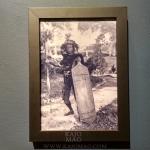
A kajer lake’ would not be complete without a parang (a type of machete) and a shield.

A night at Fort Keppel

During their visit in Bintulu, Charles and Margaret along with their entourage stayed at Fort Keppel (which was bombed into inexistence in World War II).

There, they were visited by the natives who came from the far interior, including a group of Kayans.

The locals performed dances for the couple, entertaining them through the night.

Among the performers was a Kayan man, whom the Ranee described as a ‘small, rather plump individual’ who was ushered in, brandishing his parang.

According to the Ranee, at first he crouched down like an animated frog. Then he started to dance, jumping and spinning around on one leg while screaming his war-cry.

The Kayan man moved in agility, rapidly swinging his parang. Margaret wrote, “Once or twice he came so near to where we were sitting that I fancied the blade caused a draught over my head.”

Suddenly, three of his fellow Kayans sprang up and took him away, leaving his audience in puzzlement.

The Kayan man who danced too excitedly

Curious, the Rajah asked why the man had been taken away. Apparently, the Kayan man was a famous dancer from a longhouse outside the Rajah’s jurisdiction.

Back in his hometown, he once danced with so much excitement that he had actually swept the head off one of his audience members.

The three Kayan men who took him away halfway through his performance were there when the gruesome scene happened, so when they noticed the man was about to get carried away with his dance, they intervened quickly before anything irreversible happened.

Nonetheless, the evening ended very pleasantly according to the Ranee. “I thought a good deal about the little dancing man, and came to the conclusion that he must have been an artist in his way!”

Five Sarawak legends about people turning into stones

Petrification is found in many folklore and myths around the world. People are turned into stone for many reasons in these legends, but mostly as a punishment for their sins.

Here in Sarawak, there are five legends about people who were cursed and turned into stones:

1.Fairy Cave, Bau
Five Sarawak legends about people turning into stones
Fairy Cave, Bau.

The legend of Fairy Cave, Bau is quite popular among the locals. It tells of a poor boy who lived alone with his mother and is treated to a cruel trick by one of the villagers during one of their huge Gawai celebrations.

Infuriated, the mother plots her revenge against the whole village. Dressing a cat in a beautiful attire, she throws it into the middle of their Gawai celebration. The villagers laugh hysterically, bringing on a storm. The sky roars with thunder and blazes with lightning.

When the storm stops, it is discovered that all the villagers have turned into stone. These villagers are what make up the stalagmites and stalactites inside Fairy Cave.

2.The seven Seping longhouses that turned into stone
Five Sarawak legends about people turning into stones
Belaga town.

Legend has it that the Seping people slaughtered a dragon and ate it. As a result, their seven longhouses were turned into stone or swept away by flood.

Everybody was killed except for two siblings; a brother and a sister. They fled to Penyuan river, a tributary of the Belaga river.

The siblings grew up and (here it gets Game of Thrones-ish) eventually, they both marry each other and start a new Seping community.

The Seping people are believed to be the first tribe that settled around the Belaga river.

3.The legend of Ikan Pasit
Five Sarawak legends about people turning into stones
The cursed village of Marup was believed to be located not far from Lubok Antu.

This legend was found in My Life in Sarawak by Margaret Brooke, the first Ranee of Sarawak.

A long time ago, there was a village called Marup. One day there was a girl who went fishing and caught what the locals called ‘ikan pasit’. As she was preparing the fish, one of them jumped up and touched her breast.

“What are you doing? Do you imagine that you are my husband?” she said, laughing at her own joke.

The people who were there also laughed and those who heard the commotion came over and also laughed. Suddenly, the sky turned grey and a mighty wind blew accompanied by flashes of lightning.

Then a hail-storm began. Hail stones fell down non-stop and hitting everybody even their houses, turning them into stone.

Meanwhile, the girl who made fun of the ikan pasit was only partly petrified. Her head and neck were unchanged while the remaining part of her body was turned into stone.

Together with the rest of her village, the whole longhouse and its residents fell into the river. Sadly for the girl, she lived many years with a living head and stone as her body.

Many wanted to end her misery by striking her with a blade but nothing worked. Until one day, a man who heard her cries came. Like many who came before him, he tried to strike her head with an axe and a sword but neither worked.

Eventually he struck her with a spindle and her cries finally stopped while her head and neck slowly turned into stone. According to the Ranee, the group of rocks believed to be Marup village were not far from Lubok Antu.

4.The Sarawak version of Si Tanggang
Five Sarawak legends about people turning into stones
A bridge over Batang Lupar river.

Si Tanggang is a famous Southeast Asian folktale about an ungrateful son. It is about a poor boy who became a rich sailor and married a princess. Upon his return home, he was so ashamed of his poor origins and refused to recognise his elderly mother. So the mother cursed him, turning him and his ship into stone.

Margaret Brooke also recorded the Sarawak version of Si Tanggang in her book My Life in Sarawak.

The beginning of the legend is similar to Si Tanggang except it happened not far from the mouth of the Batang Lupar river. However, in this version the son came home unmarried and ashamed with his parents. He constantly berated his parents after his return.

“One day, after insulting them more than usual, a great storm arose, and father, mother, and son, together with the whole inhabitants of the village and their houses were tossed into the sea and turned into stone.”

5.The floating temple of Sebauh
Five Sarawak legends about people turning into stones
The Chinese temple of Sebauh.

If you have been to Sebauh town, then you have seen a Chinese temple right smack in the middle of Sebauh river.

There are different legends on how the island where the temple sits came about. Apparently, there was a group of sailors who anchored at Sebauh. The cook onboard made them linut or sago porridge known for its sticky texture.

The sailors played with the linut and teased each other. As you can expect from the other stories in this list, the sky suddenly turned dark and a storm thundered overhead.

Hail stones started to drop from the sky, turning everything the hail stones hit into rocks.

Hence, that was how the island of the floating temple in Sebauh was formed.

So the lesson here is that in Sarawak, you shouldn’t laugh at animals, eat a dragon or play with your food if you do not wish to be turned into stone.

Do you know about any other folktales about people being turned into stone in Sarawak? Let us know in the comment box!