Browse Category

Culture - Page 28

First plane sightings over Sarawak; where planes were (nearly) as rare as unicorns

Sarawak’s first experiences with aviation can be dated back as early as 1922 when a Dutch flying boat was spotted flying over Belaga, about 20 years after the Wright brothers made their successful flights at Kitty Hawk, North Carolina.

Fast forward to 1924, another plane flew over the skies of Sarawak, and this time over Kuching.

Here comes an interesting fact about those particular planes; their flight paths were not planned.

The first plane to be spotted in Sarawak’s skies

The first flight to fly into Sarawak airspace was a Dutch flying boat from Dutch Borneo (current day Kalimantan) which strayed over into Belaga.

The event was first reported on The Sarawak Gazette in Sept 2, 1922 issue. However, the gazette at that time was not able to verify the incident.

“On the authority of a native officer we are informed that an aeroplane or some other flying vessel, came over Belaga fort about 8.30pm on the 14th August.

“We are told that she turned a search-light on to the fort and was flying quite low; the noise of her engines could be distinctly heard and our informant is quite certain about the matter.

“If this story is true we imagine that this is the first time any flying vessel has come over Sarawak.”

The gazette then confirmed the incident of the strayed flight and its identity in its October issue that year.

According to the report, the then third division resident verified the event stating, “Java Post confirms flying boat visited Borneo going north near Pemangkat then east inland to Kapuas 500 kilometres plainly seen close Belaga Fort fired Verey light over Belaga 8pm returning east.”

(A Verey, now spelled as Very, is a flare gun used to create illumination for improved vision or as a distress signal.)

Furthermore, the aviation company which owned the plane is now the oldest airline in the world still operating under its original name.

The plane which was a flying boat, was actually on a test flight for a feeder service in connection with the proposed Koninklijke Luchtvaart Maatschappij (today more familiarly known simply as KLM) London-Singapore route.

Response to the first plane

The Sarawak Gazette report writer then commented on how surprised the locals could be looking at an airplane for the first time in their lives.

“People at home are so used to seeing airships and aeroplanes flying overhead that Europeans in this country may find it difficult at first to realise what a novelty it must be for natives.

“Not long ago the people of Kuching were given an opportunity of seeing submarines, vessels that go under the water, and now the Belaga natives have seen a vessel which flies over land and water.

“It is true that many of the more intelligent natives have read of flying vessels, and probably some have seen them depicted on the films, but to those who were at all sceptical, and we believe there were many so, it is now proved without a doubt that the urang puteh can build ships that fly through the air.”

The spirit of the old rajah?

Meanwhile in October 1924, it was Kuching residents’ turn to see an airplane for the first time.

HMS Pegasus was an aircraft carrier/seaplane carrier bought by the Royal Navy in 1917 during the First World War.

During the last year of the war, Pegasus was stationed in the North Sea but saw no combat.

Then most of 1919 and 1920, she spent her days as a carrier supporting British intervention in North Russia and the Black Sea.

From 1924-1925, Pegasus was stationed briefly in Singapore. When she was on her way from Singapore to Miri, Pegasus sent one of her seaplanes to fly over Kuching.

It landed along the stretch of Sarawak river in front of Main Bazaar. However, the reason for its landing was not reported.

The interesting part was its arrival coincided with the unveiling ceremony of the Rajah Charles Brooke Memorial in front of the old courthouse.

According to Vincent Foo and Chai Foh Chin in Story of the Sarawak Steamship Company, some members of the large crowd even thought it was the spirit of the old rajah returning.

While other countries had planned flights to mark their firsts in aviation history, the first two planes to ever fly over Sarawak were accidental.

First plane sightings over Sarawak; where planes were (nearly) as rare as unicorns
The first aeroplane to have landed in Sarawak. Credits: Ho Ah Chon [Public domain], via Wikimedia Commons

What you need to know about the Battle of Long Jawai

The Battle of Long Jawai was one of the earliest battles in the history of the Indonesia-Malaysia confrontation (1963-1966).

The confrontation was an undeclared war which started from Indonesia’s opposition to the creation of Malaysia.

Indonesia’s then President Sukarno opposed the new nation arguing it was a British puppet state and a new-colonial experiment.

Additionally, they claimed if there was any expansion of Malaysia, it would increase British control over the region while possibly implicating Indonesia’s national security.

Meanwhile, the Philippines opposed the federation as they made a claim on eastern North Borneo for its historical links with the Sulu archipelago.

Initially, the Malayan government had set Aug 31, 1963 as the date on which Malaysia would come into existence.

This was to coincide with Malaya’s independence day celebration.

However, due to fierce opposition from the Indonesian and Philippine governments, the date was postponed.

Both countries later agreed they would accept the formation of Malaysia if a majority in North Borneo and Sarawak voted for it in a referendum organised by the United Nations.

But amidst these peace talks and the referendum, Indonesia had already started their infiltration into Sarawak through Kalimantan.

On Aug 15, 1963, there was an incursion into the Third Division (what is Sibu Division today). Then Gurkha soldiers were deployed to the border there to patrol and ambush incursions.

After a month of operations, 15 of the enemy forces had been killed and three were captured.

This was not the last of the incursion by the Indonesian army.

The Battle of Long Jawai

Less than two weeks after the Malaysian federation was declared on Sept 16, another incursion happened in a small outpost in Long Jawai of Third Division, about 30 miles from the Sarawak border.

Long Jawai back then was a small settlement with a population of 500 and the outpost was also used by the Japanese troops during World War II.

On the morning of Sept 28, about 150 (some records state 200) Indonesian soldiers attacked the outpost.

The outpost was garrisoned by six Gurkha soldiers led by Corporal Tejbahadur Gurung, three policemen and 21 Sarawak border scouts.

In Britain’s Brigade of Gurkhas by E.D. Smith, the men at the outpost were reported still sleeping when they were first attacked.

“At about half-past five the Gurkha rifleman on sentry duty heard movement near his post. Every man stood to. Shortly afterwards, three or four shots were fired nearby,” Smith wrote.

Another account pointed out that a border scout left his position to visit his sick wife in the village.

There in the village, he spotted some Indonesian soldiers and raced back to warn his comrades.

Regardless, Corporal Gurung quickly alerted the radio operators in their signal hut to establish communication with their headquarters.

Soon enough, the Indonesians launched their attacks.

They blasted the outpost with mortar bombs, machine guns and heavy small-arms fire.

Meanwhile, a small party of the enemy charged into the signal hut where the radio operators were still trying to contact their headquarters.

Unaware that their enemies were approaching since they were wearing earphones, the operators were killed before any communication was established.

The retreat to Belaga

In the meantime, the two sides of the battle continued to exchange fire until the fighting lasted for a few hours.

By 8am, only three men were left and able to continue to fight while the rest were wounded. This was when Corporal Gurung decided to call a retreat.

Unfortunately for the local scouts, all but one were captured by the Indonesian armies. Ten (some accounts stated eight) of the scouts were later executed.

The only scout who managed to escape went along with Corporal Gurung and the remaining Gurkha soldiers searching for safety.

Smith described their journey in his book, “Without food or medical supplies the small party spent the night in pouring rain, keeping the wounded men as warm as they could. Then, having made them as comfortable as possible, the corporal and his companions left for the nearest village, many miles away. Living off roots, they had a long and hazardous journey as it was four days before they reached the outpost of Belaga, weak and exhausted but with weapons spotlessly clean and able to give first-hand account of the battle.”

The aftermath of Battle of Long Jawai

At this time the Malaysian federation had come into existence. So by attacking Long Jawai, Indonesia had broken off its diplomatic relations with Malaysia.

In response, other Gurkha units were deployed into the air using helicopters. They began attacking any stragglers and small units broken off from the main force.

Eventually, they also found the tortured bodies of the local scouts.

On Oct 1, the Gurkha units caught two longboats carrying the Indonesian armies in an ambush eventually killing 26 of them.

The Indonesian survivors of this attack were later then killed in another ambush on Oct 10.

Overall, the Battle of Long Jawai had cost the lives of many from both sides. Thirty three Indonesians were killed while 13 British and Malaysian soldiers died during the battle.

What you need to know about the Battle of Long Jawai
While operating in Borneo during the Indonesian Confrontation, a soldier is winched up to a Westland Wessex HAS3 of 845 Naval Air Squadron, during operations in the jungle. A soldier is kneeling on the edge of the extraction zone. Credit: Public Domain.
Long Jawai or Long Jawe or Long Jawi or Long Jawe’?

If you can’t find Long Jawai in a Sarawak map, that is because it is spelt differently in different records.

Most non-Malaysian books and records spelt it as Long Jawai. Other records spell it as Long Jawe, Long Jawi or Long Jawe’.

All of these names refer to a large but isolated Kenyah longhouse far up the Balui tributary of the Rejang.

After the confrontation, former Sarawak Information Services Director Alastair Morrison visited Long Jawai with Temenggong Jugah Barieng when the latter was holding the post of Minister for Sarawak Affairs.

According to Morrison, the visit was to make relief payments to the relatives of those killed during the Battle of Long Jawai.

He wrote in his book Fair Land Sarawak, “The people of Long Jawi had only moved into Sarawak during the war and they had been much upset by the attack made on them. Their assailants had suffered severely because troops had been flown in behind them and they were ambushed on their return journey, but this did not save the border scouts who had been captured. They were taken a little way upriver and there slaughtered- apparently a return to an old and blood thirsty ritual.”

The residents of Long Jawai were very welcoming of Morrison and Jugah during their visit.

Morrison described his experience, “My special recollections of Long Jawi were Jugah addressing the people of the longhouse later, when we were entertained in the traditional manner, dancing the ngajat of seeing the wall behind him festooned with pictures of the British Royal Family. And, of course, the young 6th Gurkhas then garrisoning the area. Several off-duty soldiers attended the presentation and subsequent party. They were called on to dance and replied that as good soldiers they could not possibly do anything like that. They gave demonstration of arms drill instead. But as the evening wore on it became apparent that not only had they been dancing in Long Jawi, but that they had been teaching the Kenyah girls Nepalese dances too.”

A historical site wiped out in the name of development

Although Long Jawai played an important historical site for Sarawak and Commonwealth countries overall, there is no remnant of it today.

This is because the area became submerged underwater when the Bakun dam impoundment began in 2010.

What you need to know about the Battle of Long Jawai
Bakun reservoir

An amusing story of papayas during WWII in Kuching

During World War II (WWII), Batu Lintang camp housed both Allied prisoners of war (POWs) and civilian internees.

The living conditions within the compounds were cramped. The occupants were separated into different compounds and groups, namely British officers and non-commissioned officers (NCOs), Australian officers and NCOs, Dutch officers and NCOs, British other ranks, British Indian Army, Indonesian soldiers, Roman Catholic priests and religious men, male civilian internees and female civilian internees.

There were altogether 110 priests and religious Catholics, including 44 Capuchin friars, five Mountfort missionaries, 22 Brothers of Huijbergen and 38 Mill Hill missionaries.

These priests and religious men who were mostly Dutch and Irish, had a large plot of land to grow vegetables and fruits in their compound.

Meanwhile, other compounds such as those that belonged to the Australian, Dutch and British officers had not enough land for cultivation.

Besides vegetables and fruits, the priests happened to be successful in growing papayas.

According to The Sarawak Gazette report (Apr 1, 1947), it was not a surprise to see a Japanese soldier came to their compound asking for papayas.

He said that his chief needed three papayas immediately and they must be large and fully ripe.

The priests then obeyed, giving the soldier the papayas that he demanded.

Lieutenant-Colonel Tatsuji Suga and ‘his papayas’
An amusing story of papayas during WWII in Kuching

Then Lieutenant-Colonel Tatsuji Suga came into the picture. He was the commander of all Prisoner-of-War (POW) and civilian internment camps in Borneo .

Suga was believed to be a Christian. There were accounts of him attending church services at the internment camps during the war.

Within an hour after the three priests reluctantly surrendered their papayas to the Japanese, a messenger arrived from the camp commandment office.

He said that the Lieutenant-Colonel would like to see the three priests, whom he learned were all over 70 years of age.

So the priests quickly wore their best robes and proceeded to the office where they met with Suga.

Suga told the priests that while he treated all his prisoners sympathetically, he was particularly considerate of the aged.

“That being so he trusts his visitors will accept as a token of his respect and appreciation, a small gift.”

And guess what? He handed to each priest, one very succulent papaya.

Tom Harrisson’s own account of The Airmen and the Headhunters incident

The Airmen and the Headhunters: A True Story of Lost Soldiers, Heroic Tribesmen and the Unlikeliest Rescue of World War II is a book written by Judith M. Heimann.

It tells the story of how a group of American airmen was rescued by the locals during the Japanese occupation of Borneo.

The event was also made into an episode of the PBS television series “Secrets of the Dead”.

One of the key players of the rescue was Major Tom Harrisson, a British polymath who later served as Sarawak museum curator after WWII.

During the war, he was attached to Z Special Unit, as part of the Service Reconnaissance Department (SRD).

On March 25, 1945, Harrisson parachuted with seven Z Force operatives into the Kelabit Highlands.

That was when he and his unit became credited for helping the stranded American airmen.

Tom Harrisson’s own account of The Airmen and the Headhunters incident
Airmen and the Headhunters was featured in PBS’s Secret of the Dead. Credits: Youtube
The Airmen and the Headhunters, according to Australian-British Reward Mission

After the war, Major R. K. Dyce who represented the British government in the Australian-British Reward Mission wrote an article “Heroism in the Limbang” for The Sarawak Gazette (June 2, 1947).

“About the end of January or in early February 1945, a US Liberator made a crash belly landing about a mile from Kampung Telahak on the Sungai Limbang in Sarawak. Nine of the crew survived the crash. One was dead.”

From there, the story continues on how these nine American airmen were harboured and escorted by different groups of different races in Sarawak, British North Borneo (now Sabah) and Dutch Borneo (now Kalimantan).

The first group of locals who rescued them was the residents of Kampung Telahak led by their village head (ketua kampung) Mohamed Dolamit.

“The kampung people led the Americans out of the sodden paddy field on which they had landed into the village; washed them, fed them, helped them bury their dead comrade, equipped them with parangs, and planned their escape.”

Tom Harrisson’s own account of The Airmen and the Headhunters incident
Today’s Limbang river.
The escape plan for the nine Americans

Then, Mohamed started to draft an escape plan for the nine Americans. His plan was to guide the Americans by paths which avoided Japanese-occupied localities to a wise and influential old Penghulu Masing to the southeast on the Pandaruan river.

“The practice is, in an operation of this kind, to hand on the “passengers” from longhouse to longhouse and kampung to kampung,” Major Dyce reported.

After being handed over from one community to another community, the nine airmen finally arrived in Ulu Matang, somewhere near Long Pa’ Sia, Sabah.

This was where they separated with the first party proceeded to Dutch Borneo where they met up with Harrisson’s SRD party. Meanwhile, the other four who headed north were killed by the locals.

Dyce reported in 1947, “The story of the episode and its aftermath is still alive in the kampungs and longhouses, but most of the helpers concerned looked for no material reward.”

Local administrations knew how much these heroic natives had helped the Americans.

However, Dyce explained that the shortage of staff and overwork by the then local administration back then delayed in giving them proper recognition.

Tom Harrisson’s article on The Airmen and the Headhunters incident

According to Harrisson, Major Dyce’s Heroism in Limbang did not quite “give a complete picture of the amazing Borneo careers of those American airmen and of other who were cared for and protected with the same extraordinary loyalty and self-sacrifice by the peoples of the Limbang, Trusan, Padas and Mentarang rivers.”

Harrisson clarified the exact date when the plane was shot down, stating that it was on Jan 12, 1945.

The crashed crew proceeded from Limbang to Padas where they split up just as Dyce reported. The pilot Lieutenant-Commander Smith heard that there were American guerrillas in Kudat, the northern side of Sabah.

He decided to head there and three of the crew agreed to follow him.

Unfortunately, the moment they reached Tomani near Tenom, the group was betrayed by the locals.

A Japanese unit which came from Beaufort via Tenom surprised them in a village at night.

One of them was speared by the locals while another one was shot by a British North Borneo constable officer.

Their bodies were decapitated and distributed among the locals. Meanwhile, Smith surrendered and the fourth man escaped into the jungle. They spent a week hunting him down, but in the end, he too was captured and taken to Beaufort together with Smith.

According to Harrisson, his unit was about to make a rescue mission and kidnap General Masao Baba when the war ended.

At the same time, the Japanese quietly executed the two American soldiers as they were dangerous witnesses.

What happened to the other five crew member?
Tom Harrisson’s own account of The Airmen and the Headhunters incident
A view of Padas river today.

The other five men, “not Kudat-Krazy” men as Harrisson described in his article, went up the Padas river.

From there, they then came over into Kemaloh river in Dutch Borneo. Here, they were looked after by the Pa Putuk people of the Krayan Highlands.

Harrisson stated, “They were also fortunate in meeting a remarkably fine native missionary, William Mohgan of Makassar who could speak some English (and a little American). The Japs, of course, knew these men were somewhere in the interior, but as in the Limbang the people did not betray them, often at grave risk or cost to themselves.”

Nevertheless, they were forced to hide in jungle shelters and suffered great impoverishment through lack of medical supplies, mosquito nets and footwear.

By that time, the five had reunited with six other Americans who were survivors from an American 13th Army Liberator shot down on the Dutch side.

The former museum curator pointed out, “One of this crew wandered alone through the jungle for fourteen days before reaching a lonely mountain village, where he was nursed back to life and became, in a few weeks, quite fluent at Potok (a Lundayeh dialect)- the others never even got beyond the bagus stage of Malay.”

Tom Harrisson’s own account of The Airmen and the Headhunters incident
Today’s Krayan HIghlands from on top of Yuvai Semaring hill.
Harrisson and his unit to the rescue

Harrisson added that he first heard of these airmen in March 1945, who were then about ten days’ walk eastward from Bario.

“Our only medical man at that time, Sergeant F. Sanderson, made a forced march to them, carrying all the stores we could possibly spare and all our comforts (at that time all supplies had to be dropped from Moratai, thirteen hours flying; so the lifeline was slender, with three out of six planes lost in the first weeks).”

Finally, the American airmen had the help they needed from the British soldiers. Harrisson continued: “When they were fit to walk by easy stages over the mountains -harder going in Dutch Borneo than in Sarawak – we brought them into better country, where we prepared an airfield. Some RAAF pilots came in without maps or radio signals to pick the Americans out.”

Harrisson stressed that the behaviour of the native people (except those who betrayed them in Tomani) is a lasting symbol of native morale in these lands.

“And I hope that if it comes to a question of rewards (of which the helpers had no thought at the time) the British North Borneo and Dutch helpers will not be forgotten. For it is sad to admit, but true, that from that day to this no one of any race has had a word of thank you (let alone a tin of peanuts) from those boys to whom they gave back life, liberty and Nashville, Tennessee.”

Sadly, KajoMag’s own digging so far has found no official recognition of the locals’ efforts and contributions (particularly in Pa Putuk and Kampung Telahak) to helping the American airmen evade capture.

How did the rumours of Kayans practising cannibalism spread?

One of the biggest misconceptions of Borneo in the 19th century was that it was a place where cannibalism was common practice.

Plenty of tribes in Borneo were depicted as cannibals in European writing, including the Kayans in Sarawak and Dutch Borneo (Kalimantan).

One account of alleged cannibalism practised among the Kayans was recorded by Sir Henry Keppel.

He received his information from three men named Kusu, Gajah and Rinong from Kapuas.

“I examined them myself, and entertain no doubt of the correctness of these statements, as far as their personal knowledge is concerned. The witnesses themselves stated over and over again, with the utmost clearness, how much they had seen, and how much heard. There was such perfect good faith and simplicity in their stories as to carry conviction of their truth,” Keppel wrote.

How did the rumours of Kayans practising cannibalism spread?
Was cannibalism really being practised in Borneo?
So here is the full testimony of the three men on how they encountered the “cannibalistic Kayans”:

We are of the tribe of Sibaru; which is likewise the name of a branch of the Kapuas river. The tribe of Sibaru contains 2,000 fighting men and is under the government of Pangeran Kuning, who resides at Santang, a Malay town on the Kapuas. We have none of us who resides at Santang, a Malay town on the Kapuas, where the Kayans live, but they often come down to Santang where we meet them. The Kayans are quite independent, very numerous and powerful: they are governed by their own Rajahs, whom they call Takuan. Some of these Kayan tribes are cannibals (makan manusia); it is generally reported, and we know it to be true.

Pangeran Kuning of Santang was at war a few years ago with Pangeran Mahomed of Sewite, a Malay town situated on the Kapuas between Santang and Salimbaw. A large force was collected to attack Suwite. There were Malays (laut) of Santang and Sakadow, and the Dyaks of Sibaru, Samaruang, Dassar and of other tribes; and besides all these, was a party of about fifty Kayans.

We never heard the particular name of this Kayan tribe, for we did not mix with them, not did we understand their language. Suwite was not taken, but a few detached houses were captured, and one man of the enemy was killed in the assault.

Kusu saw these Kayans run small spits of iron, from eight inches to a foot long, into the fleshy parts of the dead men’s legs and arms, from the elbow to the shoulder, and from above the ankle beneath the calf to the knee-joint: and they sliced off the flesh with their swords, and put it into baskets.

They carry these spits, as we all saw, in a case under the scabbard of their swords. They prize heads in the same way as the Dyaks. They took all the fresh off the body, leaving only the big bones, and carried it to their boats, and we all saw them broil and afterward eat it. They ate it with great relish, and it smelt, while cooking, like hog’s flesh. It was not we alone that saw them eat this, but the whole force (bala) saw it.

Men say that many of these interior tribes of Kayans eat human flesh- that of their enemies; most, however, do not, and all of them are represented to be good people and very hospitable; and we never heard that they ate other than the flesh of their enemies. It made us sick to see them, and we were afraid, horrified.

Spencer St John’s records of Kayans practising cannibalism

Just like Keppel, St John did not witness any Kayans practising cannibalism during his time in Sarawak.

However, according to St John, a Malay nobleman named Usup told him that he actually witnessed it.

In 1855, men from Mukah had been executed in Bintulu. A few of the Kayans who helped in their capture took portions of the bodies of the criminals, roasted and ate them.

St John wrote, “This was witnessed by himself and many others who were then present. The Kayans had not, as a body, joined in this disgusting feast; but, perhaps some of the more ferocious may practice it to strike terror into their enemies.”

How did the rumours of Kayans practising cannibalism spread?
Records that the Kayans did not practice cannibalism

Not everybody believed that Kayans practised cannibalism.

Sir Hugh Low wrote that the Kayans were hastily stigmatised as cannibals and added: “nor does any race practicing the horrid custom of feeding on the bodies of their own species, exist on the island.”

The Kayans might not have been the second Rajah of Sarawak Charles Brooke’s favourite tribe, but he never believed that they were capable of cannibalism.

How did the rumours of Kayans practising cannibalism spread?
Here is what he wrote about the Kayans and cannibalism in Borneo:

“This tribe are cowardly, untruthful, and treacherous, and are capable of committing many horrors, but the gravest attached to the Kayans, I feel confident, is without foundation, namely, that of cannibalism. For, during the expedition of 1863, there was no sign of it, and I had abundant opportunities of making strict enquiry in the very heart of the country.

“Many reports of this description are spread by the enemies of a people to degrade them in the estimation of Europeans. Such reports are purely fabulous, and I do not believe any tribes are cannibals in this part of Borneo, although stories go far to lead one to a contrary belief.”

However, a group of Malays told the Rajah that they did see pieces of human flesh in bamboo during a visit to Kapuas region and that they were used as provision.

“I regret that I am unable positively, to contradict such statements; but it is my firm conviction cannibalism is not practiced on any part of the island of Borneo,” Brooke wrote.

Do bear in mind that all written reports of alleged cannibalism among Kayans were written by the Europeans after listening to secondary sources. Thus, some information might have gotten lost in translation. None of these 19th century writers had actually seen any Kayans eating human flesh.

Another theory was that this rumour was spread by the local guides to discourage the Europeans from travelling further inland of Borneo.

Imagine refusing to bring your client to a place by telling them it is full of cannibals.

Preparing for war expeditions in Sarawak during the 19th century

Be it a punitive excursion or a tribal feud, war expeditions way back in the 19th century Sarawak took a lot of time and resources to prepare.

Taking the infamous cholera expedition in 1902, the second White Rajah Charles Brooke brought 10,000 men to fight against the alleged rebels up Batang Lupar.

Imagine 10,000 men moving up one river and setting up camps at one large landing site.

And can you imagine the impact of these war expeditions on the environment and natural resources back then?

At the same time, preparing to feed up to thousands of men during these expeditions must have been a lot of work.

Preparing for war expeditions in Sarawak during the 19th century
Panau, one of the Iban warriors who joined Charles Brooke on his punitive expedition to Batang Lupar.
Here at KajoMag, we look at different accounts on how war expeditions were prepared in Sarawak during the 19th century.
1.Charles Brooke in Ten Years in Sarawak (1866)

It is customary to announce a coming war expedition for such and such a season at one of the great feasts, when the village is thronged with guests from the country far and near, and when there is sure to be an unusual gathering of powerful chiefs.

The speaker, who must be a great chief, gives his reason, that his people wish to put off mourning, or that his people have been slain and he must have some revenge, and he ends by inviting all present to accompany him on an incursion upon an ancient enemy.

If he be a chief of any real influence he is sure to secure an ample following, in reality more than enough for his purposes, but his ambition expands as his numbers increase and his warpath assumes grander proportions.

The women lend their assistance to induce their husbands and lovers to join this warpath.

The details are then discussed, the amount of bekals (supply) necessary, the route, the character and number of enemy, etc.

Choosing the date

The period usually selected for any expeditions on a large scale is that immediately after the seed planting or after the harvest; the former time better, and have three months clear before they are required to gather in the harvest. In the latter case they would probably have no farms at all for that year, as they would have no dry the clearings, which, therefore, would not burn well.

The Dyaks are never in a hurry in setting off. They cook and feed at leisure, and commence walking about half-past seven, and the morning meal keeps them going until late in the afternoon; they certainly get over more ground by following this plan.

2.Brooke Low in Catalogue of the Brooke-Low Collection in Borneo

Occasionally, however, the delay is so great that the force becomes for the purpose for which it was called together.

The women are everywhere busy preparing the bekals, and the produce of the gardens are taken to the nearest market to exchange for tobacco, gambir etc. The men on their part have been busy in getting the war boats ready, launching them into the river, lashing on the planks and fitting them up with palm leaf awnings and bamboo floorings.

Those who are able to purchase the material, plane the bottom of their canoes to make them smooth and tar them to preserve them, make figure heads for the bows, and paint the side planks in various patterns. They take nets with them to fish by the way, and dogs to hunt with if the distance is so great that they are likely to run short of food, but their chief support on an expedition of this kind is what they find on the banks and in the forest-especially the wild sago. The men are very busy furbishing up their arms and sharpening their weapons and decorating their helmets and war jackets.

The chief is always the first to leave the village, and as the first and chief part of the journey is by the water, he pulls away in a his canoe, and at some convenient distance from the village, he bivouacs for the night to beburong- to consult the omen birds. If the omens by birds are favourable, he proceeds to the tryst and there awaits the force as it dribbles in one by one or few by few.

Preparing for war expeditions in Sarawak during the 19th century
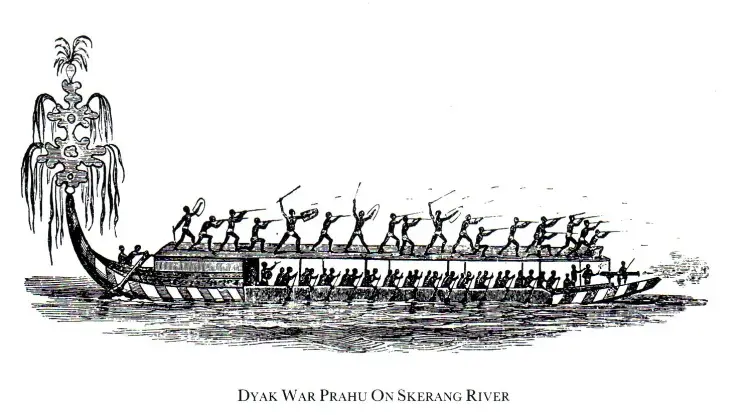
An Illustration of Iban war boat published in The Natives of Sarawak and British North Borneo (1896). Credits: Creative Common.
3.Spenser St. John in Life in the Forest Far East (1862)

They start with, perhaps, two days’ provisions, and trust to hunting for food. If they find a spot where game is plentiful, they stay there till it is exhausted; if the jungle produce no sport, they live on the cabbages taken from the palms, on the edible fern, on snakes, or anything, in fact that they can find.

If they come across bees’ nests, they stop to secure the wax and honey. If they come across bees’ nest, they stop to secure the wax and honey. Time is no value to them, as they generally start after the harvest, and many parties are said to have taken six months.

Preparing for war expeditions in Sarawak during the 19th century
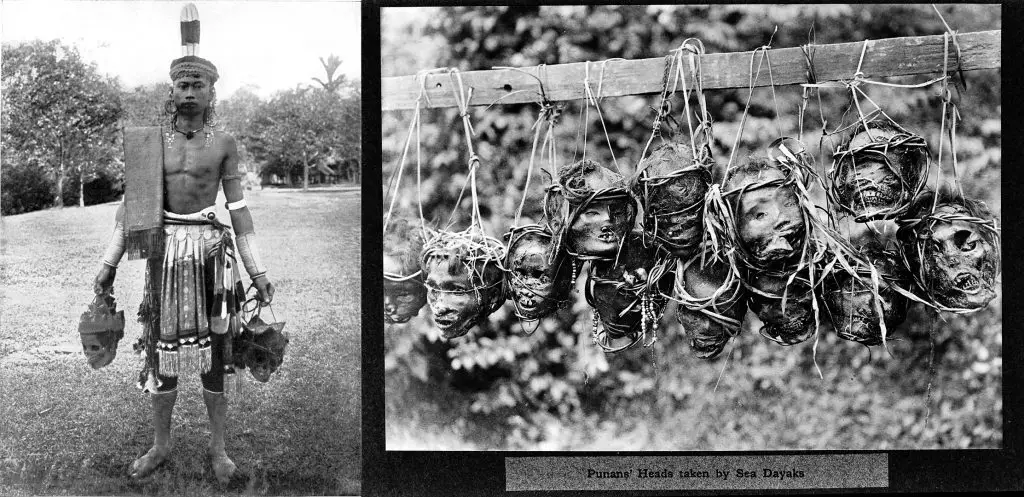
M0005506 Punan’s heads taken by Sea Dayaks Credit: Wellcome Library, London. Wellcome Images images@wellcome.ac.uk http://wellcomeimages.org Punan’s heads taken by Sea Dayaks Pagan Tribes of British North Borneo Hose & MacDougall Published: – Copyrighted work available under Creative Commons Attribution only licence CC BY 4.0 http://creativecommons.org/licenses/by/4.0/
So what happened to the women when men left for war expeditions?

After helping the men to prepare for their war expeditions, the women then were left defenseless at their villages.

So what did they do? According to Henry Ling Roth in The Natives of Sarawak and British North Borneo, the women would continue their daily activities like usual. “As long the men are away their fires are lighted on the stones or small just as if they were at home.”

Additionally, the women carried out a couple of tasks symbolically to protect their men from afar. They spread mats and kept the fires up till late in the evening and lighted again before dawn. This was to ensure men during the war expeditions would not get cold.

He added, “The roofing of the house is opened before dawn, so that the men may not lie too long and fall into the enemies’ hands.”

Whether this symbolic gestures actually work for their men, we will never know. However, it is interesting to know how the women contributed without physically being there during war expeditions.

Preparing for war expeditions in Sarawak during the 19th century
Every year or two the Iban Dayaks hold a feast called Gawai Antu in honour of the departed spirits which they believe surround the heads which hang in their houses. In this manner they hope to keep in favour with the spirits and so have good fortune. Photo by Charles Hose. Credits: Creative Commons.

Surprising facts about a Bleeding Corpse: Science and Cultural Beliefs Explained

Do you know what happens to your body after your heart stops beating — and why a bleeding corpse can appear in certain stages of decomposition?

Within seconds of death, the oxygen in your body is depleted. Soon after, blood settles in the lowest parts of the body (livor mortis), followed by the stiffening of muscles known as rigor mortis.

As time passes, the body begins to cool, entering a stage known as algor mortis.

Once the heart stops pumping, blood circulation ceases entirely. Without movement, the blood begins to coagulate, forming clots and becoming thicker in texture.

However, this does not mean the body completely stops releasing fluids after death.

Under normal conditions, the bacteria in the intestines continue their activity after death, breaking down internal tissues and producing gases that expand into the body’s cavities and surrounding tissues.

These gases cause noticeable bloating, particularly around the abdomen and face. As internal pressure builds, fluids or gases may escape through natural openings such as the mouth, nose, or rectum, and swelling can sometimes make the eyes or tongue appear slightly more prominent. These are normal physical changes associated with the natural process of putrefaction.

This stage of decomposition can also cause small amounts of blood-stained fluid to seep from the nose and mouth. Although this is a scientifically recognised part of the body’s breakdown, different cultures throughout time may have interpreted a “bleeding corpse” in various symbolic or spiritual ways.

A bleeding corpse and cruentation in medieval Europe

“Cruentation” was one of the medieval methods once used to determine guilt in suspected murder cases. It was based on the belief that a victim’s body would spontaneously bleed in the presence of the murderer.

This practice appeared in various regions, including Germany, Poland, Bohemia, Scotland, and even some European colonies in North America.

When murder was suspected, the accused would be brought before the corpse and instructed to place their hands on it. If the wounds were seen to bleed, the accused was considered guilty.

Before modern forensic science, it is easy to see how people could be wrongly suspected, as decomposition was not well understood and a corpse’s natural release of blood-stained fluids could be misinterpreted as a supernatural sign of guilt.

Surprising facts about a Bleeding Corpse: Science and Cultural Beliefs Explained
A body in its coffin starts to bleed in the presence of the murderer in an illustration of the laws of Hamburg in 1497. Credits: Public Domain.
In old Chinese superstition, a bleeding corpse meant a relative recognised the dead person.

Among some Chinese communities in the past, including Sarawakian Chinese in the 1940s, there was an ancient superstition that a corpse would begin to bleed – usually from the nose – when recognised by a family member.

In November 1947, a body was found floating in the Sarawak River. According to a report in the Sarawak Gazette, the corpse was brought to the steps of Pangkalan Batu, where a European police officer “of impeccable observation and indubitable integrity” took charge of the case.

A Chinese man soon arrived, believing the deceased might be his missing brother. To confirm, he brought his sister, who immediately identified the body.

At that moment, a small amount of blood began to trickle from the corpse’s nose.

A dresser present at the scene informed the officer that, according to local superstition, this meant the deceased had been recognised by a relative.

Do you know any more superstitions behind a bleeding corpse? Share with us in the comment box.

The Sarawak Museum curator who became a cockroach specialist

Back in the early days of Sarawak Museum, many of its curators became prominent zoologists, anthropologists and archaeologists.

Being posted here in Sarawak when it was almost unknown to the Western world allowed these curators to be among the first to discover a new plant or animal or formally write about unheard of cultures.

Many of them continued to have successful careers after their service in Sarawak. Interestingly, one of them became specialised in cockroaches.

Early life of Robert Shelford

Robert Walter Campbell Shelford was appointed as the Sarawak Museum curator from July 22, 1897 to Feb 2, 1905.

A British subject, he was the son of a merchant, born in Singapore Aug 3, 1872.

Shelford studied at King’s College and Emmanuel College, Cambridge.

After finishing his degree, Shelford first worked as a Demonstrator in Biology at the Yorkshire College in 1895.

Two years later, he left Europe to come to Borneo.

Since he was born in Singapore and spent most of his childhood there, Shelford was no stranger to the tropical climate.

However, according to his friend and colleague Edward Poulton, he was diagnosed with hip-joint tuberculosis at the age of 3. Hence, his disease limited physical activities.

“Prevented by a tubercular hip joint from taking part in the games and ordinary outdoor pursuits of a boy and young man, his active mind turned to observation, and he became a naturalist.”

Poulton also pointed out that his seven-year tenure in Sarawak gave Shelford the biggest opportunity to study topical insects and anthropology.

While in Sarawak, Shelford made several expeditions to different parts of the Kingdom. He visited Mount Penrissen (May 1899), Trusan (1902) and Sadong-Tebekang (1903). Shelford also frequented Matang mountain range and Mount Santubong.

He collected many specimens of insects in Sarawak and most of them were sent to his old university at Cambridge.

Robert Shelford and the study of mimicry and anthropology

Shelford did more than just collect these insects, he also used them to study insect mimicry. Mimicry is an evolved resemblance between an organism and another object, often an organism of another species.

Poulton wrote, “He found Borneo a very rich and imperfectly explored field for the study of this subject (mimicry), and before long he entered into a regular correspondence with me, sending large consignments of insects for investigation and determination.”

Shelford even wrote a paper on insects and mimicry which was published in the Proceedings of the Zoological Society of London.

Additionally, his works in Sarawak was not limited to insects. Shelford was also interested in anthropology.

Together with Dr Charles Hose, he contributed some insights on Sarawak tattoos which later published in Hose’s book Pagan Tribes of Borneo.

Robert Shelford’s life after Sarawak

When his tenure in Sarawak was about to end, Shelford started to find jobs back in England.

His love and interest for insects remained so he was eyeing for a job in the Hope Department at Oxford.

The Hope Department was a huge collection of insects in the university founded by Frederick William Hope.

He even wrote to Poulton that if the university was unable to pay him, he was even willing to work for free.

Fortunately, Oxford was able to offer him the post as an assistant curator which he gladly accepted.

After leaving Kuching for good, Shelton made his way home to Europe via Japan, Canada and the United States.

Before that, he managed to visit many islands in the Malay Archipelago where he collected insects.

Robert Shelford in Oxford

It was during his time in Oxford that this former Sarawak Museum curator became specialised in cockroaches.

Poulton stated, “It was also a special delight to him to show the high interest and in many species the extreme beauty of the universally despised cockroaches.”

Altogether, he had described 44 new genera and 326 new species of cockroaches.

He also described five new species of Phasmida (stick insects) and published a catalogue of Central American phasmid species.

Many of the phasmid specimens in both Oxford and Cambridge universities were collected by Shelford when he was in Sarawak.

Thanks to his works in entomology, he had a long list of species named after him. These include 17 species of cockroaches, two genera of cockroaches, one mantis and one phasmid.

The Sarawak Museum curator who became a cockroach specialist
Robert W C Shelford, British Entomolgist and Naturalist. Credits: Public Domain.
Robert Shelford’s death

Shelford’s promising career in entomology was cut short too quickly. In April 1909, he accidentally slipped causing his tubercular disease to return.

The disease limited his work for the next three years. However, he did not give up as he continued to help the Hope Department whenever he could.

Shelford once write, “I am so pleased to think that I can do something at any rate, even of small, for the Hope Department.”

He spent the last few moments of his life in Margate with hope the fresh air there would restore his health.

Sadly, Shelford never regained his health and died on June 22, 1912 at the age of 39.

The Sarawak Museum curator who became a cockroach specialist
Illustrations of the stick insects Autolyca riveti Shelford, 1913 & Autolyca affinis Shelford, 1913. Credits: Public Domain.
Robert Shelford’s A Naturalist in Borneo

Before his untimely death, Shelford was working on a book based on his seven years’ experience in Sarawak.

Poulton suggested him to write it while he was battling his illness and as he was longing for a job to do.

As the pain grew stronger, Shelford was unable to finish his manuscript. Poulton stepped in to help finishing the book after his death. What he found that the manuscript was very far from ready for publication.

“Many references had been left blank or incomplete, many names of species omitted,” Poulton wrote.

In Shelford’s unfinished introduction chapter of the book, he commented about Sarawak saying, “This independent state is quietly prosperous, and, since it is very much off the track of the globe trotting tourist, it is never much in the public eye. The annual revenue now amounts to over 1,000,000 Straits dollars.”

Nonetheless, with the help of some friends and scholars, Poulton managed to have the manuscript published entitled A Naturalist in Borneo (1916).

How did the headhunting practice start in Borneo?

Headhunting is the act of taking and preserving a person’s head after killing that person.

Generally, scholars agree that headhunting practice’s primary function was for ritualistic and ceremonial purposes.

Some even theorized that the practice came from the belief that the head contained a life force which could be harnessed through its capture.

In Borneo particularly, some of the reasons for headhunting included it being a sign of manhood, as a dowry of sorts for marriage, as casualties during the capture of enemies as slaves, looting of valuable properties, tribal conflicts and territorial expansion.

But how did the olden communities first think of taking off someone’s head and preserving it afterwards?

Here are three different accounts on how the headhunting practice originated in Borneo:
How did the headhunting practice start in Borneo?
Punan’s heads taken by Sea Dayaks. Credit: Wellcome Library, London. Copyrighted work available under Creative Commons Attribution only licence CC BY 4.0 http://creativecommons.org/licenses/by/4.0/

Headhunting practice originated from the act of sacrifice

A.M. Phillips wrote a letter to The Sarawak Gazette which was published on Apr 30, 1958. There, he shared about a legend concerning the origin of headhunting practice in Borneo.

Long time ago, the Dayaks in Saribas were still living in upper Batang Ai. There was a Dayak man who had no child of his own.

One day, he decided to take a jar along with a small party to an area where current day Kalimantan, Indonesia is.

At one of the longhouses there, he found a family who was willing to give up their son for him to adopt. After some celebration, the man and his party together with his newly adopted son set to return to Batang Ai while leaving the jar to the family as a token.

On their way home, the group had some misfortunes and sickness that two of them died. The man who started the expedition had a dream one night.

In the dream, he was told to kill his adopted son and keep only his head to be taken back to the longhouse. There the head would need to be preserved to ward off anymore misfortunes.

Once he woke up, he told the rest of his group about the dream. The idea of cutting off someone’s head was unheard of at that time. Nonetheless, the group persuaded him to do what he had been told in the dream.

The man reluctantly killed his adopted son. He then returned to his longhouse with the rest of the survivors of his group in good health. Meanwhile, the head was kept and preserved and the longhouse prospered.

A tale of vengeance

Sometime after that, a visitor from the boy’s longhouse came to visit. He heard the story about how the boy was killed and his head was hung at the longhouse. The visitor returned to his longhouse and told the boy’s biological parents.

Phillips wrote, “They were extremely incensed, for they had trusted the stranger, despite the fact that he was from another group and had hoped that friendship would have resulted between them.”

In a classic tale of vengeance, the parents together with the rest of the longhouse people set out to the man’s longhouse.

They took back the boy’s skull, but not without killing their now sworn enemies. Vengeance followed vengeance, and that was how headhunting practices started in Borneo.

It was a frog who inspired the headhunting practice in Borneo

W.F. Alder’s Men of the Inner Jungle (1923) gave one interesting legend on how the headhunting practice started in Borneo.

“One time during the progress of a tribal battle one of the warriors was sorely wounded and went to a stream to wash his hurts,” Alder wrote.

While bending over the edge of the stream he heard a voice speak to him. When he turned around, there stood a frog.

“The frog warned him that he would never succeed in battle until he took the head of his enemy and hung it from the roof of his house.”

The frog added that, only then all would fear him and because of that fear, would fall easy victim to his sword.

The man laid in the cool water until nightfall. When night came and the jungle was dark, the man made his way to his enemy’s house. There, the man crept on his enemy, struck him with a club, killing him instantly.

Alder wrote, “He then silently dragged the body of his victim into the jungle and cut off the head and at daybreak placed it upon the roof pole of his own house.”

How did the headhunting practice start in Borneo?
A crocodile mound is where the Lundayeh people of Krayan Highlands celebrated after a successful headhunting trip.

The headhunting practice was started to please a woman

Guys, how far would you go to impress somebody? According to this legend from Skrang, one of the ‘chief incentives’ of collecting heads was the desire to please the women.

Harriette McDougall, wife to Bishop McDougall recorded an old legend about the daughter of the Skrang people’s great ancestor who refused to marry.

Well…not until her betrothed brought her a present worthy of her acceptance.

The legend goes, “The man went into the jungle and killed a deer, which he presented to her; but the fair lady turned away in disdain.” (Some women just can’t be pleased.)

So the man went out again, this time he returned with the body of an orangutan. Again, the woman was not happy with her gift. (What did these poor animals ever do to her?)

“Then, in a fit of despair, the lover went abroad, and killed the first man that he met, and throwing his victim’s head at the maiden’s feet, he exclaimed at the cruelty she had made him guilty of; but to his surprise, she smiled, and said, that she now had discovered the only gift worthy of herself.”

Hence, that is how headhunting practice originated – as part of a marriage proposal.

Do you know any legends on the origin of headhunting in Borneo? Let us know in the comment box.

The inspiring story of MV Nam Hoi and its crew during WWII in Igan

If you’ve never heard of Igan, it is a small district located near the Batang Igan river in the central region of Sarawak.

The population is mostly made up of Melanau people, who are famous for their umai, a kind of ceviche, and sago paste called linut.

It may be a small and unassuming town, but it is the centre of one inspiring piece of World War II (WWII) history.

The story of MV Nam Hoi and its volunteer crew

In December 1941, the Sarawak government chartered the M.V Nam Hoi to transport paddy and food rations from Sibu to Mukah.

Unfortunately, this was during the beginning of WWII. So when the vessel passed Igan, it happened during the Japanese bombing.

According to a story published on Jan 2, 1948 in The Sarawak Gazette, the crew decided to abandon ship and go ashore, refusing to continue with the voyage.

The story stated, “As the cargo was urgently needed in Mukah and it was dangerous for the vessel to remain at Igan which was on the daily route flown over by Japanese aircraft, the then District Officer, Mukah, telegraphed to the Resident asking for permission to take a volunteer crew head quarters to obtain possession of the vessel and complete the voyage.”

The resident agreed with the proposal but instructed the district officer to remain at his station.

So the district officer promptly put together a crew. They were Abang Mostapha (Captain), Haji Zahawi (First Mate), Tuto bin Tajudin (Second Mate), Albert Galli (Chief Engineer from Sarawak Electricity Supply Company), Taha bin Haji Mohamad (Second Engineer) and Jaya bin Haji Talip (Engineer).

Meanwhile the rest of the crew were ex-constable Salleh bin Abang Kut, ex-constable Bujang, Salim bin Mohamad and Beki bin Haji Talip.

Heading to Igan from Mukah

Within half an hour after being summoned, the volunteer crew set out on bicycles from Mukah to Igan.

The report pointed out, “They travelled all night which was in itself a praiseworthy effort considering the age of some of the members.”

Here comes the frustrating part of the story; when they arrived at Igan, the original crew refused to board the vessel to show the volunteers how the engine worked, out of fear of the possibility of being targetted during the Japanese bombings.

So the volunteer crew took things into their own hands. There was no other way than pushing random buttons as long as the engine started and the vessel got moving.

“Not one of the volunteers had any experience of a marine diesel but by pulling and twisting every knob she was eventually started.

“The hook was pulled up, Captain Mostapha rang down slow ahead and the Nam Hoi went full astern. Chief Engineer Galli could not remember which knob he had twiddled to get the ship moving and for two long tanjungs (capes) the Nam Hoi careered astern with the skipper playing a fanfare on the telegraph,” the report stated.

In the middle of the journey, the vessel was stopped and the engineers stepped in to check on the engines.

The chief engineer reportedly had the help of a bottle of whiskey to refresh himself while doing his job.

After awhile looking at how the ship was seemingly going in the right direction, the crew continued with their journey to Mukah.

Meanwhile, the first mate, Haji Zahawi who was also an imam, prayed loudly and unceasingly along the journey.

The inspiring story of MV Nam Hoi and its crew during WWII in Igan
Chief Engineer Galli could not remember which knob he had twiddled to get the ship moving. Credits: Pixabay.
Nam Hoi arrives in Mukah

The vessel arrived and was anchored safely in Mukah in the evening on the same day they started their journey from Igan.

Its arrival was in the nick of time because this was just about the time the Japanese planes few over Mukah.

Whether it was the whiskey or the imam’s prayers, one thing is for sure: MV Nam Hoi’s journey from Igan to Mukah would not have been possible without the courage and the willingness of its volunteer crew to carry their jobs.

Even when the original crew refused to board the vessel again simply to show them how to run it, they refused to give up.

In 1948, the then governor His Excellency Charles Arden Clarke sent a letter to every member of the volunteer crew in 1948 to show his appreciation and to acknowledge their bravery.

1 26 27 28 29 30 38