Browse Category

Culture - Page 27

What went down in Bekenu during the Brunei Revolt 1962

Bekenu is a small fishing town near Miri at the northeastern part of Sarawak. It is a humble town with many of the shophouses dating from the 1930s.

Many might not remember that this small town witnessed an important historical event during the Brunei Revolt 1962.

The Brunei Revolt was an insurrection to oppose Brunei inclusion in the Federation of Malaysia.

The insurgents were members of the North Kalimantan National Army (TNKU), a militia linked to the Brunei People’s Party (BPP) and supplied by Indonesia.

At that time, the town was briefly taken over by the rebels.

Brunei Revolt in Niah

The rebellion first broke out at 2am on Dec 8, 1962. The rebels attacked police stations throughout Brunei, the fifth division of Sarawak along the the western edge of Sabah.

Then came the news that Bekenu was in rebel hands and there was also uncertainty as to the situation in Niah.

C Company from 99th Gurkha Infantry Brigade under Major Mark Pennell was sent to deal with the situation in Niah.

During the Brunei Revolt, hundreds of Dayaks were immediately called to help fight and contain the rebels.

The Ibans decorated their longboats with bright red feathers and set off by river to Niah.

By the time that C Company arrived in Niah by river, there was no sign of rebel forces.

Reportedly, after hearing the Iban party was about to arrive, the rebels made their escape to the jungle.

What went down in Bekenu during the Brunei Revolt 1962
This photograph was taken at the height of the Brunei Revolt on December 10th 1962. It shows soldiers of the 1st Queen’s Own Highlanders unloading stores from a 34 Squadron Beverley shortly after the British had seized the airport. Credit: British Empire.
Brunei Revolt in Bekenu

Meanwhile, the mission to liberate Bekenu fell under B Company.

Under the command of Major David Mostyn, the company approached on foot, arriving in Bekenu early morning of Dec 13, 1962.

It took them 16 hours of hiking along the coast through mangrove swamp from Tanjung Batu in Bintulu to the west of Bekenu.

The moment they arrived in Bekenu, the soldiers engaged in a brief firefight with the rebels who then fled downriver. There, they were ambushed by another platoon.

During the operation, six rebels were killed, six captured and about 10 escaped into the jungle.

For the next three to four days, patrols went up and down the river searching for escaped rebels.

Overall the operation to secure Bekenu during the Brunei Revolt was considered an immediate success.

Lesson to learn from the Brunei Revolt, especially in Bekenu, according to Tom Harrisson

One of the lessons from the Brunei Revolt taught Sarawak was that greater attention should be paid to the small racial groups.

Sarawak’s then museum curator Tom Harrisson was in charge of all irregular forces in the Sibuti, Baram, Upper Limbang and Trusan headwaters to prevent rebels from escaping into the interior during the Brunei Revolt.

According to Harrisson, looking at what happened in Bekenu where the rebellion gained support from the local Kedayans, in the modern world one small group can break up the whole of pattern of a nation.

“Some people have asked me if there are any lessons Sarawak can learn from this revolt. Well, of course, there are all sort of lessons for the administration and intelligence and so on which are right above my head. But in my mild capacity as government ethnologist and curator of the Sarawak museum, there is an ethnological problem that comes of this- that is you cannot afford to ignore small racial groups,” Harrisson wrote in an article published in 1963.

He continued, “The Kedayans have played a major role in this. There are only about less than 10,000 of them in Sarawak but they have not been taken into account. There are practically no responsible Kedayans in any positions. They are not represented adequately in government and this applies equally to many other group in the north.”

He then gave an example of how large groups of Sarawak back then were given attention not only in administration but over the radio where only they had programs.

“Although the population of people like the Kedayans, the Kayans, the Kenyahs, Kelabits and Muruts are relatively small, they occupy enormous area of this country,” Harrisson wrote.

“In my view, what happened at Bekenu, among the Kedayans there, who I know quite well and who are extremely industrious farmers, is that they did get completely confused and misled. They are guilty all the same, no one is denying that, but there is a lesson that the same sort of thing can happen widely and I do not think the argument is sufficient that this group is small one, therefore we can ignore it.”

By Dec 17, some 40 rebels were dead and 3,400 were captured, putting an end to the rebellion. Though the rebellion was cut short, it is seen as one of the first stages of the Indonesia-Malaysia Confrontation.

The migration of Indonesian romusha to Malaysian Borneo during WWII

‘Romusha’ is actually a Japanese word for labourer. However during World War II (WWII), it specifically referred to forced labourers during the Japanese occupation of Indonesia.

According to the US Library of Congress, it was estimated in Java between 4 to 10 million romusha were forced to work by the Japanese military.

Indonesia during Japanese occupation

The experience in Indonesia during World War II varied depending on where one lived and one’s social status.

Those who lived in areas considered important to the war effort such as Balikpapan or Tarakan (for their oilfields) experienced torture, sex slavery, execution and war crimes.

The migration of Indonesian romusha to Malaysian Borneo during WWII
Pantai Amal, where the Japanese landed at Tarakan in North Kalimantan.

The romusha’s services were supposed to be voluntary but in reality many were recruited against their will.

Some were taken from their homes while others were even seized in the middle of a movie in theaters.

Most of them were put to work through threats and violence.

If they were lucky, they were put to work on Java island itself. The unfortunate ones were those who werw sent to work outside Java.

These locations included New Guinea, Malaya, Singapore, Thailand, Burma, British Borneo (current day Sabah and Sarawak), Indochina and Hong Kong.

Regardless of the locations, these romusha were forced to work under harsh conditions with insufficient food, shelter or medical care.

They were often treated worse than Prisoners of War (POWs) from Allied countries.

The migration of Indonesian romusha to Malaysian Borneo during WWII
Japanese invastion of Java. Credits: Creative commons.
Romusha in British Borneo

There is no exact number on how many romusha were sent to Borneo island during WWII. It is understood that they came here to work on oilfields and build facilities such as airstrips.

Richard Wallace Braithwaite in his book Fighting Monsters: An Intimate History of the Sandakan Tragedy gave one rough number.

“One estimate is that 31,700 Javanese were sent to North Borneo and another 48,700 to South Borneo. This occurred mainly in 1944. They constructed airfields in British Borneo, worked in the oilfields at Miri, and were used elsewhere in Borneo hacking tunnels and storage facilities out of rock.”

It was also reported there were about 3,000 Javanese romusha working in Sandakan airstrip alone during WWII.

Braithwaite further noted,

“Many romusha died in the transport ships before they reached their destination. While the Japanese kept good records, most records were destroyed after capitulation. The mortality rate for those who were sent outside was 74.3 per cent. However, only 5,000 survived of those who went to British Borneo, a much higher mortality rate of 85 per cent.”

Shigeru Sato in War, Nationalism and Peasants: Java Under the Japanese Occupation, 1942-1945 gave a different estimate number for North Borneo.

He wrote,

“Sending of Javanese labourers overseas was done mostly within the 1944 fiscal year. Like other commodities, the supply of labourers from Java fell below the levels set in the initial plan due to shipping difficulties. In the case of North Borneo, for which 17,000 men were approved for the year 1944, the total number of romusha who arrived from Java during the entire occupation period was 9,000 according to one estimate between 12,000 and 13,000 according to another.”

So did the romusha in Borneo return to Java after WWII?

After the end of WWII in September 1945, the Dutch Indies government established the Nederlandsh Bureau voor Documentatie en Repatrieering van Indonesiers (Netherlands Bureau for Documentation and Repatriation of Indonesians, or NEBUDORI).

This was to register, care for, and repatriate displaced Indonesians, most of whom were Javanese romusha.

The Japanese on the other hand did not make much effort to repatriate Indonesian romusha.

According to Shigeru, the repatriation of romusha by the Dutch began in May 1946, and by April 1947, a total of 52,117 Javanese romusha had been repatriated from Singapore, Malaya, Thailand, Indochina, Borneo, Celebes, New Guinea, the Moluccas and the Lesser Sunda Islands.

However, the repatriation of Indonesian romusha was not an easy job.

According to Braithwaite, when it came to repatriation back to Java, the romusha were the lowest priorities of the Allies.

“Some refused to go on Dutch ships as the Indonesian revolution was well underway and they did not trust the Dutch. Some presumably thought that going into a revolutionary zone in Java was likely to be worse than their situation in Borneo. In the end, only about a thousand returned from British Borneo. It was 1947 before authorities made ships available to them. By then, most had found employment and many were married to local women and had children.”

A thousand reportedly only managed to return home to Java out of the estimated number of 5,000 to 13,000 that were sent here.

This meant many had either decided to call Sabah and Sarawak home after the war or died working as romushas.

Nobody knows the fate of every romusha

There is no way to confirm these. The Japanese did not keep proper records of the romusha system and those who died were often buried in unmarked graves.

Historians believed the brutality of the romusha is one of the main reasons for the mass death rates among Indonesians under the Japanese occupation.

With no proper records documenting their arrivals or departures and no tombstones to mark their graves, the lives and sufferings of romusha outside of Indonesia, particularly in Malaysian Borneo, can be easily lost amongst the current and future generations.

5 things you need to know about dragons in Iban folklore

Despite being a mythical creature, the dragon appears in various folklore of many cultures around the world.

In Western culture, it is typically depicted as winged, horned, four-legged and capable of breathing fire.

Meanwhile, dragons in Eastern culture are usually wingless (but capable of flight) short-legged, serpentine creatures.

Would it be interesting to know that the dragon in Iban folklore is a bit of both worlds?

Here are at least five things you should know about dragons in Iban folklore:
5 things you need to know about dragons in Iban folklore
A dragon in Iban folklore has a luminous stone in the centre of its brow that works like a flashlight. Credits: Pixabay.
1.The physical appearance of a dragon in Iban folklore

According to an Iban legend, the dragon or naga is a huge snake with a horn protruding from its forehead.

Unlike its fellow dragons from other folklore, an Iban dragon has a luminous bezoar or gombala stone in the centre of its brow. It works like a flashlight for the dragon to lights its way at night.

It also has several pairs of wings, legs, arms, eyes and sharp claws and teeth.

2.There are two species of dragons.

According to Iban ethnologist Benedict Sandin, there are two species of dragons in Iban folklore. One species loves the water so it lives in the sea, pool or in the river. Meanwhile, another species prefer the mountain top.

The one which lives on the mountain top kills with its crested tail. It can also spit venom and breathe fire .

3.It is believed that a dragon protected the Ibans during the infamous Cholera expedition

Benedict wrote in The Sarawak Gazette on Nov 30, 1964, “It was said by the Ulu Ai Ibans during the Cholera Expedition against Penghulu Bantin of Delok in 1902, before the arrival of the Government forces at the mouth for Delok river in the upper Batang Ai, that they saw a huge dragon track going down from the hill to the river. During the following night Bantin had a dream. He dreamt that he met a huge dragon which told him not to worry about the enemy as he (the dragon) would fight for him.”

Eventually, one fifth of the 10,000 men recruited to fight the alleged rebels died of Cholera hence the name ‘Cholera Expedition’.

4.A dragon also helped fight the Japanese during World War II

When an Iban leader, the late Temenggong Koh fought against the Japanese during World War II, he gave offerings to the dragon god seeking its protection.

Benedict shared, “It was due to this that whenever the late Temenggong Koh was worried by the enemy he would throw an offering into the river to appeal for immediate help from his dragon god. He did this during the fighting against the Japanese soldiers at the own of Song during liberation days in 1945.”

5.There is a guardian dragon cited in a mourning song

In the olden days, according to Benedict, the Iban believed that whenever a person died in this world, thousands of their relatives who died before them will come from the other world to fetch their soul to live with them in Mandai Mati.

“On their way to Mandai Mati, on reaching the Pintu Tanah (Door to Earth) which separates this world from the next, a guardian dragon is mentioned in the following mourning song,” he added.

Here is the English translation of the song:

Then spoke the maiden Simba
Who, when she died was transformed into a hawk
“Where are you maiden Jawai
Who wears a single red pelaga stone,
And you maiden Iyak,
Who is lively and gay?
Please open the door of the dragon snake;
The door of red soil;
So that we can have a way to return to our country,
In the forest full of small mango trees;
With flowers all upside down.

We have no time!
Replied the dragon snake,
Because we are doing most important work,
Having been asked by Pungga and Laja,
To weave for them coloured petticoats,
Which they will wear on a short expedition,
To the mouth of the Kantu river
If they return from thence,
They will bring for us two lumps
Of precious (gombala) stones,
As big as areca nuts.

How a Chinese magician brought crocodiles to Sarawak and other tales

When it comes to legends related to crocodiles in Sarawak, most people will remember the story of Bujang Senang.

It was a 20-foot long saltwater crocodile that once roamed the river of Batang Lupar in Sri Aman.

How a Chinese magician brought crocodiles to Sarawak and other tales
The narrower part of Batang Lupar river near Engkilili town.

Bujang Senang was believed to have swum in that river as early as 1942. (Saltwater crocodiles can have long lifespans, averaging 70 years and even up to 100.)

There is no exact number of how many had fallen into its prey, but after killing a woman in Sungai Pelaban, a tributary of Batang Lupar on May 20, 1992, it was shot to death after two more deaths later.

Some legends have it that Bujang Senang was an incarnation of an Iban warrior named Simalungun who was killed and cursed to turn into a crocodile. Seeking vengeance, he vowed to kill the descendants of those responsible for his death.

The legend of how crocodiles came to be in Sarawak

Among his accounts of how to go crocodile fishing or hunting them by torch light, J.Leong Ipoi, a Kenyah from Baram, relates a legend in the Sarawak Gazette on Aug 31, 1965 of how crocodiles first came to Sarawak.

Apparently, many years ago, there were no crocodiles found in this country.

Then came a Chinese magician named Sam Pa Kong, who brought one crocodile with him “because he did not find any fierce and wild animals here.”

He had packed the animal inside a mosquito net, which made it furious as it could not see anything.

“On arrival Sam Pa Kong set free the animal. That is why until the present time, people dare not wash their mosquito nets in the river. If they do, a crocodile will attack them,” Leong wrote.

He continued, “During many years, the Chinese said crocodiles in the Baram never attacked the Chinese because the Chinese had set the animal free.”

How a Chinese magician brought crocodiles to Sarawak and other tales
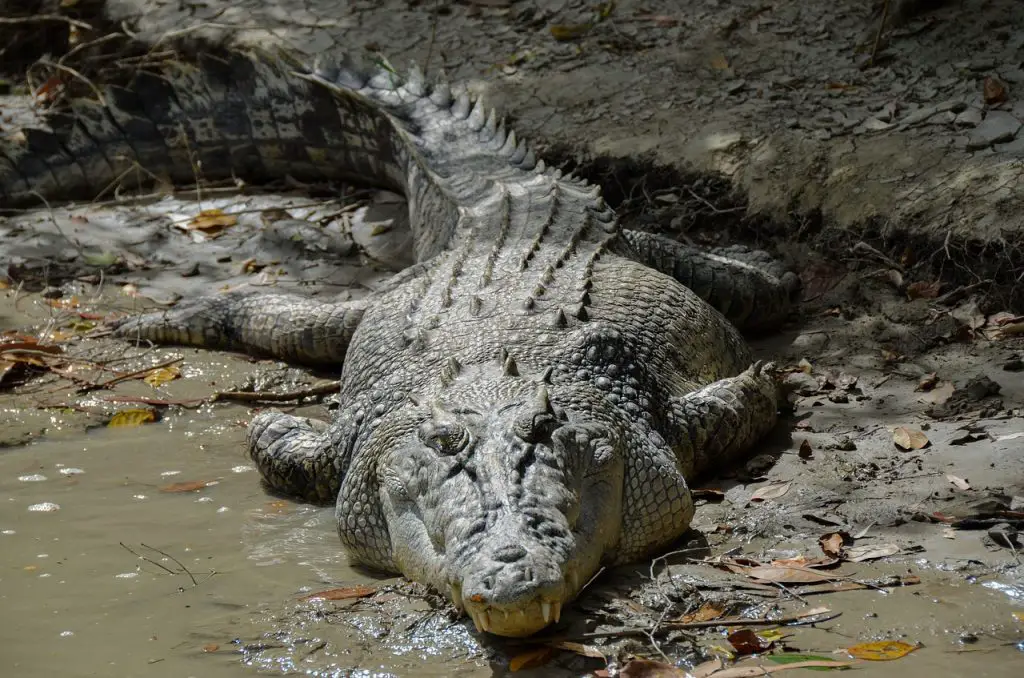
The saltwater crocodile is one of the crocodile species found in Sarawak.
Before there were crocodiles, there were water ghosts

Leong also shared a story of how water ghosts and other wild animals existed before there were crocodiles in Sarawak waters.

These water ghosts were more dangerous than crocodiles.

He wrote, “They used to take children or adults into the water while they were swimming. They did not take people for food. Instead, they only wanted to kill, most of the dead bodies recovered were still in proper condition.”

Then came a man who gave the villagers an idea of how to get rid of these dangerous ghosts.

He asked the villagers to plant chillies, ginger, tuba and other plants which could sting and give off a biting heat.

After harvesting these plants, he told them to pound them together.

How a Chinese magician brought crocodiles to Sarawak and other tales
Signage to warn visitor about crocodiles at Engkilili.

Under the man’s instruction, the villagers loaded the pounded vegetables onto the boats. At the right place, everyone capsized the boats, dumping their loads.

“This caused the fish to come out of the water including the water ghosts because their eyes could not stand it. Many of the ghosts escaped to the river bank. Some of them looked like human beings, with long finger nails, some had animal bodies but human heads; others with long hair around their bodies and also long teeth,” Leong stated.

Here comes the gruesome part of this legend; the villagers started to run after them, chopping off their heads.

Since then, only a few water ghosts are said to have survived the skirmish, but are no longer a danger to human beings.

How a Chinese magician brought crocodiles to Sarawak and other tales
Saltwater crocodile. Credits: Pixabay

How did Bintulu get its name?

Located in the central region of Sarawak, Bintulu was just a small village when James Brooke acquired it from the Brunei Sultanate in 1861.

Like most settlements ceded to Brooke, the first thing he did was build a fort in the area. In Bintulu, the Brooke government built a wooden fort name Fort Keppel named after the White Rajah’s friend Sir Henry Keppel.

In 1867, the first Sarawak Council Negri or General Council meeting was convened in Bintulu.

One of the earliest descriptions about Bintulu was written by Italian botanist Odoardo Beccari.

He arrived in Kemena River on Aug 13, 1867 using a gunboat named ‘Heartsease’.

After arriving in Bintulu, this was what he had to say about the town.

The fort of Bintulu which was built entirely of wood, was in somewhat ruinous condition. It stood nearly on the sea-shore, and just behind it, at a distance of few paces, the primeval forests commence.

Some chinamen had settled at the vicinity of the fort and had built a small bazaar; but the village is chiefly formed by the houses of the Melanau beyond the Chinese kampong (village).

These Melanaus used to live further up the river, but since the construction of the fort, and the installation of an officer of the Rajah near the mouth of the river, they came to settle near the sea – a thing they would never have dared to do in former days for fear of the attacks of the Lanun pirates and Dayak pirates.

Even during the 19th century, the area was known as Bintulu but how did the name come about?

Here are four legends on how Bintulu got her name:

How did Bintulu get its name?
In 1867, Kingdom of Sarawak’s first General Council meeting was held in Bintulu, making it the earliest legislative system in Malaysia. Today, a clock tower and a centenary stone remain as a reminder of where the meeting took place. 
1.Bintulu people had elongated heads?

One legend has it that in the olden days, Bintulu people had elongated heads. According to Chang Pat Foh in Legends and History of Sarawak, ‘bat’ means long and ‘ulau’ means head. Hence the name ‘bat ulau’ before the name Bintulu came about.

2.It was a place for drying skulls after headhunting

Additionally, Chang related another legend about Bintulu when headhunting was still a common practice.

The locals referred to headhunting as ‘milai’ while the process of drying and smoking the skull was called ‘betak’ in the local Melanau language.

There used to be site known as a place for drying the skulls in Bintulu where the locals called it ‘betak ulau’ or head drying place.

As time passed, the place’s name ‘betak ulau’ slowly evolved to Bintulu today.

3.A place to pick up skulls after headhunting

The third legend centered around headhunting. The act of picking up heads after headhunting was called ‘mentu ulau’. Sooner or later, people started to call the area ‘Mentulau’.

When the Brooke officials came, they allegedly interpreted the word ‘mentulau’ into ‘Bintulu’.

4.A place where sea and water mixed

“The fast running water from Sungai Jelalong and Sungai Tubau which flows into South China Sea mixes with the river water from Batang Kemana at the mouth of the river.

“Long ago, the people who stayed at Muara Batang Kemena gave the name ‘Ba Tulau’ to the place where they stayed. ‘Ba’ in Melanau Bintulu dialect means water whereas ‘tula’ means mixing. Hence, ‘Ba Tulau’ mean ‘mixing water,” Chang wrote.

How did Bintulu get its name?
Bintulu Night Market

How Dayak climbers helped in foreign expeditions

We have often heard of Sherpas and Nepalese mountain climbers, but did you know that Dayak climbers from Borneo were often recruited by westerners during scientific expeditions?

These adventures took these Dayak climbers out of Borneo way back in the early part of the 20th century.

Hendrikus Albertus Lorents and his Dayak climbers/porters

Hendrikus Albertus Lorentz (1871-1944) was the first recorded explorer to hire Dayak climbers to accompany him in his expedition.

The Dutch explorer participated in three expeditions to New Guinea; the first was the North New Guinea Expedition in 1903, led by Arthur Wichmann. Lorentz himself led expeditions in 1907 and 1909-1910.

According to Tom Harrisson in an article “Kenyah above the Snow Line” published on The Sarawak Gazette (April 30, 1965), Lorentz recruited Dayak climbers to climb Puncak Jaya in 1909.

Known as Carstensz Peak back then, it is the highest mountain in Indonesia standing tall at 4,884 metres.

“The 1909 expedition was a Dutch race against a British group, sponsored by the British Ornithologists Union. Dutch leader Lorentz recruited 61 Dutch-Indonesian troops and 82 Bornean Dayaks, who were allowed to bring blowpipes and poison darts but not beheading swords,” Harrisson wrote.

More than a month after leaving their base, Lorentz and his party reached the snowfield of Puncak Jaya at 14,786 feet on Nov 8, 1909.

The first Kayan and Kenyah climbers to reach a snow capped mountain

Most records stated that Kenyah porters from Apo Kayan who helped Lorentz in his conquests.

According to Tom Harrisson, the six Dayak porters were actually Kenyahs and Kayans from the Batang Kayan and Mahakam, Indonesia.

Lorentz once wrote, “It is still incredible, as it was then, to think of us and our five Dayaks standing on that high white island.”

Though it is impossible to find out their identities today, it is right to say they might be the first Kayan and Kenyah climbers to reach a snow peaked mountain.

There is a photo of them on top of the mountain. It was published in “New Guinea: The Last Unknown” by Gavin Souter with one of the Dayak climbers covering his face with snow.

On the way down, Lorentz fell and got himself seriously injured. Thankfully, his Dayak climbers saved the day by bringing him down safely.

How Dayak climbers helped in other expeditions

Meanwhile, the British expedition got into serious difficulties and failed to reach to the top. Their expedition had 96 servants from Maluku, Indonesia and ten Gurkhas.

In 1912, the British Ornithologists Union tried again. Learning from the Dutch, the British also hired Dayak climbers to aid in their expedition.

Along with 74 Iban climbers partly from Sarawak, they reached the then record height of 14,866 feet of Puncak Jaya.

Later in 1938, American zoologist Richard Archbold dispatched two exploration teams into the Baliem Valley of New Guinea. Each team consisted of Dutch soldiers, convicts and Dayak porters from Kalimantan.

According to Harrisson, a large number of them were Kenyahs and Kayans from Apo Kayan “who among other things planted garden of beans and lettuce above 10,000 feet” during the expedition.

With their jungle survival skills and high-enduring stamina, it is understandable why foreign adventurers recruited Dayak climbers during such expeditions.

How Dayak climbers helped in foreign expeditions
Dayak warriors. Credit: Creative commons

Enjoying the Traditional Food Festival in Lanjak, West Kalimantan

/

Food has always been the best way to become familiar with a place, culture and its people, so I tried to sample every dish during the Traditional Food Festival held in Lanjak, West Kalimantan.

Enjoying the Traditional Food Festival in Lanjak, West Kalimantan

From 14 to 15 September, an Indonesian community-based natural resource management (CBNRM) NGO, Riak Bumi organised a traditional food festival in Lanjak.

Enjoying the Traditional Food Festival in Lanjak, West Kalimantan

This year marked the sixth year the food festival had been organised for the community of Lanjak by Riak Bumi.  

The two-day festival saw 23 groups participating in the cooking competition as they competed to prepare the best traditional dishes on the first day.

Enjoying the Traditional Food Festival in Lanjak, West Kalimantan

During the cooking competition, the participants were required to cook traditional food without using artificial flavouring. This included commercial sugar and even regular cooking oil.

Instead, they used natural flavouring and ingredients such as palm sugar and tengkawang oil for their cooking.

As Lanjak is located about 40 minutes drive from the Lubok Antu border, some of the dishes in our neighboring country bore some similarities to Sarawakian cuisine as well.

With a smorgasbord of food laid out, here are some of the dishes that I managed to sample that everyone should try when visiting Lanjak.

Wajit
Enjoying the Traditional Food Festival in Lanjak, West Kalimantan
This sweet sticky rice snack seems too pretty to be eaten.

Wajit is a popular traditional Indonesian sticky sweet rice snack. It is made of glutinous rice, regular rice, palm sugar, coconut milk and pandan leaves. Typically, after wajit is cooked, it will be spread onto a baking tray and cut into diamond shapes. However, wajit can be molded into any shape that you fancy!

Grilled venison
Enjoying the Traditional Food Festival in Lanjak, West Kalimantan
Grilled venison

In Lanjak, the local communities still hunt for food. This includes fish, toads and even deer. During the traditional food festival, I had the opportunity to try venison straight off the grill. Yum!

Ants
Enjoying the Traditional Food Festival in Lanjak, West Kalimantan
‘Kesa’ is the local name for these ants.

In Southeast Asian countries, eating insects is a norm and Borneo is no exception. At the traditional food festival in Lanjak, one of the most fascinating dishes to be served were fried fire ants (kesa). For those who have never had them before, fried ants have a sour and tangy taste and not surprisingly, a crunchy texture.

Lakum
  • Enjoying the Traditional Food Festival in Lanjak, West Kalimantan
  • Enjoying the Traditional Food Festival in Lanjak, West Kalimantan

This sweet purple beverage is made up of lakum fruit mixed with honey. Lakum fruits looks like exactly like a blueberry.

Rice cooked in pitcher plant
  • Enjoying the Traditional Food Festival in Lanjak, West Kalimantan
  • Enjoying the Traditional Food Festival in Lanjak, West Kalimantan

Nasi pok yok is rice cooked in pitcher plants. When steaming the rice, no artificial flavouring is added as natural flavour from the pitcher plant will seep to the rice. This dish is prepared by stuffing rice and some water into the pitcher plant and steaming it until the rice is fluffy.

Kolak
Enjoying the Traditional Food Festival in Lanjak, West Kalimantan
Sweet and milky tapioca pearls kolak dessert

Tapioca kolak (kolak ubi) is a type of Indonesian dessert made with coconut milk, palm sugar and pandan leaf. Generally, kolak comes in different variations such as banana, pumpkin, sweet potatoes and jackfruits. It is said that kolak is a popular sweet during Ramadan.

Lulun Kucai
Enjoying the Traditional Food Festival in Lanjak, West Kalimantan
Chives cooked in bamboo

In Sarawak, kucai (or chives) is usually cooked with egg or chopped garlic. However, during the traditional food festival in Lanjak, I discovered an interesting way of cooking them – inside a bamboo.

Dishes cooked in bamboo
  • Enjoying the Traditional Food Festival in Lanjak, West Kalimantan
  • Enjoying the Traditional Food Festival in Lanjak, West Kalimantan
  • Enjoying the Traditional Food Festival in Lanjak, West Kalimantan

Speaking of bamboo, the traditional food festival in Lanjak would not be complete without “pansuh”. “Pansuh” means cooked in bamboo. From chicken to fish and even deer, any type of meat will taste great cooked in bamboo.

Fish umai
  • Enjoying the Traditional Food Festival in Lanjak, West Kalimantan
  • Enjoying the Traditional Food Festival in Lanjak, West Kalimantan

The fish umai in West Kalimantan is also similar to those enjoyed in Sarawak. Generally, the ingredients used for this dish are mostly similar, only instead of lime, they substitute it witha a citrus fruit called ‘buah kandi’ for its acidic and sour taste.

Jarete
  • Enjoying the Traditional Food Festival in Lanjak, West Kalimantan
  • Enjoying the Traditional Food Festival in Lanjak, West Kalimantan

This rice dish is a mixture of glutinous rice with regular rice. To prepare this dish, the rice is mixed and soaked in water. They are then ground with palm sugar and fry in a pan until they turn reddish brown. After that, the rice can easily be shaped into a cylindrical form using hand. It has a mild roasted rice scent to it and a hard, brittle texture.

Labu srikaya  
Enjoying the Traditional Food Festival in Lanjak, West Kalimantan
Labu srikaya is a sweet and savoury dish

This Instagram-worthy dish has a savoury, sweet and milky taste. This dish is prepared by cutting a hole on top of a whole pumpkin and scoop out the flesh. To prepare this dish, a mixture of coconut milk, pandan leaves, palm sugar and eggs are poured into the pumpkin mould and steamed.

Selukung
Enjoying the Traditional Food Festival in Lanjak, West Kalimantan
Selukung is prepared by inserting rice into palm leaves shaped into triangle

This dish is a traditional Kenyah dish. It is basically glutinous rice cooked in wild palm leaves and folded into triangles.

How did rubber plantations become part of rural Sarawak?

In Malaysian history class, we learned that rubber plantations in the country was promoted by an Englishman named Henry Nicholas Ridley (1855-1956).

He was a botanist, naturalist, and geologist who spent most of his time in Singapore.

His career on this side of the globe started in 1888. He applied and was selected the first director of Gardens and Forests in the Straits Settlements.

Before he made his way here, he was to meet Italian botanist Odoardo Beccari to prepare for his new job.

After reaching Singapore, Ridley was in charge of introducing new plants of economical value to the region. Against popular belief, he was not the first person to introduce rubber to this part of the world as it was already introduced 10 years earlier by Sir Hugh Low.

However, he did establish the taping method for harvesting latex. He was also the one who heavily promoted rubber plantations in Malaya.

He was so passionate in promoting rubber planting that he was always stuffing rubber seeds into the pockets of everyone he met, with hopes that they would plant the seeds. That was how he earned the nickname “Mad Ridley”.

The first rubber tree planted in Sarawak was in the Anglican bishop’s garden in Kuching
How did rubber plantations become part of rural Sarawak?
Rubber trees are tapped for their resins. Credits: Pixabay

While we learned a lot of Malaysian history in school, we only know a little about Sarawak’s own history with the rubber tree.

Ridley might not have been the one who promoted rubber in Sarawak as vigorously as he did in Malaya, but he did provide a written account of rubber planting in the state.

In September 1905, Ridley wrote an article which was published in the Agricultural Bulletin of the Straits Settlements.

He stated, “It would now be interesting to hear from the present Custodians of the gardens mentioned if the trees are still in existence, and to what girth they have attained at the sere and yellow age of 39 years.”

According to Ridley’s account, the first rubber trees planted in Sarawak were from seeds imported from the Botanic Gardens, Singapore. Reverend Bishop George Frederick Hose brought them in 1881. Bishop Hose was the uncle of Marudi resident, ethnologist and botanist Charles Hose.

He further stated, “One of these trees is still standing in the Bishop’s garden at Kuching and two more in the garden of the Resident. The former measures 6 feet 4 inches in girth at three feet from the ground and the others are nearly as large. The remainder of the trees have disappeared.”

The first rubber plantation in Sarawak

Ridley actually visited Sarawak four times, in 1903, 1904, 1914 and 1915. During his visits, Mad Ridley could not help but go out and see the rubber plantations.

The first rubber plantation he visited was the Coffee Estate on the slopes of Mount Matang. There, they planted the rubber trees together with coffee, tea and Mauritius hemp.

However according to Ridley, the rubber trees were in bad condition. Although the trees were five years old, they looked like the size of two-year-old trees.

“Many of the trees had fallen, others remained as dead stumps, or if alive bore only a few struggling leafy branches. Round Kuching, in the cemetery and along the roads, a good many para rubber trees have been planted lately, and seem to be doing fairly well, though it is too soon yet to form an opinion of them.”

Based on Ridley’s observation of rubber planting in Sarawak, the soils were too sandy.

“The greater part of the hills of Sarawak, at least that portion which I have seen, are sandstone or limestone, and a great area of the diluvium of the lower country is therefore very sandy. But the Lundu hills which I visited are granite, compose of a fine-grained granite. The soil here is less sandy and more argillacuous, with sandy mounds or small hills scattered about it. This seemed to be the most suitable ground for para rubber I saw in Sarawak. Another likely spot is long the Kucing river near Santubong, I had not time to visit this, but head that somewhere here Chinese were planting para rubber.

The first rubber export in Sarawak and the Rubber Boom
How did rubber plantations become part of rural Sarawak?
Natural rubber sheets in drying priocess. Credits: Pixabay.

Based on a report from 1962, the first rubber was exported from Sarawak in 1910.

When the world price of rubber hit historic highs during that decade (the first time in 1905-1906, followed by another boom in 1909-1910), Sarawak got hit by rubber fever.

Then Simanggang Resident AB Ward observed in his memoirs that 1911-1912 were the Planting Eras, as “Natives caught the rubber infection badly. Malays planted all the land they could. Dyaks followed suit, and rubber banished all thoughts of tribal warfare and headhunting.”

Professor Rob Cramb in Land and longhouse: Agrarian Transformation in the Uplands of Sarawak describes how the Saribas Iban took advantage of the money-making opportunity in rubber.

“Initially it was the wealthier Iban communities with a large land base and an accumulated surplus from the gutta and coffee booms which embarked on rubber planting.”

He also cites examples of early enterprising farmers like Tuai Rumah Budin in Stambak, who planted over 4,000 seedlings his son Lumpoh brought back from Singapore, and Penghulu Saang who planted his rubber in Pelandok in the Paku branch of the Saribas in 1912.

Although the price of rubber fell sharply after 1910, it nonetheless became the main agricultural export of the country until the late 1960s.

Unlike Malaya and other rubber producing countries, the kingdom was relatively late in establishing rubber plantations, as the Brookes favoured smallholders and were reluctant to give indigenous farmland to European companies.

During Charles Brooke’s reign, only five large rubber estates were established.

By 1941 before the World War II, there were 236,557 acres of rubber plantations in Sarawak.

Tengkawang Oil, the Butter from Nature

During a traditional food festival in Lanjak in West Kalimantan, Indonesia, no preservative or artificial flavouring such as MSG was used in any of the dishes. This also includes the oil they used for cooking which was substituted with tengkawang oil.

  • The traditional food festival was held at Lanjak, West Kalimantan from September 14-15 and was organised by Indonesian community-based natural resource management (CBNRM) NGO, Riak Bumi
  • The traditional food festival was held at Lanjak, West Kalimantan from September 14-15 and was organised by Indonesian Indonesian community-based natural resource management (CBNRM) NGO, Riak Bumi
  • The traditional food festival was held at Lanjak, West Kalimantan from September 14-15 and was organised by Indonesian community-based natural resource management (CBNRM) NGO, Riak Bumi
  • The traditional food festival was held at Lanjak, West Kalimantan from September 14-15 and was organised by Indonesian Indonesian community-based natural resource management (CBNRM) NGO, Riak Bumi

Known to many as the butter from nature or green butter, tengkawang oil is extracted from the fruit of tengkawang trees.

Tengkawang fruit or the Borneo shallow nut is a native fruit species that can be found in the jungles of Borneo.

However, West Kalimantan, Indonesia is particularly known for its tengkawang oil as it is still widely used by the locals.

Tengkawang Oil, the Butter from Nature
Tengkawang oil, also known as green butter, is made from the fruit of the tengkawang tree which can be commonly found in the tropical jungles of Borneo.

In both Sarawak and Kalimantan, tengkawang fruits are collected by the locals where it will then be processed into oil.

While tengkawang can be found in the jungle, there are some people who actually grow the trees at their farm.

Tengkawang is known as “engkabang” among the Iban people, and “kakawang” among the Embaloh people.

The tree will usually bear fruit once every five years, although there are places in Kalimantan that bear fruits once a year.

In Lanjak, the locals will usually collect tengkawang fruit sometime around February.

According to the locals, the trees will usually bear fruits at the beginning of the year during the rainy season. The trees are typically found near water sources such as the river.  

Usually locals will collect and process it for their own household consumption, although now most have began to commercialize the oil.

However, when picking these fruits, those that have fallen off the tree and started sprouting should not be used.

This is because when processed, they will taste differently. Apart from that, the oil will also be green instead of the usual bright yellow hue.

To process the fruits into oil, the fruits are first separated from the shell and dried under the sun.

Tengkawang Oil, the Butter from Nature
The dried tengkawang fruits before being ground into powder

This process might take up to a few days to a week before they are ground into powder.

  • Dried tengkawang fruit being ground into powder.
  • The ground tengkawang fruit.

After that, the powder is then placed in a steamer filled with water for about an hour.

However, the time may vary, depending on the amount of tengkawang powder being steamed at a time.

The lesser the amount of tengkawang powder being steamed at a time, the less time is spent steaming it.

Tengkawang Oil, the Butter from Nature
The tengkawang powder is placed in a steamer for about an hour

Then, after some time, the steamed powder is taken out to be pressed by a manual oil press machine expeller to produce a glossy, pale yellow liquid.

  • The oil is extracted from the powder by hand through an oil press machine expeller.
  • What comes out from the extractor is a glossy, pale yellow fluid.

Before the machine, the locals would extract the oil using a wooden device called an “apit”.

The dregs or the remains of the tengkawang powder is not discarded but used as fodder and fertilizer.

Tengkawang Oil, the Butter from Nature
The remains can be used as fodder or fertilizer

At room temperature, it will take about three days for the tengkawang oil to solidify, although it will be much quicker using a refrigerator.

Once solidified, tengkawang oil can be stored in containers and be kept for up to more than a year.

However, according to locals, the oil can also be stored in bamboo to ensure a longer storage period.

Tengkawang Oil, the Butter from Nature
Tengkawang oil is usually stored in bamboo to ensure longer storage period

Local people will usually use tengkawang oil for cooking and baking.  

So instead of the usual cooking vegetable or palm oil that we use for cooking, you might consider substituting it with tengkawang oil. You can even substitute butter with tengkawang oil when baking.

Tengkawang Oil, the Butter from Nature
Tengkawang oil used for cooking

On warm rice, the locals will usually press tengkawang to give the rice an aromatic nutty flavour and scent.

It is said that tengkawang oil is preferred over liquid oil when cooking in the jungle as it is more convenient.

Unlike typical oil, tengkawang oil is easier to carry and you would not have to worry about it spilling.

Tengkawang Oil, the Butter from Nature
Example of commercial products using tengkawang oil

Apart from that, tengkawang oil has also been used in cosmetic products such as lipstick and make up foundation due to it moisturising properties. It has also been used to make chocolate, bar soap, medicine, cream, lotion, hair conditioner, sunscreen and as a margarine substitute.

The Dayak-Madurese conflicts in Kalimantan, and what led up to them

Even as a kid growing up in Malaysia, particularly Sarawak, there’s a big chance you might have heard about the bloody interracial conflicts going on in Kalimantan between their native Dayak groups and the Madurese people.

The Dayak-Madurese conflicts caught the attention of international media during the late 90s and early 2000s, with coverage on the massacres featured in The Washington Post and The Guardian, among others.

To begin looking back at these events, we have to start with the transmigration programme.

The Dayak-Madurese conflicts in Kalimantan, and what led up to them
A Dayak Iban longhouse in West Kalimantan.
What was the transmigration programme?

Started by the Dutch colonial government, the transmigration programme was an initiative to move landless people from densely populated areas of Indonesia to less populous areas of the country.

This included moving people permanently from Java, Bali and Madura to less densely populated areas like Papua, Kalimantan, Sumatra and Sulawesi.

It was first started in the early 19th century to reduce overcrowding as well as to provide labour for plantations in Sumatra.

Then the Dutch colonial government demolished the programme during the end of its rule. However, the Indonesian government brought back the programme following Indonesian independence.

The rise of the Dayak-Madurese conflicts

The Madurese started to migrate into Borneo in the 1930s, so there had been Madurese people living in Borneo for about 70 years until these conflicts started.

Several reasons have been put forward to explain the violence between these two communities.

Most scholars and observers had perceived that ethnic tensions had long been simmering.

In an article published by non-profit organisation Cultural Survival, Rachel Leff explained that due to the 32-year authoritarian rule of President Suharto, the conflicts were kept in check for fear of military intervention.

Leff added, “When Suharto was forced from his office in Indonesia, old animosities erupted in violence.”

Besides this, there is another reason which triggered the interracial riots. This is an explanation popular among Indonesians. The outbreaks were reportedly provoked by supporters of Suharto who planned to undermine the democratic elections slated for June 7, 1999.

The third explanation behind the conflicts is the economic crisis affecting the country. In the second half of 1997, Indonesia was the country hardest hit by the Asian economic crisis.

Facing financial difficulties, both Dayaks and Malays blamed the Madurese for stealing jobs from them.

According to Huub de Jonge and Gerben Nooteboom who made a study of the ethnic clashes in Kalimantan, the Madurese had become better off economically because of their attitude to work.

The scholars wrote, “The Madurese tended to accept any available work; for example, they were willing to collect garbage in the cities and break up rocks for the construction of roads. They would do anything to work their way up. Used as they were to hard work and saving, they were often more successful than others in similar work. And this frequently led to amazement and jealousy among other ethnic groups.”

The Sambas Riots

One of the major Dayak-Madurese conflicts happened in Sambas district of West Kalimantan province in 1999.

Before this, the last major conflicts had occurred between December 1996 and January 1997.

During these riots, Madurese were mutilated, raped and killed by aggressors from the Malay and Dayak communities while the government did little to stop the violence.

The Sampit Conflict

Just like the Sambas Riots, the Sampit conflict in 2001 was not an isolated incident. The last major conflict occurred between December 1996 and January 1997.

The conflict in Sampit broke out on Feb 18, 2001 when two Madurese were attacked by the Dayaks. It resulted in more than 500 deaths with over 100,000 Madurese displaced from their homes.

There is no one version why this conflict broke out. One version claims the riot was caused by an arson attack on a Dayak house. Then rumours spread that the Madurese caused the fire leading a group of Dayaks to burn houses in a Madurese neighbourhood.

Meanwhile, a professor from Dayak People’s Association claimed that the massacres by the Dayaks were in self defence.

He specifically cited an incident in which a Dayak was tortured and killed by a gang of Madurese following a gambling dispute in Kerengpangi on Dec 17, 2000.

Meanwhile, another version claims that the conflict started in a brawl between students of different races at the same school.

The Dayak also decapitated at least 300 Madurese during the Sampit conflict.

In the end, the conflict resulted in more than 500 deaths with over 100,000 Madurese displaced from their homes.

The Dayak-Madurese conflicts in Kalimantan, and what led up to them
A Dayak longhouse in Kalimantan. Credits: Pixabay.
Violence fueled by spirit possession?

Besides the long history of headhunting among the Dayak community, another theory behind the level of violence in these conflicts is that it is influenced by local cultural patterns. Researcher Anika Konig from University of Lubeck in Germany pointed out one element of these local cultural patterns is spirit possession.

Based on research in a Kanayatn Dayak village in the conflict region, many of them there claimed spirit possession had played a central role in the riots.

Konig stated, “While possession by spirits in ordinary life is highly undesirable and dangerous situation which causes illness, possession was actively sought by the Dayaks who participated in the violence against the Madurese.”

According to the Dayaks, spirit possession awarded them with supernatural abilities and extraordinary strength.

Konig also noted, “Since the spirits’ favourite food is human flesh and blood, it was this that the spirits demanded from the warriors in return for their help. And it was, accordingly, the spirits who made the men perform these forms of violence.”

The Dayak-Madurese conflicts in Kalimantan, and what led up to them
A Dayak man from Kalimantan in warrior attire. Credits: Pixabay.
Why the Madurese?

The transmigration program had led the migration into Borneo from other ethnic groups such as the Javanese. But why were the Madurese targeted?

de Jonge and Nooteboom who interviewed many Dayak, Malay, Buginese and Banjarese informants, said that these people believed that the Madurese immigrants had not adapted to their new social environment and had a tendency to look down on others.

“Their behaviour is said to be arrogant, short-tempered, macho-like, rude, uncivilised, unfair, avaricious and revengeful.”

In the meantime, many of the Madurese born in Kalimantan blamed this negative image on newcomers.

They claimed that the newcomers from Madura did not know how to behave. Furthermore, some of the newcomers were reportedly members of criminal gangs involved in illegal logging, operating brothels and gambling dens. Some of them even smuggled consumer goods from Sarawak into the country.

Were the Madurese used as a scapegoat?

Again, why the Madurese? Firstly, de Jonge and Nooteboom pointed out that there was evidence that there were economical competitions among the Malays, Dayak and Madurese, particularly in terms of agricultural resources.

However, the competition, especially in West Kalimantan where most of the violence occurred, was not restricted to the economic field.

During the Suharto years, the Dayak and to a lesser degree, Malays had to hand over powerful positions in the provincial bureaucracy to civil servants (often Javanese) from outside Kalimantan.

Furthermore, huge tracts of land in Kalimantan were sold for oil palm, mining and other activities, as industrial-scale efforts to cultivate and develop the land for commercial purposes were implemented, leading to the 1997 Indonesian forest fires (reputed to be the worst in known history) and the Southeast Asian Haze.

On top of having their traditional territory appropriated by outsiders for large scale projects, the Dayaks were reportedly not compensated adequately for their land which was the source of their livelihood and survival.

With all these factors against them, de Jonge and Nooteboom believed that the Madurese were picked as a scapegoat.

“They were a small, controversial and vulnerable group, whose comings and goings incited resentment, who were involved in a series of both small and larger violent incidents, and about whom negative stereotypes abounded.”

Although the Madurese differences to other ethnic groups were largely imagined, they formed a fertile basis on which to continue the violence.

Like any riots in everywhere in the world, once the violence begins, nobody can really pinpoint a single cause for the conflict.

1 25 26 27 28 29 40