Browse Category

Culture - Page 13

The forgotten Malayan labourers of Burma Railway during WWII

The Burma Railway is infamously known as the Death Railway. It is because thousands of people died building it during World War II (WWII).

The Empire of Japan built it from 1940-1944 to supply troops and weapons in the Burma campaign.

The railway is 415-kilometres long connecting Ban Pong, Thailand and Thanbuzayat, Burma.

It is understood that between 180,000 and 250,000 Allied prisoners of war (POWs) were forced to build the railway.

However, not many remember that there were civilians working along the railway sacrificing their lives along the way.

It is estimated that there must have been more than 180,000 civilian labourers working on the railway.

They were mostly Javanese from Indonesia, Thai, Burmese as well as Chinese, Malay and Tamil from Malaya.

Sometimes referred to as romusha (the Japanese language word for labourer) in writing, they were also known as ‘the coolies’ by the Allied POWs.

The forgotten Malayan labourers of Burma Railway during WWII
Bridge over the River Kwai by Leo Rawlings, a POW who was involved in the line’s construction (sketch dated to 1943). It depicts four POWs, waist-deep in the water, carrying a large log during the first bridge’s construction. Credits: Rawlings, Leo – http://media.iwm.org.uk/iwm/mediaLib//150/media-150071/large.jpg This is photograph Art.IWM ART LD 6035 from the collections of the Imperial War Museums.

The recruitment of Malayan labourers

Speaking of Allied POWs, Australian POW Hugh Clarke described on how these civilian labourers were recruited in his work “A Life For Every Sleeper, A Pictorial Record of the Burma-Thailand Railway.”

He wrote, “The Japanese at the end of 1942 resorted to many ruses to recruit an additional labour pool of over 270,000 civilian labourers. They included Chinese, Burmese, Thais, Indians, Malays and Eurasians. As POWs began moving north the Japanese placed advertisements in Malayan newspapers seeking labourers for work periods of up to three months in Thailand. Free rail travel, housing, food and medical services were offered together with pay at a rate of one dollar a day. The response was negligible so the Japanese resorted to press-gang methods. Free pictures shows were advertised at various theatre around Malaya and when full, the doors were locked and all males in the audiences put abroad trains and railed to Thailand.”

However, could the civilians escape from being recruited? There were reports of locals agreed to become spies for the military police or Kenpeitai in order to avoid being sent to work on Burma Railway.

Dr Robert Hardie’s accounts on Malayan labourers on Burma Railway

Dr Robert was a British medical officer serving with the Federated Malay States Volunteer Force and a plantation manager in Malaya.

After the fall of Singapore, he became one of thousands of POWs forced to work on the railway.

Throughout this period, he managed to keep a diary despite the numerous searches. His diary entries were later published in a book entitled The Burma-Siam Railway: The Secret Diary of Dr Robert Hardie 1942-45.

He was reportedly an admirer of Malay culture.

On Aug 4, 1943, he wrote,

“When one hears of these widespread barbarities, one can only feel that we prisoners of war, in spite of all the deaths and permanent disabilities which result, are being treated with comparative consideration.”

Then on July 6, 1943, Hardie stated,

“A lot of Tamil, Chinese and Malay labourers from Malaya have been brought up forcibly to work on the railway. They were told that they were going to Alor Setar in northern Malaya; that conditions would be good – light work, good food and good quarters. Once on the train, however, they were kept under guard and brought right up to Siam and marched in droves up to the camps on the river. There must be many thousands of these unfortunates all along the railway course. We hear of the frightful casualties from cholera and other diseases among these people and of the brutality with which they are treated by the Japanese. People who have been near the camps speak with bated breath of the state of affairs-corpses rotting unburied in the jungle, almost complete lack of sanitation, frightful stench, overcrowding, swarms of flies. There is no medical attention in these camps, and the wretched natives are of course unable to organise any communal sanitation.”

Again on July 21, 1943, Dr Hardie wrote,

“The conditions in the coolie camps down river are terrible, Basil says. They are kept isolated from Japanese and British camps. They have no latrines. Special British prisoners parties at Kinsaiyok bury about 20 coolies a day. These coolies have been brought from Malaya under false pretence – ‘easy work, good pay, good houses!’ Some have even brought wives and children. Now they find themselves dumped in these charnel houses, driven and brutally knocked about by the Jap and Korean guards, unable to buy extra food, bewildered, sick, frightened. Yet many of them have shown extraordinary kindness to sick British prisoners passing down the river, giving them sugar and helping them into the railway trucks at Tarsao.”

What happened to the Malayan labourers when the war ended?

If you think that the suffering of Malayan labourers would end when the Japanese surrendered and the war finally ended, well, it’s usually not that clean-cut.

According to Anzac Portal, these civilians had no expectation of being rescued by military authorities when the war ended.

In other Japanese-occupied territories romusha were given supplies of food and medical attention by American troops arriving from August-September 1945 on.

Unfortunately, Allied authorities in Thailand and Burma prioritised their own military personnel leaving the romushas including the Malayan forced labourers perhaps last in line for help and supplies.

As for the repatriation of Romusha, it was managed by different authorities. The British Military Administration in Malaya sent missions to Thailand in November 1945 to aid the repatriation of Malayan laborers.

Overall for those who returned alive to their homes, no compensation were given to them. In Malaya, nonetheless, some received some clothing and a small amount of money… but many received nothing.

The unmarked and unknown graves of civilians of Burma-Thai Railway

After the war, the remains of the dead were relocated from former POW camps, burial graves along the railroad to official war cemeteries.

Overall, there were three war cemeteries which are maintained by the Commonwealth War Graves Commission.

According to Paul H. Kratoska in Asian Labor in the Wartime Japanese Empire: Unknown Histories, there are 12,043 Allied soldiers are buried in cemeteries in Kanchanaburi, Thailand. Their gravestones seem to stretch on forever.

He further stated, “However, there are no cemeteries, and no individual gravestones, for the Asian labourers who died building the railway. They were buried if they were fortunate, or else abandoned in the jungle, or thrown into the river or into a common grave. In 1988, the site of a mass grave was found in Kanchanaburi by accident, and the bones of more than 700 bones were excavated. Villagers said it was a burial site used for the Asian railway construction labourers.”

According to Anzac portal, since they were not military personal they were not interred in the Commonwealth War Graves Commission.

Furthermore, the identification of their bodies would be extremely difficult given the lack of records of where they buried.

To this day, there is no official record of how many civilian labourers died building the Burma railway.

Why were the Asian workers of Burma Railway, including the Malayan labourers, forgotten?

According to David Boggett in his paper Notes on the Thai-Burma Railway, while dead men can tell no tales, so the illiterate can write no diaries.

He stated, “Many of the Asian romusha were illiterate; poor, helpless peasants most forcibly conscripted or callously lured by false promises of riches and unaware of their ultimate destinations. While it is a matter of dispute as to whether Japan ever made any efforts to observe the Geneva convention (certainly the experiences of the POWs led them to believe that the Conventions were being deliberately ignored), the records kept of POWs movements for example from Singapore’s Changi prison to Thailand or from Thailand to Japan proper – suggest that at some perhaps higher levels, the intention of Japanese bureaucrats (as opposed to military staff on the ground) was, indeed accurate records of the POWs’ fate as obligated under the conventions.”

Boggett also added, “However, no such Geneva Conventions existed to govern the impressing or treatment of civilian labour; few official attempts were made to record the fate of Asian romusha. This lack of official Japanese documentation, coupled with the absence of almost any written records by the survivors themselves, has allowed the situation of Asian romusha to be minimise or even ignored.”

With no marked graves and no official records of their existence, it is no surprise why the civilian labourers of the Burma Railway including those from Malaya had been forgotten, even if their number could be way higher than of Allied POWs.

Numbul and Bedukun, the Bisaya traditional healing ceremonies

Before there were doctors and nurses, the people of Sarawak relied on traditional healing ceremonies to cure sickness.

Every ethnic group has its own healing ceremony, for example the Ibans have their pelian and the Melanau turn to berayun and berbayoh to heal the sick.

For the Bisaya people in the Sarawak, their traditional healing ceremonies are called numbul and bedukun.

The numbul ceremony

It is the custom of the Bisaya that if a woman is sick, a numbul ceremony is held in order to cure her.

According to Benedict Sandin in his paper The Bisaya of Borneo and the Philippines, the word numbul means a curing ceremony for a sick woman officiated by a female shaman.

Benedict wrote, “To carry out the ceremony, a female shaman wears a petticoat, sarong, cloak and bracelets. From the wrist to the elbow of her silver are nine silver buttons.”

As she starts her invocation chants, the shaman sits at the centre of the gathering of people who beat the gongs at the open veranda of the house.

The invocation chants last from dusk till dawn. As she chants her songs, she summons the soul of the patient to return quickly from where it has wandered away.

If the patient can be cured, her soul will come back as summoned by the shaman.

What happens if she cannot be cured? Then her soul will never again come back to her.

The moment the soul comes back, the shaman catches it with her hand and places it carefully on a white piece of calico cloth. Then she places it on the head of the patient.

Numbul and Bedukun, the Bisaya traditional healing ceremonies

What happens if the numbul ceremony fails?

After the shaman has successfully performed her numbul over the patient, the latter and her family are assured that she will be cured from her current illness.

If her soul did not return to her, another numbul ceremony can be officiated by the same shaman.

The shaman before this can still perform the numbul over the same patient up to three times.

If the patient still cannot be cured, another female shaman should be called upon to perform the numbul ceremony for her.

In the meantime, many people are invited to attend the numbul ceremony. The whole night they will partake in food and drink at the house of the patient’s family.

At the end of the ceremony, the shaman declares that every member of the patient’s family and those who stay in the same house must not do any outdoor work for three days.

Besides this, the shaman also strictly prevents any visitor who come to the house to bring with him a knife which has resin (malau) in its handle.

Any visitor found bringing such weapon will be fined according to the customary rules of the numbul ceremony.

Bedukun ceremony for a sick man

If a man is sick, the Bisaya family usually calls for a dukun (medicine man) to come to cure him.

For this ceremony, the dukun does not necessarily wear ceremonial dress as does the female shaman and he recites no long chants for the patient.

The dukun performs the ceremony only for about one hour. During this time he only blows (taurik) the air to the painful spot of the sick man’s body. Additionally, he recites a special spell (puchau) over the place of the patient’s pain.

Just like the numbul ceremony, the dukun declares that all members of the patient’s family must not do outdoor work for three days.

At the same time, he forbids all visitors to the family’s house to bring with them a knife which has resin in its handle.

Although we may not practice Sarawakian traditional healing ceremonies, it is always important to at least remember them.

8 things the Timugon Murut believe about Nabalu, or the afterlife

8 things the Timugon Murut believe about Nabalu, or the afterlife

Different beliefs offer different views of the afterlife. In some views, the afterlife takes place in a spiritual realm. Another popular view is reincarnation. It is where the individual may be reborn into this world with no memory of his past life.

Meanwhile in Sabah, the Timugon Murut people have their own perception of the afterlife.

According to Kielo A. Brewis in his paper The Death of a Timugon Murut (1987), nabalu is what the Timugon Murut people believe to be their afterworld.

So here are what you should know about the traditional belief of the Timugon Murut when comes to nabalu:

1.After a person dies, their soul is said to leave the body and continue to float around the house until a chicken is sacrificed on the morning of the burial day. That is when the soul goes to nabalu.
At that time, the soul is believed to not take any special form, but is merely invisible.

2.Souls of good people can straightaway go to Nabalu. Although there is no mention of an escort like the grim reaper, some said that the souls flew to Nabalu while others said angels (masundu) came to get them.

3.If there is a rainbow during the wake or on the day of the burial, it means the dead person is present to take part in the sorrow of the villagers. Beside that, it means that the soul will get to Nabalu very quickly.

4.Souls that are barred or delayed from entering Nabalu will turn into a ghost (timbunus). It is a Timugon Murut version of vampire with a particular preference for pregnant women. It likes to lurk around at the time of childbirth on lonely stretches of road causing accidents so that they can suck the blood of the victims.

5.If the deceased had cursed or poisoned someone, they may turn into a snake or a black cat at death. The soul will probably never reach Nabalu, and is destined to roam and haunt people.

6.Speaking of haunting people, the same fate goes to the soul of a person who died a violent death. His soul will not go to Nabalu immediately but will have to stay around for some time to frighten people.

7.Meanwhile, a soul who has gone to Nabalu can occasionally come down and visit people. He flies down in the form of a bird and watches the people on earth.

8.As for the location of Nabalu, those who believe in it said that it is “up there”, on top of a great mountain facing the sunrise. Brewis opined that the mountain his informants referred to could not be Mount Kinabalu since the mountain could not be seen from Tenom valley where the Timugon Murut lived. One thing for sure is that Nabalu is a good place where there is no sickness and people probably are of the age they were when they died.

How a liar caused the war between Luju, a Kayan warrior, and the Taman

Here is a story of how a war in ancient Kalimantan broke out due to mistaken identity:

How a liar caused the war between Luju, a Kayan warrior, and the Taman
Kapuas river.

There was a Palin man named Baring Ma’ Bojang. He married an Embaloh woman and moved to the village of Belimbis in the upper Embaloh river of Kapuas Hulu.

Both Palin and Embaloh are Dayak groups in Indonesian Kalimantan.

Baring was the brother of Rombonang, a Palin raja or leader.

One day, Baring decided to go on a journey to the Mahakam river in East Kalimantan in search of valuable beads.

He went with a large number of followers and he set up good connection with Luju, a member of the Kayan royalty and a warrior in the Mahakam.

There in the Mahakam, he stayed for a long time with Luju, eventually managing to obtain the valuable ‘lawang lukut’ beads.

Baring also asked Luju for seven of his Kayan villagers to show him the way back to the Kapuas from the Mahakam.

In return, Baring promised that he would send these men back with some valuables such as jars and lamps.

Luju agreed and Baring made his trip back with Luju’s seven men.

Luju and Baring’s broken promise

Throughout Baring’s stay in the Mahakam, Luju was under the impression that Baring was a Dayak Taman not a Dayak Palin.

Meanwhile, Baring was a renowned liar, and could not be bothered to correct Luju.

Baring also never had the intention to give Luju what he had promised.

On their way to Embaloh, Baring declared that the seven Kayan men were now his slaves.

Although they were enraged, the Kayan men could not do anything as they were outnumbered by Baring’s men.

To make things worse for the Kayan men, Baring planned to sacrifice the men along their route from Mahakam to Embaloh to ensure a safe journey.

By the time they had reach Embaloh, there were no Kayan men left among his party.

Luju declared war on the wrong people

Eventually, the news of Baring’s treachery had reached Luju at Mahakam. Furious, Luju spent the next three years recruiting men from the Mahakam, Tabang and Oga’ rivers .

Together with the Kayan of Mendalam river near Putussibau, Luju and his warriors attacked the Dayak Taman longhouses at night.

They sacked their homes and burned them to the ground.

As Luju attacked all the Taman longhouses, he never got as far as Embaloh where Baring was hiding.

The Kayans, satisfied with their attack and felt that the Dayak Taman had punished enough.

The Dayak Taman take revenge

The following year, Luju’s brother Kule returned to the Kapuas river with a peacemaking force.

He explained that Luju was tired of war and wished to restore peace between Taman and Kayan.

After Luju had returned to Mahakam, the Taman people had sent some raiding parties to attack the Kayans, but they were not as strong as the Kayans.

The Taman made peace with the Kayan but were still determined that they would avenge themselves against Baring who was the cause of this problem.

Baring, who seemed unaware of the vendetta against him, had ventured into the Taman area, and was subsequently ambushed by the Taman warriors who then took his head.

This caused a war between the Taman and Embaloh as Baring’s son, Bojang sought revenge.

The tribal war between the Taman and Embaloh reportedly continued until the Dutch came into the area.

This story is recorded by Victor T. King in his paper Main Outlines of Taman Oral Traditions.

How did the Ibans near Kalimantan border cope with Konfrontasi

People have been living along the border of Sabah and Sarawak, Malaysia with Kalimantan, Indonesia for centuries.

When there was a conflict such as the Indonesia-Malaysia Confrontation which broke out between the two countries, it was unfortunate that they found themselves caught in between.

So how did the Sarawakians near Kalimantan border cope with Indonesia-Malaysia Confrontation or Konfrontasi?

On Sarawak’s side of the border, Commonwealth forces were flown in to help protect the border.

Besides this, they employed Iban and other border-dwelling Dayaks as scouts. They were a local auxiliary force, widely known as ‘Border Scouts’.

On the other side of the border, Indonesian army also employed Kalimantan Iban scouts to aid in patrolling their side of border.

Before the confrontation, the Iban communities from both side of the border had been living peacefully with each other.

Most of them had relatives across the border as intermarriages were common between different Iban longhouses, regardless of nationalities.

After they were employed by their respective countries, how did they do their work while still keeping their own relatives safe?

First of all, not all of the Ibans became scouts willingly.

According to Michael Eilenberg in the book At the Edges of States, most Kalimantan Iban had no particular interest in Indonesia-Malaysia confrontation.

However, a group of Iban from the Lanjak area were recruited by force as scouts.

These unwilling scouts did their uttermost to prevent clashes between the different border patrols Indonesian and Malaysian.

Eilenberg wrote, “Former Iban scouts in Lanjak recount how they purposely led the Indonesian military patrols in circles around the Malaysian patrols in order to prevent clashes. In doing so, they avoided being forced to fight Iban kin employed as scouts by the ‘enemy’.

One very common strategy employed by Iban trackers was to use different kinds of signals to warn the oncoming Iban trackers employed by the enemy.

For example, they imitated animal cries or simply wore their caps backward as a signal that regular soldiers were following close behind.

Life at Kalimantan border while coping with Indonesia-Malaysia Confrontation

Those who lived near the Kalimantan border during the confrontation remembered it as a period of restriction.

With military forces guarding both sides of the border, contact with relatives over the border was made difficult.

Even though the border was officially closed, some of the locals had reportedly continued their cross-border interaction such as trading and visiting relatives.

But of course, these were done at considerable risk of being caught in the line of fire.

Furthermore, several Kalimantan Iban families took more drastic moves.

They permanently immigrated to Sarawak to live with their Sarawakian families.

In the paper Straddling the Border: A Marginal History of Guerrilla Warfare and Counter Insurgency in the Indonesian Borderlands, 1960s-1970s which was also written by Eilenberg, the researcher came across many Kalimantan Ibans who had immigrated to Sarawak either during the Confrontation or during the later communist insurgency.

He wrote, “A senior Iban, originally from the Lanjak area but now a Malaysian citizen, conveyed during a visit to Kalimantan how, after immigrating to Sarawak, he was employed by British soldiers to fight the Indonesian army and later awarded an honorary military insignia by the Malaysian state for his courage in the fighting. Ironically before immigrating, the same person had been employed as a scout by the Indonesian forces.”

How did the Ibans near Kalimantan border cope with Konfrontasi
Some 1,500 men from the indigenous tribes of Sabah and Sarawak were recruited by the Malaysian government as Border Scouts under the command of Richard Noone and other officers from the Senoi Praaq to counter the Indonesian infiltrations. Credit: Public Domain in Malaysia and US.

Getting close with the Sarawakians near Kalimantan border as a military strategy

Speaking of the British soldiers, blending in with the locals is part of the Commonwealth forces’ military strategy.

The Director of Operations in Borneo during the confrontation was General Sir Walter Walker.

General Walker once stated, “We set out to speak their language and respect their customs and religion. We sent small highly work among them, to protect them and share their danger, to get to know them and gain their confidence. These troops were as friendly, understanding and patient to the villagers as they were tough and ruthless in the jungle. We sought to give the villagers a feeling of security by day and night, through the presence of phantom patrols and through constant visits by the civil administration, the police and the army. We helped their agriculture, improved their communications and trading facilities, improved their water supply, provided medical clinics and a flying doctor service, established schools, provided transistor wireless sets and attractive programmes, and so on.”

Additionally, Walker saw winning popular support as ‘absolutely vital to the success of operations because by winning over the people to your side, you can succeed in isolating your enemy from supplies, shelter and intelligence.’

In the meantime, Captain David L. Watkins wrote in his paper Confrontation: the Struggle of Northern Borneo that unless villages along the border could be secure day and night from Indonesian intruders, they could be intimidated into providing the enemy aid.

“Although an armed patrol could not be posted in every village, frequent visits could be made, not only by soldiers, but by police and civil administrators as well. These visits had several purposes, two of which were to ‘encourage the loyal to give information and to discourage the few disloyal from doing anything that would disturb the uneasy peace’.”

The safety of the locals came first

At the same time, Walker emphasised that the security and safety of the local Sarawakians would always come first.

He once wrote his command, “went to any length to keep our hands clean. One civilian killed by us would do more harm than ten killed by the enemy.”

He added, “If the price a village had to pay for its liberation from the enemy was to be its own destruction, then the campaign for hearts and minds would never have been won.”

As much as the Commonwealth forces as well as the government wanted to protect its people, deaths are inevitable during war (although this war was never officially declared).

In the end of the Indonesia-Malaysia Confrontation, the total number of civilian casualties are 36 killed and 53 wounded.

Why did Indonesia give guerrilla training to Sarawak Chinese youths during Konfrontasi?

During Konfrontasi or the Indonesia-Malaysia Confrontation, Indonesia lent their support to Sarawak Chinese.

But why?

When the formation of Malaysia was proposed, President Sukarno-led Indonesia was not the only who opposed the idea.

The Sarawak Communist movement was also against the idea of Malaysia.

Instead, the Sarawak Communists supported the idea of unification of all Borneo territories to form an independent leftist North Kalimantan state.

They gained support from Sukarno who let the Sarawak Communist Organisation use Indonesian Kalimantan as a base to build up a guerrilla force.

Why did Sarawak Chinese youths turn to communism at that time?

The then Sarawak Deputy Chief Minister, James Wong might have the right explanation on why communism seemed to be attractive to Sarawak Chinese youths.

As what was reported by Sabah Times on Dec 28, 1963, Wong stated,

“As we all know some of the younger generation of Chinese in Sarawak have been much affected by the teachings of Communism. There are all sorts of reason for this.

Many young Chinese are proud of the achievements of Communist China and feel that what is good in China should be copied here. Others have had their sense of idealism twisted and misused by the Communist leaders in the country who teach that Communism is the only road to justice in this world.

Others are discontented because they cannot get good jobs or feel they are not making enough money or that they do not own enough land and that Communism will provide the answer to all their problems.

The older people do not subscribe to these ideas, but many of the older Chinese in Sarawak are people who, in China, never received a proper education.

They are overawed by the fact that so many of their children can claim to possess an education and they defer to the views of their youngsters. They are unable or unwilling to exercise the restraints and disciplines which parents should be able to exercise.”

The testimony of a young Sarawak Chinese

According to a Sarawak Tribune report which was published on Dec 8, 1965, a young Sarawak Chinese revealed his experience being recruited into CCO.

“About April or May 1962, subject to the propaganda and influence of a cadre of the clandestine communist organisation, I joined the Farmer’s Association under the Sarawak clandestine communist organisation. In August of the same year I was again recommended by my leader to join the Sarawak Advanced Youths Association, a secret communist organisation.
Later in November, I was sent by my leader to do racial work in Tebedu. Meanwhile a racial work cell for Tebedu area was formed with me as one of the cell members.

Our method of work was to make use of the SUPP (Sarawak United People’s Party) by asking the masses to join the party openly and then to absorb the better elements amongst the SUPP members into the Farmer’s Association.

In April 1963, our leader informed us that the organisation was prepared for armed struggle and wanted to send persons to receive military training in Indonesia. The Organisation wanted us to make a road from 23rd mile to Kampong Sidek in Indonesia via Tebedu.

The route was divided into four sections, and in May that year this new jungle track was completed secretly. On June 1st, the first batch of Sarawak youths of both sexes, about 40 in number, escaped to Indonesia by this jungle track.”

It was reported that harsh and contemptuous treatment by the Indonesians, as well as deprivations of jungle life had caused some of these Chinese to lose their ardour.

By the end of 1963, some of these Sarawak Chinese youths began to ‘trickle back into Sarawak’.

Those Communist exiles in Indonesia who have stayed behind, eventually would form the core of the North Kalimantan Communist Party’s two guerrilla formations.

The first one would be Sarawak People’s Guerrilla Force (SPGF) or Pasukan Gerilya Rakyat Sarawak (PGRS). Meanwhile, the second one was North Kalimantan People’s Army (Paraku).

With the assistance of the Indonesian Ministry of Foreign Affairs, PGRS was formed Mar 30, 1964 at Mount Asuansang in West Kalimantan.

How many of the Sarawak Chinese youths were in Kalimantan?

According to Justus M. Van Der Kroef in The Sarawak-Indonesian Border insurgency, “Already by mid-1964 more than one thousand Sarawak Chinese, mostly youths had crossed into Indonesia to receive guerrilla training, subsequently returning with Indonesian terrorist units, while others affiliated with the TNKU (Tentera Nasional Kalimantan Utara).”

It is believed that Sarawak Chinese youths were still slipping over the border into Indonesia to train for guerrilla war against their home state as late as March 1966.

As for the sympathisers, Herald-Journal’s report on Sept 2, 1971 might had some explanation on why some Sarawakians were not totally against communism.

First of all, the communists actually helped the people in the fields and give them medical care.

Additionally, the report stated, “Some farmers and villagers almost never see a government official; often the Communists win simply by default. In rural areas, Chinese shopkeepers have found it safer to keep quiet and roll with the punches. They don’t resist if a guerrilla demands bicycles so the frames can be made into shotguns.”

There were other impacts of communists insurgency in Sarawak mainly due to the curfew implemented in the state.

Herald-Journal reported, “Babies died of malnutrition and of diseases that could be cured because their families couldn’t go out after help. Government teams offered some relief but not all people could be reached by the limited staff.”

In the meantime, the British Intelligence estimated that there might be some 24,000 Chinese Communist sympathisers at a point in Sarawak.

The end of communist insurgency in Sarawak

While the confrontation officially ended on Aug 11, 1966, the communist insurgency in Sarawak continued until 1990.

The number of communist operatives distinctly decreased in the 1973-1974 when Sarawak then Chief Minister Abdul Rahman Ya’kub managed to convince several of the insurgents to lay down their arms.

One of their leaders Bong Kee Chok surrendered along with 481 of his supporters.

The final peace agreement communist insurgency was ratified in Kuching on Oct 17, 1990.

That was when the last of the communist operatives officially surrendered, marking the end of communist insurgency in Sarawak.

Why did Indonesia give guerrilla training to Sarawak Chinese youths during Konfrontasi?
Members of the Sarawak People’s Guerilla Force (SPGF), North Kalimantan National Army (NKNA) and Indonesian National Armed Forces (TNI) taking photograph together marking the close relations between them during Indonesia under the rule of Sukarno. Credit: Copyright Expired.

A legend of how the Timugon Murut people came into existence

The Timugon Murut is one of the 29 ethnic groups of Murut people.

Overall, the Murut people can be found mainly in Sabah and Sarawak in Malaysia as well as in Brunei and Kalimantan, Indonesia.

As for Timugon Murut, they mainly live in Sabah. Each of the ethnic group of Murut people including Timugon Murut has its own distinct language, custom and even folklore.

Here is a tale on how the Timugon people was created as recorded by researcher Kielo A. Brewis in the paper The Death of a Timugon Murut (1987):

There was a great flood which saw everyone drown, except one young man, who climbed up a very tall coconut tree.

After the waters began to recede, he went down to look for survivors.

An angel from heaven (masundu) came to tell him that there were no other survivors and gave him a proposal instead – that they should marry.

The angel wasn’t anything like the shiny Western concept of an angel, but came in the form of a woman who was afflicted with a skin condition, similar to that of ringworm.

Even though he was the only person left on the planet, the young man did not want to marry her.

Instead he went off to find prettier girls, holding on to the hope that there were survivors besides himself.

In the meantime, the angel did not handle the rejection well.

In his absence, the angel made a clay figure that looked much like herself, except the figure did not have the markings of ringworm.

Then she made the figure into a living being by spitting red betel nut juice from her mouth onto it.

When the young man returned empty-handed and saw the beautiful girl who had been made from clay, he wanted to marry her.

Their descendant became the ancestors of the Timugon Murut.

A legend of how the Timugon Murut people came into existence
The man marries the woman who was made from clay. Credit: Pixabay.

How thousands of Dayak Taman people died due to a poisonous tree

Researcher Victor King recorded in his paper Main Outlines of Taman Oral Tradition (1975) that the Dayak Taman people once suffered a great setback in their population.

And it was all thanks to a tree.

So what was the poisonous tree and how did it kill thousands Dayak Taman people?

There was a man named Bai Upa who was so angry with life. If he lived in the 21st century, you might find him ranting on social media. But instead, he decided to fetch a special poison from the headwaters of the Kapuas river.

This poison was watery in appearance and only can be found in remote places.

Additionally, the poison oozed from the ground and in the center of the ooze stood a tree.

The poison was believed to be almost impossible to obtain. Any attempts in the past usually caused the death of the seekers.

Bai Upa was a wise man. Knowing the danger of fetching of this poison, he sent eight of his slaves instead.

It was said that nothing could live around the tree for a distance of 200 paces.

There were no grass, trees or flowers. Instead, they were bones of humans and animals scattered.

The locals believed that even its scent could kill.

Bai Upa’s slaves took turns to get the poison.

The first slave only got a few paces into the poison zone when he fell dead.

Meanwhile, the second got a little further and so on. Finally, the last slave managed to hold his breath and bit one of the lower branches of the tree.

Actually, biting the tree acted as an antidote for the poison. The slave managed to collect a small amount of the poison in a container with a tight cover.

After the slave got back to Bai Upa, he used the poison to kill his enemies.

When the corpses were thrown into the river, fishes ate the flesh.

When the Dayak Taman people downstream ate these fish, they died. According to King’s informant, that was how thousands of Dayak Taman died with many of their villages abandoned.

What is the poisonous tree?

How thousands of Dayak Taman people died due to a poisonous tree
Antiaris toxicaria is a type of fig tree. Credit: Pixabay

Although King did not identify the poisonous tree, another researcher Richard B. Primack in his paper Moraceae Trees in the Religious Life of Borneo People wrote that the tree is ‘clearly about the Upas tree, Antiaris toxicaria.

Primack explained that only the latex of an Upas tree can be so poisonous.

He wrote, “There are certain inaccuracies in the exaggerated description, which was probably embellished to make the story more interesting. The poison does not ooze from the ground and does not fill the air. The vegetation under these trees is perfectly normal. People and animals can approach the tree without injury. The poison must enter the blood, generally by a poison dart, in order to be effective. Consequently, people downriver eating poisoned fish would not become poisoned. Also, biting the lower branches of the tree is not an antidote.”

It is fortunate that the poisonous tree in King’s story is not as powerful as it was said to be. Or else someone might turn it into a bio-weapon. And thankfully the antidote is not by biting the lower branches. People surrounding a tree and biting its lower branches would definitely be an interesting sight to see.

Was the first contact between James Brooke and the Kanowits a peaceful one?

The name of Kanowit town comes from the earliest ethnic group who settled in the area, the Kanowits. Today, they are often referred to as Melanau Kanowit.

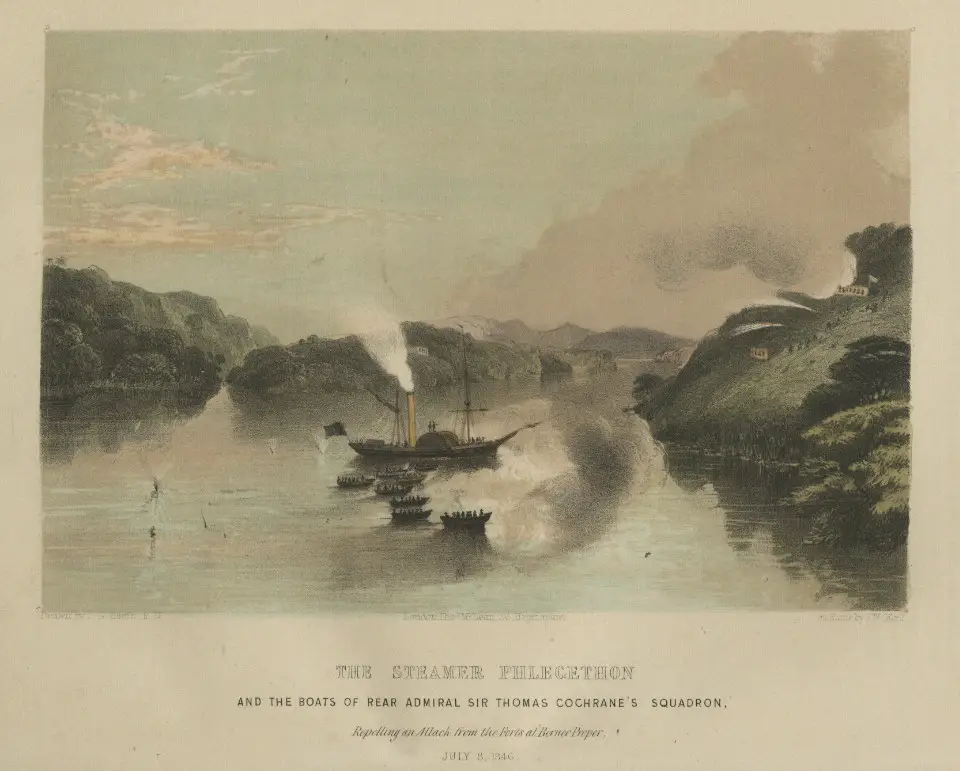
Their first contact with the British took place in 1846 when the steamer, the Phlegethon, commanded by James Brooke and Captain Rodney Mundy sailed up the Rajang River.

Brooke would have been 43 years of age at the time, and would have been Rajah of Sarawak for four years since the Sultan of Brunei had granted him the title.

Was the first contact between James Brooke and the Kanowits a peaceful one?
James Brooke

On June 29, they arrived in the area that we know now as Kanowit town.

Imagine the Kanowits’ reaction watching an unfamiliar vessel came to shore with people of different skin, eye and hair colour on board… it would have been bound to create some havoc at that time.

So did their first meeting turn out a peaceful one or was there some blowpipe action going on?

Was the first contact between James Brooke and the Kanowits a peaceful one?
The Steamer Phlegethon and the Boats of Rear Admiral Sir Thomas Cochrane’s Squadron, Repelling an Attack from the Forts at Borneo Proper, By Captain Thomas Cochrane (1789–1873), Phlegethon, 8 July 1846. Credit: Creative Commons

The answer lies in Mundy’s journal as he describes their first encounter with the Kanowits as follows:

Shortly after noon our pilots pointed out the neck of land round which, in a small bay, was situated the village of Kanowit, and above the trees we caught sight of numerous flags, and the matted roofs of houses.

The admiral (Rajah James Brooke) now ordered the steamer to be kept as close as possible to the over-hanging palms; and with our paddle-box just grazing their feathery branches, we shot rapidly round the point, and the surprise was complete; so complete, indeed, that groups of matrons and maidens who, surrounded by numerous children, were disporting their sable forms in the silvery stream, and enjoying, under the shade of the lofty palms, its refreshing waters, had scarcely time to screen themselves from the gaze of the bold intruders on their sylvan retreat.

It would be difficult to describe the horror and consternation of these wild Dayak ladies as the anchor of the Phlegethon dropped from her bows into the centre of the little bay selected for their bathing ground.

The first impression seemed to have stupified both old and young, as they remained motionless with terror and astonishment. When conscious, however, of the terrible apparition before them, they set up a loud and simultaneous shriek, and fleeing rapidly from the water, dragged children of all ages and sizes after them, and rushed up their lofty ladders for refuge; then we heard the tom-tom beat to arms, and in every direction the warriors were observed putting on their wooden and woollen armour, and seeking their spears and sumpitans.

In ten minute all seemed ready for the fight, though evidently more anxious to find the extraordinary stranger inclined for peace. Meanwhile, the steamer swinging gradually to the young flood, and so drawing her stern within a few yards of the landing-place, brought into view the whole of the under part of the floor of this immense building erected at the very brink of the stream; for the piles on which it was supported were forty feet in height, and although at this short distance, had these savages chosen to attack us, a few of the spears and poisoned arrows might have reached our decks, it was evident that their own nest thus raised in the air, though containing 300 desperate men, was entirely at our mercy.

The chief, who was a very old man, with about thirty followers, then came on board. He was profusely tattooed all over the body, and like the rest of his savage crew, was a hideous object. The lobes of his ears hung nearly to his shoulders, and in them immense rings were fixed. Round his waist he wore a girdle of rough bark which fell below his knees, and on his ankles large rings of various metals. With the exception of the waistcloth, he was perfectly naked. We knew that this old rascal and the whole tribe were pirates downright and hereditary.

Having dismissed our visitors, we all landed and some of us mounting ladders of these extraordinary houses, presented ourselves as objects of curiosity to the women and children. I could stand upright in the room, and looking down at the scene below, might have fancied myself seated on the top-mast cross-trees. Having traversed every part of the long gallery thus level with the summits of the trees, and distributed the few gifts we had to bestow on the women and children, we turned our backs on the pendant human skulls, and retracing our steps to terra firma, immediately proceeded to the Phlegethon.

Unfortunately, the forty foot high longhouse which Brooke and Mundy visited is long gone. Additionally, we can hardly see a Kanowit man with full-bodied tattoos and long ear lobes these days.

Was the first contact between James Brooke and the Kanowits a peaceful one?
Sir Rodney Mundy by Grillet Jr, albumen carte-de-visite, 1860s. Credits: Creative Commons

If only the Kanowits knew how Mundy thought and described of them then, would their first encounter have been a peaceful one?

The Lun Bawang legend of a giant man named Temueng

Long time ago, there was a giant man named Temueng and his friend named Pengiran who first lived at Kemaloh in Kalimantan, Indonesia.

The Lun Bawang legend of a giant man named Temueng

According to legends, these people were believed to be the ancestors of Lun Bawang people.

Benedict Sandin in his paper The Bisayah and Indigenous Peoples of Limbang, Sandin recorded the life journey of this Lun Bawang legendary hero.

“Temueng and Pengiran were much ashamed that they could not defeat in battle chief enemy named Yada. Therefore Temueng moved from Kemaloh to Punang Trusan, and Pengiran also moved and settled at Illot, now in Indonesian Borneo,” Sandin wrote.

The life of Temueng

Legend has it that owing to the extraordinary size of the body, Temueng could easily eat one whole pig per meal. He was also rumoured to be a very strong man.

Meanwhile, Abdul Karim Abdul Rahman in his paper History of the founding of Brunei Kingdom Based on Oral Tradition (2016) pointed out that Temueng was Upai Semaring’s son.

He is another giant who is a Lundayeh legend from the Krayan Highlands, Kalimantan.

The Lun Bawang legend of a giant man named Temueng
Upai Semaring hill, where he allegedly lived in Krayan Highlands.

When he lived in the Ulu Trusan, he carved a number of rocks and the posts of his house were all made of rocks which are still intact at that location to this day.

According to Sandin, while at Punang Trusan, Temueng lived at the present day Semado Nesab village.

His house there was surrounded by wide and deep drains for protection against invasion by his enemies.

While Temueng was living at Long Lopeng, hundreds of Kayan came to attack him. Also known as Luping, Long Lopeng is a settlement in the Lawas division.

When the enemy came, he was reportedly at ease smoking his pipe.

But when they came, he knocked each one of them on the head with his pipe and killed them all.

A giant bigger than Temueng?

Another story circles around Temueng; one day Temueng went out hunting animals in the forest.

He found a huge coil of rattan which could be used in a fish trap.

Thinking that the coiled rattan cane was a leg ornament, he put his leg into it.

But the coil was bigger than Temueng’s leg, and this frightened him. Temueng immediately thought there was a giant bigger than him living in the area.

While Temueng was not afraid of those who were smaller than him, he was afraid of people bigger than him.

Terrified, he fled from Long Lopeng and down the Trusan river to live at the foot of a mountain near Long Merarap. It is believed that is where he stayed until he died.

The Lun Bawang people after the death of Temueng

It is unsure how Temueng died but the Lun Bawang people still remember him even many years on after his death.

In memory of his settlements on the upper Trusan river, the Lun Bawang people from Kemaloh moved to the lands between the headwaters of Trusan and Limbang rivers.

They moved there in small groups, each group gradually followed by others.

Expanding their territory, they moved down the Trusan till they were attacked by the Kayans.

According to Sandin, the Lun Bawang successfully repulsed the Kayans, driving them away.

To this day, the Lun Bawang still settle in various areas of Lawas and Limbang regions.

1 11 12 13 14 15 39