Patricia Hului

Patricia Hului is a Kayan who wants to live in a world where you can eat whatever you want and not gain weight.

She grew up in Bintulu, Sarawak and graduated from the University Malaysia Sabah with a degree in Marine Science.

She is currently obsessed with silent vlogs during this Covid-19 pandemic.

Due to her obsession, she started her Youtube channel of slient vlogs.

Follow her on Instagram at @patriciahului, Facebook at Patricia Hului at Kajomag.com or Twitter at @patriciahului.

The betrayal of Pengiran Muda Hashim and his family

Pengiran Muda Hashim (also known as Raja Muda Hashim) has famously gone down in history as the man who sought the backing of James Brooke and his schooner, the Royalist, to fight against rebels and pirates in Sarawak.

Responding to the request, Brooke succeeded in controlling the uprising in Sarawak.

Subsequently, Brooke was appointed Governor of Sarawak and he became a close friend with the pengiran.

The friendship between James Brooke and Pengiran Muda Hashim

The close relationship between Brooke and the pengiran was in fact not favourable to his nephew Sultan Omar Ali Saifuddien II and some of the royal family members of the Brunei Sultanate.

Just like Brooke, Pengiran Muda Hashim was against piracy and the slave-selling business. However, it was believed that part of the sultan’s income derived from the profits of selling slaves. The sultan accused his uncle and his family of being pro-English.

So in 1844, the Sultan summoned Pengiran Muda Hashim and his whole family to return to Brunei.

The pengiran returned home accompanied by his friend Brooke on board HMS Samarang.

Upon arriving in Brunei, the pengiran discovered that the role of Bendahara (similar to Prime Minister) originally meant for him, had been taken by Pengiran Yusuf.

Despite this, the pengiran still decided to stay on in Brunei as it was his home.

After a while, however, tensions started to rise between Pengiran Muda Hashim and Pengiran Yusuf.

The peak of the tension

The tension between Pengiran Yusuf and Pengiran Muda Hashim reached its peak on June 3, 1845 when civil war broke out between them.

Pengiran Muda Hashim was assisted by one of his brothers Pengiran Badruddin.

The battle took place in an area called Barakas, Brunei. The brothers brought along 1,000 soldiers from the Kedayan tribe while the Bendahara had about 300 loyal followers.

By sheer numbers alone, Pengiran Yusuf was defeated in the battle and he fled to Kimanis in current-day Sabah.

After the battle, the Sultan reluctantly appointed Pengiran Muda Hashim as the Bendahara and named him as his heir to the throne.

This event caused the previous heir to the Sultan’s adopted son, Pengiran Temenggung Pengiran Anak Hashim, to feel threatened, enough to finally make a plan for the murder of the pengiran.

The murder plot against Pengiran Muda Hashim

Owen Rutter in The Pirate Wind detailed the murder plot against Pengiran Muda Hashim and his family.

According to Rutter, the man assigned to execute the coup against the newly appointed Bendahara was a commoner named Haji Saman.

Rutter wrote,“Without warning, and in the dead of night, forty or fifty armed men surrounded the house of Pengiran Muda Hashim, set fire to it in several places then began a general attack.”

At first, the pengiran managed to escape with his wife and children while some of his brothers were killed.

When Haji Saman and his followers caught him, he persuaded them to allow him to send a message to the Sultan begging for his life.

But the Sultan refused to spare his life. Together with his surviving family and followers, Pengiran Muda Hashim retreated to a vessel. An explosion happened on the vessel killing almost everyone except for the pengiran. Determined not to be taken alive by his enemies, Pengiran Muda Hashim ended his life by shooting himself in the head with a pistol.

The betrayal of Pengiran Muda Hashim and his family
Sketch of Pengiran Raja Muda Hashim who became the close friend of Brooke, c. 1846
James Brooke mourns his friend Pengiran Muda Hashim

Meanwhile, in Sarawak, Brooke was not informed about the death of his friend.

Japar, one of Pengiran Badruddin’s slave boys had survived the attack. He tried to relay his master’s last message to Brooke but was unable to escape from Brunei.

Japar eventually made his way to board a British warship HMS Hazard that took him to Sarawak to meet with Brooke.

After much difficulties, Japar reached Kuching on Mar 30, 1846. It was from Japar that the White Rajah finally found out about the bloody coup.

The betrayal of Pengiran Muda Hashim and his family
The pengiran and his friend James Brooke.
Regarding the death of Pengiran, the first White Rajah’s feelings are best described in his own words. Here is an excerpt from his journal dated Apr 1, 1846:

“It is impossible for me to describe the indignation which I feel at this almost unheard of butchery of every member of the royal family known to be well-inclined to the British policy.

This infamous act has sealed the most flagrant breach of treaty entered into with Her Majesty’s government with the blood of the Sultan’s nearest relatives, and His Highness has now openly declared that he is prepared to fire upon the British flag whenever it shall appear near the defences which he is erecting.

Had this dreadful event arisen out of any source of internal struggle for sovereignty or power, however much to be regretted, it would not have rendered me so miserable as this fearful intelligence has now done.

Sure Her Majesty’s Government will well consider the case. It is beyond a doubt that the treachery and bad faith of the Sultan has resulted entirely from the fidelity of the Pengiran Muda Hashim, and of Pengiran Badruddin, to their engagements and the treaty entered into with the British authorities in these seas.

What other object can the Sultan have in placing himself in a position of such decided hostility to the British Government than a determination to have again recourse to the former atrocious system of a piracy and murder?

No less than thirteen of the members of the royal family have been massacred; and that the vicious sovereign gave his consent, if he did not directly order these murders, is clear on the face of the evidence before me.

Had I the power I would destroy both the city and Sultan, or at least would depose him; then if possible I would rescue the son of Muda Hashim and his surviving brothers, and place them in a fresh locality, and commence de novo with a better government under my own supervision.

I can write no more, my poor, poor friends, how sad and melancholy has been your fate! Never, never can I forget it. The regret, the indignation which I feel overpowers me.”

What you should know about the Ligitan and Sipidan dispute

The Ligitan and Sipadan dispute was all over media headlines during the late 90s and early 00s in Malaysia.

It was a territorial dispute between Indonesia and Malaysia over islands in the Celebes Sea, namely Ligitan and Sipadan.

The location of Ligitan and Sipadan islands

Sipidan lies to the south of Mabul island and southeast of Kapalai island. While the distance from the Malaysian mainland at Tanjung Tutop on the southeastern coast of Sabah is 14 nautical miles, the nearest distance to Indonesian territory is 40 nautical miles.

The island overall is uninhabited, but it has a small reservoir of fresh water. Fishermen and turtle eggs collectors from nearby Dinawan island have visited this island on a regular basis.

Conservation-wise, Sipadan was declared a bird sanctuary by the colonial government of North Borneo in 1933. Then it was re-gazetted in 1963 by the Malaysian government after the formation of the Malaysian federation.

Since 1988, the Sabah Department for Tourism and Environment built a wildlife preservation office on the island and issued licenses to erect small chalets and beach huts for a scuba-diving resort.

Meanwhile, Ligitan island lies east of Sipadan island. To the west of Ligitan is the Indonesian part of Sebatik island at a distance of 55 nautical miles. Meanwhile, the nearest Malaysian territory is Pulau Dinawan at the northern tip of Ligitan reef with the distance of 8 1/2 nautical miles.

Just like Sipadan, Ligitan is also uninhabited with only a few low bushes growing on it.

The origin of the Ligitan and Sipadan dispute

The first publicly known Ligitan and Sipadan dispute happened in 1982 when an Indonesian naval patrol appeared near Sipadan island to investigate foreign troops. Both the Malaysian and Indonesian governments reportedly tried to play down the incident, discouraging press coverage.

Then in 1991, Indonesia discovered Malaysia had built some tourist facilities on Sipadan island. The Indonesian government claimed that it had made a verbal agreement with Malaysia in 1969 to discuss the sovereignty of the islands.

Indonesia argued based on the 1891 Convention Between Great Britain and the Netherlands Defining Their Boundaries in Borneo. This was when Sabah (then North Borneo) was under Great Britain while Kalimantan was part of Netherlands’ territory.

Based on this convention, both Ligitan and Sipidan islands would be considered within Indonesian waters.

Furthermore according to the Indonesian government, after the Indonesian-Malaysian Confrontation (1963-1966), both countries established their continental shelf boundaries in the Straits of Malacca and the South China Sea by treaty.

More evidence to support Indonesia’s case was a map in 1967 by the Indonesian Armed Forces showing both islands lying within the Indonesian claim.

Malaysia on the other hand denied the allegation of an agreement between the two countries, maintaining Ligitan and Sipidan had always been part of Sabah.

Finally on Nov 2, 1998, Indonesia and Malaysia agreed to bring the matter to the International Court of Justice (ICJ).

The court decision on the Ligitan and Sipidan dispute

What you should know about the Ligitan and Sipidan dispute
A map of British North Borneo in 1888 where Ligitan and Sipidan fell under Province Elphinstone. Credit: The British Empire

In the Ligitan and Sipidan dispute, ICJ ruled in Malaysia’s favour due to the country’s effective occupation over the islands.

Plus, it also noted that Indonesia or even the Netherlands previously, had never issued a formal protest with Malaysia (or Britain) when those activities, such as construction of the lighthouse at Ligitan or the declaration of Sipadan as a bird sanctuary – were carried out.

Additionally, the court acknowledged that both of the islands were much closer to Malaysia than Indonesia.

While the Indonesian claim was mostly based on the 1891 Boundary Treaty, there was earlier documentation which supported the Malaysian claim. It was the British 1878 Agreement with the Sultanate of Sulu during which time they acquired the Sultanate area as part of British North Borneo.

5 things to know about Malaysian cake Apam Beras

In the Malay language, “apam” generally refers to any dessert with a fluffy texture. The batter can be made from either wheat or rice flour and then baked or steamed.

So there are plenty types of apam out there such as apam balik, apam gula apong and apam gula melaka.

However, one of the popular kinds is none other than apam beras which is made from rice.

Here are five things you need to know about Malaysian cake apam beras:

1.It is known by many names

Besides apam beras, it is also known as apam nasi. Sometimes people might also refer it as apam gebu (fluffy).

In Indonesia, it is simply called as kue apam or kue apem. Their version of apam beras is made of rice flour, coconut milk, yeast and palm sugar, served with grated coconut.

2.The basic ingredients are?

Speaking of ingredients, the basic things you need to make your apam beras at home are rice flour, yeast, water, sugar and some colouring (optional).

However, some people prefer to put in equal ratio of wheat flour and rice flour for the batter. This will make the cake denser than the ones using solely rice flour.

Once you mix everything together, another important step is to let it set for at least for three hours.

Then you can pour the batter into a small mould before steaming the apam beras for at least 15 minutes.

3.You can use leftover rice to make it

If you wandering how to make a dessert out of your leftover rice, apam beras is your answer.

The ingredients are pretty basic; two cups of leftover rice, two and half cups of water, one cup of sugar, two cups of wheat flour, two cups of rice flour and one packet of yeast.

The key step is to blend your rice with water in a blender before putting in the rest of the ingredients.

4.One trick to make apam beras fluffy is by putting in ENO.

With the beauty of internet, many tend to share tips and tricks, especially when cooking traditional recipes such as apam beras.

One of the tricks shared online is that in order to make your apam beras fluffier than usual, you should add in one packet of ENO. It is an over-the-counter antacid brand containing sodium bicarbonate and citric acid.

5 things to know about Malaysian cake Apam Beras
There are many types of apam in the world, which apam is your favourite?
5.There are other types of steamed rice cakes from other countries as well

Apam beras is essentially a steamed rice cake. Here in Asia, making a dessert out of rice is a common technique.

Besides Indonesia and Malaysia, there are other types of steamed rice cakes in other countries as well.

In Chinese communities, there are two types of steamed rice cakes, namely Huat Kueh (Fa Gao) and Bai Tang Gao.

Watch how to make Huat Kueh here.

Some Huat Kueh do not use rice or rice flour at all, only the wheat flour just like apam.

And just like apam, Huat Kueh comes in different types of flavours such as palm sugar, pandan and pumpkin.

Meanwhile for Bai Tang Gao, it traditionally uses uncooked rice, soaked overnight before blending it. Other ingredients are water, granulated sugar, water, salt and instant yeast.

Another similar cake to Bai Tang Gao is the Vietnamese Banh Bo. The ingredients for Banh Bo are exactly the same with Chinese Bai Tang Gao except that the Vietnamese rice cake sometimes uses coconut milk.

Watch how to make Bai Tang Gao here.

Do you have your own family recipe to make apam beras or apam nasi? Share with us in the comment box.

50 things you would understand if you spent your childhood in a longhouse

Here in Sarawak, we have the blessings of still maintaining most of our cultural traditions including our traditional house, the longhouse.

Honestly, it is sad to see some communities letting go their longhouses and building single houses. Their children will never get to experience their childhood living in a longhouse.

It doesn’t matter if you grew up in a longhouse or only spent your long year-end holiday with your grandparents, admit it, those were one of the best times of your life.

Even when your longhouse was not blessed with clean water supply and electricity, you still enjoyed the simplicity of life back then.

While some of us might whine and complain about the heavy chores we did even at a young age, as we got older we realised that we did learn a lot of life skills.

Here are 50 things you would experience if you had an amazing childhood at the longhouse especially during the 90s:

50 things you would understand if you spent your childhood in a longhouse
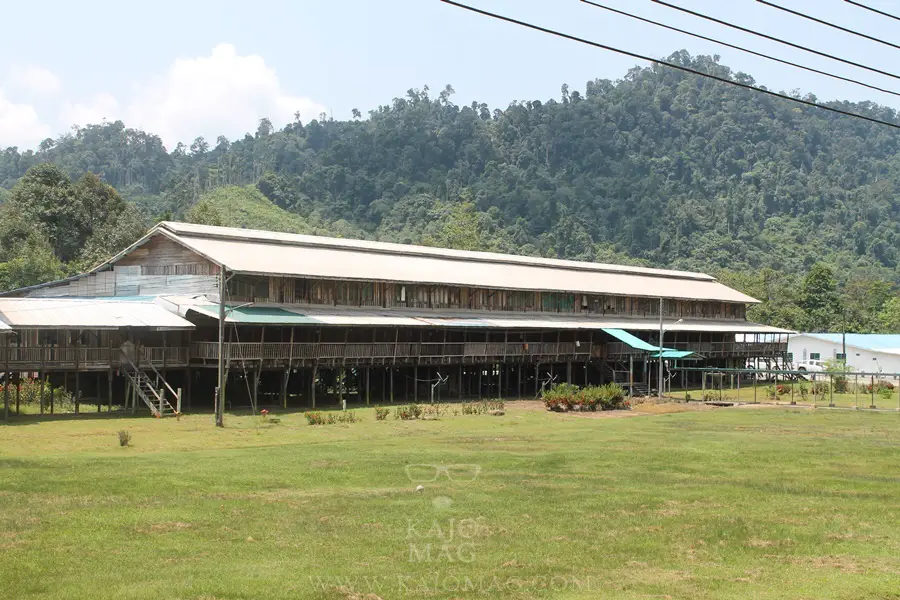
An example of a longhouse in Sarawak. This is Uma Lahanan in Sungai Asap.
Taking a bath

1.For girls, you learn the trick of using a sarong from young. Apart from using it to change your clothes or bathe, you also learn how to use it as a ‘life-buoy’.

2.You check out the water level in the metal drums before taking your bath.

3.If the water levels on these metal drums are too low, then you find your excuse to bathe in the river.

4.When it starts to rain, you run to make sure all the metal drums are out in the open to collect the rainwater.

Learning all kinds of life-skills in the longhouse

5.Growing up in the longhouse enables you to learn all kinds of life-skills such as how to catch fish with your bare hands in shallow water creeks between the stones, how to use a fish net or set up a bubu (bamboo fish trap).

6.You also learn the basics of rowing a longboat; how to change the direction when rowing and how to push the boat away from a tree or a wharf using an oar.

7.You get yelled at at least once in your life for holding on to the edge of the boat when it is docking.

8.Sometimes, you are trusted to dock the boat. But somehow, somebody is always there to retie your knot.

9.You spend the night catching green cicadas using only a plastic bag tied to a stick. After deep-frying them, those green cicadas made the best ‘keropok’.

10.Sometimes, you helped your grandparents, parents, aunties sell some kuih from ‘bilik’ to ‘bilik’.

11.Usually, doing dishes is a chore that requires three people. The first person to sponge the dirty dishes with dish soap, the second person to rinse the dishes in the first basin then the third person doing the final rinsing in the second basin.

12.You learn how to wash your own clothes from early on.

13.In addition to that, doing laundry is also communal work, especially when draining water out of thick clothes. One person needs to hold one end while the other twists it till the water is totally wrung out.

Celebrations at the longhouse
50 things you would understand if you spent your childhood in a longhouse
Preparing for a celebration usually requires the work of all ages.

14.Before any celebrations such as Gawai and Christmas, you love to help in baking cookies and cakes. One reason is you get to eat the cookies and cakes. Another reason is that you know where your elders stash them away just in case somebody decides to finish them off before the celebration.

15.However, what you do not like about preparing for any celebration is the cleaning part. You need to help in cleaning the whole bilik and decorate the living room. You will also be needed to help take out all the dishes and glasses to wash.

16.Christmas caroling is fun because you get to visit almost every ‘bilik’ at the longhouse. Sometimes, you can even visit other longhouses.

17.Then during these celebrations, you secretly enjoy watching your drunk relatives.

18.The best part about these celebrations is to ‘ngabang’ or visit from ‘bilik’ to ‘bilik’.

19.There are only two modes of transportation when visiting other longhouses; riding in a longboat or sitting on the back of a 4WD.

50 things you would understand if you spent your childhood in a longhouse
Once you reach your teenage years, riding in the back of 4WD somehow is a common thing.
Your childhood entertainment at the longhouse

20.If you walked past a ‘bilik’ which had cartoons on their TV, chances are high you would stop there and watch.

21.You create all kinds of games with your cousins. Some of these games come with punishments for the losers.

22.Additionally, you create games when taking a bath in the river. The most common games are who can hold their breath underwater the longest or who can swim from one point to another point the fastest.

23.You learn how to make somersault dives into the river.

24.If there is one bicycle among your cousins, everyone takes turns riding it.

25.Mosquito bites and scratches are common on your body.

Going to the kebun

26.You dread about going to the farm or orchard but you end up playing the hardest there.

27.Plus, you pick and taste all kinds of wild fruits and berries along your way to the farm.

28.Wearing adidas kampung is essential but you also learn how to walk barefoot in the jungle. The key is to walk only on soil surfaces while gripping it with your toes and also avoiding any sharp thorns.

29.Growing up, you get yelled at at least once in your life for the wrong way you handle the parang.

30.Furthermore, you get scolded at least once for breaking a taboo in the forest.

31.You pick up the skill of gathering firewood.

32.The best part about lighting up a fire is fanning it.

33.When it comes to picking fruits, ‘jolok’ is your best friend.

34.Speaking of fruits, you stay to wait for durians to fall at least once in your life. And that ‘thump’ sound you hear gets you running like crazy.

35.Food, as simple as it is at the longhouse, seems to be extra delicious during lunchtime at the farms or orchards.

36.Food is also more delicious when enjoying it by the river.

Your nighttime at the longhouse

37.Communal sleeping is common in the longhouse. Sometimes you fight with your cousins for the best spot to sleep at night. And the best spot is usually somewhere near the fan, not near the door or next to someone who snores.

38.You are familiar with the smell of kerosene at night, all thanks to kerosene lamps.

39.Additionally, you are used to sleeping to the sound of a diesel power generator.

40.You must go to the loo before sleeping just to avoid a journey to the toilet in the middle of the night.

Watching the adults in the longhouse

41.You enjoy watching the elders playing the Four-colour card game.

42.Sometimes you even watch them gamble or engage in cock-fighting.

43.When the elder men e.g. your father or uncles come back from a hunting or fishing trip, you run to see what they caught.

50 things you would understand if you spent your childhood in a longhouse
Raise your hand if you recognise this.

44.You secretly roll the traditional tobacco cigarettes for fun (sometimes even light it up out of a dare).

45.Besides cigarettes, you learn how to wrap Areca nuts (buah pinang).’

50 things you would understand if you spent your childhood in a longhouse
Areca nuts. Credits: Pixabay

46.You like to watch the women cutting Areca nuts using the special cutter and even try to cut them on your own.

47.Sometimes, you also need to help in wiping the betel leaves (daun sirih) clean.

48.On top of these, you actually try to chew Areca nut wraps and then realise it is not a wise decision.

49.Admit it; you recognise the smell of Zam Zam hair oil and coconut oil.

50.You get lice in your hair at least once in your life after coming back from the longhouse.

Do you have other experiences spending your childhood in the longhouse? Share with us in the comment box.

The mysterious post-war ghost ship found in Mukah

Also known as a phantom ship, a ghost ship is actually a vessel with no living crew aboard. It can be because of two reasons.

Firstly, it is just a haunted ship or at least rumoured to be haunted just like the Flying Dutchman in the Pirates of the Caribbean. The second reason is because it was found adrift with its crew missing or dead.

The term ‘ghost ship’ is sometimes referred to ships that have been decommissioned but not yet scrapped. It is also a term used for drifting boats that have been found after breaking loose of their ropes.

And that was the case of the ghost ship found in Mukah at the end of January 1948.

The mysterious post-war ghost ship found in Mukah
A post-WWII ghost ship in Mukah? Credits: Pixabay
The post-war ghost ship in Mukah

On Mar 1, 1948, The Sarawak Gazette reported there was “an unheralded guest” which arrived on the coast of Sarawak.

The ‘guest’ was a vessel found about 20 miles east of Mukah with no crew on board.

The report stated, “Weather conditions were unfavourable for an examination until Friday the 13th February when a launch from Kuching arrived there.”

After an initial examination, they found out the vessel was a landing craft tank (LCT).

A LCT was an amphibious assault craft for landing tanks on beachheads. These landing tanks were initially developed by the British Royal Navy and later by the United States Navy during World War II (WWII).

By the looks of it, the LCT found off Mukah had been taken out of commission after WWII.

There were no documents on board and the living quarters showed no sign of recent use.

Nonetheless, there were some clues found on the adrift LCT. “On the bow the number 930 is painted in large letters and a stencil on the aft bulkhead reads ‘This craft reconditioned by Philippine Consolidated Shipyards.'”

The markings also indicated that the probable date of the reconditioning was June, 1947.

In addition to that, they found only one of the five engines to be in working order.

The hull of the vessel had been smashed to that extent that the craft was in danger of breaking in two.

The theory behind the ghost ship found adrift

Since there was no living soul on board the ghost ship to give their testimony to how she ended up where she was found, the best that Sarawakians at that time could do was guess.

The Sarawak Gazette writer guessed that the ghost ship was actually a United States naval vessel which had been laid up probably in the Philippines and probably also alongside other vessels.

“She had broken adrift during a storm and had badly damaged the upper sections of her hull by rolling against the sides of neighbouring craft.”

One crucial clue that the ghost ship given was that her mooring ropes still dangled from her port and starboard quarters.

Plus, with side tanks undamaged she retained sufficient buoyancy to weather the storms. She eventually got stranded off the coast of Borneo ending her involuntary voyage.

Cost of food was also an issue in Sarawak back in 1899

No matter which country or century you are from, living expenses like the high cost of food has always been a primary concern.

But did you know this issue also affected the people of Sarawak even in 1899?

In an article published in The Sarawak Gazette on Nov 1, 1899, an unnamed author compared the increasing of cost of food in the former kingdom, highlighting how much the prices had increased over the years.

According to the author, there were no import duties on any food stuffs. Meanwhile, the market tariffs only affected vegetables, pork and fish, and these to a very small degree.

Here at KajoMag, we enjoy looking back through history, and so here is how much our food commodities cost back in 1899:

1.Fish products

Fish was sold at the market for 1/2 to 1 cent per catty (the weight equivelent of 604g). Salted terubok fish was sold at 2 or 3 cents each, which then increased to 8 to 10 cents in 1899.

The author also complained that salted tenggiri fish was selling at $5 per picul (which is old-school for a shoulder-load or 60kg), and then increased to $18.

Even dried prawns suffered the same fate whereby the price rose from 7 to 8 cents per catty to 20 cents.

Cost of food was also an issue in Sarawak back in 1899
Dried shrimp. Credits: Pixabay.

2.Vegetables

The switch from vegetables to pepper cultivation had led to an increase in vegetable prices in Sarawak in 1899.

“How prices have risen with the last few years the following figures will show: Kribang or sweet potatoes which is a staple article of food formerly cost 35 to 40 cents per picul and now cost $1 to $1.50, and all other vegetables have risen over 50%.”

3.Pigs

The author also wrote about the price of pigs in 1899, “Pigs which were formerly sold at $9 per pikul now fetch $24 per pikul, and the retail price has risen from 13 to 14 cents per catty to 30-35 cents.”

Sarawak used to import pigs from Pontianak but then the number slowly decreased due to export duty imposed on these animals.

Was price control the answer to the high cost of food?

Although the author concluded that the cost of living and the cost of production had increased in Sarawak, he pointed out that the ‘reasons and the remedy for it are beyond us’.

He stated, “The government cannot say to a man, ‘you shall produce such and such food stuff and sell at such and such a price’. That experiment was tried during the first French Revolution and failed miserably.”

So according to the author, the government’s hope that bringing Hakka immigrants to plant more rice and vegetables would be fruitful in catering to the increasing demand of food.

He continued, “Cheaper rice would doubtless make a difference but we cannot hold out hopes of any great reductions either now or in the near future.”

More than 100 years later, these prices have never been reduced!

10 easy Korean dinner recipes you can try at home

With plenty of Korean grocery shops popping up around the world, it is becoming easier and easier to buy ingredients and whip up your own Korean recipes at home.

Korean cuisine is easily accepted in Asia since it is largely based on rice, vegetable and meats… unless you can’t stand spicy food. Speaking of which, there are plenty of non-spicy but still delicious Korean food for you to try.

The basic ingredients are usually kimchi, gochugaru (Korean red chili pepper flakes), gochujang (Korean red chili pepper paste), sesame oil, doenjang (fermented bean paste) and soy sauce.

For beginners out there, here are 10 easy Korean dinner recipes you can try at home:

1.Sundubu jjigae (Soft tofu stew)

The main ingredient for this Korean dinner recipe is freshly curdled soft tofu which has not been strained and pressed.

Other ingredients are mushroom, onion, vegetables such as spring onion with common seasoning like gochujang and gochugaru. You can turn this stew into a vegetarian dish or put in some seafood or meat.

Traditionally, soft tofu stew is cooked and served directly in a robust porcelain vessel. But if you don’t have that, you can always cook it in a pot.

Add in some kimchi and replace the soft tofu with cube tofu and you can turn it into a spicy kimchi stew.

Watch how to make it here.

2.Kimchi Bokumbap (Kimchi Fried Rice)

Fried rice is a favourite dish here in Asia especially in Southeast Asia. Plus, it is so easy to make since you can use leftover rice along with other ingredients.

As for this dish, add ingredients such as kimchi, egg, spam, radish, carrot and onions.

It is a perfect inexpensive dinner that can be whipped out in a short period of time.

Watch how to make it here.

10 easy Korean dinner recipes you can try at home
Kimchi Fried Rice.

3.Bibimbap

The key to making bibimbap for your Korean dinner at home is preparation. You mostly need to prepare different kinds of namul (sauteed and seasoned vegetables).

Among the basic vegetables served in a bibimbap are kimchi seasoned spinach, seasoned bean sprouts, shiitake mushrooms, carrots, green onions, radish and cucumber.

As for your protein source, a bibimbap is usually served with fried egg and slice beef.

Once you have all of these ingredients, it is time to serve them on top of a bowl of warm rice along with some gochujang.

Watch how to make it here.

10 easy Korean dinner recipes you can try at home
Bibimbap

4.Army stew

If you are not a big fan of processed meat, this is not for you. The main ingredients for this Korean stew are kimchi, Spam (or luncheon meat), bacon and hot dogs; basically all processed meat.

Why these ingredients? The story goes back to the Korean War in the 50s. When it ended, food was scarce in South Korea. Those who lived around US army bases started to make dishes of surplus foods from these army bases, whose rations typically comprised of processed meat.

Even with food aplenty today, this army stew continues to be popular among South Koreans.

One of the reasons is perhaps because they are easy to make. Basically just boil the broth and throw all the ingredients into it.

To season the broth, add in gochugaru, gochujang, soy sauce and garlic. While the broth is boiling, put all of your processed meat together with some vegetables such as spring onion and cabbage.

Watch how to make it here.

5.Spicy Korean stir-fried pork

What makes this Korean dinner recipe easy to make is that you can prepare it ahead before cooking it.

You can marinate your pork the night before or early in the morning before you leave for work then stir-fry it once you reach home.

Or you can marinate your pork only for 30 minutes.

To make your marinade, throw in the basic ingredients such as gochujang, soy sauce, sugar, ginger, garlic, gochugaru, apple, onion and black pepper into the food processor.

Watch how to make it here.

6.Doenjang jjigae (Soybean paste soup)

So you can’t stand anything spicy? Here is a Korean dinner recipe which uses doenjang or soybean paste, instead of gochujang.

Boil it with available ingredients in your kitchen such as carrot, mushroom, radish, scallions and tofu.

But if you still need that hint of heat, add in a little bit of gochujang (red chilli paste).

Watch how to make it here.

7.Bulgogi

Originally, this dish is grilled on top of a griddle or a barbecue. However, you can always stir-fry it in a pan.

You can prepare the ingredients ahead of time by marinating thin slices of sirloin with soy sauce, sugar, sesame oil, garlic and black pepper.

When you pan fry it, add in other ingredients such as scallions, ginger, onions and mushroom.

Watch how to make it here.

8.Dakgangjeong (Sweet crispy chicken)

Do you love fried chicken? Take your favourite dish up a notch with dakgangjeong.

Basically you need to season your chicken and cover it in starch before you deep fry it. After that, coat your deep fried chicken with seasoning sauce.

The seasoning sauce is mainly made from gochujang, garlic, ginger soy sauce, honey or corn syrup to give it the sweet taste.

Your fingers might be messy and sticky when eating this dish but if the seasoning sauce is made right, your dakgangjeong will definitely be finger-licking good.

Watch how to make it here.

9.Tangsuyuk (Sweet and sour pork)

There are two parts to making tangsuyuk for your Korean dinner at home; at first you need to deep-fry your pork and then you need to fry the meat again with your sauce.

To make your pork batter, you need to soak a mixture of potato and corn starch in water for several hours before draining the excess water. This traditional method of making the batter is to ensure the crispiness of your fried pork.

Meanwhile for the sweet and sour sauce, boil soy sauce, sugar, water with other vegetables and fruit like carrot, cucumber, onion, apple, pineapple and wood ear mushroom. To thicken the sauce, pour a little bit of starch slurry.

Watch how to make it here.

10.Mauentang (Spicy fish stew)

If you are looking for a new way to cook your fish, making a maeuntang or spicy fish stew is a good start.

Again, it is seasoned mainly with chilli powder, gochujang, garlic and soy sauce with fish as its main ingredient.

You can also add in some vegetables such as radish and watercress into your spicy fish stew.

Watch how to make it here.

5 South Korean zombie movies you need to watch

You have to admit, Korean zombies are among the scariest of all fictional zombies; they run, they run in a horde, they twist into bone-breaking pretzels, they eat people alive… they are exactly what you imagine zombies should be.

When comes to terrifying an audience, Korean zombies can beat most Hollywood zombies (except those from 28 Days Later and World War Z) and of course Malaysia’s own zombies from Kampung Pisang.

Here are five South Korean zombie movies you need to watch:
1.Train to Busan (2016)

When comes to zombie movies, this is THE zombie movie to watch. Starred Gong Yoo, Jung Yu-mi and Ma Dong-seok, the movie takes place on a train to Busan as a zombie apocalypse suddenly breaks out.

The audience also get to watch the reunion for Gong Yoo and Yu-mi who both starred in a based on a true story movie Silenced (2011).

Anyway, the storyline is thrilling and the acting even for those who had only small roles is impressive.

To top it all, the zombies are just purely gory and terrifying.

We guess the movie is so good that there is a sequel in the pipeline with the Korean title Bando.

Watch the trailer here.

2.Seoul Station (2016)

If you wondering how did the events in Train to Busan unfold, then you need to watch its prequel animated zombie film.

Released a month later after Train to Busan, Seoul Station (2016) revolves around a young runaway woman named Hye-sun.

It also centers around her father Suk-gyu who is looking for Hye-sun only to find out she has become a prostitute.

While a father-daughter reunion is about to take place, a zombie epidemic conveniently breaks out in Seoul.

Watch the trailer here.

3.Rampant (2018)

When Korean period drama meets zombie epidemic, what you get is Rampant (2018).

Since it is set during the Joseon dynasty, you can imagine there would be horse riding, sword fighting, some archery skills in the movie.

The story circles around a prince named Lee Chung (Hyun Bin) who was given to the Qing empire as a political hostage.

When he returns upon hearing the death of his brother the Crown Prince Lee Young, Lee Chung is met with zombie epidemic plaguing his country.

Though the plot is predictable (you basically know which one is the bad guy and who is going to sacrifice himself in the end), this Korean zombie movie is still worth to watch.

Why? Because of the zombies of course! They are creepy, quick, disgusting and just scary.

Watch the trailer here.

4.The Odd Family: Zombie on Sale (2019)

If there is a possibility of a profiting from a zombie, would you give up the opportunity? This zombie comedy film revolves around the Park family who resides in a peaceful rural town.

One day, the whole town turns up and down when a zombie suddenly appears.

So the Park family decides that they need to find the zombie and tries to profit from it.

Watch the trailer here.

5.Kingdom (2019)
5 South Korean zombie movies you need to watch

First of all, this is not movie but a Netflix original series consists of six episodes. It is on the list because we cannot talk Korean zombie onscreen without mentioning Kingdom. It is definitely worth-watching.

Adapted from the webcomic series The Kingdom of the Gods, the series is set in Joseon period.

It tells the story of Crown Prince Yi Chang (Ju Ji-hoon) who becomes embroiled in a political coup. While investigating about what happened in the palace, the prince embarks in journey that takes him right into a zombie epidemic.

On top of the exciting plots which keeps audience on their toes, we cannot help but notice the picturesque cinematography.

You might be flip a table after watching the series because the ending is a cliffhanger. But fret not, the filming for the second season had started last February so yeay!

Watch the trailer here.

The massacre of Sarawak officers at Long Nawang during WWII

When news of Japanese troops coming to attack Sarawak broke out, the Chief Secretary put out instructions requiring all Brooke officers to remain at their stations.

However, a group of Sarawak officers decided to flee the kingdom and head to Dutch Borneo. Their decision to take refuge near the border of current day Kalimantan led to what most historians called the Long Nawang Massacre.

The journey to Long Nawang from Sibu

According to local historian Ooi Keat Gin, the Brooke officers in the Lower Rejang fled in a party of 26 men, three women and two children who were aged nine months and five years old.

The party was led by Andrew Macpherson, Resident of the Third Division. He brought along his wife who was then six-months pregnant. Other Brooke officers in the group included Sibu, Kanowit and Kapit district officers.

Ooi wrote, “Macpherson’s plan was to go up the Rajang, cross over into Dutch Borneo to Long Nawang, a Dutch military outpost.

“The party reached Kapit by motorboat, negotiated the Pelagus Rapids to arrive at Long Bahau above Belaga. They stayed at Kenyah longhouses along the way. After Belaga, smaller and lighter boats brought them through the shallower, rapid-infested headwaters of the Ulu Rejang.”

After 28 gruelling days of crossing treacherous mountains on Jan 22, 1942, the group finally arrived at Long Nawang, which was also a Kenyah settlement.

There, the party had the comfort of a four-bed hospital with an adequate supply of medicine. Furthermore, they had enough food supply to last for a year.

Macpherson and his team separate at Long Nawang

After arriving at Long Nawang, Macpherson who was suffering from malaria, decided to stay there. However, he allowed the rest to proceed and carry on their plans.

So four men – Jacks, Schotling, McKerracher and T.E Walter – decided to go to Long Iram and then Samarinda.

The men reached Samarinda and managed to board a plane to Bandung. Somehow Jacks and McKerracher eventually reached Perth while Walter and Schotling were captured and imprisoned by the Japanese.

Meanwhile another group of Brooke officers unfit to travel decided to return to Belaga. There, they were eventually taken into custody and interred at Batu Lintang POWs Camp. They may have had a better fate than those who stayed behind at Long Nawang.

The other refugees of Long Nawang

Besides Macpherson and his team, there was another group of Brooke officers and a missionary priest from Marudi who made their way to Long Nawang.

According to retired Mill Hill Missionary priest Theo M. Feldbrugge, he had a paternal uncle who was a Mill Hill priest during World War II.

The older Rev Feldbrugge was the parish priest of Marudi. Together with Resident of Marudi Mr Hudden and a few other British officers, they decided to go to Kalimantan to seek refuge.

“So they walked up to Baram and by boat and then they walked all the way to Long Sang, Long Nakang and across the mountains down the riverside till finally they ended up in Long Nawang.”

The arrival of Dutch and Indonesian soldiers

In April 1942, Lieutenant D.J.A Westerhuis arrived at Long Nawang along with 40 Dutch and Indonesian soldiers.

Four months later, two Kenyahs brought the news that more than 70 Japanese soldiers were on their way to Long Nawang.

But Westerhuis did not believe that the Japanese would ever discover their hideout.

Rev Feldbrugge pointed out that Long Nawang was at the very head of the Mahakam river in Indonesia which went to Balikpapan.

“And they thought the Japs would never come. But the Japs were in Balikpapan and they were told God knows by whom that Orang Putih were there in Long Nawang.”

So the Japanese came up to Long Nawang, trickling in via Mahakam river.

The massacre

On August 20, 1942, about 76 Japanese marines led by Captain Mora Shima arrived at Long Nawang attacking the border post with mortars, light machine guns and rifles.

Many were killed during the attack. The Japanese rounded up the surviving Europeans, imprisoning them while they allowed the Indonesian soldiers to return to their military post at Tarakan.

There were at least two eyewitnesses for what happened next; Corporal Tamburiang and Private Markus who were former native polices living in Long Nawang were executed on Aug 26 and buried in two graves.

Then a month later on Sept 23, the Japanese massacred all the women and children.

Another witness, Tusau Padan who was 11 years old at that time saw how the execution of the children took place.

The young children were forced to climb palm trees. Then they were impaled on the upraised bayonets when they slipped down in exhaustion.

All the women and children were buried in one grave.

After the war, the victims of Long Nawang massacre were exhumed and reburied on Tarakan island at Makam Pahlawan.

There have been requests by the descendants of the massacre victims to bring them home from Tarakan to Sarawak.

Among them were the grandchildren of Desmond Vernon Murphy, a British officer serving as Assistant Superintendent of the Sarawak constabulary and Sarawak Rangers.

Murphy was one of the officers who joined Macpherson to Long Nawang and later executed. His grandchildren wanted him to be buried in the Heroes Graves in Kuching so that it would be easier for them to visit to pay their respects.

The massacre of Sarawak officers at Long Nawang during WWII
Tarakan War Cemetery after the dedication on Oct 9, 1945. Photographer: Lt W. N. Prior.
Credit: Public Domain (Copyright expired).
Why did the Japanese massacre the refugees of Long Nawang?

It took the Japanese alone four weeks to reach Long Nawang. Having to travel out of the area with the more than 40 prisoners including women and children along would have taken them even longer.

For the Japanese troops at that moment, it was more expedient to kill the prisoners right there in that thick jungle.

Another reason why they were killed was because, for the Japanese, the refugees were considered enemy fugitives (even Macpherson’s newborn baby).

Ooi wrote in his book The Japanese Occupation of Borneo, “The fact that the refugees at Long Nawang did not voluntarily surrender themselves as was the expectation of the Japanese military authorities following the establishment of a new regime in Borneo made them, legally speaking, enemy fugitives.”

He added that from this perspective their execution was in line with wartime military requirements.

As for Captain Shima, the man who was responsible for the Long Nawang Massacre? There were no traces of him after WWII, and so he was never persecuted for his war crimes.

The 1994 failed British Army Expedition down Low’s Gully

There is an African proverb: “Do not call the forest that shelters you a jungle” unless you choose to dismiss it so casually.

The forest can offer solitude and a piece of heaven for adventurers, but when a group of unprepared soldiers tried to conquer one of Mother Nature’s deepest gullies in a badly-planned training exercise, the jungle was prepared to give anything but comfort for them.

Low’s Gully

Low’s Gully is located at Borneo’s Crocker Range and shares the same national park with Mount Kinabalu, the highest peak in Malaysia.

It was named after British administrator Hugh Low who first looked down it in 1851. The site is a 1,800m deep gorge carved out by glaciation on the north side of Mount Kinabalu.

The gully is one of the least explored and most inhospitable places on earth.

Nobody attempted to make a descent into the gully until 1994. On Feb 21 that year, seven British and three Hong Kong soldiers tried to abseil and climb down into the gully.

The team members going into Low’s Gully

The commander of the army that led the expedition was Lieutenant-Colonel Robert Neill. His second-in-command was Major Ron Foster.

Together, they both set up the 10-man team. Joining them, there were two corporals – Steve Page and Hugh Brittan from the Royal Logistics Corps – and Lance Corporal Richard Mayfield. Mayfield was also an expert survivalist and rock climber.

The other two British soldiers were a Territorial Army Sergeant Robert Mann and Corporal Pete Shearer.

Also with them were the three Chinese soldiers from Hong Kong, Lance Corporal Cheung Yiu Keuong and Privates Lam Wai Kee and Chan Wai Keung.

Why the expedition into Low’s Gully was a disaster from the beginning

Even before it started, the expedition seemed to be doomed anyway. The first mistake was not to equip themselves with a radio or flares.

On top of that , the three Hong Kong soldiers only learned how to abseil a few days before the expedition. And then, there was the language barrier among the soldiers.

Although some of the team members were familiar with each other, some of them only met weeks prior to the expedition. Hence, there was no teamwork or rapport right from the beginning.

The 1994 failed British Army Expedition down Low’s Gully
Low’s Gully is located at the north side of Mount Kinabalu, at Malaysian state of Sabah.

The mistakes along the way

The journey to Low’s Gully needed the team to climb to the summit of Mount Kinabalu first before making down on the north side of the mountain.

Even the tourist path to the summit was difficult for the Chinese soldiers in the beginning.

Plus with their backpacks weighing 35-40kg, the less fit soldiers found the climb exhausting and they felt overburdened.

This led to their first mistake during the expedition: the Chinese soldiers started to ditch their rations to lighten their loads.

Slowly, the team members were divided into two; the fitter five British soldiers against Lt. Col Neill, Major Foster and the unprepared, unfit Chinese soldiers.

So, the fitter party broke away from the group and made the first descent of the gully in three days. They reportedly even took the second group’s ropes and parangs.

After they made their descent, they waited for 12 hours for Lt Col Neill and the rest to descend…but they never came down.

Then they decided to set off through the jungle where they spent another two weeks making their way out to civilisation. Over this period, they swam through leech-infested pools, abseiled down waterfalls and survived through the Bornean rainforest.

The first team out

As the days went by, the five-man party also started to separate. Mayfield and Mann went their own way after being separated by the jungle’s thick undergrowth.

Finally after 18 days of what was meant to be a ten-day expedition, the pair found their way to civilisation. The locals who found them gave them food and even treated their wounds.

Upon their return, they found the other three had also made it safely back. Now they had to rescue Lt Col Neill and his four other team members.

They, however, found out that nobody had raised the alarm as nobody thought that they were missing. This was because Neill had not given a finishing date to the authorities.

The rescue from Low’s Gully

The rescue for the stranded soldiers was said to be one of the most expensive and embarrassing missions the British Ministry of Defence had ever taken.

International medias flew halfway around the world, setting up camps at Kinabalu Park as they covered the search and rescue.

The search operation involved up 1,000 people from various parties including the Malaysian Army. It took them 12 days until they finally spotted the stranded soldiers.

According to The Independent’s news report, the five-member party was spotted in a narrow ravine, trapped ‘like a spider in the bathtub’. The men were stuck between two giant waterfalls, in a place Malaysian soldiers called ‘a point of no return’.

Malaysian helicopter pilot, Captain Mohamed Izhar was the first one who saw the stranded soldiers.

He spotted ‘SOS’ written in pebbles on a boulder in a river. Then, they spotted three soldiers standing on rocks, waving and reflecting the sun at them with mirrors.

Niell and Lam were the first two soldiers rescued from the ravine and were flown to a hospital in Kota Kinabalu.

After several attempts, the final three were rescued from their misery.

The Aftermath

Brittan, Mayfield and Cheung all received commendations for their actions during the ordeal.

Mayfield sued the British Minister of Defence after suffering from dehydration, malnutrition and mental trauma after the expedition. He told the court that he warned his commanding officer Neill that the expedition should be aborted after he had abseiled down part of the gully ahead of the rest of the group.

Furthermore, Mayfield said he would only continue if it was an order. He won more than £100,000 in compensation. Apart from Mayfield, Mann also won compensation for his injuries.

Meanwhile, both Neill and Foster were severely criticised for their judgement and leadership. They knew the expedition was going to be difficult and proceeded to carry on anyway while bringing along the three inexperienced soldiers.

1 49 50 51 52 53 75