Patricia Hului

Patricia Hului is a Kayan who wants to live in a world where you can eat whatever you want and not gain weight.

She grew up in Bintulu, Sarawak and graduated from the University Malaysia Sabah with a degree in Marine Science.

She is currently obsessed with silent vlogs during this Covid-19 pandemic.

Due to her obsession, she started her Youtube channel of slient vlogs.

Follow her on Instagram at @patriciahului, Facebook at Patricia Hului at Kajomag.com or Twitter at @patriciahului.

The inspiring story of MV Nam Hoi and its crew during WWII in Igan

If you’ve never heard of Igan, it is a small district located near the Batang Igan river in the central region of Sarawak.

The population is mostly made up of Melanau people, who are famous for their umai, a kind of ceviche, and sago paste called linut.

It may be a small and unassuming town, but it is the centre of one inspiring piece of World War II (WWII) history.

The story of MV Nam Hoi and its volunteer crew

In December 1941, the Sarawak government chartered the M.V Nam Hoi to transport paddy and food rations from Sibu to Mukah.

Unfortunately, this was during the beginning of WWII. So when the vessel passed Igan, it happened during the Japanese bombing.

According to a story published on Jan 2, 1948 in The Sarawak Gazette, the crew decided to abandon ship and go ashore, refusing to continue with the voyage.

The story stated, “As the cargo was urgently needed in Mukah and it was dangerous for the vessel to remain at Igan which was on the daily route flown over by Japanese aircraft, the then District Officer, Mukah, telegraphed to the Resident asking for permission to take a volunteer crew head quarters to obtain possession of the vessel and complete the voyage.”

The resident agreed with the proposal but instructed the district officer to remain at his station.

So the district officer promptly put together a crew. They were Abang Mostapha (Captain), Haji Zahawi (First Mate), Tuto bin Tajudin (Second Mate), Albert Galli (Chief Engineer from Sarawak Electricity Supply Company), Taha bin Haji Mohamad (Second Engineer) and Jaya bin Haji Talip (Engineer).

Meanwhile the rest of the crew were ex-constable Salleh bin Abang Kut, ex-constable Bujang, Salim bin Mohamad and Beki bin Haji Talip.

Heading to Igan from Mukah

Within half an hour after being summoned, the volunteer crew set out on bicycles from Mukah to Igan.

The report pointed out, “They travelled all night which was in itself a praiseworthy effort considering the age of some of the members.”

Here comes the frustrating part of the story; when they arrived at Igan, the original crew refused to board the vessel to show the volunteers how the engine worked, out of fear of the possibility of being targetted during the Japanese bombings.

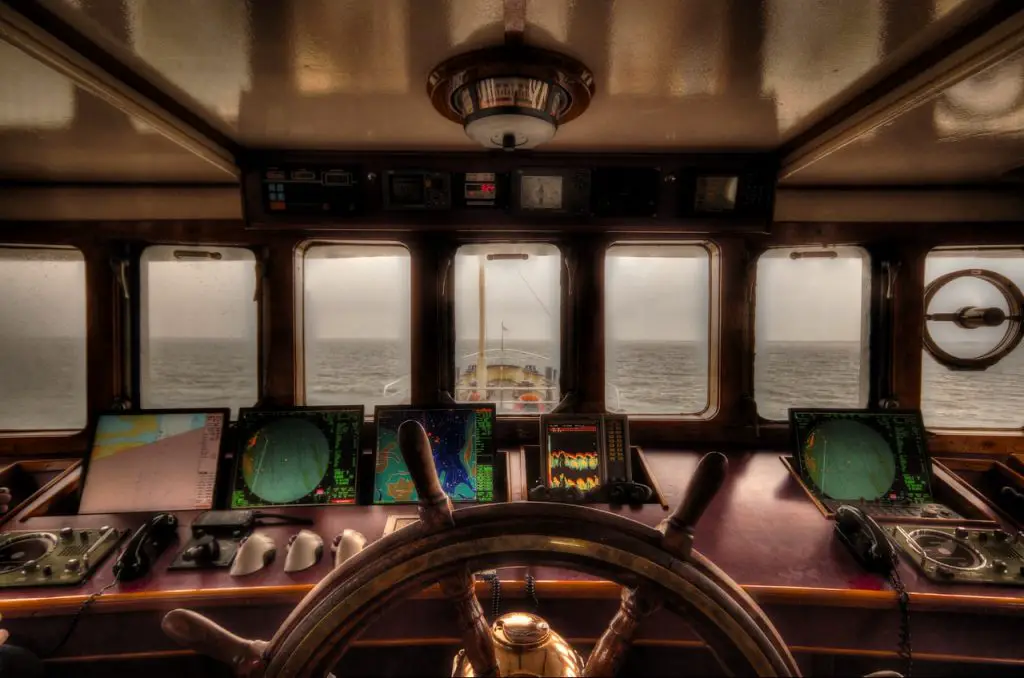
So the volunteer crew took things into their own hands. There was no other way than pushing random buttons as long as the engine started and the vessel got moving.

“Not one of the volunteers had any experience of a marine diesel but by pulling and twisting every knob she was eventually started.

“The hook was pulled up, Captain Mostapha rang down slow ahead and the Nam Hoi went full astern. Chief Engineer Galli could not remember which knob he had twiddled to get the ship moving and for two long tanjungs (capes) the Nam Hoi careered astern with the skipper playing a fanfare on the telegraph,” the report stated.

In the middle of the journey, the vessel was stopped and the engineers stepped in to check on the engines.

The chief engineer reportedly had the help of a bottle of whiskey to refresh himself while doing his job.

After awhile looking at how the ship was seemingly going in the right direction, the crew continued with their journey to Mukah.

Meanwhile, the first mate, Haji Zahawi who was also an imam, prayed loudly and unceasingly along the journey.

The inspiring story of MV Nam Hoi and its crew during WWII in Igan
Chief Engineer Galli could not remember which knob he had twiddled to get the ship moving. Credits: Pixabay.
Nam Hoi arrives in Mukah

The vessel arrived and was anchored safely in Mukah in the evening on the same day they started their journey from Igan.

Its arrival was in the nick of time because this was just about the time the Japanese planes few over Mukah.

Whether it was the whiskey or the imam’s prayers, one thing is for sure: MV Nam Hoi’s journey from Igan to Mukah would not have been possible without the courage and the willingness of its volunteer crew to carry their jobs.

Even when the original crew refused to board the vessel again simply to show them how to run it, they refused to give up.

In 1948, the then governor His Excellency Charles Arden Clarke sent a letter to every member of the volunteer crew in 1948 to show his appreciation and to acknowledge their bravery.

5 ways Sarawakians used to measure distance in the olden days

“One of the most difficult things in this world is to find out from a Dyak the distance between one place and another.”

This was what Charles Grant wrote in A Tour amongst the Dyaks of Sarawak Borneo in 1858 (1864).

According to Grant, most Dayaks would answer “Takut kabula” which means “I’m afraid of speaking untruly.”

He described their answers sometimes either “jau (far), ja-u(very far) or jau-u-u (awfully far) from the place”.

Without any knowledge of feet, meters or kilometers, how did they tell how far is a place?

Here are five ways Sarawakians used to measure distance in the olden days:
1.How many tobacco cigarettes away?

For some communities in Sarawak, one of the most common answers when asking the distance between two places was based on how many tobacco cigarettes one would smoke along the way.

Traditional tobacco cigarettes (made dried tobacco wrapped with dried banana leaves) were commonly smoked when travelling to the farm or another longhouse.

Besides to kill time, smoking these tobacco cigarettes also worked as natural insect repellent.

The only problem with this measurement was everybody smoked cigarettes at different rates. Furthermore, their cigarettes were never in the same size.

2.How many cooking pots of rice away?

According to Grant, another traditional way to tell a distance by the amount of pots to cook rice.

He wrote, “If the road is far, you will be told it is very far; if short, very short and so on. Their wars of reckoning, too are original. You are told you have gone one, or so many divisions, and have so many more to go; or that you will have to eat rice so many times between such and such a place.

“You are occasionally told you are so many cooking (or boiling) of rice from your destination (a cooking of rice maybe reckoned thirty or forty minutes).”

3.The sun position in the sky

Anglican bishop William Chalmers in 1859 pointed out as the Dayaks had no notion of dividing time into hours, their methods of reckoning distances were rather original.

One of the ways was, “To point to certain place in the heavens and say they can reach their destination when the sun is there.”

5 ways Sarawakians used to measure distance in the olden days
What do you think how far is that island according to the olden day’s measurement?
4.Is your hair dry yet?

Henry Ling Roth recorded in The Native of Sarawak and British North Borneo (1896) that the Sea Dayaks had a unique way to tell the distance.

“Short distances are described by arriving at such a place before the hair has had time to dry,” he stated.

5.Half a day or a day?

Here was and still is a common way to measure distance. It was either you would arrive at that place in a half a day or a day’s journey.

Besides these, do you know other ways Sarawakians used to measure distance back in the days? Leave them in the comment box.

Sarawak ten electrical commandments from the 1920s

Did you know that when plans for electric street lighting were drawn up in Penang and Kuala Lumpur in 1894, the second White Rajah Charles Brooke refused to adopt this new technology?

Despite his misgivings, Sarawak eventually had its first wired telephones installed around Kuching in 1898.

Then in 1914, the Anglo-Saxon Petroleum Company installed the first electrical power stations in Miri, while Borneo Company Limited installed another power station in Bau.

Finally in January 1923, a power station was completed at Khoo Hun Yeang Street and it started operation in June that year.

Today the road where the power station was once located is now known as Power Road, or Jalan Power.

After that, Sibu had its first power station installed in 1927, followed by Mukah in 1929.

From 1922 to 1932, the electrical supply in Kuching was managed by the Electrical Department, under the jurisdiction of the Public Works Department.

On Dec 1, 1928, the Electrical Department put out a PSA in The Sarawak Gazette to remind Sarawakians on how to use electricity wisely and safely.

Sarawak ten electrical commandments from the 1920s
Some of the Sarawak Ten Electrical Commandments from the 1920s are still applicable to this day.
Here is the PSA in which the department called the Ten Electrical Commandments. Some may be strange to us in 2019 as people who have Earth Day, high electricity bills, and a climate crisis, while a few are still applicable to this day:

1.Thou shalt have no needless drudgery in thy home – delegating to electricity all wearisome tasks.

2.Remember the clear light- leave it burning.

3.Thou shalt not permit the cords of thy appliances to become frayed and worn, and easy prey to short circuit.

4.Thou shalt not allow the frost to gather to an unseemly depth upon the freezing unit of thy refrigerator.

5.Remember thy bag of thy vacuum cleaner to keep it empty.

6.Thou shalt not forget that electricity is cheaper than eyesight, and shalt not use freely of the first to improve the second.

7.Thou shalt not tax thy electric circuits beyond their capacity lest they blow out their fuses.

8.Thou shalt not fail to keep extra lamps in the house against the day when they shall surely be needed.

9.Thou shalt have at least one light in every room controlled by a switch near each door – thus will you save much stubbing of toes and barking of shins.

10.Thou shalt utilise thy toaster and thy percolator and all thy table appliances to the fullest extent, for this wilt thou add to they own comfort and thy family’s enjoyment.

Sarawak ten electrical commandments from the 1920s
According to the Ten Electrical Commandments, you shalt not allow the frost to gather to an unseemly depth upon the freezing unit of your refrigerator.

15 South Korean revenge films you need to watch

They said revenge is sweet but here at KajoMag, we say it is sweeter when filmmakers make a movie out of it.

Perhaps the reason why revenge films are popular, especially the ones with good storylines and convincing lead characters, is because they bring the audience on an emotional roller coaster ride.

First, it creates a bond between you and the main character. Then it brings you down with sadness and sorrow when something important is taken from the character. When the character decides to take revenge, then you feel the eagerness and determination. After the revenge finally takes place, you feel satisfied along with the main character.

But we cannot talk about revenge films without mentioning those that come from South Korea.

Over the years, the South Korean movie industry has been generous in giving us revenge films that are not only satisfying to watch but borderline gruesome as well.

Here are 10 South Korean revenge films you need to watch:

1.The Vengeance Trilogy

The trilogy is a series of three films that are not connected in stories but directed by the same director Park Chan-wook.

The first installment Sympathy for Mr. Vengeance (2002) is a tale of how revenge can go wrong.

It all starts when a deaf-mute man kidnaps a young girl to pay for his sister’s surgery. When the young girl accidentally dies, her father seeks vengeance.

Meanwhile in the second installment Oldboy (2003) revolves around a man who is imprisoned for 15 years. He is then released without any explanation as to why he was confined and released.

When he think he has the freedom, he is given five days to learn his captor’s true identity or his new love interest will be killed.

As for the third and final installment aptly named Lady Vengeance (2005), the film tells the tale of a young woman released from prison doing time for a child killer. She of course seeks revenge against the man for whom she served time.

The movie really tells how long a person can hold grudges and how far they will go to seek revenge.

Watch the trailer here.

2.I Saw the Devil (2010)

Rolling Stone magazine picked this movie for its top 20 of ‘scariest movies you’ve never seen.” So you can imagine how scary the revenge must have been or how the events led up to the revenge must have been.

It follows Kim Soo-hyun (Lee Byung-hun) who embarks on a journey of revenge after his fiancee was brutally murdered by a psychopathic murderer.

Oh, did I mention Soo-hyun is a secret service agent of the National Intelligence Service (NIS)?

Hence, it is a cat and mouse story except the role of the cat switches between the antagonist and protagonist.

Furthermore, the psychopathic murderer (played by veteran actor Choi Min-sik) is everything you imagine your perfect villain to be: sadistic and brutal.

Watch the trailer here.

3.Mother (2009)

How far would you go to protect your son? Hye-ja is a single mom to 27-year-old Do-joon who is extremely shy.

Do-joon is prone to attack anyone who mocks his intellectual disability. Walking home one night, he encounters a young girl and then decides to follow her.

The next morning, she is found dead and Do-joon is accused of her murder.

Like any protective mother, Hye-ja sets on a journey to seek the real killer in order to free her innocent son.

Watch the trailer here.

4.Pieta (2012)

Imagine a job of threatening debtors into paying his clients, loan sharks who demand 10 times the return. That is what Kang-do does for a living.

To recover the interest, the debtors sign an insurance application for a handicap. And then Kang-do comes in to injure the debtors brutally so that they file the claim.

This might be a feasible idea to make ends meet. But what is not that feasible is to seek revenge for a woman who just shows up claiming she is your long lost mother.

That is what happens to Kang-do when a strange middle-aged woman visits him.

Later when he finds his mother missing, Kang-do goes to every person he crippled to find his mother.

Watch the trailer here.

5.Bedevilled (2010)

Have you ever thought what would make the perfect murder weapon to carry out your vengeance? In this Korean revenge film, a sickle fits the bill.

The story starts with Hae-won who escapes from her busy life to take a break in Mudo, an island where she spent her childhood.

There, she meets her friend from teenage years, Bok-nam. Bak-nam suffers under her abusive husband and her attention goes all to her young daughter Yeon-hee.

When her daughter is accidentally killed, Bok-nam seek her revenge by starting a killing spree on the island with a sickle.

Watch the trailer here.

15 South Korean revenge films you need to watch
When a mother carries around a sickle to avenge her daughter’s death. Credits: IMDB

6.Hwayi: A Monster Boy (2013)

Hwayi: A Monster Boy (2013) revolves around a 16-year-old boy who is raised by five criminal fathers to become the perfect assassin.

He follows his adoptive fathers in their criminal activity until he learns that the first man he killed was his real father.

That is when he starts his journey of vengeance against his criminal fathers who took him from his real parents.

Watch the trailer here.

7.Broken (2014)

“Life no longer exists for parents that lost their child,” is a famous quote from this movie. It centers around widower Lee Sang-hyeon (Jung Jae-young) who avenges the death of his daughter.

Frustrated with the pace of the investigation team, Sang-hyeon begins his own investigation. After he accidentally kills the first suspect, he finds out there is more than one culprit.

Then he sets to find those who are responsible for his daughter’s murder with the police hot on his trail.

Watch the trailer here.

8.No Mercy (2010)

This Korean revenge movie comes with a very shocking plot twist. It all starts with pathologist Kang Min-ho (Sol Kyung-gu) who is about to retire.

When a dismembered corpse of a young woman is found, Kang agrees to do one last job.

The main suspect for the murder is Lee Sung-ho (Ryoo Seung-bum). It seems like it is an easy case because Lee is all ready to confess for the murder. Or is there more to the story?

Watch the trailer here.

9.Soo (2007)

Two brothers, Tae-soo and Tae-jin separated when they were young. Tae-soo (Ji Jin-hee) becomes an assassin while Tae-jin becomes police detective.

When they finally reunite as adults, Tae-jin is suddenly killed. The killer really should know better than kill an assassin’s brother because Tae-soo then decides to get revenge.

10.The Five (2013)

What if you are physically incapable to take revenge on those who hurt you? Then you manipulate and threaten others to do it for you.

Go Eun-ah (Kim Sun-a) is a crippled woman who gathers four people to kill the serial killer who murdered her family.

In return, Eun-ah promises them her organs once her revenge is complete. However, things do not go as planned and the killer starts hunting them instead.

Watch the trailer here.

11.Don’t Cry Mommy (2012)

Don’t Cry Mommy is inspired by a real case of revenge which happened in South Korea. An 8-year-old Kim Bu-nam was raped by her 35-year-old neighbour Song Baek-gwon.

21 years later, following two divorces and months in a mental hospital, Bu-nam went back to her hometown where she stabbed Baek-gwon to death.

Acknowledging that she went through enough, the court sentenced Bu-nam to a three-year suspended sentence and a requirement that she receive medical treatment.

However in this South Korean revenge movie, the victim Eun-ah (Nam Bo-ra) is not that lucky. She takes her own life after being brutally raped by her schoolmates. This leads her mother Yoo-lim (Yoo Sun) on a path of vengeance to kill those who are responsible for Eun-ah’s death.

Watch the trailer here.

12.Monster (2014)

First of all, Kim Go-eun acting as Bok-soon in this movie is impressive. Bok-soon is known to be an aggressive woman with a mental disability.

She lives happily with her younger sister Eun-jeong while running a stall in a local market. Everything changed when a serial killer Tae-soo (Lee Min-ki) kills Eun-jeong.

Thus, Bok-soon’s journey to avenge her sister’s death starts making you wonder who is the real monster in this movie.

Watch the trailer here.

13.Azooma (2013)

This Korean revenge movie had its world premiere at the 2012 Busan International Film Festival. It centers around a mother seeking justice for the rape of her 10-year-old daughter.

When her daughter is sexually assaulted, Yoon Young-nam (Jang Young-nam) is not happy with how the police handles the case.

So Young-nam decides to track down the child molester herself.

Watch the trailer here.

14.Princess Aurora (2005)

This is a story of a woman who sets out to kill everyone whom she believes played a role in her child’s death.

At first glance, it seems that there is a serial killer on the loose asthere seems to be no connection between all the victims excepts for small sticker depicting a character from the popular “Princess Aurora” cartoon series is found at every crime scene.

Eventually, the killer allows herself to get caught simply to carry out the final act of her revenge.

Watch the trailer here.

15.Revenger (2018)

To sum up most of these Korean revenge movies, do not molest, rape or kill anybody because their family members, especially parents, will definitely come and find you.

Unlike the other movies on this list, Revenger (2018) is set in the near future where dangerous criminals are housed in a hellish prison island.

Then comes a man who purposely sends himself to the island just to carry out his revenge.

Watch the trailer here.

Get to know these 12 animal species named after Charles Hose

Charles Hose was not just a British colonial administrator, he was a prominent zoologist and ethnologist. He also contributed to the discovery of oil in Sarawak.

Hose first arrived in Sarawak in April 1884 when he was first posted in the Baram area. He was then made the Resident of Sibu on June 1, 1904.

Between April and June 1904, Hose led a force of 200 Kayans in Belaga on an expedition to attack the Dayaks on Bukit Batu.

This group of Dayak allegedly had committed murders against other tribes for three years.

During his tenure in Sarawak, he had explored most of Sarawak’s mountainous districts, especially in the far interior of Baram area.

He collected many species of flora and fauna and then presented them to the British and other museums.

Thanks to his contribution to science, he was conferred an honorary degree by the University of Cambridge.

Get to know these 12 animal species named after Charles Hose
A fort in Marudi named after Hose.
As for his work as a zoologist, several of these animals species were named after Hose:
1.Hose’s langur (Presbytis hosei)

In Sarawak, it lives in the lowlands and hill ranges, including the Dulit range and Usun Apau plateau.

According to Hans P. Hazebroek and Abang Kashim bin Abang Morshidi in National Parks of Sarawak, there were reports of sightings of Hose’s langur at Similajau National Park in Bintulu.

However, this might be an isolated population.

As for Niah’s lowland forest, Hose’s langur has no longer been seen where it was previously known to occur.

This animal is most often found in groups of six to eight animals. Additionally, each of this group comprises of one male, several females and their offspring.

They feed on seeds and leaves. It has four species namely Miller’s grizzled langur (Presbytis hosei canicrus), Everett’s grizzled langur (Presbytis hosei everetti), Hose’s grizzled langur (Presbytis hosei hosei) and Saban grizzled langur (Presbytis hose sabana).

2.Hose’s shrew or Bornean pygmy shrew (Suncus hosei)

This poor animal is often listed as the Etruscan shrew (Suncus etruscus) but they are actually a distinctly different species.

This species of shrew is endemic in Borneo particularly in northern Sarawak and northeastern Sabah.

Since there is little information about this animal, it has been listed as a Data Deficient species by IUCN in 2008.

3.Hose’s pygmy flying squirrel (Petaurillus hosei)

This nocturnal animal can be spotted in a nest hole in a dead tree of dipterocarp forest. Here in Borneo, Hose’s pygmy flying squirrel has been spotted in Sepilok in Sabah, Baram and Niah in Sarawak as well as in Brunei.

It is similar to the lesser pygmy flying squirrel but smaller in size and has totally pale checks.

4.Hose’s palm civet (Diplogale hosei)
Get to know these 12 animal species named after Charles Hose
An illustration by Joseph Smit. Credits: Public Domain.

Oildfield Thomas was a British zoologist who worked at the Natural History Museum. There he described over 2,000 new species and subspecies including Hose’s palm civet.

Thomas described it in 1892 a year after Hose collected the first specimen in Sarawak.

The interesting part is the first living specimen was only collected in 1997 and released after two months. That is almost a century after Hose collected it!

Besides Sarawak, Hose’s palm civet can also be found in Sabah, Brunei and Kalimantan.

5.Four-striped ground squirrel (Lariscus hosei)

Here is another species discovered by Hose that is completely endemic to Borneo. It is scattered around Sabah at Mount Kinabalu as well as mountains in northern Sarawak. This include Mount Dulit, Kalulung, Batu Song and the Kelabit highlands.

Just like Hose’s palm civet, it was Thomas who first described this species in 1892.

6.Fraser’s dolphin (Lagenodelphis hosei)

In 1895, Hose found a skull on a beach in Sarawak that he donated to the British Museum. Many years later in 1956, an expert in cetacean Francis Fraser examined the skull.

His discovered that it was a new genus of a dolphin. So the common name of the dolphin was named after Fraser while the specific name was given in Hose’s honour.

As it turned out, this dolphin can be found in the deep waters of the Pacific Ocean.

How about heading to the beach and collecting some bones or skulls? Who knows you could end up like Hose and have a species named after you years after your death?

7.Hose’s frog (Odorrana hosii)

While most of the animal species named after Hose were endemic to Borneo and rare, this one is more common than the rest.

It is a species that can be found in Southeast Asia including the Malay peninsular, Borneo, Tioman, Phuket, Bangka, Belitung and Java.

Perhaps the facts that it is more tolerant of pollution and more adaptable to secondary forest makes this frog plentiful in our environment.

8.Hose’s tree frog (Philautus hosii)

Also known as Hose’s bush frog, this species lives at the lowlands and hilly regions of Indonesia, Malaysia and possibly Brunei.

Get to know these 12 animal species named after Charles Hose
A portrait sketch of Charles Hose. Credit: Public Domain.
9.Hose’s toad (Pedostibes hosii)

This toad is distributed in Brunei, Indonesia, Malaysia and southern Thailand. It habitats subtropical or tropical moist lowlands forests and rivers.

Its more known common names are Asian yellow spotted climbing toad and Boulenger’s Asian tree toad.

10.Hose’s broadbill (Calyptomena hosii)

Unlike other birds in the genus Calyptomena, Hose’s broadbill is known for its distinct blue belly.

It is endemic to highland forests in northern Borneo.

11.Black oriole (Oriolus hosii)

In September 2011, photographer Tony Sawbridge visited Paya Maga in Ulu Trusan, Lawas. There he was able to catch the Black oriole in a photo.

Sharing his experience of capturing the Black oriole, Sawbridge told The Guardian, “It required a 4-wheel drive trip to see it, followed by a hike into site known to some local people, then two nights camping in the rainforest. We were told that were the first Westerners to see the bird in over ten years.”

This bird is one of the least known of the orioles and can only be found in Sarawak.

Hose was the one who collected the first specimen of this bird on Mount Dulit, at the head of Baram river.

Get to know these 12 animal species named after Charles Hose
Joseph Gerrald Keulemans illustrated this image of Black Oriole in 1893. Credits: Public Domain.
12.Hose’s Mongoose (Herpestes hosei)

Hose’s Mongoose is a subspecies of the short-tailed mongoose (Herpestes brachyurus) but it is sometimes considered a separate species instead.

This mongoose is similar to the short-tailed mongoose but with more reddish-brown and short hair.

Furthermore, the claws are straighter and more slender compared to Herpestes brachyurus.

The only known specimen of this species was collected in Baram way back in 1893.

Have a taste of Sabahan cuisine at Little Sulap

Delicious local food, excellent service, environmentally conscious, Insta-worthy setting and accessible location; these are all traits that describe Little Sulap in Kota Kinabalu.

Located at Jalan Dewan, the cafe is accessible even for tourists staying in the city centre area.

Have a taste of Sabahan cuisine at Little Sulap
A view of Little Sulap from its mezzanine floor.
Little Sulap’s unique menu

Firstly, thumbs up to Little Sulap for unique and creative names for its menu items.

One dish which consists of locally grown brown rice, fried crispy basung fish and turmeric sour soup is called Sumandak Godoot. “Sumandak” means young lady while “godoot” usually refers to someone who is a glutton in local Kadazandusun language. It’s great for those who get ‘hangry’ around mealtimes.

Have a taste of Sabahan cuisine at Little Sulap
Teruna Kesepian.

Another dish with an interesting name is Teruna Kesepian, which literally translates to ‘lonely young man’. The dish is similar to Sumandak Godoot except that it is served with fried chicken wings instead of fish.

So imagine telling the server, “I would like to have one Teruna Kesepian and two Sumandak Godoot, please.”

Both the fish and chicken are fried to perfection and the rice has a wonderful aroma. The turmeric soup might be a shocker for those who are not used to sourish food, but it is still palatable.

Have a taste of Sabahan cuisine at Little Sulap
The Original Sabahan.

But the must-try dish for KajoMag at Little Sulap is a dish that befits its name, Original Sabahan. On top of the brown rice and fried chicken, you can enjoy a selection of two local veggies and tuhau. You cannot not have tuhau when it comes to trying out local Sabahan cuisine.

Don’t feel like having rice? Then try their ambuyat set. Similar to Sarawak’s linut, it is a porridge-like type of food made from sago.

If you don’t feel like eating local cuisine, tell them that you want “OhMyBalls!” It is a dish made of homemade meatballs topped with creamy black pepper gravy.

An environmentally conscious eatery
Have a taste of Sabahan cuisine at Little Sulap
Your cold drink with metal straw at Little Sulap.

While the food is worth trying when visiting Kota Kinabalu, Little Sulap deserves another thumbs up for being environmentally conscious.

It does not use plastic straws but metal straws. Plus if you are looking for environmental-friendly straws, they also offer bamboo straws for sale. Buy and use them during your visit at Kota Kinabalu.

Have a taste of Sabahan cuisine at Little Sulap
Don’t forget to give Little Sulap a try when you are in town.

Before you leave Little Sulap, do not forget to strike a pose in front of Little Sulap. Its bright pink door definitely makes a good background for your Instagram photos.

How the Serian community reclaimed their paddy spirit from the Japanese post-WWII

How the Serian community reclaimed their paddy spirit from the Japanese post-WWII

After the Japanese surrendered on Aug 15, 1945, most of the occupied countries took a long time to repair the damage brought about by the war.

According to reports by British Military Administration (BMA), almost all of the coastal townships in North Borneo and Labuan were destroyed.

Meanwhile, Bintulu was deserted and the airstrip had been entirely destroyed. Other towns such as Jesselton (now Kota Kinabalu), Sandakan and Sibu were severely damaged.

Kuching, apart from minor damage in the bazaar area, was practically untouched.

On top of the destruction of infrastructures and buildings, the population in Borneo also suffered from widespread malnutrition and disease caused by acute food shortages.

Besides the loss of loved ones, their freedom, and sources of livelihood, the Japanese forces were also accused of taking a community’s paddy spirit.

Taking back the paddy spirit

A story published in The Sarawak Gazette Apr 1, 1947 was cited from an annual report of Serian District.

The district office reported it as “an interesting little bit of folklore” while the then Serian district officer described it as “obviously a new practice.”

The Dayak community in Serian back then claimed that during the Japanese occupation the Japanese government stole the paddy spirit.

The Japanese then kept the spirit in the district office, thus causing poor harvests and pest ridden crops in the area.

“In order to induce the paddy spirit to return to the Dayaks, after seeking permission from the District Office, they held a procession with gongs and drums and bearing food and drink around the inside of the office,” the report stated.

It continued, “The procession was led by the Dayong Narumboi (Priestesses) of the kampong chanting prayers and incantations.”

After the procession, a parcel of paddy was left overnight in the office.

Thankfully, the paddy spirit was reportedly pleased with the music and prayers. It entered into the parcel of paddy which was then brought back to the kampung the following day.

6 ways Sarawakians used forest products in the 19th century

Before logging for timber became one of Sarawak’s most controversial practices in the 20th century due to issues in scale and transparency, part of the Sarawak economy in the 19th century depended on other products from the rainforest as well.

With the dense rainforest available, Sarawakians have been relying on forest products as a source of livelihood for centuries.

These forest products were not limited to personal consumption but also for trade and commercial use.

Here are at least six Sarawak forest products that were greatly sourced during the 19th century.
6 ways Sarawakians used forest products in the 19th century
Sarawak: Four Kayan natives collecting gutta percha from a tree trunk. Credits: Creative Commons photo by Wellcome Collection.
1.Gutta-percha

Gutta-percha is naturally inert, resilient, electrically non-conductive thermoplastic latex produced from the sap of trees of the genus Palaquium.

Long before gutta-percha was introduced to the western world, gutta-percha was used for making knife handles, walking sticks and other purposes.

After it was discovered as a good electrical insulator, western inventors used it to insulate telegraph wire by 1845.

Here in Sarawak, the gutta-percha was mainly collected and processed to trade with the Chinese during the 19th century.

American zoologist and the first director of the New York Zoological Park William Temple Hornaday visited Sarawak in 1878. He travelled around the country observing the local cultures, including the Dayaks.

This was how Sarawakians processed gutta-percha back then, according to Hornaday.

“The native found a gutta tree, about ten inches in diameter and after cutting it down, he ringed it neatly all the way along the stem, at intervals of a yard or less.

Underneath each ring he put a calabash to catch the milk-white sap which slowly exuded. From this tree and another about the same size, he got about four quarts of sap, which, on being boiled that night for any special benefits, precipitated the gutta at the bottom in a mass like dough.

The longer it was boiled the harder the mass became, and at last it was taken out, placed upon a smooth board, kneaded vigorously with the hands and afterwards trodden with the bare feet of the operator. When it got almost too stiff to work, it was flattened out carefully, then rolled out in a wedge-shaped mass, a hole was punched through the thin end to serve as a handle and it was declared ready for the trader.

And he also observed how the sellers tried to trick the traders:

I have seen the Dyak roll up a good-sized wad of pounded bark in the centre of these wedges crude gutta, in order to get even with traders who cheat in weight, but I have also seen the sharp trader cut every lump of gutta in two before buying it. The crude gutta as a mottled, or marbled, light-brown appearance, is heavy and hard, and smooth on the outside.”

2.Nypa fruticans

Did you know that the large stems of Nypa fruticans (nipa palms) are used to train swimmers in Myanmar because of its buoyancy?

Meanwhile in Sarawak, this plant was used for various functions, from roofing, to basketry and even to make sugar.

In 19th century Sarawak, every part of the palm was turned into a different kind of forest products.

According to British colonial officer Hugh Low, nipa palms “though in growth amongst the humblest of the palm tribe, in its value to the native of this island is inferior to few of them.

“It is found on the margins of the rivers as far as the saltwater extends, and large salt marshes at the mouths of rivers are covered with it to the extent of thousands of acres; its chief value is for covering houses, the leaves of which for this purpose are made into ataps, and endure for two years.

“Salt is made in some places from its leaves by burning them, in others sugar is extracted from syrup supplied by its flower-stem. The fruit, though tasteless, is esteemed by the natives, and to make an excellent preserve. Its leaves, on luxuriant plants, are occasionally twenty feet long, all growing from the centre.”

3.Rattan

From the 19th century to this day, rattan is one of the most durable Sarawak forest products. It is not just bendable but it is also perfect for weaving.

Today, you can find it mainly used to make rattan mats and woven rattan baskets. In the olden days, it was even used to build longhouses when there were no nails available.

6 ways Sarawakians used forest products in the 19th century
Examples of rattan products.
4.Dammar

Dammar is a resin usually obtained from tapping trees although some is collected in fossilised form from the ground.

Like many of Sarawak forest products, dammar has a wide variety of uses. It can be burned to fuel fire, dissolved in molten paraffin wax to make batik, as incense and varnish.

According to Low, the Dayak mixed damar with oil to caulk their boats and make them leak-proof.

5.Oils

Speaking of oils, you can still get our native oils or ‘butter’ at the tamu or local markets today.

Here’s how the Dayaks once collected the minyak engkabang, according to Reverend Andrew Horsburgh in his book Sketches in Borneo (1858):

“Mengkabang, or vegetable tallow (Dipterocarpus) is procured in the following manner from one of the wild fruits of the jungle. When the fruit, a species of nut, has been gathered, it is picked, dried and pounded and after being thoroughly heated in a shallow cauldron, it is put into a rattan bag and subjected to a powerful pressure. The oil oozes from the bag, and being run into bamboo molds is there allowed to cool, in which state it becomes hard and yellow, somewhat resembling in purified bees’ wax. It is principally used by the Dyaks and Malays for cooking, being very palatable, but in this country it is employed for the manufacture of patent candles, for which it is superior to palm oil.

The press employed by the Dyaks in expressing these oils is, like many other of their contrivances, both simple and effective. It consists of two semi-cylindrical logs about seven feet long, placed in an upright position, their flat surfaces being fitted together and their lower ends securely fastened into each other.

On each of their upper ends a stout knob is cut, and a third piece of wood, about two feet long and three inches wide, is put over the knobs so as to clasp them together. Wedges are then inserted between the outside of the knob and the inside of the hole, and these when driven home subject whatever is between the logs to a powerful pressure.”

6.Bamboo

Bamboo was one of many multipurpose forest products in Sarawak during the 19th century. Thanks to its hard and durable surface, it was largely used for furniture, houses and bridges.

How to slash your wedding budget and still be happy – Malaysian edition

Organizing a wedding has always been a tug-of-war over what the perfect vision of the special day would be. Over the years, consumerism and the increasing amount of services and options (ohhh the options!) has led weddings to be the most expensive day of your life, not the most important day of your life.

Some people are willing to do anything just to have the so-called ‘the happiest day’ of their lives: In February 2019, a 28-year-old man in Sibu allegedly printed fake money to fund his wedding.

There is always a new trend when comes to wedding and sometimes these trends are mistaken as ‘traditions’.

So it is time to take a step back and ask why we do the things we do for that special day.

When you understand the reasons behind them, you might be able to skip certain things and eventually cut down your wedding budget.

So here are 15 ways to trim your Malaysian wedding budget and still be happy:
1.Skip the bridesmaids or groomsmen

It seems that having bridesmaids or groomsmen these days are for photography and social media purposes.

Admit it: You have seen it happen to some brides or as a bride yourself. The bridesmaids were more concerned with their own appearances or taking wefies rather than helping the bride.

The main job of bridesmaids during a wedding in these modern days is to help the bride, shadow her and attend to her every need.

However, I personally have seen more than once how the bride (or the groom) had to carry her own train or fix her look when needed while she had half a dozen bridesmaids somewhere at the wedding.

Unless you are having the wedding gatecrash tradition, it is unnecessary to have a long line of bridesmaids and groomsmen, especially for a church wedding.

Speaking of traditions, originally bridesmaids would wear the same dress as the bride and their faces veiled. This was to confuse jealous suitors and evil spirits.

Unless you strongly believe there are jealous suitors and evil spirits out to get you on your wedding day, consider not having bridesmaids and groomsmen.

How to slash your wedding budget and still be happy - Malaysian edition
It is okay not to have bridesmaids for your wedding. Credits: Pexels.
2.Don’t have children in the bridal party

Sure, having children as part of your bridal party adds extra cuteness on your wedding day. But, just like the bridesmaids and groomsmen, you can skip this part of the wedding arrangements.

While bridesmaids and groomsmen might be able to fork out for their own outfits, you would need to add in the cost of children’s outfits in your wedding budget.

What about the page boy in a church ceremony, you might ask? How will we ever get the rings delivered to us for the exchange?

You actually can have the ring readied by the altar for when the time comes. One of your family members or even the altar boy can walk over with the rings. Besides, it is less fussy this way than having a page boy who might not know what he is supposed to do.

3.Say ‘No’ to a tiered wedding cake

Do you know what’s the tradition behind a tiered wedding cake? It is believed that the tiered wedding cake started during Anglo-Saxon times when guests would bring small cakes to the wedding and stack them on top of each other.

Fast forward to this day, guests no longer bring cakes for the ceremony so the price of the cake is added to the wedding budget and borne by you.

Instead of having a tiered wedding cake which would partly be artificial, opt for one cake that you definitely would enjoy.

How to slash your wedding budget and still be happy - Malaysian edition
Why spend so much on a tiered wedding cake?
4.Be strict with your wedding list

This is the hardest part for any Asian, not just Malaysian weddings. If you are having your wedding reception in the village or longhouse, then life might be easier. Your relatives can come together gotong-royong style and prepare the food. Furthermore, your parents will be happy because they can invite as many second cousins or friends along with their children as they want.

But if you are having a reception at a restaurant or hotel, then this would definitely cause you a headache.

Regardless, narrowing down the guest list can definitely help to cut down on your wedding budget.

If your parents insist on having a big fat wedding guest list, try to negotiate with them like the FBI in a hostage situation – with patience, empathy but with your end goal always in sight. In the end, try to make sure the odds are on your side.

5.Do the environment a favour and go paperless with your wedding invitation cards

Make full use of the technology and invite your guests through chats and social media.

For those who are not digitally connected or you still need the feel of good old wedding cards, design and print them out on your own.

There are so many free, beautiful and printable templates for wedding invitation cards found online these days.

How to slash your wedding budget and still be happy - Malaysian edition
There are plenty printable wedding invite template found online.
6.Skip the wedding favours

If you are planning a Malay wedding, it is nice to keep the tradition of giving bunga telur. It is a symbol hoping the newlyweds will have a child soon. But some couples replace it with sweets since you can only prepare the bunga telur a day ahead of the wedding.

Honestly, since you have already pored over the wedding menu and done the food-tasting ahead of the day, I don’t think your guests would mind if they don’t have a small pouch of chocolates or sweets to bring home.

7.Skip the pre-wedding photos

Most Malaysian couples would be horrified with the idea of not having pre-wedding photos.

The saddest part about pre-wedding photos these days that some of them are heavily edited. In some photos, the groom’s double chin or the bride’s flabby arms magically disappear.

A tiny tweak may be acceptable, but not to the point that the couple is beyond recognition.

Can you imagine 50 years from now your grandchildren might ask, “Grandma, why do you look so different when you were younger?” The best way to reply them in all honesty, “Oh honey, those were ‘photoshopped’”.

If you want to slash your wedding budget, you can skip the pre-wedding photo shoots. Then save the money for the photo shoot on your wedding anniversary.

How to slash your wedding budget and still be happy - Malaysian edition
You can skip the pre-wedding photos if your wedding budget does not allow it. Credits:Pexels
8.Go minimal but still keep it beautiful with the decorations

Yes, there are some people out there who can afford fresh flowers for decorations like a certain former Malaysian premier’s daughter.

But for the average Joe like the rest of us, we just need to be creative.

Be crafty, go to Pinterest, use everything in your sight (or storeroom) for your wedding.

Do not spend hefty part of your wedding budget on decorations that will only last for a few hours.

AND THIS GOES ON TO…

9.No fresh flowers for your bouquet

“WHAT’S THAT?” You say, “NO FRESH FLOWERS FOR MY WEDDING BOUQUET????” Before you flip the table and refuse to read any further, we look at the several origin stories on why brides carry bouquets.

In the Middle Ages, brides carried mostly herbs not flowers to ward off evil spirits and mask the smell of body odour.

Meanwhile in Victorian times, lovers often sent different flowers to express their feelings.

Since every flower have its own meaning, the brides would carefully choose the flowers depending on the flowers for the sentiments.

If you do not stink on your wedding day or if your husband does not know the difference between a daisy and baby’s breath, why use fresh flowers for your bouquet? Ask wedding vendors if they provide fake flowers for bridal bouquets in their packages, then you won’t have to worry about the additional cost and hassle of fresh flowers.

How to slash your wedding budget and still be happy - Malaysian edition
There are realistic fake flowers out there to use fo your bouquet.
10.Create your own photo booth

No, do not follow the trend of having instant photobooth unless you can afford it. Even hiring a decorator to set up a wedding photo booth backdrop can cost you a lot these days.

Just channel your creativity from the right side of your brain or Pinterest, enlist your friends or family and build your photobooth background for your guests to take photos with.

11.Limit the alcohol

Most East Malaysians, especially the Dayaks and Kadazandusuns would be horrified with this idea. But let us be honest, the price of alcohol takes a huge chunk of your wedding budget.

If you really need to pump alcohol into your guests, limit the amount of alcohol.

As the bride and groom, it is definitely sad to see your guests are there not to celebrate your wedding but solely to get drunk instead.

As for the guest, do not complain if you are not being served with enough alcohol. If you want to get wasted, go to a bar not a wedding.

12.Consider a wedding brunch or lunch

Speaking of alcohol, you can actually skip the drinking portion entirely if you are planning a wedding brunch or lunch.

Go against the norm. Have an intimate reception with your friends and family by picking a more casual setting.

Additionally, the wedding brunch menu in particular is more affordable than the dinner menu.

How to slash your wedding budget and still be happy - Malaysian edition
Wedding breakfast or brunch reception is definitely cheaper than wedding dinner reception.
13.Get items secondhand

Since nobody is going to say it, then KajoMag will say it; it is okay to have something borrowed or something from a thrift shop for your wedding. Be it decorations from your friends or cousin’s wedding or a secondhand evening dress, just borrow it. Who cares?

14.Skip the colour theme

Have mercy on your family and friends, just skip the colour theme. Why ask them to spend money on one attire that they will most likely only wear once in their lives?

If you are the one forking out the money for these themed-coloured outfits, more reason to skip the colour theme.

15.Know your priorities

The whole idea of a wedding is to celebrate the start of a new life with your partner as husband and wife. To go broke or in debt just for that one day of your long life is ridiculous.

It is okay to have a dream wedding. Some girls have been dreaming about their weddings since they were in kindergarten.

But things change; set your wedding budget according to your priorities. Know what are the things important or matter to you.

If you have always wanted that beautiful wedding dress -something that is not rental or off-the-rack, invest in a custom-made dress. Have it in a timeless design and keep it in a good condition after the wedding. Perhaps in the future, your daughter would want to wear it.

Let say it is important to have all your relatives and friends to be there for your wedding day. Then splurge on a big wedding reception at an affordable location while skipping things that do not matter to you.

Bear in mind that these ideas are for those who are looking to cut down their wedding budget. If you have all the money in the world and you want to indulge on one of the most important days of your life, splurge on!

Do you have any more tips on how to slash down your wedding budget? Share it with us in the comment box.

10 stories in The Sarawak Gazette that made us go “What the?!”

If you have been following KajoMag, you’ll know that we love The Sarawak Gazette.

The gazette was a pet project of the Second White Rajah Charles Brooke established in 1870.

Its first issue dated Aug 26, 1870 featured a summary of Reuter’s telegrams on the Franco-Prussian War in a three-page leaflet.

The Sarawak Gazette is an important part of Sarawak history as it contained information on commodity prices, agricultural information, anthropology, archeology and so much more.

Amidst these everyday topics, there are some news in these old publications that can leave one perplexed, and amused.

Here are 10 news (at least!) in The Sarawak Gazette that made us go “What the?!”
1.The man who was deported from Sibu (February 1, 1928)

Philip Hu a species of Christian Scientist or revivalist came from Singapore and held religious meetings but his ritual upset his converts especially the women that he was deported at the request of the leading Foochows.

2.A machine to attract male mosquitoes to their deaths? (February 1, 1932)

Professor Eliher Thomson, General Electric wizard, has found a death lure for mosquitoes that would be perfect if the female of the species were not more wary than the male. Discovery of a device that imitates the hum of the female mosquito lures millions of males to death, he says, but the female won’t give it a glance. And the sad part is the female is the one that stings. And what is now needed is for some one to tune a motor to sing in the baritone of a male mosquito and the problem is solved.

3.This Sarawak Gazette ad disguised as a PSA against pipe smokers (March 1, 1932)

Pipe Smokers Beware!!
Death lurks in disease-forming tobacco habit
Pause, consider
Examine your pipe mouthpiece under a microscope!!
Just imagine what germs lurk in its dark hollows, so close to your Lips, Gums, Teeth
Are they already infected?
Are you a social menace??
Do you notice people draw away from you?

Statistics show you have but little chance of escape from dread sino-escholtzia which takes it toll of four out of five adults over the critical age of 20.

Your only chance lies in our free treatment. Thousand cured-millions of testimonials- a crossing sweeper writes “I suffered for years and tried everything.

No one would think of crossing at my crossing. I was destitute. Then I tried your treatment two years ago and since then have used no other. (Original letter can be seen if required).

Cut out the coupon carefully, using the dotted line, with a pair of nail scissors, a sharp knife or cigar cutters and post NOW together with 3/6 in stamps (obtainable at any Post Office) and we will send you free illustrated booklet entitled.

4.“Build a longhouse together or get fined!” (February 1, 1929)

Tamanok Uyaw, of Kuala Medalam, complained that his people are scattering and will not agree to come together and build one house. He was told he may order them to build a house of about 15 doors near the site of Tama Suling’s old house, and to warn them that they would be fined if they did not obey his orders.

10 stories in The Sarawak Gazette that made us go "What the?!"
5.That time when the Public Work Department’s motor roller (or in this case, the horse) fell into the Sarawak river (May 1, 1929)

That rare phenomenon, a runaway roller, was observed on the 11th, when one of the PWD motor rollers took a bit in his teeth and bolted down the causeway known as Pengkallan Sapi and fell in the water. Whether he mistook the river for Becher’s Brook or the Canal Corner, it is not certain, but he is evidently not the stuff Aintree horses are made of.

6.When cattle were the casualties on the road (December 2, 1929)

Another valuable head of cattle belonging to the Government Dairy Farm was so seriously injured by a motor bus the other day it had to be destroyed.

Although in this case it was not altogether the fault of the driver, it is noticed that motor vehicles never go slow when passing the Government Farm. Notices are being put up 50 yards from either side of the entrance asking drivers to observe this rule.

7.‘Tiga ekor’ versus ‘Tiga buah’ (May 1, 1931)

On the 13th a squadron of three flying boats commanded by Squadron-Leader Livock arrived at Pending, leaving for Brunei early on the 15th.

The flying boats circled over Kuching before landing, and their arrival was announced by our domestic staff “downing dishes” with a glad cry of — “Ah! Datang tiga ekor!” Since aeroplanes of all kinds are referred to by Malays either as Kapal bilun or kapal terbang, surely datang tiga buah would have been correct; we referred the point to our leading Malay purists, who regretfully came to the conclusions that the inhabitants of Kuching do not know their own language. What a pity.

8.When the lottery first came to Sarawak (March 1, 1941)

Shortly after the drawing of the first Sarawak Lottery, an old Chinese appeared in the Chinese Secretariat, produced three tickets, and complained that the shop from which he had bought them had refused to give him his prize. A list of the winning numbers was brought and when it was pointed out to him that none of his tickets had been drawn he said, quite seriously with great emphasis, “That is very strange!” Then he thought for a moment, and added philosophically, “Well, I suppose there’s nothing for it but to go and get my three dollars back”.

9.In an article entitled ‘Police Cause Riots’ (May 1, 1935)

According to the Birmingham Mail, the Dyak Police employed to direct the traffic in Sandakan, North Borneo, were the cause of so much fighting among Dyaks of other tribes, who resented their position, that they were relieved of duty and replaced by imported Indians.

10.“A Perilous Mistake” (October 2, 1922)

An American scientist nearly hanged himself on the bedpost by means of his braces. It is believed that in a fit of absent mindedness he mistook himself for his trousers.

10 stories in The Sarawak Gazette that made us go "What the?!"
1 47 48 49 50 51 75