Patricia Hului

Patricia Hului is a Kayan who wants to live in a world where you can eat whatever you want and not gain weight.

She grew up in Bintulu, Sarawak and graduated from the University Malaysia Sabah with a degree in Marine Science.

She is currently obsessed with silent vlogs during this Covid-19 pandemic.

Due to her obsession, she started her Youtube channel of slient vlogs.

Follow her on Instagram at @patriciahului, Facebook at Patricia Hului at Kajomag.com or Twitter at @patriciahului.

Five best New Zealand gardens to see in spring for Insta-worthy photos

From subtropical Northland to blossoms down south, New Zealand gardens are at their best once winter’s departed.

New Zealand is a land of contrasts, with a climate that ranges from hot and humid to arid and alpine.

This diversity of topography makes it ideal for a wide range of garden styles.

And you’re never very far from a pretty garden whether that’s the houses along the street or a magnificent park. 

Here’s a rundown of the best New Zealand gardens both north and south during spring.

Northland: Sun-soaked sensations

As one of the warmest parts of New Zealand, Northland is celebrated for its subtropical gardens.

But this isn’t all the balmy region has to offer the keen plant lover. Pompallier Mission in Russell is an Edwardian/Victorian garden with curving flower borders and a mix of annuals, perennials, trees and shrubs.

Bordered by scented Elaeagnus hedges, it’s a tranquil spot that references the former mission’s 19th-century provenance.

Meanwhile, the privately owned Monto Garden in Kerikeri is closer to what you’d expect of a subtropical climate. Pools fringed by palms and cycads and a wetland area are star attractions in this lovely spot.

Travel Tips

Pompallier Mission: The Strand, Russell (+64 9 403 9015)
Monto Garden: 182 Puketotara Rd, Kerikeri (+64 9 407 3329)

Just a few hours north of Auckland, Northland is best explored by car.

Spring sees the area’s gardens at their balmy prime, and you’ll also avoid the crowds that gather over the summer holidays.

Russell is accessed by car ferry from Opua, and Kerikeri is an easy three-hour drive from Auckland.

Auckland: Diverse delights

Auckland is the country’s largest city. Besides it boasts a wide range New Zealand gardens

The Auckland Garden DesignFest (a biennial event, 16-17 November 2019) is a great way to see the city’s best private gardens in a short time frame.

Twenty gardens will be open to the public showcasing a range of gardening styles.

Accessible all year round, the 64-hectare Auckland Botanic Gardens in Manurewa includes 10 hectares of native forest.

One of the highlights is the Gondwana Arboretum, with cycads, conifers and ferns unchanged from those found in the super continent of Gondwana 150 million years ago.

Travel Tips

Auckland Botanic Gardens: 102 Hill Rd, Manurewa (+64 9 267 1457)

Auckland is built amid volcanoes (more than 50) and many of these have beautiful trees and other notable plants on their slopes.

In the city’s west, the Waitakere Ranges Regional Park offers interesting walks amid the native vegetation. Driving is the best option for getting around the area.

Five best New Zealand gardens to see in spring for Insta-worthy photos
Auckland’s Botanic Gardens are a wonderful place for a colourful spirng stroll. Credits: Auckland Council.

Waikato – Hamilton and Hobbits

Only 90 minutes south of Auckland, Hamilton Gardens is one of the country’s most celebrated public gardens, attracting 4000 visitors daily over spring and summer.

It is also one of the newest, founded 30 years ago on a former refuse tip.

At more than 54 hectares, it’s a large space and tells the story of different civilisations in areas including the Indian Char Bagh Garden, the Italian Renaissance Garden and the Tudor Garden.

Additionally, Te Parapara is New Zealand’s only traditional productive Maori garden. The newest series of gardens entitled The Fantasy Collection. It includes the Mansfield Garden (inspired by Katherine Mansfield’s The Garden Party) and the Chinoiserie garden.

Future gardens under development include the Surrealist Garden with features that will be five times the normal size. 

Just 50 minutes south-east of Hamilton is Matamata or Hobbiton.

Set in green pastureland, it’s the place where The Shire scenes were filmed for The Lord of the Rings and The Hobbit trilogies.

Enjoy the Hobbit holes with their gorgeous gardens, rolling hills and a beer at the Green Dragon Inn.

Travel Tips

Hamilton Gardens: Hungerford Cres, SH1, Hamilton (+64 7 838 6782)
Hobbiton: 501 Buckland Rd, Hinuera, Matamata (+64 7 888 1505)

The Waikato River runs through Hamilton and there are a number of easy walks along the river through lovely riverside vegetation. Hamilton Gardens is also on the river’s edge, so take a stroll after your visit.

Taranaki – Flowers and Forests

With both mountain and coastal climates, Taranaki is one of New Zealand’s best gardening regions.

The main gardening attraction here is the Taranaki Garden Festival (1 – 10 November 2019), with more than 40 public and private gardens open.

Best known for its brilliant spring-flowering rhododendrons, the district also features some outstanding native forests and elegant public parks.

Travel Tips

Taranaki has a wealth of natural wonders, from the beaches to the dramatic snow-capped peak of Mt Taranaki.

One of the most unusual and atmospheric natural wonders is the Goblin Forest. It is a collection of twisted trunks and branches of kamahi trees.

Located in an area known as East Egmont, it feels like an elf might just be hiding behind each tree.

Five best New Zealand gardens to see in spring for Insta-worthy photos
In September, the Chirstchurch Botanic Gardens are at their best with camellias, bulbs and magnolia. Credit: Tourism New Zealand.

Christchurch – Garden City

Christchurch has long been known as ‘the garden city’. Additionally, the central city redevelopment post the 2011 earthquake has a major focus on new gardens and green spaces on the terraces on the banks of the Avon River.

Among the many long-standing attractions is the Christchurch Botanic Gardens. In September, the camellias, rhododendrons, bulbs and magnolias are blooming across its 21 hectares.

Adjacent Hagley Park fills with daffodils and blossom, and close by Mona Vale is an historic homestead. It is a 5.5 hectares of maples and conifers, rose gardens, camellias, a large lily pond and a stunning iris garden.

Five best New Zealand gardens to see in spring for Insta-worthy photos
Christchurch’s Mona Vale is an historic homestead with 5.5 hectares of maples and conifers. Credit: Tourism New Zealand.
Travel Tips

Christchurch Botanic Gardens: Rolleston Ave, City (+64 3 941 7590)
Mona Vale: 40 Mona Vale Ave, Fendalton (+64 3 941 8999)

Christchurch is the gateway to the Canterbury region – from here you can drive to places such as Hanmer Springs (where you can spend time soaking in thermal pools) or the turquoise lakes and alpine slopes of Tekapo and Aoraki/Mt Cook National Park.

This is a story idea provided by Tourism New Zealand.

Hatim Tai, the anonymous writer who wrote ‘The Ballad of Kuching’

In 1965, the Sarawak Gazette received an anonymous package. Inside, it contained a ‘beautifully bound autograph book with a cover in Chinese silk’.

It was properly addressed to The Sarawak Gazette editor. The book contained 52 pages, one for every week of the year.

The verses were typed, preventing one from identifying the writer by the handwriting.

According to the gazette, they normally did not publish unidentified anonymous material. But they found one poem ‘though topical in impeccable good taste’.

So they published the poem in The Sarawak Gazette on Aug 31, 1965.

“We feel this is a remarkable effort in its kind and publish it for that reason. A good deal of the ‘spirit of Sarawak’ is embalmed in the somewhat subtle ‘infrastructure’ of these verses,” the gazette reported.

The poem was called “The Ballad of Kuching” and was dedicated to Tun Jugah Barieng (1903-1981), a notable politician of Iban descent and recognised as one of the founding fathers of the Federation of Malaysia.

He played an important role in bringing Sarawak into the formation of the federation on Sept 16, 1963.

While the gazette credited the poem to ‘Hatim Tai’, it is not sure whether the penname was given by the publication or if that was what the writer called him- (or her-) self.

Hatim Tai, the anonymous writer who wrote ‘The Ballad of Kuching’
What we know about The Ballad of Kuching by Hatim Tai dedicated to Tun Jugah Barieng

Altogether, there are 52 stanzas in “The Ballad of Kuching”. The poem, as Sarawak Gazette described, truly did convey the spirit of Sarawak in its lines, describing the different races in Sarawak, such as the Malay, Chinese and the Dayaks as well as their celebrations.

“Orang Melayu, courteous, proud and gay,
The sly mouse-deer whose deeds of yesterday.
Cicadas sing, renounces kris for pen
And writes his fate upon the future’s clay.

The Orang China kicks against the womb
And scattering riches makes my house his home;
The lotus-blossom blooms in every street
Whose very stones applaud the honeycomb.

The longhouse-dweller by his jungle stream
Sends me his sons who of diplomas dream
The world moves on; some savant’s staff- who knows?-
May one day strike upon the longhouse beam.”

When did Hatim Tai write the “Ballad of Kuching”?

From the poem, we know Hatim Tai wrote it in 1965 (the year of the publication).

“This Chinese New Year celebrates the Snake
And in the streets the dragons dance and shake;
The candles burn for luck, the din of gongs
Six confined generations might awake!”

In one of the stanzas, Hatim wrote:

And in 1965, the Chinese calender celebrated the year of the snake.

Furthermore at this time, Sarawak was going through the Indonesia-Malaysia confrontation as a result of Indonesia’s opposition to the creation of Malaysia.

Hatim Tai also referred to the confrontation in stanza 19.

“Now Mao Tse-Tung is getting to his feet,
And Bung Soekorno in his winding-sheet
On Confrontation feeds- to arms! before
The bland horizons of forebears meet.”

This was also the time when Sarawak saw transitions of power and service from the British colonial officers, all of whom eventually left service here in Sarawak after it became part of the Malaysian federation.

Hatim Tai seemed unhappy with those eager to see these officers leave and yet still wanted the Commonwealth forces to stay and protect them during the confrontation.

He wrote,

“’Depart, Expatriate’, the foolish say,
‘And office leave to those who hold the sway,’
Yet dare to utter in the self-same breath,
‘Soldier, remain- the tiger stalks his prey!’”

Who could Hatim Tai have been?

A number of times in the poem, Hatim Tai referred to himself as “Kuching”, especially in the second and third stanzas.

The second stanza goes,

“Now fades the golden sunset, swift to bring
The paramour of night upon its wing;
The molten silver of the crescent moon
Exhorts my song, I am the Cat – Kuching!”

Meanwhile the third stanza goes,

“I am Kuching- the-Cat this is my town,
My city, palace, capital and crown,
And thus I reign and watch my people go,
And take no thought if they white or brown.”

A king?

However in Stanza 50 instead of referring himself as “Kuching”, Hatim Tai calls himself a king.

“Yet am I King. A king without a throne?
Yet do I have a throne; the seed I’ve sown.
Tun Abang in his palace eats my salt,
And in my shade the people’s will is known.”

Tun Abang here most probably referred to Tun Abang Haji Openg, the first Yang Di-Pertua Negeri (Governor) of Sarawak who took office from Sept 16, 1963 to Mar 28, 1969.

The official residence of the Yang di-Pertua Negeri Sarawak is the Astana. The name ‘Astana’ is a variation of ‘istana’ which means palace.

Built in 1870 by the second white Rajah, Charles Brooke, it was the Brooke family’s main residence in Sarawak.

Going back to him dedicating the poem to Jugah, the late minister was a candidate for the first Sarawak governor.

The idea, however was rejected by Malaysia’s first prime minister Tunku Abdul Rahman. His reason was that the posts of the Sarawak chief minister (which was held by Tan Sir Datuk Amar Stephen Kalong Ningkan) and the Sarawak governor could not both be held by Ibans at the same time.

Subsequently, the post which could have gone to Jugah went to Abang Haji Openg.

More questions about Hatim Tai and “The Ballad of Kuching”

Even after more than half a century later since “The Ballad of Kuching” was published (and now forgotten), there is no answer for the question, ‘Who was Hatim Tai?’

Yet, there were more questions to ask about this anonymous writer.

For instances, why did he want to conceal his identity? Is it possible that the writer was a ‘she’? Was he a close friend of Jugah?

To write a 52-long page of book and meticulously type it out must have taken a great effort on the author’s part.

Was he a Sarawak British colonial officer who had a great passion for Sarawak? Or even maybe a local who served in Sarawak service with other expatriates?

Another curious question, where is the book now? Most importantly, what were the contents of the rest of the 51 pages?

We might not be able to answer these questions anytime soon. But, Hatim Tai’s message in his final stanza in “The Ballad of Kuching” still resonates with today’s Sarawak.

“Divided we must perish- doubt not that,
We shall not fail the insignia of the Cat
If for each race the writ of freedom runs:
“Our strength lies in our unity.”

You can read the poem here. If you have any thoughts or information about the mysterious author, leave it in our comment box.

How the Bajau came to live in Tempasuk, otherwise known as Kota Belud today

Before it was named Kota Belud, this district was widely known as Tempasuk.

It is located at the midpoint of the highway connecting Sabah’s state capital Kota Kinabalu with Kudat town near the northern tip of Sabah.

Many regard the town of Kota Belud as the unofficial capital and gateway to the heartland of the West Coast Bajau people.

Besides the West Coast Bajau, the town is also home to the Dusun, Illanun and Chinese peoples.

The West Coast Bajau are often referred to as Bajau-Sama, Sama Kota Belud or sometimes Bajau Kota Belud.

This is to distinguish them from the East Coast Bajau or Sama Dilaut or Sama Laut who settled in the eastern coast of Sabah.

How did the Bajau-Sama people first come to Tempasuk in the olden days?

British anthropologist Ivor H.N. Evans in his book Among Primitive peoples in Borneo might have the answer where he collected a range of local stories told in the oral tradition.

How the Bajau came to live in Tempasuk, otherwise known as Kota Belud today
West Coast Bajau horsemen in their hometown of Kota Belud, with Mount Kinabalu behind them. Credits: Creative Commons
Tempasuk and the kendilong tree

There is a tree which the locals call kendilong. Although it had sap that was clear as water, it was also very irritating to the skin. The tree also proved to be a great home for bees.

A long time ago, there was a poor Dusun man who dreamed that if he could find a kendilong tree he would become rich.

So the man set out to look for one. He discovered one just as night was about to fall. Since it was late, he decided to spend the night.

The next morning, the man left and later returned with two companions.

After collecting the sap, the man noticed there was a bee’s nest on top of the tree. They collected the nest, although they did not know what to do with it.

On their way back, they came across a Bajau man who had come up the river in a boat.

At the time, Bajaus did not live in Tempasuk yet. The Bajau man offered to help the Dusun man sell his bee’s nest, and share the profit between them.

Being practical, he also asked the Dusun man to collect more nests, in case they really were profitable.

So the two men swore an oath of brotherhood, sacrificing a hen to mark the occasion.

While the Bajau sailed away, the Dusun man searched hard for bee’s nests.

Three months later, the Bajau man returned to Tempasuk, his tongkang filled with goods from the sale of the bees nest to share with him just as he promised.

Imagine how happy he was to see that the Dusun man’s house was full of bee’s nests.

Seeing the start of a mutually beneficial friendship, that was how the alliance formed between the Dusun and the Bajau. Eventually, the Bajau resettled in Tempasuk while the Dusun learned the use of beeswax.

Aboard the HMAS Kapunda, where the Japanese surrendered in Kuching

HMAS Kapunda played an important role in Sarawak history. This navy ship was where the Japanese officially signed their surrender in Kuching on Sept 11, 1945. The surrender officially ended Japanese occupation in Sarawak after three years and eight months.

Aboard the HMAS Kapunda, where the Japanese surrendered in Kuching
HMAS Kapunda. This image is Crown Copyright because it is owned by the Australian Government or that of the states or territories, and is in the public domain because it was created or published prior to 1969 and the copyright has therefore expired. 
HMAS Kapunda during World War II

According to the Royal Australian Navy’s official website, HMAS Kapunda was one of 60 Australian Minesweepers (commonly known as corvettes). It was built during World War II (WWII) in Australian shipyards as part of the Commonwealth government’s wartime shipbuilding programme.

The ship was named after the town of Kapunda, South Australia. She was one of the 36 corvettes commissioned solely by the Royal Australian Navy.

HMAS Kapunda was commissioned in Sydney on Oct 21, 1942. Then she began operational duty as a convoy escort vessel on the east coast of Australia between Sydney and Brisbane.

In March 1943, HMAS Kapunda began escorting convoys from Queensland ports to Port Moresby and Milne Bay in New Guinea.

This was when she first fired her shots when a flight of eight Japanese bombers, escorted by 12 fighters, attacked the Milne Bay bound convoy she was escorting.

Thankfully, the crew aboard HMAS Kapunda and her sister ship – the HMAS Bendigo – diverted the enemy’s targets and the bombs fell harmlessly into the water.

A month later, HMAS Kapunda was engaged in another battle when 37 Japanese aircraft attacked MV Gorgon, one of the ships she escorted.

After shooting down one of the aircrafts, HMAS Kapunda’s crew rescued MV Gorgon from fire, bringing the damaged ship safely to port.

In 1944, HMAS Kapunda was put to patrolling mostly New Guinea, Solomon Sea, Morotai and Biak islands areas in Indonesia.

On July 29, 1945, HMAS Kapunda left Moratai enroute to Balikpapan in Borneo, clocking her 100,000th mile since being commissioned.

During this time, life aboard the HMAS Kapunda was mostly uneventful until the end of WWII.

Japanese forces around the world (including Kuching) surrender

The first atomic bomb ever used in warfare codenamed ‘Little Boy’ was dropped on Hiroshima on Aug 6, 1945 followed by the ‘Fat Man’ on Nagasaki three days later.

Less than a week after the bombing of Nagasaki, Japanese Emperor Hirohito announced to his people that Japan would accept the Potsdam Declaration in a historic radio broadcast called ‘Jewel Voice Radio’ where he also stated a new national mission which included striving for prosperity and well-being of all nations.

Before the surrender, the Australian 9th Division was tasked to secure the main prisoner-of-war and internment camp in Kuching.

According to Ooi Keat Gin in Post-War, 1945-1950: Nationalism, Empire and State-Building, this mission became more urgent from mid-August when the Japanese surrendered.

“Out of frustration or vengeful reprisal it was feared that the Japanese military authorities might begin a wholesale slaughter of Allied prisoners of war and internees. With haste the nucleus of a task force (Kuching Force) with a British Borneo Civil Affairs Unit (BBCAU) detachment landed at Kuching on 11 Sept,” Ooi wrote.

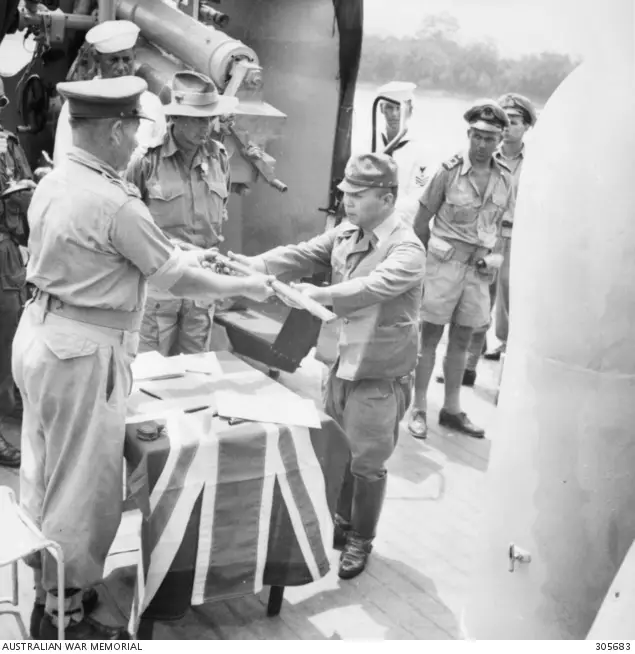
On that same day, Brigadier Thomas C. Eastick, Commander of Kuching Force, received the surrender from Major-General Yamamura Hiyoe on board the HMAS Kapunda.

Aboard the HMAS Kapunda, where the Japanese surrendered in Kuching
Aboard the corvette HMAS Kapunda, Major-General Yamamura, commanding officer of Japanese forces in the Kuching area, hands his sword to Eastick, commanding officer of Kuching Relief Force.
 
In the right background is Lieutenant A. J, Ford Ranr, commanding officer of the Kapunda. Copyrighted expired-public domain.
HMAS Kapunda in Kuching

Meanwhile, Eastick wrote to his wife Ruby on Sept 14, 1945 describing his arrival in Kuching as “the busiest five days I have ever had or likely to have, a wonderful job and one that has given me wonderful satisfaction.

“Last Monday early, I went aboard a USA destroyer escort and spent just over 24 hours aboard, transferred to HMAS Kapunda and went up the Sarawak river to Pending and there took the surrender from Jap Maj General and several thousand Japs.

“The finale of the ceremony was of course receiving the general’s sword as a token of final surrender. It is a beauty, of course, has wonderful historic value. After the general was dismissed, I spent an hour or so with the Jap chief of staff and other officers and then went to the prison camp where there well over 2,000 soldiers and civilians men, women and children. I got a greater part of them together in an an open space and said a few words to them.”

The news about the Japanese surrender also made headlines around the world.

Graham Jenkins, a special correspondent of The Mercury reported that “Cheering crowds lined both banks of the Sarawak River as the convoy carrying the Australian occupational force made its way up the river to Kuching capital of Sarawak’.

The news also reported that before the force landed, there was some delay when Yamamura “pleading illness, demurred about going out to HMAS Kapunda to surrender to Brig T. C. Eastick”.

“Excuses were not accepted, and Yamamura came reluctantly and handed over his sword. Heartfelt relief and jubilation were evidenced among Australian prisoners who were able to meet their liberators,” the news stated.

HMAS Kapunda after the war

After the Japanese surrendered, Kapunda was used to assist the evacuation of Allied prisoners of war from Kuching.

A year later, HMAS Kapunda was paid off into reserve on Jan 14, 1946. She was marked for disposal on Dec 30, 1960, and was sold on Jan 6, 1961 to Kinoshita (Australia) Pty Ltd for scrap.

Aboard the HMAS Kapunda, where the Japanese surrendered in Kuching
Aboard HMAS Kapunda as the Japanese envoy’s interpreter reads the surrender terms to Major-General Yamamura, the Kuching Garrison Commander (right). Copyright expired-public domain.

The strange death of British explorer Frank Hatton in North Borneo

Nineteenth century Borneo was as exotic as one could imagine. For the outside world, especially Westerners, hardly anything was known about the island except maybe that it was home for headhunters.

It’s no surprise then that many adventurous and curious explorers found their ways to the island in order to be the first among themselves to discover something new, be it a new plant, new animal or a new source of valuable mineral.

One of those who arrived upon the shores of Borneo back then was Frank Hatton, an English geologist and explorer.

Born in 1861, Frank was the son of journalist Joseph Hatton (1839-1907) and a graduate of the Royal School of Mines in London.

Being the son of a journalist gave Frank an advantage as his father’s connections made it easier for him to publish his writings.

The strange death of British explorer Frank Hatton in North Borneo
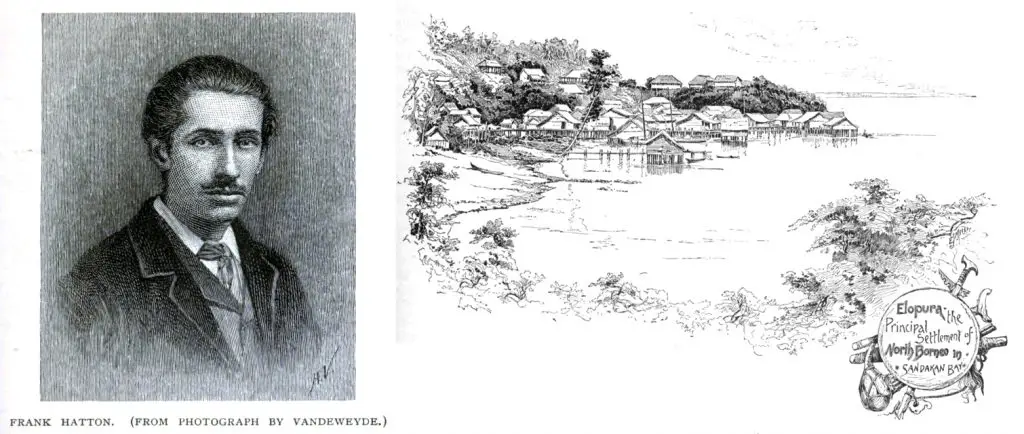
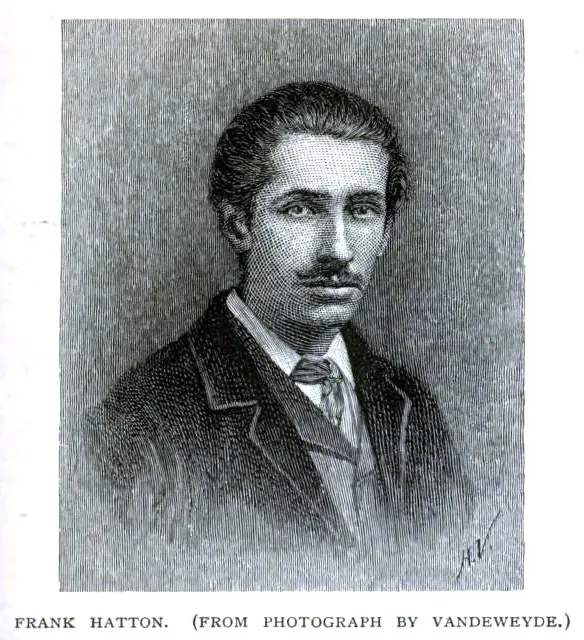
Frank Hatton, engraving based on a photo by Vandeweyde (1885) . Credit: Public Domain.
Frank Hatton’s career in British North Borneo Company

Driven and motivated, Frank joined the British North Borneo Company as a mineral explorer, leaving London in August 1881.

According to W.H Treacher, the British Governor of Labuan at the time, “Frank Hatton joined the Company’s service with the object of investigating the mineral resources of the country and in the course of his work travelled over a great portion of the Territory, prosecuting his journeys from both the West and East coasts, and undergoing the hardship incidental to travel in a roadless, tropical country with such ability, pluck and success as surprised me in one so young and slight and previously untrained and inexperienced in rough pioneering work.”

Treacher added, “He more than once found himself in critical positions with inland tribes, who had never seen or heard of a white man, but his calmness and intrepidity carried him safely through such difficulties, and with several chiefs he became sworn brother, going through the peculiar ceremonies customary on such occasions.”

For Frank, however, Borneo was far from what he had originally hoped for. In his diary, Frank vented out a few of his irritations about life in Borneo.

He grew sick of eating Dusun food. He was tired of being stared at by the natives who had never seen a Caucasian man before.

Additionally, Frank thought the local methods of headhunting was cowardly, calling it “head-stealing” not “headhunting” as he said the natives would wait in the bushes before making an attack during headhunting.

Frank Hatton and his sudden death in North Borneo

In 1883, Frank went up to the Kinabatangan river from Elopura (now known as Sandakan) to verify a local report of gold in the area.

There he was killed during an elephant-shooting expedition when his gun reportedly got tangled in the vegetation and went off, shooting him in the lungs.

According to Anne Tagge in Hatton’s Folly: Assaulting “This Eden of the Eastern Wave”, Frank had been persuaded to give up his hunt.

“On the way back to the boat, his Winchester rifle twisted in jungle creepers, a twig pulling the trigger. His followers reported that Hatton’s last words were in his recently required Malay ‘Odeen, Odeen mati saya’ (Odeen, Odeen, I am dead) to his servant while resting his head on Odeen’s shoulder.”

Frank’s only non-native companion during the expedition was an Australian gold miner named Andrew Beveridge.

Somehow knowing that Frank had always been careful with weapons, Beveridge first shouted “Who has done this?” to Frank’s party.

But after looking at how distraught his native servants were as they were exclaiming “Better we had died!”, Beveridge believed the incident was an accident caused by Frank himself.

Beveridge and the rest then went on a 60-mile journey down the river to Elopura, carrying Frank’s decaying body.

After arriving in Elopura, an inquest was held on the day of Frank’s burial on Mar 4, 1883.

The strange death of British explorer Frank Hatton in North Borneo
Elopura where Frank Hatton’s body was brought . This illustration was first published in  “Frank Hatton in North Borneo. Notes on his life and death, by his father“. Century Illustrated Magazine. Credit: Public Domain
Did the natives kill Frank and make it look like an accident?

Before Frank’s death, one of his colleagues in the British North Borneo Company named Franz Witti had been killed by headhunters.

Frank had written to his parents, reassuring them that he could take care of himself and that they shouldn’t be worried about Witti’s murder.

Tagge pointed out, “The company always ascribed such deaths (Witti’s) to accident or uncontrolled tribes or to tribes across the border in Dutch-ruled Borneo.”

As for Frank’s shooting, there was no proof that it was premeditated. The then resident at Elopura, W.B Pryer wrote to Treacher that there was no evidence that the gun was cocked.

The muzzle of the gun would have had to slip from Frank’s shoulder as he held the stock and moved a jungle creeper with his hand holding the stock.

Furthermore during the inquest, Beveridge revealed that he didn’t notice whether any of the guns carried by the natives had been discharged.

He stated that Frank fell in a very open place with a little undergrowth; the nearest vine was four feet from where Frank lay. When Beveridge arrived at the scene, running in four or five minutes from the boat, the gun had already been moved, and Frank was no longer able to speak.

Was there any tension between Frank Hatton and his servants?

According to Beveridge who had questioned Frank’s servants, he found that the natives would have defended Frank from an elephant even if it meant their own deaths.

However, there was still no definite proof that the bullet which killed Frank came from his own gun. Even if it had, how did it happen?

Before the incident, Frank had sighted an elephant on Feb 17, 1883.

He was reportedly extremely anxious to shoot one before leaving Borneo and this was his last inland trip. (Obviously, the trend of Western tourists desecrating or ravaging local spots goes back centuries…)

In his diary, Frank recorded that his group had been struggling through the swamp through this trip. One of his servants, Durahim, had also capsized a boat, costing them some of their food and valuable supplies.

He had even listed down all his losses in the diary and his willingness to cut his servants’ wages if he found out that it was their fault that the perahu (boat) had been overturned.

While they were pursuing the elephant, the day was getting darker and his servants were restless to return.

But Frank was believed to be obsessed with shooting the elephant. If he had managed to kill an elephant and acquired its tusks, he might have been the first white hunter to do so in North Borneo back then.

The inquest’s result

Maybe it was Frank’s obsession over elephants tusks that brought him to his death.

Nonetheless, the British North Borneo company interpreted Frank’s ambiguous death as an unfortunate accident and he was buried at Sandakan cemetery.

“The company seems to be anxious not only to exonerate but to praise the natives who were with Hatton. A young man dies because he is determined in the last weeks of his contract to find minerals, preferably gold, in Borneo, also to bring home the triumph of having killed an elephant. His family is determined to interpret him as a hero fallen in the cause of British scientific and geographical supremacy,” Tagge wrote.

The Hatton family also accepted the verdict of the inquiry. An article in the North Borneo Herald of 1 Sept, 1883 noted Hatton’s death and comments on contributions to the Company, including a Dusun vocabulary and mineral samples ‘which will in time doubtless be developed in the interests of the Company’s Government’.

The same issue contained a letter to the editor from Joseph Hatton in which he thanked the Company for their tributes to and care for Frank’s grave.

He also sent a floral wreath for the grave – from London to Borneo – as well as knives to be given as gifts to Frank’s servants.

After his son’s death, Joseph co-wrote and published Frank’s writing in a posthumous work entitled North Borneo, Explorations and Adventures on the Equator (1886).

Frank Hatton was 22 when he died.

10 Malaysian wedding guest etiquette rules you should remember

So, you’ve just received an invitation to a wedding. You may find yourself excited, especially if it is a union for someone (or a couple of people) you care about in your life.

It is also a chance to enjoy good food, catch up with relatives, meet old friends and make new ones.

Since it is a joyous celebration for two people, you should be honoured to be invited, so remember your etiquette as a wedding guest.

10 Malaysian wedding guest etiquette rules you should remember
A wedding celebration is a joyous ceremony for two people who decided to spend the rest of their lives together.
Here at KajoMag, we want to remind you 10 wedding guest etiquette rules you ought to know before and during the celebration.
10 Malaysian wedding guest etiquette rules you should remember
Keep your etiquette as a wedding guest in check.
1.For goodness sake, do RSVP on time.

This is the number one wedding guest etiquette rule, do RSVP.

Let the couple know once you have confirmed your attendance before their due date.

By doing this, you are helping the couple in their wedding preparation.

But what if something came up in the last minute and you cannot make it? Let the couple know, even if it is only a few days away. If the wedding reception takes place in a seated arrangement, the couple could find somebody to replace you.

2.Do not make too many requests.

Preparing for a wedding could be a stressful thing for a couple, the least you could do as a wedding guest is not make unnecessary requests.

If you are a vegan or on a restricted diet due to religious or health reasons, it is understandable to make certain requests before the wedding.

Before making any request for the wedding as a guest, ask these questions first; is it really important? Can you deal with it without bothering the couple? If the answer is no and yes, in that order, then do not make the request.

On top of the wedding preparation, the couple might also be going through a hundred other things in their lives. So be considerate of them. In the end of the day, it is their wedding not yours.

3.Do not complain to the couple, especially on the wedding day.

Remember the saying, “If you don’t have anything nice to say, don’t say anything at all”? Someone’s wedding day is the best day to practice this saying.

Before the wedding, there are plenty of things not to complain about as a wedding guest. Not happy with the dress code or the dress theme? Improvise and bear with it.

Not happy with the seating arrangement at the wedding reception? Bear with it because it is just for a few hours.

The food or drinks not to your liking? A helpful cheat, especially useful if the event runs late, is to eat a little meal before you go, that way you aren’t starving at the event. It also helps when the food isn’t to your taste, then you can nibble here and there.

If you are not happy with anything or there is something that needs to be fixed right away, be that person who helps to deal with it. The couple will really appreciate your gesture.

The worst thing you could do as a guest is to go up to the couple on the day of their nuptials and complain about their wedding.

10 Malaysian wedding guest etiquette rules you should remember
Whatever you do, do not make it a stressful day for wedding couple.
4.Again for goodness sake, do be on time.

Here in Malaysia, we have seen too many cases of guests arriving late, be it for the wedding ceremony or reception.

It is just rude. Of course, it is also rude for couples to keep their wedding guests waiting.

(For couples that do invite VIPs, especially active ministers or assemblymen, come up with a backup plan if their duties will make them late for your event. Don’t let your guests starve while waiting for them to arrive. Similarly, you have to remember that it’s your wedding, not a government function.)

So for a wedding, let us all be on time whether you are getting married or not.

10 Malaysian wedding guest etiquette rules you should remember
Always on time for a wedding especially if it takes place in a church or any religious houses.
5.Do not assume you can bring a date.

Never assume who you can bring for a wedding reception.

Check your invitation card. If the invitation doesn’t state a plus-one, then do not bring one. Do not assume your children are welcome too. If you really need to bring a date or you do not have anyone to babysit your children, let the couple know beforehand so that they can make arrangements.

And please do not assume all your mutual friends are invited as well. It is possible that you are one of the few in your group of friends or colleagues who are invited due to plenty of reasons.

It could be because the venue is small or there is a budget issue. Do not make things awkward for the couple by bringing in the whole gang but in the end some of them are not on the invitation list.

6.Do turn off your phone.

Always remember to turn off your phone especially if the wedding ceremony takes place in religious houses. Even during the wedding reception, do not be a party pooper by looking at your phone all the time. You have plenty of time to do that at home.

7.Watch where you point your camera.

In this era of smartphones, this is perhaps the wedding guest etiquette some people do not practice.

Just because you have a camera on your phone, do not feel entitled to take photos everywhere and anytime during wedding celebrations.

If the wedding ceremony takes place in a religious house, take note of the do’s and don’ts of that place.

For example, do not rush right up to the altar in a church and stand next to the priest just to take a photo for your Facebook friends. (Yes, we have seen this type of wedding guests.)

Above all, never ever stand in the way of the couple’s official photographer. As a wedding guest you should not ruin the couple’s only chance to capture their special moments.

10 Malaysian wedding guest etiquette rules you should remember
Never block the official photographer during a wedding.
8.Do not get wasted.

If you are in East Malaysia, raise your hand if you have seen fights break out during the wedding celebration, all thanks to alcohol.

In most kampungs (villages) and longhouses, there are strict rules against fighting during any celebration. You could be fined for breaking these rules.

Even if you are not the type to get into fights when intoxicated, wedding celebrations are just not the place to get wasted.

It doesn’t matter if you saw your former flame come with a hotter or better looking version of you as a date, or you have an ongoing court case over ancestral land with a relative who came for the wedding, there is no valid reason to get inebriated.

If you are drinking, know your limits and stick to them.

If you see an unfinished or unopened bottle of alcohol, leave it for the families or other wedding guests. Unless you have requested it from the newlyweds or families, do not do the Malaysian style of tapao.

10 Malaysian wedding guest etiquette rules you should remember
Keep your alcohol level in check as a wedding guest.
9.Do not leave too early.

If it is an emergency, you are free to excuse yourself but let the couple or their families know.

Different cultures have different timing as when it is considered appropriate to leave a wedding celebration.

During some Malaysian weddings, there are guests who have left even before the couple have come over to the table to make a toast (usually to beat the traffic jam in the parking lot). So imagine how disappointed the newlyweds are to see a half-empty table halfway through the reception.

10.Do bring home your wedding favour.

No matter how small the wedding favour is, do not forget to bring them home.

Do not have that mindset, “It is just a small bag of sweets,” or “it doesn’t cost much.”

Every piece of wedding favour is a sign of appreciation from the couple for their wedding guests. They could have opted to forego the whole thing and let you leave empty-handed. Yet, they chose not to do so, so appreciate them.

Remember that a wedding celebration should be a joyous one. Add on the joy and happiness of the celebration by enjoying yourself as a wedding guest.

10 Malaysian wedding guest etiquette rules you should remember
Eat, drink and be merry!

All photos from unsplash.com

KajoAsks: Going behind the DJ deck with Nick Dhillon

Knowing how much festival goers are still pumped up for more music even after the performances at Jungle and Tree Stages end, Rainforest World Music Festival introduced the DJ After Party Stage in 2019.

One of the DJs who took over the mixers during the festival this year was DJ Nick Dhillon from Kuala Lumpur.

Covering music genres from EDM,  RnB, Hip Hop, Commercial, retro, Afrobeat and Bolly/Bhangra, it’s no wonder this electronic music producer was brought in for RWMF.

Deejaying since 2003, DJ Nick has released a few singles with artists from Denmark, UK, India, Portugal and Malaysia.

So far, DJ Nick has performed all over Malaysia including Sabah, Johor, Malacca, Penang as well as other countries such as Singapore, Bangladesh and Indonesia.

KajoAsks: Going behind the DJ deck with Nick Dhillon
Recently, KajoMag had the opportunity to ask DJ Nick Dhillon on his inspiration and what goes on behind his DJ deck.
KajoAsks: Going behind the DJ deck with Nick Dhillon
DJ Nick Dhillon on his deck.
KajoMag: When did you start DJing and what or who were your early passions and influences?

Nick Dhillon: Basically, I started to learn how to DJ at 9 years old. I got inspired by my father who was a DJ/stage performer back in the day. When I was about 10, I always wondered how people made music. While listening to music on the radio, it just struck my mind – like how did music get created? I then did my research slowly with a lot of attempts. Today I make my own music and I DJ to it.

KajoMag: What are currently your main challenges as a DJ?

Nick Dhillon: My challenges are to get my music heard to a large audience and how to start well, maintain and end well during a set. I’ve set up a goal and the goal is to always do better in every gig I get as I move along.

KajoMag: How you decide to play a particular record during your sets? Is there a criteria other than pure subjectivity for selecting what to play at a gig?

Nick Dhillon: Basically, I usually prepare my set every time before my gig. I listen to new music or similar sounds of what I usually play during my sets. Sometimes I get an original track and remix it and then play during my set. Though the main actual selection of songs during my set comes on the spot while looking at the crowd response. 

KajoMag: Do you feel a crowd is actually able to appreciate the intricacies and complexity of DJing if they don’t really know what goes behind the deck? 

Nick Dhillon: Usually when I DJ, what I believe is in seeing the crowd enjoying the music. Though the understanding of you can’t please everyone with music is always there, the main aim is to catch the majority, especially playing the next song and seeing how they respond to it.

KajoMag: How much do you feel is the club experience or crowd response shaped by cultural differences? When travelling, do you take these cultural differences into consideration? What was your experience during RWMF, for example?

Nick Dhillon: Well, the club experience and the outdoor experience – especially at the RWMF – is very different.

I must say it was amazing. It’s difficult to express in words but just amazing. And playing the music I make, that is mixing traditional Punjabi instruments into modern beats. The reaction is unbelievable. Music does bring everyone together. And that’s beautiful. Though, RMWF is one of my best experiences DJing, without a doubt.

KajoAsks: Going behind the DJ deck with Nick Dhillon
Nick Dhillon performing during RWMF 2019.
KajoMag: Care to share some of your future plans or dreams?

Nick Dhillon: My future plan is to always be consistent in music, I have plenty of new music coming up. That isn’t a remix, its original tracks I am looking forward to put up to the crowd. Also I’m working on an album.

I’m an electronic (EDM) music producer. I mix electronic music elements with some traditional Punjabi/bhangra elements that’s more what it’ll sound in my upcoming music releases. I look forward to more music festivals around the world to share my music with everyone.

Check him out on Spotify, Facebook, Instagram, YouTube and official website.

All photos courtesy of DJ Nick Dhillon.

10 South Korean disaster movies you need to watch

The thought of “What’s the worst that could happen?” is perhaps how most disaster movies came about.

Any good disaster movie will keep its viewers glued to their seats; there are always multiple storylines going on while featuring a large cast and a tremendous set, all the while following the conventional main heroes as they try to escape or inspire others to cope with the disasters.

Although it doesn’t happen too often in Hollywood disaster movies, some South Korean movies do see their heroes dying, making them tear-jerking.

If you are haven’t watch these, here are 10 South Korean disaster movies you need to watch:
1.Tidal Wave (2009)

Considered as South Korea’s first disaster film, this movie received more than 11 million admissions nationwide.

Although the film’s English name is ‘Tidal Wave’, the film is actually referring to a tsunami.

Just like most disasters movies inspired by real-life disasters, this one was inspired by the 2004 Indian Ocean earthquake.

Watch the trailer here.

2.Deranged (2012)

While Tidal Wave was South Korea’s first disaster movie, this one is the country’s first medical thriller on an infectious disease epidemic.

If you believe in conspiracy theories of greedy pharmaceutical companies behind the spread of some diseases or illnesses, this movie fits that theory. It is a fatal outbreak of mutant parasitic horsehair worms that can control the human brain.

Watch the trailer here.

3.Flu (2013)

Imagine a scarier and deadlier strain of H5N1 influenza virus that could kill its victims within 36 hours… and then throw in the human factor.

Flu (2013) takes place in the district of Bundang in Seongnam where half a million people go into a panic after an outbreak of deadly flu.

What starts out like a detective story as it follows the spread of the flu, escalates into mass hysteria, so much so that the government is forced to put its military forces out against its own citizens.

Directed by King Sung-su, the movie stars Jang Hyuk and Soo Ae.

Watch the trailer here.

4.The Tower (2012)

Before Dwayne Johnson rescued his family from a Hong Kong condominium tower taken over by terrorists and set on fire in Skyscraper (2018), there was this movie called The Tower (2012).

In this film, a fire breaks out in a luxury skyscraper in central Seoul on Christmas Eve. Like most disaster movies, this is a story of bravery as the manager Dae-ho (Kim Sang-kyung) tries to save his loved ones and colleagues from the fire.

Watch the trailer here.

5.Pandora (2016)

Make sure you prepare your tissues for this movie because you are going to need it.

The story follows Jae-hyeok (Kim Nam-gil) who works in a local nuclear power plant. Suddenly, an earthquake strikes, causing an explosion at the plant.

While the whole nation is in a state of panic, Jae-hyeok and his colleagues return to the plant to prevent another nuclear disaster.

Watch the trailer here.

10 South Korean disaster movies you need to watch
A screenshot of Pandora trailer from Youtube.
6.Tunnel (2016)

If you are claustrophobic, this might not be a good movie for you to watch. Starring one of Korea’s most talented actors – Ha Jung-woo – this film revolves around a car salesman who gets trapped in a poorly constructed tunnel that collapsed.

After he regains consciousness, he finds himself trapped under tonnes of concrete.

Watch how he tries to survive with two bottles of water and his daughter’s birthday cake.

Watch the trailer here.

7.The Terror Live (2013)

Before Jung-woo starred in Tunnel, he acted in another disaster movie called The Terror Live (2013).

Here, he plays an ambitious news anchorman Young-hwa who monopolizes the live broadcast of a terrorist attack following the explosion of Mapo Bridge on the Han river.

Apparently, he is not the only one who wants to exploit the disaster for their own agenda.

Watch the trailer here.

8.Train to Busan (2016)

This is the kind of disaster that might be scary but interesting if it really happened. The plot takes place mostly on a train to Busan as a zombie apocalypse breaks out in the country.

The film set a record as the first Korean film of 2016 to break the audience record over 10 million viewers.

Besides the convincingly scary zombies, what makes the movie engrossing was the storyline of different characters.

From Gong Yoo’s acting as Seok-woo, a fund manager who is obsessed with his work to Kim Eui-sung as the selfish businessman, every character carries their own weight making the movie interesting to watch.

Watch the trailer here.

9.Exit (2019)

When disaster strikes, it is natural for humans to use every knowledge or skill they know in order to survive. In this movie, the main character Yong-nam (Jo Jung-suk) uses his rock climbing skills to save everyone from a mysterious white gas covering Seoul.

Watch the trailer here.

10.Sinkhole (working title, 2020)

Well, this movie is not out yet and is expected to be released in 2020. But the cast line-up already has people talking. The movie stars Cha Seung-won, Kim Sung-kyun and Running Man’s Lee Kwang-soo.

Furthermore, the film will be directed by Kim Ji-hoon, the same director for The Tower. With one successful disaster movie in his belt, movie buffs can have high expectations for Sinkhole.

The film follows residents of a villa who are trapped after a sinkhole occurs.

5 things you might not know about torch ginger or bunga kantan

Torch ginger (Etlingera elatior) is widely known as bunga kantan in Malaysia. It is also known as ginger flower, torch lily, Philippine wax flower, Indonesian tall ginger, rose de porcelaine and porcelain rose.

Here in Malaysia, the bud of the torch ginger makes an important ingredient in dishes such as laksa and nasi kerabu.

But did you know Malaysians are not the only ones who love this plant?

Here are 5 things you might not know about torch ginger or bunga kantan:
5 things you might not know about torch ginger or bunga kantan
Torch ginger’s flower.
1.The plant is used in different kind of cuisines throughout Southeast Asia.

In North Sumatra, Indonesia, the locals used the flower buds for a stewed fish dish called Arsik ikan mas.

Meanwhile in Bali, people use the white part of the bottom of the trunk for cooking chilli sauce called “Sambal Bongkot” and the flower buds to make chilli sauce “Sambal Kecicang.”
In Thailand, young shoots and flowers of the plants are served raw with nam phrik phao (a type of Thai spicy chilli sauce).

2.The leaves of the bunga kantan is commonly used as post-partum home treatment.

In Malaysia, the leaves of the bunga kantan is mixed with other traditional herbs such as ginger leaves, turmeric leaves and betel leaves in water. Then post-partum women would use it as bathwater to get rid any body odour.

5 things you might not know about torch ginger or bunga kantan
Thanks to its pretty and bright pink appearance, this plant is also used as decorative plant.
3.It is used to cure the symptoms of typhoid fever and other diseases.

A community in Porehu district of Southeast Sulawesi, Indonesia use the plant to cure symptoms of typhoid fever.

Apart from that, they also believe that consuming the plant could cure various kinds of diseases such as diarrhea, canker sores, cough and heartburn.

This traditional knowledge has been passed down for generations.

4.Essential oil from torch ginger could be used as an ingredient for sunscreen.

There have been a few studies done on the phytochemistry of this plant. For example, a study done by Royal College of Medicine Perak which was published in Journal of Applied Pharmaceutical Science in 2017 had proven that there were two benefits of torch ginger’s essential oil.

The researchers found that the torch ginger essential oil provided phytochemical screening, photo-protective as well as anti-oxidant properties.

Hence, the study suggested to use torch ginger as a new source of natural anti-oxidant ingredients that can be incorporated into sunscreen cosmetic products.

5 things you might not know about torch ginger or bunga kantan
Torch ginger tree.
5.The inflorescence of torch ginger is potentially used as a preservative.

Meanwhile, another research study done by Universiti Sains Malaysia had found the benefits of oil and extracts derived from the inflorescence of torch ginger.

They found that the oil and extracts had rich antibacterial activity and possessed great potential to be used as a preservative in the food and pharmaceutical industries.

5 things you might not know about torch ginger or bunga kantan
The essential oil of this plant is potentially be used as sunscreen.

KajoPicks: 10 literary detectives that we love

When it comes to fiction, who doesn’t love a good crime novel? Not only are the mysteries fascinating, but the characters themselves are essential to any compelling mystery crime fictions, be it in short stories or novels.

There are all kinds of literary detectives out there; from private investigators to professional policemen.

Some of these literary detectives have even made it to TV shows or the big screens, gathering a new fan base, especially among those who do not read crime novels.

Every literary detective usually has his or her own quirks or issues that keep readers coming back for more.

Here are KajoMag’s top 10 picks of our favourite literary detectives:
KajoPicks: 10 literary detectives that we love
1.Sherlock Holmes

We cannot talk about literary detectives without mentioning Sherlock Holmes. In terms of Holmes’ depictions on screen, fans have had long arguments on who has played Holmes better, Robert Downey Jr. or Benedict Cumberbatch. (Who also happen to share the big screen in the MCU universe XD)

At the end of the day, though, books are always better than movies or TV shows. Besides letting you imagine the setting or events happening in the story, books can usually create more interesting plots or let you in on what the characters are thinking.

Created by British author Sir Arthur Conan Doyle, Holmes is one of the most famous literary detectives of all time.

KajoPicks: 10 literary detectives that we love
2.C. Auguste Dupin

Before there was Holmes, the literary world had C. Auguste Dupin first. Edgar Allan Poe penned him in The Murders in the Rue Morgue (1841), The Mystery of Marie Roget (1842) and The Purloined Letter (1844).

The Murders in the Rue Morgue is widely considered as the first detective fiction story ever.

After Poe created Dupin, the character had inspired other authors to create their own literary detectives, including Holmes.

3.Hercule Poirot

Here is another character which is inspired by Dupin. English writer Agatha Christie first created Poirot in 1920 in the book The Mysterious Affair at Styles. This was during the “Golden Age of Detective Fiction” (1920s-1930s).

Obviously obsessive-compulsive, Poirot’s interesting character along with Christie’s writing style where she likes to keep her readers guessing, makes him one of the most memorable literary detectives.

Besides Poirot, Christie also created Miss Marple, an elderly lady who is an amateur consulting detective.

4.Harry Bosch

With years of experience as a crime beat writer and crime reporter, it’s no wonder American author Michael Connelly is one of the best crime fiction writers in recent decades.

His most notable works are those featuring Los Angeles Police Department (LAPD) detective Harry Bosch.

He has appeared in 21 novels to date since the first novel The Black Echo in 1992.

After reading any of Connelly’s books featuring Bosch, one can imagine him as a very confrontational and hostile person who always has problems with authority despite being a police officer himself.

Apart from novels featuring Bosch, other must-read books by Connelly are of Mickey Haller. He is a Los Angeles attorney and Bosch’s half brother.

5.Harry Hole

After reading crime novels written by Norwegian author Jo Nesbo, one can’t help but notice the similarities between Connelly’s Bosch and Nesbo’s main character Harry Hole.

That is because Nesbo took Bosch not only as the inspiration for his own character but also a tribute to the American literary detective.

Just like Bosch, Hole also has repeated conflict with his superiors and colleagues.

And just like Bosch, Hole is a brilliant detective who, despite his sometimes compulsive behaviour, still earns respect among his colleagues.

6.Dave Robicheaux

What do Dave Robicheaux and Harry Hole have in common apart from both being literary detectives?

They have both problems with alcohol. Created by American writer James Lee Burke, Robicheaux first appeared in The Neon Rain (1987). Burke’s latest book to date featuring Robicheaux is The New Iberia Blues (2019).

7.Adam Dalgliesh

Perhaps it is a trend or scientific fact that being a loner, or someone not in any committed relationship, makes one a great detective. Most of the literary detectives in this list are single men who either sleep around or are divorced, widowed or simply those who prefer to be alone in the first place.

P.D. James’ Adam Dalgliesh falls under the widowed category after he loses his wife in childbirth.

Like any British detective fiction, Dalgliesh is depicted as the gentlemen detective throughout fourteen mystery novels he has appeared.

8.Inspector Morse

Created by British author Colin Dexter, Inspector Morse is another gentleman detective that we love.

Inspector Morse appeared in 13 novels with the last one being The Remorseful Day (1999).

Like most literary detectives, Inspector Morse has a snobbish characteristic, but he is good at his job.

9.Jack Reacher

While most literary detectives on this list are policemen or private investigators, this character is a former major in the United States Army Military Police Corps.

British author Lee Childs first created Jack Reacher in 1997 with the book Killing Floor. Since then, Reacher has been roaming around the countryside, always coming across a mysterious situation that requires him to put on a detective’s hat.

If this character sounds familiar, that is because Tom Cruise portrays him in the movie adaptations.

10.Dr Temperance Brennan

Speaking of onscreen adaptations, Dr Temperance Brennan is perhaps one of the literary detectives that successfully transitioned from book to TV.

However, the TV’s Dr Brennan in Bones (played by Emily Deschanel) is just loosely based on American author Kathy Reichs’ Temperance Brennan.

Other than sharing the same name, they also share the same occupation as a forensic anthropologist.

According to Reichs who is the executive producer of the show, the TV’s Brennan is like the younger version of the novel’s Brennan.

Either way, if you like Dr Brennan in Bones, you might also like her in the crime novels.

Do you have any favourite literary detectives? Let us know in the comment box.

1 43 44 45 46 47 75