Patricia Hului

Patricia Hului is a Kayan who wants to live in a world where you can eat whatever you want and not gain weight.

She grew up in Bintulu, Sarawak and graduated from the University Malaysia Sabah with a degree in Marine Science.

She is currently obsessed with silent vlogs during this Covid-19 pandemic.

Due to her obsession, she started her Youtube channel of slient vlogs.

Follow her on Instagram at @patriciahului, Facebook at Patricia Hului at Kajomag.com or Twitter at @patriciahului.

10 things you might not know about Japanese hell ships during WWII

When we look at how Prisoners-of-War (POWs) suffered in internment camps or death marches during World War II (WWII), little do most people know about the atrocities onboard Japanese hell ships.

‘Hell ship’ describes a ship with extremely inhumane living conditions or with reputation for cruelty among the crew.

The term was coined during the American Revolution when the British were shipping American prisoners of war. While the term was also used for German POWs transports, ‘hell ship’ now generally refers to the ships used by the Imperial Japanese Navy and Imperial Japanese Army to transport Allied POWs and romushas during WWII.

Romusha is a Japanese word for labourer. During WWII, it is a term to refer Asian (mainly Indonesians) forced slave labourers.

The Japanese began transferring POWs by sea in May 1942. On board these ships, there was no escape for these prisoners.

10 things you might not know about Japanese hell ships during WWII
Plaque dedicated to the survivors of the P.O.W. Hell Ship Shinyo Maru, sunk by USS Paddle (SS-263) on 7 September 1944. Credit: Public Domain.

Here are ten things you should know about about Japanese hell ships during WWII:

1.Some survivors said Japanese hell ships were worse than the death marches

In 2012, American film producer Jan Thompson created a film documentary on the Japanese hell ships and POWs camps titled ‘Never the Same’.

She was inspired by her own father, who was one of the war veterans who survived the hell ships.

Thompson told Chicago Tribune in 2013, “Men who were on the Bataan Death March said the hell ships were worse and it’s a story that nobody knows.”

The Bataan Death March saw the transfer of 60,000-80,000 American and Filipino POWs from Bataan to Capas in the Philippines. The estimated casualties during the march range from 5,650 to 18,000 of POW deaths.

Thompson estimated 14,000 Allied POWs died on the Japanese hell ships. They either froze or starved to death. There was so little food that Thompson’s father resorted to eating undigested oats in horse manure in the ship’s hold.

Others suffocated when they were crammed in spaces that reached 120 degrees.

2.Not all Japanese hell ships were hellish

Not all POW-carrying Japanese ships were left under these cruel conditions. They may not have been five-star cruise ships either but they were somehow bearable.

One of them was Nagara Maru. On Aug 11, 1942, 179 American POWs departed Manila heading for Formosa (Taiwan).

The short voyage to Taiwan aboard Nagara Maru could not be strictly termed a hell ship voyage.

It was reported that the POWs were well-treated, well-fed and did not live in over-crowded conditions. Aboard the ship, there were two generals. They were given the same food as the Japanese officers. They slept on comfortable mats, had access to a clean bathroom and were allowed on deck at anytime.

The colonels and other POWs, however, found their stay aboard less satisfactory. There were 14 men forced to sleep toe-to-toe in each of the 13 foot deep berths.

Their meals consisted of rice with small pieces of fish, picked vegetables or fruits and seaweed.

Water and hot tea were provided. As for sanitation, there was a tub provided as well as access to deck and toilets.

Pacific Maru was another ‘bearable’ Japanese hell ship. On Dec 28, 1942, about 72 (perhaps 85) POWs were taken to Tanjung Priok, Java to Singapore.

According to witnesses aboard the ship, the journey was probably one of more bearable hell ship voyages, partly because there was a small number of POWs aboard and the short duration of three day journey.

3.Why many Japanese hell ships were sunk and bombed by Allied forces

Overall, more than 20,000 Allied POWs are estimated to have died at sea when the transport ships carrying them were attacked by Allied submarines and aircraft.

The Japanese could have identified the merchant vessels they used for prisoner transport by painting or putting a white cross on the ship, but they refused — violating the terms protecting POWs under the Geneva Convention.

They reportedly used transports bearing these Red Cross markings for their weapons while the ships carrying POWS were unmarked.

Due to this, the Japanese transports were often targeted by American carriers and submarines.

Nonetheless, it was believed that the Allied forces knew that some of these ships were carrying POWs after cracking shipping codes relayed among the Japanese.

So why did they bomb POW ships?

According to Greg Michno in Death on the Hellships, they opted to attack POW transport because to leave them untouched while sinking other Japanese shipping would have indicated to the Japanese that their codes had been compromised.

4.Even if POWs survived the sinking, many were not rescued

Many have said that the true character of a person is revealed in the time of crisis. What is the bigger crisis other than a sinking ship?

There were different accounts from survivors of how these POWs dealt with the situation when they were drifted in the ocean waiting for rescue.

In the case of Tamahoko Maru, the sinking showed the best of humankind.

The survivors’ report stated, “Finding themselves in the water, most prisoners managed to gain these rafts or other wreckage and settled down with the Japanese survivors to wait for dawn, all nationalities helping each other.”

However, this beautiful moment did not last long as Japanese vessels returned only to pick up the Japanese, leaving the prisoners on the wreckage.

5.Some were rescued by the same vessels which sunk them

SS Rakuyo Maru was transporting 1,317 Australian and British POWs from Singapore to Formosa in Sept 1944. Another ship in the convoy was SS Kachidoki Maru with another 950 on board.

On Sept 12, the convoy was attacked in the Luzon Strait by three US submarines.

Both Japanese vessels were torpedoed and sunk, killing around 1,159 POWs. As some of the POW survivors tried to row their way towards land in lifeboats the next day, they were bombarded by a Japanese navy vessel.

On Sept 15, the three US submarines returned and rescued 149 surviving POWs who were on rafts. Four more died before they could make it on land.

One of SS Rakuyo Maru’s survivors Roydon Charles Cornford wrote his account of survival in 1982.

The survivors saw a lot of dead POWs floating around. They took life jackets off the dead Japanese and busted them open to use the kapok to wipe the oil out of their eyes and off their faces.

At one point, it started to rain with all of the prisoners looking up to the sky with open mouths to catch any water they could.

While drifting in the sea not knowing what happened to him, Cornford shared, “We never once talked about not surviving.”

When he was rescued, Cornford pleaded his rescuers not to grab his arms because they were just blisters and sores.

6.There were mixed reactions on board on these bombings.

So how did the POWs felt seeing their own countrymen bombing their ships?

Kelly E. Crager in Hell under the Rising Sun recorded the reactions of POWs aboard Dai Moji Maru when their ship was torpedoed by the US.

“The bombing raid was quite literally a near-death experience for the POWs, and they responded in different ways. Some expressed elation that the Americans were disrupting Japanese shipping at this stage of the war and in this part of the world.

“They reasoned that if the Americans were capable of this kind of action, the war would soon be over. Houston sailor Seldon Reese cheered the American bombers, shouting from the hold: ‘Hit the son-of-bitch! Sink the bastard! Others received a morale boost from the American bombing, although they admitted that they hoped their ship would emerge unscathed.

Lester Rasbury had mixed emotions about the bombing: ‘I was kind of hoping to take up for myself, if I could. But we were glad to see it, and we weren’t, either. We at least knew (the US Army Air Forces) were still doing something.’

Kelly Bob Bramlett described his reaction: ‘Well, you hate to get it from your own people, but you’re glad to see them out, too, you know’.

To Johnny Buck, the reaction was simple: ‘I guess I was partial toward the Americans, but I wasn’t caring about them hitting us’.

Wade Webb spoke for many others: ‘I guess I had to pull for the Japs, because I wanted to stay afloat. You know you can’t straddle the fence, so I had to go with the Japs on this one.’”

10 things you might not know about Japanese hell ships during WWII
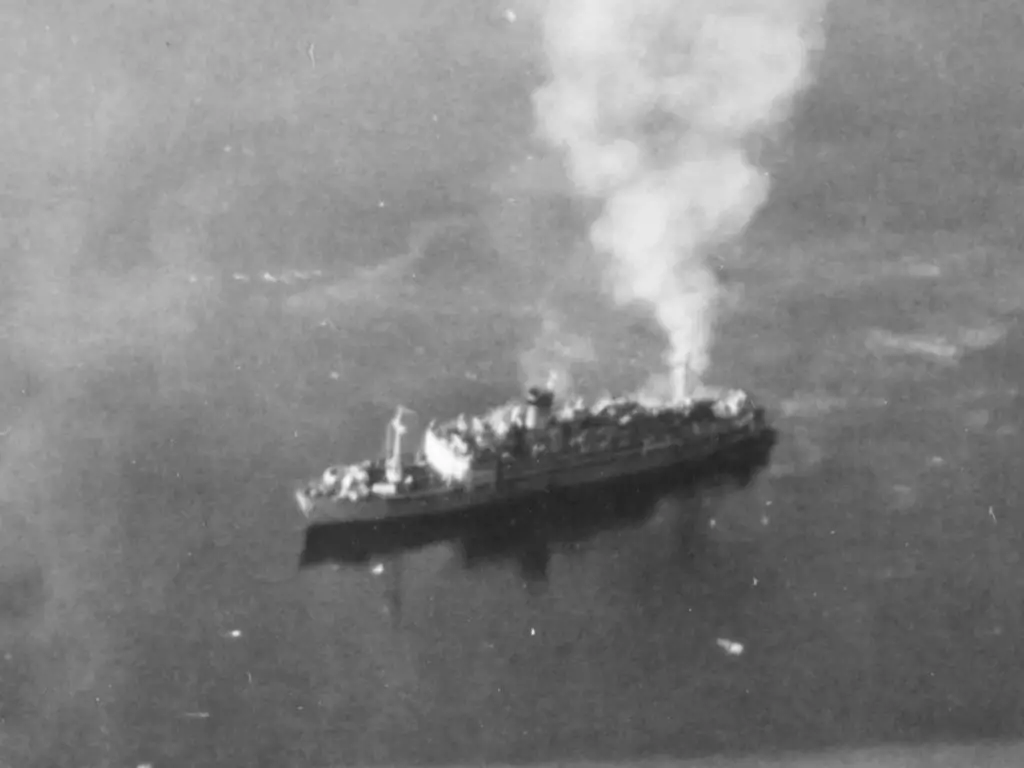
Oryoku burning after attack on 15 December 1944 about 11 AM. Photo by a Hellcat from USS Hornet shows POWs swimming in the water. Public Domaim

7.One Japanese hell ship executed all of its POWs (including throwing babies overboard alive)

While these POWs were alive to tell their tales, not all were lucky enough like them. One of the most gruesome scenes of WWII took places in one of these Japanese hell ships.

Akikaze was a Japanese destroyer and performed patrol as well as convoy escort duties during WWII.

After departing Rabaul, the Akikaze moved to Wewak from Mar 8, 1943 to deliver medicine and supplies, then to nearby Kairuru Island.

On Mar 15, 1943, Catholic missionaries including Bishop Joseph Loerks, six priests, 14 brothers, 18 nuns and one Chinese woman with her two infants were loaded onto Akikaze.

At first, the passengers were treated with dignity, even given a rear cabin and tea, water and bread. Their sea sickness were even treated by the ship’s doctor.

The destroyer proceeded northward and anchored off Lorengau on Manus Island overnight.

Then on Mar 17, 1943 twenty more civilians were brought aboard from Manus. The POWs included German missionaries, one Hungarian missionary and Chinese civilians including six woman. Now there were a total of sixty prisoners aboard the ship.

The apparent intention was to carry them to internment in Rabaul.

However, it was reported, “between Manus and Rabaul each of the adults was strung up by the hands on a gallows in the stern of the vessel, shot dead by rifle or machine-gun fire, and thrown overboard. The two Chinese infants and the European baby were thrown over alive.”

8.Journeying on these ships weaken the POWs

Even if these POWs were safely arrived at their destinations, their hellish experiences did not end on hell ships.

Suffering from diseases and malnutrition, these POWs continued to suffer even when they arrived at the POWs camps.

On Nov 6, 1943, 1230 Dutch POWs departed Singapore for Japan aboard Hawaii Maru.

They were provided with little amount of food consisted of a rice porridge and vegetable of food.

On Nov 27, their convoy was attacked near northern Taiwan. Another large transport (Hakone Maru) was sinking and an escort vessel (Tomodzuru) had been damaged.

The Hawaii Maru stopped up to rescue about 900 survivors, cramping the already crowded ship.

According to reports, Hawaii Maru arrived Moji, Japan on Dec 3, 1943. The prisoners were then moved to camps in Fukuoka, Kokura, Moji and Miyata. Some were sent to Shimonoski and Osaka.

At first, all POWs appeared to survive the journey to Japan. However, six died in the first two weeks after their arrival due to the deprivations of the journey.

Death records of camps in Fukuoka and Osaka showed there were slower effects of these voyages. The victims of hell ships that arrived in Japan typically died within 1 to 2 months due to diarrhea and malnutrition. At least another 70 passengers of Hawaii Maru died of pneumonia in the following months.

While it is impossible to tell if these deaths were caused by their journey, the high death rates among the passengers suggest that the month-long journey aboard Hawaii Maru left many men so weak that they were easily infected by diseases.

9.Those who were found guilty of war crimes because of what happened on board Japanese hell ships

Not all who were responsible of the deaths of POWS on board of these hell ships were convicted of war crimes after the war ended.

Well, it was hard to convict them as some of these Japanese armies gone down together with the sunken ships.

However, justice was served in some cases. The Tofuku Maru was transporting 1200 POWs and 600 Japanese Army troops between Singapore and Moji, Japan.

The voyage took place between Oct 27 and Nov 27, 1942. Altogether 27 POWs died during the journey, another 130 were carried off the ship on stretchers. As many as 100 died later.

Ship’s Master Shiro Otsu and Sergeant Major Eiji Yoshinari were tried for war crimes that led to deaths of the prisoners on the voyage during a Singapore War Crimes trial.

It was found that the POWs, who was a mix of American, Dutch, British and Australian were crammed into two holding areas with an average of 5 men per 6 square foot.

To make matter worse, there not enough toiletry facilities and foods for the prisoners.

On June 11, 1947, Otsu was found guilty while Yoshinari was acquitted.

10.Should these Japanese hell ships be raised from their seabed graves?

The Japanese hell ships that were sunk are still lying in the ocean bed. Now, some people opined that they should be raised.

One of them is Chinese fimmaker, Fang Li who wanted to raise Lisbon Maru that was sunk in 1942.

On her final voyage, she was transporting 1816 POWs between Hong Kong and Japan when torpedoed on Oct 1, 1942.

When the ship started to sink, the POWs tried to save their own lives.

Survivors reported that the Japanese guards first fired on the POWs who reached the deck and that other Japanese ships used machine guns to fire POWs who were in the water.

Some of the victims’ families agreed with the idea. However, one of the survivors of Lisbon Maru disagreed.

Dennis Morley, who thought to be the last survivor alive in Britain told BBC in 2018, “Oh God, how many hundred went under? Could be 1,000 odd. I don’t know. It’s no good getting them out. They’re all dead. They are probably bleached bones now. It’s wartime and a lot of horrible things happened during the war. They’re in peace. Leave them in peace. It is a war grave and should be left as a war grave.”

As for Fang Li, he had his own argument for wanting to raise Lisbon Maru as he considered it to be a jail.

He argued, “All those boys were detained there against their will, that’s why I feel so sad today- they are still detained on the sea floor. In my personal opinion they are on the Chinese sea floor in a Japanese jail. Shouldn’t we free them and send them home?”

The Melanau Oya legend of Bunga Lawan and the wicked antu sababu

Here is the Melanau version of a changeling; the legend of Bunga Lawan and the wicked antu sababu.

The Melanau Oya legend of Bunga Lawan and the wicked antu sababu
Long time ago, there was a nobleman who lived happily with his wife.

Once upon a time, there lived in Oya a Melanau nobleman with his lovely wife and his sister. This man was Bunga Lawan, the “Flower of Strength of Melanau Warriors”.

His wife was Dayang Tri-Ikat-ku Bunga and his sister was Dayang Salalan.

When Dayang Tri came with child, she told her husband that she would like to eat buah pangai, a fruit that tastes sour when it is eaten unripe but is still a favourite among Melanau women.

The tree that bore buah pangai fruit was on the opposite bank of the river, so Bunga Lawan asked his wife to accompany him. Dayang Tri also asked her sister-in-law to join them and together they set off in a boat, bringing some food with them.

On reaching their destination they were surprised to find the fruit tree was not there. Dayang Tri persuaded her husband to look for another tree, and so Bunga Lawan went deeper into the forest with his sister, leaving Dayang Tri alone in the boat. In those days, it was a Melanau taboo for women who were with child not to go into the forest.

Dayang Tri and antu sababu

While Bunga Lawan and his sister were off looking for the fruit, Dayang Tri sat alone in the boat trying to amuse herself by putting her hands into the water.

Suddenly she saw a woman coming towards her from the river bank.

It turns out that this woman was the wicked fairy, the antu sababu, who was out to do her harm.

Dayang Tri did not realise this, inviting the woman to sit down in the boat with her. No sooner had the fairy entered the boat than she knocked Dayang Tri unconscious and threw her into the river.

Then the cunning antu sababu changed herself into Dayang Tri.

Antu Sababu living as Dayang Tri

When Bunga Lawan and his sister returned, the wicked fairy tried to greet them as Dayang Tri had always done, but she was unsuccessful because she was an antu.

It is said that wicked antu shout at people rather than talk to them, and so try as she might, she could not keep her voice down.

Believing that it was Dayang Tri, and not a wicked antu, Bunga Lawan thought that the atmosphere of the forest had affected his wife’s disposition and he hurriedly rowed homeward.

In time the antu sababu’s behaviour became worse, so much so that Bunga Lawan left her alone as often as he could. Soon she gave birth to a son who was just as ugly and wicked as his mother.

As the boy grew his wickedness became more pronounced; he would bully and beat up all his friends. Bunga Lawan was so angry that he ordered his men to kill his wife but spare the boy as he believed he was of his line.

Bunga Lawan also swore he would never marry again.

Ugul and Mainang

Near where Bunga Lawan had gone to look for buah pangai there lived an old couple who had no children. The couple were named Ugul and Mainang.

Ugul was a farmer and a fisherman. One morning, Mainang told her husband that she had had a dream the night before. She dreamt that the moon had fallen to earth and that she had picked it up.

To the Melanaus such a dream was portentous of good fortune.

Ugul teased his wife about it, making her angry. She turned away and told her husband not to follow her no matter where she went that day.

Mainang went to the river and looked into the trap that Ugul had set the previous night. To her surprise, she did not find fish, but a beautiful woman! She shouted for her husband to come and they strained as they pulled it up – for they were very old – at last successfully dragging the trap onto the bank.

They opened it and took the woman out. They rubbed her with a reviving potion and at long last she opened her eyes, and said, “Where am I?”

“You are with us, child,” said Mainang. They then brought her to their home and the aged couple treated her as their own.

Dayang Tri living with Ugul and Mainang

The woman was, of course, the lovely Dayang Tri whose place the antu sababu had usurped.

In time Dayang Tri gave birth to a fine boy who looked very much like his mother.

At the sight of the boy, Dayang Tri would often weep as she remembered husband Bunga Lawan.

Her son was called Berdak Mas. When Berdak Mas was 3-years-old, he found his mother weeping one day.

Little as he was, he wanted to know why.

Dayang Tri revealed to him who she was and who his father was.

On hearing this, the boy went away resolving that he would go to look for his father one day.

However, whenever he told his mother about this, Dayang Tri said he was far too young to think about it.

Berdak Mas and his dream

One night, Berdak Mas was asleep when he saw an old man coming to him.

The old man told him that his father, Bunga Lawan was very sick. “You are the only person, my child, who could cure your father’s illness. But before you go to him, you must be made strong so that no harm will come to you,” said the old man.

The next morning, Berdak Mas told his mother what had happened and sought permission to leave her.

His mother reluctantly agreed, even packing some food for his journey.

He bid farewell to her and travelled day and night.

Berdak Mas goes against Antu Sababu’s son

At last Berdak Mas came to a place where he saw a group of boys playing marbles.

He asked about Bunga Lawan and one of the boys who was very ugly said to him, “He is my father. Come and play with me. If you beat me in the game I shall lead you to him, but if you lose I shall beat you up.”

Berdak Mas agreed. No sooner had the ugly boy’s marble come into contact with his than it broke into hundreds of fragments. The ugly boy became very angry, dragging Berdak Mas to his father who lay in bed.

The happily ever after

As soon as Bunga Lawan saw him he bid him come near and asked, “Who are you, child?”

The little boy then told his father the story that his mother had told him. On hearing this, Bunga Lawan was so delighted that he got well again and followed his son back to his mother.

Dayang Tri was waiting for them both at the door and great was their reunion.

The ugly boy, son of the antu sababu, became their servant while Ugul and Mainang were taken to live with them in Bunga Lawan’s home. They all lived happily ever after.

This legend was recorded by Gertrude Wong and published in The Sarawak Gazette on Nov 30, 1953.

KajoTries: Nigella Lawson’s Chocolate Chip Cookies

This time we tried making Nigella Lawson’s chocolate chip cookies.

KajoTries: Nigella Lawson’s Chocolate Chip Cookies
Nigella Lawson’s chocolate chip cookies
The history of the chocolate chip cookie

An American chef Ruth Graves Wakefield (1903-1977) is best known as the inventor of Toll House cookies, the first chocolate chip cookie together with Sue Brides.

She invented it around 1938. She added chopped up bits from a semi-sweet chocolate bar into a cookie.

Most reports stated that the invention was an accident and that Wakefield expected the chocolate chunks to melt.

However, Wakefield clarified that she deliberately invented the cookie. She said, “We had been serving a thin butterscotch nut cookie with ice cream. Everybody seemed to love it but I was trying to give them something different.”

Wakefield used a Nestle chocolate bar for the cookie. When she gave Nestle the recipe for her cookies, in return the food company gave her a lifetime supply of chocolate.

The nationwide craze for the chocolate chip cookie started during World War II (WWII). Soldiers who were writing home asking their families to send them some Toll House cookies.

Soon, Wakefield was bombarded with letters from around the world asking for her recipe.

From there, the craze for chocolate chip cookies even spread to the United Kingdom.

The original chocolate chip cookie recipe

Sue Brides’ daughter shared the original chip cookie recipe in 2017. It comprises of these ingredients:

​1 1⁄2 cups (350 mL) shortening
​1 1⁄8 cups (265 mL) sugar
​1 1⁄8 cups (265 mL) brown sugar
3 eggs
​1 1⁄2 teaspoon (7.5 g) salt
​3 1⁄8 cups (750 mL) of flour
​1 1⁄2 teaspoon (7.5 g) hot water
​1 1⁄2 teaspoon (7.5 g) baking soda
​1 1⁄2 teaspoon (7.5 g) vanilla
chocolate chips

Besides this, other variation of the recipe may add additional ingredients such as nuts or oatmeal. Moreover, vegans often substitute the ingredients using vegan chocolate chips, vegan margarine and so on.

KajoMag tried out Nigella Lawson’s chocolate chip cookie recipe
KajoTries: Nigella Lawson’s Chocolate Chip Cookies
Preparing the ingredients.

On her website, celebrity chef Nigella Lawson shared “It seems strange that I’ve managed to write seven books without one plain chocolate chop cookie (by which I mean a plain cookie with chocolate chips in it).

“For here’s the thing: you’d think a plain cookie with a few chocolate chips folded into the mixture would be a simple matter. It’s not. It’s never difficult to make, just difficult to get right. I may be picky, but to my mind, or my mouth, a cookie that’s too crisp feels dry and disappointing and a cookie that’s too chewy tastes like dough. I want a bit of tender, fudgy chewiness but an edge of crisp bite, too.”

After giving the recipe a try, it amazingly turned out the way Lawson describes it.

It was a bit tender, fudgy and chewy but a little bit crisp on the edges.

Would we change anything from her recipe in the future? Maybe a little bit. Instead of using a semi-sweet chocolate chips, we would replace them with dark chocolate chips. This would give a slight bitterness to it which is more to our liking.

KajoTries: Nigella Lawson’s Chocolate Chip Cookies
Fresh from the oven.

Click here for Nigella Lawson’s chocolate chip cookies.

Susumi Hoshijima, the Beast of Belsen of Sandakan POW Camp

Susumi Hoshijima, the Beast of Belsen of Sandakan POW Camp
Captain Susumi Hoshijima (center)

Susumi Hoshijima, the Beast of Belsen of Sandakan POW Camp

One of the infamous commandants of concentration camps during World War II (WWII) was none other than Josef Kramer.

He was the Commandant of Auschwitz-Birkenau (from May 8, 1944 to Nov 25, 1944) and of the Bergen-Belsen concentration camp (From Dec 1944 to its liberation on Apr 15, 1945).

The camp inmates called Kramer, the Beast of Belsen.

An apt label for someone who was directly responsible for the deaths of thousands of people.

After the war, he was captured by the British Army and convicted of war crimes.

Kramer was sentenced to death on Nov 17, 1945 and hanged on Dec 13, 1945.

Thousand of miles away from Poland and Germany’s Auschwitz-Birkenau and Bergen-Belsen concentration camps, there was another camp in Borneo where hundreds of Prisoners of War (POWs) died under severe conditions and under cruel treatment.

In the Sandakan POW camp, more than a thousand people died and another thousand died marching from Sandakan to Ranau.

And the one who was directly responsible for their deaths was the commander of Sandakan camp, Captain Susumi Hoshijima.

Captain Athol Moffitt, the prosecutor of the war crime trials for the brutality at the camp and Sandakan Death Marches, compared Hoshijima to the Beast of Belsen.

Susumi Hoshijima and Sandakan POW Camp

During WWII, the Sandakan camp POWs were forced to build a military airstrip. As Hoshijima was the military engineer, he was tasked to lead the construction.

A graduate of Osaka University, he started his military career managing the Sandakan camp as a lieutenant. By the end of the war, he was promoted to captain.

Towering at 1.8m, Hoshijima was described to have an athletic body.

In the beginning, life at the Sandakan POW camp was reported to be in good condition.

The POWs were actually paid for their work on the airstrip. The money they earned allowed them to buy extra food from the locals.

There was even a canteen for the POWs to buy extra food, medicine and cigarettes.

In terms of law and order, the discipline was considered light.

Things reportedly started to change when the Japanese moved the British and Australian officers from the Sandakan camp to Batu Lintang in Kuching.

These officers were the ones who provided some sort of protection from the Japanese. They formally complained to the Japanese and organised the soldiers to support each other.

Once they were removed, the conditions started to deteriorate in the camp.

On top of that, Formosan (Taiwanese) guards started to arrive in 1943. These guards were reportedly more vicious and cruel than the Japanese.

Since they themselves were colonial subjects, they were also suffering from their Japanese superiors, creating an injurious chain reaction.

As Japanese military officers beat and punished Formosan guards, so those same guards carried the pain forward by torturing POWs.

Susumi Hoshijima and his firing squad

Another theory is that the conditions at Sandakan camp had reportedly started to deteriorate in August 1942.

So what happened? It started when two POWs tried to escape but were caught in the jungle outside the camp.

As a warning, Hoshijima drew up a contract that specified execution by firing squad as the punishment for escape.

The POWs’ leader, Colonel A. W. Walsh at first refused to sign the contract. He stated that under Australian army regulations, it was a prisoner’s duty to take any ‘reasonable opportunity’ to escape.

Bound and held at gunpoint in front of his men, however, Walsh was left with no choice but to agree to Hoshijima’s terms.

Hoshijima’s new terms came into effect in May 1943. More than 20 men were rounded for possessing radio components.

After enduring three months of torture, one of them admitted to having the radio parts. The group was tried and found guilty. They received punishments ranging from six months in jail to execution by firing squad.

From there on, the conditions became worse and eventually ended with the infamous death marches of 1945.

Susumi Hoshijima’s cage punishment

According to Paul Taucher in his paper Command Responsibility at the Sandakan-Ranau War Crimes Trials, Hoshijima had authorised the use of the cage as punishment.

He also permitted the confinement of prisoners under inhumane conditions, and had authorised his subordinates to beat them.

“Three bamboo cages had been built in early 1943, to be used in the punishment of both POWs and IJA (Imperial Japanese Army) soldiers who broke camp regulations. The cages were designed so that a person inside could not lie down or properly stand up. These cages were not unique to Sandakan; records show they were relatively widespread in POW camps across Asia and the Pacific,” Taucher wrote.

While in the cage, these prisoners had no protection against the elements or mosquitoes.

In Sandakan, one POW died in the cage and several others died after being released from the cage.

Medical conditions in the Sandakan POW Camp

Apart from suffering from torture and brutality, the POWs were also suffering from lack of medical attention.

According to Japanese regulations, each POW camp was required to have at least one doctor on site.

However, the Sandakan POW Camp was established as a branch of the larger Batu Lintang (Kuching) camp.

Due to this, the camp doctor was permanently located there.

Records stated that two doctors visited Sandakan sometime in 1944.

Unfortunately, they did not bring any medical supplies with them. They did not even bother to treat any of the sick prisoners.

They just came, inspected the camp then went back.

The last consignment of medical supplies was sent to Sandakan from Kuching in July 1944.

By October 1944, the shipping route between Sandakan and Kuching was closed because of Allied forces continual bombing and attacks.

It was reported that the last doctor to visit Sandakan camp was Dr Yamamota. When he visited the camp in October 1944 and February 1945, he brought large amounts of quinine and atabrine (antimalarial drug).

However, it is not sure if the drugs were given to the POWs.

Susuimi Hoshijima reduces the food supply in Sandakan POW Camp

To make things worse, Hoshijima reportedly ordered the reduction of food supplies to Sandakan POW Camp.

Mark Felton in Never Surrender: Dramatic Escapes from Japanese Prison Camps wrote, “In accordance with the sudden reduction in work as the Allied air campaign closed the airstrip, in December 1944 the Japanese camp commandant, Captain Susumi Hoshijima, reduced the prisoner’s already meagre rations to only 140-200 grams of food per man per day.

“The POW death rate, which was already fairly high from tropical diseases and physical abuse, began to climb rapidly as the men, wracked by malaria, dysentery and beriberi, now became seriously malnourished and started to die of starvation and disease in large numbers. To make matters even worse Hoshijima ordered his men to cease feeding the prisoners altogether from January 1945.”

A shocking find inside the home of Susumi Hoshijima

While the POWs of Sandakan Camp slowly died due to hunger and sickness, Yuki Tanaka in Hidden Horrors: Japanese War Crimes in World War II revealed a shocking truth.

He stated, “By March 1945 the Japanese had stockpiled huge quantities of food and medical supplies in preparation for the expected Allied invasion. Presumably these stockpiles were intended only for Japanese personnel. The storage room beneath Commandant Hoshijima’s house contained more than 90 metric tonnes of rice and 160,000 quinine tablets. After the war, Allied forces found other stockpiles in the Sandakan area containing more than 786,000 quinine tablets, 19,600 Vitamin A and D tablets, large numbers of Vitamin B and C tablets, and a great deal of medical and surgical equipment. Nothing from these stockpiles was supplied to POWs, nor would the camp command have been permitted to do this even had they wished to.”

Tanaka added that the responsibility for the many POWs deaths from malnutrition and illness must lie in large part with the higher command of the Borneo Garrison and Lieutenant General Yamawaki Masataka and Major General Manaki Takanobu in particular, who seemed to have made the decisions deliberately to weaken POWs to death or close to it.

Susumi Hoshijima’s trial

It doesn’t matter whether the order to reduce the food supply came from Hoshijima or his superiors, the fact did not change that Hoshijima was directly responsible for the deaths and brutality against POWs in Sandakan camp.

After the war, Hoshijima was charged with ‘authorising and permitting POWs in his charge to be closely confined under in human conditions and beaten’, ‘authorising and permitting POWs in his charge to be tortured and beaten by soldiers under his command’, ‘failing to provide adequate and proper medical care and food for the POWs under his charge’ and ‘authorising and permitting underfed and ill POWs in his charge to be used for heavy manual labour and other labour’.

His trial took place between Jan 8 and 20, 1946 at Labuan.

Rather than focusing on the Sandakan Death Marches, his charges focused on the conditions at Sandakan Camp.

Under his command of the camp, more than 1100 POWs died from sickness, torture and starvation.

In the end, Hoshijima was found guilty on all four charges. He was sentenced to death and executed by hanging on Feb 27, 1946.

Moffitt, who had compared Hoshijima to Beast of Belsen, wanted the worst punishment for him. In fact, he even stated, “Death by the ignominy of hanging is too good for this barbarian, ironically self-termed ‘cultured’”.

Iban, Malay or Chinese? Looking at the origin of the name ‘Santubong’

The name Santubong is widely known among Sarawakians as the name of a mountain located in Sarawak.

The common myth is that the mountain takes its name after a celestial princess. But what other origin stories are there behind the name Santubong?

The legend of Princess Santubong

The common understanding of the legend behind Puteri Santubong is that she and her sister Puteri Sejinjang had an epic fight. As it usually is when it comes to fairy tales and legends, the two were fighting about which one of them was the more beautiful.

Sejinjang hit Santubong’s head, causing Santubong to fall to the earth. Managing to get the last ‘word’ in, Santubong threw the beam of her weaving loom at Sejinjang right before she fell and became a mountain.

The impact of her weaving loom broke Sejinjang’s body, and the pieces of her scattered into the ocean, forming nearby islands Pulau Satang, Pulau Talang-Talang and so on.

The discussion on the name Santubong in Sarawak Gazette correspondence

Iban, Malay or Chinese? Looking at the origin of the name 'Santubong'
The view that greets you from the top of Mount Santubong.

In the Sarawak Gazette which was published on Aug 31, 1953, there is a glossary of terms “with distinctly Chinese flavour which may be interest to readers.”

One of the words is Santubong. It stated that the word ‘Santubong’ was suggestive of Sanchubong (Kheh) ‘King of Wild Boars’ or Santoobong ‘Lord of the Jungle’.

In those days, readers were welcomed to write in and state their opinions on the subjects that have published in the gazette.

One reader, named I. A. N. Urquhart responded to the subject of the name Santubong, writing in to the gazette in September that year.

He stated, “I offer, without comment, a further fact, namely that ‘Santubong’ is the Iban word for ‘coffin’.”

C.N. Chong then responded to Urquhart in the November publication of the gazette. He agreed with Urquhart stating, “Coffin is also known in Iban as lungun. It appears, therefore, that ‘santubong’s an original Iban word as the Malays don’t use that word.”

However, Chong also pointed out that it would be interesting if anyone could explain whether the Iban meaning of ‘santubong’ has anything to do with the locality at all.

Santubong, Kheh (Hakka) or Cantonese origin

Iban, Malay or Chinese? Looking at the origin of the name 'Santubong'
Take a relaxing dip at one of the waterfalls at Mount Santubong.

Responding to all these correspondence, P. Aichner elaborated more about the name Santubong in his letter dated on Jan 27, 1954.

“The common opinion would be against it; it would rather deter people from going to Santubong, if they connect Santubong with the meaning of coffin. It is very likely that Santubong is Chinese (Kheh or Cantonese).

The explanation in August issue is certainly a good one, (Lord of the Jungle), if it can be proved that there was a Chinese temple in the locality in ancient times, because the Chinese would have gone there to worship the Tu Vong, the King of the earth.

However, Lim Swee Kee, Kapitan China of Dalat offers a more plausible explanation. The word Santubong is definitely Chinese (Kheh and Cantonese dialect) San-to-mong, i.e. the mountain much to gaze (the mountain with a good view), or it may also mean: the mountain much to hope for.

Nobody can deny the first meaning, that there is a good view from that mountain, and for many years it has been a holiday resort.

The second meaning, the mountain much to hope for, would also be justified. Imagine the Chinese coming with their junks from China, having been tossed about the waves, sighted the mountain and cried out full of joy San-to-mong, the mountain much to hope for. The perilous journey came to an end, and the sight of the mountain gave them fresh hopes for what lay ahead.

That San-to-mong became Santubong can easily be explained by the fact that people did not speak Chinese would have tried to imitate the pronunciation, sounded the m a little too hard, and it became Santubong.”

A Sarawakian mountain

Iban, Malay or Chinese? Looking at the origin of the name 'Santubong'

Meanwhile, Lee Kok Yin agreed that the name Santubong indeed came from the Hakka language.

He wrote in the Sarawak Gazette on Aug 31, 1957 , “In Chinese Hakka dialect, San means mountains; tu means in; bong means King. Santubong means ‘King of the Mountains’.”

Lee related it to a legend about how a Ming Dynasty fleet came to Sarawak. The leader of the fleet, Sam Pau Tai Chian gave honour to the local chief who helped them to fight piracy as San Tsung Wang (King of Mountain).

As time passed, the mountain which the chief lived on became ‘San Tsung Wang’ and eventually Santubong.

Overall, there are different kinds of accounts and legends explaining the meaning of Santubong, from a Malay celestial princess to a Iban and Chinese words.

Regardless, this symbolic mountain of Sarawak is truly Sarawakian with various races have their own stories and legends behind it.

Do you have stories on what is the meaning of Santubong? Let us know in the comment box.

‘Fake news’ about Sarawak in The Manila Bulletin in 1931

On Oct 1, 1931, the editor of The Sarawak Gazette published an extract from the Manila Bulletin.

Founded in 1900, the bulletin is the Philippines’ largest English language broadsheet newspaper.

Published under what the gazette referred as ‘Fiction Column(?)’, the title of the article was “Only one Filipino lives in the British Oil Colony of Sarawak.”

From the title alone, there is obviously an error since Sarawak became a British Crown Colony only after World War II in 1946.

The content of the article did not sit well with the Gazette’s editor who hit back with sarcastic comments, calling it a ‘fairy tale’.

First, here is the extract from The Manila Bulletin which was published on Aug 7, 1931:

“Did you ever know that there is but one single Filipino, struggling for his existence and hobnobbing among whites and nomadic hunters representing the lowest type of culture, in Sarawak, the only place in the world where a white rajah can be found?

Mr and Mrs H.K Fortune, of the Shell Oil Company at Borneo, say so. They arrived in the city from Borneo where they stayed more than four years and are now on their way to the United States.

Sarawak is a British protectorate on the north-western coast of Borneo. It has an area of 42,000 square miles and a population of about 600, one-third of whom are Europeans, mostly British.

It has extensive oil wells owned and managed by the government of Great Britain.

Mr. Fortune, who had been in that unique place, stated that there is only one Filipino there. He said that the Filipino is a barber. He said that he knew before a Filipino garage mechanic but that he had never heard about that boy during the past three years. It is his belief that the Filipino mechanic had sailed for the Philippines.

It was indicated by Mrs. Fortune that place in Borneo is under the direct control and super vision of C.B. Brooks, the only white rajah in the world.

She said that that rajah is living like a king. He has a family which lives luxuriously. The foreign populace of that place is made up mostly of Europeans and few Americans.

There were more than 350 Europeans at that place two years ago but the number had been decreased considerably.

Mr Fortune said that no person, except when expressly authorised by the government of Great Britain, can land in that small but rich oil country.

He said that all boats calling at that place are required to stop more than 21 miles from the shore. No passengers, under ordinary circumstances, are allowed to go to that land.

Smoking is prohibited, Mrs Fortune said. That is one reason why the government of Great Britain is taking all steps to avoid letting any visitor go to that place for fear that the cigar stubs of the foreigners may set fire to the oil there.

No resident of Sarawak is allowed to leave the place for more than 21 days a year.

Mr Fortune said, “When you are entitled to what we call ‘local leave’, you can visit Java and Sumatra for 21 days but not more than that under ordinary circumstances. Some of the residents are entitled to ‘home leave’ in which case they can take a vacation to their respective countries for about eight months.”

Mr. and Mrs. Fortune are on a ‘home leave’ vacation to the United States.

They are stopping in the Philippines to visit Mr For tune’s brother who has been residing in Iloilo for the past 24 years.

The Sarawak Gazette’s editor responds to The Manila Bulletin:

We are safe in saying that this article represents the largest printed collection of “Terminological Inexactitude” since Ananias published his memoirs.

The Filipino ‘struggling for his existence’, runs a prosperous barber’s shop and we have never seen him hobnobbing with any ‘nomadic hunters’, no sir, all wrong.

We are expecting at any moment to hear that in the city of Manila, locked up in the local zoo, there is a Sarawakian aborigine of the lowest culture, flapping his wings and yawning through his hideous proboscis as he reads with sorrow and pity the latest Manila Bulletin; winks at a passing Pterodactyl and eventually flops down dead, having realised that there are only 599 of his kind left in his tobacco-less homeland, a home which he will never again approach nearer than 21 miles, and also that he should have visited Java or Sumatra for not more than 21 days.

Did Mr Fortune really tell the Editor of Manila Bulletin all these things? If so the credulity of Editors is incredible – and it might be use if a series of lecturers are delivered in Miri for the benefit of certain people for the benefit of certain people to leave it, the subject being “The Land We Live in” or “The Truth at Last Together with a few Pardonable Embellishments for the American Press.

What do you think? Were the Fortunes ill-informed about Sarawak during their four-year stay in the kingdom? Did they purposely spin a yarn just to get themselves on the paper? Or was it a 1930s version of fake news published by the Manila Bulletin? Let us know in the comment box.

‘Fake news’ about Sarawak in The Manila Bulletin in 1931
Was it a fake news? Credit: Pixabay.

Explorer Franz Witti and his death by sumpitan in British North Borneo

Francis Xavier Witti or also known as Franz Witti, was one of the first few Europeans to explore the northern part of Borneo.

He was a former navy officer in the Austro-Hungarian Empire and avid explorer.

When Witti came in contact with German adventurer and diplomat Baron Gustav von Overbeck during his journey through Southeast Asia, he was introduced to North Borneo.

Witti was thrilled to know that this place had never been completely explored by any Europeans before.

After his short visit in North Borneo, he went to Europe to look for a job with the British North Borneo Company.

However, he was scared that his nationality would prevent him from getting the job, he then decided to return to Borneo on his own.

In North Borneo, Witti conducted various survey reports in the area. Hence, the British North Borneo Company finally officially hired him in 1877.

Under the company, Witti was in-charge of carrying out expeditions of exploration while identifying the natural resources in the area.

Through these explorations, he became the first European to visit some of the places in North Borneo.

The founding of Kudat town and debunking the idea of Kinabalu Lake

During one of his explorations, Witti discovered oil about 26 km outside present-day Kudat town.

It is assumed that this might be the reason why the Company chose Kudat as their first settlement in British North Borneo.

The town was officially founded on Dec 7, 1881.

Besides the discovery of oil, Witti was one of the first explorers who confirmed that there was no such thing as Kinabalu lake.

In the olden days, the locals believed that there was a great lake at the peak of Mount Kinabalu.

However, the earliest documented expedition to Mount Kinabalu in 1851 and 1858, unveiled the fact that there was no lake.

How did the local people come to believe there was a lake on the submit?

It was believed that during the Ice Age, Mount Kinabalu was covered with ice sheets and glaciers moving slowly down its slopes. As the glaciers moved down, it was possible that the locals could only see the peak. Since it is surrounded by glistening sheets of ice, it looked like there was a lake right below the summit.

Explorer Franz Witti and his death by sumpitan in British North Borneo
In the olden days, it was believed there was a huge lake right beneath Mount Kinabalu.

The summary of Franz Witti’s journey

Admiral Richard Charles Mayne (1835-1892) was a Royal Navy officer and a fellow of the Royal Geographical Society.

During a meeting of the society on Jan 30, 1888, he gave a summary of explorations in British North Borneo.

One of the sources of his presentation for the meeting was Witti’s diaries.

According to his diary, Witti started his journey under the Company from the northwestern end of Marudu Bay on Nov 10, 1880, reaching Papar on Dec 5.

Mayne stated, “This was a long arduous journey, occupying twenty-five days and covering some 150 miles. Passing well to the east of Mount Kinabalu, striking the headwaters of the Sugut river, which flows into the north of Labuk Bay on the east coast, and then turning west to the Padas and Papar rivers, he passed through several villages, varying in size, at all of which the party were hospitably treated.”

Mayne pointed out that Witti had to bribe one of the natives to take him exploringaround Mount Kinabalu. While the local was happy to have a petticoat for his wife (thanks to Witti’s bribery), he was reportedly so scared a big fish would devour them once they discovered the legendary Kinabalu lake. Thankfully, the big fish and the lake never existed in the first place.

As for Witti’s second journey which took place between May 13 and June 17, 1881, he travelled from the head of Marudu Bay to east heading to Sandakan.

In Witti’s own words, he described how excited his local companions were. He wrote, “They questioned one another, ‘What will my employers say? What will our old men at Tempassuk say?’ is the query with me. We did not achieve great things, but the little we did outside the round of everyday business will serve the purpose which it was done; whenever we came to a place for the first time, there we dare show our face again.”

Witti’s third and last journey – which he lost his life – was undertaken on Mar 9, 1882, nearly a year after the second.

He travelled through Kimanis until he reached Pagalan river.

According to Mayne, Witti’s journal ended abruptly on Mar 28. Interestingly, the Dutch sent the copy of his diary to the society some time after Witti’s death.

It is understood that he arrived in a place called Limbawan, somewhere near Keningau. There the local Murut chief named Jeludin warned him not to travel to Peluan (Paluan). This is because there was a feud between Jeludin’s country of Nabai and Peluan.

Nabai and Peluan are tribes belonged to the Murut ethnic group. In the olden days, Murut Nabai lived mainly in Keningau while the Murut Peluan were found near the Padas river in Tenom.

The last European to see him alive was his colleague L.B von Donop in Tambunan. His final letter was written on June 11, 1882, writing from “Naloyan, Dalit”.

The letter was a reply to his boss Sir William Hood Treacher, the first Governor of North Borneo (1881-1887).

Treacher ordered Witti to return to the coast. Instead, he insisted on travelling into the interior where he met his death only a few miles from the Dutch border of Kalimantan.

British Governor of North Borneo’s account of Franz Witti’s death

Speaking of Treacher, Witti’s death was recorded in his book, British Borneo: sketches of Brunai, Sarawak, Labuan and North Borneo (1891).

Treacher gave his account on what happened on that fateful day when Witti died.

“The two principal pioneer explorers of British North Borneo were Witti and Frank Hatton, both of whom met with violent deaths.

“Witti’s services as one of the first officers stationed in the country, before the British North Borneo Company was formed, have already been referred to, and I have drawn on his able report for a short account of the slave system which formerly prevailed.

“He had served in the Austrian Navy and was a very energetic, courageous and accomplished man.

“Besides minor journeys, he had traversed the country from West to East from North to South, and inland to the headwaters of the Kinabatangan and Sambakong Rivers, that he was murdered by a tribe, whose language none of his party understood, but whose confidence he had endeavoured to win by reposing confidence in them, to the extent even of letting them carry his carbine.

‘He and his men had slept in the village one night, and on the following day some of tribe joined the party as guides, but led them into ambuscade, where the gallant Witti and many of his men were killed by sumpitan (blowpipe).

‘So far as we have been able to ascertain the sole reaction for the attack was the fact that Witti had come to the district from a tribe with whom these people were at war, and he was, therefore, according to native customs, deemed also to be an enemy.”

The last two months of his diary and geographical records that he took were reportedly lost during the attack.

Explorer Franz Witti and his death by sumpitan in British North Borneo
Screenshot of ‘Early explorers fatal destiny in the jungle of Sabah‘ by Mario M.a. Wannier.

Franz Witti was killed by a spear not by blowpipe

Meanwhile, Witti’s colleague and a fellow explorer recorded what he heard had happened in a letter to his mother from Kudat on Oct 28, 1882.

He told his mother, “Poor Witti! He was travelling in a Murut country, and having slept in a native’s home, left the place next morning with his eleven men. They had a small native-made boat, in which they were going down stream. They came to a shallow place, where every one had to get out into the water and drag the boat. The rifles and weapons were put in the perahu. Witti waded ashore to make some notes. In the middle of all this they were attacked by some hundreds of savages, who fell upon Witti and his unfortunate men with spears, sumpitans, swords etc. Witti, it is said, had a spear thrust through his body; and even after receiving this awful wound, he turned and fired his revolver six times. Four cartridges were damp and did not explode, with the other two he killed two men. Of the rest of his followers, three escaped to tell the sad tale, the others were killed or died in the bush.”

Explorer Franz Witti and his death by sumpitan in British North Borneo
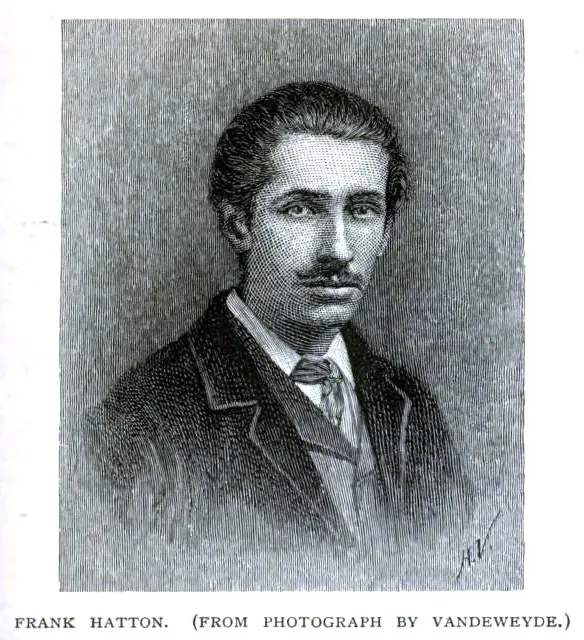
Frank Hatton.

Franz Witti knew about the dangers that came with his exploration

Exploring a new country where headhunting was still rampant always came with a price. And the cost of that price for these explorers sometimes is their heads.

As for Witti, he knew the circumstances surrounding his work as an explorer. It was believed that before Witti left Kimanis, he made a will and arranged for the settlements of all his affairs.

As Owen Rutter in British North Borneo: an account of its history, resources, and native tribes wrote, “His (Witti’s) intrepid courage, unfailing humour and disregard or personal comfort mark him as a true explorer, his tact in dealing with natives and his great black beard made him remembered by those among whom he went. ‘Whenever we came to a place for the first time,’ he says in one of his diaries, ‘there we dare show our faces again,’ and the fact he should have met his death at the hands of unthinking savages whose cause he had at heart does but enhance the tragedy of his fate.”

After his death, there were rumours of his body coming through the river flowing into the Dutch territory (Kalimantan). However, this rumour has never been confirmed.

The news of Witti’s death in the hand of headhunters was certainly viral-worthy even in the 19th century. It even made it to the New York Times on Oct 30, 1882 months after his death presumably in June, with the headline “Slain by Borneo Savages; Mr Witti’s Sad Fortunes in the Land of the Head-Hunters.” He was just 32 years old when he died.

In Sandakan, the Chartered Company Monument is built in dedication to the British servicemen or employees who were killed at the end of the 19th century. These servicemen included Witti and Hatton, who died in 1883.

10 things you might not know about the Sandakan Death Marches

Some of you might have heard of the Sandakan Death Marches. It is a series of forced marches from Sandakan to Ranau cutting through the dense rainforest of Borneo.

Overall, there were 2,434 Allied prisoners of war (POWs) died during their internment at Sandakan camp and the marches to Ranau.

It is widely considered to be the single worst atrocity suffered by Australian servicemen during the World War II (WWII).

After the Battle of Singapore in February 1942, Australian and British POWs were captured and sent to Borneo between 1942 and 1943.

They were interned at Sandakan POWs camp and forced to build a military airstrip.

Just like how the POWs were forced to build the Burma Railway, these prisoners were forced to work at gunpoint with little food to eat.

To worsen the situation, they were given little to no medical attention.

By August 1943, the officer prisoners were moved from Sandakan to Batu Lintang camp in Kuching in order to take more control of the prisoners. This turned out to be a blessing-in-disguise for the officers.

As for those who were left behind in Sandakan, the condition deteriorated significantly following the officers’ removal.

Their food were further reduced and even sick prisoners were forced to work on the airstrip.

Once the airstrip was completed, the prisoners initially still remained at the Sandakan camp.

About The Sandakan Death Marches

In January 1945, the Allied forces successfully dropped a bomb, destroying the airfield. At that time, there were only 1,900 POWs alive at the came.

After the bombing, Captain Hoshijima Susumi ordered the remaining prisoners to march to Ranau, about 260 kilometers away.

The first march took place between January and March 1945. The Japanese picked 470 prisoners whom they thought to be fit enough to carry baggage and supplies. Although the journey supposed to take nine days, the first group was given enough rations for four days.

Meanwhile, the second series of the marches started on May 29, 1945. About 536 prisoners were ordered to march toward Ranau in groups of fifty with accompanying Japanese guards.

The second march lasted for 26 days. With prisoners less fit than the first march, they were even given fewer rations. In the end, only 183 prisoners reached Ranau on June 24, 1945. That was when they found out, there were only six prisoners still alive from the first march.

After the second march prisoners departed, the Sandakan camp was left with about 250 POWs.

At first, since they were so sick, the Japanese initially planned to let them die of starvation. However, on June 9, 1945, the Japanese ordered the final group of 75 men to head to Ranau.

They were so weak, none of them survived beyond 50 kilometres. When a man collapsed from exhaustion, the Japanese guard shot him. In the meantime, the remaining prisoners left at the camp eventually died from sickness or starvation or both.

Here are 10 more facts about the Sandakan Death Marches:

10 things you might not know about the Sandakan Death Marches
The Australian Imperial Forces section of a cemetery at Sandakan camp. Credits: Australian War Memorial

1.Not all 2,428 died during the Sandakan Death Marches

The biggest misconception about the Sandakan Death Marches that there was a total of 2,428 Australian and British POWs died during the marches.

According to historian and author Lynette Ramsay Silver, 1,047 died during the marches which took place between January and June 1945.

Meanwhile, the remaining 1,381 never left the Sandakan camp. They perished due to sickness, starvation or execution by the Japanese Imperial soldiers.

10 things you might not know about the Sandakan Death Marches
The Kundasang War Memorial  is a memorial located in Kundasang, near Ranau which is dedicated to the British and Australian soldiers who died in the Sandakan POW camp during their death marches to Ranau.

2.The last known Sandakan Death Marches track cutter died in 2018.

Tuaty Akau was the last known Sandakan Death March track cutter. He died on his birthday on Oct 29, 2018, aged 105.

During WWII, he joined his father-in-law who was recruited by the Japanese to cut the trail to prepare for the marches.

He told his story to Daily Express in 2016, “One time my fellow track cutter stopped for a cigarette and was hit on the head with a rod.”

Tuaty also shared how he saw weak prisoners passing by and tried to offered rice to them but was scolded by the guards.

Thanks to Tuaty, a long time dispute between two historians – Silver and Dr Kevin Silver – was finally solved.

Dr Smith argued that the track head to Miruru via the Liwagu Valley while Silver claimed that it never went to Miruru. Tuaty then confirmed Silver’s evidence that the trail never head to Miruru.

Another witness of the march, Zudin (who died in 2017) also confirmed that the trail never passed Miruru.

10 things you might not know about the Sandakan Death Marches
An inscription found at Kundasang War Memorial.

3.Operation Kingfisher is the rescue plan that never took place

The saddest part of the marches was the fact there was a planned rescue operation.

Unfortunately, the mission (called Operation Kingfisher) never took off the planning desk.

There are several alleged reasons why the Allied forces did not execute Operation Kingfisher.

It was reported that Agas reconnaissance missions incorrectly reported that there were no prisoners left in the Sandakan camp.

Another factor said that there was no adequate air support.

Nonetheless, if only Operation Kingfishers was not abandoned, perhaps many men could have returned to their families.

10 things you might not know about the Sandakan Death Marches
The Australian Garden At Kundasang War Memorial.

4.Japanese soldiers reportedly turned to cannibalism

The Japanese soldiers themselves had their own suffering in Sabah during the war.

Dick Braithwaite and Yun Lok Lee wrote in their paper Dark Tourism, Hate and Reconciliation: The Sandakan Experience, “Many Japanese soldiers also perished of starvation and disease in the jungle. In the latter half of the Pacific War, Japanese Troops were chronically under-supplied. In order to preserve their fighting effectiveness under such conditions, individual soldiers who were no longer effective were given a day’s rations and cast out of their military unit and told to fend for themselves. Many turned to cannibalism.”

10 things you might not know about the Sandakan Death Marches
Some of the newspaper clippings at the memorial.

5.Those who were killed even after the Japanese had surrendered

By the end of July 1945, there were about 38 prisoners (some report stated 33) left alive at Ranau.

Weak and sick, they were unable to do any work. They were then killed by the guards, sadly perhaps up to 12 days after the Japanese officially surrendered on Aug 15. By killing the remaining prisoners, the Japanese wanted to get rid all possible witnesses of the marches.

As for the remaining POWs at Sandakan camp, the last man alive – John Skinner was beheaded on Aug 15 at 7.15am.

Five hours later, Emperor Hirohito announced that Japan had unconditionally surrendered.

These POWs clearly did not have the same fate with the prisoners at Batu Lintang Camp in Kuching.

After the war, there were two ‘death orders’ found among the official Japanese papers at the camp.

The first order was scheduled on Aug 17 or 18 but for unknown reason was not executed. The second order was scheduled to take place on Sept 15. Thankfully, the camp was liberated on Sept 11 by the Australian 9th Division.

The timely liberation of the camp may have saved the lives of over 2,000 men, women and children at Batu Lintang Camp.

6.The White-Japanese, the ‘betrayer’ among the Australians?

Among the six survivors of the Sandakan Death Marches, there was one Australian soldiers regarded as ‘White Jap’ by his fellow survivors. He was Warrant Officer William Hector Sticpewich.

Silver wrote in her website that he was very much hated by his fellow survivors, “So much so that, post-war, they refused to have anything to do with him.

“There have always been question marks over Sticpewich’s behaviour. Described as ‘a Jack of all trades’, as soon as he reached Sandakan he made himself indispensable to the Japanese and, therefore, avoided labour on the airstrip.

“By his own admission, he went to the airstrip on one occasion only – in late 1942 when all POWs, including the sick and officers, were put to work to ensure the first stage of construction was finished in time for a grand opening.”

Unlike other survivors who looked emaciated after their rescue, Sticpewich was reportedly in fantastic condition.

Additionally, Sticpewich was suspected to have killed another soldier Private Herman ‘Alby’ Reither when they both escaped from Ranau on July 28, 1945.

In response to Silver’s investigation, Avtar Singh wrote in the Daily Express that finding fault for war veterans and then going after them in public had to stop.

He opined, “They had suffered enough both during and after the war. And let’s remember, nobody profits from these allegations and these stories.”

7.Tracking the bodies of POWs

10 things you might not know about the Sandakan Death Marches
A couple walking through the Contemplation Garden of the Kundasang War Memorial where the panels name all the victims.

After the war ended, the difficult part of searching the remains of more than 1,000 soldiers scattered along the 250 kilometres of jungle trekking began.

One of the soldiers tasked for the job was Stan Roberts. He was a member of 8 Australian War Graves unit. Roberts was deployed to North Borneo in June 1946 to locate the remains and transferring them.

Once the remains were exhumed, they were wrapped in lengths of hessian and carried back to Ranau. There, Roberts searched for any clues to identify the remain.

Since all the army identity discs had rotted, being made from compressed cardboard, there was little to help identify the remains.

A number of those died on the Sandakan Death Marches were given their final resting place at Labuan War Cemetery. Those who could not be identified were reburied as ‘Known unto God’.

10 things you might not know about the Sandakan Death Marches
The remains of men who died or were killed in the ruins of the Sandakan camp were identified by members of war graves units sifting through hundreds of named personal items. Credits: Australian War Memorial.

8.Why the Japanese did what they did

Yuki Tanaka in Hidden Horrors: Japanese Crimes in World War II gave his insight on why the Japanese soldiers committed such horrendous crimes against the POWs.

“The ill-treatment and massacres of POWs at Sandakan and the Sandakan Death Marches were made possible in large part by the traditional Japanese military ideology and the training procedures that arose from it. Men were trained to follow orders habitually and unquestioningly, and the training evidently worked. Captain Yamamoto Shoichi and Captain Takakuwa Takuo apparently never questioned the orders they were given by their superiors. Their primary concern was how they could carry out their orders, and this thinking led them to commit war crimes. It is insufficient to attribute responsibility to these individuals, however, without placing their behaviour within the context of Japanese military ideology,” he wrote.

Yuki further explained, “Dehumanisation involves a psychological distancing process whereby it becomes possible to act aggressively toward a weaker person without feeling the remorse that would occur in more normal circumstances. When dehumanisation of the enemy reaches its extremes, normally unthinkable acts such as the massacre of POWs become possible. In the situation at Sandakan, the Japanese believed they were under such threat from an Allied Invasion that there was no hope for them; they were destined to dehumanise prisoners and act brutally toward them,

“At Sandakan the enemy bodies that could be counted were those of dead prisoners rather than enemy combatants, but the officers at Sandakan shared the same malignant obsession with counting the dead. The Japanese, partly out of the overwhelming anxiety that they were about to meet their own deaths, felt driven to kill prisoners and then, perversely, were able to use the numbers of dead to reduce their anxiety.”

9.War trials against the Japanese soldiers

Regardless of the reasons, what the Japanese soldiers committed during Sandakan Death Marches undeniably were war crimes.

Sticpewich might be considered a betrayer to some but he was one of the witnesses along with Botterill, Short and Campbell during the war crimes trials in Tokyo and Rabaul.

During the occupation, the Sandakan camp was led by Lieutenant Susumi Hoshijima.

Since he was a military engineer, he was in-charge of building the military airstrip. Hoshijima was promoted to Captain toward the end of the war.

He reportedly told the POWs, “You will work until your bones rot under the tropical sun of Borneo. You will work for the Emperor. If any of you escape, I will pick out three or four and shoot them. The war will last for 100 years.”

10 things you might not know about the Sandakan Death Marches
Captain Susumi Hoshijima (centre) during the war crimes trial in Labuan. Credit: Australian War Memorial.

In May 1945, Captain Takakuwa Takuo was put in-charge of the POWs.

Too bad for Captain Hoshijima, the war did not last for 100 years. He was found guilty for war crimes and hanged on Apr 6, 1946.

Meanwhile, Captain Takakuwa and his second-in-charge Watanabe Genzo were found guilty of causing the murders of POWs and were hanged and shot on Apr 6, 1946 and Mar 16, 1946 respectively.

As for Lieutenant-general Masao Baba, he was charged with command responsibility for the Sandakan Death Marches. The commander forces in northern Borneo was found guilty and hanged on Aug 7, 1947.

10 things you might not know about the Sandakan Death Marches
News headline reporting on the trial of Lieutenant-General Masao Baba.

10.The Suicide of Colonel Suga

The person who was responsible of all POWs and civilian internment camps in Borneo during WWII actually was Lieutenant-Colonel Tatsuji Suga.

He was an English lecturer before the war and volunteered as prison camp commander after the Japanese attack on Pearl Harbour.

In Borneo, there were mainly three interment camps; Batu Lintang (Kuching), Kota Kinabalu and Sandakan. Besides these, there was a brief internment camp on Labuan island.

Suga was based at Batu Lintang and practically absent at other camps.

10 things you might not know about the Sandakan Death Marches
Flying over the prisoner of war camp (POW) in Batu Lintang at a low height, RAAF Beaufighter pilots reported sighting white POWs, clad in khaki shorts, who excitedly waved as the RAAF aircraft flew over to drop leaflets announcing Japan’s surrender. Credits: Public Domain (Copyright expired). https://www.awm.gov.au/collection/C242106

Unlike other Japanese soldiers such as Hoshijima, Suga was remembered by some internees to be kind.

One Australian civilian internee Rosemary Beatty recalled that Suga would take the children to his residence and served them coffee and fruits. Sometimes he even gave the children sweets.

Whenever Suga was away from Batu Lintang camp, the brutality by the guards increased. It is unknown if it is due to Suga’s instruction or his men took advantage to abuse the prisoners during his absence.

Believed to be a Catholic, he attended masses at the camp during the war. Once, he even rewarded the elderly priests with some papayas. Little did he know, the papayas were obtained by his men from the priests’ own garden.

On Aug 24, Suga himself officially announced to the prisoners at Batu Lintang that Japan had surrendered.

He was heartbroken as he believed that his entire family had been killed in the bombing of Hiroshima.

When the Japanese officially surrendered in Kuching on board HMAS Kapunda on Sept 11, 1945, he was there to attend. Later that day, Suga officially surrendered himself at Batu Lintang Camp.

Together with several of his officers, he was flown to Labuan to await for their trials as war criminals.

According to the website Digger History, Suga was found dead in the morning of Sept 16, 1945. He reportedly committed suicide by stabbing his throat with a table knife. He was also found with a water bottle half-filled with sand. While some reports suggested he struck his own head using the bottle before stabbing himself, other stated that he had help in his suicide.

Did Suga disobey the first death order to execute all Batu Lintang’s prisoners? We might never know.

And did he die with the knowledge of atrocities committed at the Sandakan Death Marches and camp? We also might never know.

One thing for sure, Suga died without knowing that his wife and three of his children had in fact survived the Hiroshima bombing.

KajoTries: How to make an easy, egg-less banana cake

Did you know there was a difference between banana cake and banana bread? Compared to the dense banana bread, banana cake has a lighter texture.

Besides bananas being the main ingredient, other typical ingredients in a banana cake are flour, sugar, eggs, baking soda and butter. Some people prefer to use margarine or cooking oil to replace butter.

The most common way to prepare it is by baking. However, you can find steamed banana cake in Chinese, Malaysian, Indonesian and Vietnamese cuisine.

KajoTries: How to make an easy, egg-less banana cake
You can easily mash the banana using a fork.

How to make an easy, egg-less banana cake only using five ingredients

KajoTries: How to make an easy, egg-less banana cake
A simple egg-less banana cake.

If you are looking for an easy-to-make, no fuss recipe for a banana cake, look no further than this.

Shared anonymously by a user on Facebook, this recipe only uses five ingredients.

Moreover, it does not even need butter or egg.

The ingredients are two cups of flour, two cups of mashed bananas, one cup of white sugar, one cup of cooking oil and two teaspoons of soda bicarbonate.

The instructions are easy-peasy too; just whisk everything together in a bowl. Pour it into a baking tray and then bake it in the oven at 170oc for 45 minutes.

You can also steam it for the same period of time.

KajoTries: How to make an easy, egg-less banana cake
Just combine all ingredients in a bowl and whisk it.

KajoMag’s review of this egg-less banana cake recipe

This recipe had been tried and tested by KajoMag and our thoughts? It turned out delicious, sweet, and above all, moist.

We baked it for 45 minutes but the skewer did not come out clean when we poked it right in the center of the cake. So, we left it for another 10 minutes in the oven and increased the temperature to 180oc.

The recipe originally stated it can be topped or garnished with sliced bananas but we were too eager to try what we baked for that extra step.

If we were to make this egg-less banana cake again using the same recipe, we would tweak it a bit, more out of personal preference.

The first thing we would add is some nuts like walnuts or macadamias to add some nutty flavour and different texture into the cake.

Another thing would be to reduce the amount of sugar. For the sweet tooths out there, this recipe has a decent amount of sweetness. Just for the sake of keeping our sugar levels in check, reducing the amount of sugar to one cup or one and a half cup might not be a bad idea.

Some banana cake enthusiasts might be particular on what type of banana to use for their cake. Honestly, we could not differentiate between the variation of bananas so we just threw in fruit we knew with full assurance, were bananas.

Here is the full recipe for the easy, egg-less banana cake:

KajoTries: How to make an easy, egg-less banana cake
This recipe makes a sweet and moist banana cake.

Ingredients:
2 cups of flour
2 cups of mashed bananas
1 cup of white sugar
1 cup of cooking oil
2 teaspoons of soda bicarbonate

Instruction:

Combine all ingredients into a bowl and mix it using a mixer. Pour the batter into a baking tray then bake it in 170oc oven for 45 minutes. You can also steam it for at least 45 minutes or until the skewer comes out clean after inserting it into the center of the cake.

Have you tried this egg-less banana cake recipe? Let us know in the comment box. What type of banana do you think is best used in banana cakes? Leave a comment!

Iban olden customary laws against adultery and elopement

Some people call it love, while others call it breaking the adat (custom).

Historically, many cultures consider adultery a very serious crime, subject to severe punishment such as capital punishment, mutilation or torture.

This includes the Iban people of Sarawak.

Iban olden customary laws against adultery and elopement

According to Iban ethnologist Benedict Sandin, before Sarawak was under Brooke rule, if an Iban stole another man’s wife and he was caught, the woman’s husband had every right to strike him with a club.

He explained, “As a rule, therefore, in order to prevent this from happening, immediately after the incident, it was the duty of the longhouse chief to kill a cock as soon as possible. If the striking with a club had taken place before the cock was killed and the adulterer was killed in the process, his death would not be compensated by the killer. But if it occurred the killing of the cock, the striker would be heavily fined in accordance with the customary law of ‘Malu Mungkal’.

Furthermore, he would be ordered by the chief to pay the ‘pati nyawa’, the compensation for taking a life. The cost of ‘pati nyawa’ is one valuable jar in which the type is according to the rank of the deceased.

Charges for ‘berangkat’ or elopement

Let’s say if it was only an ordinary case of elopement, then both of the accused would be charged with adultery.

Writing for the Sarawak Gazette on May 31, 1964, Sandin stated, “They would be fined 30 catties which was equivalent to $21.60; the man twenty and the women ten.

“If they were to marry they would be charged with berangkat (taking someone’s husband or wife and vice versa). In due course the man would be fined 1 1/2 piculs or $43.20 and the woman one picul or $28.80.”

Meanwhile, the man was allowed to divorce his adulterous wife by paying the ordinary fine of twenty catties or $14.40. If they had children, they would be divided between the parties. If there was only one, according to Sandin, it would be given to the guiltless party.

1 27 28 29 30 31 75