Browse Tag

Singapore

The 3 Famous Trees of Fort Canning Park, Singapore

By Ng Ai Fern

Most people come to Fort Canning Park, one of Singapore’s most historic green spaces, for its past. Some come for the museums. Others come for the view.

But today, many visitors arrive for something else entirely: its trees – centuries old, rare, or simply photogenic.

Here are three famous trees in Fort Canning Park, including one that technically isn’t just about the tree at all.

1. The most famous heritage tree in Fort Canning: The Majestic Rain Tree

“I flew all the way to Singapore just to see this tree.”
– a Trip.com post that has since gained significant attention online

The post even provides detailed directions to locate the Rain Tree within Fort Canning Park – no small feat in a 22-hectare green space with multiple entrances and winding paths.

Native to tropical America, the Rain Tree (Samanea saman) was introduced to Singapore in 1876. It is one of the Heritage Trees in Fort Canning Park, conserved under Singapore’s Heritage Tree Scheme for its ecological and historical value.

According to the Heritage Tree Guide, the Rain Tree gets its name from the way its leaflets close when the sky is overcast. It is also known locally as “Pukul Lima” – “five o’clock” in Malay – because its leaves fold in the evening.
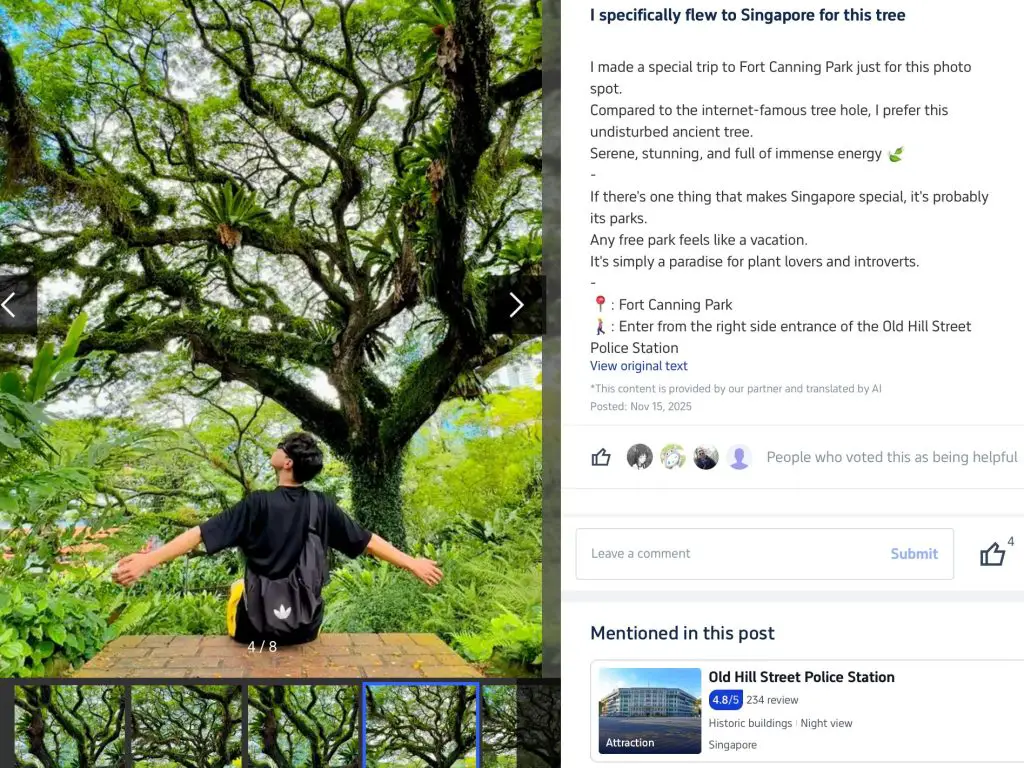
Trip.com Moments post
Post on Rain Tree in Fort Canning featured on trip.com moment

2. The most mysterious tree: The Kapok Tree that allegedly walks at night

The Kapok Tree (Ceiba pentandra) is another Heritage Tree found in Fort Canning Park and, like the Rain Tree, is native to tropical America.

Unlike its photogenic counterpart, the Kapok Tree is less famous on social media and far more renowned in folklore and ghost stories.

According to the Fort Canning tree trail guide, the Kapok is a fast-growing species that can reach heights of 50 to 70 metres, and is likely still growing today.

Its cream-coloured flowers emit a milky scent and later produce large seed pods that split open to release white, cotton-like floss. The word kapok itself means “floss” in Malay. This waterproof fibre was traditionally used to stuff pillows, mattresses, and even life buoys.

Across cultures, the Kapok Tree is steeped in mysticism.

In ancient Maya mythology, it was believed to form a sacred link between the heavens, earth, and the underworld – its roots reaching below while its branches held up the sky. Some Caribbean folklore even claims the Kapok Tree walks at night.

Closer to home, in Singapore and Malaysia, it is said that “Dear Lady P” loves to sit on its branches.

Despite its imposing presence, the Kapok Tree remains relatively overlooked online – perhaps not because of its ghostly reputation, but because its sheer height makes it difficult to frame as a dramatic photo backdrop.
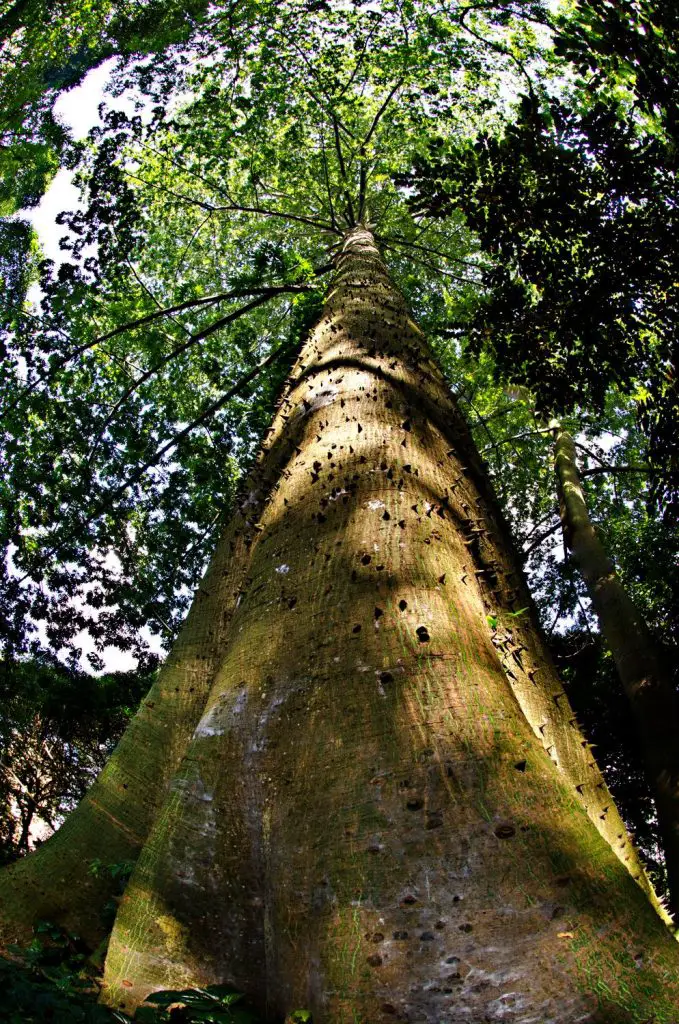
 Kapok Tree in Fort Canning, Photo from Singapore National Parks’s official Facebook page
Kapok Tree in Fort Canning, Photo from Singapore National Parks’s official Facebook page.

3. The most photographed “tree” in Fort Canning

This is the spot almost every visitor recognises, even if they don’t know its name.

Many come specifically to take a photo here, often queuing for long stretches of time for what has become Singapore’s most viral “tree” photo.

Here’s the truth: it isn’t a tree.
It isn’t a tree hole.
And it isn’t really a tree tunnel either.

It’s a drainage tunnel.

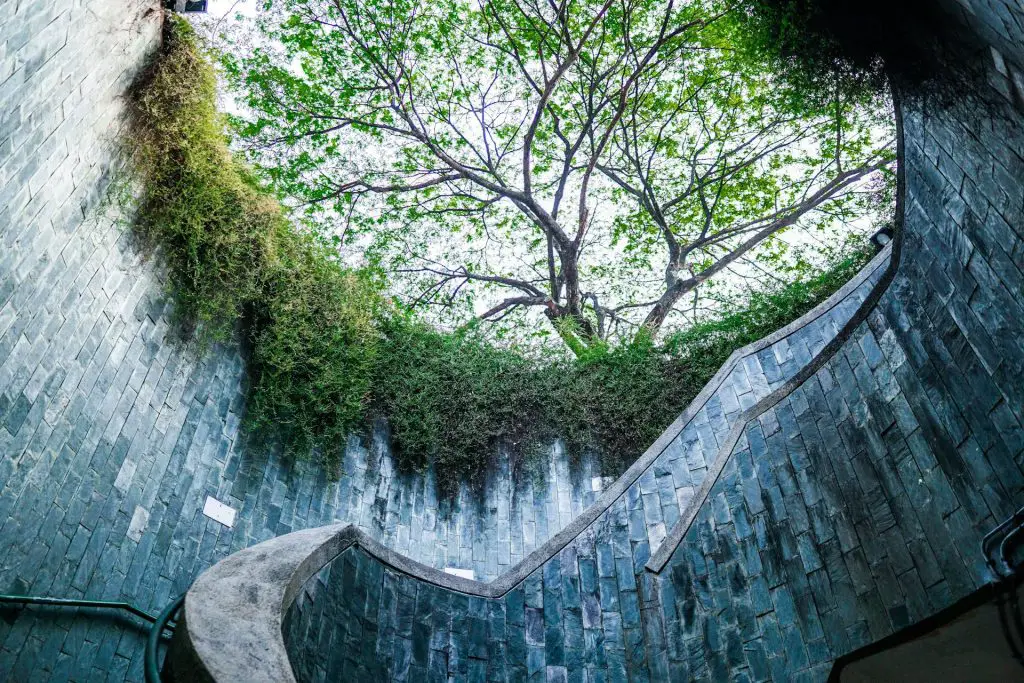
The circular opening frames a yellow Flametree above, while most photos are taken from the spiral staircase below. Together, they create the illusion of a “tree inside a tunnel”, a visual trick that has taken Instagram and Xiaohongshu by storm.

Follow the park signage to the famous “tree tunnel.” Visit at any time, but expect a queue. There have even been reports of disputes, theft, and complaints due to overcrowding.

It might just be the most photogenic piece of tree-related travel content, not only in Singapore and Johor Bahru (as Phua Chu Kang would say), but possibly the world.

Screenshots of Instagram posts with #fortcanning
Screenshots of Instagram posts with #fortcanning.

Visiting Fort Canning Park Today

Once known as the “forbidden hill,” Fort Canning is now open for everyone to enjoy. Visitors can explore the Heritage Gallery, the Spice Gallery, and nine historical gardens, all free of charge. Guided tours and virtual tours are also available.

Do keep an eye on the tropical weather: watch for lightning or falling branches during storms, and bring plenty of patience for your photoshoot.

Back home in Sarawak, our trees may be older. But there is something uniquely striking about seeing heritage trees standing quietly just steps away from bustling Orchard Road. Best of all, Fort Canning is less than an hour’s flight away with Scoot and AirAsia and soon, AirBorneo.

Discover SKULLPANDA CAGE-UNCAGE Singapore at the National Museum of Singapore

By Ng Ai Fern

Find your “key” in life at the international debut of SKULLPANDA CAGE-UNCAGE Singapore at the National Museum of Singapore.

Running from 12 December 2025 to 22 February 2026, the exhibition invites visitors on a journey of self discovery through the deeper narrative behind the popular SKULLPANDA character. 

SKULLPANDA, one of POP MART’s successful collectible characters, is created by Chinese artist Xiong Miao. Unlike the playful, mischievous Labubu, SKULLPANDA is dreamy and introspective – a character with a skull-like face wearing an astronaut-style helmet that reflects its inner world.

A quest for the “key”

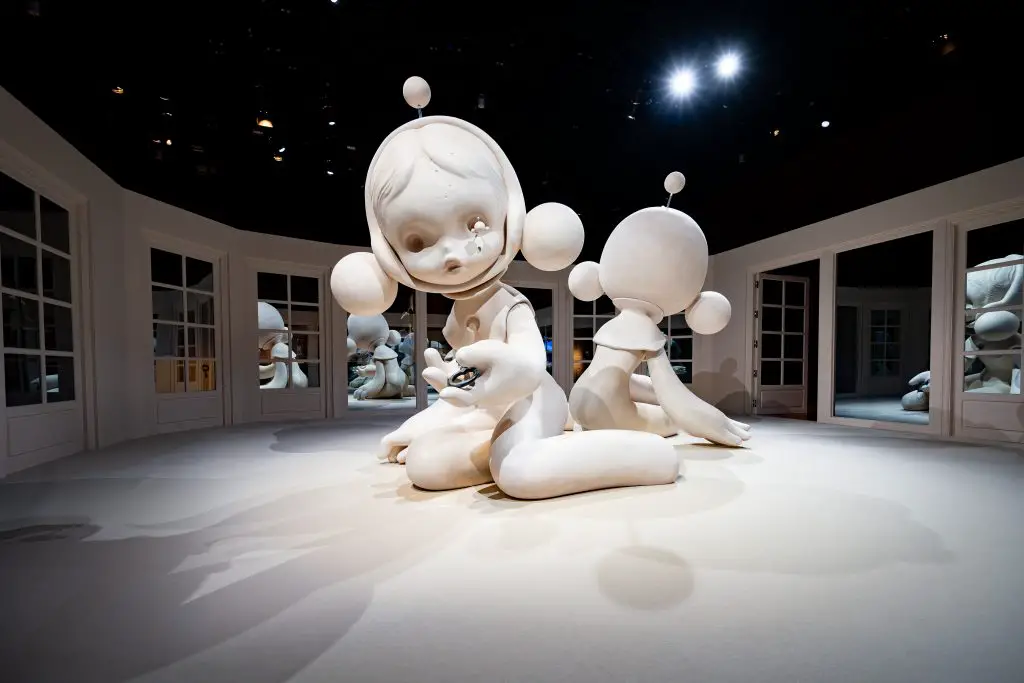
Fortune zone with mirrored surfaces and a central Skullpanda sculpture inside the Cage-Uncage Singapore showcase.

This immersive and thought-exploring showcase is built around a search for the “key,” connecting the dual states of “caged” and “uncaged” that define SKULLPANDA’s conflicting thoughts.

Visitors begin with The Key, where fragmented mirrors and scattered keys invite reflection on the boundaries between reality and endless possibilities. The journey continues through six themed zones – Emotion, Fortune, Rules, Exploration, Life and Direction – each offering a glimpse into SKULLPANDA’s inner landscape.

Visitors  can also become active participants by rotating a large cuboid. As the patterns break apart and reassemble. This simple motion mirrors exploration itself: shift your perspective, and the story changes; rearrange the pieces, and a new meaning appears.

The Room: the heart of the showcase

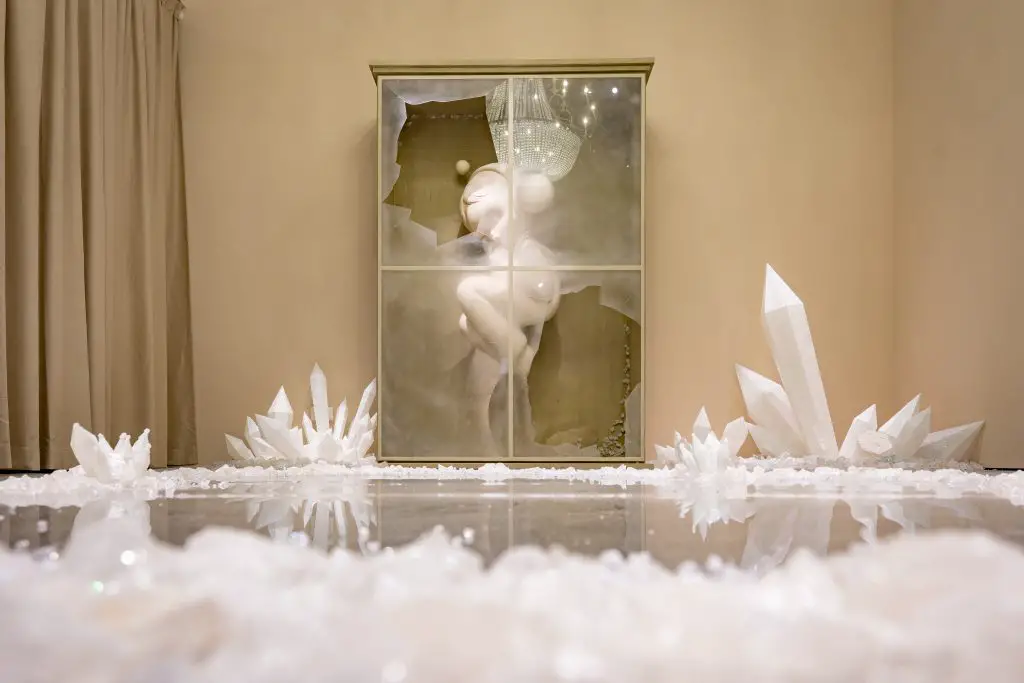
This central installation, known as The Room, uses reflection and repetition to evoke the inner conflicts at the core of SKULLPANDA’s narrative.
SKULLPANDA’s central installation, known as The Room.

At the centre of the exhibition sits The Room, a mirrored chamber linking all six zones. Two SKULLPANDA sculptures sit back-to-back, each holding a key.

The scene symbolises a familiar tension – the weight of being held back and the hope of breaking free. The mirrors create an abstract cityscape that blurs inside and outside, confinement and possibility, the finite and the infinite. Somewhere within these reflections lies the “answer” – the key held by the sculpture, and metaphorically, by the viewer.

And yes, just like SKULLPANDA, visitors eventually discover their own “key.”

A Singapore-exclusive installation

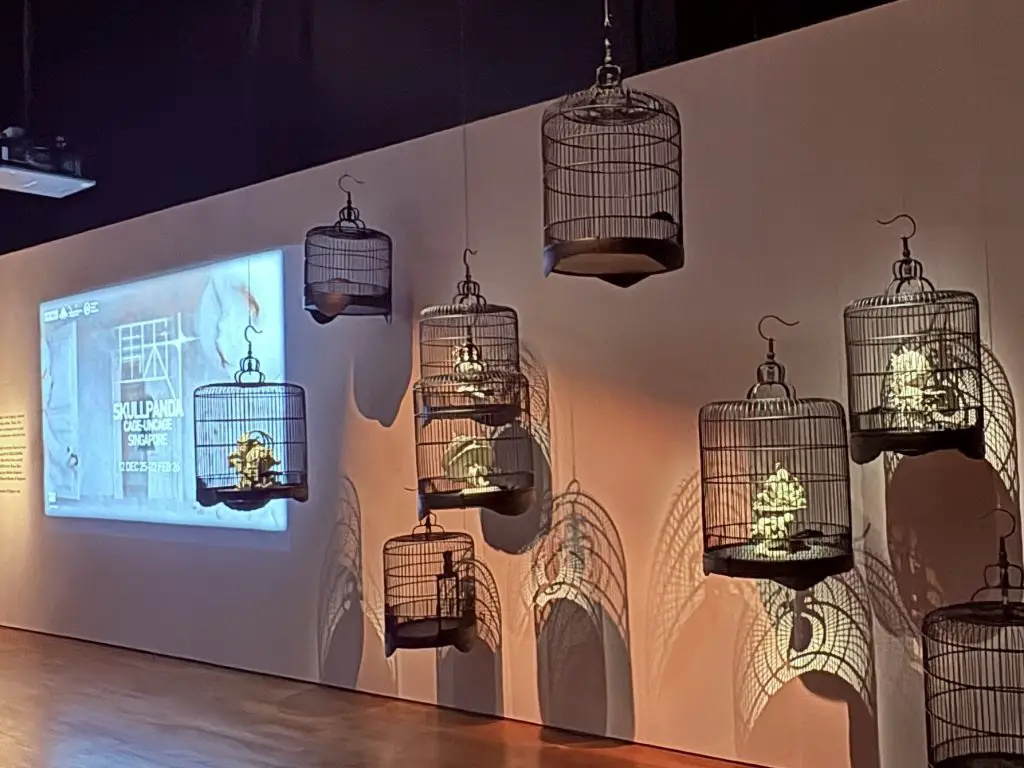
A Singapore-exclusive installation inspired by the city’s bird-singing tradition, featuring prototype Skullpanda figures from The Paradox Series and video art created specially for the CAGE-UNCAGE showcase by Xiong Miao. The exhibit was jointly created by POP Mart, The National Museum of Singapore and The Singapore Tourism Board.
A Singapore-exclusive installation jointly created by POP MART, The National Museum of Singapore and The Singapore Tourism Board.

Exclusive to the Singapore edition of the showcase is an installation that pays homage to bird singing, a beloved pastime enjoyed in Singapore’s housing estates among enthusiasts. Suspended bird cages present the original prototype figurines from the SKULLPANDA TheParadox Series, 

Presented by POP MART in collaboration with the character’s creator, Chinese artist Xiong Miao, and in partnership with the National Museum of Singapore and the Singapore Tourism Board, SKULLPANDA CAGE-UNCAGE Singapore presents a visual journey that delves into the tensions between containment and release that exist within our decisions. 

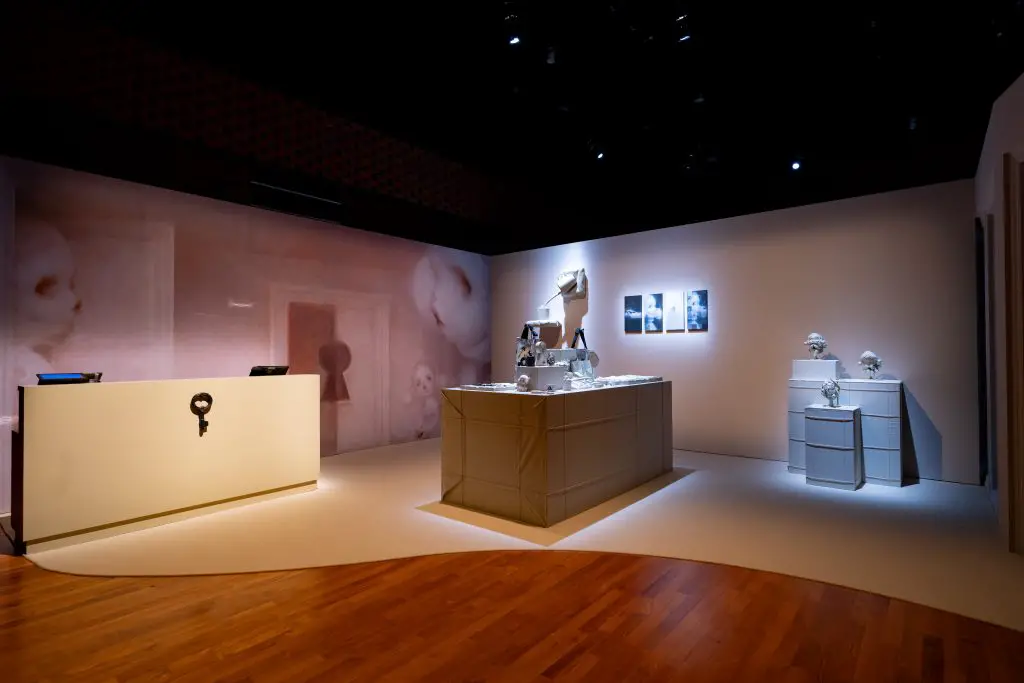
Showcase-exclusive merchandise is available at the Gallery Theatre retail zone for ticket holders, subject to eligibility and purchase limits. Additional POP MART items can be found at the POP-UP store in the museum’s Longer Concourse.

Inside the Gallery Theatre retail zone, visitors can browse exclusive CAGE-UNCAGE merchandise, available only at the Singapore exhibition.
Showcase-exclusive merchandise will be available for purchase at the Gallery Theatre retail zone.

Tickets are available at NMS at their official website or through the showcase’s ticketing partner Trip.com, priced from $36 (RM115) for Malaysian tourists. 

The National Museum of Singapore – the country’s oldest museum – is located at 93 Stamford Road, Singapore 178897.

Travel Note

Direct flights from Kuching, Sibu and Miri to Singapore are available via AirAsia and Scoot. AirBorneo will begin connecting to Singapore next year.

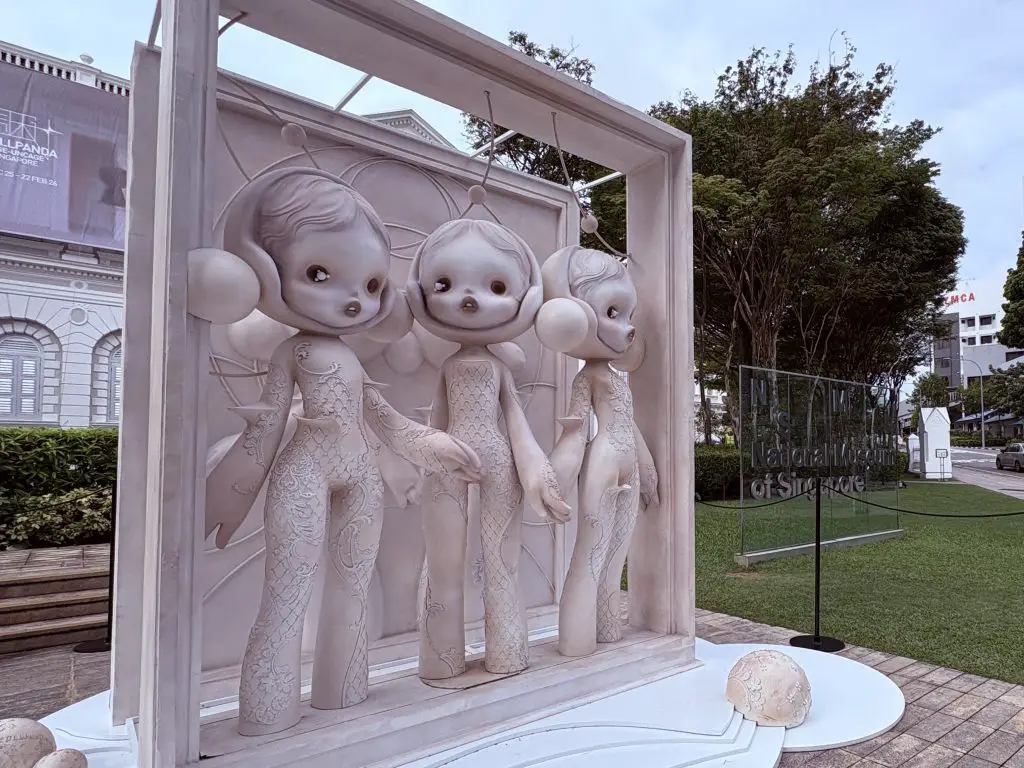
Large Skullpanda sculpture displayed on the front lawn of the National Museum of Singapore during the Cage-Uncage exhibition.
This outdoor SKULLPANDA installation marks the entrance to the CAGE-UNCAGE Singapore exhibition, extending the showcase beyond the gallery walls.
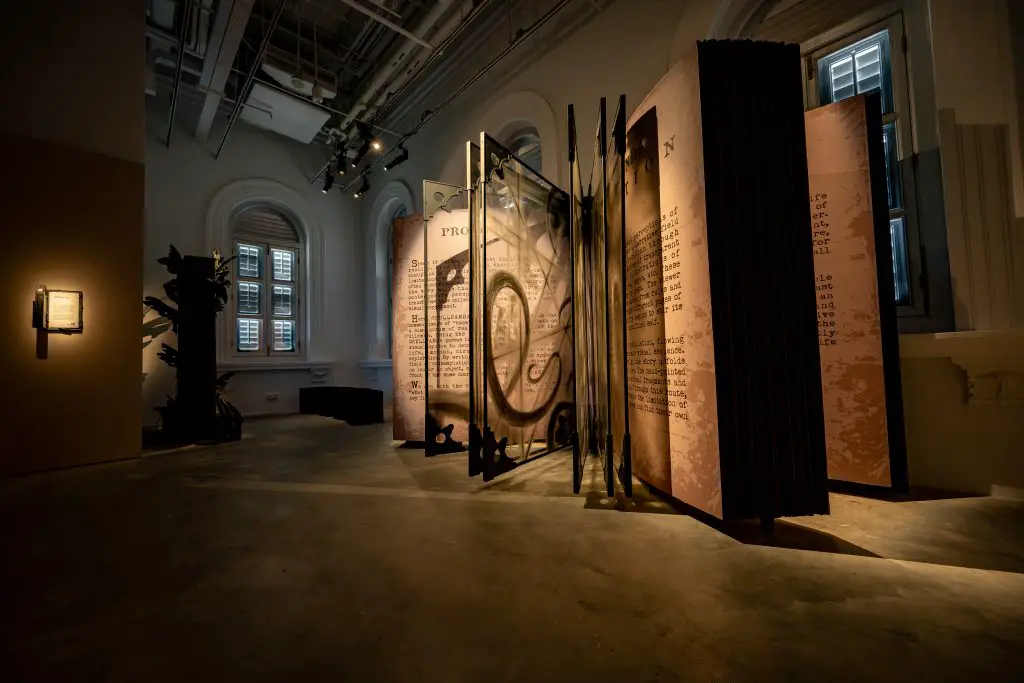
Transparent book pages installation in the Direction zone at Skullpanda Cage-Uncage Singapore.
In the Direction zone, transparent pages marked with thorns, shackles, and webs unfold like shifting paths toward freedom. Each turn reveals a new way to navigate obstacles or find sanctuary within constraints, while a giant picture frame of hand-drawn illustrations and moving light ties the narrative together with Xiong Miao’s signature butterfly motif.
Through motion and balance, the Rules zone reflects the invisible structures that shape how we move through life.

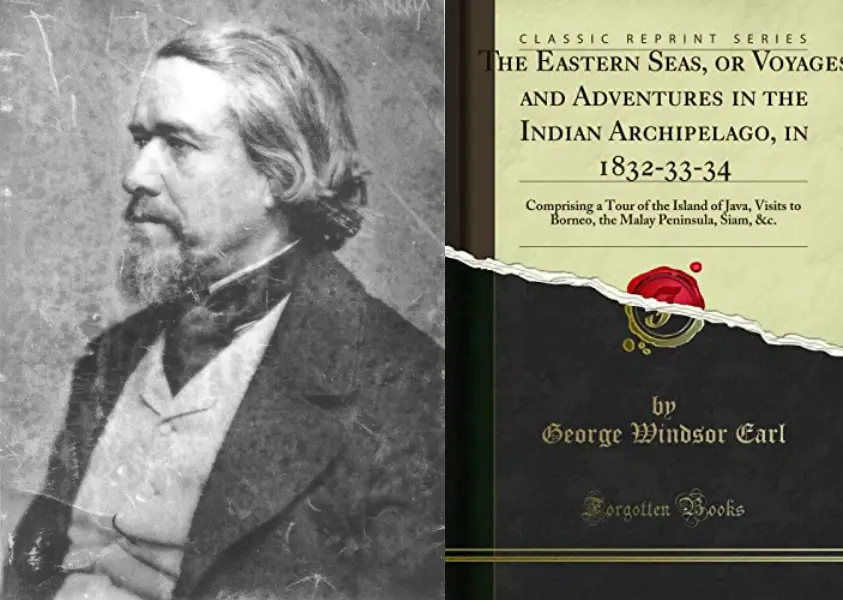
The Eastern Seas, the book which inspired James Brooke to explore

For an idea of how Borneo looked like before the Brookes, have a read of The Eastern Seas written by George Windsor Earl.

An English navigator, Earl was the first one to provide a European account of north-west Borneo’s Chinese gold miners and the incredible wealth of Borneo which included gold, diamonds and other native resources like camphor and ebony.

His voyages took him around the world including India, Southeast Asia, Papua New Guinea and Australia.

Many were inspired by his expedition and followed suit including James Brooke himself, who eventually founded the Kingdom of Sarawak and ruled the country from 1841 until his death in 1868.


The Eastern Seas
The book, The Eastern Seas and a miniature of The Royalist on display at The Brooke Gallery at The Fort Margherita.

Getting to know the author of The Eastern Seas

Born on Feb 10, 1813 in Hampstead, London, Earl was very much influenced by the world of navigation from early on. His father, Percy was a sea captain working for the East India Company. He started his nautical career by travelling to India after becoming a midshipman at age 14.

Earl was already on his journey from Western Australia bound for Java by the year 1832. Over the next two years, until about Nov 1834, he journeyed through the area he knew as “the Eastern Seas.”

Subsequently in 1835, Earl returned to London to publish his account in a book he later named The Eastern Seas or Voyages and Adventures in the Indian Archipelago in 1832-1834.

It comprised a tour of Java, Borneo, Malay Peninsular, Thailand and Singapore and observations on the commercial resources of the archipelago.

The Eastern Seas is culturally important. Interested readers can read it online through various archives.

The Eastern Seas (2)
The Eastern Seas or Voyages and Adventures in the Indian Archipelago 1832-33-34

George Windsor Earl’s work inspired many

Apart from Brooke, Earl also inspired other established naturalists and explorers.

In 1845, Earl published a pamphlet On the Physical Geography of South-Eastern Asia and Australia.

He described how shallow seas connected islands on the west for example Sumatra and Java with the Asian continent.

Furthermore, Earl found the islands on the east such as New Guinea were related to the Australian continent and reportedly had the same type of marsupials.

British naturalist Alfred Russel Wallace used Earl’s deductions to propose the faunal boundary line now known as the Wallace Line.

Charles Darwin also reportedly used Earl’s observation on deep sea channels to study the bio-geographic distribution of the region.

Another of Earl’s works ‘The Native Races of the Indian Archipelago: Papuans’, was an important work of early New Guinea anthropology.

However, he did not actually visit the island or maybe he never officially recorded his visit.

He compiled the first hand accounts of other visitors for his works on the Papuan people.

In 1850, Earl proposed the term Indunesians or Malayunesians for the people living in the Indian Archipelago or Malayan Archipelago.

Earl’s student, James Richardson Logan later popularised the name Indonesia as synonym for Indian Archipelago.

But it was only after 1900 that the term Indonesia became more commonly used.

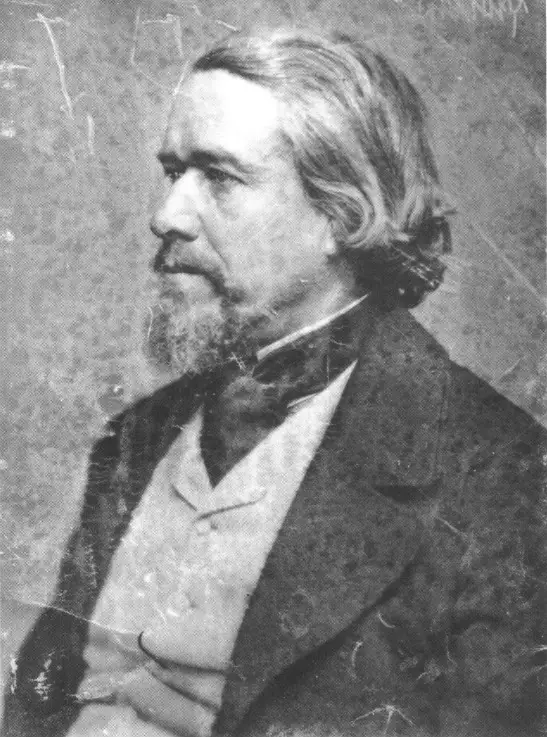
George Windsor Earl’s death

The Eastern Seas
Portrait photo of George Samuel Windsor Earl (February 10, 1813 – August 9, 1865), colonial administrator, who coined the term “Indonesia”.

From 1855, he held various official administrative posts, his last one being Penang.

Earl died on his journey back to England in 1865. He was buried at the Old Protestant Cemetery, George Town in Penang.

Read more:

Toshinari Maeda, The Japanese Nobleman Who Died off the Coast of Bintulu During WWII

Charles Hose and His Love Affair With Sarawak

How Rajah Brooke’s secretary is related to Johor royalty through Mads Lange

This is a story of two siblings; half-siblings to be precise, how they lost their family fortune and how one of them became a wife to a Sultan and the other worked as a private secretary to a Rajah.

And it all started from their father, Mads Lange.

Mads Lange and how he became the King of Bali

How Rajah Brooke’s secretary is related to Johor royalty through Mads Lange
Mads Lange Painted by unknown Chinese painter on Bali. Credit: Public Domain.

Mads Lange was a trader and entrepreneur who made his fortune in Bali so much so that he was nicknamed the ‘King of Bali’.

According to Henk Schulte Nordhort in his paper The Mads Lange Connection (1981), Mads Johansen Lange (Sept 18, 1806 – May 13, 1856) was born on the island of Langeland, Denmark.

He grew up in a merchant family and in 1824, when he was eighteen, he went to sea as a crew member on one of the ships of the Danish Asiatic company.

Nordhort wrote in his paper, “In the 1830s the Danish Company sold many of its ships, and one of them, the Syden, was brought by Captain John Burd, who planned to trade along the China coast. He left Denmark in 1833 and his second-in-command was Mads Lange. Three brothers of Mads- Hans, Karl Emillius and Hans Henrik – were also members of the crew.”

Lange eventually made his way to Dutch East Indies and subsequently settled on Bali.

There, he built a thriving commercial enterprise, exporting rice, spices and beef and importing weapons and textiles.

At one point of his career, Lange owned as many as fifteen ships that travelled and traded among ports in the East Indies, the West Indies and Europe.

He also built a factorij at Kuta, Bali. (A factorij is the common name during the medieval and early modern eras for an entrepot which was essentially a free-trade zone.)

Apart from his business, Lange was historically known as the mediator between the local Rajahs and the Dutch colonists.

As for his personal life, Lange was never officially married but he fathered three children with his mistresses.

With a local Balinese woman named Nyai Kenyer, he had two sons – William Peter who was born in 1843 and Andreas Emil born in 1850.

His second known mistress was the daughter of a wealthy Chinese merchant, a woman who Lange called ‘Nonna Sangnio’.

Sangnio gave birth to a daughter in 1848 and Lange named her Cecilia Catharina Lange.

Sadly, William died at the age of 12 in Singapore reportedly due to dysentery.

Mads Lange’s daughter Cecilia Lange

Lange died on May 13, 1856. While there was no officially inquiry made into his death, it is widely rumoured that he had been poisoned either by the local Rajah or by the Dutch.

Just like the story of Sara Crewe in the children’s novel A Little Princess (1888) by Frances Hodgson Burnett, Cecilia learned about her father’s death when she was in school in Singapore.

Unlike Sara, Cecilia was adopted by a British family and continued to be schooled in Singapore.

“She traveled with them to India, France and England before returning to Singapore. In 1869 she went to Bali to visit her father’s grave, the only time back there since she left as a child,” Peter Bloch in his book Mads Lange’ Forgotten Treasures.

She then returned to Singapore where she met her future husband. In 1870, Cecilia married Sultan Abu Bakar of Johor and converted to Islam taking the name Zubaidah binti Abdullah.

Mads Lange’s son Andreas Emil Lange

While Cecilia had her life transitioned from the daughter of the ‘King of Bali’ to the wife of the Sultan of Johor, her half-brother Andreas found his way to the shores of Sarawak.

After his father died, Andreas continued his education at Singapore’s Raffles Institution.

It is unclear on how exactly Andreas joined the Sarawak civil service but it is believed through Ludvig Verner Helms.

Helms (1825-1918) was a trader who later became the manager of the Borneo Company when it was first formed in 1856.

Before Helms came to Sarawak, he worked under Mads Lange for two years from 1847 till 1849.

After leaving Bali, Helms returned to the island only once in September 1858 to visit Lange only to find out about his death.

“He died, still in the vigour of manhood, and I returned only to find his lonely grave, instead of the friendship I had hoped one day to know,” Helms wrote in his book Pioneering in the Far East and Journeys to California in 1849 and the White Sea in 1878 (1882).

In Sarawak, Helms worked and lived here from 1852 until 1872.

A year before Helms’ departure, Andreas came to Sarawak to work. Looking at how the timeline fit, it is safe to say that Helms introduced the son of his old friend for a job in Sarawak.

Andreas brought along his wife who was originally from Pahang to Sarawak. Together, they had seven sons and five daughters, raising them in Kuching.

Fast forward to October 1909, the Sarawak Gazette published Andreas’ obituary which in the same time detailed his career in Sarawak.

“It was with a surprise and regret that we heard of the death of Mr. A. E. Lange who up to few years ago, was a well-known figure in Kuching. Mr Lange, whose death occurred in Singapore on Sept 12th from dysentery, entered the Government Service as a Clerk in the Shipping Office in 1871. In May 1872 he was appointed Court Writer and Storekeeper and in 1875 Storekeeper and Resident’s Clerk, being finally promoted Secretary to His Highness The Rajah in 1879 still keeping the office of Storekeeper, and this post he held until his retirement in 1905. By his death His Highness loses a trustworthy servant who spent the best years of his life in his Service and much sympathy will be felt with his family in their bereavement.”

After Andreas retired from Sarawak, he moved his large family back to Singapore.

Mads Lange and what is left of his fortune

Lange in fact left a will before he died in which he planned to divide his property among his children, his cousins, two nephews as well as Cecilia’s mother. At that time Andreas’ mother, Nyai Kenyer had already died most probably due to cholera.

Talking to her father’s biographer Aage Krarup Nielson, Cecilia accused Lange’s nephew Peter Christian Lange of ‘stealing everything’.

The biographer quoted Cecilia telling him, “He was a robber who left for home in Denmark with all that was left of my fathers’ riches, without leaving us two children a single penny.”

After Lange died, his business in Bali was left to his brother Hans and nephew Peter Christian.

Then in 1860, Hans died leaving Peter to keep the business going. Lange’s business however, had already been going downhill before his untimely death.

Peter eventually sold the business to a Chinese merchant and returned to Denmark where he died in 1869 at the age of 42.

Did Peter leave anything for his cousins after selling everything? Looking at how Cecilia called Peter a ‘robber’, the answer is most probably no.

The only thing Peter did not sell was a house in Banjuwangi which was supposed to pass down to Cecilia as per Lange’s will.

Unfortunately, Cecilia was unable to claim that house because she did not have the proper documentation to prove that Lange was her father.

If only Lange left not only a will but birth certificates for his children. Hence Cecilia never recovered his father’s wealth like Sara did.

Mads Lange and his legacy

Although his fortune did not survive through his lineage, Lange’s descendants are still thriving to this day especially through Cecilia.

Cecilia was the only one of Abu Bakar’s four wives who bore him a son. This grandson of Mads Lange later became widely known as Sultan Ibrahim of Johor, the 22nd Sultan of Johor who reigned from 1895 till 1959.

With that said, the current Raja Permaisuri Agong of Malaysia, Her Majesty Tunku Azizah Aminah Maimunah Iskandariah is a great-great-great-granddaughter of Mads Lange.

Additionally, the current sultan of Johor, Sultan Ibrahim Ismail is Lange’s great-great-great-grandson.

Just like his half-sister, Andreas tried to claim back his inheritance left from their father.

His first attempt was in 1872 when he asked the Dutch Indies government to investigate what happened to his father’s assets.

But at that time Andreas found there was nothing left of value. After his retirement from Sarawak, he tried again.

“He went to Bali in late 1906 after the massacres of royal families of Depasar and Pemecutan in September, which led to the Dutch taking over Badung and the surrender of Tabanan. It was Andreas’ only visit back since he left as a child. He tried to claim the land of his late father but the colonial court ruled against him and left empty-ended,” Bloch wrote.

Andreas passed away three years after his last visit to Bali. The street that his family lived on in Singapore now became known as Lange Road.

What you need to know about the Fall of Singapore during WWII

When the Malayan Peninsula and subsequently Singapore were captured during World War II (WWII), it was considered among the Japanese Army’s greatest wartime achievements.

Meanwhile, it was the worst Far Eastern defeats for Great Britain.

During WWII, Singapore was British military base in Southeast Asia.

Also known as the Fall of Singapore, the battle lasted from Feb 8 to 15, 1942.

It resulted in the Japanese capture of Singapore and the largest British surrender in history.

What you need to know about the Fall of Singapore during WWII
Japanese victorious troops march through the city centre. Credit Public Domain.

Here are eight things you should know about the Fall of Singapore:

1.Why did Japan attack Singapore?

According to Paul H. Kratoska in his book The Japanese Occupation of Malaya, Japan considered Malaya and Sumatra ‘the nuclear zone of the Empire’s plans for the Southern area’, and saw the Malay Peninsula as ‘the economic and communication axis for the entire Southern area’.

Moreover, Singapore also had considerable strategic importance because Britain’s Singapore Naval Base provided a centre for operations against Japan.

At that time, Singapore was the key to British imperial interwar defence planning for Southeast Asia and the Southwest Pacific.

If Singapore had fallen, it also meant the Allied forces in Southeast Asia had also fallen.

On the same day that the Japanese was attacking Pearl Harbour, they simultaneously bombed Royal Air Force bases to the north of Singapore on the Malay coast.

By doing this, the Japanese successfully eliminated British air forces available to protect or retaliate the troops on the ground.

The British retaliated by sending the battleship ‘Prince of Wales’ and the battle ‘Repulse’ at the head of fleet of ships.

This efforts turned out futile as they both were torpedoed and sank into the sea.

Hence even before the Japanese troops even set foot on Singapore, they already destroyed the British naval and aerial capabilities.

2.The Battle of Singapore

Somehow, the British was really expecting the Japanese forces to attack from the sea at the south of Singapore instead of from the Malay peninsula where treacherous jungle and mangrove swamp covered the region.

The British commander at the time, Arthur Percival had about 90,000 men at his disposal.

After the Japanese had attacked Kota Bharu just after midnight on Dec 8, 1941 right before the attack on Pearl Harbour, it marked the beginning of Japanese invasion of Malaya.

The Japanese assaulted their way from there heading south towards Singapore.

By Feb 8, 1942 with only around 23,000 troops, the Japanese forces which led by General Tomoyuki Yamashita entered Singapore.

Despite being outnumbered three to one, the Japanese managed to gain a strong foothold in Singapore.

One factor which contributed to that was Percival’s miscalculation in locating his troops.

Even though the British forces were far superior in number, they were were spread so thinly.

This allowed the Japanese forces to easily overwhelmed them by attacking the weakest part of the line.

Just seven days later, Percival decided to surrender to prevent further loss of life.

3.The Japanese called the Fall of Singapore ‘the bluff that worked’

What you need to know about the Fall of Singapore during WWII
Lieutenant-General Yamashita (seated, centre) thumps the table with his fist to emphasise his demand for unconditional surrender. Lieutenant-General Percival sits between his officers, his clenched hand to his mouth. (Photo from Imperial War Museum/Public Domain).

On the evening of Feb 15, Percival tried to negotiate with Yamashita on the some of the conditions for the surrender of Singapore.

The British Lieutenant-General wished to delay the ceasefire so that all of his men to receive their orders on time.

In the same time, Percival wished to keep 1000 of his men armed in case that the Japanese would retaliate against the local populations.

Yamashita, however, threatened to carry on the planned attack for that night if the British did not surrender.

This was all a facade on Yamashita’s side. He was actually afraid that the British might discover the real situation of the Japanese in Singapore.

What Percival did not know was that the Japanese had a smaller number of troops compared to the British.

Furthermore, the Japanese were at the end of their supplies with literally only hours of shells left.

If Yamashita and Percival were to play a game of poker, now we know who would be the winner.

4.Winston Churchill called it the worst disaster in British Military History

When the Battle of Singapore first started, British Prime Minister Winston Churchill ordered Percival to fight to the last man standing.

Hence imagine the shock Churchill received when he received the news that Singapore had fallen.

He called it the ‘worst disaster’ in British military history.

Later in his book The Hinge of Fate, Churchill blamed himself for the lack of fortification in order to prepare for the war.

“I do not write this in any way to excuse myself. I ought to have known. My advisers ought to have known and I ought to have been told and I ought to have asked. The reason I had not asked about this matter, amid the thousands of questions I put, was that the possibility of Singapore having no landward defences no more entered into my mind than that of a battleship being launched without a bottom.

“I am aware of the various reasons that have been given for this failure: the preoccupation of the troops in training and in building defence works in Northern Malaya; the shortage of civilian labour; pre-war financial limitations and centralised War Office control; the fact that the Army’s role was to protect the naval base, situated on the north shore of the island, and that it was therefore their duty to fight in front of that shore and not along it. I do not consider these reasons valid. Defences should have been built.”

The Fall of Singapore left the prime minister feeling in disgrace. According to his personal physician Lord Moran, it left a scar in his mind.

Moran wrote, “One evening, months later, when he was sitting in his bathroom enveloped in a towel, he stopped drying himself and gloomily surveyed the floor: ‘I cannot get over Singapore’, he said sadly.”

5.Was Arthur Percival to be blamed?

What you need to know about the Fall of Singapore during WWII
Percival (right) and his party carry the Union flag on their way to surrender Singapore to the Japanese. (Photo credit: Imperial War Museum/ Public Domain)

When things go south, it is natural for the blame game to start.

As for the Battle of Singapore, most fingers turned toward Percival.

His critics blamed him for not building the fixed defences in either Johor or the north of Singapore.

When his chief engineer Brigadier Ivan Simson requested to start construction in the area, Percival dismissed him with the comment, “Defences are bad for morale for both troops and civilians.”

Furthermore, teamwork was not in the Allied forces’ dictionary during the Battle of Singapore.

He was not in tune with Sir Lewis Health who was commanding Indian III Corps and Gordon Bennett who was commanding the Australian 8th Division.

Ultimately, Percival’s willingness to surrender to the invading Japanese forces was seen as undermining the British power in Southeast Asia.

Percival became a POW was sent to a camp near Hsian, China.

He was freed by an American intelligence agency, the OSS (Office of Strategic Services) as the war drew to an end.

After that, he went to the Philippines to witness the surrender of the Japanese army there.

In a twist of fate, Percival was ‘reunited’ with his old nemesis General Yamashita there.

Reportedly, Percival refused to shake Yamashita’s hand during their unexpected reunion as he was angered with the mistreatment of POWs in Singapore by the Japanese.

6.The escape of Australian general Gordon Bennett

Apart from Percival’s controversial decision to surrender, another person who came under scrutiny was Australian Lieutenant General Gordon Bennett.

On Feb 15, when Percival was negotiating about the surrender, Bennett decided to escape from Singapore.

After handing the command of the Australian 8th Division to Brigadier Cecil Callaghan, Bennett took a sampan with some junior officers and local Europeans crossing the Strait of Malacca to the east coast of Sumatra.

From there, the group proceeded to Padang on the west coast of Sumatra and then to Java before flying to Melbourne on Mar 2, 1942.

While Bennett was busy escaping, almost 15,000 Australian soldiers were captured in Singapore.

Unsurprisingly, Bennett’s choice to abandon his move was heavily criticised.

On Nov 17, 1945, the Prime Minister of Australia appointed Justice Ligertwood to be a commissioner to inquire into the action of Bennett relinquishing his command and leaving Singapore.

Later in his report, Ligertwood stated, “At the time General Bennett left Singapore he was not a prisoner of war in the sense of being a soldier who was under a duty to escape. He was in the position of a soldier whose commanding officer had agreed to surrender him and to submit him to directions which would make him a prisoner of war.

“Having regard to the terms of the capitulation I think that it was General Bennett’s duty to have remained in command of the AIF until the surrender was complete.

“Having regard to the terms of the capitulation I find that General Bennett was not justified in relinquishing his command and leaving Singapore.”

7.What you should know about Japanese Tomoyuki Yamashita

What you need to know about the Fall of Singapore during WWII
Portrait of Tomoyuki Yamashita, Japanese general of the Imperial Japanese Army during World War II. Yamashita led Japanese forces during the invasion of Malaya and Battle of Singapore, with his accomplishment of conquering Malaya and Singapore in 70 days earning him the sobriquet The Tiger of Malaya. (Photo: Public Domain).

Thanks to his accomplishment conquering Malaya and Singapore in 70 days, Yamashita earned the nickname “The Tiger of Malaya”.

Most people do not know that the man behind “The Tiger of Malaya” was in a way, a believer of peace despite his proven successful achievements in leading his men in battle.

When he was promoted to lieutenant-general in November 1937, Yamashita insisted that Japan should end the conflict with China.

Moreover, he proposed to keep peaceful relations with the United States and Great Britain.

Clearly, Yamashita’s proposal was ignored.

Fast forward to WWII, he was the man who led Japan to victory in Singapore against Britain.

He was assigned to defend Philippines at the end of the war and was able to hold on to part of Luzon until Japan Empire formally surrendered in August 1945.

After the war, Yamashita was tried for war crimes committed by troops under his command during the Japanese occupation of the Philippines.

The American military tribunal in Manila tried him for the Manila massacre and many atrocities against the civilians and POWs in the Philippines.

Even though Yamashita denied giving the orders for these war crimes and denied having any knowledge of these events, the court found him guilty. He was sentenced to death by hanging.

In his final statement right before he was hanged, Yamashita named and thanked the American officers who were in-charge of him during the military trial.

He also said that he did not blame his executioners and pray that the gods bless them. Yamashita was executed on Feb 23, 1946.

His controversial trial led to what the military all over the world now know as the Yamashita Standard.

It is when a soldier “unlawfully disregarding, and failing to discharge, his duty as a commander to control the acts of members of his command, by permitting them to commit war crimes.”

The overall situation was irony for Yamashita as the first orders he gave to his soldiers at the start of WWII was “no looting, no rape, no arson.”

8.The aftermath

Nonetheless, the Fall of Singapore resulted in the largest British surrender in history with a total of a nearly 85,000 personnel including Australians captured and about 5000 were killed or wounded.

Thousands were held captives in Singapore’s Changi Prison and thousands others were sent to other parts of Asia.

Many of them who boarded the infamous hell ships did not survive the journey.

A huge number of the captured Allied forces found themselves working as forced labour on Burma-Siam Death Railway, Sumatra Railway and Sandakan Airfield.

Unfortunately, many POWs perished during their internment.

Throughout the entire 70-day campaign in both Malaya and Singapore, about 8,708 Allied forces were killed or wounded while the Japanese forces suffered from 9,824 casualties.

The Fall of Singapore also marked the beginning of Japanese occupation of Singapore.

Singapore was renamed Syonan-to meaning ‘Light of the South Island’.

During this time, the local Singaporeans suffered great hardships under the rule of Japanese.

The Chinese people in particular were targeted by the Japanese due to the Second Sino-Japanese War with thousands were murdered in the Sook Ching massacre.

Finally, the island was returned to British colonial rule on Sept 12, 1945 following the formal signing of Japanese surrender.

10 things to know about the Japanese Army’s Unit 731

Unit 731’s official name was ‘Epidemic Prevention and Water Purification Department of the Kwantung Army’ but their actual work had nothing to do with safeguarding health and security.

This biological and chemical warfare research development unit of the Imperial Japanese Army actually started epidemics and polluted rivers with human remains.

Based at the Pingfang district of Harbin, Northeast China, the unit undertook deadly human experimentation during the Second Sino-Japanese War (1937-1945) of World War II (WWII).

Unit 731 was commanded by General Shiro Ishii, a combat medic officer in the Kwantung Army.

They routinely conducted tests on human beings who the members of Unit 731 referred to as ‘maruta’, or ‘logs’ in Japanese.

The majority of victims were Chinese with small percentage of Russian, Mongolian and Korean. They also did human experiments of European, American, Indian, Australian and New Zealander prisoners of war (POWs) who were imprisoned at Mukden camp.

It is estimated that up to half a million people were killed by Unit 731 and its related programs.

10 things to know about the Japanese Army's Unit 731
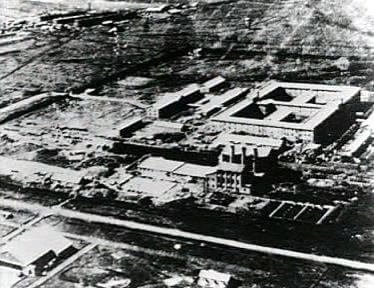
The Unit 731 complex. Two prisons are hidden in the center of the main building. Credit: Copyright expired

Here are 10 things to know about the Imperial Japanese Army’s notorious chemical warfare department Unit 731:

1.Frostbite experiments on victims including babies

Yoshimura Hisato was a lecturer at Kyota Imperial University Faculty of Medicine before he joined Unit 731 in 1938.

At the Khabarovsk War Trial in 1949, a sergeant major from Military Police at Unit 731 testified on Yoshimura’s experiments on frostbite.

He said, “When I walked into the prison laboratory, five Chinese experimentees were sitting on a long form [bench]; two of these Chinese had no fingers at all, their hands were black; in those of three others the bones were visible. They had fingers, but they were only bones. Yoshimura told me that this was the result of freezing experiments.”

After the war had ended, Yoshimura managed to escape from Manchuria, received war crime immunity, returned to university and finally became the president of Kyoto Prefectural University of Medicine.

Right up to the end, Yoshimura denied having performed these experiments although his own published scientific papers proved otherwise.

The papers revealed that not only male subjects were experimented on, but women, children and even a 3-day-old baby.

The frostbite experiment was done by chilling selected body parts to nearly 0 degrees Celsius with ice water.

2. How Unit 731 devised a method for transmission of syphilis between victims

The Japanese army wanted to develop a cure for syphilis since many of their soldiers had been infected through rape or intercourse with comfort women. But first, they wanted to study how syphilis was transmitted. Initial attempts to study the transmission of syphilis through injections were abandoned due to the absence of real results. The doctors of Unit 731 then orchestrated forced sex between infected and non infected prisoners to transmit the disease.

Nishino Rumiko, who interviewed former unit members of Unit 731, recounted during her lecture on “Unit 731 and Comfort Women”: “Infection of venereal disease by injection was abandoned, and the researchers started forcing the prisoners into sexual acts with each other. Four or five unit members, dressed in white laboratory clothing completely cover the body with only eyes and mouth visible, handled the tests. A male and female, on inflicted with syphilis, would be brought together in a cell and forced into sex with each others. It was made clear that anyone resisting would be shot.”

3.The testimony of a former medical assistant in Unit 731

Speaking to the New York Times in 1996, a former medical assistant in Unit 731 anonymously revealed what happened during his first vivisection.

“The fellow knew that it was over for him so he did not struggle when they led him into the room and tied him down. But when I picked up the scalpel that’s when he began screaming. I cut him open from the chest to the stomach, and he screamed terribly, and his face was all twisted in agony.

“He made this unimaginable sound, he was screaming so horribly. But then finally he stopped.

“This was all in a day’s work for the surgeons, but it really left an impression on me because it was my first time.”

4.A doctor of Unit 731 described his first vivisection in a 2007 interview with The Japan Times

Dr Ken Yuasa (1916-2010), a wartime surgeon, was one of at least 1,000 other doctors and nurses who conducted vivisections – surgeries conducted for experimental purposes on live organisms – under Unit 731.

In his interview with The Japan Times, he describes how took part in his first vivisection in March 1942 at an army hospital in Changzhi (formerly Luan) in Shanxi Province, China.

He tells that there were two operating tables surrounded by some 20 people, including medics, surgeons and hospital directors.

The victims were Chinese prisoners; one tall, brawny young man and an older man who may have been a farmer. Both the victims were handcuffed and waiting beside the tables.

The doctors started the vivisection with an appendectomy. Yuasa revealed that it took the doctors three incisions to locate and cut out the organ because it was ‘perfectly healthy’.

He then proceeded to perform a tracheotomy which caused bright red blood to gush out and spill on the floor.

Yuasa admitted that he was ‘impelled by interest’ so he amputated the prisoner’s right forearm.

The older patient was dead by the end of the procedures but the young prisoner was still breathing. Yuasa then injected anesthetic into his vein and executed him. Later, the victims were dumped in a hole near the hospital.

Yuasa had not realised the depth of his atrocious acts under Unit 731 until much later when he became a prisoner of the People’s Liberation Army of China, and was instructed to confess his acts in writing. After receiving a letter from the vivisection victim’s mother sometime later, reality struck. Once he returned to Japan, he went on to disclose and reveal these gruesome wartime acts until his death in 2010 so that these kinds of atrocities would never happen again.

5.Cruel experiment on mother-child relationship

In order to test the bonds between mother and her child, the doctors of Unit 731 implemented a cruel deadly experiment on the pair.

One of the experiments had a Russian mother and daughter left in a gas chamber.

Then the doctors peered through the thick glass and timed their convulsions, watching as the woman sprawled over her child in a futile effort to save her from the gas.

6.Experimenting on American Prisoners of War (POWs)

American POWs were not exempt from these cruel and harsh experiments. Besides live vivisections, American PoWs had to endure having parts of the livers removed to see if they could survive. Another experiment saw a prisoner getting drilled through his skull see if epilepsy could be cured by the removal of part of the brain. Yet another testimony told the story of how they injected one anesthetised prisoner with seawater to see if it could replace sterile saline solution.

7.Victims were exposed to bacteria through deliberate bombing

Speaking of American POWs, the survivors and their families used the Freedom of Information Act to extract from the Pentagon formerly top secret documents on Mukden POW camp.

One of the documents recounted how 20 Manchurians were tied to poles or forced to sit on the ground near a bomb filled with bacteria.

Then, the bomb exploded sending plague bacilli and anthrax bacilli into their bodies through wounds.

The document stated, “The wounded were kept in the laboratory until the symptoms of the disease appeared and when they were taken ill, they were given medical treatment and their cases were studied but most of them died in agony.”

8.The attack on civilians through germ warfare

One of the survivors of the germ warfare, Wang Juhua revealed in a 2005 interview how the attack impacted her life.

Recalling the time when she first realised that her village was attacked, she said, “I went out to feed the cattle, and I walked through the grassland. When I came back, I felt my legs itching and I scratched them. Small red dots appeared on my legs and then became blisters.”

Wang was just 8 years old at the time.

It is estimated 250,000 people were killed when Japan launched its germ-warfare experiments during its military occupation of eastern and northern China.

The one responsible for these experiments was none other than Unit 731.

They created lethal packages of fleas, wheat grain, rice and beans, all infected with deadly pathogens such as anthrax, cholera, typhoid, dysentery and bubonic plaque.

After that, they dropped all these bags from airplanes over Chinese villages. Those who survived continued to live in miserable conditions like Wang who had to live with rotting legs.

9.There are active branches of Unit 731 throughout China and Southeast Asia including Malaysia

The breeding grounds of these deadly pathogens were at the branches of Unit 731 located throughout China and Southeast Asia.

Researcher Lim Shaobin learned from Japanese WWII documents that Singapore was serving as a base in order to transport rats and fleas to Malaya.

Then in Malaya, they were transferred to Tampoi Mental Hospital in Johor and a secondary school at Kuala Pisa near Kuala Lumpur. They were also sent to a facility in Bandung, Indonesia.

Little would Malaysians today know that Malaya was Unit 731’s largest breeding ground outside of Japan and China. The unit’s research found that rat fleas thrived in Malaysians’ temperature and humidity.

The fleas were made to feed on the blood and organs of rats that had died of bubonic plague. Then, millions of these fleas were taken in big glass jars to China.

Other units under the Epidemic Prevention and Water Purification Department like Unit 9420 even sent a supply of rodents from Tokyo to Singapore to supplement the local population of rats.

10.Wiping out the existence of Unit 731

Three days after Unit 731 members heard a broadcast newsflash about the Soviet invasion, they were all ordered to destroy the evidence of the existence of their unit.

A former Unit 731 personnel Naoji Uezono revealed, “First of all the marutas were killed. Then their bodies were put in the incinerator. The specimens taken from human bodies were also put in but there were so many that they just wouldn’t burn. So we took them down to the Sungari river and dumped them in.”

Some of the bodies were thrown into the courtyard pit, covered with heavy fuel oil and set alight.

The bones that remained were collected, put in straw bags and dumped in the river.

Originally, General Shiro Ishii ordered every member of Unit 731 along with the nearby villagers to commit suicide, to the extent of issuing everyone vials of poison.

However, his idea was strongly opposed by Unit 731’s research chief Major-General Hitoshi Kikuchi.

Finally, Ishii ordered them never speak of their military past for the rest of their lives and never contact each other again.

After the war, the researchers involved in Unit 731 were secretly given immunity by the US in exchange for the data they gathered through human experimentation.

Escaping POW camps during WWII under Japanese occupation

The Geneva Conventions are four treaties and three additional protocols which establish international legal standards for humanitarian treatment in war.

Basically, the treaties define the basic rights of wartime prisoners for both civilians and military personnel.

In other words, just because you have conquered a country, it doesn’t mean that you can do whatever you want to the people who live there.

The first treaty was signed by international committees in 1864.

For the next century, the Geneva Conventions are negotiated over and over again.

In 1907 for instance, the convention added the standards for the ‘humane treatment’ of Prisoners-of-Wars (POWs).

Then in 1929, the Geneva Conventions Relative to the Treatment of Prisoners of War was signed by 47 governments including Japan.

But then why did so many POWs died during World War II (WWII) in the hands of Japanese forces?

This was because the Japanese government never ratified the 1929 treaty.

In 1942, the Japanese government stated it would follow the terms of the Convention mutatis mutandis (changing what has to be changed).

Escaping POW camps according to the Geneva Conventions

The Convention recognised that a POW may have the duty to attempt escape.

In fact the Geneva Convention prohibits a captor nation from executing a POW simply for attempting escape.

Under the authority of the senior official, a POW must be prepared to escape whenever the opportunity present itself.

In a POW compound, the senior POW must consider the welfare of those remaining behind after an escape.

However, as a matter of conscious determination, a POW must plan to escape, try to escape and assist others to escape.

During WWII, the POWs died in Germany at a rate 1.2 per cent. Meanwhile in the Pacific theatre, the rate was 37 per cent. In the Philippines alone, the death rate of POWs was 40 per cent.

One of the many motives contributing to these death rates was execution for escaping POW camps.

Escaping POW camps during WWII under Japanese occupation
Photograph taken during the Selarang Barracks Square Incident when Japanese General Fukuye concentrated 13350 British and 2050 Australian prisoners of war because of their refusal to sign a promise not to escape. The picture shows external excavations for latrines made necessary because of overcrowding in the barracks. Courtesy of Australian War Memorial (Copyright expired-Public Domain).

The Selarang Barracks Incident

In August 1942, four POWs escaped from the Selarang Barracks in Singapore. The barracks was used to house a British Army infantry regiment.

After the British surrender of Singapore on Feb 15, 1942, one of the places used by the Japanese as Allied POWs for internment was the Selarang Barracks.

The four escapees Australian Corporal Rodney Breavington and Private Victor Gale and British soldiers Private Harold Waters and Private Eric Fletcher were recaptured.

The newly arrived Japanese Commander General Shimpei Fukuye wanted every POWs intered at Selarang Barracks to sign a pledge to prevent any escaping attempts.

The pledge stated, “I the undersigned, hereby solemnly swear on my honour that I will not, under circumstances attempt to escape”

Only three agreed to sign while the rest refused to since it clearly against the Geneva Convention which stated the POWs had the right to attempt to escape.

General Fukuye then ordered all prisoners except the three who signed to gather at the parade square in Selarang Barracks.

The result? Almost 17,000 men had to cram themselves into the square which was designed to hold 800. (Some reports stated 15,000 men cramped into a space for 1,200).

Meanwhile, the four escapees were executed on Sept 2 with rifles. The initial shots were non-fatal and the poor men had to beg the Japanese to be finished off.

Despite the execution, the rest of the POWs stood firm and did not sign the oath.

However without food and little water available, and cramping under the hot sun, dysentery broke out among the POWs.

Slowly, those who were already sick before began to perish.

Before more men would die, Lieutenant Colonel Holmes ordered his men to sign the oath.

Taking advantage that the Japanese were not familiar with British names, the POWs signed them using false or meaningless names.

Finally on Sept 5, the Japanese allowed the prisoners to disperse and went back into the barrack buildings.

Escaping POW camps in Sandakan

Escaping POW camps during WWII under Japanese occupation
The cemetery at Sandakan POW Camp after the war.

Among the first to escape from Sandakan POW camp in Sabah were Herb Trackson and Matt Carr.

However, they were recaptured six weeks after their escape at the end of August 1942.

When being interrogated, they told that their commanding officer Major G.N. Campbell and Captain J.G. Scribner had ordered them to take any opportunity to escape.

The two officers then were also arrested. Due to this, the commandant in-charge Captain Susumi Hoshijima gathered all POWs to sign a contract.

The contract contained three demands; ‘we will attempt to accomplish any order given the Japanese, we will not attempt to escape and we are aware that we will be shot if we we attempt to escape.’

After back and forth debate between Hoshijima and the POWs about how the contract was not in line with the Geneva Convention, the POWs finally did signed the contracts.

However just like in Singapore, the Allied POWs signed them using fake names and even actors’ names.

Escaping POW camps – success stories

So did any of these POWs manage to escape Japanese POW camps without being captured?

The only successful mass escape from a Japanese camp during WWII was not as massive as 400 POWs that were rescued by Steve Rogers in Captain America (2011).

On April 4, 1943, US Air Force pilot Samuel Grashio, US Air Force Lieutenant William Dyess, US Marines Austin Shofner and Jack Hawkins, six other Americans and two Filipinos escaped from a camp in Davao, the Philippines.

Before their historical escape, they spent two months smuggling food and equipment to a jungle cache.

After wandering for three days in the swamp, they made contact with a group of Filipino guerrillas.

Over the course of the few months, seven of the men were transported using a submarine to Australia while three stayed behind with the guerrillas to fight.

Unfortunately, one of the three was killed by the Japanese.

The Berhala Eight

Escaping POW camps during WWII under Japanese occupation
One of the Berhala Eight, Jock McLaren (at left) returning to Berhala Island in October 1945. Awm121749. Credit: Public Domain (Copyright Expired).

Another group of POWs that managed to escape from Japanese camp was the Berhala Eight.

The Berhala island in Sandakan was made a temporary camp before the POWs were sent to a more permanent camp at Sandakan.

Eight men realised that it would be harder to escape from the permanent camp so they decided to escape from the island before they were to be transferred.

They managed to steal a boat and set off to the Tawi-tawi islands in the Philippines.

Their escape from Berhala Island save their lives as they then missed the infamous Sandakan Death Marches.

Speaking of Sandakan Death Marches, these were a series of forced marches from Sandakan to Ranau which resulted in the deaths of 2,434 Allied POWs.

There were only six survivors and they survived because they managed to escape.

The last POW to be alive at Sandakan camp was Australian John Skinner.

He was executed five hours before Emperor Hirohito announced Japan’s unconditional surrender marking the end of WWII.

Understanding the Japanese laws behind escaping POWs

Whether in it Singapore or Sandakan, what was with the Japanese obsession to have the POWs sign contracts stating that they would not escape?

Japanese historian Yuki Tanaka did some explanation in his book Hidden Horrors: Japanese War Crimes in World War II.

Generally, the contract incident was an example the distinction between Japanese and Western attitudes to law and the contradictions between the Geneva Convention and the principles of Japanese military law.

Tanaka stated,

“The seventh article of the Japanese law on punishment of prisoners states that the leader of a group of prisoners who had been captured while attempting to escape would be punished by death or between ten years and life imprisonment and all other members of the group would be imprisoned for a minimum of one year.

“The regulation on the treatment of POWs stipulates that POWs must sign a contract promising not to escape and that any prisoner who did not sign a contract would have thereby expressed an intention to attempt to escape and therefore be subject to heavier surveillance.

“If a prisoner did sign such an oath and subsequently attempted to escape, he would also be subject to a minimum sentence of one year’s imprisonment.”

Plus, a Japanese law dating from 1904 gave Japanese prison guards the right to shoot at escaping prisoners when such action was necessary to prevent a prisoner from successfully escaping.

Since their law did not define ‘when such action was necessary’, the Japanese guards would just shoot anybody who tried to escape.

The Japanese and Geneva Convention

The truth was actually simple; many of these Japanese commandants and POW camp guards were unaware of the contents or even the mere existence of the Geneva Convention and if their country had anything to do with it.

The commandant of Java POW camp Major General Saito Masazumi testified to the Tokyo War Crimes Tribunal after the war that and issue of international law in relation to POWs was never raised in a meeting.

Furthermore, he himself had no knowledge of any international law regarding to POWs and so he did not ask about it.

The same thing with Lieutenant Colonel Yanagida Shoichi, the commandant of a POW camp on the Burma-Thailand Railway. He testified that he never heard of the Geneva Convention.

Thus, just about all Japanese POW guards at every camp would shoot prisoners who made unsuccessful escape attempts.

Escaping POW camps under the Japanese was a gamble of life.

If they didn’t died being shot during the recapture, they were either executed later or died while being tortured.

Were there any justice for these men who were executed because they tried to escape after the war?

Generally, yes. For instance, General Fukuye who was responsible for the Selarang Barrack Incident was sentenced to death during the Singapore War Crimes Trial in 1946.

He was executed by firing squad on April 27, 1946 on the same spot where the four escapees were shot three years earlier.

Fortunately for the general, he died instantly and did not need to plead to be killed off.

From Sandakan POW Camp to Singapore Outram Prison

Outram Prison was one of the earliest prisons in Singapore.

Originally, it was known as Pearl’s Hill Prison before being called Outram Prison or Outram Road Prison.

Completed in 1882, the jail complex had five blocks for male criminals; four for natives and one for European.

Other buildings housed the female prisons, hospitals, employees’ quarters, execution room and morgue.

By January 1937, the long-term prisoners were transferred to the-then new Changi prison while leaving the short sentenced prisoners in Outram Prison.

During World War Two (WWII), Singapore was occupied by the Japanese Imperial Army. Immediately, the infamous Japanese military police known as Kempeitai took over Outram Prison.

They used the gaol to punish all those who broke their laws; prisoners of war (POWs), civilian internee and local people alike.

From Sandakan POW Camp to Singapore Outram Prison

The inmates jailed at Outram Prison were coming in from not only in Singapore but surrounding areas such as Malaya and Borneo.

They were transported by sea using Japanese hell ships. As if their journey to receive their sentences were not hellish enough, another form of hell welcomed them at Outram Prison.

These men and were punished for many reasons, from espionage to rebellion.

For a group of POWs from Sandakan POW camp in former British North Borneo, their crime against the Japanese circled around a radio.

From Singapore to Sandakan POW Camp

The Battle of Singapore or Fall of Singapore is till known today as the largest British surrender in history.

The intense fight took place lasted from Feb 8 to 15, 1942 which resulted in the Japanese capture of Singapore.

After the battle ended, about 80,000 British, Indian and Australian troops in Singapore became POWs along with 50,000 men who were taken by the Japanese during the earlier Malayan Campaign.

As for the Japanese, they were not entirely ready with this large influx of POWs.

One of the POWs who arrived in Sandakan POW camp to work on the airfield in July 1942 was Lionel Colin Matthews.

While many were taken prisoner in Changi Prison, thousands were transported to be used for forced labour on constructions like the Burma-Siam Railway and Sandakan airfield in North Borneo.

There, Matthews founded an intelligence network among the POWs. They collected information, weapons, medical supplies and radio.

The secret group even made contact with the local police as well as Filipino guerrillas.

Unfortunately in July 1943, four local Chinese members of Matthews’ underground group were betrayed to the Japanese.

After being tortured by the kempetai, they confessed to providing radio parts to Matthews and his team.

Matthews and his second in-command, Lieutenant Rod Wells as well as the members of the underground group were captured, beaten, tortured and starved during their interrogation.

After that, the group was sent to Kuching, Sarawak to stand for trial.

In Kuching, Matthews was sentenced to death along with two members of the British North Borneo Constabulary and six other local Sabahans.

Meanwhile, Wells and 18 others were sentenced to Outram Prison.

Rod Wells’ account on his experience at Outram Prison

Wells, who received 12 years of solitary confinement, said goodbye to Matthews with a handshake and a few personal message from Matthews to his wife.

Two days after departing Kuching, Wells arrived in Singapore where he had been captured two years before.

In Singapore, he was imprisoned at Outram Prison and here is his account as recorded by Christoper Somerville’s Our War: Real Stories of Commonwealth soldiers during World War II.

“On entering Outram Road Jail I found the most terrible sights of dejected people with absolutely no will to live, just slowly walking around. From the back you could see their reproductive organs hanging down between their legs – there was no flesh on them. It made sitting very hard. The hip bone would be pressing into bare skin. But you just had to sit and put up with the pain.

“Everything was done to order. No talking was allowed. When no order was given, you were silent and just stayed in the same position you were in when the last order was given. At nine o’clock at night you were sent back to your cell. There was a light on all night inside the cell, so that there was not a second of the twenty-four hours you were in darkness. And this went on, for me, for twenty-three months, including my period in Kuching. Twenty-three months in solitary.

“We worked at picking strands of hemp out of old ropes, to make a new ones. The strands were too tough to break with your hands; you had to follow them to find out where they started. If you left any of those knots untouched you got a belt across the back with a sword in its scabbard. And as an added incentive, if you didn’t do a hundred of these lengths of rope in day by picking out about 200 lengths of hemp from each – you got no rice that day.

“Meals were roughly five ounces of cooked rice and a bit of stewy water with a bit of weed in it, green grassy stuff. Tea – that was like a hundred to one whiskey and water, pale discoloured stuff that was always cold when you got to it.

“The little pair of shorts you had on had your number on it. 641, that was me. You had to learn that number in Japanese pretty quick, because that was your name and address and everything else. I lost all identity. I was no longer a POW – I was a criminal; just a number. That was the worst thing of the lot. Just a number.”

Bill Young’s account on his experience at Outram Prison and ‘The Postman’

Not all POWs who were sent from Sandakan POW Camp to Outram Prison belonged to Matthews’ group.

William Young or better known as Bill Young, was captured and trialed in Kuching for escaping Sandakan POW Camp.

They were captured by the Formosan guards an hour after their escape and then Young and his friend M.P Brown were severely beaten.

The duo both ended up with broken arms, a leg and an ankle.

In Kuching, Brown was sentenced to eight years of hard labour in Outram Prison while Young was sentenced to four years because of his age. Young was around 16 years old, making him one of the youngest Australian POWs during WWII.

One of the many things Young remembered about Outram Prison was a guard which the prisoners nicknamed ‘The Postman’.

“And there was one guard in particular we used to call ‘The Postman’, he was very, very particular about it. He’d open the door and come and bash you if you weren’t sitting properly. Some of the guards you knew were lazy or indifferent and you could get away with standing up, resting your legs out, reading the graffiti. Morse code. And there’s some guards you would never send a message or anything like that, you’d never read graffiti and you’d never not sit cross-legged, and the worst one was the bloke we called ‘The Postman’.

And sometimes, I know on one particular time, probably one of the first times I was caught by him. I didn’t realise he was on duty. I’m sitting back, with my back on the wall with my legs stretched and I’m shaking them and one thing and another, relaxing, and I heard the knock and that was the signal, only one knock, bang!, just one knock like that. There was about two or three minutes, which seemed to be hours in time, and you knew he was outside, you knew.

“Now after that you’d hear the key’d go in the lock, now it wouldn’t turn, you’d hear the key go in the lock, and then for another two or three minutes there’d be silence, but you’d know he was outside there, and then he’d turn the lock and you’d hear it turned and there’d be nothing else. Two, couple of minutes.

“And then all of a sudden, bang! The door’d be slammed back. Frightened the life out of you. And there would be The Postman. And they all had swords. But it was an old-fashioned jail and the locks were old-fashioned and the keys were great old-fashioned things. And he’d come in and you’d be looking up and you’d be at attention, as if you were like that all the time, you’re willing your hair to grow bit thicker because you know what’s coming.

And he’d stand just a little bit behind you on the side. Not much room between you but he’d get there, wasn’t a very big bloke actually, and then he’d be giving you a lecture or something like that and all of a sudden, while he’s doing this, he’s raising this flaming great big key and then bang! down it comes. And oh God, flaming lump or a cut, sometimes blood come down, and you couldn’t do anything and you’re sitting there and the tears come into your eyes because when you have lost all your weight, your food, your muscles go down, it’s not mentally, everything goes down too. Your resistance to pain, your resistance to everything.”

Surviving Sandakan POW Camp and Outram Prison

From Sandakan POW Camp to Singapore Outram Prison
The ruins of huts in the prisoner of war camp, Sandakan, North Borneo, October 1945. Those who were too ill for the march were eventually murdered here. Courtesy Australian War Memorial: 120457

After the war ended, Young returned to Sydney, Australia. He revealed to ABC news in 2016 at that time he couldn’t wait to reunite with his old mates from Sandakan.

But Young couldn’t find any of his friends. He told ABC, “I waited and waited and waited. It took me ages to find out.”

The sad truth was there were only six survivors from Sandakan POW camp and they had survived because they escaped.

After the war ended, 1,787 Australians died in Sandakan with many of them perishing during the 250km-long Death Marches from Sandakan to Ranau.

Those who were sent out from Sandakan to Outram Prison for their punishment had a narrow escape from death. If they were to stay in Sandakan, chances were high that they did not survive just like their friends.

Still, all of them did not escape from suffering caused by the Japanese at Outram Prison.

According to Australian War Memorial website, the prison was a place of starvation, torture and terror, a place of madness and for many, death.

Since these prisoners were sentenced to prison and not death, the Japanese couldn’t legally execute them.

Instead, the Japanese purposely trying to starve the prisoners to death by providing little food for them.

It is estimated about 1400 prisoners died at Outram Road Prison during Japanese occupation in Singapore.

MV Krait, the Japanese fishing ship that was used against the Japanese

If you want to raid the enemy’s harbour and blow up their ships without getting caught, what better way to do it than using one of the enemy’s own vessels?

MV Krait is a wooden-hulled vessel that was used in a raid against Japanese ships anchored in Singapore Harbour during the Second World War (WWII).

Codenamed Operation Jaywick, the mission was carried out by a special task forced called Z Special Unit.

They are mainly made of British and Australian soldiers who had escaped Singapore before its surrender.

The history of MV Krait

After the Fall of Singapore in 1942, civilians made their escape from the island on all kinds of boats and ships.

In the middle of the chaotic scene, an Australian master mariner named Bill Reynolds managed to salvage a little Japanese fishing boat.

The ship’s name was Kofuku Maru. Reynolds used her to rescue civilians fleeing the island and at one point evacuating over 1,100 people from ships sunk along the east coast of Sumatra.

Kofuku Maru eventually reached Australia and was handed over to the Australian military. The Allied forces then renamed her Krait after the small but deadly snake.

MV Krait and Operation Jaywick

Major Ivan Lyon, whom Reynolds came across with during his rescue work, became very interested in the Japanese vessel.

He conceived the idea of raiding Singapore Harbour using Kofuku Maru. Both Lyon and Reynolds realised that if the vessel could get out of Singapore unnoticed then she could get in unnoticed as well.

On Sept 2, 1943, eleven Australian and four British army and navy personnel as part of the Z Special Force went on board MV Krait left Exmouth Gulf, Western Australia heading to Singapore.

Today, blackface is considered rude and offensive since it was used to mock enslaved Africans. However, these operatives dyed not only their hair black but their skins as well for their disguise. The skin dye later caused many skin problems for them causing irritation and reactions to sunlight.

The crew even flew a Japanese flag and wore sarongs to look like the local fishermen.

MV Krait finally arrived off Singapore on Sept 24. There, six of them left the boat to paddle 50km to a small island near the harbour.

Then on the night of Sept 26, the men used folboats to paddle into the harbour and placed limpet mines on several Japanese ships.

The mission was successful, sinking six of the Japanese ships. The raiders waited until the commotion to die down before returning to Krait on Oct 2.

In the meantime, MV Krait spent two weeks circling in the South China Sea to avoid suspicion and waiting to return for the pre-arranged pickup.

On their way back to Australia, MV Krait was almost approached by a Japanese auxiliary minesweeper who was on patrol. Lucky for them, nothing happened and the Japanese did not suspect a thing. On Oct 19, the Krait arrived safely back at Exmouth Gulf.

MV Krait, the Japanese fishing ship that was used against the Japanese
Crew of the MV Krait during Operation Jaywick, 1943. Credit: Public Domain

The price of Operation Jaywick

The raid had caught the Japanese with their pants down. They never thought the Allied forces would attack Singapore.

Hence, their suspicion laid on the locals. The price for the successful Operation Jaywick was unfortunately paid by the blood of civilians and civilian internees who were captured and tortured by Kenpeitai (Japanese military police).

It went down in history as the Double Tenth Incident or Double Tenth Massacre since it occurred on Oct 10, 1943.

The Kenpeitai arrested altogether 57 civilians and civilians internees suspecting them to be involved in a raid on Singapore Harbour.

However, none of them had participated in the raid or even had any knowledge of it. In the end, 15 of them died in Singapore’s Changi Prison.

MV Krait after Operation Jaywick

After the success of Operation Jaywick, MV Krait was used continuously by the Australian military throughout WWII.

When the Japanese official surrendered on Ambon, Indonesia in September 1945, she was there to witness the historical event.

After her service, she was sold to the British Borneo Company at Labuan and operated off Borneo for few years.

In 1964, MV Krait was purchased as an Australian Royal Volunteer Coastal Patrol vessel. In the same year, she was dedicated as a war memorial.

Since 1988, she has been displayed to the public at the Australian National Maritime Museum, Sydney.

Since the success of MV Krait on Operation Jaywick, the Australian Commando Unit traditionally used the names of venomous snakes for their vessels.

The Berhala Eight, the daring escape from Berhala Island during WWII

Located in Sandakan Bay, Malaysian state of Sabah, the Berhala island is a small forested island.

Before World War II (WWII), the island was used as a layover station for labourers coming from China and the Philippines. There was also a leper colony on the island.

Then during WWII, the Japanese used the quarantine station as a makeshift internment camp for both prisoners-of-war (POWs) and civilian internees.

The POWs and civilian internees were stationed on Berhala Island before they were sent Sandakan POW Camp or Batu Lintang Camp respectively.

In June 1943, the island witnessed a thrilling escape of eight POWs worthy enough to inspire a Hollywood movie.

The eight-member group later became known as The Berhala Eight.

Jock McLaren of Berhala Eight

The Berhala Eight were Lieutenant Charles Wagner, Sergeant Rex Butler, Captain Raymond Steele, Lieutenant Rex Blow, Lieutenant Leslie Gillon, Sapper Jim Kennedy, Private Robert “Jock” McLaren and Sergeant Walter.

Among them, the widely known one was Jock McLaren.

During World War I (WWI), McLaren was serving in the British Army. After the war, he moved to Queensland, Australia where he was working as veterinary officer.

When the WWII broke out, he joined in the Australian Imperial Force.

According to Senior News, McLaren was assigned in British Malaya when Singapore fell to the Japanese army.

He was then captured as a prisoner of war alongside 80,000 British, Indian and Australian troops in Singapore.

However, McLaren was not going to bow down to the Japanese and stay in Changi prison quietly. Together with two other soldiers, he made his escape from Singapore.

They almost made it to Kuala Lumpur before they were betrayed to the Japanese by the local Malays.

By September 1942, McLaren was back where he was first imprisoned at Changi prison. But, ass the saying goes, “If at first you don’t succeed, try, try, try again.”

So he planned his escape again. This time, he managed to slip into a group of prisoners called ‘E’ Force.

As part of ‘E’ Force, McLaren was among 500 British and 500 Australian POWs who departed Singapore on Mar 23, 1943.

They boarded SS De Klerk, an abandoned Dutch passenger-cargo liner which was refloated by the Japanese who renamed it ‘Imabri Maru’.

The ship reached Kuching, Sarawak on Apr 1 and departed eight days later for Berhala Island.

On Apr 14, the men of ‘E’ Force arrived on the island where they stayed for six weeks before being transferred to the Sandakan POW Camp.

The Berhala Eight, the daring escape from Berhala Island during WWII
SS De Klerk. Credits: Public Domain.

Life on Berhala Island for the ‘E’ Force

According to the War Memorial Australia, the Berhala Camp was enclosed by barbed wire, was set back about 160 yards from the sea.

The toilets were outside the wire, which gave intending escapees and excuse for being outside the camp.

Once again, McLaren tried to escape. He knew that once he been transferred to Sandakan POW camp, it would be harder for him to escape. For him, the escape had to be made from Berhala Camp.

Together with Kennedy, the duo joined a wood-carrying party during their stay at the Berhala Camp. This allowed them to move around the island while planning an escape plan in their heads.

They saw the leper colony there had a small boat. McLaren then planned to use it for their escape.

Meanwhile, another escape party was being formed by Steele, Blow, Wagner, Gillon and Wallace.

Both parties made contact with a corporal from North Borneo Constabulary, Koram bin Anduat to help with their escape.

Koram advised them to make for Tawi-tawi island in the Philippines which was about 250km west of Sandakan.

McLaren then realised that it would be a long, hard and dangerous row to Tawi-tawi. He needed another man so he approached Rex Butler.

As described by Hal Richardson in his book One-man War: The Jock McLaren Story (1957) on the escape as:

“A tall thin grazier from South Australia who had been a buffalo shooter in the Northern Territory and could shoot a buffalo’s eye out at fifty yards. Butler appeared to have the necessary nerve too. There was no room in the party for a man who was likely to crack when the heat was on.”

McLaren believed that Kennedy could withstand the pressure. After watching Butler moving around the camp and his coolness under the provocation of guards, he was confident that Butler was the man for his escape team.

McLaren, Kennedy and Butler made their escape from Berhala Island

On June 4, 1943, the Japanese bought a large barge and ordered the POWs to be prepared for transfer to Sandakan the next morning.

The Berhala Eight took it as a sign that they must escape that night before being transferred.

Under the pretense of using the restroom, the eight Australians left the camp in the middle of the night.

The men then collected their hidden supplies and clothes before going into hiding in the forest.

The next day, after stealing a boat from the leper colony, McLaren, Kennedy and Butler began their gruelling journey to Tawi-tawi.

With no sail, and with just the use of wooden paddles, the three men paddled their way through the raging ocean for their lives.

The men travelled by night in order to avoid the tropical heat.

Even with their frail bodies after spending the past 16 months on little food in the POW camps, the trio made it to Tawi-tawi island.

Thankfully, the men were welcomed by friendly locals on the island.

Koram helping Steele and the rest to escape Berhala Island

In the meantime, Steele and the rest four men were still on the Berhala Island.

When McLaren and his group stole the boat from the lepers, it did not go as smoothly as planned. The lepers actually keep on pursuing them.

After that, the lepers went to the Japanese to report on the incident.

Now, it became dangerous as the Japanese are looking for the remaining five escapees.

That was when Koram and his wisdom came to work.

According to Bayanihan News, on the night of the last POWs had been transferred to Sandakan, Koram borrowed a pair of boots from one of his Australian friends.

“Then he quietly made his way to the cluster of houses near the shore. He untied one of the boats belonging to an islander, made a hole in the bottom of the boat and shoved it into the flowing waters of the estuary where it was carried some distance away before it sank out of sight in the deep water.

He stole two more boats, and did the same with them. He then put on a pair of Australian army boots which he had managed to get hold of earlier, and stomped around on the spot on the seashore, leaving a lot of tracks. Then he quietly returned to the mainland undetected.Early the next day, there was a great hue and cry when the three islanders awoke to find their boats gone. They reported the matter to the Japanese, who went to investigate.

When they saw the boot prints in the mud they concluded that the Australian POWs must have taken the boats and escaped from the island, and they immediately mounted a search at sea. They never realized that the escapees were still on the island.”

Steele and the rest made their escape using kumpit

With the help of local guerrillas, the remaining five POWs made their escape from the island.

Using a local boat called kumpit, the POWs were told to lie in the hold. Then planks were placed on them with sacks of rice on top of the planks.

There was one nerve-wracking moment when a Japanese destroyer stopped the kumpit to check on it.

Thankfully, the Japanese decided not to board the boat but let it pass.

On June 24, all members of The Berhala Eight reunited on Tawi-tawi.

The Berhala Eight staying to fight

Due to lack of transportation and the need for experienced leaders, The Berhala Eight stayed with the guerrillas to fight against the Japanese.

Unfortunately, Butler was killed in action while on a fighting patrol at Dungun river of Tawi-tawi.

His body was then decapitated by the local Moros who were friendly with the Japanese.

Meanwhile, the rest of the POWs made their way to Mindanao to join the American and Filipino guerillas under the command of Lieutenant Colonel Wendell Fertig.

The Berhala Eight, the daring escape from Berhala Island during WWII
Colonel Fertig wearing red goatee and conical hat in the Philippines during World War II. Credits: Public Domain.

On Dec 21, 1943, Wagner was killed during an engagement with the Japanese at Liangan in Lanao province.

After battling with the Japanese for some time, Gillon, Steele, Wallace and Kennedy were evacuated from the Philippines by the USS Narwhal on Mar 2, 1944.

Meanwhile Blow and McLared remained with the guerrillas until the Australian government requested their return.

The impact of Berhala Eight

In the book Fighting Monsters: An Intimate History of the Sandakan Tragedy, Richard Wallace Braithwaite described the impact of the escape on the remaining POWs.

“The key to the success of the ‘Berhala Eight’ was help from local people, and this worried the Japanese. From now on, they killed recaptured escapees and punished the camp from which they escaped through cutting rations. As a result, senior Allied officers were by this stage strongly discouraging escapes.

“The Australian prisoners probably did not realise how seriously the Japanese viewed this development of local collaborators helping prisoners escape. All this undoubtedly reflected poorly on Hoshijima (Sandakan POW Camp’s Person-in-Charge Captain Susumi Hoshijima) and invoked a strong response. While all POWs at Sandakan suffered harsher treatment, the Australians were seen by the Japanese as the main problem.

“Most prisoners now acknowledged the likely consequences for the individual and for the camp of any escape attempt. Most became content to stand on the side of the chessboard but continued to dream of escape.”

When the Berhala Eight made their escape, they would not have thought of how the Japanese would retaliate against the remaining POWs and local people who tried to help the prisoners.

Nonetheless, their escape from Berhala Island saved their lives as they then missed the infamous Sandakan Death Marches and executions of Sandakan POW Camp.

The Berhala Eight, the daring escape from Berhala Island during WWII
Jock McLaren (at left) returning to Berhala Island in October 1945. Awm121749. Credit: Public Domain (Copyright Expired).