Browse Tag

Malaysia - Page 6

The aftermath of the Indonesian-Malaysian confrontation at Long Bawan

Located at North Kalimantan, Indonesia, Long Bawan is a small town with a small airport which has become the only gateway via air to Krayan Highlands.

Looking back on its history, it was one of the combat operations sites between British Commonwealth forces and Indonesian armies during the Indonesian-Malaysian confrontation.

The confrontation which started in early 1963 was caused by Indonesia’s opposition to the creation of Malaysia.

By December 1964, there was a build-up of Indonesian forces on the Kalimantan border. This caused the British government to commit significant forces from the UK-based Army Strategic Command and Australia and New Zealand to Borneo in 1965-66.

On the Indonesian side, the fight was led by Indonesian Army special forces (Resimen Para Komando Angkatan Darat or RPKAD).

Additionally, they recruited the North Kalimantan National Army or Tentera Nasional Kalimantan Utara (TNKU).

During the confrontation, hundreds of Indonesian civilians had been loosely trained as part of TNKU.

Most of them were unemployed urban youth scrounged from cities in Kalimantan and Sulawesi.

Since the battles mostly happened at the Indonesian-Malaysian border in Kalimantan, some of them were posted in Long Bawan (Indonesia).

The aftermath of the Indonesian-Malaysian confrontation at Long Bawan
A view of Long Bawan paddy field. Perhaps this was where parachuters landed in 1968.
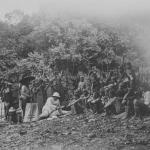
TNKU members who were left at Long Bawan

Although the confrontation had been officially declared over in August 1966, the mission was technically not over for Indonesian forces.

There were TNKU members abandoned and left behind at their border camps including in Long Bawan.

To make matter worse, the Indonesian government reportedly did not bother to disarm the army-volunteers, leaving them with weapons such as heavy machine guns and mortars.

Kenneth J. Conboy wrote in Kopasses: Inside Indonesia’s Special Forces that the ready supply of weapons and unemployed volunteers became a volatile combination.

Conboy wrote, “By late 1967, Jakarta had received reports that the former TNKU partisans were stealing food and raping women in the Long Bawan vicinity. Colonel Mung, the former RPKAD commander now serving as head of the military region, reported that the outgunned local government was screaming for help.”

Jakarta was reportedly in a fix when the government heard this news. In response, they sent out two groups from RPKAD which was led by Captain Alex Setiabudi and Captain Kentot Harseno.

Both captains had previously served at Long Bawan.

The aftermath of the Indonesian-Malaysian confrontation at Long Bawan
The small township of Long Bawan.

The two groups assembled at Cijantung during the first week of January 1968. Since there were no suitable runways, the units would be making a combat jump into paddies a half-hour trek east of Long Bawan.

“Although they would be parachuting with their weapons- including two rocket launchers – they were correctly concerned about opposition they might face. The ex-volunteers, after all, were better armed and knew the lay of the land after living there for almost four years,” Conboy wrote.

RPKAD came bearing gifts

Then Captain Kentot had an idea. Instead of going in with full force, they decided to go with gifts like food, writing pads and clothes.

His idea was adopted in and operation code-named Operation Linud X (“Airborne X”). On Jan 10, 1968, the groups made their jumps after light into Long Bawan.

The military units had expected to face difficulties from the former TNKU volunteers. However, it was the terrains of Krayan Highlands that gave them a hard time. Several of the commandos landed, drifting far from their marks, mostly in paddy fields and swamp.

Meanwhile, Captain Kentot landed in mud up to his armpits and nearly drowned. One of the pallets carrying a rocket launcher was even lost during the jump.

Nonetheless, the commandos managed to regroup at Long Bawan village where its chief greeted them like old friends.

After finding out their mission, the chief tasked some of his villagers to collect all weapons from nearby cache sites.

Surprisingly, the abandoned TNKU members were extremely tame. They took the gifts kindly and offered up their weapons without any resistance.

Four months later, all of the commandos were packing to leave. Due to some difficulties with their transport, they were forced to hike to the nearest river landing. According to Conboy, they were back on Java by June after a speedboat shuttle toward the coast.

“For once, what had the potential for being another festering security challenge had been resolved without firing a shot,” Conboy recorded.

The aftermath of the Indonesian-Malaysian confrontation at Long Bawan
The new building at Yuvai Semaring airport in construction.
The physical remnants of the Indonesian-Malaysian confrontation at Long Bawan

While confrontation now only remained in memories for the Krayan Highlands elders (which they refer to as ‘konfrontasi’), there are some physical remnants left behind at Long Bawan.

This small town was also the crash site of an Indonesian plane during Indonesian-Malaysian confrontation.

On Sept 26, 1965 during the confrontation, a C-130 plane was shot down near Long Bawan.

Ironically, the plane was shot down by Indonesian anti-craft fire, as it was mistaken for a Commonwealth aircraft.

It was carrying an RPKAD platoon from Java on orders to “neutralise” a gun position on the border ridge.

After the aircraft was hit, the RPKAD members parachuted out before it caught fire and crashed.

The wreckage of the plane is still at Long Bawan to this day.

Meanwhile, the locals also found the rocket launcher that was lost when Captain Kentot and his units parachuted in 1968.

It is now on display at Krayan’s Kepolisian Sektor or Polsek (Police District office).

The aftermath of the Indonesian-Malaysian confrontation at Long Bawan
Photocopying services at Long Bawan.

Does listening to music help you in your concentration?

You have heard this before; listening to music when studying or doing you work could help you to focus.

But how true is this statement? Here at KajoMag, we look at different studies on the effects of listening to music on our concentration.

Does listening to music help you in your concentration?
One study shows that listening to classical music helps you to focus in your work. Credits: Pexels.
Listening to music does help you in your concentration, but only classical music

One of the most common understandings is that listening to classical music does help you to focus. According to Dr Masha Godkin from Northcentral University, music activates both the left and right brain at the same time.

She added, “And the activation of both hemispheres can maximise learning and improve memory.”

When it comes to music, it is best to to stick with classical. One of the reasons is that there are no lyrics to distract you.

Furthermore, the tunes should be able to keep you awake but won’t inspire you to start tapping or moving your body to the beats.

Beside classical music, other types of music believed to be helpful in your concentration are spa music, nature sounds and music with 60-70 beats per minute.

Listening to music does help, but before your start studying

Music has been proven to be a stress reducer in most studies. University of Maryland Medical Center finds that listening to soothing music can decrease blood pressure, heart rate and anxiety levels.

If you about to head into a stressful working or studying session, listen to some music first to calm yourself down in order to help you concentrate better.

Does listening to music help you in your concentration?
You might want to listen to some music when you start feeling anxious or stressful. Credits: Unsplash.
Listening to music does help you to focus provided that you like the music

Researchers from University of Tsukuba did an experiment on how external factors, namely playing music, effects the performance on a task that requires alot of attention.

They compared three different conditions; music that the subject likes, music that the subject is not familiar with and silence.

Their result showed that listening to music that the subject likes does increase their performance level.

The researchers stated, “When doing self-study, selecting appropriate music would help raise the performance. Even when in a classroom, when it is not a lecture-style class but is a practice style, it might help students by allowing them to listen to music while solving problems.”

They also advised that teachers try different types of music in class to see how it might affect the level of concentration among the students.

Listening to music does not help you to concentrate

A researcher from University of Maryland did a study focusing on the impact different genres of music, played at different volume levels, had on the cognitive abilities of college students completing academic tasks.

What she found was that volume plays a crucial role and could be more important than the type of music played.

“However, data from this study has demonstrated that silence seems to be the best environment to maximize performance when engaging in cognitive activity,” the research reported.

Surprisingly, the study showed that classical music was not proven to enhance cognitive performance.

According to the study, the direct benefits of listening to music on cognitive processing could be more a fantasy than a reality.

Complete silence is the best

Meanwhile, Cambridge Brain Sciences published a study showing that memory performance was the best while listening to low arousal and negative music.

The study further stated, “However, compared to silence, background music had either no effect for some participants or significantly impeded memory performance.

Complete silence might help you to study or work better but if there is unnecessary noise in the background? You might want to consider putting on those earphones.

“It turns out some people use the same mental processes that are required to remember things to also process music, which means that a percentage of the brain regions responsible for memory – regions you need to focus on the task at hand – are actually being reallocated to processing background noise.”

At the end of the day, whether listening to music helps in concentration is pretty subjective. So you might want to try different kinds of music at a lower volume or no music at all to see which condition actually helps you the best.

Does listening to music help you in your concentration?
Maybe you might want to be in complete silence when doing your job. Credits: Unsplash.

Let us know in the comment box if listening to music helps you to focus.

KajoPicks: 5 performances we loved during RWMF 2019

If you were there during Rainforest World Music Festival (RWMF 2019), chances are you may still be suffering from post-RWMF withdrawal.

Despite a claim on international media last year that the festival was a dying brand with no new stories being told, the festival has definitely proven the critics wrong.

The number of festival goers this year hit 23,650 people – the highest it’s been since RWMF started in 1998.

And if you were one of those thousands who danced beneath the moonlit sky with the Santubong mountain in the background, you might not have realised how big the crowd was.

It was definitely good to see the festival highlight more local Sarawakian performers such as Suku Menoa, Suk Binie’, Kemada, Staak Bisomu and crowd favourite, At Adau.

With so many performers from all five continents gathering at Sarawak Cultural Village for three days, it was definitely hard to choose our favourites.

But here are KajoMag’s picks for our five favourite acts during RWMF 2019 which took place from July 12 to 14.
1.Duplessy & The Violins of the World (France, Mongolia and Sweden) featuring Guo Gan (China)

The beauty of Rainforest World Music Festival has always been the ability to bring artists of different musical styles and cultures to perform on the same stage.

And this year, one of the performances which managed to do that beautifully and successfully was the performance by Duplessy & The Violins of the World featuring Chinese erhu musician, Guo Gan.

Four soloists- Mathias Duplessy, Guo Gan, Naraa Puredorj and Aliocha Regnard – came together for two different sets called “Marco Polo” at the Theatre Stage and “Crazy Horse” on the Tree Stage.

Inspired by the Italian explorer who travelled through Asia, “Marco Polo” gave the audience a crossover of Western and Asian classical music, while “Crazy Horse” truly reflected its name with fast-paced, cantering rhythms and swinging tunes.

Their performances might have been a fusion between East and West cultures, but there was no confusion among the audience who was listening.

It was definitely a nice eclectic mix of classical guitar (Duplessy), erhu (Guo Gan), traditional Swedish string instrument the nyckelharpa (Regnard) and the Mongolian fiddle (Naraa).

2.Otava Yo (Russia)

This group of seven musicians from St Petersburg had a goal: to shatter the stereotype that Russian folk music was boring and undanceable.

Judging by how the crowd danced on Friday night during their performance, Otava Yo definitely achieved their goal.

Using instruments such as the Russian fife, gusli (Russian psaltery), the bagpipe and fiddle, they gave a performance which transcended languages and cultural boundaries.

KajoPicks: 5 performances we loved during RWMF 2019
Otava Yo. Credits: RWMF Official Photograph
3.Kila (Ireland)

If you are a veteran RWMF festival goer, then Kila might be a familiar act. They performed in RWMF back in 2013 and they were back again this year.

Kila is a musical ensemble of eight Dubliners centering around Irish classic, folk and rock music.

BBC World Review once described their music to be ‘one of the most beautiful euphoric live experience’ and we agree.

Kila gave a phenomenal performance as the last act on Friday night and they outdid themselves when they performed with Oki Kano, an Ainu Japanese musician on Sunday night.

Who knew a collaboration between the sounds of Dublin and Hokkaido would blend perfectly together?

KajoPicks: 5 performances we loved during RWMF 2019
Kila performing on Friday night. Credits: RWMF Official Photograph.
4.Macka B (United Kingdom/Jamaica)
KajoPicks: 5 performances we loved during RWMF 2019
Macka B. Credits: RWMF Official Photograph.

According to Macka B, Sarawakians have the reggae spirit in them and we couldn’t agree more: the moment Macka B took over the mic on Saturday night, the audience was immediately taken by his stage presence.

With a career spanning nearly four decades in the United Kingdom and Jamaica, Macka B was definitely a seasoned performer and an expert on working the crowd.

He brought the house down with songs you would expect a reggae artist to sing; peace, love, a tribute to Bob Marley and marijuana.

But Macka B’s hit “Wha Me Eat”, in which he raps a long list of food he eats as a vegan was definitely one of our faves.

Most RWMF 2019 festival goers might never have been to Jamaica but he had us screaming “Ya man!” all night.

5.Tabanka (Cape Verde)

If Tabanka could bottled up their energy and sell it, I would definitely be the first in line to buy it.

This band who performed as the final act during the final night of Rainforest World Music Festival 2019 had an infectious, excessive energy on stage.

They introduced funana, an accordion-based music and dance genre from Cape Verde.

The genre was once forbidden by the Portuguese colonial rulers but later became part of the post-Independence Cape Verdean identity.

Check out their official music video down below and you would understand why we loved them.

Who were your personal favourites during RWMF 2019? Let us know in the comment box.

Which type of RWMF goer are you? Here are 10 types that we usually see during the festival.

Here is throwback to who we loved during Rainforest World Music Festival 2017.

10 harsh realities of being a young Malaysian entrepreneur

Here at KajoMag, we want you to know these 10 harsh realities of being a young Malaysian entrepreneur before you decide to become one:

Being an entrepreneur can be like going down rabbit hole; you never know what to expect until you make that jump.

1.Not everybody gets startup capital

The number one rule of being a young Malaysian entrepreneur is to get rid of that ‘subsidy-minded’ mindset.

Do not look at these subsidies or grants as source of capital for your business. Just because you have a great business idea, it does not mean that you are entitled for everything.

If you are a determined and resourceful person, you would be surprised how many entrepreneurs (young and old) in Malaysia have a great sense of entitlement.

Even if you are successful enough to have received subsidies or grants; they were meant to boost your business, not fund it.

10 harsh realities of being a young Malaysian entrepreneur
Make sure you have enough capital before venturing into entrepreneurship. Credits: Pexels.
2. As a young Malaysian entrepreneur, it will be difficult to make ends meet in the beginning

Yes, money will be hard to find. Yes, it will be difficult to pay the bills at every end of the month.

It is okay to sacrifice certain things in life financially to spend more on your business.

You might even need to sacrifice your hobby, take extra classes, or skip some social gatherings because you can no longer afford them.

However, there is such a thing called ‘delayed gratification’, so hang in there.

3.No, not everyone – including your family – will understand what you do

If you have family that is completely supportive of what you are doing as an entrepreneur, then you are one of the lucky ones.

Here in Malaysia, what it means to have a successful career varies. Nonetheless, some believe stability equals success.

And that stability means working in the government sector, big corporate companies or sometimes the oil and gas field.

Some of the common things that people might say to you are, “When are you going to get a real job?” or “Have you applied for SPA?” or “Don’t you want to work a real job?”

Put aside what others may say in front of you or behind your back – if you truly believe in what you are doing, you just need to persevere.

4.Building your presence is a lot of work

Unless you are a celebrity or have a large capital or are related to someone very important, building your presence in any industry requires a lot of hard work.

Remember the famous saying, “Work hard until you don’t need to introduce yourself.”

Ethically, there is no shortcut to success. In this age of rising entrepreneurship in Malaysia, the best way to build your presence is to focus on branding your business.

As a young Malaysian entrepreneur, do not have that mindset of “It’s okay, the customers will come slowly.”

No. You have to get up and go to your customers.

And once you have customers, you have to perfect your customer service.

According to Sarawakian designer Paul Carling, your returning customers are always the best because they will introduce you to other clients and come back for more.

10 harsh realities of being a young Malaysian entrepreneur
If you are good at something, never do it for free. Credits: Pexels.
5.Everyone will want to collaborate or partner with you, but not all will want to pay you

Once you started building your presence, you might be approached by different parties, especially those who had been in the business earlier than you.

This happens especially when you are offering services or creative input such as designing, writing or event management. Sometimes even when you have a product to sell, you might be approached to sponsor your service or products in return for something other than money.

It is something that any young Malaysian entrepreneur needs and it is called “exposure”.

Whether you decide to proceed with the collaboration or partnership is completely up to you. No outside parties can force you to make that decision. Weigh out the pros and cons before you decide.

10 harsh realities of being a young Malaysian entrepreneur
Decide carefully before deciding venture into any partnership or collaboration. Credits: Pexels.
6.Sometimes it the project or idea is not bringing in the money, maybe it is not a good idea

Be it a project in collaboration with other parties or your own new product/service idea, make sure it brings in the money.

If it doesn’t, you might not want to spend your fund or capital into the idea. Unless you strongly believe it can be beneficial for your business in the long run.

Some young entrepreneurs jump at every opportunity for partnerships or collaborations especially with bigger companies or even government agencies.

Meanwhile, there are some even so eager to create new products or services based on the latest trends.

Plan and decide carefully before making any decision that will not only take up your funds or something that is more valuable than money, which is time.

Furthermore, loss of focus has often been identified as the main reason for startup failure.

10 harsh realities of being a young Malaysian entrepreneur
Every entrepreneur needs to focus on their dreams. Credits: Pexel
7.There is no such thing as ‘Work Smart, Not Hard’ in entrepreneurship

You have heard it before; work smart, not hard. It might be applicable when working a day job but not when you are an entrepreneur.

First of all, there is no point measuring how many work hours you put in as an entrepreneur. An entrepreneur usually works until they achieve what they needed to do that day, regardless of the hours.

Some entrepreneurs are successful, working only eight hours a day or less while others need to pump in more hours.

However, naturally in any new startups, the first few years will require more work to set up a firm foundation for your business.

Stephen C. Hogan once said, “You can’t have a million-dollar dream with a minimum-wage work ethic.”

8. Some people will assume you are free because you are your own boss

You might have families and friends giving you errands or making plans assuming that you are available all the time.

The logic behind this assumption is ‘you are your own boss’ and there is no need for you to clock-in or clock-out.

It is frustrating to deal with people who do not understand your work and assume you have all the time in the world.

But be firm and strict with yourself. Do not ever stop being disciplined with yourself especially when it comes to time management.

9.Failures are bound to happen

Winston Churchill had this famous quote about failure, “Success is not final, failure is not fatal; it is the courage to continue that counts.”

Failures, no matter what, are bound to happen to anyone. The only thing that makes any successful businessman different from those who failed is they did not give up.

10.Unless you are completely passionate, you might give up

When I was working as a reporter, I interviewed a number of entrepreneurs with great ideas in Kuching. They talked about their business with great enthusiasm and conviction that their entrepreneurial idea would be a game-changer in the industry.

Fast forward to a few years after these interviews, at least half of them were not able to sustain their businesses due to various reasons.

Some experienced burn out while some were not making enough money to carry on with their businesses.

That is the harshest reality that happened not only to Malaysians but to entrepreneurs around the world.

According to an article in Forbes by Neil Patel, nine out of 10 startups will fail. So as a young Malaysian entrepreneur, you need to make sure you belong to the 10%.

10 harsh realities of being a young Malaysian entrepreneur
Do you know that nine out of 10 startups failed?

5 things you need to know about the black orchid

The black orchid (Coelogyne pandurata) is such a unique plant that it is the official mascot for East Kalimantan province.

Also known as anggrek hitam in the Indonesian language, this orchid can be found in all three countries on Borneo; Malaysia, Indonesia and Brunei.

Unlike popular belief, it is not endemic to Borneo. It is also found in Sumatra, Peninsular Malaysia and the Philippines.

The orchid is an epiphyte found on large trees located usually near rivers.

Here are five things you need to know about the black orchid:
5 things you need to know about the black orchid
Coelogyne pandurata
1.It is called black orchid but it is not entirely black

According to the book Orchids of Sarawak, stories of a mysterious black orchid from deepest Borneo has been told for years and people ask if such a plant really exists.

So you can only see the black coloured part of the flower for a short period of time because it blooms only five to six days.

“Although the flowers are predominantly a most striking lime-green, large areas of the lip are stained with a truly black pigment as though black ink had been splashed upon it.”

If you smell it closely, the bloom emits a honey-like fragrance.

2.It is first described by John Lindley way back in 1853

The flower might be rare to see, especially in bloom, but it is not new. English botanist John Lindley (1799-1865) was the first one to have described the black orchid, publishing about it in the Gardener’s Chronicle in 1853.

He wrote, “We are indebted for this striking species to Mr Loddiges, who informs us that it was imported from Borneo by Mr Low. The lip, although really oblong, yet in consequence of the manner in which the sides are bent down, has much the form of a violin.”

However, Lindley never commented about the black markings on the orchid.

3. Its alleged medicinal purposes

In some parts of rural Kalimantan, the black orchid is boiled and used as herbal medicines.

The flower is believed to have many medicinal purposes including for heartburn, diarrhea, stomach ulcers and even tuberculosis.

However, none of these have been scientifically proven.

5 things you need to know about the black orchid
The mascot of East Kalimantan province.
4.The myth behind the black orchid

While some believed that it can be a cure for various diseases, it is also believed that the flower can be a curse.

Legend in Indonesia has it that anyone who is in possession of the black orchid or even attempts to culture it will obtain bad luck.

Perhaps the myth spread to prevent people from harvesting the flower and subsequently reducing its population in the wild.

5.Some of the environmental threats against the black orchid

Speaking of its population, according to World Wide Fund for Nature (WWF) Indonesia, some of the threats this orchid faces are forest burning and land clearing due to agriculture activities.

Since this plant is an epiphyte relying on large trees to grow, loss of jungle could immediately affect the population of black orchid.

Here in Sarawak, all orchids are listed as ‘protected plants’ under the Wildlife Protection Ordinance 1998.

According to the law: “Any person who collects, cultivates, cuts, trims, removes, burns, poisons, in any way injures, sells, offers for sale, imports, exports or is in possession of any protected plant or any recognizable part or derivative thereof, except under and in accordance with the terms and conditions of a licence issued under this Ordinance, shall be guilty of an offence: Penalty, imprisonment for one year and a fine of RM10,000.”

How to slash your wedding budget and still be happy – Malaysian edition

Organizing a wedding has always been a tug-of-war over what the perfect vision of the special day would be. Over the years, consumerism and the increasing amount of services and options (ohhh the options!) has led weddings to be the most expensive day of your life, not the most important day of your life.

Some people are willing to do anything just to have the so-called ‘the happiest day’ of their lives: In February 2019, a 28-year-old man in Sibu allegedly printed fake money to fund his wedding.

There is always a new trend when comes to wedding and sometimes these trends are mistaken as ‘traditions’.

So it is time to take a step back and ask why we do the things we do for that special day.

When you understand the reasons behind them, you might be able to skip certain things and eventually cut down your wedding budget.

So here are 15 ways to trim your Malaysian wedding budget and still be happy:
1.Skip the bridesmaids or groomsmen

It seems that having bridesmaids or groomsmen these days are for photography and social media purposes.

Admit it: You have seen it happen to some brides or as a bride yourself. The bridesmaids were more concerned with their own appearances or taking wefies rather than helping the bride.

The main job of bridesmaids during a wedding in these modern days is to help the bride, shadow her and attend to her every need.

However, I personally have seen more than once how the bride (or the groom) had to carry her own train or fix her look when needed while she had half a dozen bridesmaids somewhere at the wedding.

Unless you are having the wedding gatecrash tradition, it is unnecessary to have a long line of bridesmaids and groomsmen, especially for a church wedding.

Speaking of traditions, originally bridesmaids would wear the same dress as the bride and their faces veiled. This was to confuse jealous suitors and evil spirits.

Unless you strongly believe there are jealous suitors and evil spirits out to get you on your wedding day, consider not having bridesmaids and groomsmen.

How to slash your wedding budget and still be happy - Malaysian edition
It is okay not to have bridesmaids for your wedding. Credits: Pexels.
2.Don’t have children in the bridal party

Sure, having children as part of your bridal party adds extra cuteness on your wedding day. But, just like the bridesmaids and groomsmen, you can skip this part of the wedding arrangements.

While bridesmaids and groomsmen might be able to fork out for their own outfits, you would need to add in the cost of children’s outfits in your wedding budget.

What about the page boy in a church ceremony, you might ask? How will we ever get the rings delivered to us for the exchange?

You actually can have the ring readied by the altar for when the time comes. One of your family members or even the altar boy can walk over with the rings. Besides, it is less fussy this way than having a page boy who might not know what he is supposed to do.

3.Say ‘No’ to a tiered wedding cake

Do you know what’s the tradition behind a tiered wedding cake? It is believed that the tiered wedding cake started during Anglo-Saxon times when guests would bring small cakes to the wedding and stack them on top of each other.

Fast forward to this day, guests no longer bring cakes for the ceremony so the price of the cake is added to the wedding budget and borne by you.

Instead of having a tiered wedding cake which would partly be artificial, opt for one cake that you definitely would enjoy.

How to slash your wedding budget and still be happy - Malaysian edition
Why spend so much on a tiered wedding cake?
4.Be strict with your wedding list

This is the hardest part for any Asian, not just Malaysian weddings. If you are having your wedding reception in the village or longhouse, then life might be easier. Your relatives can come together gotong-royong style and prepare the food. Furthermore, your parents will be happy because they can invite as many second cousins or friends along with their children as they want.

But if you are having a reception at a restaurant or hotel, then this would definitely cause you a headache.

Regardless, narrowing down the guest list can definitely help to cut down on your wedding budget.

If your parents insist on having a big fat wedding guest list, try to negotiate with them like the FBI in a hostage situation – with patience, empathy but with your end goal always in sight. In the end, try to make sure the odds are on your side.

5.Do the environment a favour and go paperless with your wedding invitation cards

Make full use of the technology and invite your guests through chats and social media.

For those who are not digitally connected or you still need the feel of good old wedding cards, design and print them out on your own.

There are so many free, beautiful and printable templates for wedding invitation cards found online these days.

How to slash your wedding budget and still be happy - Malaysian edition
There are plenty printable wedding invite template found online.
6.Skip the wedding favours

If you are planning a Malay wedding, it is nice to keep the tradition of giving bunga telur. It is a symbol hoping the newlyweds will have a child soon. But some couples replace it with sweets since you can only prepare the bunga telur a day ahead of the wedding.

Honestly, since you have already pored over the wedding menu and done the food-tasting ahead of the day, I don’t think your guests would mind if they don’t have a small pouch of chocolates or sweets to bring home.

7.Skip the pre-wedding photos

Most Malaysian couples would be horrified with the idea of not having pre-wedding photos.

The saddest part about pre-wedding photos these days that some of them are heavily edited. In some photos, the groom’s double chin or the bride’s flabby arms magically disappear.

A tiny tweak may be acceptable, but not to the point that the couple is beyond recognition.

Can you imagine 50 years from now your grandchildren might ask, “Grandma, why do you look so different when you were younger?” The best way to reply them in all honesty, “Oh honey, those were ‘photoshopped’”.

If you want to slash your wedding budget, you can skip the pre-wedding photo shoots. Then save the money for the photo shoot on your wedding anniversary.

How to slash your wedding budget and still be happy - Malaysian edition
You can skip the pre-wedding photos if your wedding budget does not allow it. Credits:Pexels
8.Go minimal but still keep it beautiful with the decorations

Yes, there are some people out there who can afford fresh flowers for decorations like a certain former Malaysian premier’s daughter.

But for the average Joe like the rest of us, we just need to be creative.

Be crafty, go to Pinterest, use everything in your sight (or storeroom) for your wedding.

Do not spend hefty part of your wedding budget on decorations that will only last for a few hours.

AND THIS GOES ON TO…

9.No fresh flowers for your bouquet

“WHAT’S THAT?” You say, “NO FRESH FLOWERS FOR MY WEDDING BOUQUET????” Before you flip the table and refuse to read any further, we look at the several origin stories on why brides carry bouquets.

In the Middle Ages, brides carried mostly herbs not flowers to ward off evil spirits and mask the smell of body odour.

Meanwhile in Victorian times, lovers often sent different flowers to express their feelings.

Since every flower have its own meaning, the brides would carefully choose the flowers depending on the flowers for the sentiments.

If you do not stink on your wedding day or if your husband does not know the difference between a daisy and baby’s breath, why use fresh flowers for your bouquet? Ask wedding vendors if they provide fake flowers for bridal bouquets in their packages, then you won’t have to worry about the additional cost and hassle of fresh flowers.

How to slash your wedding budget and still be happy - Malaysian edition
There are realistic fake flowers out there to use fo your bouquet.
10.Create your own photo booth

No, do not follow the trend of having instant photobooth unless you can afford it. Even hiring a decorator to set up a wedding photo booth backdrop can cost you a lot these days.

Just channel your creativity from the right side of your brain or Pinterest, enlist your friends or family and build your photobooth background for your guests to take photos with.

11.Limit the alcohol

Most East Malaysians, especially the Dayaks and Kadazandusuns would be horrified with this idea. But let us be honest, the price of alcohol takes a huge chunk of your wedding budget.

If you really need to pump alcohol into your guests, limit the amount of alcohol.

As the bride and groom, it is definitely sad to see your guests are there not to celebrate your wedding but solely to get drunk instead.

As for the guest, do not complain if you are not being served with enough alcohol. If you want to get wasted, go to a bar not a wedding.

12.Consider a wedding brunch or lunch

Speaking of alcohol, you can actually skip the drinking portion entirely if you are planning a wedding brunch or lunch.

Go against the norm. Have an intimate reception with your friends and family by picking a more casual setting.

Additionally, the wedding brunch menu in particular is more affordable than the dinner menu.

How to slash your wedding budget and still be happy - Malaysian edition
Wedding breakfast or brunch reception is definitely cheaper than wedding dinner reception.
13.Get items secondhand

Since nobody is going to say it, then KajoMag will say it; it is okay to have something borrowed or something from a thrift shop for your wedding. Be it decorations from your friends or cousin’s wedding or a secondhand evening dress, just borrow it. Who cares?

14.Skip the colour theme

Have mercy on your family and friends, just skip the colour theme. Why ask them to spend money on one attire that they will most likely only wear once in their lives?

If you are the one forking out the money for these themed-coloured outfits, more reason to skip the colour theme.

15.Know your priorities

The whole idea of a wedding is to celebrate the start of a new life with your partner as husband and wife. To go broke or in debt just for that one day of your long life is ridiculous.

It is okay to have a dream wedding. Some girls have been dreaming about their weddings since they were in kindergarten.

But things change; set your wedding budget according to your priorities. Know what are the things important or matter to you.

If you have always wanted that beautiful wedding dress -something that is not rental or off-the-rack, invest in a custom-made dress. Have it in a timeless design and keep it in a good condition after the wedding. Perhaps in the future, your daughter would want to wear it.

Let say it is important to have all your relatives and friends to be there for your wedding day. Then splurge on a big wedding reception at an affordable location while skipping things that do not matter to you.

Bear in mind that these ideas are for those who are looking to cut down their wedding budget. If you have all the money in the world and you want to indulge on one of the most important days of your life, splurge on!

Do you have any more tips on how to slash down your wedding budget? Share it with us in the comment box.

5 things to know about Malaysian cake Apam Beras

In the Malay language, “apam” generally refers to any dessert with a fluffy texture. The batter can be made from either wheat or rice flour and then baked or steamed.

So there are plenty types of apam out there such as apam balik, apam gula apong and apam gula melaka.

However, one of the popular kinds is none other than apam beras which is made from rice.

Here are five things you need to know about Malaysian cake apam beras:

1.It is known by many names

Besides apam beras, it is also known as apam nasi. Sometimes people might also refer it as apam gebu (fluffy).

In Indonesia, it is simply called as kue apam or kue apem. Their version of apam beras is made of rice flour, coconut milk, yeast and palm sugar, served with grated coconut.

2.The basic ingredients are?

Speaking of ingredients, the basic things you need to make your apam beras at home are rice flour, yeast, water, sugar and some colouring (optional).

However, some people prefer to put in equal ratio of wheat flour and rice flour for the batter. This will make the cake denser than the ones using solely rice flour.

Once you mix everything together, another important step is to let it set for at least for three hours.

Then you can pour the batter into a small mould before steaming the apam beras for at least 15 minutes.

3.You can use leftover rice to make it

If you wandering how to make a dessert out of your leftover rice, apam beras is your answer.

The ingredients are pretty basic; two cups of leftover rice, two and half cups of water, one cup of sugar, two cups of wheat flour, two cups of rice flour and one packet of yeast.

The key step is to blend your rice with water in a blender before putting in the rest of the ingredients.

4.One trick to make apam beras fluffy is by putting in ENO.

With the beauty of internet, many tend to share tips and tricks, especially when cooking traditional recipes such as apam beras.

One of the tricks shared online is that in order to make your apam beras fluffier than usual, you should add in one packet of ENO. It is an over-the-counter antacid brand containing sodium bicarbonate and citric acid.

5 things to know about Malaysian cake Apam Beras
There are many types of apam in the world, which apam is your favourite?
5.There are other types of steamed rice cakes from other countries as well

Apam beras is essentially a steamed rice cake. Here in Asia, making a dessert out of rice is a common technique.

Besides Indonesia and Malaysia, there are other types of steamed rice cakes in other countries as well.

In Chinese communities, there are two types of steamed rice cakes, namely Huat Kueh (Fa Gao) and Bai Tang Gao.

Watch how to make Huat Kueh here.

Some Huat Kueh do not use rice or rice flour at all, only the wheat flour just like apam.

And just like apam, Huat Kueh comes in different types of flavours such as palm sugar, pandan and pumpkin.

Meanwhile for Bai Tang Gao, it traditionally uses uncooked rice, soaked overnight before blending it. Other ingredients are water, granulated sugar, water, salt and instant yeast.

Another similar cake to Bai Tang Gao is the Vietnamese Banh Bo. The ingredients for Banh Bo are exactly the same with Chinese Bai Tang Gao except that the Vietnamese rice cake sometimes uses coconut milk.

Watch how to make Bai Tang Gao here.

Do you have your own family recipe to make apam beras or apam nasi? Share with us in the comment box.

5 things you should know about the aftermath of the 13 May incident

The 13 May 1969 incident remains a dark mark in Malaysian history to this day. The racial riots which happened after the 1969 Malaysian general election led to a state of national emergency or “Darurat” by the Yang di-Pertuan Agong on May 15.

The events also caused significant changes in the country, which included the first Prime Minister Tunku Abdul Rahman stepping down.

In the wake of the 13 May riots, a caretaker government – the National Operations Council (NOC) – was formed and chaired by Tun Haji Abdul Razak bin Dato’ Hussein.

As George Santayana once said, “Those who do not remember the past are condemned to repeat it.” Here are five things every Malaysian should know about the aftermath of the 13 May incident.
1.The birth of Rukunegara

After the 13 May incident, Malaysian racial balance and interrelations were fragile.

So the Malaysian government sought ways to foster unity among its people, one of the ways was by introducing the Rukunegara, Malaysia’s declaration of national philosophy instituted by royal proclamation:

WHEREAS OUR COUNTRY, MALAYSIA nurtures the ambitions of:

– Achieving a more perfect unity amongst the whole of her society;
– Preserving a democratic way of life;
– Creating a just society where the prosperity of the country can be enjoyed together in a fair and equitable manner;
– Guaranteeing a liberal approach towards her rich and varied cultural traditions; and
– Building a progressive society that will make use of science and modern technology.

WE, HER PEOPLE, pledge our united efforts to attain these ends guided by these principles:
– BELIEF IN GOD
– LOYALTY TO KING AND COUNTRY
– THE SUPREMACY OF THE CONSTITUTION
– THE RULE OF LAW
– COURTESY AND MORALITY

2.The introduction of the New Economic Policy (NEP)

Following the 13 May incident, the new Economic Policy was announced in The Second Malaysia Plan. Over the years, many have criticised NEP as an inefficient system as it believed to be promoting a laid-back attitude among the Bumiputeras.

Apart from that, some of the policies in NEP such as Bumiputera quotas in ownership of public company stock and housing sold exclusively to Bumiputeras were viewed as discriminatory.

Nonetheless, NOC in the beginning had justified the need for NEP, especially after 13 May, stating, “National Unity is unattainable without greater equity and balance among Malaysia’s social and ethnic groups in their participation in the development of the country and in the sharing of the benefits from modernisation and economic growth. National Unity cannot be fostered if vast sections of the population remain poor and if sufficient productive employment opportunities are not created for the expanding labour force.”

3. The 13 May racial riots did not happen in Sabah and Sarawak, but some believed that these two Borneo states paid an even heftier price.

While Sabah and Sarawak did not see riots happening in their streets, the two East Malaysian states were nonetheless affected.

According to Zainnal Ajamain, political analyst and author of The Queen’s Obligation, many ordinances and gazettes were issued when Parliament was suspended during the state of emergency.

During this period, Zainnal believed the laws used to take the Bornean states’ wealth included the Emergency (Essential Powers) Ordinance No. 7, 1969, the Continental Shelf Act 1966, and the Petroleum Mining Act 1966.

He cited one example which was Sabah and Sarawak territorial waters being reduced from 350 miles to 3 nautical miles through the new ordinances and gazettes.

Explaining more on the matter, the political analyst stated: “By virtue of the Emergency (Essential Powers) Ordinance No. 7 1969, the Continental Shelf Act 1966 of Sabah and Sarawak was owned by the federal state. The emergency ordinance limited the territorial waters so that whatever was beyond three nautical miles now belonged to the federal government.”

Since it was in a state of emergency, nothing that the federal government does can be challenged as unconstitutional.

Parliament only reconvened on Feb 20, 1971.

5 things you should know about the aftermath of the 13 May incident
13 May remains a dark piece in Malaysian history. Credits: Pixabay.
4.The number of dead to this day are still in dispute

Malaysia records the official number of casualties during the 13 May riots as 196; with 143 Chinese, 25 Malay, 13 Indian and 15 undetermined.

But Western media and other observers estimated the number up to ten times as many people had died with three quarters of the casualties were Chinese.

John J. Helbie who was working as a political officer at the US Embassy in Kuala Lumpur during the 13 May riots said the government casualty figures had not been an accurate account.

In a 1996 interview, Helbie shared his experience saying, “There was an AP (Associated Press) stringer in Kuala Lumpur whom we knew. Of course, in the best of journalistic traditions, he was out in the streets. Within hours he knew enough, for example, to check several of the local hospitals and find out something about casualties. The casualty figure came in slowly. The government casualty figures were never honest. We knew that from the diverse reports we were receiving.”

He continued, “This is not uncommon in situations where governments don’t want to admit the degree of disorder that has occurred and their inability to handle the situation. It was clear that the government had lost control. The police were totally outnumbered and didn’t have the resources to deal with the situations.”

5.The cause behind the riots remain in debate

On Oct 9, 1969, the NOC released a report cited racial politics as the primary cause of the 13 May incident.

Additionally, the government pointed its finger at opposition parties for creating tensions after the 1969 elections.

The most controversial cause believed to be the reason behind the 13 May riots was based on declassified documents, which have become available at the Public Record Office at London.

Scholar Dr Kua Kia Soong even published a book May 13: Declassified Documents on the Malaysian Riots of 1969 based on these records.

He challenged the Malaysian government’s official cause of the 13 May incident.

Dr Kua stated that the “ascendant state capitalist class” in ruling party United Malays National Organisation (UMNO), had intentionally started the riot. This move, Kua stated, was backed by the police and army as a coup d’etat to topple the Prime Minister Tunku Abdul Rahman to implement the new Malay Agenda.

According to one British Foreign Office document dated May 15, 1969, it succinctly ‘concludes that the riots were organised to formalise Malay dominance, sideline the Chinese and shelve the Tunku government’.

Meanwhile Tunku Abdul Rahman blamed opposition parties for the violence. He also blamed the influence of Communists, believing the incidents were sparked off by Chinese Communist youths.

As for the Malays who engaged in the violence, Tunku Abdul Rahman said they were merely responding to intolerable provocations.

Meanwhile, current day Prime Minister Tun Dr Mahathir Mohamad on May 14 this year said that the government would study the request to declassify the official report on the May 13 1969 racial riots.

Borneo states favoured Malaysia, according to United Nations 1963 report

Sept 16, 1963 marks the day the Federation of Malaysia was established. But did you know that the United Nations only released its UN Malaysia Assessment Mission report two days before on Sept 14?

UN Secretary-General U Thant had sent nine men on a mission with the agreement of Britain, to satisfy Indonesia and the Philippines on whether the Borneo states (Sarawak and North Borneo) agreed on the setting up of Malaysia. The Philippines was laying territorial claim on a portion of North Borneo, while Indonesia under President Sukarno objected to the formation of Malaysia, calling Tunku Abdul Rahman’s plans ‘neo-colonialist’.

In the UN report, U Thant stated: “In response to the request made by the Governments of the Federation of Malaya, the Republic of Indonesia, and the Republic of the Philippines, on Aug 5, 1963, I agreed to ascertain, prior to the establishment of the Federation, the wishes of the people of Sabah (North Borneo) and Sarawak.

“As foreseen in my communication of Aug 8, 1963, a mission was established, comprising two teams, one for Sarawak and the other for Sabah, working under the supervision of my personal representative.”

Headed by Laurence Michemore and composed entirely of UN secretariat members, the mission eventually found that the great majority of the people of Sabah and Sarawak ‘strongly supported’ Malaysia.

Borneo states favoured Malaysia, according to United Nations 1963 report
Kuala Lumpur, the capital city of Malaysian Federation. Credit: Pixabay.
Here are principal findings by the UN Malaysia Mission on Borneo states’ stand on the federation:

1.Sarawak and North Borneo had reached a stage a self-government that would enable their people to make a responsible choice of their future.

2.Their decision to join Malaysia was the result of the freely expressed wishes of their peoples.

3.The great majority of the people of North Borneo had strongly supported the Malaysia proposals from the time of the elections to the present.

4.An analysis of the Sarawak election returns showed 61% in favour of Malaysia; 22.2% opposed and 16.8% neutral.

5.Of the 183,191 Sarawak citizens who took definitive stands on Malaysia, 73.3% were in favour and 26.7% opposed.

6.Sarawak’s elected representatives stood in favour of Malaysia, 284 to 123, or 66.2% to 28.7%. The other 22 could not be classified in either groups.

7.In North Borneo, doubts and reservations appeared to be limited to groups, largely in the interior and may have been attributed to satisfaction with the status quo, lack of information or lack of clear understanding of the proposal or suspicion of unfamiliar ideas.

8.Popular support for Malaysia in North Borneo had increased since the elections.

9.Malaysia was a major issue in recent elections in both Borneo states and the vast majority of the electorate understood the proposal to join Malaysia.

10.The actions of Sarawak’s Council Negri in welcoming the establishment of Malaysia could be regarded as the expression of the wish of the people through established legislative institutions.

U Thant’s statement on the report

Meanwhile, U Thant also concluded that the majority of the peoples of North Borneo and Sarawak wanted the idea of Malaysia.

“I have come to the conclusion that the majority of the peoples of Sabah and of Sarawak have given serious and thoughtful consideration to their future and to the implications for them of participation in a Federation of Malaysia.”

However, some argued that the UN could not carry out such a comprehensive survey in large territories like Sabah and and Sarawak in such a short amount of time when most parts were not even accessible back then.

Still, U Thant defended the team stating, “While more time might have enabled the mission to obtain more copious documentation and other evidence, it would not have affected the conclusions to any significant extent.”

What you need to know about Operation Claret 1964-1966

Most Malaysians are aware about the Indonesian-Malaysian Confrontation, a conflict which happened in the years 1963-1966 as a result of Indonesia’s opposition to the creation of Malaysia.

However, most may not have heard about Operation Claret, which was a long running series of secretive cross-border raids by conducted by British Commonwealth forces in Borneo.

The operation was conducted during the confrontation across the border in Indonesian Kalimantan.

Here what you need to know about Operation Claret 1964-1966:

1.What was the mission of Operation Claret?

Claret was the code name given to highly classified and never publicised operations conducted from July 1964 until July 1966 in East Malaysia (Sabah and Sarawak) across the border in Indonesian Kalimantan.

It was part of a new strategy planned to stop Indonesian incursions by forcing them onto the defensive mode.

With the agreement of the British and Malaysian government, the operation was instigated by the Director of Borneo Operations (DOBOPS) Major General Walter Walker.

During the earlier part of the confrontation, both British Commonwealth and Malaysian troops were only patrolling the border and protecting the local communities in Malaysian Borneo.

Then, the operation slowly increased their penetration into Indonesian territory from 3,000 yards, to 6,000 yards and finally 10,000 yards in April 1965.

Since these operations were about penetrating the Indonesian border and it was a matter of violation of state sovereignty, Operation Claret was highly classified. All those involved were sworn to secrecy.

What you need to know about Operation Claret 1964-1966

British Royal Marines Commando unit armed with machine gun and Sten gun patrolling using a boat in the river on Serudong, Sabah between 1963 until 1966. Credit: Malaysian Archive [Public domain]
2.Who were involved in Operation Claret?

Most Claret operatives were from the British infantry units. As for special forces operations, they were undertaken by the British Special Air Service, Special Boat Sections, Guards Independent Parachute Company, Gurkha Independent Parachute Company, patrol companies of the Parachute Regiment (C Company 2nd and D Company 3rd Battalions), the Australian Special Air Service Regiment and the 1 Ranger Squadron, New Zealand Special Air Service.

But the reconnaissance and intelligence gathering activities of the Border Scouts, mostly trained by 22 SAS, are unclear (apart from their accompanying many infantry patrols). Plus, how involved the Malaysian Army units who undertook Claret operations is also unclear.

3.What were the ‘Golden Rules’ of Operation Claret?

In order to ensure the secrecy of Operation, all operatives needed to abide what they known as the ‘Golden Rules’.

These were the rules:
Every operation will be authorized by DOBOPS
Only trained and tested troops will be used.
Depth of penetration must be limited and the attacks must only be made to thwart offensive action by the enemy.
No air support will be given to any operation across the border, except in the most extreme of emergencies.
Every operation must be planned with the aid of a sand table and thoroughly rehearsed for at least two weeks.
Each operation will be planned and executed with maximum security. Every man taking part must be sworn to secrecy, full cover plans must be made and the operations to be given code-names and never discussed in detail on telephone or radio. Identity discs must be left behind before departure and no traces – such as cartridge cases, paper, ration packs, etc.- must be left in Kalimantan.
On no account must any soldier taking part be captured by the enemy- alive or dead.

Since no soldiers, alive or dead, were to be left behind, bodies and those who were wounded had to be carried back to the Malaysian side of the border no matter what.

Thankfully for the Commonwealth forces, there were only few such cases. Officially, there was only one helicopter ‘casevac’ (casualty evacuation) from Kalimantan recorded.

There are at least two cases of soldiers being lost across the border but there are no records of Indonesians found the bodies.

4.How secretive was Operation Claret?

Then Indonesian president Sukarno, who had been vocal about his opposition on the formation of Malaysia, possibly did not even know about Operation Claret.

According to Raffi Gregorian in “Claret Operations and Confrontation, 1964-1966”, Sukarno possibly never knew about British activities in Kalimantan or that by August 1965 his soldiers were no longer operating in East Malaysia.

For any casualties during Operation Claret, the deaths were publicly reported to have happened in East Malaysia, not in Kalimantan.

Furthermore, Britain only publicly disclosed Operation Claret in 1974 while the Australia only officially admitted its involvement in 1996.

To this day, the exact number of Claret operations and their objectives are unclear.

Operational reports are available in UK National Archives but they do not identify any actions specifically to Claret. As for any incidents of ‘contacts with Indonesian forces’, the reports implied that the action took place in East Malaysia.

Although the operations were done in complete secrecy, the operatives could not hide from the local people. For instance in the Krayan Highlands near the Indonesia-Malaysia border, some of the elders have pointed out some mountain ranges where they said the British soldiers hid during ‘konfrontasi’.

This was because throughout the second half of 1965 and into January 1966, the battalion continued to prevail over the Indonesian in the valley between Long Bawan and Long Midang. During this period, every man in Company ‘C’ had spent at least half of his time actually living in Kalimantan.

What you need to know about Operation Claret 1964-1966
Local guide Alex Ballang from Krayan Highlands pointing out where British soldiers were hiding during the confrontation.
5.How did Operation Claret help to end the Indonesian-Malaysian Confrontation?

Operation Claret in a way helped to avoid any unnecessary escalation during the confrontation. By keeping Operation Claret a secret and reporting any deaths happened on Malaysian side of the border, Britain, Malaysia and Australia were able to tell the world that Indonesia was the aggressor during the confrontation.

According to Gregorian, the operation may have increased the division between Sukarno and the army officers who played an important key role in his overthrow later.

The army would not have been telling Sukarno about his military failings on his side of the border. Meanwhile, Sukarno continued to believe that the war was fought on the Malaysian side of the border.

When the Battle of Plaman Mapu in Sarawak happened on Apr 27, 1965, it became the peak battle of Operation Claret and the turning point for the confrontation.

The battle was the last attempt by Indonesian forces to launch a major raid into Malaysian territory after being defeated a number of times, especially by Claret operatives.

Indonesia lost the battle with at least 30 casualties, while two were killed and eight wounded on the British side.

Due to this, tensions continued to rise between the army and the Communist Party of Indonesia (PKI) who backed up Sukarno.

Eventually, the communists were thrown out of power and left Sukarno alone with his Confrontation.

Since, the concept of ‘Konfrontasi’ was introduced to Sukarno by PKI. Without the support of the Communists, the Confrontation quickly became unpopular in Indonesia and eventually came to an end before it escalated into a full-fledged war.

1 4 5 6 7 8 14