Browse Tag

Malaysia - Page 5

Why do Malaysians call these stores ‘kedai berhantu’?

Malaysians are talented in making up trendy phrases and urban slang. Makcik bawang (literally means ‘onion aunties’) for instance, refers to women who like to gossip.

Why the onions? The gossiping usually happens while they are in the kitchen chopping onions, hence the name ‘makcik bawang’.

Another common lingo among Malaysian netizens is ‘kedai berhantu’ or ‘haunted store’. Despite what it sounds like, there is no supernatural activity going on at the so-called haunted store.

Let say you go into a store wanting to buy a chopping board. A couple hours later you come out with not only a chopping board but also a laundry basket, a notebook, a tablecloth, a screwdriver and a pet collar (although you don’t own a pet)… then that store is referred to as kedai berhantu.

Basically, a kedai berhantu is a shop that will make you lose your self-control and any self-discipline you may have had in managing your finances as you suddenly indulg in some retail therapy that you didn’t really need. While we cannot attest to the quality of items bought in these ‘kedai berhantu’, we can confirm the variety of items offered there.

Why do Malaysians call these stores ‘kedai berhantu’?

So here are the famous ‘kedai berhantu’ that can be found throughout Malaysia:

1.Mr DIY

The first branch of Mr DIY was first opened in July 2005 and now it has claimed to be the largest home improvement retailer in Malaysia.

While the name said ‘DIY’, most of the items offered are ready made with 16,600 types of products.

Unless you want to do some repair works DIY, then this is the place to be. You can get everything you need to fix your plumbing, electrical appliances and sew your clothes here.

You can also get your car accessories, toys and furnishing items at Mr DIY.

If you are organising a kid’s party, this is also the place to be. You can get everything from party decoration, party favour to presents for kids here.

Mr DIY’s most underrated category is in fact its stationary section. If you are into bullet journals or book decorating, there are so many kinds of affordable stickers, sticky notes and notebooks to choose from.

2. The ‘kedai berhantu’ from Japan, Daiso

This 100-yen shops franchise was founded in Japan way back in 1977.

Now, it has more than 2,800 stores in Japan and 700 stores outside of Japan such as in Malaysia, Australia and Oman.

With more than 100,000 products to offer, these items are actually made in Japan, China and South Korea.

Since the Japanese are renowned for their creativity and innovativeness, you can expect out-of-the-ordinary items from Daiso.

They have products that you never thought you might need but they are undeniably useful.

For example, have you ever thought you might need a cover for your table or standing fan? After using this fan cover, you might not need to disassemble your fan every time you clean it.

How about special powder to get rid of stray cats from your compound? We cannot guarantee it would work but it is worth giving it a try.

If you are into mini block puzzle or 3D puzzle, it is definitely worth to buy one from Daiso because of its affordable price.

Trying to make cute bento for yourself or your children? Daiso is a starter place for you to buy the essentials to make cute bento.

In Malaysia, all products are priced RM5.90.

3.ECO Shop

In West Malaysia, every item costs RM2.10 while it is priced RM2.30 in East Malaysia. Nonetheless, every item from ECO Shop is still worth the money.

Besides the usual kitchenware, gardening tools and household items, ECO Shop offers a great variety of food and drinks.

You can splurge on junk food and soft drinks here. Other supply such as spices, instant food can be found here too.

Let say if you are craving for a 3-in-1 Milo drink but you don’t want to spend a lot of money to buy the whole packet, you can buy a few sticks of it for RM2.30 or less.

Or you want to make a pancake at home and you don’t want to make a large batch, you can find a small packet of instant pancake at ECO Shop.

Overall, it is a perfect place for someone who lives alone or has a small family.

4.Ninso

If you are strongly convinced that your home does not have enough containers or hangers, Ninso is the place to be.

How about more baskets or water bottles at your home?

Like other ‘kedai berhantu’ on this list, Ninso is a store where you think one more item wouldn’t hurt your pocket.

And in the end, you walk out telling yourself that you might not need it today but you will need it one day.

You can also find products from famous brands such as 100Plus, Pantene, Colgate and Julie’s.

5. The ‘kedai berhantu’ for interior design enthusiasts, Kaison

If you are into interior design, Kaison might be considered as ‘kedai berhantu’ for you.

There are many decorative items such as plastic plants and flowers as well as wall decoration at Kaison.

Their rugs, throw pillows, fancy decorative lights are perfect for those who want to touch up their homes.

For those who are looking into wedding planning or event management business, Kaison is a great place to get your items to decorate your events.

Besides that, other items that worth buying from Kaison are fluffy toys, tote bags, toiletries bag and notebooks.

It is the place to be if you ever need to buy a housewarming gift or present for a friend who just started a new job.

Do you have other Malaysian stores that you consider ‘kedai berhantu’? Let us know in the comment box. If you are visiting Malaysia for the first time, make sure to visit one of these ‘kedai berhantu’. Do not be surprised how many random things you can get in a trip.

First shots of the Pacific War were fired at Kota Bharu, not Pearl Harbour

When it comes to the Pacific War, most people believe that the first shots that began it all was Pearl Harbour.

Little do most people know that the first attack actually took place in Kota Bharu, the capital of Malaysian state of Kelantan, as part of the Japanese invasion of Malaya.

The Japanese landed at Kota Bahru at 12.25 am on Monday, Dec 8, 1941 and first attacked Pearl Harbour at 8am on Dec 7, 1941 (local times).

Are you sure Kota Bahru was the first to be attacked? You ask, as you read the dates.

Due to Malaya and Hawaii being on the opposite sides of the International Date Line, the Japanese actually launched its assault on Kota Bharu about 1 hour and 35 minutes before the attack on Pearl Harbour.

The Japanese attack on Kota Bharu and the whole of Malaya

Now the next question is why Malaya?

According to Australian War Memorial, Malaya was a key British colony prior to Second World War (WWII).

It was the source of large quantities of natural resources, particularly tin and rubber. Furthermore, it strategically provided a large defensive barrier to any landward advance on Singapore and its naval base.

The island was the cornerstone of British power in the Asia-Pacific Region.

Knowing the importance of Malaya, the Japanese began planning for an invasion as early as October 1940.

One local survivor told the Japan Times in 2009 that he remembered one particular high-ranking officer widely known as Kawasaki.

Before the war, the locals used to see him riding a bicycle around the villagers selling shrimp rice crackers and speaking fluent Malay. As it turned out, ‘Kawasaki’ was a high-ranking officer who was in-charge of the troops in Kota Bahru.

The first troop against the Japanese was the British Indian Army

When the Imperial Japanese Army first landed at Padang Pak Amat beach, they were ‘greeted’ by the British Indian Army.

Local survivors heard the Indian soldiers were singing Hindi film songs on the beachfront when they saw Japanese landing craft approaching.

Before the Japanese landing, the British had fortified the narrow beaches and islands with land mines, barbed wire and pillboxes.

Colonel Masanobu Tsuji in his book wrote, “The enemy pillboxes, which were well prepared, reacted violently with such heavy force that our men lying on the beach, half in and half out of the water could not raise their heads.”

True enough, the defence was working well, at least in the beginning. The Japanese casualties in the first and second waves were heavy.

While there were some progress, the British forces were not able to completely wipe out the landings on the beach.

Air attacks

First shots of the Pacific War were fired at Kota Bharu, not Pearl Harbour
Camouflaged A6M (Zero) fighter aircraft of 22 Air Flotilla, Japanese Navy, on airstrip at Kota Bharu. This unit flew into Kota Bharu from South Vietnam and operated along the East Coast of Malaya including flying “top cover” for the successful Japanese air attack on the British war ships HMS Repulse and HMS Prince of Wales. Credit: Public Domain.

The moment it was confirmed that the Japanese had attacked, the British air force at Kota Bharu received permission to launch an attack.

The first wave of seven aircraft made the initial attack at 2.10am. These aircraft continued to drop bombs on the Japanese until 5am.

All the Japanese transports were repeatedly hit at this time. Colonel Tsuji wrote, “Before long enemy planes in formations of two and three began to attack our transports, which soon became enveloped in flame and smoke.”

Despite the strong defense, the Japanese had three full battalions ashore at Kota Bharu by 10.30 that morning.

The British forces who were forced to retreat, fled the Kota Bharu airfield without destroying anything. This action left the Japanese invaders a fully working airfield along with fuel and ammunition.

At the same time, the Japanese troops also landed at Patani and Singora on the south-eastern coast of Thailand.

With this, the landings at Kota Bharu allowed the troops to proceed to the eastern side of the Malay peninsula. Meanwhile, the troops in Thailand advanced down the western side.

First shots of the Pacific War were fired at Kota Bharu, not Pearl Harbour
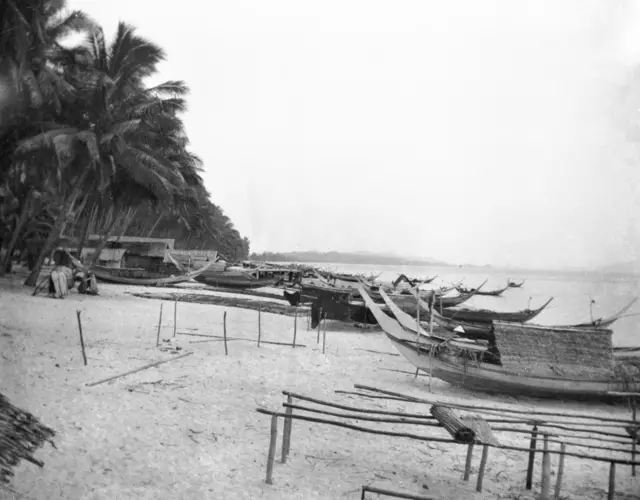
Bachok Beach, Kota Bharu, Malaya. 1941-07. Local fishing boats (perahu) pulled up on the beach, possibly at one of the points where the Japanese invasion troops landed on 1941-12. (Donor E. Cooke-Russell). Copyright expired.

The local villagers’ experience

A group of 30 local villagers came across the Japanese forces during the invasion.

They tried to escape but the Japanese ordered them to dig trenches and stay inside to avoid getting shot in the gunfire exchange.

The locals had to dig the holes in the sand with their hands. Overwhelmed with fear, they stayed in the trench for three days.

When they finally came out from it, they found about 380 dead Japanese soldiers.

The Japanese then cremated their dead comrades.

They stayed in the areas for about two weeks before moving to other locations. The Japanese reportedly did not cause any problems for the locals taking away their livestock.

Only three villagers reportedly died during the attack at Kota Bharu.

The aftermath

As for the British and Japanese troops, there is no official death toll. For the Japanese, they suffered an estimated 300 deaths and 500 wounded. The British casualties and losses were estimated at 68 fatalities, 360 wounded and 37 missing.

Regardless, the attacks on Kota Bharu were one of the most violent battles of the whole Malayan Campaign.

The forgotten Malayan labourers of Burma Railway during WWII

The Burma Railway is infamously known as the Death Railway. It is because thousands of people died building it during World War II (WWII).

The Empire of Japan built it from 1940-1944 to supply troops and weapons in the Burma campaign.

The railway is 415-kilometres long connecting Ban Pong, Thailand and Thanbuzayat, Burma.

It is understood that between 180,000 and 250,000 Allied prisoners of war (POWs) were forced to build the railway.

However, not many remember that there were civilians working along the railway sacrificing their lives along the way.

It is estimated that there must have been more than 180,000 civilian labourers working on the railway.

They were mostly Javanese from Indonesia, Thai, Burmese as well as Chinese, Malay and Tamil from Malaya.

Sometimes referred to as romusha (the Japanese language word for labourer) in writing, they were also known as ‘the coolies’ by the Allied POWs.

The forgotten Malayan labourers of Burma Railway during WWII
Bridge over the River Kwai by Leo Rawlings, a POW who was involved in the line’s construction (sketch dated to 1943). It depicts four POWs, waist-deep in the water, carrying a large log during the first bridge’s construction. Credits: Rawlings, Leo – http://media.iwm.org.uk/iwm/mediaLib//150/media-150071/large.jpg This is photograph Art.IWM ART LD 6035 from the collections of the Imperial War Museums.

The recruitment of Malayan labourers

Speaking of Allied POWs, Australian POW Hugh Clarke described on how these civilian labourers were recruited in his work “A Life For Every Sleeper, A Pictorial Record of the Burma-Thailand Railway.”

He wrote, “The Japanese at the end of 1942 resorted to many ruses to recruit an additional labour pool of over 270,000 civilian labourers. They included Chinese, Burmese, Thais, Indians, Malays and Eurasians. As POWs began moving north the Japanese placed advertisements in Malayan newspapers seeking labourers for work periods of up to three months in Thailand. Free rail travel, housing, food and medical services were offered together with pay at a rate of one dollar a day. The response was negligible so the Japanese resorted to press-gang methods. Free pictures shows were advertised at various theatre around Malaya and when full, the doors were locked and all males in the audiences put abroad trains and railed to Thailand.”

However, could the civilians escape from being recruited? There were reports of locals agreed to become spies for the military police or Kenpeitai in order to avoid being sent to work on Burma Railway.

Dr Robert Hardie’s accounts on Malayan labourers on Burma Railway

Dr Robert was a British medical officer serving with the Federated Malay States Volunteer Force and a plantation manager in Malaya.

After the fall of Singapore, he became one of thousands of POWs forced to work on the railway.

Throughout this period, he managed to keep a diary despite the numerous searches. His diary entries were later published in a book entitled The Burma-Siam Railway: The Secret Diary of Dr Robert Hardie 1942-45.

He was reportedly an admirer of Malay culture.

On Aug 4, 1943, he wrote,

“When one hears of these widespread barbarities, one can only feel that we prisoners of war, in spite of all the deaths and permanent disabilities which result, are being treated with comparative consideration.”

Then on July 6, 1943, Hardie stated,

“A lot of Tamil, Chinese and Malay labourers from Malaya have been brought up forcibly to work on the railway. They were told that they were going to Alor Setar in northern Malaya; that conditions would be good – light work, good food and good quarters. Once on the train, however, they were kept under guard and brought right up to Siam and marched in droves up to the camps on the river. There must be many thousands of these unfortunates all along the railway course. We hear of the frightful casualties from cholera and other diseases among these people and of the brutality with which they are treated by the Japanese. People who have been near the camps speak with bated breath of the state of affairs-corpses rotting unburied in the jungle, almost complete lack of sanitation, frightful stench, overcrowding, swarms of flies. There is no medical attention in these camps, and the wretched natives are of course unable to organise any communal sanitation.”

Again on July 21, 1943, Dr Hardie wrote,

“The conditions in the coolie camps down river are terrible, Basil says. They are kept isolated from Japanese and British camps. They have no latrines. Special British prisoners parties at Kinsaiyok bury about 20 coolies a day. These coolies have been brought from Malaya under false pretence – ‘easy work, good pay, good houses!’ Some have even brought wives and children. Now they find themselves dumped in these charnel houses, driven and brutally knocked about by the Jap and Korean guards, unable to buy extra food, bewildered, sick, frightened. Yet many of them have shown extraordinary kindness to sick British prisoners passing down the river, giving them sugar and helping them into the railway trucks at Tarsao.”

What happened to the Malayan labourers when the war ended?

If you think that the suffering of Malayan labourers would end when the Japanese surrendered and the war finally ended, well, it’s usually not that clean-cut.

According to Anzac Portal, these civilians had no expectation of being rescued by military authorities when the war ended.

In other Japanese-occupied territories romusha were given supplies of food and medical attention by American troops arriving from August-September 1945 on.

Unfortunately, Allied authorities in Thailand and Burma prioritised their own military personnel leaving the romushas including the Malayan forced labourers perhaps last in line for help and supplies.

As for the repatriation of Romusha, it was managed by different authorities. The British Military Administration in Malaya sent missions to Thailand in November 1945 to aid the repatriation of Malayan laborers.

Overall for those who returned alive to their homes, no compensation were given to them. In Malaya, nonetheless, some received some clothing and a small amount of money… but many received nothing.

The unmarked and unknown graves of civilians of Burma-Thai Railway

After the war, the remains of the dead were relocated from former POW camps, burial graves along the railroad to official war cemeteries.

Overall, there were three war cemeteries which are maintained by the Commonwealth War Graves Commission.

According to Paul H. Kratoska in Asian Labor in the Wartime Japanese Empire: Unknown Histories, there are 12,043 Allied soldiers are buried in cemeteries in Kanchanaburi, Thailand. Their gravestones seem to stretch on forever.

He further stated, “However, there are no cemeteries, and no individual gravestones, for the Asian labourers who died building the railway. They were buried if they were fortunate, or else abandoned in the jungle, or thrown into the river or into a common grave. In 1988, the site of a mass grave was found in Kanchanaburi by accident, and the bones of more than 700 bones were excavated. Villagers said it was a burial site used for the Asian railway construction labourers.”

According to Anzac portal, since they were not military personal they were not interred in the Commonwealth War Graves Commission.

Furthermore, the identification of their bodies would be extremely difficult given the lack of records of where they buried.

To this day, there is no official record of how many civilian labourers died building the Burma railway.

Why were the Asian workers of Burma Railway, including the Malayan labourers, forgotten?

According to David Boggett in his paper Notes on the Thai-Burma Railway, while dead men can tell no tales, so the illiterate can write no diaries.

He stated, “Many of the Asian romusha were illiterate; poor, helpless peasants most forcibly conscripted or callously lured by false promises of riches and unaware of their ultimate destinations. While it is a matter of dispute as to whether Japan ever made any efforts to observe the Geneva convention (certainly the experiences of the POWs led them to believe that the Conventions were being deliberately ignored), the records kept of POWs movements for example from Singapore’s Changi prison to Thailand or from Thailand to Japan proper – suggest that at some perhaps higher levels, the intention of Japanese bureaucrats (as opposed to military staff on the ground) was, indeed accurate records of the POWs’ fate as obligated under the conventions.”

Boggett also added, “However, no such Geneva Conventions existed to govern the impressing or treatment of civilian labour; few official attempts were made to record the fate of Asian romusha. This lack of official Japanese documentation, coupled with the absence of almost any written records by the survivors themselves, has allowed the situation of Asian romusha to be minimise or even ignored.”

With no marked graves and no official records of their existence, it is no surprise why the civilian labourers of the Burma Railway including those from Malaya had been forgotten, even if their number could be way higher than of Allied POWs.

A legend of how the Timugon Murut people came into existence

The Timugon Murut is one of the 29 ethnic groups of Murut people.

Overall, the Murut people can be found mainly in Sabah and Sarawak in Malaysia as well as in Brunei and Kalimantan, Indonesia.

As for Timugon Murut, they mainly live in Sabah. Each of the ethnic group of Murut people including Timugon Murut has its own distinct language, custom and even folklore.

Here is a tale on how the Timugon people was created as recorded by researcher Kielo A. Brewis in the paper The Death of a Timugon Murut (1987):

There was a great flood which saw everyone drown, except one young man, who climbed up a very tall coconut tree.

After the waters began to recede, he went down to look for survivors.

An angel from heaven (masundu) came to tell him that there were no other survivors and gave him a proposal instead – that they should marry.

The angel wasn’t anything like the shiny Western concept of an angel, but came in the form of a woman who was afflicted with a skin condition, similar to that of ringworm.

Even though he was the only person left on the planet, the young man did not want to marry her.

Instead he went off to find prettier girls, holding on to the hope that there were survivors besides himself.

In the meantime, the angel did not handle the rejection well.

In his absence, the angel made a clay figure that looked much like herself, except the figure did not have the markings of ringworm.

Then she made the figure into a living being by spitting red betel nut juice from her mouth onto it.

When the young man returned empty-handed and saw the beautiful girl who had been made from clay, he wanted to marry her.

Their descendant became the ancestors of the Timugon Murut.

A legend of how the Timugon Murut people came into existence
The man marries the woman who was made from clay. Credit: Pixabay.

Breaking down the different ingredients of a Malaysian nasi lemak

Malaysians can get defensive when comes to their food. When a foreigner mocks Malaysian food, Malaysians react as if their parents were insulted.

An example is when a British journalist tweeted on Jan 15, 2020 about the nasi lemak served to her on a British Airways flight.

Along with a vomiting emoji, Katie Morley tweeted, “Chicken curry served with anaemic boiled egg, topped with smelly, slimey anchovies. ANCHOVIES. I quite like plane food usually, and this was a 0/10.”

While some Malaysians condemned her harshly over her tweet, some suggested she try the real Nasi Lemak.

Morley then gave the real deal a try at a restaurant in central London. She later tweeted thanking Malaysians who suggested her to try the real nasi lemak. She stated, “You are right, it’s delicious!”

Who doesn’t love this rice cooked in coconut milk with pandan leaf and served with sambal, anchovies, cucumber and various side dishes?

Historian Ahmad Najib Ariffin – who is also the founder of Nusantara Academy of Development, Geocultures & Ethnolinguistics – gave an insight to the history of nasi lemak.

He told the Star in 2014 that nasi lemak seemed to come from the west coast of peninsular Malaysia.

“The east coast, which is the most culturally conservative part of the country, has its own signature traditional rice dishes with prominent, distinct fish flavours such as nasi dagang and nasi kerabu.

“Farmers needed a hearty meal in the morning, so eating nasi lemak kept them full because you have all have the food groups covered – carbohydrates from the rice, oils from the sambal and protein from the anchovies.”

Here at KajoMag, look into the different components that make up a traditional Malaysian nasi lemak:

Breaking down the different ingredients of a Malaysian nasi lemak
A Malaysian nasi lemak with rendang.

1.The rice

Did you know that rice cooked in coconut milk is actually common in Indonesia? Nasi uduk, nasi gurih and nasi liwet are all Indonesian dishes comprise of rice cooked in coconut milk.

However for nasi lemak, the taste is more fragrant because of the Pandan leaves.

The rice can be cooked with fresh or canned coconut milk.

Other spices used in the rice are ginger and lemon grass to enhance its fragrance.

There is a folklore behind how coconut milk was added into the rice. Long time ago, there was a widow Mak Kuntum and her daughter, Seri.

While cooking a pot of rice, Seri accidentally spilled coconut milk into it. Mak Kuntum returned home, smelling the fragrant rice, asking her daughter what it was. To this, Seri replied, “Nasi le, mak! (It is rice, Mum!).

The earliest mention of nasi lemak can be found in The Circumstances of Malay Life, written by Sir Richard Olaf Winstedt.

He did not state nasi lemak directly but rather explained how the Malay people during the early 1900s cooked their rice.

Winstedt wrote, “To an epicure well cooked rice is the alpha, just as well-spiced condiments are the omega, of good curry. Unfortunately for European taste, at marriages and festivals the Malay cook will try to improve on perfection. He will boil the rice along with such spices as carraway seeds, cloves, mace, nutmeg and ginger and garlic, in dripping or coconut oil, or he will boil it in coconut milk instead of water, or he will gild the lily with turmeric, using glutinous rice.”

2.The sambal

A sambal is basically a sauce or paste made from chilli pepper with other secondary ingredients.

The secondary ingredients usually comprise of shrimp paste, garlic, ginger, shallot, palm sugar, lime juice, scallion and tamarind pulp.

There are so many types of sambal out there.

When it comes to nasi lemak, the sambal is the one which seals the deal when deciding if it is a good nasi lemak.

The key to making perfect sambal for nasi lemak is to stir-fry it after crushing or blending the ingredients together.

As for its basic ingredients, those commonly used are garlic, shallots, white onion, dried chilli, red chilli salt and sugar to taste as well as cooking oil.

There are many tips and tricks to make a good sambal. If the blended the ingredients are too dry, add a little oil into the mixture.

If you stir-fry the blended ingredients in a hot wok, it tends to splatter oil while frying.

One trick is to a sprinkle a bit of salt in the hot oil when it starts to bubble. It will help absorb moisture and prevent splashing.

If you are using crushed anchovies in your sambal, do not blend the anchovies with the rest of ingredients. Fry the blended anchovies first before putting in the other mixture. This tip can also prevent the oil from splashing.

Some Chinese are famous for making their own sambal. Theirs are usually less spicy and combined with minced pork as an additional ingredient.

3.The cucumber slices

The basic vegetable to compliment a Malaysian nasi lemak is the cucumber slices. However, sometimes we do see nasi lemak which comes with other vegetable such as kangkung.

A fresh, crunchy cucumber is always good addition to the dish while stale cucumber slices are always a major turn off for nasi lemak.

4.The small anchovies

If Morley’s claim was true, it was sacrilege for British Airways to be serving smelly and slimey anchovies.

The real Nasi Lemak anchovies should be crunchy.

These small anchovies give extra texture and saltiness to the whole dish.

5.The roasted peanuts

Speaking of crunchiness, here is another ingredient which adds extra texture to the whole dish, the roasted peanuts.

Together with the fried anchovies, there should be roasted peanuts, making it immediately recognisable as a nasi lemak dish.

6.The eggs

Malaysian nasi lemak commonly uses a hard boiled egg as part of the dish. If the nasi lemak is selling at a cheaper price, then the hard boiled egg is cut into half or even a quarter.

Sometimes, it is also served with a fried egg.

Regardless, the egg is an essential source of protein for the dish.

7.The extra dish

Now comes the fun part, the extra dish. There are endless possibilities when comes to the extra dishes for a nasi lemak.

The common ones are, of course, rendang, curry and fried chicken. The curry can be chicken curry, fish curry or lamb curry.

Although nasi lemak is a dish of Malay origin, other races have added their own twist and made it as their own. For example, a non-halal nasi lemak is served with pork which is either served as barbecued or fried.

Breaking down the different ingredients of a Malaysian nasi lemak
A Malaysian Nasi Lemak with cripy pork slices.

If you cannot have enough of sambal, there are plenty of dishes cooked in sambal and served with a nasi lemak. This include sambal sotong (squid) and sambal udang (prawn).

With this extra dish of protein, nasi lemak has come a long way from being a comfort food for farmers.

Operation Canister: How the Colonial Service delivered news of the Brit High Comm’s death to Long Akah

Sir Henry Gurney was a British colonial administrator who served in different posts throughout the British Empire.

He joined the British Colonial Service in 1921 and was posted to Kenya as an assistant district commissioner.

After 14 years in Kenya, He was appointed Assistant Colonial Secretary to Jamaica.

From there, he served at various colonial offices including in London, Gold Coast and Palestine.

On Oct 1, 1948, Gurney was appointed High Commissioner to Malaya.

The assassination of Henry Gurney and Operation Canister

On Oct 6, 1951, Gurney was assassinated in an ambush by communist insurgents from the Malayan Communist Party.

He was on his way to a resort at Kuala Kubu Road near Fraser’s Hill, Pahang.

According to communist leader Chin Peng, the ambush was routine and the killing was by chance.

The communists only learned Gurney was among the dead from news reports.

When Gurney was killed, it was crucial to inform all the colonial officers in the region of his death.

Since it took place in the 1950s when phone coverage was still limited, especially here in Sarawak, how did the news get relayed?

One of the key people that needed to be informed of Gurney’s death at that time was Malcolm MacDonald, the British Commissioner-General for Southeast Asia.

Coincidentally, MacDonald was on a visit at rural Ulu Baram, specifically in Long Akah at that time.

Thus, the British military planned a mission called Operation Canister. The plan was to fly over Ulu Baram using a military plane to drop a pistol cartridge canister containing the letter from His Excellency Anthony Abell.

The first message was dropped near Long Lama bazaar and the second letter was dropped near Fort Long Akah where MacDonald was located.

Operation Canister: How the Colonial Service delivered news of the Brit High Comm's death to Long Akah
How the plane that flew over Long Akah looks like. Credits: Creative Commons

Here is the account of how the message conveying the news of the death of Sir Henry Gurney was delivered to Malcolm MacDonald in the Ulu Baram which was published on Oct 15, 1951 in The Sarawak Gazette:

The R.A.A.F Dakota plane under the command of Warrant Officer Brown left Kuching Airfield at 7am on Sunday, Oct 7, carrying senior Government Officers who were conversant with Mr Malcom MacDonald’s probable movements and the country in which he was travelling.

The early morning landas (runaway) weather looked far from promising as the plan took off and circled the field preparatory to settling a straight course in the direction of Miri, it having been decided to keep near the coast to begin with so as to avoid any bad weather further inland.

Flying at about 1,000 feet, the plane crossed the directly over Tanjung Jerijeh at Kuala Rajang at 7.33am crossed the lower Rajang Delta and met the sea again at Mukah flying directly over the twon at 8.05am. Being a Sunday morning there was little sign of life about the Government station.

By now the weather was clearing the prospects of a reasonably fine day seemed brighter; the plane was doing a steady 180 miles per hour, but sometime after leaving Mukah the hydraulic system sprang a leak. This is known as ‘losing your hydraulics’, an occurrence which apparently makes it necessary to lower the landing wheels. This slowed the aircraft down considerably so that off Niah and Suai it was done some 15 minutes behind schedule and the speed had dropped to around 100 knots.

Since by now the weather was improving rapidly it was obvious that there was a good chance of finding the Ulu Baram reasonably free of cloud.

The centre panel which comprises almost the whole of the entrance door was now removed and stowed forward. An approach anywhere near the great gaping hole in the side of the aircraft was only to be attempted by those who “had done it before!”

Flying over Miri to Baram

Near Miri at 9am a turn was made shore-wards, passing over the Lutong airstrip and then on to the east to pick up the Baram river.

The weather here was quite different from that experienced further south.

A normal ground mist was forming into rising patches of white cloud and Gunung Mulu stood out clearly in the morning sunlight.

It was therefore possible to map read on a straight course east of south to take the aircraft directly to the vicinity of Long Lama where the first message’ was to be dropped.

Just before ten o’clock the aircraft was circling over the Long Lama bazaar at an altitude of a few hundred feet from where all details could be clearly seen.

The government launch ‘Aline’ was tied alongside the riverbank indicating that the Commissioner-General’s Party was still upriver in longboats and that further search lay in the hills.

After a preliminary low run or two the aircraft came in straight and low, with the wireless operator stretched on the floor by the door holding the “bomb” consisting of an empty pistol cartridge canister containing His Excellency’s letter and attached by a long string to a simple roll of newspaper for a marker.

At a signal on the buzzer from the pilot this was dropped as the plane swept with a noisy rush over the open space near the bazaar.

It hit the edge of the river and was picked up by the launch crew.

Making sure that the Commissioner-General received the message

Having thus ensured that a message was left waiting at a point party the Commissioner-General’s Party would be certain to reach on their way down river the aircraft turned to follow the winding course of the river upstream towards Long Akah, and was before long flying between steep, forest covered hills forming the narrow valley down which the flooded waters of the Baram flowed swiftly.

The whole course of the river was closely followed and searched from an altitude 1,000-1,400 feet in case the longboats were on the way down.

After some twenty five minutes of twist flying and hill dodging the country opened out somewhat and the occasional appearance through billows of cloud of the distinctive broken top of Batu Kalulong indicated that the next objective, Long Akah, was nearby.

Flying over Long Akah to drop the letter

It was located and identified without delay and the plane dropped down to see people standing on the lawn in front of the Kubu, who by pointing apparently indicated that the party was upstream still.

In a few minutes the boats were identified heading for Long Akah and no doubt the occupants were a little surprised to find an R.A.A.F. Dakota in such a place, especially with the wheels down as if to land on the Kubu lawn!

The ensuing turning, banking and general aeronautics among the surrounding hills which was necessary to remain in the vicinity until the party was about to land from the boats, and get into the position to drop the message near the Kubu was a new experience for most of the passengers, although no doubt an everyday matter for the crew who had recently carried out many supply dropping efforts to the anti bandit forces in Malaya in similar country.

So it was with some relief that at 10.40 am Mr MacDonald was eventually seen to be standing up the lawn holding up the letter to show he had received it.

MacDonald returning to Kuching

It was reported that MacDonald arrived at Kuala Baram at 9.30 on Monday morning Oct 8.

Then he arrived at Kuching by air at 3.30pm on the same day. It is uncertain if MacDonald flew straight to Kuala Lumpur to pay Gurney his final respects.

Meanwhile, Gurney’s funeral took place on Oct 8. He was buried in Cheras War Cemetery in Kuala Lumpur in a ceremony that drew thousands of people.

Operation Canister: How the Colonial Service delivered news of the Brit High Comm's death to Long Akah
The news of Henry Gurney’s death featured on The Canberra Times on Oct 8, 1951.

Remembering an old Iban ceremony called ‘Gawai padi datai’

The Iban community is known for having different kinds of gawai celebrations.

Even though we associate the word ‘gawai’ with partying today, the feasting and festivities are actually secondary to the main event of the gawai celebration which is the religious ritual.

Some of the examples of gawai rituals include Gawai Antu (rituals to invite dead souls to their final separation from the living), Gawai Ngar (to celebrate patrons of weaving) and Gawai Melah Pinang (for the deity of creation).

One of the rare gawai rituals that are perhaps no longer celebrated is Gawai Padi Datai.

Betong’s then acting district officer A.M. Phillips witnessed the ritual, writing about it in The Sarawak Gazette on Sept 30, 1955.

According to Phillips, Gawai Padi Datai is held when the harvest is low, and is a celebration for paddy which they believed fell from the sky.

He stated that most longhouses in the Layar, Padeh, Spak, Rimbas and Paku areas had either performed the Gawai Padi Datai themselves or had at least attended one or two of the ritual.

Remembering an old Iban ceremony called 'Gawai padi datai'
Gawai Padi Datai is celebrated when the harvest is low.

Here is Phillips’ account of Gawai Padi Datai:

A feature of this gawai is that paddy which alleged to have fallen from the sky is brought from other houses to the house which is about to celebrate.

On arrival at the foot of the ladder a babi bland and manok labang (white pig and spotted white chicken) are killed and an offering made at the bottom of the ladder.

From the landing stage (pendai) to the foot of the ladder, thence up the ladder on to the ruai, and from the tanju to the bilik and into a tajau lama run strings, either of decorated rattan or of red cotton threaded with hundreds of puffed rice grains (letup).

The whole house is spread out with mats covering all the ruai and the whole of the bilik.

The visitors with the padi datai sit on the ruai together with 11 or possibly 13 women dressed in white, as men, with feathered hats and parangs, who make the offerings etc.

What happened after the offerings?

After this, during the night, grains of paddy are found from time to time either on the mats or on the ground outside the house.

Stones and animals’ teeth are also found, sometimes on the mats, sometimes in the offerings, sometimes falling from the roof.

All these grains of paddy and pebbles are supposed to bring good luck.

Most of the paddy probably falls out of the paddy bins in the roof whence it is disturbed by the usual rats, cats, or shaking of the house caused by the crowd of visitors.

The stones and animals teeth could also be placed in situ by subterfuge. If it is a hoax it is a big one and is yet undiscovered by the locals. The house carrying out this gawai and who place not a little faith in its efficacy include houses with many Christians. This phenomenon impresses or seems to impress, much more quickly and effectively than such mundane benefits as local authorities, or indeed V.H.F. telephones.

So what do you think? How did the paddy grains, stones and animals’ teeth are found after the Gawai Padi Datai? Let us know what you think in the comment box.

An Iban legend about the immortal Garai and his blowpipe

Here is an Iban legend from the Batang Ai area as recorded by N.S Haile on Aug 31, 1954 in the Sarawak Gazette.

A long time ago, there was an Iban Balau man named Garai.

One day, Garai went out hunting in the Klingkang Range with his blowpipe where he bumped into a very large spirit known as Antu Gayu.

Despite the blowpipe in the spirit’s hand, Garai was not frightened by Antu Gayu as he stood his ground.

Looking at Garai’s bravery, Antu Gayu challenged him, saying, “Let us see who can stick his darts into that rock. Whoever is successful will kill the other.”

Antu Gayu then pointed at a sheer sandstone cliff located in the Klingkang range.

Garai agreed, letting Antu Gayu go first.

While the spirit was selecting three of his strongest and sharpest darts, Garai excused himself and disappeared into the babas (bushes).

It did not take him long to find a pedalai tree from which he tapped some of the sticky rubber, and wound it around the tips of his darts before returning to the spirit.

Antu Gayu shot his three darts first. Although his darts were spirit darts which are much stronger and sharper than human darts, they still could not shatter the rock.

Meanwhile, Garai’s darts stuck into the rocks thanks to the pedalai rubber.

“It seems I’m the winner. You can see my darts have all stuck in. Well, nothing remains to be done but to kill you,” Garai said to the spirit.

The spirit immediately showed himself a coward as he tried to bargain for his life.

Garai’s reward after winning the competition

An Iban legend about the immortal Garai and his blowpipe

Antu Gayu tried to offer Garai some gold to which he replied he already had plenty.

The spirit then offered him some jars and gongs and Garai also said he had plenty.

“Well then, some medicine to make you a strong walker,” Antu Gayu said.

Garai responded, “I already am a strong walker, I can go farther and faster than anyone else in this area. I think it will be the best if I just kill you.”

Again, Antu Gayu negotiated offering him the charm that would make Garai irresistible to women.

To that Garai answered that he was a happily married man, so he did not need the charm.

Finally, the spirit offered him something that he took into consideration: eternal youth.

“You’ll never get old! Never die! What do you think of that?” Antu Gayu asked.

Garai in the end agreed, “If you can make me stay young forever, I won’t kill you.”

The Antu Gayu then produced a small knife and he asked Garai to swallow it.

After feeling assured that it would not cause him any harm, Garai did as the spirit told him to do.

“Now, you will never get old. Unless, you told anybody the reason for your everlasting youth and of how you put me to shame with your blowpipe, then you will die,” said the spirit.

How the immortal Garai spent his life

So Garai went on living his life day by day without getting older. When his wife got too old, with her consent he took a younger woman as his new wife. And he continued to outlive seven of his wives.

His grandchildren and great-grandchildren all became older than him.

Like all curious grandchildren, they wondered at his immortality, and begged him to let them know his secret. After being persuaded by them, the immortal Garai decided to tell them the truth, resigned himself to death.

But first, he asked them to prepare a big feast to celebrate the end of his life.

So pigs and chickens were killed and cooked while tuak (rice wine) were brewed.

Once all the feasting was done, Garai began to tell his story on how he gained his immortality.

As he finished his storytelling, the knife that he swallowed flew out from his throat.

Suddenly there was a flash of lightning and the immortal Garai met his end by being turned into stone. Shaped like a man but smaller, people began to call it “Batu Garai”.

Legend has it the stone is now kept by the people of Marakai in Kalimantan, and that it is locked in a chest. Some people believe it has extraordinary medicinal and therapeutic properties.

12 Indonesia-Malaysia combats during Konfrontasi you should know

Also known as Konfrontasi, the Indonesia-Malaysia Confrontation was an undeclared war with most of the battles happening between Kalimantan (Indonesia) and East Malaysia.

The confrontation was a result from Indonesia’s opposition to the creation of Malaysia.

Initially, Indonesian attacks on East Malaysia comprised of local volunteers trained by the Indonesian Army.

Over a period of time, the intrusions became more organised with involvement of Indonesian forces.

On the Malaysian side, the British provided help to Malaysian forces with periodic contributions from Australian and New Zealand forces.

The intensity of the Indonesia-Malaysia confrontation eventually subsided after the 30 September Movement when six Indonesian Army generals were assassinated.

Indonesia formally recognised Malaysia when a final peace agreement was signed on Aug 11, 1966.

Still, many lives were lost on both sides with combats happening in small-sized operations.

Here are at least 12 Indonesia-Malaysia Confrontation combats you should know about:
12 Indonesia-Malaysia combats during Konfrontasi you should know
While operating in Borneo during the Indonesian Confrontation, a soldier is winched up to a Westland Wessex HAS3 of 845 Naval Air Squadron, during operations in the jungle. Another soldier is kneeling on the edge of the extraction zone. Credit: Public Domain.
1.Attack on Tebedu police station

The first infiltration and attack as part of Indonesia-Malaysia Confrontation was recorded in April 1963.

On Apr 12, 1963, an Indonesian force attacked and seized Tebedu police station. Although Malaysia was not formed yet, the Malaysian government considered this as the first military attack on the-then future East Malaysia.

The raid, which happened on Good Friday that year, caused the death of a corporal and two wounded soldiers.

12 Indonesia-Malaysia combats during Konfrontasi you should know
Tebedu
2.Battle of Long Jawai

On Sept 28, 1963, a large number of Indonesian troops crossed the Sarawak-Kalimantan border and attacked the outpost at Long Jawai.

After exchanging fires for several hours, one Gurkha was killed and ten Malaysian border scouts were captured and later executed.

3.The Kalabakan Incident

The locals of Kalabakan, Tawau unfortunately witnessed one attack by the Indonesian forces on Dec 29, 1963.

Nonetheless, the attack successfully brought different groups of Malaysians to fight together for one sole cause.

A battalion from the 3rd Royal Malay Regiment (RMR) from Peninsular Malaysia, the Police Field Force, Sabah Home Guard and even Kalabakan villagers united to fight off the Indonesian forces.

The Kalabakan Incident resulted in the deaths of eight men from RMR and 18 others injured.

4.Landing at Pontian

On Aug 17, 1964, Indonesian troops made an amphibious landing at the Pontian district of Johor.

The troops landed in three different locations along Pontian coast according to plan. However, Malaysians security forces were quick to respond with half of the raiders captured immediately upon landing.

5.Landing at Kesang river

Located on the border between the Malaysian states of Malacca and Johor, Kesang river witnessed an amphibious raid conducted by a small force of Indonesian volunteers on Oct 29, 1964.

52 of these volunteers sailed across the Straits of Malacca in fishing vessels on each side of the mouth of the Kesang river.

Their action plan was to blend in with the locals and to launch guerrilla raids against Malaysian infrastructure.

However, Malaysian fishermen spotted the raiders and quickly informed the authorities.

The British troops, assisted by the Australians immediately arrived to the scene where they killed and captured all but two of the invaders.

6.Landing at Labis

About a month later after the landing at Kesang river, the Indonesians made another landing on Sept 2, 1964 near Labis, Johor and this time via air.

Three Indonesian Air Force aircraft set off from Jakarta but only two landed as the third aircraft crashed into the Straits of Malacca.

Under the command of 4th Malaysian Infantry Brigade, the operation took about a month to round up all the 98 paratroopers.

32 of the intruders were killed while the rest were captured.

7.Action of Dec 13, 1964

The Action of Dec 13, 1964 was a naval action between the Australian minesweeper HMAS Teal and two Indonesian vessels.

It took place in the Singapore Strait where HMAS Teal was conduction patrols at night. The two Indonesian vessels fired automatic weapons upon HMAS Teal. The Australian ship killed three and captured four other during the combat.

8.Battle of Plaman Mapu

The Battle of Plaman Mapu was one of the largest battles of the Indonesia-Malaysia Confrontation.

In the early hours of Apr 27, 1965, a battalion of Indonesian soldiers launched a surprise attack on B Company, 2nd Battalion of the Parachute Regiment in their base at Plaman Mapu.

The British was outnumbered by at least five to one but they still managed to cause significant damage on the Indonesians.

In the end, the battle took the lives of 30 Indonesians and two British troops.

9.Battle of Sungei Koemba

The Battle of Sungei Koemba was part of the wider Operation Claret that took place along the Sungai Koemba in Kalimantan.

The battle consisted of two ambushes conducted by two platoons from the Australian forces.

B Company ambushed Indonesian troops on May 27, 1965 resulting in significant Indonesian casualties and no loss for the Australians.

Meanwhile, the second ambush happened a little further downstream from the last one by a platoon from C Company. Occurred on June 12, 1965, the second ambush again resulted in heavy Indonesian casualties for no loss to the Australians.

12 Indonesia-Malaysia combats during Konfrontasi you should know
British Royal Marines Commando unit armed with machine gun and Sten gun patrolling using a boat in the river on Serudong, Sabah between 1963 until 1966. Credit: Malaysian Archive [Public domain]
10.Battle of Kindau

Three days after the last ambush at Sungei Koemba, a platoon from A Company successfully ambushed another large Indonesian force at Kindau, Kalimantan.

The ambush resulted in about 25 to 50 Indonesian casualties and two Australians wounded.

Unlike other engagements under Operation Claret which remained under wraps, Battle of Kindau was caught by the media after a journalist interviewed one of the wounded Australians.

However, the news was reported under the pretence the battle took place within Malaysian authority.

11.Battle of Babang

This was the last in a series of successful ambushes conducted between May and July 1965 by Australian troops from 3rd Battalion, Royal Australian Regiment (3RAR).

The battle took place on July 12, 1965 at Babang, Kalimantan as part of the wider British-Commonwealth Operation Claret.

On that day, 7 Platoon C was in an ambush position along a track near the Indonesian base at Babang. Around noon time, a force of about 30 Indonesians approached along the track. The Australians ambushed the Indonesian troops subsequently killing at least 13 of them and wounded five.

The cross-border attack was to provide warning to the Indonesian troops not to incur into Sarawak territory.

12.Battle of Bau or Battle of Gunung Tepoi

On Nov 21, 1965, 16 members of the British Army Gurkhas launched an attack on about 100 Indonesian troops.

The Gurkhas were then supported by the 104 men resulting the Indonesians to withdraw.

After the battle, the Indonesians reported at least 24 men killed in action and the British lost three men.

5 things you might not know about torch ginger or bunga kantan

Torch ginger (Etlingera elatior) is widely known as bunga kantan in Malaysia. It is also known as ginger flower, torch lily, Philippine wax flower, Indonesian tall ginger, rose de porcelaine and porcelain rose.

Here in Malaysia, the bud of the torch ginger makes an important ingredient in dishes such as laksa and nasi kerabu.

But did you know Malaysians are not the only ones who love this plant?

Here are 5 things you might not know about torch ginger or bunga kantan:
5 things you might not know about torch ginger or bunga kantan
Torch ginger’s flower.
1.The plant is used in different kind of cuisines throughout Southeast Asia.

In North Sumatra, Indonesia, the locals used the flower buds for a stewed fish dish called Arsik ikan mas.

Meanwhile in Bali, people use the white part of the bottom of the trunk for cooking chilli sauce called “Sambal Bongkot” and the flower buds to make chilli sauce “Sambal Kecicang.”

In Thailand, young shoots and flowers of the plants are served raw with nam phrik phao (a type of Thai spicy chilli sauce).

2.The leaves of the bunga kantan is commonly used as post-partum home treatment.

In Malaysia, the leaves of the bunga kantan is mixed with other traditional herbs such as ginger leaves, turmeric leaves and betel leaves in water. Then post-partum women would use it as bathwater to get rid any body odour.

5 things you might not know about torch ginger or bunga kantan
Thanks to its pretty and bright pink appearance, this plant is also used as decorative plant.
3.It is used to cure the symptoms of typhoid fever and other diseases.

A community in Porehu district of Southeast Sulawesi, Indonesia use the plant to cure symptoms of typhoid fever.

Apart from that, they also believe that consuming the plant could cure various kinds of diseases such as diarrhea, canker sores, cough and heartburn.

This traditional knowledge has been passed down for generations.

4.Essential oil from torch ginger could be used as an ingredient for sunscreen.

There have been a few studies done on the phytochemistry of this plant. For example, a study done by Royal College of Medicine Perak which was published in Journal of Applied Pharmaceutical Science in 2017 had proven that there were two benefits of torch ginger’s essential oil.

The researchers found that the torch ginger essential oil provided phytochemical screening, photo-protective as well as anti-oxidant properties.

Hence, the study suggested to use torch ginger as a new source of natural anti-oxidant ingredients that can be incorporated into sunscreen cosmetic products.

5 things you might not know about torch ginger or bunga kantan
Torch ginger tree.
5.The inflorescence of torch ginger is potentially used as a preservative.

Meanwhile, another research study done by Universiti Sains Malaysia had found the benefits of oil and extracts derived from the inflorescence of torch ginger.

They found that the oil and extracts had rich antibacterial activity and possessed great potential to be used as a preservative in the food and pharmaceutical industries.

5 things you might not know about torch ginger or bunga kantan
The essential oil of this plant is potentially be used as sunscreen.
1 3 4 5 6 7 14