Browse Category

Culture - Page 24

The local Kanowit version of the Fox and Steele murders

After two of Brooke’s officers – Charles James Fox and Henry Steele – were murdered in 1859, the government named two suspects behind the crime.

They were Saweng (sometimes spelled Sawing) and Sakalai (sometimes spelled Sekalai).

So who were they and what drove them to kill the officers?

Here is what the local Kanowit people believed happened in the Fox and Steele murders:

This version of the story was told by Jaro Lamit who was a former chief of Kampung Bedil, Kanowit. He told the story to The Sarawak Gazette in September 1963 when he was already in his mid-eighties.

In the olden days, there were many tribes living in Kanowit, including the Kanowit tribe. The Kanowit people were more populous in this area than the other tribes.

Two of their chiefs were Saweng and Sakalai. Sakalai, however was a Melanau from Matu by birth.

According to Jaro, the site of the secondary school at Kanowit in the 1960s used to be where two longhouses stood.

“In those days the Kanowit people were divided into three ranks; Raja (aristocrats), Panyin (middle class) and Dipan (slave). The aristocrats lived in the middle apartments of the longhouse; the middle class (panyin) lived on either side and the slaves (dipan) lived with the families of the aristocrats. They worked for the aristocrats and everybody lived at peace,” Jaro stated.

Then a beautiful girl named Nyalade came into the picture. Saweng only had eyes on Nyalade and wished to have her hand in marriage.

However, Nyalade had her own mind, telling Saweng, “If you are really a brave man and invulnerable, you go and cut off the heads of the two white fowls on the other side of the river.”

Nyalade was actually refusing to marry Saweng because he already had a wife and two children.

Saweng, nonetheless, felt ashamed and threatened with Nyalade’s dare. He then told his people to pack all their belongings and make refuge at Kabah river (Nanga Kabah) where they built a stronghold.

Determined to prove his bravery, Saweng and a few of his men – including Sakalai – went to the fort where Fox and Steele stayed.

Jaro told the gazette, “Before they reached the Fort, Saweng said to Sakalai and his friends, ‘When I begin to chew betel nut, you will kill those Europeans.’ When they reached the Fort, Saweng began to chew betel nut, and Sakalai and his friends took their parangs and killed them.”

The local Kanowit version of the Fox and Steele murders
Kanowit bazaar in 2016.
The aftermath of the murders
The local Kanowit version of the Fox and Steele murders
The double homicide of the Brooke officers had led the Brooke government to send punitive expedition against the Kanowit people. Credit: Pixabay.

After the news of the murders reached the White Rajah, the Brooke government sent a punitive expedition to Kanowit.

They made the fort into a stronghold and attacked the surrounding villages with their guns and cannons.

Meanwhile, Saweng and his followers made their escape to Kabah river to their stronghold.

The Ibans that the Brooke recruited knew about this so they followed them to the stronghold. Some of these Ibans were once allies to Saweng.

After a ferocious fight between Saweng and his men against Brooke and his Iban warriors, Saweng’s troop started to break apart.

As many of his followers died during the battle, those who came from Matu, Igan and Mukah to fight went back to their own homes.

Even some of the Kayan and Bukitan people who helped him perished during the battle.

Saweng, however did not falter. He attempted to escape up the Rajang river to the Iran river. There, he fought another fierce battle with the Brooke troops.

Jaro said, “The water of the Iran river became red with blood. After a long fight at the Iran river, Saweng and his followers could not longer stand the heavy fire of the Rajah’s party, and escaped to the Pelagus river where they again made a stand.”

Saweng and his followers continued to fight through the Brookes as they made another escape to the Kejaman longhouse at Tuju Metahap, near the Belaga bazaar today.

There, he made the Kejaman longhouse as his stronghold. Legend has it that he hung a mat in front of the house in order to protect it. It was said that none of the bullets fired on the longhouse were able to penetrate the magical mat.

Nonetheless, many of the Sekapan and Kejaman people paid the price for harbouring Saweng and his men.

Saweng’s final escape to Anap

After staying with the Kejaman people Tuju Metahap, Saweng then went to Anap.

When Saweng and his followers fought against the Rajah’s expedition, his children Gadap and Metalai were actually still living in Kanowit.

Upon learning about this, the Rajah reportedly sent a letter to Saweng in Anap telling him that his children were under arrest.

In order to free his children, Saweng decided to surrender himself to the Rajah in Kuching. There, he was put in jail.

They tried to put him to death by different kinds of methods such as stabbing and shooting but all failed.

The Kanowit people believed he had some power that made him invulnerable.

According to Jaro: “In the end Saweng said to the Rajah, it is painful to have your men trying to kill me like this, and it will be better for me to die quickly. Saweng then asked the Rajah to kill him himself and the Rajah took his dagger and killed Saweng.”

That one time a dragon caused a flood in Belaga in 1942

Different cultures around the world have attributed mythical creatures as the cause of meteorologic phenomenons or natural disasters like flood and earthquake.

For example, in Japanese mythology, the Namazu is a giant catfish that causes earthquakes with his tail.

Meanwhile, the thunderbird in Native American culture is believed to have the ability to produce thunderstorms and rain.

Here in Sarawak, there was one heavy flood which the locals believed had been caused by an angry dragon.

The Sarawak Gazette reported on a flood in Belaga which startes on Feb 21, 1942 and lasted for five days.

Apparently, the Kayans blamed the Kenyah Badeng whom they said tried to tie a dragon to a farm hut with rattan.

They said the dragon was about the size of an areca palm tree with a body resembling a snake with scales, horns and legs.

Somehow, the dragon managed to escape from its ties and wreaked vengeance on the people of Belaga by sending them the biggest flood they had ever experienced.

That one time a dragon caused a flood in Belaga in 1942
Belaga town in 2017.
Worst flood ever recorded in Belaga?

According to the gazette, to anyone who happened to be in Belaga at that time, the feeling was that the downpour of rain before and during the flood was enough to drive away people and dragons.

“The flood was actually caused by the heavy downpour of rain up to the Sungai Belaga and Balui at the same time and the Giam (rapids) obstructing the flow of an abnormally large volume of water.”

The report continued, “Thoughthe flood was 15 feet high from the Kubu (fort) ground floor, many buildings on a lower ground level were submerged. Those who built of lighter materials were floated away as soon the flood reached the roof top. It was strangely amusing to see the newly erected Government Dispensary moved away like a tortoise.”

Some of the village houses were anchored to the nearby trees using rattan while a few Kayan longhouses washed away by flood like steamships with cats and dogs still inside.

The shophouses in Belaga bazaar were reported to still be more or less intact but did not escape some damage.

Before this, other floods that had been officially recorded in Belaga took place in Jan 28, 1934 (estimated at 8 feet high) and Mar 24, 1887 (estimated at 4 feet).

However, it is unsure if these floods were also caused by an angry dragon.

Four covert operations by Z Special Unit in Borneo during WWII

For those who survived, they kept their silence for 30 years. Nobody knew what they did during World War II (WWII).

For those who died during their missions, nobody, not even their families knew about their sacrifices or the nature of their deaths for those 30 years.

They were part of Z Special Unit, a joint Allied Special forces unit formed to operate behind Japanese lines in Southeast Asia.

The operatives were mostly from Australia while others were British, Dutch, New Zealand, Timorese and Indonesian.

After the war ended, the special military unit operatives were sworn to secrecy and not allowed to tell anyone of their experiences until 1980.

While their best known missions were Operation Jaywick and Operation Rimau (both of which involved raids on Japanese shipping in Singapore Harbour), these operatives also carried out covert operations in Borneo.

Here are at least four covert operations run by Z Special united in Borneo during WWII:
Four covert operations by Z Special Unit in Borneo during WWII
Members of Z Special Unit at their base at East Arm, near Darwin. Credits: Australian War Memorial.
1.Operation Python

As all Z Special Unit’s operations were covert and secretive, not much has been revealed to the public even almost 80 years since the war has ended.

This included Operation Python which took place from 1943 to 1944. The mission’s objective was to set up a wireless station near Labian Point in Sabah and undertake covert operations reporting on the Imperial Japanese Navy in the Sibutu Passage and the Balabac Strait of the Sulu Sea.

The overall operation was divided into Python I and Python II. During Operation Python I, the Z Special Unit operatives landed along Labian Point in early October 1943. Besides setting up a wireless station there, they also supported and provided equipment for Filipino guerrillas.

In January 1944, Operation Python II took place with the objective of organising the native population for guerrilla warfare.

Unfortunately, these early operations did not yield significant results.

2.Operation Agas

A total of 44 Z Special Unit operatives took part in Operation Agas in carrying out guerrilla warfare against Japanese in North Borneo (present day Sabah) with the support of locals.

Operation Agas was split into five operations, starting in March 1945, continuing up to September and October 1945.

While the operations were able to supply reliable information to Australian forces, they did little rescue mission-wise.

For example, Agas 1 operatives provided information about the Sandakan Death March but there were no rescue missions for the prisoners of war (POWs). The death march subsequently resulted in the deaths of 2,434 POWs.

Nonetheless, the intelligence gathered during Operation Agas helped the Allied forces during the Battle of North Borneo which was fought between June 10 to Aug 15, 1945.

3.Operation Semut

While Operation Agas was executed in North Borneo, a similar covert mission was undertaken in Sarawak called Operation Semut.

There was four operations undertaken under Operation Semut. Overall, the operation reportedly caused the deaths of 1,500 to 1,700 Japanese from March to October 1945.

Under this operation, the Z Special Unit members trained and supplied the locals with weapons to help conduct surveillance and sabotage behind enemy lines.

Unlike Operation Agas, the intelligence gathered during Operation Semut was not entirely helpful as the locals could not differentiate between facts and rumours.

4.Operation Platypus

Just like any other operations undertaken by Z Special Unit, Operation Platypus aimed to gather intelligence and train local peoples as resistance fighters against the Japanese.

The operatives were inserted in small groups into the Balikpapan area of Dutch Borneo (present day Kalimantan).

There were 11 operations altogether in Operations Platypus with the first part of the operations carried out on Mar 20, 1945.

The last operation took place on July 22, 1945 where the operatives used folboats to reconnoitre and pinpoint prospective target areas.

5 things you should know about Sarawak’s flags throughout the years

Did you know that the current Sarawak flag was inspired by the state’s old flag when it was under the reign of the White Rajahs?

Over the years, there have been several changes to the Sarawak flag with the current design becoming official in 1988.

And who could forget the Trisakti that was designed and first hoisted by the then Chief Minister of Sarawak Abdul Rahman Ya’kub in 1973?

5 things you should know about Sarawak's flags throughout the years
The Trisakti flag: The blue was supposed to symbolise Sarawakians being unified in pursuit of national aspirations; the red to symbolise their perseverance and determination; and the white to reflect honesty and purity.

The current design retains the same colour scheme as the flag of the former kingdom, except with two significant changes. The cross was replaced with two diagonal bars while the crown was substituted with a nine-pointed star.

Here are 5 things you should know about the history of previous Sarawak flags before all these changes:
1.Before there was an official flag, there was the flag of St George.
5 things you should know about Sarawak's flags throughout the years
Brooke’s personal standard was the flag of St George’s Cross. Photo credit: The Sarawak Gazette.

When the first White Rajah James Brooke came into power, he originally used St. George’s Cross as the state’s flag.

It was a red cross on a white background in the form of swallow-tailed pennant. James flew this flag over his first fort at Berlidah, not far from Siniawan.

2.The first official Sarawak flag was designed by James Brooke.

Finally in 1845, James decided to give Sarawak a flag of its own. However, he only hoisted it three years later on Sept 21, 1848.

The flag was made up of a half blue and half red cross of his Armorial Bearings on a yellow background.

So what did the first White Rajah do after there was an official Sarawak flag? In 1845, he applied to the British Ministries for Foreign and Colonial Affairs in order for them to recognise Sarawak by allowing a Protectorate flag to be displayed.

However, it took the British government 15 years (January, 1864) to recognise Sarawak as an independent state and another 35 years (June, 1888) before Britain expressed its protection.

James was reported to have regretted that the flag did not contain a quartered Union Jack (like you see in today’s New Zealand and Australian flags).

3.Was it blue or purple?
5 things you should know about Sarawak's flags throughout the years
The first official Sarawak flag caused some debate over whether it was a blue and red cross or a purple and red cross. Photo credit: The Sarawak Gazette.

The only recorded account of the first hoisting of the Sarawak flag can be found in “Letters from Sarawak” in 1851 by Harriette McDougall, the wife of Bishop McDougall.

She wrote a letter to her son Charley who was at school in England, which was later published to help raise missionary funds in Sarawak.

Unfortunately, Charley passed away a year after this letter was written due to a blow from a cricket ball.

Going back to the Sarawak flag, this was what Harriette wrote to her son:

“The Sarawak flag is a purple and red cross, out of Sir James Brooke’s armorial shield, on a yellow background, yellow being the royal colour of Borneo. It was given by the Rajah to his people on his return from England in 1848 and I remember well what a grand occasion it was. HMS Meander was at Sarawak (the old name for Kuching) at the time, and their band played ‘God save the Queen’, as the flag was the first time hoisted on the flag-staff before the Rajah’s house.

All the English (probably only men) were assembled there, and a great crowd of natives, Malays and Dayaks, whom the Rajah addressed in the Malay language telling them the flag which he had that day given them would he hoped, be their glory and protection, as the flag of England had been hers. The Malays listened with love and reverence to his words and from house across the river, I could hear their acclamation.”

Although Mrs McDougall here pointed out that the flag was a purple and red cross, the second White Rajah Charles had clarified in a letter that the cross was in fact blue and red.

But that did not stop many of the early writers from the late 19th century stating that the colours were purple and red.

4.The first recorded official notification regarding the Sarawak flag was issued on May 7, 1870.

According to archivist W.J Chater, the first official notification regarding the Sarawak flag was concerning the dimensions of the flag.

It also stated, “Black bunting to be used in place of blue” denoting the change from the cross’ blue colour to black and quash the rumours that it was purple instead of blue.

5.The three bodies that first used Sarawak flags officially

While it is common to see the Sarawak flag hoisted up in front of government buildings these days, back in the olden days the Rajah first gave the Sarawak flags to three bodies, namely the Society for the Propagation of the Gospel (S.P.G) in 1871, the Borneo Company in 1874 and the Roman Catholic Mission in 1906.

The Roman Catholic Mission hoisted the Sarawak flag for the first time on Vyner Brooke’s birthday (Sept 26, 1906).

Meanwhile, the Kuching branch of the Borneo Company Limited hoisted the flag only for a short time. Then they refused to do so reportedly because they found ‘it was too ugly’ and the blue border being a Chinese sign of mourning might have been considered unlucky for business.

A Melanau legend of a mouse-deer, a deer and a pig

Known as “pelanduk” in Malay and Iban, a mouse-deer belongs to the genus Tragulus of even-toed ungulates.

It belongs to the same family of lesser mouse-deer or kancil.

While the lesser mouse-deer is known for its cunning behavior in Indonesian and Malaysian folktales, the Melanau community of Sarawak also have a similar tale about the mouse-deer or pelanduk.

Here is the legend of how a mouse-deer tricked a pig and a deer to save itself recorded by Brooke Low:

There was once a mouse-deer who, during a stroll, fell into a pit. Try as he might, he could not find a way to get out.

Coincidentally, a pig came and spotted the mouse-deer inside the pit. The pig then asked what the mouse-deer was doing down there.

“Oh, don’t you know,” the mouse-deer replied, feigning confidence, “the sky is going to fall in and everyone will be smashed unless he has a hole to hide in.”

After listening to the mouse-deer, the pig leaped in.

The mouse-deer then jumped onto the pig’s back, but he was still not high enough to leap out.

Next came a deer, who also asked the two animals what they were doing in the hole. The mouse-deer told him the same lie.

So, the deer jumped into the hole, afraid that the sky might fall and smash down upon him.

The mouse-deer somehow tricked the deer into standing on top of the pig’s back. The moment they were in the right position, the mouse-deer jumped out from the pit and made it to safety.

Dumbfounded, the pig and the deer finally realised that they were tricked.

Thankfully, the tale doesn’t end here for these two unfortunate animals. In order to escape from the pit, they both scratched the earth along the sides, creating a small mound in the centre. Then, they used the mound to jump out from the hole.

Deer and pig look for vengeance

Once the deer and the pig escaped from the hole, they both vowed to have their revenge. They followed the trail of the mouse-deer and found it standing on top of a tree where a bee’s nest was hanging.

“Come down from the tree because we want to kill you,” said the pig and the deer.

“I can’t, the king has got me to watch his gong,” the mouse-deer answered as it pointed to the bee’s nest.

Excited by the idea that it was the ‘king’s gong’, the deer said it had always wanted to ring it.

“So you may if you let me come down and get at a distance before you strike. The noise would deafen me,” the mouse-deer said.

The moment the deer and the pig allowed it, the mouse-deer came down and ran away to safety.

So the deer took a stick to strike the ‘king’s gong’ and was instantly stung to death by the bees.

A Melanau legend of a mouse-deer, a deer and a pig
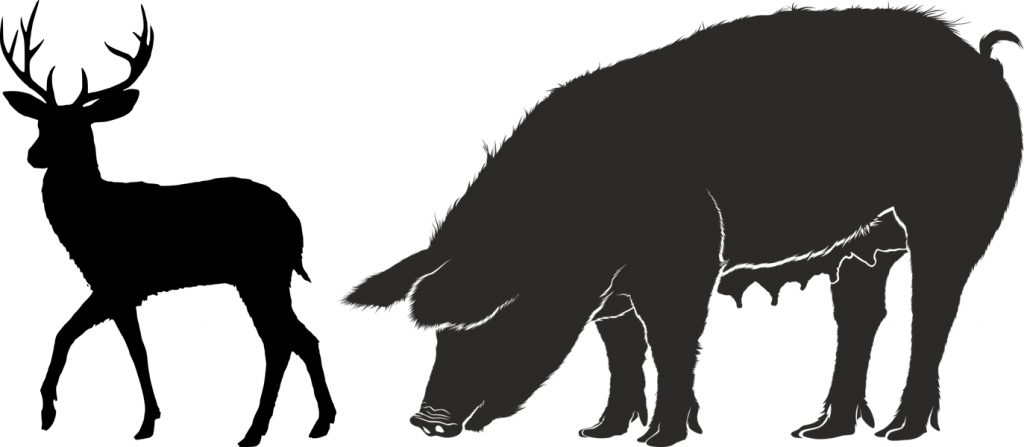
This is a legend of how a mouse-deer tricked a deer and a pig
The pig and the mouse-deer

Meanwhile, the pig went after the mouse-deer in a rage. And again, the mouse-deer was caught up by the pig.

And again, the mouse-deer climbed up a tree to escape the pig.

The mouse-deer then told the pig that it was now watching the king’s girdle, pointing at something black, long and leathery.

“Now, isn’t it pretty? I never saw a more handsome girdle in my life,” said the mouse-deer.

The pig agreed saying, “How I should like to wear it but for one day.”

“Well, so you may,” said the mouse-deer, “but be careful or you may spoil it.”

The pig gingerly got into the ‘kings’ girdle’, but was then crushed to death by what was, in fact, a cobra.

The mouse-deer then gleefully went on its way after outwitting its enemies.

The legend of seven brothers and the Kinabatangan cave

Today, Kinabatangan is the capital of Kinabatangan district in Sabah’s Sandakan Division.

But many generations ago, there was a cave in this area that mythical princesses called home.

British explorer Frank Hatton recorded many legends and stories when he came to North Borneo (Sabah) working as a geologist.

These legends included the story of a cave where seven sons of a nobleman took shelter long time ago.

Hatton did not mention the exact name of the place except that it was a cave in Kinabatangan.

The legend of seven brothers and the Kinabatangan cave
The legend of the Kinabatangan cave. Credit: Pixabay.
Here is how the legend of seven brothers and the Kinabatangan cave goes:

There was once a powerful Pangeran (nobleman) in Kinabatangan who had seven sons.

This chief was famous for his power and bravery, so much so that he wanted his sons to follow in his footsteps.

So he told his eldest son to conquer some islands near the Sulu Sea.

Obediently, the eldest took his brothers along with seven large perahus (long boats) on an expedition.

Their battles for conquest were hard and severe, but they completed their quest successfully. Upon their return home, they found themselves pulling up against strong currents.

As night fell, they realised they were opposite a cave embedded in a limestone cliff on a riverbank.

“Let us sleep in that cave,” said the eldest brother. “It will be easier and we shall enjoy more comfort than in the perahu.”

The youngest brother, however had bad feelings about the cave. He told him, “I fear some harm will come to us if we go there.”

Refusing to listen to the youngest brother, they all went ahead to stay in the cave.

It’s a TRAP! The Kinabatangan cave closes its mouth

The youngest brother was still restless, so he woke up with a sudden jolt in the middle of the night.

To his horror, he saw the entrance of the cave getting smaller. He tried to wake his brothers but none of them wanted to listen to him.

As he watched the cave entrance shrink, in his anguish the youngest brother did the unimaginable. He dove out of the cave just in time to make his escape.

In that split second, he managed to turn to look at his brothers.

That was when he saw each of his brothers in the arms of fairy-like damsels who led them further into the cave.

The entrance of the cave then shut, sealing the six brothers inside forever.

Hatton, who wrote this tale in the 1880s, said that ladders were kept hanging outside the cave, and rice thrown in by passing travellers to feed these long-lost warriors.

How did Sarawak headhunters conduct an ambush in the olden days?

An ambush was a favourite strategy among Sarawakians in the olden days especially when headhunting was still in practice.

The tactic had proven effective in winning tribal wars, including the Great Kayan Expedition in 1853.

Here are some records from the 19th century sharing how Sarawak headhunters carried out an ambush back then:
How did Sarawak headhunters conduct an ambush in the olden days?
Punan heads taken by Sea Dayaks Credit: Wellcome Library, London. Wellcome Images images@wellcome.ac.uk http://wellcomeimages.org Punan’s heads taken by Sea Dayaks Pagan Tribes of British North Borneo Hose & MacDougall Published: – Copyrighted work available under Creative Commons Attribution only licence CC BY 4.0 http://creativecommons.org/licenses/by/4.0/
1.Brooke Low in Catalogue of the Brooke Low Collection in Borneo
An ambush with luring

According to Low, one of the favourite defence strategies back then was to entice the leading boats of the enemy into an ambush on shore.

“As everybody in the attacking party is anxious to be foremost in the race for heads, there are sure to be one or two boats so far in advance of the rest as to make it worth the defenders’ while to put them to their mettle. Some convenient spot is selected and a strong defending party placed in ambush among the trees. One or two men are thrown out to stroll upon the shingly bed to lure the enemy to their destruction.”

The moment the bait is sighted, the boats give chase, and as the enemies leap ashore, the men in ambush spring from their covert to their feet and hurl stones to shatter the shields, and engage with spears and swords in what should be a short but desperate conflict.

“As the main body are seen winding up the river, whooping and yelling, and crashing up in clouds of spray and with a rush of waters, the defense plunge into the thicket with the heads they have obtained, and far away before the enemy have recovered from their discomfiture, and are prepared to follow.”

An ambush without luring

Additionally, Sarawak headhunters also did ambushes without any baiting or luring.

The simplest ambush was laying in hiding until waiting for just the right moment before leaping in front of their unsuspecting (and hence unprepared) enemy and going straight into a hand to hand combat.

Dayaks always attacked from the right side of the enemy’s march. This was because it was the unprotected side of the enemy as the shield was always carried in the left hand.

2.Reverend Horsburgh in Sketches of Borneo (1858)

Meanwhile, Horsburgh recorded that some headhunters would go as far as hiding in the wells of their enemies, covering their heads with leaves and sitting for hours in the water waiting for a victim.

He added, “Then when any woman or girl came to draw water, they would rush out upon her, cut her down, take her head, and flee into the jungle with it before any alarm could be given.”

3.Captain Henry Keppel in A Visit to the Indian Archipelago in H.M.S Meander (1853).

Here is a more intricate way Sarawak headhunters carried their attacks back then, by disguising themselves as farmers and speaking in the local tongue.

They put broad-brimmed hats usually used by farmers to lure women to come out from hiding.

This method of ambush was recorded by Keppel when he was in the Sadong area.

He stated, “Thus disguised, these miscreants stealthily dropped down the river in the small canoes which they found on the banks; and imitating the Sadong dialect, they called to the women to come out of their hiding places, saying that they had come to convey them to a place of safety. In many instances the strategem was but too successful. And the helpless women, rushing down with their infants in their arms, became the prey of these wolves in sheep’s clothing.”

12 Indonesia-Malaysia combats during Konfrontasi you should know

Also known as Konfrontasi, the Indonesia-Malaysia Confrontation was an undeclared war with most of the battles happening between Kalimantan (Indonesia) and East Malaysia.

The confrontation was a result from Indonesia’s opposition to the creation of Malaysia.

Initially, Indonesian attacks on East Malaysia comprised of local volunteers trained by the Indonesian Army.

Over a period of time, the intrusions became more organised with involvement of Indonesian forces.

On the Malaysian side, the British provided help to Malaysian forces with periodic contributions from Australian and New Zealand forces.

The intensity of the Indonesia-Malaysia confrontation eventually subsided after the 30 September Movement when six Indonesian Army generals were assassinated.

Indonesia formally recognised Malaysia when a final peace agreement was signed on Aug 11, 1966.

Still, many lives were lost on both sides with combats happening in small-sized operations.

Here are at least 12 Indonesia-Malaysia Confrontation combats you should know about:
12 Indonesia-Malaysia combats during Konfrontasi you should know
While operating in Borneo during the Indonesian Confrontation, a soldier is winched up to a Westland Wessex HAS3 of 845 Naval Air Squadron, during operations in the jungle. Another soldier is kneeling on the edge of the extraction zone. Credit: Public Domain.
1.Attack on Tebedu police station

The first infiltration and attack as part of Indonesia-Malaysia Confrontation was recorded in April 1963.

On Apr 12, 1963, an Indonesian force attacked and seized Tebedu police station. Although Malaysia was not formed yet, the Malaysian government considered this as the first military attack on the-then future East Malaysia.

The raid, which happened on Good Friday that year, caused the death of a corporal and two wounded soldiers.

12 Indonesia-Malaysia combats during Konfrontasi you should know
Tebedu
2.Battle of Long Jawai

On Sept 28, 1963, a large number of Indonesian troops crossed the Sarawak-Kalimantan border and attacked the outpost at Long Jawai.

After exchanging fires for several hours, one Gurkha was killed and ten Malaysian border scouts were captured and later executed.

3.The Kalabakan Incident

The locals of Kalabakan, Tawau unfortunately witnessed one attack by the Indonesian forces on Dec 29, 1963.

Nonetheless, the attack successfully brought different groups of Malaysians to fight together for one sole cause.

A battalion from the 3rd Royal Malay Regiment (RMR) from Peninsular Malaysia, the Police Field Force, Sabah Home Guard and even Kalabakan villagers united to fight off the Indonesian forces.

The Kalabakan Incident resulted in the deaths of eight men from RMR and 18 others injured.

4.Landing at Pontian

On Aug 17, 1964, Indonesian troops made an amphibious landing at the Pontian district of Johor.

The troops landed in three different locations along Pontian coast according to plan. However, Malaysians security forces were quick to respond with half of the raiders captured immediately upon landing.

5.Landing at Kesang river

Located on the border between the Malaysian states of Malacca and Johor, Kesang river witnessed an amphibious raid conducted by a small force of Indonesian volunteers on Oct 29, 1964.

52 of these volunteers sailed across the Straits of Malacca in fishing vessels on each side of the mouth of the Kesang river.

Their action plan was to blend in with the locals and to launch guerrilla raids against Malaysian infrastructure.

However, Malaysian fishermen spotted the raiders and quickly informed the authorities.

The British troops, assisted by the Australians immediately arrived to the scene where they killed and captured all but two of the invaders.

6.Landing at Labis

About a month later after the landing at Kesang river, the Indonesians made another landing on Sept 2, 1964 near Labis, Johor and this time via air.

Three Indonesian Air Force aircraft set off from Jakarta but only two landed as the third aircraft crashed into the Straits of Malacca.

Under the command of 4th Malaysian Infantry Brigade, the operation took about a month to round up all the 98 paratroopers.

32 of the intruders were killed while the rest were captured.

7.Action of Dec 13, 1964

The Action of Dec 13, 1964 was a naval action between the Australian minesweeper HMAS Teal and two Indonesian vessels.

It took place in the Singapore Strait where HMAS Teal was conduction patrols at night. The two Indonesian vessels fired automatic weapons upon HMAS Teal. The Australian ship killed three and captured four other during the combat.

8.Battle of Plaman Mapu

The Battle of Plaman Mapu was one of the largest battles of the Indonesia-Malaysia Confrontation.

In the early hours of Apr 27, 1965, a battalion of Indonesian soldiers launched a surprise attack on B Company, 2nd Battalion of the Parachute Regiment in their base at Plaman Mapu.

The British was outnumbered by at least five to one but they still managed to cause significant damage on the Indonesians.

In the end, the battle took the lives of 30 Indonesians and two British troops.

9.Battle of Sungei Koemba

The Battle of Sungei Koemba was part of the wider Operation Claret that took place along the Sungai Koemba in Kalimantan.

The battle consisted of two ambushes conducted by two platoons from the Australian forces.

B Company ambushed Indonesian troops on May 27, 1965 resulting in significant Indonesian casualties and no loss for the Australians.

Meanwhile, the second ambush happened a little further downstream from the last one by a platoon from C Company. Occurred on June 12, 1965, the second ambush again resulted in heavy Indonesian casualties for no loss to the Australians.

12 Indonesia-Malaysia combats during Konfrontasi you should know
British Royal Marines Commando unit armed with machine gun and Sten gun patrolling using a boat in the river on Serudong, Sabah between 1963 until 1966. Credit: Malaysian Archive [Public domain]
10.Battle of Kindau

Three days after the last ambush at Sungei Koemba, a platoon from A Company successfully ambushed another large Indonesian force at Kindau, Kalimantan.

The ambush resulted in about 25 to 50 Indonesian casualties and two Australians wounded.

Unlike other engagements under Operation Claret which remained under wraps, Battle of Kindau was caught by the media after a journalist interviewed one of the wounded Australians.

However, the news was reported under the pretence the battle took place within Malaysian authority.

11.Battle of Babang

This was the last in a series of successful ambushes conducted between May and July 1965 by Australian troops from 3rd Battalion, Royal Australian Regiment (3RAR).

The battle took place on July 12, 1965 at Babang, Kalimantan as part of the wider British-Commonwealth Operation Claret.

On that day, 7 Platoon C was in an ambush position along a track near the Indonesian base at Babang. Around noon time, a force of about 30 Indonesians approached along the track. The Australians ambushed the Indonesian troops subsequently killing at least 13 of them and wounded five.

The cross-border attack was to provide warning to the Indonesian troops not to incur into Sarawak territory.

12.Battle of Bau or Battle of Gunung Tepoi

On Nov 21, 1965, 16 members of the British Army Gurkhas launched an attack on about 100 Indonesian troops.

The Gurkhas were then supported by the 104 men resulting the Indonesians to withdraw.

After the battle, the Indonesians reported at least 24 men killed in action and the British lost three men.

How Santubong got its name according to Chinese legend

It is widely known that Mount Santubong is named after a celestial princess named Santubong.

But did you know that the Sarawak Chinese community has their own legend behind the region’s iconic Mount Santubong?

According to Lee Kok Yin who wrote to The Sarawak Gazette on Aug 31, 1957, this legend of Mount Santubong can be traced back to the 15th century.

“In Chinese Hakka dialect, San means mountains; tu means in; bong means King. Santubong means ‘King of the Mountains’. There are many legends stating how Santubong got its name. I would like to reveal one told to me by an old Chinese during my boyhood,” Lee wrote.

During the 15th century, a Chinese Emperor of the Ming Dynasty sent a fleet of 62 large junks manned by 27,000 sailors to pay a goodwill visit to the foreign countries in the South China Sea.

Leading the fleet was a famous eunuch in Chinese history named Sam Pau Tai Chian.

How Santubong got its name according to Chinese legend
Mount Santubong
How Santubong got its name

Lee stated, “While sailing along the coast of Borneo, they came to the mouth of Santubong river. There they saw a single mountain, like a king protected by his followers. It was a very good geographic site in the ancient Chinese superstition of Feng Shui.”

Furthermore, they were attracted by fire and smoke at the foot of the mountain.

The fleet subsequently anchored and the sailors were ordered to investigate.

“They found that the villagers were engaged in fighting with pirates. The battle was quickly brought to an end with the aid of Sam Pau’s sailors and the pirates were all killed. The village chief, who was an Indian, welcomed them with warmest hospitality. Sam Pau Tai Chian honoured the Chief as San Tsung Wang (King of Mountain) and gave him many valuable gifts. Including a brown ceremonial umbrella, warriors’ spears, many examples of beautiful porcelain ware and silks of fine quality,” Lee wrote.

As time passed, the honour bestowed upon the chief was forgotten and the mountain on which he lived became the name ‘San Tsung Wang’.

Gradually over the years, people started to call the mountain Santubong instead of ‘San Tsung Wang’.

Here is another legend of Mount Santubong you probably never head of.

7 types of mental illness according to Murut traditional beliefs

In January 1968, the Psychiatric Specialist-in-Charge of Sarawak Mental Hospital K.E. Schmidt published a paper called ‘Some Murut Concepts of Mental Illness’ in the International Journal of Social Psychiatry.

The Murut people are an indigenous ethnic group found in the southwest interior of Sabah, northern part of Sarawak, Brunei and North Kalimantan in Indonesia.

They are known to be the last of Sabah’s ethnic groups to renounce headhunting.

The paper explored the traditional understanding behind mental health and how native healers played important roles in the successful treatment of mental illness.

It also described the different concepts of mental illness according to the traditional knowledge of Murut people.

So here are seven types of mental illness according to Murut traditional beliefs:
7 types of mental illness according to Murut traditional beliefs
What is going on with someone’s mental health according to Murut traditional knowledge? Credits: Pixabay.
1.Ruden repan (rupan means ‘well’)

According to Murut beliefs,this illness is due to a haunted well. All Murut interviewed by Schmidt agreed that this was the number one cause of mental illness.

He stated, “If a person passes within two feet of a well or more important, if he comes into the contact with the water, he will have visual and auditory hallucinations of crowds of people who want to catch him. He therefore runs away. The urge to escape ‘them’ may be strong that he might even run into fire in order or escape. He will call out the names of those who he believes want to kill him, usually names of people unknown in the community.”

Sufferers will often die from exhaustion especially since they may refuse food and water. They might jump into the river in an attempt to drown themselves or attempt to hang themselves to be free from the terror of their ‘tormentors’. When they do not see their hallucinations, they will sit quietly and be withdrawn. Such a phase may last from one to several weeks, and spontaneous remissions are known to occur.

According to Murut beliefs, these wells are set up by the spirits under the big trees where they live. They are always at the foot of a hill and are known by the community to be haunted. Thus when a man sets out on a hunt, offerings are made to the spirits of these wells.

If there is no sacrifice, the spirit of the well may disturb the hunter.

So how to heal a person with ruden repan?

The traditional healer or ngurur will make images of animals and send them to the well. Along with these images, there are eggs, rice and household articles piled up on an altar where he will chant incantations.

Then, the ngurur will appeal to the spirits not to disturb the person anymore. If the ngurur is not properly rewarded (which is usually in the form of a buffalo or jars), relapse may occur on the patient.

2.Ruden Talai (talai means a kind of tree)

Ruden talai happens when coming into contact with the fallen leaves or touching a type of tree locally known as pelai or pulai.

The Murut people believe if the trees are disturbed and cut or the under bush is cleared, mental illnesses will occur to whoever that cause them.

Schmidt pointed out, “The illness begins with tiredness and pain in the limbs and trunk. The patient cannot sleep at night, has headache and as in ruden rupan has visual hallucinations of people who want to kill him. A person affected by this kind of mental illness will be aggressive and attack people i.e. running amok.”

3.Ruden meruai

In this condition, the patient will sometimes fall into the fire. They fall as if they were fascinated and attracted by it and have in some instances died from the burns.

The Murut believe that the spirit of the fire takes possession of the patient. Similarly, the spirit of the water will be at work if a person has a fit while taking a bath, and those of the earth of the fit occurs on land.

One of the cures prescribed by the ngurur is fasting. According to Schmidt, there exists some similarity here with dehydration achieved by the diuretic Diamox in the treatment of epilepsy in Western medicine.

4.Ruden mebuyai (mebuyai means stupid)

This condition occurs among young people who for unknown reasons change or become demented. They give indirect answers, are indecisive, aimless and drive-less.

Some people even attribute this condition to ‘sumpah’ or a curse.

5.Ruden sinoso (sinoso means poisoned)

Schmidt pointed out, “This is another allegedly induced psychosis, caused in this case by mixing into the food or drink something which has been obtained from certain trees. This may also kill. The person, after an interval of a day or so will begin to feel cold and wish to sit by the fire. Later, he may feel hot and wish to cool himself. He will often sit motionless for long periods and will neither eat nor drink. In no more than a month, he will die.”

Just like ruden mebuyai, the Murut believe it is another cause of mental illness which is the work of a paid charmer.

Additionally, they believe that a spell of this kind can be imposed for a limited period.

7 types of mental illness according to Murut traditional beliefs
A mental illness according to Murut belief can be caused by a paid charmer.
6.Ruden pa’lamai

Here is another mental condition caused by a paid charmer. The charmer will uses a kind of grass or a concoction from it and then plant it as a love charm into the seams of a persons’ garment.

When planting it, a charm is spoken: “Each time you wear this garment you will think of him who pays me. You will die if you do not return his love. If you do not die, you will become insane, but you will get well if you marry him.”

What a way to drag someone to marry you! But no worries, there is a cure to break this love spell.

Just throw the urine of several people into the face of the affected person.

7.Mururu teruaien

“Mururu” means “lose” while “teruaien” is “thinking”. It is a condition of dementia without violence but possibly with elements similar to autism which occurs in young people.

Overall, Schmidt deduced that the Murut concepts of mental illness are the various forms of schizophrenia that have been ‘fairly clearly differentiated’.

“Ruden rupan could correspond to acute hebephrenia, ruden talau does appear to have most of the features of paranoid schizophrenia, ruden sinoso sounds like catatonic schizophrenia and ruden pa’lamai may be looked upon as coming nearest to simple schizophrenia,” he stated.

Meanwhile, ruden mebuyai might be simple schizophrenia or post-encephalitic state and ruden meruai covers epilepsy including its symptomatic forms.

Read the rest of Schmidt’s paper here.

1 22 23 24 25 26 38