Patricia Hului

Patricia Hului is a Kayan who wants to live in a world where you can eat whatever you want and not gain weight.

She grew up in Bintulu, Sarawak and graduated from the University Malaysia Sabah with a degree in Marine Science.

She is currently obsessed with silent vlogs during this Covid-19 pandemic.

Due to her obsession, she started her Youtube channel of slient vlogs.

Follow her on Instagram at @patriciahului, Facebook at Patricia Hului at Kajomag.com or Twitter at @patriciahului.

5 controversies surrounding the Malayan Emergency we’re never told in history class

Also known as the Anti-British National Liberation War, the Malayan Emergency was a guerrilla war fought in British Malaya between communist pro-independence fighters of the Malayan National Liberation Army (MNLA) and the Commonwealth military forces.

To understand why the guerrilla war started, we need to go back to the end of World War II.

After the war had ended, the Japanese left Malaya with a weak economy. There was high food price inflation, many people were unemployed and even those who were working had to suffer with low wages.

Some Malayans were naturally unhappy and a number of them turned to communism. These communists fought to win independence for Malaya from the British empire and to establish a socialist economy.

At the same time, the British were preparing Malaya to be an independent country, but were only willing to pass on the power to a government who put British interests in mind.

One of their interests was in Malaya’s rubber and tin resources. These were crucial for the British as they used them to pay war debts to the United States as well as to recover from the economical damage from World War II.

The result from this difference in interests was a conflict that spanned more than 12 years from June 1948 to July 1960.

Here are five controversies surrounding the Malayan Emergency that they never told you in history class:

1.Batang Kali Massacre

This horrific event is often referred to as ‘Britain’s My Lai’. The Mỹ Lao Massacre was the mass murder of unarmed South Vietnamese civilians by the US troops on March 16, 1968 during the Vietnam War.

It is believed that between 347 and 504 unarmed people were killed by American soldiers.

Meanwhile, the Batang Kali Massacre was the mass murder of 24 unarmed villagers by the Scots Guards under the British Army on Dec 12, 1948.

The killings took place in a rubber plantation near Batang Kali, Selangor.

The British soldiers rounded up the civilians and separated the men from the women and children for interrogation.

Later, a total 24 unarmed men were killed using automatic weapons fire. They ranged from teenage boys to elderly men.

Their bodies were found to have been mutilated and their village burned to the ground.

The first one to respond to the killing was the British government. After the massacre, British diplomats introduced Regulation 27A, which authorised ‘the use of lethal weapons’ to ‘prevent escape from arrests’.

In other words, it was ‘legal’ to kill the 24 unarmed men since they were allegedly trying to escape from being arrested.

However, in 1969, six of the Scots Guards on patrol that day gave interviews to The People newspaper, claiming that they had been ordered to massacre the villagers in Batang Kali. Meanwhile, two sergeants insisted that the men had been shot because they tried to escape.

Over the years, there has been an ongoing court battle between the UK government and the families of the civilians executed by British troops.

In November 2015, the United Kingdom Supreme Court ruled that the British government was not obliged to hold a public inquiry into the Batang Kali massacre even though it may have been a war crime because the atrocity had occurred too long ago.

2.Headhunting by Iban trackers

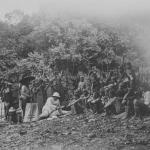
During the Emergency, Iban trackers were brought in from Sarawak by the British to be attached to units who were fighting the Communists.

Their primary task was not to fight but to track. Still, there was a strong element of danger in the job.

In April 1952, the British communist newspaper the Daily Worker published a photograph of British Royal Marines in a British military base in Malaya openly posing with decapitated human heads.

5 controversies surrounding the Malayan Emergency we're never told in history class

The Commonwealth forces instructed the Iban trackers to decapitate suspected MNLA members for identification purposes.

They also allegedly permitted the trackers to take the scalps of corpses to be kept as trophies.

Regardless of the reason, this act of decapitating the heads of the enemies were controversial and the controversy was even brought up in the British Cabinet.

Herbert Ekwe-Ekwe wrote in his book British Counterinsurgency, 1919-60, “On 2 May 1952 the First Lord of the Admiralty told the Cabinet that the decapitation had been performed solely for identification purposes after the bandit had been killed. While he agreed that taking the photograph was ‘reprehensible act’, he hastened to point out that the patrol involved had lost an officer and a well-loved corporal, and that the ‘indiscretion’ was the work of private soldiers.”

After the Cabinet had considered the matter for some time, they eventually agreed that British troops in Malaya ‘should be instructed to discontinue the practice’.

3.New Villages

In order to separate guerrillas from their supporters within the rural civilian populations, the British came up with a method.

The plan was to force these civilians to resettle in brand new areas far from the communists.

5 controversies surrounding the Malayan Emergency we're never told in history class
Photograph of a model new village, designed as part of the Briggs Plan to separate the largely Chinese Malaysian rural populace from communist guerrillas. Credit: Public Domain.

One of the biggest critics of this counterinsurgency method was British historian John Newsinger.

He wrote in the paper Hearts and minds: The myth and reality of British counterinsurgency,

“The key to British victory in Malaya was the so-called “Briggs Plan”. This was a counter-insurgency strategy proposed by the new director of operations, General Harold Briggs, that involved the forcible resettlement of Chinese squatters, living and farming in the jungle, into so-called new villages. The support of these communities was vital in sustaining the guerrilla units in the jungle. The British had tried intimidating them and now opted for something considerably more drastic.

“Between 1950 and 1952 some 400,000 people had their homes, possessions and crops destroyed before being herded into camps where they could be effectively policed. Here they lived under police state conditions, without civil liberties or freedom of movement. They were held behind barbed wire, overseen by guard towers and searchlights, their every move watched by informers and spies, and they were subjected to the arbitrary brutality of the police. Alongside the round up of the squatter population, the British also set about forcibly “concentrating” Chinese and Indian plantation workers and tin miners in policed camps under the control of their employers.

“By the end of the Emergency some 650,000 people, workers and their families, primarily Chinese, had been brought under police supervision and control. Something like half of Malaya’s Chinese population was forcibly resettled in this way. This was repression on a massive scale that had nothing whatsoever to do with any notion of “hearts and minds”. And, of course, the casual brutality and occasional murder continued.

“In 1953 a British officer wrote home to his parents that “no Chinese rubber tapper is safe when we search an estate, my men are trigger-happy with Chinese and several platoon commanders have had to plant grenades on tappers and call them bandits when their men have made ‘a small error in judgement’.”

“Alongside this resettlement policy, the British interned over 30,000 people without trial, a figure that would have been much higher except for the fact that they also deported large numbers of Chinese men and women suspected of Communist sympathies.

“By 1955 some 31,245 Chinese people, many of them born in Malaya, had been expelled from the colony.”

After Malaya was liberated from the British, these resettlement areas which were called ‘New Villages’ became ordinary residential towns and villages.

4.Beating, torturing and killing of civilians by British troops

British journalist and historian Brian Lapping in his paper End of Empire (1985) said that there was ‘some vicious conduct by the British forces, who routinely beat up Chinese squatters when they refused, or possibly were unable, to give information about the insurgents’.

Officially, there were 38 confirmed killings of civilians by British military forces during the emergency.

On top of that, there were 56 fatal shootings by British security that have been flagged as suspicious.

The justifications for these killings were that they were shot while attempting to flee or failing to stop when ordered to do so.

Instead of confirming these individuals were the ‘bandits’ or ‘insurgents’, the reports used the terms such as ‘Chinese’, ‘Indian’, ‘squatter’ or ‘suspect’.

The absence of evidence for these fatal shootings raised the question of whether war crimes were committed during the emergency.

5.The use of Agent Orange

During the Vietnam War, there was a US military operation called the Operation Ranch Hand.

It involved spraying an estimated 19 million gallons of defoliants and herbicides over rural areas of South Vietnam in an attempt to deprive Viet Cong of food and vegetation cover.

The use of these herbicides during the Vietnam War was controversial. However, the American government maintained the legality of using this method because the British did the same thing before.

Britain was the first nation in history to use herbicides and defoliants as a military weapon, and Malaya was the first region to be exposed to this method of warfare during the Malayan Emergency.

It was used to destroy bushes, food crops and trees to deprive the insurgents of both food and cover.

This mixture of the herbicides and defoliant were later nicknamed Agent Orange.

After the Vietnam War had ended, the Vietnam government claimed that there were up to four million people were exposed to the chemical and as many as three million people have suffered from the effect of it.

The health effects include various types of cancer such as chronic B-cell leukemia, multiple myeloma, prostate cancer, lung cancer and many more.

For Malaya, the estimated number of civilians and insurgents who were reported to have suffered from the effect of the defoliants is 10,000.

But many believed that the number is much larger. Unlike the US, the British has remained silent about how much of Agent Orange was used during the Malayan emergency making it difficult to confirm the real number of how many people have been affected by the chemical.

In fact, the prolonged absence of vegetation caused by defoliation has also resulted in major soil erosion to areas of Malaya.

10 things you should know about Dayak traditional weapon, mandau

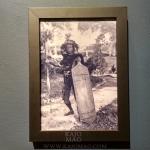
While the Japanese are known for the katana and the Korean for their geom, here in Borneo the Dayak are collectively known for their mandau.

The katana, geom and mandau are all traditional weapons once used to slay enemies.

The mandau for instance, was highly associated with the headhunting custom which was officially abolished in Sarawak during the Brooke administration (but saw something of a revival during World War 2 and even the Communist insurgency).

10 things you should know about Dayak traditional weapon, mandau
A mandau from Kutai, Indonesia. Part from Tropenmuseum. Photo credit: Creative Commons.

Here are 10 things you might not know about the Dayak traditional weapon, the mandau:

1.It is known by many names.

While the Iban, Bidayuh and Penan people call it parang ilang, the Kayan call it the malat.

This traditional weapon is called baieng by the Kenyah people, bandau by Lun Bawang or Pelepet by Lundayeh.

2.A mandau usually comes with a whittling knife.

A whittling knife or a pisau raut is a popular accompanying knife placed in the same sheath with the mandau.

While the mandau is used as a weapon, a whittling knife is used as a common crafting tool.

3.A Dayak man without a mandau was considered a ‘naked’ man.

Author Charles C. Miller in his book Black Borneo (1946) described how important the mandau was to a Dayak man back in the olden days.

“A Dayak would no more be caught without that formidable weapon attached to his person than a white man would be caught without his trousers. It was so essential that a man deprived of it in battle has been known to slink around the outskirts of the kampong like a pariah for weeks, not daring to be seen in public until he has secured another one to conceal his nakedness. Proud as the Dayaks are of their carved verandahs and doorways, their real craftmanship is lavished upon their mandaus.”

4.The beauty of a mandau perhaps lies in its hilt not in the blade.

Miller in the same book described the mandau as a ‘thirty-inch combination of battle axe, sword, cutlass and machete’.

He wrote, “The blade is about two feet long by three inches wide, whetted to razor-edge sharpness on one side, and nearly a quarter-inch thick on the other to give it weight. When they swing, they want it to mean something. A slight curve to the edge makes it especially effective in a cutting stroke, such as a blow aimed at the base of the neck.

“Though the blade is intricately engraved, the real soul of the instrument is in its handle, usually of ivory, though sometimes of ebony or horn. Dragons, human heads, reptiles and every conceivable form of Oriental symbolism are delicately carved thereon with such loving attention to detail that if it be an open-jawed dragon represented there you can see every feature of the mouth to the tonsils.”

5.They used to add their victims’ hair to the handle.

Explorer Carl Bock in his book The Headhunters of Borneo in 1881 wrote, “A thick rim of gutta-percha marks the point where the handle is fitted to the blade. Here are hung tassels of horse-hair, dyed various colours, or more often of human hair taken from victims.”

Meanwhile, Miller in his account also described similar thing about the origin of human hair on a mandau.

“Instead of the weapon being notched for every human life it has taken, a tuft of the victim’s hair is added to the handlle. A bald-headed mandau, no matter how handsome its carving, is still regarded by its owner as an inferior weapon until the sorry condition can be remedied. The chief I noticed, had more hair on his mandau than on his head.”

6.In the olden days, a man was not allowed to carry a mandau regularly unless he was married or had been on a headhunting expedition.

According to Bock in his book The Headhunters of Borneo, a man with a mandau is a sign of manhood.

“It is a rule among all the tribes that no youth can regularly wear a mandau, or be married, or associate with the opposite sex, till he has been on one or more headhunting expeditions. A mandau is presented to him, probably, at his birth, or when he receive a name; but not till he has washed it in the blood of an enemy can he presume to carry it as part of his everyday equipment.”

7.A mandau is equally useful in both battle and farming fields.

The mandau was, and still is, a common farming tool. It is perfect for clearing creepers as well as cutting paddy.

Thanks to its sharp and efficient blade design, it is also useful in bringing down large timber when clearing land for farming.

8.A mandau was a common form of gift and payment.

In this modern days, the last thing you thought of gifting someone as a birthday, Christmas or farewell present gift is a sword, right? You might want to give someone who loves to cook a chef’s knife but you wouldn’t think of a weapon as a present.

However during the olden days, the mandau was a common form of present.

Norwegian explorer Carl Bock was given a mandau as a farewell gift by Sultan of Kutai when he visited the region in 1878.

In the olden days before conventional medicine, the Kayan people turned to dayong or a priestess to cure them of illnesses.

Apart from money, the fee to pay the dayong for her service usually included a gong, a valuable bead (lukut) and a fine mandau (malat bukan).

A malat was and still is a common betrothal gift among the Kayan people during a traditional engagement ceremony.

9.A mandau or parang ilang used to be a ‘sought after’ item among tomb raiders.

Frederick Boyle (1841-1914) was an English author, journalist and orchid fancier. In 1863, he visited Sarawak with his brother and the result of this trip was a book ‘Adventures Among the Dyaks of Borneo’ (1865).

According to his travel account, Boyle bought himself a parang as a souvenir.

He stated,“The finest parangs – or those esteemed so – are found in the graves of Kayan warriors, which are consequently rifled by Dayaks and Malays on every possible occasion. I have one, purchased at Kanowit, which I was told had been obtained from a sepulchre three hundred years old – a rather improbable assertion, though I believe the weapon was really found in a Kayan grave, for it was strangely stained and rusted when I bought it.”

10.It was used during World War II.

According to some reports, “hundreds of Japanese soldiers’ heads were cut from their bodies with traditional weapons called mandau.”

This happened mainly in West and Central Kalimantan, Indonesia where Dayak people took part in guerrilla warfare against the Japanese occupation during World War II.

One of the highlights of this conflict was the Dayak Desa War or Majang Desa War.

The Dayak tribes from Ketapang to Sekadau initiated the mangkuk merah (red bowl) ritual as a symbol of hostility to the Japanese. This resulted in the town of Meliau falling under Dayak control from June 24, 1945. Many Japanese were killed and their heads taken.

Weeks later, Japanese forces managed to retake the town on July 17.

Even after the war had ended, the Dayak in the area continued to resist but this time the return of Dutch colonial authority.

Decades later on July 30, 1981, the Dayaks returned five skulls of Japanese soldiers to their families in Japan.

5 things to know about former Chief Secretary of Sarawak – Cyril Drummond Le Gros Clark

Cyril Drummond Le Gros Clark held the position as the Chief Secretary of Sarawak for barely seven months from May till December 1941.

But those seven months were a crucial part in Sarawak history.

On Mar 31, 1941, Le Gros Clark announced the decision of the third White Rajah Vyner Brooke, to introduce a democratic constitution.

Commenting on the Rajah’s move, Straits Budget on Apr 17, 1941 reported Le Gros Clark stating, “The Rajah took the opportunity of the Centenary of Sarawak to make public his decision, and the official Advisory Committee of His Highness received it with gratitude. The position of the Brooke family in Sarawak is one of extremely close personal contact with the people. Whatever is the position of the Rajah in the future, he remains in the eyes of the people as their Rajah.”

Here are five things to know about Cyril Drummond Le Gros Clark:

1.Le Gros Clark spent time on Gulangyu island to learn Hokkien language.

Le Gros Clark was born in 1894 and had started his career as a soldier. He joined the Sarawak Civil Service in 1925. According to Gustav Ecke and Edward Erkes in a 1947 obituary dedicated to him, Le Gros Clark went to Gulangyu Island and spent 1925 to 1927 to learn Hokkien language and culture.

Ecke and Erkes wrote, “Here on the shores of the Eastern Ocean, in the gorgeous mountain wilderness near the ancient port of Zayton, his imagination was captivated. He began to understand the life and atmosphere of the real China. The result was an intensive study of the country’s history and literature, which inspired him with the wish to do creative work as a scholar.”

2.Le Gros Clark was a translator of Su Shi from Chinese into English.

In 1928, he returned to Sarawak and was appointed Secretary for Chinese Affairs.

While working on his day job, Le Gros Clark managed to squeeze some times for his passion, researching and translating the works of Su Shi from Chinese into English.

At the end of 1931, he published his work ‘Selections from the Works Su Tung-Po’.

His hard work was paid off when he received great reviews for his book.

3.His last job was as the Officer Administering the Government in the absence of the rajah.

Right before the World War II, the last Rajah of Sarawak Vyner Brooke put out this proclamation on the Sarawak Government Gazette.

“Whereas we are about to leave the State on the 29th October, 1941:

Now therefore, know ye all men whom it may concern that we hereby appoint Cyril Drummond Le Gros Clark, Chief Secretary, to administer the Government of the State during our absence, and we enjoin that all respect and obedience be paid to the said Cyril Drummond Le Gros Clark in this position.”

When the war was about to hit the shore of Sarawak, it was suggested that Le Gros Clark withdraw with the Military Headquarters ‘as to facilitate the functioning of the Sarawak civil government elsewhere in Borneo’.

Le Gros Clark, however, was adamant that he should remain in Kuching.

He reportedly said during his later internment, “With these people of Sarawak, among whom I have spent, many years of my life, and in whose interests I have believe devoted my unselfish and loyal services, I have determined to remain and to share with them their sufferings during this period of trial.”

4.His final days as a civilian internee during WW2 at Batu Lintang Camp

After the Japanese had arrived In Kuching on Christmas Eve 1941, all the European officers were captured and eventually held in Batu Lintang Camp.

There, he served as the camp master.

Despite the poor condition and lack of basic necessities such as food and clothes, things were rather somehow uneventful at the camp.

Until, the issue of Chinese newspaper.

At first, the internees were permitted by their captors to receive the local Chinese newspapers. Those who could read Chinese translated them to those who didn’t understand.

Then in July 1943, the Japanese withdrew their permission but the internees continued to receive them illegally.

By October 1943, the Japanese became more strict and severe attitude towards their captives.

Naturally, some of the internees became fearful of the consequences that might fall upon them if they defied this order.

In his memoir Lawyer in the Wilderness (1980), Sarawak attorney general and judge Kenelm Hubert Digby claimed the whole situation had the internees divided.

He wrote, “We were promptly accused of cowardice by half-a-dozen members of the camp, who would not have been in personal danger themselves if the legality which they favoured had come to light.”

According to Digby, an American named Henry William Webber continued to arranged to receive the paper privately through the wire. His fellow internees reportedly asked him to desist but he refused to do so.

This is how Digby narrated on what happened next on the newspaper incident.

“In April 1944, the conspiracy was uncovered. The Chinese, who passed the paper to the British sergeant in charge of an outside working party, and the sergeant himself were caught. Having been very badly knocked about, the latter gave the names of his “contacts” in the civilian camp. In the result Le Gros Clark, who, as Camp Master, was deemed to have primary responsibility; Cho, the Chinese consul at Sandakan before the occupation who translated the Chinese part of the paper; Abbott, a North Borneo administrative officer , who translated the Malay part of the paper; Hill, another North Borneo administrative officer, who, in his capacity as secretary of the General Committee, had had the job of reading out the translations in the huts; Macdonald, a Sarawak planter; Stokes, a North Borneo doctor; and the American, Webber, were all arrested in June.”

5.Remembering Cyril Drummond Le Gros Clark

Some reports stated that the group was arrested in May. Regardless, Le Gros Clark and the rest of them first sentenced to prison in Kuching and later in Batu Tiga in Jesselton (now Kota Kinabalu).

In January 1945, the Japanese moved their prisoners to Beaufort and on April 12, 1945, they moved them to Keningau.

Since then, nobody knew the fates of these prisoners at first. As none of them were seen alive after the war had ended, the British government started inquiries to locate them.

Then in October 1945, the group of investigators led by former resident of the Sabah West Coast Division Richard Evans found the graves of Le Gros Clark and others at an airfield used by the Japanese.

As it turned out, Le Gros Clark, Cho Huan Lai, Valentine A. Stokes, Henry William Webber and Donald Macdonald were all executed on July 6, 1945, two months before the Japanese had surrendered.

All of their remains were later reburied at the old Anglican Cemetery of Jesselton.

Today, a monument is erected near the former airfield where Le Gros Clark and others been executed.

KajoPicks: 6 K-dramas written by Korean screenwriter Kim Soon-ok to watch

If you have been watching Korean dramas long enough, you might be familiar with the names of the screenwriters who were behind your favourite dramas such as the Hong Sisters and Kim Eun-sook.

Some you might not be familiar with Kim Soon-ok but she is the brain behind the popular drama The Penthouse.

As every screenwriter has his or her own distinct style, Soon-ok’s works are known for extreme ‘ridiculousness’ that viewers cannot stop themselves from watching.

Basically when you watch her drama, you cannot help but think, “This story is so unreal but I still want to know what happens in the end.”

Hence there is no surprise that her dramas are harshly criticized while also widely-viewed and highly-rated.

Here are six K-dramas written by Korean screenwriter Kim Soon-ok to watch:

1.Temptation of Wife (2008)

In this revenge drama, Goo Eun-jae (Jang Seo-hee) was a woman who was nearly killed by her husband Jung Kyo-bin (Byeon Woo-min).

Her husband truly believes that she had died until a woman named Min So-hee who looks identical to his dead wife but with a completely different personality shows up.

Here comes the ridiculous part; the only physical difference between Eun-jae and So-hee is a mole on her left cheek.

Just because of this mole, nobody recognises Eun-jae anymore.

Putting aside the many controversial issues surrounding the plot, it became one of the most viewed dramas.

On top of that, the series has been adapted into China, Malaysia and Filipino versions.

2.Jang Bo-ri is Here! (2014)

As a child, Jang Bo-ri (Oh Yeon-seo) was adopted by a family without much money.

She then learns that she is the missing daughter from a wealthy family.

Bo-ri goes through a drastic change in her life and tries to become a successful designer of traditional Korean dresses.

The drama became highly-acclaimed and won Drama of the Year at the 2014 MBC Drama Awards.

3.My Daughter, Geum Sa-wol (2015)

The Korean public dubbed it an ‘absurdly unrealistic drama that rated well’ while The Korea Times called it a drama that been ‘drawing flak for an unrealistic plot, complicated relations among characters and scenes with certain dramatic settings that seemed far-fetched’.

The plot tells the story of three friends Sa-wol, Hye-sang and Oh-wol who grew up in the same orphanage.

Hye-sang finds out that Sa-wol is to be adopted by her wealthy biological father instead of her after a DNA test that reveals the mix up between them.

Wanting to be raised in the upper class society, Hye-sang traps the orphanage director, who is also her true father, to hide the truth.

However, when Sa-wol ends up being brought into the family as well, Hye-sang starts tormenting, blame shifting and burying the truth, to make herself the better daughter. 

Let us warn you that the series is 51-episodes long, so you can expect plenty of twists and an emotional roller coaster ride.

4.Five Fingers (2012)

The drama starts when Yoo Ji-ho and Yoo In-ha were kids. When Ji-ho suddenly loses her grandmother after being run over by a mysterious black car, he is adopted into the rich family of In-ha.

Life at his new family is not easy for Ji-ho as his adopted father begins to favour him causing the jealousy and outrage of his adopted father.

His own best friend who becomes his adopted brother also starts to feel threatened by him.

Overall, the story is about the two of them who became rivals not only in their careers but also in their love lives.

Through this drama, it is the first time we see actor Ji Chang-wook in an antagonist role and Ju Ji-hoon’s first TV role after his drug scandal in 2009.

5.The Last Empress

The Last Empress is set in an alternate universe, in which Korea is a constitutional monarchy in 2018.

Oh Sunny (Jang Na-ra) is a bright and vivacious musical actress who marries the Emperor of the Korean Empire, Lee Hyuk (Shin Sung-rok).

She becomes involved in the palace power struggle and a mysterious murder that sets off events that threaten the monarchy itself, while searching for true love and happiness.

She teams up with Na Wang-shik (Choi Jin-hyuk) who works as a bodyguard for the imperial family in order to uncover the crimes of the Imperial family.

Most people do not know that Na actually started working in the palace to take revenge on the person responsible for his mother’s death.

In the midst of the political drama, Oh starts to fall for her bodyguard Na.

Overall, the series received high ratings and Jang in particular was praised for her performance.

6.The Penthouse: War in Life (2020-2021)

Speaking of ridiculousness, nothing beats The Penthouse: War in Life. This drama led the Korean public to give Kim Soon-ok various nicknames such as ‘Anything is possible with Kim Soon-ok’ and ‘Kim Soon-ok’s mythology’.

This is because dead characters kept on coming back alive throughout three seasons of the drama.

Even the scriptwriter herself admitted in an interview that The Penthouse lacks a sense of reality.

Despite that, the drama to this day is one of the most viewed Korean series of all times.

It follows the story of wealthy families living in Hera Palace and their children at Cheong-ah Arts School.

All of the parents have grand ambitions for their children and would do anything for them.

For those who are planning to watch this drama, we highly advise you to just through your common sense out of the window.

Let just say that this is the 90s telenovela equivalent of Korean dramas.

KajoPicks: 12 K-dramas and movies starring Kim Rae-won you should watch

Known for his deep, baritone voice, Kim Rae-won is one of the most memorable South Korean actors out there.

It is not just his unique voice that sets him apart from most of the other actors, it is his appearance as well.

Perhaps because of his masculine facial features and slightly darker skin tone, Kim usually finds himself taking roles as both opposite sides of the law; a policeman or a criminal.

To top his voice and look, Kim also has the talent and passion for acting to make him a well-rounded performer and one of South Korea’s most sought after actors.

Honestly, it was hard to choose our favourite dramas and movies starring Kim Rae-won since he has so many impressive works under his belt.

But somebody had to make the hard decision, so here are 12 K-dramas and movies you should watch if you are a fan of Kim Rae-won:

1.My Little Bride (2004)

This film is a Korean remake of the 2002 Hong Kong movie My Wife is 18 starring Charlene Choi and Ekin Cheng.

Here, Kim plays the role of a male college student Sang-min who has an arranged marriage between a female high school student Bo-eun (Moon Geun-young).

Both of them are forced to get married due to their grandfathers’ arrangement during the Korean War.

After they got married, they decide to hide their marriage. Things get complicated when Bo-eun pretends to be single and starts to date.

And the whole situation escalates even more when Sang-min becomes an art teacher at Bo-eun’s school.

The movie became a sleeper hit and was the second top-crossing Korean film of 2004.

2.Love Story in Harvard (2004)

If My Little Bride was the film that made us to take notice of Kim Rae-won, the drama of his that really caught our attention was none other than Love Story in Harvard (2004).

In this romantic drama, Kim teams up with future female star of K-dramas Kim Tae-hee.

They both play the roles of Harvard students who find love while studying abroad.

Their career choices lead them to different parts of the world after graduation.

Years pass and the former lovers find each other again in Seoul but this time will they let each other go?

The release of the drama brought a lot of popularity to both of the main leads but specifically to Kim Tae-hee who saw an increase amount of advertisement deals after the series.

3.Sunflower (2006)

In this film, Kim takes up the role of a former gangster named Oh Tae-sik.

After being released from prison, Tae-sik heads back to his hometown to start a new life.

He starts a new job at a garage and in the same time tries his best to leave his criminal past behind.

It has not been easy especially because most of the people still live in fear of his past brutal reputation.

But his past eventually catches up on him when a local politician tries to demolish his adoptive mom’s restaurant in order to build a new mall.

Overall, the movie was a hit when it came out. Kim on the other hand was impressive with his acting in the film especially near the ending.

4.A Thousand Days’ Promises (2011)

What we love about Kim is that he always tries to challenge himself in different types of roles as long as there is any opportunity rises for him.

For this melodrama, he plays the role of a doting husband who never gives up on his wife who is struggling with early on-set Alzheimer’s.

Park Ji-hyung (Kim Rae-won) works as an architect. Despite having a fiancee, he has a secret affair with Lee Seo-yeon (Soo Ae).

Seo-yeon breaks up with him after being diagnosed with early on-set Alzheimer’s.

After finding out the reason of the break up, Ji-hyung dumps his fiancée two days before the wedding to be with Seo-yeon.

Despite the fierce opposition from his parents and Seo-yeon herself, Ji-hyung insists to marry Seo-yeon.

Seo-yeon eventually agrees and the couple begins their marriage life together with hardship.

Even when Seo-yeon’s memories starting to fail her, Ji-hyung’s love for her never falters.

A Thousand Days’ Promises is a great drama to watch when you are feeling lovey dovey with your partner.

5.Punch (2014)

When Park Jung-hwan (Kim Rae-won) is told that he only has six months left to live, it makes him to reexamine his life choices.

As the chief of the anti-corruption investigation team for the Supreme Prosecutor’s Office, he had made a lot of decisions that he is not proud of.

Since he is nearing to his death, Jung-hwan decides to pursue justice regardless of its price.

His main goal is to bring down his own boss Prosecutor General Lee Tae-joon, whose friendly public face masks his corruption.

Kim was nominated for the Top Excellence Award at the APAN Star Awards as well as Best Actor in Television at the Baeksang Arts Awards for his role in this drama.

6.Gangnam Blues (2015)

Kim returns to Set in the 1970s during the height of political corruption in South Korea, this action film stars Kim Rae-won and Lee Min-ho.

Kim returns to play a role he is familiar with; being a gangster.

Childhood friends, Jong-dae (Lee Min-ho) and Yong-ki (Kim Rae-won) struggle to get by, until their shanty homes are demolished by local thugs.

Desperate for cash, they get involved in violent political clashes, and are separated during one of the skirmishes.

Three years later, Jong-dae lives as an adopted son of a former gang leader, Gil-soo (Jung Jin-young) and unknown to him, as a small-time gangster.

Meanwhile, Yong-ki has risen as a made man inside Seoul’s most powerful criminal organization.

To play this role, Kim was asked to shed 15 kilograms for his character, which he did in less than a month.

7.The Doctors (2016)

Kim switches his usual police and prison uniforms for some scrubs in this medical drama.

He plays the role of Hong Ji-hong, a doctor who needs to step back in his career and become a biology teacher.

As a teacher, he plays an ‘extra’ attention to a rebellious student named Yoo Hye-jung (Park Shin-hye).

Both are caught in some dramas and eventually separated.

But 13 years later, the teacher-student pair is now reunited as colleagues as both are now surgeons working in a private hospital.

When it was aired, the drama was a hit which lead to Kim experiencing a surge in his popularity and commercial offers.

8.Prison (2017)

In this movie, Kim takes up the challenge playing someone is from both sides of the law.

He plays the role of a former detective Song Yoo-gun who got sentenced in prison for hit-and-run, destruction of evidence and bribery.

In the prison, he catches the attention of Ik-ho (Han Suk-kyu) who is known as “The King’.

Ik-ho wields his power truly like a king from the prison up to a point that the prisoners can leave the prison at nights to commit the perfect crimes.

The film was a surprise hit and Kim received critical acclaim for his realistic execution of action scenes.

9.Black Knight: The Man Who Guards Me (2017)

If you want to see Kim rocking a historical costume, this is his drama for you.

He plays two different role in this series from two different time period.

First is Lee Myung-so, an aristocrat who falls deeply in love with his housemaid/concubine and the 21st century Moon Soo-ho, a young CEO who is still in love with his first crush.

What Soo-ho does not know is that he is the reincarnation of Lee Myung-so. Since Myung-so did not get to live happily ever after with the love of his life, Soo-ho determines that he would.

It is a romantic drama with a dose of fantasy. While the series did not gathered mainstream success like Kim’s previous works, we still enjoy the overall drama.

10.Long Live The King (2019)

Kim is familiar playing the role of a gangster but this time he is playing a mobster in love.

Mob boss Jang Se-chool (Kim Rae-won) meets lawyer Kang So-hyun at an anti-construction protest and quickly falls in love.

Unfortunately, she thinks of him as a thug. She repeatedly rejects him while telling him to live a decent life.

So-hyun eventually tries to get rid of Se-chool by saying that she can never accept him because her life goal is to become a first lady.

Meanwhile, one of Se-chool’s friends is on death row, and the only way to save him is through a presidential pardon.

When Se-chool ends up rescuing passengers after a bus accident at Mokpo Bridge, he is praised as a hero; he decides to use his newfound fame to run for public office, believing that success will lead him to win So-hyun’s heart and save his friend.

Critics has praised Kim’s performance in this movie as ‘one of his finest works’.

11.L.U.C.A: The Beginning (2021)

After dipping his toes in fantasy drama, Kim challenges himself once again in a science fiction genre.

Ji Oh (Kim Rae-won) is a man with special power and unearthly fighting skill. The only problem is, he has no memory of himself, how he got his power and why he is being pursued by a mysterious group of people.

In search of his memory and looking into those who pursued him, he comes across a mysterious group of scientists at an institution named Human Tech and a secretive biotech project code-named L.U.C.A.

Through his adventure, Ji Oh gains himself one ally Ha Neul-ae-goo-reum (Lee Dae-hee). She is a police detective who has a secret past of her own.

12.The First Responders (2022)

KajoPicks: 12 K-dramas and movies starring Kim Rae-won you should watch
Kim Rae-won going undercover as a prisoner in The First Responder (2022)

Here is another cliche role from Kim Rae-won; acting as a police detective.

The drama circles around the cases that takes place at Taewon Police Station and Taewon Fire Station.

Both buildings happened to be located next to each other and even handle most cases together.

Kim in this criminal procedural drama is Jin Ho-gae, a police detective team inspector in Taewon who was recently transferred from Regional Investigation Unit.

He starts to make friends with firefighter Bong Do-jin (Son Ho-jun) and paramedic Song Seol (Gong Seung-yeon).

Jin Ho-gae has tremulous relationship with his father Jin Cheol-jung (Jo Seung-yeon) who is the prosecutor of the Eastern District Attorney’s Office.

His father never wanted Ho-gae to be a policeman as he wanted him to follow his footsteps to read law.

Ho-gae on the other hand, resents his father who maintains dubious relationships with those who are corrupted especially among the rich and politicians.

The series marks Kim’s first terrestrial television in six years since 2016. His return to the small screen is definitely worth it as he bagged the Top Excellence Award for an Actor in a Miniseries Genre/Fantasy Drama at the SBS Drama Awards 2022.

Taboos followed by the Iban women when their men went to war during the olden days

While Kayan women had their forbidden things to do when their husbands left for headhunting trips, Iban women also had a list of their own taboos when their men were out for war.

John Hewitt who was the Curator of the Sarawak Museum from 1905 to 1908, published the paper ‘Taboo customs of the warpath amongst the Sea Dayaks of Sarawak’ in the Journal of the Straits Branch of the Royal Asiatic Society in March 1909.

In the paper, Hewitt discussed some of the taboos observed by Iban (Sea Dayak) women when their husbands were sent to a punitive expedition against some border tribes.

These men were part of the Sarawak Rangers and mainly came from villages around the Batang Lupar area.

Here are some taboos that must be followed by Iban women when their husbands were sent to war:

1.The Iban women must wake up early in the morning and at the streak of dawn all windows must be opened, for fear that their husbands would oversleep and be caught by the enemy. With the window opened early to bring light into the room, so would be bright when the men commence their march.

2. Wives were not allowed to take a nap during the day or else their husbands would be drowsy when walking.

3.It is forbidden (pemali) for the women to oil their hair as it was feared that their husbands would slip while walking along a batang (tree trunks) path.

4.Hewitt stated, “Every morning they must scatter popcorns (made of rice) on the verandah: and just as the elastic popcorns bounds and rebounds on the hard floor so will the men be agile in their movement. At the same time the women sing a verse-

‘Oh kamba, enti tinggi surok,
Enti baroh, perjok,
Munsoh suroh genong
Awak ka baka ditanggong, baka sangkutong’

This can be translated to “Oh you absent ones dodge under the high obstacles and leap over the low ones. Petrify the enemy and keep off the hands raised against you”.

5. It was pemali (forbidden) to bathe in the usual way with the petticoat on because the garment would become wet and heavy so it was believed that their husbands would also feel heavy in body and unable to move rapidly.

6. Homes must be kept very tidy, all boxes being placed near the walls, for should anyone stumble in the house so may the men fall when walking and thus be at the mercy of the enemy.

7. During eating, they must eat their food only at meal times and must be sitting down properly. Otherwise, the men will be tempted ‘to chew leaves or earth on the march’.

8. At each meal, a little rice must be left in the pot and must be put aside. This is to ensure that the men shall have plenty to eat and never go hungry.

Taboos followed by the Iban women when their men went to war during the olden days
A woman is not allowed to sit so long that she might have the cramp of her husband will surely become stiff and unable to rise up quickly after resting or to run away. Image is under Creative Commons.

9.Hewitt also listed, “On no account may a woman sit so long at the loom as to have the cramp’ or the men will surely become stiff and be unable to rise up quickly after resting or to run away. Accordingly the women intersperse their weaving operations by frequent walks up and down the veranda.”

10. It is forbidden to cover up the face with a blanket or the men will not be able to find their way through tall grass or jungle.

11.When it comes to sewing, the women must not sew with a needle or the men will thread upon ‘tukak’ (sharpened spikes of bamboo placed point upwards in the ground by the enemy).

12.The women are not allowed to wear flowers or scent, otherwise the movements of the men will be revealed to the enemy by their smell.

13.It is bad luck to break the ‘kain apit’ (the piece of leather or bark of tree with which the women support their backs when weaving); should this occur the men will be caught be the chin on some overhanging bough during their expedition.

14.Lastly, the women are not allowed to be unfaithful or commit adultery during the absence of their husbands or he will lose his life in the hands of his enemy.

In the same paper, Hewitt further explained some of taboos and customs that must be observed by the men during the war trip. These include:

1.The men must not cover up the rice when cooking, or their vision will become obscured and the way difficult to see.

2.The spoon must not be left standing up in the rice pot, otherwise the enemy will so leave a spear sticking in their bodies.

3.During cooking time should the pots be a distance apart from each other they must be connected by sticks; so will the men have neighbours near at hand should they be surprised by the enemy. It is thus customary to put the pots very close together.

4.It is pemali to pick out the bits of husk from the rice when feeding lest the enemy in like manner pick out that man from a group.

5.As the rice is taken from the pot, the cavity thus left in the food must be immediately smoothed over; otherwise wounds will not heal quickly.

6.It is unlucky to sleep with legs crossed or touching those of a neighbour lest the spears of the enemy smite the unfortunate offender of this taboo.

KajoPicks: 5 most epic Bollywood movies of all times that you must watch

When we talk about the most epic Bollywood movies, we are talking about something that is larger than life and beyond your wildest imagination.

Imagine having hundreds of elephants and well-trained martial artists as the extras of these movies with custom-made sets that cannot be seen anywhere else.

As you watch these movies, one cannot help but be inspired about the amount of work and dedication put into every scene.

Here are our choices for the most epic Bollywood movies of all times that you must watch:

1.Asoka (2001)

There are plenty reasons to call Shah Rukh Khan the King of Bollywood. First and foremost, the characters that he portrays in films are usually larger than life.

Take Asoka (2001) as an example in which he played the role of Emperor Asoka.

Also known as Ashoka the Great, he was the third emperor of the Maurya Empire of Indian subcontinent during 268 to 232 BCE.

The plot is the dramatized version of the early life of the emperor.

Do you want to know how epic the movie is? The final battle scene featured over 6,000 extras and hundreds of elephants.

Moreover, the actors portraying warriors in the film were masters of Kalari who used real weapons during the filming.

The film was selected for screening at the Venice Film Festival and the Toronto International Film Festival where it received positive reviews.

2.Devdas (2002)

If you have watched this movie, you won’t forget that it has the most iconic running scene in Bollywood history.

It is when Parvati (Ashwarya Rai) runs out of her mansion home, knocking things with her white saree flowing behind her just to get to her lover Devdas (Shah Rukh Khan).

This Bollywood movie is iconic for many reasons. When it was released in 2002, it was the most expensive Indian film ever at made with a budget of USD 10.29 million.

Moreover, the brothel in the film was one of the most expensive sets ever built in history of Hindi cinema with USD2.47 million spent.

The film tells the story of Devdas Mukherjee (Khan), a law graduate who returns from London to marry his childhood fried Parvati or Paro (Rai).

Like a classic Romeo and Julliet story, the two lovers’ relationship is opposed by both families.

Paro subsequently is forced to marry against her own will to a widower with three grown children.

This causes Devdas to turn to alcohol and him seeking refuge at a brothel with the comfort of courtesan Chandramukhi (Madhuri Dixit).

Based on the 1917 novel of the same name by Sarat Chandra Chattopadhyay, the filmmakers went all out researching on Calcuttan building design from the period of the British Raj.

The extensive research definitely paid off as Devdas (2002) is without a doubt has one of the most impressive sets and breathtaking cinematography in Bollywood history.

3.Jodhaa Akbar (2008)

Set in the 16th century, Jodhaa Akbar (2008) narrates the life and romance between the Muslim Emperor Akbar of Mughal Empire and a Hindu Princess Jodhaa Bai of Amber.

The movie plot is a partly fictionalized account of a political marriage between the emperor and the princess.

Emperor Akbar is played by Hrithik Roshan while Ashawarya Rai takes the role as Princess Jodhaa.

In real life, Jodhaa was Akbar’s fourth and favourite wife and she was the only wife buried near to him.

Famous costume designer Neeta Lulla took up the challenge to design the film’s costumes and she was the same designer for Devdas (2002).

It took her a year and a half to research the type of clothes people wore as well as the types of fabric used during the Mughal Empire.

Apart from the costumes, the shooting locations were equally impressive.

Fans would be delighted to know that some of the filming locations are historical places that have now turned into tourist attractions.

These places include Roopangarh Fort, Agra Fort and Amber Fort.

4.Padmaavat (2018)

This Indian historical drama film is based on the epic poem from 1540 of the same name by Sufi poet Malik Muhammad Jayasi.

It tells the story of Padmavati (Deepika Padukone), a 13th-14th century queen or Rani of the Mewar kingdom in present-day India.

She was an exceptionally beautiful princess of the Sinhalese Kingdom (present-day Sri Lanka). The news of her beauty even spread out to nearby kingdoms.

Ratan Singh (Shahid Kapoor), the Rajput ruler of the kingdom of Mewar eventually heard about her beauty from a talking parrot. After some adventurous quest, he won her hand in marriage and brought her back to his kingdom to be his queen.

Ratan was not the only one who heard of Padmavati’s beauty.

Alauddin Khalji (Ranveer Singh) who ruled the Delhi Sultanate was also determined to have Padmavati as his wife.

According to Padmaavat the original poem, Alaudddin laid siege on Ratan’s kingdom motivated by jhis desire for Padmavati.

There are so many things to rave about this Bollywood film. First of all, let us start with the costumes.

The costumes are simply unbelievable especially the attention to every detail. Deepika’s costumes as the queen for instance are everything you imagined how a Rajasthani queen should be.

You can tell that great amount of research was put into every costume.

The most epic part of the film is of course the war battle scene. It is on a par with Hollywood movies such as 300 (2006).

With the budget of USD27 million, it is the most expensive Hindi film and one of the most expensive Indian films ever made.

After watching how the film turned out, it is safe to say that the filmmakers made full use every single cent of the budget.

5.Bajirao Mastani (2015)

Going through the list now, you must have an idea that most epic Bollywood movies are based on historical love stories that transcend through times.

Hence, here is another epic historical romance that surely will impress you.

It circles around the story of Maratha Peshwa Bajirao (1700-1740 AD) and his second wife Mastani.

Although their marriage was a political one, the couple eventually fell in love with each other.

For the director Sanjay Leela Bhansali, the film was like a dream came true. He conceived the idea for the film as early as the 1990s and even went ahead to announce it in 2003.

Bhansali had intended to make Bajirao Mastani after the release of his film Devdas (2002).

The production, however, delayed several times due to several factors.

The cast members feature Ranveer Singh as Bajirao, Deepika Padukone as Mastani and Priyanka Chopra as Kashibai, Bajirao’s first wife.

One of our favourite scenes in the film is the song ‘Pinga’. Padukone and Chopra performed the song along with their background dancers.

It is interesting to know that the less than 5-minute scene took weeks to film.

Bhansali insisted to have lit diyas (oil lamp) and torches in the background. This should not been a problem if the scene was not shot at night on an open-air set with many of the diyas would snuff out while filming.

When it was suggested that the snuffed diyas should be corrected in post production, Bhansali was not having it. The solution? At least a dozen of crew would run around the set to relight the snuffed diyas.

The results of their hard work is one of the unforgettable and beautiful dance scenes in Bollywood films.

KajoPicks: 10 Housewife vloggers you might want to follow on YouTube

20 years ago, you would never imagine a common housewife could have millions of followers online by just sharing what she did in her daily life like cooking and cleaning.

But that is the reality we live in today. People on the net are actually interested in watching a stranger doing something that our mothers or grandmothers did on a daily basis.

These housewife vloggers sometimes even scored impressive brand deals while making content at home.

There have been some debates online for examples on Reddit about the safety of producing family vlogs.

Questions are raised especially when parents are sharing too much online about their children with almost no regards for their privacy. For instances showing their children’s names, ages and faces as well as their bedrooms.

What makes these housewife vloggers on this list different from other typical family vlogs is that the focus are on them and their lives as homemakers.

Some of their children are not even in these vlogs and even if they did, their faces are never shown.

With the amount of times that they spent daily running their households, these amazing women naturally have many cooking and cleaning tips as well as recipes to share.

Here are 10 housewife vloggers you might want to follow on Youtube:

1.Roha

Roha is one of many South Korean housewife vloggers who has been sharing their lives online.

Her journey on YouTube started before she was pregnant with her first child. Now her daughter has grown into a toddler.

While it is fun watching her spending her daily life cooking and visiting cute cafes for her 609,000 subscribers, there is one video of hers that is definitely worth watching even if you are not a housewife.

It is a tutorial video on how to care and store your fresh ingredients in the kitchen.

Check out her channel here.

2.Haegreendal

With more than 2.2 million subscribers, Haegreendal sure proved that you can make it big online even while staying at home.

All of her videos were nicely recorded with pretty props and aesthetic vibes.

Unfortunately, her most recently uploaded video was back in February 2022.

Regardless, her old contents especially her recipes are still relevant to this day.

Check out her channel here.

3.Hamimommy

Hamimommy is a housewife in her mid-30s living in Seoul. She is currently taking a leave of absence from work to take care of her child.

During this break of hers, she is producing one of the best homemaking Youtube channels.

She started her channel in August 2019 and since then she has gathered at least 2.26 million subscribers on Youtube.

Her most popular video is a vlog of her daily cleaning routine which has more than 11 million views.

While her cleaning vlogs are so thearaputic to watch and might inspire to do your own cleaning, we also love her cooking meals for her family.

Check out her channel here.

4.Heymayday

Scrolling through heymayday’s channel and looking at her video titles, viewers can see that she is excited to share her life as a Korean housewife.

From showing her daily life as a Korean housewife, her winter life as a Korean housewife to a Korean housewife’s night routine, we can watch them all on her channel.

However, our favourite ones are videos of her sharing her favourite items that she uses at her home.

While we might not bother to buy them for our own homes such an auto sensor trash can from Xiaomi, still we enjoy watching strangers online using fancy stuffs at their homes.

Check out her channel here.

5.Tthne

A housewife that has a passion for crochet is not something rare.

This Youtuber shares not only her daily works as a homemaker but also her hobby crocheting.

Some of her crochet works include bag, indoor shoes and artificial flowers.

Overall, her vlog channel is about living a simple, relatable life as a housewife.

Check out her channel here.

6.Honeyjubu

With an impressive audience of 2.09 million subscribers on Youtube to date, Honeyjubu has been making content since December 2019.

Behind the camera lens, she is a simple housewife living in Seoul with her husband, two children and a cute puppy named Lucy.

Apart from sharing her daily life that usually starts from 5 in the morning, she also shares some homemaking tips to her viewers.

These tips include on how to store bulk ingredients and how to cut down on disposables.

Check out her channel here.

7.Housewife Story

Admit it; there is at least on homemaker that you personally know who is obsessed with cleaning.

This South Korean vlogger is definitely one of them.

Looking at the way she cleans, we bet there is no dust at every nook and cranny of her home.

If you are like her who finds pleasure and satisfaction in cleaning, do check out her channel.

Or if you need some inspiration to tidy, watching her clean on Youtube might inspire you.

Check out her channel here.

8.Heo-ssam

Speaking of cleanliness, are you the type that love to clean everything up to the point that you microwave your toothbrush?

This is one of many housekeeping tips shared by this housewife vloggers.

How about those icky stains on your grouts? Heo-ssam suggested in one of her videos to rub candle back and forth along the grouts after cleaning them. This will keep the grouts clean for a long time.

Check out her channel here.

9.SisLetter

What makes this channel different from the rest on the list is because it features two housewife vloggers.

The content of SisLetter is produced by two sisters Yohee and Joy who live on the opposite coasts of the United States.

Yohee who lives on the west coast is the older sister while Joy the younger sister lives on the east coast.

They both shares their daily lives of cooking and cleaning while raising their kids.

Check out their channel here.

10.Leni Mizzle

From South Korea, we are moving to Indonesia for our next homemaker Youtube channel.

Lenni Mizzle is a mother of two who shares her life online that circles around being a mom, homemaking and succulents.

Besides the usual contents of cooking and cleaning her house, she also shares some tips on planting succulents.

Check out their channel here.

KajoPicks: 10 Chinese transmigration dramas you need to watch

If you are a fan of Chinese webnovels, you must be familiar with the transmigration genre.

This is when the main character finds himself/herself transported into a fictional world such as a book, drama, game and so on.

It also covers stories in which the protagonist inhabits an existing person’s body across different time periods.

Perhaps the most famous Korean drama which carries a transmigration type of plot is Moon Lovers: Scarlet Heart Ryeo.

In the drama, Go Ha-jin (Lee Ji-eun) from the 21st century finds herself in the body of Hae Soo in the year 941.

As for C-dramas, here are KajoMag’s choices of 10 Chinese transmigration dramas you need to watch:

1.The Eternal Love (2017)

As if being transmigrated into another person’s body was not complicated enough, in this story the main character’s body switches back and forth between two souls.

Set in the ancient China, Qu Tan Er (Liang Jie) is the second daughter of the Qu family.

She is in love with the king’s oldest son, Mo Yi Huai (Wang Rui Chang).

Unfortunately, she is being forced to marry, Yi Huai’s younger brother, Mo Lian Cheng (Xing Zhao Lin), the eighth prince of the Dong Yue Kingdom.

Unhappy with the forced marriage, Tan Er tries to commit suicide, only to wake up from her failed attempt with the spirit of another woman also taking up residence in her body.

The modern Xiao Tan (also played by Liang Jie) has the opposite personality of Tan Er, cheerful and assertively strong.

She is stuck in the past world and has so far been unsuccessful in her attempts to find a way back to the modern time.

Whenever one of the women tells a lie, the other personality takes over the body.

To complicate the situation, Lian Chen falls in love with the vivacious Xiao Tan.

The drama is an adaptation of Fan Lai’s popular novel ‘Laugh Favourite Concubine: Sir, I Wait for You to Divorce Me’.

Yes, it is quite a mouthful for a title of a novel. It is no surprise in the drama adaptation is simply called ‘The Eternal Love’.

2.Cinderella Chef (2018)

This drama follows the story of Ye Jia Yao (Zhong Dan Ni) is a chef who runs a mobile diner in the modern day.

One day, a dejected young man comes in one day and asks her to cook his last meal.

Apparently, he plans to take his life that night. As it turns out, the man is devastated that his professor has stolen all of his data for a time machine that he built.

The man then brings Jia Yao to his lab to show her his time machine. An incident happens in the lab and Jia Yao is catapulted back to ancient times.

There, Jia Yao finds herself in the body of Ye Jin Xuan who is the daughter of a magistrate.

The moment she wakes up, she is suddenly kidnapped to Hei Fang Camp where she meets the leader of the bandits Xia Chun Yu.

He is the former master of the Jing An Marquis manor. One thing leads to another, the two get engaged in a fake marriage.

Like many fake marriages in the drama world, both of them starts to fall for each other.

3.Princess at Large (2018)

This Chinese transmigration drama follows the story of Ji Xian Yun (Yang An Qi) who is preparing for her career as a doctor.

However one day, she is transported back to the ancient times and finds herself in the body of a powerful minister’s daughter at the Imperial Court.

The moment she is transmigrated, the minister’s daughter has just survived a suicide attempt.

Her parents are forcing her to marry the Emperor’s favourite son, Prince Ming or Qi Ling Xiao (Sheng Ying Hao).

Despite being the favourite son, Prince Ming is suffering from mysterious illness.

As Ji Xian Yun is looking her way to return to the modern times, the minister’s family is pushing the marriage ahead.

After being forced to go through the wedding, Ji strikes a deal with Prince Ming. If she can cure him from his mysterious sickness, the prince will divorce her.

Being transmigrated from the modern era, Ji is definitely not a weak princess in this drama and that makes the whole series fun to watch.

4.Joy of Life (2019)

Based on the webnovel Qing Yu Nian by Mao Ni, Joy of Life (2019) follows the story of Fan Xian (Zhang Ruo Yun).

He is born in the ancient empire of Southern Qing with memories of the 21st century.

He lives in a rural town as the illegitimate son of the Minister of Finance, raised by his grandmother.

His mother, Ye Qing Mei, was once a celebrated inventor and the founder of the Overwatch Department, the country’s spy network but was killed shortly after her son was born.

Fan Xian has since been protected by a blind martial arts expert, Wu Zhu, his mother’s bodyguard.

He learned martial arts and the art of poison as a child, also assisted by his knowledge from the 21st century.

After an assassination attempt, he decides to venture into the capital to find out more about his mysterious mother and why anyone would want to kill him, as he perceives himself to be an unimportant person.

He also wants to know why he has memories of a sharply different era. In the capital, he accidentally meets Lin Wan Er (Li Qin) the sickly illegitimate daughter of Princess Royal, and falls in love with her.

Unbeknownst to him, she is the woman the emperor chose for him to marry so that he would be the new overseer of the Royal Treasury, an institute Fan Xian’s mother established in the palace and currently handled by Princess Royal.

In the capital, however, he gets entangled in the Imperial Court conflict as well as in the Overwatch Department.

The drama garnered high viewership and mostly positive reviews for its comedic elements and logical story flow. It won two awards at the Shanghai Television Festival including Best Adapted Screenplay.

5.My Heroic Husband (2021)

This Chinese transmigration drama is adapted from the novel Zhui Xu by Fen Nu de Xiang Jiao.

It follows the story of a successful entrepreneur in modern-day China.

Due to some business dispute, his former business partner has him brutally beaten.

When he awakes, he has transmigrated back in time hundreds of years and now inhabits the body of a young man named Ning Yi (Guo Qi Lin).

He immediately discovers that he is engaged into the family of a successful cloth merchant and will become a matrilocal husband.

Even though at first he is reluctant to get married, things change after he meets his fiancee Su Tan Er (Song Yi).

Ning Yi changes his mind and the couple ties the knot.

After their wedding, Ning Yi discovers some of the problems of his in-laws’ cloth merchant business.

Using his modern day business skill, Ning Yi helps the family’s business to grow.

6.Love Better Than Immortality (2020)

How about a Chinese transmigration story with some love triangle drama?

The plot starts in the year 2196 when technology has advanced so much that was once considered extraordinary has now become ordinary.

For example being immortal has now become a normal thing.

Humans can even experience different life through virtual reality program.

However, Chun Hua (Zhao Lu Si) wants more than virtual reality. She yearns to experience true love.

Hence, Chun Hua agrees to participate in a VR program called Tianlei System where she can transmigrate into a different world to find true love in exchange for her immortality.

After waking up in a world of martial arts, Chun Hua is caught between the love of two men; the arrogant and aggressive Qie Yue (Li Hong Yi) and the kind and gentle Xiao Bai (June Wu).

Both men are mortal enemies and are different as night and day, yet both falling in love with the same woman, Chun Hua.

Like many drama on this list, this series is based on the novel of the same name by Shu Ke.

7.Mr Bad (2022)

If you are looking for something light and sweet to watch, this is the C-drama for you.

The plot follows the life of Nan Xing (Shen Yue) who works an online novel writer.

In the novel she wrote, her main character is based on her favourite idol Lu Zi Chen (Luo Ming Jie) while his main antoganist is Xiao Wu Di (Chen Zhe Yuan). He is a cunning and manipulative martial artist.

One day, after making a wish for an ‘unforgettable love’ in a Fairy Pool.

To her surprise, Xiao Wu Di who is the villain of her novel appears before her.

She tries to avoid him but Xiao Wu Di keeps on threatening her into taking care of him.

After awhile, Nan Xing realises that she develops a special power; whenever she needs help, Xiao Wu Di would teleports next to her to fulfill her wish.

8.Dance of the Phoenix (2020)

In modern-day China, a quiet, shy young female student named Meng Yuan (Yang Chao Yue) works hard at her dream of becoming a leading practitioner of Chinese traditional medicine.

But on one fateful day, she finds herself transported into the body of a woman named Feng Wu who lives in a fantasy land where magic and martial arts rule the world.

Feng Wu is forced into a marriage with a prince named Jun Lin Yuan (Xu Kai Cheng), who also resents the fact that his bride has been selected for him against his will.

Meng Yuan soon discovers that if she is to make her life as Feng Wu a success, she will have to learn how to defend herself against danger and make powerful friends.

Fortunately, she soon discovers that her knowledge of Chinese traditional medicine will be invaluable here and will help her treat the ailments of her newfound friends.

9.The Romance of a Tiger and a Rose (2020)

Overall, this Chinese transmigration drama is cute and enjoyable to watch.

But what we love the most about it is how the drama plays around the idea of stereotypical gender roles.

Chen Xiao Qian (Zhao Lu Si) is a struggling screenwriter who has never been in love before.

Her script was finally being picked up but the filming has been delayed because the main actor Han Ming Xing (Ding Yu Xi) questioned a lot about the storyline.

The next day, she finds herself being transmigrated into her own script in the body of the third princess of Dong Liang named Chen Qian Qian.

Dong Liang is a unique country where females dominate and males are perceived to be the weaker species that need to be protected.

Since she knows the storyline of her script, she knows that her character Princess Chen Qian Qian is a supportive character that soon to be killed in the third episode by the male lead character Prince Han Shuo.

Prince Han Shuo is from the neighbouring country where the gender roles are conservatives and are opposite of Dong Liang’s.

On top of that, Han Shuo looks exactly like Han Ming Xing who is the actor in Chen Xiao Qian’s drama.

Being in her own drama, Chen’s goal is simple which is trying to find her way back home while avoiding being killed by the male lead.

10.The Player (2022)

This Chinese transmigration drama follow the story of Lu Ren Jia (Zhang Yun Long) who lives a lonely life.

After being abandoned by his mother as a child, he lost all trust in other people and became an almost reclusive.

He has shunned society, but has also taught himself a range of IT-related skills, transforming himself into something of a tech whizz.

His daily existence is dull and relatively uneventful until he discovers the latest gaming craze, an AI-based game named 5W.

5W becomes a massive phenomenon in the gaming world, pitting humans against one another and artificial intelligence, allowing them to interact with one another and aid or harm each other in the battle to gain ultimate transcendence.

In this online arena, Lu Ren Jia meets Zhou Zhi Shu (Deng Jia Jia), a beautiful and kind-hearted kindergarten teacher with some mysterious secrets of her own.

Her former boyfriend introduced Zhou Zhi Shu into the virtual world of 5W.

Because of a bug, a group of gamers get transmigrated into the game and the border between reality and the gaming world begins to blur.

5 sad truths about unsolved crime case, the Frog Boys that inspired K-movie Children (2011)

Children (2011) is a mystery thriller Korean movie which circles around a television producer, a psychology professor and a police detective who are investigating the mysterious disappearance of five boys.

In the movie, five years after the boys’ disappearance, Ji-seung (Park Yong-woo), a young ambitious producer at a Seoul television broadcaster, is sent to Daegu after he is caught fabricating parts of a documentary.

In Daegu, he is determined to get a scoop on the mystery case so that he can proudly return to Seoul.

There, he meets a psychology professor, Woo-hyuk (Ryu Seung-ryong), who, using his psychology theory, points to the parents of one of the missing boys as main suspects.

Ji-seung and Woo-hyuk work together to try to prove that Jong-ho’s father and mother killed the children.

But their attempt clashes with Kyung-shik (Sung Dong-il), a veteran detective from a local police station who is the lead investigator of the case.

Kyung-shik believes that a stranger who is familiar with the village committed the crime, not the parents.

Nonetheless, Ji-seung and Woo-hyuk ransack Jong-ho’s house, digging out the stone floor and emptying the toilet, hoping to find the buried bodies of the children, with scores of village residents, reporters and police officers watching.

But the search ends in vain, and the two are slammed for insulting the parents.

The movie then flashes forward to 2002 when the bones of the five children are found at a hill near the village.

5 sad truths about unsolved crime case, the Frog Boys that inspired K-movie Children (2011)
The movie poster for Children (2011)

About the Frog Boys incident, the truth behind Children (2011)

The film unfortunately is based on a true story.

On March 26, 1991, a group of five boys disappeared while searching for salamander eggs in the outskirts of Daegu, South Korea.

Aged between 9 and 13 years old, the boys were Woo Cheol-won (13), Jo Ho-yeon (12), Kim Yeong-gyu (11) , Park Chan-in (10) and Kim Jong-sik (9).

They were later known as the Frog Boys.

Since the disappearance took place on a public holiday for local elections, the media went crazy over the case.

The then President Rae Tae-woo even ordered a massive manhunt to find the frog boys.

Despite all the media attention and 300,000 force dispatched to look for the boys, they remained missing until 10 years later.

On Sept 26, 2002, a man discovered their bodies on Mount Waryong while searching for acorns.

At first the police believed that they died of hypothermia. There were, however, a number of flaws in that theory.

First of all, the site where they were found was not even 100 meters from the streets. Theoretically, even if it was raining and cold that day, it would have taken them five minutes to run home.

Additionally, if they had died due to natural causes, the bones would have been found on top of the dirt, not buried underneath.

Foul play was immediately suspected after a post mortem showed they had signs of blunt-force trauma.

Meanwhile, the parents of the Frog Boys went through tremendous ordeal since the incident.

Here are five sad truths about the Frog Boys and the parents that they left behind:

5 sad truths about unsolved crime case, the Frog Boys that inspired K-movie Children (2011)
Phone cards with the photos, names, and ages of the Frog Boys used to raise awareness and help find them.

1.Many of the parents of the frog boys quit their jobs to look for their sons.

Before the bodies were found, according to Channel News Asia (CNA), the five fathers quit their jobs, rented a small lorry and kept searching across South Korea.

The lorry had photos of the children pasted on the sides and coated to withstand rain. Written below were the word “please help find our missing children”.

2.There were many false leads about the case.

Reportedly, there were over 500 leads about the case. Unfortunately for now, all of them led to nowhere.

There were basically too many theories and conspiracies on what happened to the children.

On top of that, there were many prank calls which only made things worse. Some fake calls even claimed that it was from a kidnapper.

The worst lead perhaps came from Kim Ga-won, a criminal psychologist who had studied in the United States.

Kim claimed that the children were buried in Jong-sik’s house because his father Kim Cheol-gyu couldn’t remember the first three hours on the day the children went missing.

Since there were not many criminal psychologists in those days, many believed Kim, including the police force. The police even brought in an excavator to dig Jong-sik’s house.

The whole fiasco was filmed by the media as many other public members stood there watching.

Even after the house has ruined, nothing had been found.

This resulted in a group of unhappy people who directed their anger toward Kim. The police had to take him away for his own safety.

3.One of the fathers died before ever finding the truth about his son.

Speaking of Jong-sik’s father, Kim Cheol-gyu passed away due to liver cancer a year before the boys’ remains were found.

Many believed that it was caused by the stress he suffered after his son has disappeared.

CNA also reported that some of the fathers had fallen into addictions such into sleeping pills and alcohol while dealing with their losses.

4.The heartbreaking moment when the parents were asked to identify their sons

According to a news report, the first group of police who arrived at the scene were beyond horrible in their jobs.

They just dug out whatever they could find, organising the long bones and the skulls together instead of separating them as one complete body.

One of the parents told in an interview, “How dare they treat the bones like this by arranging them in piles, then call us to look at them and ask them whether this is our child or not. We couldn’t do anything, so we became angry.”

The police did called for forensic scientist Professor Chae Jong-min from Kyungbook University to the crime scene. Even he was baffled with the crime scene that he arrived to with all the bones piled up together.

5.The parents filed a lawsuit against the police for their failures but the result turned out to be heartbreaking.

Obviously lacking common of sense, it was no surprise why the Korean police was served a lawsuit by the parents.

They were sued for having ‘not done their jobs properly’ such as botching evidence at the crime scene.

Unfortunately, the parents lost not in one but three trials against the police.

In 2021, a memorial stone has been erected at Seonwan Park near Mount Waryong in conjunction with the 30th anniversary of the unfortunate incident.

The monument which was named the ‘Frog Boy Commemoration and Child Safety Prayer Monument’, was installed to commemorate all the missing children and to prevent the recurrence of similar incidents.

1 5 6 7 8 9 75