Patricia Hului

Patricia Hului is a Kayan who wants to live in a world where you can eat whatever you want and not gain weight.

She grew up in Bintulu, Sarawak and graduated from the University Malaysia Sabah with a degree in Marine Science.

She is currently obsessed with silent vlogs during this Covid-19 pandemic.

Due to her obsession, she started her Youtube channel of slient vlogs.

Follow her on Instagram at @patriciahului, Facebook at Patricia Hului at Kajomag.com or Twitter at @patriciahului.

What you need to know about Borneo’s only two macaque species

Unlike other primate species such as the orangutan or proboscis monkey known worldwide due to their endangered status, Borneo’s macaque species are infamously known as pests.

Despite their status as pests, surprisingly, there are only two macaque species residing in Borneo.

Check out what makes these two species of macaques unique primates to share the island of Borneo with:
1.Long-tailed macaque (Macaca fascicularis)
What you need to know about Borneo's only two macaque species
Long-tailed macaque.

This primate is native to Southeast Asia. Although they are named the crab-eating macaque, they don’t live entirely on crabs for their diet. They are opportunistic omnivores.

According to Junaidi Payne and Charles M. Francis in A Field Guide to the Mammals of Borneo, a group of long-tailed macaques can often be detected by their calls. The most common call is being ‘krra!’ which might explain why it is called “kera” in Malay.

Fruits and seeds make up to 90% of their food intake. However, they also prey on insects, frog’s eggs, and small birds.

They are commonly found at the beach, mangrove areas and along the river. With more humans encroaching on their habitat, these mammals have become more adaptable, taking advantage of our facilities.

Some long-tailed macaques take food from garbage cans and even have no qualms stealing food from people.

With their opposable thumbs, they know how to open food containers or simply grab your food.

They often travel in groups of 20 to 30 but only part of the group can be seen at one time. Individual macaques tend to be less noisy than langurs when travelling through the tree canopy but groups are more noisy.

Sometimes you can even spot them running in a group at coastal beach such as at Bako National Park and Similajau National Park.

What you need to know about Borneo's only two macaque species
A group of long-tailed macaques seen scavenging from a dumpster at Sarawak Cultural Village.
2. Pig-tailed macaque (Macaca nemestrina)
What you need to know about Borneo's only two macaque species
The Macaca nemestrina at Sepilok, Sabah, Malaysia. Photo credit: Hectonichus [CC BY-SA 3.0 (https://creativecommons.org/licenses/by-sa/3.0)]

Do you know that this is the only primate which often descends to the ground to flee from man?

In Peninsular Malaysia and Thailand, however, these pig-tailed macaques are trained to pick coconuts by their handlers.

They are distinctively known for their short tails, which look like pig tails. These primates are typically found in the jungle, and with increasing agriculture and human activities, plantations. Also known as Sundaland pig-tailed macaques, they feed on fruits, seeds, berries, fungi and small invertebrates.

Ecologically, scientists discovered that they play an important role as seed dispersers of rattan.

If you are not familiar with them, you might know them as ‘beruk’.

The non-Malaysian’s guide to economy rice

Economy rice is a Malaysian favourite when it comes to lunch. It is a type of food stall usually found in hawker centres or food courts across the country.

Recently, a Malaysian even went viral for his Instagram account dedicated only to this rice dish.

Also known as nasi campur or mixed rice, chap fan or chap chye ping, economy rice is quick to have, affordable and reminds us of mom’s cooking.

Here is your guideline if you are a foreigner visiting Malaysia for the first time and wondering what this ‘economy rice’ is:
1.It might look like a buffet, but it is not a buffet.

The first thought if you see an economy rice stall for the first time is “Oh look, it is a buffet!”

No, it is not. I have too often seen foreign tourists take too many dishes and be surprised at the exorbitant price afterwards.

There are four factors contributing to the cost of your nasi campur; the number of dishes you take, the types of dishes (meat costs more than vegetables), the portion amount per dish and your location.

Most of the time your economy rice in a fully air-conditioned shopping mall costs more than the one at an open-air coffeeshop. Additionally, some states in Malaysia offer cheaper nasi campur than others. For example, generally the price of a plate of nasi campur in Kota Kinabalu is more expensive than in Kuching.

2.In Malaysia, there are Chinese, Indian, Malay, vegetarian and Dayak types of economy rice.

Here in Malaysia, thanks to our multi-cultural society we are blessed with so much good food. So you can choose the different kinds of nasi campur from Chinese to vegetarian.

For Chinese economy rice stalls, the most common dishes are sweet and sour pork, braised tofu, stir-fried Chinese vegetables, and deep fried food.

Meanwhile, Malay and Indian stalls will typically serve up curry dishes, and more spicy fare.

Specifically in Sarawak, you can even find Dayak cuisine among the economy rice.

The concept of picking your own dishes is similar to Nasi Padang or Nasi Campur in Indonesia. Singapore and Thailand also have the same concept.

The non-Malaysian's guide to economy rice
A nasi campur stall in Kalimantan
3.Some Malaysian economy rice stalls only open during lunch hour.

Lunch time is the favourite meal of the day to have economy rice. Since most of them cater to office workers, they only open during lunch hour from 12pm to 2pm.

With that in mind, some of the best and affordable stalls are located near office areas.

But how to choose which economy rice stall to go to? First of all, make sure it is clean. Plus, the better quality nasi campur stalls have warmers beneath the food. Then you can ensure your food is served hot.

4.Come with a group of friends if you want to taste more dishes

An economy rice stall can consist up to 30 different type of dishes including meat, vegetables, eggs and tofu. You can select any combination of these dishes together with a bowl of steamed white rice.

Here is a trick; if you want to taste more dishes, bring a group of friends. Each and every one takes a different kind of dish so that everyone can have a taste.

Bon Appetit!

10 reasons why Malaysians should be talking about gum health

Systema recently launched a free gum health check website as part of “Systema Gumbatte Towards 1 Million Gum Health Checks” awareness campaign 2019.

With the collaboration of the Malaysian Dental Association, the campaign aims to help Malaysians achieve better oral health outcomes with the ultimate goal of motivating more people to retain 20 of their natural teeth when they are 60 years and older. (The average person has 32 teeth in total.)

On March 19, Systema organised the “Gum Health Forum for Sarawak” at Pullman Kuching to introduce the campaign as well as their Advance Anti-Plaque Toothpaste for Sarawak.

Here are 10 important things KajoMag learned about gum health from the forum:

1.Gum disease has overtaken cavities as the leading cause of tooth loss in adults.

This is due to prolonged plaque build-up in between teeth, along the gum lines and in gum pockets due to poor brushing habits and usually remains undetected for long periods of time.

2. 9 out of 10 Malaysian adults suffer from gum disease.

A 2010 study conducted by Lion Corporation on 450 Malaysian adults revealed that 80% of respondents had at least one visible sign and symptom of gum disease, the most common symptoms being bleeding and swollen gums. Only 1% realise that they have gum disease.

3. The main cause of gum disease is plaque

Plaque is the soft sticky film that covers your teeth after you have food or drink. It also contains billions of bacteria. When plaque builds up in between teeth, along the gum line and inside gum pockets, the toxin from the bacteria will damage gum tissues.

4. Periodontal disease can affect the health of the whole body

Studies have shown that your poor oral health can increase chances of cardiac disease, pneumonia, diabetes, and premature birth.

5. How do you know that you have a good gum health?

Your gums should be pink in colour, not red. Healthy gums also leads to healthy bones.

6. There are two types of gum disease

The two types of gum disease are called gingivitis and periodontitis. The good news is gingivitis is reversible by brushing your teeth while periodontitis is irreversible.

Periodontitis is when your gums become inflamed, turn red and your gums bleed easily when you brush. If left unchecked, it can then spread into the gums and into the bones and ligaments supporting your teeth, loosening them.

How to take care of your gums?
10 reasons why Malaysians should be talking about gum health
You can get rid of gingivitis by brushing your teeth. Credits: Pexels.

7. Mouthwash is not essential to gum health

According to Dr Tie Sing Fong from Sarawak Health Department who spoke during the forum, mouthwash was invented for people who were not able to brush their teeth, such as people who suffer from Parkinson’s disease.

Corporate companies have turned them into commercial products which Dr Tie believed were not necessary to use.

8. Flossing is an important part of your oral health care

Dr Tie stressed that flossing was important to do every day, if not every alternate day.

9. It is not necessary to brush your teeth after every meal.

The main cause of gum disease is plaque. According to Dr Tie, plaque is only formed between two to four hours after you eat something. Hence, brushing your teeth twice a day is sufficient enough.

10. Should you rinse your mouth after brushing or keep the toothpaste in?

There is a belief that you should not rinse your mouth after brushing your teeth. It is believed to be better for overall dental health to leave some toothpaste in your mouth for better oral care. Once again, Dr Tie debunked this myth, citing a study that there was not much difference if you rinsed or not after brushing your teeth.

Get to know two species of gibbons found in Borneo

The Borneo orangutan is the only great ape found in Asia. Here in Borneo, it shares the rainforest with 12 other primate species including two gibbon species.

Although they more closely resemble monkeys, gibbons are actually called smaller or lesser apes, and like all apes, gibbons lack tails.

Compared to great apes, gibbons are small, exhibit low sexual dimorphism (meaning there’s not much difference in size or appearance between male and female) and do not make nests.

They are also known to be the fastest and most agile of all tree-dwelling, nonflying mammals.

Here are the basic things you need to know about the two gibbon species that can be found in Borneo:
1.Bornean white-bearded gibbon (Hylobates albibarbis)

It is also known as the Bornean agile gibbon or southern gibbon. Before this, it was considered as a subspecies of the agile gibbon (Hylobates agilis). However, based on DNA research it is classified as a completely different species.

They are commonly seen with grey or dark brown fur, a black face and white beard.

According to Borneo Nature Foundation, gibbons are harder to study than orangutans because they travel very quickly through the forest canopy and are difficult to habituate.

It is crucial to study more about this particular species of gibbon since it is an endangered animal.

Additionally, it is endemic only to southern part of Borneo, between the Kapuas and Barito rivers.

Get to know two species of gibbons found in Borneo
Kapuas river in Kalimantan.

Additionally, the Bornean white-bearded gibbon is endemic only to southern part of Borneo, between the Kapuas and Barito rivers.

Sixty-five percent of their diet comprises fruit, while 23% is made up of leaves and insects.

They rely heavily on dense and tall forest areas for safety and travelling. Hence, logging and mining are huge threats to their survival.

Gibbon Behaviour Project by Borneo Nature Foundation is the only project in the world dedicated to the long term study of Bornean white-bearded gibbon.

They found out that the 2015 huge forest fires in Central Kalimantan had a long term impact of the gibbon population even two years after the incident.

After a large part of the forest habitat was lost to fire, the gibbons had to fit into a smaller space and forced to compete for more food and other resources.

Just like humans during home intrusions, some of these gibbons were moving to a new area after the fire and raising conflicts with other groups.

2.Mueller’s gibbon or Bornean gibbon (Hylobates muelleri)
Get to know two species of gibbons found in Borneo

Hylobates muelleri is one of the gibbon species that can be found in Borneo.

According to A Field Guide to the Mammals of Borneo by Junaidi Payne and Charles. M Francis, Hylobates muelleri is basically grey-brown but with a wide range in coat colour and pattern.

It is endemic to the island of Borneo and can be found in the northern and eastern part of the island.

In Indonesia, they are distributed in a number of protected areas including Betung Kerihun National Park, Bukit Baka Bukit Raya National Park, Kayan Mentarang National Park, Kutai National Park, Sungai Wain Protection Forest and Tanjung Puting National Park.

Meanwhile in Malaysia, Hylobates muelleri occurs in Pulong Tau National Park, Lanjak Entimau Wildlife Sanctuary and Semenggoh Nature Reserve.

How do you spot this mammal in the forest? Payne and Francis stated that they are most often detected by the loud, bubbling call of the adult female, heard during the first hours of daylight and carrying for a distance of over 2km under suitable conditions.

Their diets are mainly made up of fresh, ripe fruits, young leaves and small insects.

They are social animals, just like all primates. Plus, all gibbons are strongly territorial. Mueller’s gibbons usually can be found in small groups consisting of one adult male, one adult female and one to three young.

Each group defends a territory of 20-30 hectare. So, it is sad and depressing to see them after being rescued in a small, confined cage such as in Matang Wildlife Centre.

They wouldn’t be there in the first place if it weren’t for irresponsible human acts like keeping them as pets or wildlife trafficking.

The history of James Brooke’s schooner, the ‘Royalist’

If Sarawakians were to name one 19th century schooner that they may know, the answer would most probably be the Royalist.

(For Pirates of the Caribbean fans who said The Black Pearl, you’d be off by a century as the trilogy was set roughly in the mid-1700s.)

The Royalist itself was famously known to have played an important role in establishing British adventurer James Brooke’s foothold in Sarawak.

He bought the vessel in 1836 with money he had inherited from his father.

The Findlay

That being said, did you know that the Royalist was not Brooke’s first vessel?

Brooke always wanted to sail to this part of the globe. He was reportedly inspired by the book The Eastern Seas written by George Windsor Earl. According to Robert Payne in The White Rajahs of Sarawak, Brooke begged his father for a ship – any ship.

“At last, in February 1834, his father relented and promised to buy a ship for him and to furnish it with merchandise.”

Finally, he saw a ship he wanted in Liverpool. It was black, with a black hull and black mast.

Like any young man excited over a new ride, Brooke got excited and told his friend about it.

In a letter to Cruikshank, he wrote: “Me voila done! I have a vessel afloat, and nearly ready for sea- a rakish slaver brig, 290 tons burden- one that would fight or fly as occasion demanded, and made to pay her expenses The Indian Archipelago, the northeast coast of China, Japan, New Guinea and the Pacific is the unlimited sphere of our adventure.”

So, the ship (which was called The Findlay) sailed from England on May 6, 1834.

Unfortunately for Brooke, his captain (a friend named Kennedy) and first mate (Harry Wright) did not see eye to eye with each other.

Kennedy and Wright were constantly quarreling along the journey. Brooke then abruptly decided to sell The Findlay and its cargo.

The history of James Brooke’s schooner, the 'Royalist'
The Eastern Seas by George Windsor Earl.
The Royalist

Frustrated, Brooke returned to Bath, England where he spent his time fox-hunting and yachting. At this time, Payne stated that he “seemed to have no purpose in life.”

Finally, his purpose in life came in the form of a 142-ton topsail schooner.

When Brooke’s father died in December 1835, he inherited £30,000 (about £3,780,000 in 2019). He immediately bought a yacht, The Royalist. She was believed to be built in Cowes in 1834 as a gentleman’s yacht for Rev T.L Lane.

It was “armed with six six-pounders, a number of swivel guns, and every kind of small arms.”

The Royalist was a vessel of the Royal Yacht Squadron, one of the most prestigious yacht clubs in the world that still exists to this day.

Due to this, she could fly The White Ensign. This was a flag flown on British Royal Navy ships and shore establishments.

In other words, the Royalist was accorded the same right as ships of the Royal Navy.

This time, Brooke had learned his lesson from The Findlay, so he chose his officers wisely. For his first journey on the Royalist, he took some of his relatives and friends to the Mediterranean.

During this journey, he even brought along his nephew John Brooke Johnson Brooke who later became Rajah Muda, his heir to the Kingdom of Sarawak. This was before Brooke disinherited him in favour of his younger brother, Charles.

They travelled to Malta, Bosporus, Halicarnassus (now Bodrum) and Rhodes. Then, they returned home in June, 1837.

For 18 months, Brooke studied where he was going and charted his journey.

In fact, his initial plan was to establish a settlement at Malludu Bay (now Kota Marudu, Sabah).

The Royalist sets sail to the Far East

After that long and studious period of planning, he was ready to sail the Royalist by the end of 1838.

He was famously quoted from his diary stating, “Could I carry my vessel to places where the keel of European ship never before played the waters, could I plant my foot where white man’s foot has never been before – could I gaze upon scenes which educated eyes have never looked on – see man in the rudest state of nature – I should be content without looking to further rewards.”

Finally, the Royalist sailed from Devonport on Dec 16, 1838 with 19 crew members.

On June 1, 1839, Brooke arrived in Singapore where he remained for a few weeks. It was here that Brooke finally heard about Sarawak.

Payne wrote, “He learned that the antimony ore, which gleamed with a dull silvery gleam and which he could see being unloaded in Singapore harbour, came from Sarawak. He learned, too, that the Rajah (Pangeran Muda Hashim) was fighting some obscure rebels in the interior. There had been no mention of Sarawak in his prospectus. Now he was on fire to enter Sarawak.”

At that time, the future king never thought he would became the first White Rajah of Sarawak.

The Royalist arrives in Sarawak

So Brooke made his preparation, readying gifts such as silk, cloth, sweets, preserved ginger, gunpowder to present to Pangeran Muda Hashim.

Even during the 19th century Made-in-China items were famous as Brooke prepared a huge box of toys from China for Pangeran’s children.

On July 27, the Royalist left Singapore and heading toward Borneo. Then on Aug 11, they laid eyes on Mount Santubong for the first time.

Three days later on Aug 14, the Royalist sailed slowly up Sarawak river passing through mangroves and nipah palms along the riverbank.

“At night, less than two miles from Kuching, he dropped anchor. At first dawn the Royalist rounded a bend in the river, and at seven o’clock came in sight of Kuching,” Payne wrote.

And the rest is history.

The history of James Brooke’s schooner, the 'Royalist'
A small replica of The Royalist on display at The Brooke Gallery at Fort Margherita.
The royal shipwreck

Two years after Brooke became the first White Rajah of Sarawak on September, 1843, the Royalist was recorded in Brunei.

Then, it was reported that the Royalist was sold as a trading vessel early in 1844 but still retained her name.

On Dec 11, 1854, the schooner was wrecked near Kawhia, New Zealand. Her captain then, a man named Tavernor wrote a letter on Dec 12, 1854 to Charles Davis reporting on the wreck.

“I had done my best to save the vessel from destruction; but afterwards my whole thought was how to save our own lives, but fortunately the tide and serf left us sufficiently for us to get onshore safe. We then commenced to get everything from the wreck that we possibly could, it then being 6 o’clock, and the tide making fast, this morning we cut her fore-mast and main-mast away, saved them with sails and yards, and a little timber, whether we shall save more I cannot say all the timber and most part of the wheat, the vessel is now a total wreck.

The Royalist was 86 tons register, and had on board 1,700 bushels wheat, and 14,000 feet sawn timber, at the time she went ashore.”

Captain Tavernor (Dec 12, 1854)
The Resurrection of the Royalist

In September 2018, the Royalist made headlines as it would make a return to Kuching after 180 years.

Sarawak Chief Minister Datuk Patinggi Abang Johari Tun Openg announced that the replica of the Royalist, with the exact scale of the original vessel will be placed at the Brooke Dockyard.

This would be after The Brooke Trust and Hollywood were done using it for their shoot in the upcoming White Rajah film.

5 things you need to know about Bako Buntal Bay

Most travellers visiting Sarawak might not have Bako Buntal Bay as part of their itinerary….unless they are avid birders.

Located about 40km from Kuching city, this vast bay area is an ecologically important site for birds.

The Bako Buntal Bay covers roughly 3,590ha from Mount Santubong at its west to the sandstone plateau of Bako National Park at its east.

Here are five things you need to know about Bako Buntal Bay and why we need to protect it:
5 things you need to know about Bako Buntal Bay
The observation point of Buntal Esplanade.
1.Bako Buntal Bay is one of 55 IBAs in Malaysia

IBA stands for Important Bird and Biodiversity Area, an area identified and agreed as being globally important for the conservation of bird populations.

These sites are identified by BirdLife International. It is a global partnership of conservation organisations that work to conserve birds and their habitats.

Currently, there are over 12,000 IBAs worldwide with 55 of them located in Malaysia.

This number includes 18 in Peninsular Malaysia, 14 in Sabah, 22 in Sarawak and one oceanic island.

2.It is the first East Asian-Australasian Flyway Site in Malaysia.

Malaysia became a partner of EAAFP in 2012. Then on Aug 23, 2013, Bako Buntal Bay was recognised as the first East Asian-Australasian Flyway site in the country.

A flyway is a route migratory birds follow every year from breeding ground to non-breeding sites across different countries and continents.

There are nine flyways of waterbirds in the world covering an area of roughly 350 million square kilometers.

That being said, the birds of Bako Buntal Bay belong to the East Asian-Australasian Flyway. They migrate from the Northern Hemisphere to the Southern Hemisphere and back every year.

3.Buntal Bay Flyway Network is an important site for wintering birds.

The East Asian-Australasian Flyway spans over Russia, Japan, China, Korea, Australia and New Zealand.

So these birds stop at this bay as a wintering and refueling site for this particular flyway.

About 25,000 migratory birds are lured to Bako Buntal Bay between October and April every year to escape winter in their habitats.

After flying long haul from the northern countries such as China and Korea, here is where they stay for two to three weeks to feed and rest, before making their way southwards to New Zealand or Australia.

5 things you need to know about Bako Buntal Bay
The bay is a vast mud and mangrove area.
4.Rare birds have been sighted at Bako Buntal Bay.
5 things you need to know about Bako Buntal Bay
Nordmann’s Greenshank. Photo credit: tunpin.ong [CC BY-SA 3.0 (https://creativecommons.org/licenses/by-sa/3.0/)]

There are at least 27 species of migratory birds make a pit stop at Bako Buntal Bay.

According to EAAFP, most of them are threatened species including Nordmann’s Greenshank, Asian Dowitcher and Far Eastern Curlew.

In 2009, two rare bird species sighted at Bako Buntal Bay made headlines on the local news. There were the globally-threatened Pied Avocet (Recurvirostra avosetta) and Eurasian Oystercatcher (Haematopus ostralegus).

5.At least 10% of the world population of threatened Chinese Egret stop at Bako Buntal Bay.

The Chinese egret (Egretta eulophates) is a a threatened egret species from east Asia. They usually breed in Russia, Korea and mainland China.

The total population of this bird is estimated at 2600 to 3400. According to Sarawak Forestry, the highest number recorded of Chinese egret at Bako Buntal Bay is 40, that is more than 10 per cent of its population.

5 things you need to know about Bako Buntal Bay
The bay at low tide.

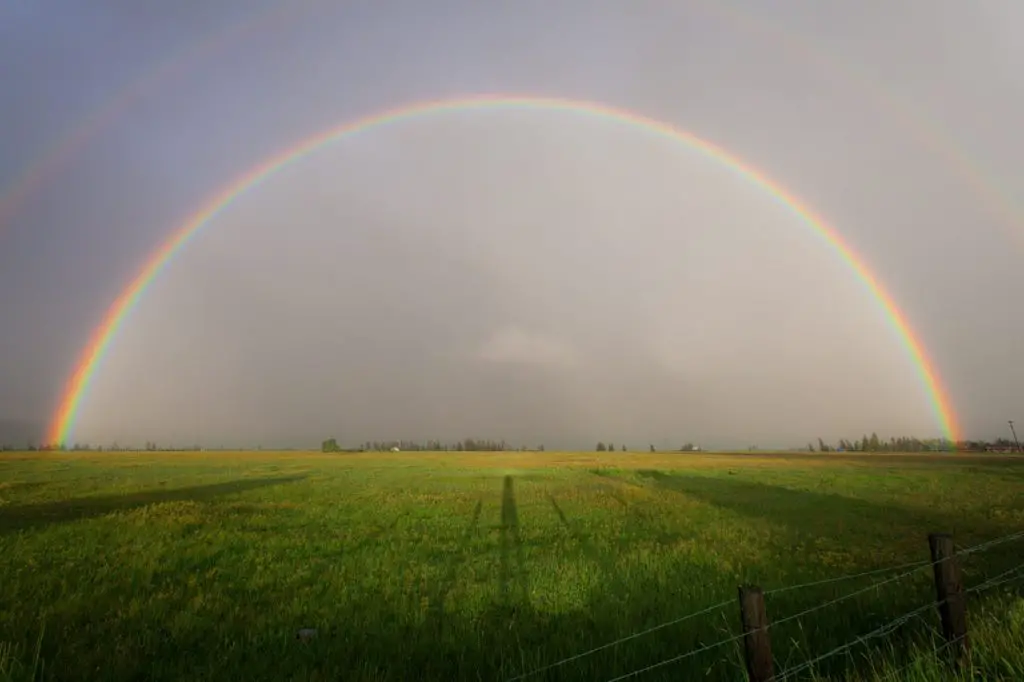
Why rainbows are formed according to Dusun legend

A rainbow is a natural weather phenomenon caused by reflection, refraction and dispersion of light in water droplets, resulting in a spectrum of light appearing in the sky.

Due to its beautiful and mystical appearance, it has been a subject of mythology and superstition from different cultures across the world.

In Hawaiian legends, the rainbow maiden Avuenue is believed to be the messenger for her brothers, the gods Tane and Kanaloa.

Meanwhile, the rainbow is depicted as an archer’s bow in Hindu mythology.

In the bible, rainbows are a sign of God’s promise. After the Great Flood in the book of Genesis killing all living things excepts those on Noah’s ark, a rainbow appears to symbolise God will never send another flood to destroy the earth.

Though it can be a full circle, we usually see an arch formed by illuminated droplets above the ground.

This archIng shape of the rainbow has also inspired many myths to see it as a bridge.

Why rainbows are formed according to Dusun legend

A rainbow is a meteorological phenomenon that is caused by reflection, refraction and dispersion of light in water droplets resulting in a spectrum of light appearing in the sky.  Credits: Pexels
The rainbow as a bridge in various cultures

If you are a big fan of Marvel Cinematic Universe (MCU), then you have watched all three Thor films. In the films there is a rainbow bridge called the Bifrost that is guarded by Heimdall (played by ultimate gentleman, Idris Elba).

According to Norse religion, the Bifrost connects Midgard (earth) with Asgard, home of the gods. It can be only used by gods and those who are killed in battle.

Similarly in ancient Japanese beliefs, rainbows served as a bridge to enable their ancestors to descend to earth.

Meanwhile, the Maori has a tale of Hina (moon) who caused a rainbow to span the heavens and down to the earth to allow her mortal husband to return to earth to end his days since there is no death in her celestial home.

Rainbow as a bridge in a Dusun legend

A mystical bridge to connect two lovers is something that the Dusun people of Sabah can relate to.

According to a legend recorded by Ivor Evans in Among Primitive Peoples in Borneo, a rainbow was a path for men long time ago.

“Those who lived up-country used the rainbow as a bridge when they wished to go down-country in search of wives,” he wrote.

When they first made the rainbow, the men would walk directly to the women’s houses.

After the women served them food, they followed the men back to their homes over the rainbow.

Once they arrived back up-country, their marriages were celebrated with a great feast.

Then came an old man from another village asking the men what they did with the rainbow, now that they had their wives with them.

The men simply replied, “When we want to go down-country with our wives we will put it in place, but when do no want it we will take it away.”

Certainly, this legend makes you wonder if this is how people in the olden days deal with LDR.

10 kawaii Japanese bento recipes from Ochikeron you can try

Tokyo-based YouTube user Ochikeron has been sharing easy-to-follow Japanese home cooking on her channel since 2011.

If you are not familiar with her, she was the one who created the three-ingredient cheesecake using eggs, white chocolate and cream cheese.

Additionally, Ochikeron created a five-ingredient chocolate lave cake out of chocolate, butter, egg, sugar and flour.

Besides these creative innovations, other highlight of her YouTube channels are her cute, cartoonish Japanese bento.

They look so intimidating to make but if you follow her instructions closely, they are actually easy to make.

Some of the essential tools to make your own bento box are tamagoyaki nabe (rectangular omelette pan), eyebrow scissors (used solely for food) and plastic wrap.

Here are 10 kawaii Japanese bento recipes from Ochikeron you can try to make at home:
10 kawaii Japanese bento recipes from Ochikeron you can try
1.Hello Kitty Bento Box

Do you know that you can find all kinds of rice molds for bento at most Japanese shops even in Malaysia? To make this bento box, get a Hello Kitty mold to make your life easier.

The main highlight of this recipe is its stuffed red peppers which Ochikeron decorated as apples in the bento box.

Another trick she taught in this recipe is on how to make a Kamaboko (fish cake) house. The roof is made of imitation crab meat or crab sticks while the house is made from Kamaboko. Attach the two pieces together to make your house using a small piece of uncooked spaghetti pasta. The hard pasta will be soft after awhile so you can safely eat it.

2.My Melody Bento Box

Now how about making Hello Kitty’s best friend, My Melody? As for this bento box recipe, the main ingredient is Sauteed Shimeji Mushrooms and Peppers.

Meanwhile, the cutesy part of this bento box is what Ochikeron called ‘Fish Sausage Strawberries’.

It required immense amount of detailing to make these ‘strawberries’ out of fish sausage, edamame beans and black sesame seeds but it still looked doable.

Then, she also made ‘Usuyaki Tamago Egg Crepe Flowers’. It is basically thinly fried omelette rolled and cut to look like a flower.

Watch how to make it here.

3.Cinnamoroll Bento Lunch Box

If you want your egg rolls to look like oranges, the key thing to do here is to attach seeds cutouts cheddar cheese on your roll with mayonnaise. Who knew mayonnaise can be used like glue for your food?

Apart from mayonnaise, Ochikeron also used honey to attach the little details on her rice balls.

Watch how to make it here.

4.Pompompurin Bento Lunch Box

Here is another character from the Hello Kitty world. The rice balls which shaped up the yellow-coloured Pompompurin character is pretty easy to make. It is basically minced omelette mixed with rice and forming into the shapes of the character.

As for the main dish, you can always use your leftover from last night’s dinner.

Watch how to make it here.

5.Olaf Bento Lunch

This bento box recipe is pretty easy to make because Olaf is a snowman. There is no extra seasoning or cooking for your rice balls because it uses only the Japanese white rice.

But of course there are those extra steps in making the face and limbs of Olaf. Just like any other bento boxes, be creative and use whatever ingredients you have to make them.

Watch how to make it here.

6.Monsters University Bento

Here is another easy to make bento from Ochikeron. The only tricky part is to make your green and blue-coloured rice.

However, you can always head over to the nearest Japanese store to find rice sprinkles. Or you can always improvise and settle with white rice balls to make the Monsters University characters.

Watch how to make it here.

7.Doraemon Bento Lunch Box

To shape your rice balls, you really need to use plastic wraps. But what if you don’t have any plastic wrap to make your rice?

Here is a bento box recipe which does not require any plastic wrap. Essentially, cut the face of Doraemon using easily available ingredients such seaweed sheets, cheese and imitation crab stick.

Watch how to make it here.

8.Kero Kero Keroppi Bento

If you want to take the art of bento seriously, one of the must have ingredients in your pantry is Sakura Denbu. Basically, it is a mashed, seasoned codfish with red food colouring.

Mix your rice with Sakura Denbu to make pink-coloured rice balls while green laver to make green-coloured rice balls. With some cut-out eyes made from cheese, ham and seaweed sheets, there you have it! Your Kero Kero Keroppi characters in a bento.

Watch how to make it here.

9.Minions Bento Box

These minions from Despicable Me are so doable to make, all thanks to their yellow-coloured rectangular shaped.

Just cut your Japanese omelette and put in the details using seaweed sheet. Just like the Doraemon bento box, you don’t need to make rice balls for this bento.

Watch how to make it here.

10.Santa Clause Bento Box

For this Santa Clause Bento Box, the key point is to wrap the top of your rice balls to make the Santa’s head.

To sum up Ochikeron’s bento making tips, there are four ingredients she uses to make up the details of her characters. There are imitation crab stick, cheese, ham and seaweed sheets.

By using these ingredients and some skills with the eyebrow scissor, you can make your own bento characters.

Watch how to make it here.

Three legends of the orangutan you’ve probably never heard of

The orangutan is the only genus of great apes native to Asia. Like other great apes, they are highly intelligent.

Furthermore, they share approximately 97% of their DNA with humans.

Due to their similarities with humans, it comes as no surprise that this ape has become the subject of some local legends.

Here are three legends of the orangutan you’ve probably never heard of:
Three legends of the orangutan you've probably never heard of
1.The man who refused to work and became an orangutan

The commonly known legend in Indonesia about the orangutan is that they were once able to speak like humans.

But then they decided to become silent after humans entered the forest. Why? They feared that if people knew that they could speak, they would be harassed or enslaved by humans.

Another legend has it that if an extremely lazy or mean person were to be punished, their would be changed into an orangutan.

2. The female orangutan who kidnapped a human male

Carl Sofus Lumholtz recorded this particular legend when he stayed at Central Kalimantan, Indonesia.

There was a man who just lost his wife and children. Out of grief, he took a walk into the forest.

After awhile, he felt exhausted so he took a nap underneath a tree. He must have been so exhausted because he did not realise a female orangutan carried him up to her nest far up on a tree.

The man woke up and to his surprise, he was already high up in the tree, unable to come down.

He was left with no choice but to stay up in that tree. For his survival, the female orangutan brought him fruits and even rice stolen from people’s homes.

One day, the orangutan tried to make her moves on him but the man resisted. The animal was so angry that it bit him on the shoulder. Unwillingly, the man surrendered.

After some times, the orangutan gave birth to child. It was a boy but he was covered with long hair.

The man stayed there up on the tree out of fear for his life until one day when he saw an opportunity to escape.

He saw a ship along the coast putting out a boat for hauling water from the river nearby.

Thankfully, the orangutan was away looking for food. So the man made a rope from his clothes and began climbing down from the tree.

Though the rope was not long enough, he successfully jumped into the river.

With all his might, he swam to the boat. The people of the boat saw him and came to his rescue.

When the orangutan did not find the man at their nest, she was angry. Then, she saw the ship from a distance. She tried to catch up to the ship but failed.

Here comes the gruesome part; she returned to her nest in anger, took their son and tore him in half.

3.The orangutan who was a healer

The particular legend came from Kampung Kiau at the foothill of Mount Kinabalu, Malaysian state of Sabah.

Long time ago, a group of men went into the jungle carrying blowpipes.

Suddenly, they heard someone singing among the trees. They looked and saw an orangutan singing on the ground.

Ivan Evans wrote in his book Among Primitive Peoples in Borneo the song that orangutan sang,

“First of all I lived at the River Makadau, but I went to the River Serinsin. From there I went to the River Wariu; from the Wariu to the Penataran. From Penataran to the Kilambun; from Kilambun to the Obang, and from the Obang to the Tenokop.

I cannot go up into the trees again for I am old and must die upon the ground. I can no longer get fresh young leaves to eat from the trees; I have to eat young grass.”

Then the men who heard the song, said to one another: “This orangutan is clever at verses, let us shoot him with our blowpipes.”

When one of the men was about to shoot him, the orangutan pleaded for his life.

“Do not shoot me, but make me a hut and let me live here till I die. When you have made my hut, bring your sisters here and I will teach them magic, for I am skilled in it.”

So the men agreed; they built him a hut and brought their sisters to him.

In return, he taught the women how each sickness had its own magical ceremony. He also taught them the spells for snake bites and fevers.

Then they went home, a journey which took them about three days, to get rice for the orangutan.

But when they came back to the hut, he was already dead.

From there on, whenever there was sickness in Kampung Kiau, the women who were taught by the orangutan would serve as their healers.

10 movies starring Lee Jung-jae you should watch

If KajoMag were to pick the most talented and versatile Korean actor, Lee Jung-jae would definitely be on top of our list.

The 46-year-old actor has managed to pull off different types of characters, from melodrama to action movies.

In every film that he has starred in, Jung-jae developed a distinct way of speaking for his character, making it iconic.

Even if you have never seen his movies, you might recognise his characters, because some K-pop idols love to imitate and parody the characters that Jung-jae has played

So here are 10 movies starring Lee Jung-jae you must watch:

1.New World (2013)

This is perhaps one of the Jung-jae’s most iconic roles so far. He plays an undercover cop in a crime organisation who finds it hard to play his role.

The movie is interesting thanks to its shifting-alliances plot, with viewers left with questions on who is on whose side now.

As for Jung-jae, viewers can appreciate how he portrays the struggle between the good and evil in him. (Or maybe he is just evil in the first place.)

Watch the trailer here.

2.The Face Reader (2013)

Even when he is put on the same screen with a more senior and experienced actor like Song Kang-ho, Jung-jae still manages to shine.

Here, he portrays Prince Suyang who is involved in a power struggle with a high-ranking general.

He won Best Supporting Actor at the Blue Dragon Film Awards and the Baeksang Arts Awards for his role.

Watch the trailer here.

3.The Housemaid (2010)

There is one word to describe Jung-jae’s character in The Housemaid – ‘disturbing’.

Directed by Im Sang-soo, this melodramatic, erotic thriller follows a maid of an upperclass family named Eun-yi played by Jeon Do-yean.

She becomes part of a destructive love triangle between Hoon (Jung-jae) and his wife Hae-ra (Seo Woo).

The movie had its premiere at the Cannes Film Festival and Toronto International Film Festival. Meanwhile, Jung-jae nabbed the Best Actor Award at the Fantasporto Director’s Week.

Watch the trailer here.

4.An Affair (1998)

Here, young Jung-jae plays a man who has a scandal with his fiance’s older sister. It was the seventh highest-grossing Korean film in 1998.

It also won the Best Asian Film award at the 1999 Newport Beach International Film Festival.

5.Typhoon (2005)

Together with another charismatic Korean actor Jang Dong-gun, Typhoon (2005) definitely makes our list.

Here Jung-jae plays a South Korean Naval Intelligence Service Officer named Se-jong. The plot follows modern-day pirate planning a massive attack on North and South Korea.

Watch the trailer here.

6.Il Mare (2000)

How about a time-travel romance movie starring Jung-jae? Directed by Lee Hyun-seung, the movie also stars Jun Ji-hyun.

In this film, the main characters both live at a seaside house named Il Mare or ‘The Sea’ in Italian but two years apart in time.

However, they are able to communicate through a mysterious mailbox.

There is an American remake of the movie called The Lake House, starring Keanu Reeves and Sandra Bullock.

7.The Thieves (2012)

This movie is like a dream come true for Asian movie fans. This is because it manages to combine the best of both Hong Kong and Korean film scenes with a star-studded ensemble cast.

Jung-hae stars as Popeye, one of the criminals in a cross-border diamond heist. He also reunited with his former co-star Jun Ji-hyun who plays a cat burglar named Yenicall.

The Thieves is currently the fifth highest-grossing film in Korean film history with over 12.9 million ticket sale.

Watch the trailer here.

8.Assassination (2015)

Set in 1900s during Japan’s rule over Korea, Jung-jae plays a resistance fighter named Yem Sek-jin. He tries but fails to assassinate the governor-general and a pro-Japanese businessman.

Due to his role in this movie, Jung-jae won a Best Actor Award at the 24th Buil Film Awards.

The movie was the highest-grossing Korean film of 2015 as well as the eighth highest-grossing movie of all time in Korean cinema industry.

Watch the trailer here.

9.The Accidental Gangster and the Mistaken Courtesan (2008)

It is every interesting to see how this actor jumps from one character to another in each different movie.

Here Jung-jae plays Cheon-doong, a comical hoodlum who meets and falls in love with Seol-ji, a kisaeng.

While he pursues Seol-ji, he unknowingly angers the top-ranking gangster in the area.

The movie is based on actual fight that occurred at a kisaeng house in 1724 , depicting the gangster culture of Joseon Dynasty.

Watch the trailer here.

10.Along with the Gods: The Two Worlds and Along with the Gods: The Last 49 Days (2017 and 2018)

Well, first of all Jung-jae is not even the main characters in Along with the Gods movies.

However, he plays as the supporting character as Yeomra so well that he is almost unrecognisable in the film.

Perhaps because he wears a wig and beard in the films, but also because his charisma as the god of death in the movie was both interesting and imitating.

Watch the trailer here.

1 53 54 55 56 57 75