Patricia Hului

Patricia Hului is a Kayan who wants to live in a world where you can eat whatever you want and not gain weight.

She grew up in Bintulu, Sarawak and graduated from the University Malaysia Sabah with a degree in Marine Science.

She is currently obsessed with silent vlogs during this Covid-19 pandemic.

Due to her obsession, she started her Youtube channel of slient vlogs.

Follow her on Instagram at @patriciahului, Facebook at Patricia Hului at Kajomag.com or Twitter at @patriciahului.

KajoPicks: 5 performances we loved during RWMF 2019

If you were there during Rainforest World Music Festival (RWMF 2019), chances are you may still be suffering from post-RWMF withdrawal.

Despite a claim on international media last year that the festival was a dying brand with no new stories being told, the festival has definitely proven the critics wrong.

The number of festival goers this year hit 23,650 people – the highest it’s been since RWMF started in 1998.

And if you were one of those thousands who danced beneath the moonlit sky with the Santubong mountain in the background, you might not have realised how big the crowd was.

It was definitely good to see the festival highlight more local Sarawakian performers such as Suku Menoa, Suk Binie’, Kemada, Staak Bisomu and crowd favourite, At Adau.

With so many performers from all five continents gathering at Sarawak Cultural Village for three days, it was definitely hard to choose our favourites.

But here are KajoMag’s picks for our five favourite acts during RWMF 2019 which took place from July 12 to 14.
1.Duplessy & The Violins of the World (France, Mongolia and Sweden) featuring Guo Gan (China)

The beauty of Rainforest World Music Festival has always been the ability to bring artists of different musical styles and cultures to perform on the same stage.

And this year, one of the performances which managed to do that beautifully and successfully was the performance by Duplessy & The Violins of the World featuring Chinese erhu musician, Guo Gan.

Four soloists- Mathias Duplessy, Guo Gan, Naraa Puredorj and Aliocha Regnard – came together for two different sets called “Marco Polo” at the Theatre Stage and “Crazy Horse” on the Tree Stage.

Inspired by the Italian explorer who travelled through Asia, “Marco Polo” gave the audience a crossover of Western and Asian classical music, while “Crazy Horse” truly reflected its name with fast-paced, cantering rhythms and swinging tunes.

Their performances might have been a fusion between East and West cultures, but there was no confusion among the audience who was listening.

It was definitely a nice eclectic mix of classical guitar (Duplessy), erhu (Guo Gan), traditional Swedish string instrument the nyckelharpa (Regnard) and the Mongolian fiddle (Naraa).

2.Otava Yo (Russia)

This group of seven musicians from St Petersburg had a goal: to shatter the stereotype that Russian folk music was boring and undanceable.

Judging by how the crowd danced on Friday night during their performance, Otava Yo definitely achieved their goal.

Using instruments such as the Russian fife, gusli (Russian psaltery), the bagpipe and fiddle, they gave a performance which transcended languages and cultural boundaries.

KajoPicks: 5 performances we loved during RWMF 2019
Otava Yo. Credits: RWMF Official Photograph
3.Kila (Ireland)

If you are a veteran RWMF festival goer, then Kila might be a familiar act. They performed in RWMF back in 2013 and they were back again this year.

Kila is a musical ensemble of eight Dubliners centering around Irish classic, folk and rock music.

BBC World Review once described their music to be ‘one of the most beautiful euphoric live experience’ and we agree.

Kila gave a phenomenal performance as the last act on Friday night and they outdid themselves when they performed with Oki Kano, an Ainu Japanese musician on Sunday night.

Who knew a collaboration between the sounds of Dublin and Hokkaido would blend perfectly together?

KajoPicks: 5 performances we loved during RWMF 2019
Kila performing on Friday night. Credits: RWMF Official Photograph.
4.Macka B (United Kingdom/Jamaica)
KajoPicks: 5 performances we loved during RWMF 2019
Macka B. Credits: RWMF Official Photograph.

According to Macka B, Sarawakians have the reggae spirit in them and we couldn’t agree more: the moment Macka B took over the mic on Saturday night, the audience was immediately taken by his stage presence.

With a career spanning nearly four decades in the United Kingdom and Jamaica, Macka B was definitely a seasoned performer and an expert on working the crowd.

He brought the house down with songs you would expect a reggae artist to sing; peace, love, a tribute to Bob Marley and marijuana.

But Macka B’s hit “Wha Me Eat”, in which he raps a long list of food he eats as a vegan was definitely one of our faves.

Most RWMF 2019 festival goers might never have been to Jamaica but he had us screaming “Ya man!” all night.

5.Tabanka (Cape Verde)

If Tabanka could bottled up their energy and sell it, I would definitely be the first in line to buy it.

This band who performed as the final act during the final night of Rainforest World Music Festival 2019 had an infectious, excessive energy on stage.

They introduced funana, an accordion-based music and dance genre from Cape Verde.

The genre was once forbidden by the Portuguese colonial rulers but later became part of the post-Independence Cape Verdean identity.

Check out their official music video down below and you would understand why we loved them.

Who were your personal favourites during RWMF 2019? Let us know in the comment box.

Which type of RWMF goer are you? Here are 10 types that we usually see during the festival.

Here is throwback to who we loved during Rainforest World Music Festival 2017.

Tom Harrisson’s own account of The Airmen and the Headhunters incident

The Airmen and the Headhunters: A True Story of Lost Soldiers, Heroic Tribesmen and the Unlikeliest Rescue of World War II is a book written by Judith M. Heimann.

It tells the story of how a group of American airmen was rescued by the locals during the Japanese occupation of Borneo.

The event was also made into an episode of the PBS television series “Secrets of the Dead”.

One of the key players of the rescue was Major Tom Harrisson, a British polymath who later served as Sarawak museum curator after WWII.

During the war, he was attached to Z Special Unit, as part of the Service Reconnaissance Department (SRD).

On March 25, 1945, Harrisson parachuted with seven Z Force operatives into the Kelabit Highlands.

That was when he and his unit became credited for helping the stranded American airmen.

Tom Harrisson’s own account of The Airmen and the Headhunters incident
Airmen and the Headhunters was featured in PBS’s Secret of the Dead. Credits: Youtube
The Airmen and the Headhunters, according to Australian-British Reward Mission

After the war, Major R. K. Dyce who represented the British government in the Australian-British Reward Mission wrote an article “Heroism in the Limbang” for The Sarawak Gazette (June 2, 1947).

“About the end of January or in early February 1945, a US Liberator made a crash belly landing about a mile from Kampung Telahak on the Sungai Limbang in Sarawak. Nine of the crew survived the crash. One was dead.”

From there, the story continues on how these nine American airmen were harboured and escorted by different groups of different races in Sarawak, British North Borneo (now Sabah) and Dutch Borneo (now Kalimantan).

The first group of locals who rescued them was the residents of Kampung Telahak led by their village head (ketua kampung) Mohamed Dolamit.

“The kampung people led the Americans out of the sodden paddy field on which they had landed into the village; washed them, fed them, helped them bury their dead comrade, equipped them with parangs, and planned their escape.”

Tom Harrisson’s own account of The Airmen and the Headhunters incident
Today’s Limbang river.
The escape plan for the nine Americans

Then, Mohamed started to draft an escape plan for the nine Americans. His plan was to guide the Americans by paths which avoided Japanese-occupied localities to a wise and influential old Penghulu Masing to the southeast on the Pandaruan river.

“The practice is, in an operation of this kind, to hand on the “passengers” from longhouse to longhouse and kampung to kampung,” Major Dyce reported.

After being handed over from one community to another community, the nine airmen finally arrived in Ulu Matang, somewhere near Long Pa’ Sia, Sabah.

This was where they separated with the first party proceeded to Dutch Borneo where they met up with Harrisson’s SRD party. Meanwhile, the other four who headed north were killed by the locals.

Dyce reported in 1947, “The story of the episode and its aftermath is still alive in the kampungs and longhouses, but most of the helpers concerned looked for no material reward.”

Local administrations knew how much these heroic natives had helped the Americans.

However, Dyce explained that the shortage of staff and overwork by the then local administration back then delayed in giving them proper recognition.

Tom Harrisson’s article on The Airmen and the Headhunters incident

According to Harrisson, Major Dyce’s Heroism in Limbang did not quite “give a complete picture of the amazing Borneo careers of those American airmen and of other who were cared for and protected with the same extraordinary loyalty and self-sacrifice by the peoples of the Limbang, Trusan, Padas and Mentarang rivers.”

Harrisson clarified the exact date when the plane was shot down, stating that it was on Jan 12, 1945.

The crashed crew proceeded from Limbang to Padas where they split up just as Dyce reported. The pilot Lieutenant-Commander Smith heard that there were American guerrillas in Kudat, the northern side of Sabah.

He decided to head there and three of the crew agreed to follow him.

Unfortunately, the moment they reached Tomani near Tenom, the group was betrayed by the locals.

A Japanese unit which came from Beaufort via Tenom surprised them in a village at night.

One of them was speared by the locals while another one was shot by a British North Borneo constable officer.

Their bodies were decapitated and distributed among the locals. Meanwhile, Smith surrendered and the fourth man escaped into the jungle. They spent a week hunting him down, but in the end, he too was captured and taken to Beaufort together with Smith.

According to Harrisson, his unit was about to make a rescue mission and kidnap General Masao Baba when the war ended.

At the same time, the Japanese quietly executed the two American soldiers as they were dangerous witnesses.

What happened to the other five crew member?
Tom Harrisson’s own account of The Airmen and the Headhunters incident
A view of Padas river today.

The other five men, “not Kudat-Krazy” men as Harrisson described in his article, went up the Padas river.

From there, they then came over into Kemaloh river in Dutch Borneo. Here, they were looked after by the Pa Putuk people of the Krayan Highlands.

Harrisson stated, “They were also fortunate in meeting a remarkably fine native missionary, William Mohgan of Makassar who could speak some English (and a little American). The Japs, of course, knew these men were somewhere in the interior, but as in the Limbang the people did not betray them, often at grave risk or cost to themselves.”

Nevertheless, they were forced to hide in jungle shelters and suffered great impoverishment through lack of medical supplies, mosquito nets and footwear.

By that time, the five had reunited with six other Americans who were survivors from an American 13th Army Liberator shot down on the Dutch side.

The former museum curator pointed out, “One of this crew wandered alone through the jungle for fourteen days before reaching a lonely mountain village, where he was nursed back to life and became, in a few weeks, quite fluent at Potok (a Lundayeh dialect)- the others never even got beyond the bagus stage of Malay.”

Tom Harrisson’s own account of The Airmen and the Headhunters incident
Today’s Krayan HIghlands from on top of Yuvai Semaring hill.
Harrisson and his unit to the rescue

Harrisson added that he first heard of these airmen in March 1945, who were then about ten days’ walk eastward from Bario.

“Our only medical man at that time, Sergeant F. Sanderson, made a forced march to them, carrying all the stores we could possibly spare and all our comforts (at that time all supplies had to be dropped from Moratai, thirteen hours flying; so the lifeline was slender, with three out of six planes lost in the first weeks).”

Finally, the American airmen had the help they needed from the British soldiers. Harrisson continued: “When they were fit to walk by easy stages over the mountains -harder going in Dutch Borneo than in Sarawak – we brought them into better country, where we prepared an airfield. Some RAAF pilots came in without maps or radio signals to pick the Americans out.”

Harrisson stressed that the behaviour of the native people (except those who betrayed them in Tomani) is a lasting symbol of native morale in these lands.

“And I hope that if it comes to a question of rewards (of which the helpers had no thought at the time) the British North Borneo and Dutch helpers will not be forgotten. For it is sad to admit, but true, that from that day to this no one of any race has had a word of thank you (let alone a tin of peanuts) from those boys to whom they gave back life, liberty and Nashville, Tennessee.”

Sadly, KajoMag’s own digging so far has found no official recognition of the locals’ efforts and contributions (particularly in Pa Putuk and Kampung Telahak) to helping the American airmen evade capture.

How did the rumours of Kayans practising cannibalism spread?

One of the biggest misconceptions of Borneo in the 19th century was that it was a place where cannibalism was common practice.

Plenty of tribes in Borneo were depicted as cannibals in European writing, including the Kayans in Sarawak and Dutch Borneo (Kalimantan).

One account of alleged cannibalism practised among the Kayans was recorded by Sir Henry Keppel.

He received his information from three men named Kusu, Gajah and Rinong from Kapuas.

“I examined them myself, and entertain no doubt of the correctness of these statements, as far as their personal knowledge is concerned. The witnesses themselves stated over and over again, with the utmost clearness, how much they had seen, and how much heard. There was such perfect good faith and simplicity in their stories as to carry conviction of their truth,” Keppel wrote.

How did the rumours of Kayans practising cannibalism spread?
Was cannibalism really being practised in Borneo?
So here is the full testimony of the three men on how they encountered the “cannibalistic Kayans”:

We are of the tribe of Sibaru; which is likewise the name of a branch of the Kapuas river. The tribe of Sibaru contains 2,000 fighting men and is under the government of Pangeran Kuning, who resides at Santang, a Malay town on the Kapuas. We have none of us who resides at Santang, a Malay town on the Kapuas, where the Kayans live, but they often come down to Santang where we meet them. The Kayans are quite independent, very numerous and powerful: they are governed by their own Rajahs, whom they call Takuan. Some of these Kayan tribes are cannibals (makan manusia); it is generally reported, and we know it to be true.

Pangeran Kuning of Santang was at war a few years ago with Pangeran Mahomed of Sewite, a Malay town situated on the Kapuas between Santang and Salimbaw. A large force was collected to attack Suwite. There were Malays (laut) of Santang and Sakadow, and the Dyaks of Sibaru, Samaruang, Dassar and of other tribes; and besides all these, was a party of about fifty Kayans.

We never heard the particular name of this Kayan tribe, for we did not mix with them, not did we understand their language. Suwite was not taken, but a few detached houses were captured, and one man of the enemy was killed in the assault.

Kusu saw these Kayans run small spits of iron, from eight inches to a foot long, into the fleshy parts of the dead men’s legs and arms, from the elbow to the shoulder, and from above the ankle beneath the calf to the knee-joint: and they sliced off the flesh with their swords, and put it into baskets.

They carry these spits, as we all saw, in a case under the scabbard of their swords. They prize heads in the same way as the Dyaks. They took all the fresh off the body, leaving only the big bones, and carried it to their boats, and we all saw them broil and afterward eat it. They ate it with great relish, and it smelt, while cooking, like hog’s flesh. It was not we alone that saw them eat this, but the whole force (bala) saw it.

Men say that many of these interior tribes of Kayans eat human flesh- that of their enemies; most, however, do not, and all of them are represented to be good people and very hospitable; and we never heard that they ate other than the flesh of their enemies. It made us sick to see them, and we were afraid, horrified.

Spencer St John’s records of Kayans practising cannibalism

Just like Keppel, St John did not witness any Kayans practising cannibalism during his time in Sarawak.

However, according to St John, a Malay nobleman named Usup told him that he actually witnessed it.

In 1855, men from Mukah had been executed in Bintulu. A few of the Kayans who helped in their capture took portions of the bodies of the criminals, roasted and ate them.

St John wrote, “This was witnessed by himself and many others who were then present. The Kayans had not, as a body, joined in this disgusting feast; but, perhaps some of the more ferocious may practice it to strike terror into their enemies.”

How did the rumours of Kayans practising cannibalism spread?
Records that the Kayans did not practice cannibalism

Not everybody believed that Kayans practised cannibalism.

Sir Hugh Low wrote that the Kayans were hastily stigmatised as cannibals and added: “nor does any race practicing the horrid custom of feeding on the bodies of their own species, exist on the island.”

The Kayans might not have been the second Rajah of Sarawak Charles Brooke’s favourite tribe, but he never believed that they were capable of cannibalism.

How did the rumours of Kayans practising cannibalism spread?
Here is what he wrote about the Kayans and cannibalism in Borneo:

“This tribe are cowardly, untruthful, and treacherous, and are capable of committing many horrors, but the gravest attached to the Kayans, I feel confident, is without foundation, namely, that of cannibalism. For, during the expedition of 1863, there was no sign of it, and I had abundant opportunities of making strict enquiry in the very heart of the country.

“Many reports of this description are spread by the enemies of a people to degrade them in the estimation of Europeans. Such reports are purely fabulous, and I do not believe any tribes are cannibals in this part of Borneo, although stories go far to lead one to a contrary belief.”

However, a group of Malays told the Rajah that they did see pieces of human flesh in bamboo during a visit to Kapuas region and that they were used as provision.

“I regret that I am unable positively, to contradict such statements; but it is my firm conviction cannibalism is not practiced on any part of the island of Borneo,” Brooke wrote.

Do bear in mind that all written reports of alleged cannibalism among Kayans were written by the Europeans after listening to secondary sources. Thus, some information might have gotten lost in translation. None of these 19th century writers had actually seen any Kayans eating human flesh.

Another theory was that this rumour was spread by the local guides to discourage the Europeans from travelling further inland of Borneo.

Imagine refusing to bring your client to a place by telling them it is full of cannibals.

KajoReviews: 5 reasons to watch C-drama Detective L (2019)

Set in 1930s Shanghai, Detective L (2019) is a Chinese detective drama that follows Qin Xiaoman (played by Una You Jingru 尤靖茹 ) after she graduates from police academy.

She happens to live the same apartment building as Luo Fei (Bai Yu 白宇), a former policeman turned private detective who is an outstanding investigator.

The duo often clash with each other but eventually find themselves making a great team when it comes to solving cases.

It has been one of the highest rated Chinese dramas for 2019 and after watching the series, we at KajoMag understand why.

Here are five things to appreciate while watching Chinese drama Detective L:

1.The fascinating cinematography and camera transition

First of all, let us talk about the beautiful colour palette used in Detective L. The dark gray and different blue tones of the drama manage to set the mood and transport viewers to 1930s Shanghai.

In order to tell the story better, different camera transitions are used throughout the drama.

For example, the camera would shift from the back of the main actors while they interview a suspect. This gives the viewers the impression of being in the same room with the characters, walking around and watching the whole conversation.

2.The intriguing story-line with plenty of (sometimes unpredictable) plot twists

Fans of detective stories, sometimes have a tendency to try to solve the mystery in our minds ahead of the next plot unveil.

But things can get boring if the plots get predictable. Thankfully, most of the cases featured in Detective L are not that easy to crack even for devout fans of detective stories.

However if you pay close attention throughout the episode, you might be able to ‘catch’ the culprit.

KajoReviews: 5 reasons to watch C-drama Detective L (2019)
You cannot miss a thing while watching this drama or else you might miss an important clue to solving the case. Credits: YouTube.
3.The grandeur of Shanghai French Concession architecture and attention to detail filming sets

The events in Detective L actually takes place in the Shanghai French Concession. Although some of the buildings are clearly CGI-animated, some of the shooting takes place at historical buildings and sites.

Even for Luo Fei and Xiaoman’s apartments which are clearly studio filming sets, one can’t help but notice the props used in the drama to depict that era.

The production team’s attention to details is definitely worth our thumbs up. So much so, we bet you would never find a Starbucks cup anywhere in the camera frame in this drama. 😉

4.The stylish costumes in Detective L

Since Detective L is set in 1930s Shanghai, the costumes carefully depict the fashion of that era.

China in the 1930s is considered the golden age of the cheongsam (qipao). This Chinese traditional dress became slimmer and more skintight during this era. In 1933, a slit was added to the dress, giving it the look that we are all familiar with today.

And you can observe the beauty of these cheongsams in Detective L, especially on Luo Fei and Xiaoman’s landlady Wang Susu (Dong Weijia).

Besides the filming sets, the production team also pay great detail to costuming the characters.

You cannot help to appreciate their outfits (men and women alike) while getting caught up with the storyline.

KajoReviews: 5 reasons to watch C-drama Detective L (2019)
This Chinese detectivedrama is definitly one of the must-watch dramas for 2019. Credits: Youtube.
5.It somehow reminds you of Sherlock Holmes, but in an Agatha Christie book

Speaking of storyline, you can’t help the similarity between Luo Fei and Sherlock Holmes.

There are some quirks and eccentricities of Luo Fei which reminds you of Sir Arthur Conan Doyle’s Holmes.

Furthermore, Bai Yu’s acting as Luo Fei in this drama is indeed impressive. It is a complete deviate from his previous roles such as in Love O2O.

When it comes to the flow of the storyline, some of the cases seem almost taken out or inspired by Agatha Christie’s books.

So if you are a fan of Doyle and Christie, you will definitely enjoy Detective L.

Watch the trailer here.

You can watch Detective L on Tencent Video’s official YouTube channel.

Preparing for war expeditions in Sarawak during the 19th century

Be it a punitive excursion or a tribal feud, war expeditions way back in the 19th century Sarawak took a lot of time and resources to prepare.

Taking the infamous cholera expedition in 1902, the second White Rajah Charles Brooke brought 10,000 men to fight against the alleged rebels up Batang Lupar.

Imagine 10,000 men moving up one river and setting up camps at one large landing site.

And can you imagine the impact of these war expeditions on the environment and natural resources back then?

At the same time, preparing to feed up to thousands of men during these expeditions must have been a lot of work.

Preparing for war expeditions in Sarawak during the 19th century
Panau, one of the Iban warriors who joined Charles Brooke on his punitive expedition to Batang Lupar.
Here at KajoMag, we look at different accounts on how war expeditions were prepared in Sarawak during the 19th century.
1.Charles Brooke in Ten Years in Sarawak (1866)

It is customary to announce a coming war expedition for such and such a season at one of the great feasts, when the village is thronged with guests from the country far and near, and when there is sure to be an unusual gathering of powerful chiefs.

The speaker, who must be a great chief, gives his reason, that his people wish to put off mourning, or that his people have been slain and he must have some revenge, and he ends by inviting all present to accompany him on an incursion upon an ancient enemy.

If he be a chief of any real influence he is sure to secure an ample following, in reality more than enough for his purposes, but his ambition expands as his numbers increase and his warpath assumes grander proportions.

The women lend their assistance to induce their husbands and lovers to join this warpath.

The details are then discussed, the amount of bekals (supply) necessary, the route, the character and number of enemy, etc.

Choosing the date

The period usually selected for any expeditions on a large scale is that immediately after the seed planting or after the harvest; the former time better, and have three months clear before they are required to gather in the harvest. In the latter case they would probably have no farms at all for that year, as they would have no dry the clearings, which, therefore, would not burn well.

The Dyaks are never in a hurry in setting off. They cook and feed at leisure, and commence walking about half-past seven, and the morning meal keeps them going until late in the afternoon; they certainly get over more ground by following this plan.

2.Brooke Low in Catalogue of the Brooke-Low Collection in Borneo

Occasionally, however, the delay is so great that the force becomes for the purpose for which it was called together.

The women are everywhere busy preparing the bekals, and the produce of the gardens are taken to the nearest market to exchange for tobacco, gambir etc. The men on their part have been busy in getting the war boats ready, launching them into the river, lashing on the planks and fitting them up with palm leaf awnings and bamboo floorings.

Those who are able to purchase the material, plane the bottom of their canoes to make them smooth and tar them to preserve them, make figure heads for the bows, and paint the side planks in various patterns. They take nets with them to fish by the way, and dogs to hunt with if the distance is so great that they are likely to run short of food, but their chief support on an expedition of this kind is what they find on the banks and in the forest-especially the wild sago. The men are very busy furbishing up their arms and sharpening their weapons and decorating their helmets and war jackets.

The chief is always the first to leave the village, and as the first and chief part of the journey is by the water, he pulls away in a his canoe, and at some convenient distance from the village, he bivouacs for the night to beburong- to consult the omen birds. If the omens by birds are favourable, he proceeds to the tryst and there awaits the force as it dribbles in one by one or few by few.

Preparing for war expeditions in Sarawak during the 19th century
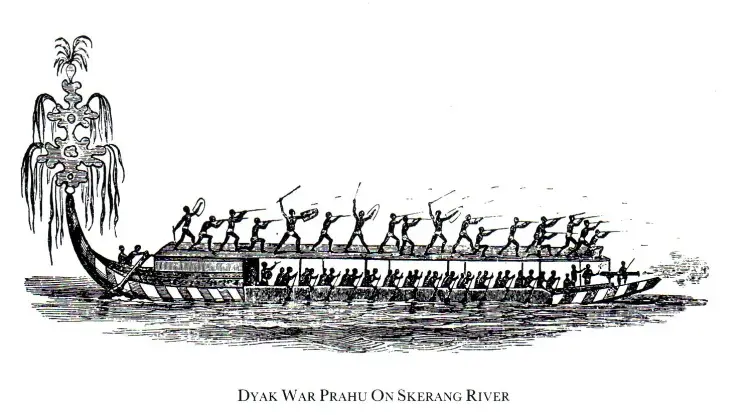
An Illustration of Iban war boat published in The Natives of Sarawak and British North Borneo (1896). Credits: Creative Common.
3.Spenser St. John in Life in the Forest Far East (1862)

They start with, perhaps, two days’ provisions, and trust to hunting for food. If they find a spot where game is plentiful, they stay there till it is exhausted; if the jungle produce no sport, they live on the cabbages taken from the palms, on the edible fern, on snakes, or anything, in fact that they can find.

If they come across bees’ nests, they stop to secure the wax and honey. If they come across bees’ nest, they stop to secure the wax and honey. Time is no value to them, as they generally start after the harvest, and many parties are said to have taken six months.

Preparing for war expeditions in Sarawak during the 19th century
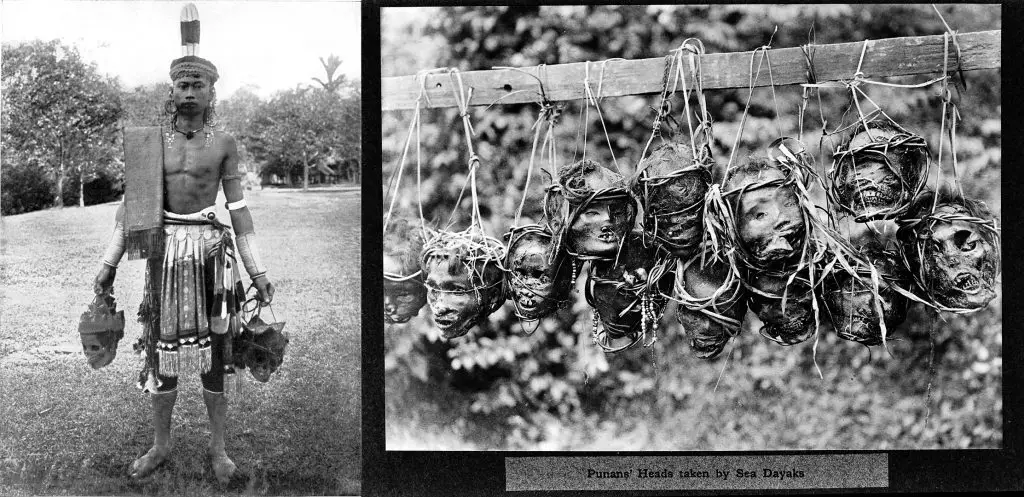
M0005506 Punan’s heads taken by Sea Dayaks Credit: Wellcome Library, London. Wellcome Images images@wellcome.ac.uk http://wellcomeimages.org Punan’s heads taken by Sea Dayaks Pagan Tribes of British North Borneo Hose & MacDougall Published: – Copyrighted work available under Creative Commons Attribution only licence CC BY 4.0 http://creativecommons.org/licenses/by/4.0/
So what happened to the women when men left for war expeditions?

After helping the men to prepare for their war expeditions, the women then were left defenseless at their villages.

So what did they do? According to Henry Ling Roth in The Natives of Sarawak and British North Borneo, the women would continue their daily activities like usual. “As long the men are away their fires are lighted on the stones or small just as if they were at home.”

Additionally, the women carried out a couple of tasks symbolically to protect their men from afar. They spread mats and kept the fires up till late in the evening and lighted again before dawn. This was to ensure men during the war expeditions would not get cold.

He added, “The roofing of the house is opened before dawn, so that the men may not lie too long and fall into the enemies’ hands.”

Whether this symbolic gestures actually work for their men, we will never know. However, it is interesting to know how the women contributed without physically being there during war expeditions.

Preparing for war expeditions in Sarawak during the 19th century
Every year or two the Iban Dayaks hold a feast called Gawai Antu in honour of the departed spirits which they believe surround the heads which hang in their houses. In this manner they hope to keep in favour with the spirits and so have good fortune. Photo by Charles Hose. Credits: Creative Commons.

Surprising facts about a Bleeding Corpse: Science and Cultural Beliefs Explained

Do you know what happens to your body after your heart stops beating — and why a bleeding corpse can appear in certain stages of decomposition?

Within seconds of death, the oxygen in your body is depleted. Soon after, blood settles in the lowest parts of the body (livor mortis), followed by the stiffening of muscles known as rigor mortis.

As time passes, the body begins to cool, entering a stage known as algor mortis.

Once the heart stops pumping, blood circulation ceases entirely. Without movement, the blood begins to coagulate, forming clots and becoming thicker in texture.

However, this does not mean the body completely stops releasing fluids after death.

Under normal conditions, the bacteria in the intestines continue their activity after death, breaking down internal tissues and producing gases that expand into the body’s cavities and surrounding tissues.

These gases cause noticeable bloating, particularly around the abdomen and face. As internal pressure builds, fluids or gases may escape through natural openings such as the mouth, nose, or rectum, and swelling can sometimes make the eyes or tongue appear slightly more prominent. These are normal physical changes associated with the natural process of putrefaction.

This stage of decomposition can also cause small amounts of blood-stained fluid to seep from the nose and mouth. Although this is a scientifically recognised part of the body’s breakdown, different cultures throughout time may have interpreted a “bleeding corpse” in various symbolic or spiritual ways.

A bleeding corpse and cruentation in medieval Europe

“Cruentation” was one of the medieval methods once used to determine guilt in suspected murder cases. It was based on the belief that a victim’s body would spontaneously bleed in the presence of the murderer.

This practice appeared in various regions, including Germany, Poland, Bohemia, Scotland, and even some European colonies in North America.

When murder was suspected, the accused would be brought before the corpse and instructed to place their hands on it. If the wounds were seen to bleed, the accused was considered guilty.

Before modern forensic science, it is easy to see how people could be wrongly suspected, as decomposition was not well understood and a corpse’s natural release of blood-stained fluids could be misinterpreted as a supernatural sign of guilt.

Surprising facts about a Bleeding Corpse: Science and Cultural Beliefs Explained
A body in its coffin starts to bleed in the presence of the murderer in an illustration of the laws of Hamburg in 1497. Credits: Public Domain.
In old Chinese superstition, a bleeding corpse meant a relative recognised the dead person.

Among some Chinese communities in the past, including Sarawakian Chinese in the 1940s, there was an ancient superstition that a corpse would begin to bleed – usually from the nose – when recognised by a family member.

In November 1947, a body was found floating in the Sarawak River. According to a report in the Sarawak Gazette, the corpse was brought to the steps of Pangkalan Batu, where a European police officer “of impeccable observation and indubitable integrity” took charge of the case.

A Chinese man soon arrived, believing the deceased might be his missing brother. To confirm, he brought his sister, who immediately identified the body.

At that moment, a small amount of blood began to trickle from the corpse’s nose.

A dresser present at the scene informed the officer that, according to local superstition, this meant the deceased had been recognised by a relative.

Do you know any more superstitions behind a bleeding corpse? Share with us in the comment box.

The Sarawak Museum curator who became a cockroach specialist

Back in the early days of Sarawak Museum, many of its curators became prominent zoologists, anthropologists and archaeologists.

Being posted here in Sarawak when it was almost unknown to the Western world allowed these curators to be among the first to discover a new plant or animal or formally write about unheard of cultures.

Many of them continued to have successful careers after their service in Sarawak. Interestingly, one of them became specialised in cockroaches.

Early life of Robert Shelford

Robert Walter Campbell Shelford was appointed as the Sarawak Museum curator from July 22, 1897 to Feb 2, 1905.

A British subject, he was the son of a merchant, born in Singapore Aug 3, 1872.

Shelford studied at King’s College and Emmanuel College, Cambridge.

After finishing his degree, Shelford first worked as a Demonstrator in Biology at the Yorkshire College in 1895.

Two years later, he left Europe to come to Borneo.

Since he was born in Singapore and spent most of his childhood there, Shelford was no stranger to the tropical climate.

However, according to his friend and colleague Edward Poulton, he was diagnosed with hip-joint tuberculosis at the age of 3. Hence, his disease limited physical activities.

“Prevented by a tubercular hip joint from taking part in the games and ordinary outdoor pursuits of a boy and young man, his active mind turned to observation, and he became a naturalist.”

Poulton also pointed out that his seven-year tenure in Sarawak gave Shelford the biggest opportunity to study topical insects and anthropology.

While in Sarawak, Shelford made several expeditions to different parts of the Kingdom. He visited Mount Penrissen (May 1899), Trusan (1902) and Sadong-Tebekang (1903). Shelford also frequented Matang mountain range and Mount Santubong.

He collected many specimens of insects in Sarawak and most of them were sent to his old university at Cambridge.

Robert Shelford and the study of mimicry and anthropology

Shelford did more than just collect these insects, he also used them to study insect mimicry. Mimicry is an evolved resemblance between an organism and another object, often an organism of another species.

Poulton wrote, “He found Borneo a very rich and imperfectly explored field for the study of this subject (mimicry), and before long he entered into a regular correspondence with me, sending large consignments of insects for investigation and determination.”

Shelford even wrote a paper on insects and mimicry which was published in the Proceedings of the Zoological Society of London.

Additionally, his works in Sarawak was not limited to insects. Shelford was also interested in anthropology.

Together with Dr Charles Hose, he contributed some insights on Sarawak tattoos which later published in Hose’s book Pagan Tribes of Borneo.

Robert Shelford’s life after Sarawak

When his tenure in Sarawak was about to end, Shelford started to find jobs back in England.

His love and interest for insects remained so he was eyeing for a job in the Hope Department at Oxford.

The Hope Department was a huge collection of insects in the university founded by Frederick William Hope.

He even wrote to Poulton that if the university was unable to pay him, he was even willing to work for free.

Fortunately, Oxford was able to offer him the post as an assistant curator which he gladly accepted.

After leaving Kuching for good, Shelton made his way home to Europe via Japan, Canada and the United States.

Before that, he managed to visit many islands in the Malay Archipelago where he collected insects.

Robert Shelford in Oxford

It was during his time in Oxford that this former Sarawak Museum curator became specialised in cockroaches.

Poulton stated, “It was also a special delight to him to show the high interest and in many species the extreme beauty of the universally despised cockroaches.”

Altogether, he had described 44 new genera and 326 new species of cockroaches.

He also described five new species of Phasmida (stick insects) and published a catalogue of Central American phasmid species.

Many of the phasmid specimens in both Oxford and Cambridge universities were collected by Shelford when he was in Sarawak.

Thanks to his works in entomology, he had a long list of species named after him. These include 17 species of cockroaches, two genera of cockroaches, one mantis and one phasmid.

The Sarawak Museum curator who became a cockroach specialist
Robert W C Shelford, British Entomolgist and Naturalist. Credits: Public Domain.
Robert Shelford’s death

Shelford’s promising career in entomology was cut short too quickly. In April 1909, he accidentally slipped causing his tubercular disease to return.

The disease limited his work for the next three years. However, he did not give up as he continued to help the Hope Department whenever he could.

Shelford once write, “I am so pleased to think that I can do something at any rate, even of small, for the Hope Department.”

He spent the last few moments of his life in Margate with hope the fresh air there would restore his health.

Sadly, Shelford never regained his health and died on June 22, 1912 at the age of 39.

The Sarawak Museum curator who became a cockroach specialist
Illustrations of the stick insects Autolyca riveti Shelford, 1913 & Autolyca affinis Shelford, 1913. Credits: Public Domain.
Robert Shelford’s A Naturalist in Borneo

Before his untimely death, Shelford was working on a book based on his seven years’ experience in Sarawak.

Poulton suggested him to write it while he was battling his illness and as he was longing for a job to do.

As the pain grew stronger, Shelford was unable to finish his manuscript. Poulton stepped in to help finishing the book after his death. What he found that the manuscript was very far from ready for publication.

“Many references had been left blank or incomplete, many names of species omitted,” Poulton wrote.

In Shelford’s unfinished introduction chapter of the book, he commented about Sarawak saying, “This independent state is quietly prosperous, and, since it is very much off the track of the globe trotting tourist, it is never much in the public eye. The annual revenue now amounts to over 1,000,000 Straits dollars.”

Nonetheless, with the help of some friends and scholars, Poulton managed to have the manuscript published entitled A Naturalist in Borneo (1916).

How did the headhunting practice start in Borneo?

Headhunting is the act of taking and preserving a person’s head after killing that person.

Generally, scholars agree that headhunting practice’s primary function was for ritualistic and ceremonial purposes.

Some even theorized that the practice came from the belief that the head contained a life force which could be harnessed through its capture.

In Borneo particularly, some of the reasons for headhunting included it being a sign of manhood, as a dowry of sorts for marriage, as casualties during the capture of enemies as slaves, looting of valuable properties, tribal conflicts and territorial expansion.

But how did the olden communities first think of taking off someone’s head and preserving it afterwards?

Here are three different accounts on how the headhunting practice originated in Borneo:
How did the headhunting practice start in Borneo?
Punan’s heads taken by Sea Dayaks. Credit: Wellcome Library, London. Copyrighted work available under Creative Commons Attribution only licence CC BY 4.0 http://creativecommons.org/licenses/by/4.0/

Headhunting practice originated from the act of sacrifice

A.M. Phillips wrote a letter to The Sarawak Gazette which was published on Apr 30, 1958. There, he shared about a legend concerning the origin of headhunting practice in Borneo.

Long time ago, the Dayaks in Saribas were still living in upper Batang Ai. There was a Dayak man who had no child of his own.

One day, he decided to take a jar along with a small party to an area where current day Kalimantan, Indonesia is.

At one of the longhouses there, he found a family who was willing to give up their son for him to adopt. After some celebration, the man and his party together with his newly adopted son set to return to Batang Ai while leaving the jar to the family as a token.

On their way home, the group had some misfortunes and sickness that two of them died. The man who started the expedition had a dream one night.

In the dream, he was told to kill his adopted son and keep only his head to be taken back to the longhouse. There the head would need to be preserved to ward off anymore misfortunes.

Once he woke up, he told the rest of his group about the dream. The idea of cutting off someone’s head was unheard of at that time. Nonetheless, the group persuaded him to do what he had been told in the dream.

The man reluctantly killed his adopted son. He then returned to his longhouse with the rest of the survivors of his group in good health. Meanwhile, the head was kept and preserved and the longhouse prospered.

A tale of vengeance

Sometime after that, a visitor from the boy’s longhouse came to visit. He heard the story about how the boy was killed and his head was hung at the longhouse. The visitor returned to his longhouse and told the boy’s biological parents.

Phillips wrote, “They were extremely incensed, for they had trusted the stranger, despite the fact that he was from another group and had hoped that friendship would have resulted between them.”

In a classic tale of vengeance, the parents together with the rest of the longhouse people set out to the man’s longhouse.

They took back the boy’s skull, but not without killing their now sworn enemies. Vengeance followed vengeance, and that was how headhunting practices started in Borneo.

It was a frog who inspired the headhunting practice in Borneo

W.F. Alder’s Men of the Inner Jungle (1923) gave one interesting legend on how the headhunting practice started in Borneo.

“One time during the progress of a tribal battle one of the warriors was sorely wounded and went to a stream to wash his hurts,” Alder wrote.

While bending over the edge of the stream he heard a voice speak to him. When he turned around, there stood a frog.

“The frog warned him that he would never succeed in battle until he took the head of his enemy and hung it from the roof of his house.”

The frog added that, only then all would fear him and because of that fear, would fall easy victim to his sword.

The man laid in the cool water until nightfall. When night came and the jungle was dark, the man made his way to his enemy’s house. There, the man crept on his enemy, struck him with a club, killing him instantly.

Alder wrote, “He then silently dragged the body of his victim into the jungle and cut off the head and at daybreak placed it upon the roof pole of his own house.”

How did the headhunting practice start in Borneo?
A crocodile mound is where the Lundayeh people of Krayan Highlands celebrated after a successful headhunting trip.

The headhunting practice was started to please a woman

Guys, how far would you go to impress somebody? According to this legend from Skrang, one of the ‘chief incentives’ of collecting heads was the desire to please the women.

Harriette McDougall, wife to Bishop McDougall recorded an old legend about the daughter of the Skrang people’s great ancestor who refused to marry.

Well…not until her betrothed brought her a present worthy of her acceptance.

The legend goes, “The man went into the jungle and killed a deer, which he presented to her; but the fair lady turned away in disdain.” (Some women just can’t be pleased.)

So the man went out again, this time he returned with the body of an orangutan. Again, the woman was not happy with her gift. (What did these poor animals ever do to her?)

“Then, in a fit of despair, the lover went abroad, and killed the first man that he met, and throwing his victim’s head at the maiden’s feet, he exclaimed at the cruelty she had made him guilty of; but to his surprise, she smiled, and said, that she now had discovered the only gift worthy of herself.”

Hence, that is how headhunting practice originated – as part of a marriage proposal.

Do you know any legends on the origin of headhunting in Borneo? Let us know in the comment box.

10 harsh realities of being a young Malaysian entrepreneur

Here at KajoMag, we want you to know these 10 harsh realities of being a young Malaysian entrepreneur before you decide to become one:

Being an entrepreneur can be like going down rabbit hole; you never know what to expect until you make that jump.

1.Not everybody gets startup capital

The number one rule of being a young Malaysian entrepreneur is to get rid of that ‘subsidy-minded’ mindset.

Do not look at these subsidies or grants as source of capital for your business. Just because you have a great business idea, it does not mean that you are entitled for everything.

If you are a determined and resourceful person, you would be surprised how many entrepreneurs (young and old) in Malaysia have a great sense of entitlement.

Even if you are successful enough to have received subsidies or grants; they were meant to boost your business, not fund it.

10 harsh realities of being a young Malaysian entrepreneur
Make sure you have enough capital before venturing into entrepreneurship. Credits: Pexels.
2. As a young Malaysian entrepreneur, it will be difficult to make ends meet in the beginning

Yes, money will be hard to find. Yes, it will be difficult to pay the bills at every end of the month.

It is okay to sacrifice certain things in life financially to spend more on your business.

You might even need to sacrifice your hobby, take extra classes, or skip some social gatherings because you can no longer afford them.

However, there is such a thing called ‘delayed gratification’, so hang in there.

3.No, not everyone – including your family – will understand what you do

If you have family that is completely supportive of what you are doing as an entrepreneur, then you are one of the lucky ones.

Here in Malaysia, what it means to have a successful career varies. Nonetheless, some believe stability equals success.

And that stability means working in the government sector, big corporate companies or sometimes the oil and gas field.

Some of the common things that people might say to you are, “When are you going to get a real job?” or “Have you applied for SPA?” or “Don’t you want to work a real job?”

Put aside what others may say in front of you or behind your back – if you truly believe in what you are doing, you just need to persevere.

4.Building your presence is a lot of work

Unless you are a celebrity or have a large capital or are related to someone very important, building your presence in any industry requires a lot of hard work.

Remember the famous saying, “Work hard until you don’t need to introduce yourself.”

Ethically, there is no shortcut to success. In this age of rising entrepreneurship in Malaysia, the best way to build your presence is to focus on branding your business.

As a young Malaysian entrepreneur, do not have that mindset of “It’s okay, the customers will come slowly.”

No. You have to get up and go to your customers.

And once you have customers, you have to perfect your customer service.

According to Sarawakian designer Paul Carling, your returning customers are always the best because they will introduce you to other clients and come back for more.

10 harsh realities of being a young Malaysian entrepreneur
If you are good at something, never do it for free. Credits: Pexels.
5.Everyone will want to collaborate or partner with you, but not all will want to pay you

Once you started building your presence, you might be approached by different parties, especially those who had been in the business earlier than you.

This happens especially when you are offering services or creative input such as designing, writing or event management. Sometimes even when you have a product to sell, you might be approached to sponsor your service or products in return for something other than money.

It is something that any young Malaysian entrepreneur needs and it is called “exposure”.

Whether you decide to proceed with the collaboration or partnership is completely up to you. No outside parties can force you to make that decision. Weigh out the pros and cons before you decide.

10 harsh realities of being a young Malaysian entrepreneur
Decide carefully before deciding venture into any partnership or collaboration. Credits: Pexels.
6.Sometimes it the project or idea is not bringing in the money, maybe it is not a good idea

Be it a project in collaboration with other parties or your own new product/service idea, make sure it brings in the money.

If it doesn’t, you might not want to spend your fund or capital into the idea. Unless you strongly believe it can be beneficial for your business in the long run.

Some young entrepreneurs jump at every opportunity for partnerships or collaborations especially with bigger companies or even government agencies.

Meanwhile, there are some even so eager to create new products or services based on the latest trends.

Plan and decide carefully before making any decision that will not only take up your funds or something that is more valuable than money, which is time.

Furthermore, loss of focus has often been identified as the main reason for startup failure.

10 harsh realities of being a young Malaysian entrepreneur
Every entrepreneur needs to focus on their dreams. Credits: Pexel
7.There is no such thing as ‘Work Smart, Not Hard’ in entrepreneurship

You have heard it before; work smart, not hard. It might be applicable when working a day job but not when you are an entrepreneur.

First of all, there is no point measuring how many work hours you put in as an entrepreneur. An entrepreneur usually works until they achieve what they needed to do that day, regardless of the hours.

Some entrepreneurs are successful, working only eight hours a day or less while others need to pump in more hours.

However, naturally in any new startups, the first few years will require more work to set up a firm foundation for your business.

Stephen C. Hogan once said, “You can’t have a million-dollar dream with a minimum-wage work ethic.”

8. Some people will assume you are free because you are your own boss

You might have families and friends giving you errands or making plans assuming that you are available all the time.

The logic behind this assumption is ‘you are your own boss’ and there is no need for you to clock-in or clock-out.

It is frustrating to deal with people who do not understand your work and assume you have all the time in the world.

But be firm and strict with yourself. Do not ever stop being disciplined with yourself especially when it comes to time management.

9.Failures are bound to happen

Winston Churchill had this famous quote about failure, “Success is not final, failure is not fatal; it is the courage to continue that counts.”

Failures, no matter what, are bound to happen to anyone. The only thing that makes any successful businessman different from those who failed is they did not give up.

10.Unless you are completely passionate, you might give up

When I was working as a reporter, I interviewed a number of entrepreneurs with great ideas in Kuching. They talked about their business with great enthusiasm and conviction that their entrepreneurial idea would be a game-changer in the industry.

Fast forward to a few years after these interviews, at least half of them were not able to sustain their businesses due to various reasons.

Some experienced burn out while some were not making enough money to carry on with their businesses.

That is the harshest reality that happened not only to Malaysians but to entrepreneurs around the world.

According to an article in Forbes by Neil Patel, nine out of 10 startups will fail. So as a young Malaysian entrepreneur, you need to make sure you belong to the 10%.

10 harsh realities of being a young Malaysian entrepreneur
Do you know that nine out of 10 startups failed?

5 things you need to know about the black orchid

The black orchid (Coelogyne pandurata) is such a unique plant that it is the official mascot for East Kalimantan province.

Also known as anggrek hitam in the Indonesian language, this orchid can be found in all three countries on Borneo; Malaysia, Indonesia and Brunei.

Unlike popular belief, it is not endemic to Borneo. It is also found in Sumatra, Peninsular Malaysia and the Philippines.

The orchid is an epiphyte found on large trees located usually near rivers.

Here are five things you need to know about the black orchid:
5 things you need to know about the black orchid
Coelogyne pandurata
1.It is called black orchid but it is not entirely black

According to the book Orchids of Sarawak, stories of a mysterious black orchid from deepest Borneo has been told for years and people ask if such a plant really exists.

So you can only see the black coloured part of the flower for a short period of time because it blooms only five to six days.

“Although the flowers are predominantly a most striking lime-green, large areas of the lip are stained with a truly black pigment as though black ink had been splashed upon it.”

If you smell it closely, the bloom emits a honey-like fragrance.

2.It is first described by John Lindley way back in 1853

The flower might be rare to see, especially in bloom, but it is not new. English botanist John Lindley (1799-1865) was the first one to have described the black orchid, publishing about it in the Gardener’s Chronicle in 1853.

He wrote, “We are indebted for this striking species to Mr Loddiges, who informs us that it was imported from Borneo by Mr Low. The lip, although really oblong, yet in consequence of the manner in which the sides are bent down, has much the form of a violin.”

However, Lindley never commented about the black markings on the orchid.

3. Its alleged medicinal purposes

In some parts of rural Kalimantan, the black orchid is boiled and used as herbal medicines.

The flower is believed to have many medicinal purposes including for heartburn, diarrhea, stomach ulcers and even tuberculosis.

However, none of these have been scientifically proven.

5 things you need to know about the black orchid
The mascot of East Kalimantan province.
4.The myth behind the black orchid

While some believed that it can be a cure for various diseases, it is also believed that the flower can be a curse.

Legend in Indonesia has it that anyone who is in possession of the black orchid or even attempts to culture it will obtain bad luck.

Perhaps the myth spread to prevent people from harvesting the flower and subsequently reducing its population in the wild.

5.Some of the environmental threats against the black orchid

Speaking of its population, according to World Wide Fund for Nature (WWF) Indonesia, some of the threats this orchid faces are forest burning and land clearing due to agriculture activities.

Since this plant is an epiphyte relying on large trees to grow, loss of jungle could immediately affect the population of black orchid.

Here in Sarawak, all orchids are listed as ‘protected plants’ under the Wildlife Protection Ordinance 1998.

According to the law: “Any person who collects, cultivates, cuts, trims, removes, burns, poisons, in any way injures, sells, offers for sale, imports, exports or is in possession of any protected plant or any recognizable part or derivative thereof, except under and in accordance with the terms and conditions of a licence issued under this Ordinance, shall be guilty of an offence: Penalty, imprisonment for one year and a fine of RM10,000.”

1 46 47 48 49 50 75