Patricia Hului

Patricia Hului is a Kayan who wants to live in a world where you can eat whatever you want and not gain weight.

She grew up in Bintulu, Sarawak and graduated from the University Malaysia Sabah with a degree in Marine Science.

She is currently obsessed with silent vlogs during this Covid-19 pandemic.

Due to her obsession, she started her Youtube channel of slient vlogs.

Follow her on Instagram at @patriciahului, Facebook at Patricia Hului at Kajomag.com or Twitter at @patriciahului.

10 reasons you should visit Krayan Highlands in the Heart of Borneo

The Krayan Highlands in the Heart of Borneo is an enchanting place located at an altitude between 760 and 1200 meters.

Unlike the lowlands of Borneo which is known for its hot and humid climate, this place offers cool weather and chilly winds, especially at night.

Located in North Kalimantan, Indonesia, the highlands lie right along the border with Sarawak and Sabah of Malaysia.

Administrative-wise, the highlands are divided into five-sub-districts in the Nunukan District.

Long Bawan works as its centre with connecting flights from Indonesian towns of Nunukan, Tarakan and Malinau.

Visitors can also visit the highlands by road from Ba Kelalan, Sarawak.

The Heart of Borneo is an initiative of Brunei Darussalam, Indonesia and Malaysia to preserve and maintain the sustainability of Borneo’s last remaining rainforest.

Part of the conservation done for the initiative is to improve the conservation management in the area and documenting traditional ecological knowledge.

Here are 10 reasons why you should visit the Krayan Highlands in the Heart of Borneo:
1.For the biodiversity at the Heart of Borneo Highlands
10 reasons you should visit Krayan Highlands in the Heart of Borneo
A pitcher plant.

Most parts of the Krayan Highlands are covered by heath forest. The locals call it tana’ payeh.

There you can find unique flora and fauna including pitcher plants and various kinds of wild orchids.

2.Learn about the culture of Lundayeh people
10 reasons you should visit Krayan Highlands in the Heart of Borneo
The Krayan Highlands are home to mostly Lundayeh people.

The highlands are the homeland of several thousand Dayak community especially the Lundayeh. Besides them, there are also the Kelabit, Sa’ban and Penan people living there.

The best place to learn about Lundayeh culture is at Cultural Field School near Trang Baru village.

It is a space for cultural celebrations as well as where you can learn about traditional music and dances.

The school is initiated by Formadat (Forum of the Indigenous People of the Highlands of Borneo) in collaboration with WWF-Indonesia.

There you can also learn traditional wood carving and rattan weaving.

3.Visit ancient burial sites called “perupun”
10 reasons you should visit Krayan Highlands in the Heart of Borneo
The ruins of a perupun.

Forget about the pyramids, “perupun” are ancient Lundayeh burial sites that can be found in the Krayan Highlands.

Villages including Pa Rupai, Terang Baru, Long Umung, Pa Raye, Long Layu, Long Api and Pa Kebuan all have perupun of their own.

These ancient graves were built by piling up dozens of huge stones on the burial ground.

However, nobody really knows how the olden communities of Krayan Highlands were able to do that.

4.Visit the mysterious crocodile mounds

10 reasons you should visit Krayan Highlands in the Heart of Borneo
A crocodile mound which is now covered in vegetation.

Here is another mysterious archaeological site of the Krayan Highlands; the crocodile mounds.

The ancestors of Lundayeh people built them as a sign of bravery especially after returning from a successful headhunting trip.

These crocodile mounds can be found in places like Long Midang, Tang Payeh, Terang Baru and Long Layu.

Most of the heads of these crocodiles were built facing the river. This was to protect the community who built them from enemies coming from the river.

The unexplainable part of these mounds is that, there are no crocodiles in Krayan Highlands.

5.Watch how mountain salt is processed

10 reasons you should visit Krayan Highlands in the Heart of Borneo
Natural salt brine being boiled in a salt production house in Long Midang.

Mountain salt is one of the most important sources of livelihood of the Krayan Highlands.

Salt production occurs all-year round but is more intensive when the locals are not working on their rice fields.

Most of production houses where this salt is processed are a humble building made from wooden planks with zinc roof.

There, the brine from salt springs are boiled for at least 24 hours before the crystallised salt is dried and packaged for marketing.

Make sure you buy some as souvenirs before you go home.

6.Enjoy the scenic view of paddy farms
10 reasons you should visit Krayan Highlands in the Heart of Borneo
The view of Krayan Highlands paddy fields from a plane.

The main source of income for the locals Krayan Highlands is paddy farming.

These paddy farms offer scenic view of the highlands regardless of the season. The local farmers start to prepare the rice seedlings in July and then they begin to plant. The harvesting period is usually starts late December until February.

While buffaloes are commonly found in the highlands, they are only used to trample the paddy field and eating the weeds.

The rice from Krayan Highlands has the certificate of Geographic Indication (GI), thanks to the unique characteristics of this rice.

Known as adan rice, it comes in red, white and black colours.

10 reasons you should visit Krayan Highlands in the Heart of Borneo
A black adan rice.
7.Take a look at rock art
10 reasons you should visit Krayan Highlands in the Heart of Borneo
A Batu Narit in Pa Rupai village of Krayan Highlands.

Batu Narit is a form of rock art found in several places in the Krayan Highlands including Pa Rupai village.

The one in Pa Rupai have several motives including a snake and some geometrical shapes.

Nobody knows who exactly carved these rocks and the meanings behind these motives.

8.Take a sip of Krayan’s ‘Fountain of Youth’
10 reasons you should visit Krayan Highlands in the Heart of Borneo
Wash your face at the Fountain of Youth of Borneo.

Locally known as Air Bunga, the small stream named Ba’ Sarang is the Krayan version of Fountain of Youth.

Locals believe the water flows from the stream has anti-aging properties as well as healing powers.

The stream is located five-minute walk from the town hall of Tang Payeh village.

Even if you do not believed in the water’s miraculous power, a walk to the stream passing through paddy field is therapeutic enough.

9.Have a gastronomic adventure of Lundayeh food
10 reasons you should visit Krayan Highlands in the Heart of Borneo
Some of Lundayeh delicacies.

The Lundayeh people have their own unique culinary food which are made from their own farms and jungle produce.

Their desserts and pastries are mostly made from rice flour, which is widely available.

One of their must-try dishes is biter, a type of rice porridge cooked with different vegetables such as cassava leaves and ginger flower.

Additionally, there are so many fruits to choose from and all of them are locally sourced.

10 reasons you should visit Krayan Highlands in the Heart of Borneo
Terap or tarap fruit.
10.Hike up the hill of legendary hero Yuvai Semaring
10 reasons you should visit Krayan Highlands in the Heart of Borneo
How the top of Yuvai Semaring hill looks like from afar.

If trekking is your thing then you cannot miss a visit up the hill of Yuvai Semaring.

The hill stands about 1,100 meters offering hikers the beautiful view of Krayan Highlands settlements.

On the top of the hill, hikers can also explore the mountain ranges which border the highlands to Sarawak and Sabah.

It takes only less than an hour to climb. A trip to the Krayan Highlands is definitely incomplete without looking at the highlands from the top of Yuvai Semaring.

10 reasons you should visit Krayan Highlands in the Heart of Borneo

What you need to know about the Japanese souffle pancake

What happens when you combine a souffle with a pancake? A souffle pancake of course! This jiggly dessert has been making waves around the world recently, all thanks to social media.

Here are 5 things to know about this trendy, Insta-worthy Japanese souffle pancake:
What you need to know about the Japanese souffle pancake
Japanese souffle pancake with whipped cream and strawberry for toppings. Credits: Pixabay.
1.Nobody really knows who started the Japanese souffle pancake… we only know it is from Japan.

While many have speculated on the origins of this dessert, no one precisely knows who invented the recipe.

Rumour has it that it was inspired by the Japanese cartoon, Crayon Shin-chan. The character was a slightly plump, small child shaped just like a Japanese souffle pancake. Another rumour was that the Japanese souffle pancake had its beginnings in Hawaii, US.

One thing for sure was that it made its first appearances in Japan some time in 2013. Since then, you can find it in all over the world including here in Kuching.

2.There are different toppings to choose from.

What makes it trendy on Instagram (more than 73,600 photos on Instagram and counting)?

The toppings make the pancakes photogenic on social media. From ice-creams to maple syrup, there are so many fancy toppings to choose.

Even chewy boba pearls have been selected as toppings for this pancake.

When you choose a topping, imagine what would be nice with this fluffy, soft yet thick dessert. If you choose cheesy toppings such as creme brulee or tiramisu, it might be too heavy for some people.

As for drinks to go with the dessert, opt for something slightly bitter like any types of black teas.

3.It is one of the food trends to look out for in 2020.

Yelp, a business directory service and crowd-sourced review forum, came up with its list of 2020 food trends to watch, and the Japanese souffle pancake made it to the list.

They came up with the list by analysing the foods Yelp users mentioning on the platform.

According to Yelp, the reviews on this Japanese culinary trend increased by 156.2 per cent in the last year.

4.You can try to make it at home.

If you are passionate about baking and pastries, you can try to make a Japanese souffle pancake at home. But brace yourself for failures. These fluffy stacks require skill and patience.

Firstly, the eggs in the recipe have to be separated. The egg whites and sugar are beaten into a meringue texture while the yolks are mixed with flour and milk.

You also need to chill the whites before whipping them in to keep the batter firm.

Additionally, the whipping time needs to be taken into account. You cannot even let it sit for 30 seconds or else it will be ruined.

Another thing for sure is that the temperature has to be precise. If it is overcooked by even a few seconds, it will deflate. If it is under cooked, it turns battery and wet.

5.Order it only when you have patience to wait.

Knowing how long it takes to make one, take note when you decide to order this dessert. It can take at least 15 minutes for you to wait till your Japanese souffle pancakes come.

Since it looks good on your Instagram feed, do not forget to take a photo before you dig in, or do a Boomerang or slow-mo effect focusing on the pancakes’ jiggles.

What you need to know about the Japanese souffle pancake
Take that perfect Instagram shot with the pancakes as your star.

Waddell’s last goodbye to Sarawakians on the eve of Malaysia Day

September 16, 1963 may be known as the day Sarawak had entered into a mutual partnership with Malaya, Sabah and Singapore to form the Federation of Malaysia, but on July 22, it was the day Sarawak was also granted independent self-rule.

On July 22, the last British governor of Sarawak, Sir Alexander Waddell left the Astana on a white sampan, crossing the Sarawak River to witness the lowering of the Colonial flag, and the raising of the Sarawak flag with a black and red cross and a yellow crown in its centre, in a ceremony which effectively handed over the Sarawak government to its people.

The Governor appointed Stephen Kalong Ningkan, then Secretary-General of the Sarawak Alliance party, as the first Chief Minister of Sarawak as well as new Supreme Council members to form the government’s first ministerial Sarawak Cabinet.

It wasn’t until the eve of Sept 16, 1963 when the governor and his wife, Lady Jean Waddell left Sarawak’s shores, saying their final goodbye to all Sarawakians. 

The final parade

Waddell's last goodbye to Sarawakians on the eve of Malaysia Day
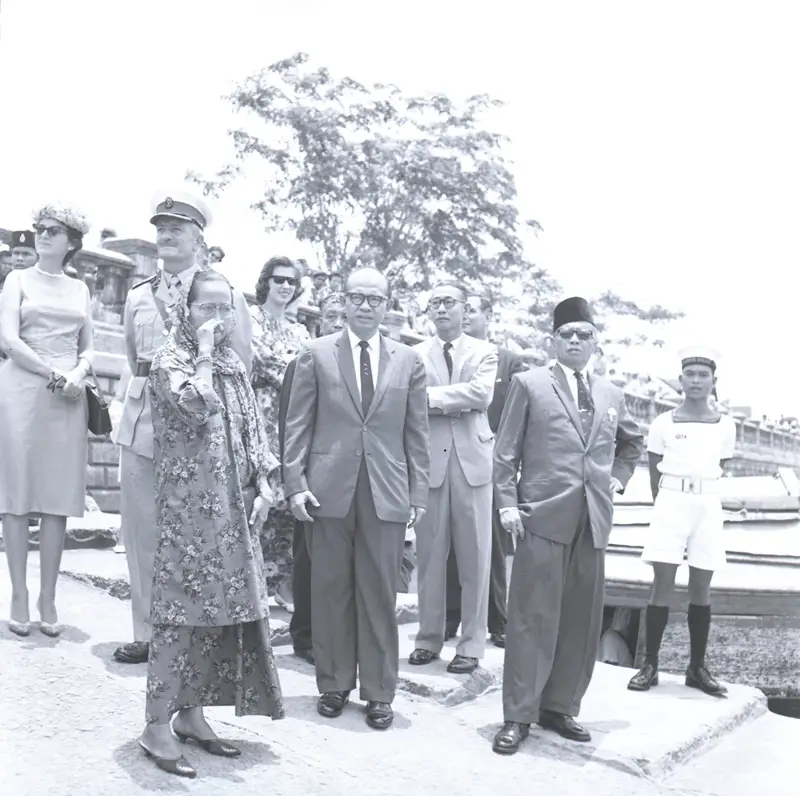
Sarawak’s first governor Datu Abang Haji Openg bin Abang Sapi’ee , chief minister Stephen Kalong Ningkan and other officials awaiting the arrival of outgoing colonial governor on Pangkalan Batu.

The Waddells left their official residence at the Astana at 12.30pm on Sept 15, 1963 by the state sampan from Pangkalan Batu before they would board the British frigate H.M.S. Loch Killisport anchored at the Steamship Wharf. 

“The Astana is all yours now” was what he said to the new Governor Datu Abang Haji Openg bin Abang Sapi’ee before he boarded the Astana sampan.  Also present to say their farewells were Ningkan and Temenggong Jugah anak Barieng. 

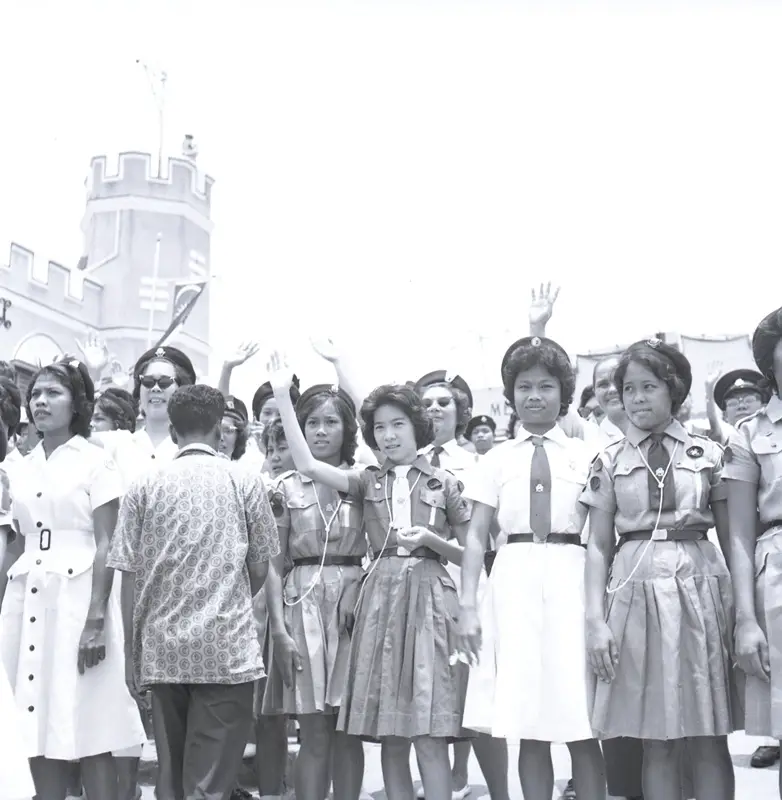
As the sampan drew knew to the frigate, three cheers of “Hip Hip Hurrah” rang though the crowd who came to witness the departure of the last colonial governor. 

Waddell's last goodbye to Sarawakians on the eve of Malaysia Day
Waddell saying goodbye to Sarawak’s first governor Datu Abang Haji Openg bin Abang Sapi’ee .

Lady Waddell made her final gesture of farewell by standing on the bridge of the British frigate, waving goodbye with a white handkerchief to crowds lining both sides of the riverbanks. 

The frigate moved slowly along the Sarawak River and as it was sailing past Fort Margherita, the Sarawak Constabulary Band played “Auld Land Syne”. 

Waddell’s last message to the people of Sarawak

At 1pm his farewell message was broadcast over the radio to the people of Sarawak, “To say goodbye is never easy but it is particularly difficult to say goodbye to Sarawak – the more so at a time of historic change and of great events.” 

His words were both careful and thoughtful as he said, “Of these I will not dwell but you can be sure that tomorrow Malaysia Day and in the future our thoughts, our hearts and our prayers will be with you as you step out on the great high road of independence with the star of hope and promise before you.”

Waddell's last goodbye to Sarawakians on the eve of Malaysia Day
There were crowds lined up on both sides of the riverbank to give Sir Alexander Waddell and Lady JeanWaddell an official send-off.

Waddell, who was appointed as the Governor of Sarawak in 1960 and spoke in Malay at his installation, reminisced over his three-and-a-half years of service, his memories visiting various rural places in Sarawak such as Rajang and Baram in his final words. 

“Those are but few of the memories that come crowding in – there are millions more and of gay and tragic events none more than in the last crucial years of endeavour.

“But the sum is of a wonderful country with a charm and vigour and tradition that is unequalled in the world, with its peoples of dignity rugged individuality and warmth at heart”. 

“These things you must not lose for they are Sarawak and you will add immeasurably to the strength of the new nation upon which you enter tomorrow,” Waddell reminded Sarawakians. 

Waddell's last goodbye to Sarawakians on the eve of Malaysia Day

“You will all I know support the new government to the full in the days that lie ahead when the State flag, of revered origin, is unfurled tomorrow.”

The departure of last British governor marked the end of one chapter of Sarawak’s history which started 17 years earlier when the Act of Cession brought Sarawak under the direct rule of British constitutional monarchy.

A new chapter started the day after, on Malaysia Day when the flag of the Federation of Malaysia was first raised and the national anthem ‘Negaraku’ was first played at Central Padang, now known as Padang Merdeka. 

Waddell died at Cirencester, Gloucestershire on June 14, 1999. He was 85. 

Ong Kee Hui’s letter on the Wangkang festival in Sarawak

The Wangkang festival is a unique event aimed to pick up evil spirits and wandering souls believed to be responsible for sickness and epidemics, ultimately to cast them away and bring peace to the world.

Back in the 1930s, Kuching and Malacca were the only two towns outside of China in which this festival was held.

How did the festival come to Sarawak in the first place? On Feb 2, 1937, a man named Jee Eng Fui from Simanggang wrote an open letter to Ong Kee Hui in The Sarawak Gazette.

Jee asked the latter two questions; how did the Wangkang festival come to be a customary procession among the Chinese at Kuching once every two years? And was there anything concerning it in Sarawak history?

Jee added that he had heard one version of Wangkang festival origin in Sarawak. An old man told him that one morning the old Rajah (it is unsure which Rajah) used his telescope to look towards the mouth of the Kuching river.

The rajah then saw a very curious junk and he became very anxious to see it when it reached Kuching.

However, the junk never came. He searched for it with his telescope again but saw nothing.

The next morning, the rajah looked into his telescope in the same direction and saw the junk again.

This time, he sent a search party to the river but they returned without finding anything.

The rajah told his Chinese friend about the story who had then informed him that he must have seen a Wangkang.

That was how the rajah came to know about Wangkang rite and procession. He then allowed the Chinese community in Kuching to hold the Wangkang festival.

Ong, who later became a prominent politician and founder of Sarawak United People’s Party replied Jee in an open letter published in The Sarawak Gazette (Apr 1, 1937).

Ong Kee Hui’s letter on the Wangkang festival in Sarawak
Do you have any photos of Wangkang Festival happening here in Sarawak? Share with us in the comment box.
Here is the content of the letter on the origin of Wangkang Festival in Sarawak:

“Dear Mr Eng Fui,

It has given me much pleasure to receive your letter dated the 15th instant. Your enquiries are of considerable interest to me and I only hope you will excuse the delay in relying.

As a result of enquiries which I have made from my grandfather, Mr Ong Tiang Swee, supplemented by information gathered from my uncle Teck Khoon, I am able to answer your queries. I think you now know how the Wangkang procession started in China, but in case you do not, I will give a brief account of its origin.

A certain Emperor (Ban Lek?) in the Ming Dynasty was a most sceptical man in matters spiritual, and even went so far as to question the powers of his spiritual adviser (Teo Thian Soo).

He demanded some sort of proof of this man’s supernatural powers, and put forward a scheme to set the adviser’s powers to the test. He had a big tunnel dug, fully ventilated and well provisioned, and in the tunnel he put forty of his officers of the rank of Chin Soo.

Over the tunnel the spiritual adviser was told to use all his powers and try to kill the officers inside.

The challenge was accepted, and as a result all the forty officers were killed.

The revenge of the dead

The Emperor was satisfied but not so the spirits of the victims of the experiment.

They haunted the palace and pestered the Emperor, who had no peace of mind.

The cruelty of the whole thing invoked the vengeance of the power above, and China was visited by an epidemic of cholera, which killed a large number of people.

At last the Emperor had to appease the spirits of the forty Chin Soo and make some sort of treaty with them.

The Emperor promoted them all to the rank of Wang and empowered them to visit every district in his kingdom as his representative.

He also gave out that all honour and respect had to be accorded them wherever they went, if not, they could wreak their vengeance on the people of the locality.

The spirits were satisfied, and on an appointed day with much ceremony they were given a public send off on their long, long voyage that was to have no end in a junk especially made for them.

And thus was started the first Wangkang procession in China.

The letter then continued on how it came to Sarawak:

The story of the old Rajah and the Chinese junk he saw has no connection with the origin of the Wangkang procession in Kuching.

What actually happened was that a serious epidemic of cholera broke out in Kuching; hundreds of people died, and as there were so many people dying each day no proper burial could be given them.

As a result, the whole town reeked with the terrible smell of the dead.

The Rajah (Charles Brooke) was at loss to know what to do. The older Chinese, recalling what had happened during the Ming Dynasty in China, came to the conclusion that the forty Chin Soo must have reached Sarawak at last, and the epidemic of cholera was an indication that they were here.

So steps were taken after a public meeting to entertain the visiting spirits, and to send them away with all honour and respect.

Thus was started the first Wangkang procession in Sarawak.

The epidemic was then so bad that the Rajah really did not care a pin what people did so long as normal conditions were restored, so no objection was raised and it transpired (whether it was coincidence or not, we cannot say), that the epidemic stopped some time after the procession.

An arrangement was then made with the spirits concerning their next visit, and that was how the ten years’ interval came into being.

I need hardly add that there has been no epidemic of cholera in Sarawak since. Firm believers attribute this to the effect of the Wangkang procession.

Personally, I think that the real cause of the epidemic has been removed, namely a bad water supply.

Kuching was in the old days dependent on the river for water, and you can imagine how dirty river water can be especially during dry season.

No wonder there was cholera!

Now with the supply of good and pure water we have from Matang such a state of affairs no longer exists, and chances of serious epidemics are remote.

Yours sincerely,

Ong Kee Hui

Fast forward to today, the festival became recognised as Malaysia’s National Intangible Heritage in 2013, has been submitted to Unesco to be recognised as intangible cultural heritage.

Read more:

How to cure Cholera According to Old Sarawakian Traditions

How the cobra got its venom according to a Kedup legend

Local folktales and legends commonly have an answer for everything. Although they are not scientifically correct, it is still entertaining to know how some things came about from a mythical point of view.

How the cobra got its venom according to a Kedup legend
How did this snake get its venom? Credits: Pixabay
Here is a legend of how the cobra got its venom according to a legend recorded from Ulu Kedup, Sarawak:

Long time ago, there was a black fish called the ikan dudok. This fish was the most poisonous of creatures, so much so that if a man’s shadow even fell on a pool in which the ikan dudok was lurking, the man would immediately die.

The cobra, although a wise and cunning beast, in those days had no weapons of defence, but wore in the centre of his head a bright jewel.

One day, the cobra sidled up to the pool where the ikan dudok lay and hissed. “Oh black fish! Are you not ashamed of the deaths you caused? You are a stupid fish, unfit to have this virulent poison which you use so indiscriminately.”

The cobra then asked the fish to give its poison in exchange for the bright jewel on his head.

Then the cobra reared up his head in the sun and the fish saw the sparkling jewel.

He agreed to the exchange, vomiting out the poison on a handy leaf. In the meantime, the cobra gave up its jewel (which of course, was not a real diamond).

“Good!” said the cobra, “Now I promise you that I will not spread death with this poison as you have; I will only strike men in their eyes or on their big toe.”

Thus to this day, the cobra rears up proudly to search for his victims’ eyes. Meanwhile, the legend also explains why you can find a white stone in the head of every ikan dudok.

As for the leaf that the fish chose to vomit on, its poison is called daun api. One can get a painful rash with just a brush from this leaf.

#KajoPicks: 5 movies inspired by the Gwangju Uprising you should watch

In 1980, South Korean president Chun Do-hwan’s military rule led to a confrontation in a city of Gwangju, the southern region of South Korea. The confrontation would later be known as the Gwangju Uprising, May 18 Gwangju Democratisation Movement or May 18 Democratic Uprising by UNESCO.

From May 18 to 27, 1980, Gwangju residents took up arms by robbing local armories and police stations.

The uprising started when local Chonnam University students started to demonstrate against the government’s martial law.

About 200 students gathered at the the gate of the university and were opposed by 30 paratroopers on the morning of May 18.

By evening, the government dispatched 686 soldiers to the scene as the conflict broadened to more than 2,000 protesters.

Witnesses reported the soldiers attacked both protesters and onlookers.

As the conflict escalated, the army started to fire on civilians, killing an unaccounted number on May 20.

The protesters then began to seize weapons from police stations and armories, then attacking the army.

By May 21, the soldiers left and citizens took over the city. On May 26, the army returned to retake the city. After less than two hours of operations, the army arrested 1,740 rioters.

Like many riots or protests around the world, there is no universally accepted number of the death toll during the Gwangju Uprising.

The official figures stand at 144 civilians, 22 troops and four policeman killed. However based on foreign press, the actual death toll could be up to 2,000.

After South Korean President Moon Jae-in took over office in May 2017, he vowed to investigate the government’s role during the Gwangju Uprising.

Later it was revealed for the first time that the army had used a helicopter to fire on civilians.

In 2018, the South Korean government formally apologised for the rape of women by troops during the Gwangju Uprising.

A formal investigation by the government confirmed there were 17 cases of sexual assault, including against teenagers and a pregnant woman.

The Gwangju Uprising definitely left a dark mark in South Korean history. According to Korea Resource Center, it ignited the floundering pro-democracy movement in Korea culminating in 1987 when the People’s Power movement finally broke the power of the South Korean military.

With a number of references and portrayal in popular culture, South Korea’s younger generation will not forget this piece of their history.

So here are KajoMag’s picks of five movies to watch inspired by the Gwangju Uprising:
1.26 Years (2012)

This movie is a fictional story circling around five ordinary people from different backgrounds who come together to kill the person behind the massacre during Gwangju Uprising.

26 years after the massacre in 2006, a sports shooter, a gangster, a policeman, a businessman and head of private security firm plot revenge against the man responsible.

Former president Chun Doo-hwan is believed to given the order to fire on civilians but he is not explicitly named in the movie.

However, the target clearly is referring to Chun.

The main three characters are Kwak Jin-bae (Jin Goo), a gangster who lost his father during the uprising, Shim Mi-jin (Han Hye-jin) a national team shooter and policeman Kwon Jung-kyuk (Im Seul-ong) who lost his family.

2.Peppermint Candy (1999)

After watching this movie, you will never forget the iconic opening scene when the main character Yong-ho faces an oncoming train, screaming “I want to go back again!”

As the movie starts with the suicide of Yong-ho, the story unfolds through flashbacks some of the important events over the past 20 years leading to his death.

Every event in his life coincides with some of the major incidents in South Korean history, including the Gwangju Uprising.

During his flashback to the uprising, Yong-ho is seen performing his mandatory military service. This is when he accidentally shoots and kills a student protester.

It also shows how he becomes traumatised by the shooting incident and later becomes a more brutal and cynical policeman.

Likewise, Yong-ho ends up losing his job in the 1990s, mirroring the real-life impact of the Asian financial crisis.

The movie explores different themes, including how it killed the innocence of those who pulled the triggers during the uprising.

Watch the trailer here.

3.Fork Lane (2017)
#KajoPicks: 5 movies inspired by the Gwangju Uprising you should watch

Similar to Peppermint Candy, Fork Lane (2017) follows the story of a soldier trying to cope with his life after Gwangju Uprising.

It tells the story of Kim Gang-il (Uhm Tae-woong), a paratrooper who was sent to suppress the protesters during the demonstration.

After his retirement, he works as a forklift driver. Eventually, he starts to uncover the truth from his past.

4.May 18 (2007)
#KajoPicks: 5 movies inspired by the Gwangju Uprising you should watch

Most of the protesters during the Gwangju Uprising were not part of the initial protest in front of the university but were acting in retaliation after their loved ones were attacked by the soldiers.

The main character, Min-woo (Kim Sang-kyung) leads a peaceful life with his younger brother Jin-woo (Lee Joon-gi) until the uprising happens.

Angry that his classmate is beaten to death by the military while they are not even college students, Jin-woo leads his friends into the streets to protest.

Meanwhile, Min-woo wants to stop his brother from taking part in the uprising.

This movie shows how the first attack on civilians on May 18 triggers other unassuming citizens to fight for what is right.

5.A Taxi Driver (2017)

While other movies inspired by the Gwangju Uprising are fictional, here is a movie that might be closest to the real event.

The story follows a taxi driver Man-seon (Song Kang-ho) who receives an offer to drive a foreign journalist from Seoul to Gwangju during the uprising.

The character is loosely based on real-life taxi driver Kim Sa-bok whose existence remained out of the public eye until the release of A Taxi Driver. He died of cancer in 1984, four years after the Gwangju events.

Meanwhile, the journalist Peter (Thomas Kretschmann) is based on the life Jurgen Hinzpeter (1937-2016) who filmed and reported on the Gwangju Uprising.

His widow, Edeltraut Brahmstaedt watched the movie with President Moon in 2017. The Blue House later released a statement saying, “The movie shows how a foreign reporter’s efforts contributed to Korea’s democratization, and President Moon saw the film to honor Hinzpeter in respect for what he did for the country.”

The film turned out to be a commercial success and was the second highest grossing film of 2017.

Watch the trailer here.

The local Kanowit version of the Fox and Steele murders

After two of Brooke’s officers – Charles James Fox and Henry Steele – were murdered in 1859, the government named two suspects behind the crime.

They were Saweng (sometimes spelled Sawing) and Sakalai (sometimes spelled Sekalai).

So who were they and what drove them to kill the officers?

Here is what the local Kanowit people believed happened in the Fox and Steele murders:

This version of the story was told by Jaro Lamit who was a former chief of Kampung Bedil, Kanowit. He told the story to The Sarawak Gazette in September 1963 when he was already in his mid-eighties.

In the olden days, there were many tribes living in Kanowit, including the Kanowit tribe. The Kanowit people were more populous in this area than the other tribes.

Two of their chiefs were Saweng and Sakalai. Sakalai, however was a Melanau from Matu by birth.

According to Jaro, the site of the secondary school at Kanowit in the 1960s used to be where two longhouses stood.

“In those days the Kanowit people were divided into three ranks; Raja (aristocrats), Panyin (middle class) and Dipan (slave). The aristocrats lived in the middle apartments of the longhouse; the middle class (panyin) lived on either side and the slaves (dipan) lived with the families of the aristocrats. They worked for the aristocrats and everybody lived at peace,” Jaro stated.

Then a beautiful girl named Nyalade came into the picture. Saweng only had eyes on Nyalade and wished to have her hand in marriage.

However, Nyalade had her own mind, telling Saweng, “If you are really a brave man and invulnerable, you go and cut off the heads of the two white fowls on the other side of the river.”

Nyalade was actually refusing to marry Saweng because he already had a wife and two children.

Saweng, nonetheless, felt ashamed and threatened with Nyalade’s dare. He then told his people to pack all their belongings and make refuge at Kabah river (Nanga Kabah) where they built a stronghold.

Determined to prove his bravery, Saweng and a few of his men – including Sakalai – went to the fort where Fox and Steele stayed.

Jaro told the gazette, “Before they reached the Fort, Saweng said to Sakalai and his friends, ‘When I begin to chew betel nut, you will kill those Europeans.’ When they reached the Fort, Saweng began to chew betel nut, and Sakalai and his friends took their parangs and killed them.”

The local Kanowit version of the Fox and Steele murders
Kanowit bazaar in 2016.
The aftermath of the murders
The local Kanowit version of the Fox and Steele murders
The double homicide of the Brooke officers had led the Brooke government to send punitive expedition against the Kanowit people. Credit: Pixabay.

After the news of the murders reached the White Rajah, the Brooke government sent a punitive expedition to Kanowit.

They made the fort into a stronghold and attacked the surrounding villages with their guns and cannons.

Meanwhile, Saweng and his followers made their escape to Kabah river to their stronghold.

The Ibans that the Brooke recruited knew about this so they followed them to the stronghold. Some of these Ibans were once allies to Saweng.

After a ferocious fight between Saweng and his men against Brooke and his Iban warriors, Saweng’s troop started to break apart.

As many of his followers died during the battle, those who came from Matu, Igan and Mukah to fight went back to their own homes.

Even some of the Kayan and Bukitan people who helped him perished during the battle.

Saweng, however did not falter. He attempted to escape up the Rajang river to the Iran river. There, he fought another fierce battle with the Brooke troops.

Jaro said, “The water of the Iran river became red with blood. After a long fight at the Iran river, Saweng and his followers could not longer stand the heavy fire of the Rajah’s party, and escaped to the Pelagus river where they again made a stand.”

Saweng and his followers continued to fight through the Brookes as they made another escape to the Kejaman longhouse at Tuju Metahap, near the Belaga bazaar today.

There, he made the Kejaman longhouse as his stronghold. Legend has it that he hung a mat in front of the house in order to protect it. It was said that none of the bullets fired on the longhouse were able to penetrate the magical mat.

Nonetheless, many of the Sekapan and Kejaman people paid the price for harbouring Saweng and his men.

Saweng’s final escape to Anap

After staying with the Kejaman people Tuju Metahap, Saweng then went to Anap.

When Saweng and his followers fought against the Rajah’s expedition, his children Gadap and Metalai were actually still living in Kanowit.

Upon learning about this, the Rajah reportedly sent a letter to Saweng in Anap telling him that his children were under arrest.

In order to free his children, Saweng decided to surrender himself to the Rajah in Kuching. There, he was put in jail.

They tried to put him to death by different kinds of methods such as stabbing and shooting but all failed.

The Kanowit people believed he had some power that made him invulnerable.

According to Jaro: “In the end Saweng said to the Rajah, it is painful to have your men trying to kill me like this, and it will be better for me to die quickly. Saweng then asked the Rajah to kill him himself and the Rajah took his dagger and killed Saweng.”

That one time a dragon caused a flood in Belaga in 1942

Different cultures around the world have attributed mythical creatures as the cause of meteorologic phenomenons or natural disasters like flood and earthquake.

For example, in Japanese mythology, the Namazu is a giant catfish that causes earthquakes with his tail.

Meanwhile, the thunderbird in Native American culture is believed to have the ability to produce thunderstorms and rain.

Here in Sarawak, there was one heavy flood which the locals believed had been caused by an angry dragon.

The Sarawak Gazette reported on a flood in Belaga which startes on Feb 21, 1942 and lasted for five days.

Apparently, the Kayans blamed the Kenyah Badeng whom they said tried to tie a dragon to a farm hut with rattan.

They said the dragon was about the size of an areca palm tree with a body resembling a snake with scales, horns and legs.

Somehow, the dragon managed to escape from its ties and wreaked vengeance on the people of Belaga by sending them the biggest flood they had ever experienced.

That one time a dragon caused a flood in Belaga in 1942
Belaga town in 2017.
Worst flood ever recorded in Belaga?

According to the gazette, to anyone who happened to be in Belaga at that time, the feeling was that the downpour of rain before and during the flood was enough to drive away people and dragons.

“The flood was actually caused by the heavy downpour of rain up to the Sungai Belaga and Balui at the same time and the Giam (rapids) obstructing the flow of an abnormally large volume of water.”

The report continued, “Thoughthe flood was 15 feet high from the Kubu (fort) ground floor, many buildings on a lower ground level were submerged. Those who built of lighter materials were floated away as soon the flood reached the roof top. It was strangely amusing to see the newly erected Government Dispensary moved away like a tortoise.”

Some of the village houses were anchored to the nearby trees using rattan while a few Kayan longhouses washed away by flood like steamships with cats and dogs still inside.

The shophouses in Belaga bazaar were reported to still be more or less intact but did not escape some damage.

Before this, other floods that had been officially recorded in Belaga took place in Jan 28, 1934 (estimated at 8 feet high) and Mar 24, 1887 (estimated at 4 feet).

However, it is unsure if these floods were also caused by an angry dragon.

Four covert operations by Z Special Unit in Borneo during WWII

For those who survived, they kept their silence for 30 years. Nobody knew what they did during World War II (WWII).

For those who died during their missions, nobody, not even their families knew about their sacrifices or the nature of their deaths for those 30 years.

They were part of Z Special Unit, a joint Allied Special forces unit formed to operate behind Japanese lines in Southeast Asia.

The operatives were mostly from Australia while others were British, Dutch, New Zealand, Timorese and Indonesian.

After the war ended, the special military unit operatives were sworn to secrecy and not allowed to tell anyone of their experiences until 1980.

While their best known missions were Operation Jaywick and Operation Rimau (both of which involved raids on Japanese shipping in Singapore Harbour), these operatives also carried out covert operations in Borneo.

Here are at least four covert operations run by Z Special united in Borneo during WWII:
Four covert operations by Z Special Unit in Borneo during WWII
Members of Z Special Unit at their base at East Arm, near Darwin. Credits: Australian War Memorial.
1.Operation Python

As all Z Special Unit’s operations were covert and secretive, not much has been revealed to the public even almost 80 years since the war has ended.

This included Operation Python which took place from 1943 to 1944. The mission’s objective was to set up a wireless station near Labian Point in Sabah and undertake covert operations reporting on the Imperial Japanese Navy in the Sibutu Passage and the Balabac Strait of the Sulu Sea.

The overall operation was divided into Python I and Python II. During Operation Python I, the Z Special Unit operatives landed along Labian Point in early October 1943. Besides setting up a wireless station there, they also supported and provided equipment for Filipino guerrillas.

In January 1944, Operation Python II took place with the objective of organising the native population for guerrilla warfare.

Unfortunately, these early operations did not yield significant results.

2.Operation Agas

A total of 44 Z Special Unit operatives took part in Operation Agas in carrying out guerrilla warfare against Japanese in North Borneo (present day Sabah) with the support of locals.

Operation Agas was split into five operations, starting in March 1945, continuing up to September and October 1945.

While the operations were able to supply reliable information to Australian forces, they did little rescue mission-wise.

For example, Agas 1 operatives provided information about the Sandakan Death March but there were no rescue missions for the prisoners of war (POWs). The death march subsequently resulted in the deaths of 2,434 POWs.

Nonetheless, the intelligence gathered during Operation Agas helped the Allied forces during the Battle of North Borneo which was fought between June 10 to Aug 15, 1945.

3.Operation Semut

While Operation Agas was executed in North Borneo, a similar covert mission was undertaken in Sarawak called Operation Semut.

There was four operations undertaken under Operation Semut. Overall, the operation reportedly caused the deaths of 1,500 to 1,700 Japanese from March to October 1945.

Under this operation, the Z Special Unit members trained and supplied the locals with weapons to help conduct surveillance and sabotage behind enemy lines.

Unlike Operation Agas, the intelligence gathered during Operation Semut was not entirely helpful as the locals could not differentiate between facts and rumours.

4.Operation Platypus

Just like any other operations undertaken by Z Special Unit, Operation Platypus aimed to gather intelligence and train local peoples as resistance fighters against the Japanese.

The operatives were inserted in small groups into the Balikpapan area of Dutch Borneo (present day Kalimantan).

There were 11 operations altogether in Operations Platypus with the first part of the operations carried out on Mar 20, 1945.

The last operation took place on July 22, 1945 where the operatives used folboats to reconnoitre and pinpoint prospective target areas.

5 things you should know about Sarawak’s flags throughout the years

Did you know that the current Sarawak flag was inspired by the state’s old flag when it was under the reign of the White Rajahs?

Over the years, there have been several changes to the Sarawak flag with the current design becoming official in 1988.

And who could forget the Trisakti that was designed and first hoisted by the then Chief Minister of Sarawak Abdul Rahman Ya’kub in 1973?

5 things you should know about Sarawak's flags throughout the years
The Trisakti flag: The blue was supposed to symbolise Sarawakians being unified in pursuit of national aspirations; the red to symbolise their perseverance and determination; and the white to reflect honesty and purity.

The current design retains the same colour scheme as the flag of the former kingdom, except with two significant changes. The cross was replaced with two diagonal bars while the crown was substituted with a nine-pointed star.

Here are 5 things you should know about the history of previous Sarawak flags before all these changes:
1.Before there was an official flag, there was the flag of St George.
5 things you should know about Sarawak's flags throughout the years
Brooke’s personal standard was the flag of St George’s Cross. Photo credit: The Sarawak Gazette.

When the first White Rajah James Brooke came into power, he originally used St. George’s Cross as the state’s flag.

It was a red cross on a white background in the form of swallow-tailed pennant. James flew this flag over his first fort at Berlidah, not far from Siniawan.

2.The first official Sarawak flag was designed by James Brooke.

Finally in 1845, James decided to give Sarawak a flag of its own. However, he only hoisted it three years later on Sept 21, 1848.

The flag was made up of a half blue and half red cross of his Armorial Bearings on a yellow background.

So what did the first White Rajah do after there was an official Sarawak flag? In 1845, he applied to the British Ministries for Foreign and Colonial Affairs in order for them to recognise Sarawak by allowing a Protectorate flag to be displayed.

However, it took the British government 15 years (January, 1864) to recognise Sarawak as an independent state and another 35 years (June, 1888) before Britain expressed its protection.

James was reported to have regretted that the flag did not contain a quartered Union Jack (like you see in today’s New Zealand and Australian flags).

3.Was it blue or purple?
5 things you should know about Sarawak's flags throughout the years
The first official Sarawak flag caused some debate over whether it was a blue and red cross or a purple and red cross. Photo credit: The Sarawak Gazette.

The only recorded account of the first hoisting of the Sarawak flag can be found in “Letters from Sarawak” in 1851 by Harriette McDougall, the wife of Bishop McDougall.

She wrote a letter to her son Charley who was at school in England, which was later published to help raise missionary funds in Sarawak.

Unfortunately, Charley passed away a year after this letter was written due to a blow from a cricket ball.

Going back to the Sarawak flag, this was what Harriette wrote to her son:

“The Sarawak flag is a purple and red cross, out of Sir James Brooke’s armorial shield, on a yellow background, yellow being the royal colour of Borneo. It was given by the Rajah to his people on his return from England in 1848 and I remember well what a grand occasion it was. HMS Meander was at Sarawak (the old name for Kuching) at the time, and their band played ‘God save the Queen’, as the flag was the first time hoisted on the flag-staff before the Rajah’s house.

All the English (probably only men) were assembled there, and a great crowd of natives, Malays and Dayaks, whom the Rajah addressed in the Malay language telling them the flag which he had that day given them would he hoped, be their glory and protection, as the flag of England had been hers. The Malays listened with love and reverence to his words and from house across the river, I could hear their acclamation.”

Although Mrs McDougall here pointed out that the flag was a purple and red cross, the second White Rajah Charles had clarified in a letter that the cross was in fact blue and red.

But that did not stop many of the early writers from the late 19th century stating that the colours were purple and red.

4.The first recorded official notification regarding the Sarawak flag was issued on May 7, 1870.

According to archivist W.J Chater, the first official notification regarding the Sarawak flag was concerning the dimensions of the flag.

It also stated, “Black bunting to be used in place of blue” denoting the change from the cross’ blue colour to black and quash the rumours that it was purple instead of blue.

5.The three bodies that first used Sarawak flags officially

While it is common to see the Sarawak flag hoisted up in front of government buildings these days, back in the olden days the Rajah first gave the Sarawak flags to three bodies, namely the Society for the Propagation of the Gospel (S.P.G) in 1871, the Borneo Company in 1874 and the Roman Catholic Mission in 1906.

The Roman Catholic Mission hoisted the Sarawak flag for the first time on Vyner Brooke’s birthday (Sept 26, 1906).

Meanwhile, the Kuching branch of the Borneo Company Limited hoisted the flag only for a short time. Then they refused to do so reportedly because they found ‘it was too ugly’ and the blue border being a Chinese sign of mourning might have been considered unlucky for business.

1 38 39 40 41 42 75