Patricia Hului

Patricia Hului is a Kayan who wants to live in a world where you can eat whatever you want and not gain weight.

She grew up in Bintulu, Sarawak and graduated from the University Malaysia Sabah with a degree in Marine Science.

She is currently obsessed with silent vlogs during this Covid-19 pandemic.

Due to her obsession, she started her Youtube channel of slient vlogs.

Follow her on Instagram at @patriciahului, Facebook at Patricia Hului at Kajomag.com or Twitter at @patriciahului.

Ellena, the forgotten American colony in Sabah

Did you know that there was an American colony in Sabah? And at one point in time, James Brooke and successors were not the only white ‘Rajahs’ on Borneo island.

The establishment of Consulate in Brunei

In 1850, the United States signed a bilateral treaty of Peace, Friendship, Commerce, and Navigation with the Sultanate of Brunei. This treaty was enforced on July 11, 1853 and is still in effect to this day.

Then in 1865, the US sent its first consul in Brunei, Charles Lee Moses.

Moses later on played an important role in the establishment of Ellena.

In August 1865, Moses concluded a 10-year lease with Brunei’s Sultan Abdul Momin.

The Sultan then guaranteed land rights in various areas in the north of Borneo.

Later, Moses went on to sell these rights to an American merchant Joseph William Torrey in return for a third of any profits made.

In October 1865, Torrey along with another American, Thomas Bradley Harris decided to build a colony in the area of today’s Kimanis, about 45km from Kota Kinabalu.

The new venture was pursued under The American Trading Company of Borneo. It was a chartered company formed by Torrey, Harris and several Chinese investors.

Torrey even made a trip to Sultan of Brunei to draw up a new concession letter on Nov 24, 1865.

In the letter, the Sultan even gave Torrey the title of ‘Rajah of Ambong and Marudu’.

The beginning of Ellena colony

Finally in December 1865, Torrey with 12 Americans and around 60 Chinese founded a colony in Kimanis called ‘Ellena’.

After raising a flag of his own designed, Torrey appointed himself as the governor and Harris as his vice-governor.

The news of this colony even made it to Hong Kong China Mail. The news reported, “The progress of the enterprise will be watched with much interest, as being the first attempt of Americans to colonise away from their own continent.”

Ellena, the forgotten American colony in Sabah
Thomas Bradley Harris (standing) and Joseph William Torrey, founders of the US colony “Ellena” on the Island of Borneo

The downfall of Ellena

According to Frank Tatu in his paper ‘The United States Consul, the Yankee Raja, Ellena and the Constitution’, the British government was concerned with American intentions.

They asked their Minister in Washington to enquire about the issue.

In response, the British was informed that the US had not authorised any attempts to form any settlements in Borneo.

As for Moses, he simply acted on his own.

Maybe because the colony was not approved by their own government, Ellena went down as fast as it came into being.

Ellena became a target for pirates from Hong Kong and Macau.

In the same time, the colony did not have any financial backup and their workers were going hungry.

Rumours had it that it was Moses who recruited the pirates in an effort to collect the money from the company.

While Torrey was trying to find investors in Hong Kong for Ellena, Harris died of Malaria on May 22, 1866.

By the end of 1866, Ellena was abandoned.

The remaining Ellena colonists found work at nearby British-operated coal fields while others went back to Hong Kong.

As for Torrey, he buried his friend Harris on the top of a nearby hill in Ellena.

He still used his title as the ‘Rajah’ and conducted commerce in the region for several years.

Finally in 1881, Torrey sold his rights in Kimanis to Austrian Baron von Overbeck and partner Alfred Dent for $25,000.

This paved way for what we know now as the British North Borneo Company (BNBC).

What happened to Moses?

The fall of Ellena affected the life Moses who became poor after the collapse of the colony.

Tatu stated, “He frequently wrote the US State Department complaining that no consular fees were to be had, and imploring that he be accorded a salary. Receiving no favourable response, Moses was driven to desperation.

“Moses allegedly armed attacks on the burning of his consulate on Mar 25, 1867 by ‘Malay people’.
By way of demanding reparations, Moses threatened the Sultan with retaliation by American naval units ‘to fire and burn the city.’”

However, the Sultan strongly believed that Moses burned the consulate himself. He was reportedly seen removing valuables from the consulate for days before the fire.

In the meantime, Moses moved to Labuan to wait for any news especially from the US.

There, tragedy struck him again when one of his children died. He had no choice but to send his wife and surviving child back to the US.

In September 1867, Moses received the news that he had been suspended from his duties by the president.

Then in May 1868, he boarded the Barque Swallow and later reported to be lost at sea.

The rediscovery of Ellena and he rediscover the grave of Thomas Bradley Harris

Ernest Alfred Pavitt, a land surveyor for the British North Borneo Company (BNBC) was the one who found Harris’ grave in 1909.

In a note published in British North Borneo Herald, Pavitt wrote, “A good many years ago, having to go from the West Coast to the Interior of British North Borneo, accompanied by Mr. P.F. Wise, the District Officer of North Keppel, we made our starting point from Kimanis and from the principal native kampung on the river. Mr Wise pointed on a hill on which he had told me an American gentleman had, some years previously, been buried.

”This was again brought forcibly to my collection some days ago as in my examination of land at this particular place I sent a gang of coolies to clear the top of a small and prominent hill of jungle to enable me to have a look at the surrounding country.

“On my going up a few days later I found this was the resting place of evidently an old pioneer, as there still exist in a very fair state of preservation both the head and foot stone marking this interesting spot.”

A year later, while BNBC was opening the Kimanis Rubber Estate, they found that some of the hill sides had been carefully terraced.

The company believed that these terraces were probably the remains of the company’s experimental planting.

What happened to Torrey after Ellena collapsed?

A year after the collapse of Ellena, Torrey had a daughter born in 1867. He named her Elena Charlotte, most probably after his colony.

Torrey later bought his own ship which he christened as ‘Ellen’.

From 1877 to 1880, Torrey was a vice-consul at the US Consulate in Thailand.

By 1883, he returned to America. In 1885, he received the news that he had been appointed as the King of Thailand’s chief adviser.

While he was contemplating whether he should accept the post, Torrey died suddenly on June 22, 1885.

After his death, Torrey was known as the ‘Yankee Rajah’ and ‘the only American Rajah’ despite the fact his beloved colony did not even last a year.

Elizabeth Mershon’s patronising descriptions of ‘Wild Men of Borneo’

It is the 1920s. Imagine you are a pastor’s wife, and have sailed thousands of miles from your home to live in a very foreign country.

You don’t speak the local languages so there is no way you can understand their cultures or customs.

Your husband is always away from home preaching to people you refer to as the ‘wild men’ with hope the news of the Gospel will ‘civilise’ them.

And you stay at home with your servant girl who often clashes with you because she is not running the chores according to your American way.

The only way you could learn about this foreign place you are living in is through your husband and other Westerners around you.

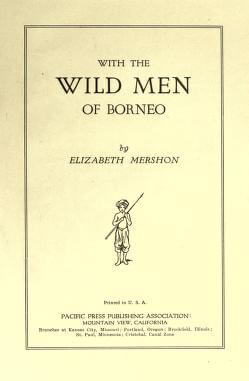
By the time you return to your home country, you write a book and publish it under the title ‘With the Wild Men of Borneo’ (1922), which is what Elizabeth Mershon did.

Elizabeth and her husband Leroy Mershon were stationed in Sandakan in the 1920s as part of the Seventh-day Adventist North Borneo Mission.

Her book ‘With the Wild Men of Borneo’, obviously was by no means an anthropology book but was based on her experience here in Borneo.

For the most part, it offers a glimpse of life in Borneo before World War 2, and also the Western perspective of the ‘civilising mission’ which can be seen in Mershon’s descriptions of Borneans as part of an introduction in the third chapter of her book.

These descriptions are based on her personal opinions which Mershon seemed to have gathered from hearsay around her.

Elizabeth Mershon’s patronising descriptions of ‘Wild Men of Borneo’

So here are some of Elizabeth Mershon’s eyebrow-raising descriptions about the so-called ‘Wild Men of Borneo’:

1.There are ‘two classes’ of Dayaks and one of them is ‘more truthful than the other’

“There are two classes of Dyaks. Those living inland are called Land Dyaks; those living on the coast are called Sea Dyaks.”

“The Sea Dyak, unlike the Land Dyak, is truthful and fairly honest.”

2.The Ibans are descended from the Bugis?

“The Sea Dyaks are not as pure a race as the Land Dyaks, having intermarried with the Bugis from Makassar, in the Celebes.”

3.The description about Bajau people

“On the east coast of British North Borneo are found the Bajaus, or Sea Gypsies. They are a lazy, irresponsible race, building their houses over water, but living almost entirely in their boats. They are of Malay origin, although much darker and larger than the Malays. Taking each day as it comes, and never troubling about what is going to happen tomorrow, they pick up a scanty living along the seashore, catching fish, and finding turtles’ eggs, clams and sea slugs. They lead a wild roving life in the open air, plundering and robbing at every opportunity.”

4.The Bajau are not the only ‘lazy people’ in Borneo according to Mershon

“The Sulus are very lazy, independent and troublesome. Yet they are very brave, and make the best sailors and traders among the islands.”

5.Perhaps ‘the laziest people’ in Borneo according to Mershon are the Muruts

“A very low race called the Muruts live in the interior, on a mountain range near the west coast. These people simply will not work. They eat food they can put their hands on. No matter how dirty an article of food may be, and no matter how long an animal may be dead, it is all the same to the Muruts; they eat it and seem to enjoy it.”

6.The Bruneians don’t seem to be hardworking either

“The natives living in Brunei are called after the name of their country. They too are very lazy; but when they have a mind to work, they make good fishermen.”

7.Finally, the last group of ‘lazy people’ of British North Borneo

“There are also a few Malays and Javanese in British North Borneo. The former are naturally lazy and do not care to work. The Javanese make fairly good gardeners for the Europeans.”

As patronising as Mershon might sound, she did grow fond of Borneo.

In the very first paragraph of her book, “From my childhood days until I arrived in Borneo, all I knew about the country was that it was where the wild men lived, and I always imagined that they spent most of their time running around the island cutting off people’s heads… Before you finish what I am going to tell you about distant Borneo and its people, I hope you will have learned that the ‘wild man from Borneo’ is not such a bad fellow after all.”

How people travelled from Tubau to Belaga 70 years ago

Today, it only takes two to two-and-a-half hours to drive from Tubau to Belaga.

It depends on the weather, road conditions and how many timber-laden lorries you come across along the way.

However, did you know that to travel from Tubau to Belaga 70 years ago would have taken roughly two and a half days depending on the river water levels?

In March 1949, when the Geological Survey Department of British Territories in Borneo was established, their job was to do a geographical survey in Sarawak and North Borneo (Sabah).

At the same time, they interviewed the locals on their mode of transportation in order to understand the geographical features of the area.

Some of their reports were published in the Sarawak Gazette.

During one of the surveys, the director F.W Roe interviewed an Iban longhouse chief near Sungai Takis named Nawi anak Ngelai.

How people travelled from Tubau to Belaga 70 years ago
Geological Survey, British Territories In Borneo. R.A.F. Food Supply Drop to Geological Party, Upper Rajang River, Eastern Sarawak. Photo by G. Whittle.

Nawi gave Roe a rough description on how to travel from Tubau to Belaga because he himself had already made a few trips.

First, Nawi explained how to travel from Bintulu to Tubau: “From Bintulu to Tubau up the Kemena river a launch can be used. At three places rocks occur in the river bed, but these do not normally break the surface of the water; the first two rocks are not far apart and are about three miles upstream from Labang, the first locality is near the mouth of the tributary Telavei, about two miles before Tubau. These rocks do not show at the surface, and are neither marked on the maps, nor by a notice on the river bank; it is wise to take a local waterman knowing their location, although if the water is calm the locality is indicated by a slight surface ripples.”

Then, the Iban chief described to the geologist the journey from Tubau to Belaga.

So here is Roe’s note on how to travel from Tubau to Belaga based on Nawi’s description written in 1953:

1.From Tubau to the confluence of the Tubau and Pesu rivers is about half an hour’s travel in a long boat using an outboard engine.

2.Beyond the mouth of the Pesu, the journey up the Tubau river to the Langunan takes about one day. The first section to Rumah Maring Batok, the last house, takes about three hours using an outboard engine; from here to the Langunan the longboat usually has to be paddled, and the journey takes about seven hours. If the water is high and an outboard can be taken and the distance would then be covered in almost three hours.

3.From the Langunan river to Rumah Tamang Ubong on the Belaga river is said to take about four hours. Boats have to be left near the mouth of the Langunan (the locality is referred to locally as Pangkalan) and one travels on foot up the valley. At the source of the river there is said to be a low col leading over the watershed, and after crossing this the route is downhill following the valley of the Paku. Near the confluence of this tributary with the Belaga river there is the Kenyah longhouse, Rumah Tamang Ubong.

4.Rumah Tamang Ubong to Belaga Kubu (fort) is said to be one day’s journey. After two hours paddling down the Belaga river the section is reached where the river loops, around Bukit Jayang, and there are numerous falls. A jungle route follows the mountain side past these falls and takes about 10 hours to cross. Once the falls are passed, Belaga Kubu is about 15 minutes down river.

Take note that the Nawi’s description might not be 100 per cent accurate since the interview was done under the influence of alcohol.

In addition, the longhouses that Nawi mentioned might have already moved to other locations today.

Nonetheless, it is still interesting to know the route taken to travel from Tubau to Belaga 70 years ago.

Prince Philip’s full address in Sarawak’s Council Negri on Feb 27, 1959

Prince Philip, Queen Elizabeth II’s husband, has died Friday (April 9, 2021) at age 99, Buckingham Palace announced.

The death of the Duke of Edinburgh is a profound loss for the 94-year-old monarch, who once described him as her “strength and stay all these years”.

In a statement, the palace said: “His Royal Highness passed away peacefully this morning at Windsor Castle.”

Prince Philip’s visit to Sarawak

Did you know that in 1959 the duke actually had a short tour in Sarawak?

Prince Philip made a 41-hour visit to Sarawak when it was still part of the British colony. He arrived in Kuching on Feb 26, then visited Sibu and Miri before making his way to Brunei.

During his visit, he attended a private dinner at the Astana, tasted our Iban tuak and watched the multi-cultural performances by Sarawakians.

Prince Philip’s full address in Sarawak's Council Negri on Feb 27, 1959
Prince Philip alights under a yellow umbrella, a sign of royalty. The arch was erected by the Malay community. Screengrab from The Sarawak Gazette
Prince Philip also attended a Council Negri meeting on Feb 27, 1959. Here is his full address to the council members back then:

“Mr President, Honourable Members:

I have always enjoyed travelling especially when it brings me to such a charming and friendly place as Sarawak. I have often heard of your hospitality but even so I was not prepared for the kind and generous welcome I have received from so many people.

It was particularly thoughtful of you to invite me to attend this meeting of the Council Negri to present these four Addresses of Welcome. As you have kindly provided me with translation of what has been said in Malay, Iban and Mandarin I can truthfully say that I greatly appreciate your expressions of loyalty and affection to the Queen. I will see to it that she receives a copy of what has been said I know it will give her very great pleasure.

The Queen takes a close and personal interest in the well being pf all the people of the Commonwealth and Empire but I know that she has a special place in her heart for all those who suffered loss and damage during the last war. We have been following the progress of your reconstruction with admiration and sympathy.

I hope and believe that this progress will be maintained in peace and growing prosperity but it would be idle to suppose that there are no problems. The four Addresses heard this morning illustrate the problems of a multi-racial society, the difficulties arising every day when people of different race and customs live side by side. Only common sense in deciding what is in the best practical interests of the State and tolerance of the cultural traditions of all will produce a happy and progressive community.

Take the Commonwealth for example, British Administration from the earliest times has fostered and encouraged local language and culture, but for practical purposes of administration, law, commerce, engineering and science and education is in English. The practical result is that the leaders in every sphere of human activity can understand each other. This ability to exchange ideas in a common tongue is both link binding the countries together as well as a very practical advantage in trade, commerce and science.

There is another characteristic of the Commonwealth which I would like to mention. There is an automatic sympathy and interest in the progress and problems of other Commonwealth countries. On the national level there is the Colombo plan and other similar cooperative schemes but this also applies to individuals. All the Universities of the Commonwealth are willing and anxious to be of service and I am delighted to hear that so many men and women from this country are taking advantage of this.

I am also interested to hear that there are several boys from British schools performing useful service here in the Government’s Community Development projects.

The Commonwealth exists to make this sort of exchange possible and I hope that they will be continued and expanded to the benefit of the countries concerned as well as an example to all the world that the Commonwealth is a brotherhood of nations and a brotherhood of people.

The Queen, as Head of the Commonwealth, sends you and all the people of Sarawak her best wishes for a happy and successful future.

Queen Elizabeth II also visited Sarawak, together with Prince Philip and their only daughter Princess Anne in 1972. Since then, Princess Anne made another visit to the Land of the Hornbills in 2016.

7 book recommendations from your favourite Korean dramas

Are you looking for book recommendations? Oddly, one of the places to look for some book recommendations are K-dramas.

If you have watched a dozen Korean dramas by now, you should know how much K-dramas love books.

Sometimes, books are mentioned to build up the character background, or to make the character look smart like in Encounter (2018).

Other times, a book plays a crucial key or a turning point, as it does in The King: Eternal Monarch (2020).

While most of the books are in Korean and unfortunately not available in English translation (yet), a handful of titles that feature in these dramas are in English.

7 book recommendations from your favourite Korean dramas

Here are seven book recommendations from some of your favourite Korean dramas:

1.’The Miraculous Journey of Edward Tulane’ by Kate DiCamillo (My Love from the Star)

The male protagonist in My Love from the Star quotes this book so much throughout the series that the novel became a bestseller in major Korean bookstores.

Written by American writer Kate DiCamillo, ‘The Miraculous Journey of Edward Tulane’ follows the life of a china rabbit (a rabbit made of ceramic, just to be clear).

Overall, the novel circles around the themes of loss and recovery as well as the journey to self-discovery.

One of the famous quotes in the book is, “If you have no intention of loving or being loved, then the whole journey is pointless.”

2.’The Happy Prince’ by Oscar Wilde (My Absolute Boyfriend)

My Absolute Boyfriend (2019) follows the story of Zero Nine (Yeo Jin-goo), a humanoid robot who is programmed to be in love with his one and only girlfriend.

When he was first programmed, his programmer read out ‘The Happy Prince’ by Oscar Wilde over and over again to remind Zero to never become like the character in the story.

The Happy Prince and Other Tales (1888) is a collection of short stories for children.

Apart from ‘The Happy Prince’, other short stories by Wilde are ‘The Nightingale and the Rose’, ‘The Selfish Giant’, ‘The Devoted Friend’, and ‘The Remarkable Rocket’.

3.’To Room Nineteen’ by Doris Lessing (Because This is My First Life)

Since the female lead Yoon Ji-ho (Jung So-min) in Because This is My First Life (2017) loves to read, books can be found throughout the series.

One of them is ‘To Room Nineteen’ by Doris Lessing which is actually a collection of short stories.

‘To Room Nineteen’ itself is a short story of a couple who get married because it is the logical thing to do.

One day, the wife realises her career is sidelined because of her duties as a wife and a mother.

So the wife finds herself a secret refuge, in room 19, a place where she can be herself.

4.’World’s End Girlfriend’ by Kim Yeonsu (Because This is My First Life)

In one of the episodes of Because This is My First Life, Ji-ho receives this book as a gift.

It is a short story collection entitled ‘World’s End Girlfriend’ by Korean writer Kim Yeon-su.

There is a no English translation of the book.

However, there is an audiobook produced by Literature Translation Institute of Korea.

5.’The Wind in the Willows’ by Kenneth Grahame (When the Weather is Fine)

In the drama When the Weather is Fine (2020), Eun-seob (Seo Kang-joon) is the owner of ‘Goodnight Bookstore’.

Besides selling his books, Eun-seob’s life revolves around drinking coffee, reading, writing on his blog.

One of his favourite books is The Wind in the Willows by Scottish author Kenneth Grahame (1908).

Eun-seob loves the book so much that he owns a collection of at least twelve different Korean editions of it.

This children’s book focuses on four animals; Mole, Rat, Toad and Badger.

A former employee of Bank of England, Grahame moved to an old farmhouse in Blewbury, England in 1908.

There, Grahame used the bedtime stories he had told his son Alastair to write the basis for The Wind in the Willows.

6.’Owl At Home’ by Arnold Stark Lobel (When the Weather is Fine)

Speaking of the drama When the Weather is Fine, Eun-seob turns his bookstore into a book club meeting at night on weekly basis.

During the meeting, members are encouraged to share about their favourite books, poems or verses.

In one of the meetings, the youngest member of the book club Jung Seung-ho (Han Chang-min) shares his favourite book ‘Owl at Home’.

It is a 1975 children’s book written by American author Arnold Lobel.

The story follows Owl who lives by himself in a warm little house and makes a friend when he goes for a walk one night.

If you have young children at home, this is a perfect book to read for them.

7.’Unterm Rad’ by Hermann Hesse (Encounter)

Also known as ‘Beneath the Wheel’, this 1906 novel by Hermann Hesse is on the heavier side of our book recommendations.

It follows the story of Hans Giebenrath, a talented boy sent to a seminary to study and his life after he is expelled.
Overall, Hesse is criticising education system that focuses only on students’ academic performance and nothing more.

The male lead character Kim Jin-hyuk (Park Bo-gum) reads this book when he is travelling on a bus, which makes some of us wonder, “Doesn’t he get any motion sickness?”

Sarawak traditional handicrafts in danger of being lost

In a paper published in the Sarawak Museum Journal in August 1983, former Sarawak Museum director Lucas Chin came up with a list.

The list is made of Sarawak traditional handicrafts he had observed would become extinct.

It has been almost 40 years since Chin listed down these items. Going through the list, however, we could not agree more that these Sarawak traditional handicrafts are in danger of being lost or have already vanished.

So here are the endangered Sarawak traditional handicrafts in need of revival according to Chin in 1983:

Wood carvings:

  • Kenyah carved wooden utensils: dishes, bowls and spoons which are elaborately carved and decorated should be revitalised and promoted.
  • Kenyah traditional ceremonial wooden masks. He recommended that smaller but genuine versions be produced for the market.
  • Sape musical instrument – smaller versions should be produced and sold together with the cassette music tape.
  • Parang Ilang- Chin noted that those produced in the Baram and Belaga were very coarse and simplified. Traditionally, the parang ilang blade is proportionately cut and decorated and the sheath decorated with tufts of hair or fibre and carved bone.
  • Blowpipes which are only produced by the Penan should be further promoted.
  • Traditional walking sticks which are more elaborately carved than those simplified ones available in the market today, should be encouraged to be produced and promoted.
  • Traditional ceremonial Iban hornbill carving, a stylised interpretation of a striking bird, which holds and honoured place in the Iban folklore – smaller genuine versions are recommended to be produced and promoted.
  • Iban carved trap charms (tuntun peti) – these small carvings in the form of squatting human figure with the elbows resting on the knee, etc., were traditionally made and used by the Iban to attract and lure game, especially wild pigs. The Iban no longer produce these as most of them own shotguns.
  • The series of sickness images made by the Melanau in connection with their healing ceremonies, should be encouraged to be produced and promoted. Traditionally, these images were quickly carved from sago pith. It is recommended that carvers should produced these images from more lasting soft wood (for instance jelutong) but not hard wood as it is difficult to carve the intricate designs onto hard wood.
  • The series of fishing fetishes elaborately carved from the antlers by the Melanau as fishing charms, should be encouraged to be produced and promoted. Antlers are difficult to get nowadays, but it is recommended that other bones, like those of buffalo, should be used by the craftsmen for carving these items.
  • The series of bamboo items such as ceremonial shields, walking sticks, tobacco pipes, pencil holders, etc., which are still being popularly produced by the Bidayuh of Kampung Pichin, need further improvement as their workmanship and standard somewhat deteriorated.

Textiles Weaving

  1. The Sarawak famous Kain Songket, Kain Berturus and other garments produced by the Malay, should be revitalised and promoted. Apparently only one elderly lady living along Datu’s Road (sincd renamed Jalan Datuk Ajibah Abol after Sarawak’s first female minister) could produce this craft.
  • Iban textiles like blankets, skirts, jackets and other smaller garments traditionally woven on simple loom, should also need to be looked into as the technique is gradually being modified. Weavers nowadays no longer take the trouble to collect, prepare and process the raw materials for weaving. Instead, more and more weavers prefer to use commercial coloured threads, dyes, etc.,
  • Kenyah/Lun Bawang/Kelabit bark cloth – it is recommended that simple sleeveless jackets made of bark and decorated with traditional designs should be revitalised and promoted, not so much for wearing, but for decorative purposes.

Basket, Mats and Hats

  • Smaller versions of the tikar lampit produced by the Kayan, Kenyah and Kelabit and should be encouraged to be produced. Nowadays, it is difficult to see any good tikar lampit on sale. It is suspected that the saga rattan is getting difficult to obtain in the jungle nowadays;
  • The Kayan/Kenyah sun hats (saong in Kenyah/hong in Kayan) traditionally produced by the Kayan and Kenyah should be encouraged to be produced and promoted as these items are popular among tourists.
Sarawak traditional handicrafts in danger of being lost
A Kayan woman weaving a traditional mat.

Hopes for Sarawak traditional handicrafts

Some of these handicrafts that Chin predicted as ‘in danger of being lost’ have become extinct 40 years later due to a number of factors like change in lifestyle and depletion of natural resources.

There is no way we could revive Iban hornbill carving, for example, as the bird is an endangered species. Even so, we still can find other alternatives to revive this art form without harming the environment.

Overall, other Sarawak traditional handicrafts on Chin’s list have potential to be revitalised. For example, promoting the Kayan and Kenyah sun hats just as vigorously as Vietnam promotes their leaf hats. You can find them in almost every handicraft store in that country.

Thankfully, Sarawak traditional handicrafts such as sape and Iban textiles are still being promoted and produced today, even taking on the world stage in contemporary art and music.

Other items like the Iban tuntun peti, fishing fetishes carved from antlers and Melanau sago carving, however, are almost never heard of nowadays.

What Chin wrote in 1983 still rings true today:“A country without heritage can be likened to a person without a passport or identity. Although the Government is making gradual efforts to preserve and protect our heritage, I believe that the people themselves should also play a major part in preserving their heritage.”

What was it like living in Sarawak in 1912?

Have you every wondered what life was like in Sarawak over a hundred years ago?

Thanks to a contributing writer of The Sarawak Gazette in 1948 who wrote under the initials ‘O.F’, we had a glimpse of old Sarawak through his writing.

So here is the author’s account of what it was like living in Sarawak in 1912:

“Sarawak in 1912 was enjoying the end of its heydays. The last great war had been the affair in South Africa, and bar a Melanau policeman we all called Lord Kitchener on account of his moustache, and a gentleman who after a gin or two loved telling us about the joys of the Base at Cape Town, that campaign had left no visible mark on the country.

Cadets came out on a hundred dollars a month and the five years furlough was a thing recent memory. One of my first outstation acquaintances was just about to go home after a full ten years service. He looked extremely healthy and I am certain that he did not have an electrolux either.

The whole European Civil Service numbered less than fifty, of which about twenty one were in outstations, the same number in Kuching and the rest or knocking about somewhere. Except for the staff of the two Government collieries there were no Departmental officers outside Kuching.

There was no wireless, no electric light (except, I think, in Bau) but one motorcar, no buses, no cocktail parties and no slap-and-tickle dancing.

Those ladies who wore European dress would not have been seen dead in the street without a monster hat or topi; those who wore Malay dress covered their shy heads with gay sarongs and veils; only the older Chinese women were ever seen in public.

Lofty masted schooners lay in the creek off Sibu Maleng. The Second Division was served by sailing bandongs, propelled up the rivers by the crew sweating at the sweeps; steam vessels and launches laboriously pounded along with sparks sometimes flying from the funnel from the wood fuel.

In Kuching Lee Wai Heng made us good white suits for three dollars sixty and a khaki one was four dollars and a half. Hap Shin would make white canvas shoes for a dollar twenty. Syn Hin Leong, Chong Kim Eng and Ban Jui Long had good whisky at under a dollar a bottle for the same sum you could get nearly three tins of cigarettes. If you went the right way about it it was possible to charter a smart rickshaw to take you to and from the office every day, and a few odd extra trips thrown in, for fifteen dollars a month you could send all the washing you liked to a dhobie for a monthly payment of four dollars.

Sebah, known to everyone, brought round real kain tenun for a couple of dollars a piece, and she was a pleasant company too. Good gold, as pure as one could wish for, could be bought over the counter from Kong Chan for a bit over four and a half dollars an amas, real gold sovereigns about nine dollars, half a quid for four fifty and a real whopper of an American gold piece for about seventeen dollars. Belts made of silver dollars cost their face value plus an equal amount for labour. Every year the pawn farmers used to melt down the unredeemed gold, and I have handled lumps of the stuff.

In Singapore the police arrested Sarawak Dayaks for walking around Raffles Place in a chawat, cables were received from England and Singapore via Labuan, the festival of chap goh meh was the only time one saw Chinese girls, and the idea of ‘Women’s Day’ or processions of gaily clad members of Kaum Ibu was a thing which no man, brown, yellow or white, could dream of.

Once a year, hordes of little Malay boys went over to the Astana to eat the Rajah’s curry, and on New Year’s Day there was a monster regatta. Tuba fishing were always great occasions. In outstations everyone nearby took a holiday. Government servants included, and even if the catches were hot often great the fun was. Most of the tuba was secreted for private fishing up small streams the next day.

In Limbang they raced buffaloes, and in Sibu we spent half the landas roaming about in small boats. When the officers in Mukah and Oya got bored they went pukat fishing with the police and prisoners. In Bintulu they went to Kedurong (Kidurong) to catch rock cod and cast a jala.

Sarawak Rangers paraded with snider rifles and sword bayonets; at headquarters they still exercised in ‘form hollow square to receive cavalry!’ The Rajah’s yacht ‘Zalora’ lay off Kuching with a three-pounder hotchkiss mounted on the forecastle.

Up in the outstations administrators and people lived a feudal but by no means an uncolourful life. Now and again a headhunting foray lived up things, occasionally Chinese gang robbers threw pepper in travelers’ eyes and got away with the spoils. A sporting District Officer, out after snipe, was gored by an angry buffalo. In Limbang an unhappy Chinese tried to commit hara kiri and was saved and lived happily ever after by the efforts of the Resident and his assistant who pushed in his entrails, sewed him up and then gave him a good shaking to get them into place.

One or two small motor boats were introduced at this time and the Malays, ever quick to catch on to a good nickname, called them by a most expressive word. Rajah Brooke drove around Kuching in a wagonette, or sometimes a governess cart; the manager of the Borneo Company had a dashing dog cart. Silk-hatted gentlemen went to Church on Sunday evenings and bottle-green tails appeared at Astana functions.

No one seemed to have much money; in any cases few of the merchants seemed to use it. For raw sago the Kuching towkays sent up cargoes of tobacco, cloth, pots and pans, hurricane lamps, braces and sock suspenders and Dr Williams Pink Pills.

The State was not run on orthodox lines, and I suppose that some modern thinkers would say that it was sheer autocracy, oligarchy and despotic benevolence, and of course so it was. It was run very well. But it could not have gone on much longer. The first world war shook it a bit but left the foundations cracked but standing. The second world war finished it off.”

Curiosity for Sarawak in 1912

What was it like living in Sarawak in 1912?
This is not Sarawak in 1912 but in 1919. In the back of the photo is the jewellery store Kong Chan mentioned by O.F in his writing. Credit: The National geographic magazine (Public Domain)

Obviously, there are huge changes between Sarawak in 1912 and the present.

Even though we still see ladies wearing ‘European dress’ today, they no longer pair their outfits with a ‘monster hat’.

Speaking of clothing, you will never find ‘good white suits for three dollars sixty and a khaki one for four dollars’ anywhere in this world, let alone in Kuching.

While we still have cobblers to repair our footwear, nobody would make white canvas shoes today.

Furthermore, it would be nice to have a bottle of whisky under a dollar right now.

Thanks to O.F, we now know the modus operandi of 1912 Sarawak robbers. Who knew Sarawak pepper had its criminal usage?

Plus, who knew Residents back then had the surgical skill to rescue someone who committed harakiri? Can you imagine the effort they took in 1912 to push someone’s entrails back into their abdomen and stitch them back together again?

For those who are curious, the medicine stated in the article is Dr Williams’ Pink Pills for Pale People.

It contained ferrous sulfate and magnesium sulfate and it was claimed to cure chorea.You will never find it today because it was withdrawn from the market in the 1970s.

What was it like living in Sarawak in 1912?
Dr Williams’ ‘Pink Pills’, London, England, 1850-1920 Credit: Science Museum, London. Wellcome Images (Creative Commons)

Finally, it would be interesting to know if the descendants of those O.F. mentioned in his article are still alive today

KajoPicks: 15 South Korean high school dramas you need to watch

Feel like indulging in some teen dramas? Here are 15 South Korean high school dramas to watch:

1.School 2013 (2012)

We cannot talk about Korean high school dramas without putting KBS’s School anthology series on the list.

So far, seven School drama series have premiered since 1999.

The series has been noted for launching the careers of many rookie actors who have become household names in the Korean entertainment industry today.

For instance, School 2013 (2012) was the launching point for actors Lee Jong-suk and Kim Woo-bin.

This edition was set at Seungri High School, apparently one of the worst-ranking schools out of the178 high schools in Seoul based on its academic scores.

The drama depicts the real-life issues faced by Korean high school students like bullying, school violence, mental health, suicides and private tutoring.

Watch the trailer here.

2.Who Are You: School 2015 (2015)

Here is another of our favourites from the School series, Who Are You: School 2015. We love it mainly because of Kim So-hyun’s impressive performance playing two different characters in the drama.

She plays the roles of Go Eun-byul and Lee Eun-bi, identical twins who were separated as children.

Eun-bi lives in an orphanage while her sister was adopted.

After intense bullying by her classmates, Eun-bi tries to commit suicide. Eun-byul coincidentally is there and rescues her sister.

She decides to switch places with her twin after she realises that Eun-bi has lost her memory. Eun-byul reasons that with this, Eun-bi can start a new life unknowingly as her twin.

Trouble starts when Eun-bi’s bully transfer to the same school and recognises her.

You can watch the drama on KBS World Youtube Channel.

Watch the trailer here.

3.Dream High (2011)

Imagine Disney’s High School Musical as a Korean drama series and almost all the leads are played by K-pop singers.

Starring miss A’s Bae Suzy, 2PM’s Ok Taecyeon, T-ara’s Ham Eun-jung, 2PM’s Jang Woo-young and IU, the drama was a hit when it was first broadcast.

The only non-Kpop idol among the cast is Kim So-hyun, who trained for three months for his role in the drama.

It follows of the story of six students of Kirin High School who dream of becoming K-pop idols.

Besides showcasing the difficult training and competition in making K-pop singers, the drama also highlights the dark side of Korean entertainment like sexual harassment.

The drama marks the acting debuts of Suzy and IU who later continued to take lead acting roles in Korean dramas.

Watch the teaser here.

4.Reply 1997 (2012)

Do you want a glimpse of Korean high school in the 1990s? Reply 1997 (2012) centers on six friends who lived in Busan.

The storyline goes back and forth between their past as 18-year-old high school students in 1997 and their present time as 33-year-olds at their high school reunion dinner in 2012.

The drama is praised for being well-researched since it was able to recreate the South Korea in the late 90s with accuracy.

Reply 1997 stars Jung Eun-ji, Seo In-guk, Hoya, Shin So-yul, Eun Ji-won and Lee Si-eon.

Since the drama is set in Busan, most of the cast members are from the region who can speak in the local Gyeongsang dialect.

The drama was a hit among South Koreans with the last episode recording the highest ratings at the time for a Korean cable drama.

5.The Heirs (2013)

While Reply 1997 offers viewers some realism, this Korean high school drama is the exact opposite.

Written by Kim Eun-sook, The Heirs (2013) is set in a high school which caters only to the rich and privileged.

It is a classic Cinderella story where rich boy Kim Tan (Lee Min-ho) falls in love with his housekeeper’s daughter Cha Eun-sang (Park Shin-hye).

Plus, a series set among the rich is not complete without some chaebol (Korean conglomerate) drama.

From family squabbles over inheritance to embezzlement charges, The Heirs (2013) is definitely a higher level of teen drama.

Watch the trailer here.

6.Class of Lies (2019)

How about watching a Korean high school with a dose of mystery?

Class of Lies (2019) follows the story of Gi Moo-hyeok (Yoon Kyun-sang) who goes undercover as a substitute teacher Gi Kang-jae after his lawyer’s license is suspended.

In order to regain his license, he is determined to solve the murder case of a female student which made him lose his license in the first place.

As Moo-hyeok continues to dig deeper into the case while undercover, he uncovers a secret society of privileged students that controls the students and also the teachers.

The secret club is called Veritas Club that aims to falsify awards and student records so that the members can enter prestigious universities. Perhaps Felicity Huffman and Lori Loughlin have heard of this club before?

Anyway, the drama is aired on OCN channel which is widely known for their thriller and mystery series selection.

Watch the trailer here.

7.Sassy Go Go (2015)

Kang Yeon-doo (Jung Eun-ji) is the leader of street dance club ‘Real King’. The members are students who come together because of their poor academic performance with Yeon-doo herself positioned at 196th out of the 200 students at her school.

Meanwhile, Kim Yeol (Lee Won-keun) is the highest ranking student and the president of Baek Ho, an elite club composed of students from the top fifth percentile in school. He is known for his intelligence and arrogance.

When the Real King and Baek Ho clubs are forced to create a cheerleading squad, both groups put aside their differences to work together.

Meanwhile, Kim Yeol slowly falls for Yeon-do despite their contrasting personalities and preferences.

Watch the trailer here.

8.Moments of 18 (2019)

Do you remember when you were 18 years old?

Choi Joon-woo (Ong Seong-wu) is forced to transfer to Cheonbong High School for a violation he did not commit.

As transfer student, he becomes a subject of ridicule and prejudice from his new classmates.

One of his classmates, Yoo Soo-bin (Kim Hyang-gi) is the top student of the class. She has a helicopter mother who dictates her every move.

Moments of 18 tells the story of teenagers discovering themselves while going through their daily lives as high school students.

Watch the trailer here.

9.Best Mistake (2019)

If you want to watch Korean high school drama but do not have the time, this is the series for you. Each episode only runs for 8 minutes.

Kim Yeon-do (Lee Eun-jae) wants to get rid of a boy who just won’t leave her alone.

In desperation, she posts a random photo of another boy claiming that he is her boyfriend.

Later, she finds out that the boy in the photo is Ji Hyun-ho (Kang Yoo), one of her classmates.

Nonetheless, her posting creates some buzz in the school.

It has simple storyline circling around high school romance and friendship.

Watch the trailer here.

10.Hi! School: Love On (2014)

This Korean high school drama stars Kim Sae-ron, Nam Woo-hyun and Lee Sung-yeol.

It is teen romance fantasy series about an angel who accidentally becomes human after unintentionally saving a male student in danger.

Since then, the angel whose name is Lee Seul-bi slowly learns how to be a human while studying in a high school.

You can watch this drama on KBS World TV on Youtube.

11.Extraordinary You (2019)

Speaking of high school fantasy drama, here is another one for you.

Extraordinary You (2019) is based on the webtoon “July Found by Chance” which was first published in January 2018.

Can you imagine finding out that the world you live in is a comic?

One day, Eun Dan-oh (Kim Hye-yoon) finds out that she is just an extra character in a Korean comic.

She realises that all of her actions are predetermined by the comic artist and she is destined to die because of her lifelong heart condition.

So, Dan-oh decides to fight back against the comic artist and write her own destiny.

Sooner or later, some of her classmates start to realise that the reality they live in is in fact inside a comic book.

What happen when Dan-oh goes against the comic artist? Will she able to change her reality and not die?

Overall, Extraordinary You is a fun and amusing drama suitable for lighthearted entertainment.

Watch the trailer here.

12.Love Alarm (2019)

Love Alarm (2019) made headlines for being the first Korean series confirmed for pick-up by Netflix.

It follows the story of a technology that enables users to discover love through an application that notifies whether someone within the range of a 10-meter radius has romantic feelings from for them.

With this kind of app, it is bound to be downloaded by teenagers.

So what happens when a group of high schoolers get carried away with the app?

Watch the trailer here.

13.A-Teen (2018)

In the recent years, Korean web dramas began to gain its popularity among viewers due to its short running time per episode.

One episode could last between eight minutes to half an hour, which is different from the usual Korean dramas which take about an hour.

PlayList Global is known to be one of the famous production companies for web dramas and viewers can easily watch their series on YouTube.

One of the series is A-Teen (2018) starring Shin Ye-eun, Lee Na-eun, Shin Seung-ho, Kim Dong-hee, Kim Su-hyun and Ryu Ui-hyun.

It follows the story of six students and how they deal with their high school years.

Watch the trailer here.

14.True Beauty (2020)

KajoPicks: 15 South Korean high school dramas you need to watch

This Korean high school drama made a lot buzz when it came out especially because of the ‘Second Lead Drama’ phenomenon.

It is a term coined by K-drama fans when the second male lead character is more suitable with the female lead character compared to main male character.

In True Beauty (2020), both Lee Su-ho (Cha Eun-woo) and Han Seo-jun (Hwang In-youp) fall for Lim Ju-kyung (Moon Ga-young).

Ju-kyung has been constantly discriminated by her family and bullied by her peers due to being perceived as ugly.

Before she transfers to her new school, Ju-kyung masters the art of make up and transforms her look completely.

There in her new school, she is regarded as ‘goddess’ by her new classmates.

The drama is based on the Line Webtoon of the same name by Yaongyi.

Watch the trailer here.

15.A Love So Beautiful (2020)

This series is a Korean remake of a Chinese drama of the same name, which is based on a novel To Our Pure Little Beauty by Zhao Qianqian.

It centers around Sin Sol-i (So Joo-yeon), a cheerful girl who studies at Chun Ji High School.

She has a crush on her classmate and neighbour Cha Heon (Kim Yo-han).

While she repeatedly confesses her love to Cha Heon, he never expresses his feelings in return. The plot follows Sol-i and Cha Heon with their friends as they go through high school and eventually adulthood.

Watch the trailer here.

5 interesting Sarawak stories as recorded by Harrison W. Smith

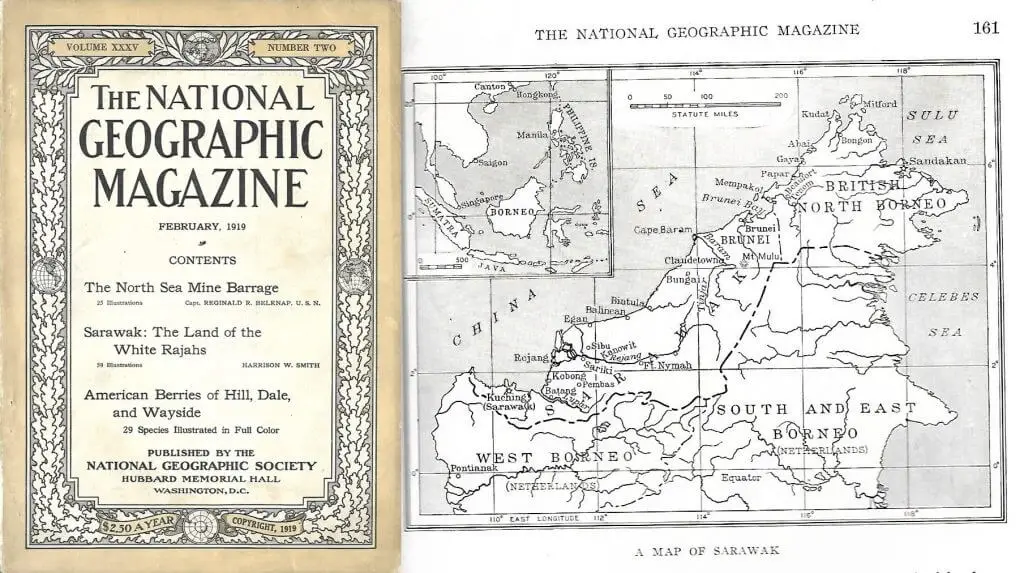
About 100 years ago, an article was published in The National Geographic Magazine about Sarawak.

The article ‘Sarawak: Land of the White Rajahs’ was written by Harrison W. Smith and published in February 1919.

Smith basically described his experience in Sarawak mingling with the Iban, Bidayuh and Kayan peoples in the 58-page long article featuring a whopping 59 photographs taken by Smith himself.

It was written in a non-condescending and enlightening tone to introduce Sarawak to National Geographic readers.

The Sarawak Gazette even published a note on July 16, 1919 to comment about the article and the only problem they had about it was the use of an outdated map.

It stated, “The article gives an interesting account of Professor Smith’s experience in this country and is illustrated, as might be expected, by photographs, excellent in themselves and in their variety.

“The map for which Professor Smith denies all responsibility is another matter; in any paper it would be a matter for regret, but in a magazine whose professed object is ‘the increase and diffusion of geographic knowledge’ it calls for both criticism and correction. This map, taken apparently from a thirty year old school atlas, shows near the whole of Borneo, about which the Sarawak boundary wanders in pleasing uncertainty. The whole of state of Brunei is included therein and Labuan disappears entirely.”

Nonetheless, here are five interesting Sarawak stories that Smith experienced when he was in Sarawak:

5 interesting Sarawak stories as recorded by Harrison W. Smith

1.A phonograph in Sarawak

“A phonograph that I carried for the purpose of recording native songs was a source of great amusement. Many natives who had traveled to the government stations had heard the ordinary records, but none had ever heard their own language.

It was at times difficult to persuade any one to sing into the rather formidable looking trumpet, but when a song had been reproduced from a record made at another village there was usually no further difficulty in bringing forward of the artists of the house.

When they finally they heard their own voices issuing from the little box, their wonder and amusement knew no bounds. It is a pity no photograph could have been obtained of the bank of faces surrounding our little party, with the phonograph in the center, when they first realised that a box was talking their own language in the voice of one of their own number.”

2.Counting using fingers and toes

One of Smith’s companions was an Iban man named Changkok. On one occasion, Smith had to ask Changkok about a longhouse they about to visit.

“Having occasion to ask Changkok the size of a particular house that I planned to visit, he began counting on the fingers of his right hand, calling off the name of the head of each family. He continued counting on the fingers of his left hand, then on the toes of his right foot, then, beginning on the big toe of his left foot, he paused in thought, holding the second toe.

But the effort had been too much; he lost hold of the toe and had to count all over again.

Probably if the problem had required a computation above 20 Changkok, like many other natives, would have had to call in another man with more fingers and toes to count on.”

3.Sarawakians have heard about the Titanic a hundred years ago

Smith spent a great deal of time at Mulu area. One time, he was spending a night at the house of a Malay trader near Melinau river.

“The trader had fastened some logs together and moored them to the shore, forming a small landing stage with a little shed, where one could bathe without danger from crocodiles.

As the launch swung in toward the landing, the current caught the bow, and for a moment it seemed that we should strike the log with considerable force; whereupon a Malay on the landing cried out, ‘Don’t run into the iceberg.’ Thus the story of the Titanic, incredible to the tropical people, spread far into Borneo.”

Titanic sank in the North Atlantic Ocean on Apr 15, 1912.

4.The female Kayan leader of Long Palei

While female presidents fascinate people nowadays because they are rare, female Kayan chieftains were not something unusual even back in Smith’s day.

Even back then, a Kayan woman could rule a longhouse as long as she came from an aristocratic family (maren).

Smith had the opportunity to meet a woman Kayan chief named Ulau when he was visiting Long Palei (Long Palai), Baram.

“The dignified presence and stateliness of the old lady gave me one of the greatest surprises I ever experienced. She maintains rigid discipline, which is characteristic of the Kayan household, from the chief of the house to the head of the family, and the fruits of discipline are apparent in the good manners and recognition of authority that, more than anything else, astonish the visitor, who is not prepared to find such culture among Bornean ‘savages’”.

5.Trying to teach geography to a Kayan

Ulau had a stepson named Kebing who later became one of Smith’s companions during his journey.

While learning about the local culture, Smith in return taught the natives some knowledge of geography and a taste of astronomy and the sun’s orbit.

“In an effort to give Kebing some idea of geography, I told him it was possible to go to America by travelling either in the direction in which the sun rises or the direction in which it sets, and to explain this incredible statement I scratched a map on the surface of a green orange, telling him that the sun stands still and the earth turns around.

‘Once every day?’ he asked.

‘Yes,’ I replied.

‘Well, why does it turn?’ A rather difficult question.”

10 hardworking female leads from K-dramas who will inspire you

Are you looking for some motivation to work? While some Korean dramas offer an escape from reality by telling stories of how a rich, handsome man comes and sweeps the girl of her feet, others give viewers a glimpse of reality in which the female leads work hard on their own. These damsels in distress do not need any rescuing because they pick themselves up no matter what.

If you are looking for Monday motivation, here are ten hardworking female leads from K-dramas to inspire you in a day’s work:

1.She Was Pretty (2015)

Kim Hye-jin (Hwang Jung-eum) is an intern in the administration section before being transferred to be a junior writer at a fashion magazine.

Here is the problem, Hye-jin knows nothing about fashion or writing. Nonetheless, she starts from the bottom and is willing to learn to do her job properly.

She slowly learns the ropes of fashion writing with the help of her colleagues.

Hye-jin grew up rich but after her family’s publishing company went bankrupt, her family lost their fortune.

Hence, she works hard to help her family’s financial situation. After saving a lot of money for her family, Hye-jin then focuses to achieve her own dream as a children’s book author.

This hardworking female lead shows that it is okay to postpone your dream for the sake of your family.

Realistically, most people are like Hye-jin who has to put food on their table first before they can even think about their own ambition.

But once you’ve reached your financial goal or are financially secured, it’s never too late to pursue your own dreams.

Watch the trailer here.

2.Fight My Way (2017)

Due to its realistic storyline and great performance, this drama was popular when it first aired.

The hardworking female lead in this drama is Choi Ae-ra (Kim Ji-won), a department store employee who dreams of becoming an announcer.

Together with her friends Ko Dong-man (Park Seo-jeon), Kim Joo-man (Ahn Jae-hong) and Baek Seol-hee (Song Ha-yoon), the gang faces the ups and downs of quarter-life crisis.

Fight for My Way is far from your usual glamorous K-drama as it is relatable and has true-to-life background stories.

The most relatable quote in the drama is when Ae-ra vents out her frustration in episode eight: “Even though we woke up earlier than others, even though we went to bed later than others, we never had time. We lived harder than anyone, but our resumes that doesn’t show anything pretends to reflect who I am. I’m angry, I’m frustrated.”

This line could not get any more relatable than this for those who are struggling to find a place in the society.

Overall, the plot highlights the competitive working environment among young adults today and the high unemployment rate in South Korea.

Watch the trailer here.

3.Doctors (2016)

Is there any hope for a delinquent to become a successful doctor? Apparently in this Korean medical drama, there is hope after all.

The hardworking female lead of Doctors (2016) Yoo Hye-jung (Park Shin-hye) works her way up to become a neurosurgeon.

She might have a juvenile record but it doesn’t stop Hye-jung to turn her life around.

Sometimes, you only need that one person to believe in you.

For Hye-jung, the people who trust her are her teacher Hong Ji-hong (Kim Rae-won) and her grandmother.

Watch the trailer here.

4.Search: WWW (2019)

Search: WWW (2019) features not one but three hardworking female characters.

It is a story of three women in their late 30s, Bae Ta-mi, Cha Hyeon and Song Ga-kyeong who work in top two competitive web portal companies.

The drama is considered a breath of fresh air as it highlights professional women striving for success as the main plot.

Meanwhile, the male characters in Search: WWW are the subplots of the story just like most female characters in other dramas.

These hardworking female characters are unapologetic when it comes to their careers as well as their love lives.

Watch the trailer here.

10 hardworking female leads from K-dramas who will inspire you

5.Be Melodramatic (2019)

This romantic comedy tells the story of three best friends Lim Jin-joo, Lee Eun-jung and Hwang Han-joo.

They are all in their 30s, each having her own struggles in love and career.

Lim Jin-joo (Chun Woo-hee) is a drama screenwriter who just got out from a long term relationship. She has unique personality who sometimes talks to a luxurious purse.

Meanwhile, Lee Eun-jung (Jeon Yeo-been) is a documentary director who runs her own one-woman company. After the death of her boyfriend, she suffers from PTSD and often imagines and talks with him.

The last member of the trio is Hwang Han-joo (Han Ji-eun) who works as the head of a marketing team for a drama production company. At home, she is a single mother who struggles to balance her work while raising a kid.

All three hardworking female characters having real-life struggles is something that some of us could relate to.

Watch the trailer here.

6.What’s Wrong with Secretary Kim (2018)

If you have been working hard for nine years under a difficult boss and you finally paid off your family’s debt, you have definitely earned a break.

For Kim Mi-so (Park Min-young), she does not even bat an eye when she turns in her resignation letter after all that hard work.

Her life as a secretary for the past nine years has revolved around her work and her boss. She even carries around a men’s handkerchief and lighter in her handbag just in case her boss needs it.

When Mi-so’s boss Lee Young-joon (Park Seo-joon) asks the reason for her resignation her answer might resonate with some viewers.

“I need to go find my life now. A life as not as someone’s secretary nor as a breadwinner, but life just as myself.”

Watch the trailer here.

7.Second 20s (2015)

Ha No-ra (Choi Ji-woo)’s dream to become a dancer was interrupted when she unexpectedly became pregnant at 19.

She then had to quit school and get married. For the next 20 years, No-ra spent her life being a housewife and mother.

At the age of 38, she finds herself on the brink of divorce. To make matter worse, No-ra is diagnosed with terminal pancreatic cancer and given a six-month prognosis.

No-ra decides to go back to college again to the horror of her own son Kim Min-soo and his girlfriend Oh Hye-mi who becomes her new classmate.

Unbeknownst to No-ra, her estranged husband accepts a new job at the same university.

Well, do not wait until being diagnosed with cancer for you to achieve your dream like No-ra.

As cliched as it might sound, time and tide wait for no man.

8.Strongest Deliveryman (2017)

Have you heard of the term “Hell Joseon, Hell Chosun or Hell Korea?” It is a satirical South Korean term used to criticise the socioeconomic situation in the country.

The phrase is often used when complaining about unemployment among youths and the inability to escape from poverty despite being overworked.

In Strongest Deliveryman (2017), the hardworking female lead Lee Dan-ah (Chae Soo-bin) is doing everything she could to make money and escape from ‘Hell Joseon’.

She has no time for romance so she turns down all advances from men while working as a delivery woman.

However, Dan-ah did find love in the story in veteran deliveryman Choi Kang-soo (Go Kyung-pyo).

Equally hardworking as Dan-ah, Kang-soo eventually works his way up to become the CEO of his own delivery app company.

Watch the trailer here.

9.Start-Up (2020)

Speaking of opening up a company, here is a story of a woman who dreams to become a prolific entrepreneur.

Seo Dal-mi (Bae Suzy) is bright and ambitious ans wants to be Korea’s Steve Jobs. In order to do that, she takes a wide range of part-time jobs.

The drama sets in South Korea’s fictional Silicon Valley called Sandbox. It follows the story of Dal-mi and other aspiring entrepreneurs as they struggle to take their business off the ground.

Watch the trailer here.

10.Romance is a Bonus Book (2019)

One of the most hardworking female leads in K-dramaland is none other than Kang Dan-i (Lee Na-young).

After her husband cheats on her, she is left to take care of her daughter.

Not an easy task since Dan-i quit her job before her marriage and now no one wants to hire her.

She then gets a job at a publishing company as a temporary task support team member.

Despite the scepticism Dan-i faced from her superiors and colleagues being a former ‘housewife’, she proves them wrong by performing well in her job.

Watch the trailer here.

1 16 17 18 19 20 75