Browse Category

Culture - Page 27

Hatim Tai, the anonymous writer who wrote ‘The Ballad of Kuching’

In 1965, the Sarawak Gazette received an anonymous package. Inside, it contained a ‘beautifully bound autograph book with a cover in Chinese silk’.

It was properly addressed to The Sarawak Gazette editor. The book contained 52 pages, one for every week of the year.

The verses were typed, preventing one from identifying the writer by the handwriting.

According to the gazette, they normally did not publish unidentified anonymous material. But they found one poem ‘though topical in impeccable good taste’.

So they published the poem in The Sarawak Gazette on Aug 31, 1965.

“We feel this is a remarkable effort in its kind and publish it for that reason. A good deal of the ‘spirit of Sarawak’ is embalmed in the somewhat subtle ‘infrastructure’ of these verses,” the gazette reported.

The poem was called “The Ballad of Kuching” and was dedicated to Tun Jugah Barieng (1903-1981), a notable politician of Iban descent and recognised as one of the founding fathers of the Federation of Malaysia.

He played an important role in bringing Sarawak into the formation of the federation on Sept 16, 1963.

While the gazette credited the poem to ‘Hatim Tai’, it is not sure whether the penname was given by the publication or if that was what the writer called him- (or her-) self.

Hatim Tai, the anonymous writer who wrote ‘The Ballad of Kuching’
What we know about The Ballad of Kuching by Hatim Tai dedicated to Tun Jugah Barieng

Altogether, there are 52 stanzas in “The Ballad of Kuching”. The poem, as Sarawak Gazette described, truly did convey the spirit of Sarawak in its lines, describing the different races in Sarawak, such as the Malay, Chinese and the Dayaks as well as their celebrations.

“Orang Melayu, courteous, proud and gay,
The sly mouse-deer whose deeds of yesterday.
Cicadas sing, renounces kris for pen
And writes his fate upon the future’s clay.

The Orang China kicks against the womb
And scattering riches makes my house his home;
The lotus-blossom blooms in every street
Whose very stones applaud the honeycomb.

The longhouse-dweller by his jungle stream
Sends me his sons who of diplomas dream
The world moves on; some savant’s staff- who knows?-
May one day strike upon the longhouse beam.”

When did Hatim Tai write the “Ballad of Kuching”?

From the poem, we know Hatim Tai wrote it in 1965 (the year of the publication).

“This Chinese New Year celebrates the Snake
And in the streets the dragons dance and shake;
The candles burn for luck, the din of gongs
Six confined generations might awake!”

In one of the stanzas, Hatim wrote:

And in 1965, the Chinese calender celebrated the year of the snake.

Furthermore at this time, Sarawak was going through the Indonesia-Malaysia confrontation as a result of Indonesia’s opposition to the creation of Malaysia.

Hatim Tai also referred to the confrontation in stanza 19.

“Now Mao Tse-Tung is getting to his feet,
And Bung Soekorno in his winding-sheet
On Confrontation feeds- to arms! before
The bland horizons of forebears meet.”

This was also the time when Sarawak saw transitions of power and service from the British colonial officers, all of whom eventually left service here in Sarawak after it became part of the Malaysian federation.

Hatim Tai seemed unhappy with those eager to see these officers leave and yet still wanted the Commonwealth forces to stay and protect them during the confrontation.

He wrote,

“’Depart, Expatriate’, the foolish say,
‘And office leave to those who hold the sway,’
Yet dare to utter in the self-same breath,
‘Soldier, remain- the tiger stalks his prey!’”

Who could Hatim Tai have been?

A number of times in the poem, Hatim Tai referred to himself as “Kuching”, especially in the second and third stanzas.

The second stanza goes,

“Now fades the golden sunset, swift to bring
The paramour of night upon its wing;
The molten silver of the crescent moon
Exhorts my song, I am the Cat – Kuching!”

Meanwhile the third stanza goes,

“I am Kuching- the-Cat this is my town,
My city, palace, capital and crown,
And thus I reign and watch my people go,
And take no thought if they white or brown.”

A king?

However in Stanza 50 instead of referring himself as “Kuching”, Hatim Tai calls himself a king.

“Yet am I King. A king without a throne?
Yet do I have a throne; the seed I’ve sown.
Tun Abang in his palace eats my salt,
And in my shade the people’s will is known.”

Tun Abang here most probably referred to Tun Abang Haji Openg, the first Yang Di-Pertua Negeri (Governor) of Sarawak who took office from Sept 16, 1963 to Mar 28, 1969.

The official residence of the Yang di-Pertua Negeri Sarawak is the Astana. The name ‘Astana’ is a variation of ‘istana’ which means palace.

Built in 1870 by the second white Rajah, Charles Brooke, it was the Brooke family’s main residence in Sarawak.

Going back to him dedicating the poem to Jugah, the late minister was a candidate for the first Sarawak governor.

The idea, however was rejected by Malaysia’s first prime minister Tunku Abdul Rahman. His reason was that the posts of the Sarawak chief minister (which was held by Tan Sir Datuk Amar Stephen Kalong Ningkan) and the Sarawak governor could not both be held by Ibans at the same time.

Subsequently, the post which could have gone to Jugah went to Abang Haji Openg.

More questions about Hatim Tai and “The Ballad of Kuching”

Even after more than half a century later since “The Ballad of Kuching” was published (and now forgotten), there is no answer for the question, ‘Who was Hatim Tai?’

Yet, there were more questions to ask about this anonymous writer.

For instances, why did he want to conceal his identity? Is it possible that the writer was a ‘she’? Was he a close friend of Jugah?

To write a 52-long page of book and meticulously type it out must have taken a great effort on the author’s part.

Was he a Sarawak British colonial officer who had a great passion for Sarawak? Or even maybe a local who served in Sarawak service with other expatriates?

Another curious question, where is the book now? Most importantly, what were the contents of the rest of the 51 pages?

We might not be able to answer these questions anytime soon. But, Hatim Tai’s message in his final stanza in “The Ballad of Kuching” still resonates with today’s Sarawak.

“Divided we must perish- doubt not that,
We shall not fail the insignia of the Cat
If for each race the writ of freedom runs:
“Our strength lies in our unity.”

You can read the poem here. If you have any thoughts or information about the mysterious author, leave it in our comment box.

How the Bajau came to live in Tempasuk, otherwise known as Kota Belud today

Before it was named Kota Belud, this district was widely known as Tempasuk.

It is located at the midpoint of the highway connecting Sabah’s state capital Kota Kinabalu with Kudat town near the northern tip of Sabah.

Many regard the town of Kota Belud as the unofficial capital and gateway to the heartland of the West Coast Bajau people.

Besides the West Coast Bajau, the town is also home to the Dusun, Illanun and Chinese peoples.

The West Coast Bajau are often referred to as Bajau-Sama, Sama Kota Belud or sometimes Bajau Kota Belud.

This is to distinguish them from the East Coast Bajau or Sama Dilaut or Sama Laut who settled in the eastern coast of Sabah.

How did the Bajau-Sama people first come to Tempasuk in the olden days?

British anthropologist Ivor H.N. Evans in his book Among Primitive peoples in Borneo might have the answer where he collected a range of local stories told in the oral tradition.

How the Bajau came to live in Tempasuk, otherwise known as Kota Belud today
West Coast Bajau horsemen in their hometown of Kota Belud, with Mount Kinabalu behind them. Credits: Creative Commons
Tempasuk and the kendilong tree

There is a tree which the locals call kendilong. Although it had sap that was clear as water, it was also very irritating to the skin. The tree also proved to be a great home for bees.

A long time ago, there was a poor Dusun man who dreamed that if he could find a kendilong tree he would become rich.

So the man set out to look for one. He discovered one just as night was about to fall. Since it was late, he decided to spend the night.

The next morning, the man left and later returned with two companions.

After collecting the sap, the man noticed there was a bee’s nest on top of the tree. They collected the nest, although they did not know what to do with it.

On their way back, they came across a Bajau man who had come up the river in a boat.

At the time, Bajaus did not live in Tempasuk yet. The Bajau man offered to help the Dusun man sell his bee’s nest, and share the profit between them.

Being practical, he also asked the Dusun man to collect more nests, in case they really were profitable.

So the two men swore an oath of brotherhood, sacrificing a hen to mark the occasion.

While the Bajau sailed away, the Dusun man searched hard for bee’s nests.

Three months later, the Bajau man returned to Tempasuk, his tongkang filled with goods from the sale of the bees nest to share with him just as he promised.

Imagine how happy he was to see that the Dusun man’s house was full of bee’s nests.

Seeing the start of a mutually beneficial friendship, that was how the alliance formed between the Dusun and the Bajau. Eventually, the Bajau resettled in Tempasuk while the Dusun learned the use of beeswax.

Aboard the HMAS Kapunda, where the Japanese surrendered in Kuching

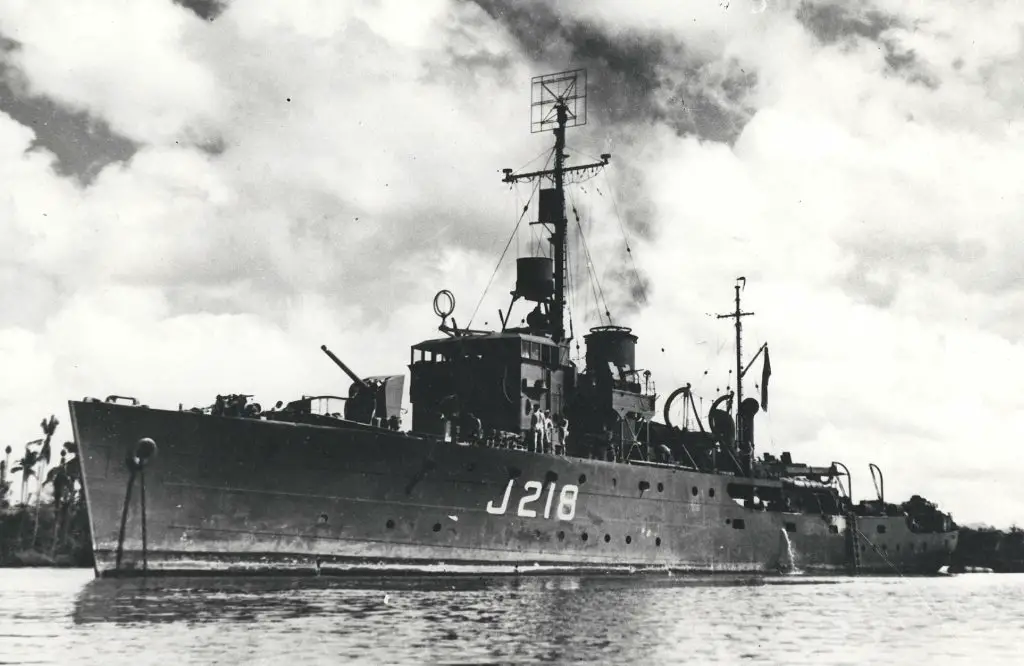
HMAS Kapunda played an important role in Sarawak history. This navy ship was where the Japanese officially signed their surrender in Kuching on Sept 11, 1945. The surrender officially ended Japanese occupation in Sarawak after three years and eight months.

Aboard the HMAS Kapunda, where the Japanese surrendered in Kuching
HMAS Kapunda. This image is Crown Copyright because it is owned by the Australian Government or that of the states or territories, and is in the public domain because it was created or published prior to 1969 and the copyright has therefore expired. 
HMAS Kapunda during World War II

According to the Royal Australian Navy’s official website, HMAS Kapunda was one of 60 Australian Minesweepers (commonly known as corvettes). It was built during World War II (WWII) in Australian shipyards as part of the Commonwealth government’s wartime shipbuilding programme.

The ship was named after the town of Kapunda, South Australia. She was one of the 36 corvettes commissioned solely by the Royal Australian Navy.

HMAS Kapunda was commissioned in Sydney on Oct 21, 1942. Then she began operational duty as a convoy escort vessel on the east coast of Australia between Sydney and Brisbane.

In March 1943, HMAS Kapunda began escorting convoys from Queensland ports to Port Moresby and Milne Bay in New Guinea.

This was when she first fired her shots when a flight of eight Japanese bombers, escorted by 12 fighters, attacked the Milne Bay bound convoy she was escorting.

Thankfully, the crew aboard HMAS Kapunda and her sister ship – the HMAS Bendigo – diverted the enemy’s targets and the bombs fell harmlessly into the water.

A month later, HMAS Kapunda was engaged in another battle when 37 Japanese aircraft attacked MV Gorgon, one of the ships she escorted.

After shooting down one of the aircrafts, HMAS Kapunda’s crew rescued MV Gorgon from fire, bringing the damaged ship safely to port.

In 1944, HMAS Kapunda was put to patrolling mostly New Guinea, Solomon Sea, Morotai and Biak islands areas in Indonesia.

On July 29, 1945, HMAS Kapunda left Moratai enroute to Balikpapan in Borneo, clocking her 100,000th mile since being commissioned.

During this time, life aboard the HMAS Kapunda was mostly uneventful until the end of WWII.

Japanese forces around the world (including Kuching) surrender

The first atomic bomb ever used in warfare codenamed ‘Little Boy’ was dropped on Hiroshima on Aug 6, 1945 followed by the ‘Fat Man’ on Nagasaki three days later.

Less than a week after the bombing of Nagasaki, Japanese Emperor Hirohito announced to his people that Japan would accept the Potsdam Declaration in a historic radio broadcast called ‘Jewel Voice Radio’ where he also stated a new national mission which included striving for prosperity and well-being of all nations.

Before the surrender, the Australian 9th Division was tasked to secure the main prisoner-of-war and internment camp in Kuching.

According to Ooi Keat Gin in Post-War, 1945-1950: Nationalism, Empire and State-Building, this mission became more urgent from mid-August when the Japanese surrendered.

“Out of frustration or vengeful reprisal it was feared that the Japanese military authorities might begin a wholesale slaughter of Allied prisoners of war and internees. With haste the nucleus of a task force (Kuching Force) with a British Borneo Civil Affairs Unit (BBCAU) detachment landed at Kuching on 11 Sept,” Ooi wrote.

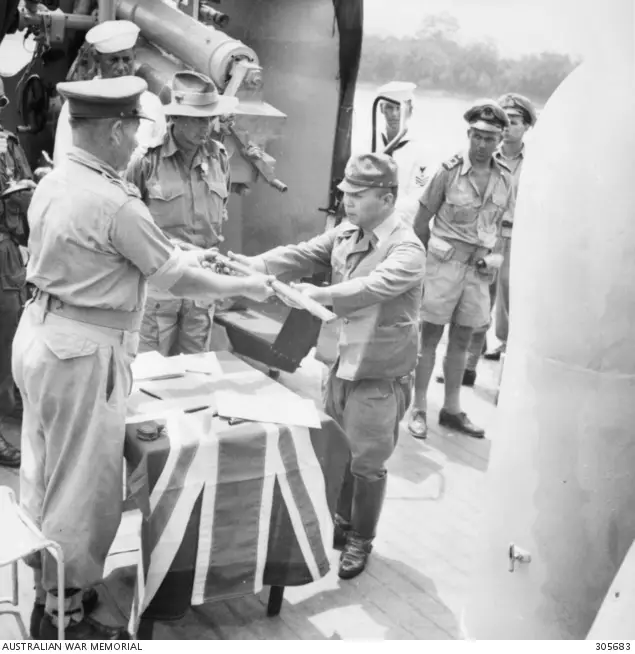
On that same day, Brigadier-General Thomas C. Eastick, Commander of Kuching Force, received the surrender from Major-General Yamamura Hiyoe on board the HMAS Kapunda.

Aboard the HMAS Kapunda, where the Japanese surrendered in Kuching
Aboard the corvette HMAS Kapunda, General Yamamura, commanding officer of Japanese forces in the Kuching area, hands his sword to Eastick, commanding officer of Kuching Force.
 
In the right background is Lieutenant A. J, Ford Ranr, commanding officer of the Kapunda. Copyrighted expired-public domain.
HMAS Kapunda in Kuching

Meanwhile, Eastick wrote to his wife Ruby on Sept 14, 1945 describing his arrival in Kuching as “the busiest five days I have ever had or likely to have, a wonderful job and one that has given me wonderful satisfaction.

“Last Monday early, I went aboard a USA destroyer escort and spent just over 24 hours aboard, transferred to HMAS Kapunda and went up the Sarawak river to Pending and there took the surrender from Jap Maj General and several thousand Japs.

“The finale of the ceremony was of course receiving the general’s sword as a token of final surrender. It is a beauty, of course, has wonderful historic value. After the general was dismissed, I spent an hour or so with the Jap chief of staff and other officers and then went to the prison camp where there well over 2,000 soldiers and civilians men, women and children. I got a greater part of them together in an an open space and said a few words to them.”

The news about the Japanese surrender also made headlines around the world.

Graham Jenkins, a special correspondent of The Mercury reported that “Cheering crowds lined both banks of the Sarawak River as the convoy carrying the Australian occupational force made its way up the river to Kuching capital of Sarawak’.

The news also reported that before the force landed, there was some delay when Yamamura “pleading illness, demurred about going out to HMAS Kapunda to surrender to Brig T. C. Eastick”.

“Excuses were not accepted, and Yamamura came reluctantly and handed over his sword. Heartfelt relief and jubilation were evidenced among Australian prisoners who were able to meet their liberators,” the news stated.

HMAS Kapunda after the war

After the Japanese surrendered, Kapunda was used to assist the evacuation of Allied prisoners of war from Kuching.

A year later, HMAS Kapunda was paid off into reserve on Jan 14, 1946. She was marked for disposal on Dec 30, 1960, and was sold on Jan 6, 1961 to Kinoshita (Australia) Pty Ltd for scrap.

Aboard the HMAS Kapunda, where the Japanese surrendered in Kuching
Aboard HMAS Kapunda as the Japanese envoy’s interpreter reads the surrender terms to Major-General Yamamura, the Kuching Garrison Commander (right). Copyright expired-public domain.

The strange death of British explorer Frank Hatton in North Borneo

Nineteenth century Borneo was as exotic as one could imagine. For the outside world, especially Westerners, hardly anything was known about the island except maybe that it was home for headhunters.

It’s no surprise then that many adventurous and curious explorers found their ways to the island in order to be the first among themselves to discover something new, be it a new plant, new animal or a new source of valuable mineral.

One of those who arrived upon the shores of Borneo back then was Frank Hatton, an English geologist and explorer.

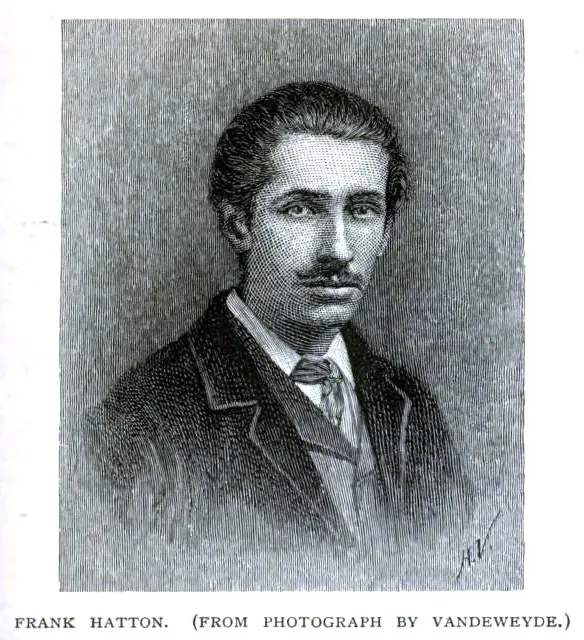
Born in 1861, Frank was the son of journalist Joseph Hatton (1839-1907) and a graduate of the Royal School of Mines in London.

Being the son of a journalist gave Frank an advantage as his father’s connections made it easier for him to publish his writings.

The strange death of British explorer Frank Hatton in North Borneo
Frank Hatton, engraving based on a photo by Vandeweyde (1885) . Credit: Public Domain.
Frank Hatton’s career in British North Borneo Company

Driven and motivated, Frank joined the British North Borneo Company as a mineral explorer, leaving London in August 1881.

According to W.H Treacher, the British Governor of Labuan at the time, “Frank Hatton joined the Company’s service with the object of investigating the mineral resources of the country and in the course of his work travelled over a great portion of the Territory, prosecuting his journeys from both the West and East coasts, and undergoing the hardship incidental to travel in a roadless, tropical country with such ability, pluck and success as surprised me in one so young and slight and previously untrained and inexperienced in rough pioneering work.”

Treacher added, “He more than once found himself in critical positions with inland tribes, who had never seen or heard of a white man, but his calmness and intrepidity carried him safely through such difficulties, and with several chiefs he became sworn brother, going through the peculiar ceremonies customary on such occasions.”

For Frank, however, Borneo was far from what he had originally hoped for. In his diary, Frank vented out a few of his irritations about life in Borneo.

He grew sick of eating Dusun food. He was tired of being stared at by the natives who had never seen a Caucasian man before.

Additionally, Frank thought the local methods of headhunting was cowardly, calling it “head-stealing” not “headhunting” as he said the natives would wait in the bushes before making an attack during headhunting.

Frank Hatton and his sudden death in North Borneo

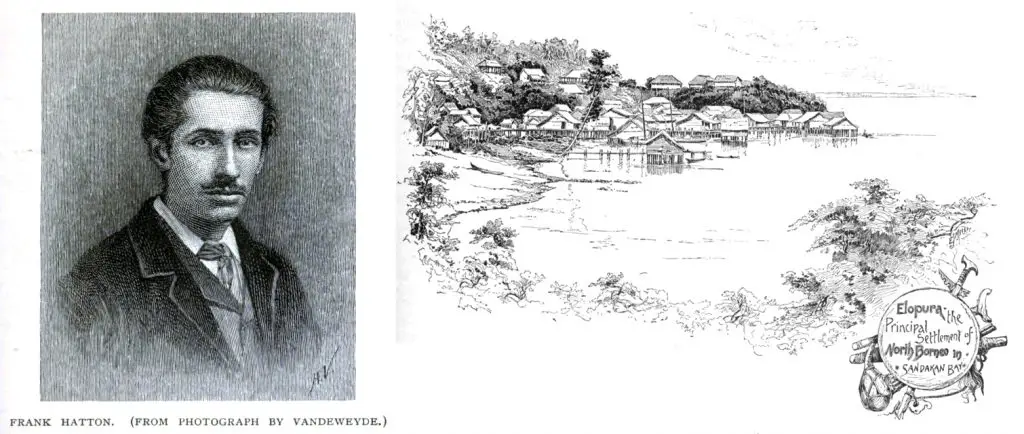
In 1883, Frank went up to the Kinabatangan river from Elopura (now known as Sandakan) to verify a local report of gold in the area.

There he was killed during an elephant-shooting expedition when his gun reportedly got tangled in the vegetation and went off, shooting him in the lungs.

According to Anne Tagge in Hatton’s Folly: Assaulting “This Eden of the Eastern Wave”, Frank had been persuaded to give up his hunt.

“On the way back to the boat, his Winchester rifle twisted in jungle creepers, a twig pulling the trigger. His followers reported that Hatton’s last words were in his recently required Malay ‘Odeen, Odeen mati saya’ (Odeen, Odeen, I am dead) to his servant while resting his head on Odeen’s shoulder.”

Frank’s only non-native companion during the expedition was an Australian gold miner named Andrew Beveridge.

Somehow knowing that Frank had always been careful with weapons, Beveridge first shouted “Who has done this?” to Frank’s party.

But after looking at how distraught his native servants were as they were exclaiming “Better we had died!”, Beveridge believed the incident was an accident caused by Frank himself.

Beveridge and the rest then went on a 60-mile journey down the river to Elopura, carrying Frank’s decaying body.

After arriving in Elopura, an inquest was held on the day of Frank’s burial on Mar 4, 1883.

The strange death of British explorer Frank Hatton in North Borneo
Elopura where Frank Hatton’s body was brought . This illustration was first published in  “Frank Hatton in North Borneo. Notes on his life and death, by his father“. Century Illustrated Magazine. Credit: Public Domain
Did the natives kill Frank and make it look like an accident?

Before Frank’s death, one of his colleagues in the British North Borneo Company named Franz Witti had been killed by headhunters.

Frank had written to his parents, reassuring them that he could take care of himself and that they shouldn’t be worried about Witti’s murder.

Tagge pointed out, “The company always ascribed such deaths (Witti’s) to accident or uncontrolled tribes or to tribes across the border in Dutch-ruled Borneo.”

As for Frank’s shooting, there was no proof that it was premeditated. The then resident at Elopura, W.B Pryer wrote to Treacher that there was no evidence that the gun was cocked.

The muzzle of the gun would have had to slip from Frank’s shoulder as he held the stock and moved a jungle creeper with his hand holding the stock.

Furthermore during the inquest, Beveridge revealed that he didn’t notice whether any of the guns carried by the natives had been discharged.

He stated that Frank fell in a very open place with a little undergrowth; the nearest vine was four feet from where Frank lay. When Beveridge arrived at the scene, running in four or five minutes from the boat, the gun had already been moved, and Frank was no longer able to speak.

Was there any tension between Frank Hatton and his servants?

According to Beveridge who had questioned Frank’s servants, he found that the natives would have defended Frank from an elephant even if it meant their own deaths.

However, there was still no definite proof that the bullet which killed Frank came from his own gun. Even if it had, how did it happen?

Before the incident, Frank had sighted an elephant on Feb 17, 1883.

He was reportedly extremely anxious to shoot one before leaving Borneo and this was his last inland trip. (Obviously, the trend of Western tourists desecrating or ravaging local spots goes back centuries…)

In his diary, Frank recorded that his group had been struggling through the swamp through this trip. One of his servants, Durahim, had also capsized a boat, costing them some of their food and valuable supplies.

He had even listed down all his losses in the diary and his willingness to cut his servants’ wages if he found out that it was their fault that the perahu (boat) had been overturned.

While they were pursuing the elephant, the day was getting darker and his servants were restless to return.

But Frank was believed to be obsessed with shooting the elephant. If he had managed to kill an elephant and acquired its tusks, he might have been the first white hunter to do so in North Borneo back then.

The inquest’s result

Maybe it was Frank’s obsession over elephants tusks that brought him to his death.

Nonetheless, the British North Borneo company interpreted Frank’s ambiguous death as an unfortunate accident and he was buried at Sandakan cemetery.

“The company seems to be anxious not only to exonerate but to praise the natives who were with Hatton. A young man dies because he is determined in the last weeks of his contract to find minerals, preferably gold, in Borneo, also to bring home the triumph of having killed an elephant. His family is determined to interpret him as a hero fallen in the cause of British scientific and geographical supremacy,” Tagge wrote.

The Hatton family also accepted the verdict of the inquiry. An article in the North Borneo Herald of 1 Sept, 1883 noted Hatton’s death and comments on contributions to the Company, including a Dusun vocabulary and mineral samples ‘which will in time doubtless be developed in the interests of the Company’s Government’.

The same issue contained a letter to the editor from Joseph Hatton in which he thanked the Company for their tributes to and care for Frank’s grave.

He also sent a floral wreath for the grave – from London to Borneo – as well as knives to be given as gifts to Frank’s servants.

After his son’s death, Joseph co-wrote and published Frank’s writing in a posthumous work entitled North Borneo, Explorations and Adventures on the Equator (1886).

Frank Hatton was 22 when he died.

#DearKajo: More legends from Semabang about people being turned to stone

#DearKajo: More legends from Semabang about people being turned to stone
Like what you read on KajoMag? Share your thoughts with us! Give your feedback in English through the contact form. KajoMag reserves the right to edit letters for clarity and length. Only letters regarding KajoMag’s articles will be published under #DearKajo.

DearKajo,

I saw your re-publication of the great stories about people or buildings turned to stone.

There are two more that are almost identical and both relate to villages named Semabang in the Sadong River basin.

Because of their similarity in names and stories, I thought they were about one place but they are actually about two.

I’ll give you the oldest first; it’s about the famous and majestic Silabur cave in Serian.

1.This legend of the ancestors of a Sadong chief is recorded in Natives of Sarawak and North Borneo by Henry Ling Roth. It is based on the Mss. of the late Hugh Brooke Low, Sarawak Government Service. 1896.

“It was many, many years ago that a Dyak, of Semabang (in Sadong), and his young son arrived, after a long journey through the jungle, at a village called Si-Lébor. The village was extensive, the Dyaks very numerous. On arriving, the chief of the tribe placed food before the older visitor, but to his young son they offered nothing.

The little fellow seeing this, and being very hungry after his journey, felt much hurt, and began to cry. “To my father” said he, “you have given food, the priok (pot) of rice is before him, the fatted pig has been killed” “everything you have given him; why do you give me nothing?”

But the child’s appeal was useless. These strange Dyaks had hearts of stone; not a morsel was handed to the fatigued and hungry little wayfarer; so he wept on, and wept in vain.

“After a while the boy looked more cheerful; he had dried his tears, and was now engaged in catching a dog and a cat. These he put together on the mat, round which all the people were seated. The cat and the dog played, or more likely, as these animals will do, fought together; but whatever it was, there was something so ludicrous in it all, while the boy sat over them and set them at each other, that the whole assemblage burst into immoderate laughter.

The boy, it would seem, was working some spell there was an object in what he had been doing. Perhaps he was in communication with evil spirits, or under their influence; there was something ominous about it, we know not what.

But, to proceed, presently the sky became overcast, and gradually great volumes of black clouds came sailing up, propelled by great gusts of wind; one by one they rolled along, and were heaped up one on top of another, or got all broken up, as it were, in their collision.

The sky appeared one mass of confusion, looking blacker and more angry as the sun gradually disappeared in the darkness. At last the storm burst forth with a fury never known before; sharp flashes of lightning, followed by awful peals of thunder, succeeded one another, fast and furious; the very ground below shook as the palm leaf quivers in the breeze it seemed as if the great end of all things was at hand.

“Now commenced a gradual but awful change. Amidst the rolling thunder and the dazzling lightning, which only served to make the awful darkness visible, the village, the houses, all began to dissolve, to melt away, as it were, into burning lava, and, with his works, man perished likewise. There you might see the grey-headed chief starting up with his grandson in his arms, but ere reaching the door, being gradually hardened into stone. There mothers would be seen flying with their little ones to escape the same dreadful fate, but all in vain. There a young and helpless maiden would be clinging to her brave warrior, to that arm which had always been the first to help her, which could surely save her now.

Alas, that cruel transformation. The living light in those bright eyes is gone, the tender grasp of that warm hand is cold; from flesh and blood they too pass away into senseless petrifactions, whilst, mingling with the shrieks and yells, and invocations of the men and the Borich, would still be heard the boom of the thunder and the crackling of the houses.

Not a man, woman, or child “no, nor even a visitor” at that fated village, save only the neglected boy, was left alive to mourn the loss of his all. One after another, they all melted, and were changed, when the heat of the storm was over, into solid rock. Houses and all in them succumbed beneath the fiery elements, and when the storm ceased, all lay, not a heap of charred ruins, but huge masses of smoking stone.

“A hill with great precipices now marks the spot where this tragedy occurred, and on the hill (itself the transformed village) are still pointed out, if people speak truth, the traces of petrified houses. An upright rock is shown as the transformed figure of a Malay, an unhappy visitor on that awful day. There he stands with his hand still fixed on his sword hilt, once a living soul, now’ a lifeless stone.

The whole scene indeed is a standing monument at once of the crime of inhospitality and its fearful punishment. Gazing on his revenge, the youth retreated. He returned to his native village, Semabang: and time flew on, and here he died, he was the chief of his tribe, the grey-headed patriarch appealed to by the new and rising generation.

Years and hundreds of years rolled away, fathers and mothers passed off the stage, and young children grew up to take their places, to attain manhood, to work, to become old, to die too; and so time went on, and children danced and played over the same ground that their ancestors had danced and played on for centuries before.

“At last, no great time ago, the tribe of Semabang having flourished and become populous and rich, a young chief, the lineal descendant of the little hungry boy, dreamed that great riches were in store for him and his tribe if they went to Mount Si-Lebor, the petrified village.

The next day a party was organized, and they went there and searched. They at last discovered a magnificent cave. With lighted torches they entered, and found it to be very extensive and full of the celebrated edible birds-nests.

“Ah”, said they, “this is our portion, instead of that which was denied to our ancestor; his due was refused then, it has now been given to us, his descendants; this is our balas (revenge).” Thousands and thousands of birds-nests they brought out of the cave, which realized many reals (Mexican dollars) to the discoverers. The Si-Lebor caves are now said to be the richest, and the tribe possessing them (the Semabang youth’s descendants) the wealthiest and most prosperous in Sadong.”

Charles T.C. Grant, “A Tour amongst the Dyaks of Sarawak in 1858”

The old village of Kg. Gahat Semabang is now known as Kg. Gahat Mawang.

One can see how the story has changed over time here.

2.The second legend about petrification related to Semabang

Now there is another Semabang that is close to Simunjan. The famous naturalist Alfred Russel Wallace visited this longhouse around 1856 to collect orangutans.

There is a smaller cave close to this village (no longhouses) now entirely surrounded by palm oil plantation and a legend similar to the one recorded by Charles Grant is known here.

Small boy and his father, small boy is teased and not given food, and he curses the villagers and a huge torrential rain falls that turns the longhouse into stone. Wallace did not mention or know of the cave, it seems, though he must have passed within a few hundred meters on the river.

J. Drawhorn

Friendships, betrayals and manhunts: What you need to know about the Gaat expedition 1919

When Sarawak was an independent kingdom under the reign of three White Rajahs, the then government carried a number of punitive expeditions against its alleged rebels.

These include an expedition against the Ibans in Kedang and the infamous Cholera Expedition down Lupar river.

Reasons for these punitive expeditions varied; from punishing fleeing criminals to pacifying wars between different tribes.

Here is one of the last few punitive expeditions which took place before the peacekeeping ceremony between the Iban, Kayan, Kenyah and Kajang on Nov 16, 1924.

The expedition had Sarawak government forces together with locals went up Nanga Gaat, Baleh river to punish the Iban group living along Gaat river.

The cause of the Gaat Expedition

During the 19th century, headhunting practices and hostilities caused the Punans to leave Apau Kayan in search of new places to stay.

According to the book Beyond the Green Myth (edited by Peter Sercombe and Bernard Sellato), the Punan moved into uninhabited areas and divided themselves into three groups.

“One group moved to the Kihan, a tributary of the Kayan river in Kalimantan. A second group went to the lower reaches of the Kajang and the middle part of the Linau, tributaries of the Balui in Sarawak. A third group, comprising primarily Punan Vuhang, whose forefather had had no quarrel with the Kayan or the Kenyah, decided to return to the Balui headwaters.”

After the Punan Vuhang returned to the Balui headwaters, the Iban killed 14 of them.

For the Punans, the Iban had seemed to be the genuine forest exploiters and tapped gutta percha for a long period.

They came to the Punan area to collect forest products, appearing harmless and friendly towards the Punan Vuhang.

Hence the Punan Vuhang let their guard down and welcomed the Ibans to their homes.

Friends who turned into enemies

To prove their friendship, the Ibans even held a swearing ceremony whereby they became bound to the Punan Vuhang as blood brothers.

Unfortunately, the Punans had no idea that the Iban were actually planning to kill them.

One the eve of the attack, the Iban asked their hosts to hold a singing ritual in praise of the spirits. After feasting and dancing all night long, they fell into a deep sleep. It was then that the Ibans killed the Punans.

Seeking revenge against the Iban, the survivors and fellow Punans from Linau area sought help from the Kayan. However, the Kayan reported the massacre to the Brooke government. The government later set out a punitive expedition against the Ibans from Gaat who was responsible for the killings.

The Gaat Expedition according to Bertram Brooke

The expedition was joined by Bertram Brooke, the son of second Rajah Charles and the brother of third Rajah Vyner.

According to his report published in the Sarawak Gazette on May 16, 1919, the government force left Kapit heading to Nanga Gaat on Apr 5 that year with G.M. Gifford in charge.

On Brooke’s side, there were 200 government forces and unaccounted number of local people.

They received information that the rebels had prepared a final place of refuge on Bukit Tunggal.

Gifford’s main plan was to drive any of the rebels who might be lurking on the river banks towards Bukit Tunggal instead of allowing them to escape to the flanks.

With this, he hoped the rebels would be cornered into a fight or escape into the Dutch East Indies territory (Kalimantan).

Brooke’s force encountered their first fight with the rebels on the 10th. They fired at two boats, capsizing one of the them.

Friendships, betrayals and manhunts: What you need to know about the Gaat expedition 1919
A view of Batang Rajang from the first floor of Fort Sylvia.
Setting up base camp at Nanga Marang

Two days later, the force arrived and camped at Nanga Marang which was en route to Bukit Tunggal.

This was where the force divided themselves into two groups; one group pursued them to Bukit Tunggal via river in small boats and another to proceed through land.

Eventually, the two groups reassembled at Nanga Bulat where they found a large number of boats belonging to the rebels abandoned along with household stuff and paddy.

After a few hour of trekking, the force spotted a temporary house which the Iban Gaats built near Bukit Tunggal from a distance.

By the time they reached the house, it was already burning and there were no signs of the rebels.

So, the government force sent out a scout team to check out where the rebels had headed.

After awhile, the scout team came across a large river which they believed was a tributary river of Kapuas river. There, they found a large number of boats where they killed a small party of rebels.

The Gaat Expedition at Bukit Tunggal

The scout team returned to the new camp at Bukit Tunggal reporting what they found. Since speed was crucial, the government selected forty Sarawak Rangers which led by Penghulu Merdan and Gaui in pursuit of the rebels.

Together with them they carried two day’s provisions. The plan was if the river they encountered turned out to be Kaniou (a tributary of Kapuas river, meaning they were in Dutch East Indies territory), they should return.

If not, they were to proceed as far as as their supplies would allow, in hopes of overtaking some of the rebels.

Meanwhile, the rest of the forces would be at the burned house until the 19th when it would proceed slowly downriver collecting as much as food and property as possible on the way.

By Apr 22, the force reached Nanga Marang base where they were met with Merdan and Gaui who arrived previous evening via land.

The end of the Gaat Expedition

Bertram reported, “The rebels had evidently taken their women for safekeeping to the house on the ridge (the house that they burned), for these had abandoned their skirts upon the road. Mosquito curtains, Kayan mats, cooking utensils, baskets of provisions, valuable parangs, and even several guns were among the articles strewn along the route until all traces ceased, there being apparently nothing remaining to discard.”

After the expedition ended, Bertram considered the mission a successful one.

He wrote, “It is, however, satisfactory that such a severe lesson has been given with so small a loss of life. It would seem given with so small a loss of life. It would seem that the rebels having no property to return to in the Gaat, must choose between unconditional surrender and moving into Dutch East Indies territory. It is locally considered unlikely that they will take the latter course.”

The Gaat Expedition was not enough for the Punan

Te Punan Vuhang who had joined the government forces during the Gaat Expedition, however, were not satisfied despite the reported success.

They felt the victory belonged to Brooke’s forces, not to them, and so decided they would carry out further revenge.

They went to Iban territory in the Baleh river basin and killed four Ibans.

In return, the Ibans again used a friendship-betrayal scheme to take revenge. But they mistakenly killed a group of Penan Bunut.

Unsatisfied, they decided to seek revenge against the Punan Vuhang. At the meantime, the Punan Vuhang sought refuge among the Kenyah in Kalimantan who were also enemies of the Ibans.

A few years later in 1924, the Kapit Peace making ceremony finally forged peace between the Iban, Kayan, Kenyah and other tribes.

For the first time in a long time, peace finally came to the area and the Punan Vuhang returned to Balui headwater from Kalimantan.

Friendships, betrayals and manhunts: What you need to know about the Gaat expedition 1919
A memorial stone in Front of Fort Sylvia to commemorate the 1924 peace-making ceremony.

The aftermath of the Indonesian-Malaysian confrontation at Long Bawan

Located at North Kalimantan, Indonesia, Long Bawan is a small town with a small airport which has become the only gateway via air to Krayan Highlands.

Looking back on its history, it was one of the combat operations sites between British Commonwealth forces and Indonesian armies during the Indonesian-Malaysian confrontation.

The confrontation which started in early 1963 was caused by Indonesia’s opposition to the creation of Malaysia.

By December 1964, there was a build-up of Indonesian forces on the Kalimantan border. This caused the British government to commit significant forces from the UK-based Army Strategic Command and Australia and New Zealand to Borneo in 1965-66.

On the Indonesian side, the fight was led by Indonesian Army special forces (Resimen Para Komando Angkatan Darat or RPKAD).

Additionally, they recruited the North Kalimantan National Army or Tentera Nasional Kalimantan Utara (TNKU).

During the confrontation, hundreds of Indonesian civilians had been loosely trained as part of TNKU.

Most of them were unemployed urban youth scrounged from cities in Kalimantan and Sulawesi.

Since the battles mostly happened at the Indonesian-Malaysian border in Kalimantan, some of them were posted in Long Bawan (Indonesia).

The aftermath of the Indonesian-Malaysian confrontation at Long Bawan
A view of Long Bawan paddy field. Perhaps this was where parachuters landed in 1968.
TNKU members who were left at Long Bawan

Although the confrontation had been officially declared over in August 1966, the mission was technically not over for Indonesian forces.

There were TNKU members abandoned and left behind at their border camps including in Long Bawan.

To make matter worse, the Indonesian government reportedly did not bother to disarm the army-volunteers, leaving them with weapons such as heavy machine guns and mortars.

Kenneth J. Conboy wrote in Kopasses: Inside Indonesia’s Special Forces that the ready supply of weapons and unemployed volunteers became a volatile combination.

Conboy wrote, “By late 1967, Jakarta had received reports that the former TNKU partisans were stealing food and raping women in the Long Bawan vicinity. Colonel Mung, the former RPKAD commander now serving as head of the military region, reported that the outgunned local government was screaming for help.”

Jakarta was reportedly in a fix when the government heard this news. In response, they sent out two groups from RPKAD which was led by Captain Alex Setiabudi and Captain Kentot Harseno.

Both captains had previously served at Long Bawan.

The aftermath of the Indonesian-Malaysian confrontation at Long Bawan
The small township of Long Bawan.

The two groups assembled at Cijantung during the first week of January 1968. Since there were no suitable runways, the units would be making a combat jump into paddies a half-hour trek east of Long Bawan.

“Although they would be parachuting with their weapons- including two rocket launchers – they were correctly concerned about opposition they might face. The ex-volunteers, after all, were better armed and knew the lay of the land after living there for almost four years,” Conboy wrote.

RPKAD came bearing gifts

Then Captain Kentot had an idea. Instead of going in with full force, they decided to go with gifts like food, writing pads and clothes.

His idea was adopted in and operation code-named Operation Linud X (“Airborne X”). On Jan 10, 1968, the groups made their jumps after light into Long Bawan.

The military units had expected to face difficulties from the former TNKU volunteers. However, it was the terrains of Krayan Highlands that gave them a hard time. Several of the commandos landed, drifting far from their marks, mostly in paddy fields and swamp.

Meanwhile, Captain Kentot landed in mud up to his armpits and nearly drowned. One of the pallets carrying a rocket launcher was even lost during the jump.

Nonetheless, the commandos managed to regroup at Long Bawan village where its chief greeted them like old friends.

After finding out their mission, the chief tasked some of his villagers to collect all weapons from nearby cache sites.

Surprisingly, the abandoned TNKU members were extremely tame. They took the gifts kindly and offered up their weapons without any resistance.

Four months later, all of the commandos were packing to leave. Due to some difficulties with their transport, they were forced to hike to the nearest river landing. According to Conboy, they were back on Java by June after a speedboat shuttle toward the coast.

“For once, what had the potential for being another festering security challenge had been resolved without firing a shot,” Conboy recorded.

The aftermath of the Indonesian-Malaysian confrontation at Long Bawan
The new building at Yuvai Semaring airport in construction.
The physical remnants of the Indonesian-Malaysian confrontation at Long Bawan

While confrontation now only remained in memories for the Krayan Highlands elders (which they refer to as ‘konfrontasi’), there are some physical remnants left behind at Long Bawan.

This small town was also the crash site of an Indonesian plane during Indonesian-Malaysian confrontation.

On Sept 26, 1965 during the confrontation, a C-130 plane was shot down near Long Bawan.

Ironically, the plane was shot down by Indonesian anti-craft fire, as it was mistaken for a Commonwealth aircraft.

It was carrying an RPKAD platoon from Java on orders to “neutralise” a gun position on the border ridge.

After the aircraft was hit, the RPKAD members parachuted out before it caught fire and crashed.

The wreckage of the plane is still at Long Bawan to this day.

Meanwhile, the locals also found the rocket launcher that was lost when Captain Kentot and his units parachuted in 1968.

It is now on display at Krayan’s Kepolisian Sektor or Polsek (Police District office).

The aftermath of the Indonesian-Malaysian confrontation at Long Bawan
Photocopying services at Long Bawan.

The life of Sibu historical figure Wong Nai Siong in Sarawak

Wong Nai Siong is perhaps one of the most famous Chinese pioneers to arrive in Sibu.

Born on July 25, 1849 in Fuzhou, Fujian Province of China, Wong was the eldest of four sons. His father was Wong King Po who worked as a farmer (although some records stated that he was a carpenter).

The life of Sibu historical figure Wong Nai Siong in Sarawak
Young Wong Nai Siong in an undated photo, but most probably in the late 19th century. Credits: Public Domain.
Wong Nai Siong was one of the first to convert into Christianity in his village in Fuzhou

Looking back on his life, Wong was an educated man. He first studied at a traditional Chinese village school. Then he took the Imperial examinations and was awarded the rank of Xiu Cai.

Back in old Chinese dynasties, Xiu Cai was the name for intellectuals who participated in the Imperial Examination. Later, Wong took his County Exam or Autumn Exam in which he passed and became a Ju Ren. As a Ju Ren, Wong was an official reputable member of the literati.

In 1866, missionaries from the Methodist Episcopal came to China. Wong was then baptised in November that year, becoming one of the few to become a Christian.

A year later, a priest named Xu Yang Mei took him in. It was during this time that Wong started to learn English and became exposed to Western culture.

Wong Nai Siong started the first Christian newspaper promoting political reform in China

Wong started to be interested in reforming Chinese politics after his third brother was killed in the First Sino-Japanese War.

Another report by author Lee Khoon Choy in Golden Dragon and Purple Phoenix, stated that Wong was frustrated with the decadent Qing dynasty and wanted a change.

“He was very much influenced by Kang You Wei’s reformist ideas. China, under the rules of Empress Dowager, was signing away unequal treaties to the Western Power. He went to Beijing and got in touch with the reformist leader Kang You Wei, who was advocating a reform movement similar to the Japanese Meiji Reform,” Lee wrote.

Kang was a Chinese scholar and political thinker of the late Qing dynasty.

Wong even started the first Christian newspaper promoting political reform.

Unfortunately for both Wong and Kang, their political reform movement failed. The failure forced Wong to flee back to Fujian and eventually to Nanyang (Southeast Asia).

Wong Nai Siong was responsible for bringing Chinese immigrants to Sibu in 1900

In September 1899, Wong arrived in Singapore to work as an editor for a local newspaper.

According to David W. Scott in Mission as Globalization, this was the year when Wong stopped by Sarawak while on his tour of Southeast Asia as part of visiting his daughter and son-in-law, prominent Singaporean Chinese leader Lim Boon Keng.

This visit led to a contract between Wong and the second White Rajah, Charles Brooke.

Reportedly, the Rajah gave him a loan of $30,000. This was to cover the cost of transporting the settlers from China to Sibu.

“This agreement stipulated that Nai Siong would bring 1,000 settlers to immigrate to Sarawak for the sake of developing an agricultural colony. To select these labour migrants, Nai Siong recruited heavily among his Methodist compatriots, especially his home county and two neighbouring counties in Foochow (Fuzhow),” Scott stated in his book.

Meanwhile, the loan was to be repaid over a period of five years. Wong undertook to recover the loan from the settlers by making them pay two-third of their annual produce as tax until the debt was fully repaid.

The Sarawak government once arrested Wong Nai Siong

On Feb 20, 1901, Wong brought in 72 Foochows from China to Sungai Merah and another 535 arrived on Mar 16.

That same year, Wong received a second loan of $10,000 from the Sarawak government to bring more settlers to Sibu.

Unfortunately for Wong, he gave the money to a man named Lik Chiang for safe-keeping, but the latter ran away with it to Taiwan.

Somehow, Wong still managed to bring another group of 511 settlers on June 7, 1902.

He then set up a custom office at Lower Rajang to collect tolls from farmers and traders.

Historian Chang Pat Foh in Legends and History of Sarawak pointed out that this landed Wong in trouble because he was accused of collecting taxes without the Rajah’s authority.

Chang wrote, “He was arrested but was released not long afterwards. Upon his release, he promised to pay the debts incurred but he failed due to poor harvests by the Fuzhow community. In the end, the White Rajah gave up hope to collect the repayment of loan.”

In June 1904, Wong decided to return to Fujian, China after passing his managing duties to American priest James Hoover. His departure was surrounded by different rumours including poor health, his reluctance to deal opium and his $40,000 debt to the Rajah.

Wong Nai Siong’s legacy in Sarawak
The life of Sibu historical figure Wong Nai Siong in Sarawak
YMCA Board of Directors, Fuzhou, Fujian, China in 1920. Wong Nai Siong, front row, seventh from right. Credits: Public Domain.

Wong died on Sept 22, 1924 after suffering from liver illness. Although he only spent less than four years in Sarawak, his legacy continues to linger, especially in Sibu.

There you can find few sites built in commemoration of Wong including the Wong Nai Siong Memorial Garden at Sungei Merah, SM Wong Nai Siong and Wong Nai Siong Road.

The life of Sibu historical figure Wong Nai Siong in Sarawak
Fukien Cabinet – Fuzhou Protestants and the Making of a Modern China in 1911. Wong Nai Siong, first row, fourth from left. Credit: Public Domain.

How salt was obtained in the olden days of Borneo

Salt plays an important role in not just Sarawakian cuisine, but in Borneo overall.

Besides seasoning, every community, whether they were Iban, Bidayuh or Kadazandusun, used salt as a means to preserve their food.

How salt was obtained in the olden days of Borneo
Here are just five ways how salt was obtained in Borneo back when there were no supermarkets:

Salt is such an available commodity for us today; we can simply buy it from any grocery store or supermarket. Have you ever wondered how the olden communities of Borneo used to get it back in those days?

1.Nipah palm

Nipah salt or garam attap is salt processed from the mature leaves of the nipah palm, Nypa fruticans.

Here in Borneo, nipah palm grows wild and abundantly along coastal areas, especially in Borneo.

The palms are constantly washed by saltwater daily and this salt can be processed from the leaves.

Unlike conventional salt, it has a smoky flavour as well as the aroma of dried nipah leaves.  

Here is how Reverend Andrew Horsburgh in Sketches in Borneo described nipah salt processing:

”The chief condiment of the Dyaks is salt, which they procure from the nipah palm, and which they much prefer to that obtained by evaporation from seawater. The boughs of the nipa are cut, dried, and burnt, and their ashes washed in water, so as to dissolve the salt contained in them. This water being then allowed to run off clear is evaporated in pans, the salt remaining at the bottom of the vessel. It is a dirty grey and often black-looking substance, processing a slightly bitter taste, which is grateful to the palate of the Dyaks; and it is generally produced in a masses of considerable size and as hard as a stone, it has much the appearance of a mineral that has been dug out of the earth.”

2.Seaweed

According to Captain Thomas Forrest in A Voyage to New Guinea and the Moluccas from Balambangan (1780), the Bajau would gather seaweed, burn them, make a lye of the ashes, filter it and finally form a bitter kind of salt.

How salt was obtained in the olden days of Borneo
Salted fish, a common delicacy found in Sabah and Sarawak.
3.Mangrove roots and nipah palm

Meanwhile, Spenser St John recorded how salt was processed at the foot of Mount Kinabalu.

“They burnt the roots of the mangrove with those of the nipah palms as well as wood collected on the sea-beach and therefore impregnated with salt.

In one place, I noticed a heal, perhaps fifteen feet in height, sheltered by a rough covering of palm leaves, and several men were about checking all attempts of the flames to burst though by throwing saltwater over the pile. This doubtless, renders the process much more productive. In one very large shed, they had a kind of rough furnace, where they burnt the wood; and suspended around were many baskets in which the rough remains of the fire are placed, and the whole then soaked in water and stirred about till the salt is supposed to have been extracted from the charcoal and ashes. The liquid is the boiled, in large iron pans purchased from the Chinese.”

4.Seawater and ashes of driftwood

In The Gardens of the Sun, British explorer and tropical plant collector Frederick William Burbidge detailed how the Kedayans used a combination of seawater and ash to obtain their salts.

“The ashes of driftwood are placed in a tub and seawater poured over them. To evaporate the water, receptacles are neatly made from the sheaths of the Nibong palm, fastened into shape by slender wooden skewers. Two logs are then laid parallel to each other, and a foot or fifteen inches apart, and over these the pans are placed close together, so as to form a rude kind of flue, in the which a fire of light brushwood is lighted, and very soon afterwards the salt maybe observed falling to the bottom of the evaporators.”

5.Salt springs
How salt was obtained in the olden days of Borneo
Salt spring in the Krayan Highlands.

Even to this day, the people of Bario and Ba Kelalan Highlands (Malaysia) as well as Krayan Highlands in (Indonesia) still use salt springs to make salt.

The water from these natural springs is boiled and evaporated for an extended period of time before it is dried to form salt.

How salt was obtained in the olden days of Borneo
An example of how saltwater is processed traditionally these days.

Read how salt springs are processed in Long Midang, Krayan in Kalimantan, Indonesia.

10 Sarawak funeral customs of the 19th century you need to know

Just like any other cultures in the world, Sarawak has its own sets of funeral customs varying with the different races found here.

While some funeral customs are still being practiced to this day, others are completely forgotten.

So here are 10 Sarawak funeral customs of the 19th century you probably never heard:
1.If more than two or three people die in the same house, they will most likely abandon it and move to another area.

Charles Grant in his book A Tour Amongst the Dyaks of Sarawak, Borneo in 1858 shared that it was a taboo to continue to stay in the same area if there were too many people in their village.

He wrote, “It appeared that many of the people of their village of Kuap had died, and Dyaks do not much like to live on at a place where they think themselves likely to be haunted by the ghosts of the dead.”

Similarly, Reverend William Crossland also wrote in his diary in 1867, “The Land Dyaks are spoken of as being very fickle as to their abode, one year here, another there, for if two or three die the house is forsaken and another built.”

2.The house in which a death occurred must be closed for certain amount of times.

If someone died back in those days, the house must be closed to strangers and in some communities even to its own occupants.

Bishop William Chalmers wrote in Some Account of the Land Dyaks of Upper Sarawak that this taboo must be practiced or else ghost of deceased will haunt it.

Meanwhile, another bishop Francis McDougall recorded almost the same thing.

In a paper entitled On the Wild Tribes of the N.W. Coast of Borneo, he stated, “The hill tribes have the custom of pamoli, or taboo, which on certain occasions they enforce with great strictness; they close their houses to all strangers, and no one can go inside under the penalty of death.”

3.When a Land Dayak died, his/her family must give a feast on that exact same day.

This funeral taboo was recorded by Spenser St. John. “On the day of a Land Dyak’s death, a feast is given by the family to their relations; if the deceased be rich, a pig and a fowl are killed, but if poor, a fowl is considered sufficient,” he wrote.

Another example St. John gave was of the Sea Dayak in which he stated, “If a Dayak lose his wife, he gives a feast, which is really an offering to the departed spirit.”

4.The family and those who carried the dead must trace back their steps when returning from the funeral.

Speaking of the Sea Dayak, here is another funeral tradition that is no longer practiced after returning from burying the dead.

St. John stated, “Amongst the Sea Dyaks, the relatives and bearers of the corpse must return direct to the house from which they started before entering another, as it is unlawful or unlucky to stop, whatever may be the distance to be traversed.”

5.Some communities would go for a headhunting trip as a sign of mourning.

This is one of those funeral customs that is definitely never practiced now. According to St John, the Sea Dayaks sometimes would go for headhunting trip after the death of their loved ones.

“After the death of relatives, they seek for the heads of enemies, and until one is brought in they consider themselves to be in mourning, wearing no fine clothes, striking no gongs, nor is laughing or merry-making in the house allowed; but they have a steady desire to grieve for the one lost to them, and to seek a head of an enemy, as a means of consoling themselves for the death of the departed. At the launching of a new boat, preparatory to the headhunting, the spirits presiding over it are appeased and fed, and the women collect in and about it, and chant monotonous tunes; invoking the heavenly spirits to grant their lovers and husbands success in finding heads, by which they may remove their mourning and obtain a plentiful supply of the luxuries and necessaries of life.”

10 Sarawak funeral customs of the 19th century you need to know
Punan’s heads taken by Sea Dayaks Pagan Tribes of British North Borneo Hose & MacDougall Published: – Copyrighted work available under Creative Commons Attribution only licence CC BY 4.0 http://creativecommons.org/licenses/by/4.0/
6.As for the olden Melanau communities, the friends of the dead would gather for a cock-fighting session.

Meanwhile, chief resident of Sarawak William Crocker shared an interesting funeral custom practiced among the Melanaus.

“A few months after the death of a Milanow the friends assemble for a monster cock-fighting and feasting which lasts three or four days; sometimes as many as three or four hundred cocks are killed, the sacrifice being for the benefit of the departed spirit.”

7.If someone died in a room, the whole flooring is changed.

Will you renovate your house after your loved ones die in your home?

This is one of funeral customs that most probably too expensive to practise in this modern time.

According to Brooke Low, when a Sea Dayak dies back in those days, the floor of the room in which he died is changed.

8.Some objects or names which related to a dead person are taboo to touch or say.

Low also recorded another funeral custom which was practiced by the Kenyah communities in Lepo Anan and Long Sebatu.

“The camphor tree abounds in the forests of Balui Pe, but the Lepu Anans (Lepo Anan) and other may not touch it for a couple of years, out of reverence for the memory of Ana Lian Avit, the powerful Kinah (Kenyah) chief, who died a few months ago. Similarly Dian’s name may not be uttered in Long Sbatu (Long Sebatu), a Kinah village, it having been the name borne by a former chief here.”

9.A river can be taboo to fish or enter into during the mourning period.

During a journey to Lingga, the second White Rajah of Sarawak Charles Brooke witnessed another funeral custom.

He wrote in Ten Years in Sarawak (1882), “On the Lingga we passed one small rivulet tabooed in consequence of a rich chief having lately died, there were some spears stuck into the bank, and poles fixed across. No one could break through these impediments without incurring a severe fine; but when the time of mourning (ulit) is expired, the relatives of the deceased poison the fish in the stream, and of the population can be present to spear them after which the taboo is opened.”

10.A widow must not leave her room for seven days and she cannot marry again until Gawai Antu.

This funeral custom was practiced by those who lived in Undup back in those days. Crossland recorded, “If the deceased be a married man the widow many not leave her room for seven days; so everything here requires is brought to her; she wails for her dead husband mourning and evening; she may not marry again until after the Gawai Antu.”

If she did get married, she is fined for adultery as if her husband were alive. According to custom, she still belongs to the husband until the performance of the last rites of the Gawai Antu.

1 25 26 27 28 29 38