Browse Tag

World War II - Page 4

The Berhala Eight, the daring escape from Berhala Island during WWII

Located in Sandakan Bay, Malaysian state of Sabah, the Berhala island is a small forested island.

Before World War II (WWII), the island was used as a layover station for labourers coming from China and the Philippines. There was also a leper colony on the island.

Then during WWII, the Japanese used the quarantine station as a makeshift internment camp for both prisoners-of-war (POWs) and civilian internees.

The POWs and civilian internees were stationed on Berhala Island before they were sent Sandakan POW Camp or Batu Lintang Camp respectively.

In June 1943, the island witnessed a thrilling escape of eight POWs worthy enough to inspire a Hollywood movie.

The eight-member group later became known as The Berhala Eight.

Jock McLaren of Berhala Eight

The Berhala Eight were Lieutenant Charles Wagner, Sergeant Rex Butler, Captain Raymond Steele, Lieutenant Rex Blow, Lieutenant Leslie Gillon, Sapper Jim Kennedy, Private Robert “Jock” McLaren and Sergeant Walter.

Among them, the widely known one was Jock McLaren.

During World War I (WWI), McLaren was serving in the British Army. After the war, he moved to Queensland, Australia where he was working as veterinary officer.

When the WWII broke out, he joined in the Australian Imperial Force.

According to Senior News, McLaren was assigned in British Malaya when Singapore fell to the Japanese army.

He was then captured as a prisoner of war alongside 80,000 British, Indian and Australian troops in Singapore.

However, McLaren was not going to bow down to the Japanese and stay in Changi prison quietly. Together with two other soldiers, he made his escape from Singapore.

They almost made it to Kuala Lumpur before they were betrayed to the Japanese by the local Malays.

By September 1942, McLaren was back where he was first imprisoned at Changi prison. But, ass the saying goes, “If at first you don’t succeed, try, try, try again.”

So he planned his escape again. This time, he managed to slip into a group of prisoners called ‘E’ Force.

As part of ‘E’ Force, McLaren was among 500 British and 500 Australian POWs who departed Singapore on Mar 23, 1943.

They boarded SS De Klerk, an abandoned Dutch passenger-cargo liner which was refloated by the Japanese who renamed it ‘Imabri Maru’.

The ship reached Kuching, Sarawak on Apr 1 and departed eight days later for Berhala Island.

On Apr 14, the men of ‘E’ Force arrived on the island where they stayed for six weeks before being transferred to the Sandakan POW Camp.

The Berhala Eight, the daring escape from Berhala Island during WWII
SS De Klerk. Credits: Public Domain.

Life on Berhala Island for the ‘E’ Force

According to the War Memorial Australia, the Berhala Camp was enclosed by barbed wire, was set back about 160 yards from the sea.

The toilets were outside the wire, which gave intending escapees and excuse for being outside the camp.

Once again, McLaren tried to escape. He knew that once he been transferred to Sandakan POW camp, it would be harder for him to escape. For him, the escape had to be made from Berhala Camp.

Together with Kennedy, the duo joined a wood-carrying party during their stay at the Berhala Camp. This allowed them to move around the island while planning an escape plan in their heads.

They saw the leper colony there had a small boat. McLaren then planned to use it for their escape.

Meanwhile, another escape party was being formed by Steele, Blow, Wagner, Gillon and Wallace.

Both parties made contact with a corporal from North Borneo Constabulary, Koram bin Anduat to help with their escape.

Koram advised them to make for Tawi-tawi island in the Philippines which was about 250km west of Sandakan.

McLaren then realised that it would be a long, hard and dangerous row to Tawi-tawi. He needed another man so he approached Rex Butler.

As described by Hal Richardson in his book One-man War: The Jock McLaren Story (1957) on the escape as:

“A tall thin grazier from South Australia who had been a buffalo shooter in the Northern Territory and could shoot a buffalo’s eye out at fifty yards. Butler appeared to have the necessary nerve too. There was no room in the party for a man who was likely to crack when the heat was on.”

McLaren believed that Kennedy could withstand the pressure. After watching Butler moving around the camp and his coolness under the provocation of guards, he was confident that Butler was the man for his escape team.

McLaren, Kennedy and Butler made their escape from Berhala Island

On June 4, 1943, the Japanese bought a large barge and ordered the POWs to be prepared for transfer to Sandakan the next morning.

The Berhala Eight took it as a sign that they must escape that night before being transferred.

Under the pretense of using the restroom, the eight Australians left the camp in the middle of the night.

The men then collected their hidden supplies and clothes before going into hiding in the forest.

The next day, after stealing a boat from the leper colony, McLaren, Kennedy and Butler began their gruelling journey to Tawi-tawi.

With no sail, and with just the use of wooden paddles, the three men paddled their way through the raging ocean for their lives.

The men travelled by night in order to avoid the tropical heat.

Even with their frail bodies after spending the past 16 months on little food in the POW camps, the trio made it to Tawi-tawi island.

Thankfully, the men were welcomed by friendly locals on the island.

Koram helping Steele and the rest to escape Berhala Island

In the meantime, Steele and the rest four men were still on the Berhala Island.

When McLaren and his group stole the boat from the lepers, it did not go as smoothly as planned. The lepers actually keep on pursuing them.

After that, the lepers went to the Japanese to report on the incident.

Now, it became dangerous as the Japanese are looking for the remaining five escapees.

That was when Koram and his wisdom came to work.

According to Bayanihan News, on the night of the last POWs had been transferred to Sandakan, Koram borrowed a pair of boots from one of his Australian friends.

“Then he quietly made his way to the cluster of houses near the shore. He untied one of the boats belonging to an islander, made a hole in the bottom of the boat and shoved it into the flowing waters of the estuary where it was carried some distance away before it sank out of sight in the deep water.

He stole two more boats, and did the same with them. He then put on a pair of Australian army boots which he had managed to get hold of earlier, and stomped around on the spot on the seashore, leaving a lot of tracks. Then he quietly returned to the mainland undetected.Early the next day, there was a great hue and cry when the three islanders awoke to find their boats gone. They reported the matter to the Japanese, who went to investigate.

When they saw the boot prints in the mud they concluded that the Australian POWs must have taken the boats and escaped from the island, and they immediately mounted a search at sea. They never realized that the escapees were still on the island.”

Steele and the rest made their escape using kumpit

With the help of local guerrillas, the remaining five POWs made their escape from the island.

Using a local boat called kumpit, the POWs were told to lie in the hold. Then planks were placed on them with sacks of rice on top of the planks.

There was one nerve-wracking moment when a Japanese destroyer stopped the kumpit to check on it.

Thankfully, the Japanese decided not to board the boat but let it pass.

On June 24, all members of The Berhala Eight reunited on Tawi-tawi.

The Berhala Eight staying to fight

Due to lack of transportation and the need for experienced leaders, The Berhala Eight stayed with the guerrillas to fight against the Japanese.

Unfortunately, Butler was killed in action while on a fighting patrol at Dungun river of Tawi-tawi.

His body was then decapitated by the local Moros who were friendly with the Japanese.

Meanwhile, the rest of the POWs made their way to Mindanao to join the American and Filipino guerillas under the command of Lieutenant Colonel Wendell Fertig.

The Berhala Eight, the daring escape from Berhala Island during WWII
Colonel Fertig wearing red goatee and conical hat in the Philippines during World War II. Credits: Public Domain.

On Dec 21, 1943, Wagner was killed during an engagement with the Japanese at Liangan in Lanao province.

After battling with the Japanese for some time, Gillon, Steele, Wallace and Kennedy were evacuated from the Philippines by the USS Narwhal on Mar 2, 1944.

Meanwhile Blow and McLared remained with the guerrillas until the Australian government requested their return.

The impact of Berhala Eight

In the book Fighting Monsters: An Intimate History of the Sandakan Tragedy, Richard Wallace Braithwaite described the impact of the escape on the remaining POWs.

“The key to the success of the ‘Berhala Eight’ was help from local people, and this worried the Japanese. From now on, they killed recaptured escapees and punished the camp from which they escaped through cutting rations. As a result, senior Allied officers were by this stage strongly discouraging escapes.

“The Australian prisoners probably did not realise how seriously the Japanese viewed this development of local collaborators helping prisoners escape. All this undoubtedly reflected poorly on Hoshijima (Sandakan POW Camp’s Person-in-Charge Captain Susumi Hoshijima) and invoked a strong response. While all POWs at Sandakan suffered harsher treatment, the Australians were seen by the Japanese as the main problem.

“Most prisoners now acknowledged the likely consequences for the individual and for the camp of any escape attempt. Most became content to stand on the side of the chessboard but continued to dream of escape.”

When the Berhala Eight made their escape, they would not have thought of how the Japanese would retaliate against the remaining POWs and local people who tried to help the prisoners.

Nonetheless, their escape from Berhala Island saved their lives as they then missed the infamous Sandakan Death Marches and executions of Sandakan POW Camp.

The Berhala Eight, the daring escape from Berhala Island during WWII
Jock McLaren (at left) returning to Berhala Island in October 1945. Awm121749. Credit: Public Domain (Copyright Expired).

What happened to the 300 prisoners of Labuan POW camp during WW2?

What happened to the 300 prisoners of Labuan POW camp during WW2?
Flying over the prisoner of war camp (POW) in Batu Lintang at a low height, RAAF Beaufighter pilots reported sighting white POWs, clad in khaki shorts, who excitedly waved as the RAAF aircraft flew over to drop leaflets announcing Japan’s surrender. Credits: Public Domain (Copyright expired). https://www.awm.gov.au/collection/C242106

When it comes to prisoner-of-war (POW) camps in Malaysian Borneo, most people immediately think of Batu Lintang in Kuching and Sandakan POW camps.

What is less known is that Labuan had a POW camp for some time during World War II (WWII).

The purpose of Labuan POW Camp

By 1944, the Japanese military decided to build an airstrip on Labuan to give additional air cover for Brunei Bay.

Captain Nagai Hirawa was appointed to command the Labuan POW Camp. He arrived in Labuan with 300 British POWs from Sandakan on June 16, 1944.

Another 200 POWs arrived from Kuching on Aug 15, 1944.

According to post-war investigation report, the camp was originally sited on the grounds of the Victoria Golf Club.

However due to the constant air raids by Allied forces over the waterfront area, the campsite was moved to a new compound 3 miles north of the harbour.

It was here that the POWs were kept until they departed for Brunei on Mar 7, 1945.

Tracing the steps of the prisoners

Agnes McEwan and Campbell Thompson summarised briefly the footsteps of POWS in Labuan.

“In August 1944, Tom Tadman, Charles Shun, John Parker and Frederick Wain were among a group of 300 sent to Labuan to construct an airfield intended for the defence of a fleet anchorage planned for Brunei Bay,” they stated.

Reportedly, life was not too bad for the POWs. Things changed in October that year when the Allies began bombing airfields in the region, including Labuan.

The Japanese started to reduce rations for the prisoners and then the death tolls began to increase significantly.

On Jan 23, 1945 Captain Nagai left for Ranau and his place was taken by Sergeant Major Sugino.

McEwan and Thompson wrote, “By March 1945, 188 of the prisoners taken to Labuan had died. Due to the proximity of Allied shipping, the remainder began the move back to Kuching.”

On their way to meet deaths

Captain Nagai claimed that POWs were given quinine for their malaria. Even so, with the lack of food combined with heavy labour that they were forced to do, it came as no surprise why many of them did not survive.

The group arrived in Brunei on Mar 8, 1945 and remained there until the beginning of May.

By this time, only 82 men arrived from the initial 300.

From there, the remaining 82 men were taken to Kuala Belait and on to Miri on May 28.

Then on June 8, the POWs had now been reduced to 46. The Japanese ordered them to make their way into the jungle along a rough track where they rested for two days.

McEwan and Thompson stated, “There the Japanese officer in charge, Sergeant Major Sugino, received news that the Australian 9th Division had landed at Brunei Bay, only 125 miles away. As a precaution against the prisoners being rescued, Sugino decided to put into operation the Final Disposition – the murder of all POWs.”

They were shot to death and their bodies buried by the guards.

In search of one of the soldiers continues

In 2017, the Telegraph reported on how a retiree living in London had spent much of the past 75 years looking for his brother’s grave.

Len Tadman talked about how he and his two sisters had visited Singapore and Borneo five times trying to retrace his brother’s steps.

So what happened to Len’s brother, Tom Tadman?

McEwan and Thompson in their book revealed some of the fates of these prisoners of Labuan POWs camp, including Tom’s.

Tom, or Lance Bombardier Thomas Tadman, died in Brunei on Apr 3, 1945. His cause of death is unknown.

Meanwhile, others who were part of the Labuan group like Gunner Charles Shun, Staff Sergeant John Parker and Gunner Frederick Wain who died in Labuan at different times throughout 1944 to 1945 were also never recovered.

What happened to Labuan POW camp?

What happened to the 300 prisoners of Labuan POW camp during WW2?
Military police guard four Japanese officers of the Borneo Prisoners of War and Internees Guard Unit, outside the Australian 9th Division Headquarters where they were to appear at a war crimes trial, Labuan Island, December 1945. AWM 123170

Soldiers of the Australian 24th Brigade landed in Labuan on June 10, 1945. They quickly captured the harbour and main airfield.

Meanwhile, the Japanese offered little resistance as they were greatly outnumbered.

When the Australian forces arrived at the abandoned Labuan POW camp in June, they only found unmarked graves.

After the Allied forces liberated POW camps in Batu Lintang and Sandakan, they started to round up the Japanese soldiers and their Formosan guards responsible for abuses and killings.

They housed them in the former Labuan POW camp site and turned the site into a military court.

Labuan became one of the 16 locations of the war crime trials held between December 1945 and January 1946.

During one of the trials, Sugino was charged with having ‘caused to be killed 46 POWs at Miri on June 10, 1945’. He was found guilty and sentenced to death.

Of the 300 POWs who had left for Labuan in 1944, not even one was left alive. Hence, none was left to tell their stories of what really happened at Labuan POW camp.

What happened to the 300 prisoners of Labuan POW camp during WW2?

John Skinner, the last man executed at Sandakan POW Camp

“In the Sandakan prisoners’ compound, Warrant Officer Hisao Murozumi had his sword raised. It would be the last atrocity in this camp in this backwater of war. Terrible things happen in battle. In the heat and smoke of it, morality enters a strange world. Killing is survival. What Murozumi was about to do was barbarism. A prisoner, tall, thin, wearing only a loincloth was pushed down to kneel beside a slit trench. A black cloth was tied around his eyes. His hands were free because he was too weak to struggle. Murozumi carefully took his stance. It was a matter of pride to do this properly. He stood legs apart, arms above his head, the blade in a two-hand grip pointing directly backward, eyes fixed on the bare, supremely vulnerable back of neck. The sword flashed, John Skinner was beheaded and guards shovelled earth into the trench.”

That was how Cameron Forbes described the final moment of John Skinner in his book Hellfire.

Who was John Skinner? Why was he beheaded mercilessly? And what happened to the Japanese officer who swung his sword to kill Skinner?

John Skinner and his brother Edward “Ted”

According to The Sydney Morning Herald, John Skinner and his younger brother Edward were from Mount Mackenzie near Tenterfield, Australia.

When World War II broke out, the brothers were working for a timber contractor. Their job was considered a reserved occupation or essential service.

During WWII, this kind of occupation was deemed important enough to the country that those serving in such occupations were exempted from military service.

However, the brothers believed they should do their duty, so they enlisted.

Both were then posted to 2/10 Field ambulance and sent to Malaya.

After Singapore was defeated by Japan on Feb 15, 1942, they both became prisoners of war (POWs).

In July that year, they were among 1,500 POWs who boarded a Japanese hell ship and were sent to Sandakan in North Borneo (now Sabah).

The brothers separated at Sandakan POWs Camp

At first, life at the POW Camp was bearable. The POWs were tasked to build an airstrip for the Japanese and they had food to eat.

Things reportedly worsened in August 1943. Some suggested it was due to the arrival of Formosan guards who were more cruel than the Japanese.

Another factor might have been because the Japanese moved the Allied commanders and high-ranking officers who were imprisoned in Sandakan to Batu Lintang camp at Kuching.

Since then, there were no one left to fight for the rights of the POWs and boosted their morality. The Japanese also started to cut down their food and medicine supply, causing many to suffer from starvation and sickness.

In the beginning of 1945, the Japanese started to march the POWs westward into the mountainous town of Ranau, which was about 260km away.

They were sent in three phases. That was when the two brothers were separated as Edward was chosen to march to Ranau.

However, Edward was determined to survive and the only way to do that was to escape.

Together with him were Owen Campbell, Ted Emmet, Keith Costin and Sidney Webber.

They took along 12 tins of rice, six tins of salmon and some dried fish, all stolen from the Japanese.

Unfortunately, the group had one main problem, they were sick and malnourished.

The Fate of Edward Skinner

They made their escape on June 8, 1945, taking the small window of opportunity when an Allied plane flew over causing panic and chaos.

In Never Surrender: Dramatic Escape from Japanese Prison Camps, Mark Felton wrote that the group only managed to “painfully hobble a couple of miles through the jungle towards the coast before exhaustion and sickness stopped them in their tracks.”

“The following day Campbell had an attack of malaria severe enough that he could not walk any further and the whole group rested up. On 10 June Campbell felt sufficiently recovered to try again, but this time Ted Skinner’s dysentery meant that another member of their party was immobilised and once again the group rested in the jungle.”

That was when the group separated. Emmet, Webber and Costin went on heading to the coast. Campbell stayed with Edward.

Then, Edward did the unthinkable when Campbell went out to look for food.

Believing that he would not survive as he was sick with dysentery and he did not want to delay Campbell, Edward reportedly committed suicide by slitting his own throat.

His action came as a surprise for Campbell, as Edward was known for his faith and to always be carrying a bible with him during his imprisonment.

The last group of POWs at Sandakan POW Camp

Meanwhile, the key witness who watched what had happened to the remaining POWs at Sandakan was Wong Hiong.

At that time, he was a 15-year-old Chinese boy who worked in the Japanese cookhouse.

Since the remaining POWs were not able to march to Ranau, they were left in the open on stretchers, simply to die.

Paul Ham in his book Sandakan described the dehumanising situation that the POWS had gone through.

“The only food they get is a small rice ration; they drink whatever happens to fall on their faces. Some are barely able to open their mouths. The stronger ones manage to keep a few scant belongings by their side; a dixie, a blanket, a razor. The ration disappears and a small bucket of rice is dumped in their vicinity. Most prisoners can’t reach it.”

Wong tried to help the prisoners by stealing a little course of salt from the camp kitchen. But he was caught and beaten. Another friendly local named Ali Asa brought them some tapioca and kangkung. The men nibbled them uncooked.

Ham stated, “An English officer, Lieutenant Phillip Young dies on 26 July, and the rest fade away. In the first week of August, five survivors remain: the Australians John Davis, 34, Walter Hancock, 42, Ivan Sinclair, 36, and John Skinner, 31; and one British soldier Harold Rooker, 31. They beg for more food, but Ali Asa refuses: the Japanese threaten to shoot anyone caught helping the prisoners.”

On the morning of Aug 15, only one still alive among the group and that was John Skinner.

The witness of John Skinner’s death

John Skinner, the last man executed at Sandakan POW Camp
The ruins of huts in the prisoner of war camp, Sandakan, North Borneo, October 1945. Those who were too ill for the march were eventually murdered here. Courtesy Australian War Memorial: 120457

When Sergeant Hisao Murozumi executed Skinner, he did not expect to have any witnesses.

After the war ended, Murozumi testified at the Labuan War Crimes Tribunal in January 1946 that remaining POWs were not massacred.

He claimed that they all died one after another of illness starvation between July 13 and Aug 15.

Moreover, he commented that they did not shoot the remaining prisoners because they knew they would die in any case.

“We did not cook for the POWs at this stage; those who were able to crawl about were caring for the others. These POWs eventually died from lack of care and starvation, being too weak to eat. The last POW died about 15 August 1945. From 13 July to 13 August, 30 odd POWs died from malnutrition and lack of medical attention. As they died, their bodies were thrown into slit trenches by Javanese coolies and buried.”

Wong Hiong’s testimony

John Skinner, the last man executed at Sandakan POW Camp
The Australian Imperial Forces section of a cemetery at Sandakan camp. Credits: Australian War Memorial

Murozumi’s testimony clashed with Wong’s. Wong testified, “The one surviving POW came from No 3 Camp (Australia). His legs were covered in ulcers. He was a tall dark man with a long face and was naked except for a loin cloth.

One morning at 7am, I saw him taken to a place where there was a trench like a drain. I climbed up a rubber tree and saw what happened. Mirojumi (Murozumi) was with the man and fifteen Japs with spades were already at the spot. Mirojumi made the man kneel down and tied a black cloth over his eyes. He did not say anything or make any protest. He was so weak that his hands were not tied. Mirojumi cut his head off with one sword stroke. Mirojumi pushed the body into the drain with his feet. The head dropped into the drain. The other Japs threw in some dirt, covered the remains, and returned to the camp. The Japs went away the next day and that was the finish of my job.”

Was Murozumi charged for John Skinner’s death?

Unfortunately, John’s death was not one of the cases prosecuted during the war crime trials.

One main reason was Wong’s statement only came to light in April 1947, long after the Labuan trials were completed.

Besides, Yuki Tanaka in his book Hidden Horrors: Japanese War Crimes in World War II wrote that at that time Murozumi was already serving a life sentence for his other crimes at the Sandakan camp.

“With only one witness and relatively little forensic evidence, the cases might well have been considered too weak to make successful prosecution a likely outcome,” Tanaka wrote.

Five hours after John was executed, Emperor Hirohito announced Japan’s unconditional surrender marking the end of WWII.

After the war, John was buried in an unmarked grave at Labuan War Cemetery until author and military historian Lynette Silver identified him. Now his grave bears his name while his brother’s body has never been found.

Operation Kingfisher, the rescue mission that never took place

Do you know that there was a so-called rescue plan for the Sandakan Death Marches code-named Operation Kingfisher?

The death march was a series of forced marches in Borneo from Sandakan to Ranau which resulted to the deaths of 1,047 prisoners-of-war (POWs). Meanwhile, the remaining 1,381 never left the Sandakan camp and died there.

If there was a rescue plan, how come the prisoners were never rescued?

Operation Kingfisher and Operation Agas

The Allied forces reportedly knew there was a POW camp at Sandakan thanks to Operation Agas.

The operation was a series of reconnaissance operations carried out by Z Special Unit in 1945.

Overall, the operation was executed in 5 parts. It commenced in March 1945, continuing up to September and October 1945.

In Operation Agas 1, Major F.G.L Chester landed at Sandakan along with six other personnel in early March 1945.

They managed to gather information such as the train schedule to and from Beaufort, cargo movements, and details of local timber mining.

Additionally, the operatives found out that there were Allied POWs being held at Sandakan.

Unfortunately, they were unable to get close enough to the camp to investigate.

They ultimately reported in error that the Sandakan camp had been abandoned. They reportedly didn’t know that there were 800 POWs were still alive at that time.

Many reports suggested due to the error in intelligence that the rescue mission was called off.

Or did the Allied forces know there were hundreds of men still alive yet chose not to rescue them?

Operation Kingfisher never takes place because there was no plane available?

The person who might have the answer for this was Field Marshal Sir Thomas Albert Blamey.

He was the commander-in-chief of the Australian Military Forces. Blamey was also the commander of Allied Land Forces in the South West Pacific Area under the command of American General Douglas MacArthur during WWII.

Blamey’s speech at the Second Annual Conference of the Australian Armoured Corps on Nov 19, 1947 somewhat addressed the reason why Operation Kingfisher never took place.

He declared, “We had high hopes of being able to use Australian parachute troops. We had complete plans for them. Our spies were in Japanese-held territory. We had established the necessary contacts with prisoners at Sandakan, and our parachute troops were going to relieve them. The parachute regiment didn’t know what was planned, of course. But at the moment we wanted to act, we couldn’t get the necessary aircraft to take them in. The operation would certainly have saved that death march of Sandakan. Destiny didn’t permit us to carry it out.”

His speech naturally caused a stir in the media and public back then as he was suggesting the American did not provide the necessary aircraft for the rescue mission.

Moreover, imagine the family members of the victims knowing the fact that their loved ones could have been saved.

Was it a cover up?

Mark Felton in his book The Final Betrayal: Mac Arthur and the Tragedy of Japanese POWs shared there is more than just no ‘airplane available’ for Operation Kingfisher.

“It has been suggested that there was a cover-up at the highest levels of government over the failure to launch Operation Kingfisher, especially when it became widely known after the war how many prisoners had been murdered by the Japanese on the death marches. The fiction that General MacArthur sealed the fate of the starving prisoners at Sandakan and rubbished Kingfisher by refusing to provide material support for the mission is not correct.”

Operation Kingfisher never get off the drawing board

Australian Jurist Athol Moffitt informed the National Conference of the Veterans’ Review Board that the truth was the Allied forces never even planned to execute the rescue mission.

Moffitt stated, “Rescuing the prisoners would have required a major offensive and it probably would have only resulted in the prisoners being shot anyhow … it was decided nothing could be done”.

According to Paul Ham in the book Sandakan, the Allied forces deduced that the rescue plan was ‘impractical’ and ‘unacceptable’.

It would require carrier-born combat aircraft (no carriers were operating south of the Philippines in 1945), a 600-bed hospital ship and a large task force to pull the rescue mission.

Ham stated, “All this shows that MacArthur was not the only commander dismissive of the rescue proposal. Perhaps it is consoling to feed families the myth that Kingfisher was close to being realised, the hard truth is that top brass had no intention of approving the project.”

So why did Blamey blame MacArthur for not providing the so-called airplanes?

Some historians believed that Blamey accusing MacArthur was to cover up his men’s bungle in gathering intelligence.

If Blamey really did that, it wouldn’t be the first time. Before the war when he was the Chief Commissioner of the Victoria Police, his attempt to cover up the shooting of a police officer led to his forced resignation in 1936.

Many historians managed to refute Blamey’s reason. The declassification of the Kingfisher files in the 1970s revealed that the Royal Australian Air Force in fact had enough aircraft.

Felton pointed out in his book that “The Australians had absolutely no reason to ask MacArthur to divert some of his aircraft to support Kingfisher because they already had more than enough themselves, something that Blamey conveniently forgot.”

The lives of hundreds of POWs versus of the lives of people in Borneo

This might sound cruel but some historians believed that Operation Kingfisher was considered a low priority for the Allied forces. Since it was a low priority, the mission was subsequently aborted.

The Allied forces, mainly the Australians were reportedly looking at the bigger picture at that time, the Operation Oboe.

It was the last major Allied campaign to liberate Japanese-held British Borneo (Sabah and Sarawak) and Dutch Borneo (Kalimantan).

Dr Ooi Keat Gin in his paper Prelude to Invasion: Covert Operations Before the Reoccupation of Northwest Borneo, 1944-1945 stated, “Preparations were in earnest for the launching of the Oboe operations, and it would have been a diversion of effort to mount a rescue attempt in the midst of the overall invasion plan. There was a genuine fear that an attempted rescue operation might effectively sign the death warrant for all POWs and civilian internees.”

“As for the sad ending of the Sandakan POWs, their rescue took a backseat to the execution of the principal object, namely the reoccupation of Borneo and the defeat of Japan.”

Basically, the Allied forces were busy planning to free a whole island so the lives of less than 800 sick and malnourished men were not high on their priority’s list.

And their intention was clear since during the Borneo Campaign made their first landings in Tarakan, Balikpapan, Labuan and Beaufort in Borneo but did not land in Kuching, Sandakan or Ranau where the Allied POWs located.

The mystery remains

But the one mystery remains, why did Blamey said there were no aircraft available if they never wanted to rescue them in the first place?

Perhaps telling the public that they almost rescue the POWS and blaming the Americans for not providing aircraft was more comforting for the families, rather than telling them “We did not rescue your husbands and sons because they were not our priority. And we did not actually believed the Japanese would kill them”.

Nonetheless one thing for sure, if Operation Kingfisher actually took place against all odds, hundreds of men would have been given a chance to go back to their families.

Operation Kingfisher, the rescue mission that never took place
Some of the Sandakan POWs who were commemorated at Kundasang War Memorial.

Japanese immigrants in North Borneo before World War II

Somewhere near the Tanjung Batu Street of Tawau, Sabah there is an old cemetery site. There, Japanese people were laid to rest.

One might assume that they died during World War II (WWII) when Sabah was under Japanese occupation.

However, a vast majority of them died way before the Second World War.

Who were these Japanese immigrants and why were they buried so far from their home?

The four stages of Japanese immigrants entering North Borneo

According to Hara Fujio in his paper Japanese activities in North Borneo before World War II: Focus on Labour Immigrants, the Japanese penetration into North Borneo (present day – Sabah) can be divided into four phases.

The first stage took place from 1884 to 1910 when the British North Borneo Company (BNBC) who administered North Borneo needed cheap labour.

At the same time, the Japanese government wanted to push out the surplus population who mainly consisted of poor peasants.

Hence, more than a few hundred Japanese peasants entered North Borneo during this first phase.

Unfortunately for them, the harsh tropical climate was too much to handle. Moreover, their welfare were not well taken care of and many died from sickness. Due to this, the Japanese immigration into North Borneo came to a standstill from 1896 to 1910.

Then, the second phase of immigration started from 1911 to 1920. During this time, many large scale concessions were granted to Japanese plantation companies.

However, the British government began opposing the immigration of Japanese into her territories including British North Borneo. The British suspected the Japanese had an ulterior motive for willing to ship out their citizens as labourers.

Regardless, the BNBC was in need of labourers and was reluctant to refuse the entry of the Japanese immigrants.

From 1921 to 1936, a new type of immigration was introduced to those who came to North Borneo.

The labour immigrants were allowed to invest in projects , subsidised by the Japanese government. Meanwhile, the hard work of manual jobs were given to the Chinese or local Sabahans.

The secret Japanese state scheme in North Borneo

Finally, the final phase of Japanese settlement scheme in North Borneo started from 1937 till 1941 in Tawau

Hara pointed out, “The fundamental difference from former Japanese immigration schemes was that it was secretly initiated and subsidized by the Ministry of Colonisation (MC). In other words, it was a secret state project under the disguise of a private project by Nissan (a Japanese company). This was because the Japanese authorities thought that of the government’s involvement was known to the British or the Sabah government, the project would not have been approved in the first place.”

Under this secret scheme, the MC’s subsidy was used for the construction of a hospital and a school for settler families and the passage fees. On top of that, the MC also provided low interest-rate loans for constructions in North Borneo.

They were more than labourers, they were spies for the Japanese empire?

If you have never watched The Americans (2013), it is period spy thriller television series.

It is about two Soviet KGB officers posing as an American married couple living in the suburbs of Washington DC.

Similarly, the British government began to suspect that the labourers sent to North Borneo at that time were spies.

In the book British Intelligence and the Japanese Challenge in Asia, 1914-1941, its author A. Best noted that there was a spate of reports of Japanese land purchases in Malaysia, the Dutch East Indies, the Philippines and North Borneo.

“To those in the intelligence community it appeared that all too often the Japanese bought plantation land in areas of strategic importance,” Best stated.

Outside of North Borneo, there were reports Japanese nationals involved in the distribution of pan-Asian propaganda to the indigenous people in Dutch Indies. Even in Malaya, there were Japanese planes flying their flags in a manner designed to impress Japanese power on the Malays.

“Watching these activities from London, MI2c, the branch of the Military Intelligence Directorate (MID) that dealt with East Asia, noted in July 1917 that the Japanese, utilising their ‘intricate and highly organised system of secret service’, were extending their influence into every corner of the region, and that it was possible that they would be willing to support rebellions against European colonial rule.”

Espionage activities in North Borneo by Japanese immigrants

Meanwhile in North Borneo, there were some incidents which were considered as proof of Japanese espionage.

In the paper Anti-Japanese Activities in North Borneo before World War Two 1937-1941, Danny Wong Tze-ken gave several evidence which ‘lend credence to the theory that intelligence networks operated in North Borneo prior to the war.

Giving one of the proofs, Wong stated, “One example is the sudden expansion of Nomura and Company after August 1940, when it opened a rubber estate near Sandakan. Thai authorities arrested one of the managers at its Sungai Golok office (in the Malay Peninsula) for making a map of the surrounding country and police buildings, strengthening the view that the firm acted as a course of intelligence.”

Then in October 1940, the consul at Sandakan Taku Taniguchi, made an extensive tour of North Borneo, Sarawak and Brunei. Some said the tour was a thinly disguised exercise to select suitable landing sites for an invading force.

Looking back, was it just coincidence that the reports of espionage coincides with Japanese government’s secret settlement scheme in Sabah?

Life as Japanese immigrants in North Borneo

The Japanese community in North Borneo numbered 1,737 in 1941. 84 per cent of them were living in Tawau or on Si Amil island. Many of them had been living there since the 1890s.

In North Borneo, these Japanese immigrants took up all kinds of professions, apart from labourer in fishing and plantation companies.

For the young female Japanese immigrants, they were working as hairdressers and masseurs and even as prostitutes in Japanese-owned brothels.

The book Sandakan Brothel No.8: Journey into the History of Lower-class Japanese Women by Tomoka Yamazaki offered a glimpse of how a teenager named Osaki was forced to work as a prostitute. She came to Sandakan thinking that she was working as a cleaner.

Others came here working as barbers, dentists, physicians and traders.

Overall, according to Ooi Keat Gin in Rising Sun over Borneo, the Japanese communities in North Borneo kept a low profile, living their lives inconspicuously.

“The Japanese as a whole, maintained a cordial and hospitable attitude towards the local government and population, particularly the indigenous peoples,” Ooi stated.

Repatriation of Japanese immigrants

Japanese immigrants in North Borneo before World War II
Japanese civilians leaving North Borneo after the surrender of the Japanese. Credit: Public Domain due to copyright expired.

Things changed drastically for the Japanese immigrants in North Borneo after WWII ended.

The Japanese companies which invested in North Borneo lost their investment immediately after the Japanese surrendered.

All Japanese citizens (military and civilians alike) were repatriated back to Japan.

Shigeru Sato in his paper More Bitter Than Sweet: Reflecting on the Japanese Community in British North Borneo 1885-1946 stated that about 2600 Japanese were shipped from Tawau to Jesselton (Kota Kinabalu) after the war.

There, they waited for several months in an internment camp. Altogether the civilians consisted of 720 men, 505 women and 608 children.

They even formed temporarily school in the camp which enrolled 250 primary school pupils and 30 high school students.

Finally, the repatriation ship for civilians left Jesselton on Mar 25, 1946 and arrived a week later in Hiroshima Bay.

Japanese immigrants in North Borneo before World War II
Japanese troops disarmed, Jesselton, North Borneo. Credits: Public Domain due to copyright expired.

Life back in Japan

Those who came from mainland Japan were allowed to proceed to their home villages.

However, those who were from Okinawa’s fishing villages were made to wait in Kagoshima. They waited there until mid-August in makeshift shelters in the cold weather.

For the children who were born in the tropical climate of Borneo, they could not stand the harsh cold conditions. Furthermore, they did not have access to warm clothes, medicine and food.

Sadly, more than half of the children died while awaiting repatriation.

As for the Japanese military men from British Borneo, many of them were civilians before they conscripted into army in the late 1944. More than 10 per cent of them died while working during the war and waiting for their repatriation ship.

Explaining about their situations, Shigeru stated, “In prewar Japan, primogeniture was widely practiced, and eldest sons inherited most of the family property, if the family had any. There was pressure on the other children to leave and find a livelihood elsewhere, like Borneo. When they left for Borneo, they had little to to lose in Japan.”

Nonetheless, how these people re-adapted to postwar Japan is poorly studied and information is hard to obtain.

One thing for sure, Shigeru claimed, some repatriates were eager to return to Borneo.

Fighting for Japan: The Korean and Formosan soldiers during WWII

When a soldier serves in a war for his country, it is out of patriotism. But what happens when soldiers fight in a war for a country that colonised them?

After World War II (WWII), many Korean and Taiwanese (Formosan) soldiers were convicted for war crimes alongside Japanese troops.

How did they end up fighting for a nation who conquered their home countries in the first place? Was it voluntary? What happen to them after the war has ended?

The recruitment of Taiwanese Imperial Japan Service

Taiwan and the Penghu Islands were under the Japanese empire between 1895 and 1945.

It started when China’s Qing dynasty ceded Taiwan province in the Treaty of Shimonoseki after Japanese victory in the First Sino-Japanese War.

At first under Japanese rule, the Taiwanese were not allowed to serve in combat and they were working mostly as translators for the Japanese army operating in China.

When the United States joined the war in 1942, Japan started to recruit Taiwanese in combat capacities.

Many Taiwanese joined the service for the sake of their families. Those who served were given extra food for their loved ones.

Meanwhile, the Republic of Formosa was a short-lived republic that existed in Taiwan from May 23 to Oct 21, 1895.

Even though the republic only lasted a few months, many Taiwanese who served during WWII were called Formosan soldiers.

Officially, they were Taiwanese Imperial Japan Servicemen referring to any Taiwanese person who served in the Imperial Japanese Army or Navy during WWII.

Overall, it is estimated a total of 207,182 Taiwanese served in the military of Imperial Japan in both the Second Sino-Japanese War and WWII.

Fighting for Japan: The Korean and Formosan soldiers during WWII
Taiwanese servicemen in the Imperial Japanese Army. Credits: Public Domain.

The recruitment of Korean Voluntary Unit

Meanwhile, Korea was officially under the Japanese empire when Japan formally annexed the Korean empire in 1910 in the Japan-Korea Treaty of 1910.

Starting from 1938, Japan started to enlist Koreans into the Japanese military as the first Korean Voluntary unit.

By 1944, all Korean males were drafted to either join the Imperial Japanese army or work in military-related industry.

According to Utsumi Aiko of Keisen University, many of these men feared they would be shipped to Japan as indentured servants if they did not join the army.

Others were perhaps attracted by the high pay rates offered, about 50 yen per month, an amount that was considered a large amount at that time.

Korean and Formosan soldiers as Prisoners-of-wars (POWs) camp guards

According to Yuki Tanaka in his book Hidden Horrors: Japanese War Crimes in World War II, after the Japanese army decided to employ Korean and Formosan soldiers as POW camp guards, they came up with a set of instructions.

Entitled “Outline for Dealing with POWs”, the instruction detailed two principal reasons for the use of non-Japanese guards in prison camps.

Yuki stated:

“One reason was to destroy the lingering sense of superiority attached to white people by many Asian societies that had been colonised and consequently to elevate the Japanese as ‘white substitutes’. By having Koreans and Formosans guard white prisoners under Japanese command, the Japanese military hoped that the old ‘pecking order’ would be reversed- that non-Japanese Asians would come to see whites as inferior, subjugated people and the Japanese as the ‘natural’ leaders of Asia. The other, more mundane purpose was to free up more Japanese men to be sent to the front line. On May 15, 1942, 10 days after the outline had been distributed, the recruitment of Korean and Formosan guards began.”

These non-Japanese soldiers were trained in Japanese and forbidden to use their native language. They were also given Japanese names.

The Formosan guards were sent mostly to Southeast Asia including Borneo while the Koreans were scattered around the world including the Central Pacific.

The cruelty of Korean and Formosan soldiers

POWs who survived the war claimed that the troops from Japan’s colonies such as Korea and Taiwan were the most vicious abusers of prisoners.

One of them, Arthur Lane told The Telegraph in 2014, “ The Japanese guards were bad, but the Koreans and the Formosans were the worst. These were men who the Japanese looked down on as colonials, so they needed to show they were as good as the Japanese. And they had no one else to take it out on other than us POWs.”

Lane was one of the 180,000 to 250,000 Allied POWs who was sent to work on the infamous Death Railway. In the end, about 102,000 Allied prisoners died.

In another example case of mistreatment of POWs by Korean guards took place in North Sumatra.

Around February 1945, there were 12 Korean guards assigned for approximately 1,500 t o 1,600 prisoners as they were tasked to build a military road.

While it was fortunate that there were no deaths reported during the construction, the guards frequently beat the prisoners who fell out of line to make them keep walking.

This is not the only example of Korean and Formosan soldier’s brutality. Survivors of Batu Lintang POWs camp as well as Sandakan POWs camp had all claimed Formosan soldiers were worse than the Japanese.

Justice Bert Rolling who represented the Netherlands at the Tokyo War Crimes Tribunal once stated, “Many of the commanders and guards in POW camps were Koreans and it is said that they were sometimes far more cruel than the Japanese.”

Explaining the cruelty of Korean and Formosan soldiers

So why were the Korean and Formosan soldiers cruel towards the POWs?

In the book The Routledge History of Genocide, Cathie Carmichael and Richard C. Maguire stated that the Germans did the much the same in the death camp system, where brutal Ukrainian auxiliaries worked under SS supervision.

“Japanese officers and soldiers routinely treated Korean and Formosan soldiers with utter contempt, beating and humiliating them even though they were ostensibly allies. In turn, Allied POWs consistently noted that Korean and Formosan guards were among the most brutal of their captors as these humiliated underdogs of the Japanese war machine worked off their shame and loss of face on POWS,” they stated.

Carmichael and Maguire gave an example of Sandakan POW Camp in North Borneo (present-day Sabah). The Australian POWs noticed a dramatic changed in the level of brutality once a large party of Formosan guards arrived in April 1943.

They noted, “The Japanese treated the Formosans as their inferiors and the Formosans took to delivering mass beatings of POW work details under the flimsiest of pretext.”

Meanwhile, Yuki explained there is no coincidence that was why the Korean guards on the Burma-Thailand railway and the Formosan guards in Borneo were capable of great cruelty.

“It was an effect of the power structure that operated within the prison camp system.”

The retaliation of Korean and Formosan guards

There were many instances when these Korean and Formosan guards went against the Japanese soldiers.

In Sandakan, there was a Japanese officer who was murdered by a Formosan guard. According to Michele Cunningham in Hell on Earth: Sandakan-Australia’s greatest war tragedy, the guard was angry because Captain Takakuwa and Lieutenant Suzuki had beaten him for having a dirty rifle.

The beating was a trigger point for him as he was also discontent generally with the way the Japanese treated the non-Japanese guard.

The guard took a rifle and fired at Takakuwa, wounding him in the soldier and then killed Suzuki with a shot right in the head.

He also wounded a couple more soldiers before throwing a grenade that failed to explode. The Formosan guard then committed suicide by shooting himself.

There were cases of Korean and Formosan soldiers, however, who did not abuse the POWs over whom they were left in-charge.

One guard, who went by the name Toyoda Kokichi, would reportedly cook chicken, rice and fish for the POWs with supplies he had bought from local villagers using his own money. Moreover, he would allow the POWs under him to take it easy and work at their own pace.

In most cases, retaliating against the Japanese resulted in severe punishments (sometimes execution) upon the Korean and Formosan soldiers themselves.

Fighting for Japan: The Korean and Formosan soldiers during WWII
Military police guard four Japanese officers of the Borneo Prisoners of War and Internees Guard Unit, outside the Australian 9th Division Headquarters where they were to appear at a war crimes trial, Labuan Island, December 1945. AWM 123170

What happened to the Korean and Formosan soldiers after World War II?

After the Japanese surrendered marking the end of WWII, it also marked the end of Japanese rule over Korea on Aug 15, 1945 as well as over Taiwan.

In total, there were 5,379 Japanese, 173 Formosans and 148 Koreans who were tried.

Of these number, 984 were sentenced to death, 476 to life imprisonment and 2,944 to some of punishments.

As for the Korean and Formosan soldiers, 23 Korean and 26 Formosan were sentenced to death.

Those who went home alive did not carry on living a normal life.

In 1995, Joan Kwek the daughter of Hugh Waring, one of the Australian officers in Sandakan and Kuching came across a Japanese language book in the National Library of Australia.

The book, the title of which was translated as Cry of the Colonial Soldiers Imprisoned as War Criminals, was written by a former Formosan guard in Kuching named Okabayashi Takemitsu.

Kwek, who was proficient in the Japanese language stated, “The book was a cry of resentment against the Japanese who taught him to be a guard, the Australians who convicted him as a war criminal with a sentence of 15 years, the Australians who mistreated him while a prisoner himself for ten years on remote island prisons near Borneo and New Guinea, the Japanese who said he was no longer Japanese after he finally finished his sentence (Taiwan was by then no longer a Japanese colony), and the Japanese who continue to deny him any form of compensation or pension for his sacrifice in the name of the Emperor.”

Like Okabayashi Takemitsu, many non-Japanese soldiers sought for pension and compensation from the Japanese government after the war.

Some were granted some kind of compensation after battling their pleas in courts, but in most cases the amount was much less than what the Japanese soldiers received.

Fighting for Japan: The Korean and Formosan soldiers during WWII

Not all were happy with the Korean and Formosan soldiers seeking for compensation

Of course, not everyone was happy with the fact that these veterans were seeking for Japanese compensation after the war.

Lane, who had witnessed many atrocities as an Allied POW, was one of them.

Speaking to The Telegraph, Lane said, “These men volunteered and they all knew exactly what they were doing. And they mistreated us because they wanted to please their masters and knew they could get away with it. They joined up for kicks, when Japan was winning the war, and they took advantage of that for their own enjoyment.”

For Lane, instead of getting compensation or apology from the Japanese government, he believed a more fitting result would be to have them taken out and whipped for what they did to the POWs.

In the end, a total of 207,183 Taiwanese served in the Imperial Japanese Army and 30,304 of them were declared killed or missing in action.

It is unsure how many Koreans were missing or killed in action during WWII as they fought for the Japanese. However in 1944, the total number of Korean military personnel was estimated at 242,341.

What do you think KajoReaders? Do you think the Korean and Formosan soldiers deserve apology or compensation from the Japanese government? Let us know in the comment box.

Atrocities aboard Japanese destroyer Akikaze during WWII

Adults executed, babies thrown overboard from Japanese destroyer Akikaze during WWII

If you’re a history buff, you might have heard of all kind of atrocities that took place during World War II (WWII).

However, have you heard about how adults were executed and children thrown overboard while still alive?

About Japanese destroyer Akikaze

Akikaze was a Minekaze-class destroyer that was built for the Imperial Japanese Navy immediately following the end of World War I.

In those days, the Minekaze class was considered advanced for their time. They served as first-line destroyers in the 1930s.

Akikaze was laid down on June 7, 1920 and launched on Dec 14, 1920. It was completed on Apr 1, 1921, Akikaze was commissioned on Sept 16, 1921.

During her career, she served under Torpedo Squadron 1. In 1938-1939, her division was assigned to patrols of the central China coastline in support of Japanese combat operations in the Second Sino-Japanese War.

During War World II, Akikaze was on patrol and convoy escort duties. From January to the end of April 1942, she was based at Davao (Philippines).

By May 1942, Akikaze Was based out of Rabaul, escorting transports throughout the Pacific.

Atrocities aboard Japanese destroyer Akikaze during WWII
Imperial Japanese Navy destroyer Akikaze departing Yokosuka. Credits: Public Domain.

The Prisoners-of-War (POWs) aboard Akikaze

After departing Rabaul, Akikaze moved to Wewak (Papua New Guinea) from Mar 8, 1943 to deliver medicine and supplies then to nearby Kairuru Island.

On Mar 15, the Akikaze loaded Catholic Divine Word missionaries (mostly German citizens) including Bishop Joseph Loerks, six priests, 14 friars, 18 nuns and another Chinese woman with her two children.

Two days later, 20 more civilians were brought aboard from Manus. They were German missionaries, one Hungarian missionary and Chinese civilians including six women. The second batch of missionaries were reported from the Liebenzell Evangelical Mission.

Other reports stated that the Chinese infants were the children of Wewak storekeeper Ning Hee. Additionally, the POWs who boarded from Manus were reportedly consisted of an European infant, a plantation owner named Carl Muster and plantation overseer Peter Mathies, two Chinese and four Malays. There were reports stated there were at least two Americans among the missionaries.

However, it is difficult to determine the identities of the POWs as most records were destroyed after the end of WWII.

Altogether, there was a total of sixty POWs aboard the ship including three children.

Life on board the Akikaze

At first, the POWs on board were treated with dignities. They were well fed and taken care off.

The commander even removed some of his crew from their quarters so the missionaries and children could be sheltered from Allied bombs should his ship have encountered enemy forces.

Furthermore, the ship’s surgeon was ordered to attend to the sick POWs.

Suddenly, things changed dramatically over one order.

Many historians have described the events leading to the massacre.

Bruce Gamble in his book Target: Rabaul: The Allied Siege of Japan’s Most Infamous Stronghold stated, “Akikaze’s captain, Lieutenant Commander Tsurukichi Sabe, evidently presumed he would deliver the civilians to New Britain.

Several hundred missionaries and associates were already interned at Vunapope, the largest Catholic mission in the territory.

But the message delivered at Kavieng rattled him. With a pale, somber expression Sabe gathered his officers and informed them that 8th Fleet Headquarters had issued orders “to dispose of all neutral civilians on board.””

The Akikaze crew’s testimony

Perhaps, the one would give the best account of what happened during the is one of the crew of Akikaze.

In his interrogation in December 1945, the crew member described the slaughtering (which he said took 2 hours 50 minutes) as follows:

Each internee passed beneath the forward bridge on the starboard side and came upon two waiting escorts. Here they were blindfolded with a white cloth and supported by each arm.

By this time the interrogation of the second person was begun. Meanwhile, beneath the bridge of the quarter-deck on the starboard side, both wrists of the first person were firmly tied and he was again escorted to the execution platform. On the execution platform, they were faced toward the bow, suspended by their hands by means of a hook attached to a pulley, and at the order of the commander, executed by machine gun and rifle fire.

After the completion of the execution the suspension rope was slackened and it had been so planned that when the rope binding the hands was cut, the body would fall backwards off the stern due to the speed of the ship. Moreover, boards were laid and straw mats spread to keep the ship from becoming stained.

Thus, in this way, first the men and and the women executed. The child going on toward five years old was thrown into the ocean.

The testimony of Akikaze crew can be found in the paper The Australian War Crimes Trials and Investigations (1942-51) by D.C.S. Sissons.

Appeasing the dead

Meanwhile in Slaughter at Sea: The Story of Japan’s Naval War Crimes, Mark Felton described how the executions took place.

“At a given signal the destroyer would suddenly increase speed, the noise of the engines used by the Japanese to disguise the shots coming from behind the curtain. A four-man firing squad then took aim and dispatched the victims with a single, along with a burst from Lieutenant Takeo’s machine gun. Afterwards, the body was dropped to the deck, untied and pitched over the stern of the ship as she continued on her way. Whether international or not, the nature of the prisoners’ deaths, suspended as if crucified, was the final indignity to their beliefs.”

After all the internees were killed, the captain held a short religious service in honour of the recently deceased.

The motives behind the killing

The big question is why killed them? What did they do to deserve to be executed?

Felton theorised that the Japanese suspected there was a spy among the civilians.

He wrote, “The missionaries were suspected by the Japanese authorities of using concealed radio transmitter to report the movements of Imperial Navy ships to the Americans.

The spying story was most probably concocted by the Tokei Tai naval police as an excuse to dispose of the Germans, giving them a reason to kill them within Japanese military law.”

But why kill the Germans, who were the Japanese allies? Germany and Japan were both belonged to the Axis power.

Most of the times during WWII, the Japanese helped to protect the civilians of their fellow Axis forces.

Gamble explained that the Japanese forces in New Guinea did not regard German missionaries as allies, even though Nazi Germany and Japan shared a military allegiance.

“Instead, missionaries came under the jurisdiction of the minsei-bu as neutral civilians,” he stated.

The investigation

After the war ended, many war crimes came to light including the Akikaze massacre.

According to Yuki Tanaka in his book Hidden Horrors, the staff members of the Australian War Crimes Section who investigated the massacre on the Akikaze tried to discover who issued the order for the executions.

The executions were clearly against the Geneva Convention.

Meanwhile, the Australian War Crimes Section realised that this order could not have been issued by a single and relatively low-ranking staff officer. They believed that the source was several senior staff of 8th Fleet Headquarters.

The Australians interrogated Rear Admiral Onishi Shinzo. He was at that time the chief of staff at 8th Fleet Headquarters. They also interrogated vice admiral Mikawa Gunichi, who was the commander in chief.

Onishi at first tried to avoid responsibility. He claimed that the Akikaze did not belong to the 8th Fleet but rather to the 11th Fleet.

Of course, Onishi could not lie his way out of this because the vessel clearly belonged to the 8th Fleet.

Meanwhile, Mikawa claimed that he did not issue the order to move the civilians in the first place let alone execute them.

It was possible that Onishi and Mikawa both collaborated and blamed their subordinates in order to avoid prosecution.

Moreover, the Akikaze’s captain, Lieutenant Commander Sabe and his second-in-charge both died in action during the war.

As dead men could not talk, the living could spin stories as they want.

Why did Australia refused to proceed with the charges?

In the end, the Australian War Crimes Section did not continue with the prosecution.

The official reason is that they were no Australians among the victims.

A ‘victim of war crimes’ is defined in the Australian War Crimes Act 1945 as “the provisions of this Act shall apply in relation to war crimes committed, in any place whatsoever, whoever within or beyond Australia, against British subjects or citizens of any Power allied or associated with His Majesty in any war, in like manner as they apply in relation to war crimes committed against persons who were at any time resident in Australia.”

Even though the victims had been living in an Australian territory, they were not Australian citizens.

On July 18, 1947 the Australians handed the matter over to the American authorities. The Americans in turn never took further action on the case.

What happen to Akikaze?

On May 1, 1944, Akikaze was reassigned to Destroyer 30 of the Central Pacific Fleet. Together with Yukuzi (flagship) and Uzuki (destroyer), Akikaze departed Mako Guard District heading toward Brunei.

Mako was the major navy base for the Japanese in Taiwan before and during WWII. It is located at present-day Makung, Pescadores Islands.

The ships were escorting carrier Junyo and cruiser Kiso. Two days into the journey, a US Navy submarine fired a spread of torpedoes at Junyo.

In order to save the carrier, Akikaze intercepted them sacrificing herself.

Akikaze sank with all hands at about 257 km west of Cape Bolinao, Philippines.

In the meantime, it is unsure what happened to Onishi after the war. As for Mikawa, he lived a quiet, peaceful life in Japan, dying in 1981 at the age of 92.

It has been more than 75 years passed since the Akikaze massacre, one question remains; who gave the order to kill the sixty civilians including three children?

10 things you might not know about Japanese hell ships during WWII

When we look at how Prisoners-of-War (POWs) suffered in internment camps or death marches during World War II (WWII), little do most people know about the atrocities onboard Japanese hell ships.

‘Hell ship’ describes a ship with extremely inhumane living conditions or with reputation for cruelty among the crew.

The term was coined during the American Revolution when the British were shipping American prisoners of war. While the term was also used for German POWs transports, ‘hell ship’ now generally refers to the ships used by the Imperial Japanese Navy and Imperial Japanese Army to transport Allied POWs and romushas during WWII.

Romusha is a Japanese word for labourer. During WWII, it is a term to refer Asian (mainly Indonesians) forced slave labourers.

The Japanese began transferring POWs by sea in May 1942. On board these ships, there was no escape for these prisoners.

10 things you might not know about Japanese hell ships during WWII
Plaque dedicated to the survivors of the P.O.W. Hell Ship Shinyo Maru, sunk by USS Paddle (SS-263) on 7 September 1944. Credit: Public Domain.

Here are ten things you should know about about Japanese hell ships during WWII:

1.Some survivors said Japanese hell ships were worse than the death marches

In 2012, American film producer Jan Thompson created a film documentary on the Japanese hell ships and POWs camps titled ‘Never the Same’.

She was inspired by her own father, who was one of the war veterans who survived the hell ships.

Thompson told Chicago Tribune in 2013, “Men who were on the Bataan Death March said the hell ships were worse and it’s a story that nobody knows.”

The Bataan Death March saw the transfer of 60,000-80,000 American and Filipino POWs from Bataan to Capas in the Philippines. The estimated casualties during the march range from 5,650 to 18,000 of POW deaths.

Thompson estimated 14,000 Allied POWs died on the Japanese hell ships. They either froze or starved to death. There was so little food that Thompson’s father resorted to eating undigested oats in horse manure in the ship’s hold.

Others suffocated when they were crammed in spaces that reached 120 degrees.

2.Not all Japanese hell ships were hellish

Not all POW-carrying Japanese ships were left under these cruel conditions. They may not have been five-star cruise ships either but they were somehow bearable.

One of them was Nagara Maru. On Aug 11, 1942, 179 American POWs departed Manila heading for Formosa (Taiwan).

The short voyage to Taiwan aboard Nagara Maru could not be strictly termed a hell ship voyage.

It was reported that the POWs were well-treated, well-fed and did not live in over-crowded conditions. Aboard the ship, there were two generals. They were given the same food as the Japanese officers. They slept on comfortable mats, had access to a clean bathroom and were allowed on deck at anytime.

The colonels and other POWs, however, found their stay aboard less satisfactory. There were 14 men forced to sleep toe-to-toe in each of the 13 foot deep berths.

Their meals consisted of rice with small pieces of fish, picked vegetables or fruits and seaweed.

Water and hot tea were provided. As for sanitation, there was a tub provided as well as access to deck and toilets.

Pacific Maru was another ‘bearable’ Japanese hell ship. On Dec 28, 1942, about 72 (perhaps 85) POWs were taken to Tanjung Priok, Java to Singapore.

According to witnesses aboard the ship, the journey was probably one of more bearable hell ship voyages, partly because there was a small number of POWs aboard and the short duration of three day journey.

3.Why many Japanese hell ships were sunk and bombed by Allied forces

Overall, more than 20,000 Allied POWs are estimated to have died at sea when the transport ships carrying them were attacked by Allied submarines and aircraft.

The Japanese could have identified the merchant vessels they used for prisoner transport by painting or putting a white cross on the ship, but they refused — violating the terms protecting POWs under the Geneva Convention.

They reportedly used transports bearing these Red Cross markings for their weapons while the ships carrying POWS were unmarked.

Due to this, the Japanese transports were often targeted by American carriers and submarines.

Nonetheless, it was believed that the Allied forces knew that some of these ships were carrying POWs after cracking shipping codes relayed among the Japanese.

So why did they bomb POW ships?

According to Greg Michno in Death on the Hellships, they opted to attack POW transport because to leave them untouched while sinking other Japanese shipping would have indicated to the Japanese that their codes had been compromised.

4.Even if POWs survived the sinking, many were not rescued

Many have said that the true character of a person is revealed in the time of crisis. What is the bigger crisis other than a sinking ship?

There were different accounts from survivors of how these POWs dealt with the situation when they were drifted in the ocean waiting for rescue.

In the case of Tamahoko Maru, the sinking showed the best of humankind.

The survivors’ report stated, “Finding themselves in the water, most prisoners managed to gain these rafts or other wreckage and settled down with the Japanese survivors to wait for dawn, all nationalities helping each other.”

However, this beautiful moment did not last long as Japanese vessels returned only to pick up the Japanese, leaving the prisoners on the wreckage.

5.Some were rescued by the same vessels which sunk them

SS Rakuyo Maru was transporting 1,317 Australian and British POWs from Singapore to Formosa in Sept 1944. Another ship in the convoy was SS Kachidoki Maru with another 950 on board.

On Sept 12, the convoy was attacked in the Luzon Strait by three US submarines.

Both Japanese vessels were torpedoed and sunk, killing around 1,159 POWs. As some of the POW survivors tried to row their way towards land in lifeboats the next day, they were bombarded by a Japanese navy vessel.

On Sept 15, the three US submarines returned and rescued 149 surviving POWs who were on rafts. Four more died before they could make it on land.

One of SS Rakuyo Maru’s survivors Roydon Charles Cornford wrote his account of survival in 1982.

The survivors saw a lot of dead POWs floating around. They took life jackets off the dead Japanese and busted them open to use the kapok to wipe the oil out of their eyes and off their faces.

At one point, it started to rain with all of the prisoners looking up to the sky with open mouths to catch any water they could.

While drifting in the sea not knowing what happened to him, Cornford shared, “We never once talked about not surviving.”

When he was rescued, Cornford pleaded his rescuers not to grab his arms because they were just blisters and sores.

6.There were mixed reactions on board on these bombings.

So how did the POWs felt seeing their own countrymen bombing their ships?

Kelly E. Crager in Hell under the Rising Sun recorded the reactions of POWs aboard Dai Moji Maru when their ship was torpedoed by the US.

“The bombing raid was quite literally a near-death experience for the POWs, and they responded in different ways. Some expressed elation that the Americans were disrupting Japanese shipping at this stage of the war and in this part of the world.

“They reasoned that if the Americans were capable of this kind of action, the war would soon be over. Houston sailor Seldon Reese cheered the American bombers, shouting from the hold: ‘Hit the son-of-bitch! Sink the bastard! Others received a morale boost from the American bombing, although they admitted that they hoped their ship would emerge unscathed.

Lester Rasbury had mixed emotions about the bombing: ‘I was kind of hoping to take up for myself, if I could. But we were glad to see it, and we weren’t, either. We at least knew (the US Army Air Forces) were still doing something.’

Kelly Bob Bramlett described his reaction: ‘Well, you hate to get it from your own people, but you’re glad to see them out, too, you know’.

To Johnny Buck, the reaction was simple: ‘I guess I was partial toward the Americans, but I wasn’t caring about them hitting us’.

Wade Webb spoke for many others: ‘I guess I had to pull for the Japs, because I wanted to stay afloat. You know you can’t straddle the fence, so I had to go with the Japs on this one.’”

10 things you might not know about Japanese hell ships during WWII
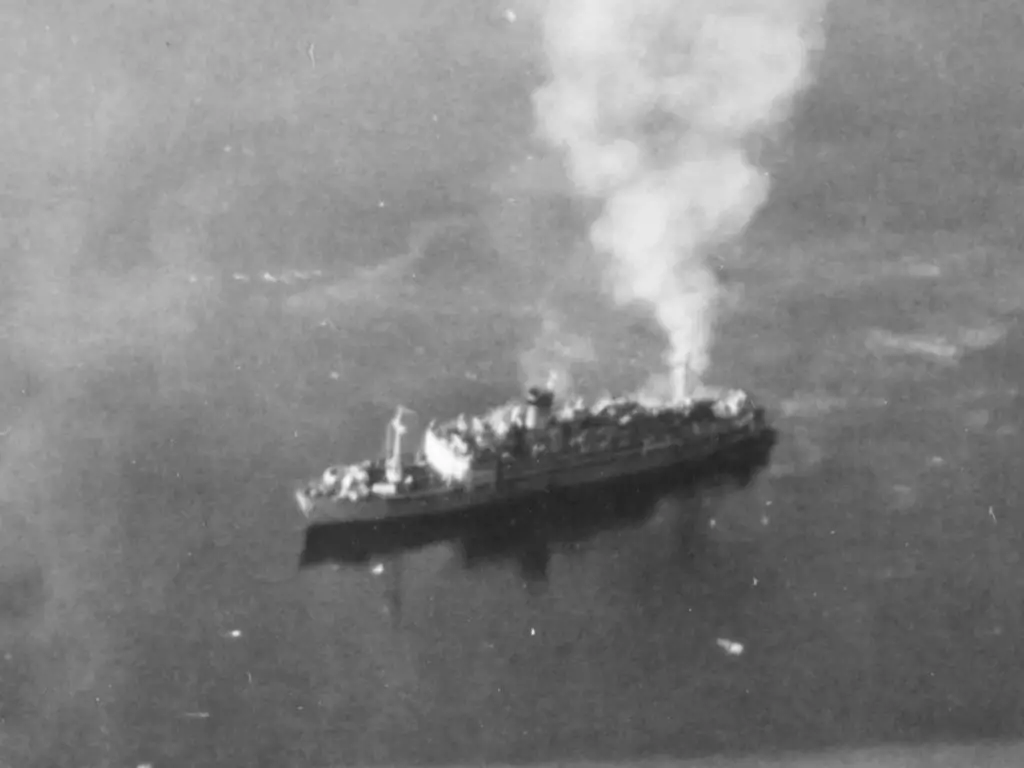
Oryoku burning after attack on 15 December 1944 about 11 AM. Photo by a Hellcat from USS Hornet shows POWs swimming in the water. Public Domaim

7.One Japanese hell ship executed all of its POWs (including throwing babies overboard alive)

While these POWs were alive to tell their tales, not all were lucky enough like them. One of the most gruesome scenes of WWII took places in one of these Japanese hell ships.

Akikaze was a Japanese destroyer and performed patrol as well as convoy escort duties during WWII.

After departing Rabaul, the Akikaze moved to Wewak from Mar 8, 1943 to deliver medicine and supplies, then to nearby Kairuru Island.

On Mar 15, 1943, Catholic missionaries including Bishop Joseph Loerks, six priests, 14 brothers, 18 nuns and one Chinese woman with her two infants were loaded onto Akikaze.

At first, the passengers were treated with dignity, even given a rear cabin and tea, water and bread. Their sea sickness were even treated by the ship’s doctor.

The destroyer proceeded northward and anchored off Lorengau on Manus Island overnight.

Then on Mar 17, 1943 twenty more civilians were brought aboard from Manus. The POWs included German missionaries, one Hungarian missionary and Chinese civilians including six woman. Now there were a total of sixty prisoners aboard the ship.

The apparent intention was to carry them to internment in Rabaul.

However, it was reported, “between Manus and Rabaul each of the adults was strung up by the hands on a gallows in the stern of the vessel, shot dead by rifle or machine-gun fire, and thrown overboard. The two Chinese infants and the European baby were thrown over alive.”

8.Journeying on these ships weaken the POWs

Even if these POWs were safely arrived at their destinations, their hellish experiences did not end on hell ships.

Suffering from diseases and malnutrition, these POWs continued to suffer even when they arrived at the POWs camps.

On Nov 6, 1943, 1230 Dutch POWs departed Singapore for Japan aboard Hawaii Maru.

They were provided with little amount of food consisted of a rice porridge and vegetable of food.

On Nov 27, their convoy was attacked near northern Taiwan. Another large transport (Hakone Maru) was sinking and an escort vessel (Tomodzuru) had been damaged.

The Hawaii Maru stopped up to rescue about 900 survivors, cramping the already crowded ship.

According to reports, Hawaii Maru arrived Moji, Japan on Dec 3, 1943. The prisoners were then moved to camps in Fukuoka, Kokura, Moji and Miyata. Some were sent to Shimonoski and Osaka.

At first, all POWs appeared to survive the journey to Japan. However, six died in the first two weeks after their arrival due to the deprivations of the journey.

Death records of camps in Fukuoka and Osaka showed there were slower effects of these voyages. The victims of hell ships that arrived in Japan typically died within 1 to 2 months due to diarrhea and malnutrition. At least another 70 passengers of Hawaii Maru died of pneumonia in the following months.

While it is impossible to tell if these deaths were caused by their journey, the high death rates among the passengers suggest that the month-long journey aboard Hawaii Maru left many men so weak that they were easily infected by diseases.

9.Those who were found guilty of war crimes because of what happened on board Japanese hell ships

Not all who were responsible of the deaths of POWS on board of these hell ships were convicted of war crimes after the war ended.

Well, it was hard to convict them as some of these Japanese armies gone down together with the sunken ships.

However, justice was served in some cases. The Tofuku Maru was transporting 1200 POWs and 600 Japanese Army troops between Singapore and Moji, Japan.

The voyage took place between Oct 27 and Nov 27, 1942. Altogether 27 POWs died during the journey, another 130 were carried off the ship on stretchers. As many as 100 died later.

Ship’s Master Shiro Otsu and Sergeant Major Eiji Yoshinari were tried for war crimes that led to deaths of the prisoners on the voyage during a Singapore War Crimes trial.

It was found that the POWs, who was a mix of American, Dutch, British and Australian were crammed into two holding areas with an average of 5 men per 6 square foot.

To make matter worse, there not enough toiletry facilities and foods for the prisoners.

On June 11, 1947, Otsu was found guilty while Yoshinari was acquitted.

10.Should these Japanese hell ships be raised from their seabed graves?

The Japanese hell ships that were sunk are still lying in the ocean bed. Now, some people opined that they should be raised.

One of them is Chinese fimmaker, Fang Li who wanted to raise Lisbon Maru that was sunk in 1942.

On her final voyage, she was transporting 1816 POWs between Hong Kong and Japan when torpedoed on Oct 1, 1942.

When the ship started to sink, the POWs tried to save their own lives.

Survivors reported that the Japanese guards first fired on the POWs who reached the deck and that other Japanese ships used machine guns to fire POWs who were in the water.

Some of the victims’ families agreed with the idea. However, one of the survivors of Lisbon Maru disagreed.

Dennis Morley, who thought to be the last survivor alive in Britain told BBC in 2018, “Oh God, how many hundred went under? Could be 1,000 odd. I don’t know. It’s no good getting them out. They’re all dead. They are probably bleached bones now. It’s wartime and a lot of horrible things happened during the war. They’re in peace. Leave them in peace. It is a war grave and should be left as a war grave.”

As for Fang Li, he had his own argument for wanting to raise Lisbon Maru as he considered it to be a jail.

He argued, “All those boys were detained there against their will, that’s why I feel so sad today- they are still detained on the sea floor. In my personal opinion they are on the Chinese sea floor in a Japanese jail. Shouldn’t we free them and send them home?”

Susumi Hoshijima, the Beast of Belsen of Sandakan POW Camp

Susumi Hoshijima, the Beast of Belsen of Sandakan POW Camp
Captain Susumi Hoshijima (center)

Susumi Hoshijima, the Beast of Belsen of Sandakan POW Camp

One of the infamous commandants of concentration camps during World War II (WWII) was none other than Josef Kramer.

He was the Commandant of Auschwitz-Birkenau (from May 8, 1944 to Nov 25, 1944) and of the Bergen-Belsen concentration camp (From Dec 1944 to its liberation on Apr 15, 1945).

The camp inmates called Kramer, the Beast of Belsen.

An apt label for someone who was directly responsible for the deaths of thousands of people.

After the war, he was captured by the British Army and convicted of war crimes.

Kramer was sentenced to death on Nov 17, 1945 and hanged on Dec 13, 1945.

Thousand of miles away from Poland and Germany’s Auschwitz-Birkenau and Bergen-Belsen concentration camps, there was another camp in Borneo where hundreds of Prisoners of War (POWs) died under severe conditions and under cruel treatment.

In the Sandakan POW camp, more than a thousand people died and another thousand died marching from Sandakan to Ranau.

And the one who was directly responsible for their deaths was the commander of Sandakan camp, Captain Susumi Hoshijima.

Captain Athol Moffitt, the prosecutor of the war crime trials for the brutality at the camp and Sandakan Death Marches, compared Hoshijima to the Beast of Belsen.

Susumi Hoshijima and Sandakan POW Camp

During WWII, the Sandakan camp POWs were forced to build a military airstrip. As Hoshijima was the military engineer, he was tasked to lead the construction.

A graduate of Osaka University, he started his military career managing the Sandakan camp as a lieutenant. By the end of the war, he was promoted to captain.

Towering at 1.8m, Hoshijima was described to have an athletic body.

In the beginning, life at the Sandakan POW camp was reported to be in good condition.

The POWs were actually paid for their work on the airstrip. The money they earned allowed them to buy extra food from the locals.

There was even a canteen for the POWs to buy extra food, medicine and cigarettes.

In terms of law and order, the discipline was considered light.

Things reportedly started to change when the Japanese moved the British and Australian officers from the Sandakan camp to Batu Lintang in Kuching.

These officers were the ones who provided some sort of protection from the Japanese. They formally complained to the Japanese and organised the soldiers to support each other.

Once they were removed, the conditions started to deteriorate in the camp.

On top of that, Formosan (Taiwanese) guards started to arrive in 1943. These guards were reportedly more vicious and cruel than the Japanese.

Since they themselves were colonial subjects, they were also suffering from their Japanese superiors, creating an injurious chain reaction.

As Japanese military officers beat and punished Formosan guards, so those same guards carried the pain forward by torturing POWs.

Susumi Hoshijima and his firing squad

Another theory is that the conditions at Sandakan camp had reportedly started to deteriorate in August 1942.

So what happened? It started when two POWs tried to escape but were caught in the jungle outside the camp.

As a warning, Hoshijima drew up a contract that specified execution by firing squad as the punishment for escape.

The POWs’ leader, Colonel A. W. Walsh at first refused to sign the contract. He stated that under Australian army regulations, it was a prisoner’s duty to take any ‘reasonable opportunity’ to escape.

Bound and held at gunpoint in front of his men, however, Walsh was left with no choice but to agree to Hoshijima’s terms.

Hoshijima’s new terms came into effect in May 1943. More than 20 men were rounded for possessing radio components.

After enduring three months of torture, one of them admitted to having the radio parts. The group was tried and found guilty. They received punishments ranging from six months in jail to execution by firing squad.

From there on, the conditions became worse and eventually ended with the infamous death marches of 1945.

Susumi Hoshijima’s cage punishment

According to Paul Taucher in his paper Command Responsibility at the Sandakan-Ranau War Crimes Trials, Hoshijima had authorised the use of the cage as punishment.

He also permitted the confinement of prisoners under inhumane conditions, and had authorised his subordinates to beat them.

“Three bamboo cages had been built in early 1943, to be used in the punishment of both POWs and IJA (Imperial Japanese Army) soldiers who broke camp regulations. The cages were designed so that a person inside could not lie down or properly stand up. These cages were not unique to Sandakan; records show they were relatively widespread in POW camps across Asia and the Pacific,” Taucher wrote.

While in the cage, these prisoners had no protection against the elements or mosquitoes.

In Sandakan, one POW died in the cage and several others died after being released from the cage.

Medical conditions in the Sandakan POW Camp

Apart from suffering from torture and brutality, the POWs were also suffering from lack of medical attention.

According to Japanese regulations, each POW camp was required to have at least one doctor on site.

However, the Sandakan POW Camp was established as a branch of the larger Batu Lintang (Kuching) camp.

Due to this, the camp doctor was permanently located there.

Records stated that two doctors visited Sandakan sometime in 1944.

Unfortunately, they did not bring any medical supplies with them. They did not even bother to treat any of the sick prisoners.

They just came, inspected the camp then went back.

The last consignment of medical supplies was sent to Sandakan from Kuching in July 1944.

By October 1944, the shipping route between Sandakan and Kuching was closed because of Allied forces continual bombing and attacks.

It was reported that the last doctor to visit Sandakan camp was Dr Yamamota. When he visited the camp in October 1944 and February 1945, he brought large amounts of quinine and atabrine (antimalarial drug).

However, it is not sure if the drugs were given to the POWs.

Susuimi Hoshijima reduces the food supply in Sandakan POW Camp

To make things worse, Hoshijima reportedly ordered the reduction of food supplies to Sandakan POW Camp.

Mark Felton in Never Surrender: Dramatic Escapes from Japanese Prison Camps wrote, “In accordance with the sudden reduction in work as the Allied air campaign closed the airstrip, in December 1944 the Japanese camp commandant, Captain Susumi Hoshijima, reduced the prisoner’s already meagre rations to only 140-200 grams of food per man per day.

“The POW death rate, which was already fairly high from tropical diseases and physical abuse, began to climb rapidly as the men, wracked by malaria, dysentery and beriberi, now became seriously malnourished and started to die of starvation and disease in large numbers. To make matters even worse Hoshijima ordered his men to cease feeding the prisoners altogether from January 1945.”

A shocking find inside the home of Susumi Hoshijima

While the POWs of Sandakan Camp slowly died due to hunger and sickness, Yuki Tanaka in Hidden Horrors: Japanese War Crimes in World War II revealed a shocking truth.

He stated, “By March 1945 the Japanese had stockpiled huge quantities of food and medical supplies in preparation for the expected Allied invasion. Presumably these stockpiles were intended only for Japanese personnel. The storage room beneath Commandant Hoshijima’s house contained more than 90 metric tonnes of rice and 160,000 quinine tablets. After the war, Allied forces found other stockpiles in the Sandakan area containing more than 786,000 quinine tablets, 19,600 Vitamin A and D tablets, large numbers of Vitamin B and C tablets, and a great deal of medical and surgical equipment. Nothing from these stockpiles was supplied to POWs, nor would the camp command have been permitted to do this even had they wished to.”

Tanaka added that the responsibility for the many POWs deaths from malnutrition and illness must lie in large part with the higher command of the Borneo Garrison and Lieutenant General Yamawaki Masataka and Major General Manaki Takanobu in particular, who seemed to have made the decisions deliberately to weaken POWs to death or close to it.

Susumi Hoshijima’s trial

It doesn’t matter whether the order to reduce the food supply came from Hoshijima or his superiors, the fact did not change that Hoshijima was directly responsible for the deaths and brutality against POWs in Sandakan camp.

After the war, Hoshijima was charged with ‘authorising and permitting POWs in his charge to be closely confined under in human conditions and beaten’, ‘authorising and permitting POWs in his charge to be tortured and beaten by soldiers under his command’, ‘failing to provide adequate and proper medical care and food for the POWs under his charge’ and ‘authorising and permitting underfed and ill POWs in his charge to be used for heavy manual labour and other labour’.

His trial took place between Jan 8 and 20, 1946 at Labuan.

Rather than focusing on the Sandakan Death Marches, his charges focused on the conditions at Sandakan Camp.

Under his command of the camp, more than 1100 POWs died from sickness, torture and starvation.

In the end, Hoshijima was found guilty on all four charges. He was sentenced to death and executed by hanging on Feb 27, 1946.

Moffitt, who had compared Hoshijima to Beast of Belsen, wanted the worst punishment for him. In fact, he even stated, “Death by the ignominy of hanging is too good for this barbarian, ironically self-termed ‘cultured’”.

The mystery behind eight missing priests in Sabah during WWII

One of the worst things when it comes to the atrocities of war is not knowing the fate of your loved ones who went missing.

When people went missing during wartime, it became logical to presume they were dead.

However, without physical evidence, one may never know the circumstances surrounding their deaths.

When Borneo was under Japanese occupation during World War II, all European soldiers and civilians were taken as prisoners of war (POWs). These civilians included missionary priests and nuns who came to the island to spread Christianity and established schools.

In Sarawak, most of the priests and nuns were taken to the Batu Lintang POW camp. One Mill Hill priest who was the parish priest of Marudi went along with other British officers to go to Long Nawang, Kalimantan to seek refuge. There, he was executed with more than 40 people by the Japanese.

In North Borneo, however, a small group of priests and their companions went missing, their bodies never found, even after the war.

It is understood that they were killed but how? And when?

Who were the missing priests?

The oldest of the missing priests is Monsignor August Wachter, who was also the Prefect of Northern Borneo at that time.

Born in Bludenz in Austria on Dec 7, 1878, Wachter was ordained as a priest on Dec 6, 1903. He came to Borneo in September, 1905, first arriving in Kuching and serving in Mount Singai. He also founded the St Michael Catholic Church Penampang and the Congregation of the Franciscan Sisters of the Immaculate Conception.

Reverend Joseph Bӧhm was born on Feb 20, 1900 in the diocese of Prague. He was ordained priest at the age of 27 and immediately sent to Borneo.

Meanwhile, Reverend Joseph Theurl was born on April 24, 1907 in Innsbruck, the fifth-largest city in Austria. Just like Bohm, he was sent to Borneo after his ordination on July 8, 1934.

The fourth of the missing priests was Reverend John Unterberger. He came to Borneo two days after his ordination on Sept 21, 1907. Unterberger was also the Pro-Prefect during the absence of Monsignor Wachter.

Reverend Mark Obertegger was born on April 18, 1905 at Meran. He came to North Borneo in 1930. The sixth missing priest is Reverend Anthony Raich. He was ordained during the First World War but he only joined the Mill Hill Society in 1923. Raich left for Borneo a year later in 1924.

The seventh priest in the group was Reverend Francis Flűr. Born on Jan 29, 1906, he was ordained on July 14, 1905 and then sent to Borneo.

Little is known about the eighth member of the group except that his name was Bro. Aegidius Leiter. He was a close companion of Monsignor Wachter.

Along with these eight religious men, there were three young local men who went missing with them. They were Patrick Lee, Peter Wong and Stanislaus Sabahai.

A fragment of a Roman collar that could have belonged to one of the missing priests

According to Union Catholic Asian News, British and Dutch missioners were detained in Batu Lintang POW Camp soon after the Japanese occupied Borneo in early 1942.

The report stated, “German missioners’ movements were restricted, except for Monsignor Wachter, who was free to visit Catholic communities. When Germany surrendered, the Japanese military no longer trusted the German missioners. Detained in May 1945, they were herded from place to place until they arrived in Tenom, the North Borneo Japanese military headquarters deep in the interior of Sabah, where one priest died of malaria in June. The other missioners were last reportedly seen alive in early August in Tenom, a piece of Roman collar found on the Sapong rubber estate near Tenom led to the belief they were killed there, but their bodies were never found.”

Located on the Tenom Lama-Kemabong road, Sapong was a rubber and tobacco estate established in 1905.

During the Japanese occupation, the estate became the 37th Japanese Army Headquarters in early 1944 to avoid being targeted by the Allies forces.

Were the missing priests shot to death?

An unnamed author wrote a historical account of what happen during the Japanese invasion of North Borneo which was published in The Daily Express on Nov 8, 2014.

In an article entitled ‘Looking back: North Borneo war scars’, the author gave his part of the story on might have happened to the eight missing priests.

He stated, “I have a sad and frightening story to tell. Monsignor A. Wachter, who was the Head of the Prefecture Apostolic of North Borneo and a few other priests of German nationals were later interned by the Japanese and were brought to Tenom from Penampang after the fall of Germany in 1945.

“Monsignor Wachter and the other priests, while being interned in Tenom, tried to contact us (my two brothers, Henry Edward, Jack Harry Maurice and myself) but they were refused permission by the Japanese to see us. We only learnt after the war, they were brought to Tenom from Penampang.

“Had we known they were in Tenom, we would have done something to rescue them from the Japanese. It was indeed sad to hear that Monsignor Wachter and the other priests were believed shot and killed by the Japanese.

“After the war, while I was serving in the District Office, Tenom, I tried my level best to locate the grave or graves of the late Monsignor Wachter and the other priests but to no avail.”

The mystery behind eight missing priests in Sabah during WWII
A view of Tenom town.

The missing priests could not have been killed by the Japanese because they spoke German?

However, another famous theory about what happened to the eight missing priests is that they were not killed by the Japanese in the first place.

As per reported in the Union Catholic Asian News, the Austrian priests at first were not interned by the Japanese because they knew how to speak German.

During WWII, the fight was between two major groups of nations which became known as the Axis Powers and the Allied Powers. The Allied forces were the countries that fought against the Axis powers. Meanwhile, the Axis Powers is an alliance between Germany, Japan and Italy.

It was believed that the Japanese did not interned the Austrian priests due to their alliance with the German.

If it is true, why did the Japanese capture and subsequently move them from Penampang to Tenom in May 1945?

The widely reported theory is that since Germany surrendered unconditionally to the Allies on May 7, 1945, the Japanese could no longer believe the German-speaking Austrian priests.

Another theory is that after the failed resistance led by Albert Kwok and his Kinabalu Guerrillas, the Japanese started to turn aggressive toward the Catholic missionaries.

Putting aside what might be the reason behind the Japanese’ change of heart toward the priests, there is one thing for sure. The eight missing priests were moved from Penampang to Tenom in May 1945.

The answer could be in ‘A Glimpse of a Mystery’

In searching for the truth behind the mystery of missing priests, the answer could lie in the book ‘A Glimpse of a Mystery’.

Written by Fr Charles Chiew in 2012, the book explored all the possibilities of what could have happened to the priests.

He believed that the shooting of the priests by the Japanese was just based on rumour and hearsay.

In the end, Chiew concluded “without hesitation submit that the eight Austrian Mill Hill Missionaries, their companions and the Japanese soldiers and officers of the Judiciary Department perished at Sapong during the Allies Airstrike sometime between July 1 and August 15, 1945 (most likely on July 3, 1945).”

According to Chiew, there was no reason for the Japanese to kill the priests and they were in fact, brought to Tenom for their safety.

Even so, the airstrike caused the building of Judiciary Department and its occupants to be completely annihilated.

How did the Allies forces find out about the location of 37th Japanese Army Headquarters?

Operation Semut was a series of reconnaissance operations carried by Australia’s Z Special Unit during WWII. By June 1945, Operation Semut 1 successfully spread its armed forces thinly in entire northern Sarawak even as far as Tenom.

On top of that, they successfully gathered intelligence regarding Japanese positions in these areas.

The Allies forces then were able to launch precisely their attacks on Japanese strongholds including the Sapong estate, dropping bombs on it without knowing that there could be civilians inside these buildings.

At the end of the day, however, the mystery behind the eight missing priests could only be answered by theories.

Was it possible they were shot by the Japanese and then their graves were annihilated during the Allies airstrike? Maybe. Or what had Chiew proposed was true in the first place that they were all well and alive until the bombing? We might never a hundred per cent sure.

In remembrance of the eight missing priests, a cenotaph was erected to commemorate them at the Church of St. Anthony, Tenom.

Here are the photos of the cenotaph taken by KajoMag in August, 2018.

The mystery behind eight missing priests in Sabah during WWII