Browse Tag

World War II - Page 3

Beriberi, the deadly disease among Allied POWs during WWII

Do you know that a severe chronic form of thiamine (vitamin B1) is known as beriberi?

The term ‘beriberi’ is believed to come from a Sinhalese phrase for ‘weak, weak’ or ‘I cannot, I cannot’.

There are two main types in adults; wet beriberi and dry beriberi. Wet beriberi affects the cardiovascular system while the dry beriberi affects the nervous system.

During World War II, beriberi was widespread among Allied prisoners of war (POWs) captured by the Japanese.

This is due to they were fed only with a diet of rice which did not contain adequate quantities of most vitamins.

Beriberi, the deadly disease among Allied POWs during WWII
Four prisoners of war (POWs) with beriberi at Burma-Thai Railway. Copyright expired – public domain

Beriberi’s symptoms among POWs

When suffering from dry beriberi, the victims would experience tingling in their hands and feet, loss of muscle function, vomiting and mental confusion.

Meanwhile, suffering from wet beriberi commonly can cause oedema or severe swelling. Another Australian POW Stan Arneil recalled what was it like to suffer from oedema due to beriberi.

“The symptoms were swollen feet and legs as the moisture contained in the body flowed down towards the feet. Ankles disappeared altogether and left two large feet almost like loaves of bread from which sprouted legs like small tree trunks, in bad cases the neck swelled also so that the head seemed to be part of the shoulders.”

Despite this, the Japanese continued to force the POWs to work through their sickness as no medical care was given.

During the Sandakan Death Marches for instance, POWs were forced to march from Sandakan to Ranau, of a distance of approximately 260km long through thick tropical jungle.

Those who too weak to walk due to exhaustion or sickness, were shot by Japanese guard.

“Death had slippers” when it came to beriberi

Speaking of Sandakan Death Marches, an Australian POW who had a very narrow escape from the deadly march witnessed first hand how a victim of beriberi perished.

Billy Young was among the soldiers who was imprisoned at Sandakan POW Camp.

After a failed escape from the camp, he was sent to Outram Road Jail in Singapore. This turned out to be a blessing in disguise for Young as those who stayed at Sandakan camp all died during the war (except for six Australians who managed to escape).

Still, Young went through hell on earth where he spent six months in solitary confinement and was forced to sit cross legged for hours at a time.

Since food rations were scarce, everyone including Young became skeletal. One time, one of Young’s inmates, a Dutch, died in his arms due to beriberi.

“I put his head on my lap. I chatted to him and I pushed his chest and felt it. And you could feel it going up and down as he was panting for breath. But death must have had slippers because he died and I didn’t know so I waited.

“I put him down and I didn’t tell the guard, and I waited till his box of rice came and I put Peter’s bowl by him. And I got mine, I ate mine, and then I ate Peter’s. And that’s the only banquet we ever had between us you know.”

Similarly, many of the surviving POWs described the deaths of the fellow comrades due to beriberi as ‘wasting away’.

Beriberi, a ‘norm’ for Prisoners of War

Ian Duncan was one of thousands Australian POWs who were send to work at Burma-Thai Railway.

He once shared this to journalist Tim Bowden during an interview, “At the end of the war, I interviewed every Australian and English soldier in my camp. I was the only medical officer in the camp. And I though it was duty to record their disabilities. And you’d say to them, what diseases did you have as a prisoner of war? Nothing much, Doc, nothing much at all. Did you have malaria? Oh yes, I had malaria. Did you have dysentery? Oh yes, I had dysentery. Did you have beriberi? Yes, I had beriberi. Did you have pellagra? Yes, I had pellagra but nothing very much. These are lethal diseases. But that was the norm, you see, everyone had them. Therefore they accepted them as normal.”

Burma-Thai POW camp was not the only one which was suffering from this disease. Another infamous Japanese internment camp is Batu Lintang Camp in Kuching which had similar conditions.

After the camp was liberated on Aug 30, 1945, a female civilian internee who was also a nurse named Hilda Bates went to visit the sick POWs.

She recounted, “I was horrified to see the condition of some of the men. I was pretty well hardened to sickness, dirt and disease, but never had I seen anything like this in all my years of nursing. Pictures of hospital during the Crimean War showed terrible conditions, but even those could not compare with the dreadful sights I met on this visit. Shells of men lay on the floor sunken-eyed and helpless; some were swollen with hunger, oedema and beriberi, others in the last stages of dysentery, lay unconscious and dying.”

Meanwhile in Indonesia, it was reported the disease affected nearly one hundred percent of Bataan POWs. It was considered as the most ubiquitous disease among the POWs.

Experiments on POWs to cure beriberi

A Japanese doctor army named Masao Mizuno described experiments he conducted in a report he submitted in October 1943.

He wrote in the report, “In South Sea operations, such conditions as the lack of materials, the difficulty in sending war materials, the heat and moisture, increase the occurrence of beriberi patients. For this reasons, attention must be given to the use of local products. Favourable results in the prevention of beriberi have been noticed by the usage of coconut milk, coconut meat and the yeast from corn.”

Mizuno continued to describe an experimental treatment he did on 16 POWs who were suffering from beriberi in an unknown location.

He gave them hypodermic injections of 30ml of sterilized coconut milk. (Yes, you read that right – sterilized coconut milk.)

According to Mizuno, most patients felt a slight prickling pressure pain at the site of the first injection and one felt a slight headache.

Later, the condition of most patients improved with the second, third and fourth injections. They showed ‘satisfactory pulse, refreshing sensation and increased appetite.’

However, it is not known whether these experiments were continued or if the procedure was ever used as a treatment.

The death tolls caused by beriberi among Allied POWs remain unknown

Through survivors’ testimonies, we might know which perished Allied POWs had the disease but we will never if the disease was the leading cause of death.

Just like Dr Duncan had testified, these poor men had other diseases such as pellagra, malaria, dysentery on top of beriberi.

For the fortunate POWs who were freed after the war had ended, sickness including beriberi followed them into their liberation.

It was reported that some deaths due to wet beriberi did occur soon after their release but the number was small and did not continue.

One unusual case, however, did happened on a British POW who died of cardiac failure 31 years after his release.

As a POW, he suffered very severe beriberi. After autopsy, it was found that he had extensive myocardial fibrosis considered due to the effects of severe wet beriberi.

Unfortunately until today, it is difficult to know how many Allied POWs suffered or died due to beriberi during and after the war.

What you should know about the Battle of Beaufort

The Borneo campaign of 1945 was the last major Allied campaign in the South West Pacific Area during World War II (WWII) to liberate Japanese-held Borneo.

One of the combats that took place during the campaign was Battle of Beaufort in 1945.  

Located about 90 kilometers south of Kota Kinabalu, the town of Beaufort was initially developed to help the economic activity of interior of Sabah.

The town was named after former British governor Leicester Paul Beaufort.

The prelude before the Battle of Beaufort

The operation to secure North Borneo was separated into phases; preparatory bombardment, forced landing and an advance.

They wanted to turn Brunei Bay into a naval base for the British Pacific Fleet. To do that, the Allied forces need to secure Labuan to control the entrance to Brunei Bay. At the same time, Labuan would be developed as an airbase.

After several weeks of air attacks as well as a short naval bombardment, soldiers of the Australian 24th Brigade landed on Labuan on June 10.

The Japanese garrison was outnumbered and the Australians quickly captured the island’s harbour and main airfield.

The fight in Labuan continued until June 21. In the end, a total of 389 Japanese personnel were killed on Labuan and 11 were captured. Meanwhile, Australian casualties numbered 34.

After capturing Labuan, the Australian solders successfully captured the town of Weston against light opposition from the Japanese.

Since there was no road from Weston to Beaufort, the battalion advanced along the single track railway toward Beaufort.

In the meantime, another Australian battalion landed around Mempakul from Labuan also without any resistance from the Japanese.

They managed to secure the Klias Peninsula before moving along the Klias River heading to Beaufort.

Later, the two Australian battalions reunited at Kandu and made their journey towards Beaufort together.

Once the Australians captured Beaufort, they would be able to control the railway that ran toward Jesselton (now Kota Kinabalu).

The Battle of Beaufort

What you should know about the Battle of Beaufort
A 2/43rd Battalion mortar crew firing on Japanese positions near Beaufort on 28 June 1945 (Copyright expired – Public Domain).

On June 26, the two Australian battalions started to approach the town. At that time, there were about 800 to 1000 Japanese soldiers at Beaufort.

The Australian soldiers coordinately captured the town and ambushed the route where the Japanese were expected to withdraw along.

At the same time, the Japanese resistance lacked coordination as they tried to launch six counterattacks against the Australians.

During the battle, some fights even went down to hand-to-hand combat.

The six counterattacks by the Japanese all resulted in failure. By June 29, Australian soldiers had captured the town.  

With that, the Australians were able to open the Weston-Beaufort railway line to bring in the supplies.

The Allied forces then continued to secure Papar on July 6.

In the end, The Battle of Beaufort took the lives of seven Australians and 93 Japanese, leaving 40 people (including 2 Japanese) wounded.

The story of Tom Starcevich’s gallantry

What you should know about the Battle of Beaufort
A patrol from the 2/43rd Battalion in the Beaufort area during August 1945 (Copyright expired- Public Domain).

On June 28, Tom Starcevich’s company encountered two Japanese machine-gun positions in the middle of a jungle track.

The Japanese opened fire first and the Australians suffered some casualties. Starcevich moved forward and assaulted both Japanese positions using his Bren gun.

He killed five Japanese soldiers and causing the rest to retreat. Later on the same day, the company again came across another two machine gun positions. Again, Starcevich single-handedly attacked both and killing another seven Japanese soldiers.

For his bravery, Starcevich was awarded the Victoria Cross after the war. It is the highest decoration for gallantry in the face of the enemy that can be awarded to members of Commonwealth armed forces.

The track where Starcevich’s gallant move took place was later renamed Victoria Cross Road.

Additionally, there is a monument in Beaufort named The Starcevich Monument or Beaufort Australian Monument dedicated to Starcevich.

The aftermath of Battle of Beaufort and the discovery of comfort women

With their six counterattacks, the resistance in Beaufort was the only time that the Japanese had actually made an effort to fight against Allied forces in North Borneo.

Although there were minor combats in the following months, the Battle of Beaufort was considered the last significant action fought in North Borneo during WW2.

In August 1945, a member of the Australian Ninth Regiment was in Borneo as part of the British-Borneo Civil Affairs Unit.

He reportedly found some Javanese women who had been transported to Borneo by the Japanese as comfort women. These women were forced into sexual slavery during the war.

The Javanese women were living in the ruins of the Japanese comfort station somewhere in Beaufort.

According to the book Legacies of the Comfort Women of World War II, the Australian forces took them to a small island off in the Borneo coast for medical treatment and rehabilitation.

While the Australians wanted to send them back to Indonesia, the women were afraid of going home because of the shame associated with their experience, so much so that one of them committed suicide. However, it is not certain if the rest of the women managed to return home.

After the war ended, Beaufort was the place where the Japanese were told to gather before they were transported back to Japan.

Unfortunately for them, many of the Japanese were killed by the Muruts on their way to Beaufort.

Out of thousands of Japanese troops who marched to Beaufort after surrendering their firearms, only a few hundred ever reached Beaufort.

10 random historical facts about Malaysian islands you might know

Malaysia has a lot of islands. In fact, there are 878 that belong to the country.

Taking the prize for having the largest number of islands is the state of Sabah, with 394 within its waters.

Each of these islands has its own charm. Some Malaysian islands are uninhabited, while others are a place the locals call home. The ones which offer accommodation, white sandy beaches and activities such as snorkeling and scuba diving were always swarmed by tourists during pre-Covid days.

Nonetheless, the historical attractions of these Malaysian islands are often overlooked. 10 random historical facts about Malaysian Islands you might not know:

1.One of Malaysia’s islands is shared with North Kalimantan.

10 random historical facts about Malaysian islands you might know
Pulau Sebatik. Credit: Creative Commons.

The biggest island in Malaysian territory – Borneo – is shared with Brunei and Indonesia. But do you know that there is a Malaysian island which has a border cutting straight through it with the northern half belonging to Sabah on one side and the southern part to North Kalimantan, Indonesia?

Located on the eastern coast of Borneo, between Tawau Bay to the north and Sibuku Bay to the south, the island is officially listed as one of the 92 outlying islands of Indonesia.

The border was carved out by the British and the Dutch under the Anglo-Dutch treaty when they colonised British North Borneo and Indonesia respectively, in the 19th century.

It is not immediately obvious that the island belongs to two different countries when you arrive there. There are no border guards, no immigration office, no customs department and no barbed wire fence or any kind of fencing.

2. The Suluk male population of this island was executed by Japanese forces during World War II.

During World War II (WWII), the locals formed the Kinabalu guerrillas to rebel against the Japanese forces in North Borneo.

With about 300 guerrilla fighters, the revolt was aided by the Bajau-Suluk leaders such as Panglima Ali (Sulug island), Jemalul (Mantanani islands), Arshad (Udar island) and Saruddin (Dinawan island) attacking from the sea.

They won, successfully reclaiming Jesselton, Tuaran and Kota Belud with 50 to 90 Japanese casualties.

Meanwhile, the Japanese retaliated and they retaliated hard. They launched a series of bombings from Kota Belud to Membakut, burning down villages along the way.

In Dinawan island in particular, nearly every Suluk male was executed while their women and children were moved elsewhere.

According to official reports, 66 were killed out of a population of 120 in Dinawan island.

3.On another island, the Japanese massacred the women and children who were left behind.

Today, the Mantanani islands provide a popular diving site, boasting rich marine life and blue waters. But in World War 2, the islands became a site of bloodshed.

The Japanese was gathering all the Kinabalu Guerrillas when they heard a rumour that some of them were hiding on the island of Mantanani.

Edward Frederick Langley Russell in the book The Knights of Bushido wrote, “When the Japanese force commander on Mantanani was unable to find the Chinese guerrillas for whom he was searching. During the next few weeks, each one of these men died of torture or starvation at the Kempei Tai headquarters or in Jesselton Prison. Not a soul survived.”

Two days after the Japanese force had left Mantanani with the arrested Suluks, it returned.

First, they machine-gunned the Suluk men and women, subsequently killing all the wounded.

After that, the Japanese killed 25 women and four children.

4.One of the battle of the Napoleonic Wars took place near the vicinity of this island

While the Napoleonic Wars had nothing to do with Malaysia, interestingly enough, one of its tiny battles took place near our coast.

The Napoleonic Wars (1803-1815) were a series of major conflicts between the French Empire and other European powers.

On Valentine’s day in 1804, a large convoy of East Indiaman (a type of sailing ship) consisting of well-armed merchant ships chased away a powerful French naval squadron. The naval engagement took place in the vicinity of Aur island, Johor.

The french convoy was led by Contre-Admiral Charles-Alexandre Durand Linois. Meanwhile, Commodore Nathaniel Dance was the commander of the British convoy.

Although the French force was much stronger than the British convoy (they were just merchant chips by the way), Dance’s aggressive approach against the French led Linois to retire after only a brief exchange of shot.

After chasing the French away, Dance resumed his passage toward British India.

Perhaps out of embarrassment, Linois later exaggeratedly claimed that the British convoy was defended by eight ships of the line. This claim, of course was later disputed by many historians.

Whatever makes you happy, Linois.

10 random historical facts about Malaysian islands you might know
The retreat of Rear Admiral Linois’s Squadron consisting of the ‘Marengo’ of 84 guns, the ‘Belle Poule’ and ‘Semillante’ of 44 guns each, a corvette of 28 guns and a Batavian brig of 18 guns from a fleet of 16 of the East India Company ships after the action off Pulo Aor in the China Seas on the 15th. February 1804. Credit: Public Domain.

5.Another island which witnessed a battle during World War I.

10 random historical facts about Malaysian islands you might know
Route taken by Emden during her commerce raiding operations. Credit: Public Domain.

During World War I (WWI), Penang island was a part of the Straits Settlements, a British Crown Colony.

Right after the outbreak of WWI, the German East Asia Squadron left its base in China. All but one ship headed east for Germany. In the meantime, the lone ranger which was the SMS Emden under Lieutenant Commander Karl von Muller was sent on a solitary raiding mission.

Then on the early morning of Oct 28, 1914, SMS Emden appeared off Penang island to attack any harbour defenses or any vessels she could find.

As a disguise, von Muller made her vessel to look like the British cruiser HMS Yarmouth (1911).

Once Emden entered the harbour, she came across the Imperial German navy. von Muller then proceeded to launch a torpedo at the Imperial Russian protected cruiser Zhemchug.

In retaliation, French cruiser D’lberville and French destroyer Fronde by now opened fire on the Emden. However, the French was just shooting wildly and Emden just left the harbour unharmed.

You might wonder why Zhemchug did not return fire. Well, her captain Baron I. A. Cherkassov went ashore that night to visit his wife (in some reports, they state it was his mistress).

After spending what we like to assume was a good night with his woman, Cherkassov watched helplessly from the Eastern & Oriental Hotel as his ship sank.

88 of his men died and 121 were wounded because of the attack.

6.The former name of this island is Peria (bittergourd in Malay).

Pulau Duyong is a river island located in the mouth of Terengganu river.

The island was a famous residence for Tok Syeikh Duyong (1802-1889). Originally, the island was known as Pulau Peria or Bittergourd Island alluding the shape of the island.

However, the villagers of the island allegedly saw two mermaids landing on its shore.

Hence, the name Duyong or Mermaid.

Honestly, Mermaid Island does sound cooler than Bittergourd Island.

10 random historical facts about Malaysian islands you might know
A mermaid sighting has led the residents of Pulau Peria to change its name to Pulau Duyong. Credit: Pixabay.

7.One of the Malaysian islands is a former leper colony and camp for Prisoners of War (POWs).

Located in Sandakan Bay, Malaysian state of Sabah, the Berhala island is about 5 hectares in size.

Before World War II (WWII), the island was used as a layover station for labourers coming from China and the Philippines. There was also a leper colony on the island.

Then during WWII, the Japanese used the quarantine station as a makeshift internment camp for both prisoners-of-war (POWs) and civilian internees.

The POWs and civilian internees were stationed on Berhala Island before they were sent Sandakan POW Camp or Batu Lintang Camp respectively.

Some of the notable internees who were held here were author Agnes Newton Keith and her husband, Harry Keith as well as North Borneo district officer Keith Wookey.

In June 1943, eight POWs made a daring escape from the island. They managed to escape to Tawi-tawi in the Philippines before they were transferred to Sandakan POW Camp.

The eight-member group was later known as the Berhala Eight.

8.The 18th descendant of Prophet Mohammad was buried on one of Malaysian islands.

Pulau Besar or Big Island is an island in Malacca. On the island, there is a tomb which belongs to Sultan Al Ariffin Syeikh Ismail.

He was the 18th descendant of the Prophet Mohammad. He received his calling to spread Islam to Java after a visit to the Prophet’s tomb in Medina.

Syeikh Ismail reached Pulau Besar in 1495 and from there start to preach the Islamic teaching throughout the Malay Archipelago.

He passed away at the age of 58 and was buried on the island.

His tomb along other ancient graves and mausoleums are now part of tourist attraction of the island.

9.A Malaysian island was a refugee camp for up to 40,000 Vietnamese refugees.

10 random historical facts about Malaysian islands you might know
Bidong island in undated photo. Credit: Creative Commons.

The Vietnam War ended on Apr 30, 1975 with the evacuation of the American Embassy and the fall of Saigon to the North Vietnamese Army.

Soon after that, millions of people tried to flee the new communist rule in Vietnamese.

By May 1975, the first boat with 47 Vietnamese refugees arrived on Malaysian shore. On Aug 8, 1975, Bidong island off Terengganu officially opened on Aug 8, 1978. At one point, the small island was cramped with up to 40,000 refugees.

From then, about 250,000 Vietnamese had passed through or resided on Bidong island until it was closed as a refugee camp on October 30, 1991.

Most of them resettled in countries such as the United States, Canada, Australia and France. The remaining ones were repatriated to Vietnam against their will. The last refugees left on Aug 18, 2005 for Vietnam.

Today, a marine research station was established by Universiti Malaysia Terengganu on the island.

10.The natives of this island attacked shipwreck survivors, cutting off the legs of one of them.

The year was 1805. A 75-tonne schooner named Betsey departed Macau heading for Sydney. Her crew comprised of two officers, Captain William Brooks and chief mate Edward Luttrell, and 10 seamen, including four from China, three from the Philippines and three from Portugal.

On Nov 21, 1805, the vessel struck a reef. The crew struggled to refloat their vessel for three days before deciding to abandon her.

Brooks, Luttrell and three Portuguese crew climbed into the jollyboat while the rest abandoned the Betsey on a raft. The initial plan was to travel together, but a strong wind parted them.

Unfortunately, the raft and the crew on it were never seen again.

On Dec 2, the jollyboat arrived on the Balambangan Island off the North Coast of Borneo. There, 11 natives attacked them. Brookes died after they cut off both his legs.

The survivors, Lutterall and two Portuguese crew managed to escape and head back to the sea.

Two weeks later on Dec 15, the three men arrived at another island to find food but were attacked by a group of local Malays.

After killing one of the Portuguese, the Malay kept Lutterall and the surviving Portuguese crew as slaves. A year later, the captors finally released them.

Remember these interesting historical events when you have the opportunity to visit any of these Malaysian islands some day.

5 things you need to know about Operation Opossum during WWII

In 1945, the Australian Z Special Unit organised a dangerous mission to rescue the Sultan of Ternate, Muhammad Jabir Syah right under the Japanese nose. They called the mission Operation Opossum.

Also known as the Kingdom of Gapi, the Sultanate of Ternate is one of the oldest Muslim kingdoms in Indonesia.

It was established in 1257 by Momole Cico who was the first leader of Ternate.

The kingdom’s Golden Age took place in 1570-1583 during the reign of Sultan Baabullah. During this time, the sultanate encompassed most of the eastern part of Indonesia and a part of southern Philippines.

Fast forward to 1942 during World War II (WWII), the capital of the sultanate Ternate city was occupied by the Japanese.

The sultan and his family were held hostage in his own palace. While imprisoned, the Sultan sent several of his men to Australian Army headquarters on Morotai island asking to be rescued.

General Douglas MacArthur heard the Sultan’s plea and sent a team from the Z Special Unit to rescue him in a raid called Operation Opossum.

So here are five things you need to know about Operation Opossum:

1.The initial plan for Operation Opossum was not to rescue the Sultan

According to Australian War Memorial, the original plan for the Operation Opossum was to attack Ternate Island in order to extract an Australian airman.

However, the Netherlands Indies Civil Administration later informed that the man was later removed.

Since most of the intelligence on which Operation Opossum based came from the Sultan, the plan then changed to extract him as a preliminary move to recover the missing airman.

2.How Operation Opossum went down

The team consisted of eight Australians from Z Special Unit along with three Dutch officers and a Timorese corporal.

After roughly two months of planning, the mission left Morotai on Apr 8, 1945 and landed on Hiri Island, two kilometers north Ternate.

From Hiri, the message that Z Force had arrived was sent up the volcano where the royal family was hiding.

The family then safely descended to the coastal village of Kulaba after a six-hour trek. From there, two perahu took the Sultan along with his two wives, eight children and other relatives to Hiri.

3.The mission almost failed because the locals were too happy to see the Sultan.

When the royal family arrived at the village, the villagers were too happy to see their sultan and greeted him in their traditional way. They squatted down with one raised knee, with hands pressed against their faces in an attitude of prayer and remained so until dismissed by a nod from the Sultan.

Some of the village elders even lined up to kiss his feet.

The sultan was not happy with the greetings from his people. He kept telling them to be careful in case the Japanese would see them.

True enough, word got out that Sultan was escaping. Several boats carrying Japanese soldiers were sent to Hiri to stop the mission at dawn the very next day.

5 things you need to know about Operation Opossum during WWII
TERNATE ISLAND, HALMAHERA ISLANDS. 1945-11-09. ATTENDED BY AUSTRALIAN FORCES THE SULTAN OF ISKANDAR MUHAMMAD DJABIR, SYAH OF TERNATE MAKES A SPEECH AFTER HIS INAUGURATION. (NAVAL HISTORICAL COLLECTION).

4.The heroic death of Lieutenant George Bosworth

When the Japanese soldiers made contact with the Z Forces, they exchanged fire.

The current Sultan of Ternate, Sultan Mudaffah described what happened during the attack to The Sydney Morning Herald in an interview back in 2010. He was 10 when his family was rescued by the Z Forces.

Lieutenant George Bosworth, who was guarding Sultan Jabir, rushed about 500 meters to the landing site.

Speaking of Bosworth, Sultan Mudaffah said, “This man was too brave. According to my father, he was just standing there, shooting. My father said ‘you can’t just stand there’.”

Three of the Japanese soldiers fell on the beach. As Lieutenant Bosworth approached one of them, it turned out the Japanese soldier was still alive as he picked up his rifle and shot Bosworth in the head.

The fight continued between Z Force and the Japanese, forcing the remnants of Japanese tried to swim back to Ternate.

However, the Japanese were all killed by the locals before they reached shore.

From Hiri, the sultan and his family were taken to Moratai. There, Sultan Jabir debriefed General MacArthur on Japanese positions and tactics in the area.

They were then sent to settle in the Queensland town of Wacol until the end of the war.

MacArthur learned from the sultan that the Australian airman had been removed. Therefore the plan for his extraction was not carried out.

5.Operation Opossum loosely inspired a movie which starred Mel Gibson before his Hollywood fame.

Attack Force Z (alternative title The Z Men) is a 1982 Australian-Taiwanese film. Operation Opossum reportedly inspired the film, although the plot was very different from what had actually happened.

The plot circles around Captain P.G. Kelly (Mel Gibson) who leads a team of the Z Special Unit against Japanese during the WW2.

The movie was screened at the Cannes Film Festival on May 18, 1981. Years later, Gibson called the film “pretty woeful… it’s so bad, it’s funny.”

MV Krait, the Japanese fishing ship that was used against the Japanese

If you want to raid the enemy’s harbour and blow up their ships without getting caught, what better way to do it than using one of the enemy’s own vessels?

MV Krait is a wooden-hulled vessel that was used in a raid against Japanese ships anchored in Singapore Harbour during the Second World War (WWII).

Codenamed Operation Jaywick, the mission was carried out by a special task forced called Z Special Unit.

They are mainly made of British and Australian soldiers who had escaped Singapore before its surrender.

The history of MV Krait

After the Fall of Singapore in 1942, civilians made their escape from the island on all kinds of boats and ships.

In the middle of the chaotic scene, an Australian master mariner named Bill Reynolds managed to salvage a little Japanese fishing boat.

The ship’s name was Kofuku Maru. Reynolds used her to rescue civilians fleeing the island and at one point evacuating over 1,100 people from ships sunk along the east coast of Sumatra.

Kofuku Maru eventually reached Australia and was handed over to the Australian military. The Allied forces then renamed her Krait after the small but deadly snake.

MV Krait and Operation Jaywick

Major Ivan Lyon, whom Reynolds came across with during his rescue work, became very interested in the Japanese vessel.

He conceived the idea of raiding Singapore Harbour using Kofuku Maru. Both Lyon and Reynolds realised that if the vessel could get out of Singapore unnoticed then she could get in unnoticed as well.

On Sept 2, 1943, eleven Australian and four British army and navy personnel as part of the Z Special Force went on board MV Krait left Exmouth Gulf, Western Australia heading to Singapore.

Today, blackface is considered rude and offensive since it was used to mock enslaved Africans. However, these operatives dyed not only their hair black but their skins as well for their disguise. The skin dye later caused many skin problems for them causing irritation and reactions to sunlight.

The crew even flew a Japanese flag and wore sarongs to look like the local fishermen.

MV Krait finally arrived off Singapore on Sept 24. There, six of them left the boat to paddle 50km to a small island near the harbour.

Then on the night of Sept 26, the men used folboats to paddle into the harbour and placed limpet mines on several Japanese ships.

The mission was successful, sinking six of the Japanese ships. The raiders waited until the commotion to die down before returning to Krait on Oct 2.

In the meantime, MV Krait spent two weeks circling in the South China Sea to avoid suspicion and waiting to return for the pre-arranged pickup.

On their way back to Australia, MV Krait was almost approached by a Japanese auxiliary minesweeper who was on patrol. Lucky for them, nothing happened and the Japanese did not suspect a thing. On Oct 19, the Krait arrived safely back at Exmouth Gulf.

MV Krait, the Japanese fishing ship that was used against the Japanese
Crew of the MV Krait during Operation Jaywick, 1943. Credit: Public Domain

The price of Operation Jaywick

The raid had caught the Japanese with their pants down. They never thought the Allied forces would attack Singapore.

Hence, their suspicion laid on the locals. The price for the successful Operation Jaywick was unfortunately paid by the blood of civilians and civilian internees who were captured and tortured by Kenpeitai (Japanese military police).

It went down in history as the Double Tenth Incident or Double Tenth Massacre since it occurred on Oct 10, 1943.

The Kenpeitai arrested altogether 57 civilians and civilians internees suspecting them to be involved in a raid on Singapore Harbour.

However, none of them had participated in the raid or even had any knowledge of it. In the end, 15 of them died in Singapore’s Changi Prison.

MV Krait after Operation Jaywick

After the success of Operation Jaywick, MV Krait was used continuously by the Australian military throughout WWII.

When the Japanese official surrendered on Ambon, Indonesia in September 1945, she was there to witness the historical event.

After her service, she was sold to the British Borneo Company at Labuan and operated off Borneo for few years.

In 1964, MV Krait was purchased as an Australian Royal Volunteer Coastal Patrol vessel. In the same year, she was dedicated as a war memorial.

Since 1988, she has been displayed to the public at the Australian National Maritime Museum, Sydney.

Since the success of MV Krait on Operation Jaywick, the Australian Commando Unit traditionally used the names of venomous snakes for their vessels.

Rowan Waddy and his experience as a Semut Operative in Sarawak

Operation Semut was a series of reconnaissance operations that took place in Sarawak.

It was carried out by Australia’s Z Special Unit in 1945 during the final days of World War II (WWII).

Altogether, there were four operations were undertaken under Operation Semut.

Their main objectives? To gather intelligence and to train the indigenous people in launching guerrilla warfare against the Japanese.

Commando! The M/Z Unit’s Secret War Against Japan (1996) is a book compiled and edited by A.B. Feuer.

The book is a compilation of stories from Australian commandos who fought against the Japanese in Borneo during WW2.

In it, readers can find an interesting story of Australian Lieutenant Rowan Waddy and his experience in Sarawak. He was a part of Operation Semut IVB.

From Aug 13 to 23, 1945, Semut IVB sailed out of Labuan via HMAS Tigersnake and moored at Mukah. Together with Lieutenant Ron Hoey, Waddy paddled Hoehn folboats (collapsible canoes) journeyed along the Mukah river to engage any remaining hostile Japanese groups.

They continued to work in Sarawak until October 1945 to secure the surrender of remaining Japanese troops.

Rowan Waddy and his experience as a Semut Operative in Sarawak
HMAS Tiger Snake. Public Domain.

Rowan Waddy on working with local guerrillas

Here, Waddy had the opportunity to work with the locals, especially the Ibans.

Commenting about them, Waddy stated, “The Ibans are a paradox. Despite their warrior reputation, they are a happy, fun-loving people- highly superstitious and tattooed – with long black hair and cut-extended earlobes. The Ibans are also loyal, brave and love to fight. Their weapon is the blowpipe (sumpit) using poisoned darts. The dart is about 20cm long and perforated near the point. After the dart enters the skin, the shaft easily breaks off, leaving the poisoned tip embedded in the flesh. It can take from 20 minutes to 24 hours of agonizing suffering to kill a person. There is no doubt that the Japanese feared the Ibans more than they did the Australians.”

Waddy also commented on how the Ibans were always in the lead while on patrol, always moving without caution and always looking for action. Waddy often was forced to hold them back.

Additionally, the Ibans had great eyesight, even working in the dark jungle. In one of the nights which Waddy described as ‘so dark that it was impossible to see one’s own foot’, an Iban man who carried spare magazines for his gun stayed closed by.

Waddy shared, “He constantly made slight physical contact, which was indeed reassuring. If the Iban wanted me to stop, he would give a gentle tug on my sleeve, slide his arm over my shoulder, and point in the direction he wanted to look, but I could not see or hear anything unusual.”

The importance of local cooperation

It was crucial for these soldiers to work closely with the locals. According to Waddy, agents inserted into enemy-occupied Europe did not have the problems of colour or stature.

There, they blended in with the local population but not in Borneo or throughout the Southwest Pacific.

“White Europeans, with large builds, attracted a lot of unwelcome attention. Therefore, to ensure success, it was essential that the local population was friendly and cooperative,” Waddy noted.

Thankfully for Waddy and most Semut operatives, the locals were being cooperative to them.

Although the Ibans in particular never heard of Australia before, and thought the Semut operatives were British.

Rowan Waddy and his Japanese head

During one of the combats under the Semut Operation, Waddy successfully killed a Japanese soldier.

He described what happened after the battle when he returned to his boat, “The Ibans followed after burying the body. I had no sooner taken my seat in the perahu than a thin, torn burlap bag was dropped at my feet. To my horror it contained the bloody head of the soldier I had killed.”

The Iban guerillas had cut off the soldier’s head, extracted the brain and brought it back with them.

From there, Waddy managed to witness Iban traditions no longer practiced to this day.

According to Iban tradition, the head officially belonged to Waddy. For the next couple of weeks, the head was always hung where he slept.

Describing the smoking process, Waddy wrote, “The head was positioned above a slow fire that was covered with thatching, allowing the smoke to continuously encircle the head. The heat caused the fat, especially from around the cheeks, to slowly drip and sizzle in the fire – not unlike sausage a barbecue grill. At all times there were Ibans squatting and gazing longingly, with admiring smiles, at the head and the sizzling.”

Waddy goes on to describe the rest of the effects of the smoking process, and how the smoking drew the skin taut across the face, and the skin split down one side, revealing the teeth, and “leaving the head with a permanent grin.”

Celebrating the head and its owner, Rowan Waddy

After the skin on the head was dried, it was now the time for the Feast and Dance of the Enemy Head.

According to Waddy, it was an amazing experience.

The event lasted two days and nights which began outside the longhouse before moving inside the long communal room in from of the fifteen doors.

As the “owner” of the head, Waddy was one of very few white men who had ever witnessed and participated in the head dance.

There were dancing and chanting as well as beating of the gongs and drums. While Waddy described the atmosphere and excitement as electric, he said that the ceremonies were sparse compared to what they normally would have been.

This was due to the food shortages forced upon the locals by the Japanese.

Rowan Waddy on the tension between the Chinese and the Iban

Speaking about the locals, Waddy could not help but notice the tension between the Iban and the Chinese during the war.

He noted, “There is no love lost between the Chinese and the Ibans. The Chinese are traders, and comparatively wealthy. On the other hand, the Ibans are simple, communal jungle people who love to hunt heads including Chinese collaborators. The Ibans look down upon the Chinese – the Chinese fear the Ibans.”

Waddy related a story on how he received an unconfirmed report that a small party of Japanese were hiding out in a nearby village when he was in Bintulu.

Since he was busy at the time, his fellow companion Penghulu Blaja from Kanowit volunteered himself to go have a look.

He agreed but he instructed them not to attack or kill any Japanese soldiers, only to observe.

The next day, a group of Chinese showed up wanting to see the Military Governor.

Apparently, there was a loud argument between the Chinese and Iban the previous night and several Chinese were killed.

Waddy immediately sent for Blaja. As it turned out, the penghulu was behind the attack.

After sending the Chinese with Malay police escort, Waddy asked the penghulu why he disobeyed his order.

To that Blaja insisted that he had not disobeyed Waddy’s order as the order was not to kill any Japanese. Blaja argued however that Waddy never told him not to kill Chinese, especially those who had collaborated with the enemy.

Waddy eventually was forced to admit that Blaja had a point.

Rowan Waddy and his experience as a Semut Operative in Sarawak
Lieutenant Rowan Waddy and Penghulu Blaja in an undated photo. Credit: Australian War Memorial

Rowan Waddy’s final goodbye to Sarawak

Not long after that, the operatives received orders that all special operations in Sarawak were to cease and members of Z unit were to be out of the field by Oct 15, 1945.

On Oct 11, Waddy handed over command of his district to Major Futter of the British Borneo Civil Affairs Unit (BBCAU).

Waddy wrote, “The night before we left Bintulu, Les Royle, Max Newton and I were treated to a memorable farewell party – an unforgettable feast with ample supplies of rice wine. We played many games with Penghulu Blaja and the happy Ibans. The festivities went on until the early hours of the morning.”

The Australian commandos reportedly taught the Ibans how to play musical chairs and how to dance the Hokey Pokey.

On his final thoughts about leaving Sarawak, Waddy stated, “I had mixed feelings when our Catalina took off later in the day. I had left many friends behind. But, for the first time, I realised that the war was finally over, and I had survived. Still feeling the effects of our emotional farewell, I did not remember much at all about that flight.”

First shots of the Pacific War were fired at Kota Bharu, not Pearl Harbour

When it comes to the Pacific War, most people believe that the first shots that began it all was Pearl Harbour.

Little do most people know that the first attack actually took place in Kota Bharu, the capital of Malaysian state of Kelantan, as part of the Japanese invasion of Malaya.

The Japanese landed at Kota Bahru at 12.25 am on Monday, Dec 8, 1941 and first attacked Pearl Harbour at 8am on Dec 7, 1941 (local times).

Are you sure Kota Bahru was the first to be attacked? You ask, as you read the dates.

Due to Malaya and Hawaii being on the opposite sides of the International Date Line, the Japanese actually launched its assault on Kota Bharu about 1 hour and 35 minutes before the attack on Pearl Harbour.

The Japanese attack on Kota Bharu and the whole of Malaya

Now the next question is why Malaya?

According to Australian War Memorial, Malaya was a key British colony prior to Second World War (WWII).

It was the source of large quantities of natural resources, particularly tin and rubber. Furthermore, it strategically provided a large defensive barrier to any landward advance on Singapore and its naval base.

The island was the cornerstone of British power in the Asia-Pacific Region.

Knowing the importance of Malaya, the Japanese began planning for an invasion as early as October 1940.

One local survivor told the Japan Times in 2009 that he remembered one particular high-ranking officer widely known as Kawasaki.

Before the war, the locals used to see him riding a bicycle around the villagers selling shrimp rice crackers and speaking fluent Malay. As it turned out, ‘Kawasaki’ was a high-ranking officer who was in-charge of the troops in Kota Bahru.

The first troop against the Japanese was the British Indian Army

When the Imperial Japanese Army first landed at Padang Pak Amat beach, they were ‘greeted’ by the British Indian Army.

Local survivors heard the Indian soldiers were singing Hindi film songs on the beachfront when they saw Japanese landing craft approaching.

Before the Japanese landing, the British had fortified the narrow beaches and islands with land mines, barbed wire and pillboxes.

Colonel Masanobu Tsuji in his book wrote, “The enemy pillboxes, which were well prepared, reacted violently with such heavy force that our men lying on the beach, half in and half out of the water could not raise their heads.”

True enough, the defence was working well, at least in the beginning. The Japanese casualties in the first and second waves were heavy.

While there were some progress, the British forces were not able to completely wipe out the landings on the beach.

Air attacks

First shots of the Pacific War were fired at Kota Bharu, not Pearl Harbour
Camouflaged A6M (Zero) fighter aircraft of 22 Air Flotilla, Japanese Navy, on airstrip at Kota Bharu. This unit flew into Kota Bharu from South Vietnam and operated along the East Coast of Malaya including flying “top cover” for the successful Japanese air attack on the British war ships HMS Repulse and HMS Prince of Wales. Credit: Public Domain.

The moment it was confirmed that the Japanese had attacked, the British air force at Kota Bharu received permission to launch an attack.

The first wave of seven aircraft made the initial attack at 2.10am. These aircraft continued to drop bombs on the Japanese until 5am.

All the Japanese transports were repeatedly hit at this time. Colonel Tsuji wrote, “Before long enemy planes in formations of two and three began to attack our transports, which soon became enveloped in flame and smoke.”

Despite the strong defense, the Japanese had three full battalions ashore at Kota Bharu by 10.30 that morning.

The British forces who were forced to retreat, fled the Kota Bharu airfield without destroying anything. This action left the Japanese invaders a fully working airfield along with fuel and ammunition.

At the same time, the Japanese troops also landed at Patani and Singora on the south-eastern coast of Thailand.

With this, the landings at Kota Bharu allowed the troops to proceed to the eastern side of the Malay peninsula. Meanwhile, the troops in Thailand advanced down the western side.

First shots of the Pacific War were fired at Kota Bharu, not Pearl Harbour
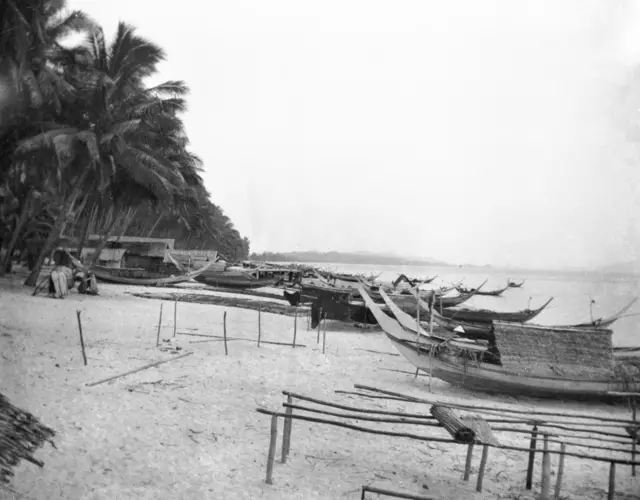
Bachok Beach, Kota Bharu, Malaya. 1941-07. Local fishing boats (perahu) pulled up on the beach, possibly at one of the points where the Japanese invasion troops landed on 1941-12. (Donor E. Cooke-Russell). Copyright expired.

The local villagers’ experience

A group of 30 local villagers came across the Japanese forces during the invasion.

They tried to escape but the Japanese ordered them to dig trenches and stay inside to avoid getting shot in the gunfire exchange.

The locals had to dig the holes in the sand with their hands. Overwhelmed with fear, they stayed in the trench for three days.

When they finally came out from it, they found about 380 dead Japanese soldiers.

The Japanese then cremated their dead comrades.

They stayed in the areas for about two weeks before moving to other locations. The Japanese reportedly did not cause any problems for the locals taking away their livestock.

Only three villagers reportedly died during the attack at Kota Bharu.

The aftermath

As for the British and Japanese troops, there is no official death toll. For the Japanese, they suffered an estimated 300 deaths and 500 wounded. The British casualties and losses were estimated at 68 fatalities, 360 wounded and 37 missing.

Regardless, the attacks on Kota Bharu were one of the most violent battles of the whole Malayan Campaign.

The forgotten Malayan labourers of Burma Railway during WWII

The Burma Railway is infamously known as the Death Railway. It is because thousands of people died building it during World War II (WWII).

The Empire of Japan built it from 1940-1944 to supply troops and weapons in the Burma campaign.

The railway is 415-kilometres long connecting Ban Pong, Thailand and Thanbuzayat, Burma.

It is understood that between 180,000 and 250,000 Allied prisoners of war (POWs) were forced to build the railway.

However, not many remember that there were civilians working along the railway sacrificing their lives along the way.

It is estimated that there must have been more than 180,000 civilian labourers working on the railway.

They were mostly Javanese from Indonesia, Thai, Burmese as well as Chinese, Malay and Tamil from Malaya.

Sometimes referred to as romusha (the Japanese language word for labourer) in writing, they were also known as ‘the coolies’ by the Allied POWs.

The forgotten Malayan labourers of Burma Railway during WWII
Bridge over the River Kwai by Leo Rawlings, a POW who was involved in the line’s construction (sketch dated to 1943). It depicts four POWs, waist-deep in the water, carrying a large log during the first bridge’s construction. Credits: Rawlings, Leo – http://media.iwm.org.uk/iwm/mediaLib//150/media-150071/large.jpg This is photograph Art.IWM ART LD 6035 from the collections of the Imperial War Museums.

The recruitment of Malayan labourers

Speaking of Allied POWs, Australian POW Hugh Clarke described on how these civilian labourers were recruited in his work “A Life For Every Sleeper, A Pictorial Record of the Burma-Thailand Railway.”

He wrote, “The Japanese at the end of 1942 resorted to many ruses to recruit an additional labour pool of over 270,000 civilian labourers. They included Chinese, Burmese, Thais, Indians, Malays and Eurasians. As POWs began moving north the Japanese placed advertisements in Malayan newspapers seeking labourers for work periods of up to three months in Thailand. Free rail travel, housing, food and medical services were offered together with pay at a rate of one dollar a day. The response was negligible so the Japanese resorted to press-gang methods. Free pictures shows were advertised at various theatre around Malaya and when full, the doors were locked and all males in the audiences put abroad trains and railed to Thailand.”

However, could the civilians escape from being recruited? There were reports of locals agreed to become spies for the military police or Kenpeitai in order to avoid being sent to work on Burma Railway.

Dr Robert Hardie’s accounts on Malayan labourers on Burma Railway

Dr Robert was a British medical officer serving with the Federated Malay States Volunteer Force and a plantation manager in Malaya.

After the fall of Singapore, he became one of thousands of POWs forced to work on the railway.

Throughout this period, he managed to keep a diary despite the numerous searches. His diary entries were later published in a book entitled The Burma-Siam Railway: The Secret Diary of Dr Robert Hardie 1942-45.

He was reportedly an admirer of Malay culture.

On Aug 4, 1943, he wrote,

“When one hears of these widespread barbarities, one can only feel that we prisoners of war, in spite of all the deaths and permanent disabilities which result, are being treated with comparative consideration.”

Then on July 6, 1943, Hardie stated,

“A lot of Tamil, Chinese and Malay labourers from Malaya have been brought up forcibly to work on the railway. They were told that they were going to Alor Setar in northern Malaya; that conditions would be good – light work, good food and good quarters. Once on the train, however, they were kept under guard and brought right up to Siam and marched in droves up to the camps on the river. There must be many thousands of these unfortunates all along the railway course. We hear of the frightful casualties from cholera and other diseases among these people and of the brutality with which they are treated by the Japanese. People who have been near the camps speak with bated breath of the state of affairs-corpses rotting unburied in the jungle, almost complete lack of sanitation, frightful stench, overcrowding, swarms of flies. There is no medical attention in these camps, and the wretched natives are of course unable to organise any communal sanitation.”

Again on July 21, 1943, Dr Hardie wrote,

“The conditions in the coolie camps down river are terrible, Basil says. They are kept isolated from Japanese and British camps. They have no latrines. Special British prisoners parties at Kinsaiyok bury about 20 coolies a day. These coolies have been brought from Malaya under false pretence – ‘easy work, good pay, good houses!’ Some have even brought wives and children. Now they find themselves dumped in these charnel houses, driven and brutally knocked about by the Jap and Korean guards, unable to buy extra food, bewildered, sick, frightened. Yet many of them have shown extraordinary kindness to sick British prisoners passing down the river, giving them sugar and helping them into the railway trucks at Tarsao.”

What happened to the Malayan labourers when the war ended?

If you think that the suffering of Malayan labourers would end when the Japanese surrendered and the war finally ended, well, it’s usually not that clean-cut.

According to Anzac Portal, these civilians had no expectation of being rescued by military authorities when the war ended.

In other Japanese-occupied territories romusha were given supplies of food and medical attention by American troops arriving from August-September 1945 on.

Unfortunately, Allied authorities in Thailand and Burma prioritised their own military personnel leaving the romushas including the Malayan forced labourers perhaps last in line for help and supplies.

As for the repatriation of Romusha, it was managed by different authorities. The British Military Administration in Malaya sent missions to Thailand in November 1945 to aid the repatriation of Malayan laborers.

Overall for those who returned alive to their homes, no compensation were given to them. In Malaya, nonetheless, some received some clothing and a small amount of money… but many received nothing.

The unmarked and unknown graves of civilians of Burma-Thai Railway

After the war, the remains of the dead were relocated from former POW camps, burial graves along the railroad to official war cemeteries.

Overall, there were three war cemeteries which are maintained by the Commonwealth War Graves Commission.

According to Paul H. Kratoska in Asian Labor in the Wartime Japanese Empire: Unknown Histories, there are 12,043 Allied soldiers are buried in cemeteries in Kanchanaburi, Thailand. Their gravestones seem to stretch on forever.

He further stated, “However, there are no cemeteries, and no individual gravestones, for the Asian labourers who died building the railway. They were buried if they were fortunate, or else abandoned in the jungle, or thrown into the river or into a common grave. In 1988, the site of a mass grave was found in Kanchanaburi by accident, and the bones of more than 700 bones were excavated. Villagers said it was a burial site used for the Asian railway construction labourers.”

According to Anzac portal, since they were not military personal they were not interred in the Commonwealth War Graves Commission.

Furthermore, the identification of their bodies would be extremely difficult given the lack of records of where they buried.

To this day, there is no official record of how many civilian labourers died building the Burma railway.

Why were the Asian workers of Burma Railway, including the Malayan labourers, forgotten?

According to David Boggett in his paper Notes on the Thai-Burma Railway, while dead men can tell no tales, so the illiterate can write no diaries.

He stated, “Many of the Asian romusha were illiterate; poor, helpless peasants most forcibly conscripted or callously lured by false promises of riches and unaware of their ultimate destinations. While it is a matter of dispute as to whether Japan ever made any efforts to observe the Geneva convention (certainly the experiences of the POWs led them to believe that the Conventions were being deliberately ignored), the records kept of POWs movements for example from Singapore’s Changi prison to Thailand or from Thailand to Japan proper – suggest that at some perhaps higher levels, the intention of Japanese bureaucrats (as opposed to military staff on the ground) was, indeed accurate records of the POWs’ fate as obligated under the conventions.”

Boggett also added, “However, no such Geneva Conventions existed to govern the impressing or treatment of civilian labour; few official attempts were made to record the fate of Asian romusha. This lack of official Japanese documentation, coupled with the absence of almost any written records by the survivors themselves, has allowed the situation of Asian romusha to be minimise or even ignored.”

With no marked graves and no official records of their existence, it is no surprise why the civilian labourers of the Burma Railway including those from Malaya had been forgotten, even if their number could be way higher than of Allied POWs.

Pigs reared in Batu Lintang Camp had better food than the POWs

When Batu Lintang camp was liberated on Sept 11, 1945 by the Australian 9th Division, the camp population was 2,024.

Overall, there were 1,392 prisoners of wars (POWs), 395 were male civilian internees and 237 were civilian women and children.

There were two death orders found among the official Japanese papers at the Japanese-run internment camp. Both papers described how to execute every POW and internee in the camp.

For unknown reasons, the first death order which was scheduled on Aug 17 or 18 was not carried out.

Meanwhile, the second order was scheduled on Sept 15, four days after the camp was liberated.

While Batu Lintang POW Camp was able to escape mass executions, it does not change the fact that hundreds of POWs died there during World War II (WWII).

Pigs reared in Batu Lintang Camp had better food than the POWs
Flying over the prisoner of war camp (POW) in Batu Lintang at a low height, RAAF Beaufighter pilots reported sighting white POWs, clad in khaki shorts, who excitedly waved as the RAAF aircraft flew over to drop leaflets announcing Japan’s surrender. Credits: Public Domain (Copyright expired). https://www.awm.gov.au/collection/C242106

The war crime trials against the Japanese officers of Batu Lintang Camp

Pigs reared in Batu Lintang Camp had better food than the POWs
Th Sydney Morning Report’s headline on Batu Lintang POW Camp trial news.

On Dec 18, 1945, The Sydney Morning Herald reported on the war crime trial held against the Japanese soldiers in-charge of Batu Lintang Camp.

Lieutenant R. Balzer, the prosecuting officer, told the court that between 600 and 700 POWs including Australian officers of the Eight Division, died in Batu Lintang Camp.

The prisoners died due to starvation, brutal assaults, and denial of available medical supplies.

They were suffering from all kinds of diseases such as malaria, beriberi, dysentery, dengue fever, diphtheria, scabies and skin infections.

The four accused were Captain Takeo Nakato and Motoi Tokino and Lieutenants Ojima and Yamamoto.

The news report stated, “Lieutenant Isaki, giving evidence against his own countrymen, said the only meat the prisoners received was pig’s heads. All the prisoners were in bad condition, while the Japanese were in excellent condition. He admitted that 400 Allied prisoners had died of malnutrition in the last 12 months of the war.”

Meanwhile, Colonel W. Lempriere showed the court medical evidence stating that if 2,000 survivors, including 170 Australian officers, had not received medical attention and proper diet, the majority would have died within three months.

One victim had the incredible weight of 3st 4lb (about 20kg) when rescued, and was still in a dreadful condition.

Balzer accused the defendants of ‘unmitigated sadism’ and of making a carefully calculated plot slowly to kill off the prisoners.

Moreover, Balzer claimed that the diet fed to the camp’s pigs was more nutritious than the food given to the prisoners.

In the end, the four officers were found guilty on all charges and sentenced to deaths.

So how bad the was the condition on Batu Lintang Camp?

Fred Bindon was a private in the Australian Army when he was captured in Singapore. He was then sent to Batu Lintang camp.

There, he convinced the Japanese Army officers that he was a cook. He was then allowed to be a cook in the kitchen.

Taking this opportunity, he would steal food and give it to the other prisoners and internees.

His granddaughter, Paula Mcloughlin told the Borneo Post in 2017, “Sometimes he was caught for stealing food. He had some bamboo scars underneath his nails and he said that was very torturous.”

In the meantime, Eric Oliver was another POW imprisoned at Batu Lintang Camp. He was a warrant officer in the United Kingdom’s Royal Air Force (RAF).

He was forced to ditch his plane in the Sunda Strait between Java and Sumatra after being shot up by the Japanese.

Oliver was then captured and imprisoned in Changi Jail before he was sent to Kuching.

According to Lancashire Post, Oliver was on grave digging duty during his imprisonment.

He buried up to ten of his comrades every day towards the end of his incarceration.

Oliver’s misery did not end with the war, he went home suffering from post traumatic stress disorder (PTSD).

Sometimes, he woke up in the middle of the night crying telling his wife, “I keep thinking about the lads who died.”

By June-July 1946, the bodies in the cemetery at Batu Lintang camp had been exhumed. They were then reburied in the Labuan War Cemetery.

Besides the officers, the Australian war crime court also charged 45 guards (mostly Formosan), suspected of ill-treating prisoners at the Batu Lintang camp.

The court acquitted three of the guards and sentenced the remainder to terms of imprisonment ranging from one year to life.

The forgotten All Saints Chapel of Sandakan POW Camp

The forgotten All Saints Chapel of Sandakan POW Camp
The ruins of huts in the prisoner of war camp, Sandakan, North Borneo, October 1945. Those who were too ill for the march were eventually murdered here. Credits: Public Domain (Copyright expired) Courtesy Australian War Memorial: 120457

Do you know there was an Anglican chapel at Sandakan prisoners of war (POW) Camp? The priest, Padre Albert Thompson who founded the church called it ‘All Saints’.

The Sandakan POW camp was infamously known as the starting point of the notorious Sandakan Death Marches.

The last prisoners of the camp was John Skinner who was beheaded on Aug 15, 1945, five hours before the Japanese Emperor announced his country’s unconditional surrender.

Life on the camp was beyond horrible, especially towards the end of the war. The prisoners were subjected to shock and water torture.

Those who committed ‘crimes’ such as stealing food from the camp kitchen were imprisoned in a small cage similar to a dog cage.

They were placed there up to 30 days with little food.

In the midst of the torture and suffering, a number of the prisoners found hope and faith through the camp’s All Saints Chapel.

The description of All Saints Chapel

The forgotten All Saints Chapel of Sandakan POW Camp
Shand’s tribute to Padre Thompson.

The description of the chapel can be found in a letter written by Lieutenant Sergeant H.W. Shand to Gladys Minnie Thompson. She was the wife of Chaplain Thompson.

“Space was at a premium, and all quarters overcrowded in the extreme, so with a few willing helpers, he got to work and dug out an area under one of the huts, which he made into a rather beautiful little chapel.

“The furnishings, ornaments, etc., were made from odd bits of materials scrounged by working parties, and then carved by various fellows in the camp. The cross and altar of wood were very nicely made. Altar hangings consisted of some cloth he had saved and intended one day to have made into a cassock.”

According to Shand, Thompson called the chapel ‘All Saints’ and calling the Sandakan POW Camp his parish.

The servers of All Saints Chapel

Shand wrote, “Although by no means an ardent churchman myself, and of no practical assistance to him, I am proud to say that I became a friend of his. Apart from ordinary church parades and services for regular churchgoers, he began his work by conducting hymn singing sessions, with a short service each Sunday night. Even song usually followed these.”

As for the layman servers of the chapel, Shand stated “Church wardens and a vestry council were appointed, and one man on light duties acted as verger and cared for the chapel. A Church of England Men’s Society was formed, and many new members were regularly admitted.”

As time went by, All Saints Chapel came to be packed for all services, both on Sundays and midweek evening.

This was despite the fact that most of the men had been out all day doing manual labour building Sandakan airstrip.

Padre Thompson’s sacrifice for his parishioners

Writing to Mrs Thompson about her husband’s life at the camp, Shand stated, “You will understand that many of these things were done in the face of opposition by the Japanese at times, and under difficult and disheartening circumstances. His normal and important work of cheering the sick, etc., went on all the time.”

Even though there were times Thompson was not required to do manual work, he would go out with the rest in order to give someone badly needed rest.

While Shand was one of the 150 POWs chosen to Batu Lintang Camp, Kuching in October 1943, Thompson was left behind in Sandakan with the rest which included almost 2,000 prisoners.

The forgotten All Saints Chapel of Sandakan POW Camp
Flying over the prisoner of war camp (POW) in Batu Lintang at a low height, RAAF Beaufighter pilots reported sighting white POWs, clad in khaki shorts, who excitedly waved as the RAAF aircraft flew over to drop leaflets announcing Japan’s surrender. Credits: Public Domain (Copyright expired). https://www.awm.gov.au/collection/C242106

The life of Padre Albert Thompson

The Reverend Albert Henry Thompson was serving in the Australian Army Chaplains Department during World War II (WWII).

He was taken prisoner at Singapore in February 1942. At first, he was sent to Changi Prison as a POW. Then in July that year, he was sent to Sandakan in British North Borneo (Sabah) .

The chaplain was on the second phase of the marches to Ranau, a distance of approximately 260km away through mountainous terrains.

The Japanese decided to move the prisoners as they were anticipating Allied forces landing.

Historian Lynette Silver wrote that his POW column was about two kilometers east of a place called Tampias where Thompson struggling with walking due to a large suppurating ulcer on a foot.

Then, two Japanese officers removed him from the line and ordered him not to go further.

To this day, we might never know whether the Japanese killed him or he was left to die due to his condition.

Record stated that Thompson died on June 19, 1945 at the age of 42.

In his letter which was published on Advocate on Mar 27, 1946, Shand also paid tribute to the late priest.

“Of one thing I am sure – Albert Thompson died as he lived, steadfast in his faith and his church, and setting an example in fellowship and self-sacrifice to those about him.”

As for Thompson’s little chapel the All Saints, it was burned to the ground along with the rest of the camp sometime in May 1945.

The forgotten All Saints Chapel of Sandakan POW Camp
Kundasang War Memorial which was dedicated to those who died during Sandakan Death Marches including Padre Thompson.